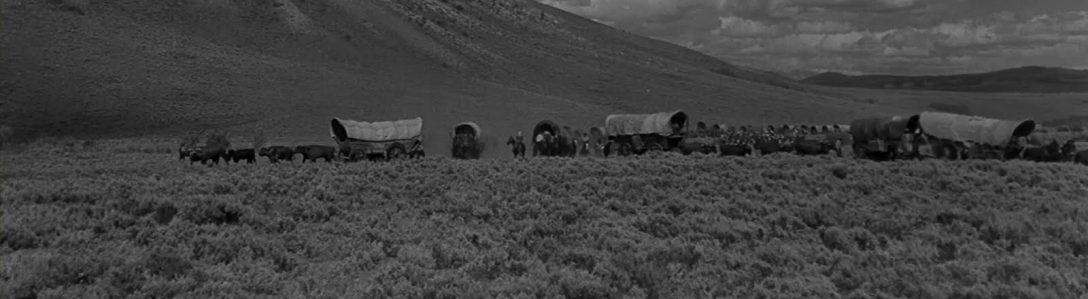
Killing Them Softly: The Executioner (1963)

January 17, 2017

Executioner_1963_V1_

Over the last few months I have been exploring the films of Luis Garcia Berlanga, an acerbic Spaniard who turned Franco-era fascist bureaucracy into grim comedy. In Bienvenido, Mr. Marshall (1953) a poor town dresses up as a romantic Andalusian village to impress impending American visitors, while in Placido (1961) a group of moralizing middle-class businessmen use the homeless as props for a publicity blitz. The grimmest of Berlanga’s works I’ve watched so far, however, is The Executioner (1963) a squirm-inducing death penalty comedy in which murder is just another way to get ahead. Displaying the full range of Berlanga’s gift for caricature, deep-focus joke-building and disgust with the Franco regime, it’s a comedy in which the laughs die in your throat. All three of these works are now streaming on The Criterion Channel of FilmStruck.

In short The Executioner is about an undertaker who marries an executioner’s daughter. The undertaker is José Luis Rodríguez (Nino Manfredi), who works that dead end job while living in a cramped apartment with his brother’s family. Every woman he meets scampers away when they learn about his job. When towing away the corpse of a killer he meets the executioner Amadeo (José Isbert), who, blessed by the state, kills his victims with a garrote. Nearing retirement, Amadeo lives with his daughter Carmen (Emma Penella), who cannot secure a man because they blanch when they hear about her father’s vocation. With no other options on the horizon, José and Carmen get married. But then comes the news that Amadeo’s fancy new state housing will be revoked after his retirement. It can only be secured if José takes on the job of executioner, only José is repulsed and terrified by the proposition. But with a baby on the way and intense familial pressure, José accepts the position anyway, in the hopes that he’ll never have to perform his assigned task. He even takes to breaking up arguments in the street in the hopes of lowering the city’s murder rate. But alas, he is finally called to perform his duty, and despite all his promises to resign, can no longer avoid his fate. It is just easier to get along in this life if you do what the government asks, even if they are asking you to take another’s life. 

Franco’s government recognized the incendiary nature of the film, which was made soon after he had executed three of his political opponents, Communist Party member Julián Grimau and anarchists Francisco Granados Mata and Joaquín Delgado Martínez.. The Spanish ambassador to Italy Alfredo Sanchez Bella, after  seeing it at the Venice Film Festival, wrote a letter to Franco disparaging it as, “one of the greatest libels ever made against Spain, an incredible political pamphlet, not only against the regime but against all society too.” It is rather remarkable that only fifteen minutes were cut by censors, and that it was still released into theaters at all in Spain. Perhaps it was allowed through due to that last phrase, “but against all society too.” Perhaps the censors missed the pointed attack on Franco due to the film’s overall nihilism, in which everyone has their reasons to tacitly endorse murder. Or maybe they just admired its craft.

Executioner_1963_V2_

Despite the brutality of the film’s subject, it can be a very funny movie. This is due to Berlanga’s ability to give every bit part a humorous detail or color, getting jokes out of everyone. There is a an old couple sitting in the background in the park listening to the radio. José and Carmen walk by, and start dancing to the tunes in the foreground. Incensed that José and Carmen are dancing to his music for “free”, he shuts the radio off and stalks away, snapping at them to get their own music. This is a remarkable act of stinginess, to be protective of the sound vibrations emanating inside a public park. How bitter and cantankerous this old duo must be! But they are just another passing character in Berlanga’s parade of short-tempered Spaniards. Another brilliant set piece occurs during José and Carmen’s wedding, a budget affair that uses the scraps from the bourgeois wedding that happened immediately before theirs. So the happy couple walks up a red carpet as it is being rolled up, kneel at an altar as the candles are being snuffed out by an altar boy, and shuffle towards the sole source of light until that, too, is eliminated, and their nuptials are sealed in the dark. It is a brilliant scene of visual gags that cruelly depicts the income inequality that will later force José into his act of violence. The ever-inventive cinematography was shot by the legendary Tonino Delli Colli, a previous collaborator of Sergio Leone (The Good, the Bad, and the Ugly [1966] and Once Upon a Time in the West [1968]) and Pier Paolo Pasolini (The Decameron, 1971).

José Isbert was a beloved character actor, his persona that of a befuddled rustic. To put him in the role of an executioner was already a provocation, and Isbert ported over his usual charms to the role, making Amadeo a charming figure despite the details of his job. Amadeo is relentlessly upbeat, vigorously nostalgic grandpa, even though what he is nostalgic for are the days when those on death row had more respect for his job. He keeps a framed photo of one of his victims on the wall, and unpacks his garotte equipment on the kitchen table, as if he were a handyman rather than a government sanctioned killer. He is, he claims, only doing a job that needs to get done. If it wasn’t him doing the garroting, it would be someone else. So he might as well take the paycheck. This is the attitude of everyone in the film, passing the buck of morality until there is no one left to pick it up. The final holdout is José, not out of bravery but cowardice. He insists that he will resign before executing the condemned man. But, the warden explains to him, with the way the bureaucracy worked it would take at least a week to find a different executioner, putting the condemned through even more mental torture. The shortest, easiest path through that bureaucratic red tape is to kill the man. Sure it would undermine José’s whole moral compass, but the warden has a prison to run, and Franco had his country to govern. Don’t ask questions, but do your job. What does it matter if you lose your soul along the way.
A Poet’s Life: Pyaasa (1957)

Originally published at StreamLine, the official blog of FilmStruck

January 10, 2017

Guru Dutt is a tragic figure in Bollywood history, a tremendously talented actor and filmmaker who committed suicide at the age of 39. He was able to direct eight films before his passing, the most famous of which is Pyaasa (1957), an intensely moving melodrama about a struggling poet, Vijay (played by Dutt). It is a movie about failure, as Vijay’s poems are roundly rejected, while his vagabond lifestyle alienates him from his immediate family. Broke and depressed, Vijay wanders the lower depths of the city and finds the first honest people he’s ever met, they just happen to be prostitutes and hucksters. As proper society would rather he disappear, Vijay pursues his art anyway, to destructive and unpredictable consequences. Filmed with a delirious mobility, the camera is always dollying from long distances into huge closeups, the distance between two unrequited lovers closed by the lens. With sinuous, unforgettable music by S.D. Burman and evocatively nihilistic Urdu poetry by Sahir Ludhianvi, FilmStruck is streaming Pyaasa as part of its “Classic Bollywood” package, and if you are looking to start exploring Bollywood cinema, this is a wise place to begin.

Guru Dutt was trained as a dancer before switching to acting, joining the Prabhat studio in 1944 as an actor, choreographer and assistant director. He would eventually set up his own production company, making everything from adventure films to comedies. He began writing what would become Pyaasa soon after the Partition of India in 1947, which was originally titled “Conflict,” and in which Vijay is a painter, not a poet. The script was finished nearly a decade later by Abrar Alvi, when Dutt had the clout to produce it on his own. It opens with Vijay lounging in a meadow, declaiming verse to the natural world around him, at least until a fellow park goer stalks by and kills a bug. His solitary life of solitude and meditation is constantly getting interrupted by these godforsaken humans. This is the bitter Vijay we meet at the beginning, already a failure, with publishers only accepting his book of poems if they can use it as scrap. When Vijay at least gets an officious publisher to hire him as an assistant, it turns out he is married to Vijay’s first love. Meena (Mala Sinha) is stranded in a loveless marriage with Ghosh (Rehman), an opportunistic owner of a book imprint who might be keeping Vijay around just to make him miserable. During his nightly wanders, Vijay runs into Gulabo (Waheeda Rehman), a prostitute who has been collecting his poetry unbeknownst to him. All of Vijay’s plans collapse – he loses his job, his family, and all of his savings, forcing him to live on the streets. His poetry is starving him, and Vjiay grows ever more bitter, showing up at a school reunion to sing a dark song about failure, which includes the lines: “I confess I have been crushed by life’s sorrows.”  The indignities pile up until Vijay would rather disappear than endure another day as himself.

Dutt was an enigmatic, quiet personality, and something of a perfectionist on the set, reportedly trashing two-to-three reels of footage that were already edited, re-casting some parts, and starting over from scratch. Character actor Mehmood recalled how many reshoots Dutt insisted on, “when he himself was acting, he would shoot take after take. He should be in the Guinness Book of World Records for giving retakes.” This was not just some vanity move, however. Dutt was trying to nail down certain moods for each sequence, and his patience gives the film its melancholic pull. Waheeda Rehman explains the reasons for the retakes: “He would not okay a shot if just one actor got it right, he’d make sure we all performed to his satisfaction. If we didn’t understand something, he would enact the whole scene. Because he understood rhythm and music and he understood the film medium very well, he knew how to get us to act in the right way.”

DP V.K. Murthy, who would execute Dutt’s vision on the set, told Nasreen Munni Kabir (for Guru Dutt: A Life in Cinema) that, “It’s the Indian method of working. We constructed the sets all right, but we conceived the shot on the set.” These are remarkable improvisations which play with different POVs and registers. Waheeda Rehman plays the prostitute Gulabo, who falls for Vijay’s words before doing the same in person. The first time she meets him she is unaware of his identity, but she is still drunk on the power of his poems. So instead she treats him as a john in a bracingly erotic sequence. Rehman follows him through a park, her eyes greedily devouring him in an invitation for her services, the camera following the direction of her gaze at Vijay’s quizzical visage. There are any number of heart-stopping sequences, including a shot inside a nightclub (with a baby crying in the back) where tears run down the camera lens. This is a deeply sad movie with a qualified happy ending, one not originally included. Guru Dutt’s brother Devi recalls: “The end of Pyaasa was changed. He changed the ending because of the way the distributors reacted. They felt the ending was too heavy. The financiers requested, ‘Why don’t you have a happy ending?’ It now has a sort of happier ending.”

That “sort of” is instructive, because Vijay’s character is so profoundly disillusioned in humanity that no ending to that film could feel truly “happy.” Instead, it ends now with something like an exile and identity wipe, anything to escape the grips of the family, friends and community that had driven him to thoughts of suicide. It isn’t explicit, but there is a languorously slow sequence of Vijay walking over a bridge and on to a train depot, both possible sites of self-annihilation. Eventually a train car does bear down on him, to catastrophic consequences. Vijay lives in a reduced state, a martyr to his art, and he departs “to a place from where he shall not need to go any further.”

Pyaasa was a massive success, and one that Dutt could never replicate. He wrote about his creative isolation in an article entitled “Classics and Cash”:  “In the formula-ridden film world of ours one who ventures to go off the beaten track is condemned with the definition which Matthew Arnold used for Shelley: ‘an angel beating wings in a void.’” Dutt would continue to produce and act, but would only direct one more feature. Kaagaz Ke Phool (1959), the first Indian film shot on CinemaScope, was his A Star is Born, a gorgeously doomed tale of an actress’s rise and her director’s fall. It ends with Guru Dutt dead in his director’s chair. He would overdose on sleeping pills five years later.

Potemkin Village Blues: Bienvenido Mr. Marshall! (1952)

Originally published at StreamLine, the official blog of FilmStruck

January 2, 2017

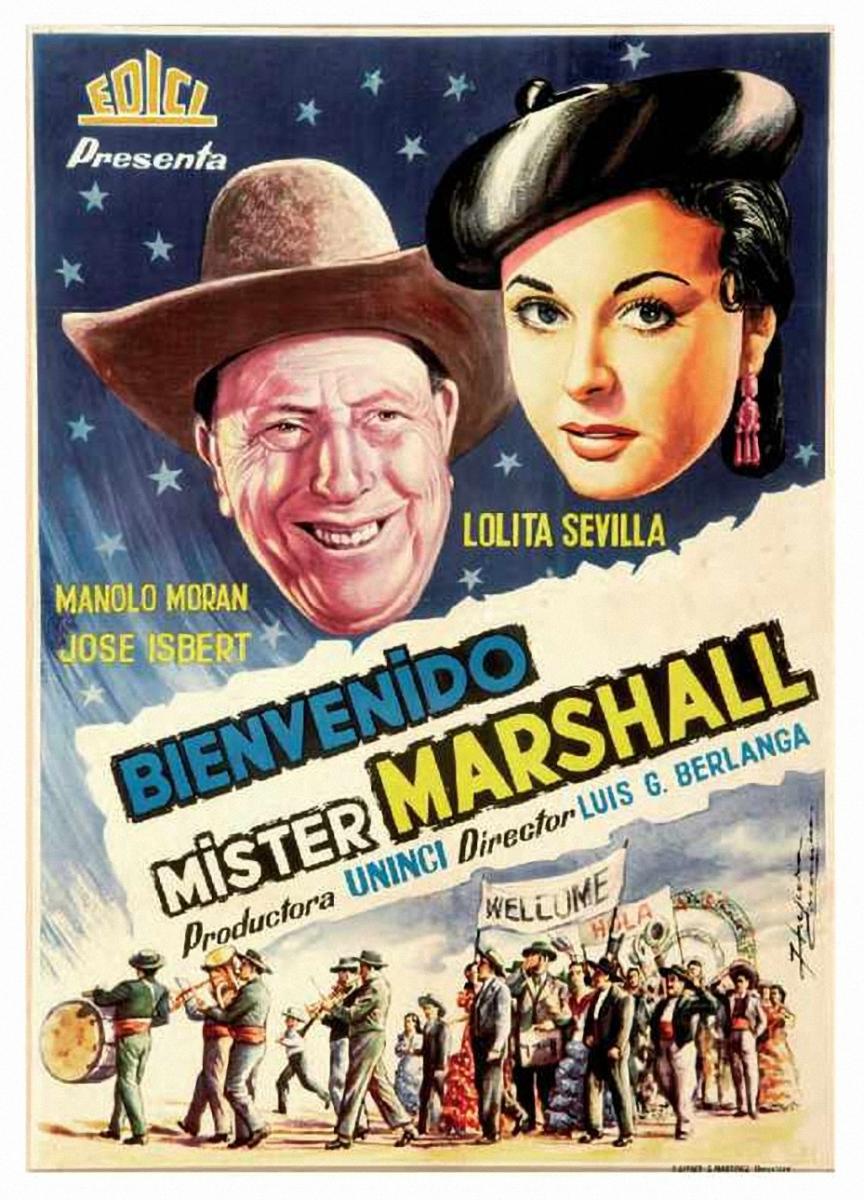
Last week I listed Luis Garcia Berlanga’s Placido (1961) as one of my film discoveries of 2016. A devilishly funny account of Christmastime sanctimony, it was the first film I had seen by Berlanga. Luckily, The Criterion Channel on FilmStruck is streaming four more of his films so I can get further acquainted with this acidic Spaniard. The earliest work on display is Bienvenido Mr. Marshall! (aka Welcome Mr. Marshall!, 1952), Berlanga’s breakout feature, which lovingly satirizes a small Spanish town trying to lure Marshall Plan funds from the U.S. It won the second place International Prize at the Cannes Film Festival, but was famously denounced by jury member Edward G. Robinson as “anti-American.” The film is more anti-Catholic Church and Generalissimo Franco than anything else, however, as the Americans are phantoms wielded as symbols by the local government and clergy – described as both wealthy benefactors and agents of moral decay. What the film lampoons most spectacularly and thoroughly is Franco’s attempt to promote Spain in a single image: an Andalusian Spain that was all flamenco and bullfights. Before the Americans’ arrival, the town hides the drunks, throws up fake facades and wears Andalusian costumes to pretend they are a tourist paradise rather than a poor farming town. As in Placido, Berlanga uses thumbnail caricatures to populate his village, hilarious creations like the half-deaf mayor, a broke colonialist aristocrat and a rotund hustler/producer who turns their town into a Walt Disney-fied version of Spanishness.

Bienvenido Mr. Marshall! was the first film that Berlanga directed on his own. He had previously co-directed That Happy Couple with his writing partner Juan Antonio Bardem (Javier Bardem’s uncle), a bittersweet comedy about a newly married couple trying to make ends meet in Madrid. Bardem was a close friend from film school – they had both graduated from the Institute of Cinematic Investigation and Experience (IIEC) in Madrid. Mr. Marshall was originally intended to be another collaboration, a musical folk comedy set to promote young flamenco singer Lolita Sevilla. But the plot kept shifting during development, the main inspirations being the rural dramas of Emilio Fernandez and Jacques Feyder’s Carnival in Flanders (similarly about a small town changing its colors to accept a rich foreign visitor). Then absurdist playwright Miguel Mihura was brought in to tweak the script, lending it its self-reflexive narration (it opens with an omniscient voice who introduces the villagers by telling the film to stop, zoom in, and move through the town – as if the screenwriter was on the mic). Bardem dropped out due to money disputes with the production company, and Berlanga was set to direct himself.

The film is set in Villar del Río, a poor farming town that is turned upside down when government officials arrive and tell them that U.S. representatives will be visiting on a tour to determine funding for the Marshall Plan. Instead of giving their children some American flags and their women some flowers to lay at the Americans’ feet, theatrical impresario Manolo (Manolo Morán) has a grander plan – turn their city into the Andalusian paradise that exists only in tourism board photos. So the town builds new facades to cover their dingy stone houses, orders bull-fighting costumes on credit, and changes their sleepy cul-de-sac into a romantic music-filled postcard of Franco’s Spain. The idea is enthusiastically embraced by the town’s creaky old mayor Don Pablo (José Isbert), who is desperate to give his town some shine. Isbert has a gravelly Tom Waits voice and uses a prop hearing device like a conductor’s baton. He’s forever crouching in closer to hear another insane suggestion from one of his constituents, making Don Pablo a sympathetic fool. He is the richest of a poor lot, but also sweet and gullible, trying his best and constantly failing to improve Villar del Río’s lot.

So when Manolo rolls into Villa del Rio with this flamenco chanteuse Carmen (Lolita Sevilla, her character cut down significantly from the original concept), it seems like a gift from the heavens. Here is a man who knows how to deal with Americans, or at least other rich people. So the whole town is drafted into a performance they’d prefer not to be involved in. But there are promises of massive donations from the Americans, so they don the insulting outfits with reluctant enthusiasm, and stand in line to tell Don Pablo the one object they’d like to receive from the USA’s largesse. They work day and night for their grand illusion, and the only moment in the film in which everything works as it should is during the rehearsal of the Americans’ arrival. It is a grand pageant of flamenco, Spanish folk music and wide-brimmed hats, a raucous celebration that the whole town rises up for, knowing that they were performing for an audience only of themselves.

That group high lasts into their dreams. For the night before the big U.S.A. day, there are three delirious dream sequences where the villagers live out their violent fantasies of American life. The priest Don Cosme (Luis Pérez de León) has been fearful of the arrival, preaching to his choir that Americans are spiritually delinquent heretics who will despoil their simple hard working town. His dream is a nightmare montage of U.S. culture: he is arrested by hooded KKK members, interrogated in a film noir police station under one bright swinging light and sentenced before a judge of the “Un-American Activities Committee” on an expressionist B&W set. He wakes up as he is about to be hung from a rope (it is probably this sequence that Edward G. Robinson objected to). Don Luis (Alberto Romea), the last of  a long line of aristocratic colonizers, is always complaining how Indians ate his ancestors, and clearly considers all Americans to be equally savage. His dream has him plant his flag on U.S. soil only to be put into a pot to be boiled. Before he is plated for dinner his cats wake him up. Don Pablo had just come out of a Western at the one-screen cinema, so his dream has him engaged in a chaotic shootout at an Old West saloon, dying in a showgirl’s arms.

Villar del Río wakes up the next morning and tries to meet their fantasies of the United States with what they believe the Americans’ fantasy of Spain is – that is, wide-brimmed hats, flamenco in the streets, wild displays of emotion. It is a collision of misunderstandings, if only the U.S. representatives would show up. The film ends in an anticlimax that brutally returns Villar del Río to reality. No longer a political plaything, the town sloughs off Franco’s projected image of Spain, its own visions of America, and gets back to the hard work of being itself.

FILM DISCOVERIES OF 2016

December 27, 2016

TOO LATE FOR TEARS, Dan Duryea, Lizabeth Scott, 1949

As 2016 staggers to a close, I am looking back at the pockets of film pleasure I enjoyed from the year that was. This season is clogged with lists, and here I offer another, though one more suited to the historically minded viewers of TCM and FilmStruck. It is a list of my favorite old movies that I viewed for the first time over the past twelve months. These came from all over – rare MoMA film prints, old Warner Brothers DVDs, and yes, from streaming titles on FilmStruck. It’s an eclectic grouping of arts high and low, from all over the world. I hope it points you in some different cinema directions in 2017, or at least diverts your attention from current events for a few minutes. So prematurely, let me wish you all a Happy New Year, and I hope you’ll continue reading our little blog in the year to come.

The below list is in alphabetical order


Any Which Way You Can (1980), directed by Buddy Van Horn

Raucously entertaining Clint Eastwood-orangutan buddy comedy in which a bare knuckle brawl tears down Jackson Hole, Wyoming. The sequel to Every Which Way But Loose (1978), this one shunts tough guy Philo Beddoe (Eastwood) into a mob-backed big money fight against infamous fighter Jack Wilson (William Smith). Most of the run time is spent on the road, as Eastwood pals around with his yokel brother Orville (Geoffrey Lewis) on a trip to Wyoming. Ruth Gordon is on hand as their combative battle ax mother, tougher than both her kids combined. The real star, of course, is Clyde the orangutan, an expressive primate who loves Philo and despises the cops who try to break up their fun. The chaos builds into a full-on brawling blowout that tears up the Jackson Hole countryside. All that plus a killer title song sung by Ray Charles and Clint himself.


Emperor of the North (1973), directed by Robert Aldrich

In Emperor of the North (1973) the Hobo and the Railroad Man are respective avatars of chaos and order, bloody abstractions who engage in a near-wordless duel to the death on a train rumbling through the Pacific Northwest. They have no back stories or personal motivation, they simply fight because it is in their nature, and the other one is there. Though the film is set in 1933 during the Depression, the story seems to take place outside history on a plane of pure hatred. Director Robert Aldrich expertly channels this hate in an elemental chase film in which stars Ernest Borgnine and Lee Marvin tear out chunks of each other’s flesh to perpetuate their mutually solitary ways of life. It was released last year on Blu-ray from Twilight Time.


Her Man (1930), directed by Tay Garnett

Tay Garnett’s Her Man (1930) has had a small but enduring auteurist cult, for those lucky enough to have seen the Cinematheque Francaise print that circulated in the ’50s and ’60s. In his American Cinema, Andrew Sarris wrote of its “extraordinarily fluid camera movements that dispel the myth of static talkies,” while British critic Raymond Durgnat compared it favorably to Howard Hawks’ A Girl in Every Port (1928). Poet John Ashbery saw it in Paris in the late ’50s, and it was an inspiration for his “Pavane pour Helen Twelvetrees,” which you can read here.  The film has seemingly disappeared from view since then, with David Thomson erroneously stating that it was a “lost film” in his Biographical Dictionary of Film. It wasn’t lost, but just hiding. The camera negative was discovered in the Columbia Pictures collection at the Library of Congress, and a 4K restoration was performed by Sony Pictures, with funding provided by the Film Foundation (I viewed the restoration at MoMA earlier this year). Her Man is a redemptive romance that takes place in one of the scummiest bars in Havana: the Thalia. There Garnett winds his camera through a knockabout group of con artists, drunks and killers to get to his dewy-eyed lovers, who strong-arm their way out the door.


The Heroic Trio (1993), directed by Johnnie To

A deliriously entertaining Hong Kong superhero movie starring the unbeatable trio of Anita Mui, Michelle Yeoh, and Maggie Cheung. I went to see a battered but beautiful print at the Metrograph in NYC, and was whisked away by the elegant wirework fight scenes and breathless plot mechanics that mashes up kung fu/comic book/horror tropes. Anita Mui is Wonder Woman (no relation), intent on breaking the nefarious baby stealing underworld demon king known only as Evil Master. She is reluctantly joined by fast talking mercenary Chat (aka Thief Catcher – Maggie Cheung) and Ching (Michelle Yeoh), who has access to an invisibility robe (it’s a long story). The three actresses slice through the film with grace and aplomb, but Cheung is the acid-tongued standout – introduced flying over the police’s heads on a motorcycle, and then riding a dynamited barrel into a hostage situation. It’s a well-carpentered, ever surprising entertainment that I’d take over any of the Marvel movies thus far.

russo_cleaning.jpg

In Vanda’s Room (2001)

The second film in Pedro Costa’s Fontainhas Trilogy, three remarkable features that depict the everyday life of a slum in Lisbon. Vanda Duarte, who portrayed one of the maids in Ossos, becomes the central character here, playing herself as she and her friends smoke heroin, play cards and gossip. The destruction and relocation of Fontainhas’ residents had already begun, so half the neighborhood is rubble. With the shift to digital Costa experiments in recording in very low light and extremely long takes. He is able to shape hieratic, exalted images with these limited means, turning Vanda and her friends into saints. Whether Vanda is snorting H, hacking up a cough or napping, the waver and hum of the blacks as they buffet her angelic face lend the images a religious intensity. Available to view on the Criterion Channel on FilmStruck.

MEN DON'T LEAVE

Men Don’t Leave (1990)

Paul Brickman took seven years to make his follow-up to Risky Business, and Men Don’t Leave is a finely tuned family melodrama about the loss of a husband and father – and the aftershocks of grief. But it failed to find an audience and swiftly disappeared from view. Brickman has not directed a feature since. Men Don’t Leave, now streaming on FilmStruck, should have been the start of the next phase of his career instead of an abrupt end. It is a film of empathy and grace, led by a thorny performance by Jessica Lange as a widowed, exhausted single mother trying to raise two kids and make ends meet.


My Little Loves (1974), directed by Jean Eustache

Jean Eustache’s My Little Loves (1974) is about a boy. Twelve-year-old Daniel climbs trees, flirts with girls and punches classmates in the stomach. He is poised between youth and adolescence, and the film seeks to capture all the moments, and all the silences, of this befuddling transition. After Eustache’s coruscating The Mother and the Whore (1973), a logorrheic portrait of post-May ’68 despair, My Little Loves seems startlingly quiet and gentle. But each are after a kind of completism, of leaving nothing out. Discussing My Little Loves, Eustache told his fellow filmmaker, and Cahierdu Cinema habitue, Luc Moullet, that he wanted “to reconstruct [my] childhood: every wall section, every tree, every light pole.” With the help of cinematographer Nestor Almendros, All My Loves becomes a sensorial memory object. There isn’t much of a narrative – it drifts – but it builds up the fabric and texture of Eustache’s childhood in the small rural town of Pessac (outside of Bordeaux), and the industrial city of Narbonnes, on the Mediterranean coast.

PLACIDO, Spanish poster art, 1961

Placido (1961), directed by Luis Garcia Berlanga

Placido (1961) takes place over the course of one chaotic Christmas Eve night as a provincial Spanish town desperately tries to prove its Christian charity. It is a ferociously funny black comedy about performative morality, in which the homeless are used as props to stroke the middle classes’ ego. It is directed by Luis Garcia Berlanga (The Executioner) with intricately orchestrated long takes in which a chorus of self-serving characters negotiate the social corridors of Franco’s Spain. With its rhythmic rapid-fire dialogue and cutting use of caricature, it reminded me most of Preston Sturges (and the small town misunderstandings of The Miracle of Morgan’s Creek [1944]). Placido is now streaming on The Criterion Channel of FilmStruck, along with four other Berlanga features.


A Summer’s Tale (1996), directed by Eric Rohmer

Like all of Eric Rohmer’s summer vacation films, it is about hesitation and uncertainty, the holidays a transient borderland before the return to adulthood, when decisions have to be made. A Summer’s Tale involves a moody engineering student and hopeful musician named Gaspard who is romantically entangled with three women on the beach. He is entranced by the idea of love but is rather afraid of the physical reality, and masters the art of the indeterminate reply, a master of escape. One of Rohmer’s few male protagonists (the film often feels like a throwback to the masculine bull sessions of the Moral Tales), Gaspard is reported to be a highly autobiographical character who runs through a composite of events from the director’s life. Rohmer doesn’t look back with nostalgia, but with a lucid gimlet eye, his Gaspard one of high ideals and evasive, indecisive actions. A Summer’s Tale is streaming on Netflix, and is available on DVD from Big World Pictures.

TOO LATE FOR TEARS (1949)

Too Late For Tears (1949), directed by Byron Haskin

After viewing Too Late For Tears (1949), I would advise all couples against accepting cash-stuffed valises of mysterious origin. Sure, it would be nice to be raised up out of your dead-end middle-class marriage, but there is the whole issue of the money’s origin, and the pile-up of bodies that keeping the cash may entail. Too Late For Tears is a vicious little film noir with a flinty, sociopathic performance by Lizabeth Scott, but it had been in public domain purgatory for decades, circulating in muddy transfers under its re-release title Killer Bait. The Film Noir Foundation has lobbied for its restoration for years, and with the help of a Hollywood Foreign Press grant, the UCLA Film and Television Archive was able to reconstruct the film from a 35mm nitrate French dupe negative, a 35mm acetate re-issue print, and a 16mm acetate. The result can be seen in a superb new Blu-ray from Flicker Alley.

BLACK & BLUE CHRISTMAS: PLACIDO (1961)

December 20, 2016

PLACIDO, Spanish poster art, 1961

Placido (1961) takes place over the course of one chaotic Christmas Eve night as a provincial Spanish town desperately tries to prove its Christian charity. It is a ferociously funny black comedy about performative morality, in which the homeless are used as props to stroke the middle classes’ ego. It is directed by Luis Garcia Berlanga (The Executioner) with intricately orchestrated long takes in which a chorus of self-serving characters negotiate the social corridors of Franco’s Spain. With its rhythmic rapid-fire dialogue and cutting use of caricature, it reminded me most of Preston Sturges (and the small town misunderstandings of The Miracle of Morgan’s Creek (1944)). Placido is now streaming on The Criterion Channel of FilmStruck, along with four other Berlanga features.

It is all set in motion by an elaborate publicity stunt engineered by Spanish kitchenware manufacturer Cocinex, who encourage their customers to “Sit a Poor Person at Your Dinner Table.” All the best houses must have a homeless guest of their own if they want to maintain their status. So all the winos in the area are gathered together for a parade in which they have to stand in the freezing cold. They share the parade cars with so-called “movie stars” from Madrid (to be auctioned off as dinner guests for charity) — but they are really bit players and showgirls.

Stuck in the middle of all this madness is Placido (Casto Sendra, aka “Cassen”), a member of the working poor whose family lives in a public lavatory. He makes what little wages he does with his motorized cart, which he is paying down in installments. The first payment is due Christmas Eve night, but he is working the parade – his cart turned into a makeshift float, a shooting star bursting out of its roof. Placido is trying to get paid, chase down the bill collector, and stave off repossession for a month. Cassen was a popular comedian of stage and small screen, and Berlanga plucked him for his first film role in Placido. He is the film’s stubborn interlocutor, a witness to the madness developing around him who just wants to pay his bill and go home. Cassen plays him with a thin patience, on the verge of snapping but holding himself together all the same. His face is still, but his short angry strides are expressive. He knows he will not receive charity, because he is not aesthetically poor, only materially so. He doesn’t have the alcoholic’s red nose, the torn cap, missing teeth. All he has are a family to feed and a dwindling means of support.

His employer is Gabino Quintanilla (José Luis López Vázquez), a neurasthenic parade organizer who is tasked with solving endless operational problems, from a missing beauty queen to dinner guest heart attacks. He is a curiously opaque character, for while his role is functionary, oiling the rails for Cocinex’s exploitative sideshow, Gabino does his best to get Placido his money. Though it is admittedly not #1 on his list of priorities. Those would be pleasing his own bosses, getting rid of his sinusitis and corralling his fiancée, who has developed a crush on one of the movie stars. Vázquez is a marvel, his performance orchestrating Gabino’s nervous tics into anxious art.

These two are surrounded by legions of caricatured types who pass through quickly but leave evocative traces: a blustery old actor with delusions of fame, a pompadoured radio host who lies with panache and a cadaverous notary who is at a loss of what to do with his drunken dinner guest wino who just wants to sing folk songs. As class lines are crossed the movie ratchets up the chaos – soon Placido’s bill collector chase becomes wrapped up in a deathbed wedding of questionable legality, leading to his festive parade cart being used as a hearse. In the end everyone is back where they started, with Placido having to scheme a day-to-day living, Gabino alone and likely to remain that way and the rest of the proper homes in town cleansed of the poor’s presence so the self-congratulation can begin. The film is a tour-de-force of inertia.

Placido was censored by Franco’s government, but the version that exists still stings, and was nominated for a Best Foreign Film Academy Award. Berlanga was hard to place politically – he fought against Franco towards the end of the civil war, but in order to curry favor to save his father’s life, he volunteered for Franco’s División Azul, which went to fight in Russia on the side of the Germans. These experiences made him suspicious about everyone – he is something of a cynical realist. After Franco tried to suppress screenings of The Executioner (1963) he was reported to have said, “Berlanga is not a Communist, he is worse than a Communist, he is a bad Spaniard.” Placido shows the bad Spaniard at his most incorrigible, depicting his country as an amoral carnival where presentation trumps reality. As Berlanga described his work: “My films are about failure. They’re about individuals who see a chance to get out of the mess they’re in and set out to grab that chance, but they always fail, because it was an illusion anyway.”

GETTING PHYSICAL: ATHINA RACHEL TSANGARI

December 13, 2016

SlowBusinessofGoing_going_2001_10_GalleryBig

In the first shot of her first film, Athina Rachel Tsangari depicts a close up of a warring kiss, two tongues battling for position. This image from Fit, her 1994 short film, is one not of love or lust but of utility, the tongue turned into a tool. Throughout her career Tsangari has made a skill out of this kind of estrangement, re-contextualizing how bodies are used in cinema, whether it’s the dystopian sci-fi of The Slow Business of Going (2001), which turns youthful wanderlust into a downloadable commodity, or Attenberg (2010), which poses female friendship as a ritualized comedy of animalistic posing. Tsangari is a cinephile whose education took her to New York, Austin, and her homeland of Greece. FilmStruck is now streaming Tsangari’s entire output to date on The Criterion Channel, including three short films and her latest feature, Chevalier (2015), which pushes male upmanship to its natural, hilarious conclusion.

Tsangari came to the United States intending to study drama at NYU, but instead ended up at the University of Texas at Austin, where she befriended Richard Linklater, netting a bit part in Slacker. She became a central hub of Austin’s film community, founding and programming the Cinematexas International Short Film Festival while working towards a degree in filmmaking at U of T. While a teacher’s assistant, she taught the likes of Jay Duplass. It was while at school that she started production on The Slow Business of Going, which would become her thesis film. A madcap amalgam of spy movie, Chris Marker-style essay film, and slapstick comedy, it took four years to make, as Tsangari shot it piecemeal, only as money became available.

SlowBusinessofGoing_going_2001going_7_GalleryBig

It follows Global Nomad Project (GNP) employee Petra Going (Lizzie Martinez) as she hopscotches across the globe with her rocking chair and record player. Her job is create memories that the GNP can offload and sell back to their customers, who can live the globe-trotting life they so desired. But what sounds like an adventurous gig is mostly spent inside faceless skyscrapers as Petra briefly befriends fellow rootless travelers like herself. The film is as patchwork and DIY as its protagonist, which is both maddening and appropriate – the film is schizophrenic in tone, jumping from lonesome melancholy to a kind of manic jubilation in successive sequences. As a student film, Tsangari is experimenting with different forms, using multiple formats, superimpositions and wild bursts of animation. Though an untamed work, it shows Tsangari’s interest in bodies as performance – as Petra has to turn her life into an act. She is generating memories for purchase, so everything she does, down to taking the hotel elevator, is mediated and posed for an imagined audience.

After The Slow Business of Going Tsangari took a nine-year break from directing, which she filled by continuing to operate the Cinematexas Short Film Festival, which ran through 2007, and producing the work of her friends, including Yorgos Lanthimos (Dogtooth, Lobster). She returned to directing in 2010 with Attenberg, a strange, deeply affecting comedy about grief. Marina (Ariane Labed) is a young do-nothing forced into adulthood when she has to care for her father Spyros (Vangelis Mourikis) after he is diagnosed with terminal cancer. The title of the film comes from a mispronunciation of the name of her favorite TV personality, David Attenborough. She watches Attenborough’s nature documentaries with her dad, seeing in them a baser, simpler way of living. Ariane and her best friend Bella (Evangelia Randou) test each other’s physical limitations. Like in Fitthe first shot is of a wet tongue kiss, ostensibly for Bella to teach the inexperienced Ariane how it’s done. But the kiss is as awkward as that on an exaggerated SNL sketch – and in fact Kate McKinnon would be impressed with the physical comedy on display. Aside from the smooching, Bella and Ariane engage in games of silly animalistic walks that they must perform in unison, with plenty of hooting, and rhythmic leg smacking. It is a way for Ariane to reaffirm her physical being while her father wastes away.

ATTENBERG_8_GalleryBig

Chevalier was released this year in the U.S., though played most of the world in 2015. A comedy of male insecurity, it places a group of men on a yacht during a weekend getaway. Natural competition emerges between the group, but instead of keeping it to poker they turn their whole lives into a game. They decide to grade each other on everything they do in their lives, and each man is also tasked with inventing a new competition for them to compete in. They are graded on everything for how their wives speak to them on the phone to the amount of morning wood they have after a night’s sleep. It gets more and more out of control until they are speed building Ikea bookcases and entering blood pacts with guys who were previously casual business acquaintances. The bemused staff starts betting on the winners, and are ultimately not immune to the lure of competition. The film is basically a series of brilliantly clever sketches that play with notions of self-esteem. No matter how successful these men are in the outside world, there is always a kernel of doubt, that voice that says you are a failure, a fake. Chevalier weaponizes that voice and aims it at a group of middle-aged strivers, reducing them to their worst impulses.

Chevalier_2016_IMG_8226_GalleryBig

Tsangari has shifted her style from the patchwork experiments of  The Slow Business of Going to more handheld intimacy on Attenberg and ChevalierShe is getting closer to her characters as they deal with different varieties of death and self-destruction. Her peculiar comedies of humiliation are something like arthouse Farrelly Brothers, channeling the darker elements of our nature through disfigurements of the body. The next film she is developing, White Knuckles, is described as a “screwball action thriller” to star Labed from Attenberg. If my strained comparison holds up, I’m hoping it’s her Me, Myself, and Irene. But if it’s like her other work it will probably be something strange and new.

ON THE ROAD AGAIN: A POEM IS A NAKED PERSON (1974)

December 6, 2016

LeonR_Short_Textless_R1_0128471.tif

On November 14th Leon Russell passed away at the age of 74, after a remarkable career in music. He started as a sought-after studio session ace, working on everything from the Beach Boys and Frank Sinatra to the “Monster Mash.” Drawn to roots music of all kinds, when he started his rock band it played an ecstatic blend of country-blues-R&B (known as the “Tulsa Sound”) that became one of the top touring acts of the 1970s. In 1972 Les Blank started filming a documentary, A Poem is a Naked Person, that would follow one of Russell’s tours as well as the recording process of what would become the album Hank Wilson’s Back. It was shot over two years, and has the vibrancy and surprise of Blank’s improvisatory style. He captures anything, whether it’s an intense studio session or a random girl singing a Three Dog Night tune before a wedding. A Poem Was a Naked Person was not a traditional concert doc, so due to creative differences and contractual snags, it did not see the light of the projector for decades. But it was finally released by Janus Films in 2015, and is now available to stream on FilmStruck.

““It looks more like a travelogue than a Leon movie”, is what Leon Russell told Rolling Stone’s Eric Hynes in 2015, right before A Poem is a Naked Person was released into theaters. It was the reason he refused to sign off on its release in the first place. Russell first became a star after he appeared in the concert film of Joe Cocker’s tour, Mad Dogs and Englishmen, on which Russell arranged Cocker’s backing band of the same name. With his mane of gray hair and top hat, and the moniker “The Master of Space and Time,” he cut quite a counterculture figure, and the Poem was expected to be another extension of that. Instead he got a film that pauses to take in the world around him.

PoemisaNakedPerson_1974_805_image_01

In 1979 Les Blank described his approach to filming people: “I’ve seen a lot of cameramen go in and treat the subjects like so many guinea pigs. I think the people pick up on my very protective feelings toward them, and they aren’t self-conscious about what they do or say, and they try to show the inner light about themselves that I find so attractive.” His films contain exuberant portraits of musicians, cooks, artists and other proponents of the good life, including blues legend Lightnin’ Hopkins (The Blues According To… [1970]), guitarist Mance Lipscomb (A Well Spent Life [1972]), and filmmaker Werner Herzog (Burden of Dreams [1982]), all of which are available on The Criterion Channel of FilmStruck. He finds the inner light in each, just by letting them alone. He focuses so much on other distractions – friends, family, picnic tables, the sky – that people get comfortable and open up. He often lived with them for weeks before and during filming.

That intimacy did not exist between Blank and Russell. Russell told Hynes, “He was good at what he did…he was just kind of a jerk sometimes. But I guess I was kind of a jerk too.” That distance might be the secret gift of the film, as it gives Blank even freer reign to veer from his subject. Neither wanted to be near the other, so Blank decided to go off and explore. So we get gracious details like two of Russell’s Oklahoma neighbors, an old couple enjoying the celebrity in their midst. The woman is enamored with Russell’s long hair, and encourages her husband to keep it growing. The love just beams out of them. Then there are long segments of artist Jim Mitchell, one painting Russell’s pool floor into a kaleidoscopic aquarium of octopi, and another in which he feeds a chick to his pet snake, an image which Blank returns to throughout the film and seems to shapeshift meanings – first as a blunt image of capitalism, and by the end, as Kent Jones notes in his Criterion essay, “about the snake as a model consumer, eating only when it’s famished, and about consumption itself as a basic fact of human existence.”

Jim Franklin Swimming Pool Photo Les Blank 90008.jpg

Leon Russell seems exhausted throughout, coasting on the high of his ride to fame, one which he would retreat from in the final decades of his life. He is something of a structuring absence in the movie, the reason the film exists but missing for large stretches, or at least a recessive presence, listening attentively in a corner. The musical highlight for me is a performance by George Jones. Jones stops by the recording studio drinking a Budweiser and smoking a cigarette, and casually sings a gorgeously weary version of “Take Me.” This is contrasted with the nervous, enigmatic, and effortful Russell, a reluctant showman and awkward carnival barker. The top hat became his trademark, and would hang on a hook above the stage until the close of one of the shows. The atmosphere feels like that of a revival tent, with Blank fixing his camera on fans dancing with ecstatic intensity, giving themselves over to the music.

LeonR_Short_Textless_R1_0128972.tif

It’s understandable why Russell was disappointed with the film – he phrased it as, “I got into the movie and wanted to be like James Dean and I ended up being like Jimmy Dean.” Thankfully he was able to look back on it with humor, and allow Les Blank’s son Harrod to shepherd A Poem is a Naked Person back into the world. For in the end it is not a film about Leon Russell, but about the power and exhaustion of creating, whether it’s onstage in front of thousands, or in front of a camera for an audience of one.

ORNETTE: MADE IN AMERICA (1985)

November 29, 2016

PERSONALITIES

Ornette Coleman’s symphony “Skies of America” was conceived in 1965, recorded in 1972, and performed intermittently in the ensuing decades. It was something of a grand introduction to Coleman’s “harmolodic” compositional method, the term a portmanteau of harmony, motion and melody, and required a full orchestra alongside Coleman’s working jazz quartet. Due to budget limitations the recording eliminated the quartet (Coleman played solo) and cut out a third of the symphony, due to the length limitations of vinyl. Coleman sought to realize the original vision of the piece over the ensuing decades. Shirley Clarke’s hyperkinetic documentary Ornette: Made in America (1985), is an attempt to track the artistic evolution of the project from the sixties into the eighties, using a performance of “Skies of America” in Coleman’s hometown of Fort Worth, Texas as the fulcrum. Available to view on FilmStruck, or on DVD and Blu-ray from Milestone Films, it eschews historical context for the immediacy of performance, making it more of a piece for fans rather than newcomers to Coleman’s work. But it is a rare peek into Coleman’s artistic process – which means it is a glimpse into the mind of one of the greatest and most influential artists of the twentieth century.

PERSONALITIES

Ornette: Made in America was the last completed film by Shirley Clarke, brilliant iconoclast in her own right. She was a choreographer-turned independent filmmaker with an eye for self-destructive showmen, as seen in her narrative debut of heroin-addicted jazzmen, The Connection (1961). She is not able to dig very far under Coleman’s notoriously sphinx-like personality. Prone to speaking in aphorisms and reluctant to speak about his personal life, instead he talks about Buckminster Fuller and his desire to be castrated. A shy man who speaks with a soft-spoken lisp, Coleman radiates a calm mystery that is transfixing whenever he speaks on screen. One wishes for a long fixed camera interview with Coleman, but it’s unlikely he would have ever submitted to such a self-revealing interrogation (as Clarke was able to do with hustler Jason Holliday in Portrait of Jason [1967]). Instead we get a mosaic approach, with Clarke editing to the tempo of the music, in rapid-fire montage that flickers from performances, Buckminster Fuller architecture, and historical re-enactments. It is an attempt to match the film’s style with Coleman’s music, which I found both instructive and irritating. In a concert inside of one of Fuller’s geodesic domes, Clarke matches the angular construction to that of the music, her edits keeping time with the composition. It works less well during interviews, when Coleman’s oracular statements, which are already hard to parse, are cut to shreds in the editing bay.

This was her intent all along, as she told the Los Angeles Times: “‘I wasn’t trying to make a ‘documentary’ of Ornette Coleman,’ said director Shirley Clarke in her room at the Chateau Marmont. ‘I hope nobody goes to this film expecting a record of Ornette’s musical life because that’s not what it is. We wanted people to come away feeling a certain way about somebody and knowing a little bit about his music and its relation to him. Ornette is not violently well known (outside the jazz world) and that had something to do with my choosing to make a film that could appeal to people who just want to see this kind of filmmaking and don’t have to know it’s about Ornette.’”

PERSONALITIES

The project originated in the late sixties, when Clarke began shooting a documentary about Coleman’s decision to use his 11-year-old son Denardo as the drummer in his trio with bassist Charlie Haden. It fell apart in 1969, “when the producer disliked a partially completed version of the film. Clarke engineered her firing from the project to avoid being liable for $40,000 in expenses and the footage spent the next dozen years gathering dust under people’s beds.” In 1983 the Caravan of Dreams Performing Arts Center in Fort Worth booked Coleman’s first hometown performance in 25 years – which also happened to be his latest iteration of “Skies of America,” performed with the Fort Worth symphony (conducted by John Giordano) and his current band, Prime Time.  Largely ignored by Fort Worth previously, now he was to receive a key to the city and other celebrations for a local boy done good. When producer Kathelin Hoffman suggested a documentary be made about the event, Coleman suggested that Clarke direct it.

PERSONALITIES

Clarke dug up all the old film from the abandoned sixties project, and incorporated it into the new footage to create a mini-arc of Coleman’s career, at least since his working relationship with his son Denardo, who he felt had a direct connection to the music – a path uncluttered by education, rather similar to how Bresson used untrained “models” as his actors. Denardo is not pressed on how performing at such a young age affected him, though he clearly adores and cares for his father. This comes through when Denardo discusses his father’s performance space and community center in NYC’s lower east side, on Rivington St. Ornette Coleman bought an abandoned schoolhouse with a vision of turning it into a cultural center – but he kept getting mugged and eventually had his lung punctured during one horrific beating. Denardo fears for his safety as he continues to practice and create in the dangerous crack-infested locale (now one of the most expensive neighborhoods in the city). The role of Denardo in Coleman’s band is a fascinating one – from the glimpses we get he is the loving, earthbound anchor to Ornette’s spiritual, ghostly presence. But we only get a brief peek behind the curtain – as the music is the thing. And “Skies of America” is an imposingly complicated construction. Orchestral waves buffet the squall of Prime Time’s improvisations, which both cut against and flow with the symphony’s tide. Before a 1997 performance of the piece, Ben Ratliff described the symphony’s origins for the New York Times:

“It was so cold,” [Coleman] said of that time in Montana. ”It must have been 2 or 3 below zero, and when I saw the American Indians praying, doing their purity ritual, they looked like their bodies were transparent. All of a sudden, I saw the American Indian and the sky as the same people. It taught me something about religion, race, wealth, poverty, commerce. I said: ‘Oh, I’m going to go over to the other side. I only want to be on the side of the consciousness that comes to people naturally.”’

What he came up with was a gargantuan metaphor: just as every person sees the sky his own way, every musician produces a note in his own voice. But the sky, and the notes, are always there, unchanging: the sky has seen war and famine; the notes have seen Gregorian chant and jazz. The intended result was that in ”Skies of America,” the thick bed of the orchestra, with its deep blend of colors in great parallel melodies, would be the sky, and the improvising soloists the Americans.

Clarke doesn’t bother trying to explicate the enormity of Ornette Coleman’s musical project, but instead lets it represent itself. Coleman is a man and a personality who lets the music speak for him, so Clarke does the same in Ornette: Made in America. She lets the symphony play, and it is up to us to listen.

FAMILY TIES: MEN DON’T LEAVE (1990)

November 22, 2016

MEN DON'T LEAVE

“I squandered a really good career. What can I say?” – Paul Brickman to Salon

After the phenomenal success of Risky Business (1983), writer-director Paul Brickman was offered hundreds of screenplays to adapt. Brickman rejected them all, including future hits Rain Man and Forrest Gump. Frustrated with the Geffen Film Company’s imposed happy ending on Risky Business, he instead bided his time until Men Don’t Leave (1990) crossed his desk seven years later. A finely tuned family melodrama about the loss of a husband and father – and the aftershocks of grief – it failed to find an audience and swiftly disappeared from view. Brickman has not directed a feature since. Men Don’t Leave, now streaming on FilmStruck, should have been the start of the next phase of his career instead of an abrupt end. It is a film of empathy and grace, led by a thorny performance by Jessica Lange as a widowed, exhausted single mother trying to raise two kids and make ends meet.

The project originated with the obscure French tearjerker La Vie Continue (1981), which screenwriter Barbara Benedek (The Big Chill) adapted into an English-language screenplay. Brickman told Randy Lofficier at the WGA that, “I don’t believe Men Don’t Leave was truly a remake. It evolved into something far removed from the original. Initially I was presented with a script by Barbara Benedek. While I could have had access to the original material, I chose to avoid it, so as not to be influenced by it. I wanted to stay true to Barbara’s voice. I did not see the original film until well after the script was completed.” The finished script, credited to both Brickman and Benedek, is an anatomy of repressed melancholy.

MEN DON'T LEAVE

The Macauley family suffers a traumatic blow when father John (Tom Mason) dies in a tragic construction accident. Drowning in debt from their unfinished kitchen remodel, mother Beth (Jessica Lange) forces her kids Chris (Chris O’Donnell) and Matt (Charlie Korsmo) to move from the suburbs and into Baltimore, so she can take on a string of demeaning service jobs. Each family member avoids the mourning process in their own way. The teenaged Chris becomes infatuated with a nurse (Joan Cusack) in their building, while the tween Matt spends his afternoons robbing VCRs and selling them to a bootleg porn dubber (Kevin Corrigan). Beth has no time to grieve, and cultivates her hopes of happiness around Charles Simon (Arliss Howard), an experimental musician who flirts his way into her life.

The early sequences establish the Macauleys’ easy rapport but also Beth’s inadvertent isolation. John is a construction foreman idolized by his sons. John soaks up this love so unthinkingly that he often cuts Beth out of the loop. On a random weekday he takes the kids to a worksite, but without telling Beth he takes them to a movie after. Brickman and his editor Richard Chew (returning from Risky Business) cuts from the clamor and excitement of John’s job, with Matt playing in an excavator, to an image of Beth alone leaning on the kitchen island, waiting for dinner to finish. There is no sound except for some ambient crickets. It is an image that passes quickly but one that lingers – even in this supposed domestic bliss Beth is being sidelined, taken for granted.

As in Risky Business, Brickman makes use of expressive POV shots, though instead of dreamlike fantasies, they are haunting memories that Beth cannot shake. In the unreal aftermath of John’s death (which is not shown), Beth has to navigate a labyrinthine hospital, taking a wrong turn and ending up in the kitchen, where the staff is slicing up fish. This image will return to Beth throughout the film, an uncanny moment of estrangement from the world that Beth takes the entire movie to recover from. Discussing his work on Risky Business with the Editors Guild, Richard Chew paraphrases Buñuel : “Fantasy and reality are equally personal and equally felt, so their confusion is a matter of only relative importance.” The use of the hospital sequence in Men Don’t Leave serves a similar purpose as those in Risky Business, that is, to enter more deeply into the protagonists’ headspace.

From this point on, Beth battles depression, and fully succumbs after she loses her job at a gourmet food store managed by a short-haired Kathy Bates. The world seems to have collapsed around her, so she refuses to leave her bed for weeks, the apartment getting buried in filth. Chris spends most of his time with the nurse – a fascinating character deftly played by Joan Cusack. She is an eccentric loner who at first seems to be exploiting Chris’ youth, getting a thrill out of a younger guy, but she reveals complicating facets as the film unspools – including a boundless sympathy for Beth’s debilitating depression.

MEN DON'T LEAVE

Meanwhile Matt has been hanging with his suburban buddy ripping off middle-class homes of their home entertainment gear, and is welcomed as another son into his friend’s family. This subplot is highlighted by a pudgy, preposterously young Kevin Corrigan as a sleazy porn dubber and fence, his bedroom festooned with a bank of CRT TVs. The Macauley family unit is fracturing and about to splinter entirely. As Dave Kehr, one of Brickman’s most eloquent supporters, put it in his Chicago Tribune review of Men Don’t Leave, it is a “subtly subversive film, suggesting that America’s most sacred and apparently solid institution, the nuclear family, is in reality as fragile as a spider’s web, collapsing into confusion with the slightest brush of fate.”

MEN DON'T LEAVE

Eventually, Matt can no longer repress his emotions and runs away from home, back to the playhouse in his old backyard, the one his dad built for him. When Beth and Chris finally find him, they all mutually, and silently, accept their need to grieve. It is a powerfully moving sequence that reduced this new dad to a blubbering mess. Jessica Lange, who invested Beth with mutating contradictions – she is an optimistic depressive, a fragile ditz with indomitable determination – can put on a good face no longer. It is a scene of immense sadness in which they accept the void of their loss.

Men Don’t Leave was also funded by the Geffen Film Company, and like Risky Business, ends on an optimistic note. I am curious to know if Brickman wanted the film to end in the playhouse, or carry on to the literally sunny conclusion, which re-unites the Macauley friends and family in a blissful summer frolic. Whatever the truth of the production history, it doesn’t detract from the movie’s accomplishment. It is a brutal, cathartic and brilliantly acted melodrama that more than proves that Risky Business was no fluke. But this is not a story of failure, but one of admirable integrity – and of two remarkable films. I’ll end with words from Brickman’s editor Richard Chew: “I’m still friends with Paul. I wish he would have made more films, but at the end of the day, he wasn’t comfortable with the compromises necessary in Hollywood. He’s his own man. That’s why I love him.”

DIRTY POOL: LA CIENAGA (2001)

November 15, 2016

CIENEGA, LA (2001)

La Cienaga (2001) translates as “The Swamp”, and it is a fetid, decaying film—its forests overgrown and its characters unwashed. For her feature debut, Lucrecia Martel depicts the dissolution of a middle-class Argentine family through sound and set design. To escape the humid city during the summer, they retreat to their country home, a rotting edifice with a filthy leaf-choked pool. With nothing to do, the adults check out on iced red wine while the children tote rifles through an overgrown forest literally shooting their eyes out. The soundtrack is thick with clinking ice, chairs dragging on cement and distant thunder. Martel emphasizes the moments and sounds in-between actions since her characters have very little interest in performing any actions themselves. Instead, they sit, drink and complain. La Cienaga is a blackly funny portrayal of middle-class self-absorption—of a people so wrapped up in themselves they cannot see that their clothes are dirty, the walls are peeling and the pool is a bacterial broth. It is now streaming on FilmStruck and available on DVD and Blu-ray from Criterion.

CIENEGA, LA (2001)

Martel based the characters in La Ciénaga on the people she knew growing up in the Northern Argentinian city of Salta. She told Haden Guest of BOMB Magazine that “All the stories in La Ciénaga—in all my movies, really—are things that I’ve heard. There are people in my family, in fact, who are very similar to the characters. A great aunt of mine went to see it and when she was leaving she said to her husband, “Gregorio is just like you!” I had made that character thinking of him!” The film does not have a central character, but expands as a series of digressions at “La Mandragora” the country house of Mecha (Graciela Borges) and Gregorio (Martin Adjemian). Both are semi-functional alcoholics who stumble around the environs in a zombie-like daze. In the surreal opening sequence, a drunk Mecha stumbles by the pool and impales herself on a broken tumbler glass. Despite her bleeding out, Gregorio is more concerned with getting another drink, and Mecha that her maid is stealing their sheets. Their children pay them no mind instead turning the grounds into their anything-goes playground. The youngest children roam the knotty, brambly forest like violent colonists shooting at treed dogs and occasionally misfiring on one of their own. Luciano (Sebastian Montagna) loses an eye while the rest get covered in horrendous scratches.

CIENEGA, LA (2001)

The older children have their own separate adventures—each age group seems to inhabit different solar systems despite living down the hall. Teenager Momi (Sofia Bertolloto), who refuses to wash her hair, has a crush on the young maid Isabel (Andrea Lopez). Isabel is the only character who seems to have a life as she sneaks off to meet her boyfriend Perro (Fabio Villafane), going to parties in town. She is actually integrated into a society larger than the layout of La Mandragora. In a pivotal sequence, the oldest son, Jose (Juan Cruz Bordeu), goes to the same outdoor dance as Isabel and aggressively hits on her. This is an unforgivable invasion of privacy, not only of her personal space, but of the town’s. Jose treats the party as he would Mandragora, as if he owned it. In reprisal, Perro breaks Jose’s nose. An irreparable class border is crossed here, which means only trouble for those on the lower end of the scale.

The movie tries to ape the vibe of a large family living in a small space where one story ends by a sibling barging in and tipping the tale in another direction. Martel described her approach to structure to Haden Guest: “The narrative lines occur in different layers but within the same scene. You can have this character in the foreground, but over here there’s something else going on—an argument between my mom and one of my brothers, for example. In the next scene, that person, who has some problem in school, let’s say, is talking on the phone and maybe my mom is also off-screen. And then here’s another person complaining to my mom, who’s also off-screen. So the themes are superimposed on each other in “layers.” The characters’ movements and the themes get closer and farther away from the camera. The important thing is to define where I’m going to place the focus in order to give one of the layers a place of importance and weave the other things in and out.”

La Cienaga is a powerfully sensorial movie. It almost has a stink to it. Jose is always shirtless and covered in grime, while Momi is perpetually teased for never washing her hair. The summer is a humid one, and Mecha never seems to change out of her nightgown which adheres to her like a mildewed second skin. Gregorio is notable mainly for his hair dye, which has started to stain all of the sheets. Everyone is molting or shedding or disfigured in some way. Mecha’s chest wounds never really heal, Jose’s nose becomes a black-and-blue grotesquerie, while the younger childrens’ faces look like they’ve engaged in nightly knife fights. It is a darkly funny illustration of the family’s dissolution. They are being composted back into the earth.

CIENEGA, LA (2001)

All of these expanding and contracting stories in the film hide a secret one— a fable-like horror story of an “African Rat” that scares the children early on. A tale of shape-shifting, in which a domestic pet turns out to be a monster that turns on its owners, it takes on totemic meaning by the end of the film. The rat could stand in for the Spanish colonizers or the apathetic middle-class represented by Mecha and Gregorio, a disease devouring its host from within. It is a story that mesmerizes and haunts the children of the film— leading to a scene of abrupt and terrifying violence. Though hidden in the movies’ layered structure in which no character is followed for too long, a little boy fears that the Rat is barking beyond the stucco wall of his tiny backyard plot. This child, a friend of the family of the rotting Mandragora clan, still retains his innocence enough to believe in scary stories. But the Mandragora clan has no belief left in them. The last shot is a repeat of the first, but instead of the parents lazing about the pool it is the children, set to relive the emptied out lives of their parents.