TAIPEI STORY: A BRIGHTER SUMMER DAY (1991)

March 22, 2016

810xl8VIOrL._SL1500_

“This film is dedicated to my father and his generation, who suffered so much for my generation to suffer less. I hope they, the forgotten, can be made unforgettable.” – Edward Yangdirector’s note for A Brighter Summer Day

A Brighter Summer Day is an empathic epic of Taipei in the early 1960s. Four hours long, it is a finely detailed portrait of the families who fled China for Taiwan after the Communist Revolution, unsure if they would ever see their homeland again. It is how Edward Yang grew up, and he felt a responsibility to honor the memory of his friends and family who lived and endured this dislocated life, all under the martial law of the Kuomintang government, who stifled dissent in what became known as the “White Terror”. Freedoms were circumscribed and national loyalties scrambled, so in order to establish an identity many children joined street gangs and imbibed Western pop culture, especially Elvis Presley and rock n’ roll. The film is a succession of atmospheric reveries (Proustian sense memories of school uniform fabrics, clunky radio units and stucco dance halls) punctuated by spasmodic violence, boredom and confusion breeding obscure hatreds. The cast of characters is enormous, and Yang is able to build a real sense of a community, conveying the ragged dignity of alcoholic shop owners, philosophical gang leaders, and the apathetic teen who throws his life away with a few thrusts of the knife. It is a towering achievement, though it has been nearly impossible to see in the United States outside of rep screenings and muddy-looking VCDs. But today the Criterion Collection has issued  A Brighter Summer Day in a beautiful DVD and Blu-ray  from the  4K restoration performed by Criterion in partnership with The Film Foundation’s World Cinema Project. It is one of the essential releases of 2016.

BB18.tif

One of the major news stories from Edward Yang’s youth in Taipei was the stabbing murder of a high school girl. Yang told Michael Berry that “every single one of my classmates and people my age remember this case very clearly. The murder had a huge impact on all of us of my generation. But no one born a few years later has any recollection of any of this. So I wanted to do something to leave behind a record of what happened.” Yang’s impulse was documentary in nature, but since so many years had passed, he had to reconstruct the period imaginatively, and he took exacting care in evoking the era. He spent nearly a year with the child actors, which numbered over sixty, in order to educate them about the time period and the manner in which they should act. This included the putative star Chang Chen (The Assassin, 2046, Crouching Tiger, Hidden Dragon), here making his film debut.

a-brighter-summer-day

Chang plays Zhang Zhen, nicknamed Xiao Si’r, a middle child of the Zhang family, who immigrated to Taipei from Shanghai following the Communist takeover of the Mainland (Yang was born in Shanghai in 1947, and his family moved to Taipei before the takeover in ’49). The father is a milquetoast government functionary, and his wife is a former schoolteacher who left her accreditation back in China, and can’t get a job. Xiao mostly slides under their radar – his oldest sister (Wang Chuan) is the success story, on an advanced education track with dreams of moving to the United States, while his brother Lao Er (Chang Han) is the black sheep, always drowning in gambling debts. So Xiao skates by, failing out of day school but hanging on in night school, absorbed in movies (including Rio Bravo) and comic books and dabbling with the local gangs. There is also a hopeful romance with Ming (Lisa Yang), a beautiful, impetuous schoolmate who screen tests for a bumbling local film director. Xiao is a bit of a cipher, and Chang plays him with dreamy reserve, his face a mask. He tries on multiple personalities and none seem to fit, drifting through Yang’s tableau compositions without direction. He seems most comfortable, and most childlike, with his stable of school friends, including the tiny Elvis-wannabe Cat (Wong Chi-Zan), who sings rock covers phonetically since he can’t speak English. He has a high lonesome voice that lends even the most rousing tunes a backbeat of melancholy.

brighter

It is a film that proceeds at a magisterial tempo, enough to absorb every element of the production design of Yang’s intricate long shots. In Figures Traced in Light David Bordwell calculated that the average shot lasts 26 seconds, where his previous features averaged 11-15. This is a film to absorb as much as to watch, and when Yang does cut in to details, it is jarringly impactful. The family radio is a recurring character, an aging antique that the father brought over from China. On the heavily censored Taipei airwaves, the radio only utters banalities, long lists of names for those who passed exams and little else. During his youth, Yang recalled that, “our favorite broadcasts were those of the basketball games. We knew that everything else was bullshit.” In the movie the radio is a lack, a box that emits meaningless noise. When Cat takes it apart and puts it back together, it starts emitting a buzz, one that is equally entertaining as the usual monotone voice that thrummed out of it.

CeFcNVuUkAEFXq5.jpg large

In interviewing friends and family for the project, Yang was shocked that “out of all the people I interviewed, virtually every single one of them could recall their father being called in for questioning or imprisoned at one time or another during the White Terror.” In the film, Xiao’s father is called out at night for questioning and disappears for days, lost in a Kafkaesque bureaucratic nightmare. He is forced to sit and write the story of his life, and to include every person he has ever met, it seems. The KMT interrogator acts as a sadistic book reviewer, poking holes in his prose and accusing the father of leaving out important relationships. It is all a perverse kind of torture, an attempt to tire him out until he breaks. This sequences includes Yang’s most artificial, dream-like compositions, of a man seated on an ice block, and vast industrial space centered with a single table and chair. The father is eventually released, only to return to a family that is breaking apart at the seams. Xiao gets expelled from school and descends into criminality, Lao Er continues to gamble, and the realization is dawning that the Communists will not fold, and that their hometown may be lost forever. It is a struggle to endure, but Yang patiently charts the family’s resilience, through tragedies large and small. The closing image has the mother staring at Xiao’s now-useless school uniform as if into a void. It is the end of that dream of normality, and the beginning of more brute realities to come.

KID STUFF: MY LITTLE LOVES (1974)

Originally published at Movie Morlocks, the official blog of Turner Classic Movies

March 15, 2016

Jean Eustache’s My Little Loves (Mes petites amoureuses, 1974) is about a boy. Twelve-year-old Daniel climbs trees, flirts with girls, and punches classmates in the stomach. He is poised between youth and adolescence, and the film seeks to capture all the moments, and all the silences, of this befuddling transition. After Eustache’s coruscating The Mother and the Whore (1973), a logorrheic portrait of post-May ’68 despair, My Little Loves seems startlingly quiet and gentle. But each are after a kind of completism, of leaving nothing out. Discussing My Little Loves, Eustache told his fellow filmmaker, and Cahierdu Cinema habitue, Luc Moullet, that he wanted “to reconstruct [my] childhood: every wall section, every tree, every light pole.” With the help of cinematographer Nestor Almendros, All My Loves becomes a sensorial memory object. There isn’t much of a narrative – it drifts – but it builds up the fabric and texture of Eustache’s childhood in the small rural town of Pessac (outside of Bordeaux), and the industrial  city of Narbonnes, on the Mediterranean coast. My Little Loves is screening on 35mm in the Metrograph’s Jean Eustache series, one of the inaugural programs for this ambitious new theater on NYC’s Lower East Side.

Eustache had long wanted to make My Little Loves, but it was only after the relative success of The Mother and the Whore (which won the Grand Jury prize at the 1973 Cannes Film Festival), that he was able to secure funding. The film follows the loose outline of Eustache’s own youth: Daniel (Martin Loeb) begins the film living with his grandmother (Jacqueline Dufranne) in Pessac. His days unwind over long country roads, where he shoots cap guns at girls who ignore him, and at school, where he punches the tallest, and meekest, kid in class, just because he can. Then Daniel’s mother (Ingrid Caven) floats into town with her sullen new Spanish lover José (Dionys Mascolo). She is going to take him to Narbonnes, a gritty industrial town in which Daniel will be pulled from school and given a job as a handyman’s assistant. The wide open spaces of Pessac become cramped alleyways, and Daniel escapes into cinema and girl chasing with the layabouts at the nearby cafe. Pessac is a promise that is not kept, and My Little Loves is about Daniel adapting to his own solitude.

Moullet wrote in Film Comment that, “Grandparents played an important role in the lives of many French filmmakers during this period. The generation born in the Twenties often sent their children to the countryside to live with their grandparents: this allowed the children to be better fed during the German Occupation, and the parents to enjoy life immediately after the war. The result was a reverence for grandparents and a rejection of the father and mother – a crisis that fertilized a number of artistic careers.” As in the film, Eustache was born in 1938 in Pessac, raised by his grandmother, and moved to Narbonnes with his mother when he was around 12-years-old. The grandmother in the film is presented as a figure of love and light, indulgent and comforting. Sunlight streams through her rural home, one which is kept clean and precise with fastidious care. Daniel, feeling safe in this care, begins to push the boundaries of his childhood. His playfulness is getting ever more violent. Martin Loeb’s performance as Daniel is one of uncanny calm, his wide-set eyes surveying the scene. But even though we are given some of his thoughts in voice-over, they are always ambivalent or self-mortifying. He is as uncertain about his true self as we are – so we just look alongside him at his childhood haunts: there is a the perfect climbing tree in an isolated field, or the bustling market in the square with one precious ice cream vendor.

His mother comes to usher him out of this childhood reverie and into the harsh reality of his situation. As Eustache did, Daniel comes from a working class family, and his mother has hit hard times. His father is missing (or dead), and she is scrounging up money doing odd sewing jobs. José is a manual laborer in seasonal farm work, seeming too tired to speak. Daniel moves into their cramped one bedroom apartment, sleeping on a mat on the floor. He cannot attend school because his mom cannot afford the textbooks. The wallpaper is curled and the smell of mildew emanates off the screen. They are too busy working to take notice of him, so Daniel takes refuge in the streets and in the cinemas – places where you can be alone in groups. He sits in the balcony for the rapturously romantic Pandora and the Flying Dutchman, a makeout spot for idle teens eager to work out their tongues. His other bad influence are the layabouts at his neighborhood cafe, including one slickly rich dick who carries 5,000 francs on him at all times in a leather satchel, enough for two “peppermint jet” drinks a day and for wooing random girls who pass by.

If he’s not at the movies or slouching at the cafe, he’s at work tinkering with motor bikes at a repair shop operated by José’s brother. Daniel is paying some kind of family debt he is never privy to, working as a virtual servant for little to no pay, all for the pleasure of put downs by the owner and his friends, including a cameo by Maurice Pialat (a similarly dyspeptic director – read Nick Pinkerton on “The Second New Wave” at Metrograph’s lovely site for more on their relationship), who weeps for the immature, uneducated youth of the day. For the most part Eustache and Almendros keep the camera unobtrusive, letting the locations and the actors tell their story – but occasionally they are enraptured by faces. There are two bravura sequences that slow down Eustache’s process of remembrance, as if he is stopping and savoring these pockets of time. One is a slow dolly of the cafe, rolling past the bored, antsy, dissolute young men waiting for the day to pass or an event to happen (there is usually a dance, or a party, or a pinball game). The later, more extended one happens at a performance of a girls’ choir, which Daniel happens to stumble into on a lazy afternoon. Eustache pans past the faces of the choir, and their faces encompass the world: there is irony, joy, boredom, studiousness, and passion. Though Eustache obsessively details this moment, Daniel can only see the girl to his right, and the opportunity to briefly caress female flesh. His mind has been taken over with lust, and it is pursued with religious intensity (early in the film, Daniel presses himself up against a girl during his Communion procession). The final sequences find Daniel back home in Pessac, on vacation. His old friends are still kids, while Daniel has aged irrevocably into adolescence. This is a loss that cannot be recovered, and Eustache renders it with eloquent, bone-deep sadness.

BLU-RAY BLUES: I CONFESS and WHERE THE SIDEWALK ENDS

March 8, 2016

4692955824_438e4f4b1a_b

Blu-ray is dead. Long live Blu-ray. Last month a new home video format was released to replace it: Ultra HD Blu-ray, which offers quadruple the resolution of regular old BD. Compatible only with 4K televisions and UHD players, the new format is likely fated to become the niche of a niche. The original Blu-ray was never ensconced in most Americans’ living rooms, instead becoming the choice of collectors, cinephiles, and home theater geeks. DVDs were still too new and cheap, and the rapidly expanding accessibility of streaming video made the relatively expensive Blu-ray an afterthought.  Today Blu-ray and DVD are considered as interchangeable formats, lumped together in narratives of physical media’s decline (according to DEG combined sales dropped by 12% in 2015 – though it is still a six billion dollar business). Anecdotally, it is remarkable how few of my film friends own a BD player, even though their prices have dropped to DVD levels these last few years. As audiences seemed to shrug at BD, Hollywood studios became wary of investing too much in the format. They were nearly twice as expensive to author, so new releases made it to Blu-ray, but library titles would have to wait. It has taken a few years, but the Blu-ray dam is leaking a bit, if not yet broken. Take for instance, the recent releases of Otto Preminger’s Where the Sidewalk Ends (via the Twilight Time label, only available for purchase through Screen Archives), and Alfred Hitchcock’s I Confess, released courtesy of the Warner Archive.

13048099663_691738f323_o

Twilight Time was founded by Nick Redman and Brian Jamieson, two studio employees  who used their connections to license classic movies and start their own label. Redman works as a consultant for Fox restoring film music, and Jamieson was the Senior VP of Marketing for WB Home Video International for 30 years. They release their films in limited edition Blu-ray runs of 3,000 units, with some of their titles selling out within minutes of release. They only sell their Blu-rays through Screen Archives or their own site, so they never receive the discounts of a big chain like Amazon or Barnes & Noble. This causes some grumbling from the buying populace, but if you can get your hands on it,  Where the Sidewalk Ends (1950) is a gorgeous B&W transfer, filmic and detailed. Director Otto Preminger made it right after his hypnotism noir Whirlpool, and it maintains that film’s somnambulant dread, and returning star Gene Tierney. She is paired with Dana Andrews, reuniting the haunted duo from Preminger’s Laura. Here Andrews plays disgusted police detective Mark Dixon, a proto-Taxi Driver who wishes he could wash the scum off the streets. Except unlike Bickle, he has legal backing to do so, so he takes his inner violence out on the beat.

Screen shot 2011-01-12 at 12.38.25 AM

Dixon is repeatedly accused of abuse and harassment, and these violent outbursts keep him from being promoted. While interviewing a dopey witness to a mob murder conducted by Tommy Scalise (Gary Merrill), Dixon pops the witness in the mouth and accidentally kills him. The victim is the estranged husband of Morgan Taylor (Gene Tierney), a department store model who thinks she can soften Dixon’s hard edges. This is a cold and hard movie in which Dixon, the purported hero, is a rageaholic killer who is coming apart at the seams. Dixon has to cover up his murder, so he investigates as normal and tries to pin it on Scalise – a supercilious gangster who worked in the mob with Dixon’s late father. The film uses a series of repeated low-angle camera set-ups to emphasize the how fate is slowly sneaking up behind Dixon. The crime has to be walked through by the investigators, so he sees everything again, pushing in his own lies when necessary. But in this movie the camera doesn’t lie, and Preminger uses looming close-ups of Andrews’ gradually tightening face of a man imploding in on himself. Twilight Time has also released Preminger’s devastatingly decadent drama Bonjour Tristesse (1958) and the paranoid child kidnapping thriller Bunny Lake is Missing (1965).

8382

Warner Brothers has been reluctant to license their films to third party distributors, and though they have released a ton of their library onto their Warner Archive line of manufactured-on-demand DVDs, they had not done a ton with their back catalog for Blu-ray. That is starting to change, as their releases of The Big Sleep, Key Largo, and The Wrong Man would attest. Another of their recent Blu-ray releases is Hitchcock’s I Confess (1953), which I watched for the first time this past weekend. Hitchcock considered it one of his weaker films, calling it “rather heavy-handed…lacking in humor and subtlety.” It is a resolutely Spartan production shot in Quebec City about a priest (Montgomery Clift) who hears the confession of his handyman Otto (O.E. Hasse), who admits to the killing of a local lawyer. The priest must abide by his vows and remain silent, but the circumstantial evidence gathered by the police points to him as the main suspect. The priest acts as if he has absorbed and taken on Otto’s guilt for him. The style is as pared down and restrained as Clift’s performance, in which he barely emotes. One has to imagine the thoughts dancing around in his head, of how much anger and anxiety is suppurating in there. But Clift, and Hitchcock, give nothing away. The priest remains an impenetrable cipher throughout. Whether you find this enervating or transfixing depends on your opinion of Montgomery Clift’s eyes. Eric Rohmer and Claude Chabrol wrote that: “In this story, in which the lips of the hero are voluntarily sealed, only these looks give us access to the mysteries of his thought. They are the most worthy and faithful messengers of the soul. We are not to be blamed if the tone of our commentary is somewhat inflated. The majesty of this film invites as much, and leaves little room for humor.” iconfess04

Where the Sidewalk Ends and I Confess were released rather late in DVD’s lifespan (2004 and 2005, respectively), and it took Blu-ray equally as long to get there (I would place the UHD ETA for these in 2046). But with studios like 20th Century Fox and Paramount licensing to boutique distributors like Twilight Time, and Warner Brothers continuing to mine their library through their “Archive”, we are entering a secret golden age of Blu-ray releases. In this fallen age of physical media, I will take what I can get.

GROWING PAINS: THE BOY AND THE BEAST

March 1, 2016

maxresdefault-1

The animated films of Mamoru Hosoda are all about the practical aspects of the fantastical. Wolf Children (2012) begins with the transcendent love between a city girl and a werewolf, but instead of ending at their union, it begins there, with the bulk of the film concerned with the hard realities of raising two rambunctious lycanthrope kids. Summer Wars (2009) uses a video game virtual reality to tell a story about getting along with your prospective in-laws, while the girl in The Girl Who Leapt Through Time (2006) uses her powers to perfect a karaoke routine. His new film, The Boy and the Beast, is about a child runaway who discovers a secret world of warrior animals, where he is mentored by a splenetic bear-man. Though there are universe-shaking implications, the core of the movie is about how a kid fills in the emotional lack left by his absent parents. Opening in limited release on March 4th, The Boy and the Beast is another of Hosoda’s gorgeous spectacles that finds beauty and pain in the minutiae of existence.

Boy-and-the-Beast

The Boy and the Beast is the first film on which Hosoda has received sole screenwriting credit, and the second produced by his small animation Studio Chizu (or “Map”). With each project Hosoda has acquired a little more independence. He graduated the Kanazawa College of Art with a degree in oil painting, and nabbed a job at Toei Animation, making minimum wage and working under veterans like Sailor Moon director Kunihiko Ikuhara. His first directing job was for Digimon, the virtual pet and TV show. Some of his segments were edited into what became Digimon: The Movie in the U.S.. Studio Ghibli was sufficiently impressed to offer him the directing job on Howl’s Moving Castle (2004) — Hosoda was to be the first company outsider to direct one of their films. But he clashed with the producers, and, according to Screen Daily, Hosoda quit the project “after failing to come up with a concept satisfactory to his Studio Ghibli bosses.” He would move on to Mad House studio, where he worked from 2005 – 2011, contributing to the long running One Piece series. He paid enough dues until he could adapt the bestselling novel The Girl Who Leapt Through Time, which takes place at Nakai Station in Shinjuku, 20 minutes from the Madhouse studios. He received his first story credit on the Mad House production Summer Wars,  which was conceived after Hosoda got married and discovered his in-laws’ city of Ueda, Nagano. He became fascinated by the family’s  easy rapport and deep connection to the area.

Studio Chizu was formed to make Wolf Children, which was set in the rural area outside his home town of Toyoma. Hosoda told New People Travel that, ““To tell you the truth, I built Studio Chizu because it just had to be done. I used to make movies under the big umbrella of large companies like Toei Animation and Mad House. However, I thought that from here on, the product is the main priority so I will need to have the best environment for myself in order to continue creating movies.” It has often been stated, but it looks to be coming true: with Wolf Children and now The Boy and the Beast, Studio Chizu is establishing itself as the heir to Studio Ghibli and Hayao Miyazaki.

166480

The Boy and the Beast begins with the tousle-haired kid Ren running away from home and into the streets of Shibuya, a heavily trafficked shopping neighborhood in Tokyo. Ren’s mother passed away when he was 9, and his father intends to pass Ren off to his late wife’s family, who arrive to take him away. Instead Ren bolts into the unknown, resentments swirling through his heart, which Hosoda visualizes as a glowing dark orb inside his shadow. While ready to give up hope in a rain soaked alley, Ren picks up a pet in an adorable mouse-like hairball he calls Chico. And then a hooded, blustering stranger walks by, asking if Ren if he would like to be an apprentice. Ren follows him through a maze-like series of alleyways, and then finds himself in the Beast Kingdom (Jutengai), a secret world led by a civilization of refined hind-legged animals. The Kingdom’s lord has decided to reincarnate as a God, and so a new Lord will have to be named. The two contenders are the noble Iôzen, an intellectual warthog-looking gentleman and Kumatetsu, an asocial bear-like creature with a hair-trigger temper.

maxresdefault

It is Kumatetsu who Ren followed into this bewildering world, and their relationship is one of agitation. Kumatetsu is an orphan himself, one who prefers to drive others away before they have a chance to leave. But Ren identifies with this self-protective anger, and decides to follow through with the whole apprentice thing. Ren accepts the new name of Kyûta, and learns to fight in the world of beasts. He focuses his anger into the training, becoming a formidable fighter. But he is a boy split in two – both Ren and Kyûta. When he returns to Shibuya he reverts to becoming sullen teenager Ren, and there he meets Kaede, a bookish girl who tutors him  through a Japanese translation of Moby Dick. While Ren is romancing Kaede with Herman Melville, he continues training in the Beast Kingdom as Kyûta, though he is unsure to what end. All that is clear is that he and Kumatetsu seem to complete each other through barking insults and thwacking each other with broom handles.

603606

I was only able to view the English dub of the feature, but I’d love to revisit the film with the original Japanese voice cast, which includes Koji Yakusho (CurePulse) as Kumatetsu. That may help more of the humor land than in the English dub, which makes Kumatetsu’s voice a ragged over the top growl. But the visual splendor of the film still shines through in the English dub, a marvel of hand-drawn animation with CGI goosing the traveling shots. The Beast Kingdom is a bright, big village arcadia, an expanded vision of the Ueda of Summer Wars, while Shibuya is a dark urban bowl with pricks of neon. When Ren is about to leave home, his relatives are depicted half drawn in the background, literally faceless. As Ren/Kyûta and Beast Kingdom/Shibuya draw closer together, the visual scheme also shifts.  Ichirôhiko, Iôzen’s son, is consumed by resentful anger – that swirling shadow orb Ren had been battling — and it threatens to consume all universes. Ichirôhiko transforms his shadow into Ahab’s white whale, and projects it into Shibuya, aiming to destroy both Ren’s world and his own. These are the most bravura sequences in the film, which link the long nurtured hurt of abandoned kids with the fantastic imagery of Melville’s ego devouring beast.

bakeko2

The result is a spectacle of overpowering sadness. As with most of Hosoda’s characters, both Ichirôhiko and Ren/Kyûta are isolated and lonely. Ren is ready to accept Ichirohiko’s pain into his heart and commit suicide, a gift, he thinks, for them both. There is a sincere, lasting depression to Hosoda’s films that lingers past their ambiguously happy endings. The Boy and the Beast was the second highest grossing Japanese film of 2015, behind only Yo-Kai Watch: The Movie 2.  It is not as starkly moving as Wolf Children or deliriously inventive as Summer Wars, but The Boy and the Beast is an emblematic Hosoda film in how it shows the thin border between fiction and reality, and how much we need of the former to stay sane.

CRIME AND PUNISHMENT: DAY OF WRATH (1943)

February 23, 2016

day-of-wrath-movie-poster-1943-1020433862“Is it not a fact that the greatest dramas occur in silence?” -Carl Dreyer

Day of Wrath (1943) is set in 1620s Denmark, a period of increasing paranoia surrounding the practice of witchcraft. King Christian IV passed an ordinance in 1617 which defined the crime for the first time, and specified that only witches who had made pacts with the devil would be burned. Prosecutions proliferated in the decade following the establishment of the ordinance, and Day of Wrath takes place in its aftermath. The film is about witchcraft, incest and torture, but director Carl Dreyer keeps all of it offscreen. What he focuses on instead is how the weight of guilt expresses itself on his actors’ faces. The accusers and the accused are all guilty of contributing to the debased state of their society, whether it is through the suppression of female sexuality or attempted acts of murder (it was filmed during the Nazi occupation of Denmark). Dreyer arranges his pained characters in static tableaux that his camera maneuvers around with funereal grace, with suspected witches and unforgiving torturers all equal under DP Karl Andersson’s floating camera. Day of Wrath is a film about the intensity of belief, one in which the supernatural and the divine are the only escapes from the brutal repression of reality.

I was led back to Day of Wrath because the Brooklyn Academy of Music screened it in their ongoing “Witches’ Brew” series. The series was inspired by the horror phenomenon du jour, The Witch, set in 1630 New England, nearly the same time period as the Dreyer film. I have yet to see it, but am taking this revived interest in the conjuring arts as a gift from the dark gods, and as an opportunity to revisit Day of Wrath, which continues to retain its mystery.


Day-of-wrathDay of Wrath was adapted from the play “Anne Pedersdotter” (1908) by Hans Wiers-Jenssen. Anne was one of the most famous victims of the Danish witch hunt, though Wiers-Jenssen’s play has little to do with the real case. The actual Pedersdotter was prosecuted for killing six people, including children, while in the play and film Anne (Lisbeth Movin) is embroiled in a love triangle between her old minister husband Absalon (Thorkild Roose) and her stepson Martin (Preben Lerdorff Rye, Ordet). Anne is Absalon’s second wife, married off while still in the bloom of youth. She has had to repress all her dreams, hopes, and desires for the stable life offered her by Absalon and his mother Merete (Sigrid Neiiendam). Merete despises Anne for her cursed lineage. Anne’s mother was a practicing witch whom Absalon pardoned in an attempt to tie Anne closer to him. Anne’s mischievous witch spirit is not awakened until the arrival of Martin, whose youth and beauty entrances her. As Martin responds in kind, they escape from Absalon’s spartan home to the fecund woods, away from God and into nature. Anne is filled love and lust and power, and begins to openly wish for Absalon’s death.

day-of-wrath-3 The_Anatomy_Lesson

Dreyer modeled many of his compositions on Rembrandt group paintings from the period, like The Anatomy Lesson of Dr. Nicolaes Tulp (1632) and Syndics of the Drapers’ Guild (1662). These offer era-specific clothing and a certain filtered quality of light, but also how to orchestrate a line of pompous learned men, seekers and slackers both. The Anatomy Lesson comes through in Dreyer’s shots of the sober bearded men putting kindly old crone Herlofs Marte (Anna Svierkier) on trial, in which they invoke the light of God while threatening to tear Herlofs limb from limb. Dreyer gets closer with his camera than Rembrandt chooses to on his canvas, and every face that Karl Andersson’s camera glides by in these intricately composed sequences is hiding some secret shame. Dryer wrote that in, “Day of Wrath, I attempted to restore to the visual the priority which it is due. But I did not introduce scenes for their pictorial beauty, merely to delight the eye. I adhered to the rule that unless a sequence advances the action it is detrimental to the picture. No matter how beautiful it may be.”

001-day-of-wrath-theredlist

This is a composed film, one as controlled as its characters; the film is almost suffocating in its quietude and construction. Film theorist Siegfried Kracauer valued this aspect of Day of Wrath, as he wrote in Theory of Film: “When the Inquisition tried and burned witches, the world was stationary rather than dynamic, thinly populated rather than crowded; there was not yet the sensation of dizzying physical movement and the amorphous masses were still to come. It was essentially a finite cosmos, not the infinite world of ours.” Their world lacked plenitude, so it was sought with God or with the Evil one.

Anne-dryer_nep_day_of_wrath

Anne becomes intrigued with the concept of witchcraft when she hears about her mother’s powers from Absalon, how she could “call both the living and the dead.” You can see the sparks lighting behind Anne’s eyes, and Lisbeth Movin’s performance deserves more comment than I can give her. Her elfin face is a powerful instrument that Dreyer takes full advantage of, from her natural sullen pout, to a narrowing of brow that indicates an accumulation of power. And it is power that Anne clearly seeks – over her own desires especially. She is attracted to Martin, probably the first time she has been so sexually charged, and finds the strength to pursue that lust through the guise of witchcraft. She never performs any rituals or spells, but you can see in her eyes that she is searching for her mother’s demons inside of herself.

day-of-wrath

Absalon is not equipped to deal with a self-actualizing sexually assertive woman like this, but he tries. He admits to her his guilt over stealing her youth, taking her on as though she were hired help rather than as part of a fully functioning marriage. But by this point it is far too late. She has lost too much, and the aging minister does not have much left to give. With shadows dividing Anne’s face, lending her a demonic energy, she admits to her romance with Martin, and spitefully tells him that she wishes his death. Soon, he dies, and Merete accuses Anne of witchcraft. At first Anne denies the accusation, reassuring Martin that she had nothing to do with it. And she probably did not, the stress of her revelation probably cracked Absalon’s heart. But then she changes her mind, or simply states the truth: “I did murder you with the Evil One’s help, and with the Evil One’s help I lured your son into my power.” It is an assertion of independence and the signature of her death warrant.

COLUMBO: DOUBLE EXPOSURE (1973)

Originally published at Movie Morlocks, the official blog of Turner Classic Movies

February 16, 2016

Robert Culp makes a quality killer. He wears finely tailored clothing and and can convey a level of self-satisfaction that would make Narcissus blush. It is no surprise then, that he was the guest star/guest murderer on Columbo three times, including the episode under study today, Double Exposure (Season 3/Episode 4). Culp plays Dr. Bart Keppel, a marketing guru who peddles the value of subliminal messaging to companies. He calls himself a “motivation research specialist” who writes bestselling books with titles like, Advertising and the Motivated Sale, Motivation Research and its Value in Advertising, Human Values Vs Human Motives, and, my favorite, The Mind String: And How to Pull It. He is a master of manipulating people to part with their money, a corporate con man. He sets up the murder of his largest client (who is ready to fire him) through subliminal film editing. And Columbo finally catches him through subliminal editing of his own. This is a cat-and-mouse game where the chase happens on a flatbed Steenbeck editing table. Directed with panache by old pro Richard Quine, this deviously complex Columbo was made in an era when celluloid was not yet dead — and it could kill.

MV5BMzMxM2MzMTktM2FlMi00Mjc4LTk2YmUtNTU4ZDNhY2UxMmMyXkEyXkFqcGdeQXVyNDM1MzYzMzc@._V1_

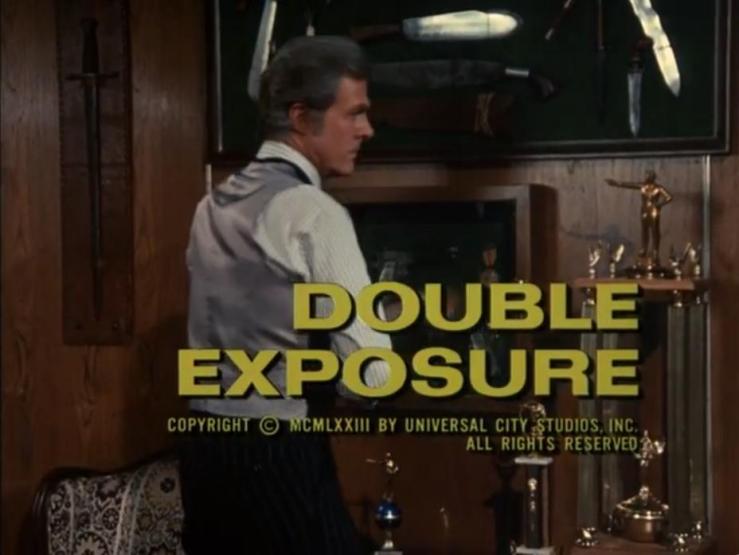
Double Exposure aired on NBC on December 16, 1973, and was written by Stephen J. Cannell (creator of The Rockford Files and The A Team). In the title screen above you see Dr. Keppel placing one of his guns back in its display case, right below a collection of antique blades. Nothing incriminating here, for sure. But what Keppel has in mind for his client Victor Norris (Robert Middleton) is no simple shooting, but an elaborate one involving caviar, a tape recorder, and the aforementioned subliminal editing. Norris is Keppel’s biggest client, and to lose him would be lose his business. Keppel had previously kept him on the hook through blackmail thanks to some compromising photographs. But now Victor is getting antsy, and his only solution is murder. The plan is (not so) simple. Victor and his team will be at Keppel’s studio to view a new cut of a promotional film. To establish an alibi, Keppel will act the voice-over in person, but let the tape recorder take over for him while he slips out for some killing. How does he get Victor out of the theater? Easy: by feeding him caviar beforehand,  jacking up the thermostat, and then slipping in subliminal single frames of iced soda into the promo film, so the sweaty Victor will be consciously and unconsciously dying of thirst. The plan works of course, and Keppel has a complete alibi, as all the filmgoers will testify to his presence in the theater while the murder was taking place.

Well, this is why Columbo is Columbo. Peter Falk completely inhabits the role as the disheveled homicide lieutenant, whose ruffled exterior masks a rigorously logical mind. Falk introduces a mass of tics to Columbo’s character, from his shuffling walk to the way he arches his elbow to scratch his forehead while thinking. He is also a constant snacker, whether it’s one of his hard boiled eggs or whatever is available on the scene. He has inevitably missed breakfast, lunch or dinner at home, and thus has to nibble his way around a crime scene. In this episode it leads him to a clue, for when he complains about his empty stomach, a cop on the scene leads him to the leftover caviar, which Columbo devours like a bag of Fritos. The saltiness dries his mouth out, and leads him to unlock one piece of Keppel’s absurd puzzle. The others come free in due time, through Columbo’s own dogged research.

One of the great pleasures of the series is the interplay between the killer and Columbo, which can be a respectful duel between equals (as with Donald Pleasence in Any Old Port in a Storm), or, as in this case, total obliviousness. Keppel has so much belief in his own unimpeachable genius that when Columbo drops the hammer, he sheds a tear. Culp is so beautifully delusional in this episode, treating Columbo with withering disdain whether in his office or on the golf course wearing gigantic sunglasses. His mere presence should make the case disappear, and yet it doesn’t. For Columbo’s great gift is that he doesn’t go away. He doesn’t give up and he never goes away, even when you think he’s out the door he will always return with “one more thing.” When Nietzsche wrote about “eternal recurrence”, he was simply foreshadowing the existence of Columbo.

And in the perfect world of Columbo, persistence always pays off.  Columbo chooses to play into Keppel’s narcissism in acknowledging him as the main suspect, but admitting they don’t have enough evidence to book him. This is telling Keppel what he wants to hear, warming him up for an emblematic gotcha moment. For Columbo has read all of Keppel’s books, and learned how subliminal advertising works. So when Keppel is away from his office, Columbo takes still pictures from many angles, and inserts them into the latest Keppel commercial. After Keppel views the film, he wanders into his office, tilts a lampshade and pulls out a calibration converter – one that turns his .45 into a gun that can shoot a .22 bullet. Keppel is shell shocked, and Quine pushes the camera closer after his jaw drops: “Subliminal cut, you used a subliminal cut!” In Columbo, it’s the editing that solves the crime.

ACCUSED: THE WRONG MAN (1957)

February 9, 2016

Annex-Fonda-Henry-Wrong-Man-The_02

The Wrong Man was promoted as Alfred Hitchcock’s first film based on a true story, and the director went to great lengths to secure its authenticity. To shoot the story of Manny Balestrero, who was falsely accused of robbing a life insurance company, Hitchcock shot the film on location in NYC, and cast supporting parts with many of the actual participants in the case. The movie strives for “reality”, and much of it plays as a heightened kind of docudrama, focused through Balestrero’s POV as he is arrested, processed, and put to trial. Manny’s world of Manhattan night clubs and his Jackson Heights home shrinks to the space between his shoes on the ground of his jail cell, seen with impressive clarity on the new Warner Archive Blu-ray. Manny’s resemblance to a hold-up artist has undone the life he had built over forty-three years, as his wife suffers a nervous breakdown from the stress. For no reason at all, a void has opened up and swallowed him whole.

caseofidentity

The screenplay by Maxwell Anderson and Angus MacPhail was based on a 1953 LIFE magazine article by Herbert Brean, “A Case of Identity”, which laid out Balestrero’s story. A steady bass player at Manhattan’s Stork Club, with a wife named Rose (Vera Miles) and two children, he had a penchant to play the horses but no debilitating vices. Needing money to help pay for his wife’s dental work, Manny went to his life insurance company to see if he could borrow money off of the policy. While there, a few employees become convinced that Manny is a dead ringer for the man who previously held up their office. They call the cops and Manny becomes the prime suspect. Then a handwriting sample sort of matches, and more witnesses give positive IDs. The case seems insurmountable until he is saved by intrepid grocery owners who capture the real thief, Charles J. Daniell, who soon confesses to be the real purveyor of  the Jackson Heights heists. But Rose cannot handle the stress of the trial, and suffers a nervous breakdown. She is moved to a psychiatric facility, and remains there at the end of the article, though the film has a more qualified happy ending.

Poster - Wrong Man, The (1956)_05

Brean described the evening of the arrest as having “the somnambulistic quality of a bad dream” that, “became a nightmare.” The film hews closely to Brean’s text, from the tone to the performance style. Henry Fonda plays Balestrero as something of an ashen sleepwalker, paralyzed by fear into zombiedom. Brean writes that “Balestrero is a timid man, by his own admission afraid of his own shadow. He has never been in a fight in his life, never carried a weapon, never been arrested, never even received a traffic ticket. As the net of evidence tightened, his mind spun and he did not know what to do or say. ‘When things happen like that and you’re innocent’,  he has said since, ‘you want to shout and scream but you can’t. I don’t know how many ways I tried to say to them I was innocent. They acted as if I was guilty and wanted me to say so.”

henryhastocallhiswife

After the police officers walk him from the front door into the police car, the film’s POV becomes severely restricted, Fonda getting suffocated by the law. While in the car, Hitchcock and DP Robert Burks have Balestrero looking right and left, confronted with extreme close-ups of the arresting officers, their impassive mugs impossible to read. While their faces obscure most of the frame, in one shot the blurry silhouette of his wife Rose (Vera Miles) is visible, indicative of his past world that will now be left behind. Hitchcock said “I enjoyed making this film because, after all, that is my greatest fear — fear of the police.” The famous story goes that as a six-year-old, his father sent him to the police station with a note. He had apparently committed some sin, because the cop locked him in jail for five minutes, with little Hitchcock unaware of the reason why, or if he would ever get out. Whether it’s apocryphal or not, it compactly conveys the sense of free-floating terror that motivates many of Hitchcock’s heroes, their mistaken identities or fractured psyches.  Through incompetence or animus the police are able to take your life away. You can see the personality draining out of Balestrero the further he is pushed through the penal system. And already a quiet man, he seems to become stiller, in a permanent state of stunned silence.

Annex - Fonda, Henry (Wrong Man, The)_NRFPT_10

Hitchcock told American Cinematographer that “I want it to look like it had been photographed in New York in a style unmistakably documentary.” He shot on a number of real locations from Balestrero’s story, including his home in Jackson Heights, the Stork Club where he worked, the 110th and Roosevelt Avenue police stations, Ridgewood Felony Court, and the actual courtroom used for Manny’s trial at Queens Felony Court. The Greenmont Sanitarium in Ossining, NY, where Rose Balestrero was sent following her breakdown, is used as a setting for the final third of the film, with Rose’s real nurses hired as extras. Now, as scrupulous as Hitchcock is as at researching the events of the story, at no point does it feel like it is presented in documentary style. There are too many composed shots, including the POV material which crops out most of the world outside Manny’s eyes. Hitchcock is too interested in getting inside Balestrero’s head to stick to an objective reporting of the facts, instead conveying the existential crisis of the Balestrero family. For Manny the world outside the prison has been cropped out, but for Rose her whole life has been blotted out. Her psychiatrist says, “She’s living in another world from hours…a frightening landscape that could be on the dark side of the moon.”

Annex - Fonda, Henry (Wrong Man, The)_03

Henry Fonda had a personal connection to this material. His second wife was Frances Ford Seymour, who he married in 1936, and with whom he had two children: Peter and Jane. Frances suffered from severe depression, and took her own life at the age of 42, in 1950. Fonda biographer Devin McKinney reads the film as a “transfer of anxiety from himself [Manny’s] to his wife. The film’s ‘personal’ element passes from Hitchcock to Fonda, our focus from the director’s passive observation to the character’s encounter with his wife’s depression.” Hitchcock wasn’t happy with this transition, telling Francois Truffaut that “The first weakness was the long interruption in the man’s story in order to show how the wife was gradually losing her mind.” But this transition is one of the film’s great artistic strengths, the terror not isolated or controllable in Manny but spreading outward. Rose starts laughing when all of Manny’s alibis turn up dead, their lives turned into a cosmic joke. She soon shuts down emotionally, convinced the world is conspiring against her family. The terrifying part is that there is no conspiracy, it is simply an average everyday mistake that has evacuated meaning from her life. There is nothing left to believe in, so she disappears inside herself. The pain on Fonda’s face flickers with recognition.

PRE-CODE COMEDIES: FIFTY MILLION FRENCHMEN, GOLD DUST GERTIE, AND HER MAJESTY, LOVE

February 2, 2016

Fifty00022

In 1931 the vaudeville circuit was dying out, and Hollywood was poaching its performers and routines. Needing content for the new sound technology, studios would string together comedies around a collection of old stage bits. Anarchic, chaotic, and scattershot, these films will do anything for a laugh, and they occasionally get them. The Warner Archive has just released three of these pre-code sketch films on DVD, all from 1931:  Gold Dust GertieHer Majesty Love, and Fifty Million Frenchmen. They feature actors who cut their teeth in vaudeville, including the comedy duo Olsen & Johnson, one-liner artist Winnie Lightner, and W.C. Fields, who made his sound film debut in Her Majesty Love.

photo40chic_0427

Fifty Million Frenchmen (1931)is a showcase for the antics of Ole Olsen and Chic Johnson, who had been working as a duo since the late teens. Their act didn’t really have a straight man, with wiry neurotic Olsen facing off against the rotund giggling softie of Jonhson.They were known for their boundary dissolving stage shows which strung clotheslines from balcony to balcony to dry their wash, had cows falling from the ceiling, and dubbed Hitler into Yiddish. This kind of madcap deconstruction wouldn’t show up on film until Hellzapoppin’ in 1941, but there some evidence of their insanity in Fifty Million Frenchmen. Originally intended to feature Cole Porter’s songs from the Broadway show, these were cut after the audience rebelled against the glut of musicals released after the coming of sound. Director Lloyd Bacon strings the gags along a slender thread of plot –  in a Paris bar Michael Cummings (John Halliday) bets Jack Forbes (William Gaxton) that he can’t win the love of blonde bombshell LuLu (Claudia Dell) without using any of his family’s money. Jack wins if he successfully woos LuLu only on what he can earn doing odd jobs. Cummings hires Olsen & Johnson to watch Forbes – to make sure he follows the rules of the bet.

Fifty00003 Fifty00012Fifty00008

This is the excuse for a series of sketches: like when Johnson mixes a cocktail inside a passed out fat drunk’s mouth, or when both Olsen and Johnson model women’s underwear in the hopes of selling them to an American tourist. Forbes gets a job as a tour guide for English speakers, and one of the best recurring gags involves a woman (Helen Broderick) who hires his services, looking to be “shocked, you know, insulted.” She is nonplussed when he passes her a photo of a nearly-nude strongman, and when Forbes asks her where she’d like to start the tour she responds, “From the bottom, you’re only young twice.” There is also a Bela Lugosi sighting as a short-lived magic act whose routine is usurped and botched by the incompetent trio of Forbes, Olsen & Johnson, who cause a near riot. The latter duo ends up in a Keystone Cops chase through the Paris streets, over the tops of cars and through newly laid tar, in which the chase bogs  down into slow motion.

Fifty00020

Olsen & Johnson also appear in Gold Dust Gertie (1931), but the name above the title is Winnie Lightner, a wiseass who specialized in sassy gold digger roles, most famously in Gold Diggers of Broadway (1929). The opening of the film shows her marrying both Olsen and Johnson, and the film kicks off by her pursuit of their alimony payments. And the only way to get those bums to pay is to get them raises at their bathing suit company (whose conservative “Carrie Nations Fit” is not selling). So Lightner insinuates herself into the company, woos the ancient president Arnold (Claude Gillingwater), and convinces him to produce a more contemporary, risque style of suit. Along the way she runs into a few more ex-husbands from whom she’s still chiseling cash. A money-grubbing dynamo, she is getting what she can while the getting’s good. Lightner has a wonderfully expressive face, one that can flip you off with a sneer. In 1931 Picture Play magazine called her “the only feminine star of rough house comedy”.

Fifty00027Fifty00026

My favorite gag in Gold Dust Gertie, also directed by the industrious Lloyd Bacon, is a moment of bedroom farce. At one point the president invites Lightner, Olsen, and Johnson onto his ship. He has already declared his love for Lightner, unaware that she has already married and divorced every guest on his yacht. Eventually Olsen & Johnson bully their way into her stateroom, hoping to blackmail her with the news of yet another of her ex-husbands, but she neatly twirls them around her little finger with some flirtation and a bottle of booze. But then the president knocks on the door, and Olsen & Johnson are thrust outside the porthole window (after some requisite pottery smashing), getting thrashed by the waves while Lightner continues her seduction of the president. It is a perfectly tuned and timed bit of humiliation, and one of her multiple triumphs of male manipulation.

Fifty00029

Her Majesty, Love, is the most polished film of the three, directed with a roving energy by William Dieterle. This was the second feature Dieterle directed in Hollywood after being imported from Germany (the first: The Last Flight (1931)). It is an adaptation of the German film Ihre Majestät die Liebe, directed by Joe May earlier in ’31. It takes place in Berlin and follows Fred von Wellingen (Ben Lyon), heir to his family’s ball bearing factory fortune. Instead of cultivating the board of directors’ favor, he spends his time in a nightclub, becoming smitten with bartender Lia (Marilyn Miller). His family forbids their marriage, and will only give him the reigns to the company if he agrees to break off their union.

Fifty00037

The central drama is stilted, but there are pleasures at the margins. Dieterle and his DP Robert Kurrle use a circling camera in the nightclub sequences, creating an air of drunken revelry, where everything is spinning in a joyful blur. This is Broadway star Marilyn Miller’s third and final film appearance (she would die in 1937 from a botched nasal surgery), and you get an inkling of what made her so beloved on the stage. She has a relaxed, insouciant charm that makes it believable that her father in the film is played by W.C. Fields. Fields plays a barber and indulgent father who is a born entertainer. At Fred and Lia’s engagement dinner, he can’t sit still for a few seconds before he’s catapulting with his spoon or juggling dishes to the gasps of his table mates. It is his first sound feature, and his movie voice is not fully formed, that plummy nasal whine not fully ripened. And yet he is the clear star of the movie, despite his truncated screen time. One wishes for Fred to disappear and for Lia and her father to put on a show of their own.

KNOCKED UP: SUSAN SLADE (1961)

Originally published at Movie Morlocks, the official blog of Turner Classic Movies

January 26, 2016

In 1958 Delmer Daves suffered a heart attack, forcing him out of the Wild West and into the boudoir. Instructed by his doctors to avoid physically taxing Western location shoots, he embarked on a series of lurid melodramas starring poseable Ken doll Troy Donahue. Donahue’s unthreatening blonde-haired blue-eyed good looks made him the heartthrob of choice from 1959 – 1962, when he made A Summer Place, Parrish, Susan Slade and Rome Adventure with Daves, all of which were box office hits and critical failures (the latter three are available on DVD in WB’s Romance Classics box set, while A Summer Place is out on its own). They are films about sex that treat it as an inevitable result of adolescence, not as a threat to be avoided, and teenagers of the time must have appreciated this honesty, along with the vibrant Technicolor photography capturing the dewy Donahue/Sandra Dee/Connie Stevens. And if you were going to have an illegitimate baby, the gentle Donahue would be the father of choice. I added a poster of Susan Slade to my Facebook page, and immediately one of my friend’s mothers commented, “I was in love with Troy Donahue.” These are movies that are weighted with sense memories for people of a certain age, and they are ripe for reevaluation.

Critics have prioritized Daves’ war films (Pride of the Marines) and Westerns (3:10 to Yuma, Jubal), but these disreputable melodramas are equally representative of his talents, trading Western vistas for suburban split-levels. Dave Kehr wrote in the New York Times that, “the virtues of Daves’s late romances are essentially the same as those of his adventure films: characters composed with the utmost integrity and respect; a gift for creating a detailed and convincing social background; and a strong, clear narrative style that allowed him to manage a large cast of characters and several simultaneous levels of dramatic events.” I have previously written about A Summer Place, but today I am going to discuss Susan Slade, a remarkably strange romance in which Connie Stevens, with the aid of her permissive parents, hides her unwanted pregnancy from the world, and then falls in love with the intellectual-novelist-stable boy Donahue, from whom she hides the truth. The film throws up any number of improbable barriers to their union, from a Guatemalan coal mine to an ill-fated cigarette lighter. Their union is impossible, until it isn’t.

Susan Slade was based on the novel The Sin of Susan Slade (1961), by Doris Hume, and was quickly optioned by producer Edward Small (Kansas City Confidential), who turned around and sold it to Warner Brothers. Eager to further capitalize on the success of one of their last studio-manufactured stars, they turned the book into the latest Daves-Donahue potboiler. Donahue’s real name was Merle Johnson, but WB’s publicity team re-christened him as Troy Donahue. Mere/Troy recalled the process to People magazine: “At first they had Paris, the lover of Helen of Troy, in mind,” Donahue says. “But I guess they thought they couldn’t name me Paris Donahue because there was already a Paris, France and Paris, Illinois.”  So Troy it was. Two years earlier A Summer Place had made Donahue a star, but his screen presence remained ethereal and remote. He was never really fit to take on the role of approachable West coast dreamboat, as he was an incorrigible alcoholic who drank his way out of the movie business in a few years. Resentful of the limited roles he was offered, he told People that,  “I would like to forever get rid of that image of the California beachboy.” He takes a drag on his cigarette and says matter-of-factly, “I’m an actor. Not an ornament.”

But these are beautifully ornamented features, with Donahue perhaps the most beautiful. Susan Slade’s director of photography was Lucien Ballard, whose first gig was doing additional photography for Von Sternberg’s Morocco (1930). Donahue is outfitted in an apple red jacket to reference Rebel Without a Cause, and his character Hoyt Brecker is something of a destabilizing force. Brecker’s father was arrested for embezzlement and then hung himself in his jail, and all of the old family friends disassociate themselves. So Hoyt withdraws from society, only occasionally drawn out by Connie Stevens as Susan Slade, who still keeps in touch with this awkward, strikingly handsome lad.

Slade’s life is a parade of tragedies. The opening sequences detail her shipboard flirtation and passionate romance with a young playboy mountain climber named Conn (Grant Williams), who sleeps with her and cuts off contact. Hard to believe you can’t trust a man named Conn. There is a languorous, highly suggestive crane shot of slumped and supine partygoers lazily cuddling on a stateroom floor. Many are smoking, an intimation of post-coital bliss as the love theme from A Summer Place twinkles over the radio. It is here that Conn dips Susan down for a deep, loving kiss. It is here, one assumes, the doomed coupling takes place. Conn dies trying to summit Mount McKinley, leaving a distraught Susan pregnant and alone.

Her parents are played with glowing warmth by Lloyd Nolan and Dorothy McGuire, the models of connubial bliss. Nolan is all empathy, his jowly face in a continual mask of concern for his poor daughter. One of the more moving sequences occurs in close-up, after the Slades move into their new cliffside home in Carmel, CA, where he thanks God for all his blessings. It is an unusual sequence in how it slows down the narrative, but it is the kind of character grace note that gives these films their emotional punch. McGuire’s performance is more guarded, as she becomes more inward when the family decides to pretend that Susan’s baby is actually her mother’s. McGuire then has to convey a protectiveness of her pseudo-baby, hinting that she might be willing to take Susan’s son for good. This mother-daughter jealousy is further ramped up after the father’s passing, leaving the two women to fend for their son/grandon’s affections.

Connie Stevens has the most difficult role here, with Susan stuck between different phases of life: She is a doting daughter and a thwarted mother, an immature girl and an experienced lover. Connie threads the needle with the aid of costuming, hair and makeup. On the ship she has a sophisticated evening gown and up-do, whereas home in Carmel she ties back her hair in girly bows and dresses in giant sweaters. 23 at the time of shooting, she has a button-nose Mickey Mouse Club cuteness that makes the “adult” scenes even more shocking. But Stevens is an agile enough actress to balance these two extremes of her character. In the climactic scene of revelation, in which she lays the whole story bare, she speaks with steel in her voice, and bends Donahue to her will.

GIRLHOOD: ANNE OF GREEN GABLES (1934)

January 19, 2016

Anne-of-Green-Gables-1934-film-images-5e538c64-0946-4a23-906d-f76cd610614

The books of my childhood have no hold on me, no permanent perch in my imagination. I was immersed in the boys-solving-crimes genre of The Hardy Boys and Encyclopedia Brown as a lad, and today I couldn’t dredge up a single plot point from the dozens I read. My wife, however, is continually revisiting the worlds of Laura Ingalls Wilder and L.M. Montgomery, with Little House on the Prairie and Anne of Green Gables deepening for her over time. They evoke a rambunctious, adventurous girlhood as well as a very tactile sense of place. The forbidding tundra of Little House’s upper midwest and idyllic Prince Edward Island of Anne are landscapes that she has incorporated into her being. If she ever goes starry eyed, she has probably escaped to the Ingalls cabin in her mind. As a selfish male, I desired access to this secret girls club. But as a lazy one, I haven’t had time to read the novels. So instead I viewed the 1934 adaptation of Anne of Green Gables, newly on DVD from the Warner Archive. It’s a polished RKO production that softens the book’s tragedies, but still captures the stumbling energies of Anne’s incorrigible youth.

6HiqOOU6buAGCLh1sLVQIBwaaSn

Lucy Maud Montgomery’s mother died when she was two, and she was raised by her strict Presbyterian grandparents in Cavendish, Prince Edward Island, where, according to her biographers, she never felt truly wanted. Anne of Green Gables was written by Montgomery and first published in 1908, becoming an instant success. Soon after its release Mark Twain wrote Montgomery, saying that Anne was, “the dearest and most lovable child in fiction since the immortal Alice.” Anne Shirley is a flame-haired orphan who is taken in by the brother and sister spinsters Matthew and Marilla Cuthbert of Prince Edward Island. The Cuthberts requested a boy from the orphanage to help out around the house, but Anne’s creativity and klutziness endears her to them, and they keep her around. She then embarks on a series of episodic misadventures, motivated by cute schoolboy Gilbert Blythe’s chaotic pursuit of her affections. It is something of a picaresque adventure, at least until the melancholy close. Margaret Atwood, in the Guardian, wrote that “Montgomery was an orphan sent to live with two old people, but, unlike Anne, she never did win them over. Marilla and Matthew are what Montgomery wished for, not what she got.”

tumblr_o0jzhk3dCW1qd3nk9o7_1280

The movie was filmed by RKO in 1934, and marketed as “A Picture for the Millions who Loved Little Women.” George Cukor’s Little Women was a hit in 1933 for the studio, so they quickly turned around the similarly themed Anne. It had been filmed as a silent in 1919 by William Desmond Taylor, but this would be the first sound version. According to the AFI Catalog, Alfred Santell was initially slated to direct – he had helmed the girl-focused Rebecca of Sunnybrook Farm in 1932 – but was removed upon insisting he shoot on location in Santa Cruz. RKO replaced him with George Nicholls, Jr., who used the rear projection shots they preferred, doing Prince Edward Island on the cheap.  The whole production has a rushed feel about it, with the screenplay collapsing entire arcs into a few scenes, such as Anne’s romance with Gilbert or Matthew’s illness. So much has been removed from the book that Montgomery described the film’s third act in her journals as, “a silly sentimental commonplace end tacked on for the sake of rounding it up as a love story.”  All of the book’s melancholy is replaced with false uplift, which betrays the pain Montgomery poured into her novel.

Anne-of-Green-Gables-002

It is a compromised film, but it holds wonderful performances. Child actor Dawn O’Day won the role of Anne Shirley, and in a publicity stunt legally changed her name to that of her character. She is credited as “Anne Shirley” in the film’s credits, and she sustained the stunt through the rest of her career, which included parts in Stella Dallas (’37, for which she received a Best Supporting Actress Oscar nomination) and Murder My Sweet (1944), her final film before retiring at the age of 26. Shirley plays Anne as wide-eyed and spazzy, a destabilizing force in the Cuthbert home. Matthew (O.P. Heggie) is a pushover, immediately charmed by Annie’s awkwardness. The Australian Heggie has a ready-made bemused twinkle in his eyes for all situations, and eases into each scene with a sideways lope, fingers locked under an overall strap. He is the picture of laid-back fatherliness. It is Marilla (Helen Westley) who is the harder nut to crack. Westley was a Brooklyn actress with extensive stage experience, and she inhabits Marilla as a starchy spinster all tucked into herself. Her hair is always pulled tightly back, with no loose ends detectable on her body. She is perpetually on guard against Anne’s cuteness. So she immediately suspects Anne of stealing her amethyst brooch when it goes missing. But when it turns up attached to her shawl, revealing Marilla to be a bit of a scatterbrain herself, the barriers fall, and Marilla admits that she loves the kooky girl.

11374449_ori

It is a movie of great warmth and tenderness thanks to these performances, but it is missing the melancholy that makes the books endure. Atwood claims that, “the thing that distinguishes Anne from so many ‘girls’ books’ of the first half of the 20th century is its dark underside: this is what gives Anne its frenetic, sometimes quasi-hallucinatory energy, and what makes its heroine’s idealism and indignation so poignantly convincing.” This energy is missing from the film, hacked away in the hurried attempt to put it on the screen. In its place is a corny heart-tugger that resolves all of Anne’s problems at the end of  78 minutes. It is closed off where the book runs loose, unafraid to present children with images of irrevocable loss. But Anne will live on, in the books and in the imaginations of women like my wife, entranced with the image of that wild, lovable girl, who could wrap an entire island around her little finger due to the force of her untamed intellect.