SUMMER OF ROHMER: THE GREEN RAY (1986)

Originally published at Movie Morlocks, the official blog of Turner Classic Movies

July 12, 2016

My Summer of Rohmer has been held over for its fourth smash week! For the uninitiated, I have been writing about the summer-set films of Eric Rohmer, allowing my vacation-less self to live vicariously through his characters. I have already traveled to Saint-Tropez for La Collectionneuse  (1967), the French Alps for Claire’s Knee (1970), and Normandy for Pauline at the Beach (1983). Today I join one of Rohmer’s most peripatetic souls, Delphine (played by Marie Rivière), through Cherbourg, the Alps, and Biarritz in The Green Ray (1986). Delphine has recently separated from her long-distance boyfriend, leaving her alone and without direction for her summer vacation. A melancholy romantic, she is fiercely protective of her independence, and forever seeking the man who is worthy to end it. She spends her holiday bouncing from resort town to resort town, staying long enough until her loneliness overwhelms her and she is forced to move on. She begins to see portents all around, creating meaning by turning the world into a Tarot card to be read. Rohmer finds the beauty in her intense ascetic solitude, and grants her an ending of offhand sublimity.

It has been absurdly difficult to see The Green Ray in the United States since its theatrical release, where it was re-titled Summer and topped Andrew Sarris’ top ten list. The Fox Lorber DVD is out-of-print and pricey, and there are no streaming options (though VHS versions can be had cheaply). I viewed it on a UK Region 2 DVD, part of Arrow’s eight-film Eric Rohmer Collection, and it is also available on Blu-ray from the French label Potemkine, although only as part of a massively expensive box set (and it is locked for Region B – so you must have an all-region player to view). However you can get your hands on it, it’s worth it.

Rohmer first conceived of The Green Ray after seeing the following classified ad:  “I am beautiful. I am from Biarritz. I should please, and men pay no attention to me, why?”. He combined this with his childhood memories of reading Jules Verne’s The Green Ray, a romance of the Scottish highlands in which a young girl avoids romance until she can see the titular ray, a flash of light that occurs after the sun sets, and which, per Verne,  “has the virtue of making him who has seen it impossible to be deceived in matters of sentiment; at its apparition all deceit and falsehood are done away, and he who has been fortunate enough once to behold it is enabled to see closely into his own heart and read the thoughts of others.” The film takes the lonely yearning of the classified ad and the mystical romance of the Verne novel and combines it into the character of Delphine, created together by Rohmer and actress Marie Rivière.

Rohmer and Rivière held endless conversations about the character, with the director recording the actress’ thoughts on everything from her relationships to her vegetarianism, all of which were incorporated into the script. In the newly translated Eric Rohmer, A Biography by Antoine de Baecque and Noel Herpe, Rivière recalls Rohmer saying that, “I’m reproached for writing sentences that are too long. But in life, people talk a long time without stopping. And I’m going to demonstrate that. No one will see the difference between a text I’ve written and an improvised text.” In order to create an atmosphere conducive to such improvisation, Rohmer opted for a completely female crew, from the sound engineer to the camera operator. He hired the 23-year-old Sophie Maintigneux to be the cinematographer, “giving her a small Aaton 16mm camera fitted with an old-fashioned zoom lens. Although he sometimes discreetly asked Sophie to use this zoom lens…in general he let her set the frame the way she wanted.” Francois Etchegaray was the production supervisor, who had already helped Rohmer on Full Moon in Paris. Rohmer would tell Marie Claire magazine that “It isn’t that I like girls so much that I feel the girl that resides in every man. I feel it in me.”

It was an austere, cheap 16mm production, shot in chronological order.  Etchegaray was frequently annoyed by Rohmer’s miserliness, but toughed it out, arranging housing with friends and family at each of the locations and casting locals wherever possible. After it was shot, it sat in the can for two years while Rohmer decided what to do with this strange object. Eventually it was cut into presentable form by his longtime editor Cecile Decugis and her assistant Lisa Heredia. He decided on the unusual route of giving it to the cable television channel Canal+. They would debut it on television before its theatrical premiere. From the Canal+ advance and the one paid by Orion Classics in the United States, the film was almost entirely paid for before it’s opening. It’s theatrical life was not harmed by debuting on television, either, as it won the Golden Lion at the Venice Film Festival, and attracted more than 460,000 viewers in France. Baecque and Herpe claim it was “certainly one of the most profitable films in the history of French cinema.”

Rohmer wanted the intimacy of a home movie, and got a tremblingly open-nerved performance from Rivière as a result. Incorporating her own improvisations with Rohmer’ written texts, Rivière’s Delphine is annoyingly sympathetic, a vulnerable introvert and judgmental scold. So intent on protecting the domain of her self, she can lash out at others simply wanting to entertain her. Any incursion into her space is a violation to Delphine, whether well-meaning or no. And Rivière can throw a fine tantrum with her long-levered limbs. But then she is given moments of privileged silence. There are three pivotal sequences of solitude at her vacation stops, where she walks off on her own and contemplates her loneliness. Rivière’s face can be a mask when with others, but here it cracks, she is so utterly alone against the vastness of nature. To invest this solitude with meaning, she begins to read signs. Throughout her journey she stumbles upon the color green, whether on street signs or the playing cards that mysteriously turn up at her feet. Though she denies a belief in the supernatural during an earlier conversation with friends, as the vacation drags on she begins to grasp for such belief as coincidences pile up around her and a group of scholars discuss Verne’s The Green Ray in Biarritz.

A fugue (composed by Jean-Louis Valero) intermittently plays on the soundtrack, a rare use of non-diegetic sound by Rohmer, as Delphine seeks the ray, and impulsively flirts with a cabinetmaker (Vincent Gauthier) at the Biarritz train station. Everything starts to glow with meaning as she travels with him to Saint-Jean-de-Luz, at which a gift shop is named Le Rayon Vert, and the sun begins to set over the horizon. He asks Delphine to stay with her a few days. She delays a response until after the sunset, waiting to see the ray, for the truth, and for some rest in the arms of another.

I previously wrote about The Green Ray in 2010. Check it out here if you can’t get enough.

SUMMER OF ROHMER: PAULINE AT THE BEACH (1983)

Originally published at Movie Morlocks, the official blog of Turner Classic Movies

July 5, 2016

Welcome to the third week of my Summer of Rohmer, in which I fill the void of my own vacation-less summer by vicariously joining the beach holidays of Eric Rohmer’s neurotic, attractive, and hyper-articulate characters. I started the series by visiting a Saint-Tropez cottage in La Collectionneusefollowed with a scenic French Alps home in Claire’s Knee, while today I scurried off to a Normandy beach house in Pauline at the Beach. We have leapt from Rohmer’s cycle of “Moral Tales” to his “Comedies and Proverbs”, as well as his shift to female protagonists (which began with his previous film A Good Marriage (1982)).

Pauline at the Beach (1983) is set during the waning weeks of summer, with Marion (Arielle Dombasle) bringing her 15-year-old niece Pauline (Amanda Langlet) to spend a few parent-less weeks before they both have to return to work and school. There is a pressure to find friends and have a fling before the holiday runs out. The waifish blonde Marion is immediately pursued by two men, the dewy-eyed romantic Pierre (Pascal Greggory) and the older, pragmatic womanizer Henri (Feodor Atkine). Rohmer frames the film around Pauline’s observations. She is a quiet, almost background presence throughout, silently weighing Marion’s actions as she falls for Henri and keeps Pierre on her string. Rohmer leads off his Comedies and Proverbs films with a quote, and here it is one from Chretien de Troyes: “He who speaks too much does himself harm.” Marion, Pierre, and Henri talk incessantly about the nature of love, but show no knowledge of how to embody it. Instead they remain irrevocably wrapped up inside themselves. I produced the DVD and Blu-ray of Pauline at the Beach for Kino Lorber (complete with an Eric Rohmer interview and a  fine booklet essay by Michelle Orange), so consider that a full disclosure of my biases.

The French summer holiday is unfathomably long to this American, who snags week-long respites if he can afford it. In Pauline at the Beach, Pauline has been vacationing for months, and wants to use the Normandy trip as a final unwinding before a return to responsibility. This is Marion’s only holiday, having spent the rest of the summer preparing her next fashion line. So there is already an inset anxiety – the fun is about to end. Pauline had spent the previous two months with her parents, and is free for the first time. Marion has started peeking at swatches for her fashion design job, which looms at the end of their stay. So the seductions and crushes seem to happen on fast forward – Marion immediately falls into bed with the mercenary Henri, and Pierre declares his undying love to her (they had a brief  fling a few summers back). All the while Pauline stays silent, unwilling to take part in their philosophical parlor games, in which they intellectualize their respective thoughts on love, a Plato’s Symposium if held by untrammeled narcissists.

They all have different manners of self-regard. Henri believes himself to be a “nomad” who “can’t stand a woman who makes me think of her as furniture.” This is a flattering way for him to justify his serial womanizing, enabling their freedom instead of justifying his pursuit of pleasure. Marion, recently divorced, is not interested in freedom. She wants love to manifest physically (“I’ve never burned with love except in dreams”), and transport her beyond herself. It is a storybook vision. Pierre says that “passion that flames too quickly burns out too fast.” He is trying to position himself for Marion’s sake, as he knows she has never “burned” for him. He is playing a longer game, “for a deep and lasting love”, one that unfolds over time. His is the most grounded version, but he is too jealous and petty for him to realize his noble goals. He is always focusing on his own pain, his own feeling of being slighted, to have time to cultivate his higher emotions. Pauline only chimes in with, “I don’t agree with any of you, except maybe Pierre…You must know people to love them.”

Rohmer might have tweaked her phrase to say that he had to know people before they could act in his movies. He had first worked with Arielle Dombasle and Pascal Greggory in his 1979 stage production of Kleist’s Catherine de Heilbronn, which suffered withering reviews. The actors, however, were thrilled with the experience, and were eager to work in Rohmer’s collaborative, intensely rehearsed style once again. The story’s origins went back to some of his plays in the ’1950s, but it didn’t begin to take true shape until the late ’70s for a group of scenes he titled Loup, y es-tu? (Wolf, Are you There?). The totality came together on a train ride filled with loud soldiers. Rohmer is quoted in Eric Rohmer: A Biography:  “under those conditions, I couldn’t read, it was impossible to read, but at the same time, ultimately, it’s easier to write. So I concentrated; I had a notebook and I began writing very fast without listening to what was being said around me and I really had the idea of the continuity of the film.” He kept tinkering with it up until the start of shooting on A Good Marriage. 

In terms of casting the biggest question mark was Pauline. He found a photo of Amanda Langlet in the French Production Society’s file of child actors, and after a brief telephone call with her cast her on the spot. Fifteen years old, Rohmer treated her like any other member of the cast, consulting “her regarding the psychological details of her character”, recording her thoughts on a tape recorder. According biographers Antoine de Baecque and Noel Herpe, who listened to the tapes, “it is hard to distinguish directed improvisation from desultory conversation”, as Langlet blurred into the character of Pauline. Through all of this collaborative work Langlet gives a wonderfully subdued performance, a watcher and thinker not yet ready to take center stage in her own life.

Once again Nestor Almendros was the director of cinematography, though he had begun to get tired of Rohmer’s thrifty ways. Head camera operator Virgine Thevenet told de Baecque and Herpe: “In the United States, Nestor had become a star. Back in France, it drove him nuts to find Eric still quibbling about paying for his coffee.” The reigning visual influence on this film was Matisse, specifically his painting Romanian Blouse. The red, white, and blue color scheme would be adopted, and counter to their usual insistence on not altering locations, they would repaint hallways to keep the motif intact. Rohmer hung a reproduction in Langlet’s room, and Rohmer was delighted to find that she shrugged her shoulders in a manner similar to the painting in a restaurant scene with Greggory.

Pauline at the Beach was poorly received by French critics, with Le Figaro calling it “a strong contender for the prize for the most ridiculous film of 1983″, reserving the most damning insults for the “illiterate” dialogue and Arielle Dombasle’s performance. Perhaps the schematic nature of the dialogue plays better in translation, but Dombasle is a delight, a frothy, lightly comic performance around which the men circle and Pauline observes with bemused interest. The film was a still a financial success at home and abroad, and stands as one of Rohmer’s purely pleasurable works, from the location (the sad loveliness of an emptied out beach town) to the outfits (I don’t have the language for fashion, but my wife exclaimed any time Arielle Dombasle appeared in a new ensemble), to the romantic nettle woven by  their pretty words. Marion, Henri, and Pierre cannot live up to those words, but Pauline, with her reflective, penetrating stare, offers the possibility of authenticity, and an enduring love.

SUMMER OF ROHMER: CLAIRE’S KNEE (1970)

June 28, 2016

My Summer of Rohmer continues with Claire’s Knee (1970), the fifth of the director’s Six Moral Tales. It is a story of fidelity and an experiment in desire, in which a betrothed vacationer enters into a flirtation with two teenage girls. As with La Collectionneuse (which I wrote about last week), it takes place within the span of a summer holiday, this time on Lake Annecy in Haute-Savoie. Instead of enjoying the transcendent view of the Alps, Rohmer’s characters debate the nature of love, whether it is an act of will or something more…elusive. Summer is once again used as a crucible to test one’s belief. La Collectionneuse depicts the curdling of male desire outside of Saint-Tropez, while the male protagonist of Claire’s Knee is trying to trigger his lust in an attempt to overcome it.

The man is Jérôme (Jean-Claude Brialy) a rakish diplomat living in Sweden who returns to Haute-Savoie in order to sell his family’s vacation home. While there he runs into Aurora (Aurora Cornu), a writer and provocateur who challenges Jérôme to pursue a flirtation with the reflective teenage girl next door, Laura (Beatrice Romand), who harbors a crush on him. This adventure will help Aurora invent an ending for her unfinished novel, and kill the remaining time left on her holiday. Jérôme accepts Aurora’s invitation, to help out a friend , indulge his baser instincts, and to test the strength of his love for his fiancee Lucinde. His puppy-love flirtation with Laura, which they both quickly tire of, further cements his love for his betrothed, but then he spies Laura’s half-sister Claire, a waifish beauty with a distractingly sculptural knee. Jérôme pours his remaining energies into touching that joint, for if he can channel his unwieldy desire into that one chaste locale, it will re-confirm his feelings for Lucinde. With Lucinde he does not have the same power over his will, his emotions emanate from something beyond. Lucinde “is everything. You can’t add to everything.”

Like all of the Moral Tales, Claire’s Knee originated as story Rohmer had written years earlier, one from the ’40s  entitled, “Who is Like God?”. It started with the de Sade epigram, “It is not pleasure that makes people happy, but desire and the obstacles that are put in the way of realizing that desire.” The basic set-up was already present, of a thirty-something about to marry who dallies with two teenagers near his vacation home. In the final version of the story, also titled “Claire’s Knee” (1949), the man, Jérôme, spies the girls playing tennis, and hides their balls to lure them to his home. This is a more predatory scenario than that in the film, and Rohmer has Aurora present this earlier version as an idea for a novel she was never able to complete. So in the film Jérôme agrees to playact the character from her book, adding to the blurring of reality and fiction that Rohmer was so skillful at with his performers.

Aurora Cornu, a Romanian writer, essentially played herself. According to Eric Rohmer, A Biography (Columbia University Press) Rohmer, “had known this woman of letters for many years and liked her frankness and anti-conformism. Together, they spent whole afternoons reorganizing the world on the second floor of the Cafe de Flore or visiting Parisian churches.” In the film Rohmer has her recreate their lively discussions with Jean-Claude Brialy, whom Rohmer liked for his dandified looks. He only gave him one instruction before shooting: “to let his beard grow.”  Laurence de Monaghan, who played Claire at the age of 16, was spotted coming out of the Royal Saint-Germain hotel, a non-professional actor who had the ethereal look Rohmer was seeking.

The most striking performances in the film come from the youngsters, especially Beatrice Romand as Laura and Fabrice Luchini as her motormouthed friend Vincent. Romand looks like a sly sylph under a mop of curls, and is one of those rare actors who can convey the act of thinking without saying a word. Her face is a seismograph of reactions to Jérôme’s flirtations, at once ecstatic, disbelieving, and suspicious. It turns out the latter is correct, and midway through the movie she pivots her attentions from the debonair Jérôme to the gawky, overactive Vincent, embodied in a thoroughly charming performance by Luchini. His body has not quite balanced out yet, so he speaks as fast as possible to distract from his awkwardness. He impressed Rohmer by reciting Nietzsche to him the first time they met, and “made the whole Claire’s Knee group laugh until they cried by imitating Rohmer or by developing one of the far-fetched theories that were his specialty – to the point that Rohmer let him improvise his own text in front of the camera.”

Following the success of La Collectionneuse and My Night at Maud’s, Rohmer was granted his largest budget to date, thanks to an investment from Bert Schneider (of BBS Productions), who had just produced Easy Rider. Though it filmed in a rapid six weeks, Rohmer had a full crew for the first time, complete with set photographer and camera dolly. He had so much time to prepare that, according to co-producer Barbet Schroeder, “the maddest case of anticipation was for the sequence in which Jean-Claude Brialy leans down to pick a rose. A year earlier, Rohmer had planted the rose at the spot where it was supposed to bloom, calculating the date when it would open, which was written down in the work plan…Everything happened as planned!”

Once again Nestor Almendros was the director of photography, opting for a cooler mountainous palette than the hothouse of La Collectionneuse. Still utilizing the 1.33:1 frame, the film unspools in a series of calm centered two-shots, as Jérôme determinedly goes about his seductive business. For Jérôme his love for Lucinde has been sanctified as something beyond desire while for Claire and Laura he is a rather clumsy, if handsome, intruder upon their still developing amorous adventures, which often spill outside the frame. Jérôme and Aurora hold the center, with Laura and Claire going beyond. They have their own affairs to get in order and desires to slake.

SUMMER OF ROHMER: LA COLLECTIONNEUSE (1967)

June 21, 2016

Collectionneuse00004

Summer has officially arrived, along with the mounting pressure to enjoy it before it passes. The filmmaker who  most deeply investigated the contradictions of the sweaty months is Eric Rohmer, whose summer films contain placid surfaces rippled by violent speech. His characters are surrounded by beauty and inevitably beset by anxieties of how their time there is being wasted, ticking away. Since I have no summer getaway planned, I have chosen instead to get away with Rohmer, by viewing his summer-set films, and writing about them throughout the season. My guide will be the door stopping Eric Rohmer: A Biography (Columbia University Press), by Antoine Baecque and Noël Herpe (newly translated by Steven Rendall and Lisa Neal). First up is La Collectionneuse (1967), part of his series of Six Moral Tales, a chronicle of a poisoned vacation near Saint-Tropez. Two men attempt to subsume themselves in nature, but instead resort to their true selves when a young woman joins the house, whereupon they descend to macho posing and bickering.

Collectionneuse00017

La Collectionneuse originated in a short story that Rohmer wrote in 1949 entitled, “Chantal, ou l’épreuve” (Chantal, or the test), and was the third of his “Moral Tales” to be filmed (after The Bakery Girl of Monceauand Suzanne’s Career, both 1963), though it was the fourth in Rohmer’s intended order. He had to delay My Night at Maud’s for funding issues, so the cheaper Collectionneuse, which takes place almost entirely at one location, went first. The story was about two dandies who stay in a villa with a young woman of dubious reputation who had “an angelic face, a dazzling complexion, and the manners of a middle-school student.” Rohmer adapted the basic scenario for Collectionneuse, and brought along friends to make it on a shoestring. Having recently come off making a string of educational films for French schools, Rohmer was especially interested in documentary experiments, which, he wrote,

“A welcome development is emerging in the domain of informative film that resembles less and less a picture album accompanied by a sonorous and hollow commentary. …The means used are very direct, drawing mainly on the speech of the interview, on debate, on conversation, all of which are means, despite what people have said, that are highly cinematic and modern. Thus alongside the fiction film, a domain that is infinitely vaster than that of classic documentary is being constituted.”

He would carry over some of these lessons to Collectionneuse, on which he would record “remarks made by his actors, who had been asked to speak freely about their passions and love affairs.” Rohmer bent the fiction to fit the reality of his performers, who were mostly non-professionals.

Collectionneuse00024

Adrien (Patrick Bauchau, A View to a Kill) is an art collector in the process of raising funds to start his own gallery. Needing a break from the stress, he accepts a friend’s offer to stay at his vacation house outside of Saint-Tropez. Also there is Daniel (Daniel Pommereulle), a mercurial sculptor with time to kill, and Haydée (Haydée Politoff), a young woman who is playing the field, heading out with a new man almost every night. Adrien undertook “to really do nothing”, Daniel was his partner in embracing the void, while Haydée went about her nighttime searches for love. Daniel and Adrien have reached a state of decadence and rot, ready to concede the end of the ’60s dream. They wear ratty nightgowns  while Haydée is grasping for the future. Daniel and Adrian treat their life as a game, and Haydée as a pawn, a diversion from their boring adult lives, not realizing that she has already surpassed them.

Collectionneuse00020

Bauchau was a friend of Rohmer’s producer Barbet Schroeder, and had been a co-producer on the French New Wave omnibus films Paris Seen By…, which Rohmer organized. He is a lithe, leonine performer, a man aware of his own beauty who can easily convey Adrien’s perplexity when Haydée does not swoon over him. She becomes a curiosity and a puzzle to Adrien’s narcissistic mind.  Daniel Pommereulle was an artist friend of Bauchau who was essentially playing himself. He was also a sculptor of strange objects on a break, but instead of going on vacation he made a film. He is of a similar slim body type as Bauchau, but less commanding. He recedes where Bauchau pushes forward.

Collectionneuse00021

Haydée was cast after Rohmer met her at a party at his his pal Paul Gégauff’s house. She was working in real estate, and had never acted before. Her inexperience is appropriate for the role, as both actor and character are thrust into a strange situation without much prior experience. Haydée is presented first in the prologue as a visual element, the image of an ingenue with Louise Brooks hair and kewpie doll features. Rohmer breaks her down in a series of close-ups of torso/knees/feet, an objectified image that the film will undermine as she toys with the juvenile games played by Adrien and Daniel. Rohmer would run the three actors through multiple rehearsals before shooting a frame, where they would “invent the text they were going to perform”. The rehearsals were an artistic choice as well as an economic necessity. Not willing to waste a frame of film, Rohmer rarely shot more than one take. His DP Nestor Almendros recalled in his autobiography, A Man With a Camera, that, “We were able to keep the ratio of footage taken to film length at only 1.5:1. A record! We used only 15,000 feet of negative…in the laboratories they thought they were the rushes of a short.”

Collectionneuse00006

This was Almendros’ first feature film, and it displays a sumptuously beautiful use of natural light, most of which was due to budget constraints. You can see the gradients in the summer sunlight and textures in the shadows. This use of natural light was both an aesthetic choice and a budgetary necessity. They didn’t have big arc lamps , so usually used whatever light was at hand, pushing the limits of the 35mm film stock. For all its rivers of dialogue, La Collectionneuse is a remarkably tactile feature, of terry cloth robes against the skin, rocks under your feet, a shaft of light entering the room. Like most of Rohmer’s work La Collectionneuse has a piercing lucidity, conveying an understanding of background birdsong as well as the labyrinthine self-delusions of aging artist-lotharios.

LOVE IS IN THE AIR: ROME ADVENTURE (1962)

Originally published at Movie Morlocks, the official blog of Turner Classic Movies

June 14, 2016

I marked the arrival of summer by watching one of Delmer Daves’ grandly romantic teen melodramas, Rome Adventure (1962). It is earnestly sweet travelogue about a 21-year-old ex-librarian who seeks her independence in Italy and falls for blonde bombshell Troy Donahue. Like the other films Daves made with Donahue (A Summer Place, Parrish, Susan Slade), Rome Adventure is disarmingly frank about the desires of its randy young characters. Instead it revels in the unstable beauty of these kids and their still-forming moralities. Rome Adventure pairs teen idol Donahue with the plucky, world-weary Suzanne Pleshette, an immensely likable personality to follow for the two-hours of the film’s Roman tour. Much of the film’s pleasures derive from simply walking around Rome with two-good looking kids while admiring Charles Lawton’s Technicolor cinematography. Since I won’t be making any European vacations myself this summer, Rome Adventure will have to do.

Delmer Daves suffered a heart attack in 1958, and was instructed by his doctors to avoid physically taxing shoots like the Westerns he had become known for (3:10 to Yuma, The Hanging Tree). So he abruptly switched gears to melodrama, which necessitates less running around. This sunk his stock with critics, who have never come around to these films, but kept his commercial success rolling. In both his Westerns and his melodramas, he had an unerring eye for locations, able to build up detailed social milieus for his inevitably forthright and sincere characters. For Rome Adventure, Delmer Daves dusted off Irving Fineman’s 1932 novel Lovers Must Learn for his adapted screenplay, lending some of the film an anachronistic quality – like the transatlantic steamship that takes Prudence Bell (Pleshette) from New England to Italy. It’s appropriate for a girl with an old-fashioned name like Prudence, though she does her damndest to undercut it.

Prudence opens the movie by quitting her job. She is working as a librarian at a hoity-toity New England college, and the spinster professors disapprove of a novel she personally lent to a student: Lovers Must Learn, by Irving Fineman (!). So she read the book the movie she is appearing on is based on – and will go on to act it out. Before they can fire her she quits, calling it “my independence day.” Just like that she jumps aboard a ship to Rome by herself, hoping to experience the kind of passion she only had read in literature. She will go on to test herself in a variety of romantic entanglements to see what works for her temperament. The movie is focalized through her perspective, so the film’s gaze is pointed outward from her and towards the men in her life, wondering which one will really ring her bells.

The first men she meets are a mousy student named Albert Stillwell (Hampton Fancher, who would go on to write the Blade Runner screenplay) and Roberto (Rossano Brazzi), an older slick tongued Roman who continually tries and fails to win Prudence’s heart. Albert is her parents’ choice, a safe milquetoast type whose only topic of conversation is the Etruscans. Naturally Prudence gravitates towards the more dangerous Roberto, who at least offers the possibility of new experiences. Both men try to lead her around town, but once Prudence sets her sights on the baby-blue eyes of Don Porter (Donahue), no other man stands a chance. Daves said that Donahue “looks like Young America wants to look”, and he was one of the most bankable stars in Hollywood in the early ’60s. This blonde-haired blue-eyed lunk was handsome but still retained some of his baby fat, giving him the unbeatable combination of beautiful and non-threatening.

What makes these films so pleasurable, though, are the characters that surround the main company, the little worlds that Daves is able to build. At her Rome home Prudence has the pensione owners and employees, a gaggle of sweet old Italian ladies who cluck over her every move. The most fascinating character is Daisy (Constance Ford), the owner of the “American Bookshop” where Prudence works. Daisy is a true independent spirit, a model, one would think, for what Prudence is trying to do in Rome. Daisy lives alone with her big English Sheepdog Mcguinness – having left her schoolteacher gig behind to follow her dreams of the romantic life in Italy. Introduced in yellow pajamas, thick glasses, and smoking a cigarette in an elegant holder, she is the vision of  a self-made eccentric. Constance Ford is hilariously funny in the part, playing Daisy as a woman with no filter. I wish she was more of a central character, as the tidbits we do learn about her are so tantalizing. She mentions that she makes yearly vacations to Ischia on which she inevitably meets and loses a man in the same weekend. I would have loved to have seen a spinoff movie (directed by Rohmer, ideally), that followed Daisy on one of these amorous trips, to see more of what makes her tick.

But alas, the movie returns to Prudence and Don as they make their way across Italy, traveling to Lake Maggiore, where they stay in a tiny chalet by the water. Prudence is reluctant to sleep with Don, worried it would break the spell that they are weaving. Things start to unravel when Don’s ex-girlfriend Lyda (Angie Dickinson) returns to the scene. Something of a man-devourer, Lyda had dumped Don out of boredom, but has come back to toy with him some more. Gorgeous and imperious, she is the one thing more beautiful that Don. Dickinson is devilishly good in the part, chewing up the scenery just as she gnaws at Don’s ego.

The film ends on a disappointingly paternalistic note, one that undermines Prudence’s so-called “Independence Day”. Roberto, who early on promises to offer her a sexual education, later offers a narrow definition of a woman’s role – that of companion who is there to tame a man’s baser instincts. Essentially, to be a babysitter. Throughout the entire film Prudence has been the driving force of the plot, making her own romantic decisions, and then in the penultimate sequence Roberto swoops down like a mansplainer-ex-machina to throw the movie off balance. Prudence and Don are destined to be together, but it was a misstep to have their union decided not by Prudence, but by the kindly old Italian lech who lives around the corner. But this does not eliminate the multifarious pleasures of Rome Adventure, a relaxed, charming travelogue that I would have been happy to tag along on for many hours more.

MARTIAL ARTIST: XU HAOFENG’S THE FINAL MASTER (2015)

June 7, 2016

Xu Haofeng is a student of martial arts, a chronicler of its lore and history. He graduated from the Beijing Film Academy in 1997, but instead of entering the movie business, he spent over a decade tracking down old kung fu masters and writing wuxia novels. His most famous publication is The Bygone Kung Fu World (Shiqu de Wulin, 2006), a book about Li Zhongxuan a practitioner of xingyiquan, one of the Wudang styles of Chinese martial arts (Wong Kar-wai admired the book, which led him to hire Xu to co-write The Grandmaster). When Xu found him, Li had been working as a receptionist for a household appliance store in downtown Beijing for decades. Xu is obsessed with preserving the minutae of kung fu history. He told China Daily that,  “A real kung fu battle lasts only seconds. And the results of a competition between top practitioners are decided even before opponents begin combat.” This reveals itself in his directorial debut The Sword Identity (2011), an elliptical and idiosyncratic martial arts film  in which fights end in the blink of an eye. Xu’s latest feature, The Final Master, was released into U.S. theaters this past weekend, and is yet another intensely ritualized take on the kung fu film.

Based on one of Xu’s novellas, The Final Master takes place in 1930s Tianjin, a heavily Westernized port city. The Qing dynasty had been ceding territory, or “concessions”, within the city to European countries since the 19th century in order to encourage trade, hence all the English language advertising seen slapped all over town. Chen Shi (Liao Fan) makes a vow to his master to pass on the lessons of the Wing Chun fighting style to future generations. Exiled from Canton, he attempts to set up an academy in Tianjin. The only way to open a school in the city, however, is to beat the eight great martial arts houses in battle. Wanting to blend into society, he makes a business arrangement with an acid tongued barmaid with a Rudolph Valentino crush (Song Jia) to be his wife, as a strange single drfiter would cause undue attention. He also learns that an outsider would never be accepted into the Tianjin martial arts community, so he drafts the cocky local Geng Liangchen (Song Yang), to train as an apprentice. The rules keep shifting under Chen Shi’s feet, however, as local politics and the poisonous influence of dojo boss Madame Zou (a delightfully evil Wenli Jiang) and the increasing power of the military begins to undermine the old martial arts traditions. Whether or not Chen Shi gets to open his academy, he will face down all eight dojos, regardless of the cost.

As in The Sword Identity, the fights are staged with unfamiliar quickness (The Final Master won for Best Action Choreography at the 2015 Golden Horse Awards). Xu believes this to be a more realistic way of depicting how martial arts were actually fought, a matter of one quick thrust or parry before defeat. Liao Fan trained for two months to pull off the style Xu prefers – which forbids the use of stuntmen. Fighters are doomed by their choice of weapon, stance, or target before the bouts have even begun. These are not adrenaline pumping sequences, but cerebral and cunning. It is disorienting to watch these after decades of ever-more elaborate stunts and wire-work, making these “realist” fights seem abstract, suggestions of fights, templates of them, rather than the real thing. It gives Xu’s films a rather ritualistic dreamlike quality, of men going through pre-determined motions. In the climactic battle, held in a stone alleyway, waves of  fighters ebb and flow with disturbing orderliness, they bow in defeat and depart as if completing a stage acts. For Xu these are the only moments that matter – the clash of broad Northern swords with Chen Shi’s smaller, quicker Southern blades. His narratives float, while his fights are freighted with the weight of the world. The Sword Identity and The Final Master have near-identical plots, about beating martial arts schools so out-of-town masters can open an academy (I haven’t seen his second feature, 2011′s Judge Archer, because it has never been released, even in China) . But this basic set-up fractures into pieces as the moves go along, with none of the normal plot payoffs one would expect of such a linear narrative line. Instead there are proliferating subplots and a miasma of obscure motivations. Xu never allows you to see inside his characters’ heads. You have to read them from the way they move.

Near the beginning Chen Shi has just entered Tianjin and is having dinner at a Western restaurant. He is told no one has ever eaten more than five loaves of their bread at one sitting. So, to match the number of martial arts houses he has to beat, he starts eating eight loaves of bread before stalling in gluten overload. Everything in Xu’s films is a test of some sort or another that has to be met, though resolutions are foggy and happy endings are non-existent. The fighters in Xu Haofeng’s films abide by Tom Sizemore’s line in Heat, “the action is the juice.” The action is their principles put into motion, their spiritual beliefs made physical.

In The Final Master the militarization of society is pushing out the old martial art codes. Chen Shi and his dogged, stubborn refusal to compromise is a bulwark to protect the legacy Wing Chun kung fu. Chen Shi rarely makes more than one movement in a fight, staying still as long as possible before flicking out his arms in an an effortless gesture that stuns his opponents (whom he never kills, only incapacitates). He wants his wisdom to be absorbed by the fighters he is vanquishing – each fight a lesson, each loss an education.

In 2009 China Daily described his novels: “Xu prefers to meticulously describe battle scenes and how people undertake strict training. He says he does so according to what he learned during his studies. Xu often strays from main plots, addressing other interesting topics, such as ink painting, calligraphy, antiques and food, to add more dimensions.” His films are extensions of these novels, with simple narratives that drift away into the ether while the action remains gem-like in its precision and clarity. These are rigorous, principled, and remarkably strange films, possessing a recalcitrant, obsessive personality not often seen in action movies of today.

INJUSTICE DEPARTMENT: HIDE IN PLAIN SIGHT (1980)

Originally published at Movie Morlocks, the official blog of Turner Classic Movies

May 31, 2016

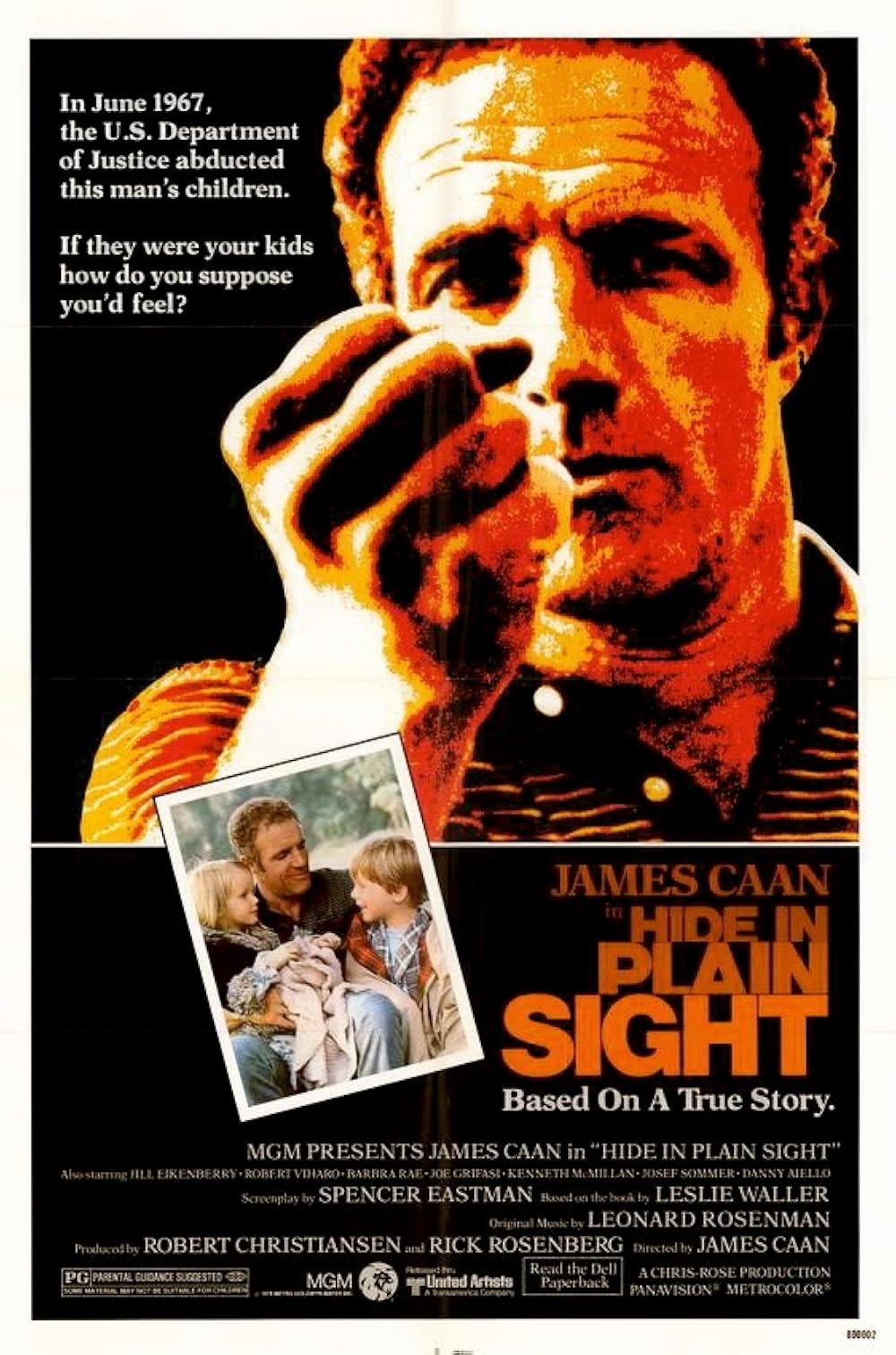
In June of 1967, Thomas Leonhard’s children disappeared. They vanished along with his ex-wife and her new husband. A year later Leonhard would learn that they were given new identities as part of the FBI’s Witness Protection Program. A cement mason in Buffalo, New York, Leonhard spent the next eight years in State and Federal courts trying to win the right to see his two kids. This remarkable story became the subject of Leslie Waller’s true crime novel Hide in Plain Sight, which James Caan would adapt for his directorial debut in 1980. Caan wanted the film to be a “cinema verite kind of thing”, so he shot the film on location in Buffalo, with most of the film unfurling as a low-key docudrama, sticking to the everyday details of Leonhard’s life. United Artists considered it too arty and a money loser, so it did not receive the full support of the studio, despite largely positive critical notices. It has been available on DVD from Warner Archive for a few years, but what led me to Hide in Plain Sight was the Buffalo News’ list of the top ten films shot in Western New York. Buffalo is my hometown, and it hasn’t had much luck on the silver screen, aside from Vincent Gallo’s idiosyncratic Buffalo ’66 and some turn-of-the-century Edison shorts (I am partial to A Trip Around the Pan-American Exposition  (1901)). Locals have always been most proud of The Natural (and its use of Parkside Candy Shop), but for me, Hide in Plain Sight presents a more complete view of the city, from the bars to the factories to the zoo.

In the film Leonhard’s name is changed to “Thomas Hacklin Jr.”, and in Spencer Eastman’s screenplay his job is changed from a cement mason to a rubbery factory worker, for reasons unknown. Caan plays him with mumbling, under-his-breath casualness. Pauline Kael complained that Caan “can’t express anything but ‘huh’”, but Hacklin is a mild-mannered, keep-to-himself kind of guy who keeps his emotions buried down deep. It’s a nuanced, sensitive performance from Caan, which works well against the stellar cast he has assembled. Kenneth McMillan plays  police detective Sam Marzetta with sympathies for Hacklin’s plight, but he’s too busy to do anything about it. Marzetta is a like a beached whale with deli cake crumbs perpetually stuck to his moustache. Then there is Hacklin’s pal  Matty (Joe Grifasi), a hatchet-faced co-worker who offers Hacklin the pleasure of inane chatter. Hacklin spends most of the film in a haze, confused about his children’s disappearance and running up against an apathetic bureaucracy. It’s only when his new girlfriend Alisa (Jill Eickenberry) hooks him up with a competent lawyer (an intense Danny Aiello) that he begins to make some progress. The movie gives Hacklin more of a hero’s ending, including a fight scene where he thwacks a guy with a shovel  (which, Leonhard said, he never did).

Leonhard was fine with the film and its factual liberties. He was just happy to get his story out, telling the New York Times that the important thing was “getting his story told, so it won’t happen to anyone else.”  Not that he did it for free, since he was making $250 a week at the cement factory. He received $20,000 to give up the rights to his story, and one percent of the producers’  net receipts. He became a local celebrity, becoming “one of the biggest heroes in Buffalo since O.J. Simpson.” Caan does a fine job detailing the day-to-day life of Leonhard/Hacklin, starting the film with an impressive crane shot as workers leave the rubber factory, settling in on Hacklin and Matty as they make their way back home. All the markers of Buffalo life are here – there is an old sign for Iroquois Beer when Hacklin goes on a blind date. It was a local brew that traces its opening to 1842, but after a series of mergers and buyouts, the last Iroquois would be bottled in 1980, during the film’s shoot. Then there is the shot of a Bocce’s pizza box, which Hacklin’s ex-wife Ruthie (Barbara Rae) is bringing to her mobster boyfriend. Bocce’s was founded in 1946 and is still in operation today, continuing to feed the mobsters of tomorrow. There are also trips the the Buffalo Zoo, Delaware Park, and a dingy eatery called Gulliver’s on Allen St. This is where Hacklin first encounters Marzetta about the whereabouts of his family. Marzetta sits like a lumpy stone, ham sandwich in hand, refusing to answer questions to Caan’s insistent, desperate dad, Yankees cap firmly set on his head.

This was something of a passion project for Caan, and the way in which United Artists refused to support it soured him on directing – it would be the first and only feature that he directed. While promoting Michael Mann’s Thief in 1981, he vented his frustrations to the New York Times:

I spent two years of my life doing it, and some jerk at United Artists -who’s been fired, thank God – said, ‘This picture isn’t commercial.’ Well, it wasn’t. There were no sharks.Plus I had to listen to speeches like, ‘I’ve been watching rushes for 40 years, and you have to do so and so.’ I’d say, ‘everything’s changed in 40 years. Peanut butter’s changed in 40 years. What are you telling me?’ ‘I mean, the guy put music into my film when I wasn’t there. I said, ‘I don’t want music, I’m shooting a cinema verite kind of thing, so why the hell is the Fifth Symphony coming out of the candy store, all of a sudden?’  He won’t direct again, Mr. Caan says, because ‘everybody wants to do ‘Rocky Nine’ and ‘Airport 96′ and ‘Jaws Seven’ and you look and you listen, and what little idealism you have left slowly dwindles.’

Though the score was imposed, the film seems otherwise unscathed, and Caan imposes some unorthodox maneuvers. During a pivotal argument between Hacklin and his ex-wife, in which she admits to marrying her mobster boyfriend, Caan starts pulling back their increasingly heated exchange until the dialogue becomes inaudible, flooded by traffic sounds. This avoidance of drama, subordinating it background noise, fits the ethos of this whole film, meant to be not just a ripping yarn but a portrait of a Rust Belt city in the midst of decline. I was born the next year, and well-paying factory jobs like Hacklin’s had disappeared by the time I was of working age.

The movie, as real as Caan tried to make it, avoided the difficult truths of the case. Leonhard was reunited with his children, now teenagers, for a summer. But they decided to move back in with their mother in Reno. After nearly a decade of searching for them, they had grown up too much without their father by their side. With great equanimity, Leonhard said, “We still love each other, but I was new to them, I was a stranger, and we didn’t have that closeness of everyday things that parents normally have with their children, things like taking your son to a ballgame, or seeing him graduate from high school, or seeing your daughter’s first date, or watching her dress up for the prom.”

HYPNO-MURDER: SECRETS OF THE FRENCH POLICE (1932)

May 17, 2016

Secrets00006Secrets of the French Police is an everything-but-the-kitchen-sink oddity that flings together police procedurals, adventure serials, and a horror villain with hypno-murder powers. Never settling into one genre for more than a few scenes, it’s totally incoherent and bizarrely entertaining, as it absorbs influences from the famous French Inspector Bertillon to Dracula and The Mystery of the Wax Museum. This RKO programmer from 1932 is now on DVD as part of the Warner Archive’s Forbidden Hollywood Volume 10, and is recommended for those with attention deficit disorder.

600full-secrets-of-the-french-police-poster

Alphonse Bertillon was a turn-of-the-century French detective who pioneered modern investigative techniques, including ballistics testing and criminal identification, which he systematized through a series of biometric measurements. RKO was keen to adapt his story to film, and their text was the series of articles written by H. Ashton Wolfe for American Weekly Sunday Magazine, arranged under the title Secrets of the Surete. Wolfe claimed to be a pupil of Bertillon’s, and was promoted as a “famous British investigator,” but his expertise would come under scrutiny. Per the AFI Catalog,  RKO discovered that Wolfe was a fraud and “wanted on swindling charges in France and England at the time of this production.”

Secrets00001

The timing of all this is unclear, but it is reasonable to assume they discovered Wolfe’s dissembling in pre-production, whereupon they had writer Samuel Ornitz (a devoted leftist and  future member of the Hollywood Ten) do surgery on Wolfe’s material. Ornitz took two of Secrets of the Surete stories, involving a mad sculptor who embalms his models in his art and a deformed thief who steals jewels through hypnosis, with chunks of his unpublished novel The Lost Empress, about the Princess Anastasia. These are improbable, impossible elements to combine into one script, but Ornitz plowed forward, and RKO approved. Presumably the timing was tight and they needed something, anything to film, so voila, here we have Secrets of the French Police, directed by Edward Sutherland.

Secrets00010

The Wolfe character is turned into St. Cyr (Frank Morgan), a Bertillon-type who uses newfangled technology to track down killers, including a facial recognition technology that provides one of the more striking images of the film. He is investigating the kidnapping of flower girl Eugenie (Gwill Andre), who is being held by the mad Russian-Chinese hypnotist/sculptor Hans Moloff (Gregory Ratoff), who speaks in an unexplained Dracula-accent. Moloff’s plan is to hypnotize Eugenie into thinking she is Princess Anastasia, thereby gaining access to her royal fortune. And yes, he kills and embalms models inside wax sculptures as a hobby. Eugenie’s boyfriend Leon (John Warburton) is an infamous thief, but he teams up with St. Cyr to rescue Eugene and take down Moloff.

Secrets00011

Despite writing the above paragraph, I have no idea what happened in this movie. It is all packed into less than an hour of runtime, so when we are ready to settle into a police procedural with Frank Morgan as your amiable Sherlock Holmes knockoff, it turns into a baroque horror movie with secret underground chambers and evil laughing madmen. Time is relative inside Secrets of the French Police, as characters are introduced and then immediately killed off (or just forgotten) —  at a certain point inside Moloff’s torture mansion I forgot St. Cyr was still investigating a murder. It’s a pleasurable collision, a Frankenstein’s monster of mismatched movie parts. But what parts!

Secrets00013 Secrets00014 Secrets00015

Frank Morgan does a fine pantomime drunk routine while trolling for information at a rooming house, and then strolls into his super-cool crime lab as his beehive of assistants assemble a gigantic portrait of Eugenie from a hodgepodge of descriptions. It is the most striking image of the film, a romantic portrait conveyed in giant puzzle pieces of cardboard on a police station’s wall. St. Cyr could be a superhero if he only had the powers; he already has the acting chops and the sweet high-tech lair. And Moloff could be a formidable villain with his mesmerizing eyes and murderous sculpting powers.  He is no great shakes at long-time planning, however, as there is no plausible endgame to his Anastasia ruse. Why would the Romanov family ever believe that this narcotized Parisian flower girl was their relative? Moloff would have been better off hypnotizing bank prison guards and robbing the vaults. But I digress. What Moloff IS very fine at is murdering models and embalming them in wax casts, a routine suspiciously repeated that same year in Michael Curtiz’ Mystery of the Wax Museum. One suspects that RKO execs or Ornitz read the Wax Museum script and incorporated some elements from it into their already overstuffed feature.

Secrets00008

Moloff’s most impressive killing is neither of the hypnotic or sculpting variety though, but an insanely elaborate back projection illusion set-up on a country road. Moloff’s goons set up a back projection rig inside of a billboard on a country road. When a car comes near, the projector is triggered, throwing up a gigantic image of a car bearing down directly toward oncoming traffic. The target, thinking there will be a head-on collision, makes a hard right turn, and crashes off a bridge into a stream. A needlessly elaborate way to kill someone, perhaps, but incredibly impressive all the same. Moloff is the king of all media when it comes to murdering people. Secrets of the French Police is an impossible film and a lovable one, displaying all the ingenuity and limitations of the studio system. Faced with a looming production deadline the RKO writers and technicians had to throw something on-screen, so faced with an impossible task, they made an impossible film.

BLOOD MONEY: TOO LATE FOR TEARS (1949)

May 10, 2016

ct-too-late-for-tears-20140828After viewing Too Late For Tears (1949), I would advise all couples against accepting cash-stuffed valises of mysterious origin. Sure, it would be nice to be raised up out of your dead-end middle-class marriage, but there is the whole issue of the money’s source, and the pile-up of bodies that keeping the cash may entail. Too Late For Tears is a vicious little film noir with a flinty, sociopathic performance by Lizabeth Scott, but it had been in public domain purgatory for decades, circulating in muddy transfers under its re-release title Killer Bait. The Film Noir Foundation has lobbied for its restoration for years, and with the help of a Hollywood Foreign Press grant, the UCLA Film and Television Archive was able to reconstruct the film from a 35mm nitrate French dupe negative, a 35mm acetate re-issue print, and a 16mm acetate. The result can be seen in a superb new Blu-ray from Flicker Alley, complete with Alan K. Rode audio commentary and a highly informative essay by Brian Light. Too Late for Tears Poster (2)Too Late For Tears originated in a novel by Roy Huggins, which was first serialized in the Saturday Evening Post in April and May of 1947. The rights were snapped up by United States Pictures (who had an output deal with Warner Brothers), but were soon passed on to independent operator Hunt Stromberg, who planned it to be his follow up to his Douglas Sirk thriller Lured, which was opening that September. Stromberg had been one of MGM’s top producers in the 1930s, overseeing The Thin Man series, Best Picture Winner The Great Ziegfeld (1936), and Cukor’s The Women. He started his career in the silents as an independent producer, and he returned to that role in 1943, starting Hunt Stromberg Productions with the Barbara Stanwyck hit Lady in Burlesque. But Lured failed to perform at the box office, and Stromberg struggled to find financing for Too Late For Tears. It took him two years to cobble together an “unusual” deal, per the New York Times, in which Republic Pictures would provide studio facilities and financing for a film that United Artists would distribute. Republic normally distributed their own product, but here would “participate heavily in the profits” instead – though none were in the offing. The desired cast of Joan Crawford and Kirk Douglas failed to materialize, so instead Stromberg brokered yet another deal, borrowing Lizabeth Scott, Don DeFore, and director Byron Haskin from Hal Wallis. Publicity_still_for_-Too_Late_for_Tears-_(1949)Roy Huggins was retained to adapt his book into the screenplay, and according to Brian Light’s essay the film hews closely to the novel. It is about Alan (Arthur Kennedy) and Jane (Lizabeth Scott) Parker, a bickering couple who can’t decide whether to attend a dinner party, so they turn around and go home instead. A blackmail victim mistakenly takes their veering as a signal, and drops a $60,000 payoff bag into their car. Jane is immediately smitten with the valise, her eyes flashing with desire, while buttoned-up Alan wants to turn the cash into the police. With no hesitation Jane starts her manipulations, asking him to keep the money only for a week, just to see if anyone comes looking. Someone does, in the form of Danny Fuller (Dan Duryea), a clumsy, violent chiseler who is determined to shake Jane down for the bag. But Jane plays them both for saps, stringing them along, giving them want they want to hear (and see). She preys on Alan’s insecurities, as in the withering exchange when he says,  “I’ve tried to give you everything you wanted, everything I could.” Jane replies, “Yes, you’ve given me a dozen down payments and installments for the rest of our lives.” toolatefortears_1949_mbdtola_ec006_h_11145_While she plays the dissatisfied wife with Alan, she is going full hardened femme fatale with Danny, a cold, calculating criminal mind. He is instantly attracted to her, and he responds in the only way he knows how, with misogynistic violence, slapping her around. But Jane paws him away like a lion with its prey, and soon he becomes her errand boy, covering up Jane’s increasingly brazen crimes. She pushes him so hard he breaks, ending in a self-pitying puddle of boozy tears. Dan Duryea is the embodiment of hollow machismo, a fast-talker with no backbone to support it. It is a slangy and loose performance – at his most arrogant he pronounces “tedious” as “tee-jus”, bending words to his will. But few can hold up to Jane’s steely-eyed assault. Lizabeth Scott did not think kindly of Too Late For Tears, telling Alan K. Rode that it was her “least favorite film”, but she is truly terrifying in it. It is a cold, unrelenting, and entirely unsympathetic performance. At no point does she beg for the audience’s understanding, you can see the calculation in her eyes from the start. Once she opens that bag, Alan becomes an inconvenience to her, so every smile becomes a sneer the nanosecond he turns his back. Film Noir Poster - Too Late for Tears_01The only guy who can take her down is a doughy interloper who claims to be Alan’s old war buddy. Don (Don DeFore) is in fact a figure from Jane’s past who is seeking revenge for one of her previous trespasses upon the male sex. The supposed hero of the story is also the least interesting, a clean-cut Hardy Boy with no interior life who is present merely to nudge the story along. In the fallen world of the movie, it is jarring to see such a square. One wishes Duryea’s character could have been expanded and become Jane’s main foe – a duel to the death of two dead-enders. But the film was already getting harassed by the censors, so, as ever, we should be grateful for the perversities we are left with.

LOST AND FOUND: THE MAN AND THE MOMENT (1929)

May 3, 2016

ManMoment00019

The light comedy The Man and the Moment (1929) was considered lost until a dupe negative was recently discovered at Cineteca Italiana di Milano. This part-talkie from First National Pictures was restored in 2K by Warner Bros. at L’Immagine Ritrovata laboratory in Bologna, and was released on Warner Archive DVD last month. A charming proto-screwball comedy, it’s about a marriage of convenience between a rich playboy and an impetuous adventuress that ends up destroying planes, boats and nightclub aquariums. Made during the transition to sound, it exemplifies the stereotype of that era’s stiff, static line readings. It has snap and vigor in the silent sequences, and grinds to a halt for dialogue. This is not aided by leading man Rod la Rocque, who is a debonair charmer in the silent sequences and a wooden statue during dialogue. His co-star Billie Love is more of a natural, and she waltzes away with the film.

ManMoment00010

Adapted from an Elinor Glyn best-seller, The Man and the Moment finds Jane (Billie Love) and Michael (La Rocque) at a personal impasse. Jane has a passion for flying, but her strict guardian forbids her to continue her training in the air. Michael, a rich bachelor, is being blackmailed into marriage by the slinky Viola (Gwen Lee). They meet when Jane crash lands her plane into one of Michael’s “Polo Boats” (he plays polo with sea crafts rather than horses – as he is super rich and super bored). They realize that they can solve both of their problems with a quickie marriage. Jane will gain independence from her guardian and Michael can undermine Viola’s scheme. So together they agree to wed, with the understanding it is purely a business arrangement, and that they will divorce soon after. Nothing goes as planned, of course, as Michael instantly falls in love with Jane, and Jane skedaddles, sick of his advances. Jane ends up at Viola’s house, where the various strands of the plot converge and tangle in a wildly convoluted finale.

ManMoment00007

Variety wrote that director George Fitzmaurice, “has diluted the Glyn molasses so that the screen version avoids most of the love licorice and dwells on the comedy situations.” Agnes Christine Johnston adapted the story into a script, while the spoken dialogue is credited to Paul Perez. The inter-titles set the tone of the decadent milieu, one reads that Michael’s yacht was “lit by electricity – the guests by noon.” Michael is introduced playing “boat polo”, driving a motorboat with a woman on the stern trying to hit a beach ball towards a goal. It looks insanely dangerous, and Fitzmaurice anchors a camera to the back of a speeding polo boat to emphasize the needless danger of the enterprise. The opening inter-title of the film states: “No person ever dashed their brains out playing Polo Boat – because no person with brains every played polo boat.” Michael is thus introduced as a self-destructive decadent frittering away his wealth on near-death experiences.

Exhibitors Herald World February 2 1929

Jane is something more of a mystery. Johnston’s script cuts out any explanatory backstory, so what we are left with is a stuffy guardian (the status of her parents is unknown) and her love of flight. Despite this lack of characterization Billie Dove invests Jane with a winsome ebullience. She is fearsomely independent and lonesome because of it. Most of her identity is wrapped up in her plane. In one telling sequence she blows off Michael by manipulating elements of her plane, knocking him down with wing flaps and blowing him into the water with the engine. She feels strongest when in control of the machine. She loses control of herself when she is accepted into Viola’s circle, and is invited to an “Under the Sea”-themed party (from “8pm – Blotto”, per the invite), complete with giant human aquarium. There she tests out her flirtation skills against Viola’s (impossible, for Gwen Lee is a superb vamp, a sinuous haughty cigarette smoking machine aimed at rich bachelors), and ends up in the tank with a fellow inebriate. Michael can only get her out by smashing the whole thing to smithereens, depicted through the use of endearingly fake miniatures.

ManMoment00022

Michael and Jane’s jealousy is now destroying private property, and they need to work things out on their own. Unfortunately this means more dialogue, which Fitzmaurice and his team are ill-equipped to handle. The film’s audio was shot on Vitagraph disc, providing sound effects for the entire feature, and dialogue for a select few. The surviving source was re-cut for silent exhibition, and, as the stated before the feature, “some of the dialogue sequences were truncated. Inter-title cards in place of the missing footage have been inserted into the feature.”  This means the inter-titles appear during the dialogue sequences, a disorienting necessity to maintain synchronization. Regardless, La Rocque is audibly uncomfortable with the dialogue, speaking in monotone as if reading the phone book. Fitzmaurice keeps the dialogue scenes almost exclusively in long, static two-shots, with no sound editing to massage the rhythm. I’ve always found the “static” early sound film to be a canard, as there was intense experimentation going on with the new sound technology at the time, audible in how Von Sternberg uses off-screen space in his contemporaneous film Thunderbolt (1929). But The Man and the Moment is just trying to get the sound-on-disc and move on as quickly as possible. Billie Dove comes off the best in the dialogue sequences, as she has an inviting, conversational tone. Though working with flimsy material, Dove conveys an appealingly clumsy flirtatiousness while La Rocque barely sounds present.

ManMoment00024

But even with the technical drawbacks, The Man in the Moment provides a diverting evening at the movies, mainly due to Billie Dove and some outrageous set-pieces. How much you enjoy it may depend on your enjoyment of late ’20s/early ’30s fantasies of wealth (I have a high tolerance). The New York Times reviewed it and wrote: “The Man and the Moment seems designed for those who do not think Mrs. Glyn’s plots fatuous; who like love in airplanes, in yachts and among the members of high society; who would prefer thinking themselves on the beach at Monte Carlo, and who believe that the Four Hundred go to cocktail parties in silk pajamas.” If you check off all those boxes like I do, do give The Man and the Moment a spin.