THE SAMUEL FULLER COLLECTION

October 20, 2009

it-happened-in-hollywood.117025

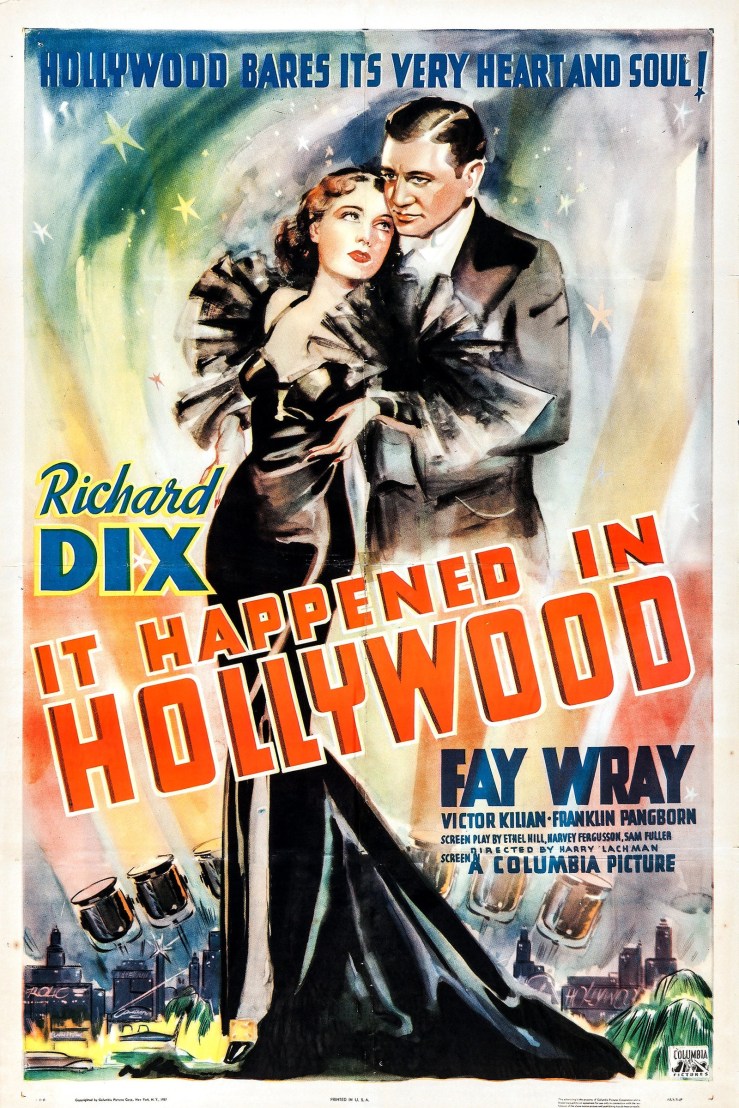
For the next two weeks I’ll be knee-deep in The Samuel Fuller Collection, a seven-disc set being released on October 27th by Sony Pictures, in association with Martin Scorsese’s heroic film preservation organization, The Film Foundation. It’s a doggedly auteurist production that traces the contours of Fuller’s entire career, presenting five of his writing gigs (It Happened in Hollywood (1937), Adventure in Sahara (1938), Power of the Press (1943), Shockproof (1949) and Scandal Sheet 1952)) along with two lesser-known directorial efforts (The Crimson Kimono (1959) and Underworld, U.S.A. (1961)). In this marketplace it’s downright courageous to release these later subterranean slices of Fuller, and just about saintly to include some of his early writing jobs. As the juvenilia of other great artists like Picasso are studied in the context of his life’s work, so should the early scribbling of this brusquely unique American. Without an institution like the Library of America to preserve and present a director’s work in the proper context (instead of being thrown to the wind in various star-themed sets), it’s up to studios to flog their geniuses, and their priorities clearly lie elsewhere. So much of the credit to this release must lie with Scorsese and his Film Foundation, who also released the essential Budd Boetticher Collection last year, and produced the Columbia Pictures Film Noir Classics set due November 3rd.  In convincing Sony to release these films in cleaned-up masters, he’s keeping the spirit of serious film appreciation alive.

The earliest film in the set is a sprightly little comedy spiced with melancholy, It Happened in Hollywood(1937). It was Fuller’s second credit in Hollywood, after he wrote the scenario for Hats Off (1937), an elaborate bit of slapstick he conceived for Boris Petroff, who directed Mae West’s variety shows on Broadway. In his autobiography, A Third Face, he says about Hats Off that, “the finished film had just about nothing to do with my original story. Petroff fashioned a movie that made people forget about their problems. I’d wanted to expose man’s foolish belligerency.” That characteristic, foolish belligerency, is what pops up again and again in these early screenplays, regardless of the damage done to his scripts by the studios. Each film in the set, to varying degrees, contain a vague anti-authoritarian streak, whether the conservative mulishness of Richard Dix in It Happened in Hollywood or the violent resentment of Paul Kelly in Adventure in Sahara. But let’s start with the former, which is one of the minor delights of the set.

Directed with studied reserve by Harry Lachman, it’s a self-reflexive bit of Hollywood fantasy. He wrings a couple of surprising effects out of the material. The first is the opening, which shows Dix rescuing Gloria Gay (a luminous Fay Wray) on his noble horse Toby. It’s unclear that this is a film-within-a-film until the laughter and cheering of kids fill the audio track. Then the camera slowly pulls back from the screen and into the children’s hospital where Bart is holding court to an enraptured crowd. This clever shot establishes the construction of Bart’s image, how it is shaped by the frame and his fans outside of it. He is not a free man.

Based on the career of Tom Mix, it follows Tim Bart (Richard Dix, drawling as if his tongue were bathed in molasses), a hugely popular silent Western star who flops upon the transition to sound. With his ranch about to be sold, the only thing rooting him to Hollywood is the adoration of his sole remaining fan, an infirm boy who calls himself Billy the Kid. In a wild attempt to make Billy’s wish come true and meet all of his silver screen heroes, Bart gathers a menagerie of celebrity stand-ins and arranges a faux star-studded bash, a clever bit of burlesque celebrating Hollywood’s unseen working class. The affected hauteur of the Marlene Dietrich impersonator while rejecting a morose fake-Clark Gable is particularly amusing.

Lachman achieves a surreal carnival effect at the stand-in party, especially on a slow tracking shot down the dinner table, as W.C Fields, Charlie Chaplin, and Victor McLaglen impersonators cavort and mug as if they were in an old vaudeville routine. Fuller’s touch is all over this film, especially in its skepticism towards the idea of heroism and the idealizations that surround it (Fuller’s original title was Once a Hero). Tim Bart’s heroism is a clear construct, a virtue built by the studios and disposed of when technological advances make other stories more appealing. His aura is built by the production machine, and just as easily destroyed. There’s a devastating montage of all of Bart’s paraphernalia getting incinerated, cardboard cut-outs and sheriff badges going up in flames. That it was based on the story of Tom Mix gives the whole enterprise a feel of a low-budget valediction, and Bart’s improbable resurrection as a star at the end can be forgiven as a kind of wish-fulfillment fantasy for that faded star. Fuller is credited as screenwriter on the film along with Ethel Hill and Harvey Fergusson.

Adventure in Sahara is an altogether different story, a dire little tale of mutiny in the French Foreign Legion. C. Henry Gordon plays a sadistic commander who drills his soldiers to death. Jim Wilson (Paul Kelly) hears of his brother’s death at this fascist’s hands, and enlists to seek revenge. He succeeds in leading a mutiny, kicking the officers out into the desert. But Gordon returns, and someone will have to pay… The film was directed rather anonymously by D. Ross Lederman, and the script was written by Maxwell Shane, as Fuller receives only a story credit. Aside from Wilson’s anti-fascist, anti-authoritarian bent, very little of Fuller’s personality shines through. The film twists itself in knots trying to show respect for military protocol as well as individual freedoms, and it turns into ideological mush. Gordon gives a deliciously hammy performance however, answering all questions with a beady eye and a crick in his neck. Fuller’s anecdote about his inspiration for the story is more entertaining than the movie itself:

He [Sam Briskin, head of Columbia] asked me if I could write an adventure movie for the studio. He may as well have been asking me if I could bake a seven-layer cake…. I took out a cigar and slowly prepared to light it, buying a few moments to figure out a way out of this mess. Briskin never took his beady eyes off me. I lit the cigar, blew the smoke out of my mouth, and proudly announced, “William Bligh meets Victor Hugo!” ‘Who the hell are they?’ snarled Briskin.

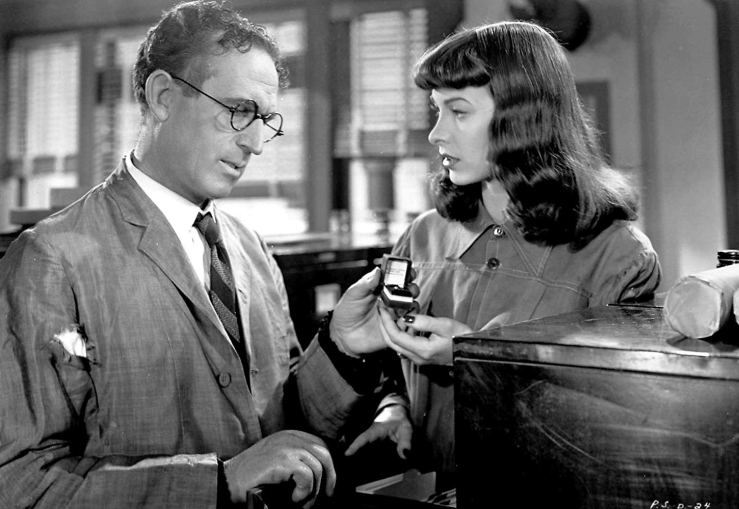
While working on his novel, The Dark Page, Fuller was knocking out scripts on the side to make a living. One of these was 1943’s Power of the Press, directed by Lew Landers, original story by Fuller, screenplay by Robert Hardy Andrews. This film stands as a curious precursor to his ode to journalism, Park Row(he was previously a crime reporter for the New York Evening GraphicThis film, mediated by Landers and Andrews, replaces his snarling wit with a series of moralistic speeches about the perils of isolationism. It is about a publishing magnate, John Cleveland Carter, who has a late change in heart about his yellow journalism practices, which threatens the domain of an oily fifth-columnist, Rankin. Gangland killings ensue, and after the dust settles, it’s a mild-mannered power battle between Rankin and Guy Kibbee, who plays a Horace Greeley worshipping small-town editor with whom Carter endowed his paper.

There are an endless number of comparisons to Rankin and his goons with Nazis. They run the place “like the Gestapo”, Rankin’s assistant is “a Himmler” and so on. The flavorful performances, Lee Tracy’s soulless managing editor first and foremost, prettify the propaganda machinery, but it eventually grinds to a halt with a series of static monologues about free speech and the dangers of isolationism. Fuller’s politics were probably similar at the time, but he would have never staged them so slowly or humorlessly. The only character with a whiff of Fuller’s life force is Eddie (Gloria Dickson), Carter’s secretary and the brains behind Kibbee’s goal to clean up the New York Gazette. She bulldozes through the publisher without a thought to her status or role, simply following her impulse.  Gloria is a little stiff as a performer, but if you squint hard enough, you can see the outlines of Barbara Stanwyck in Forty Guns.

Next week I’ll (hopefully) have an interview with Christa Fuller, Sam’s wife, as well as a discussion of the remaining titles in the set.

THE 2009 NEW YORK FILM FESTIVAL

October 13, 2009

hye-ja_wide-fde574854a398541a30f8bce882e23312e077f4c-s800-c85

The coverage of this year’s New York Film Festival was weirdly tendentious, culminating in A.O. Scott’s bizarre NY Times dispatch in which he claims (I paraphrase), that there is a cabal of scheming festival programmers who hate humanity and eagerly promote films which espouse a “principle of innate depravity.” I’m (slightly) exaggerating his argument, but he adopts a strikingly strident tone for a diverse slate of movies, grandly sweeping complex works of art into his “festival” category so he can haughtily ignore them. What he yearns for, it seems, are films of “high-minded middlebrowism.” Don’t we have the next two months of Oscar-bait to satisfy that particular need? I’d much rather have a rare screening from an experimental young Filipino filmmaker like Raya Martin than the latest Sam Mendes chin-scratcher that will be released nationwide the following week.

Two of the films he dismisses under the “innate depravity” tag are Bong Joon-ho’s hugely entertaining Mother and Claire Denis’ mesmerizing White Material. I love innate depravity! Mother is a unique blend of police procedural and melodrama of suffocating motherly love. Opening on a shot of the galvanic lead, Kim Hye-ja (famous in Korea for her portrayal of maternal roles), sinuously dancing in a glade of flowing high grass, Bong is announcing the film’s playfully enigmatic tone. The shot is an amusing non-sequitur until the plot reveals its seedy secrets.

Kim is the unnamed mother of Do-jun (Weon Bin), a soft-spoken simpleton who can barely string a sentence together. Their relationship is combative and creepy. Mother stalks his every move, inching up to him as he pisses against a wall, lifting a bowl of “medicine” to his lips. As the urine pools on the sidewalk, she tries to cover it up with a street side hunk of trash. This kind of suffocating attention is twisted inside out when Do-jun is accused of murder. Artlessly bulldozing her way through the crime scene and the victim’s friends, she styles herself a one-woman truth commission. She is an incredibly unreliable narrator, riveted on clues that lead to digressive dead ends and a motley crew of supporting characters. Do-jun’s erstwhile “friend” Jin Tae (Jin Gu) is the most fascinating of these ghouls, a self-styled Dirty Harry who milks the mother for money while doggedly, and quite violently, pursuing the lurid clues in the case.

Bong moves among these different plot strands with startling precision, steadily layering motifs (of pooling liquids that build in malevolence, from the aforementioned urine up to the blood on a dirt floor) until they effortlessly evoke the complicated moods of its compromised protagonists. The way he levers the mother’s acupuncture kit into a moment of tragedy is a master class in scripting and composition. It’s the most devilishly enjoyable film I’ve seen in quite a while. Luckily it has been acquired by Magnolia and will be released early in 2010.

Denis’ immersive, knotty White Material is a return to the more allusive, abstract style of L’intrus after the more straightforward family drama of 35 Shots of Rum, with Material’s multiple flashbacks and fragmentary narrative. Set in an unnamed African country (although shot in Cameroon) suffering from a protracted civil war, Isabelle Huppert’s Marie is hanging on to her family’s coffee plantation long after safety would dictate she return to France. Denis’ first film without cinematographer Agnes Godard since 1990s No Fear No Die(Bruno Dumont’s regular DP Yves Cape takes the reins here), it still maintains her tactile, overwhelmingly physical sense of space. The camera lingers on Marie’s “white material”, her upholstered seats, gold-plated lighters, and cotton blue dresses.

Denis lolls back and forth between these spaces of buzzing comfort and the pastoral scenes of rebel activity outside. Violence is generally kept off-screen, while ragtag groups of teens, and some small children, carry machetes and rifles along the rugged countryside. As the country descends into chaos, the boundary between house and country breaks down, and Denis repeats an earlier montage of household items: iron, bathtub, dress. Two armed African children enter the space, steal her clothes, muddy the tub, and are spirited away. There’s an extraordinary sequence where the child soldiers revert to an innocent state, play games, and fall asleep in Marie’s home, and Cape’s camera caresses their victimized bodies as if of a loving parent. Denis later dedicates the film to these “rascals” who have had their lives stolen from them.

This incursion marks the inevitable breakdown of the line between colonizer and colonized, and soon Marie, increasingly hysterical and determined to keep the only success of her life, is doomed to fall under the sway of the country’s destruction. It’s woozy and masterful, exploding into pure metaphorical chaos as the paternalism of France, the greed of the government, and the horrifying violence of the rebels break down the bonds of a corrupted society. It demands to be seen again, and I hope a distributor takes a chance on it. Hey, Denis’ previous film, the sublime family drama, 35 Shots of Rum, has had a successful run in NYC, so here’s hoping.

Quick takes:

Another favorite at the festival was Jacques Rivette’s small gem Around a Small Mountain, which is anchored by Sergio Castellito’s phenomenally detailed performance. A traveling circus is on its last legs, and Jane Birkin returns to the fold after a tragedy drove her away decades earlier. Castellito is just a curious interloper, but one with a silent comedian’s grace. His performance is essentially a pantomime, from the wordless car repair opening to his coiled tension and release entrances and exits, it’s a tour de force of timing and charm. No distributor.

Eccentricities of a Blonde is another remarkable sliver of a film, this one from 101 year old treasure Manoel de Oliveira. In setting Eça de Queiroz’s short story of courtly love in modern-day Lisbon, he gets great anachronistic effects from a poet’s recitation, an uncle’s growling rejection of a marriage vow, and the curling irony of the final, puppet-like shot of resignation. No distributor.

Police, Adjectivefunny about language and Romania’s bumbling law enforcement bureaucracy, nailing a Kafkaesque sense of the absurd. The Romanian New Wave has legs in it yet. IFC Films will release this next year (they are also releasing Lars Von Trier’s Antichrist on October 23rd, which was neither as horrible or shocking as you might expect. It’s a tossed off domestic horror film that contains moments of beauty, terror, and ridiculousness. A decent Trier experiment).

Trash HumpersThe title says it all, but I found this fake piece of found footage to be oddly affecting. As Harmony Korine and pals don elderly people masks and debauch around flourescent-lit parking lots and basements, shot in the oatmeal murk of old VHS tape, a performative truth rang out: humping trash is funny. No distributor.

To Die Like a Man: A drag-queen melodrama filled with graceful touches. Director João Pedro Rodrigues’ playful color manpulation lifts a few of the musical sequences to the plane of back-alley Minnelli. No distributor.

So, as it turns out, there was a vast scope in this year’s slate, and I only saw 8 of the 29 entries! If I didn’t discover any stone-cold masterpieces (unlike the previous year’s Headless Woman), there was plenty of bold experiments, minor pleasures, and strangely alluring waste baskets.

FARBER ON FILM: THE COMPLETE FILM WRITINGS OF MANNY FARBER

Originally published at Movie Morlocks, the official blog of Turner Classic Movies

October 6, 2009

The Library of America has released a wriggling mass of Manny Farber’s prose, and now the world is a (slightly) better place. Farber On Film: The Complete Film Writings of  Manny Farber (edited by Robert Polito) is a maddening, insightful and frankly thrilling collection of his writing on movies (and a little on TV) from 1942 – 1977. It includes the work that made up his previous compilation, Negative Space, plus a massive trove of reviews from the The New Republic, The Nation, and lad mags like Cavalier (he requested that his capsules for Time be left out, feeling that the editors rendered them unrecognizable).

In his valuable introduction, Polito says “his writing can appear to be composed exclusively of digressions from an absent center.” To borrow his own term, Farber approaches his subjects termite-like, gnawing at the edges of the films, ignoring plot summary and character psychology to focus on movement and composition, informed by his long career as a painter. He does not treat a film as a monolith, a hunk to be labeled as good or bad and then forgotten. He engages with every aspect of a film, emphasizing its collaborative nature. He breaks down performances, compositions, and dialogue with equal vigor with his jagged, jumpy and allusive prose. It’s often impossible to tell whether he likes a film or not, as he builds up and tears down a production from every angle.

Reading his reviews is like witnessing an archaeological dig, nosing around his celluloid sites for objects of interest, or for banalities worth exposing. And when he digs in to something, his descriptions pop off the page. In a 1943 New Republic piece, he analyzes the Bogart species:

“[he] looks as though he had been knocked around daily and had spent his week-ends drinking himself unconscious in the back rooms of saloons. His favorite grimace is a hateful pulling back of the lips from his clenched teeth, and when his lips are together he seems to be holding back a mouthful of blood.”

Or this Artforum piece on Howard Hawks from 1969 (one of my favorites):

His Girl Friday is one of the fastest of all movies, from line to line and gag to gag. Besides the dynamic, highly assertive pace, this Front Page remake with Rosalind Russell playing Pat O’Brien’s role is a tour de force of choreographed action: bravado posturings with body, lucid Cubistic composing with natty lapels and hat brims, as well as a very stylized discourse of short replies based on the idea of topping, out maneuvering the other person with wit, cynicism, and verbal bravado.

This isn’t just pungent writing, although it’s certainly that (it’s impossible to see a Bogart film now without peeking for a trickle of red down his lip), but it also prescribes a way of seeing. This emphasis on a performative detail, his “pulling back of the lips”, reveals a sensibility that is specifically cinematic. He’s concerned about movement that reveals character, facial tics or otherwise, as well as its relationship to the frame it’s traipsing about in. He offers due respect to a well-turned phrase, but he rarely pays much notice to plot, which is often described as a cliched nuisance. He praises Hitchcock’s Shadow of a Doubt because it “is an example of what the movies might do in breaking with the idea that the story is more important than the movie.”

He’s concerned with what is buzzing beneath the strained scenario, the people who imprint their signatures on a film regardless of pedigree. Cary Grant’s grace and Jean Arthur’s Arthurness (“she is both an ordinary girl with ordinary reactions and a scatterbrain who wears birds’ nests on her head and at normal times is out of breath from running or screaming or hitting someone on the chin”) transcend their roles. They are still just people in front of the camera. In this vein, Farber also has a fascinating series of articles on WWII documentaries, and in which he prophetically states, “the difference between the documentary and the story film in the final esthetic evaluation is unimportant”. International auteurs like Abbas Kiarostami and Jia Zhangke have been pursuing this line of thought for the last decade with astonishing results.

Then there are his hugely entertaining reflections on movie-going itself. There is his famous statement in “Underground Films” (1957) that:

The hard-bitten action film finds its natural home in caves: the murky, congested theaters, looking like glorified tattoo parlors on the outside and located near bus terminals in big cities. These theaters roll action films in what, at first, seems like a nightmarish atmosphere of shabby transience, prints that seem overgrown with jungle moss, sound tracks infected with hiccups. The spectator watches two or three action films go by and leaves feeling as though he were a pirate discharged from a giant sponge.

But he was a brave sociologist since 1943, when he complained: “Who builds movie theaters? If you seek the men’s room you vanish practically away from this world, always in a downward direction.” His roving eye was always searching for the errant telling detail, even when it was off the screen and down the stairs.

In a fascinating panel discussion upon the release of the book last week, Polito was joined by Greil Marcus, Kent Jones, and Geoffrey O’ Brien to discuss Farber’s life and work, which informed a lot of this piece. There are a few other stray items from their talk I wanted to bring out. First,  that Farber’s interests were circumscribed by the distribution patterns of the ’40s and ’50s. He discussed mostly Hollywood product because that’s all he could see at the time. Once foreign and experimental film became more readily available in the U.S., Farber expanded his taste likewise, becoming an articulate interpreter of Michael Snow, Chantal Akerman, Rainer Werner Fassbinder, and Jean-Luc Godard, among others. Kent Jones also discussed Farber’s teaching notes, which he was able to look at for a book he’s helping to publish with Farber’s wife and collaborator Patricia Patterson. Farber lectured on cinema at UCSD until the late 80s, after retiring from film criticism to focus on his painting. Jones divulged little as to their contents, only that they were “amazing” and further represented the constant re-evaluations Farber engaged in with the works he was intrigued by.

I’ll close by paraphrasing Kent Jones again: The publication of Farber on Film is not just a landmark for American film criticism, but for American literature as a whole.

For further info on Farber and the book, well, buy the book, but also read Jonathan Rosenbaum’s article at the Moving Image Source, and Paul Schrader’s remembrances at the same site. For insight into his painting, the exhibition book About Face is a great introduction.

DIGGING INTO THE WARNER ARCHIVE: EXPERIMENT PERILOUS and THE TALL TARGET

September 29, 2009

experiment perilous

The Warner Archive is murdering my bank account. The latest culprits are Jacques Tourneur’s Experiment Perilous (1944) and Anthony Mann’s The Tall Target (1951). After my first purchase, documented here, I’ve tried to stay away from the service, what with its un-restored prints and overpriced DVDs ($20 is a lot for a burned disc), but they are pumping out an endless array of rare goodies that would tempt even the cheapest cinephile. I couldn’t stay away for long.

I was drawn to Experiment Perilous because of the praise of Chris Fujiwara, who in his definitive study of the director, The Cinema of Nightfall, described it as “one of Tourneur’s most personal and beautiful films.” It’s also one of his most unknown, at least from my perspective, having not heard of it until it popped up on WB’s release schedule. It’s most famous, perhaps, for containing a mesmerizing performance from Hedy Lamarr, her own favorite, as she relays in her decadently titled autobiography, Ecstasy and Me.The print used on the DVD contains adequate sharpness, but has suffered a decent amount of wear and tear over the years. There is a consistent amount of scratches and dust marks, but nothing terribly distracting. It’s watchable, if nowhere near pristine.

In 1944, Tourneur was coming off the lower budgeted success of his Val Lewton horror films, having churned out the remarkable duo I Walked with a Zombie and The Leopard Man the year before. Handed an A-picture budget from RKO, he delivered Experiment Perilous, a Victorian age psychological thriller often compared to Gaslight, which was released the same year. It’s an adaptation of the novel by Margaret Carpenter, which screenwriter Warren Duff altered by moving the setting from the present day to the turn of the century. It was rumored that Hedy Lamarr’s request to wear period costumes necessitated the change, but Fujiwara reports that it was more of  narrative decision:

Executive producer Robert Fellows offered a more reasonable explanation: ‘It was felt that the slightly archaic quality of the heroine, who appears in the book as a cloistered and frustrated orchid, would lend itself to a clearer expression on the screen if presented against a less realistic background.’

Hedy Lamarr’s Allida is not just a “cloistered and frustrated orchid”, but is quite possibly mad. Or at least her older husband Nick Bedereaux (Paul Lukas) seems to think so. He employs Doctor Bailey (George Brent) to look into her curious peccadilloes, which include sending herself daisies and then denying doing so, and hallucinating that she is being followed.

Tourneur opens the film with a train ride, in which Bailey is introduced to Nick’s bird-like spinster sister Cissie. In a voice-over, he opines that Cissie herself might be insane, as she clucks at him about her home and family like he was an old friend. Tourneur frames him against a mud-spattered window, and then captures their mottled shadows on his suit jacket (see right). This minor contact with the Bedereaux family has soiled him, and this mark dooms him to further entanglement in their sordid story.

Once home, he joins a fashionable dinner party, admiring a snake-haired female statue his pal Clagg unveiled. Tourneur emphasizes Bailey’s connection to this image of the Medusa, joining him first in medium-shot, then pushing into a close-up. Clagg’s attempt to demonize womanhood through his art speaks to Nick’s impotent attempt to harness Allida’s sexuality, and Bailey’s low-key Perseus is here to slay that demonization.


Tourneur lavishes most of his attention on the Bedereaux home, in the stunning set design of Albert S. D’Agostino and Jack Okey. This vision is of an accumulation of knickknacks and rooms within rooms, a gilded prison to keep Allida busy and away from the prying eyes and more virile bodies of possible pursuers. Fujiwara notes:

The incredible profusion of bric-a-brac in the Bedereaux house not only makes us aware that Allida is merely another piece – albeit the centerpiece – in Nick’s collection but also creates a stifling atmosphere that correlates with Allida’s panic.

Just inspect the image I started the piece with. Allida is in the right foreground, arguing with Alec, a young poet-admirer, who stands askance at the fireplace. Nick is reflected in the far left-hand side of the mirror, blurred and indistinct. Alec, paired with Nick by the mirror, is simply another man trying to impose his vision of Allida onto her. Alec’s vision is romantic, but it is still controlling and allows Allida no voice of her own. Shunted off into the far corner of the frame, Allida is alone and increasingly fragile, the painting in the background a subtle rhyme to the mens’ artistic, almost directorial designs on her.

It’s a densely visual film – any frame I grabbed would be rich with symbolic significance. Tourneur’s narrative strategies are as oblique as his images are direct, as he obscures motivations and elides major events (the two murders which drive the plot are never shown), repressing them into Hedy Lamarr’s dewy-eyed stare and Paul Lukas’ skittish motormouth. It all adds up to a dreamlike reverie on sexual obsession and death, richly upholstered.

***

The Tall Target will always have a special place in my memory as the first (and so far only) film I saw at the Cinematheque Francaise. There was an Anthony Mann series running during my (only) trip to Paris, and viewing this historical noir in a the finely appointed theater (not the same place as the New Wavers sat, but the recent Frank Gehry-designed space) was a damn near transcendent experience. The inky blacks of Paul C. Vogel’s Alton-esque cinematography seemed to melt out of the frame (the Warner Archive disc captures these deep blacks remarkably well.

This counterfactual bit of history has Inspector John Kennedy (Dick Powell) attempting to thwart an assassination attempt on Abraham Lincoln before his inauguration, on a train ride from Springfield, Illinois to Washington, D.C. The pacing is unnaturally taut, the performances, from Adolphe Menjou’s sickly sweet Colonel to Ruby Dee’s resolute slave, are stellar across the board, and Mann wrings incredible tension out of a scenario we already know the conclusion to (spoiler: Lincoln doesn’t get assassinated). Utilizing low-angles to convey a sense of cramped intimacy, he often frames the figures against the ceiling of the train.

This strategy leads to an astonishingly subtle tracking shot that turns Powell from predator to prey in the brief flash of his pupils. Entering a train car, Powell is in search of a gun, as he’d already been targeted by a Confederate goon. In a long shot, he waltzes in, keeping his eye on the pockets of the passengers. He espies a revolver in the pocket of a passed out schlub, and he casually sits down on the adjacent armrest. Mann cuts in to a medium shot of Powell, and then a close-up of the gun. The man rolls over onto it, making it impossible for Powell to grab it.  He winces, stands up, and continues on his way.

Mann then pushes in to an extreme low angle close-up, framing Powell’s head tightly against the lamps above his head. It is a smoothly disorienting shot, eliminating the passengers and focusing on Powell’s increasingly strained and wrinkled forehead. Then, in a flicker of his eye to the left of the screen, almost indecipherable upon first viewing, Powell registers fear. The camera arcs around him to the left, settling onto a close-up of a gun pushing into his back, ending the sequence on a note of symmetrically grim irony. It’s a 1 minute sequence of incredible grace and narrative economy, introducing Kennedy’s ruthlessness and the motif of exchanging guns, which leads to perilous consequences later on. This minor Mann would be a major work for any other artist.

JOHN FORD’S WAGON MASTER (1950)

September 22, 2009

hqdefault

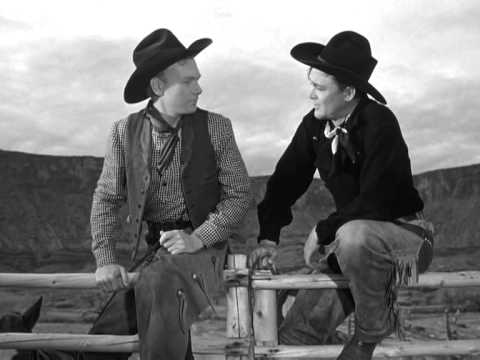
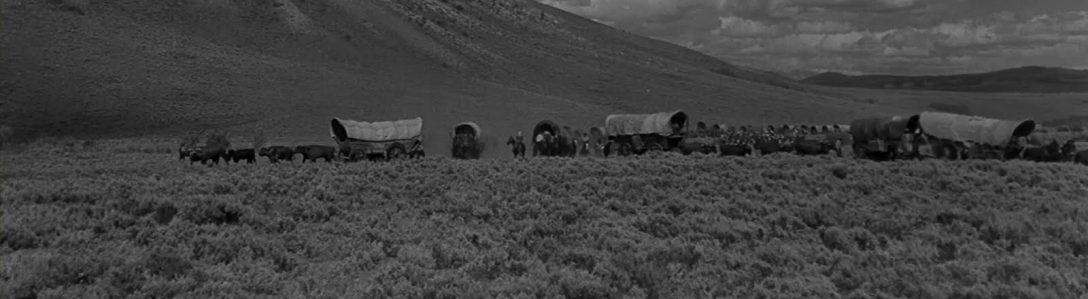
Two horse traders straddle a wooden gate in a stationary medium shot. The boyish one, Sandy (Harry Carey, Jr.) doffs his hat in an exaggerated curtsy to the passing Mormon travelers. The ruddy-faced Prudence (Kathleen O’Malley) peeks back nervously from her cart, embarrassed to display her interest in the cute stranger. Sandy whoops it up even more in response, waving his cap with adolescent bravado. He turns to fence-mate Travis (Ben Johnson), lamenting the fate of “all those women and children” making the journey across the desert towards the San Juan river. Travis gibes, “yeah, and that red-headed gal” too.  After the wagons recede into the distance in a painterly long-shot composition lensed by DP Bert Glennon, Sandy turns to Travis and starts singing: I left my gal in old Virginny. And Travis finishes the phrase, fall in line on the wagon train. Without further deliberation (aside from another verse), he tells Sandy, “looks like we got a job.”

It’s no surprise it took this long for Wagon Master to appear on DVD. It contains no stars, and the entire film proceeds on this soft-spoken, economically paced path. But thankfully Warner Brothers brought out this sublime piece of Fordian drama last week, in a stunning transfer that includes an anecdote-rich audio commentary with Peter Bogdanovich, Harry Carey, Jr., and an early sixties interview with Ford himself.


In the simple scene I described, John Ford compresses the story material, Sandy and Travis decide to lead a Mormon wagon train, into a ballet of gestures and emotions. He turns a basic scene of exposition into an expression of character: Sandy is impulsive and sentimental, Travis is contemplative and decisive. He conveys this through the twirl of Sandy’s hat, the curl on Travis’ upper lip, and the ease in which they fall into song. It’s an adventure they cannot pass up, for the moral reasons Sandy sets forth, but also for the pure romance of the journey. When Glennon returns to the shot of the wagons receding into the distance, Johnson’s horse races parallel to the fence towards the vanishing point, the plot effortlessly moving forward.

On the audio commentary, Harry Carey, Jr. notes that John Ford was in a great mood during the shoot. So good he thought he might be ill (he was not known for his cheery disposition). Perhaps feeling a little more freedom on this low-budget outing, he made the production a family affair, as biographer Joseph McBride has helpfully noted. He gave his brother Francis, a silent star, a role as a mute drummer, the script was co-written by his son Patrick, his daughter Patricia was the assistant editor, “and the assistant directors included his brother Eddie O’ Fearna, brother-in-law Wingate Smith, and nephew Francis Ford, Jr.”

The mood is laid-back charm and casual mastery. This starts, of course, with Ford’s eye for the landscape of Moab, Utah, but it seeps into the performances of Ben Johnson and Carey, Jr., who were both ace horse riders. Johnson caught Ford’s eye as Henry Fonda’s stunt-man on the set of Fort Apache, McBride relates, when he saved three actors in a munitions wagon from being dragged by spooked horses into a “sheer rock wall.” Ford rewarded him with a seven-year contract. Johnson repays him with a performance in Wagon Master of refined nonchalance, as if he were silently etched out of the Utah landscape by sandstorms, and wasn’t set into motion until Ford and Glennon’s cameras started rolling. This gritty reserve is beautifully played off of Carey Jr.’s aw shucks bashfulness. Ward Bond provides the comic relief as Elder, the hot-headed Mormon always on the verge of cursing and eyed by his own elder, a silently admonitoryAdam Perkins (the extraordinary visage of Russell Simpson). This, as McBride suggests, could have been a subtle jibe by Ford at Bond’s support of the House Un-American Activities committe, which Bond was enthusiastically endorsing at the time. In casting him as a man persecuted and expelled from society because of his ideology, Ford must have been aware of the satiric parallel.

But as much as Ford could ease out the natural humor and personality of his performers, his overriding concern is always that of the community, and Wagon Master is probably his purest statement on the matter. It’s at least the favorite of his films, as the director stated many times. Sandy and Travis become the unlikely leaders of a group of outcasts, all rejected by some facet of society. The two horse traders are derided for their shady profession, while the Mormon’s are being kicked out of town because of their faith. Along the way, the wagon train picks up a trio of drunken medicine show performers, and has a run-in with a sympathetic group of Navajos, who consider Mormons to be lesser thieves than the regular run of white men. Ford envisions this traveling society through his favorite means: the ceremonial dance. He stages two versions – the first a Mormon hoedown, which depicts Carey’s continuing flirtation with Prudence and Travis’ nascent pursuit of Denver (Joanne Dru), the medicine show girl. The beat is kept by a wooden leg, and the group joyously unites in a twirling show of arms, legs, and hopes of utopia. The second is set in the Navajo camp, another circle dance that shocks the straight-laced Mormon women, but which Sandy is enthusiastically joins. These two sequences, along with the music of the Sons of the Pioneers that weave throughout the film (and are occasionally sung by the characters themselves, make the film a kind of “horse opera”, as Tag Gallagher playfully mentions in his critical study John Ford: The Man and his Films.

This is a film where the plot takes a backseat to gesture, landscape, and character. There is a conflict and a resolution, ably provided by Charles Kemper as the huffing and puffing Uncle Clegg, leader of a family of thieves, but it’s handled so swiftly and without emphasis it’s obvious Ford’s concerns are elsewhere. He’s focused on the manner in which Ben Johnson whittles a stick of wood, Joanne Dru stares from the back of a wagon, or Harry Carey twirls his hat. After watching Wagon Master for the first time, you’ll consider it minor, a trifle of Western whimsy. Then images will linger in your mind, and you’ll wonder why. It’s a mastery that sneaks up on you, that speaks quietly and calmly about a world within our reach. The image that stuck with me this time is Ford pushing in slowly on Joanne Dru, after she rejected an oblique offer of marriage, reflectively smoking at the back of a wagon, weighing the value of her independence. Next time it will be something different, and, of course, something extraordinary.

PHIL KARLSON’S KORNER: A TIME FOR KILLING

September 15, 2009

a-time-for-killing-a75e909b-9f0c-4d60-a909-228967afd69-resize-750

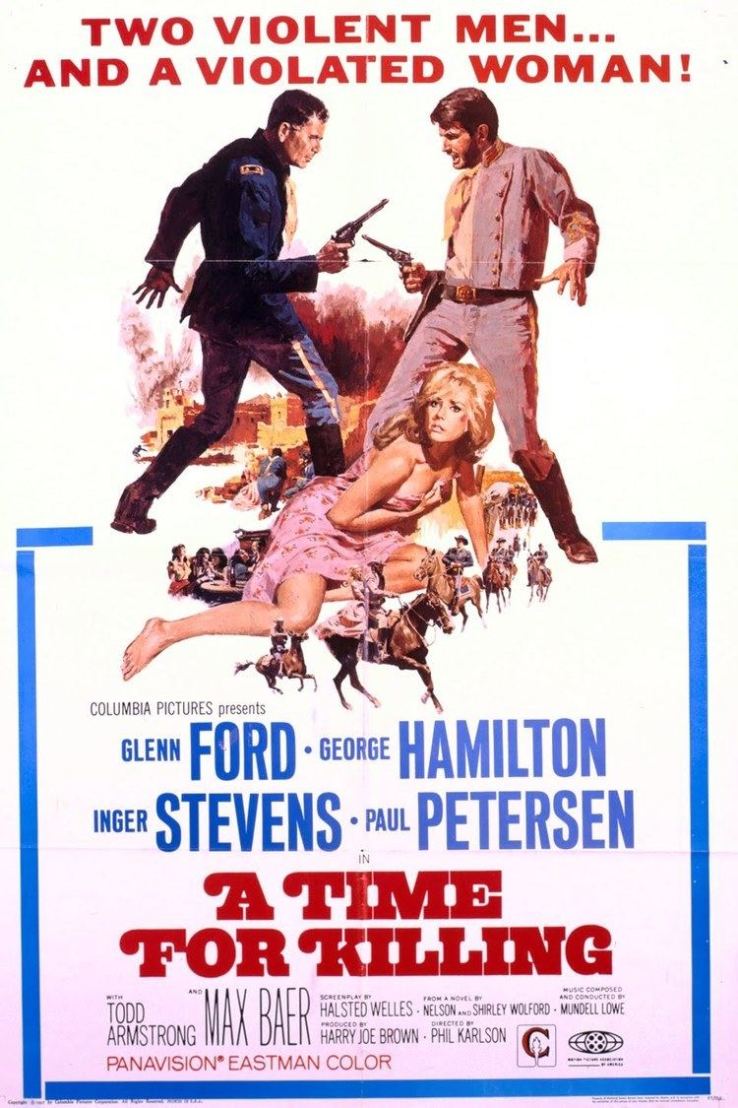
September 25th is Phil Karlson night on TCM, as they’ll be screening three of his tight-lipped noirs along with a rare  B-musical, Ladies of the Chorus. He’s one of the many unsung talents from the studio system, and I’ve been entranced with his work since I saw The Phenix City Story, a docu-drama so precisely detailed the stench of corruption wafts off the screen in pungent waves (it airs at 9:45PM on the 25th). So whenever a Karlson comes across my radar, I devour it. Which brings me to 1967′s A Time For Killing, a film which I watched on TCM a few months back, but which is also available for  purchase on iTunes (the TCM master is in the correct 2.35 aspect ratio, but the iTunes listing says their version is full-screen).

Karlson is credited as the sole director, but the movie was originally developed by Roger Corman under the title The Long Ride Home, hot on the heels of The Wild Angels and The St. Valentine’s Day Massacre. It was the first film in a new multi-picture deal Corman made with Columbia Pictures. It was based on the novel The Southern Blade, a Civil War drama written by Nelson and Shirley Wolford, whose adaptation duties he handed to a young Robert Towne, while Monte Hellman was on board as the editor (he was producing Hellman’s The Shooting, released the same year). A few weeks into the production however, Corman was fired, Hellman resigned in protest, and Towne’s script was scrapped.

There is no definitive story regarding his ouster, but Corman biographer Beverly Gray offers the following:

Towne told Corman’s assistant Francis Doel he suspected that the ouster occurred “because Roger insisted on saving money. Roger didn’t understand that, unlike Sam Arkoff or AIP, [Columbia] wouldn’t think any better of him for saving money. In fact, they would think the opposite. They would think that he was going to make them a picture of lesser quality than they were used to.” Doel recalls that when Columbia executives sent Corman lists of equipment they were planning to ship to his Arizona location, he would cross out items he felt weren’t needed. If, for instance, two generators were listed, he would eliminate one, figuring that the remaining generator would work adequately for the length of the shoot. Presumably, this thrifty behavior raised the suspicions of the Columia brass, who feared getting a cheap-looking product.

Essentially, Corman’s DIY ethos clashed with the plush expectations of the Columbia suits. Corman doesn’t say much about the incident, claiming only that he had a “series of disagreements” before leaving the set. Monte Hellman has a more colorful evasion, quoted from Brad Stevens’ biography of the iconoclastic filmmaker:

“I was editor on the film for a couple of weeks, and resigned when Corman was fired. I never saw the film, and have no recollection of which scenes I may have worked on. It’s another CRAFT moment: Can’t Remember A Fucking Thing.”

In any case, Karlson took over the director’s chair, and Halsted Welles (3:10 to Yuma) received sole screenwriting credit. It’s unclear how much of Towne’s script was used in Welles’ version. The cast remained the same, though, and a number of Corman’s cadre of character actors give delightfully eccentric turns: Timothy Carey, Dick Miller, Harry Dean Stanton are all on hand, wielding their jutting-out faces with expressionistic glee. Carey is a bombastic sharpshooter named Billy Cat, Miller a cowardly Union soldier tittering in the corners of frames, while Stanton is a nervous voice of reason on the Confederate side, duly ignored. They provide the colorful background to the dour leads: Glenn Ford and George Hamilton. The contrast is so great between the supporting comedians and the leading brooders, its easy to think that Corman shot most of the former material with his friends and Karlson took over the more psychologically tinged sequences with the latter. But unless someone turns up the production log, it’s impossible to say.

Ford plays Major Wolcott, a quiet type just trying to keep his troops alive as the Civil War winds to a close. He’s stationed at a prisoner-of-war camp, where Confederate Captain Bentley (Hamilton) is held with a gaggle of good ol’ boys. Wolcott is in love with a missionary, Emily Biddle (Inger Stevens), who he sends away from the camp because it’s too dangerous.  Bentley and his gang soon break out, run down Biddle’s wagon train and take her hostage. Wolcott is sent out to track them down, just as the war is rumored to be coming to a close.

The script sets up the chase as a study in vengeance. At the open, Wolcott attempts to temper the bloodthirstiness of his Colonel, who orders a brutal execution of a Confederate prisoner. He requests that the search be called off for the escaped prisoners, since the South was expected to surrender at any minute. The colonel insists, Wolcott leaves, and the film tracks the Major’s slow descent into the cycle of vengeance that has enveloped everyone else.

Corman & Karlson keep much of the action in long shot, subordinated to the landscape and the fates that are driving them towards death. Even fight scenes are fought in long shot, including a series of duels between two bickering Confederates. The first takes place in the desert, starting with laughter and ending with knives drawn. Their rage is made small by the camera’s distance, rendered as just a symptom of the disease devouring both sides of the war. For punctuation, Karlson/Corman cut in to distorted extreme close-ups, underlining further Bentley and Wolcott’s psychological breakdown. By the end of the film, when Major Wolcott barrels his way into Mexico, recklessly leading his men to certain death in order to satisfy a personal vendetta, brittle Dick Miller, who runs off with his pal to avoid further combat, turns out to be the smartest soldier in town.

THE END OF SUMMER

September 8, 2009

vlcsnap-2012-04-17-23h54m20s140

Goodbye, summer. The heat dissipates and a nostalgic sadness creeps into my mood. Call it the ghost of “back to school” blues, the end of youthful freedom. My adult self is staunchly anti-summer, averse to damp undershirts and the fetid stench of perspiring garbage piles. So outwardly I celebrate the great cooling-off, no longer having to hear the words “weekend getaway” or feign interest in another’s banal sunbathing/soaking/tanning plans. But there’s an insistent twinge in the human part of my heart, a vestigial sense of loss that the good times are over, it’s time to get back to work. I try to ignore it, but I might as well admit it’s there. As with most things regarding people and their damned emotions, Yasujiro Ozu has a lot to say.

So in honor of the season, I cracked open the cases of I Was Born But… and The End of Summer (both available in Criterion’s Eclipse line of DVDs). The first, a silent from 1932, is a salve for the schoolkid in me, detailing the illusions and pranks of two young brothers as they try to mesh in their new suburban home. The latter, from 1961 (his penultimate film), is for the sentimental old coot I’m prematurely becoming, a story about a childlike father and his stumblingly mature sons and daughters. The former is set in the beginning of the school year, the latter, well, read the title. An arbitrary start and end, 29 years apart.


I Was Born But… starts in a rut. Specifically, it’s a wheel spinning in mud on a country road. Ryoichi (Hideo Sugawara) and Keiji (Tomio Aoki) are with their salaryman father Yoshii (Tatsuo Saito), riding to their new home in a moving truck. After some fruitless spins in the dirt, there is a cut to Yoshii looking perplexed, instantly associated with stasis and weakness. His kids stare at him with suspicion. Then Yoshii tells them he’s off to visit his boss, and sends them on home with the driver, ambling off frame left in the sparse, electrical-post lined landscape. In these opening three minutes, Ozu sets up the themes that thread themselves throughout the rest of the feature. There is the move to the country, and the upheaval that will cause in the children’s lives. Then there is the conflict between father and sons, as the boys become increasingly aware of their father’s less than illustrious station in life, including his need to kowtow to his superior. The economy of expression here is astonishing.

But what I’m concerned with here is the bereft look on the kids’ faces as they approach school. The end of summer for Ryoichi and Keiji means the end of their previous lives. Now they have to adapt to the weird new suburban kids, with their own rituals and games. Keiji starts annoying people straight off, initiating a gang war with his transcendent oddness. Aoki’s  performance, filled with testicular scratches and exaggerated mugging, is probably the most entertaining child performance I’ve ever seen. His taunt (seen to the left) as he leaves his tiny antagonizers is a move of balletic slapstick.

He’s moving too, as he apes Sugawara’s every move in their tantrums. He’s always a step behind his brother, but his loyalties are ironclad (unless a rice ball shows up). These pantomimes of his reminded me of my lapdog relationship with my older brother. I camped out by his side and honed my interests to match his, whether it was spending hours pricing baseball cards or constructing a basement city (called Hudsonville), I strived to meet his approval at every turn. I always attempted to maintain a facade of independence with subtle variants, as we grew older he liked Pearl Jam, I chose Nirvana. He liked Metallica, I listened to Megadeth. Keiji doesn’t even attempt to mount even that minute kind of differentiation. He is Ryoichi’s disreputable mirror. Where Ryoichi is stern and commanding, Keiji is disheveled and confused (there is always a bit of white dress shirt sticking out of his fly). But they act as trusted confidants and pranksters, sharing a hive mind of youthful rebelliousness. Their faux-pouting stare as their parents try to ease them out of a funk (brought on by their father’s obvious lack of status) is both heartrending and hilarious. They are being brutally awoken to the inequalities in the world, but they carry it with impish humor, a quality one hopes they carry into old age.

If Keiji grew up and had a family, he probably would have turned out a little like Manbei Kohayagawa (Ganjiro Nakamura), the playful patriarch in The End of Summer. Manbei is a widower who is attempting to marry off his remaining single daughters, Akiko (Setsuko Hara) and Noriko (Yoko Tsukasa). He’s a gregarious sake brewery owner with active eyebrows, who has recently re-ignited a relationship with an old mistress in Kyoto.  The repeated refrain of his children is, “I wish he would act his age.” But what does that mean, exactly?

This childhood-in-adulthood aspect of the film is dealt with throughout, variously treated as a defect and a blessing, a reflection of happiness and selfishness. Ozu never chooses one side of these contradictions, but lets Manbei loose in all his irresponsibly engaging glory. He prances along, alienating and bewitching his children and mistress in equal measure. Nakamura plays him with a similar mischievousness as Aoki’s Keiji, playing endless rounds of hide and seek with his grandson before sneaking out to a rendez-vous at a race track.

In a conversation with Noriko, Akiko echoes the fable of the Scorpion and the Frog (made famous (for me) in Orson Welles’ Mr. Arkadin) by saying that it’s possible to change a man’s actions, but never his character. This statement echoes throughout the film, rendering any attempt to “change” this old coot as absurd. This aging Keiji is disreputable, perhaps, but chasing happiness with seemingly more energy than his concerned children. Akiko and Noriko are the only other two characters with designs on a free life. Setsuko Hara, Ozu’s greatest actress, radiates a self-assured wisdom, completely secure in her widowhood and unwilling to sacrifice her life for the sake of a cow-loving, Ralph Bellamy-type husband.


Circling around these characters though is a motif of smoke, a symbol of dissipation eventually awaiting all of these characters. At this point in his career, Ozu has settled into his serene late style, with low-angle framings and little camera movement. It’s startlingly different from the fluidity of I Was Born But…, which includes witty tracking shots matching a line-up of schoolkids with yawning office workers, but his images are still layered with action. These images of smoke originally seem incidental, as in the shot heading this post. The incense in the foreground is only one aspect of the family home. But its unobtrusive presence slowly accretes meaning, its insubstantial wisps a growing reminder of the body’s slow demise, and the flimsiness of our everyday complaints. Ozu frames it in his famous “pillow shots”, framings held after characters leave the screen, empty rooms with traces of a human presence. Then the smoke billows around Manbei’s body, his final lament, “Is this it? Is this really it?’ shooting up the chimney.

SPEND SEPTEMBER WITH BERNARD HERRMANN

September 1, 2009

header1

Every Tuesday night in September, starting tonight, TCM will be screening a diverse selection of films (23 in all) scored by the legendary Bernard Herrmann. As an appetizer, I’ve compiled a list of my ten favorite Herrmann scores, from radio, TV, and film. It’s easy to forget, but Herrmann was a master of radio orchestration before he created those distinctive tonalities for the screen. He had an innate sense of how to adapt his musical ideas to different formats, sounding more descriptive on the radio, and increasingly atmospheric and emotional on the screen. His work wasn’t merely music added to images – he composed out of these images, creating an organic whole that lifted the films he worked on into another level of artistry. How can one think of The Mercury Theater, Citizen Kane, or Hitchcock without him?

10. Taxi Driver1976

Biographer Steven C. Smith (buy his Hermann study, A Heart at Fire’s Center, here!) relates that after Scorsese pitched Herrmann on the idea of scoring Taxi Driver, the composer snapped, “I don’t know anything about taxi drivers.” After reading the script, and being particularly impressed that Bickle ate cereal with peach brandy, he signed on. Thus this swooningly melancholic score was created, with a little help from his friends. That opening theme, with its ebb and flow of muted trumpets, riding cymbal, insistent snare and pizzicato bass, is the low key entree to Bickle’s tortured psyche. Herrmann asked friend and collaborator Christopher Palmer to adapt an older piece of his for a jazz melody he needed for a scene with Harvey Keitel and Jodie Foster. Smith says Palmer, “took the first four bars of the soprano solo “As the Wind Bloweth” from The King of Schnorrers, then continued the melody line in a piece he titled “So Close to Me Blues.” Hermann was so delighted with the result that the theme became a key part of the score.”

9.  DraculaMercury Theater on the Air. Aired July 11th, 1938 on CBS Radio.

Bernard Herrmann was “reluctantly assigned” to Orson Welles’ landmark radio program. He had a terrible experience working with Welles a year earlier, on the Columbia Workshop radio production of Macbeth. Producer John Houseman relates that Welles arrived onto set with a script twice as long as expected, and so Herrmann’s score was useless. Welles brought along a bagpiper and conducted his own music cues throughout the show, while Bernard stood helplessly at his podium. The second time ’round, while still creatively fraught, was far more productive. Hermann himself looked back with fondness:

Welles’ radio quality…was essentially one of spontaneity. At the start of every broadcast Orson was an unknown quantity. As he went along his mood would assert itself and the temperature would start to increase till the point of incandescence…. Even when his shows weren’t good they were better than other people’s successes.

All of the Mercury radio productions are worth a listen, but the first is still my favorite. Herrmann’s work is spare and mournful.  Steven C. Smith, isolates his instrumentation as “muted brass and graveyard bell”, and that alone gives a sense of its haunted grandeur. Paired with Welles’ tour-de-force performances of the majority of the roles, it’s an unforgettable listen. Most of the episodes are available for download here, as well as anywhere else you care to look.

8. On Dangerous Ground1952

I’ll let the work speak for itself here, one of the most galvanizing themes of all time.

7. Cape Fear, 1962

Simplicity itself. A descending figure of four notes, with slight variations to freak you out. The repetition never resolves itself into a theme, but suspends in an air of uncertainty, putting you off center as the credits roll. When the swirling strings kick in, you think you’re losing your mind. Scorsese hired Elmer Bernstein to incorporate this theme into his 1991 remake. Bernstein told The Bernard Herrman society that Herrmann would “have killed me, he would have yelled and screamed with no question.” This theme was memorably used in The Simpsons episode “Cape Feare”, in which Sideshow Bob takes the Mitchum/DeNiro role.

6. North By Northwest1959

Herrmann takes a fandango figure, repeats it over and over again, and helps to create one of the most suspenseful sequences in film history. This is what they call genius.

5. Citizen Kane1941

Ok. You’re sick of seeing Citizen Kane on lists. I understand. But do you realize how important Bernard Herrmann was to the film’s success? Part of Orson Welles’ genius was his ability to surround himself with other geniuses, so he was able to wrangle Herrmann and Gregg Toland onto his first feature. Music is of paramount importance to the film, and Hermann carried over many tricks from their radio days, with a complex series of musical cues joining scenes, commenting on the action, and helping to tip Kane into hysteria, in his words, “unorthodox instrumental combinations…sound effects blended with music, music used in place of soundtrack.” (quoted in Simon Callow’s Orson WellesThe Road to Xanadu) Herrmann was given the luxury of composing music before editing began, so Welles could form the picture around the score’s rhythms. In short, Herrmann’s contribution to this inexhaustible work of art is immeasurable.

4. Twisted Nerve1969

You have Quentin Tarantion to blame for this one. This remarkable theme, of a childlike whistle couched against some soothing vibes, has a gothic, Ennio Morricone feel. I only became aware of it through Tarantino’s use of it in Kill Bill, when Daryl Hannah’s Elle Driver whistles it as she attempts to fatally inject Uma Thurman. I have never seen Twisted Nerve, and have no idea of its value as cinema, but this theme has wound its way into my cerebral cortex, and I don’t think it’s ever going to leave.

3. The Twilight Zone, 1959

Self-explanatory. Possibly his most famous musical phrase, again utilizing a simple repeated melody to create an overwhelming sense of unease, and then the swirling strings take you away.

2. Psycho, 1960

Those slashing violins open up your veins and let loose fear. As often as it has been parodied, it still retains its power to shock and awe.

1. Vertigo, 1958

Jack Sullivan, in his book Hitchcock’s Music, nails it straight off:

Vertigo opens with triplets spiraling in contrary motion, plunging the audience into cinema’s most beautiful nightmare. Obsession receives its definitive sound in Hermann’s endless circlings, re-circlings, and suspensions.

The opening theme is seductive, hypnotic, and romantic. One wishes to get lost in its grandiloquent tremors, an artistic height that Jimmy Stewart will peer down from, causing his psychological breakdown. Blame Herrmann. Which in this case, means celebrating him. The greatness of Vertigo is inseperable from this score, which would be enough to put him in the pantheon. But as I hoped to have sketched out here…there is so much more.

PRESTON STURGES GOES INDEPENDENT: THE SIN OF HAROLD DIDDLEBOCK (1947)

August 25, 2009

MV5BNjEwOGQwMGUtNGZmMC00Y2ZlLWE5ZjMtZjE0Y2EyZGQ0YjI0XkEyXkFqcGdeQXVyMjIyNjE2NA@@._V1_SY1000_CR0,0,1450,1000_AL_

In 1944, Preston Sturges had his first flop for Paramount. After numerous battles with production executive (and storied songwriter) Buddy DeSylva, The Great Moment was released in a studio-mandated cut, which Sturges said

was a bitter story about the discovery of anesthesia which I intended to sweeten a little with some funny moments. The studio decided that the picture should be cut for comedy. As a result, the unpleasant part was cut to a minimum, the story was not told, and the balance of the picture was upset….  I was certain the picture would have a mediocre and shameful career in that form and with that title [he wanted it to be called Triumph Over Pain], a guaranteed gilt-edged disaster that would do neither me nor the studio any good.

He was right, of course, and Moment was the only film in his Paramount run to lose money. Negotiations over a new contract collapsed over Sturges’ request that he have a two-week period after each production to annul the deal. He wanted leverage in case of future studio meddling, but he was rejected outright. Thus ended one of the greatest Studio-Director runs in Hollywood history.

He spent the next few years in the independent picture business, when an eccentric millionaire straight out of The Palm Beach Story, Howard Hughes, offered him a job later in 1944. Sturges claims that Hughes wanted someone to run his movie interests so he could focus on aviation, and so the California Pictures Corporation was born. With Sturges’ artistic and commercial pedigree tied to Hughes’ deep pockets, there were high hopes for the company. Manny Farber stated in The New Republic that “it would be likely to cause the large studios surprise and worry”, while Sturges laid down an optimistic statement of purpose: “to invest full authority in young writers, directors, and producers to act on their own initiative.” He wanted to give directors the freedom he found ever so briefly at Paramount. Unfortunately Hughes’ eccentricities soon torpedoed this optimism.

Two productions were on the table. Sturges was to direct The Sin of Harold Diddlebock, a comedy luring Harold Lloyd out of retirement, and he hired Max Ophuls to direct his screenplay for Vendetta, an adaptation of Prosper Merrime’s Colomba (read Lutz Bacher’s Max Ophuls in the Hollywood Studios for a more in depth history of this troubled production). Things fell apart quickly on Vendetta. Bacher claims that Sturges pushed Ophuls out of the director’s chair because of his perfectionism, only wanting to see his vision on the screen. In his autobiography, Sturges claims that Hughes fired Ophuls because “he didn’t like foreigners and didn’t want them working for the company.” In any case, Hughes dissolved the partnership in 1946, citing cost overruns.

Both films were later re-edited and re-shot by Hughes. Diddlebock bombed in a brief release in 1947, so Hughes pulled it back within a few weeks. He did some re-shoots (including a scene with a talking horse), and released Diddlebock as Mad Wednesday through RKO in 1951.  Vendetta was hacked apart even more, with nothing of Struges’ script remaining. Stuart Heisler completed principal photography, and then Mel Ferrer was brought on to do further re-shoots (he received the sole directorial credit). It was released through RKO in 1950 and sunk like a stone. Luckily, Sturges’ version of Diddlebock still exists, and it’s the version that airs on TCM (next time on Oct. 19th at 11:30AM).

It’s an unfairly neglected work in Sturges’ career, cited only as part of the “decline” narrative that defined this part of his filmography, and which Yacov Freedman outlined earlier today. Its interest lies first with Harold Lloyd, who hadn’t appeared in a film since 1938′s Professor Beware. The film functions as a sequel to Lloyd’s The Freshman, following that film’s hero through the twenty years following his improbable college football heroics. Sturges boldly opens the film with the final quarter of  The Freshman‘s championship game, inter-cutting it with new footage of E.J. Wagglebury in the crowd (Raymond Walburn), an ad executive who later offers Diddlebock a job.

This bit of film history leads to a beautifully bittersweet sequence of workplace inertia. After Wagglebury promises Diddlebock the fruits of the American dream, he installs him as a bookkeeper, and Sturges shows the Presidential calendar fly by from Harding to Truman. The camera pans over to Diddlebock, still hunched over the same desk, his ramrod posture gone stooped and haggard. This sarcastic sequence is not only a biting comment on the idea of upward mobility, it also acts as a metaphor for the fate of the silent comedian. Harold Lloyd had fared better than most, due to some wise investing, but in reprising his most famous silent character, he acts as a stand-in for the faded Hollywood stars of Keaton and Arbuckle and the rest. Chaplin would do similarly bitter-nostalgic work in Limelight in 1953.

But that’s just the opening sequence. There are a few classic Sturges runs regarding Diddlebock’s decline, including  Lloyd’s monologue  on his crushes on a succession of sisters, seven in all, from Hortense to Harriet, who ran away with a headstone salesman. Further emphasizing Diddlebock’s entropy and passivity (he’s tossed over for death), Sturges quickly charts the intervening years as a series of lost loves and a rapidly disappearing future (in a timely aside, his pension is piddling because he lost most of it in the Crash). Lloyd’s Diddlebock just seems lost. Sturges axiom Jimmy Conlin notices his empty stare, needles him for some cash, and promptly jolts this teetotaler full of booze. In an elegant bit of vaudeville, the bartender (“the king of the slow burn”, Edgar Kennedy), peppers him with esoteric questions in order to concoct a deadly cocktail, The Diddlebock. He soon blacks out, and the increasingly chaotic narrative attains the character of a dream.

The plot kicks into gear with a bit of capitalist carnivalesque, as a drunkenly placed $1000 bet leads to a cascade of money and the purchase of a debt-laden circus. Aghast at the actions of his id, he goes a little mad, gloriously, grabbing a lion by the tail and dangling off of a rooftop, barely escaping death. Clad in a Franklin Pangborn special (see top photo), he whizzes around the city, reconstructing his drunken evening and desperately trying to sell this big top money pit. His life literally becomes a carnival and it trails along with him wherever he goes as he gleefully turns Madison Ave. into riotous display of animal anarchy. With such publicity, the bankers can’t help but line up to take the zoo off his hands. It’s a wild send-up of capitalism and a loving tribute to Lloyd and the silent film tradition.

Lloyd complained afterward about their clashing comedy styles. Sturges focused on the verbal, Lloyd on the physical. Lloyd claims they shot two versions of every scene, one to please each of them, but the director inevitably won in the editing room. Lloyd eventually sued Howard Hughes over his billing on the re-release. Whatever their differences, the sweet chaos of their work is up there on the screen. Take a look.

FURTHER ADVENTURES IN VOD

August 18, 2009

poster-780

After exploring Hulu for cinematic surprises two weeks back, I discovered the nifty search engine SpeedCine [Speed-Sinny], which claims to make  “it easy to find legal feature-length movies on your computer”. Founded by film publicist Reid Rosefelt, it trawls the web for films that can be viewed on VOD for free or through rental, purchase, or subscription. It’s very simple to use, and with a quick click on the FREE button, and a leisurely scroll through its large A-Z library, I uncovered a wide variety of oddities and masterpieces that won’t cost you a dime (the FAQ informs us that not all titles are listed in the index, that some can only be found through the search function. Mysterious! Let me know if you find any hidden nuggets through this feature). These free titles are all ad-supported on various sites, with commercials popping up at different intervals. Most sites offer their “top” titles as rentals or purchases only (without ads), while shuffling their lesser known material into the “free”, ad-supported category.

Searching for free titles filters out the Herculean efforts of The Auteurs to bring a cinematheque to your computer (at a reasonable $5 a film, with a few titles gratis), but I discussed them earlier this year. They’re the most forward thinking VOD operators around, with the best content, so by all means check them out. But this week I’m focusing on the questionably curated free VOD sites that SpeedCine introduced me to, like Crackle, Jaman, Fancast, and EZ Takes, all of which vary wildly in quality.  I’ll profile each of these sites on various arbitrary categories (streaming quality, commercial interruptions, etc.) and offer some viewing recommendations on each. In any case, SpeedCine is a remarkably useful tool for those interested in excavating the vast trove of cinema available on these here tubes.

I’m judging these sites based on a Poor, Average, Great scale in the following categories:

Streaming Quality (for their Free titles): Looking for the evil presence of digital blocking and artifacting. The cleaner the better.

Commercial Interruptus: On the length and frequency of the ads.

Burnt-In Logos:    On how much the company logos obscure the screen.

Aspect Ratio:   Whether the films are presented in their correct AR.

Selection:   The quality of work in their Free library

***

Jaman

Movie Viewed: Born to Win, Ivan Passer, 1971

A wonderfully acted story of a small-time operator and heroin addict played by George Segal. It is Czech emigre Passer’s first film in the U.S., following up 1965′s sublime Intimate Lighting, and it’s a similarly digressive tale, although toned far darker. Segal floats from scam to scam, running into his estranged, prostituted wife (a suitably zonked out Paula Prentiss), a fellow doper (Jay Fletcher), and a middle-class bohemian gal who takes a shine to him (Karen Black). Segal is brilliant, his brittle energy burning out by the end of the film, leaving a husk of a man shivering in an abandoned park. Replete with gloriously grimy location footage of the city’s druggie years, it’s a haunting, and strangely, often hilarious slice of NYC life in 1971. Robert DeNiro has a small role as a cop, which is why his blown-up face is misleadingly on the cover of the DVD.

Streaming Quality:      Poor. Not only was the print in bad shape (I’m curious as to the quality of the dubious-looking DVD), but the stream was consistently marred by digital blocking.

Commercial Interruptus:     Great! The film opens with one minute long commercial, and the film follows with no interruptions. The best setup for ad-supported streaming video I’ve seen so far.

Logos:     Average. The Jaman logo is transparent and placed at the top right hand side of the screen. It hides itself well.

Aspect Ratio:     Great. 1.33 is hard to screw up. Jaman didn’t.

Selection:     Poor. The only other titles worth looking at in their free library are Stagecoach and Meet John Doe, and they are both presented in fuzzy public domain prints.

Overall: Jaman has embraced the renting VOD philosophy, leaving the Free, ad-supported section rather fallow. Born to Win is a must-see, though, regardless of the shaky viewing conditions.

***

Crackle

Movie Viewed: The Stone KillerMichael Winner, 1973

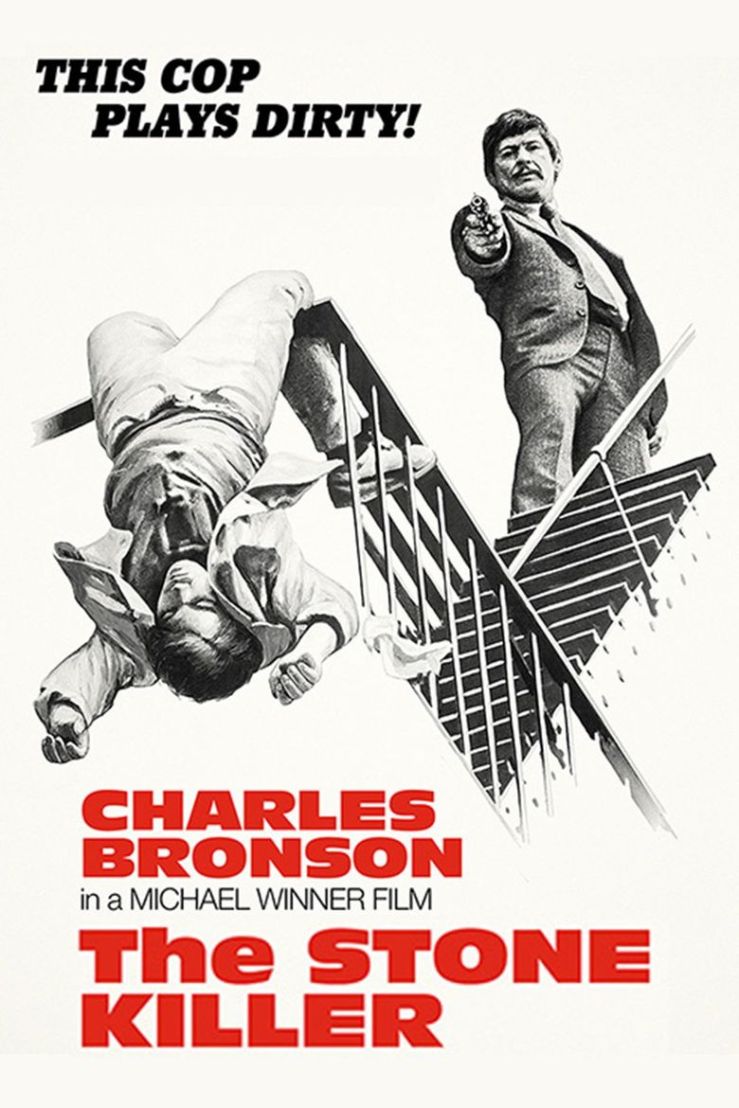
I was rather bummed about missing all of Anthology Film Archives’ 70s Buried Treasures series, programmed by Blue Underground founder William Lustig, so I was relieved when I clicked through SpeedCine and saw The Stone Killer listed. Charles Bronson is as inexpressive as ever in this right-wing actioner, but Michael Winner keeps the pace moving with expressive smash cuts while the idiosyncratic cast (Norman Lear, John Ritter, Martin Balsam) add varying notes of laconic style. Bronson is a violent cop marched out of NYC because he gunned down one too many perps, and before he can settle into his new L.A. gig, he’s drawn into the middle of a mob war. Also, a hippie commune is caricatured as a small-top circus who interpretive dance around camels. Conservative politics, solid action film mechanics, and a skyscraper stunt fall, all one could want from Bronson in the 70s.

Streaming Quality:      Great. Along with Hulu, it’s the sharpest, least artifact-y free VOD site around.

Commercial Interruptus:     Poor. 15 second ads appear approximately every 10 minutes. This is the price paid for higher video quality.

Burnt-In Logo: Great. The transparent logo is small and nestled in the bottom right hand corner. In widescreen films it doesn’t overlap with the image.

Aspect Ratio: Great. 1.85:1, correct and accounted for.

Selection: Great!  Along with The Stone Killer, I espied Bunny Lake is MissingComanche StationCalifornia SplitFat CityFull ContactHard TimesMickey OneOur Man in HavanaRide Lonesomeand Starman.

Summary: Crackle has really embraced ad-supported VOD, and the quality of the stream as well as the titles proves it. Along with Hulu, it’s the best site for free streaming movies. It’ll be interesting to see whether their model will end up more successful than Jaman’s rental-based model. Time will tell. The only downside: I memorized a Last House on the Left ad by the time my movie was over. Not a good thing.

***

Fancast

Movie Viewed: A Pocketful of Miracles, Frank Capra, 1961

From this point on, I did not view the films in their entirety, only the first 15 or 20 minutes to get a sense of the quality. That said, I would definitely want to return to this, Frank Capra’s final film, if only for the ridiculous display of character actor talent. Ahem: Peter Falk, Thomas Mitchell, Edward Everett Horton, Jack Elam…and it stars Bette Davis.

Streaming Quality: Poor. Image is fuzzy and there is artifacting visible on the edges of every object. Impossible to watch full-screen, tolerable in the normal size.

Commercial Interruptus:     Poor. Started off with a 15 second ad, then 10 minutes in there were back-to-back ads (one 30 sec., the other 15). I didn’t stick around to see what happened later…

Burnt-In Logo: Great! There isn’t one!

Aspect Ratio: Great! 2.35:1.

Selection: Average. Other titles included Witchfinder General (aka Conqueror Worm)Dillinger (1973 version), Kiss Me, Stupid,and Phaedra.

Summary: The last resort. If there’s no other way to view a film, by all means watch it on Fancast, but the poor streaming quality and excessive ads make it a less than pleasurable experience.

***

AMC B-Movies

Movie Viewed (20 min.): Dark StarJohn Carpenter, 1974

This off-beat sci-fi comedy was scratching me where I itch when I had to move over to the next site. Made at the low low price of $60,000, this was a student film project that took off (relatively speaking) when it’s stoner comedy Star Wars vibe struck a chord with college audiences. I’ll be going back to this one…

Streaming Quality: Average. Since the source material is poor, it’s impossible to judge fairly, but the feed was strong and clear, with a lack of major artifacting from what I could see. After a full viewing, I might have to bump this up a  notch.

Commercial Interruptus:  Great. Oddly enough, while their TV counterpart breaks up their films with ads, this internet portal has no commercials at all. Huzzah!

Burnt-In Logo: Poor. Uh-oh. There’s a giant honking AMC.com logo perched at the bottom middle-right of the screen. In a 1.33 film like Dark Star, it’s right in the middle of the action. It’s larger and further towards the middle than the other logos. Bad form.

Aspect Ratio: Great. With caveats. It appears to me that this print was cropped slightly on the sides, as some of the opening credits get cut off. Undoubtedly this is a problem on the original print, so I can’t really deduct imaginary points here. Plus I might be wrong.

Selection: Average. I’m playing it safe, since the rest of these schlocky titles are not my thing. Just a matter of taste. Although I like The Devil Dolland Shake, Rattle & Rock sounds rather irresistible (Fats Domino fights for the kids’ right to boogie).

Summary: A solid locale for VOD, lacking only in content. Which is a bit of a lack. But that’s just personal taste. The tech specs are up to snuff, and the lack of ads is refreshing.

***

Indie Movies Online

Movie Viewed (15min.): Greaser’s PalaceRobert Downey Sr., 1972

An absurdist western with midget romance, the plot summary tells us, and who am I to disagree? Dave Kehr says it’s “Reminiscent of Simon of the Desert, only without the ideas”. I’ll leave it to you to parse.

Streaming Quality: Great. Smooth and silky.

Commercial Interruptus:     Great. Starts with an ad for the site, but the feature had no ads at all for the time I was viewing.

Burnt-In Logo: Great. No logo at all.

Aspect Ratio: Average. The 1.85 image was non-anamorphic, letterboxed so there’s black bars on all four sides of a 16×9 screen. This was a result of the master they received, and no fault of their own, but I’m docking them anyway. Just for fun.

Selection: Poor. There’s literally nothing else I’d like to watch there. Seriously.

Summary: All the tech specs are great, but unfortunately its library is rather bare.

***

EZ Takes

Movie Viewed (20min.): The Outlaw, Howard Hughes, 1943

Famous for Jane Russell’s breasts and Howard Hawks’ firing. Also famous for the variety of public domain prints circulating the internet. Uh oh.

Streaming Quality: Poor.  This is like watching the movie through a hailstorm.

Commercial Interruptus:     Average. One 15 second ad to start, nothing afterward.

Burnt-In Logo:     Great. No logo.

Aspect Ratio: Great. 1.33:1 lives on.

Selection: Average. There’s no shortage of material, although most of it looks to be PD: D.O.A., My Man Godfreyand The Umbrellas of Cherbourg (licensed from Koch). As much as I love VOD, watching Cherbourg on streaming video should be some kind of crime.

Summary: EZ Takes seems to use their free feeds as advertisements for their downloads, which they state are DVD quality. Since the streams are so poor, there’s little reason to use this as a VOD site, although it’ll do for a quick fix if desperate.