TARKOVSKY TIME: GEOFF DYER’S ZONA

February 21, 2012

Screen Shot 2020-02-03 at 11.53.26 AM

Andrei Tarkovsky’s Stalker (1979) is the latest beneficiary of Geoff Dyer’s cultural immersion method. Zona, which comes out today from Pantheon Books, is a pellucid scene-by-scene ramble through Tarkovsky’s sci-fi head trip, alive to the film’s textures as much as its ideas.  In his non-fiction works, Dyer is a dilettante angling for expertise, his books (whether on jazz, photography, or WWI) documents of an enlightenment-in-progress. Like a student prone to daydreaming, Dyer often strays off-topic, doodling in the corners of his notebook, not Van Halen logos, but on his susceptibility to boredom, how his wife looks like Natasha McElhone in the Solaris remake, or simply on his love of knapsacks. These detours are maddening and lovely, bracing returns to everyday neuroses in the midst of high-minded esthetic ruminations. It’s this whiplash between objective and subjective modes, from high to low (he’ll go from quoting William James to thoughts on three-ways), that makes his work so addictive.   The pleasure of Zona lies in Dyer’s method, in its constant sense of discovery, as if he had just stumbled out of a screening and was sharing his thoughts with you after a beer or three.

Dyer originally intended to give the book 142 chapters, one for each shot in the film, but found, “I kept losing track of where one shot ended and another began.” Instead, he splits the book into two parts, corresponding to the rather arbitrary split in the film itself. It is not a rigorous textual analysis, although it has some striking instances of that, but “an account of watchings, rememberings, and forgettings”, of how the film has implanted itself in his memories and his working life, not as a static object. It is a similar approach to what Jonathan Rosenbaum attempted in Moving Places, his cinematic autobiography, on how films affected, and were affected by, the time and place he watched them. Zona is less personal and more attuned to the active viewing experience, a kind of diary of his eye as it wanders around the screen.

He first gazed upon Stalker on February 8th, 1981, which is also the day I was born. A transformative day for us both, although perhaps more life-changing for Dyer, who says that if he had not seen the film in his twenties, “my responsiveness to the world would have been radically diminished.” For the uninitiated, the film follows a stalker (a kind of mystical tour guide) as he leads a Writer and a Professor through the cordoned off area of the Zone, said to contain a Room that grants one’s innermost wish (it was adapted from the Russian sci-fi novel Roadside Picnic, which is receiving a new English translation that comes out May 1st). In the more conventional analytical sections of the book, Dyer does a fine job of breaking down the film’s use of time, space and language, all of which expand and contract in the amorphous landscapes of the Zone.

The Zone is surrounded by barbed wire and armed guards, but when the Stalker’s wife protests his latest jaunt, he proclaims that everywhere is a prison. As Dyer demonstrates, the language of the Gulag permeates the world of Stalker. He quotes Anne Appelbaum’s Gulag: “the world outside the barbed wire was not referred to as ‘freedom’, but as the bolshoya zona, the ‘big prison zone’ larger and less deadly than the ‘small zone’ of the camp, but no more human – and certainly no more humane.” Then there is the most dangerous section of the Zone, the “meat grinder”, which is how prisoners often referred to the Gulag. But in the Zone, these definitions are not fixed, as each new sector provides both new freedoms (of solitude and silence) and new forms of imprisonment (forcing you to reside inside your own head).

Dyer’s sense of Tarkovsky Time is generated through the history of Russia and of cinema. He first brings it up in the context of war strategy, one that “had done for Napoleon and would do for Hitler too: ‘Trade space for time’, a message Tarkovsky took to heart.” Russian army strategists gave up chunks of land for more time to defend it, and Tarkovsky traverses a delimited amount of space (there are only a few sets in Stalker) but explores every inch of it in his heavingly slow zoom-ins and tracking shots. Then Dyer describes his first viewing of Antonioni’s L’Avventura (“the nearest I have ever come to pure cinematic agony”), in which “every second lasted a minute, every minute lasted an hour, and an hour a year, and so on. Trade time for a bigger unit of time.” Tarkovsky pushes Antonioni-time even further, where in a minute an eternity could have passed, what Tarkovsky said, required “a special intensity of attention”. Dyer has this intensity in spades, although not for another slow-footed European modernist, the recently deceased Theo Angelopolous, of whose Ulysses’ Gaze he describes as “another nail in the coffin of European art cinema.”

Dyer has plenty of tossed off, heretical bon mots like this, designed to raise the hackles of any passionate cinephile. He says that Luis Bunuel’s The Discreet Charm of the Bourgeoisie and Belle du Jour “sucked”, Godard’s Breathless was “unwatchable”, Kieslowski’s The Double Life of Veronique “made straight-ahead porn seem tasteful”, Jim Jarmusch’s The Limits of Control was “vacuous” and that Lars Von Trier’s Antichrist was “a highly crafted diminution of the possibilities of cinema”. These are all stashed away in the footnotes, and in the adrenaline provided by my indignant rage, serve as potent energy boosters to binge-read through the rest of the book.

In any case, let’s remain thankful he wrote about Stalker, and not Bunuel. His obsessive viewings of the film have given him an innate sense of the atmosphere and landscapes of the film. The book is a marvel of tactility, no more so when Dyer describes the trio’s first landing in the Zone:

It is every bit as lovely as Stalker Claims – and, at the same time, quite ordinary. The air is full of the sound of birds, of wind in the trees, running water. Mist, muted greens. Weeds and plants swaying in the breeze. The tangled wires of a tiled telegraph pole. The rusting remains of a car. We are in another world that is no more than this world perceived with unprecedented attentiveness. Landscapes like this had been seen before Tarkovsky but – I don’t know how else to put it – their beingness had not been seen in this way.

Then, after noting rhyming images with Walker Evans’s “sagging shacks” and Bresson’s dictum to “Make visible what, without you, might perhaps never have been seen’, Dyer embarks one of his more majestic digressions, of his own childhood adventures in a decaying industrial landscape, an old train station at Leckhampton. “Faded, rain-buckled, the timetable was still displayed – a memorial to its own passing.” This memory fits what Dyer would later define to be “quintessentially Tarkovskyian…: the magic of the discarded ordinary, the filmic archaeology of the everyday.” This is the elegiac highlight of the book, in which Dyer alchemically lifts his childhood memory into the realm of art, and brings Stalker, as mysterious an object as cinema has given us, deep down into the swampy earth.
LANCE HENRIKSEN: NOT BAD FOR A HUMAN

August 9, 2011

Screen Shot 2020-01-31 at 3.22.57 PM

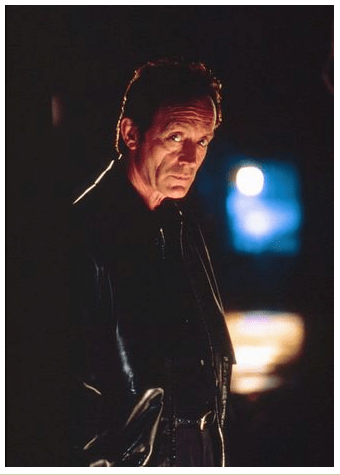
You know this gaunt growler. He lurks in the disreputable direct-to-video section of your local video store, if it still exists, or pops up on Netflix in a low-budget creeper rated with one reluctant star. He is, of course, Lance Henriksen, a tireless worker and a real character of a character actor. In his wild, circuitous life he’s compiled a trunk-full of  anecdotes and chastened life lessons. With the help of co-writer Joseph Maddrey, he packed all of them into his autobiography, Not Bad For A Human. It lays bare his poverty-stricken youth and job-hustling acting career with a disarming lack of vanity and a rhythmic sense of cursing.

“‘You know, Lance, you’re not going to work much until you’re older.’ Why’s that Charlie? ‘Because you look funny.” – Charles Durning to Henriksen, on the set of Dog Day Afternoon


Henriksen had a face he needed to grow into. His Easter Island head needed the ballast of sagging cheeks and the proliferating slashes of wrinkles to ease his transition from awkwardly handsome man to sage and unsettling elder. The transformation was complete with the addition of a cigarette-scarred rasp to his low rumble, able to modulate between wise or psychotic with the turn of a script page.

One of Henriksen’s many forthright confessions is that he wouldn’t be able to read those scripts until he was thirty. He was born in NYC on May 5th, 1940 to James Henriksen and Marguerite Healey. James was never around, and Marguerite worked waitressing jobs to keep her kids fed. She flailed for stability, with “great dreams for her life, but she had no education and she kept marrying men for the sake of being taken care of.” She married five times. In between men there were financial troubles, and one way to make money was acting on television:

There was this talk show in New York where you’d go on the air and tell a bleeding heart story, and listeners would call in and make contributions. My mother got me on that show when I was a little kid, and we would tell these awful lies. It was like we were were a family of grifters…

Lance bounced between family members, but once his maternal grandmother Floss died, he had no reliable guardians to speak of. He ended up at an orphanage at Hastings-on-Hudson and, as Henriksen recounts:

They were impatient with me because I couldn’t read. I was just a little kid, but they got me up in front of the class and I couldn’t read, so they humiliated me. And that was the end of reading. I just thought, Fuck reading. in my heart, I just…turned it off. And school. Fuck school.

He worked as a shoeshine boy and lived on the streets of New York, only finding the sense of community he sought in the movies. His favorite at that time was Howard Hawks’ Western The Big Sky (1952). The love between Kirk Douglas and Dewey Martin as they venture through the Grand Teton Mountains struck a chord with the lonely and adventurous Henriksen. When he watched it, he said he was a “Method movie viewer”, bringing a “knapsack, a canteen, a frying pan…and what I thought was a sleeping bag…. I brought all the stuff into the theater with me…and I watched the movie maybe eight times. I’d fall asleep for a while and wake up and watch it some more.”

After years of wandering, through San Francisco and a short stint in the Navy, he ended up in New York with a yen for acting. Still unable to read, he would have a friend recite his dialogue parts into a recorder, from which he would memorize lines. Eventually he taught himself to read, although he claims a nagging sense of inferiority at his lack of education throughout his career.

He was immediately drawn to the physicality of Method acting, and became a part of The Actors’ Studio community, although he was never an official member. Henriksen says Lee Strasberg simply, “wasn’t my kind of guy.” He also rejected studying with Sandy Meisner, who asked him to quit acting for five years if he wanted him as a teacher. Henriksen didn’t think he could afford to live under those circumstances and responded, “Yeah, okay, I’ll do it…but if you fail me, I’m gonna kick your ass.” Meisner declined to accept him as a student.

As with reading, Henriksen learned acting through osmosis and practice. His process was to immerse himself totally in his characters, building elaborate backstories not included in the script, and designing his own costumes and props that he would react to spontaneously in scenes. Inside of this invented world he would feel free to act instinctually instead of mechanically. Part of this process required playing his characters on and off set. When he was playing Wally Schirra in The Right Stuff, a good-hearted family kid, he went looking for his biological father and reunited him with his mother: “My mom really liked Wally. Here she had this son who was attentive to her, didn’t swear around her, took her out to dinner…I think she wishes Wally would have stayed around!”

The impressive thing about Henriksen’s ethic is that he applied it to every project, whether a prestige Hollywood item like The Right Stuff or a ridiculous action film like Stone Cold (1991). Henriksen has invented a useful vocabulary for the roles he would take on. There were the “fart-catcher” roles, which were essentially background players who would absorb the leads’ precious gases. Then there were the “alimony films”, which he took on after his two divorces, and the “jet-lag” gigs, for the low-budget Eastern European movies. For the latter, “I wouldn’t even get an eight hour turn-around before I had to start reciting all this shit.” The first of these was Antibody (2002), in which he plays an “FBI agent who gets injected into the bloodstream of a terrorist.” Henriksen has an extraordinary ability to compartmentalize his performance from the films he appears in. His method allows him to act the movie he has constructed in his head, which the final product rarely lives up to.

Stone Cold falls outside these categories, one of the few films in which he had complete creative control. A vehicle for NFL bust Brian Bosworth, the creative chaos on the set allowed him to finally act without restrictions. The original director was fired and Craig R. Baxley was hired to replace him. He was dissatisfied with the dialogue for his character, the villain Chains Cooper, and requested he be able to improvise all of it.  Baxley agreed and Henriksen, “got so deep into the role that I’d just say whatever came into my mind.” He was given similar freedom on Jim Jarmusch’s Dead Man, which along with Aliens is one of the few films worthy of his talents. He told Jarmusch that “I don’t want to say one line that you’ve written for this character in the script. I want to improvise the whole thing”. The director trusted him, although Lance’s conviction went to frightening lengths. Jarmusch remembers:

He stayed in character a lot of the time, which was a little scary. Some actors can just walk off the set and become themselves again, but Lance puts so much of himself into a performance that it takes him a little while [to get out of character]. It’s always percolating. And like all really fine actors, he doesn’t act out the stuff; he reacts.

Henriksen is one of the great reactors of the cinema, even if the environment around him isn’t worth reacting to. On my last trip home, my Dad was flipping through the channels and found the direct-to-video alimony film Sasquatch (aka The Untold, 2006). His first reaction was, “any movie with Lance Henriksen has got to be good.” As I watched Lance on-screen,  manfully staggering after a man in a rubber suit with wide-eyed desperation, grief over his daughter’s death doubling the carved lines on his face, it was clear my Dad’s dictum was correct. Lance Henriksen justifies the existence of any movie he appears in, however threadbare.

I’ll leave him with the last word:

If I get another script that says “The Sasquatch looks around the tree”, I’m going to go, “No way, leave me alone, man.”

J. HOBERMAN’S AN ARMY OF PHANTOMS

March 15, 2011

Scene-Fort-Apache-John-Ford

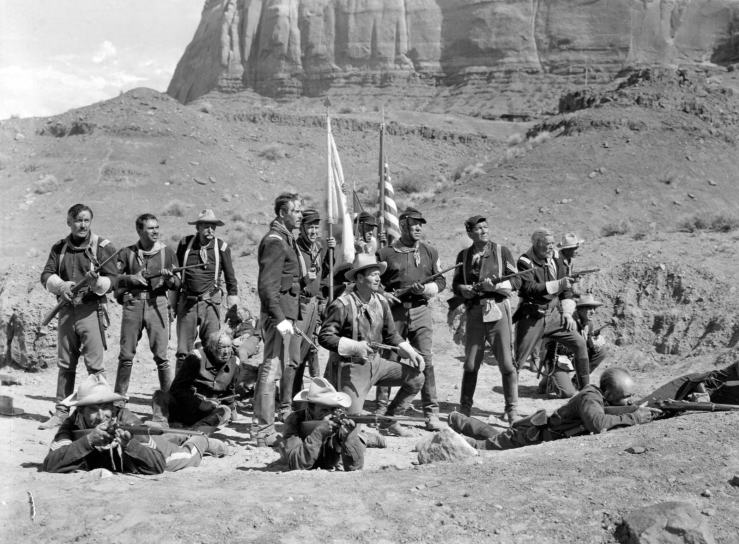
Under siege. John Ford’s Fort Apache established one of the major Cold War film archetypes, as J. Hoberman explains in An Army of Phantoms, his breathless, careening cultural history of the period (which the New Press released today). Covering the initial years of the political frost, from the mid-1940s through 1956, it’s the prequel to his 2003 The Dream Life, which ranged from 1960 to the release of Blow Out in 1981. He is preparing a third volume, Found Illusions: The Romance of the Remake and the Triumph of Reaganocracy, that will cover the rest of the 80s and the end of the Cold War. His stated inspiration is Siegfried Kracauer’s From Caligari to Hitler, and Hoberman’s less deterministic project will likely cozy up to it on film reference shelves in the coming decades as an essential and idiosyncratic work of cultural studies.

The phrase “cultural studies” tends to make me recoil in various poses of disgust. It’s the lapsed academic in me. As David Bordwell said in a Cinema Scope interview, ” most film scholars aren’t interested in film as a creative art. I know it sounds odd to say that, but I think it’s true. Most scholars are interested in film as an expression of cultural trends, interests, processes, etc. or of political moods, tendencies, etc.” Much of what I encountered of cultural studies in school reduced films to fit ideological agendas, starting with a theory and then squeezing the movie to fit that theory. The art object itself was lost in the process.

What Hoberman is doing here is undoubtedly cultural studies, describing how social and political events shaped the era, and in turn the tone and texture of Hollywood’s product, but it is a supple and nuanced version of the discipline. Since he is coming from a film critic’s background, he never loses sight of the unruly complexity of the movies themselves. The wealth of production history Hoberman lays down here is one of its most invaluable aspects, and has me continually dogearing pages (Full disclosure: I took a Film Criticism seminar that Hoberman taught at NYU).

For example, in his thumbnail portrait of The Thing (1951), he places it in the context of Edgar G. Ulmer’s The Man From Planet X, an alien cheapie that beat it into theaters, heralding 1951 as “the year that the saucers landed and the extraterrestrials arrived.” The Thing’s pre-production also “coincided with the emergence of Senator McCarthy and the early stages of the Korean War.”, resulting in a “congealed hysteria.” Politics and film inform each other, but they are not irreducible to the other. Hoberman is adapting French philosopher and sociologist Jacques Ellul’s concept of sociological propaganda:

a vague, spontaneous, all-pervasive, yet half-conscious form of social bonding and ideological proselytizing advanced by advertising, newspaper editorials, social service agencies, patriotic speeches, and anything else that might use the phrase ‘way of life.’”

It is the haziness of being a part of an epoch, the received wisdom that we mouth daily because we don’t have time to reflect on everything we say. It is a flexible, elusive concept, the perfect prism from which to pursue the indirect but palpable influence of the social and political spheres on film. Those are his theoretical walking orders, but Hoberman fills the book  with the clammy details of the dream factory. After spotty snowfall in Cut Bank, Montana, the crew re-located “to an arctic landscape created on the RKO ranch in Encino – another sort of ordeal with sweaty, parka swaddled actors tramping over the artificial snow that had been created from rock salt, ground-up Masonite, and crystallized photographic solution.”

The Thing’s scenario was comic-book Fort Apache, the group under siege by a marauding, unknowable force. The parallels with Communist infiltration (and the bloody “police action” in Korea) were starkly clear, and The Thing’s “effete little Nobel Prize-winning scientist affecting a blazer, turtleneck, and goatee” is nothing less than a “wannabe Russian”. The Thing makes gestures toward anti-communism, but more than anything else it’s a Howard Hawks film, a buzzing group of insecure he-men talking their way through their problems and through the Red Menace. This Fort Apache scenario of terror from without is one of the repeated motifs of the book (Only the Valiant, which I wrote up earlier, introduces subversion from within into the cavalry Western), although many others wind through it, including The Next Voice You Hear, whose vision of God-as-entertainment actualized Hollywood’s fondest dreams of itself. Hoberman draws out the cruel irony of how the real universal communicator, television, almost puts Hollywood out of business. The third major strand is provided by Kiss Me Deadly and screenwriter A.I. Bezzerides’ term for nuclear power, The Great Whatzit, which Hoberman uses throughout as both a metaphor for nuclear weapons as well as the undefinable anxieties which haunted the generation.

All of these ideas are buttressed by meticulous research, with reams of contemporary opinions from VarietyThe New York Times and especially The Daily Worker, as film and  political history start to smack up against each other. Everything converges in his tour-de-force explication of the House Un-American Activities Commission hearings, whose impact on the movie business is laid out in granular detail, as studio heads tried to triangulate between Sen. McCarthy and the panicky artist-progressives who pushed out their money-making product. Never have I read such a thorough examination of this period, and the moral gray areas that subpoenaed witnesses had to traverse. There is no cheap moralizing or blanket condemnations of those who named names, only a fanatically detailed, contextually rich rundown of the cultural currents that led to their decisions.

I’d advise you not to open the Great Whatzit, but please open the book.

Screen Shot 2020-01-28 at 5.52.57 PM

BOOKS ON FILM: A LIST

June 9, 2009

The problem of the young cinephile: what to see next? Growing up in movie-thin Buffalo, I had to consult the oracles: movie critics in bigger cities. Then there was the winnowing process – who to trust and who to ignore? Once I locked in on a kindred spirit, I followed in lockstep with their viewing and reading recommendations. Soon a whole network of informed writers radiated from my admiration of one critic, and opened up whole new vistas of learning. For me, that critic was Jonathan Rosenbaum, formerly of the Chicago Reader. Sure, I also gobbled up the words of J. Hoberman at the Village Voice, but Rosenbaum had a combative skepticism that suited my own tastes of the time, and I eagerly anticipated his work every week. His enthusiasms also led me to the work of Manny Farber, Joe Dante, Jacques Rivette, and a whole host of others.

Why the reminiscing? Well, the enigmatically named MovieMan0283 of The Dancing Image started a meme on his site, listing the ten film books that left the greatest impression on him. He encouraged other film bloggers to do the same, and it’s been all over the internet this past week. I noticed it first at Glenn Kenny’s Some Came Running. Below the fold is my contribution, all of them determining factors towards my questionable taste.

1. The Chicago Reader‘s Brief Reviews Archive: Admittedly, this is cheating, but ever since I discovered this vast trove of critical nuggets from Rosenbaum and Dave Kehr, I’ve considered it my go-to reference book, despite its mere virtual existence. With the click of my sweaty fingers, I could read the concise and informed opinion of my two favorite writers on just about any cinematic subject at hand. Need a recommendation for an upcoming pre-code series? Hmm…Me and My Gal was Manny Farber’s favorite Raoul Walsh, sez Rosenbaum, and that it’s “A small picture, but an ecstatic one.” Sold!  I’ve consulted the site more than anything bound in pulp, and I daresay I’m the better for it.

2. Negative Space, by Manny Farber (1971, 1999): See, film critics can be great writers! Just read Negative Space, the only published collection of Farber’s work. His dense, allusive prose takes as much time to unpack as some of the films he adores (Scarface, Me and My Gal, Wavelength), and goshdarnit if he doesn’t have a cantakerously careening essay on Howard Hawks. On Scarface, and also not a bad description of his writing: “The image seems unique because of its moody energy: it is a movie of quick-moving actions, inner tension, and more angularity per inch of screen than any street film in history.”  (and is Amazon lying to me or is this out of print? A tragedy, if so, despite its Kindle availability)


3. Howard Hawks, by Robin Wood (1981, 2006):  Of all the words I’ve consumed about Howard Hawks, these were the first and the most influential. His introduction to the 1981 edition told me that “the distinction between ‘art’ and ‘entertainment’ was too rigid”, and that Mozart worked for an audience as much as Hawks. His thematic breakdown of the work still holds up, as does his enthusiasm (also see his excellent recent monograph on Rio Bravo). I’ll also always agree with him on this point: “If I were asked to chose a film that would justify the existence of Hollywood, I think it would be Rio Bravo.”

4. A Biographical Dictionary of Film, by David Thomson (1975-2002): If I could rewrite history, I would have told my youthful self to purchase Andrew Sarris’ The American Cinema instead of this tome, but I can’t, so here we are. I’ve grown weary of Mr. Thomson and his inability to engage with contemporary cinema (see his lazy entries on Abbas Kiaorstami and Wes Anderson, for instance), but his elegant phrasing and embrace of Hawks (sensing a theme?) were definitely valuable, and it’s impossible to discount this book’s importance in shaping my young mind. The only thing that sticks with me from that book is his epic ode to Johnny Carson, both moving and mystifying for this Letterman-aged viewer.

5. This is Orson Welles, by Orson Welles & Peter Bogdanovich (1992, 1998): Before Hawks, Welles was my favorite – and where Hawks was tight-lipped, Welles was expansive. An incredibly entertaining romp through Welles’ astonishing career, with the added benefit of an exhaustive career chronology, an appendix of the scenes cut from The Magnificent Ambersons, and the memo Welles sent Universal with his suggested revisions to Touch of Evil. A treasure trove of research material to please any budding Wellesian. Also plenty to throw back at those who say Welles declined after Citizen Kane, or similarly ill-informed gobbledygook.

6. Movie Mutations, by Jonathan Rosenbaum, Adrian Martin, et. al. (2003): My most obscure choice introduced me to a number of young cinephiles, and clued me in to the vibrant journals Senses of Cinema Rougeand Cinema ScopeIt lent me a sense that I belonged to a community, not just a darkened living room. First published as a series of letters in the French magazine Trafic, it brought together Rosenbaum, Martin, Kent Jones, Alexander Horwath, Nicole Brenez and Raymond Bellour. These epistles were added together with a few essays on transnational cinematic exchanges: Jones on Tsai Ming-liang, Shigehiko Hasumi on Hawks (!), and an excellent tete-a-tete between Martin and James Naremore on academic film study (which I was about to enter). This volume was very prescient in regards to the bourgeoning online film community, and in a sense paved the way for my own modest entry into the online film conversation.

7. Who the Devil Made It, by Peter Bogdanovich (1997): Another superb book of interviews from Bogdanovich, this time chatting with a gaggle of the greatest talents from Hollywood’s Golden Age, from Aldrich to Walsh (Hawks is included, of course). Rich with production minutae and backstage anecodotes, it’s an invaluable resource, and I find myself always coming back to it. My recent infatuation with Leo McCarey led me to it recently, and his reticence at discussing one of his masterpieces, Make Way for Tomorrow, is palpable and moving: “It was the saddest story I ever shot; at the same time very funny. It’s difficult for me to talk about, but I think it was very beautiful.”


8. Ozu and the Poetics of Cinema, by David Bordwell (1988): This is available for free as a PDF at the link provided, so download it now. Got it? OK, this is the most in-depth auteur study I’ve ever read, exhaustively covering Ozu’s style (his 360 degree use of space, low-angle camera, etc.) as well as the culture he came out of. Definitive in every sense, and essential for an understanding of one of the greats. I came to it while writing a forgotten paper on An Autumn Afternoon, and its erudition, depth, and breadth are staggering. Read his blog, too!

9. Objects of Desire: Conversations with Luis Bunuel, by Jose de la Colina & Tomas Perez Turrent (1986, 1992): Bunuel’s autiobiography, My Last Sigh, is phenomenal (I’ve never forgotten his poetic description of his lost sex drive), but the offhanded charm of this collection of interviews was too hard to resist. Full of important lessons, like, “Let’s put a little rum in our coffee like they do in Spanish country towns. It gives coffee a nice smell.”

10. Fun in a Chinese Laundry, by Josef von Sternberg (1965) & A Third Face, by Sam Fuller (2002): I cheated at the beginning, so it’s only appropriate I do so at the close. These cooly enigmatic (Sternberg) and riotously entertaining (Fuller) autobiographies are fascinating reflections of these directors respective artistic personalities. Von Sternberg is dry, ironic, and withholding: “The system of films can be a severe shock to anyone whose mind has made progress since childhood.” Fuller is blunt and hilarious: “If a story doesn’t give you a hard-on in the first couple of scenes, throw it in the goddamned garbage.” Both revelatory in their own way.