THE BITTER NOIRS OF MARK STEVENS: CRY VENGEANCE (’54) AND TIMETABLE (’56)

August 6, 2013

76152718

Second-tier actor Mark Stevens directed two first-rate film noirs in the 1950s, Cry Vengeance (1954) and Timetable (1956). Made when his acting career was in decline, these are self-lacerating works in which Stevens casts himself as a physically and morally disfigured criminal, as if doing penance for his Hollywood failures. In both films America is a prison his characters are desperate to escape, a repository of the fearful past. The destinations of his flight take on symbolic weight, from the vertiginous heights of Ketchikan, Alaska in Cry Vengeance (shot on location), to the neon claustrophobia of the studio Tijuana in Timetable. Stevens, a former handsome romantic lead, plays his obsessives with bitter quietude, his delivery a strangled monotone, as if he is devouring his own charisma. These are strikingly melancholy works made in near anonymity for Allied Artists (formerly known as Poverty Row studio Monogram), and thanks to Olive Films Cry Vengeance is now available in an appropriately funereal B&W Blu-ray. Timetable is in public domain hell, and is viewable in various samizdat versions on YouTube.

1p3Az

Born Richard William Stevens in Cleveland, his name was changed to Stephen Richards as a contract player for Warner Brothers. Most able-bodied men were enlisted to fight in WWII, but Stevens had long-time back problems that exempted him, stemming from a diving accident that incapacitated him for months as a teen. It bothered him all his life, lending his motions a stuttered, tortured quality appropriate to noir heroes. He gained his modicum of fame after he jumped to 20th Century Fox. It was there that Daryl Zanuck dubbed him “Mark Stevens”, and his short-lived career as a leading man began, from Henry Hathaway’s noir The Dark Corner (1946) to the Oscar-nominated melodrama The Snake Pit (1948). They also tried him in light musicals (Oh You Beautiful Doll (’49)), but they  released him from his contract in 1950. Hathaway blamed The Dark Corner’s box office failure on Stevens, saying he, “never quite cut it. Too arrogant, cocksure.” Once one of the top ten actors “Most Likely To Achieve Stardom” in a 1946 Motion Picture Herald poll, Stevens had to take whatever work was available. In the early ’50s he moved on to a few mid-budgeted action-adventures at Columbia and Universal-International before he finally went bust at the big studios, and had to move into the independents, while expanding his work in TV. He nabbed a starring role in the short-lived ABC series News Gal (1951), and went on to a prolific career on the small screen, from the newspaper drama Big Town (1954 – 1956, which he also produced) all the way to guest spots on Magnum P.I. and Murder She Wrote.

en9036

He acted in two films for Allied Artists before becoming a director, the cheap Korean War drama Torpedo Alley (1952), directed by the insanely prolific Lew Landers, and the vigilante Western Jack Slade (1953). It was through these productions that Stevens met producers Lindsley Parsons and John H. Burrows, who gave him the opportunity to direct. Production began on Cry Vengeance in September 1954 at the KTTV studios in Los Angeles. Location photography would be shot in San Francisco and Ketchikan, Alaska. The script by Warren Douglas and George Bricker involves former police detective Vic Barron (Stevens), released from a three-year jail stint after being framed for taking bribes. He was set up after pursuing mobster Tino Morelli (Douglas Kennedy), and lost his wife and child in a car bomb, along with half his face. He is hell-bent on revenge. Horrifically scarred, Vic is a tense ball of hatred, his first act as a free man to purchase a revolver at the local pawn shop.

8404593420_c47d8bcfab_z

He is a ghost to his old friends in San Francisco, speaking in mono-syllables with a stooped, mechanical gait. Their sympathy clangs off his rigid exterior until he starts throwing haymakers to escape their impotent pity. The thrum of San Francisco is replaced by the chill of Alaska, as Vic tracks Morelli north, hiding as a single father in the small fishing town of Ketchikan, aping the movement of city to country in Nicholas Ray’s noir On Dangerous Ground (1952). The entrance from the airport into town is a vertiginous wooden walkway emblazoned with chamber of commerce ads like “Salmon Capital of the World”. It is a neighborly small town, where even the bar owner Peggy (Martha Hyer) is a conscientious community member. Even Morelli is softened by the ocean air, going so domestic even his hired goon has turned into a modified babysitter for his little girl.

But the past is never past, and so bleach-haired killer Roxey (a serpentine Skip Homeier) stalks into town with addled floozy Lily (Joan Vohs) in tow, ready to rub out Vic and Morelli for fun and profit. Vic is courting death, whether his own or Morelli’s, he doesn’t seem to care. Walking with tin man stiffness in the natural light of Alaska, he sees Roxey as another unnatural man with a similar talent for self-destruction, so they test each other’s gift for annihilation in a perilous chase up through a paper mill, higher and higher into obliteration.

[MAJOR SPOILERS AHEAD]

In Timetable (1956) Stevens plays an outwardly adjusted American male, but who is inwardly even more twisted than Vic. For this film Stevens set up his own production company, Mark Stevens Productions, of which Timetable is the only result (while commonly known as Time Table, the AFI Catalog notes that “All available contemporary sources” list the title as one word, which I will follow). Mark Fertig discovered the fate of this venture in his extensively researched profile of Stevens in Noir City:

Mark Stevens Productions was formed in 1955, with huge plans: there was to be a filmed version of the dark western novel Feud at Five Rivers, a new primetime series for future Mister Ed star Alan Young, and a pilot based on the radio drama The Mysterious Traveler, set for Vincent Price. Stevens also expanded into the music business, launching Mark Stevens Music (publishing), Mark Records (distribution), and Marelle Productions (retail). None of the ventures panned out — Mark Stevens Productions officially brought just one film to theaters, Time Table(though at times Stevens claimed others, including Cry Vengeance and The Bitter Ride). All four companies crashed within a year when, as described in a Twentieth Century Fox press release for the 1964 film Fate is the Hunter, “outside management of his company forced him into bankruptcy.”

Timetable‘s Charlie Norman is close to Stevens’ heart – a hard-working striver stuck in middle-management who eventually gives up and leaves for foreign lands. Norman is an insurance investigator who goes rogue to mastermind a train payroll heist before lighting out for Tijuana. Stevens is a frustrated actor and director who eventually leaves Hollywood for Majorca, spending his days running restaurants and his nights cranking out adventure novels. He even told Los Angeles Times in 1956 that, “I don’t like to act, I’m not a very good actor and I’m not kidding myself about it.”

klugjack

It is this self-doubt and makes Stevens such a riveting performer in Cry Vengeance and Timetable, a sense of exhaustion perfectly apt for his profoundly alienated characters. Norman has what seems to be the ideal American life – a solid job and a doting wife in the big city, but it is all a fragile facade. The film begins with a bravura heist sequence, one we are led to believe Norman is investigating. But less than thirty minutes into the film he is revealed to be the architect of the robbery. His reason, he later tells his astonished wife, is that “The house becomes a prison, the job a trap.” For Mark Stevens acting became his prison, and Cry Vengeance and Timetable are a bracing ventilation of all of his resentments toward his chosen art.

HEAT WAVES: A SUMMER PLACE (1959)

July 23, 2013

28887PRPPHOTO01

The infernal weather system that soaked the Northeast in sweat this past week was moving backwards. In the United States these systems usually travel west to east, but this persistent “dome of hot air” was  traveling in reverse. I feel a kinship with this contrarian gasbag, so in its honor I will look back at an undervalued movie set during summer. A Summer Place (1959) is mainly remembered for birthing the #1 instrumental single by Percy Faith (adapted from the Max Steiner score), but it was a sensation at the time for its frank discussion of sex. It marked a transition in director Delmer Daves’ career from macho action-adventure films into melodramatic women’s pictures, one of the more reviled shifts in film history. He completed his twilight Western The Hanging Tree in August of 1958, and made four candy-colored romance pictures for WB afterward. Dismissed by both critics (the NY Times memorably called it “garishly sex-scented…. The whole thing leaves a rancid taste”) and ardent admirers (Jean-Pierre Coursodon called this period “dangerously close to artistic suicide”) , today they are ripe for rediscovery. A Summer Place is bursting with erotic energy that spreads out in the Technicolor widescreen frame, and treats adultery and teen sex with a forthright shrug.

Sloan Wilson was a hot commodity in Hollywood after his novel The Man in the Gray Flannel Suit (1955) became a hit movie (1956) for 20th Century Fox. So when his 1958 book A Summer Place created another stir,with its teenage bed hopping and middle age lust, it was swiftly optioned by WB. Wilson wrote the initial script, but Daves rejected it because it retained the ten-year arc of the novel. Wanting a more linear, compact story, Daves re-wrote the screenplay himself, and compressed the action into one year. Daves had started his career as a scribe, and even had some experience with love stories, having co-written Leo McCarey’s sublime Love Affair (1939). His decision to switch to studio-bound melodramas can be attributed to his health, according to Delmer’s son Michael. Daves had a heart attack in 1958, and doctors advised him to limit his exertions, which would be easier to do at the studio than on location in the Arizona badlands.

a-summer-place

The leading role of Molly, the young girl who falls for an inn owner’s son in Maine, was initially offered to Natalie Wood. She declined, and admitted to later regretting it. The part went to Sandra Dee, on loan from Universal, the up and coming emblem of innocence from Gidget (1959). While retaining her perk, the 17-year-old Dee gives an unselfconscious performance as a pragmatic teen in lust, ready to follow her body wherever it tells her to go. The location is Troy Donahue, the sensitive and slender blonde-haired blue-eyed preppie of every suburban white girl’s dreams. He had just been released from his contract with Universal, and after A Summer Place went nuclear signed a long term deal with WB. His earnestly handsome face would grace each of Daves’ next three films. Their parents, involved in an inadvertent wife-swapping roundelay, were played by consummate Hollywood pros Richard Egan, Dorothy McGuire, Arthur Kennedy and Constance Ford. An A-picture all the way, the film received a lushly romantic score from Max Steiner and ripe Technicolor cinematography from Harry Stradling (Johnny Guitar). Kennedy is especially memorable as Donahue’s dad Bart Hunter. A cognac swilling inn-owner who squandered his family’s fortune, Bart is a lost man who Kennedy plays with a slow, sad burn. Punctuating every line with a shot of booze and a lascivious glance, he’s the image of a decadent aristocrat gone to seed.

richardegan16

Bart’s whole kingdom is falling apart at the Maine resort town of Pine Island. Formerly a wealthy scion of a prominent family, he is reduced to renting rooms at the family mansion. A vindictive drunk, his wife Sylvia (McGuire) can barely stand his presence. Their son Johnny (Donahue) is the only proof their union wasn’t a waste. Then Ken Jorgenson (Egan) decides to bring his family for a visit. A former lifeguard at the Hunter estate, he’s now a self-made millionaire with a lingering crush on Sylvia. His wife Helen (Ford) is a neurotic terrified of sexuality, who sleeps in separates beds and browbeats her daughter Molly (Dee) about the sanctity of virginity. When they all come together in the inn, the atmosphere turns hothouse. Bart, sensing the ratcheting erotic tension, teases Helen about his “perverted garden” and its “aphrodisiac” qualities. Within days of the the Jorgenson’s arrival Molly is necking with Johnny while Sylvia and Ken rendezvous in the boathouse. There are divorces and recriminations and unexpected pregnancies, but these are not punishments, they are brute realities waiting to be overcome by couples who are truly in love.

A hallmark of Daves’ films are the forthrightness of his characters. They fall for each other with total abandonment. There is no manufactured tension about “will they or won’t they”, only about the realities of what happens after you do. In Pride of the Marines (1945) doughboy John Garfield woos Eleanor Parker in the opening scenes – the majority of the film revolves around how they cope with his blindness inflicted by the war. Love is total and intoxicating in his movies, but are then rattled with the impositions of living. Late in A Summer Place, Ken is agonizing over how to speak to Molly about sex, wanting to warn caution without robbing her of its joys. Sylvia responds, “Warn her that first it’s the passions and desires that rule a girl’s wants, but that love is far wider and deeper than that. Love is a learned thing between a man and a woman. And after those first, fierce passions start to fade, it’s that love, that learned love, that counts for everything.” Delmer Daves’s movies are about this learning.

622

THE ENTERTAINER: ALLAN DWAN (PART 2)

July 16, 2013

This is Part 2 of a series on director Allan Dwan. Part 1 focused on his silent films.

Dwan was ready for the transition to sound. He had experimented with the new technology as early as 1925, when he made a satirical sound short that screened at the private Lambs’ Club. There was a failed effort at the men’s only institution to allow women to join, or at least perform at their “gambols”. So Dwan directed a sketch in which Gloria Swanson audibly crashed their proceedings, as reported by Frederic Lombardi in his Dwan biography. In 1927 he made a sound newsreel for Movietone News (“The Military Academy at West Point”), and shot a sound prologue for The Iron Mask (1929). So when his career fully transferred to talkies later in ’29 with Frozen Justice, he already had a feel for how he could bend the technology to serve his roving camera. In her introduction for Slightly Scarlet at the Museum of Modern Art, filmmaker and critic Gina Telaroli remarked that the concept of “circulation” is the key to Dwan’s art, referring to his circling plots as well as the perambulations of his camera and actors. His mastery of the tracking shot, which he developed as early as 1915 in David Harum, continued unabated into the sound era, even with the restrictions of onerous recording equipment. Even when the camera is static, his films percolate with a choreography of micro-movements inside the frame, as his anxious characters push forward into the unknown.

The earliest sound feature I saw at MoMA’s Dwan retrospective was Man to Man (1930), another of Dwan’s absent parent dramas. It’s an experiment in sound production, testing if audiences would accept varying volume levels in a scene. Dwan used synchronous sound in his tracking shots, affixing a mic to the camera boom and pushing it down the small town set’s Main Street. Because some characters are further away from the mic, the volume fluctuates, more accurately capturing how our ears work than the usual emphasis on clarity above all. He would abandon this technique by Chances (1931), a WWI drama with battle scenes as harrowing as All Along the Western Front (1930) on a much smaller budget. Like Man to Man, it was made for First National (a subsidiary of WB), and concerns two enlisted brothers (Douglas Fairbanks Jr. and Anthony Bushell) who are in love with the same woman (Rose Hobart). Dwan told Peter Bogdanovich that, “Everything I did was triangles with me. If I constructed a story and had four characters in it, I’d put them down as dots and if they didn’t hook up into triangles, if any of them were left dangling out there without a sufficient relationship to any of the rest, I knew I’d have to discard them because they’d be a distraction. And you’re only related to people through triangles or lines.” His movies are constantly in motion making these connections, and one more mathematically minded than I could probably make graphs tracking his character relationships (especially for the comedies he made for Edward Small in the ’40s). In Chances it is a straightforward love triangle, with the dashing Fairbanks and aw shucks Bushell both enraptured with the rambunctious and gorgeous Hobart, whom they’ve known since childhood. As the trio’s relationship fissures so does the plot, severed into home and war fronts. A feminist even if he would never admit it, Dwan elevates Hobart from a prize being fought over into a fighter of her own, giving her a “sufficient relationship” to the boys. She does not spend the film pining in her boudoir, but in the muck driving ambulances to the front. She has seen the ravages of war as much as the brothers, which Dwan dramatizes in sludge level tracking shots of soot filled trenches. Each character battles their death drive until Bushell cracks, staggering into the mist.

Dwan moved to Fox to make another smoke-filled drama, While Paris Sleeps (1932). F.W. Murnau was under contract to Fox from 1927 – 1930, and his presence influenced everyone at the studio from John Ford (see: Four Sons) to Dwan. Like Man to Man, the story is about an imprisoned father returning to his child, only this time he has to break out of prison, and tries to aid his offspring without their knowledge. Victor McLaglen stars as roughneck Jacques, doing life in jail for killing a dirtbag at a bar. When he receives word that his wife is ailing, leaving his teenage daughter adrift, he engineers a breakout. Plashing through fog-choked swamps reminiscent of Sunrise (1927), Jacques finds his way to the city to engineer his redemption, swinging his ham-fists to clear the way for his daughter Manon (Helen Mack) and busking beau Paul to live free of their past.

A tireless worker, he would also crank out charming programmers for Fox in this period, including the slam-bang melodrama Wicked (1931), a women-in-prison/kidnapping thriller/courtroom drama that cycles through more genres than Tarantino’s wet dreams. What lingers in the mind are the class tensions – old society biddies judging Elissa Landi as she languishes in the clink, waddles wagging, and the dried up rich couple who adopt Landi’s baby without her knowledge. Only a chivalrous deus ex machina Aussie (Victor McLaglen again) can save her from the pits of poverty. 15 Maiden Lane (1936) is also concerned with the circulation of capital, this time in a snappy jewel thieving comedy. Another hour-long Fox quickie, it stars Claire Trevor as a jeweler’s niece who goes undercover to uncover who is running the black market gem trade in town. She gloms onto light-fingered Cesar Romero, who absconds with a diamond in the screwball opener, and slinks her way into his crew, widening her circle of underworld contacts until she meets the main man. As with Wicked, Dwan displays his dexterity with tone, flipping from insouciant comedy to tough-minded gangster flick with the flick of a gun’s hammer.

While the Fox programmers derive their energy from a pile-on of plots, Dwan’s 40′s comedies depend on the slow burn – from anxiety to total destruction. In Dwan’s telling Trail of the Vigilantes (1940) was intended as a straightforward Western for Universal, but he was so dissatisfied with the script he turned it into a parody. The casting of Franchot Tone and Broderick Crawford certainly backs Dwan’s contention, but they attack the subject with glee. Stuck with a mildewed scenario of an evil land grabber harassing homesteaders, Dwan turned it into a slapstick desecration of the Western. The frontier is an exaggerated Tombstone, with gunfights and brawls pimpling every surface of town. Every shot contains at least one man in leathers tumbling to the ground. The film is a playground for performance, and the characters try out and shed a series of identities during its run time. Tone is an investigator acting as a cowboy, while Mischa Auer is a quick-change artist, going from Native American to a trick horse riding gaucho.

This was ideal practice for the farces he would make for producer Edward Small: Up in Mabel’s Room (1944), Brewster’s Millions (1945) and Getting Gertie’s Garter (1945). Both Mabel and Gertie were adapted from plays by Wilson Collison, who popularized French farce in the U.S. Mabel was a Broadway hit in 1919, and Small and Dwan both thought it would be appealing light entertainment during wartime. The Collison adaptations use essentially the same plot. In both Dennis O’Keefe plays a neurotic obsessed with retrieving an engraved undergarment from a former beau, for fear his wife will discover his former indiscretion. His clumsy attempts at cloak and dagger lead to outrageous speculation and escalating jealousies. Couples invent baroque scenarios of betrayal, set to the rhythm of slamming doors. Dwan’s camera movement is restrained in these films, nearly static, allowing the tension to arise from the fidgety comings and goings inside of the frame, a stop-start pace that mimics their frazzled mindset. Brewster’s Millions is also about performance, as one-time skinflint Brewster (O’Keefe again) must spend a million dollars in a month to inherit his uncle’s fortune. Not allowed to tell his friends and family of the will, he has to embody a self-destructive capitalist and risk alienating his pals forever. One indelible schizophrenic image finds his team gathered around the TV, cheering on the nag he just splurged on during its inaugural race. O’Keefe is in the background, pulling his hair out as his million to one long shot hits, pushing his ledger back into the black.

While Brewster is sending money to die, The Inside Story (1948) tells of $1000 that circulated through a small town during the Depression, improving everyone’s lot. Made with no stars for Republic, it is the purest distillation of Dwan’s cinema, an organism that thrives on motion. A collection agency arrives to a struggling Vermont town with a payment for a local farmer. Due to a mixup, the hotel owner believes it to be his, and pays off his landlady. Then she uses it to retain a struggling lawyer, and the circle continues on as the stolen cash infuses the whole town with hope. It incorporates many of his favorite motifs, including playacting (the hotel manager’s daughter vamps to distract the collector), circulation (the cash) and strong women (one major subplot is women getting jobs to support their out-of-work husbands). While not providing the visceral impact of Silver Lode or the pure pleasure of Up in Mabel’s Room, it is essential to understanding his work as a whole.

In the 1950s Allan Dwan began one of the great director-producer runs with Benedict Bogeaus, for whom he made 10 films. Their bargain basement budgets hearken back to his Fox programmer days, but they are some of his most ravishingly beautiful, as he used color as another dramatic tool in his kit, like his ironic use of red, white and blue bunting in Silver Lode (1954). Dan Ballard (Dwan axiom John Payne) is about to be married on the 4th of July when McCarty (Dan Duryea) smirks his way into town and places him under arrest for murder. The town initially rallies behind Ballard, but as evidence mounts they turn on him, forcing him to shoot his way out before being lynched. In one of Dwan’s monumental tracking shots, the camera follows Ballard as he flips over Independence Day festooned picnic tables as the citizens rally against him. His railroading is a clear allegory of the blacklist, although that is likely a contribution from screenwriter Karen Dewolf, who was a victim of it soon afterward (she would never write another feature, but did find work in television). Dwan is more interested in the machinations that lead to mob violence, the gradual re-configuring of a town’s moral code. It’s the tragic version of the Edward Small comedies (Getting Gertie’s Garter was co-written by Dewolf), and world-weary saloon gal Dolly (Dolores Moran) even makes the crack, “What do you think this is, a French farce?”, to a deputy peeking under her bed. Both Bannister and McCarty are the Dennis O’Keefe characters, playacting (as a proper gentleman and marshal) to get what they want. But it turns out thtownspeople were the true thespians, as their civilized facade was a performance, vengeful violence their reality. Instead of building up to the pratfalls of a Small comedy, here it’s gunshots.

Tennessee’s Partner (1955) is Silver Lode’s gentle counterpart, another tale of a town’s greed and corruption, but with the focus shifted to two lonely drifters, played with easy charm by John Payne and Ronald Reagan. There is one moment in the film that moves me deeply every time I see it. After the requisite circlings of the Dwan storyline, Payne and Reagan reach a détente. Forgiveness is proffered and accepted, and Payne places his hand on Reagan’s shoulder. I don’t know why this gesture affects me so – perhaps because it is a rare pause in the whirl of the Dwan universe, a moment of beneficent calm before Dwan’s irresistible entertainment machine cranks back up again to take them away.

THE ENTERTAINER: ALLAN DWAN (PART 1)

July 2, 2013

manhandled-1030x807

“Directing movies — I’d do it for free, I like it that well.” -Allan Dwan to Kevin Brownlow, The Parade’s Gone By…

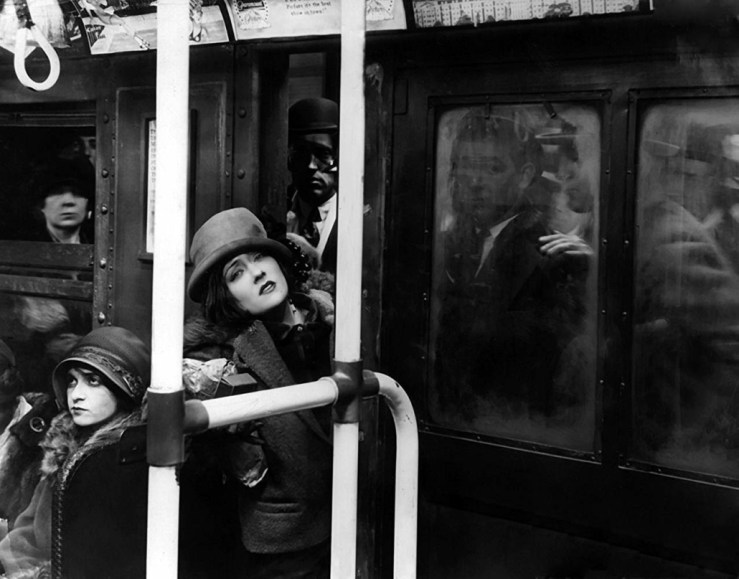
The 400 or so films that Allan Dwan directed are playgrounds for their actors, sandboxes of freewheeling experiment. Trained as an electrical engineer, Dwan was a technical innovator, but his flourishes were always in service to the specific talents of his performers.  In his self-effacing style, elaborate tracking and dolly shots never call attention to themselves, but only to the characters on-screen. Whether its suave Franchot Tone swinging off a saloon chandelier in Trail of the Vigilantes (1940) or glamour queen Gloria Swanson fighting through a packed subway car in Manhandled (1924), Dwan found hidden reserves of athleticism and wit in his stars. They would need it to motor through the  scenarios of borders, doublings and makeshift families that Dwan was assigned, which he treated as complex logic problems that are always solved, from institutional separation (political or geographic) into personal bonds (lovers, friends). He oils these Hollywood mechanics through his attention to character detail and penchant for parody, able to pack pathos and the madcap into his unstable, gleefully entertaining concoctions.

Dwan has never had the name recognition of some of his classical Hollywood contemporaries, and aside from Peter Bogdanovich’s essential interview book The Last Pioneer (1971), has had precious little written about his inexhaustible career. Some of this has to do print scarcity, as much of his silent one-reelers are lost, and his Republic Pictures films might as well have been due to rights limbo. That has all changed this year, with two major retrospectives (at MoMA in NYC and Il Cinema Ritrovato in Bologna), and a flood of writing, from Frederic Lombardi’s critical biography Allan Dwan and the Rise and Decline of the Hollywood Studios to the massive (free) dossier published by Gina Telaroli and David Phelps, a labor of love with contributors from around the world (including yours truly). After viewing twenty-some of his films over the past month, I’m about to add more to the pile.

220px-AllanDwanAllan Dwan was born in Toronto on April 3rd, 1885 as Joseph Aloysius Dwan. He told Brownlow the name change was caused by teasing at school, “they used to say Aloysius to be a girl”. After graduating from Notre Dame with a degree in electrical engineering, he caught the eye of George Spoor of Essanay Studios, as he was working on a mercury vapor arc lamp, which was easier on actors’ eyes.  Dwan supervised their use on set, and eventually submitted stories to the studio when he discovered they paid $25. Lombardi sketches the exaggerated variants of Dwan’s origin story over the years. In 1920 he said he was merely inspecting the installed lights when Spoor met him, but in the 1960s he claimed to have developed the arc lamp himself.

In any case he was subsumed into the movie business, and stumbled into directing a few weeks into his job as a writer at the American Film Manufacturing Company. One of their film crews had gone AWOL, and Dwan was sent out to investigate why. He discovered that the alcoholic director had skipped town on a binge, and was given the job on the spot. He told Brownlow, “I just let the actors tell me what to do and I get along very well. I’ve been doing it now for fifty-five years — and they haven’t caught me yet!” He was an actor’s director from the beginning.

One of his early stars was Pauline Bush, whom he claims to have directed in over 50 Westerns for the American Film Manufacturing Company (or the “Flying A”) from 1911 – 1913 and 20 films at Universal Pictures between 1913 – 1915. In Charles Foster’s history of Canadians in Hollywood, Stardust and Shadows, Dwan says “she just came in off the street and told me she wanted to become an actress.” Born in Lincoln, Nebraska in 1886, she had lit out for Los Angeles and was performing amateur theater before he discovered her. With Dwan she had risen to a modicum of fame, and used it to advance feminist causes. In a Feb. 1913 issue of the Chicago tabloid “The Day Book”,  a profile of her is headlined: “The Western Girl You Love in the Movies Is A Sure-Enough Suffraget [sic]“. She is described as an “ardent suffraget [sic], believing woman can and should do just anything a man can do. That is, she thinks a woman’s brain and ability ranks right alongside, not a few feet behind a man’s.” Dwan married her in 1915.

Dwan’s films are filled with assertive female characters, from the Gloria Swanson silents through Natalie Wood’s tiny truth-teller in Driftwood (1947) to the veritable matriarchy of Woman They Almost Lynched (1953). His ease with female power would seem to spring from this early relationship with Bush, which despite ending in divorce in 1921, remained friendly throughout the rest of their lives. Dwan sent her birthday and Christmas cards every year after their parting. Foster spoke with Bush in 1963, and she still valued Dwan’s directorial flexibility, saying, “He gave us a great deal of freedom in our actions and movement…we were all relaxed and he got the results he wanted.”

This freedom is evident in the earliest film I viewed in the MoMA series, his Flying A production The Mother of the Ranch (1911). Dwan’s films are filled with absent parents, and how the kids fill that gap, but this one regards a mother whose son is absent. He heads west to be a cowboy, but tires of the hard work and turns to cattle rustling instead. Undercutting the East’s romanticization of the cowboy lifestyle, it anticipates the comic Dwan-Fairbanks feature Manhattan Madness, in which city-boy Fairbanks brags about cowpunching skills and gets pranked by his friends. In Mother of the Ranch, the Easterner’s laziness gets him killed, and the mom arrives looking for her n’er do well offspring in vain. But in typical Dwan fashion, he doesn’t stoop to sentimental gloop, but installs her as a kind of Snow White to the remaining ranch hands, who lie to her about her son’s virtue, and take her on as their own mother. The image of Louise Lester perched atop a mound of beaming cowboys in the final shot encapsulates one of Dwan’s recurring themes, you take family where you can get it.

david-harum-1915-granger

David Harum (1915) is a more straight-forward bit of rural Americana, embracing the virtues of small town life. Based as it was on a popular 1899 novel, that was then a hit 1900 play, Dwan was probably instructed to play it straight. The stage star William H. Crane reprises his role as the kindly banker David Harum, who attempts to nurse a fatherless cashier towards adulthood. Crane is a warm presence in constant rotund motion, and Dwan employs one of the earliest tracking shots on record to capture him. He placed a camera on a truck to capture his waddle down Main Street, looking down at him from a high angle, watching as the town comes to greet and ignore him in equal measure.

The_Iron_Mask_(1929)_5

Before Dwan began his ten film run with Douglas Fairbanks in 1916 with The Habit of Happiness (Triangle Picture Co.), he had worked on female-centered films with Mary Pickford (A Girl of Yesterday, 1915) and with both Lillian (An Innocent Magdalene, 1916) and Dorothy (Betty of Greystone, 1916) Gish. It was the Fairbanks films that became blockbusters, though, irresistible entertainments that poked fun at popular genres. While Manhattan Madness parodies the Western, A Modern Musketeer (1917) does the same for the swashbuckler, with a D’Artagnan-adoring Fairbanks attempting to bring the chivalric code into the modern day, and running into the suffragette movement. Dwan remarked to Bogdanovich that he and Fairbanks tried to create, “plenty of suspense, but from the humorous side.” Audiences ate up these exuberant and lightly subversive takes on old favorites, which highlighed Fairbanks’ easy athleticism, in which which his legs seem spring loaded. Dwan would cut down the height of tables and barriers to make every Fairbanks leap look as easy as breathing. Even when Fairbanks actually played D’Artagnan in The Iron Mask (’29, their final collaboration), it was still light as a feather. When he leaps into heaven in the final reel, it seems like the most natural thing in the world.

Gloria_Swanson_Unknown_R1-976x757

When Gloria Swanson is on-screen it is impossible to ignore her, and Dwan elicits two of her greatest performances in Manhandled (1925) and Stage Struck (1926) (out of the eight films they made together, four survive). In both Dwan draws out her rambunctious comedienne, pushing her down the social ladder, from costume drama clotheshorse to working class striver. Dwan called the glamorous diva, “a clown if there ever was one”, and lets her loose as a destructive force upon the city. Swanson would later call Dwan her favorite director because of it. Manhandled opens with a tour-de-force of physical comedy, as her daily commute turns into a gauntlet of male girth. She is tenderized by the oceans of businessman in the subway car, squeezed up to the roof and shunted down to the ground. She manages to deflect serious injury through a kind of bruising ballet, wriggling through until she spots light at the end of the tunnel. For Swanson, surviving in a man’s world will take all she’s got. She plays a snappy store clerk whose beauty attracts rich suitors, and she is bemused by fantasies of wealth. She leads a double life, attending high-class parties and netting modeling gigs, while returning home to her tenement flophouse.

Annex - Swanson, Gloria (Stage Struck)_02

In Stage Struck Swanson is a meeker animal, cowed by her man crush grill cook Orme, for whom she does laundry and pines wistfully at the window. The film is a story of her self-actualization as a lustful woman, enacted in a series of close-up inserts of a home-made makeover. She takes a scissor to her floppy hat and leather shoes to look the part of a flapper, and tears up at every eyebrow pluck, a thoroughly de-glamorized vision of glamor. Her sexual will-to-power eventually throws off these outward signs of beauty and opts for pure aggression, as the next group of close-ups will be at a fairground boxing match, where Swanson lays down a beating while still having time to spout verse. It is both absurdly funny and a character’s statement of purpose – her willingness to look absurd a proof of love. Pathos and pratfalls, together forever in Dwan’s effortlessly entertaining art.

In two weeks, Part 2 of this article will attempt to discuss Dwan’s sound features.

BOXED IN: OTTO PREMINGER’S THE HUMAN FACTOR (1979)

June 25, 2013

M8DHUFA EC007

“The dullest movie ever made.” -Rex Reed, review of The Human Factor

Nothing much happens in Otto Preminger’s film adaptation of The Human Factor. A group of gray men sit in poorly upholstered rooms and talk about cheesemongers and malted milk balls. The detente between Eastern and Western powers reduces the workload of the bored British secret service agents to whinging and paper pushing. So when an inconsequential leak is uncovered, it is treated as a matter of national security, the boys gifted a bone to gnaw on. They end up gnawing on each other, their whole world reduced to a series of boxes that splits and drains them. Their deaths are as dull as their lives, but the emotions held in check by these relentlessly logical manipulators – fear, doubt, loneliness – curls the wallpaper in its repressed intensity. Newly released on DVD by Warner Archive in an un-restored transfer (the print shows plenty of wear and tear but it was certainly watchable), this final film of Otto Preminger pushes his dispassion to a radical extreme.

human-factor-movie-poster-1980-1020232860

Preminger was at a low ebb in his career, scrambling to source funding after a string of 1970s box office failures. He had a number of projects fall through, including a bio-pic of  Mao Tse-tung’s Canadian physician and a recreation of the hostage rescue at Entebbe Airport in Uganda by Israeli Defense Forces. Then he nabbed the rights to Graham Greene’s novel The Human Factor through his Sigma Productions a few weeks before the book’s release. He had previously optioned Greene’s A Burnt-Out Case in 1967, but nothing came of it. This time he pushed it through, with financing promised from the inexperienced producer Paul Crosfield, which later fell through. While on a location shoot in Nairobi, his crew’s checks started bouncing, and to avoid a mutiny he bankrolled the feature himself, selling his house and two Matisses, though still having to slash the budget by $2 million (he managed to keep one of Saul Bass’ most memorable opening montages). The Human Factor would put Preminger in debt for years.

M8DHUFA EC005

An eager Tom Stoppard was hired to adapt the screenplay. Stoppard claimed that, “if Otto had said I can’t pay you but you’ll get one or two lunches with Graham Greene, I might have done the job. I was much more nervous of displeasing Greene than I was of displeasing Otto.” He delivered a very faithful script, so much so that Greene expressed surprise, telling Stoppard he “needn’t have stuck so closely to the original.” The story concerns Castle (Nicol Williamson), a  lifelong diplomat with a wife and kids and the whole middle-class shebang. When MI6 discovers a small leak of economic information into the USSR, Col. Daintry (Richard Attenborough) and Dr. Percival (Robert Morley) begin investigating the African department, including Castle and his partner Davis (Derek Jacobi). Circumstantial evidence damns Davis, but it is Castle who was living a double life, one that begins to collapse.

M8DHUFA EC008

The dry, procedural script served Preminger’s purposes, in any case, and after failing to snag Michael Caine or Richard Burton for the lead role, he settled on Nicol Williamson. Williamson is ideal for the self-effacing part of Castle, a pasty company man of rumpled shirts and clammy handshakes. It is hard to imagine Caine or Burton disappearing into the background as humbly as Williamson. As Castle’s South African wife Sarah, Preminger tapped Supermodel Iman, for her film debut. Since his discovery of Jean Seberg in Saint Joan, Preminger considered himself an actress whisperer, but Iman never gets into the flat declamatory flow of spy-speak, her halting line readings registering as stilted.

M8DHUFA EC006

Preminger was insistent at a flat, drab look across locations, so an English country estate would looks as nondescript as Castle’s peeling suburban home or Spartan office. In Chris Fujiwara’s critical study, The World and Its Double, director of photography Mike Molloy recalls he, “started out trying to light it with a bit of mood to it and a bit of contrast, and he [Preminger] had an apoplexy at the first batch of rushes.” Fujiwara writes that he “complained of not being able to see the actors’ eyes”, making Molloy use flat and direct light. He used a 20mm lens and placed it in the corners of rooms, getting wide shots of the decrepit interiors, the actors just another piece of furniture, what Dave Kehr described as a “drama of pure surfaces…purged of the seductive highs and lows of traditional narrative texture.”

M8DHUFA EC009

In a pivotal speech, the casually sadistic Dr. Percival points at a Mondrian print and expounds: “Boxes. All part of the same picture. Each one separate, but held in perfect balance. Everyone to his own box, you in yours, I in mine. No responsibility for the next man’s box.” The upsetting of this monastic balance is Percival’s cause for justifiable homicide. Preminger seems to take his line as a formal decree, the film as a whole is a series of discrete boxes, those corner shots emphasizing the boundedness of the interiors, cells which only lead to other cells. Castle, eventually smoked out and isolated in Moscow (rendered in chintzy backdrop at Pinewood Studios), realizes he is caught in this labyrinth of logical bureaucratic design, partly of his own making. It is only then that Castle, and Preminger, can vibrate the surface of the film’s rational design, Williamson’s tears expressing a profound regret at a lost love now safely locked away in another impregnable box across the ocean.

M8DHUFA EC004

NO SUCH AGENCY: THE NSA, ENEMY OF THE STATE AND EDWARD SNOWDEN

June 11, 2013

Screen Shot 2020-02-12 at 5.24.36 PM

Top: Edward Snowden, bottom, Jason Lee in ENEMY OF THE STATE (1998)

“I made the judgment that we couldn’t survive with the popular impression of this agency [the NSA] being formed by the last Will Smith movie.” -ex-director of the NSA Michael Hayden to CNN, 1999

Before The Guardian’s video interview with Edward Snowden, the most damaging movie to the National Security Agency’s image was Enemy of the State (1998). Just another slam-bang Jerry Bruckheimer-Tony Scott blockbuster, it also depicted the NSA as a rogue operation that could tap the phones and bank records of American citizens at will. In the book Deep State, Marc Ambinder and D.B. Grady report that, “Not a few NSA managers at the time saw the movie and privately thought, ‘If only!’”  Following a dustup with European governments over the NSA’s global surveillance program ECHELON, Enemy of the State convinced Hayden that the NSA had to make gestures towards transparency. But as Snowden’s leaks reveal, the NSA was continuing to gather the capabilities, if not the legal authorization to target American citizens, for the tools deployed in Enemy of the State.

genehackmanasbrill

Bruckheimer and his late production partner Don Simpson began developing Enemy of the State in 1991, with a one line idea about a man whose electronic identity is stolen. After the Baltimore Sun ran a series of articles on the NSA in 1995, a time when the agency was reluctant to admit it even existed, they collaborated with screenwriter David Marconi to build it up into a story about the surveillance state, which Tony Scott dramatized through use of spy cameras and satellite footage – a layering of textures he would later push to extremes in Man on Fire and Domino. In the press notes Bruckheimer utilized some classic Hollywood double-talk, eager to please all political factions:

“I’ve always been interested in the inevitable questions surrounding the invasion of privacy. With today’s technology anything is possible and everything is probable. I don’t think the public is truly aware of what’s at stake in terms of an individual’s privacy. But the other side of the controversy remains – we need to be able to protect our borders and our citizens. The NSA has been incredibly active in preventing terrorist attacks and finding those responsible for the rash of senseless bombings that have erupted recently.”

Despite this defense of NSA practices, he was denied cooperation from the agency. So for technical assistance he enlisted Larry Cox, an 11-year veteran of the NSA. In a bizarre bit of historical coincidence, Cox would, just a few years later, be in a position to make the film’s paranoid fantasies come true.

Cox was founder and president of the menacing-sounding ORINCON Sygenex Incorporated, which was acquired in 2003 by Lockheed Martin. where he became the Vice President of Signals Intelligence. In 2005 he became the senior vice president and general manager of the Intelligence & Information Solutions Business Unit (IISBU) of SAIC (Science Applications International Corporation). SAIC employs approximately 41,000 people that “serve customers in the U.S. Department of Defense, the intelligence community, the U.S. Department of Homeland Security, other U.S. Government civil agencies and selected commercial markets.” SAIC was, along with Booz Allen Hamilton, the main contractor assigned to work on the NSA’s massive data mining Total Information Awareness project that was stripped of its funding by Congress in 2003. Cox came aboard two years later, but there are strong indications the program lived on well into his term. An expansive precursor to the Snowden-disclosed PRISM project, TIA sought to “predict terrorist attacks by mining government databases and the personal records of people in the United States.” Cox remains a consultant to the NSA Advisory Board.

At the same time that Hayden was  engaging his NSA charm offensive against Enemy of the State in 1999, the agency was starting an aggressive privatization push, which accelerated following 9/11. Needing to hire more analysts and translators, they began contracting heavily from private companies like SAIC and Booz Allen Hamilton, the latter of which Snowden worked at for three months before leaking the PowerPoint slides that outline the siphoning of TeleCom and internet data.

enemy

While many of the actions performed by the super-spies in Enemy of the State are pure science-fiction, some are now plausible. An early sequence finds cherubic agent Jack Black pulling up Will Smith’s phone records and cross-checking them against his banking statements, and within seconds forging a link to an ex-flame of his played by Lisa Bonet. The NSA cannot listen in to the conversations of U.S. citizens, but it does suck in all the metadata of their phone calls, their number and duration. While American citizens’ metadata cannot legally be targeted as part of an investigation, it is still collected and stored, ready to be used if the secret rulings of the FISA court ever deem it necessary.

It is President Obama’s contention that collecting this metadata is part of the balance of privacy and security, but that listening in to conversations is the bright line that cannot be crossed. The metadata, though, has an enormous explanatory power of its own, and combined with the NSA’s power to search credit card and bank records, can sketch an entire life. At Foreign Policy Shane Harris notes that “a study in the journal Nature found that as few as four ‘spatio-temporal points,’ such as the location and time a phone call was placed, is enough to determine the identity of the caller 95 percent of the time.”

enemy_of_the_state_1998_500x336_966862

Will Smith is able to escape the dragnet due to the help of ex-NSA hand Gene Hackman (there are many nods to his role in paranoid surveillance classic The Conversation). It is unclear what help Edward Snowden will receive, aside from legions of internet admirers. His closest analogue in the film is the environmental activist played by Jason Lee, who stumbles upon a government secret and scrambles to release it to the public before getting crushed by a commuter bus. Luckily for Snowden he is not inside a Tony Scott movie, but somewhere…else (he checked out of his Hong Kong hotel today, his current whereabouts are unknown).

The video interview hosted at The Guardian is a fascinating object, hermetic in form but expansive in implication. Conducted by Glenn Greenwald and directed by Laura Poitras (whose forthcoming untitled whistleblower doc has already achieved legendary status), it opens with a scenic picture of lolling boats in Hong Kong harbor. It’s a dis-establishing shot, since Snowden’s specific whereabouts are to remain hidden. When he appears he is a talking head, the back of which is reflected in a nearby mirror. He looks pasty and unshaven, rather the IT stereotype of a denizen of dark rooms. He speaks in calm, even tones, whether about his disillusionment with and deception of the surveillance state, or his fears of government reprisal. It is impossible to glean anything of an inner life, but it is curious that he is speaking at all, considering his stated claim of keeping attention off himself and onto changing U.S. policies. His appearance has deflected debate of this country’s privacy laws, diverted into drive-by psychologial evaluations of Snowden and attempts to identify the girlfriend he left behind (I won’t link to that), and recent polls show that 56% of the U.S. population approves of the NSA’s actions.  But there are promises of more leaks, and I’m sure Jerry Bruckheimer is takings notes for the Enemy of the State sequel to come.

EXPERIMENT IN TERROR, EXERCISE IN STYLE

February 26, 2013

8_larkin_street_4.jpg.scaled1000

Following the gargantuan success of Breakfast at Tiffany’s (1961), Blake Edwards acquired the freedom to develop his own projects. Typecast as a director of light comedies, he was eager to explore the stylistic opportunities offered by other genres. Experiment in Terror (1962) is the initial result, a thriller shot in stark B&W,  in which Edwards tries out a dazzling variety of styles, from baroque expressionism to naturalistic location photography of San Francsico. The plot, about a bank teller forced to rob her employer, is a dry procedural that moves from clue to clue with Dragnet terseness. Its main job is to move the protagonists around the city, so Edwards can light them in flamboyant chiaroscuro interiors or at Candlestick Park.   Experiment in Terror has the feel of a preternaturally talented kid playing with toys previously denied him. Twilight Time has released this bewitching oddity in a richly detailed Blu-Ray available through Screen Archives.

Edwards described that period of his life as one of “constant testing”. He wanted to “try something that was…away from the things that I was suddenly finding myself involved with.” The opportunity to do something different came when Columbia Pictures optioned the novel Operation Terror for $112,500, an astronomical sum at the time. The book and resulting screenplay were written by the husband-wife team of Gordon and Mildred Gordon, who spun Gordon Gordon’s experiences in the FBI (as a counter-intelligence officer during WWII) into crime fiction novels. This particular tale involves bank teller Kelly Sherwood (Lee Remick), who is forced to steal $150,000 from her job or a wheezing goon named Red (Ross Martin) will kill her sister Toby (Stefanie Powers). Kelly is able to contact the FBI, and Agent John Ripley (Glenn Ford) races against the clock to find the psycho before the money is lost or Toby gets snuffed.

The opening is a masterful bit of claustrophobic horror. To the strains of Henry Mancini’s wailing autoharp score, Remick pulls into the garage of her house near the Twin Peaks in San Francisco.  With shadows of plant fronds splayed across the wall behind her, she pauses as if hearing a noise. The camera pushes in, and the static shadows become a moving one, the darkened figure of Ross Martin sidles over and slides his hands around her neck. His face in darkness, what follows is an extended monologue of sexual aggression in extreme close-up, as he slides his hands down her body offscreen and ticks off her measurements. This is profoundly disturbing, made even more so by Edwards’ refusal to diffuse the tension with a long shot.

experiment-in-terror-ross-martin-as-red-lynch

Interiors become filled with grotesques, which Edwards forces in his frequent use of extreme closeups and canted angles, reminiscent of Orson Welles’ delirious Mr. Arkadin (1955). This motif reaches its climax inside the apartment of a mannequin designer and friend of the killer whose apartment is a necropolis of plastic appendages. When Red appears among this pile, he looks like just another mound of soulless molding. A creature more of sound than sight, his labored breathing is the only thing that identifies him as human.

experiment-in-terror

The usual thriller mechanics would demand Remick be piled with stress until she snaps into hysteria, waiting to be saved by a male interlocutor. Instead she is spooked but self-assured, as inflexible as the FBI and as fiercely independent as any criminal. She is completely self-sufficient, with no romantic interests and a cold-eyed intensity at getting the job done. She is so self-confident it rather drains the film of tension – there is no question she will succeed. The interest in the film lies in the how, and in what lighting scheme.

candlestick_park_5a.png.scaled1000

Gradually the film moves from baroque interiors to naturalistic exteriors, all shot on location throughout San Francisco, as if Edwards flipped the channel from Welles to Rossellini. Along with his DP Philip Lathrop, whom he worked with on the TV series Peter Gunn,  he captures the Twin Peaks neighborhood, the Fisherman’s Wharf and Candlestick Park with a mix of atmospheric long shots and handheld work. Outside the world is legible with nothing to fear. It is inside buildings and inside characters were there are stresses and manias and kidnappings.

Interiors and exteriors collide in the bravura final sequence at Candlestick Park, during a game between the Los Angeles Dodgers and the hometown Giants. While most films just use grainy stock footage of games, Edwards actually shot gorgeous footage on the field, and went to the expense of getting additional insert shots of the sweaty face of Don Drysdale before throwing a pitch (anticipating where network coverage was heading). While this is a boon to baseball nerds like myself, this extreme closeup is an indication that the claustrophobia of the opening sequence will reappear in this outdoor space. The climax occurs after the game ends and the crowd is filing out, the cover for Red’s takedown of Kelly and the money. The previous frames of looming faces and headless mannequins are here replaced by a mass drunken revelers. It is only when Glenn Ford can cut through this morass and empty out the film frame that the threat can be nullified. In the final shot a helicopter pulls up and away from Candlestick Park, out into nothingness.

Don Siegel pays homage to that final shot with his own in Dirty Harry, another story of a San Francisco psycho in which the camera pulls away from a blood-strewn stadium into the sky, as if revulsed by humanity. There are also a number of circumstantial echoes in David Lynch and Mark Frost’s landmark TV series Twin Peaks. The title is taken from the San Francisco neighborhood Lee Remick lives in, and Red’s full name is Garland “Red” Lynch. Perhaps tickled with the coincidence of sharing a name with the movie’s murderer, he also named a Twin Peaks character Garland (Major Garland Briggs) as well. So while the film is a compilation of Blake Edwards’ influence, his triumph of style over substance has had its own curious effect on the films that came after.

candlestick_park_8.jpg.scaled1000

DEATH DEFIERS: THE DAWN PATROL (1930)

February 19, 2013

Screen Shot 2020-02-07 at 4.59.42 PM

The aviation films of Howard Hawks are comprised of tightly knight groups of men confronting death. The bleakest entry, The Dawn Patrol (1930), also happened to be the first , a tale of a British Air Force outpost that acts as a waypoint between consciousness and the void, escorting young fliers into the blood-flecked air across the German lines. A pivotol work in the scope of Hawks’ career, it was his first sound feature, and introduces themes of professional obligation and facing up to mortality that appear throughout his career, reiterated most directly in Only Angels Have Wings (1939).  It has been difficult to see The Dawn Patrol in recent years until the Warner Archive released a fine looking edition on DVD last month.

fairbanks-hawks-barthelmess

Hawks’ first sound film was supposed to have been Trent’s Last Case (1929), and the director did extensive tests with the new technology, but Fox had failed to negotiate talkie rights when licensing the 1913 mystery story by E.C. Bentley. So instead it became his final silent, made in a market so hungry for sound that Fox didn’t even bother releasing it in the U.S. According to Hawks biographer Todd McCarthy, it only opened in Britain to poor notices, with Hawks regarding it as his worst film.

He wrapped filming on Trent’s Last Case in February of 1929, and was fired in May, after refusing to work on the titles Fox assigned him (Life’s a Gamble and Big Time).  Hawks and the studio sued and counter-sued over wrongful termination and failure to fulfill contracts, but all the litigation was dismissed with prejudice by the courts. He was free for the moment, and looking for a project. Hawks told Peter Bogdanovich that he got the idea for The Dawn Patrol from a story by Irvin Cobb, “about an evening with a British squadron that was being hit hard.”  Contra Hawks, Todd McCarthy found a sworn deposition from screenwriter John Monk Saunders that “he had dined with former war journalist Irvin S. Cobb…and had that night heard the story of ‘young British pilots.’” Whoever originally conceived the scenario, the script was a collaboration between the two men, both of whom were steeped in flyboy lore.

The_dawn_patrol

Saunders and Hawks had both entered the Army Air Corps during WW1, and became flying instructors in the states, neither of them seeing action. After hearing news of the Armistice, Saunders went “out alone onto the airfield and wept, his head resting on the wing of his plane.” Robbed of his chance to burn up in a war, Saunders lived vicariously through combat anecdote, soaking up stories from every pilot he met. He was a prolific writer in the 30s, his newspaper stories leading to the scenario for Wings and his Lost Generation novel Single Lady (1931), which he adapted for William Dieterle’s masterful Last Flight (1931, which I wrote about here). His wife Fay Wray described him as a man “who wanted to live dangerously and die young”, which he accomplished by hanging himself at the age of 44.

Hawks was a mechanically minded kid who drove race cars before entering the war, and flying became the latest of his obsessions. He did not acquire Saunders’ insecurity about missing combat action, but he was not unmarked with tragedy. The five friends he signed up for the Air Corps with were all dead by the time he started shooting The Dawn Patrol, all in plane accidents. His brother Kenneth was directing Such Men Are Dangerous when he perished in a plane crash during a failed stunt, mere weeks before The Dawn Patrol was set to film.

The_Dawn_Patrol2

If Hawks wanted to get a WW1 subject filmed in 1930, having Saunders on board would guarantee studio backing. First National (A Warner subsidiary) bought the rights with Richard Barthelmess slated to star. Howard Hughes was still working on the similarly-themed Hell’s Angels, and tried to disrput Hawks’ production at every turn, buying up any extra WW1-era planes and threatening to sue for copyright infringement. Nothing came of it though, and both titles had healthy success at the box office. Having already done sound tests before Trent’s Last Case, Hawks had the technical capacity for talkies, but he already had an aesthetic plan as well. He was intent on having his actors underplay, instead of projecting to the back of the theater. The conventional wisdom held that theatrical stage forms would take over, from performance to direction. But Hawks innately knew that cinema could bring you close with a whisper as easily as a shout.  Barthelmess was already well-versed in the subtle forms Hawks was looking for, since he had worked with the similar-minded D.W. Griffith.

Barthlemess plays Dick Courtney, a veteran British combat flier leading raids into German territory. His squadron bunks at a remote outpost led by Major Brand (Neil Hamilton), all exposed nerves as the death toll rises. As each mission team returns, he counts the sound of engines to determine the number of casualties. The dead disappear as quickly as the time it takes Courtney to wipe their names off the squad chalkboard. The pilots deal with this constant metronome of death through drink and camaraderie, gathering in the makeshift bar to talk of former flings and initiating group sing-alongs to their scratchy record player. These are necessary distractions, a way in which to immerse oneself in the present rather than stare at the abyss of the past. At one point a fragile Royal Air Force member, having just lost a friend, blows up at these callous displays. It’s a scene repeated by Jean Arthur in Only Angels Have Wings, after the air service fliers do their own carousing following the loss of a pilot. All female characters were cut from The Dawn Patrol, giving it its atmosphere of sweaty locker-room claustrophobia. Although it is similarly constrained to one location, Only Angels is more open and convivial, as the group teaches Arthur about how they cope, bringing her into their self-sustaining circle. The Dawn Patrol instead presents the group as a continuously disrupted family, little more than a replaceable collection of flesh.

dawn2

When the pilots do engage the reality of their fallen mates, it’s with the grim, mock-heroic acceptance of a song that Howard learned from his brother Ken:  “So stand by your glasses steady/This world is a world of lies/Here’s a health to the dead already/And hurrah for the next man who dies”. It’s hard not to read this as Hawks’ own attempt to react stoically to his brother’s passing, death as a liberation rather than a defeat. This is how the professional fliers stand it day after day, as new recruits arrive and then disappear. The only constants are Courtney and his pal Scott (Douglas Fairbanks, Jr.). But when Major Brand gets a promotion, Courtney becomes the squad leader, tied to a desk and unable to lose himself in flight. Now he is the one counting engine motors, made stir crazy by inaction and the crushing responsibility for so many lives. His job becomes that of a bureaucratic funeral director, and he can only free himself by disobeying orders and taking on a daredevil solo mission himself. There he can lose himself in the present, never to return.

The Warner Archive presentation has remarkably clear audio for a production of this period, and though the print they transferred is a bit worn and fuzzy, it’s likely the best this film has looked in ages. At this early stage, it’s the home video release of the year.

dawn

THE YOUNG ADVENTURES OF JOHN WAYNE

Originally published at Movie Morlocks, the official blog of Turner Classic Movies

January 22, 2013

Screen Shot 2020-02-07 at 4.40.16 PM

Marion Morrison had to work hard to become John Wayne. His earth-straddling lope and taffy-stretched line readings were not invented by John Ford or Howard Hawks, only finely exploited by them. The flood of Republic Pictures movies released on Blu-Ray by Olive Films illustrates this fact, filling in the blanks of the evolution of one of the screen’s most indelible personalities. Following the box-office failure of the Raoul Walsh masterpiece The Big Trail (1930), Wayne would have to wait nearly a decade before his delayed acceptance as part of Hollywood’s firmament in John Ford’s Stagecoach (1939). The period in between shows him sliding into obscurity, from Columbia and Warners down to the resourceful Poverty Row studios Mascot, Monogram and the slightly more reputable Republic. Olive has so far transferred sparkling editions of seven of the Republics, most of which finds him stepping in to play Stony Brooke, the leader of the long-running Western trio The Three Mesquiteers (he already played in a modern dress Three Musketeers for a 1933 Mascot serial – endless remakes are nothing new). Stony Brooke is lithe and quick where the classic John Wayne figures are slow-moving monuments, visible in Olive’s gorgeous 4K scan of The Quiet Man, out today on Blu-ray, but his Mesquiteers voice exudes the chummy warmth and presence of Wayne-ness, not yet weighed down with history.

The Mesquiteers films were Wayne’s second go-round at Republic, after a series of low-cost A action films at Universal failed to ignite audience interest. He told Maurice Zolotow that “the exhibitors wouldn’t touch a John Wayne movie with a ten-foot projector”, so when his Universal contract expired, he returned to Republic at a lowered salary. He considered his return the lowest point of his career, and was suitably dismissive of his work in this period, saying “Christ, they were awful. They were kids’ movies.” Secretary Mary St. John recalled that Wayne looked like a “wounded puppy — sad, frustrated and unhappy. He felt like his career has bottomed out.” Yet these are marvelously entertaining works, with spectacular stunts directed with speed and clarity by George Sherman, Joe Kane, and other Republic craftsmen. Wayne may have been in a depressive funk, but on film he registers with his lighthearted, almost lilting delivery, emitting from a powerfully angular frame knifing through the wilderness.

While John Ford’s Wayneare always haunted by the past, his step slowed to allow his pained memories to emerge around him, the Republic Wayne is engaged in the perpetual now of a chase. Stony is without past or future, each Mesquiteers film a new beginning. Paired mostly with fellow upright gent Tucson Smith (Ray Corrigan) and comic ventriloquist sidekick Lullaby Joslin (Max Terhune), these three earnest cowhands inevitably get roped in to save their community from evil land developers of one shade or another. These quickies are strongly pro-New Deal, pitting the Mesquiteers against a parade of oily land speculators and tin-pot dictators. In this series Wayne is, above all else, a community organizer.

Ostensibly a Western series, the constant need for stories (Wayne made 8 in less than two years) incorporated all manners of cliffhanging dramatics, from the crime procedural of Red River Range (where Stony impersonates a gangster) to the surreal circus comedy of Three Texas Steers. By the end of the Mesquiteers’ time-folding run, they were fighting Nazis. The most elaborately strange of the Wayne Republics would have to be The Night Riders (1939), which imports a Mexican revolution narrative onto the Western U.S. A disgraced cardsharp is convinced to impersonate a Spanish nobleman in order to claim a “Western Empire” of 13 million acres from forged land grants. So what starts as a riverboat gambling brawler ends up as a revolutionary war drama, complete with the Mesquiteers donning masks as a violent protest group, redistributing wealth with the verve of a 99-percenter. The vigilante trio even stumbles into the bedroom of a slumbering President Garfield, who can only offer back channel support against the Western Empire dictator, his hands tied by the isolationist mood of the government. Screenwriters Betty Burbridge and Stanley Roberts stole not only from pulp novels but from the headlines, as FDR was battling isolationist sentiments even as Hitler had invaded Czechoslovakia in March ’39. The Night Riders was released on April 12th.

Wayne’s career was at a standstill until his friend John Ford cast him in Stagecoach. Eager for the chance to star in an A picture, he accepted the part of Ringo Kid for the low salary of $3,000, barely above his Republic pay. In comparison, the female lead, Claire Trevor, would receive $15,000. Republic agreed to release him to film the project in return for $600 a week. Herbert Yates had no expectations that the film would raise Wayne’s standing. In fact, by the time Stagecoach was released in March of 1939, Wayne was already back making the Mesquiteers quickies Three Texas Steers, Wyoming Outlaw and New Frontier. But eventually the film’s overwhelming success, both critically and at the box office, made Wayne a valuable commodity, and he became their A feature star, for the one or two big budget features they produced each year. Dark Command (1940), one of the first results of this new contract, reunited Wayne with director Raoul Walsh, who had tapped him for stardom ten years previously in The Big Trail.

Wayne’s performances, perhaps chastened by the incessant insults Ford would throw at him on set, became more deliberate and thoughtful, as if he weighed each word before letting it loose. This makes Wayne’s characters seem haunted from the first frame in Ford’s works, even in the sprightly Irish romance The Quiet Man, in which Wayne is dogged by an accidental murder in his past. Winston Hoch’s luminous cinematography, which elaborates an endless palette of greens, can do nothing to prettify the striding husk of Wayne, who drags his violent history along with him into every frame. When he sees Maureen O’Hara emerge like a flame-haired ghost in the open plain though, some of that Mesquiteers lightness returns.

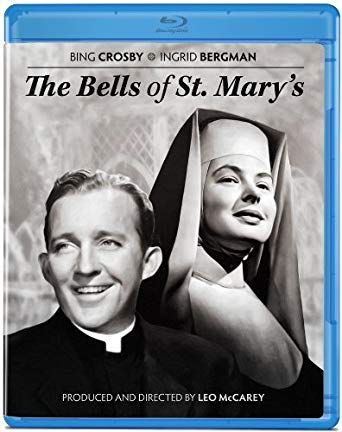
THE LOOK OF LOVE: THE BELLS OF ST. MARY’S (1945)

51tj6RapBXL._SX342_

Originally published in a booklet for the 2013 Olive Films Blu-ray release.

As WWII was winding down, the most popular character in America was the singing priest Chuck O’Malley. As portrayed by Bing Crosby, O’Malley was an amiable reformist, trying to bring Catholicism out of the cathedral and onto the streets. Created in collaboration with director Leo McCarey, Going My Way (1944) and The Bells of St. Mary’s (1945) were the highest grossing films of their year, and amassed ten Academy Awards between them. Adjusted for inflation, The Bells of St. Mary’s made more money domestically than The Dark Knight Rises (2012). Father O’Malley is a kind of Catholic superhero, trying to modernize the religion before it lapses into irrelevancy.

Following Going My Way, McCarey was one of the highest paid men in America, and he could call his own shots. He formed a production company, Rainbow, and started planning the sequel, The Bells of St. Mary’s, which he sold to RKO (Going My Way was distributed through Paramount). He developed the story with screenwriter Dudley Nichols, which focuses on the efforts of Sister Mary Benedict (Ingrid Bergman) to acquire a new building for her crumbling school, which will soon be shut down because of code violations. Father O’Malley is the new parish priest who must try and corral her ambition.

Bergman was under contract with David O. Selznick, so RKO had to pay him $175,000 to borrow her services, as well as sell him the rights to Little Women and A Bill of Divorcement. Bergman recalled how Selznick attempted to dissuade her from accepting the role, arguing that she “would just be a stooge for Bing Crosby’s singing.” She was enraptured by McCarey’s energy, though, and felt that, “If you didn’t like him, there was something wrong with you.” It was a hefty sum for RKO to pay, but Bergman had just won the Best Actress Oscar for Gaslight, and teaming her up with Crosby was the safest box office bet in town. Crosby was an altar boy as a teenager, and attended a Jesuit secondary school, but dropped out of Gonzaga to pursue a career in music. Conversant with both laissez-faire parishioners and strict observers, he was the ideal personality to bridge the gap between the traditionalist and progressive wings of the Catholic church.

While the episodic Going My Way has a tendency to meander, The Bells of St. Mary’s is anchored by the bubbling rapport between Crosby and Bergman. In a reversal of traditional gender roles, O’Malley is presented as a tender nurturer, while Sister Mary is strict and assertive, even teaching a young boy how to box. Crosby is introduced to St. Mary’s school through a series of humiliations. He is chastised by the maid (Una O’Connor), who clucks “I see you don’t know what it means to be up to your neck in nuns”. In Going My Way he owns every room he’s in with his laid back charm, whereas when he lays back here, he accidentally hits a buzzer and rouses the whole convent. Upon entering the conclave, he proceeds to sit down on a shrieking kitten. And when he gives his welcome address to the nuns, another cat toys with a straw hat behind him, causing the sisters to erupt in laughter.

Despite these indignities, Father O’Malley is still eager to assert his masculinity, so after two kids end up in a brawl, he expresses pride that they stood up for themselves. He tells Sister Mary, “On the outside, it’s a man’s world.” Mary replies, “How are they doing, father?” Their shifting power relations are expressed through the direction of their gaze. Mary begins her retort with modesty, eyes looking down, but by the end of her pointed phrase they drift up and stare straight off-screen at O’Malley, with the edges of her mouth curling into a grin. In his reaction shot O’Malley exhales and looks down, mumbling, “not doing too good” under his breath. This oblique reference to the horrors of WWII is also a decisive moment in their relationship. From here on out they exchange roles – Mary will exert aggression, and O’Malley compassion, accepting his subordinate role in the school’s pecking order.   He becomes a matchmaker for an estranged husband and wife whose daughter attends the school, while Sister Mary teaches her kids how to swing a baseball bat and throw a punch.

McCarey modeled Bergman’s character after his aunt, also named Sister Mary Benedict, a member of the Immaculate Heart Convent in Hollywood. Bergman portrays her with impish exuberance, an admitted tomboy who still finds pleasure in upsetting the expectations of how a nun is supposed to act. Bergman is very loose and inventive, and contributed eagerly to the improvisations that McCarey encouraged. Off-hand gestures, like how she flips a baseball off her wrist in a sporting goods store, or exaggerates her footwork during a boxing lesson, were made possible by McCarey’s improvisatory process. During down time, the director would sit at a piano and spitball ideas with the cast, encouraging acts of wild spontaneity. Bergman was already feeling free, not having to worry about her figure since she was clothed in a nun’s habit for the entire feature. “I was like a child with money”, she recalled, “and in the country of the greatest ice cream.”

McCarey put this improvisatory process on the screen with the Christmas Play, which Sister Mary is overseeing. She lets the children write it themselves, and informs O’Malley that, “Every time they do it, the dialogue is different.” The children are clearly making it up as they go along, as Bobby (the son of musical director Robert Emmett Dolan) hems and haws his way through the story of the birth of Jesus, ending in a tableaux of golf-club wielding shepherds. Instead of closing with “O Holy Night”, the kids sing “Happy Birthday”. Despite being set at a Catholic school, The Bells of St. Mary’s is quite secular, presenting the church as more of a social services organization than a religious one.

This is made explicit with the subplot of Patsy Gallagher (Joan Carroll), whose single mother pays the bills through prostitution. O’Malley takes her in as a student without asking questions, and tracks down her errant pianist father. This whole section plays like canned melodrama, a staid commercial for the value of church in the community. It almost seems as if McCarey included these scenes so he could get away with the more subversive antics of the rest of the movie.

One of the next turning points in the film occurs during a secular song. Sister Mary is singing a traditional Swedish folk tune by the piano with the nuns gathered all around her. O’Malley is attracted to the scene by her lilting soprano. He steps towards the circle, and McCarey cuts into a shot from his POV. It is the most artful composition in this otherwise classically framed film, in which two black habits join in the foreground to make a “V” shape, with Sister Mary’s face centered in the middle, as if in a cameo necklace. It is a devotional image, but this is not a religious psalm, but a love song.

Her eyes are shaded downward as she trills the lyrics, which roughly translate to: “Spring breezes whisper and caress loving couples/Streams rush by/But they are not as swift as my heart”. As she winds the song to a close, her voice lowers. But she inches up her head and finally sees O’Malley, which makes her voice fly up the scale to hit her highest note, which breaks up into a chuckle and a grin: “Oh, Father O’Malley!” In recognizing his gaze, she breaks the spell, but the tenor of their relationship has changed.

Their reciprocal glances continue to build in intensity, as word comes down that Mary will be transferred to another convent out West. It is ordered by her doctor, but O’Malley has to pretend it was his decision. This betrayal of trust triggers her shift from secular to spirtual, folk song to prayer. Before her departure, she kneels in in the chapel. Her eyes are directed upwards as she pleads,“Dear Lord, remove all bitterness from my heart”. It is a rare acknowledgment of God’s presence in a film otherwise occupied with the physical. As she passes by O’Malley outside the doors of the convent, her stare is unwavering, as she searches for some flicker of regret in his face. But there is none.

As she is about to depart, her prayer is answered. O’Malley calls her back, and gives her the truth. He did not order her re-assignment. Sister Mary closes her eyes in ecstasy, a beaming smile lighting up her face. She simply says, “Thank you, father. You’ve made me very happy.” They hold each other with their gazes, neither breaking away. For the first time their looks are equal. This is as close as they can come to a declaration of love.

Aware of the erotic tension of this goodbye, Ingrid Bergman planned a practical joke on the final day of shooting. In one of the last takes she threw her arms around a stunned Crosby and kissed him passionately on the lips. Reportedly one of the priests on the set jumped up and yelled, “You can’t use that!” McCarey didn’t, but this missing negative should be as sought after as the original cut of The Magnificent Ambersons. Something else to pray for.