AN INTERVIEW WITH DAVE KEHR

Originally published at Movie Morlocks, the official blog of Turner Classic Movies

April 5, 2011

Screen Shot 2020-01-29 at 3.10.44 PM

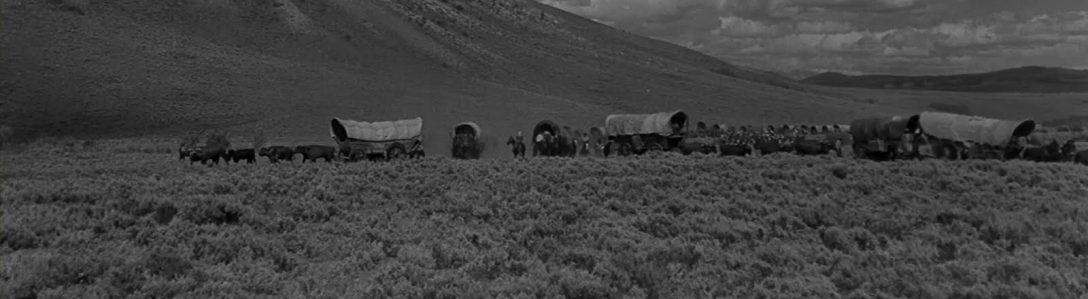
It’s taken as long as the caravan journey in The Big Trail, but we finally have a collection of film criticism from Dave Kehr, who currently writes the essential DVD and Blu-Ray column at the NY Times.  When Movies Mattered (University of Chicago Press) gathers his work from his period at the Chicago Reader, from 1974 – 1986. For years I’ve consulted his capsule reviews to guide my viewing habits, still available at the Reader website, but his long-form pieces have long been out of circulation. So this is a cause for celebration, although the resulting party would drive other critics to drink out of jealousy rather than selflessness. His prose is patient and lucid, laying bare stylistic and thematic mechanisms with the graceful invisible style of one of his favored Hollywood auteurs.

I was able to sit down with Mr. Kehr to talk about some of his favorite directors, as well as those not given much critical attention. So we range from Raoul Walsh to Godard and from Eastwood to Paul W.S. Anderson. Something for everyone! And it should be noted that the University of Chicago Press is doing an incredible job, releasing not just Kehr’s book, but also the most recent writings of Jonathan Rosenbaum and David Bordwell & Kristin Thompson.

RES:  It’s easy to get caught up in Raoul Walsh’s energy, but it’s hard to pin down his specific style. Could you break it down?

DK:  Well, he goes through a few different periods. If you’ve seen Regeneration, from 1915, the longest feature that survives, he’s really doing Griffith.  There are standard set-ups, moving into close-ups for moments of emotional intensity or alienation. And then we don’t have anything until 1922, something called Kindred of the Dust which is at the Eastman House. In that one he’s already doing wider angles, longer takes, and more staging of action in depth. He’s doing a lot less cutting. He’s moved in a different direction than Griffith at that point. That becomes very obvious in Thief of Baghdad (1924) and What Price Glory(1926). He becomes more about bodies moving through space and less about shots following shots.

The Big Trail (1930) is a huge breakthrough for him. The effect of working in what was essentially CinemaScope in 1930 makes him reconsider everything. Suddenly he’s got this equipment that will give him dead sharp focus over a range of like 5 miles. And he sees the possibilities instantly, which is what I find so fascinating. It has these incredible deep focus compositions, so you can see every aspect of a shot unfolding in the same image. There is a shot of the wagons being lowered down the mountains in the background, and people approaching in the foreground. Conceptually it’s incredible; multiple planes, multiple focal points. A lot of the stuff people think Welles and Tati invented is already pretty much there in The Big Trail. The other thing he finds there is this sense of background motion which becomes really important for him. He’ll have static figures having a conversation in the foreground, but have a lot of crossing in the background, with isolated pockets of action. You get the feeling these extras could star in their own movie. He develops that in a lot of different ways  in the early ‘30s.

RES: How did he carry the lessons of framing for widescreen back to Academy ratio after The Big Trail?

DK: Well, then he starts working on the deep focus. He works with James Wong Howe on Yellow Ticket (1931) which is a really fascinating film, and I wish Fox would make a print of it. They don’t quite have lenses that are fast enough, and they don’t have enough light, but conceptually they are 100% in Gregg Toland, Billy Wilder, Orson Welles land. They’ve got it all figured out. There are shots in that movie that could have come straight out of Citizen Kane.

RES: Did Andre Bazin ever write anything about Walsh?

DK: Not to my knowledge. These films were pretty hard to see. The Fox stuff dropped out of circulation after the studio fire.  I don’t think people were looking at these movies.

RES: When Walsh began making widescreen films again later in his career, do you see any shift in style from The Big Trail?

DK: It’s like he picks up where he left off. Even before that, when he makes his 3D movie, Gun Fury (1953). He had been making movies in 3D all the time. The irony being that he was blind in one eye. He doesn’t do anything differently in Gun Fury than the way he was staging stuff in The Lawless Breed which comes out the same year. He has that natural sense of depth. He identified cues of perspective and how to nestle characters within a space. It works brilliantly in 3D when you see it projected.

RES: How would you characterize his handling of actors?

DK: Well he likes a very distinctive kind of performer. He didn’t do a lot with Douglas Fairbanks, but he was at the same studio, Triangle, for five years. But when he finally does get to direct him there’s an immediate chemistry: this is the man in action. This is the Walsh hero. He carries this over in different forms. With Fairbanks it’s all light and jolly and weightless. It’s the same with James Dunn in Sailor’s Luck. There’s always something that kicks these people into action, and it can be a conventional goal, or it could be this animal sense of, “I have to keep moving.” And in the case of Sailor’s Luck I think it’s sex. The sexual attraction between those two characters is staggering. Obviously a year later you couldn’t do anything remotely like it. They just have to get together.

Then you get to Errol Flynn, who kind of picks up the Fairbanks stuff, but it’s a little darker, a little nuttier. He’s kind of angry and violent. In Flynn’s first few films he’s juvenile in an irresponsible way, taking unnecessary chances that’ll get him in trouble. And as he works with Walsh, from They Died With Their Boots On (1941) through Operation Burma (1945), that character grows up in really interesting ways.

Flynn achieves manhood for Walsh’s heroes in Operation Burma, and then you get those baroque variations from the late ‘40s and early ‘50s. Most famously, White Heat (1949), where the character is plainly psychotic. He’s no longer just dangerous, he’s fucking crazy. That performance is so gutsy. It seems so modern to this day. Chewing on a chicken leg as he walks over to the trunk to shoot the guy….

RES: Even in something like The Strawberry Blonde, Cagney is a little insane.

DK: It’s got that Walsh energy, but it’s more coiled and manic than Flynn, and certainly more than Victor McGlaglen. There’s always the sense that something is pushing these guys forward. It could be something as benign as that spirit of adventure of Fairbanks, or as psychotic as what Cagney does.

RES:  I heard you will be writing a new regular column for Film Comment starting a few issues from now. Will it be about directors like Walsh, who have not been written about much?

DK: Yes. For some reason research on American directors stopped with Andrew Sarris. Probably something to do with the fact that theory came swooping in around that same time, and we all had to pretend there was no such thing as authors for a few years. In the meantime directors are dying left and right and prints are dropping out of circulation. The older I get the more amazed I am by the size of the classical Hollywood cinema, how many interesting people there were, and how many films. It’s gigantic. I don’t think any writer has gotten their head around the enormity of this thing.

RES: Have you selected some filmmakers you’ll discuss?

DK: Two of the people I was planning on writing about… One was a guy who worked at Republic in the 30s and 40s named John H. Auer. And another guy named William Nigh who started at Warners in the teens, worked at MGM and ended up on Poverty Row in the 30s and 40s. He had an interesting late career. I thought I would call the column “The Auer is Nigh”, but they didn’t like it…[laughs]

RES: Are there any unpretentious action directors working today worth paying attention to?

DK:  Yeah. Paul W.S. Anderson I think is pretty talented. I always enjoy his films. I’m not sure he’s any kind of thematic auteur, but he certainly knows how to shoot action. And David Twohy, who did Pitch Black (2000) and A Perfect Getaway (2009). This is a sad example. The guy has directed four movies in the last eleven years . How many films would Raoul Walsh have made in that time? You just don’t have the chance to get good anymore.

RES: I’m happy you named Paul W.S. Anderson, who I get a lot of shit for liking. He’s always attracted to constrained spaces…

DK: Yeah, he’s kind of Langian. He loves these underground chambers. In every movie there’s people penetrating a gigantic spaceship [Event Horizon (1997)] or the bowels of the corporate headquarters in the Resident Evil movies. His first film just came out on DVD, Shopping, which is an art film compared to what came later.

RES: You devote a whole section to Jean-Luc Godard in your book, who at that time (the early-to-mid 80s) was re-engaging with, and questioning, narrative. You wrote that he was “concerned with breaking through a media poisoned world to something clear, clean and transcendent.” How would you contrast that with his recent work, which seems like a return to more experimental formal structures, interested in layering images and ideas rather than “breaking through”?

DK: Passion (1982) is probably my favorite of the late Godards. That one almost seems like a Dreyer film, completely spiritual. It’s all about the transcendent, how do we get out of here, what’s in the next room if there is one. After that he falls back into the argumentative mode.

Film Socialism (2010), which is in three parts, seems to correspond to three stages of his career. You get the opening sequence, which is the big beautiful and lyrical piece, of the stunning images he was doing in the 80s and 90s. Then you get the up close and personal family interaction stuff that he was doing in Numero deux (1975) and the films from the 70s that nobody sees anymore. And then it ends up with an essay-ish section which is very much like the Histoire(s) du Cinema. So he seems to be conscious of playing with his different manners. A retrospective film.

RES: Another of your pieces that struck me was your review of Sudden Impact (1983), and Eastwood in that period. I assume he was not taken seriously as a director at that time. Could you talk about Eastwood’s place in relationship to the New Hollywood, whom you often seem to be reacting against?

DK:  I was somewhat alienated from the whole Bob Rafelson, Easy Rider thing. I don’t think I would write those things as negatively now as I did then. It was a polemical moment.  I liked Clint because of his association with Don Siegel. I thought his first film showed an awful lot of personal investment, and particularly in the way he was looking at himself as an object. It’s a theme that continues, consistently imagining his own disappearance, his own death, obsessively. Sudden Impact is the best of the Dirty Harrys because it gives him such a powerful, other form, a Dirty Harriet, which it was often called at the time. He more than meets his match. Directed masculine energy meets undirected female anger.

RES:  The way Eastwood pares away any affect in his performances, I think you even called it “Bressonian” in your review, really stands out in Firefox (1982) in which he barely emotes, like one of Bresson’s models.

DK: I know, and that’s a great example of him imagining his own disappearance. Because at the end of the movie he flies off away from the camera into this little dot.

RES: Another interesting aspect is how, as a secret agent in Firefox, he’s supposed to be a good actor, but he keeps screwing up. He’s portraying himself as a bad actor.

DK:  Which is what I loved about Pink Cadillac (1989). That was a movie I got a lot of crap for liking, but this is a movie about why Clint likes acting, and why he’s not very good at it.

RES: His movies are so rich because of how he interrogates his own persona…

DK: Yeah, once he stops doing that, his work really dries up for me. His last great film was Gran Torino (2008), which is the summation of that theme, a film I found emotionally devastating. Literally handing over the keys to the new generation. Again he’s imagining his own death and irrelevance, but this time something comes after that.

RES: Could you talk a bit more about his work post-Gran Torino? It seems the craft is still there but not the same level of personal involvement.

DK: I don’t find them very personal at all. It seems like he’s taking whatever hot, Oscar-ish script of the moment is. He’s getting people like Brian Grazer to make his movies, and they’re prestige oriented stuff.

RES: What about the WWII diptych, which I felt was very strong.

DK: Yeah, the first one I thought was good, the second was really good. In Flags of Our Fathers (2006) he was aiming a little too hard for social significance – it didn’t feel like an Eastwood film. Letters from Iwo Jima (2006) is just the opposite .

RES: You felt the same about Invictus (2009) and Hereafter (2010)…

DK: Invictus I just couldn’t get into at all and Hereafter I thought was actually bad. Very disappointing. We’ll see about J. Edgar. Sounds like another Oscar candidate.

RES: Another director you devote two pieces to is Blake Edwards…

DK: Edwards was important because he was a full-fledged studio auteur who was still working at a peak level when I was writing those pieces. Just the perfect example of someone was could make very personal films in a very commercial context.

RES: Would you put him with Eastwood as the last of that breed?

DK: I suppose. I don’t want to sound all apocalyptic or anything. Joe Dante is still in there plugging. And John Carpenter…he’s a real independent. He released through studios but made maybe one studio produced film,The Thing (1982) through Universal. He has that studio ethic without being a studio guy. He fought to keep his independence so he could make movies as if he were working for an old studio.

RES: I wonder when we’ll get to see Carpenter’s The Ward (2010)…

DK: It’s played all over Europe. And Monte Hellman’s got a new picture with no distribution [UPDATE: Monterey Media has acquired Hellman’s ROAD TO NOWHERE]. And Joe’s last picture [The Hole (2010)] never got distribution.

RES: Was The Hole’s fate decided because studios booked all the 3D screens?

DK: He explained it to me. The problem selling it was it wasn’t scary enough for teenagers and it was too scary for twelve year olds. A tweener.

RES: Continuing with more recent work, you wrote that great piece on The Cable Guy (1996) recently, so could you expand your thoughts on Apatow’s output? He has his champions.

DK: He does, but I don’t think he’s that innovative. He’s never done anything as far out as The Cable Guy again. He wrote a lot of it and didn’t put his name on it, but he learned his lesson on that one. Keep it friendly, keep it nice.

RES: Funny People (2009) did seem very personal…

DK: It did, but not in such great ways. It kind of gets preachy on you. I didn’t like how he was layering the characters where the people at the center were these three dimensional, psychologically complex types, but the further you got from them the more grotesque and cheap sitcom-y they got. When they finally meet the husband, he’s this total cartoon. He’s no real competition, there’s no real drama between those two guys. The guy’s a joke. It was an easy way out of that dramatic situation. I generally find the Farrelly’s more interesting, although they kind of ran out of steam. They’re not as funny as they used to be.

RES: I’m a big Stuck on You (2003) partisan.

DK: Yeah, I like that. And Kingpin (1996), I just love it.

RES: Is is their anarchic qualities you admire?

DK: That’s where the real energy is now. Comedy and horror is where you can break the rules. You don’t have people breathing down your neck because executives don’t care about these genre things, they don’t watch them half the time.

RES: That’s why I’m a big fan of the Will Ferrell/Adam McKay comedies, especially Step Brothers (2008), which becomes incredibly anarchic.

DK: Yeah, I have to see that. Ferrell, I can’t quite figure him out. There’s something a little condescending in what he does. It’s not mean spirited, he just likes playing stupid people. He lets you know he’s smarter than they are all the time. Something about that bothers me. You can see him working down, where you could never see Stan Laurel working down.

RES: Step Brothers takes that as its subject. They are literally overgrown children, these men in their 40s, so I think it takes on that criticism. By the end of the film the narrative totally dissipates, into a series of non-sequitur gags. The Other Guys (2010) is more conventional…

DK: I saw that. It was a buddy cop movie that kept telling you, “this is a parody of a buddy cop movie.” But it was doing all the things a buddy cop movie does.

RES: It got caught up in the plot for some reason…

DK: Isn’t this a great parody?  No, it’s just like everything else.

RES: There was a flare-up recently in your blog’s lively comments section recently, this time about Tony Scott, who also has his critical defenders.

DK: I guess so. I was kind of amazed to discover that all of the Lisandro Alonso fans also like Tony Scott. I can’t reconcile this. Looks like the same guy to me who made Top Gun (1986). Just run and gun, shoot, shoot shoot, and maybe we can massage this into something that makes sense but we’ll worry about it later.

RES: So you didn’t find any coherent visual scheme.

DK:  I couldn’t find a pattern in what Pat Graham was talking about in Unstoppable (2010), supposedly mirrored, up and down panning shots. If they’re there, I totally missed it. One little trick for getting a quick sense of a director’s visual style is to fast forward through the movie.

RES: Do you do that often?

DK: Not often, but once in a while. So you’re not distracted by the trivialities of plot and character and acting [laughs]. But a quick fast-forward through and you get a good sense of the visual vocabulary. I just ran Unstoppable, the ten minute version, and there didn’t seem to be anything particularly organized about it. He takes these really banal screenplays and embroiders them with these big effects, which is what everybody does. He’s a little more creative technically, he’s willing to go the extra mile of bringing in the helicopter.

RES: I admit I’ve enjoyed his last few movies. I’d say he’s the main exponent of Bordwell’s “intensified continuity”. He’s able to take this style and pare it down where it moves and still makes sense, even if there is no overarching visual structure.

DK: But there are those push-ins at the end of close-ups, for no effect. It doesn’t mean anything. He uses it here but doesn’t use it there. It’s what someone called “refreshing the screen”. It’s just to keep something happening to keep kids from getting bored. Stimulating the optic nerves to keep people interested.

RES: I can’t argue that. But I also think he’s an efficient storyteller.

DK: That’s the kind of filmmaking I value. I just don’t get him, or “the working class metaphysics.”

RES: That quote from Mark Peranson in Cinema Scope (read here) really got under your skin.

DK: That phrase stuck in my craw. It’s too easy. What’s working class about that movie? It’s not about the Hawksian pleasures of doing your job or the Walshian pleasures of community. It’s your typical Hollywood heroes acting in complete isolation. The thematic is tired old therapy stuff. By stopping this train we’ll become better husbands and fathers.

RES: Let’s talk about your blog, and the great community you’ve created there.

DK: I don’t think I created anything. It’s just there aren’t that many places where you can discuss these issues without having the same tired argument over and over again, “is the director the author of the film?” I’m too old, I don’t want to talk about that anymore.

RES: The discussions get intense sometimes. Do you think it recreates the polemical atmosphere of the Kael-Sarris period of your writing, of “When Movies Mattered”?

DK: I hope so. The thing about Tony Scott was a pretty good example of that. I really enjoyed that, it got tense.

RES: In the blog you mentioned that I Saw the Devil (2010) is the natural endpoint of the revenge film cycle kicked back off by Tarantino. Could you elaborate on that?

DK: It’s just hard to imagine things going any further. It’s the old gag where the cop is as crazy as the criminal, but in this case the competition is about who can cause the other greater pain. The pain is registered with such force and originality, it really shook me up. He’s not nearly the craftsman that Park Chan-wook is, but his color sense is magnificent in that great opening shot of the face created in the rear view mirror.  You don’t know whose point of view it is until a half-hour into the movie. It has that old-fashioned craftsmanship that cares about composition and texture and color. You see it in the Korean films coming out now, which I guess is inspired by Park Chan-wook. It’s not happening in many other places now.

RES: Is there anywhere else?

DK: Well, we seem to be living in this post-mise-en-scene world, with a few pockets of it remaining. Johnnie To mainly, the couple guys in Korea, David Fincher, David Twohy, and I’m sure a few others but not that many. Now it’s all about acting and framing the performance. Most mise-en-scene is just finding some way to separate the actor from the background. And that’s all they’re thinking about, how to isolate this face. I was sitting through Sucker Punch (2011) last week, and I thought, what am I doing here? I could have watched three Allan Dwan films in the time it took me to watch it!
PHYSICAL EVIDENCE: WHITE MATERIAL (2009)

November 16, 2010

whitematerial

White Material opens with a shot of dogs crossing a headlight-lit road, followed by flashlights illuminating the well-appointed interior of an abandoned bourgeois home. The sequence ends with the image of an African revolutionary leader named The Boxer (Isaach de Bankole) lying dead, his face etched out in circles of light. It is a film about coming out of the darkness into this rather cursed light – what is revealed is dissolution and chaos. Claire Denis’ allusive and texturally beautiful film opens this Friday from IFC Films, and will appear on video-on-demand services starting November 24th. I participated in a round table interview with Denis and star Isabelle Huppert last week in NYC, and their insights will be liberally sprinkled in with my own below.

Huppert stars as Maria Vial, the sinewy-strong manager of a coffee plantation in an unnamed African nation (it was shot in Cameroon). A seductive voice crackles over the radio about armed unrest and the iron hand with which the government plans to put it down. Maria’s workers start fleeing en masse, and soon her ex-husband Andre (Christopher Lambert) urges her departure as well. Her father-in-law Henri (Michel Subor), the owner of the plantation, is a ghost-like presence, sickly and waiting for death (the fate of a white man’s burden), while her son Manuel (Nicolas Duvauchelle) shows signs of mental breakdown. Everything is falling apart, and yet Maria is obsessively intent on completing the year’s harvest. She exists in a state of willful ignorance, unable to accept the destruction of the only home she’s known.

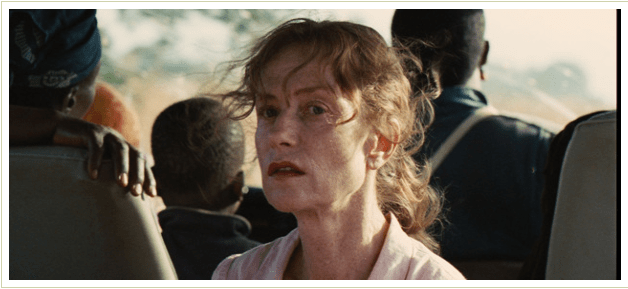
Huppert and Denis emphasize the split nature of Maria’s personality. Together with DP Yves Cane (long time collaborator Agnes Godard was tending to her sick mother at the time), Denis frames Maria up close with a handheld camera, emphasizing her isolation. And yet within these spare framings, Huppert exudes an indomitable, intractable kind of fortitude. Her denial of reality doesn’t unmoor her from it, but makes her dig deeper inside of it. From the outside,  the perspective of the French soldiers in helicopters urging her to leave, she is fragile and soon to be victimized. But in the cocoon of close framing she is a warrior, her pink cotton dress, as Denis described it, a kind of armor. Denis again: “I remember a scene from the coffee plantation. There was this young man, young worker in the plantation, took his moto, raised his arms and said, ‘every morning when I go on my motorcycle I feel  free and strong’. I really liked that. She [Maria] was seen by the French soldier as a little fragile victim they came to rescue. A minute after riding the motorbike she starts feeling, ‘I will make it, I will manage to finish the harvest. I will not be a victim’.”

Huppert:  “As Claire was writing the script with Marie [author and first time screenwriter Marie N’Diaye], I remember she was giving me clues, she was something like a bionic woman, a super woman. By this exaggeration she gave me a clue of what she wanted. Not psychological, but a physical approach to the character. I remember when she said that to me. It really opened a whole world. A totally physical approach, and nothing else. So I started to learn how to ride a motorcycle, and when I got to Cameroon I started to learn how to ride the tractor. So the character was defined by resistance to the natural elements, and the whole situation against her.”

As self-destructive as her behavior is, Maria is still imbued with a kind of faded grandeur. She is fully committed to the colonial project even to the point of death. She identifies completely with the land, raking in the coffee cherries with the workers and focused only on keeping the farm open. It is a phenomenonally physical performance by Huppert, even standing still she seems like a natural part of the landscape, a stylish scarecrow.

Her principles are paternalistic and outmoded, but at least she has them. The violence that threatens the edge of every frame seems to have no principles except destruction. The rebels are terribly young, child soldiers drafted into a war they didn’t choose. The government is run by cynical profiteers, organizing militias for their own protection but caring little that the rest of the country will burn. In the midst of this chaos, Maria is a stabilizing presence. She is insane, but steady. This steadiness of belief is why Denis continually compares her visually to The Boxer, the mythical rebel leader, and the only other character who seems to believe in his own cause. The Boxer is also given intimate single close-ups like Maria, while the rest of the film uses medium to long shots set on a tripod.

His story is also one of dissolution. He is wounded, his life slowly draining out of him while the rebellion he once led spirals out of control. Like Marie with her family, the rebel forces are no longer under his command. And yet he remains impossibly serene, his face an imperturbable mask. Their destinies are intertwined through these visual, thematic and structural rhymes. Structural, because the opening shot of his death immediately precedes the introduction of Maria, riding a bus to nowhere, before it moves back in time to establish what led her to get that empty look on her face (She meets The Boxer briefly in this middle section). This flashback structure establishes the entropic direction of the narrative – we know things will fall apart, but not how. White Material was shot before 35 Shots of Rum, but was released a year later, not just due to the vagaries of distribution, but also because she spent so much time establishing the structure. In the interview she said the script was written in chronological order, but that the bus scene got stuck in her mind, because she wanted, “To have Maria appear in the broad daylight, already lost, already too late.” The opening shot of the Boxer was necessary because she wanted,  “Dark night preparing her to walk into daylight. I cannot explain why.”

MARTIAL FINE ARTISTS: NINJA II – SHADOW OF A TEAR

December 31, 2013

Screen Shot 2020-01-23 at 1.52.09 PM

The best action movie of 2013 went direct to video. Ninja II: Shadow of a Tear comes out today on DVD and Blu-ray, and was released on VOD earlier in the month. It is the seventh DTV collaboration between director Isaac Florentine and actor Scott Adkins, trained martial artists driven to bring clarity to the fight film, showcasing athleticism rather than camera blur. This is a ninja revenge movie without filigree, stocked with some of the most intricate moves this side of Fred Astaire, arranged by fight choreographer Tim Man. For his dance sequences Astaire demanded to be framed in long shots, to convey the full expression of his body, and Florentine takes a similar approach with Adkins. As Adkins told me in an interview yesterday: “We want to show the action, we don’t want to hide it. We know when they do the shakycam and everything we know why they do that. What you’re actually seeing looks shit, so you shake the camera to give the impression something amazing is happening. All you’re actually seeing is nothing. We try not to do that, we want to show the performers, the highly trained, physical performers, doing what they do best. In a very balletic, graceful way.”

The first Ninja (2009) was a broad comic book-style action movie, with a corporate death cult threatening the safety of NYC. Casey Bowman (Adkins) is the orphan raised in a dojo who tears down their international conspiracies with the help of fellow student Namiko (Mika Hijii). With its kitschy hooded villains and unconvincing Bulgaria-for-NYC locations, it’s more Adam West than Christian Bale, superhero-wise. If you are a cheese aficionado, it is a profound experience, but even if not, there are some miraculous fight sequences, including a closed-quarters slobberknocker in a subway car (which Jason Statham borrowed for Safe). For the sequel, they wanted to make “an old-school martial arts film”, as Adkins put it. This time around Bowman has married Namiko, and they run the Japanese dojo in which he was raised. A brutal attack destroys this idyll, and Bowman snaps, violently tracking down the drug lord Goro (Shun Sugata), whom he suspects of the crime. It’s a simple narrative line to hang a series of wildly inventive fight sequences on.

The revenge plot and use of ninjitsu is reminiscent of the Sho Kosugi ninja trilogy from the 1980s (Enter the Ninja (’81), Revenge of the Ninja (’83) and Ninja III: The Domination (’84)). All three were produced by Menahem Golan and Yoran Globus’ Cannon Films, and it was Golan that gave Florentine his first directing job (Desert Kickboxer (’92)). Florentine even casts Sho Kosugi’s son Kane in a pivotal role as Casey’s enigmatic friend and rival Nakabara. Adkins comes out of a kickboxing background, so his version of a ninja mixes in showy kick acrobatics with the Japanese styles. His influences also differ from Florentine. While the Israeli-born director emerged out of endearingly slapdash Cannon Films canon, Adkins grew up idolizing Bruce Lee and Van Damme before turning to martial arts himself. A real student of the form, he listed his fight film favorites as Enter the Dragon, Fist of Legend, Drunken Master 2 and Armor of God. Their interests complement each other, as Florentine learned how to stretch a buck while Adkins studied how to make bodies look fluid on-screen.

In one interesting experiment they attempt a one-take fight scene, set at a rival Japanese dojo. Casey is there snooping out information on two local thugs, and takes out all five men in an unbroken forty second shot. It is not as ambitious as those of Tony Jaa in The Protector or Choi Min-Sik in Oldboy, but it serves a different purpose. This is not a showstopper but a scene-setter, displaying Casey’s easily snappable temper and setting up the array of fighting styles to come. He takes them out with brawling punches, soaring spin kicks, and a submission arm-bar. Adkins, who admitted to being exhausted after shooting seven takes of this, is a stylistic chameleon, with the looks and power of a brute force brawler but with the ability to execute nimble air strikes. With a handheld camera Florentine and his longtime DP Ross W. Clarkson float around Adkins, a member of the bout rather than an observer. The camera privileges the fighter, but also engages in its own choreography, dancing with the brawlers. Adkins mentioned this camera choreography as party of his fight film philosophy:

A lot of people, the way they get it wrong is they document the action, as if making a documentary. From that side, that side, and that side, with a long lens or whatever. That’s not the way to do it. You need to get the camera in, with the action performers, moving in unison with them, and the camera should be as choreographed as the performers are. You’re part of the action, not watching it from afar. That’s what good action filmmaking is all about.

Their showstopper in Ninja 2 is a barroom brawl that tips its cap to Drunken Master and Kickboxer. Casey is drinking himself into oblivion when a loudmouth drunk splashes him with booze. Needing little provocation, he proceeds to decimate every loser in the joint. Ninja II uses inebriated fighting to darker comedic ends than the Jackie Chan and Van Damme films. The Chan and JCVD personas have something of the beatific innocent about them, their moves very clearly for show – a performance. Adkins is a more brooding type, his most fully formed character the anti-heroic convict Boyka in the Undisputed series, who fights not to please, but as an instinctual survival mechanism. The same is true of Casey, whose only remaining identity is tied to the dojo and the study of ninjitsu (although the film shows only a smidgen of that form). In the bar he completely loses his self control, revealing himself to be nothing other than a very nimble town lush. But he does it with style. Florentine keeps the camera at a distance, occasionally isolating the more spectacular feats with cut-ins and slow motion. But every blow is visible, as his regular editor Irit Raz (Florentine always works with the same crew) cuts the sequence percussively, on every meaty kick or knife-wielding snik.

There are countless other memorable battles here, which is remarkable considering the restraints of time, money, and Adkins’ aching back, which he seriously injured on the set. But despite all the limitations of DTV productions, Florentine and Adkins are relentlessly pursuing, and have nearly perfected, a pure form of the fight film, returning the genre to its roots as simply capturing fine-tuned bodies in collision-course motion. Hopefully we get to see their next distillation in 2014, with the highly anticipated Undisputed IV tentatively slated for release.

THE SAMUEL FULLER COLLECTION, PART 2: AN INTERVIEW WITH CHRISTA FULLER

October 27, 2009

crimson kimono


Today finds me further entrenched in The Samuel Fuller Collection, a seven-disc box set which comes out today from Sony Pictures Home Entertaintment and the Film Foundation, and for which I had a hugely entertaining interview with Christa Fuller, Sam’s wife. Before I get to her exuberant personality, a few more notes about the movies…

An auteurist’s delight, the set traces Fuller’s career from assembly-line scriptwriter to writer-producer-director tyro. The leap from the innocuously pleasant It Happened in Hollywood (1937) to the delirious noir Underworld U.S.A. (1961) is fascinating, and the drips of his personality discernible in his screenwriting work from Hollywood through Shockproof (1949) and Scandal Sheet (1952) is something of a revelation. Fuller’s blunt-edged prose is handled deftly by Phil Karlson’s hopped-up realism in the latter, while Douglas Sirk’s gleaming surfaces and detached irony are an odd, endlessly fascinating fit for Shockproof, which should be some kind of auteurist case study.

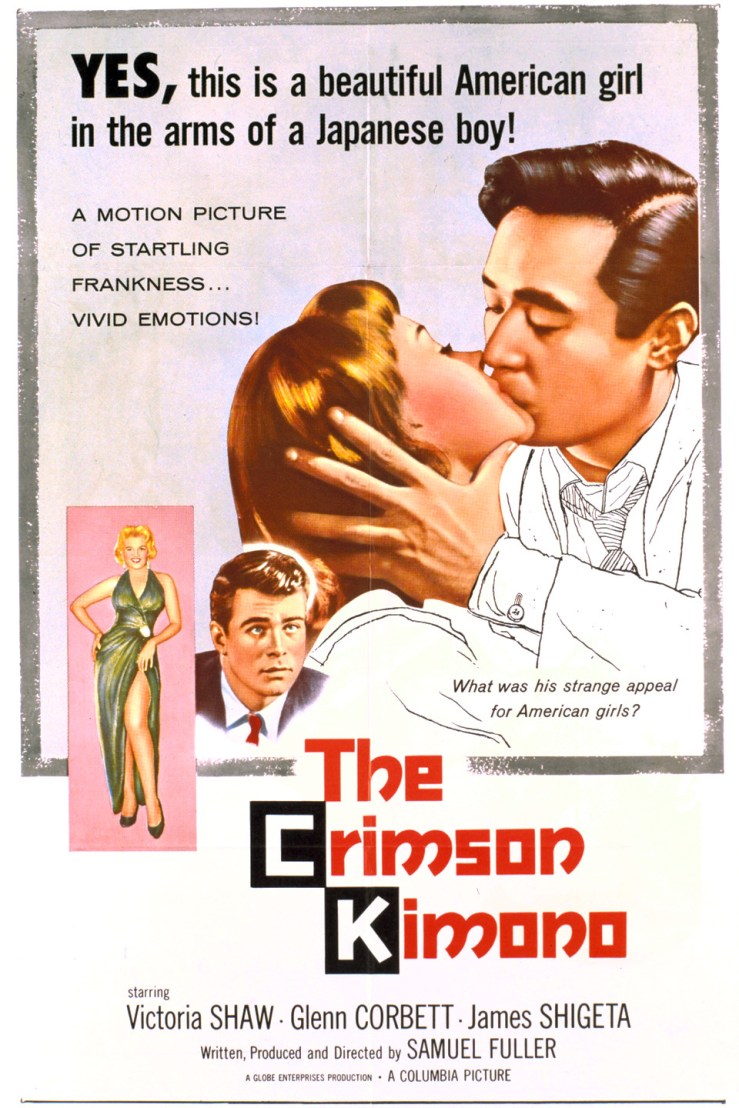
Then there is the full-on eau de Fuller with The Crimson Kimono (1959) and Underworld U.S.A. Kimono is a nuanced take on inter-racial romance shot through with Korean war guilt and stunning location photography of L.A.’s Chinatown. Underworld U.S.A. is all clenched fists and close-ups, documenting the all consuming revenge kick that takes down Cliff Robertson and anyone near him. His tormentors are thrown up as shadows on an alley wall, his own brick-screen idols that he’ll track down one by one with bitter ferocity.

Below the fold is the interview with the delightful Christa Fuller, Sam’s wife for over thirty years and a great thinker and actress in her own right (her film debut was in Godard’s Alphaville), about her late husband’s career in newspapers, the Army, and Hollywood.

What have you learned about Fuller since you completed editing his autobiography, A Third Face?

A Harvard archivist went looking for Sam’s  papers, and he found something that Sam never told me. He was married to Buster Keaton’s wife who committed bigamy. He was 26 years old, had just sold Hats Off! [1936, Sam’s first scriptwriting gig], and she dragged him to Tijuana and married him.  After he found out she was still married to Buster, the marriage was annulled. He never told me. The archivist found the annulment papers and the newspaper announcement. Buster Keaton at the time claimed he was so drunk he didn’t remember having married her.

Sam was so disgusted he never told me. He even cut her face out of a photo. It’s just her and a woman’s sleeve, and he never told me about it. I was shocked. He told me when we met in Paris that he’d never marry or go out with actresses. He hadn’t told me why. He probably forgot about it. He was traumatized by it. So the marriage was annulled, and that’s how he was briefly related to Buster Keaton.

Was Sam’s writing style influenced by his time in the newspaper business? Power of the Press and Scandal Sheet (and later, Park Row), seem to show a strong influence from this time in his life.

Totally. Sam was broken into the newspaper business by John Huston’s mother, Rhea Gore. John and Sam worked at the New York Evening Graphic together, along with Walter Winchell. It was run by Emile Gauvreau, the crazy Irishman with eight beautiful daughters (Charles MacArthur and Ben Hecht based their play and film, “The Front Page”, on him). And he was a health nut, he went barefoot from Nyack to New York every day. At the time they called the paper the “Porno” Graphic. And John Huston’s Mom, Rhea, broke Sam into crime reporting. John said he spent more time with his mother than he did. Rhea, even though she divorced Walter Huston and married into a railroad fortune, continued working as a newspaper woman. She was very ballsy, cutting through red tape, bribing cops to get the story. She’s a Sam Fuller character herself.

John didn’t get along with his mother, left the paper, ran off to Hollywood and started writing for William Wyler. He came to Hollywood before Sam. Sam started as a copyboy for Arthur Brisbane, one of the most powerful men he worked for. He was the brain behind William Randolph Hearst, and Sam was his personal copyboy when he was 14. Hearst wouldn’t make a move without him. Sam lost his father when he was 11, and Brisbane was a father figure to him. Sam had a lot of these father figures.

The newspaper office was like his living room, growing up…

Totally! Sam always wanted to run his own paper somewhere in New Hampshire and write his own editorials, and convey his own vision of the world.

What did Fuller think of some of the early adaptations of his work, like Power of the Press?

There’s some great dialogue in that. Like “Freedom’s dynamite, it to be handled with care”! It does sound like him. Scorsese said that Sam was so deeply American, the kind of America that is vanishing. When we lived in Europe together, it always struck me that Sam was innocence abroad. I think he was kind of like a Mark Twain character. Europeans have layers of perversion, and Sam was really innocent there.

What was his relationship like with the studio heads, and how did he manage to get such envelope-pushing material onto the screen, like the relationship between a Japanese-American man and a white American woman in The Crimson Kimono?

Such a beautiful film. Alain Resnais made Hiroshima Mon Amour around the same time, about a white woman with a Japanese man. The same year an article in an Oxford newspaper dubbed TheCrimson Kimono as “Los Angeles Mon Amour.” The head of the studio said to Sam, why don’t you make the white guy a little bit on the mean side, so we understand why she prefers the Japanese man. And Sam said, hell no. They have a lot of affinities, they’re both nice guys, fought in Korea together, and I’m not making the white guy on the mean side so the bible belt will buy it.

In Forty GunsSam wanted the heroine to die, and at the end he should have to shoot her, the woman he loved. Zanuck said “Barbara Stanwyck is a star, you cannot kill the star.” So Sam had to attach a happy ending. He had to compromise, they all had to. But Sam was a very moral guy. He never lied. He berated himself, undervalued himself. He didn’t want to marry me, saying “I’m 54 you’re 22, I don’t like younger women, ten years from now I’ll be an old fart, I’m a has-been.”  He talked himself out of it. He didn’t promise me anything. Because he didn’t bullshit me, I stayed with him. It’s hard to take, but it’s easier on a relationship. And that was courageous. Maybe it was the courage of a fool, but it worked.

He didn’t promise me lines in his films. I had to give up many of my own ambitions to make the marriage work. Even though Sam was a feminist and worked with women, it’s such a nerve-wracking business. I did squeeze in a master’s degree in literature and taught French for four years, and started a doctorate on Samuel Beckett. But then this White Dog thing happened, and we moved to Europe, and I never finished it. Instead I finished Sam’s autobiography.

Will you go back to the Ph.D.?

No, I’m still intrigued with Sam’s characters. I love Beckett, but there’s something so modern, so way ahead of his time in Sam’s work. I’m intrigued by he got away with it, and through so many ups and downs. Why do they call a European movie an art movie and his movies B-movies?

Howard Hawks bought the rights to Fuller’s first novel, The Dark Page, could you talk about that time in his life?

Hawks bought the novel while Sam was still in the war. I’ve got a letter Hawks wrote to Zanuck raving about Sam’s writing, and he bought the novel. This is one of the items I posted on the fan page for The Dark Page on Facebook. They republished the book last year in Scotland, the same company also re-published No Bed of his Own, by Val Lewton , the producer of Cat People. The first time he saw his book in print was in an army edition of The Dark Page, which ends up as a scene in The Big Red One.

Was Sam upset when Hawks sold the rights to his book to MPI?

Hawks was a businessman, Sam wasn’t. He bought it for 15 grand, and I think he sold it for 100, netting 85. He wanted to do it with Humphrey Bogart and Edward G. Robinson before it fell through. Of course if you’re a writer and Hawks buys it, and you’re young…

The plot is similar to many of his works,  including his novel Crown of India, where an older man trains a younger man, teaches him the ropes, and then the younger man has to expose the older man, and use his lessons against him. Totally Oedipus. The son always wants to outsmart the father. I’ve seen it with all the young directors that came and almost destroyed Sam, some of them. They always wanted something. There’s no innocence when somebody comes and says, “I admire you.” Sam was a very simple person, he never wanted to become a cult figure. Truffaut said about Sam that he’s simple without being simplistic, and that’s very rare. Well said.

Curtis Hanson was one of the nicest disciples. We knew him when he was 18 years old, when Sam and I first got married, he always knocked on Sam’s window. He wound up spending hours with him. Then there was Peter Bogdanovich. Sam helped him write Targets. Peter acknowledges it, but Sam didn’t want any credit.

Sam had his own father figures, but Sam was a gentleman, a civilized man, and I could see how he handled his Oedipus complexes. He never destroyed these father figures. He had all kinds, from Arthur Brisbane, and later on when he came to Hollywood, Peter Pan – Herbert Brenon, was one of his first. The German director E.A. Dupont, who directed Piccadilly, who helped him on I Shot Jesse James, was another. John Ford was one as well.

What was Sam’s relationship with Ford?

Ford loved Sam as a writer and always wanted to work with him. Sam thought John was the greatest director in the world. He worshipped him. John was very proud of Sam, and would call him every year on D-Day and say, “Fuck the Big Red One!” That was a running gag because Ford was in the Marines. Sam just had an unlimited admiration for him – he’s pure Americana.

Another father figure was General Terry De La Mesa Allen. He made the cover of Time and Newsweek. He was so famous at the time. All the dogfaces, all the soldiers loved him. He fought alongside them. He was so famous John Ford pleaded with Sam to meet him. Sam organized a luncheon or dinner, and I have pictures of Ford with General Allen. When he made the covers of Time and Newsweek, he was so modest. “I’m no hero”, he said, “dead men made me a general.” Listen to that line. Gives me goosebumps.

That sounds like a line right out of one of Sam’s war films…

He influenced Sam the most. All these years of battle, and Sam volunteered for it. People tend to forget, that when Sam volunteered in WWII, he was a writer and an artist. The whole war scene hit him differently than other soldiers. I think that Sam’s nervous system was shaken forever. People forget that he was in every major battle in WWII, including Omaha Beach. And war hysteria never left him. Sam had a very short fuse. People are never the same after an experience like that, for the rest of their lives.

Did he ever talk to you about his battle experiences, or was it something he kept to himself?

No, he talked about it constantly! That’s why people thought he was a macho guy, but Sam was very sensitive, he cried before me when we saw a film. And I think he was covering up his sensitivity by talking like he did, about killing Nazis and such. He really suffered for the rest of his life from war hysteria.

You acted in Dead Pigeon On Beethoven street, one of his lower budgeted European productions (for German TV)…

It was Pulp Fiction twenty years before Pulp Fiction. Sam always wanted to make a comedy, and this was a private eye spoof made for German TV. Sam couldn’t make a realistic German film about German cops. What does he know? And what is realism anyway? Wim Wenders said you should strike the world realism from the dictionary. At the time they had the Profumo Affair, where two call girls brought down the English government. So Sam wrote me a part of a girl who sets up politicians and blackmails them. At the time, Fassbinder, who was so obsessed with American cinema, he showed Sam that he made a Western. And it was awful. He showed it to Sam, in Cologne.

Never released?

No. And Fassbinder wanted to play the part of Charley Umlaut in Dead Pigeon, but they had already cast the role. The English loved it, they thought it was funny, it played at the London Film Festival. But the French, they expected Sam to make a straight film noir. You always get pigeonholed. Because Sam fought in WWII, he was punished for it. He had to do straight film noir. They wouldn’t let him do comedy, and he had such a great sense of humor, and such a great sense of the absurd.

Thieves After Dark was booed at the Berlin Film Festival in 1984, when John Cassavetes got the Golden Bear for Love Streams. But John loved the film, and we wound up spending the whole night with John and Gena Rowlands eating herring and drinking beer. And he said, “I loved the picture”. And I guess the French didn’t like the idea of Sam making comments about French unemployment. I saw it again, and it’s a very good film. They have a love-hate relationship with Hollywood. I remember when I was there, and they called John Ford a fascist. I just hated it. After I met Sam I saw Shock Corridor with a friend of mine who was a movie critic, and he said “Fuller is a genius, but he’s a fascist”.  Sam was the opposite of a fascist.