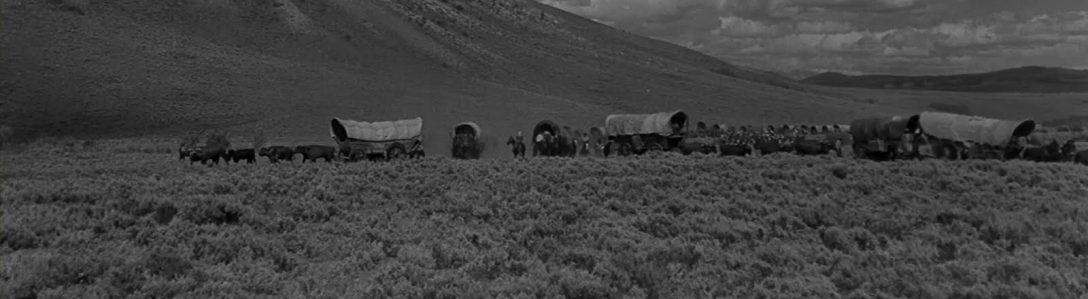
HIDEKO TAKAMINE: NO CHARACTERISTICS

January 4, 2011

hideko

Hideko Takamine, who passed away on Dec. 28th at the age of 86, had a face worth puzzling over. In her films with director Mikio Naruse, she engineered an impassive, barely perceptible sag to her delicate kewpie doll features,  embodying the spiritual toll post-WWII deprivations had inflicted on her indomitable Japanese women. She expresses the sag with supreme subtlety in Floating Clouds (1955), and later, When A Woman Ascends the Stairs (1960) (both available on this BFI box). But this reduces her accomplishments to my limited view of what I’ve seen of her work, as she had a long career before and after the masterpieces I associate her with.
hideko2

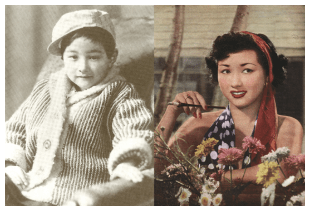
She began her film career at the age of 5, with a part in 1929′s Haha (Mother)which is considered lost (sad, since it would make a stellar double bill with Hong Sang-soo’s recent Hahaha). She rapidly rose to become a child star, nicknamed Deko-chan, and garnered comparisons to Shirley Temple, although Hideko would often play both male and female roles (this according to Chris MaGee, whom I also gleaned the above photo from). From this period, she can be seen in Yasujiro Ozu’s Tokyo Chorus (1931), available on DVD from Criterion in the Silent Ozu box set.

In 1937 she would leave the Toho studios for Shochiku, where her persona of stubborn independence would be developed over the next 40 years. During WWII she transitioned into a sex symbol, as Dave Kehr writes in the NY Times, becoming a “popular pin-up girl for Japanese troops” while also performing a nightclub act. It is during the U.S. occupation that she really digs into emblematic roles of iron-willed perseverance.  In 1955, and married at the age of 31, she told a newspaper that she wanted to “create a new style of wife who has a job.” (quoted in Catherine Russell’s must read article in CineAction). She followed this thought through her life and her art – her characters who don’t have this kind of freedom are marked by dissatisfaction with their subservient role in life, and the frequent tragedy is that it is impossible for them to transcend these roles. Takamine’s reflects on her subtle approach in a conversation with Yukio Mishima, again quoted in Russell’s piece:

In a 1954 interview with Yukio Mishima, Takamine discusses her favourite Hollywood actors, Ingrid Bergman and James Stewart. Mishima suggests that “someone with strong characteristics has to be a supporting actor,” and they agree that Takamine has “no characteristics,” which is why she is so well suited to leading roles.

“No characteristics” implies a kind of blankness from which Takemine pardoxically is able to wrench unutterable emotions. There are inflections to her stone-face, either holding a glance a beat too long or deflecting it downward at the decisive moment, that are of a delicacy far more expressive than a more aggressively emotional style. This was aided, perhaps, by Naruse’s maddeningly hands-off approach. Takemine:

“More than merely reticent”, his “refusal to talk was downright malicious. Even during the shooting of a picture, he would never say if something was good or bad, interesting or trite. He was a completely unresponsive director. I appeared in about twenty of his films, and yet there was never an instance in which he gave any acting instructions.”

In my reading of this quote, Naruse wanted Takemine to act even less. His studied distance from his actors encouraged a pared down, more instinctual style, and despite her complaints, returning for close to 20 films says something about her opinion of the man and their work together.

For Japanese audiences, she is best known for her spunky work with director Keisuke Kinoshita, like her exotic dancer in Carmen Comes Home (1951, Japan’s first color film), and her school-teacher in the smash hit Twenty Four Eyes (1954, available on DVD from Masters of Cinema), who tends to her students from the rise of fascism through the after-effects of WWII.

Takamine retired from performing in 1979, and maintained an apathetic attitude toward her time on film, focusing instead on her late career as a writer, publishing travel articles as well as her memoirs . She described her first twenty years on-screen as nothing more than a “money making machine”, and her complaints of Naruse’s working methods are well-documented. This spirited indifference toward her remarkable career is not dissimilar from her characters, who vainly try to dismiss the past in order to capture a quicksilver moment of happiness in the present. Fortunately for us, Takamine’s past artistry is preserved (for the most part) on screen, and will speak to us for decades to come.

THE NEW YORK ASIAN FILM FESTIVAL & JAPAN CUTS

June 29, 2010

Screen Shot 2020-01-23 at 5.29.03 PM

The New York Asian Film Festival (June 25th – July 8th) is more essential than ever. With distribution companies shutting their doors to Asian cinemas of all types,  there are very few outlets to watch the continent’s resourceful, often brilliant genre cinema on the big screen. For nine years programmer Grady Hendrix and his crew have been filling the void, and for the past few has joined forces with the Japan Cuts Festival of Contemporary Japanese Cinema (July 1 – 16th)  to provide the most eclectic and revelatory overview of Asian film in the U.S. It’s a heady mix of spectacle, grotesquerie, slapstick and resolute artistry. Every year you’ll see something you’d never seen the likes of before.

For me, this year’s edition surprised me with its Chinese slate, and specifically the skittish performances of actor Huang Bo, recepient of this year’s redundantly titled  Star Asia Rising Star Award. My knowledge of contemporary Chinese cinema doesn’t extend far beyond the arthouses and underground film clubs that show Jia Zhangke and the documentaries of Zhao Dayong. So getting exposed to Huang in the antic Crazy Racer and morbidly funny Cow expanded my limited horizons.

A squat, frog-faced actor with a quick smile and a quicker temper, Huang plays stubborn fools with a clumsiness and slack-jawed innocence reminiscent of Buster Keaton. Crazy Racer (the sequel to Crazy Stone (2006), which I haven’t seen) is a time-shifting crime-comedy in the Pulp Fiction mode, with Huang’s disgraced bike racer bumping into two bumbling assassins, a Thai drug dealer, the Chinese mob and beatings with a frozen fish. The twisty narrative is imaginative and cleanly executed, and director Ning Hao doesn’t bother dawdling over too much sentiment. Cow has Huang playing a similarly alienated character, but in a completely different context. His Niu-Er is a simple peasant caught up in the Sino-Japanese war. His village gets slaughtered, the only surviving creature a foreign cow donated to give milk to the Chinese troops. Navigating some dramatic tonal shifts, Huang manages to insert a violence into his pratfalls and a resignation in his stubbornness that keeps the film from descending into treacle. He elicits laughs that catch in your throat, inserting a jaggedness to the sentiment that makes the whole improbable set-up go down a lot smoother. Plus the cow is pretty good too.

Revelatory in another sense is SOPHIE’S REVENGE, which is a blatant Sex & the City knockoff produced by and starring Zhang Zhiyi. She plays the Carrie role with an overwhelming barrage of animal-themed hats and cow-eyed stares. While the cartoon-y stylization and wonderfully violent fantasy sequences take some of the sting out of the blatant consumerism of this day-glo contraption, the story suffers from an inert supporting cast and a story too cliched for even the Sex gals to endure. While no great shakes as a film – as a cultural object it’s fascinating, as it creates a photo-shopped super-rich city of chrome and flowers and whimsy where women are sexually independent and the rural poor exist only in the “arty” shots of the hunky photographer.

Moving to Hong Kong, the best film in the festival is the uncut version of John Woo’s RED CLIFF, but I’ve already written about it here at Morlocks and also at Moving Image Source, so I won’t spill more words on it. But I will recommend Gallants, a quirkily nostalgic martial arts film featuring oldsters Bruce Leung and Chen Kuan-Tai. Waiting for their near-ancient master to awake from a coma, Leung and Chen turn the gym into a restaurant, until a callow teen sparks a feud with the high-tech workout joint across town. It’s a pleasant and comfy piece of work, sliding into the normal revenge plot mode with tongue gently pressing against cheek.

Little Big Man, Jackie Chan’s diverting take-off on the series of swashbuckling origin stories (including Red Cliff), finds the cherubic 56 year old actor playing a coward. He plays dead during the heroic battles in order to stay alive, and captures a wounded opposing General after all the bodies fall. Failing to push its subversive premise very far, the film ends up celebrating the same kind of warrior ethos it is ostensibly parodying. But it features a few agile Chan fight scenes, and that should be enough.

The only Korean feature I was able to preview was the loopy romantic comedy, Castaway on the Moon, which is unable to sustain its whimsy past the one-hour mark, upon which it devolves into standard love story pabulum. Mr. Kim attempts suicide by jumping into the Han river, only to find himself on an isolated island. Not too upset to be cut off from society, he starts living off the land and communicating with a shut-in, Mrs. Kim, who watches him through a telescope at a high-rise apartment. There is some good obsessive work with black bean noodles, bird poop and the real utility of credit cards, but once the separated duo start communicating, invention flags and director Lee Hey-Jun gropes for cliche.

The Japan Cuts program tends to be more reserved and dramatic, leaving the madness to NYAFF, and this year is no exception. The main highlight for me has been Yoji Yamada’s About Her Brother, an expertly staged family melodrama starring the superb Sayuri Yoshinaga and Tsurube Shofukutei. They play sister and brother, respectively, with the latter drinking himself into a debauched oblivion. Yamada, now 78, is in perfect control of the medium, setting up familial relations and foreshadowing events through composition and staging. Beginning with a quick montage of recent Japanese history (including clips from Yamada’s own 48-feature long Tora-san series), the film slowly unveils Tsurube as the inebriated black sheep of the family, upending a family wedding with the destructive power of his singing voice.

He prefaces this destruction with a quietly witty shot – a wine glass in the left foreground marking doom. Later, Tsurube’s knee juts up into the middle of the frame, another subtly amusing jibe at his need to be the center of attention. But this isn’t a comedy of reformation. Yamada never allows Tsurube to be judged so simplistically, eventually offering a subtle critique of the middle-class values that would attack his particular kind of independence. If you need more reasons to see it, David Bordwell is a fan and wrote about it briefly here.

The festival started on June 25th, but there’s plenty more to see. And while it’s likely you won’t catch them in cinemas again anytime soon, many will be available at your local Chinatown on DVD, and will be for sale at on-line retailers like YesAsia.

AKIRA KUROSAWA AT 100

January 19, 2010

stray dog
Akira Kurosawa is a director I’ve long taken for granted. I’ve never bothered to look much farther beyond the recognized classics: Rashomon, Seven Samurai, Kagemusha, Ran. The latter two floored me with their blood-red blood in my image-besotted youth, but I repressed that enthusiasm to make the usual auteurist arguments – belittling Kurosawa in order to praise Ozu, as if it were a zero-sum game. It’s absurd of course, and because of it I’ve missed out on the minor contours of Kurosawa’s career, the mini-masterpieces, curiosities and salvageable disasters that make auteur criticism worthwhile in the first place. His 100th birthday (on March 23rd) has spurred a series of retrospectives and releases that have finally shamed me into exploring more of his career. Film Forum in NYC is holding a massive retro, and Criterion released a 25-disc box-set, AK 100. I have no more excuses, so I sat down for Stray Dog and The Idiot.

Stray Dog, from 1949, is hot. It’s a meltingly humid summer in Tokyo, and everyone is sweating through their clothes and guarding their electric fans with rabid ferocity. The heat is making people quick-tempered, and then Detective Murakami (Toshiro Mifune) has his gun stolen, a Colt. The rookie cop is desperate to recover it before he’s fired. It’s a perfect set-up to explore the various underbellies of Tokyo as handkerchiefs are applied to perspiring foreheads. The film has been compared to Jules Dassin’s The Naked City in its raw depiction of urban life, but Kurosawa’s technique is far more experimental than Dassin’s social-realist gangster film. In the first ten minutes, Kurosawa uses a quick flashback, whip pans, a voice-over about the godforsaken heat, and a close-up montage of legs getting onto a bus. This low-angle shot of Murakami’s lower half will rhyme with the muddy shoes of a murderer, one of the many linkages Kurosawa provides between the two.

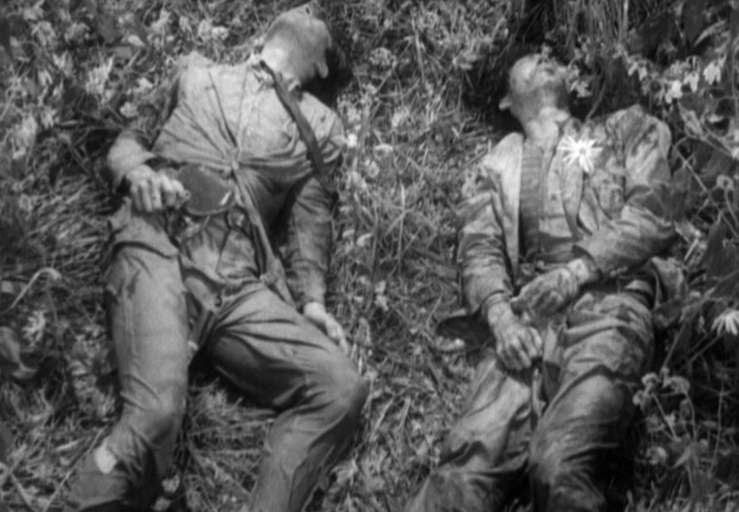
As Murakami lurks through the docks, a seedy nightclub, a ballpark, and a gloomy hotel, he discovers that the perp  has been cutting through civilians with his Colt. And also that both men were robbed of their belongings when they returned home from WWII. They are, essentially, the same person, connected through gun and history. Kurosawa is relentless in pairing the two, embroidering patterns around them until they’re inseparable on-screen. Their final battle is staged in a series of symmetrical framings, with the two collapsing to the ground in unison (see top image). It’s the most successful example of this well-worn trope that I can remember (although Eastwood does a decent job of it in Tightrope).

Paired with the oppressive, impeccably art-desgined atmosphere of pore-choked Tokyo, it’s a remarkable film, frank in its eroticism and its violence. The only influence Kurosawa cops to is Georges Simenon, who he modeled the script after, but the scene on the docks and the nightclub struck me as spaces straight out of a Josef Von Sternberg movie, clogged with smoke, pancaked makeup and decorative netting. These are impassable spaces that one can get lost in. Peek at the shot of the nightclub dancers collapsed in the upstairs room, where legs, arms, and heads no longer connect in an abstracted zone of pure eroticism. This shot could be inserted into The Shanghai Gesture and no one would blink.

Amid all of this, Kurosawa maintains his marvelous sense of pacing and tension, cross-cutting between Murakami’s interrogation of the killer’s girl with his boss’ run-in with the thug himself, connecting the two spaces with an incessant pouring rain and a faint radio melody playing over the phone when the deed occurs. Kurosawa then links this musical piece to the final chase, when the music of a lady practicing her piano pipes in over the frenzied showdown, a sound initially coming from nowhere that calls back to the previous scene – adding an uncanny sense of doom to their tussle. The film is loaded with these kinds of linkages, just charting the uses of flowers, guns, and shoes in the film could fill up a master’s thesis.

After Kurosawa broke people’s minds with the complex flashback structure of Rashomon (1950), he undertook what might be his greatest economic and critical failure, an adaptation of Dostoyevsky’s The Idiot. Having read this recently, I was amazed at how closely he hewed to the book, aside from setting the film in contemporary Hokkaido. His Prince Myshkin is named Komeda, played with slow-footed grace by Masayuki Mori, whose experience in the war has left him an “idiot”, unable to tell a lie and as sensitive as a child. He is taken with a photo of Taeku Nasu (a smoldering Setsuko Hara), a kept woman about to be sold off for marriage. Komeda loves her out of pity, while Akama (the great Toshiro Mifune) lusts after her with a white-hot rage. This is the central triangle that radiates out to affect the major families of Hokkaido, all entranced by Komeda’s inhuman ability to empathize with everyone, that is, his kindness.

The respect Kurosawa has for the material is almost stifling, but the depth of feeling is palpable. He has his actors speak in a slow, halting style, wringing every subtlety out of the phrases, while utilizing symmetrical framings, deep focus, and frequent close-ups to register every minute change in their battles for power. The film has a ritualistic feel, akin to the work of Dreyer – he’s aiming for a religious intensity that can come off as stilted, but for me was riveting. But I should note that close-ups of Setsuko Hara have the same effect on me, regardless of the film. But it’s the most intense film I’ve seen from Kurosawa, the most emotionally committed and his only film that attempts to reach the sublime (that I’ve seen). For that alone, it’s a must see, even if you deem it ridiculous.

THE END OF SUMMER

September 8, 2009

vlcsnap-2012-04-17-23h54m20s140

Goodbye, summer. The heat dissipates and a nostalgic sadness creeps into my mood. Call it the ghost of “back to school” blues, the end of youthful freedom. My adult self is staunchly anti-summer, averse to damp undershirts and the fetid stench of perspiring garbage piles. So outwardly I celebrate the great cooling-off, no longer having to hear the words “weekend getaway” or feign interest in another’s banal sunbathing/soaking/tanning plans. But there’s an insistent twinge in the human part of my heart, a vestigial sense of loss that the good times are over, it’s time to get back to work. I try to ignore it, but I might as well admit it’s there. As with most things regarding people and their damned emotions, Yasujiro Ozu has a lot to say.

So in honor of the season, I cracked open the cases of I Was Born But… and The End of Summer (both available in Criterion’s Eclipse line of DVDs). The first, a silent from 1932, is a salve for the schoolkid in me, detailing the illusions and pranks of two young brothers as they try to mesh in their new suburban home. The latter, from 1961 (his penultimate film), is for the sentimental old coot I’m prematurely becoming, a story about a childlike father and his stumblingly mature sons and daughters. The former is set in the beginning of the school year, the latter, well, read the title. An arbitrary start and end, 29 years apart.


I Was Born But… starts in a rut. Specifically, it’s a wheel spinning in mud on a country road. Ryoichi (Hideo Sugawara) and Keiji (Tomio Aoki) are with their salaryman father Yoshii (Tatsuo Saito), riding to their new home in a moving truck. After some fruitless spins in the dirt, there is a cut to Yoshii looking perplexed, instantly associated with stasis and weakness. His kids stare at him with suspicion. Then Yoshii tells them he’s off to visit his boss, and sends them on home with the driver, ambling off frame left in the sparse, electrical-post lined landscape. In these opening three minutes, Ozu sets up the themes that thread themselves throughout the rest of the feature. There is the move to the country, and the upheaval that will cause in the children’s lives. Then there is the conflict between father and sons, as the boys become increasingly aware of their father’s less than illustrious station in life, including his need to kowtow to his superior. The economy of expression here is astonishing.

But what I’m concerned with here is the bereft look on the kids’ faces as they approach school. The end of summer for Ryoichi and Keiji means the end of their previous lives. Now they have to adapt to the weird new suburban kids, with their own rituals and games. Keiji starts annoying people straight off, initiating a gang war with his transcendent oddness. Aoki’s  performance, filled with testicular scratches and exaggerated mugging, is probably the most entertaining child performance I’ve ever seen. His taunt (seen to the left) as he leaves his tiny antagonizers is a move of balletic slapstick.

He’s moving too, as he apes Sugawara’s every move in their tantrums. He’s always a step behind his brother, but his loyalties are ironclad (unless a rice ball shows up). These pantomimes of his reminded me of my lapdog relationship with my older brother. I camped out by his side and honed my interests to match his, whether it was spending hours pricing baseball cards or constructing a basement city (called Hudsonville), I strived to meet his approval at every turn. I always attempted to maintain a facade of independence with subtle variants, as we grew older he liked Pearl Jam, I chose Nirvana. He liked Metallica, I listened to Megadeth. Keiji doesn’t even attempt to mount even that minute kind of differentiation. He is Ryoichi’s disreputable mirror. Where Ryoichi is stern and commanding, Keiji is disheveled and confused (there is always a bit of white dress shirt sticking out of his fly). But they act as trusted confidants and pranksters, sharing a hive mind of youthful rebelliousness. Their faux-pouting stare as their parents try to ease them out of a funk (brought on by their father’s obvious lack of status) is both heartrending and hilarious. They are being brutally awoken to the inequalities in the world, but they carry it with impish humor, a quality one hopes they carry into old age.

If Keiji grew up and had a family, he probably would have turned out a little like Manbei Kohayagawa (Ganjiro Nakamura), the playful patriarch in The End of Summer. Manbei is a widower who is attempting to marry off his remaining single daughters, Akiko (Setsuko Hara) and Noriko (Yoko Tsukasa). He’s a gregarious sake brewery owner with active eyebrows, who has recently re-ignited a relationship with an old mistress in Kyoto.  The repeated refrain of his children is, “I wish he would act his age.” But what does that mean, exactly?

This childhood-in-adulthood aspect of the film is dealt with throughout, variously treated as a defect and a blessing, a reflection of happiness and selfishness. Ozu never chooses one side of these contradictions, but lets Manbei loose in all his irresponsibly engaging glory. He prances along, alienating and bewitching his children and mistress in equal measure. Nakamura plays him with a similar mischievousness as Aoki’s Keiji, playing endless rounds of hide and seek with his grandson before sneaking out to a rendez-vous at a race track.

In a conversation with Noriko, Akiko echoes the fable of the Scorpion and the Frog (made famous (for me) in Orson Welles’ Mr. Arkadin) by saying that it’s possible to change a man’s actions, but never his character. This statement echoes throughout the film, rendering any attempt to “change” this old coot as absurd. This aging Keiji is disreputable, perhaps, but chasing happiness with seemingly more energy than his concerned children. Akiko and Noriko are the only other two characters with designs on a free life. Setsuko Hara, Ozu’s greatest actress, radiates a self-assured wisdom, completely secure in her widowhood and unwilling to sacrifice her life for the sake of a cow-loving, Ralph Bellamy-type husband.


Circling around these characters though is a motif of smoke, a symbol of dissipation eventually awaiting all of these characters. At this point in his career, Ozu has settled into his serene late style, with low-angle framings and little camera movement. It’s startlingly different from the fluidity of I Was Born But…, which includes witty tracking shots matching a line-up of schoolkids with yawning office workers, but his images are still layered with action. These images of smoke originally seem incidental, as in the shot heading this post. The incense in the foreground is only one aspect of the family home. But its unobtrusive presence slowly accretes meaning, its insubstantial wisps a growing reminder of the body’s slow demise, and the flimsiness of our everyday complaints. Ozu frames it in his famous “pillow shots”, framings held after characters leave the screen, empty rooms with traces of a human presence. Then the smoke billows around Manbei’s body, his final lament, “Is this it? Is this really it?’ shooting up the chimney.