ROMA MUSICAL: CARAVAN (1934)

October 22, 2013

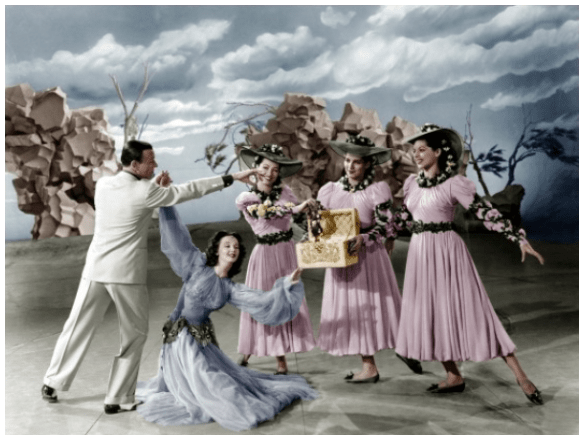
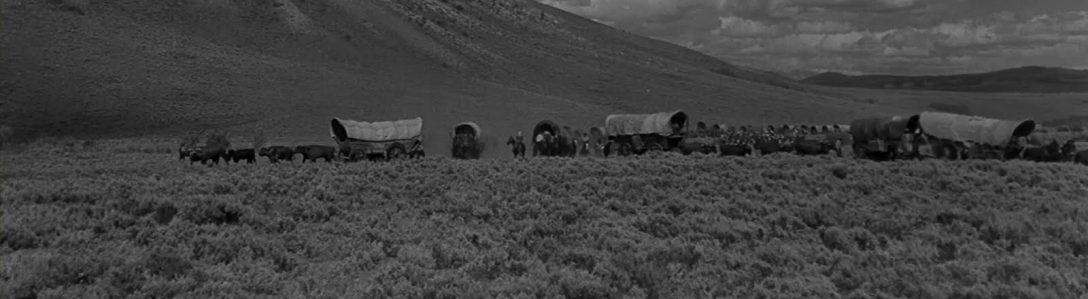
Poaching European talent has always been a popular Hollywood pastime, from Murnau to Lubitsch to Lang. Not every import had such an impact however, as proven by the reception of Caravana lavish 1934 roma musical directed by one Erik Charell.  Charell and his leading lady Lilian Harvey had become a hot commodity after the international success of their German film operetta The Congress Dances (1932). Fox decided to make Caravan a “super-special” with a budget over a million dollars, importing French heartthrob Charles Boyer as the male lead. It was a financial and critical disaster, with the NY Times moaning that it was  “an exceptionally tedious enterprise”.  Charell’s professional career was over – but what a way to go out (Harvey also flamed out in Hollywood after four films). Fully utilizing the emerging mobile camera technology, Caravan is a perpetually moving marvel, pirouetting through the romani like a fellow reveler. The average shot is thirty seven seconds long, so even expository conversations become epic journeys through the cavernous sets – providing an anarchic sense of freedom. Screening as part of MoMA’s “To Save and Project” series of film preservation, Caravan is a major re-discovery.

Caravan was based on an original story by Melchior Lengyel, a Hungarian writer who later wrote the scenarios for Lubitsch’s Ninotchka and To Be or Not To Be. Clearly hoping to generate some of that Lubitsch magic, Fox packed the creative team with Europeans, from Charell and Lengyel to art director Ernst Stern and composer Werner Richard Heymann. The story is a mistaken identity farce, with shades of Ninotchka, as Countess Wilma (Loretta Young) will inherit her family’s vineyard on her twenty-first birthday – as long as she is married. She has been promised to a dashing young Lieutenant (Phillips Holmes), but instead she grabs fiddling roma Lazi (Boyer) and gets him to sign on the dotted line. After Wilma takes on Roma garb, the Lieutenant falls for her, not realizing it is the Countess.The social structure is set on its head when the Countess marries Lazi, and then invites his whole clan to stay in the mansion. Through an increasingly manic series of reversals, soon the roma people occupy the mansion while the upper crust are out on the street (getting the cops, but still).

In a scene as subversive as The Last Supper sequence in Viridiana, the romani traipse into the marble be-decked mansion and proceed to turn it into their personal nightclub, shocking the waitstaff and sending the Countess’ wedding party guests home in a huff. With respectable civilization ousted, the libidos come unsheathed, hilariously so in the case of the Countess’ beloved governess (Louise Fazenda, a slapstick veteran and a thorough delight here) who makes eyes with a strapping, bare chested lothario. The cast is filled with brilliant character actors, including Fazenda, Eugene Pallette, C. Aubrey Smith, Charley Grapewin and Noah Beery. Pallette’s turn as a bewigged, nigh-criminal roma pops off the screen with its brazen idiosyncracy.

Charell uses a combination of crane and tracking shots to wend his way through this chaos. In a dream of revolution, armed guards arrive to roust them out, but they too get caught up in the music, and the rousing dance begins again.  Historian Tino Balio supposed he used the proto-Steadicam “Velocilator”, a Fox studio update of the Bell & Howell Rotambulator. The Rotambulator used a central column on a turntable, which could set the camera at any height between eighteen inches and seven feet. The camera could raise on the column for crane-like shots, and hydraulics could be used to control panning and tilting. The Velocilator reduced the weight of the machine, and replaced the column with an angled boom arm that could raise or lower the camera. No Hollywood feature fully explored the capabilities of the moving camera since Paul Fejos’ Lonesome , another European director whose experimentation shortened his career.

Charell was experimenting not just with camera movement though, but with editing in the midst of movement. In elegant flashback sequences, he cuts seamlessly from the present-day Countess and governess’ POV of her master bedroom to the entrance of a little girl – the Countess as a toddler behaving badly. When the camera swings back to the governess, there are tears in her eyes, remembering the days of youth. All this is accomplished without gauzy dissolves or other obvious markers of shifting time. It takes only a few seconds of screen time, but establishes the deep emotional bond between Loretta Young and Fazenda. It’s this offhand mastery that is so striking about the movie – every detail has been thought through to achieve maximum expressiveness.

Caravan was presented in a print restored by MoMA, but I only saw it because Dave Kehr recommended it at the end of his preview piece on the “To Save and Project” festival. In a bit of serendipity, Mr. Kehr has been hired as the new Adjunct Curator in MoMA’s film department. He told Scott Foundas at Variety that:

“My real concern in the last 10 years has been that, as much as we’ve made progress on the preservation and restoration of films, access to those films has really been slipping away,” Kehr said by phone Monday afternoon. “I hope one of the things I’ll be able to accomplish is to work on that idea, both at the Museum and elsewhere, and explore other ways of getting those films to the public, other kinds of distribution that don’t involve going to a nice auditorium on 53rd Street.”

So while it is difficult to see Caravan today, it sounds like Kehr is eager to get these titles back out into circulation through digital channels, or otherwise. While I will miss my weekly routine of reading his Sunday NY Times DVD column, it sounds like Kehr will be doing even more valuable work at his new position at MoMA.

THE OLD & THE NEW: BYE BYE BIRDIE (1963)

Originally published at Movie Morlocks, the official blog of Turner Classic Movies

August 28, 2012

Screen Shot 2020-02-05 at 1.36.54 PM

Against a backdrop of retina-bursting blue, the 22-year-old Ann-Margret waves goodbye to the classical Hollywood musical in Bye Bye Birdie (1963). Director George Sidney seems prescient in expanding Ann-Margret’s role at the expense of intended stars Janet Leigh and Dick Van Dyke, considering the explosion of the youth market less than a year later, when The Beatles would appear on The Ed Sullivan Show (which also makes an appearance in Bye Bye Birdie), cementing rock band movies/concerts as the musicals of the near-future. Now available in a gorgeous limited edition Blu-Ray from Twilight Time (for purchase exclusively at Screen Archives), Bye Bye Birdie is an eye-popping transitional work, with the old and the new Hollywood brushing up against each other with both awkward and thrilling results.

As a Broadway show,  Bye Bye Birdie was a gently satiric take on the gnashing of female teeth caused by Elvis Presley getting drafted into the army, told mainly through an adult’s perspective.  It follows struggling songwriter Albert Peterson and his secretary and sometime girlfriend Rosie Alvarez as they try to get rock heartthrob (and Elvis stand-in) Conrad Birdie to sing their tune on The Ed Sullivan Show. The character of Kim McAfee, the teen girl plucked from Birdie’s fan club to receive his last kiss before he enlists, is a distinctly supporting part.

But when director George Sidney saw Ann-Margret’s ebullient performance, he expanded her role to include five musical numbers (up from two), and cut out Janet Leigh’s big “Spanish Rose” routine. This shifts the perspective to the teenage denizens of Sweet Apple, Ohio.  One of Sidney’s inventions was placing Ann in front of a blue-screen to open and close the picture, a showcase in which she exhibits a faux-naivete (clutching her skirt), only to be replaced by a self-aware come-hither stare, in a performance which, as Dave Kehr wrote in the New York Times, is “so charged with erotic energy that you can practically feel a nation’s toes curling. She plays Kim, the head of the Conrad Birdie fan club, and her scenes are supercharged with hormonal energy, including her “How Lovely To Be A Woman” solo, in which her playfully aggressive donning of a sweater dress completely undermines the squeaky clean sexism of the lyrics (“It gives you such a glow just to know/You’re wearing lipstick and heels!”). Kim is fiercely in charge of her own life, especially over her milquetoast boyfriend Hugo (Bobby Rydell), who unfortunately is tasked with trying to one-up her at a dance-off during the “A Lot of Livin’ To Do” number (he loses).

In between all of this, Dick Van Dyke and Janet Leigh valiantly attempt to keep the supposed A plot, that of Peterson and Rosie, percolating. But maybe because Sidney was too enamored of Ann-Margret, their work looks flat in comparison. Leigh was inevitably disappointed with the finished film, writing in her autobiography that, “George had changed as well. I couldn’t exactly define the difference. It might be accredited to the transference of his Svengali attitude from me to the new and young Ann-Margret. He saw, perhaps, an opportunity to mold another budding career. I was ‘old hat’ after the numerous pictures and tests we had made together. His dismissing behavior wreaked havoc with my already precarious stability.” The only relative oldster who comes off with an equal level of energy or verve, is, of course, Paul Lynde, who takes on his stage role of Mr. McAfee, Kim’s befuddled dad. Knocking out a venomous version of “Kids”, Lynde’s particularly nasal wit makes it seem like being an adult is not the bore Peterson and Rosie make it out to be.

One thing that brings all ages together in the film is their desire to be on television. From Peterson to Kim to the mayor, everyone kowtows to Ed Sullivan and his producer, hoping the idiot box will goose their businesses or make them a star. Television, and variety shows like Sullivan’s, was part of the reason for Hollywood’s decline in box office in this period, and spurred their desperate search for what audiences actually wanted. But the film reflects that all people wanted was more TV. The finale, which turns the Sullivan show into an amped up burlesque, thanks to the effective sabotage work of Peterson and Rosie, is an attempt to depict television as, even at this late date, as a kind of rough and tumble Wild West of entertainment. The sequence makes it look like a particularly poor night at a community college’s talent show – as contrasted with the slick musical sequences from earlier in the film.

It is a sparklingly polished film, like a lollipop licked to maximum sheen, the popping primary colors captured in smoothly arcing crane shots. None of the colors register as sharply as Ann-Margret’s personality. A musical star was born, but right at the beginning of the genre’s slow demise. She would co-star with the real Elvis in Viva Las Vegas (1964), but aside from the rock-opera Tommy (1974), wouldn’t star in a full-blown musical again.

STILL SINGING: SINGIN’ IN THE RAIN and COVER GIRL

July 17, 2012

Screen Shot 2020-02-04 at 3.03.04 PM

Singin’ In the Rain (1952) is 60 years young in 2012, a birthday which Warner Brothers is celebrating with a dazzlingly remastered Blu-ray that comes out today. Richly textured with popping primary colors, this is the best the film will look outside a screening of a new 35mm print. Last week, the boutique home video distributor Twilight Time released a Blu-ray of Cover Girl (1944), the first film in which Gene Kelly and Stanley Donen were given free rein to choreograph their own dance routines, under the auspices of director Charles Vidor. Licensed from Columbia Pictures, the transfer of this Technicolor film is dark with fluctuating color intensities – Rita Hayworth’s hair doesn’t quite blaze off the screen like it should. That technical quibble aside, these releases are a wonderful excuse to revisit the work of Kelly and Donen, and what struck me this time around was the violence of some of their routines, borne out of a melancholy that would come to the fore in their final collaboration, It’s Always Fair Weather (1955).

Cover Girl was promoted as the first musical to integrate its musical numbers into the plot, arising out of and advancing the story. There are sure to have been predecessors, but this was the biggest hit, and became the most influential. The story is a boiler plate backstage musical, with dancing girl Rita Hayworth rocketing to stardom after winning a magazine cover girl contest, and having to struggle with leaving her nightclub manager Gene Kelly for the bright lights of Broadway. The story arc is a predictable drag, but the film has some incredible compensatory pleasures, from its score to its choreography.

Rita Hayworth’s Svengali Harry Cohn was not enthused with the casting of Gene Kelly and his “tough Irish face”, and Columbia originally wanted to borrow Dennis Morgan from Warners to play the lead. Kelly was slated to appear in Dragon Seed (1944), but when that project was postponed, MGM extended his loan out to Columbia, and movie history was made.

It’s a film of firsts. It was Jerome Kern and Ira Gershwin’s first pairing for a film production, writing the future standard “Long Ago and Far Away”. And then there is Kelly and Donen being granted creative control of their routines, a canny move by producer Arthur Schwartz. You can see the duo bursting with inventiveness, eager to break out of the stodgy confines of the story. The most famous is the “Alter Ego” dance routine, in which Kelly confronts his conscience over Hayworth stepping out with another man, dancing a duet with his super-imposed image on the dark studio streets of New York, the rage-filled inverse to the title Singin’ in the Rain softshoe. He chases himself across the street, each mirror-image seeming to pull the string on the other, until the “real” Kelly destroys the superimposed one by smashing his image with a garbage can. Cover Girl doesn’t dare play out the self-destructive impulses this sequence implies.

Singin’ In the Rain is such a contradictory pleasure, a film that parodies the artificiality of film construction, but in turn uses that construction to create one of the most giddily entertaining movies of the period. This is encapsulated in the “You Were Meant for Me” ballad, sung in an abandoned sound stage. We see Kelly arrange the set, flicking on the fill lights and industrial-strength fan, and watch Debbie Reynolds ascend a ladder and arch her back to appropriately catch the artificial wind and rays. But by the end of the sequence, as Jane Feuer wrote in her seminal The Hollywood Musical, “the camera arcs around and comes in for a tighter shot of the couple…reframing to exclude the previously exposed equipment. We regress from an expose of romantic duets to an example of a romantic duet.” I would quibble with her use of “regress”, but there is definitely some sleight-of-hand here, except we have already been shown how the trick works.

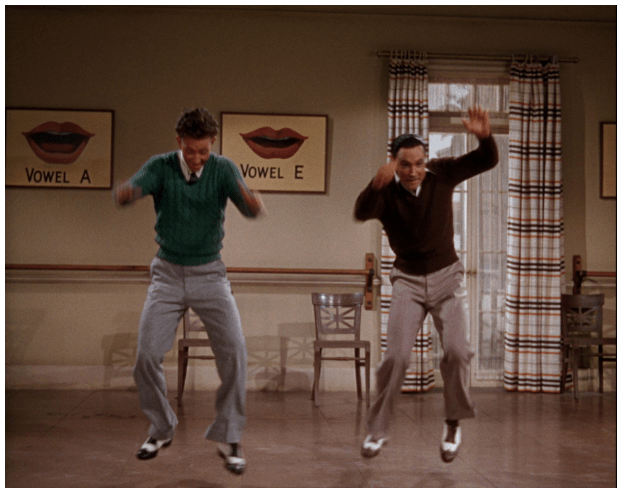
This trick also appears in my favorite number in the film, and one of the two original songs (along with “Make ‘Em Laugh”, “Moses Supposes”.The pleasure of the sequence comes out of the seeming sponteneity of their actions, from twirling a tie to using curtains as veils. But of course this sequence was meticulously planned out. It’s hard to make something look this easy. Violently anarchic, this elocution lesson ends up, as in the “Alter Ego” number, with up-ended trash cans and a feeling of ecstatic release. This is pitched in a comic rather than dramatic mode, with Kelly and Donald O’Connor parodying the nasal stuffiness of the teacher by inventing a nonsense rhyme and tap-dancing the room into submission.This introduces another favored Hollywood trope, that of upsetting the apple cart of “high art” with the more spontaneous, communal pleasures of the low arts; in Singin’ in the Rain, it’s vaudeville. This theme is brought to its apex in Vincente Minnelli’s The Band Wagon, but it’s present here too, most famously in the opening montage, in which Kelly’s gaseous voice-over about “Dignity, always dignity”, is replaced with the reality of his hoofing it as a vaudevillian and stunt man.

“Alter Ego” allowed Kelly to cut loose without the less schooled dancer Hayworth, and the same is true here, with Kelly paired with the astoundingly athletic O’Connor, and they end up stamping an office table, tapping on a pair of wooden chairs before trashing the room. When Kelly is paired with a classically trained dancer in Cyd Charisse for the “Broadway Melody” routine, it can only be done in a fantasy sequence, so the down-to-earth quality of Kelly’s character is not upset by the delicacy of his sublime work with Charisse. Her impossibly sharp angles and Kelly’s rounded movements melt into an inflammatory erotic reverie, punctuated by those delirium inducing ascending crane shots. It is another privileged moment when Kelly loses his grip, and it is moments like these that make up  It’s Always Fair Weather, in which army buddies reunite and realize their past friendship may have been a sham.  Kelly threatens to finally fall apart completely, but instead he simply loses his audience, and that film signaled the end of the classical Hollywood musical.

THE MINNELLIUM: YOLANDA AND THE THIEF (1945)

September 20, 2011

Screen Shot 2020-01-31 at 5.51.10 PM

Vincente Minnelli had been interested in making a surrealist musical since his days as a Broadway set designer and director. After he saw successful stagings of “Four Saints in Three Acts” (with libretto by Gertrude Stein) and “Pins and Needles” (starring members of the International Ladies Garment Workers Union), he was convinced he could make it work. In 1938, he tried to woo musical comedy star Bea Lillie to take the lead role in a “surrealist revue” he titled “The Light Fantastic”. In a letter to Lillie, quoted in Minnelli’s autobiography, he wrote, “It sets out to prove that the world today is completely screwy. A surrealist fantasy set in jig time.” The project was shelved, and he moved on to direct “Very Warm For May”, the first Jerome Kern-Oscar Hammerstein collaboration in eight years.

Once in Hollywood, and flush with studio goodwill off the hits Meet Me In St. Louis (1944) and The Clock (1945) (he had also directed the majority of the revue-style Ziegfeld Follies, which the studio tinkered with until ’46), he finally put his “Light Fantastic” inspiration into action, resulting in Yolanda and the Thief (1945), one of the strangest and most enchanting films ever released by a Hollywood studio. Released earlier this year on DVD by the Warner Archive, Yolanda and the Thief  is also screening at the Brooklyn Academy of Music in October, as part of a complete retrospective of the director’s work (presented along with the Locarno Film Festival).

The genesis of Yolanda did not begin with Minnelli, but with children’s author Ludwig Bemelmans, the creator of the Madeleine series. In July, 1943, he co-wrote a fanciful short story called “Yolanda and the Thief” for Town & Country magazine with Jacques Thery. Producer and songwriter Arthur Freed purchased the rights the same year, and installed Bemelmans in an office at MGM to hash out a script from the material. He produced a treatment, but it went through three more rewrites before a fourth draft by Irving Brecher was accepted.

In the fantastical South American Ruritanian country called Patria, a beautiful heiress named Yolanda Aquaviva (Lucille Bremer) will inherit the family fortune and the defacto throne on her 18th birthday. Raised in a Catholic orphanage, she is naive in  the dirty ways of the world, and Johnny Riggs (Fred Astaire) takes full advantage. He overhears Yolanda praying to her guardian angel, and so Johnny pretends to be the embodiment of this protective spirit. Yolanda immediately believes his schtick, and is soon convinced to sign over power of attorney to this sweet-faced con artist. Johnny’s heart may be as soft as his shoes, and he’s not sure if he can go through with the theft…

Lucille Ball was originally slated for Yolanda, but after Minnelli was hired, Lucille Bremer took the role, since she had worked well with the director as the older sister in Meet Me In St. Louis. While he had little involvement in the scripting process, Minnelli immediately went to work on the visual design, which pulls from a dizzying array of influences and styles, from children’s picture books to Salvador Dali. Minnelli wrote that “I tried to get the quality of Bemelman’s books and illustrations, a curious mixture of worldliness in high places and a primitive naiveté, using his sometimes crude prism colors right out of a child’s paint box and combining them with beautifully subtle monotones.”

No concession is made to realism, with the waking sequences as garish and artificial as the centerpiece dream ballet. The opening sequence includes plastic ferns, papier-mache rock formations, a llama, and children sitting in green, yellow and red robes with a pinkish-orange sunset matte-painting beckoning them to greater flamboyance. This transitions to the orphanage, in which a parade of red-dressed, black hatted girls add skipping accents to a regal castle edifice. The nuns, in contrast, are in a dull blue-gray, building blocks of the building itself.

When Yolanda first appears in her family’s palace, out of the orphanage’s garb for the first time, she wears a simple cream-colored dress, which brightens the grays of the marble and fading murals. Her dotty Aunt Amarilla (a sublime Mildred Natwick, “Do my fingernails and immediately bring them to my room”) greets her wearing a blue-gray shade similar to that of the sisters, again blending into the background, part of the institution.

Yolanda’s next outfit is worn to visit Johnny for the first time, whom she believes to be an angel. Appropriate to such a worshipful occasion, she wears a black lace number, with a veil-like mantilla . A white rose adds a pop of contrast. In order to convince her of his otherworldliness, Minnelli shows Johnny arranging his own lighting, angling a lampshade so the rays seem to emit from his forehead. Positioned in front of heavenly mural behind him, he is a picture of vain celebrity, but Yolanda falls for the ruse, and also, Minnelli winks, he hopes we fall for his technical tricks.

The dream ballet is where Minnelli is fully allowed to display his Surrealist influences, with a Dali-esque landscape the setting for irruptions of unconscious illogic. The sequence begins in what looks like the film-world’s reality, as Astaire walks down the town’s main thoroughfare. The first puncture of this reality occurs when Astaire is asked for a cigarette. It’s the same rumpled man who had asked earlier in the film, but Astaire obliges anyway. After he lights one, a third hand appears from the blackness, cig in hand. He lights it, but more hands appear, until there are six arms sharing puffs from one mouth. The coins he had flipped to some street urchins start falling from the sky in rhythmic patterns, as the street set disappears for one streaked with lines of gold. Washerwomen in flame red skirts (recalling the orphanage outfits) ensnare him in reams of white laundry, as the rhythm set by the coins continues.

Echoing the reams of white fabric, a figure emerges from a pond, fabric flowing up and around her, as if in her own personal hurricane (this is a reversed image of Bremer walking backward into the water). She leads him into a desiccated Dali landscape of mutated white clumps and bare trees looming over an empty space, leading nowhere. Minnelli: “I wanted to suggest South American baroque without actual architectural forms, and used a series of rock formations in fantastic shapes.” Astaire removes the drapery of Bremer’s body, revealing her face. She is again wearing a cream-colored dress, as in her first, welcoming, arrival. The fabric that entangled him, he is able to free her from. It is a dramatization of Johnny’s fears of entrapment and attraction, visualized in spare, haunting landscapes.

This wildly imaginative sequence is a logical extension of the fantastic real world, and, as Jane Feuer wrote in The Hollywood Musical: “The transition to the dream in Yolanda is one instance of a play on the boundaries between fantasy and ‘reality’ which  informs the entire film. It is through cinematic technique that the boundaries between worlds are able to be blurred, placed en abime.”

Audiences were not receptive, and according to the AFI Catalog, Yolanda and the Thief  lost $1.5 million on its initial release. Minnelli muses that “much of the public couldn’t accept a simple story in an avant-garde setting.” Likely so, but it should be appreciated now in its oneiric Technicolor glory. Minnelli, a humble sort, should have the last word: “Film buffs say the picture was ahead of its time. I like to think so.”