Potemkin Village Blues: Bienvenido Mr. Marshall! (1952)

Originally published at StreamLine, the official blog of FilmStruck

January 2, 2017
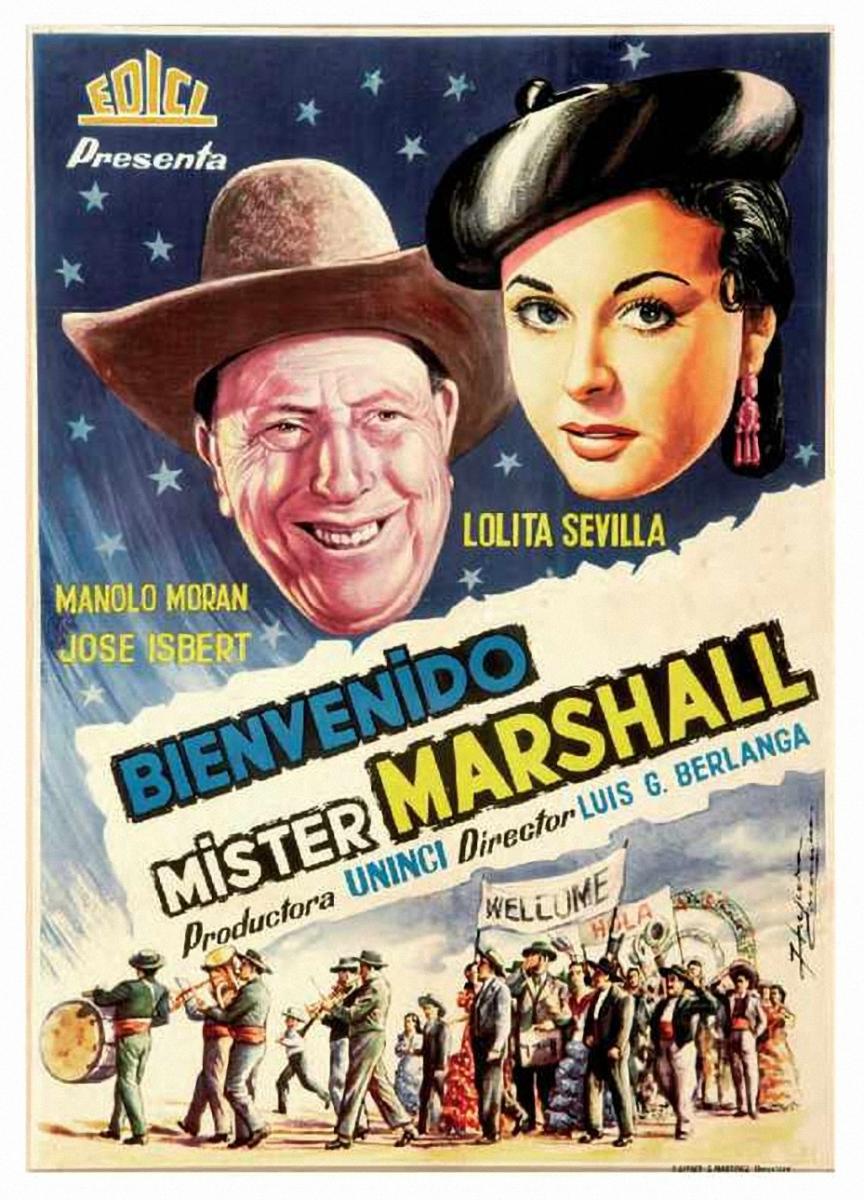
Last week I listed Luis Garcia Berlanga’s Placido (1961) as one of my film discoveries of 2016. A devilishly funny account of Christmastime sanctimony, it was the first film I had seen by Berlanga. Luckily, The Criterion Channel on FilmStruck is streaming four more of his films so I can get further acquainted with this acidic Spaniard. The earliest work on display is Bienvenido Mr. Marshall! (aka Welcome Mr. Marshall!, 1952), Berlanga’s breakout feature, which lovingly satirizes a small Spanish town trying to lure Marshall Plan funds from the U.S. It won the second place International Prize at the Cannes Film Festival, but was famously denounced by jury member Edward G. Robinson as “anti-American.” The film is more anti-Catholic Church and Generalissimo Franco than anything else, however, as the Americans are phantoms wielded as symbols by the local government and clergy – described as both wealthy benefactors and agents of moral decay. What the film lampoons most spectacularly and thoroughly is Franco’s attempt to promote Spain in a single image: an Andalusian Spain that was all flamenco and bullfights. Before the Americans’ arrival, the town hides the drunks, throws up fake facades and wears Andalusian costumes to pretend they are a tourist paradise rather than a poor farming town. As in Placido, Berlanga uses thumbnail caricatures to populate his village, hilarious creations like the half-deaf mayor, a broke colonialist aristocrat and a rotund hustler/producer who turns their town into a Walt Disney-fied version of Spanishness.

Bienvenido Mr. Marshall! was the first film that Berlanga directed on his own. He had previously co-directed That Happy Couple with his writing partner Juan Antonio Bardem (Javier Bardem’s uncle), a bittersweet comedy about a newly married couple trying to make ends meet in Madrid. Bardem was a close friend from film school – they had both graduated from the Institute of Cinematic Investigation and Experience (IIEC) in Madrid. Mr. Marshall was originally intended to be another collaboration, a musical folk comedy set to promote young flamenco singer Lolita Sevilla. But the plot kept shifting during development, the main inspirations being the rural dramas of Emilio Fernandez and Jacques Feyder’s Carnival in Flanders (similarly about a small town changing its colors to accept a rich foreign visitor). Then absurdist playwright Miguel Mihura was brought in to tweak the script, lending it its self-reflexive narration (it opens with an omniscient voice who introduces the villagers by telling the film to stop, zoom in, and move through the town – as if the screenwriter was on the mic). Bardem dropped out due to money disputes with the production company, and Berlanga was set to direct himself.

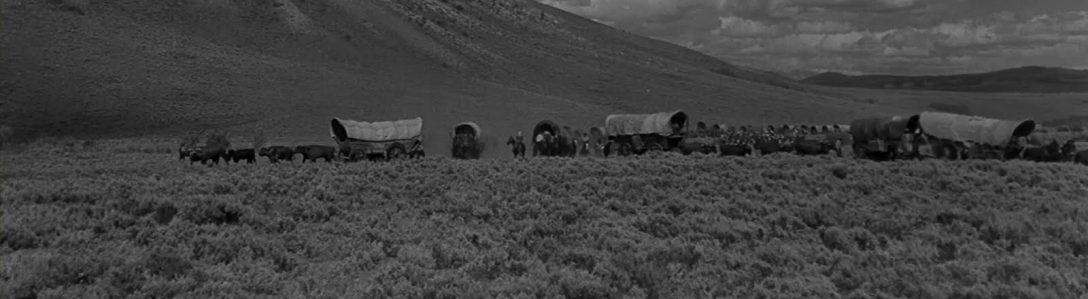
The film is set in Villar del Río, a poor farming town that is turned upside down when government officials arrive and tell them that U.S. representatives will be visiting on a tour to determine funding for the Marshall Plan. Instead of giving their children some American flags and their women some flowers to lay at the Americans’ feet, theatrical impresario Manolo (Manolo Morán) has a grander plan – turn their city into the Andalusian paradise that exists only in tourism board photos. So the town builds new facades to cover their dingy stone houses, orders bull-fighting costumes on credit, and changes their sleepy cul-de-sac into a romantic music-filled postcard of Franco’s Spain. The idea is enthusiastically embraced by the town’s creaky old mayor Don Pablo (José Isbert), who is desperate to give his town some shine. Isbert has a gravelly Tom Waits voice and uses a prop hearing device like a conductor’s baton. He’s forever crouching in closer to hear another insane suggestion from one of his constituents, making Don Pablo a sympathetic fool. He is the richest of a poor lot, but also sweet and gullible, trying his best and constantly failing to improve Villar del Río’s lot.

So when Manolo rolls into Villa del Rio with this flamenco chanteuse Carmen (Lolita Sevilla, her character cut down significantly from the original concept), it seems like a gift from the heavens. Here is a man who knows how to deal with Americans, or at least other rich people. So the whole town is drafted into a performance they’d prefer not to be involved in. But there are promises of massive donations from the Americans, so they don the insulting outfits with reluctant enthusiasm, and stand in line to tell Don Pablo the one object they’d like to receive from the USA’s largesse. They work day and night for their grand illusion, and the only moment in the film in which everything works as it should is during the rehearsal of the Americans’ arrival. It is a grand pageant of flamenco, Spanish folk music and wide-brimmed hats, a raucous celebration that the whole town rises up for, knowing that they were performing for an audience only of themselves.

That group high lasts into their dreams. For the night before the big U.S.A. day, there are three delirious dream sequences where the villagers live out their violent fantasies of American life. The priest Don Cosme (Luis Pérez de León) has been fearful of the arrival, preaching to his choir that Americans are spiritually delinquent heretics who will despoil their simple hard working town. His dream is a nightmare montage of U.S. culture: he is arrested by hooded KKK members, interrogated in a film noir police station under one bright swinging light and sentenced before a judge of the “Un-American Activities Committee” on an expressionist B&W set. He wakes up as he is about to be hung from a rope (it is probably this sequence that Edward G. Robinson objected to). Don Luis (Alberto Romea), the last of  a long line of aristocratic colonizers, is always complaining how Indians ate his ancestors, and clearly considers all Americans to be equally savage. His dream has him plant his flag on U.S. soil only to be put into a pot to be boiled. Before he is plated for dinner his cats wake him up. Don Pablo had just come out of a Western at the one-screen cinema, so his dream has him engaged in a chaotic shootout at an Old West saloon, dying in a showgirl’s arms.

Villar del Río wakes up the next morning and tries to meet their fantasies of the United States with what they believe the Americans’ fantasy of Spain is – that is, wide-brimmed hats, flamenco in the streets, wild displays of emotion. It is a collision of misunderstandings, if only the U.S. representatives would show up. The film ends in an anticlimax that brutally returns Villar del Río to reality. No longer a political plaything, the town sloughs off Franco’s projected image of Spain, its own visions of America, and gets back to the hard work of being itself.

ON THE ROAD AGAIN: A POEM IS A NAKED PERSON (1974)

December 6, 2016

LeonR_Short_Textless_R1_0128471.tif

On November 14th Leon Russell passed away at the age of 74, after a remarkable career in music. He started as a sought-after studio session ace, working on everything from the Beach Boys and Frank Sinatra to the “Monster Mash.” Drawn to roots music of all kinds, when he started his rock band it played an ecstatic blend of country-blues-R&B (known as the “Tulsa Sound”) that became one of the top touring acts of the 1970s. In 1972 Les Blank started filming a documentary, A Poem is a Naked Person, that would follow one of Russell’s tours as well as the recording process of what would become the album Hank Wilson’s Back. It was shot over two years, and has the vibrancy and surprise of Blank’s improvisatory style. He captures anything, whether it’s an intense studio session or a random girl singing a Three Dog Night tune before a wedding. A Poem Was a Naked Person was not a traditional concert doc, so due to creative differences and contractual snags, it did not see the light of the projector for decades. But it was finally released by Janus Films in 2015, and is now available to stream on FilmStruck.

““It looks more like a travelogue than a Leon movie”, is what Leon Russell told Rolling Stone’s Eric Hynes in 2015, right before A Poem is a Naked Person was released into theaters. It was the reason he refused to sign off on its release in the first place. Russell first became a star after he appeared in the concert film of Joe Cocker’s tour, Mad Dogs and Englishmen, on which Russell arranged Cocker’s backing band of the same name. With his mane of gray hair and top hat, and the moniker “The Master of Space and Time,” he cut quite a counterculture figure, and the Poem was expected to be another extension of that. Instead he got a film that pauses to take in the world around him.

PoemisaNakedPerson_1974_805_image_01

In 1979 Les Blank described his approach to filming people: “I’ve seen a lot of cameramen go in and treat the subjects like so many guinea pigs. I think the people pick up on my very protective feelings toward them, and they aren’t self-conscious about what they do or say, and they try to show the inner light about themselves that I find so attractive.” His films contain exuberant portraits of musicians, cooks, artists and other proponents of the good life, including blues legend Lightnin’ Hopkins (The Blues According To… [1970]), guitarist Mance Lipscomb (A Well Spent Life [1972]), and filmmaker Werner Herzog (Burden of Dreams [1982]), all of which are available on The Criterion Channel of FilmStruck. He finds the inner light in each, just by letting them alone. He focuses so much on other distractions – friends, family, picnic tables, the sky – that people get comfortable and open up. He often lived with them for weeks before and during filming.

That intimacy did not exist between Blank and Russell. Russell told Hynes, “He was good at what he did…he was just kind of a jerk sometimes. But I guess I was kind of a jerk too.” That distance might be the secret gift of the film, as it gives Blank even freer reign to veer from his subject. Neither wanted to be near the other, so Blank decided to go off and explore. So we get gracious details like two of Russell’s Oklahoma neighbors, an old couple enjoying the celebrity in their midst. The woman is enamored with Russell’s long hair, and encourages her husband to keep it growing. The love just beams out of them. Then there are long segments of artist Jim Mitchell, one painting Russell’s pool floor into a kaleidoscopic aquarium of octopi, and another in which he feeds a chick to his pet snake, an image which Blank returns to throughout the film and seems to shapeshift meanings – first as a blunt image of capitalism, and by the end, as Kent Jones notes in his Criterion essay, “about the snake as a model consumer, eating only when it’s famished, and about consumption itself as a basic fact of human existence.”

Jim Franklin Swimming Pool Photo Les Blank 90008.jpg

Leon Russell seems exhausted throughout, coasting on the high of his ride to fame, one which he would retreat from in the final decades of his life. He is something of a structuring absence in the movie, the reason the film exists but missing for large stretches, or at least a recessive presence, listening attentively in a corner. The musical highlight for me is a performance by George Jones. Jones stops by the recording studio drinking a Budweiser and smoking a cigarette, and casually sings a gorgeously weary version of “Take Me.” This is contrasted with the nervous, enigmatic, and effortful Russell, a reluctant showman and awkward carnival barker. The top hat became his trademark, and would hang on a hook above the stage until the close of one of the shows. The atmosphere feels like that of a revival tent, with Blank fixing his camera on fans dancing with ecstatic intensity, giving themselves over to the music.

LeonR_Short_Textless_R1_0128972.tif

It’s understandable why Russell was disappointed with the film – he phrased it as, “I got into the movie and wanted to be like James Dean and I ended up being like Jimmy Dean.” Thankfully he was able to look back on it with humor, and allow Les Blank’s son Harrod to shepherd A Poem is a Naked Person back into the world. For in the end it is not a film about Leon Russell, but about the power and exhaustion of creating, whether it’s onstage in front of thousands, or in front of a camera for an audience of one.

ORNETTE: MADE IN AMERICA (1985)

November 29, 2016

PERSONALITIES

Ornette Coleman’s symphony “Skies of America” was conceived in 1965, recorded in 1972, and performed intermittently in the ensuing decades. It was something of a grand introduction to Coleman’s “harmolodic” compositional method, the term a portmanteau of harmony, motion and melody, and required a full orchestra alongside Coleman’s working jazz quartet. Due to budget limitations the recording eliminated the quartet (Coleman played solo) and cut out a third of the symphony, due to the length limitations of vinyl. Coleman sought to realize the original vision of the piece over the ensuing decades. Shirley Clarke’s hyperkinetic documentary Ornette: Made in America (1985), is an attempt to track the artistic evolution of the project from the sixties into the eighties, using a performance of “Skies of America” in Coleman’s hometown of Fort Worth, Texas as the fulcrum. Available to view on FilmStruck, or on DVD and Blu-ray from Milestone Films, it eschews historical context for the immediacy of performance, making it more of a piece for fans rather than newcomers to Coleman’s work. But it is a rare peek into Coleman’s artistic process – which means it is a glimpse into the mind of one of the greatest and most influential artists of the twentieth century.

PERSONALITIES

Ornette: Made in America was the last completed film by Shirley Clarke, brilliant iconoclast in her own right. She was a choreographer-turned independent filmmaker with an eye for self-destructive showmen, as seen in her narrative debut of heroin-addicted jazzmen, The Connection (1961). She is not able to dig very far under Coleman’s notoriously sphinx-like personality. Prone to speaking in aphorisms and reluctant to speak about his personal life, instead he talks about Buckminster Fuller and his desire to be castrated. A shy man who speaks with a soft-spoken lisp, Coleman radiates a calm mystery that is transfixing whenever he speaks on screen. One wishes for a long fixed camera interview with Coleman, but it’s unlikely he would have ever submitted to such a self-revealing interrogation (as Clarke was able to do with hustler Jason Holliday in Portrait of Jason [1967]). Instead we get a mosaic approach, with Clarke editing to the tempo of the music, in rapid-fire montage that flickers from performances, Buckminster Fuller architecture, and historical re-enactments. It is an attempt to match the film’s style with Coleman’s music, which I found both instructive and irritating. In a concert inside of one of Fuller’s geodesic domes, Clarke matches the angular construction to that of the music, her edits keeping time with the composition. It works less well during interviews, when Coleman’s oracular statements, which are already hard to parse, are cut to shreds in the editing bay.

This was her intent all along, as she told the Los Angeles Times: “‘I wasn’t trying to make a ‘documentary’ of Ornette Coleman,’ said director Shirley Clarke in her room at the Chateau Marmont. ‘I hope nobody goes to this film expecting a record of Ornette’s musical life because that’s not what it is. We wanted people to come away feeling a certain way about somebody and knowing a little bit about his music and its relation to him. Ornette is not violently well known (outside the jazz world) and that had something to do with my choosing to make a film that could appeal to people who just want to see this kind of filmmaking and don’t have to know it’s about Ornette.’”

PERSONALITIES

The project originated in the late sixties, when Clarke began shooting a documentary about Coleman’s decision to use his 11-year-old son Denardo as the drummer in his trio with bassist Charlie Haden. It fell apart in 1969, “when the producer disliked a partially completed version of the film. Clarke engineered her firing from the project to avoid being liable for $40,000 in expenses and the footage spent the next dozen years gathering dust under people’s beds.” In 1983 the Caravan of Dreams Performing Arts Center in Fort Worth booked Coleman’s first hometown performance in 25 years – which also happened to be his latest iteration of “Skies of America,” performed with the Fort Worth symphony (conducted by John Giordano) and his current band, Prime Time.  Largely ignored by Fort Worth previously, now he was to receive a key to the city and other celebrations for a local boy done good. When producer Kathelin Hoffman suggested a documentary be made about the event, Coleman suggested that Clarke direct it.

PERSONALITIES

Clarke dug up all the old film from the abandoned sixties project, and incorporated it into the new footage to create a mini-arc of Coleman’s career, at least since his working relationship with his son Denardo, who he felt had a direct connection to the music – a path uncluttered by education, rather similar to how Bresson used untrained “models” as his actors. Denardo is not pressed on how performing at such a young age affected him, though he clearly adores and cares for his father. This comes through when Denardo discusses his father’s performance space and community center in NYC’s lower east side, on Rivington St. Ornette Coleman bought an abandoned schoolhouse with a vision of turning it into a cultural center – but he kept getting mugged and eventually had his lung punctured during one horrific beating. Denardo fears for his safety as he continues to practice and create in the dangerous crack-infested locale (now one of the most expensive neighborhoods in the city). The role of Denardo in Coleman’s band is a fascinating one – from the glimpses we get he is the loving, earthbound anchor to Ornette’s spiritual, ghostly presence. But we only get a brief peek behind the curtain – as the music is the thing. And “Skies of America” is an imposingly complicated construction. Orchestral waves buffet the squall of Prime Time’s improvisations, which both cut against and flow with the symphony’s tide. Before a 1997 performance of the piece, Ben Ratliff described the symphony’s origins for the New York Times:

“It was so cold,” [Coleman] said of that time in Montana. ”It must have been 2 or 3 below zero, and when I saw the American Indians praying, doing their purity ritual, they looked like their bodies were transparent. All of a sudden, I saw the American Indian and the sky as the same people. It taught me something about religion, race, wealth, poverty, commerce. I said: ‘Oh, I’m going to go over to the other side. I only want to be on the side of the consciousness that comes to people naturally.”’

What he came up with was a gargantuan metaphor: just as every person sees the sky his own way, every musician produces a note in his own voice. But the sky, and the notes, are always there, unchanging: the sky has seen war and famine; the notes have seen Gregorian chant and jazz. The intended result was that in ”Skies of America,” the thick bed of the orchestra, with its deep blend of colors in great parallel melodies, would be the sky, and the improvising soloists the Americans.

Clarke doesn’t bother trying to explicate the enormity of Ornette Coleman’s musical project, but instead lets it represent itself. Coleman is a man and a personality who lets the music speak for him, so Clarke does the same in Ornette: Made in America. She lets the symphony play, and it is up to us to listen.

FAMILY TIES: MEN DON’T LEAVE (1990)

November 22, 2016

MEN DON'T LEAVE

“I squandered a really good career. What can I say?” – Paul Brickman to Salon

After the phenomenal success of Risky Business (1983), writer-director Paul Brickman was offered hundreds of screenplays to adapt. Brickman rejected them all, including future hits Rain Man and Forrest Gump. Frustrated with the Geffen Film Company’s imposed happy ending on Risky Business, he instead bided his time until Men Don’t Leave (1990) crossed his desk seven years later. A finely tuned family melodrama about the loss of a husband and father – and the aftershocks of grief – it failed to find an audience and swiftly disappeared from view. Brickman has not directed a feature since. Men Don’t Leave, now streaming on FilmStruck, should have been the start of the next phase of his career instead of an abrupt end. It is a film of empathy and grace, led by a thorny performance by Jessica Lange as a widowed, exhausted single mother trying to raise two kids and make ends meet.

The project originated with the obscure French tearjerker La Vie Continue (1981), which screenwriter Barbara Benedek (The Big Chill) adapted into an English-language screenplay. Brickman told Randy Lofficier at the WGA that, “I don’t believe Men Don’t Leave was truly a remake. It evolved into something far removed from the original. Initially I was presented with a script by Barbara Benedek. While I could have had access to the original material, I chose to avoid it, so as not to be influenced by it. I wanted to stay true to Barbara’s voice. I did not see the original film until well after the script was completed.” The finished script, credited to both Brickman and Benedek, is an anatomy of repressed melancholy.

MEN DON'T LEAVE

The Macauley family suffers a traumatic blow when father John (Tom Mason) dies in a tragic construction accident. Drowning in debt from their unfinished kitchen remodel, mother Beth (Jessica Lange) forces her kids Chris (Chris O’Donnell) and Matt (Charlie Korsmo) to move from the suburbs and into Baltimore, so she can take on a string of demeaning service jobs. Each family member avoids the mourning process in their own way. The teenaged Chris becomes infatuated with a nurse (Joan Cusack) in their building, while the tween Matt spends his afternoons robbing VCRs and selling them to a bootleg porn dubber (Kevin Corrigan). Beth has no time to grieve, and cultivates her hopes of happiness around Charles Simon (Arliss Howard), an experimental musician who flirts his way into her life.

The early sequences establish the Macauleys’ easy rapport but also Beth’s inadvertent isolation. John is a construction foreman idolized by his sons. John soaks up this love so unthinkingly that he often cuts Beth out of the loop. On a random weekday he takes the kids to a worksite, but without telling Beth he takes them to a movie after. Brickman and his editor Richard Chew (returning from Risky Business) cuts from the clamor and excitement of John’s job, with Matt playing in an excavator, to an image of Beth alone leaning on the kitchen island, waiting for dinner to finish. There is no sound except for some ambient crickets. It is an image that passes quickly but one that lingers – even in this supposed domestic bliss Beth is being sidelined, taken for granted.

As in Risky Business, Brickman makes use of expressive POV shots, though instead of dreamlike fantasies, they are haunting memories that Beth cannot shake. In the unreal aftermath of John’s death (which is not shown), Beth has to navigate a labyrinthine hospital, taking a wrong turn and ending up in the kitchen, where the staff is slicing up fish. This image will return to Beth throughout the film, an uncanny moment of estrangement from the world that Beth takes the entire movie to recover from. Discussing his work on Risky Business with the Editors Guild, Richard Chew paraphrases Buñuel : “Fantasy and reality are equally personal and equally felt, so their confusion is a matter of only relative importance.” The use of the hospital sequence in Men Don’t Leave serves a similar purpose as those in Risky Business, that is, to enter more deeply into the protagonists’ headspace.

From this point on, Beth battles depression, and fully succumbs after she loses her job at a gourmet food store managed by a short-haired Kathy Bates. The world seems to have collapsed around her, so she refuses to leave her bed for weeks, the apartment getting buried in filth. Chris spends most of his time with the nurse – a fascinating character deftly played by Joan Cusack. She is an eccentric loner who at first seems to be exploiting Chris’ youth, getting a thrill out of a younger guy, but she reveals complicating facets as the film unspools – including a boundless sympathy for Beth’s debilitating depression.

MEN DON'T LEAVE

Meanwhile Matt has been hanging with his suburban buddy ripping off middle-class homes of their home entertainment gear, and is welcomed as another son into his friend’s family. This subplot is highlighted by a pudgy, preposterously young Kevin Corrigan as a sleazy porn dubber and fence, his bedroom festooned with a bank of CRT TVs. The Macauley family unit is fracturing and about to splinter entirely. As Dave Kehr, one of Brickman’s most eloquent supporters, put it in his Chicago Tribune review of Men Don’t Leave, it is a “subtly subversive film, suggesting that America’s most sacred and apparently solid institution, the nuclear family, is in reality as fragile as a spider’s web, collapsing into confusion with the slightest brush of fate.”

MEN DON'T LEAVE

Eventually, Matt can no longer repress his emotions and runs away from home, back to the playhouse in his old backyard, the one his dad built for him. When Beth and Chris finally find him, they all mutually, and silently, accept their need to grieve. It is a powerfully moving sequence that reduced this new dad to a blubbering mess. Jessica Lange, who invested Beth with mutating contradictions – she is an optimistic depressive, a fragile ditz with indomitable determination – can put on a good face no longer. It is a scene of immense sadness in which they accept the void of their loss.

Men Don’t Leave was also funded by the Geffen Film Company, and like Risky Business, ends on an optimistic note. I am curious to know if Brickman wanted the film to end in the playhouse, or carry on to the literally sunny conclusion, which re-unites the Macauley friends and family in a blissful summer frolic. Whatever the truth of the production history, it doesn’t detract from the movie’s accomplishment. It is a brutal, cathartic and brilliantly acted melodrama that more than proves that Risky Business was no fluke. But this is not a story of failure, but one of admirable integrity – and of two remarkable films. I’ll end with words from Brickman’s editor Richard Chew: “I’m still friends with Paul. I wish he would have made more films, but at the end of the day, he wasn’t comfortable with the compromises necessary in Hollywood. He’s his own man. That’s why I love him.”

DIRTY POOL: LA CIENAGA (2001)

November 15, 2016

CIENEGA, LA (2001)

La Cienaga (2001) translates as “The Swamp”, and it is a fetid, decaying film—its forests overgrown and its characters unwashed. For her feature debut, Lucrecia Martel depicts the dissolution of a middle-class Argentine family through sound and set design. To escape the humid city during the summer, they retreat to their country home, a rotting edifice with a filthy leaf-choked pool. With nothing to do, the adults check out on iced red wine while the children tote rifles through an overgrown forest literally shooting their eyes out. The soundtrack is thick with clinking ice, chairs dragging on cement and distant thunder. Martel emphasizes the moments and sounds in-between actions since her characters have very little interest in performing any actions themselves. Instead, they sit, drink and complain. La Cienaga is a blackly funny portrayal of middle-class self-absorption—of a people so wrapped up in themselves they cannot see that their clothes are dirty, the walls are peeling and the pool is a bacterial broth. It is now streaming on FilmStruck and available on DVD and Blu-ray from Criterion.

CIENEGA, LA (2001)

Martel based the characters in La Ciénaga on the people she knew growing up in the Northern Argentinian city of Salta. She told Haden Guest of BOMB Magazine that “All the stories in La Ciénaga—in all my movies, really—are things that I’ve heard. There are people in my family, in fact, who are very similar to the characters. A great aunt of mine went to see it and when she was leaving she said to her husband, “Gregorio is just like you!” I had made that character thinking of him!” The film does not have a central character, but expands as a series of digressions at “La Mandragora” the country house of Mecha (Graciela Borges) and Gregorio (Martin Adjemian). Both are semi-functional alcoholics who stumble around the environs in a zombie-like daze. In the surreal opening sequence, a drunk Mecha stumbles by the pool and impales herself on a broken tumbler glass. Despite her bleeding out, Gregorio is more concerned with getting another drink, and Mecha that her maid is stealing their sheets. Their children pay them no mind instead turning the grounds into their anything-goes playground. The youngest children roam the knotty, brambly forest like violent colonists shooting at treed dogs and occasionally misfiring on one of their own. Luciano (Sebastian Montagna) loses an eye while the rest get covered in horrendous scratches.

CIENEGA, LA (2001)

The older children have their own separate adventures—each age group seems to inhabit different solar systems despite living down the hall. Teenager Momi (Sofia Bertolloto), who refuses to wash her hair, has a crush on the young maid Isabel (Andrea Lopez). Isabel is the only character who seems to have a life as she sneaks off to meet her boyfriend Perro (Fabio Villafane), going to parties in town. She is actually integrated into a society larger than the layout of La Mandragora. In a pivotal sequence, the oldest son, Jose (Juan Cruz Bordeu), goes to the same outdoor dance as Isabel and aggressively hits on her. This is an unforgivable invasion of privacy, not only of her personal space, but of the town’s. Jose treats the party as he would Mandragora, as if he owned it. In reprisal, Perro breaks Jose’s nose. An irreparable class border is crossed here, which means only trouble for those on the lower end of the scale.

The movie tries to ape the vibe of a large family living in a small space where one story ends by a sibling barging in and tipping the tale in another direction. Martel described her approach to structure to Haden Guest: “The narrative lines occur in different layers but within the same scene. You can have this character in the foreground, but over here there’s something else going on—an argument between my mom and one of my brothers, for example. In the next scene, that person, who has some problem in school, let’s say, is talking on the phone and maybe my mom is also off-screen. And then here’s another person complaining to my mom, who’s also off-screen. So the themes are superimposed on each other in “layers.” The characters’ movements and the themes get closer and farther away from the camera. The important thing is to define where I’m going to place the focus in order to give one of the layers a place of importance and weave the other things in and out.”

La Cienaga is a powerfully sensorial movie. It almost has a stink to it. Jose is always shirtless and covered in grime, while Momi is perpetually teased for never washing her hair. The summer is a humid one, and Mecha never seems to change out of her nightgown which adheres to her like a mildewed second skin. Gregorio is notable mainly for his hair dye, which has started to stain all of the sheets. Everyone is molting or shedding or disfigured in some way. Mecha’s chest wounds never really heal, Jose’s nose becomes a black-and-blue grotesquerie, while the younger childrens’ faces look like they’ve engaged in nightly knife fights. It is a darkly funny illustration of the family’s dissolution. They are being composted back into the earth.

CIENEGA, LA (2001)

All of these expanding and contracting stories in the film hide a secret one— a fable-like horror story of an “African Rat” that scares the children early on. A tale of shape-shifting, in which a domestic pet turns out to be a monster that turns on its owners, it takes on totemic meaning by the end of the film. The rat could stand in for the Spanish colonizers or the apathetic middle-class represented by Mecha and Gregorio, a disease devouring its host from within. It is a story that mesmerizes and haunts the children of the film— leading to a scene of abrupt and terrifying violence. Though hidden in the movies’ layered structure in which no character is followed for too long, a little boy fears that the Rat is barking beyond the stucco wall of his tiny backyard plot. This child, a friend of the family of the rotting Mandragora clan, still retains his innocence enough to believe in scary stories. But the Mandragora clan has no belief left in them. The last shot is a repeat of the first, but instead of the parents lazing about the pool it is the children, set to relive the emptied out lives of their parents.

‘TIL DEATH DO THEY PART: LA POISON (1951)

November 8, 2016

POISON, LA (1951)

When inspiration failed Francois Truffaut, he would look at a 1957 photo of Sacha Guitry sitting on his deathbed, working on a moviola. Truffaut said looking at the image made him “recover my good mood, bravery, and every courage in the world.” An indefatigable playwright, performer, and filmmaker, Guitry was a model of a complete director for Truffaut and Jean-Luc Godard, who advocated for Guitry’s work in the early years of Cahiers du Cinema. Godard included Guitry in a “gang of four” French filmmakers (along with Pagnol, Cocteau and Duras) who demonstrated a “grandeur and power” which enabled him and the other New Wave filmmakers to believe in cinema as an art form (Guitry appears multiple times in Godard’s Histoire du Cinema). Like Orson Welles (another Guitry fan), Guitry was raised in the theater, and used his command of theatrical effects to experimental uses on film, especially in his teasing, self-reflexive use of voice-over. Though there was a flurry of appreciations when Criterion released their essential box set in 2010, he has never gained the same level of recognition in the States as his peers. One of his late masterpieces, La Poison (1951), is available for streaming on FilmStruck – it was previously unavailable in any format in the U.S. A gleefully black comedy about dueling spouses who both dream of killing the other, it features a savagely funny performance by Michel Simon as a self-justifying murderer.

POISON, LA (1951)

The film’s opening credits are an elaborate Guitry performance in which the director walks from set-to-set introducing the actors, and explaining why they were ideal for their role. Dressed to the nines in a pinstripe suit and fedora, and smoking a cigarette–he begins the film speaking to Michel Simon: “Since you kindly asked me for a dedication, here it is. Michel Simon, this film offers me one of my greatest joys from the theater, because I can’t keep from calling it theater. You’d never acted for me before. You’re exceptional, even unique. Between the moments where you’re you and when you start to act, it’s impossible to find the bridge. It’s the same when you stop acting and become yourself to such a degree that there’s no reason to stop shooting. You belong among the greats: Frederic Lemaitre, Sarah Bernhardt, my father, Zacconi, and Chaliapin.” He goes on to Simon, who sits nervously next to him absorbing the compliments. This is an extraordinary opening– the director reviewing his own movie before you’ve had the chance to see it! Welles said that these elements were the inspiration for his essay films, and their fourth-wall breaking informality and shocking disregard for tradition are both bracing and often very funny.

For after his homage to Simon, he tours the rest of the cast and crew, charming the pants of his composers, carpenters, stars and anyone else who happened to be around (“If you had less talent, I’d still be your friend.”). He even thanks voice actors over the phone (“We only hear you in the film, so we won’t see you in the credits.”) and the sound engineer (“You recorded everything, so add my gratitude to it.”). By the time he’s finished joking around with his whole crew nearly seven minutes have past. The credits are a short film unto themselves, a marvel of self-reflexive sweet talking that emphasizes the artificiality and communality of the filmmaking process.

POISON, LA (1951)

La Poison was the 23rd feature Guitry directed, and that after a prolific career in theater, having written 128 plays, starting in 1918. His father Lucien was considered to be one of the finest stage actors of fin de siécle France, and Sacha traveled with the theater, and sat at the knee of Maupassant, Octave Mirbeau, Anatole France, Sarah Bernhardt and an endless cast of theater folk. He grew up in the theater, it was the air he breathed. As in the notes he read to Michel Simon, he still considered his films to be part of his theatrical life. Dave Kehr wrote that he only started in the film business to preserve the history of his theatrical productions, he was convinced by his then-wife Jacqueline Delubac that film would “allow him to preserve stage productions that would otherwise be lost.” And within four years of entering the movie business (1934 – 1938) he directed twelve films.

La Poison is about the battling Braconniers, a doubly exhausted small-town couple whose lives were constructed around avoiding each other as much as possible. Paul (Michel Simon) confesses to the local vicar that he has fantasized about killing her. His wife Blandine (Germaine Reuver) buys rat poison and stashes it up high in a cupboard for future use. One evening, with Blandine passed out on dinner wine, Paul hears a radio interview with defense lawyer Aubanel (Jean Debucourt), famous for 100 straight acquittals, claiming his sympathy for wife and husband killers. Paul immediately makes up an excuse to go to Paris to meet his new hero, and falsely claims to have already killed Blandine, just to hear how he should react should he ever go through with it. Emboldened by his new high-powered knowledge, Paul attempts to kill his wife in a manner that will guarantee his acquittal. That is, unless Blandine can poison him first

POISON, LA (1951)

The town is desperate for any attention that will attract business (local leaders earlier asked the vicar to fake a miracle for publicity), and the trial becomes a circus of self-promotion and capitalist enterprise. Their house becomes a true crime museum, while Aubanel becomes wary of the monsters his little publicity stunt created. Michel Simon plays Paul as an amiable sad sack given license by the law to become a loudmouthed demagogue. Paul takes up his defense, often drowning out Aubanel, by running down his wife’s looks and telling the court his murder was a preventive one. The whole film feels like an anticipation of Trumpism. Apologies to Alec Baldwin, but after watching La Poison Michel Simon is the only actor who could have done justice to Trump’s media-friendly fool, a jester who believes unthinkingly in his own infallibility. Simon’s entreaty to the court, a harrumphingly hilarious and horrifying justification of murder, is remarkably similar to the offhanded misogyny of Trump’s debate performances.

Unlike those lumbering debates, however, the movie moves with aplomb (it’s a speedy 85 minutes), and Guitry does remarkable things with sound. One of the protagonists is the radio. In this town of gossips and eavesdroppers, one neighbor mistakes a radio play argument for one between Paul and Blandine. He stands next the shutters, aghast at the violently flung insults. Soon he spreads the word that they are in a murderous rage, when in fact they are having their wordless blackout drunk dinner as per usual. So the neighborhood grapevine is spreading lines which turn out to be true – as after Paul hears Aubanel’s interview he stages what he believes to be a perfect murder. Later on during the trial, the local children begin mockingly re-enacting Paul and Blandine’s crimes, the murder now entering local folklore. So what started as a radio play ends as a children’s farce, all playing off of the fungible morality displayed by all members of this modern French society. From Aubanel on down, everyone is in it for themselves. As Truffaut put it in his introduction to Guitry’s memoir Le Cinema et Moi, his characters display “a morality which doesn’t offer itself as such but which consists simply in protecting oneself from the moralities of others.” In La Poison morality is a weapon that turns a sleepy small town against itself.

TUNNEL VISION: UNDER PRESSURE (1935)

December 8, 2015

Screenshot (102)

Under Pressure is a swarthy, bellowing beast of a movie, burrowing its testosterone underneath the East River. Directed by Raoul Walsh in 1935, it depicts a race between two teams of self-described “Sand Hogs” who are digging a tunnel to connect Manhattan and Brooklyn. It is an insanely dangerous job, as they contend with fires, flooding, and the compressed air underground, which gives them the bends, or what they call “the itch”. The itch gives the teams a convenient excuse to act like gambling degenerates, so Victor McLaglen and Edmund Lowe revive their clashing brawn and brain routine from What Price Glory (’26), only this time shirtless and covered in river sludge.  Directed with swagger by Raoul Walsh, the camera keeps pushing in, in, in – until there’s a sock to the noggin’ or a natural disaster. Previously unavailable on home video, 20th Century Fox has added it in HD to iTunes, part of their 100th Anniversary initiative to release more of their library to digital platforms (I previously reviewed their iTunes release of John Ford’s The Black Watch here). 

motionpicturedai37unse_0169

Under Pressure was based on the novel Sand Hog by Frank G. Fowler and Edward J. Doherty, first published serially in Argosy magazine. Fowler helped dig the Holland Tunnel, and adapted his experiences into the book.  Once Sand Hog was optioned by Fox, Fowler changed his name to Borden Chase (after the milk and the bank) and went on to a prolific career as a Western screenwriter (Red River, Winchester ’73, Vera Cruz). But Chase received his first script credit on Under Pressure, along with co-writers Noel Pierce and Lester Cole (and an uncredited polish job by Billy Wilder).

Screenshot (107)

The story follows Jumbo (McLaglen) and Shocker (Lowe) as they lead the Brooklyn team in a tunnel digging race against the Manhattan scalawags fronted by Nipper Moran (Charles Bickford). Whoever fights their way into the opposite team’s tunnel wins $500. Newspaper gal Pat (Florence Rice) is sick of covering horse shows, so ditches the society pages and attempts to report on the feats and follies of the Sand Hogs. Her first pitch is denied by an uppity Manhattan editor, who says, right before firing her: “I wouldn’t be surprised if one of those rural editors over in Brooklyn didn’t fall for your yarn.” They did, and Pat gets the cover story she so desired. The Sand Hogs’ violent, brutish and short lives make for good circulation, but Pat starts to become part of their family. The mother would be Amelia Hardcastle, the owner of the favored Sand Hogs bar, and the one who keeps the peace in the hot-headed profession. But even she can’t heal the macho head games played by Jumbo and Shocker, who butt heads over the leadership of the Brooklyn Sand Hogs as well as the affections of Pat.

Screenshot (103)

Instead of confessing their feelings they go back to their dark holes and dig, or else they are stuck in the decompression chamber which eases them back into the above ground oxygen flow. Their whole job is enclosed, trapped and controlled.  One of the central images is the bubbling of water that indicates a healthy oxygen flow underneath. Amelia can read this bubbling like a novel, she can tell when there’s a fire or a containment leak based on the shape and intensity of the burble. This bubble is far more expressive than Jumbo and Shocker, who prefer to express themselves in grimaces and put-downs.

Screenshot (100)

The first thing Walsh shows before panning down some miniatures into the dank tunnel set (“a huge tube, nearly 500 feet long and seventeen feet in diameter, an exact replica of a vehicle tunnel during construction, was copied as a set from the Fulton Street tunnel in New York, which connects Brooklyn and Manhattan” – AFI Catalog), made up of wrought iron and glistening torsos . The biggest torso belongs to Jumbo, and Vincent McLaglen plays him with his usual aw shucks bravado, a gentle giant who bellows out of insecurity, he’s puffed up mainly with hot air. Walsh had previously worked with McLaglen on What Price Glory, and in his autobiography described McLaglen as “a great broth of a man and a fine actor who once fought Jack Johnson.” Edmund Lowe was “a matinee-idol type who was unpredictably able to transform himself”. He has an arch tone to his theatrical voice that fits the character of a know-it-all, while McLaglen bellows like a cow being led to the slaughter. Both men need each other to get through this job alive, as they provide a balance, one that keeps the Brooklyn Sand Hogs’ tunnel from collapsing.

Walsh finished shooting the film in under a month, finishing in October of 1934. But according to the notes in the AFI Catalog, re-shoots were ordered from December 3rd – 31st, with Walsh replaced by Irving Cummings. These were extensive and expensive, costing Fox an additional $200,000. Pat was originally played by Grace Bradley in the version Walsh shot, but her footage was cut and she was replaced by Florence Rice. So all of the scenes with the Pat character were replaced. It is unclear why Bradley provoked such an extreme reaction from Fox, but it means the surviving Under Pressure is only half of a Walsh movie. But it remains 100% a McLaglen and Lowe film, and their affectionate bravado and bluster carry through the movie.

Screenshot (105)

The movie was dismissed as another McLaglen-Lowe programmer, with the New York Times writing, “vehicles which the studio litterateurs arrange for the hulking needs of Victor McLaglen & Edmund Lowe are never notable for their IQ count.” Contemporary sources like Walsh’s biographer Marilyn Ann Moss dismiss it as “undistinguished”. But this film has a raw energy and a raging visual libido, an extended metaphor for sexual repression, with those energies only released when the two competing tunnel shafts touch in the middle and the Jumbo-Moran fistfight commences. Howard Hawks often said that A Girl in Every Port was a love story between two men, and the same applies to Under Pressure. Jumbo and Shocker care for each other, but they can only express it in the depths underneath the city.

OPENING THE VAULTS: JOHN FORD’S THE BLACK WATCH (1929)

November 17, 2015

Screenshot (96)

In the era of declining DVD sales, Hollywood studios are still experimenting with how to exploit their extensive libraries, if they choose to do so at all. With their Warner Archive line of manufactured-on-demand DVDs, and Warner Archive Instant streaming service, Warner Brothers has been the most aggressive in remastering, distributing and marketing their holdings. Universal, MGM, Sony and Fox have all started their own DVD-MOD labels, but with little-to-no publicity and questionable commitment to quality (Fox was notorious for releasing old cropped and pan and scan transfers to their MOD-DVDs). Some license titles to boutique labels like Twilight Time, Kino Lorber (my employer), and Shout! Factory, while Paramount has made the surprising step of launching a free YouTube channel with hundreds of titles, which they are calling “The Paramount Vault.” For now it is a branding exercise that doesn’t delve very deeply into their catalog, but Paramount starts dropping restored Republic Pictures films on there, I will take notice. Since Netflix has shown little interest in films made before Millennials were born, the one place that might turn a buck is iTunes and other transactional VOD providers (where you pay-per-movie), which have shown an insatiable desire for content regardless of the production year. And for their centenary, 20th Century Fox is releasing one hundred of their films to iTunes in HD, many of which have never been available on home video (you can see the full list at Will McKinley’s blog).  Announced in October, some of the rarer titles have recently appeared in the iTunes store, including John Ford’s first all-talkie feature The Black Watch (1929). Not included in the massive Ford At Fox box set and impossible to see otherwise except on fuzzy bootlegs, this is a promising development for the future accessibility of 20th Century Fox’s film library.

CaptureIn Variety the president of 20th Century Fox Home Entertainment, Mike Dunn, spoke about the opportunity digital streaming is presenting: “You’re not trying to hold shelf space in a retail outlet. It allows you to have more of your catalog readily available, because you put it on iTunes and it stays there. You’re not being judged by how many units it sells. Services like iTunes want to be a completist.” With lower overhead costs than DVD and Blu-ray, and less immediate sales pressure, it’s an attractive spot to place those HD transfers the studio archives have been stocking for a decade plus. While the quality will never match Blu-ray (my HD iTunes download of The Black Watch was 2.86GB, while a single-layered Blu-ray can hold 25GB), it is an acceptable substitute for those niche titles Fox would never release in a physical format. The first reel of The Black Watch is heavily scratched and worn, but the remainder shows clarity and depth, doing justice to Joseph August’s cinematography. It’s certainly worth a $4 rental.

Screenshot (98)

John Ford’s first sound film was a short, now lost, entitled  Napoleon’s Barber (1928), about an “anarchistic French barber who gives a shave to Napoleon on his way to Waterloo” (description courtesy of Joseph McBride’s John Ford: A Life). He would make two more silents (Riley the Cop and Strong Boy), before entering production on The Black Watch, which was something of a debacle. The film was based on the novel King of the Khyber Rifles (1916) by Talbot Mundy. The scenario by John Stone and dialogue by John K. McGuinness tell the story of Donald King (Victor McLaglen), a captain in England’s Black Watch regiment of Scotsmen. Just before the Black Watch is sent to fight in France at the start of WWI, King is selected to undertake a secret mission in India. His men think he is a coward for taking a cushy post, but his mission is to break up a group of Indian insurrectionists led by Yasmani (Myrna Loy), the so-called Joan of Arc of India, set to start a holy war against the British colonizers. King infiltrates Yasmani’s clan and attempts to break it up from within, which their growing attraction makes more difficult.

Screenshot (75)

Screenshot (76)

Ford filmed The Black Watch as a part-talkie, but Fox general manager Winifred Sheehan hired British cast member Lumsden Hare to direct additional dialogue sequences. Ford recalled that

Sheehan was in charge of production then, and he said there weren’t enough love scenes in it. He thought Lumsden Hare was a great British actor — he wasn’t, but he impressed Sheehan  — so he got Hare to direct some love scenes between McLaglen and Myrna Loy. And they were really horrible — long, talky things, had nothing to do with the story — and completely screwed it up. I wanted to vomit when I saw them.

Though they didn’t make me nauseous, there are some extended dialogue sequences of ponderous deliberation. It is as if Hare believed dialogue couldn’t be registered unless McLaglen and Loy have rests in between each line. These are jarringly static sequences, because Ford and August shot the rest of the film with group dynamics in mind.

The film begins with a classic Fordian dinner, soldiers arranged symmetrically around the table singing mournful melodies in between busting each other’s chops. There is a general clamor nonexistent in the added dialogue sequences. This clamor increases when the troops go off to war at the train station, in which lines of men wind through the concourse and the soundtrack crackles with drums, bagpipes, and the cries of parting families. In the New York Times Mordaunt Hall praised it’s realism: “Those who witnessed the trains carrying soldiers to the front during the black nights of London town, will be affected by these sequences, for they are without a doubt the most realistic thing of their kind that has come to the screen, and the fact that these scenes are presented with a variety of sounds such as singing, the tramping of fighters’ feet, the officers’ commands, the chug-chug of the locomotives, render them particularly vivid.”

Screenshot (78)Screenshot (79)

Things get even more elaborate once Captain King goes to India, and August has a field day shooting through latticework, curtains and lace. Yasmani is introduced in extreme close-up under a veil, Myrna Loy’s face just a suggestion. The representation of India doesn’t get beyond Indiana Jones levels of colonialist fantasy. Though in her early career she was positioned as an exotic object of desire (Across the Pacific, Desert Song), the Montana-born Loy is never quite convincing as a warrior who could command the loyalties of Indian subversives (who are depicted as a thoughtless mob that get gunned down in a gruesome Wild Bunch ending).

Screenshot (97)

The Black Watch remains strongest in its depiction of the war, and a short sequence showing the Black Watch battling through Flanders Fields is haunting. As the camera slowly tracks backward through a foggy landscape, the men pour forth with ill-fated enthusiasm, as their lives are cut down in the trenches. Peter Bogdanovich praised the back-lighting in this sequence to Ford, who responded with, “Well, we never had many people so I tried that way to make it look as though I had more.” Ford ascribes poetic results to practical problems, describing filmmaking as an issue of mechanics. The Black Watch is a transitional work that provided Ford and his crew an opportunity to work out the kinks in the sound film, poor Lumsden Hare aside. And with Ford’s Men Without Women (1930) also scheduled for release to iTunes in HD  from Fox, we will soon get a fuller picture of Ford and DP Joseph August’s development into the audible age.

screenland19unse_0352


MARTIAL ART: PEDICAB DRIVER AND THE GOLDEN HARVEST LIBRARY ON WARNER ARCHIVE INSTANT

July 14, 2015

Last week Warner Archive snuck out a minor announcement with major implications. Six martial arts films from Golden Harvest studios were made available in HD on their Instant streaming service, in their original language and aspect ratios. Golden Harvest was the proving ground for Bruce Lee, Jackie Chan,  Sammo Hung and Jet Li, producing some of the most enduring kung fu films from the 1970s through the ’90s. These days Golden Harvest has segued from production to exhibition, and their classic titles remain frustratingly hard to see in decent transfers. Warner Brothers owns the U.S. rights to part of their catalog, and the initial six titles are only the beginning. On their Twitter feed Warner Archive promised, “we’re just starting to tackle the domestically unreleased Golden Harvest library”.  Available now to stream on Warner Archive Instant are: Downtown Torpedoes (1997), Big Bullet (1996) , The Blade (1995), Blade of Fury (1993), Pedicab Driver (1989)  & Terracotta Warrior (1989). While many of these titles are far overdue for release on DVD and Blu-ray, the fact that WB is preparing HD masters of these films is reason for optimism. I started the month-long free trial of their Instant service to check out Sammo Hung’s Pedicab Driver, an irresistible showcase for his knockabout acrobatics that packs in a public transit war, human trafficking, and Triad gangs into its 90-odd minutes.

Golden Harvest was formed in 1970 by Raymond Chow and Leonard Ho, two former employees of the Shaw Brothers studio. Shaw Brothers was then the largest production operation in China, specializing in historical martial arts films like King Hu’s Dragon Inn (1967) and Chang Cheh’s One-Armed Swordsman (1967).  Golden Harvest would become their main competitor, poaching director King Hu and most importantly Bruce Lee, who was on the cusp of superstardom. The gargantuan success of Lee’s The Big Boss (1971), The Chinese Connection (’72), The Way of the Dragon (’72) and Enter the Dragon (’73) secured the company’s financial future, allowing them to invest in talents like Sammo Hung. Hung came up through the brutal training of the Peking Opera, enrolling in Yu Zhanyuan’s China Drama Academy at the age of nine, studying acrobatics, martial arts, singing and dancing, along with future co-stars Jackie Chan and Yuen Biao. They endured painful tests like maintaining a handstand on a stool for one hour. Hung’s parents enrolled him, he told the New York Times, because, “I was never good at school and was always fighting in the streets. So they sent me to learn to fight.” He was a senior member of the “Seven Little Fortunes” performing troupe, and became known as “Big Brother” to Biao and Chan. In 1971 Golden Harvest hired him as a martial arts instructor on The Fast Sword, and thus began a two-decade association with the company, where he worked with everyone from King Hu (The Valiant Ones) to Bruce Lee (Enter the Dragon). He directed his first feature in 1977 with The Iron-Fisted Monk, and would gain success by working with Biao and breakout star Chan — directing hits like Winners & Sinners (’83) and Wheels On Meals (’84).

By ’89 Hung’s relationship with Golden Harvest was strained. His films were getting more ambitious and expensive, including the globe-hopping martial arts Western Millionaire’s Express (’86) and the post-Vietnam War commando movie Eastern Condors (’87), but the box office returns were not keeping pace. Pedicab Driver was a back-to-basics fight film set in 1930s Macau involving a group of pedicab operator friends who get mixed up with a Triad gang. There are few sets but plenty of brawling, and the tone ping-pongs from slapstick comedy to dark melodrama and back again, with the whipsawing speed representative of Hong Kong films of this period (and of pre-code Hollywood films). Sammo Hung plays Lo Tung, a leader of the pedicab union who bikes around town in a bowl cut, checked shirt and suspenders. He looks like an overgrown child in lumberjack costume, but when he throws down, his blows land like giant redwoods to the face. He pals around with a driver nicknamed Malted Candy (Max Mok) who thinks he has found his dream girl in Hsiao-Tsui (Fennie Yuen). However, she is paying off her debts to gang leader Master 5 (John Shum) by working at a brothel. When Malted Candy tries to buy Hsiao-Tsui’s freedom, he invokes Master 5′s wrath. Lo Tung, Malted Candy and their friends are faced with a fight for their lives. Approximately five hundred other things happen, including Lo Tung’s romancing of a bakery girl named Ping (Nina Li Chi), but that is the kernel of the digressive story.

Pedicab Driver contains some of the finest fight choreography of Hung’s career, combining Looney Tunes lunacy and more traditional sparring. The absurdity is stacked up front when the pedicab operators get into a brawl with rickshaw drivers in a cavernous restaurant. Hung makes his entrance by leaping over a rail with the ease of a man a fraction his size. There is supposed to be a negotiation, a splitting of work between the two tribes, but it soon devolves into fisticuffs involving Three Stooges-esque eye pokes and Star Wars parodies. At one point Yuen Biao pulls down a long fluorescent bulb from the ceiling and wields it like a lightsaber. His opponent does the same, and a brief saber duel occurs (with requisite sound effects) until both men get electrocuted  like Wile E. Coyote at an Acme Electrical Line.

The most thrilling bout in the film has no bearing on the plot. After an intensely dangerous pedicab car chase, Lo Tung and Ping crash into a gambling hall. The managers insist upon recompense until their the den boss (Lau Kar-leung) decides to settle it with a fight. This fight represents a generational battle, between a Shaw Brothers legend in Lau versus the more modern, manic and comical Golden Harvest performer in Sammo Hung. Hung begins with a sneak attack, trying to catch Lau unawares. But Lau has those quick, deep strikes that continually send Hung to the ground. Hung tries clowning for distraction, but is thrown through a wall of strategically placed bamboo. Then there is an intricate battle of dueling staffs that (see above) Hung attempts to use his acrobatic skill to evade. But again he is struck down. Eventually he is pinned with his feet over his head, and admits defeat. But Lau sets him free, admitting respect for Hung’s skill, and that he was the only fighter he ever made him afraid he might lose. It is a sweaty, sweet, passing of the torch.

The streaming video was sharp and clean, aside from some speckling during the slow-motion sequences. The subtitles had their fair share of typos, but nothing to distract from the presentation (be sure to click the CC button to turn them on).

The film shifts into darker territory with Malted Candy and Hsiao-Tsui. Master 5′s operation is built on total control of his rapt criminal network, from his indentured servants (prostitutes, hired thugs) to the addicts and johns that fill his coffers. Malted Candy initially reacts to the news of Hsiao-Tsui’s work with chauvinistic horror – she is a “bitch” for resorting to prostitution. But his friends argue him back to sanity, that it is the male populace who condones and perpetuates the sex worker trade, and that Hsiao-Tsui is just doing what she can to get by. Their brief reunion is thwarted by Master 5, who sends his anonymous top assassin (a lithe, hard-kicking Billy Chow) to erase them from his books. Billy Chow is the real villain here, a quiet psychopath who waits his turn after all the pawns have been cleared from the stage. In the climactic battle at Master 5′s mansion, he sits at a table slurping soup as Lo Tung annihilates what’s left of the hired goons. His patience comes from confidence, and the final bout between him and Lo Tung is a brutal succession of high-impact maneuvers. There is none of the subtlety and grace of the fight with Lau here, this one is all deliberately paced destruction set to the tempo of move/rest/strong move.  Lo Tung is victorious of course, a roly-poly hero beaten, bloodied, and exhausted. That’s the state of Sammo Hung after most of his features from this period, leaving it all up on the screen. Hopefully Warner Brothers and the Warner Archive will continue to create HD masters of Sammo Hung’s sacrifices.

DIAMOND IN THE ROUGH: THE SQUEAKER (1937)

April 15, 2014

Screenshot (9)

The Criterion Collection built its luxury brand on an expectation of quality, and its formidable library is stacked with international classics presented in exacting restorations. This is a model without room for beat-up prints of forgotten programmers, though they’ve found a way to smuggle some in through their streaming channel on Hulu Plus (it was just announced that Criterion has renewed their contract with Hulu, so their 800+ films will available on the VOD site for years to come). There are endless independent productions that have been poorly preserved, and are not famous enough to justify extensive restoration work. Hulu has allowed Criterion a place to distribute these orphan titles, those from directors too obscure to even put out in their more budget-conscious Eclipse line of DVD box sets.  As I was idly searching for Criterion titles only available on Hulu Plus’ subscription service, I scrolled upon William K. Howard’s The Squeaker (aka Murder on Diamond Row), a low-budget British mystery produced by Alexander Korda in 1937. Howard raises auteurist alarm bells because he was a favorite of legendary film historian William K. Everson, and was the subject of one of Dave Kehr’s “Further Research” column in Film Comment. A fleet, funny and noir-tinged detective yarn adapted from an Edgar Wallace play, The Squeaker is an unpolished little gem.

william-k_opt-1

Howard was born in St. Mary’s, Ohio in 1899, went on to serve in Europe during WWI, and graduated from Ohio State University with an engineering law degree. He gave up a possible lawyering career to enter the disreputable movie business, where he took a job as sales manager at Vitagraph. He jumped to the creative side in 1921 when he co-directed his first movie, the Buck Jones Western Get Your Man (1921), at the age of 22. Gaining a reputation as an innovative stylist, Everson described Howard’s best work as, “strong gutsy thrillers with a penchant for German-style lighting and camerawork.” Influenced, like everyone of the period, by F.W. Murnau, he utilized a constantly roving camera and stark chiaroscuro lighting, which captures, according to Kehr, a “sense of lost happiness linked with an irrecoverable past and a present fraught with fear and regret…[with an] insistence on mercy and forgiveness as the highest human values”.

boyscinema7911025amal_0369

He’s most famous for the nesting flashbacks of The Power and the Glory (1933), which were an acknowledged influence on the structure of Citizen Kane. But Howard had been playing with shifting time gimmicks in the previous year’s courtroom thriller The Trials of Vivienne Ware (1932), and Kehr found flashbacks in his films as early as 1922′s Deserted at the Altar. His narrative and formal experiments encountered studio resistance, which came to a head on the set of The Princess Comes Across (1936), when he banned Paramount suits from the set. Though he had a right to a closed set as negotiated by the Screen Directors Guild, that brash act led him to seek work outside the country. He would go on to make two films for Alexander Korda in the U.K., the Spanish Armada swashbuckler Fire Over England (1937) and The Squeaker (1937).

4ad42fdf37573_71847n

The Squeaker was based on mystery writer Edgar Wallace’s hit play of 1928. The Variety review claims that Howard, with his writers Edward O. Berkman and Bryan Wallace, eliminated the play’s dialogue, retaining only the outline of the original production. This act of compression is budget-conscious, reducing the film’s length to a svelte seventy-four minutes (four minutes were cut for the American release under the title Murder on Diamond Row), but it also allows Howard to express exposition visually, and skips all the theatrical extemporizing necessary on the stage. Through a series of dipping crane shots and dissolves, Howard introduces the actions and personalities of the whole drama:  jewel robbers, beat cops, the Inspector (Allan Jeayes) and the presciently barmy Scottish reporter (Alistair Sim) who encourages them to “follow those diamonds.” Those diamonds will lead to “The Squeaker”, a prominent fence who buys all the hot goods and then implicates the thieves, keeping his hands clean and keeping prices low through lack of competition. He maintains anonymity by remaining silent, communicating only through words doodled on his car’s fogged-up window (it’s a ruse only possible in dreary London weather).

tumblr_m6s6feTCKr1r3tgdjo1_1280

Hiding becomes a major theme in the film, as the protagonist is an alcoholic ex-cop named Barrabal (Edmund Lowe) who had disappeared down the bottle years ago, ditching his home town for Canada, where he ended up serving time for buying stolen goods. He’s a man who made a serious effort to hide from himself. He washes back into London as part of a perp lineup, where the Inspector recognizes his once prized pupil. Desperate for a break, he hires Barrabal to go undercover and sniff out The Squeaker’s true identity. Through his old underworld contacts he insinuates himself into the world of an upper-class twit who turns out to be the notorious fence. Now he only has to find incriminating evidence without getting killed (and woo the Squeaker’s earnest assistant while he’s at it).

Screenshot (11)Screenshot (12)Screenshot (13)

The Squeaker is a furtive, secretive film, with Howard even hiding the big action set-pieces. When a key witness is murdered, Howard stages it behind a tree, the frame emptied out of human figures, the only indication of violence is a gun blast on the soundtrack. And again when the dead witness’ torch-singing girlfriend positively IDs the body, it is done in shadow behind a scrim. This is all building up to the dramatically unbelievable but stylistically thrilling ending when Barrabal uses expressionist lighting effects to browbeat The Squeaker into squealing on himself. It’s absurd to think that a criminal mastermind would crack for no reason other than there are shadows on the wall and a dead man on a slab, but Howard gives it a macabre internal logic of its own, turning The Squeaker’s anonymity into a visual prison that he becomes desperate to escape, even though it will mean a life sentence.