SHIP OF FOOLS: THE LONG VOYAGE HOME (1940)

October 13, 2015

HollywoodBar6

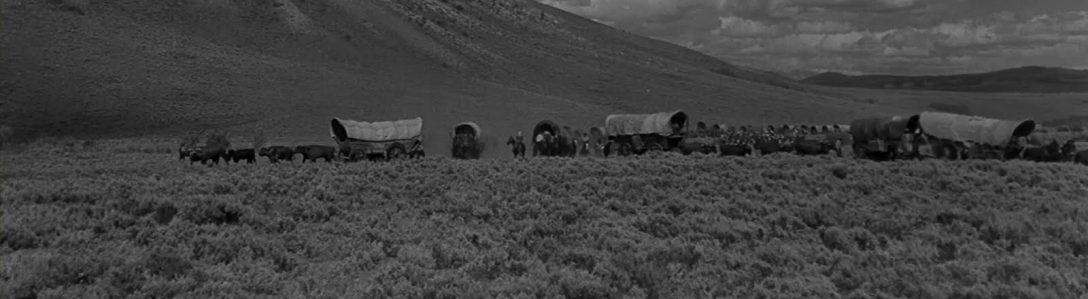
The Long Voyage Home (1940) was self-consciously an art film. An atmospheric bummer adapted from four one-act plays by Eugene O’Neill, it was the first  movie made for John Ford’s independent production company Argosy (co-founded with Merian C. Cooper). This offered Ford an unusual amount of freedom, and co-producer Walter Wanger commissioned prominent fine artists (Thomas Hart Benton, Grant Wood, Luis Quintanilla, Georges Schreiber, and Ernest Fiene) to come on the set and paint whatever they wanted.  In the biography Searching for John Ford Joseph McBride quotes the director as saying “I didn’t like the idea at first, but the artists proved to be a grand bunch of guys.” Ford and cinematographer Gregg Toland did their own painting with light, making The Long Voyage Home his most visually experimental film. There is the deep focus that Toland made famous the next year in Citizen Kane, plus low-light chiaroscuro and trick shots like anchoring the camera to the floor of the ship so the audience has a plank-level view of a storm, the waves crashing over the lens. It screened on 35mm (a UCLA restoration) in the Revivals section at this year’s New York Film Festival, but it is also streaming on Criterion’s Hulu page, if you are digitally inclined. At points the film feels like a workshop, to try out techniques Ford was unable to use on his bigger studio pictures, which gives The Long Voyage Home its patchwork quality. And yet Dudley Nichols’ sensitive script is able to tie the anecdotal structure together, and it remains a profoundly moving experience of unmoored men at sea, fruitlessly trying to claw back to land.

tumblr_m83jse9c4T1qbhnrvo1_1280

The Long Voyage Home was shot in thirty-seven days for $682,495 at the Goldwyn Studios lot, as well as aboard the freighter S.S. Munami at Wilmington Harbor, CA. Eugene O’Neill was friends with Ford and proposed bundling his seafaring one-acts into a film. Dudley Nichols updated it to WWII, gathering a group of O’Neill’s dead-ender sailors on The Glencairn as they travel from the West Indies to Baltimore and on to England, transporting explosives through a war zone. It is an ensemble cast that includes Thomas Mitchell as Driscoll, a gregarious Irish rouster, John Wayne as Ole, a sensitive, big-hearted Swede, and Ward Bond as Yank, a bullet-headed brawler. In the digressive narrative room is given to the stories of Smitty (Ian Hunter), an alcoholic escaping his past, and Cocky (Barry Fitzgerald), a failure come to terms with his lonely life at sea. John Qualen and Billy Bevan are also on board to provide some nosy comic relief.

wayne_61

None of them have managed to figure out life on land, so they continually sign up for more journeys on the ocean, in perpetual avoidance of the “real” world on solid ground. Instead they drink and brawl and pine nostalgically for the old days of drinking and brawling. The crew pairs off in friendships, with Driscoll and Yank as best friends and world travelers, even if they can’t remember half of their trips. Smitty and Cocky continually end up on deck with each other, as the rest of the crew gets blasted. Smitty is nervous, sweaty and haunted, the most noirish character of the bunch. The crew invents an elaborate backstory for his secretiveness, one that expands in complexity until they start believing his is a Nazi spy.  Most of their time is occupied inside of these fantasies. Smitty’s refusal to participate marks him as an outsider. The truth is sadder than any of them can comprehend. So they ignore it and move on.a_wa1094

John Wayne gives one of his most unusual performances, taking on a Swedish accent and playing Ole as a sweet, slow-witted goofball. He is a lovable giant, and the characterization runs counter to the All-American athlete persona he had been cultivating for years. But for John Ford he would do anything. Wayne was still finishing off his Republic Pictures contract, and had to shoot the drama Three Faces West for twenty days before taking on Long Voyage Home. Insecure at his talent for accents, he asked Ford for help. As quoted in Scott Eyman’s John Wayne: The Life and Legend, Ford responded: “Well, Jesus, all right if you want to be a goddamn actor. You don’t need it.” But Ford hired Danish acting coach Osa Massen to help him out, and if the accent isn’t quite accurate, her instruction put Wayne at ease, and his performance of wide-eyed innocence is one of the most delicate of his career. Though it was a glorified supporting part, Wayne was still given top billing, probably due to the smashing success of Stagecoach in 1939.

a_duk153

Ole has plans to quit the seaman life and return home to his family in Sweden. It is the crew’s solemn vow that they will protect him on shore leave and make sure he gets on the ship home. He has failed many times before, getting caught up in drink, getting in debt, and returning to work to pay off his debts. But for all of the men, Ole is a symbol of freedom, the only one who could conceivably forge a real life on land. Everyone else has had their family and friends die off or disavow them. The ship is their entire world. And the way in which Toland shoots them it feels like a moving mausoleum. Toland reserves his low light shots for the bridge, the tools of navigation bathed in darkness. They hyperreal qualities of deep focus here emphasize the empty spaces, of lost crew members and phantom memories. The most representative sequence is the shot of the raging storm that crashes onto the camera, which anticipates the GoPro techniques of Verena Paravel and Lucien Castaing-Taylor’s immersive boat film Leviathan. There are no actors in the shot, it is emptied of everything but the water. The crew of the Glencairn are disappearing, and they will all eventually be subsumed in the ocean. The shot is a foreshadowing of future absence, and for most of the crew, not an unwanted one.
THE 2015 NEW YORK FILM FESTIVAL

October 6, 2015

Originally published in Movie Morlocks, the official blog of Turner Classic Movies

To stud its carpets with stars, the 53rd New York Film Festival has turned to the biopic. It opened with The Walk, Robert Zemeckis’ recreation of Philippe Petit’s World Trade Center tightrope walk, gave a centerpiece slot to Michael Fassbender as Steve Jobs, and closes with Don Cheadle’s Miles Davis movie, Miles Ahead. Though I haven’t managed to see those high-gloss productions, biographical approaches extended throughout the festival and into many of my favorites. Manoel de Oliveira’s Visit, Or Memories and Confessions is a wistful and austere reflection on his life, his career, and the house he lived in for forty years. Hong Sang-soo puts another of his wayward film director characters through a structural ringer in Right Now, Wrong Then, and the weight of history and mortality is felt in Apichatpong Weerasethakul’s Cemetery of Splendour, set in his hometown of Khon Kaen, Thailand, and which he has described as “a search for the old spirits I knew as a child.” Soldiers afflicted with sleeping sickness dream away their lives in a makeshift hospital, situated on top of ‘an ancient burial ground. Those sleepy spirits of history seem to have wandered throughout the festival and through the avant-garde Projections sidebar, much of which is on Weerasethakul’s somnambulant wavelength.

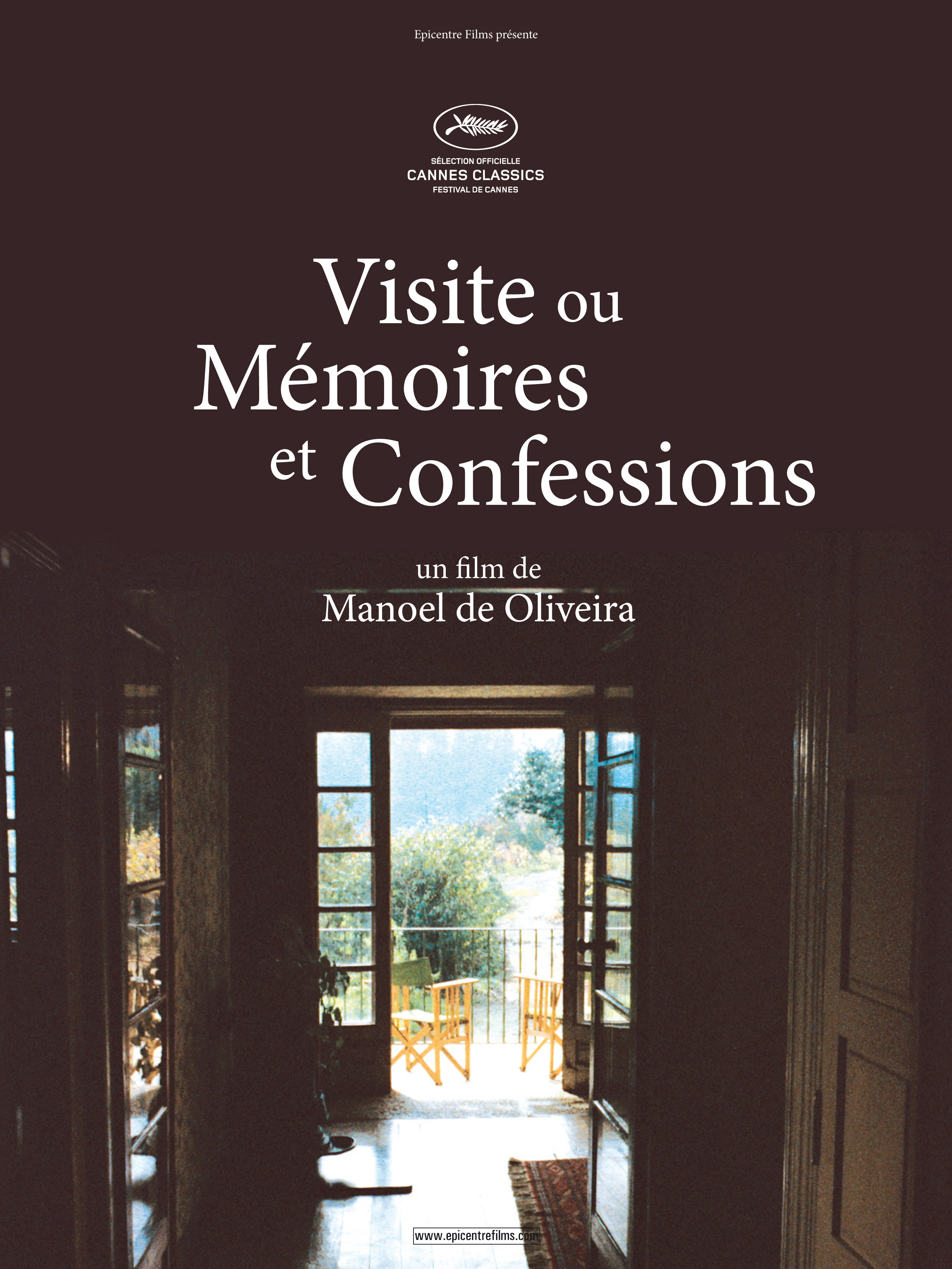
“It’s a film by me, for me. Maybe I shouldn’t have made it. Either way, it’s done.” So says Manoel de Oliveira near the start of Memories and Confessions, in a voice-over written by novelist and frequent collaborator Agustina Bessa-Luís. It is a film of reluctant revelation. Shot in 1982, Oliveira ordered it not be shown until after his death, which sadly occurred this past April. The NYFF screening was its North American premiere. The film is structured as a tour of Oliveira’s Oporto home, built for he and his wife Maria Isabel (still with us at age 97) after their marriage in 1940. An unseen male and female walk through its environs, comparing the garden trees to guardians and the house as a ship – to these interlocutors it is a shapeshifting landscape occupied by spirits. They hear noises of its previous inhabitants, one of them being Oliveira the friendly ghost, tapping away at his typewriter. He turns in an artificially startled manner toward the camera, as if on an awkward public access show, and tells the story of his life. He screens home movies of his four children, lingers over portraits of his wife, and walks us through the economic failure of his father’s hat factory that put him into debt, leading to the sale of the home. Maria Isabel is only shot outside in the garden, cutting flowers. Asked by an offscreen voice what it is like to be married to a filmmaker, she replies, “it is a life of abnegation”, with a hint of a Mona Lisa smile on her face conveying the years of stresses living with a “man of the cinema”. Manoel has numerous copies of Da Vinci’s masterpiece stashed around the house – perhaps it reminds him of his wife? Though only 72 at the time of shooting, the film seems like a summation, a wrapping up, as he strolls through a Portuguese film studio and reflects on his own insignificance as the roll of film ends, cutting to white screen and the sound of flapping celluloid. He would go on to shoot twenty-five more features.

Cemetery of Splendour is also about the energies and spirits that can adhere to a space. Apichatpong Weerasethakul grew up in the small town of Khon Kaen in Thailand, where his parents were doctors. For the film he merged all of his childhood landscapes into one: his wooden home, the patients’ ward where his mother worked, the school, and the cinema. The movie is about a temporary rural hospital that cares for soldiers with sleeping sickness that no other wards will take.  Their building is a rotting old schoolhouse that still displays remnants of its past: chalkboards, toys, and textbooks. The doctors utilize an experimental therapy using colored fluorescent lights that are said to tame the patients’ dreams, and perhaps ease them back to consciousness. Volunteer Jenjira (Weerasethakul regular Jenjira Pongpas) develops a close friendship with patient Itt (Banlop Lomnoi), who scribbles enigmatic koans in a notebook in between narcoleptic sleeps. An encounter with the psychic Keng (Jarinpattra Rueangram) forges a mental bond between Jen and Itt that traverses dreams and reality, with Itt guiding Jen into the world of warring kings, buried in the ancient cemetery underneath the hospital. At the same time Jen leads Itt through the ruins of the school where she once attended, weaving history and myth together, all part of a lost Thailand that Weerasethakul is mourning.

At the beginning of the short video Bring Me the Head of Tim Horton, Guy Maddin is mourning his career. Unable to complete funding for his next feature (what would become The Forbidden Room, part of the NYFF main slate), he decides to take a job as a director of a behind-the-scenes video for Hyena Road, a big-budget Afghanistan war movie. Maddin decries how Hyena Road’s catering budget could fund most of his features, so he soldiers on, even deigning to act as an extra corpse in one particularly humiliating long shot. But this being a Guy Maddin film (co-directed with Evan and Galen Johnson), things don’t stay linear for long. He decides to cobble together his own war movie with random shots of extras and and some lo-fi CGI lasers, morphing the hero-worshipping Hyena Road into some kind of subversive sci-fi freakout where the Afghan extras are the leads. Maddin makes it personal by pulling in his childhood hockey heroes Tim Horton and Guy Lafleur (he intones “Lafleur, Lafleur” as if the name itself held the key to the universe), and ends with Lafleur’s bumptious disco song “Scoring” while a talky drone interprets the lyrics.

Hong Sang-soo is a serial self-portraitist, always depicting sensitive male artist types in various states of self-examination or self-delusion. In Right Now, Wrong Then he follows famed art film director Han Chun-su (Jung Jae-young) the day before he is giving a post-screening lecture in the small town of Suwon. He spends it with painter Hee-jung (Kim Min-hee), who he is strenuously attempting to seduce. They have coffee, retreat to her workshop to discuss her work, have dinner, and attend a small party. Through it all Han is working from an established script, using practiced lines from old interviews to create the seamless patter of an intellectual pickup artist. Hee-jung is initially charmed, then slowly irritated by his insecure mansplaining. But this is not the end – as Hong cycles the timeline back to the beginning and replays each scene, with Han subtly altering his approach.  Each detail is magnified in this second go-round, each thread of conversation a possible fork in the narrative that sends it down new paths. Han displays more confidence in his own thoughts the second time around, speaking thoughtfully and honestly rather than relying on recycled ideas, baring his body and soul. As Han begins to listen to Hee-jung’s perspective, Hong shifts his camera to her – though it framed Han more centrally in the first half. It all sounds very simplistic and binary, but in action it is a marvel of subtlety of Jung and Kim’s performances. The first half was completed and screened for them before they shot the second, and their reactions seem to play off that first encounter, a teasing flirtation both with each other and with the movie itself.

The Projections programs of experimental films also dealt with the self, especially Laida Lertxundi’s Vivir Para Vivir, which attempts to render her body through cinema. Mountain peaks are connected to the peaks in her cardiogram, which are both seen and heard on-screen. It is a bold, sensuous kind of embodied cinema, ending with a blast of color timed to a recording of an orgasm. Alee Peoples’ Non-Stop Beautiful Ladies is a casual bit of urban photography, as Peoples documents an unusual marketing technique around her north Los Angeles neighborhood: busty female mannequins which hold motorized signs for a variety of small businesses – income tax accountants and gas stations alike. In an economically depressed landscape of empty billboard signs, these intrepid inanimate ladies still hawk their wares, absurd emblems of sexism that have held onto their jobs longer than most. The most unique and haunting work I saw in the festival was Lois  Patiño‘s Night Without Distance, another short playing in Projections. Shot in the mountains on the Galicia/Portugal border, it envisions the smuggling trade as ghostly emanations of the landscape. Patiño used color reversal stock and then presented it in negative, creating uncanny silvery images that look like they came out of the video game Metal Gear Solid. That impression is further solidified by how the spectral figures, speaking of secret meetings and escapes, use stealth like that game’s Solid Snake. The long takes of smugglers waiting in crevasses and by creeks take on depth and volume, with physical textures vibrating across the frame. The travelers seem to speak in code, traveling towards a point beyond time, ghostly smugglers wandering the borderlands of perceivable reality.  It conjures the same spell as Cemetery of Splendour, leaving me suspended in its waking dream of cinema.

THRILL KILL: 10 TO MIDNIGHT (1983)

September 29, 2015

ten


Charles Bronson’s association with the exploitation mavens at Cannon Films started with Death Wish II (1982), and continued through six years and seven more movies of profitable urban bloodshed. The second of these was 10 to Midnight (1983), a ultra-sleazy slasher film in which Bronson’s morally dubious cop attempts to protect his daughter from a loony who commits murders in the nude. Now out on Blu-ray from Twilight Time (available exclusively through Screen Archives), it’s a lowest-common-denominator product that gives the people what they want, and what they wanted in 1983 was healthy heaping of gently jogging nudity (male and female), a few spurts of blood, and Bronson looking constipated, apparently.

10-to-midnight

10 to Midnight began as a title without a story. Producer Pancho Kohner had been working with Bronson since St. Ives (’76), and was being pitched by Menahem Golan to come to Cannon Films to make Bronson’s next picture. In Paul Talbot’s book Bronson’s Loose!, Kohner described the strange development of the film. Initially he and Bronson wanted to adapt the novel The Evil That Men Do, but Golan was unwilling to reimburse them for the rights, so, Kohner recalled:

Golan said: ‘I’ll tell you what. We’ll go to Cannes anyway and we’ll pre-sell the next Bronson picture. When we come back in two weeks, we’ll find another story and we will not make The Evil That Men Do. What’s a good title?’ I always liked 10 to Midnight. So, we went over to Cannes and I sat in this suite at the Carlton and all the buyers came through. I explained that there was going to be great action and great danger and great revenge and it was going to be called 10 to Midnight. Everyone was pleased. We didn’t have a script yet. We got back to Los Angeles and I had to scramble to find a story that would be a Bronson project that Charlie would like. I called a friend of mine…and I asked him if he had any stories and he know of Bill Roberts’ screenplay called Bloody Sunday…. I said, ‘Would you mind if we called it 10 to Midnight?’ He said, ‘No.’ [Laughs].

10 To Midnight

William Roberts’ script was loosely based on the story of serial killer Richard Speck, who murdered eight student nurses in 1966. The screenplay transposes him into Warren Stacey (Gene Davis), a good-looking perv who gets his kicks by stripping naked and chasing down young women with a knife. Bronson plays Lieutenant Leo Kessler, a decorated investigator who has started cutting corners to imprison those he deems guilty. His partner Paul McAnn (Andrew Stevens) is more of an idealist, an educated upstart who wants to clean up the force. Both are interested in protecting Kessler’s daughter Laurie (Lisa Eilbacher), a student nurse and one of Warren’s potential targets. Note: the title has nothing to do with the story, though the posters promised “a deadline”, there is no such thing in the film.

10tomidnightpolice-1600x900-c-default

Bronson had developed a stone face as inert as Buster Keaton’s, and opted for as little physical movement as possible. Watching a Bronson film from this period is a constant test of the Kuleshov effect. If the cutaway is to  a scumbag murderer, Bronson’s impassive face must be registering anger, but if he’s looking at his daughter, then it has to be affection. The closest he comes to “acting” is when he confronts some of the more ludicrous turns of the plot. While at the morgue standing next to the latest victim, he is forced to say, “If anybody does something like this, his knife has gotta be his penis.” Though he maintains a laconic volume, there is a rhythm to his delivery that lands “penis” as a punchline. His co-star Andrew Stevens recalled, “Charlie made continual jokes, and when he has to say the line, “The knife is his penis,” he cracked up over and over. Usually standoffisih on set, Stevens reported that Bronson was feeling loose and jocular, perhaps having fun with the absurdity of the script.

10tomidnight

The crew was made up of professionals, from director J. Lee Thompson (The Guns of Navarone), to DP Adam Greenberg (The Terminator), who frame the story as more of a horror film than a thriller. Warren is positioned as a Michael Myers-type, scarred by psychological damage here left unexplained, his only source of pleasure when he is able to strip and take another life. Once naked, he is a monster, appearing as a Psycho shadow behind the shower curtain. He is something like the male id run wild, and shows off his svelte behind more often than the any of the women he goes to out to kill. He is objectified more than anyone, though the film has its quota of buxom ladies running for their demise. Roger Ebert was disgusted by the film, calling it a “scummy little sewer of a movie”, and declaring that everyone who made it, including Bronson, should be ashamed of themselves. It is a cynical market-driven product that exploits all of its characters for cheap thrills. But it is consistent in its cynicism, depicting everyone as compromised or on the take, and contains a barely suppressed lunacy that threatens to overtake the film at every turn. This spark of madness makes it hard to look away from Brosnan’s rigid visage, in the hopes of watching it break.

OUT FOR THE COUNT: FAT CITY (1972)

September 22, 2015

Fat_City-742983492-largeFat City (1972) is a major bummer in a minor key, detailing the apathetic lives of a couple of down-on-their-luck boxers in Stockton, California. Director John Huston had been trained as a boxer when he was seventeen, and was still friends with some of his fellow pugs from the Lincoln Heights neighborhood of Los Angeles. So he was attracted to Leonard Gardner’s novel of the same name, which captured the lower levels of the sweet science, of callow kids struggling  their way up the card and punch-drunk veterans close to washing out. The film is as stuck in a haze as its protagonists, with neither attaining sharpness or clarity, both shot in the dusky glow of DP Conrad Hall’s cinematography. All of which can be seen to devastating effect in the beautiful new Blu-ray from Twilight Time (available exclusively through Screen Archives).

fat-city-poster

John Huston and his producing partner Ray Stark hired Gardner to adapt the screenplay from his novel, and the film started shooting on location in Stockton, CA in June of 1971. The story, such as it is, revolves around two struggling fighters. The first is Tully (Stacy Keach), a drifter and day laborer who dreams of getting back into shape for another run inside the ring. His initial boxing career was ended by booze, which he hit hard after his marriage dissolved. Broke and almost thirty-years-old, all he has left are dreams and alcohol. One day at the gym he meets Ernie (Jeff Bridges), a painfully young kid with a long reach who Tully encourages to pursue a career in pugilism. Tully directs him to his old coach Ruben (Nicholas Colasanto), an amiable bottom-feeder with delusions of championship belts. His eyes light up when he sees Ernie, a handsome white kid who could bring in box office. Tully and Ernie both get in the ring, winning some and losing some, but never getting ahead. Tully spends his free time with Oma (Susan Tyrrell), a similarly afflicted drunk, who is passing the time until her boyfriend Earl (Curtis Cokes) gets out of prison. Ernie takes up with small town girl Faye (Candy Clark), their relationship made out of conversations in parked cars. Poverty is an endless loop, and as much as Tully and Ernie claw against its grip, they always end up broke and looking for another angle.

111FATcity

It’s a recursive film, with Tully sticking to his routines and hoping for different outcomes that never arrive. He goes from day labor (picking fruits and vegetables) to a grim-looking bar and back home, with an occasional detour to an empty gym. The locations speak more than Tully ever could, as the movie opens with a montage of the  town’s poorest neighborhood, showing a Mission house, a burnt-down home, a bum smoothing his hair in front of a Kaopectate sign, while the locals, , blacks, whites and Hispanics, go about the business of daily life next to the bombed-out homes. In his autobiography An Open Book, John Huston recalled the Stockton neighborhood. where he cast many non-professional actors:

We shot most of the picture on Stockton’s Skid Row. It’s now a thing of the past; they’ve wiped it out. I wonder where all the poor devils who inhabited it have gone. They have to be somewhere. There were crummy little hotels; gaps between buildings like missing teeth; people…standing around or sitting on orange crates; little gambling halls where they played for nickels and dimes. Many of the signs were in Chinese because the area had a large Chinese population. The police were very gentle with the derelicts. As long as they stayed within the sharply defined boundaries of the neighborhood, they could sleep in doorways, wine bottle in hand; if they wandered out, the police simply shooed them back. They were completely harmless, defeated men.


fatcity2

Stacy Keach embodies the defeated man, first seen sprawled in bed in old tight briefs, faded polo shirt, and a stringy receding hairline. His most prominent feature is a scar on his lip, which makes him look like he’s snarling before he even speaks. He’s a natural backslider. His first day back in the gym he pulls a muscle, so ends up at a bar. It is there he meets Oma, a a blowsy broad who dresses as loudly as Edina from Absolutely Fabulous. Susan Tyrrell was nominated for a Best Supporting Actress Oscar for her performance, and it is a fearless one. She is greasy all over, and shows Oma to be so pumped full of alcohol she’s almost sliding out of the film frame throughout the movie. Oma’s rapport with Tully is like recognizing like, two defeated people pretending to be alive again. The flirtation is invigorating, firing those old synapses, in their brief time together they seem like patients awakening out of a coma. But it’s only a flash, and soon they retreat to their own pockets of darkness.

fat-city-poster_149514_37942

DP Conrad Hall does some wonderful things with shadow, including one moving sequence with Ruben, the boxing coach. In the only shot of him at home, he is sitting up in bed next to his slumbering wife, knuckles on chin. His face is edged with light as he expresses his dreams: “This kid could develop. Aw, you oughta see the reach on him. And he’s tall, you know. He put on some weight he could look like a good looking white heavyweight. He could draw crowds someday, if he ever learned how to fight. Maybe he can if he just listened to me and let me put everything I know into him. Sweetheart, you awake?” She is not awake, having missed his fantasies for what we assume is the umpteenth time. Ruben turns off the lamp, and smokes his cigarette in the dark, the tip of it lighting up just before a cut. Ernie is not much of a fighter, but this is a ritual Ruben clearly most go through to justify his work, one of the many rationalizations that keep these men and women going. Tully constantly claims he can get back into fighting shape while Ernie talks himself into loving and marrying Faye, despite having known each other briefly, mostly by the sides of roads.

IMG_20150922_024811

Fat City is made up these rationalizing rituals, the little motivational tactics that get us through bad days. It’s easiest when another person is there to hear them, even if they aren’t paying attention. The saddest and most beautiful performance of the film comes from Sixto Rodriguez (not the Searching for Sugar Man guy, but an ex-boxer), whose character is completely alone. He plays Lucero, a veteran Mexican fighter brought to Stockton to face Tully. He arrives on a Greyhound bus, pisses blood, starts the fight, and gets knocked out. After the bout he wordlessly strolls out of the theater hallway, impeccably tailored. The ceiling lights start turning off in succession above him, a theatrical send-off for the end of his career, and quite possibly his life.   Rodriguez was an ex-boxer who fought under the nickname “Kid Sixto”. He compiled a career record of 28-12-3, with 7 knockouts. The 6′ 1″ Puerto Rican’s last fight was in 1964 when he was 27, a 10 round victory over Norman Letcher in San Francisco. Rodriguez was 34 when Fat City was being shot, retired for seven years already. So he already knew how it felt on that last walk, when all you had known, all you had trained for, fades to black.


IMG_20150922_025014

PASSING FASHION: KAY FRANCIS AT WARNER BROTHERS

September 15, 2015

Kay00017

In 1935 Kay Francis was one of the highest paid women in Hollywood, a glamorous star who set fashion trends based on the gowns Orry-Kelly designed for her. In 1939 Warner Brothers terminated her contract. This rapid fall from corporate favor is documented in three films the Warner Archive recently released on DVD:  I Found Stella Parish (’35), The White Angel (’36), and Confession (’37). All feature Francis as the suffering center, absorbing the sins of the world in sacrifice for the virtues of motherhood and mercy, expressed in extreme close-ups where Francis radiates a divine glow. Stella Parish and Confession are urban melodramas that offer Francis the opportunity for multiple hair and costume changes, one of the main pleasures of any Francis film, whereas The White Angel, a Florence Nightingale biopic, keeps her in heavy woolen nursing gear. It was the latter that disappointed Warners. It was perceived as a flop (though it actually turned a profit), and started the downshift in her career. None of these movies are masterpieces (see Trouble in Paradise for that), but contain the compensatory pleasures of any Francis film – gorgeous gowns, a dizzying array of haircuts, and a heart-tugging melodrama of female self-sacrifice.

I Found Stella Parish, directed by studio stalwart Mervyn Leroy (I Was a Fugitive on a Chain Gang) was such a success on its New York opening that WB extended Francis’ contract well before it was to expire. Based on a John Monk Saunders story called “The Judas Tree”, it is the story of London stage sensation Stella Parish (Francis), who disappears right after another smash hit debuts. A shadowy figure from her past appears in her dressing room, threatening to reveal a violent secret. In order to protect her daughter, Parish flees home to the US, and is trailed by a reporter, who reveals her past involvement in a murder case. Fashion is closely tied to identity. On the ship from London to the US,Francis hides her identity as a gray-haired granny in what looks like conservative mourning clothes. When she takes off the wig and returns to her natural age, reality sets in, the past still on her trail.

Kay00022 Kay00023

Parish abandons her daughter to keep her free of scandal, and hits the stage to cash in on her newfound fame. Francis goes from grand dame lead in London to vaudeville circuit curiosity, her wardrobe getting tawdry, her language salty. There are no surprises in the film, but it hits its marks, and Francis is reliably stunning in Orrin-Kelly’s draping, backless gowns, and she positively glows with mother-love:

Kay00014Kay00019Kay00027Kay00032

The White Angel is something else entirely, a drab biopic of Florence Nightingale’s reformation of England’s nursing corps during WWI. Director William Dieterle, who had directed Francis before in the fast-paced screwball heist film Jewel Robbery (’32), seems bored with the material, as does most of the cast and crew, although there are a few nice tracking shots of Nightingale checking on wounded veterans, lit only by a lantern. But Francis wasn’t right for the role, and she knew it: “I shudder to think of that one”, she said in 1938:

Kay00037Kay00034Kay00038

More importantly, the studio was displeased. Producer Hal Wallis:  “In scene after scene, reacting to the sight of the injured…she looked completely blank. We weren’t too happy with the picture. The White Angel was well directed, but miscast, and Kay Francis had lost the box office she once had. It was one of our box office failures.” Though he overstated the financial failure (it made $886,000 domestically on a $506,00 budget), the perception was something of a disaster. And once she lost that shine, she had trouble getting it back, not that WB was giving her great opportunities to succeed.

Kay00003

Confession (1937) is the most fascinating film of the three (and the least successful at the box office), directed by German expat Joe May (Asphalt). The film was a remake of the Pola Negri movie Mazurka (1935), and reportedly May was militant about copying the film down to the second, showing up to the set with a stopwatch to make sure the shot length matched exactly. The movie has a complex flashback structure, delving into the past of Vera (Francis), as she is being tried for murder. A one-time actress in operettas for Michael Michailow (Basil Rathbone), she had later married, divorced, and lost her daughter in the split. Each phase of her life brings a different haircut and wardrobe, from the chin-length blonde locks of her court date, to a curly golden wig of her nightclub routine, back to her days as a happy-go-lucky brunette. Francis doesn’t even appear in the film for the first twenty minutes, a bold narrative strategy that focuses on secondary characters in elaborate tracking shot sequences, in and around a transit station, and then up and through a dinner theater. The lengthy prologue ends with Francis in a tacky patterned dress and wig, desperate to end that segment of her life. And so she does, with a gunshot to her male tormentor’s torso. The film has a strong sense of female solidarity, as Vera finds sympathy and tenderness from the second wife of her husband  and the estranged daughter who was the cause of it all. The intensity of that bond is terribly moving, and May’s roving camera and cluttered mise-en-scene provides a background of  a life in disarray. After the disappointing returns on The White Angel and Confession, WB started giving her cheaper projects, eventually shunting her off to their B unit, until they terminated her contract in 1939.

Kay00006 Kay00010 Kay00015 Kay00013

PAST LIVES: THE SHE-CREATURE (1956)

September 1, 2015

she_creature_poster_02In 1956 the hip new fad was past life regression, thanks to the story of Bridey Murphy. In Colorado, amateur hypnotist Morey Bernstein had been experimenting his craft with Virginia Mae Morrow, who claimed to have died in Ireland in 1864, when she was known as Bridey Murphy. The story was reported in the Denver Post, and then published as a best-selling book authored by Bernstein in 1956, The Search for Bridey Murphy. It was briefly on everybody’s lips, with the New York Times reporting, “there were Bridey Murphy parties (‘come as you were’) and Bridey Murphy jokes (parents greeting newborns with ‘Welcome back’).”  Hollywood wanted to cash-in on the craze while it was still relevant, so Paramount rushed their official adaptation of The Search for Bridey Murphy, starring Teresa Wright, into production. It was released on October 1st of 1956. American International Pictures worked a little quicker, cranking their past life regression monster movie The She-Creature (1956) out in nine days, and getting it into theaters on July 25th. Though beset by casting troubles and budget restrictions, The She-Creature manages to create an atmosphere of voluptuous dread, aided by Paul Blaisdell’s insectoid creature design and efficient direction from bargain basement king Edward L. Cahn.

TheShe-creature1

Wanting to profit while past life regression was still all the rage, AIP president Jim Nicholson assigned Lou Rusoff to put together a treatment for a film with hypnotism as its theme. The project didn’t have a clear shape until Nicholson and producer Alex Gordon were at a party where local exhibitor Jerry Zigmond mentioned The She-Creature as a possible title that could sell the Bridey Murphy hook. With the title in place, Rusoff then built the story around a prehistoric female monster, the endpoint of a past-life regression that goes back to the beginning of time. Andrea (Marla English) is the suggestive woman under the power of carny mesmerist Dr. Carlo Lombardi (Chester Morris), who is able to take her back through all of her past lives back into a primordial creature. The power of this hypnotic trance is so strong that the monster gains physical form,  killing socialites on the California beaches with its thudding she-claws before disappearing back into the ocean. Lombardi builds his psychic reputation by predicting these murders, and starts to make millions with his business patron Timothy Chappel (Tom Conway). The one skeptic is Dr. Ted Erickson (Lance Fuller), a strait-laced academic who studies psychic phenomena. He is out to debunk Lombardi and free Andrea from his thrall.

621_356_the_she_creature

The budget was $104,000 and the shoot was set for nine days. Director Edward L. Cahn had just completed Girls in Prison (1956) for AIP, and rolled right into The She-Creature, on which he wrings a lot out of abandoned beaches and double exposures – representing all the souls of Andrea’s past.  Gordon wanted to get Peter Lorre for the Carlo Lombardi part, and Edward Arnold for Chappel. Both actors had worked together before in Josef Von Sternberg’s Crime and Punishment (1935). But Lorre backed out after reading the script, and Arnold died soon before shooting was set to begin. So they scrambled and hired Chester Morris and Tom Conway. Morris, best known for his starring role in the Columbia Boston Blackie series, was an experienced amateur magician, and brought an enthusiasm for prestidigitation to the role. His wide-set eyes and rumbling voice made for convincing hypnotics, even when he’s trying to mesmerize a dog. Tom Conway had his own series, as The Falcon for RKO, and looks to be having fun in deploying his plummy British accent in service of a scummy exploitation entrepreneur making a fortune off of Lombardi’s morally dubious act – not unlike how AIP was cashing in on the whole Bridey Murphy affair. This might have been an in-joke on Rusoff’s part (he was executive producer Sam Arkoff’s brother-in-law). Lance Fuller (This Island Earth) was another last-minute addition to the cast, and he looks jet-lagged and morose throughout, the dead space in an otherwise well-acted film.vOsaE

The she-creature herself is doubled as Marla English in the human present, and Paul Blaisdell in the foam rubber suit as her prehistoric avatar. English was a San Diego beauty queen, whose career, at the age of 21, was already over. Previously signed to Paramount Pictures, they dropped her contract after she refused a lead role in The Mountain alongside Spencer Tracy, either due to falling ill from a smallpox vaccine, orbecause they would not cast her boyfriend Larry Pennell, causing her to quit in protest. She would retire from acting soon after shooting The She-Creature, and she looks ready to leave Hollywood for good, dazed but distantly beautiful — appropriate for a character in a hypnotic trance for most of the film’s running time. There is something elemental about English’s connection to the creature, depicted in double exposures as a foggy excrescence on the ocean until it takes physical form, her thoughts taking shape. It is an embodiment of the rage she has suppressed, her loss of power diverted into the creature’s superpower. And though Lombardi guides Andrea to call this being to life, it is not his creation – so he cannot control it. The most affecting moment in the film occurs when the monster, after scaring off one of Chappel’s rich regression parties, kneels worshipfully next to Andrea, as if in some kind of  mind meld, sharing each other’s pain.

SheCreature#2

The monster itself is another remarkable creation by Paul Blaisdell, the unsung hero of 1950s science fiction (read Randy Palmer’s Paul Blaisdell, Monster Maker for the full story – it is the main source of information for this post). Blaisdell was a creature designer and builder for AIP who made something out of next-to-nothing, working in close concert with his wife, Jackie. They designed monsters for The Day the World Ended, It Conquered the World, Invasion of the Saucer Men, It The Terror From Beyond Space and many more. The She-Creature was “the best one I’ve ever done”, Blaisdell said. He built the creature on a pair of old long-johns, with the body a jigsaw puzzle of foam rubber made to look like the seabed floor. Its chest was made of “sea hooks” which could be used for disemboweling, its arms were clubbing crab-like claws built around a pair of welding gloves, while the face is a cat-lizard-insect combo with stringy blonde hair made for man-devouring. The compressed time schedule kept Cahn from utilizing all of the creature’s capabilities (swinging tail, chewing sea hooks), but it is a striking, unearthly creature that somehow has a spark of humanity in it. Blaisdell built the costume to fit his own body, he literally knew it inside and out, so there was no better person to give the She-Creature life.

DREAMLIFE: SHATTERED IMAGE (1998)

August 25 2015

It has been four years since the Chilean director/mesmerist Raul Ruiz left this mortal coil, but it will take eternities to assess his work, comprising over one hundred features and shorts of labyrinthine, shape-shifting narratives. Of all of his oddball projects Shattered Image (1998) might be the oddest. It was his first film made with American producers, a dreamlike erotic thriller starring William Baldwin and Anne Parillaud (playing off her La Femme Nikita image). The production, which shot in Vancouver and Jamaica, was reportedly fraught, with Ruiz and DP Robby Muller clashing with the rest of the crew, who were used to the formula of TV movie productions. The resulting film is a curious mix of Ruiz-ian reverie and the gauzy softcore sleaze you’d find on late night Cinemax. Though not a movie with the same oneiric pull as Ruiz’s City of Pirates (1983), it remains stubbornly representative of his work, combining as it does the pulp narratives he loved as a child with the dream logic central to all of his films. As J. Hoberman wrote upon its opening in the prestige picture season of 1998 (against A Bug’s Life and the Psycho remake), “part of the movie’s pleasure is imagining an entire multiplex audience looking around at each other and wondering, “What the f**k?”

Shattered Image was a Seven Arts/Schroeder Hoffmann production, in association with Fireworks Entertainment. Thirteen producers are credited on the project, including director Barbet Schroeder. In short, it was a complicated project to get made, and there were a whole raft of interests that Ruiz had to satisfy. In an interview with Jonathan Rosenbaum Ruiz describes it as, “this American accident, Shattered Image, I fought to make, and I now have a film about what it means to make a film in America — why American movies are the way they are.” So, per the Jacques Rivette line, he considers the film a documentary of its own making, reflective of the limitations imposed on him by the lower reaches of the Hollywood production chain. In his book Poetics of Cinema Ruiz had described the Hollywood narrative system as premised on what he coined to be “central conflict theory”, in short, “someone wants something and someone else doesn’t want them to have it. From this point on […] all the elements of the story are arranged around this central conflict”. Ruiz was clearly frustrated by the experience, but if someone wanted to pick a Hollywood film of 1998 that represented central conflict theory, Shattered Image would be at the bottom of the list. It remains, miraculously, a Ruiz film through and through.

The script was written by Duane Poole, though I would have thought it a Ruiz pseudonym if not for Poole’s lengthy track record, including two other TV movies in 1998: I’ve Been Waiting For You and I Married a Monster. The dual narrative follows two Anne Parillauds, both named Jessie. The first is an ascetic assassin hired to kill the lightly tousled blackmailer Brian (William Baldwin), and she tries to fulfill her assignment despite her growing attraction to him. The second Jessie is on a honeymoon in Jamaica as Brian’s wife, though she soon suspects he is trying to kill her. The assassin dreams the story of the newlywed, and the newlywed dreams the story of the assassin. Both believe their life to be “real” and the other’s a figment of their unconscious. Ruiz leaves the truth opaque, instead preferring to run through a series of paranoid plots as if Jessie were simply at home flipping TV channels, projecting herself into every story on screen. She is an action star, a scream queen, a voracious lover, a chaste wife, a comatose depressive and a rape-revenge killer. As it ends up Jessie doesn’t even know what’s real or fake, she is as unknowable to herself as she is to us, just a ghost in a mirror grasping for a form she may never discover, caught in an endless narrative loop.

Anne Parrillaud is a sleek, mysterious presence, while Baldwin seems adrift, a cardboard cutout of sub-Keanu mumblings. His struggle, his failure to tap into the Ruiz-verse lends the film a direct-to-video stiffness, as if he was reading the script phonetically. He is most effective as a visual – and he is most often the subject of her gaze. The morning after Assassin Jessie sleeps with Brian, she gifts him with the kiss off: “You’re not the reason I couldn’t care less about you.” He is an absence that she continually cycles around, a void she is tempted to disappear into. His embrace for both Jessies means a different kind of death.

Though Ruiz was restrained by the limitations of his crew, there are still some Ruizian flourishes, including diopter shots and those constructed from impossible angles. Brian’s wife hires Assassin Jessie to kill Brian, and in this sequence Ruiz whips out the diopter, joining two shots into one to create the illusion of extreme focus shifts. In one shot-countershot, we see Jessie’s hand clutching a cigarette, with the wife in the background – then a cut to Jessie putting the cig in her mouth, with the wife’s lips seeming to yearn for that same cigarette on the right of the screen. These impossible perspectives seem to combine Jessie and the wife into one person – and Jessie will soon take on the role of vengeful spouse. Another Ruiz specialty is the impossible angle. In City of Pirates there is one from inside a man’s mouth – here it is less extravagant, but a shot from underneath a cup of tea peers up at Newlywed Jessie as if through an aquarium (the site of Assassin Jessie’s first tryst with Brian). Then there is the disorientingly surreal sequence where Newlywed Jessie wanders  lost into the Jamaican woods and stumbles into an abandoned home overrun with crabs, ending up dangling of a cliff, like the moment in dream right before you wake up. Instead of wakefulness, she gets Brian helping her up off the precipice. But even with these flourishes, it is one of his more “traditional” looking features. Ruiz explained why to Rosenbaum:

The idea that I decided where to put the camera was new to them. The editor was the director, and not the cameraman. It seems to me most were coming from TV. Normally, the director does nothing, as the camera is placed by the cameraman, and the director looks when everything is ready, and then the actors are directed by the coach. There is no connection, and you are supposed to cover the scene. I was always arguing with the script girl, who said I didn’t cover the scene. And people would say where is the [covering shot, where is] the master shot? This was a film about dreams, and there were two dreams, so it was only mental images, and once you make an establishing shot you are disturbing the oneiric feeling. This is easy to understand. And they understood, of course, but they were still disturbed by the idea that there was no master shot or establishing shot. The idea that you had to convince people to do this and not that was new to me, and it was completely normal for an Anglo-Saxon mentality that you have to explain why you’re doing what you’re doing.

For Ruiz, all the explaining that needs doing is in the film itself. In watching Shattered Image, I didn’t glean any answers, but can feel its mysteries deepening around me as I type.

WAY DOWN EAST: HOUSE OF BAMBOO (1955)

August 18, 2015

houseofbamboo-poster4

For his last film under contract at Twentieth Century-Fox, Sam Fuller directed House of Bamboo (1955), a film noir relocated to Japan. Daryl Zanuck took Harry Kleiner’s screenplay for The Street With No Name (’48) and dropped it in Fuller’s lap, inviting him to remake it on location in Tokyo. Shot in CinemaScope and Deluxe color, it is Fuller’s most beautiful film, and the new Blu-ray from Twilight Time (available for purchase at Screen Archives) looks flawless. Clearly inspired by his surroundings, and backed by an A-picture budget, Fuller works variations on the slashing lines of slatted bamboo curtains, sliding doors, and the increasingly vertical Tokyo cityscape, ending in a justifiably famous rooftop amusement park ride, a deadly trip around Saturn’s rings.

Fox promoted House of Bamboo as the first Hollywood feature shot in Japan, but that was all just ballyhoo. In 1951 RKO produced their anti-commie drama Tokyo File 212 on location, complete with approval from Douglas MacArthur, who was then Supreme Commander for the Allied Powers in Japan. Four years later the pressure to produce propaganda was lessened, and Fuller sneaks some subversive elements into the film’s double-agent drama. The film follows a military cop (Robert Stack) who goes undercover, using the identity of the dishonorably discharged Eddie Spanier. As Spanier, he worms his way into a growing Tokyo gang led by Sandy Dawson (Robert Ryan), who use a string of pachinko parlors as a front. Spanier gets close with Mariko (Shirley Yamaguchi), whose husband was a member of Dawson’s crew until he was killed in a heist-gone-wrong. Together they help destabilize Dawson’s group from within, with assists handed out by the Japanese police’s Inspector Kito (Sessue Hayakawa, the first Asian star in Hollywood – he starred in Cecil B. DeMille’s The Cheat in 1915) and the American Captain Hanson (Brad Dexter).

vlcsnap-2010-10-24-01h49m05s21

Fuller describes his additions to the script: “I moved the entire shebang to Tokyo, added stuff about Japanese contemporary life, threw in some sexual exploitation and interracial romance, and then, for some unexpected pizzazz, wrote a violent love scene between two hardened criminals.” The Dawson character is in a veiled relationship with his top lieutenant Griff, whom he calls “Ichiban”. Their bond is destroyed by the arrival of the cute Spanier, who Dawson begins to favor. At a post-heist party, Dawson seats Spanier next to him, which causes Griff to to have a drunken blow-up at his descending rank. Essentially Griff is upset at where Dawson positions him in the film’s mise-en-scene. This leads to the “violent love scene” to which Fuller refers, a brilliantly designed assassination in which a bathtub is plugged full of holes, life draining out along with the water. It plays as a scorned lover revenge killing, filled with rage and tenderness.

vlcsnap-2010-10-24-02h05m34s167

The pecking order of Dawson’s gang is established introductory scene in the movie. While trying to prove his underworld bona fides, Spanier attempts to shakedown Tokyo pachinko parlors for protection money. On his second attempt he is coldcocked by Griff (Cameron Mitchell), crashes through a sliding door and into a backroom where Dawson’s crew is arranged in a semicircle around him, with Robert Ryan seated king-like on a riser in the center. This sequence not only establishes the power structure of Dawson’s crew – the farther you radiate out from the center, the weaker the hold – but it establishes Japan as a kind of Russian nesting doll of facades. As each character is hiding secret identities and desires, so the city itself has rooms within rooms, frames within frames.

HoB6

One thing Fuller hid from view was the resentment the Japanese people had towards the continuing American presence in their country, and the wide latitude granted to them in the Security Treaty signed in 1951. The relationship between the Japanese and U.S. military police is depicted as open and honest, as Inspector Kito and Captain Hanson exchange information freely in their investigation into Dawson’s gang. But while Fuller was filming, protesters would gather and “chanted anti-American slogans, trying to ruin the scene as best they could.” Fuller intended to use them as background footage – but once DP Joe MacDonald turned the camera on them, they dispersed, likely not wanting to have their faces caught on film.

vlcsnap-2010-10-24-01h55m39s133

Traversing these labyrinthine spaces are Robert Stack and Robert Ryan. Fuller claims he wanted Gary Cooper for the Spanier role, but realized that location shooting would be impossible with such a huge star – any street shooting would be immediately mobbed by fans. So instead he went with Stack, who was recommended to him by his friend Budd Boetticher, for whom Stack starred in Bullfighter and the Lady (1951). Stack brings a wiry, wary quality to the role, a hopped up paranoia that works well in this film of double and triple crosses. Robert Ryan was recommended by producer Buddy Adler, and his lank, louche performance is as relaxed as Stack’s is wound up. They are matched opposites who end up chasing each other through the modernizing Tokyo streets. What starts at a luxe pearl dealership ends at the elaborate rooftop playground at the Matsuma department store. Fuller and MacDonald have fun with the possibilities, at one point sticking the camera on a children’s train ride, following Dawson as he stumbles through the crowd. All the dissembling and hiding in cataracts of secret rooms ends on an amusement park ride, a replica of Saturn with rotating rings. Dawson is chased up there like a treed cat, though with the advantage of having a gun and knowing how to use it. The ride looks rusty and is set at an angle, so the camera takes a canted look at the final movement, and it seems Stack, Ryan and the cameraman are in as much danger as Dawson and Spanier. But they complete the precipitous sequence, and Dawson is left dangling, having run out of hiding places.

INVISIBLE INTRUDER: THE AMAZING TRANSPARENT MAN (1960)

August 11, 2015

amazing_transparent_man_poster_01

In April of 1959 Edgar G. Ulmer was given an impossible task. Toiling in Dallas for Miller Consolidated Pictures, a short-lived B-picture studio, he was assigned to shoot two features in eleven days. These turned into Beyond the Time Barrier (1960) and The Amazing Transparent Man (1960). Most of the limited time and money was spent on Beyond, since its leap into the future required more elaborate set design and a larger cast.  What remained for him to use for The Amazing Transparent Man was a house on a hill, five actors, and an improbable tale of a mad Major experimenting with nuclear radiation to create an army of invisible warriors. From these meager resources Ulmer spun a dark, despairing tale of Atomic Age breakdown. Each character nurses a private tragedy, egged onward to self-annihilation. For most of its life the film has been an object of scorn — it was the subject of a Mystery Science Theater 3000 episode — but seeing a 16mm print projected at Anthology Film Archives (in their series on American International Pictures) was something of a revelation.

AmazingTransparentMan2

Miller Consolidated Pictures, led by John Miller, Mike Miller and Robert Madden, was a fly by night operation targeting the seedier side of the B-picture market, hiring exploitation publicity legend Kroger Babb as Vice President. He likely came up with the prime ballyhoo on the poster about how the Transparent Man will “appear invisibly IN PERSON at every performance.” The Amazing Transparent Man could be included in Anthology’s AIP series because Miller Consolidated Pictures (MCP) went belly up soon after the film was given a limited release in 1960, finishing its run with three films to its name (Date With Death (’59) and the two Ulmers). AIP snapped up the rights to Amazing Transparent Man and gave it a national rollout in 1961 as the top half of a double bill with the British Godzilla knockoff GORGO. In the dual review in the New York Times Howard Thompson raved about GORGO (“the best outright monster shocker since King Kong“), leaving only one withering sentence for the Ulmer film: “The word for The Amazing Transparent Man is pitiful.”

amazing7

This “pitiful” production seemed doomed from the start. Edgar Ulmer’s daughter Arianne acted in Beyond the Time Barrier, but bailed before shooting on the Transparent Man was completed (Ulmer was working on both simultaneously). “The reason I left”, she recalled to Tom Weaver (Science Fiction and Fantasy Film Flashbacks), “was because the two-story motel where the whole crew was living burned to the ground.” Hence the reason each actor seems so hollowed out and exhausted. The pulpy script was by Jack Lewis, a former Marine and founder of Gun World magazine who self-described as a “reporter, drunk, editor and hobo.” Whether he was drunk or vagrant during his creation of the script is unknown, but Lewis was mainly a writer of Westerns, with Transparent Man the only science-fiction yarn he ever filmed.

AmazingTransparentpic2

Major Paul Krenner (James Griffith) and Laura Matson (Marguerite Chapman (Spy Smasher), in her final film) help ace safecracker Joey Faust (Douglas Kennedy) bust out of prison. In return for his freedom, the Major wants Faust to break into a government facility to steal fissile materials. This will allow Dr. Peter Ulof (Ivan Triesault) to continue his invisibility experiments, which has thus far only successfully been executed on guinea pigs. With no way out, Faust agrees to the deal, becoming Ulof’s first human trial – only a transparent man could break into the vault containing nuclear material. The Major’s goal is to create an entire army of invisible men, but Faust isn’t keen on his crackpot scheme, and instead goes into business on his own, convincing Laura to help him rob a bank and flee Krenner’s control. But the invisibility treatment starts to wear of, he is identified, and everyone’s plans begin to crumble. As everyone scrambles to save their lives, Ulof’s lab becomes a ticking time bomb.

AmazingTransparentMan1

Invisible man stories are creative opportunities for the budget-minded director (see also: Edward L. Cahn’s Invisible Invaders), because you can shoot an empty room and the viewer’s mind creates the illusion of action. Ulmer takes advantage of this throughout, training his camera on nothing. Bare tables and floors become axes of tension, and the director relies on his actors as reactors, their expressions investing the void with dread. Lewis’s script posits the past as another void, with each character wishing for it to disappear. Dr. Peter Ulof, a European refugee, confesses to Faust that he was forced to become a doctor for the Nazis, performing experiments on hooded prisoners in concentration camps. Each patient was anonymous, so Ulof could not tell that one of his “patients” was his own wife, who died under his hand on the operating table. Ulof has been forced to work for Krenner because his daughter Maria is being held hostage, and if he quits, she dies. Krenner is also manipulating one of his guards, Julian (Red Morgan), by convincing him his son has been jailed in Europe, and that Krenner can set him free (this turns out to be a lie). Laura’s motivation is simply money and power, and she gravitates to Faust’s plan for a quick score at the local bank. Though he is named Faust, the deal he makes with Krenner is not a selling of a soul, for Faust has none. He’s a craven criminal with nothing but the basest self-interest.

AM

In one of the film’s most elaborate optical effects, Faust’s body starts reappearing during the bank robbery, his head popping back into view, and then his legs, before his whole body reconstitutes itself.  He is disappointed when he gets his body back – the only happiness in the film appears in Faust’s voice when he is invisible, when he can revel in his insubstantiality. But being cured of his visibility is going to kill him – the doc gives him only a few weeks to live. Characters don’t die in The Amazing Transparent Man, though, they just to crumple and dissipate. When Julian is informed that his son was dead, he slumps down onto a chair and simply shuts down. He is never seen or heard from again, as if the illusion of his son’s existence was the only thing tying him to this earthly plane. The ending is suitably apocalyptic, bringing the atom bomb to middle America. This catastrophic event is something the characters seem to yearn for, to have their individual cells fission along with the nuclear material, to wholly disappear into the bright, white light.


HYPER HYPOCHONDIRA: FEEL MY PULSE (1928)

August 4, 2015

Bebe2_edited-1

Bebe Daniels was a born performer. She debuted on film at the age of nine as Dorothy Gale in The Wonderful Wizard of Oz (1910, a Selig Polyscope short), and went on to a long and varied career, from co-starring in Harold Lloyd comedy shorts to headlining Cecil B. Demille bodice rippers, before settling in England as a popular radio personality. In 1928 she was in the middle of an interesting run at Paramount/Famous Players Lasky, making subversive comedies in which she was taking on traditionally male roles (as Fritzi Kramer has noted at Movies Silently). She was the lead in Miss Brewster’s Millions (1926), re-booting the George Barr McCutcheon novel with a female lead,  a Zorro-figure in Senorita (1927), and takes on a Valentino-esque persona in She’s a Sheik (1927). In 1928 the cast of She’s a Sheik (Daniels, Richard Arlen, and William Powell) was brought back together for Feel My Pulse (1928), a madcap hypochondriac comedy directed by the up and coming Gregory La Cava. La Cava was a cartoonist who was hired by William Randolph Hearst’s International Film Service to oversee their animations. After that business went kaput, he entered live action two-reelers and features, finally making his way to Bebe Daniels and Feel My Pulse.  Anthology Film Archives recently screened a beautiful print preserved by the Library of Congress, which is 63 minutes of gags, a showcase for Daniels’ effervescent personality and La Cava’s comic strip punchlines.

FeelMyPulse

The story is prime nonsense. Barbara Manning (Daniels) is the heir to a family fortune, but her late, wildly eccentric father stipulated in his will that she be kept in a germ-free environment until she was 21. Her mild-mannered Uncle Edgar (George Irving) is to watch over her until that day. As the movie begins, Barbara could be knocked over by a feather, constantly ministered to by a flock of nurses. At the slightest cough she needs to lubricate her larynx with various tonics. But the destined birthday is around the corner, at which point her Texan Uncle Wilberforce (Melbourne MacDowell) is to take over the guardianship. Wilberforce is a cigar chomping Yosemite Sam type who tries to shock Barbara out of her passivity by shooting off his revolver into the ceiling. In order to escape this uncouth germ carrier, Barbara decides to decamp to an island sanitarium that is to be part of her inheritance. But the nuthouse has been taken over by a gang of rum runners led by Todd (William Powell) and his new protege Wallace Roberts (Richard Arlen). They spend their days battling hijackers and shuffling casks of booze in and out of the former rest home. Wanting to keep their operation a secret from Barbara, they pretend to be running the sanitarium, with Todd the head doctor and the other gang members acting as patients. The absurdities build up as they desperately keep their illegal secret, and as Barbara hides out from her Uncle.

1928 Feel my pulse - Tomeme el pulso doctor (ing) (lc) 01

The basic setup for Daniels’ performance is that Barbara believes herself to be a delicate flower, when in reality she has a physical prowess that reveals itself in moments of high stress. When Wilberforce shoots off his revolvers, she leaps to the ground with alacrity, and when her medicines fall out of a speeding car, she hurls herself down to the road and chases after them with the spring of an Olympic vaulter. She doesn’t know the power of her own body, or how to relate to the world outside. Most of the gags are built off of her alienation from the world. She doesn’t know how cars work, and drinks rum as if it were a new healing tonic. One of the funniest bits involves her sitting with an old drunk, trading belts of hooch, while they mangle the lyrics to “Sweet Adeline” (i.e. “You are the hower of my flart”).

feel-my-pulse-1928-bebe-daniels-richard-arlen-william-powell-silent-movie-review-13

While at first Todd seems like a lovable kind of criminal, he reveals himself to be a ruthless and abusive operator. William Powell, in a fetching curly moptop and bushy ‘stache, uses his natural charisma to hide the grim calculus going on inside his head. On one late night, under the ruse of a regular checkup of Barbara’s health, he proves himself to be a predator, Powell raising his lips to reveal his incisors in a vulture-like grin. Barbara has not yet recognized her own physical strength, so she lets Wallace bail her out of that threatening situation. Wallace is the sympathetic rum runner, with a gentle All-American corn-fed handsomeness (he has a Tom Brady thing going on).

1928 Feel my pulse - Tomeme el pulso doctor (ing) (lc) 02

The film builds to a fever pitch when hijackers attack the sanitarium just as Barbara realizes the truth about her hosts. An enormous brawl of non-stop pratfalls erupts, as if the Keystone Kops were drafted into Upstate New York bootlegging wars. It is here, finally, where the body and mind of Barbara align, and she begins to realize her own power. In the aftermath of the fight, Barbara is being chased by the remnants of Todd’s gang, whereupon she flips out. Her body turns into a weapon, a flailing, whirling dervish of pain that knocks out the entire rum gang. She knocks them out with their own barrels of booze, as well as a handy bottle of chloroform she finds on a shelf. In the most brilliant gag in the film, she smashes the chloroform on Todd’s head, and La Cava uses extreme slow-motion to represent the gang’s slow descent into oblivion. It is so slow that is acts as an analytic breakdown of a pratfall, as each man collapses in a ballet of unconsciousness. One man does a header towards the camera, while Powell does a controlled, slow slide down, suave even while blacked out.

feel-my-pulse-1928-bebe-daniels-richard-arlen-william-powell-silent-movie-review-26

Barbara’s Uncles then come rumbling up the stairs with some cops, only to encounter Barbara’s still roiling defense mechanisms. After she has expended her energies smashing a few officers, the film gets down to business of wrapping up the Barbara-Wallace romance and send the audience home happy (which I most certainly was). What would make me happier was greater access to Bebe Daniels’ silents. Also in 1928 she acted in The Fifty-Fifty Girl, which the New York Times wrote involved a man and woman jointly owning a mine, and as “Kathleen has ideas about the equality of woman with man, so our two friends make an agreement that she is to do the leading, he is to follow with all ‘the courtesies’ ordinarily given to the fairer sex.” Though this feature is said to end with the man regaining control, Bebe Daniels is clearly cultivating an image of New Womanhood in this period, testing boundaries before bowing to the conventions of the period. Along with Colleen Moore and Louise Brooks, Daniels was redefining the image of women onscreen in the 1920s.