LONELY RODEO: THE LUSTY MEN (1952)

October 14, 2014

The Lusty Men is haunted by the Great Depression. It’s about economic displacement, wandering the countryside to make a buck at podunk rodeos, and where the dream of owning a home seems forever out of reach. As with most Hollywood studio projects, The Lusty Men was built out of compromise and circumstance, starting as a Life magazine article on the rodeo by Claude Stanush, and turning into a largely improvised character study by director Nicholas Ray and star Robert Mitchum. In between were a series of scripts, the first by David Dortort, and the second by Horace McCoy, who had made his name writing about Depression desperation, most famously in his novel They Shoot Horses, Don’t They?  None of them satisfied Ray or producers Jerry Wald and Norman Krasna, so they often worked without a screenplay. It is a vulnerably acted film, as Ray teases out the fragility in Mitchum and co-stars Arthur Kennedy and Susan Hayward. It is a love triangle of sorts, but one enacted with complete honesty and forthrightness. The question is between the stability of Arthur Kennedy or the soulfulness of Mitchum, and while aesthetically it’s an easy decision (Mitchum has never been so beautiful), for characters raised dirt poor it’s a heart-wrenching choice. The Lusty Men, recently restored on 35mm by Warner Brothers, The Film Foundation and the Nicholas Ray Foundation, has finally been released on DVD by the Warner Archive (it also airs 11/4 at 1:30PM on TCM). Ever since the restored print screened at the New York Film Festival last year, I was patiently awaiting a Blu-ray release, but this will have to do. Luckily the DVD is in fine shape, aside from the beat-up archival rodeo footage which sets the stage for the drama to come.

The producing team of Jerry Wald and Norman Krasna had a distribution deal with Howard Hughes’ RKO to make sixty films in under six years, according Bernard Eisenschitz’s essential Nicholas Ray: An American Journey.  The Hollywood Reporter called it “The biggest independent transaction in industry history”. They made four: Behave Yourself! (’51), The Blue Veil (’51), Clash By Night (’52) and The Lusty Men. Hughes’ legendary indecision led to projects dragging on for years. One of these was the comedy thriller Macao (’52), credited to director Josef Von Sternberg, but much of it was re-shot by Mel Ferrer and Nicholas Ray, who telegraphed Sternberg to gain his permission for the re-shoots. Sternberg responded, “I’m here in New Jersey with my rose garden, I’m close to Wall Street and my art gallery. Go ahead.” Unhappy with the results, Sternberg later told Kevin Brownlow: “Nicholas Ray is an idiot. He did terrible things to Macao.”

But Ray was in Howard Hughes’ good graces for that carpenter job, and Wald and Krasna considered him for the director on Clash By Night, since Ray was acquaintances with writer Clifford Odets from their Group Theater days. But they also needed someone to take on the Cowpoke project (later re-titled to The Lusty Men), as Robert Parrish had bowed out after seeing the Dortort script, and Wald/Krasna failed to lure Raoul Walsh or Anthony Mann. The job was Ray’s, and he threw himself into the research that Stanush provided. Eisenschitz lists “50 pages on ‘Western dialogue and colloquialisms’, 75 on ‘drought and grass problems’, 120 on ‘general research, ranching and rodeo’, plus a collection of notes…on the modern cowboy.”

The opening sequence consists of archival footage of a small town parade, followed by the local fair rodeo. These sections are scratched up, possibly from old newsreel footage, and then it cuts in to Robert Mitchum perched above a bronco, read to hang on for eight seconds. It’s a brash intrusion of the mythic into the mundane, but Ray immediately cuts to an insert of Mitchum’s hand being tied to the bronc’s hide, an image attending to the technique of the rodeo rider’s art. That cut is an example of the simplicity and clarity in which Ray and his collaborators combined the everyday and the dramatic. The story is also simple. Wes (Arthur Kennedy) and Louise (Susan Hayward) Merritt are saving up money to buy a house. Wes works on a ranch, but is lured into the rodeo by Jeff McCloud (Mitchum), a former champion rider who agrees to train Wes for a cut of any profits he might win. Wes quickly becomes a star, and his dream of home fades. Louise continues to desire that stability more than ever, and can no longer stand to endure the rodeo’s constant near-death experiences. So as Wes and Louise distance themselves, Jeff inserts himself into the gap, seeing in Louise an alternate path not taken, a safe harbor in his self-destructive life. Louise has to make some kind of choice.

There is a lot of choreography in the frame to establish their shifting relationships. Early on they invite Jeff to dinner. Afterward is the clean-up, with Louise cleaning, Wes sitting on the counter and drying, while Jeff standing coyly in a corner with a mug of coffee, undomesticated and alluring. This arrangement is repeated outside, with Wes seated on a fence, Jeff standing, and Louise pitched in between. Wes looks like a kid, and Jeff a man. Cinematographer Lee Garmes sets up the flashiest version of this composition, with Louise seated in her vehicle while Jeff and Wes are reflected in the windshield. This all sets up the dramatic arc of their characters, as each goes through a different kind of maturation. Mitchum claimed that Ray didn’t give him any marks to hit. In his usual self-deprecating manner, he described their working relationship: ”

Well, you know, a lot of directors will give you the marks. When I act, I come in and say: what page is it and where are the marks? While the director is talking to the other actors, I check out the marks, and I hit ‘em. But Nick is a fellow who likes to discuss the scenes with the actors, what they mean, what my background was…. So while he would talk to me about those things, I’d be looking for my marks. He would usually end up these speeches by saying, And also, improvise. But I couldn’t improvise the marks. Since Nick usually told the cameraman to be on the actor who had listened the most when he was telling them about their background, about Stanislavsky and those people, a lot of times I wasn’t in the scene…

So maybe it was Ray and Kennedy improvising Wes always being seated, but it’s clear much of the film was worked out on the fly, scene by scene. Since they didn’t know where they were going, each sequence has a lived-in feel. This is epitomized in the melancholy sequence when Jeff visits his old broken down family home. He crawls underneath the eaves and pulls out his childhood toys – a dime paperback, a gun, and a tobacco tin that holds two nickels. In this silent act of remembrance a whole childhood flashes by, and an outline of the man we see on-screen, enacting the Wild West fantasies he had as a kid, fantasies that wear poorly on a man pushing 40. While fondling these talismans, he is rousted by the current owner,  a crusty old loner (Burt Mustin, making his film debut at age sixty-seven) who visibly softens when he hears it’s the McCloud boy. They commiserate on their lives of solitude before Jeff departs, two generations of men too frightened to settle down, build a family, share anything of themselves. While Wes learns something of humility over the course of the film, Jeff develops empathy. Having been a direct man all his life in pushing the world away, he is just as straightforward in embracing it. The close-up of Susan Hayward when Jeff declares his feelings is one of trembling astonishment. It is one of the glories of the cinema. Her lips part slightly, as if ready to throw off her ordered life. But she is a practical woman, and a poor one, and there are other things to consider.

NYFF: THE TALES OF HOFFMANN (1951)

October 7, 2014

Originally published at Movie Morlocks, the official blog of Turner Classic Movies

For director Michael Powell, The Red Shoes was “mostly a sketch for The Tales of Hoffmann“. So far the sketch has eclipsed the full painting, with The Red Shoes a repertory film staple that plays regularly around the country (you can catch it in my cinema-starved hometown of Buffalo on November 17th!), while The Tales of Hoffmann has endured decades of neglect and chopped up film prints. Its relative obscurity should begin to lift, now that a new 4K scan of the original camera negative has been performed by the BFI, with support from The Film Foundation and StudioCanal.  The stateside premiere of the restoration occurred at the New York Film Festival, introduced by superfan Martin Scorsese and his long-time editor Thelma Schoonmaker (who was married to Powell until his passing in 1990).

The Tales of Hoffmann is a deliriously beautiful film about male fantasies of female perfection. Hoffmann (Robert Rounseville) invents women to match the romantic ideal he has of himself, all of whom emerge from a mediated perceptual and meta-cinematic schema. Olympia (Moira Shearer) is a mechanical doll who looks human when Hoffmann views her through ornate (3D?) glasses. Giulietta (Ludmilla Tcherina) is a devil’s handmaiden who steals Hoffmann’s soul by having him stare into a mirror.  Antonia (Ann Ayars) is a thwarted opera singer whose mother’s statue comes to life.  Absorbed in his own vanity, Hoffmann is not granted unmediated sight, and so ends up drunk and alone.

Michael Powell and Emeric Pressburger were after something they called a “composed film”, a gesamtkunstwerk of music, dance and film that grants each their individual freedom but operates in concert, working without dialogue, but through purely expressive gesture. Their test of this concept was the climactic dance in The Red Shoes, and The Tales of Hoffmann was to be its fruition. The choice of subject matter was brought to them by conductor Sir Thomas Beecham. According to Powell the original idea was to record with him “a wonderful performance of the singers of the opera, and then make a film of it with dancers . Simple as that.” They adapted the Jacques Offenbach opera into a new English translation (by Dennis Arundell), and hired both voices and bodies for each character. Powell wanted “a performance, not a recording”, so he strayed from operatic singers and chose singer-actors for the vocals to which the actors would lip-sync. Only Rounseville’s Hoffmann and Ann Ayars’ Antonia sung their own parts. They recorded the score separately, and then shot the film according to the music’s rhythms, giving the director of photography and actors more freedom than they had since the silent era. It is not just the camera movement that is calibrated to the music though, but equally the actor’s movement inside the frame (dance choreographed by Frederick Ashton), as well as the rhythmic editing of Reginald Mills.

Instead of trying to mitigate the artificiality,  of the enterprise, they emphasize it, with painted backdrops and fantastical set designs by Hein Heckroth. This overt “staginess” attracted significant criticism. Siegfried Kracauer called it “nothing but photographed theater”, and that seemed to be the prevailing viewpoint until the film became nigh impossible to see. Distribution was nonexistent through the 60s, and when prints did get out, they were in B&W and missing the third act. That’s how Scorsese first saw it on the “Million Dollar Movie” on local NYC television, beginning a lifelong obsession. He named Robert Helpmann’s face as an influence on Taxi Driver. Schoonmaker related how Scorsese would screen the film endlessly during the editing process of Raging Bull, and would get enraged when MoMA would ask for the print back, because another director was requesting it. It turned out George Romero was another Hoffmann fanatic, and was analyzing it in the run-up to his film about traveling renaissance fair/ motorcycle gang , Knightriders (1981).

Act 1, “Olympia”, takes place in a mechanical doll studio that Hein Heckroth gave a Fauvist explosion of color. Hoffmann is agog at the ingenuity of it all, lost in his own perceptual whirlwind. The inventor Coppelius (Helpmann) twirls him through demonstrations of his amazingly lifelike puppets, which come to life underwhen Hoffmann dons garish glasses, some with pearls stringing down. They are a cinematic talisman, allowing the inanimate objects to come to life under his gaze. The camera rises up into the rafters to display the puppet master pulling the strings – but what are wooden dolls up there turn into prancing humans on stage – and one in particular catches Hoffmann’s eye. To him she is too real to be fake, or simply too beautiful not to reflect his idea of reality. In any case, it’s Olympia (Moira Shearer) reclining on a hammock, her aquiline features and aerodynamic limbs lying still in anticipation. It is clear this is a body that can do damage. And she does, swirling like a top but needing to be constantly wound up by her handlers.  Shearer is a marvel, not just as a dancer but a comedian, able to execute lithe ballet maneuvers at one end of the stage, and then collapse like an accordion at the other. Hoffmann is helpless at her cold, inanimate beauty, a dumbfounded idiot who thought he found the perfect woman. He is humiliated at the revelation of her not-aliveness, and she is eventually torn limb-from-limb in a scene of sadistic doll violence.

Act 2, “Giulietta”, gets supernatural, and begins to bring out the German Expressionist strains in Heckroth’s designs and Robert Helpmann’s Nosferatu garb. It takes place in Venice, and Giulietta is a leggy siren luring Hoffmann towards her. In a disorienting sequence, Powell and Pressburger cut back and forth between Giulietta’s disembodied head superimposed on the canal singing a ghostly tune, and Giulietta’s physical body in a gondola rowing for home. Here again is the spirit/body split, the woman multiplied into parts that Hoffmann can then separate and filter through his own ego. In this fable of betrayal she steals his soul for a neck full of diamonds. His soul is taken when he looks into a mirror, and his image disappears. His sight is blinkered and uncertain, his love a delusion. It’s only when he skewers a man with a saber and cracks the mirror in two, that his soul is restored to him. It did not, however, give him intelligence.

Act 3, “Antonia” is Hoffmann’s best shot at capturing reality. There are no disruptions of his sight, only his empathy. Antonia is in ill health, and has been advised not to sing for fear of her weak constitution. Her father isolates her in the bedroom, alone with a statue of her late grande dame mother, once a famed opera singer. Hoffmann arrives to declare his love and burst into song, and the satanic Dr. Miracle (Helpmann, again, with his menacing widow’s peak) has similar designs to nefarious ends – he wants her to sing until she dies, so she can join her mother. Miracle is a weird amalgam of Dr. Caligari madman and Dracula force of nature, able to summon Antonia’s body to instantaneously appear at his examining couch when she is off in another room – yet more imagery of the segmented female body. She is not in control of herself  – and her mind starts cracking. Her hallucinations escalate until she is sharing a duet with her dead mother in a medieval wood, sharing a mournful duet before suffering the same fate – a brutally beautiful escape.

The restored Tales of Hoffmann will screen at NYC’s Film Forum in early 2015 and presumably tour the country after that. It’s a bewitching, profoundly strange work, both radically free and conservatively stagebound. Kracauer wrote that it is both “a spectacle that transcends the possibilities of the stage”, but “built from miraculous studio effects, it shuts out any miracle the camera may reveal. The ripple of a single leaf suffices to denounce its treacherous glamour.” It’s a gorgeously suffocating work, and there’s truly nothing else like it.

THE 2014 NEW YORK FILM FESTIVAL: GONE GIRL AND TWO DAYS, ONE NIGHT

September 30, 2014

GONE GIRL Movie HD Trailer Captures00004_1_1

The New York Film Festival opened this past Friday night with the sadistic comedy of remarriage Gone Girl  (which is released nationwide October 3rd). It trails success in its wake, adapted from Gillian Flynn’s blockbuster novel, which has occupied the majority of bedside end tables in the United States. It is the second straight bestseller that director David Fincher has adapted, following his glacial Girl With the Dragon TattooGone Girl is another story of female victimhood and bloody revenge, except this time the narrator is highly unreliable. If you are one of the zeitgeist-less few not to have read the story, it concerns the unraveling marriage of struggling writers Nick (Ben Affleck) and Amy Dunne (Rosamunde Pike). After Amy goes missing after an apparent home invasion, a massive investigation is launched to find her, with the evidence continuing to pile up against Nick. What follows is a thorough autopsy of their lives together, their union a sustained performance of mutual denial and dishonesty, an act that Amy internalizes to such a degree that she stages a much larger, more entertaining production in response. Fincher and Flynn jettison the balanced 50/50 POV split from the novel and filter the majority of the narrative through Nick’s perspective. This simplifies the story but also flattens Amy into a sociopathic cipher, one who can too easily be dismissed as a hysterical female. But Rosamunde Pike’s performance is ferociously controlled, betraying no loss of agency. If men want Amy to play a part to salve their fragile egos, she will oblige only until a better role comes along, whereupon she can trash their script and obliterate them.

Jean-Pierre and Luc Dardennes’ Two Days, One Night depicts a different kind of determined female. Sandra (Marion Cotillard) returns to work after a bout with depression, only to find her job at a solar panel factory will be eliminated. In an either/or vote, the union chose to receive a 1,000 EUR bonus over Sandra keeping her job. Sandra successfully lobbies for a re-vote after rumors of tampering, and has a weekend to convince each individual employee to forego the bonus and keep her on staff. The film is a kind of moral procedural, the question re-framed through each employees’ personal circumstances. Sandra troops through the Dardennes’ terrain of Seraing, Belgium on foot, bus and car, continually wilting and re-forming under the stress and humiliation of her position. The handheld camera sticks tight to Cotillard (who, with this and The Immigrant is in perpetual close-up this year), whose face is a Richter scale of emotional tremors.

gone-girl-nyff-press-conference-dl-image-630x420

Gone Girl is a David Fincher movie and is thusly a very good-looking one, working again with DP Jeff Cronenweth (The Girl With the Dragon Tattoo, The Social Network, Fight Club). Though it opens and closes with a shallow-focus close-up, the majority of the film emphasizes maximum visibility, with a lot of long shots that encompass glass, television monitors and security cameras. Much of the film has to do with the media frenzy that accompanies Amy’s disappearance, as she was the model for a popular children’s book series written by her parents. The tabloid talk shows push the trashiest and most outrageous narratives of the case, including at one point speculating on Nick and his twin sister Margo (an acerbic Carrie Coon) engaging in “twincest”. And though the movie runs a robust 150 minutes, Fincher and editor Kirk Baxter utilize a clipped editing style that always cut a beat or two before I expected. Even the opening credit titles flash on and off far quicker than usual. This clipped style kept me off balance  – as if the film was proceeding ahead of me and I was scrambling to catch up. It was fun to feel that off kilter, though the tempo distends in the climactic latter stages into something more conventional.

gone_a

The acting tends to be as controlled and clipped as the editing, especially the investigative team led by Kim Dickens as Detective Rhonda Boney. Dickens is a superb no-bullshit cop, forever with an oversized styrofoam coffee cup in her hand and a bloodhound twitch in her eyes  when clues passed her field of vision. She has no wasted gestures, words or syllables. She leaves those to her assistant (Patrick Fugit), who seems to speak entirely in pithy putdowns. The only one in the cast who lacks this tightness is Ben Affleck, whose Nick floats in a boyish fog. When Amy disappears he doesn’t so much as shrug, while at the station he speaks to the police with distanced deference, as if arguing a speeding ticket rather than helping a search for his missing wife. It is an impressive bit of smarminess for a major star, but he doesn’t manage to sustain it. As Nick takes on the mantle of victimhood, Affleck becomes a genial joker, instead of the self-regarding a-hole the movie needs to balance its battle of the sexes. When the couple reforms, the movie becomes less about how spouses deform themselves to sustain relationships, but about the subjugation of Affleck’s good ‘ol boy to Rosamunde Pike’s world-devouring wife.

2J1N_photo9_copyright-christine-plenus


In Two Days, One Night Sandra is no Amy. Living in a healthy relationship with husband Manu (Fabrizio Rongione), she has no ability to dissemble in front of her fellow workers. It takes her entire force of will to knock on each door, and put herself under their pitying, guilty glares. She knows that her question will instill guilt, and each bonus voter is a fount explanations and justifications, some understandable, others not. Each encounter has the tension of a heist sequence, just that the stakes are much higher. Money is tight all over, and Sandra is asking these people to give up a year of gas bills. It is the rare film where bills have a physical weight, that conveys the suffocating anxiety that money problems can instill – the complete helplessness. Her path through the town in Two Days, One Night is stop-start as that force of will crumbles, having to be built up again by Manu or her few encouraging co-workers. Then there are the brief moments of happiness. Timur (Timur Magomedgadzhiev) weeps at getting a chance to reverse his vote to Sandra – and as she walks away breaks into uncontrollable smiles, Cotillard’s body a brief lightning rod of joy. The other burst occurs inside of Manu’s car, as Van Morrison’s “Gloria” crackles over the radio. The whole car bursts into song, Sandra giving herself up to the chorus, trying to escape into the tune. 

THE 2014 NEW YORK FILM FESTIVAL: HILL OF FREEDOM AND JAUJA

September 23, 2014

Originally published at Movie Morlocks, the official blog of Turner Classic Movies

The fifty-second New York Film Festival begins this Friday night with the world premiere of Gone Girl, the David Fincher adaptation of Gillian Flynn’s  ubiquitous spousal murder mystery. But the early highlight of the thirty-film main slate concerns another missing woman, although in a less-outwardly-thrilling scenario. Hong Sang-soo’s Hill of Freedom, which screens the evenings of 9/30 and 10/8, concerns an unemployed Japanese intellectual in Korea, searching for an absent woman he once loved. It’s another variation on Hong’s recent string of films about travellers and transitional spaces (Our SunhiIn Another Country, The Day He Arrives) where drinking is the main form of communication. Hill of Freedom works hilariously well as a fish-out-of-water comedy, but also contains pockets of melancholy about time’s passage, professional failure, and the inadequacy of language. It is currently without a distributor, and unlikely to acquire one, considering how poorly his sparsely distributed output has done stateside.

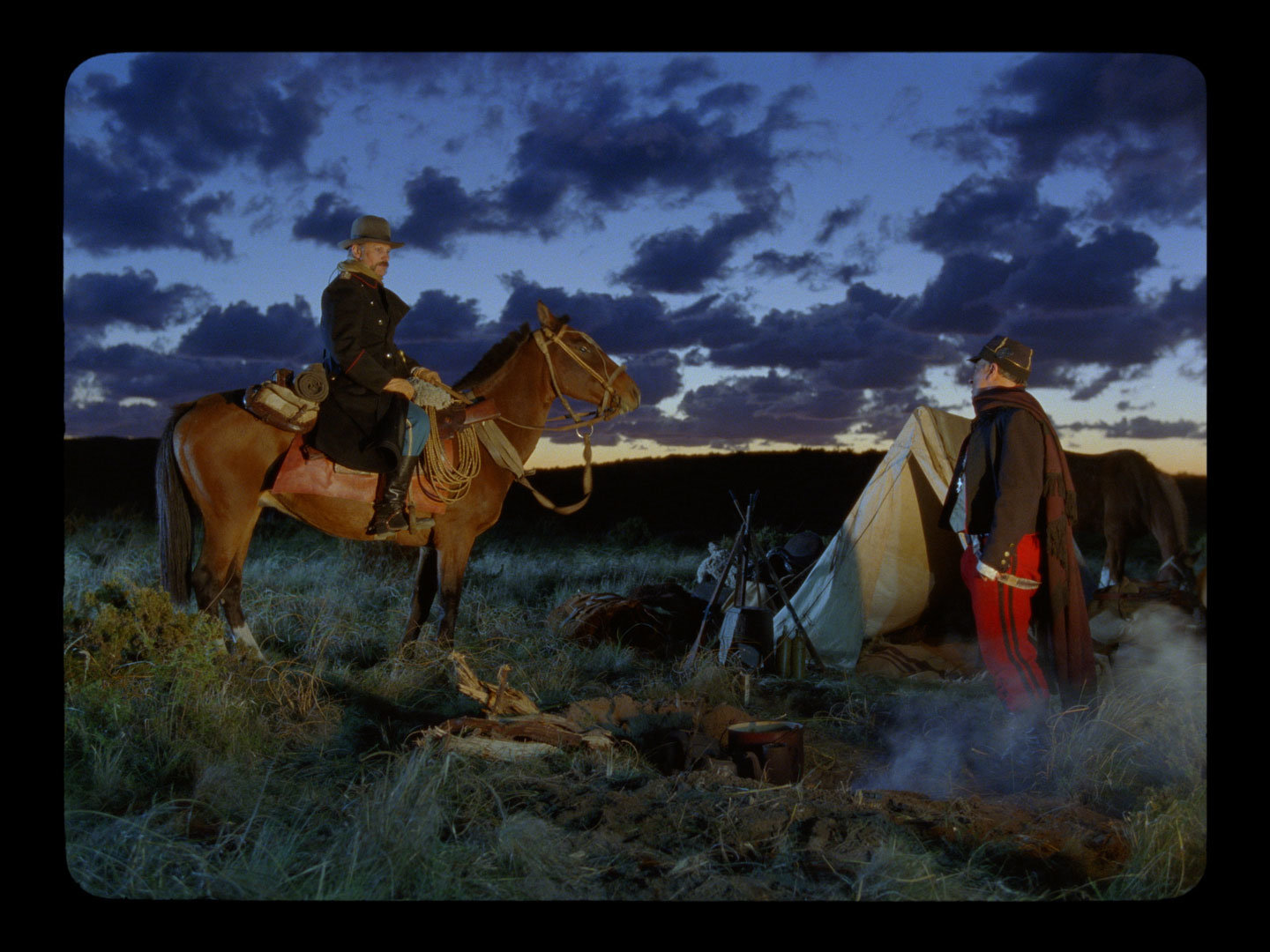
There is another gone girl in Lisandro Alonso’s Jauja (screening 10/7 and 10/9), when the daughter of a colonial Danish military engineer (Viggo Mortensen) scampers off into the Patagonian wilderness. In his three features La Libertad, Los Muertos and Liverpool, Alonso has chosen landscapes first and built narratives around the spaces and the habits of its people. Jauja is his first period piece, and an imaginative leap from the patient everydayness of his previous films. With nods to The Searchers and Heart of Darkness, Jauja follows the engineer as he plunges deeper into a country he doesn’t understand, ending in hallucinations and a legacy of confusion.

Hong Sang-soo has been paring his films down to the essentials. Never one for excess, in recent years his films have limited themselves to a few city streets, a few self-loathing men and women, and a narrative built on repetition. Hill of Freedom constricts itself to couple of blocks in Seoul, mainly taking place at a guest house and at a coffee shop. Mori (Ryo Kase) is a Japanese visitor staying at the guest house, and is searching for Kwon (Seo Young-hwa). Mori met Kwon two years before, but is only now convinced of his love for her. But unbeknownst to Mori, Kwon is off in the mountains for health reasons, so he is forced to mope around town, communicating in limited English with his deep-in-debt guest house buddy Sangwon (Kim Eui-sung) and the profoundly unhappy owner of the coffee shop (named “Hill of Freedom). The story is told in flashback, from letters that Mori wrote to Kwon after his departure from Seoul. As Kwan is leaving the post office, she drops the letters on the stairs, shuffling them out of chronological order. The film proceeds in the order Kwon reads the letters, so they jump back in forth in time during Mori’s stay. The ghost that haunts the film is the one letter Kwan leaves on the staircase – perhaps the one that reveals the truth of Mori’s intentions, but more realistically documents another night of inebriated rambles.

Mori carries a dogeared book with him throughout his visit, which he seems to treat as a sacred text, or maybe more as a binky to calm his nerves. In one of his many awkward, flirtatious conversations with the coffee shop owner Youngsun (Moon So-ri) he informs her that it is a philosophical treatise that claims “time is not a real thing.” But that “at the end, you cannot escape this frame of mind, because our brain evolved this way.” He  believes that time is an illusion, a construct of our consciousness, that perhaps in reality, outside of ourselves, events occur in the shuffled manner of the narrative. It is our brains that constantly seek to arrange them in order. Mori is a failure at this kind of arranging, and at this order. He is an unemployed loner wandering Seoul, his only hope a woman he last saw years ago and who might want nothing to do with him. And in some ways Mori seems to live in his own pocket of pre-Internet time. The settings are clearly contemporary, but no one uses a cell phone, Mori hand writes his letters, and there is nary a computer in sight.

Then there is the film’s blunt use of language. The movie is almost entirely in English, the common ground for Japanese-Korean relations in this film. But this limits their vocabulary, so each conversation is abrupt and direct. Every conversation seems to begin with the question, “Business or pleasure?” Mori hems and haws through each iteration, his visit having possibly to do with neither, ending up as more misery than pleasure. When his guest house manager tells him the banality, “I hope you will enjoy your stay”, Mori cannot respond in kind. Instead, he says, “It’s not always easy to enjoy, except when I am lucky.” The bemused manager replies, “You know, I was just saying that”, implying it was a rhetorical question. But Mori is incapable of deflecting or armoring his meanings with the subtleties of his native languages. He is forced into direct statement, as are his interlocutors. Sangwon insists that Mori admit to being sad. Mori considers people to be “great” or “poison”, with no shades of grey in between. This forced directness creates quick bonds between Mori and Sangwon, who get blitzed and dream of happiness, as well as between Mori and Youngsun, whose attraction seems to be borne out of mutual melancholy. It ends as it has to, in the middle, unresolved, our minds having to put all the broken pieces together.

Jauja is equally concerned with blowing minds as puzzling them. With its pulsing colors and immersive deep focus cinematography, it’s cinema-as-sensorium. There’s a vibrant interplay in Alonso’s frames (in the old 1.33:1 aspect ratio) between background and foreground, usually with Viggo Mortensen in the front, his visage staring out beyond the horizon. It is 1882 on the Patagonian coast, during the “Conquest of the Desert”, a bloody campaign to drive the indigenous peoples out of the jungle, to make the region safe for European settlers. Mortensen plays Dinesen, a Danish engineer who will plan the future European-style cities that will replace the wiped-out cultures.  He is there with his daughter Ingeborg (Viilbjork Agger Malling), who soon absconds into the jungle with a young soldier. As Dinesen follows her deeper into  the country,  rumors persist that an ex-soldier, Zuluaga, has gone mad and gone “native”, slaughtering the Europeans he comes across.  Fugitive signs of Ingeborg emerge and dissipate, but Dinesen trudges on into something like madness. He is like Ethan Edwards in his metastasizing hatred of the indigenous population, and the obsessive chase for his lost girl that is less an act of courage than of bloodlust. The deformity of the European colonial project seems to alter the landscape as well as his body, from watery shores crenellated with rock formations, to the dried out gray of the mountains. By the end Mortensen is a ragged wandering ghost, led by an undernourished dog to some kind of afterlife. The ending is a time-and-space shifting mystery that lays beyond my grasp, images of a fecund forest overgrowing the past, drawing me back in.

DEATH’S DESIGN: FINAL DESTINATION (2000)

September 16, 2014

large final destination blu-ray2

John Waters wishes he directed Final Destination. At the recently completed John Waters retrospective at the Film Society of Lincoln Center, there was a sidebar of films Waters was “Jealous I Didn’t Make”. One of them was Final Destination, the 2000 horror film about five teens who cheat death – for which Death itself wants bloody recompense. It spawned four sequels (the most recent was Final Destination 5, released in 2011), having created the ideal  machinery for the mid-budget franchise. The main character was non-corporeal, with Death’s presence represented as a light breeze or a trickle of water, so there was no worry of escalating salary demands. Then they could replace each iteration of the cast with unknowns, as Death plucked them off one by one in “accidents” of savage everydayness (a slip in the bathtub, a mug springing a leak). In his introduction to the screening (in blessed 35mm), Waters reminisced about his time in Baltimore grindhouses, bonding with the brood of rats that scrambled under his feet while marvelling at the depravity on-screen. He considered Final Destination worthy of that heritage, a resourceful exploitation film with shades of Ingmar Bergman. These are teenagers who are grappling with their morality for ninety-eight minutes, though on the genre level. So instead of playing chess with Death, they try to outsmart it as various pointy things hurtle towards their fleshy areas. Waters repeatedly stated that he was not being ironic, that the film is not camp, but a well-crafted fright film. I agree with the distinguished Mr. Waters.

large final destination blu-ray10

The original conception for Final Destination came from Jeffrey Reddick, a budding horror aficionado who sent New Line Cinema a treatment for a Nightmare on Elm Street prequel when he was fourteen years old. In 1997 he wrote a spec script for The X-Files where Scully’s brother has a premonition about his own death, and escapes it. The spec was never submitted to the show, but it got Reddick an agent, and encouragement to turn the idea into a feature. Reddick got the idea while flying home to Kentucky. He read an article about how a mother called her daughter the night before she was to fly home from vacation in Hawaii, warning her not to fly home the next day, that she has a “bad feeling about it.” The daughter postponed her flight, and the one she was originally booked on crashed. Glen Morgan and James Wong were long-time writers and producers on The X-Files, and took on Reddick’s story for their first theatrical project. Morgan would write and produce, and Wong would write and direct.

Their version of Reddick’s story concerned the survivors of a plane crash headed for Paris. A high-school class boarded the plane for their class trip, but Alex (Devon Sawa) began suffering terrible visions of an impending explosion, and demanded to be let off. Six others were hustled off the plane as well in the commotion. There was the Henry Miller-reading, iron-sculpture welding goth Clear Rivers (Ali Larter), Alex’s motor mouthed best friend Tod (Chad Donella), the roided up jock Carter (Kerr Smith), his perky blonde girlfriend Terry (Amanda Detmer), the slackjawed doofus Billy Hitchcock (the Seann William Scott) and one of the teacher advisors Valerie Lewton (Kristin Cloke). They are the lone survivors of the original passengers, but they start dying off in elaborate accidents. Alex begins to suspect that their survival undermined death’s design, and that Death is now trying to wrench things back in place, to restore the proper order. Which means they all have to die.

large final destination blu-ray0

As you can tell from the Hitchcock and Val Lewton name drops, Wong, Morgan and Reddick were eager to flaunt their horror knowledge. The two FBI Agents who are investigating the crash (and which seem transposed Mulder and Scullys from the spec script) are named Weine [sic] (Robert Wiene directed The Cabinet of Dr. Caligari) and Schreck (the actor who played Nosferatu). There’s also a “Murnau” and a “Dreyer” listed in the credits. It warms a film obsessive’s heart to see all these great artists name-checked in a mainstream movie, but spot-the-reference games only go so far. Luckily the movie is more concerned with logical mechanics of its scenario, and presenting each Rube Goldberg-esque death with blunt clarity. The plane crash itself, highlighted by John Waters as one of his favorites, is built up by an accumulation of ominous detail picked out through Alex’s POV. There is a spot of rust in the entrance doorway, and then he looks down to see a large gap between the ramp and the entry to the plane itself, a baggage truck seen cruising down below. All the connections are slightly off – even the seat tray lock snaps off in his hand. The coming inferno has strong practical effects work making the destruction look truly hellish, the passengers attacked not just by fire but the blunt force of their own suitcases. It’s the largest set-piece in the film, one that probably used up half of the budget.

large final destination blu-ray11

The other deaths are less grandiose. The whole series is built on the banal ways in which the human body can expire. Death is vaguely embodied as a liquid that slips up Tod, as he entangles himself in a threaded steel wire that holds up the shower head. There is a distant echo of the Lewton style here, of hiding the menace instead of showing. The line of blood trickling under the door frame in the Lewton-produced, Tourneur-directed The Leopard Man as an analogue in the slowly advancing liquid advancing on the tile floor. In both cases they indicate death – only in Final Destination the end is depicted in explicit mechanical detail instead of poetic abstraction.  In the Final Destination series the tension of the films arise in the how of the deaths, not in the why.  It rids itself of the lugubrious backstories and motivations of traditional slasher films, and cuts to the chase (or the evisceration, or what have you). The series works because of this pared down simplicity, which was almost ruined from the beginning. According to Reddick, New Line wanted to give Death human form at the end of Final Destination, to have that “big bad” to peg a marketing campaign around. But Morgan and Wong defended the concept, and lent the series its exploitation integrity.

RENOIR NOIR: NIGHT AT THE CROSSROADS (1932)

September 9, 2014

LA NUIT DU CARREFOUR (1932)

“Every detail, every second of each shot makes La Nuit du carrefour [Night of the Crossroads] the only great French thriller, or rather, the greatest French adventure film of all.” -Jean-Luc Godard, Cahiers du Cinema (December 1957)

Night of the Crossroads was the first film adaptation of Georges Simenon’s phenomenally popular Inspector Maigret novels, and was lent a thick, hallucinatory atmosphere by director Jean Renoir. Yet, sandwiched as it is between Renoir’s classics with Michel Simon, La Chienne (1931) and Boudu Saved from Drowning (1932), it has escaped much serious critical attention. It does not even get an entry in Andre Bazin’s collected writings on Renoir. Anthology Film Archives arranged a very rare screening of the feature this past weekend, with Simenon’s son John in attendance to discuss the production beforehand. It’s a traditional whodunit, except all of the motivations are missing. Instead of attributing the crime to a single perpetrator, the whole town becomes culpable through their xenophobia and greed. As Renoir’s character Octave says in The Rules of the Game, “everyone has their reasons”. To that Night of the Crossroads would add, “for murder.”

La-nuit-du-carrefour-1932

This narrative opacity was originally attributed to missing reels. Godard wrote that Jean Mitry “lost three reels after shooting was completed.” Renoir was asked to confirm the rumor, and said, “It’s possible, but even at the time, you know, it wasn’t very clear. I don’t think anyone of us understood anything. Least of all me.” As Renoir implies, the legend is not necessarily true. In Richard Brody’s article on the film for The New Yorker, he reports that the “fragmentary construction” was due to “his running out of money during production.” The project was all improvising – working around the financial limitations. Andre Brunelin wrote that the production was “a business of make do and mend. Decor had to be made out of anything at hand, it was all painting and knock-up.” This was no unauthorized fly-by-night operation, however. It had full support of Georges Simenon, who was friends with Renoir and collaborated on the screenplay.

B607

The story concerns a murder in a small town outside Paris. A local insurance agent (Jean Gehret) discovers his car has been swapped with another. When the locals search the neighborhood, they find his vehicle with a corpse behind the wheel. It is stowed inside the garage of a Danish brother and sister who are already despised in the community for their eccentricity and foreignness. Inspector Maigret is brought in and stirs up all of the local resentments, putting more lives at stake.

carrefour01

It was shot from January – March of 1932, three weeks at a crossroads near Bouffemont, outside of Paris, and the remaining time at the Europa Films studio in Billancourt. The location was choked with fog and rain –  perfect for the tale of secret identities and cloaked motivations. Before the screening, John Simenon confirmed that his father approved of the project, and especially of the casting of Pierre Renoir, Jean’s brother, as Maigret. He had the right height and bearing, if not the described muscularity of the book’s Inspector. With his prominent widow’s peak and hawk like face, Pierre Renoir strikes a strange figure, one of bookish, watchful intensity. His role is an observer that lets the villagers stumble into their confessions. His main move is to listen attentively, his interrogation method one of waiting out silences. The Danish man is Carl, a gangly Frankenstein’s monster type with an appropriately ghastly artificial eye, who happens to paint commercial art for a living. He keeps house for his sister Else (Winna Winifried), a hothouse flower quick with come-ons. One of the more perverse shots has a her flirting with her pet tortoise in an overhead shot. Their house is a dusty catacomb of ash, useless tchotchkes, and secret hiding places. One of them slides open when Else leans in to to kiss a nonplussed Maigret. Her shoulder pushes a painting across the wall, revealing a bottle of Veronal and a gun.

nuit-du-carrefour-1932-cine-sonoro

The street is hidden in fog, drugs are secreted behind paintings, and whole backstories are missing because of the budget shortage. But this expository lack fits the whole theme of the film – one which renders the last act revelations truly surprising, since we don’t know who half the characters are. Renoir uses this chaotic situation to experiment with a variety of techniques. There are deep focus shots with characters posed in background doorways in windows, winding tracking shots executed by mounting cameras onto cars, and a grand experiments in sound, in which audio acts as a kind of metronome. In his interrogations, Maigret knows the time is up when his empty glass is filled up by his dripping office faucet. To compress the time of the original investigation, Renoir cuts back and forth from Maigret running down leads to shots of commuters feet shuffling in front of a newspaper vendor. Their yelling out of “Morning edition!”, “Afternoon edition!” and “Evening news!” keeps the timing down. The abstracted shot of legs is then rhymed later with the hidden assailant, seen as a pair of feet stomping through mud puddles, and as an arm placing a poisoned beer onto a table. Some of these spy game machinations recall Feuillade, which Renoir was undoubtedly familiar with, though on a much simpler scale.

nuit-du-carrefour-1932-02-g


Renoir also had the advantage of more mobile cameras, and he used them to the fullest extent. There is a camera-mounted car chase sequence of unbelievable beauty. All is shrouded in darkness as two Model-Ts chase each other around the turns, the brightest illumination provided by the exploding muzzles of gunfire. It is thrilling to be plunged into darkness, and felt like I was riding Space Mountain at Disney World for the first time. Except this thrill is not a celebration of modernity, but a resigned condemnation of it. All of the town is implicated in the murder. The bourgeois insurance company family , the artistically inclined Danes and the group of working class mechanics all pursued their self-interest into criminality.Maigret offers some hope – telling Else, “in two years [of jail time] you will be truly free.” Though what she will do with that freedom is seriously in doubt. All Maigret can do is grin and bear it, and wait for the next case.

IN A FRAME: OUT OF THE PAST (1947)

September 2, 2014

Annex - Mitchum, Robert (Out of the Past)_01

Jeff Markham knew Kathie would not arrive, but he sat there and drank anyway. He was resigned to his premonitions, seemingly able to tell the future but powerless to stop it. “I think I’m in a frame…I don’t know. All I can see is the frame. I’m going in there now to look at the picture.” The picture remains obscure to Jeff throughout Out of the Past, though the film image itself is luminous in the new Blu-ray from the Warner Archive. Jeff, played by Robert Mitchum as a slow-motion somnambulist, can see the outline of his fate, but not the details. Director Jacques Tourneur and cinematographer Nicholas Musuraca previously collaborated on Cat People, and continue their use of low-key lighting to produce dream-like suggestions of violence. All of the deaths in Out of the Past are hidden off-screen, the specifics elided. They simply accrue in the fog of Jeff’s rueful investigation, a case that turns into a series of delaying tactics to stay alive. But he can only pause to smoke so many times before the darkness finally deigns to meet him.

OUT OF THE PAST / BUILD MY GALLOWS HIGH

Out of the Past was based on a crime novel by Daniel Mainwaring (under the pseudonym Geoffrey Homes) entitled Build My Gallows High. In 1945 RKO outbid Warner Bros. for the rights to the then unpublished book for a reported $20,000. A George Gallup poll revealed the American public’s distaste for the fatalistic title Build My Gallows High, so it was changed to Out of the Past during the pre-production. The novel was Mainwaring’s last – he had already transitioned to the higher pay of motion picture writing. So he was tasked with writing a first draft of the script – which later went through the hands of crime novelist James M. Cain (Double Indemnity)and Frank Fenton, an old RKO hand who had recently worked on the George Raft noir Nocturne, as well as multiple entries in the “Falcon” mystery series. “Homes” received sole credit upon the film’s release, though in his Film Comment article “The Past Rewritten”, Jeff Schwager read through all of the script variations and credits most of the film’s famously allusive dialogue to Fenton. Tourneur undoubtedly took a pass at it himself. As quoted in Chris Fujiwara’s The Cinema of Nightfall, interviewer Jean-Claude Biette claimed that Tourneur had “refused several times to shoot this crime film, whose script he didn’t like, until all the changes he wanted had been accepted.”

Poster - Out of the Past (1947)_04

The story circles around private detective Jeff Markham (Mitchum), who is hired by gang boss Whit Sterling (Kirk Douglas) to track down the dame who shot him and made off with forty grand. He finds the culprit Kathie (Jane Greer), falls in love with her, and the couple drops out of sight. Their relationship disintegrates from a life on the lam, they split, and Markham goes straight, rebranding himself “Jeff Bailey” and opening a gas station. As the title indicates, Bailey is soon haunted by “Markham”, and pulled back into the poisonous web of Whit and Kathie.

Annex - Mitchum, Robert (Out of the Past)_03

The shape of the project kept shifting. RKO attempted to convince Warners to loan out Bogart, but they claimed he was booked for the next year. Then the director-actor team of Edward Dmytryk and Dick Powell was announced, as they had collaborated on Murder, My Sweet (1944) a few years before. They ultimately settled on their young leading man Robert Mitchum, whose last starring part for RKO was West of the Pecos (1945), and the reliable Tourneur, whom RKO had worked profitably with on the Val Lewton-produced horror movies like Cat People. Each casting decision would change the texture and tenor of the film. As artists both Tourneur and Mitchum were crepuscular creatures, attracted to the dreaming hours (though there are key sun-drenched sequences in Out of the Past). Mitchum, with his hooded eyes and one-beat-too-late delivery, gave off an air of laziness, though he was remarkably present as an actor. Tourneur valued this, saying that Mitchum (and Dana Andrews) “knows how to listen in a scene. There are a large number of players who don’t know how to listen. Mitchum can be silent and listen to a five minute speech. You’ll never lose sight of him and you’ll understand that he takes in what is said to him, even if he doesn’t do anything. That’s how one judges good actors.”

Annex - Mitchum, Robert (Out of the Past)_04

Watching Out of the Past for the first time in years, I started to focus on entrances and exits, and the transitional way Tourneur and Musuruca light them. The most famous example is when Kathie is first introduced, walking into a Mexican cantina. There is a blazing white light outside the door, rendering her almost invisible. Her white dress and sun hat blend into this brightness, so when she walks into the shade of the alcove her silhouette seems to emerge out of nothingness. She is a phantom, or a figment of Jeff’s heat-addled mind. She is a transformative figure throughout the film, given more shadings of character than the usual Madonna-Whore of film noir. She is as secretive and withholding as Jeff, but both find an excuse to playact a love affair in Acapulco. Once back in the states, they can no longer hide their true natures. Kathie has a finely tuned survival instinct that trumps any of her repressed emotions. While Jeff’s seemingly embraces his own doom. Right after he says “I’m in a frame”, he walks right into the setup, hoping to outsmart the trap. But a man with a set of survival skills like Kathie’s would leave the scene, and change into yet another name. Jeff almost seems to savor his entrapment, or has long since been resigned to it. Mitchum responds to each revelation with equanimity, as if he expected it for years. Bodies drop all around him and he is left unperturbed. He is waiting for his own, and he will embrace it when the opportunity arises, fulfilling his anti-hero’s journey.

UNFOLLOWING THE GOLDEN RULE: GOOD SAM (1948)

August 26, 2014

Annex - Cooper, Gary (Good Sam)_NRFPT_02

“I’ve tried to break him of it…but he just loves people!”  -Lucille (Ann Sheridan) complaining about her husband Sam (Gary Cooper) in Good Sam

In 1948 Leo McCarey was coming off the biggest hits of his career, as Bing Crosby’s singing priest in Going My Way (1944) and The Bells of St. Mary’s (1945) topped the box office. Both films were amiable attempts at humanizing Catholicism, moving from the inaccessible Latin mass to the lucid curative powers of pop crooning. They also feature McCarey’s talent for improvisation – Bells features a Nativity scene enacted by children who replace “O Holy Night” with “Happy Birthday”. For Good Sam, McCarey again returned to a religious theme, placing a man of saintly selflessness in the bourgeois suburbs. Sam’s insistence on giving away his time and money to those around him frustrates his wife Lucille, who has to deal with the human consequences of his do-goodism. That is, she has to care for all the strays he brings home as their nest egg slowly dissipates. Lucille is the cynical realist to Sam’s idealist Christian (they’re Episcopalian), but their love allows them to bridge the philosophical gap. It is, for the most part, a bitterly funny film. It posits the impossibility of saintliness in a materialist society, and McCarey mourns this loss through comedy rather than tragedy. Decades later, after the film had disappeared from view, McCarey stated, “the moment was ill chosen to make a film about apostleship.” This fascinating, frequently hilarious apostle-out-of-time feature  is now available on Blu-ray from Olive Films.

Capture

McCarey went independent after directing Going My Way for Paramount.  He formed Rainbow Productions to make The Bells of Mary’s, which was distributed by RKO. He had valuable experience with an independent artist early on. His first job in Hollywood was as an assistant to Tod Browning. McCarey recalled, “From film to film, I had the opportunity to propose ideas because the scenarios we were shooting were all original. It was a unique apprenticeship working with a man who wrote, directed, and edited his films himself.” The Bells of St. Mary’s grossed even more money than Going My Way, and sits at number fifty-one on the all time list (adjusted for inflation), one spot above The Lord of the Rings: Return of the King. McCarey secured the same beneficial arrangement for Good Sam – a Rainbow Production released through RKO.

Good Sam originated with McCarey’s wife Stella. “I was working with Sinclair Lewis on another story and that’s when my wife told me, ‘Why don’t you make a picture about yourself? You’re always doing the most unbelievable things trying to help others.’” McCarey shared the story credit with John Klorer, with the script attributed to Ken Englund, who co-wrote Danny Kaye’s Secret Life of Walter Mitty the year before, another comic tale of a guy too kind to fit into corporate society.

Gary Cooper was going to play Sam Clayton from the start, and he is superb as the reticent nice guy (similar to his Professor in Ball of Fire). On their off days on the Good Sam shoot, Cooper and McCarey were friendly witnesses for HUAC (you can find their testimony here). Good Sam is their comic depiction of the value of religion to American life, of how it looked to them without people living by the Golden Rule. In such a world, saintliness becomes a joke. In his testimony, McCarey joked about why Going My Way and The Bells of St. Mary’s weren’t hits in Russia:

McCarey: Well, I think I have a character in there that they do not like.

Mr. Stripling: Bing Crosby?

McCarey: No; God.

McCarey originally had Jean Arthur in mind for the part of Lucille, though she was unable to take the part. He had run into Ann Sheridan at the Kentucky Derby, who was eager to shed the label of “The Oomph Girl”. She had more than oomph to offer. Sheridan recalled their encounter in Modern Screen: “McCarey’s one of my idols; when I was a stock girl at Paramount he was a big shot there, and I’d always yearned to work with him. I have this mental picture of McCarey in Kentucky. He was standing up and lifting a julep glass when I came into his line of vision. ‘Annie’, he hollered, ‘how are you?’ ‘Fine’, I hollered back. ‘Let’s do a movie together’, he said. I said, “You’re on”, and kept walking”

Annex - Cooper, Gary (Good Sam)_NRFPT_08

McCarey recounts the same meeting in a different issue of Modern Screen, in an article entitled, “My Love Affair with Ann Sheridan”. He was “struck for the nine-hundredth time with what a smick-smack, forthright, clear-eyed, redheaded, realistic gal this Annie Sheridan is.” McCarey claims that after she read the script she said she’d do it for nothing. Warner Brothers loaned her to Rainbow Productions after she agreed to add an extra picture to her WB deal. Though these articles were likely massaged by RKO PR, Sheridan’s excitement at playing a woman without “oomph” palpates off the screen. She is spectacular as Lucille: acidic, absurdist and reluctantly loving. McCarey came up through the slapsticks honing reaction shots, from Charley Chase and Max Davidson to Laurel and Hardy, mastering the art of looking askance at the world crumbling around you. Ann Sheridan has a barrage of exasperated looks to deal with Sam’s gullibility/generosity.

Annex - Cooper, Gary (Good Sam)_NRFPT_07

Early on Sam invites a mechanic over for breakfast – and ends up paying for his neighbor’s repairs. Sheridan is a marvel of amusement and disdain. Upon the mechanic’s entrance she stares at Cooper mischievously, lowering her head and rolling her eyes up, backed by a disbelieving smirk – entertained by the absurdity of her cluttered life. Then the mechanic hands her dirty plates to clear, and the humor turns to contempt. Her eyebrows shoot down and her jaw drops in disbelief. Then a quick recovery into thick, dripping sarcasm. She asks for “the Crunchies too please” in a fake-civilized tone with a plasticine smile. Her hands full of plates, she raises her left arm so the cereal box can be shoved in her armpit – a perfect picture of overburdened domesticity. Staring needles at him, she says “Thank you” in a sing-song voice, and absconds with the dishes. This all happens in fifteen seconds, packing hilarity into every frame.

Her tour-de-force occurs about forty-five minutes in, when the deluge of needy humanity finally breaks her down. But not into tears – she expresses her defeat in an explosive laughter jag. Sheridan consistently shows how Lucille knows how to distance herself – to treat her life as a performance. The inciting incident is the capper to a day of good deeds with bad results. Sam had let his neighbors borrow his car over the weekend. It turns out they got into an accident, and the victim is suing. As Sam is the owner of the car, he will be the subject of the suit. When Sam comes home from work, he is ready to apologize to Lucille for all the hassles he brings home to her, oblivious to the fact that the neighbors are sitting in the living room. Sam’s apology, and his rare criticisms of others, send Lucille into convulsions. “No more Nelsons ruining our dinner, no more Butlers ruining our car”, he says, as Sheridan subtly shakes her head “no”, ramping up the joke she is about to play on him. When he calls Butler a “Four-eyed four-flusher”, she begins to break, the right side of her mouth curling up into a smile, soon followed by the left. She muffles a laugh through her nose. Soon she cracks and then, the torrent. Sam can’t understand why his sweet talk is making her laugh, so he asks, “Does my love border on the ridiculous?” Through choked chuckles she says, “Yes, in a way, yes.” It’s an uproarious scene that emerges out of everyday frustrations.

PWC18

Sam’s generosity keeps backfiring, and eventually he’s squandered the entire nest egg, making it impossible for them to buy Lucille’s dream home. It is Sam’s turn to snap, and he hits the bottle. An alkie wanders into a bar, looking for a drink. The bartender wants to throw him out, but Sam still believes that “all he needs is a helping hand”. The drunk responds, “I can’t remember when I heard a more stupid remark. You’re not really helping me, all you’re doing is boosting your own ego. …You can afford to be condescending.” The idea that altruism is equivalent to self-love sends him into a spiral. He switches clothes with the bum, and seems ready for obliterate himself. A Salvation Army marching band agrees to take him home – the first kind act he’s received all day. This would be a bittersweet, complicated ending, a man of shaken faith receiving a salve.

However, McCarey and RKO opted for a miraculously happy closer that erases the satiric depiction of self-serving materialist United States of the previous two hours. It clumsily channels the communal spirit of the It’s a Wonderful Life finale, but McCarey was always better with couples than communities. As Robin Wood pointed out, he rarely even has time for families (Sam and Lucille have kids, although you’d barely know it). This particular miracle rings false, making Good Sam one of the only times McCarey places his faith in God above that of his characters. In his greatest work, they are intertwined, as in the transcendent, sanctified union of Love Affair, or the unspoken affection of a priest and a nun in The Bells of St. Mary’s.

The January 17, 1948 Showman’s Trade Newsreel reported that McCarey “decided upon an entirely new ending”, and that “preview audiences will be given their choice of two finishes”. What is not known is the content of the alternate ending, or what process led to McCarey re-shooting those pivotal sequences. There is some archival work to be done here, or perhaps a lucky discovery in some old subbasement.

BRAINQUAKE: THE LOST NOVEL BY SAMUEL FULLER

August 19, 2014

116-Brainquake-cover

“Sixty seconds before the baby shot its father, leaves fell lazily in Central Park.” -the first line of Sam Fuller’s Brainquake

Sam Fuller was not one for the slow burn. He preferred instant incineration. He learned his potent pulp technique in the NYC tabloids as a crime reporter, where an attention grabbing lede was all that mattered. The same skill is applied to his movie potboilers, as in The Naked Kiss‘ gonzo opener, where a bald prostitute assaults a john with her purse. His penchant for arresting opening scenes also appears in his novels – one of which is appearing in English for the first time this year. Fuller wrote Brainquake in the early 1990s, but it was only published in French and Japanese, rejected by U.S. editors for being too “European”. Intrepid pulp purveyors Hard Case Crime have corrected this injustice by releasing Brainquake last week in its English debut, complete with a gloriously seamy cover painting by Glen Orbik. The book is a densely plotted crime fiction farrago, deeply informed by Fuller’s experience as an exile. Ever since his inflammatory anti-racist White Dog was banned from U.S. cinemas, Fuller could only find work in Europe, and so he moved there with his wife Christa. The center of Brainquake is a monosyllabic bagman for the NYC mob who ends up on the lam in Paris. The bagman also happens to suffer from hallucination-inducing migraines that lend the book its title. Stacked with memorable characters, from a serial killer in priest’s garb to a melancholy French resistance fighter, the book is an overheated, overstuffed and never less than entertaining slab of Fuller’s expansive pulp imagination.

SamuelFuller-CrimeReporter-TomSutpe

In 1990 Fuller was working on the British-French co-production Chiller, a TV anthology adapted from the short stories of Patricia Highsmith. For his episode Fuller chose The Day of Reckoning, a violent eco-parable about industrial chicken farming that ends with the patriarch getting pecked to death. Fuller had twelve days to shoot it, and didn’t have time to thoroughly vet each location. For the climactic pecking, they chose a small farm with hundreds of chickens. What they weren’t aware of was how they animals would react to being exposed to sunlight – and that the owner of the farm was more than willing to let them die, since they were headed for the slaughter. And so, Fuller recalls, “Blinded and terrified, the maniacal chickens scurried around until they finally dropped dead on the ground right in front of our crew.” But Fuller could always look on the bright side:  “The good thing about all those insane chickens was that they got my creative juices really stirred up.”

It was at this point, with images of horrific chicken deaths dancing through his head, that he completed Brainquake at a place outside Avignon, with his manuscript and “a couple boxes of cigars”. The story circles around Paul, a former mute who learned to speak in gravelly croaks, and who is a reliable bagman for the mob. He is perfect for the job – anonymous, quiet and reliable. Except for those hallucination-inducing migraines, which Paul dubs “brainquakes”, and are preceded by the sound of a flute and flickering color. He is life is upended when he becomes infatuated with mob wife Michelle. Her husband, a low level bookie, is the one who is gunned down by his baby, thanks to a booby-trapped stroller. Paul is overcome by a desire to protect her, and instead becomes a pawn in Michelle’s long con.

tumblr_inline_mn2tot99ec1qz4rgp

This is a massive condensation of the book, which introduces fascinating, seemingly central characters, only to gruesomely kill them off a few pages later. Also emerging as pivotal are the inflexible black  detective Zara, the star of the force who becomes enveloped in the case. Then there is the bureaucratic machine of the mob, made human in the figure of “The Boss”, the mother-figure whom Paul reports to, and Hampshire, the big boss who calls the shots from afar. In Brainquake the whole world is controlled by the rackets, with little hope for those who toil under its thumb. Fuller uses imagery of fleshy decay. Here he describes a corpse:

The tunnel between Al’s lower teeth at closest focus was a cutaneous crypt. His tongue drooped down a corner of his mouth through red lava. Fingernail scratches were red trenches in a Sahara wadi. The ceiling bulb reflecting in his frozen eyes was elliptical Daliism. Taken by the police photographer for his personal collection, the photos would eventually win acclaim when he published them in an art book selling for fifty dollars a copy.

His style consists of these quick jabs of imagery, staccato sentences that sketch out scenes of vivid immediacy. These are the strongest passages of the book, and convey the same giddy collision of high and low art as his punchy kino fist movies. The book bogs down in interior monologues, set off by italics. He reserves these to describe Paul’s brainquakes, but they are repetitive and brake the narrative velocity to a screeching halt. There is also a French resistance fighter who narrates his own nightmares, a beloved hero who is carrying an unrelievable guilt for an act of cowardice during the Occupation. There are no heroes in Fuller’s world, only survivors.

SHALL WE DANCE: STEP UP ALL IN

August 12, 2014

“I wanted to show great dancing and inventive choreography without too much cutting, without chopping it up too much. Good dancing should speak for itself. Watch old Fred Astaire or Gene Kelly movies – a loose head-to-toe shot and very few edits. It’s so restrained and elegant!” -Trish Sie, director of Step Up All In

The durable Step Up franchise released its fifth entry over the weekend, a giddy 3D extravaganza subtitled All In. In these Rob Marshall-marred times, the series is the closest thing we have to the spectacular musicals of the classical era. That is, they hire people who know how to dance…and let them dance. No celebrities here, just kids who can move. Producer Adam Shankman said, “What’s nice about these movies is, they don’t need stars. They just need people who can do everything.”  This keeps costs down and has the added benefit of promoting young talent. Channing Tatum started off his career in the first Step Up, and Summit Entertainment is now placing their bets on Ryan Guzman, a Mexican-American actor who comes from a modeling and MMA background. Guzman adapted his cage fighting agility to the dance floor, and while he may never develop Tatum’s natural charisma, he has effortlessly meshed with the pro hoofers on the set. And the directors have respected their movements. All In was directed by Trish Sie, a dancer and choreographer who has worked for Pilobolus and those OK GO music videos (the lead singer’s her brother). She takes a distanced approach, allowing the performances to take place almost entirely in long master shots, privileging the dancers and the choreography of Dondraco Johnson, Christopher Scott, and Jamal Sims. Sie shows great faith in her dancers and collaborators, as well as the intelligence of her audience. The result is a joyous mix of old-school craft and angular modern dance styles.

The story is packed with as much incident as a ’30s backstage musical. Guzman returns from the previous Step Up Revolution with his dance crew The Mob. They are struggling to make a living in Los Angeles,  rejected in auditions in increasingly humiliating and racially charged ways (it’s the most diverse cast this side of the Fast and Furious franchise). On their last attempt they are done up in stereotyped Mexican outfits, in sombreros and mariachi garb. The crew wants to give up and move back to Miami, while Guzman is obsessed with “making it” in Hollywood. He sees a way in the VH1 reality show “The Vortex”, a hipper So You Think You Can Dance? hosted by Lady Gaga clone Alexxa Brava (a very funny Izabella Miko). With The Mob departed, he sets out to build a new crew with Step Up series standby Moose (Adam Sevani). This provides an opportunity to gather a bunch of actors from previous iterations, including co-lead Briana Evigan, who returns to the dance floor after her turn in Step Up 2 the Streets (2008). Everyone has a loaded backstory. Evigan is insecure about her bum knee, Guzman alienates his best friend because of his hyper-competitiveness, while they are both dealing with traumatic break-ups. There’s also inadvertent adultery, reality show rigging, and a wordless love story between two dancers who specialize in the robot. The supporting cast is thick with exuberant performances, especially that of “World Class B Boy” Kid David, who plays dance instructor Chad as a hilariously foul mix of Warren William and Pepe le Pew.

Step Up Revolution had stunningly elaborate set pieces, though it was a slog to get through the exposition in between them. With All In, Trish Sie has scaled everything down to human size, developing natural transitions between plot and performance, and imbuing the characters with an inner life. While Revolution is Busby Berkeley razzle dazzle, All In opts for the naturalism of Astaire and Kelly. One of the more irresistible numbers emerges out of a rehearsal in the dance studio of Moose’s parents. Guzman’s crew is preparing to shoot an audition video for The Vortex, while Chad leads a children’s class at the other half of the room. The routine emerges organically, as Chad joins Guzman’s team, followed by the kids joining in, creating the illusion of spontaneity. The whole film exudes this loose charm, as Sie focuses more on the dancers than the dance: ”  I wanted to lighten things up. I wanted to make a movie about young people and their daily lives – the drive to dance, the realities of how tough that world can be”.

It is a film of touching sincerity about making ends meet as a member of the creative working class. The thematic arc of the film traces how Guzman learns to accept his failure to become a star, and simply enjoys his art for art’s sake. The inspirational speech before the climactic dance battle is about lowering your economic expectations if you want to pursue a career in the arts. I found it all to be very moving, but it would be all for naught if the dance sequences didn’t deliver. But they do, and in a variety of moods and tones. I was most taken with the pas de deux between Guzman and Evigan at a Las Vegas amusement park, a flirtatious push and pull that twirls around a tea cup ride set to Bobby Brown’s “Every Little Step”. In its teasing lightness it reminded me of the sublime Fred Astaire-Cyd Charisse “Dancing in the Dark” duet from The Band Wagon. That’s not to say it’s all restrained elegance. There is a whole Frankenstein’s monster routine with electrical bursts, while the finale is a dystopic steampunk routine with twirling fireballs. Sie mostly shoots the latter in a wide low angle, capturing the ecstatic waves of undulating bodies. Shot natively in 3D, the added depth gives background dancers as much of the frame as the leads. It’s an egalitarian musical, and a great one.