FARBER ON FILM: THE COMPLETE FILM WRITINGS OF MANNY FARBER

Originally published at Movie Morlocks, the official blog of Turner Classic Movies

October 6, 2009

The Library of America has released a wriggling mass of Manny Farber’s prose, and now the world is a (slightly) better place. Farber On Film: The Complete Film Writings of  Manny Farber (edited by Robert Polito) is a maddening, insightful and frankly thrilling collection of his writing on movies (and a little on TV) from 1942 – 1977. It includes the work that made up his previous compilation, Negative Space, plus a massive trove of reviews from the The New Republic, The Nation, and lad mags like Cavalier (he requested that his capsules for Time be left out, feeling that the editors rendered them unrecognizable).

In his valuable introduction, Polito says “his writing can appear to be composed exclusively of digressions from an absent center.” To borrow his own term, Farber approaches his subjects termite-like, gnawing at the edges of the films, ignoring plot summary and character psychology to focus on movement and composition, informed by his long career as a painter. He does not treat a film as a monolith, a hunk to be labeled as good or bad and then forgotten. He engages with every aspect of a film, emphasizing its collaborative nature. He breaks down performances, compositions, and dialogue with equal vigor with his jagged, jumpy and allusive prose. It’s often impossible to tell whether he likes a film or not, as he builds up and tears down a production from every angle.

Reading his reviews is like witnessing an archaeological dig, nosing around his celluloid sites for objects of interest, or for banalities worth exposing. And when he digs in to something, his descriptions pop off the page. In a 1943 New Republic piece, he analyzes the Bogart species:

“[he] looks as though he had been knocked around daily and had spent his week-ends drinking himself unconscious in the back rooms of saloons. His favorite grimace is a hateful pulling back of the lips from his clenched teeth, and when his lips are together he seems to be holding back a mouthful of blood.”

Or this Artforum piece on Howard Hawks from 1969 (one of my favorites):

His Girl Friday is one of the fastest of all movies, from line to line and gag to gag. Besides the dynamic, highly assertive pace, this Front Page remake with Rosalind Russell playing Pat O’Brien’s role is a tour de force of choreographed action: bravado posturings with body, lucid Cubistic composing with natty lapels and hat brims, as well as a very stylized discourse of short replies based on the idea of topping, out maneuvering the other person with wit, cynicism, and verbal bravado.

This isn’t just pungent writing, although it’s certainly that (it’s impossible to see a Bogart film now without peeking for a trickle of red down his lip), but it also prescribes a way of seeing. This emphasis on a performative detail, his “pulling back of the lips”, reveals a sensibility that is specifically cinematic. He’s concerned about movement that reveals character, facial tics or otherwise, as well as its relationship to the frame it’s traipsing about in. He offers due respect to a well-turned phrase, but he rarely pays much notice to plot, which is often described as a cliched nuisance. He praises Hitchcock’s Shadow of a Doubt because it “is an example of what the movies might do in breaking with the idea that the story is more important than the movie.”

He’s concerned with what is buzzing beneath the strained scenario, the people who imprint their signatures on a film regardless of pedigree. Cary Grant’s grace and Jean Arthur’s Arthurness (“she is both an ordinary girl with ordinary reactions and a scatterbrain who wears birds’ nests on her head and at normal times is out of breath from running or screaming or hitting someone on the chin”) transcend their roles. They are still just people in front of the camera. In this vein, Farber also has a fascinating series of articles on WWII documentaries, and in which he prophetically states, “the difference between the documentary and the story film in the final esthetic evaluation is unimportant”. International auteurs like Abbas Kiarostami and Jia Zhangke have been pursuing this line of thought for the last decade with astonishing results.

Then there are his hugely entertaining reflections on movie-going itself. There is his famous statement in “Underground Films” (1957) that:

The hard-bitten action film finds its natural home in caves: the murky, congested theaters, looking like glorified tattoo parlors on the outside and located near bus terminals in big cities. These theaters roll action films in what, at first, seems like a nightmarish atmosphere of shabby transience, prints that seem overgrown with jungle moss, sound tracks infected with hiccups. The spectator watches two or three action films go by and leaves feeling as though he were a pirate discharged from a giant sponge.

But he was a brave sociologist since 1943, when he complained: “Who builds movie theaters? If you seek the men’s room you vanish practically away from this world, always in a downward direction.” His roving eye was always searching for the errant telling detail, even when it was off the screen and down the stairs.

In a fascinating panel discussion upon the release of the book last week, Polito was joined by Greil Marcus, Kent Jones, and Geoffrey O’ Brien to discuss Farber’s life and work, which informed a lot of this piece. There are a few other stray items from their talk I wanted to bring out. First,  that Farber’s interests were circumscribed by the distribution patterns of the ’40s and ’50s. He discussed mostly Hollywood product because that’s all he could see at the time. Once foreign and experimental film became more readily available in the U.S., Farber expanded his taste likewise, becoming an articulate interpreter of Michael Snow, Chantal Akerman, Rainer Werner Fassbinder, and Jean-Luc Godard, among others. Kent Jones also discussed Farber’s teaching notes, which he was able to look at for a book he’s helping to publish with Farber’s wife and collaborator Patricia Patterson. Farber lectured on cinema at UCSD until the late 80s, after retiring from film criticism to focus on his painting. Jones divulged little as to their contents, only that they were “amazing” and further represented the constant re-evaluations Farber engaged in with the works he was intrigued by.

I’ll close by paraphrasing Kent Jones again: The publication of Farber on Film is not just a landmark for American film criticism, but for American literature as a whole.

For further info on Farber and the book, well, buy the book, but also read Jonathan Rosenbaum’s article at the Moving Image Source, and Paul Schrader’s remembrances at the same site. For insight into his painting, the exhibition book About Face is a great introduction.

DIGGING INTO THE WARNER ARCHIVE: EXPERIMENT PERILOUS and THE TALL TARGET

September 29, 2009

experiment perilous

The Warner Archive is murdering my bank account. The latest culprits are Jacques Tourneur’s Experiment Perilous (1944) and Anthony Mann’s The Tall Target (1951). After my first purchase, documented here, I’ve tried to stay away from the service, what with its un-restored prints and overpriced DVDs ($20 is a lot for a burned disc), but they are pumping out an endless array of rare goodies that would tempt even the cheapest cinephile. I couldn’t stay away for long.

I was drawn to Experiment Perilous because of the praise of Chris Fujiwara, who in his definitive study of the director, The Cinema of Nightfall, described it as “one of Tourneur’s most personal and beautiful films.” It’s also one of his most unknown, at least from my perspective, having not heard of it until it popped up on WB’s release schedule. It’s most famous, perhaps, for containing a mesmerizing performance from Hedy Lamarr, her own favorite, as she relays in her decadently titled autobiography, Ecstasy and Me.The print used on the DVD contains adequate sharpness, but has suffered a decent amount of wear and tear over the years. There is a consistent amount of scratches and dust marks, but nothing terribly distracting. It’s watchable, if nowhere near pristine.

In 1944, Tourneur was coming off the lower budgeted success of his Val Lewton horror films, having churned out the remarkable duo I Walked with a Zombie and The Leopard Man the year before. Handed an A-picture budget from RKO, he delivered Experiment Perilous, a Victorian age psychological thriller often compared to Gaslight, which was released the same year. It’s an adaptation of the novel by Margaret Carpenter, which screenwriter Warren Duff altered by moving the setting from the present day to the turn of the century. It was rumored that Hedy Lamarr’s request to wear period costumes necessitated the change, but Fujiwara reports that it was more of  narrative decision:

Executive producer Robert Fellows offered a more reasonable explanation: ‘It was felt that the slightly archaic quality of the heroine, who appears in the book as a cloistered and frustrated orchid, would lend itself to a clearer expression on the screen if presented against a less realistic background.’

Hedy Lamarr’s Allida is not just a “cloistered and frustrated orchid”, but is quite possibly mad. Or at least her older husband Nick Bedereaux (Paul Lukas) seems to think so. He employs Doctor Bailey (George Brent) to look into her curious peccadilloes, which include sending herself daisies and then denying doing so, and hallucinating that she is being followed.

Tourneur opens the film with a train ride, in which Bailey is introduced to Nick’s bird-like spinster sister Cissie. In a voice-over, he opines that Cissie herself might be insane, as she clucks at him about her home and family like he was an old friend. Tourneur frames him against a mud-spattered window, and then captures their mottled shadows on his suit jacket (see right). This minor contact with the Bedereaux family has soiled him, and this mark dooms him to further entanglement in their sordid story.

Once home, he joins a fashionable dinner party, admiring a snake-haired female statue his pal Clagg unveiled. Tourneur emphasizes Bailey’s connection to this image of the Medusa, joining him first in medium-shot, then pushing into a close-up. Clagg’s attempt to demonize womanhood through his art speaks to Nick’s impotent attempt to harness Allida’s sexuality, and Bailey’s low-key Perseus is here to slay that demonization.


Tourneur lavishes most of his attention on the Bedereaux home, in the stunning set design of Albert S. D’Agostino and Jack Okey. This vision is of an accumulation of knickknacks and rooms within rooms, a gilded prison to keep Allida busy and away from the prying eyes and more virile bodies of possible pursuers. Fujiwara notes:

The incredible profusion of bric-a-brac in the Bedereaux house not only makes us aware that Allida is merely another piece – albeit the centerpiece – in Nick’s collection but also creates a stifling atmosphere that correlates with Allida’s panic.

Just inspect the image I started the piece with. Allida is in the right foreground, arguing with Alec, a young poet-admirer, who stands askance at the fireplace. Nick is reflected in the far left-hand side of the mirror, blurred and indistinct. Alec, paired with Nick by the mirror, is simply another man trying to impose his vision of Allida onto her. Alec’s vision is romantic, but it is still controlling and allows Allida no voice of her own. Shunted off into the far corner of the frame, Allida is alone and increasingly fragile, the painting in the background a subtle rhyme to the mens’ artistic, almost directorial designs on her.

It’s a densely visual film – any frame I grabbed would be rich with symbolic significance. Tourneur’s narrative strategies are as oblique as his images are direct, as he obscures motivations and elides major events (the two murders which drive the plot are never shown), repressing them into Hedy Lamarr’s dewy-eyed stare and Paul Lukas’ skittish motormouth. It all adds up to a dreamlike reverie on sexual obsession and death, richly upholstered.

***

The Tall Target will always have a special place in my memory as the first (and so far only) film I saw at the Cinematheque Francaise. There was an Anthony Mann series running during my (only) trip to Paris, and viewing this historical noir in a the finely appointed theater (not the same place as the New Wavers sat, but the recent Frank Gehry-designed space) was a damn near transcendent experience. The inky blacks of Paul C. Vogel’s Alton-esque cinematography seemed to melt out of the frame (the Warner Archive disc captures these deep blacks remarkably well.

This counterfactual bit of history has Inspector John Kennedy (Dick Powell) attempting to thwart an assassination attempt on Abraham Lincoln before his inauguration, on a train ride from Springfield, Illinois to Washington, D.C. The pacing is unnaturally taut, the performances, from Adolphe Menjou’s sickly sweet Colonel to Ruby Dee’s resolute slave, are stellar across the board, and Mann wrings incredible tension out of a scenario we already know the conclusion to (spoiler: Lincoln doesn’t get assassinated). Utilizing low-angles to convey a sense of cramped intimacy, he often frames the figures against the ceiling of the train.

This strategy leads to an astonishingly subtle tracking shot that turns Powell from predator to prey in the brief flash of his pupils. Entering a train car, Powell is in search of a gun, as he’d already been targeted by a Confederate goon. In a long shot, he waltzes in, keeping his eye on the pockets of the passengers. He espies a revolver in the pocket of a passed out schlub, and he casually sits down on the adjacent armrest. Mann cuts in to a medium shot of Powell, and then a close-up of the gun. The man rolls over onto it, making it impossible for Powell to grab it.  He winces, stands up, and continues on his way.

Mann then pushes in to an extreme low angle close-up, framing Powell’s head tightly against the lamps above his head. It is a smoothly disorienting shot, eliminating the passengers and focusing on Powell’s increasingly strained and wrinkled forehead. Then, in a flicker of his eye to the left of the screen, almost indecipherable upon first viewing, Powell registers fear. The camera arcs around him to the left, settling onto a close-up of a gun pushing into his back, ending the sequence on a note of symmetrically grim irony. It’s a 1 minute sequence of incredible grace and narrative economy, introducing Kennedy’s ruthlessness and the motif of exchanging guns, which leads to perilous consequences later on. This minor Mann would be a major work for any other artist.

JOHN FORD’S WAGON MASTER (1950)

September 22, 2009

hqdefault

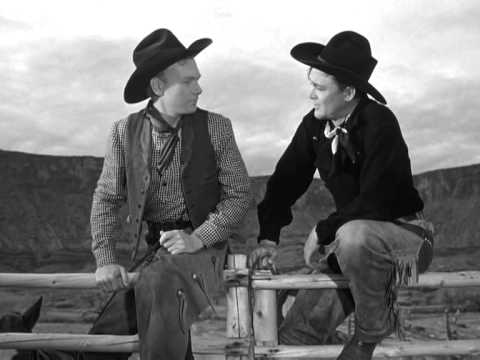
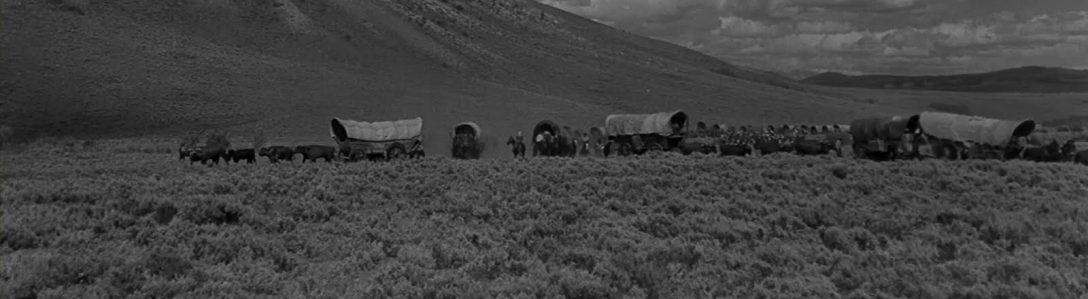
Two horse traders straddle a wooden gate in a stationary medium shot. The boyish one, Sandy (Harry Carey, Jr.) doffs his hat in an exaggerated curtsy to the passing Mormon travelers. The ruddy-faced Prudence (Kathleen O’Malley) peeks back nervously from her cart, embarrassed to display her interest in the cute stranger. Sandy whoops it up even more in response, waving his cap with adolescent bravado. He turns to fence-mate Travis (Ben Johnson), lamenting the fate of “all those women and children” making the journey across the desert towards the San Juan river. Travis gibes, “yeah, and that red-headed gal” too.  After the wagons recede into the distance in a painterly long-shot composition lensed by DP Bert Glennon, Sandy turns to Travis and starts singing: I left my gal in old Virginny. And Travis finishes the phrase, fall in line on the wagon train. Without further deliberation (aside from another verse), he tells Sandy, “looks like we got a job.”

It’s no surprise it took this long for Wagon Master to appear on DVD. It contains no stars, and the entire film proceeds on this soft-spoken, economically paced path. But thankfully Warner Brothers brought out this sublime piece of Fordian drama last week, in a stunning transfer that includes an anecdote-rich audio commentary with Peter Bogdanovich, Harry Carey, Jr., and an early sixties interview with Ford himself.


In the simple scene I described, John Ford compresses the story material, Sandy and Travis decide to lead a Mormon wagon train, into a ballet of gestures and emotions. He turns a basic scene of exposition into an expression of character: Sandy is impulsive and sentimental, Travis is contemplative and decisive. He conveys this through the twirl of Sandy’s hat, the curl on Travis’ upper lip, and the ease in which they fall into song. It’s an adventure they cannot pass up, for the moral reasons Sandy sets forth, but also for the pure romance of the journey. When Glennon returns to the shot of the wagons receding into the distance, Johnson’s horse races parallel to the fence towards the vanishing point, the plot effortlessly moving forward.

On the audio commentary, Harry Carey, Jr. notes that John Ford was in a great mood during the shoot. So good he thought he might be ill (he was not known for his cheery disposition). Perhaps feeling a little more freedom on this low-budget outing, he made the production a family affair, as biographer Joseph McBride has helpfully noted. He gave his brother Francis, a silent star, a role as a mute drummer, the script was co-written by his son Patrick, his daughter Patricia was the assistant editor, “and the assistant directors included his brother Eddie O’ Fearna, brother-in-law Wingate Smith, and nephew Francis Ford, Jr.”

The mood is laid-back charm and casual mastery. This starts, of course, with Ford’s eye for the landscape of Moab, Utah, but it seeps into the performances of Ben Johnson and Carey, Jr., who were both ace horse riders. Johnson caught Ford’s eye as Henry Fonda’s stunt-man on the set of Fort Apache, McBride relates, when he saved three actors in a munitions wagon from being dragged by spooked horses into a “sheer rock wall.” Ford rewarded him with a seven-year contract. Johnson repays him with a performance in Wagon Master of refined nonchalance, as if he were silently etched out of the Utah landscape by sandstorms, and wasn’t set into motion until Ford and Glennon’s cameras started rolling. This gritty reserve is beautifully played off of Carey Jr.’s aw shucks bashfulness. Ward Bond provides the comic relief as Elder, the hot-headed Mormon always on the verge of cursing and eyed by his own elder, a silently admonitoryAdam Perkins (the extraordinary visage of Russell Simpson). This, as McBride suggests, could have been a subtle jibe by Ford at Bond’s support of the House Un-American Activities committe, which Bond was enthusiastically endorsing at the time. In casting him as a man persecuted and expelled from society because of his ideology, Ford must have been aware of the satiric parallel.

But as much as Ford could ease out the natural humor and personality of his performers, his overriding concern is always that of the community, and Wagon Master is probably his purest statement on the matter. It’s at least the favorite of his films, as the director stated many times. Sandy and Travis become the unlikely leaders of a group of outcasts, all rejected by some facet of society. The two horse traders are derided for their shady profession, while the Mormon’s are being kicked out of town because of their faith. Along the way, the wagon train picks up a trio of drunken medicine show performers, and has a run-in with a sympathetic group of Navajos, who consider Mormons to be lesser thieves than the regular run of white men. Ford envisions this traveling society through his favorite means: the ceremonial dance. He stages two versions – the first a Mormon hoedown, which depicts Carey’s continuing flirtation with Prudence and Travis’ nascent pursuit of Denver (Joanne Dru), the medicine show girl. The beat is kept by a wooden leg, and the group joyously unites in a twirling show of arms, legs, and hopes of utopia. The second is set in the Navajo camp, another circle dance that shocks the straight-laced Mormon women, but which Sandy is enthusiastically joins. These two sequences, along with the music of the Sons of the Pioneers that weave throughout the film (and are occasionally sung by the characters themselves, make the film a kind of “horse opera”, as Tag Gallagher playfully mentions in his critical study John Ford: The Man and his Films.

This is a film where the plot takes a backseat to gesture, landscape, and character. There is a conflict and a resolution, ably provided by Charles Kemper as the huffing and puffing Uncle Clegg, leader of a family of thieves, but it’s handled so swiftly and without emphasis it’s obvious Ford’s concerns are elsewhere. He’s focused on the manner in which Ben Johnson whittles a stick of wood, Joanne Dru stares from the back of a wagon, or Harry Carey twirls his hat. After watching Wagon Master for the first time, you’ll consider it minor, a trifle of Western whimsy. Then images will linger in your mind, and you’ll wonder why. It’s a mastery that sneaks up on you, that speaks quietly and calmly about a world within our reach. The image that stuck with me this time is Ford pushing in slowly on Joanne Dru, after she rejected an oblique offer of marriage, reflectively smoking at the back of a wagon, weighing the value of her independence. Next time it will be something different, and, of course, something extraordinary.

THE END OF SUMMER

September 8, 2009

vlcsnap-2012-04-17-23h54m20s140

Goodbye, summer. The heat dissipates and a nostalgic sadness creeps into my mood. Call it the ghost of “back to school” blues, the end of youthful freedom. My adult self is staunchly anti-summer, averse to damp undershirts and the fetid stench of perspiring garbage piles. So outwardly I celebrate the great cooling-off, no longer having to hear the words “weekend getaway” or feign interest in another’s banal sunbathing/soaking/tanning plans. But there’s an insistent twinge in the human part of my heart, a vestigial sense of loss that the good times are over, it’s time to get back to work. I try to ignore it, but I might as well admit it’s there. As with most things regarding people and their damned emotions, Yasujiro Ozu has a lot to say.

So in honor of the season, I cracked open the cases of I Was Born But… and The End of Summer (both available in Criterion’s Eclipse line of DVDs). The first, a silent from 1932, is a salve for the schoolkid in me, detailing the illusions and pranks of two young brothers as they try to mesh in their new suburban home. The latter, from 1961 (his penultimate film), is for the sentimental old coot I’m prematurely becoming, a story about a childlike father and his stumblingly mature sons and daughters. The former is set in the beginning of the school year, the latter, well, read the title. An arbitrary start and end, 29 years apart.


I Was Born But… starts in a rut. Specifically, it’s a wheel spinning in mud on a country road. Ryoichi (Hideo Sugawara) and Keiji (Tomio Aoki) are with their salaryman father Yoshii (Tatsuo Saito), riding to their new home in a moving truck. After some fruitless spins in the dirt, there is a cut to Yoshii looking perplexed, instantly associated with stasis and weakness. His kids stare at him with suspicion. Then Yoshii tells them he’s off to visit his boss, and sends them on home with the driver, ambling off frame left in the sparse, electrical-post lined landscape. In these opening three minutes, Ozu sets up the themes that thread themselves throughout the rest of the feature. There is the move to the country, and the upheaval that will cause in the children’s lives. Then there is the conflict between father and sons, as the boys become increasingly aware of their father’s less than illustrious station in life, including his need to kowtow to his superior. The economy of expression here is astonishing.

But what I’m concerned with here is the bereft look on the kids’ faces as they approach school. The end of summer for Ryoichi and Keiji means the end of their previous lives. Now they have to adapt to the weird new suburban kids, with their own rituals and games. Keiji starts annoying people straight off, initiating a gang war with his transcendent oddness. Aoki’s  performance, filled with testicular scratches and exaggerated mugging, is probably the most entertaining child performance I’ve ever seen. His taunt (seen to the left) as he leaves his tiny antagonizers is a move of balletic slapstick.

He’s moving too, as he apes Sugawara’s every move in their tantrums. He’s always a step behind his brother, but his loyalties are ironclad (unless a rice ball shows up). These pantomimes of his reminded me of my lapdog relationship with my older brother. I camped out by his side and honed my interests to match his, whether it was spending hours pricing baseball cards or constructing a basement city (called Hudsonville), I strived to meet his approval at every turn. I always attempted to maintain a facade of independence with subtle variants, as we grew older he liked Pearl Jam, I chose Nirvana. He liked Metallica, I listened to Megadeth. Keiji doesn’t even attempt to mount even that minute kind of differentiation. He is Ryoichi’s disreputable mirror. Where Ryoichi is stern and commanding, Keiji is disheveled and confused (there is always a bit of white dress shirt sticking out of his fly). But they act as trusted confidants and pranksters, sharing a hive mind of youthful rebelliousness. Their faux-pouting stare as their parents try to ease them out of a funk (brought on by their father’s obvious lack of status) is both heartrending and hilarious. They are being brutally awoken to the inequalities in the world, but they carry it with impish humor, a quality one hopes they carry into old age.

If Keiji grew up and had a family, he probably would have turned out a little like Manbei Kohayagawa (Ganjiro Nakamura), the playful patriarch in The End of Summer. Manbei is a widower who is attempting to marry off his remaining single daughters, Akiko (Setsuko Hara) and Noriko (Yoko Tsukasa). He’s a gregarious sake brewery owner with active eyebrows, who has recently re-ignited a relationship with an old mistress in Kyoto.  The repeated refrain of his children is, “I wish he would act his age.” But what does that mean, exactly?

This childhood-in-adulthood aspect of the film is dealt with throughout, variously treated as a defect and a blessing, a reflection of happiness and selfishness. Ozu never chooses one side of these contradictions, but lets Manbei loose in all his irresponsibly engaging glory. He prances along, alienating and bewitching his children and mistress in equal measure. Nakamura plays him with a similar mischievousness as Aoki’s Keiji, playing endless rounds of hide and seek with his grandson before sneaking out to a rendez-vous at a race track.

In a conversation with Noriko, Akiko echoes the fable of the Scorpion and the Frog (made famous (for me) in Orson Welles’ Mr. Arkadin) by saying that it’s possible to change a man’s actions, but never his character. This statement echoes throughout the film, rendering any attempt to “change” this old coot as absurd. This aging Keiji is disreputable, perhaps, but chasing happiness with seemingly more energy than his concerned children. Akiko and Noriko are the only other two characters with designs on a free life. Setsuko Hara, Ozu’s greatest actress, radiates a self-assured wisdom, completely secure in her widowhood and unwilling to sacrifice her life for the sake of a cow-loving, Ralph Bellamy-type husband.


Circling around these characters though is a motif of smoke, a symbol of dissipation eventually awaiting all of these characters. At this point in his career, Ozu has settled into his serene late style, with low-angle framings and little camera movement. It’s startlingly different from the fluidity of I Was Born But…, which includes witty tracking shots matching a line-up of schoolkids with yawning office workers, but his images are still layered with action. These images of smoke originally seem incidental, as in the shot heading this post. The incense in the foreground is only one aspect of the family home. But its unobtrusive presence slowly accretes meaning, its insubstantial wisps a growing reminder of the body’s slow demise, and the flimsiness of our everyday complaints. Ozu frames it in his famous “pillow shots”, framings held after characters leave the screen, empty rooms with traces of a human presence. Then the smoke billows around Manbei’s body, his final lament, “Is this it? Is this really it?’ shooting up the chimney.

COLD CALCULATION AND SENSUALITY: GLORIA GRAHAME AND FRITZ LANG

August 11, 2009

large_human_desire_01_blu-ray_

On March 19th, 1953, Gloria Grahame was awarded the Best Supporting Actress Oscar for The Bad and the Beautiful (1953). Production on Fritz Lang’s The Big Heat (1953) began two days earlier, according to TCMDB. Little did she know during this string of dizzying successes that a couple of French cineastes were busy defining her image in perpetuity. In 1955, Raymond Borde and Etienne Chaumeton’s Panorama du film noir americain was published, a landmark study of a particular strain in American filmmaking that previous French critics had coined “film noir”. The term wouldn’t break into common parlance in the U.S. until the 1970s, but it would come to define Gloria Grahame’s career.

Borde and Chaumeton declared  her the ideal femme fatale, one who intimated “cold calculation and sensuality” in her performances (for more on this book’s impact, check out James Naremore’s More Than Night: Film Noir in its Contexts). She wielded her sly, cheshire-cat grin, nasal sing-song voice and girlish vanity as canny masks for her character’s various vices and insecurities. Her exuberant energy, almost anarchic at times, threatens to overwhelm the subtlety of her characterizations, and her unselfconscious sexuality made even the most sophisticated writer adopt the violent romanticism of a noir protagonist: Francois Truffaut wrote, “…as is the case of most of the Cahiers writers, the beautiful eyes of Gloria Grahame make you die of love….”, while academic Tom Gunning, in his magisterial Films of Fritz Lang, can’t help but add an aside that Grahame’s ability to make a fur coat swish “is one of the few arguments against animal rights activists.”

Along with Crossfire (1947) and In a Lonely Place (1950), The Big Heat is the defining film noir role of her career, and she delivers an astonishing performance. The Big Heat was based on a novel by William P. McGivern, originally serialized in the Saturday Evening Post. The script was written by Sydney Boehm before Lang was officially hired on to the project in mid-February of 1953. Lang biographer Patrick McGilligan notes that Boehm was a police reporter on the New York Evening Journal, and that “his specialty was crime…”. The script he delivered was a spare, unflinching tale of corruption, that which kills the wife of Detective Dave Bannion (Glenn Ford), and leads to his vigilante-like quest to take down Mike Lagana’s (Alexander Scourby) crime syndicate. Gloria Grahame plays Debby Marsh, the mistress to Lagana’s right-hand man, Vince Stone (a lip-trembling Lee Marvin).It’s a perfect scenario for Lang’s continued emphasis on systemic evils and unchangeable destiny (think Mabuse or You Only Live Once), and it results in one of his darkest, richest films (read the Gunning for an in-depth investigation of its formal and thematic strategies).

Lang’s perfectionist tendencies on set were notoriously difficult on actors, and there are very strong indications that he and Grahame did not get along. McGilligan says vaguely that there was “friction”, and in an interview with Charles Higham and Joel Greenberg about the film, Lang says, “…and there’s a whole story about Gloria Grahame and the picture I’d rather not discuss.” Which says all that needs to be said. Grahame was reputedly a “spitfire”, and Lang probably spat back. Regardless of their working relationship, their mutual genius is up there on the screen, and Grahame’s Debby Marsh is a marvelous creation, a girlish exterior hiding a sardonic sense of humor as well as a weary cynicism. When Bannion self-righteously asks her where her money comes from, Marsh replies, “I’ve been rich and I’ve been poor – believe me, rich is better.” This depressing realist comes out later in the film.

Graham enters the story lolling on the couch, answering the phone for Stone with mock sincerity, telling him “His Highness” Lagana is on the line, before strolling over to the mirror to check on her makeup. She exudes teenage rebelliousness and vanity, except her wit has more sting than your normal brat. Her burlesque of Stone’s relationship with Lagana reaches an absurd pitch when she starts singing a little ditty comparing Lagana to a lion tamer as she shuffles off to mix cocktails, indicating how “whipped” Stone really is, despite all his bravado. Grahame’s perky subversiveness gives Marsh select moments of independence, even if Stone doesn’t always pay attention to her jokes: “When Vince talks business I get my legs waxed”. She takes refuge from her life in humor and her physical appearance, which is the only way she can gain power in this sexist society. It is only after Bannion stands up to Stone that Marsh dallies with escaping her kept lifestyle.

After following the scarily stoic Bannion to his hotel room, Marsh opens up about her transcendent unhappiness. Grahame’s sexual invitation, as she composes herself on the bed, all shaded eyes and perfect posture, is duly swatted away by the detective. It is this flirtatious crime that leads to the Marsh’s famous scarring – a close-up of a bubbling coffee pot and an off-screen scream is all it takes for that scene of improbable violence to be inflicted by Lee Marvin. As Gunning notes, after this scarring Marsh avoids mirrors and acts as Bannion’s id, committing the murder he’s unable to. Meeting up with the scheming widow who is extorting from Lagana, and who holds the evidence to the syndicate’s downfall, Grahame greets her with the wonderfully sarcastic line, “We’re sisters under the mink”, as they face each other in matching furs. Marsh’s decadence is now ironic, another punchline, but this time in service of her redemption – and she goes on to return the coffee (see right).

McGilligan notes that the box office returns were “average” and the reviews “fair”, but Columbia Pictures were satisfied enough with the result to sanction a re-teaming of Ford and Grahame in Human Desire the next year, an adaptation of Emile Zola’s La Bete Humaine (filmed by Jean Renoir in 1938 – Lang had already remade Renoir’s La Chienne (1931) as Scarlett Street (1945)). The Zola novel would have been rich material for Lang, with the central character a mentally unstable “sex killer” in a world self-destructing around him. This being 1953 Hollywood, however, this subject would never be approved for production. So, as Lang told Peter Bogdanovich:

“In an American movie, you cannot make the hero a sex killer. Impossible. So Glenn Ford has to play it, you know, like a Li’l Abner coming back from Korea-100 percent red-blooded American with very natural sex feelings-if such a thing exists.”

This project was totally a contract job, but Lang had held out hope that he could land Peter Lorre as the lead, and perhaps coax a darker performance out of the material. Unfortunately, Lorre declined, and Glenn Ford stepped in to an impossible task – to portray a straight-laced aw-shucks American in a story of sexual obsession and death. His performance is incongruous and jarring. Lang’s visual mastery is in full force, though, with a wordless opening consisting of the cold geometry of train tracks, indicating the web of fate he’ll soon be caught in. It’s a film to savor for it’s purely plastic virtues, as producer Jerry Wald drove the final stake into its narrative conception:

…one day he called us [Lang and Alfred Hayes] in and said, “You are both wrong.” I said, “What have we done this time, Jerry?” He said, “Look. This is called La Bete Humaine, the human beast. But everybody is bad in your picture. ” “Naturally, because Zola wanted to show that in every human being is a beast.” He said, “You both don’t understand it. The woman is the human beast.” What can you do against the producer?

Glenn Ford plays Jeff Warren, a clean-cut soldier returning from the Korean War. He’s seduced by Gloria Grahame’s Vicki, who is chained to her drunken, murderous husband Carl Buckley  (Broderick Crawford), who’s eager to pin a death on her. Vicki attempts to seduce Warren so he’ll knock off Buckley and end her virtual imprisonment.

Gloria Grahame does not add the electricity of her turn in The Big Heat, but opts for a more reserved and maudlin tone, emphasizing Vicki’s opacity and unreadability, perhaps in an attempt to undercut Wald’s misogynist reading of Zola’s book. She is an enigma to Warren and to the audience, her character’s perversity kept in check until the final reels, where her proof of love, and proof of sexual attraction, is to kill.

I don’t like to emphasize the ghoulish backstory of Grahame’s life, but at this point in her career  her obsession with plastic surgery started to affect her performances. Her upper lip, the subject of multiple rumored procedures, looks almost paralyzed, and it alters her speech. She still receives a grand introduction, though, lazing about the premises, and then showing off her new stockings to a preoccupied Crawford. Despite her physical incapacity and the limits of the material, Grahame delivers moments of subtle beauty, including her final, incantatory pitch for true love (which she equals with Crawford’s death). Even when Lang and Grahame are working with subpar material, their intelligence finds it’s way on-screen. It was received rapturously by Cahiers (which Lang was always surprised by), and it inspired one of Andrew Sarris’ finest pieces of writing:

Where Renoir’s The Human Beast is the tragedy of a doomed man caught up in the flow of life, Lang’s remake, Human Desire, is the nightmare of an innocent man enmeshed in the tangled strands of fate. What we remember in Renoir are the faces of Gabin, Simon, and Ledoux. What we remember in Lang are the geometrical patterns of trains, tracks and fateful camera angles. If Renoir is humanism, Lang is determinism. if Renor is concerned with the plight of his characters, Lang is obsessed with the structure of the trap.

In any case, viva Gloria Grahame, quintessential noir actress and so much more, an artist of whirring energy and sensuality, who was able to transform her girlish charm into characters dangerous, wounded, and majestically alive.

THE INVISIBLE AMERICAN GENRE DIRECTORS

July 7, 2009

Steven Soderbergh’s baseball statistics movie Moneyball was shelved by Sony a few weeks back, mere days before shooting was to begin. Budgeted at $57 million and with Brad Pitt slated as the lead, its abandonment seemed to signal that mid-range, artistically ambitious projects will suffer the most in the current financial crisis. As ace Variety blogger Anne Thompson has noted, “Hollywood is moving in two simultaneous directions: behemoth event pics, and smaller personal films — with little middle ground.” One would expect that along with Soderbergh, Michael Mann and David Fincher will find it increasingly difficult to get their visions onto the screen. This is lamentable, regardless of your opinion of the filmmakers (I’m partial to Fincher, but an admirer of all), who each bring an ambitious pop sensibility to the screen. But what of the genre directors? These mid to low-budgeted spectacles (the Transporters, House Bunnies, and Hangovers) will always be cranked out, and will generally be profitable. If nothing else, the espousers of the auteur theory taught us to ignore the boundary between “high” and “low” art, to scavenge in every nook and cranny of the American cinema for possible artistry.

The Independent’s Kaleem Aftab expands Thompson’s reasoned analysis into a confusing screed about the lack of “great American directors”, and he ignores genre films as well. Below the fold I offer a list of my favorite contemporary genre operators, a group of under-the-radar auteurs and purveyors of quality pulp. First though, I have to take Aftab to task. Aside from the fact that he lists 20 or so “great” directors in his own piece, he clearly has no idea what an “auteur” is. His definition: “a director whose films had to be watched no matter what they were about or who was in them.” He goes on to say that after the auteur theory hit, “Suddenly, it was the director rather than the producer, the studio or the lead actor who became the star.” Aside from the fact that this is blatantly false (only Hitchcock could be considered a “star”, everyone else the New Wavers or Sarris championed were anonymous genre operators: Howard Hawks, Nicholas Ray, Sam Fuller), it never discusses the films themselves, only their popularity.

He equates auteur status with box-office success, and so he has little interest in Paul Thomas Anderson, Sofia Coppola, or Wes Anderson, because “none are household names, and none command guaranteed box-office.” The ignorance of this line is breathtaking – a studio head couldn’t have encapsulated the triumph of commerce over art better.  Nothing tops the line in his discussion of Judd Apatow though….witness: “It’s unusual for a comedy director to gain auteur status…”. Yes, if you ignore Charlie Chaplin, Buster Keaton, Jerry Lewis, George Cukor, Ernst Lubitsch, Blake Edwards, Preston Sturges….

That’s enough negativity for one post. Let’s think pretty thoughts – ones involving bodily fluids, but pretty nonetheless. This list is not supposed to act as a counterweight to Hollywood doomsaying. I agree that the majority of Hollywood’s output has suffered terribly since the studio days, and that kind of effortless craft is probably never to return. Consider this an addendum to Sarris’ chapter in THE AMERICAN CINEMA on “Subjects for Further Research”, a hodgepodge of encouraging voices from the disreputable realms of the action, comedy, and horror realms, and in no way tracking any trends. Just a few names I’ve gained plenty of pleasure from on the lower end of the Rotten Tomatoes rankings, and those that will continue to reside in-between the “behemoth event pics and smaller personal films”. These guys (and girl) make up the ignored middle ground.

1. Adam McKay (Anchorman (2004), Talladega Nights (2006), Step Brothers (2008)):

Adam McKay has a clear directorial personality and style: he places emphases on group improvisation and the psychoses of men in arrested development. His comedy skews anarchic and prefers digression to clean narrative lines. He’s the only true inheritor of the Marx Brothers’ manically performative aesthetic, even their relatively lax visual style. Absurdities build up until they burst out in insane setpieces (the anchorman street fight, the Mountain Dew-sponsored dinner, the Catalina Wine Mixer). Step Brothers is the purest distillation of his aesthetic thus far. Directed best episode (#5) of Eastbound and Down. Curious to see how a film without Will Ferrell would turn out…

2. Mark Neveldine and Brian Taylor (Crank (2006); Crank: High Voltage (2009)):

The cleverest action-film fanboys on the screen (apologies to Robert Rodriguez and Quentin Tarantino). The two Crank films are marketed as action films but end up as comedies about the action genre. The plot in both concerns Chev Chelios’ heart failure. In the first he needs shots of adrenaline to stay alive, in the second, shocks of electricity. Both reflect on the audience’s need for constant titillation, and do so in resourceful ways. Jason Statham proves to be a deft deliverer of wisecracks and pratfalls, as he shimmies to “Achy Breaky Heart” or tumbles onto a horse track. Sequel is funnier, less moving than the original. Next up for them is Gamer (2009).

3. Peyton Reed (Bring it On (2000), Down With Love (2003), The Break-Up (2006), Yes Man (2008)):

By far the most successful director on this list, he’s possibly the most unknown. The only director who could resurrect the romantic comedy as a viable genre. Had the gall to end The Break-Up with an actual break up, as well as filming arguments with bite and verve. Handles female performers well: see Kirsten Dunst’s exuberant performance in Bring it On and Renee Zellwegger’s last charming turn in Down With Love (including a bravado 3 minute or so monlogue). Shows a talent for brisk pacing and actual witty dialogue. Have yet to see Yes Man.

4. Jessica Bendinger (Stick It (2006)):

She’s only directed one film, but it shows a flair for Busby Berkeley-esque montages of bodies in motion as well as other offhanded bits of visual wit, like when the lead gymnast blocks out her annoying competitor in the background by blotting her out with her sneaker in extreme close-up. Not to mention the exuberant performances by a slew of unknown teen girls in Jeff Bridges’ struggling gymnast camp. And to further not mention the strikingly visualized theme of girls taking power over their own bodies in the beautifully anti-climactic finale. Bendinger primarily made her mark as a screenwriter and script doctor, having her hands in Bring it On (her debut), Mean Girls, Sex and the City, Freaky Friday, Hitch, among others.  Stick It is superior to all of her written workdespite its modest box office returns, and I dearly hope she’s allowed to make another mid-range teen film soon. Her first book will be published in November, a paranormal romance called The Seven Rays.

5. Ti West (The Roost (2005), Trigger Man (2007), The House of the Devil (2009)):

In thrall to 80s horror without devolving into camp, Ti West makes solidly unpretentious scare films that actually take the time to build tension. Trigger Mancreates suspense out of a few guys in the Delaware woods, the sound of gunshots, and gallons of fake blood. Impressive scenes of wandering, small talk, getting to know you stuff. The kind of laid back character work needed to lay the hammer down later (Full disclosure: I work for Kino, the company that put this out on DVD). James Whale knew this, John Carpenter knew this, and now apparently, this indie director knows it too. The House of the Devil (image left) was picked up by Magnet Releasing (a subsidiary of Magnolia), a satan-worshipper film that bewtiches for its set design and performances as much for its gore. The long delayed sequel to Cabin Feveris still in post-production, and here’s hoping he won’t have to cut his films to ribbons upon his entree to Hollywood.

FRINGE BENEFITS FROM THE DECLINE OF DVD

June 30, 2009

KillZone

According to a recent report from the research group Screen Digest, DVD sales declined by 4.7% in 2008, and that Blu-Ray “barely made a dent in the missing revenue”. They conclude that the new format won’t spur “minimal sector growth” until 2010. It’s rapidly becoming clear that VOD (video on demand) will eventually become the dominant form of home entertainment. In a Wall Street Journal article about Netflix CEO Reed Hastings, it claims he is “is quickly trying to shift Netflix’s business — seeking to make more videos available online and cutting deals with electronics makers so consumers can play those movies on television sets.” Hastings sees the DVD by mail business to start declining in four years, and hence his deals to stream movies on the XBox and other set-top devices, like the Roku. Packaged discs will not disappear entirely, but will likely lose a large percentage of their market share.

The benefit to consumers in the short term…sales! I recently talked about my cherry-picking of Battleground from the demise of the Virgin Megastores in NYC, but this new downer of a report spurred me to check out what was left of DVD retailers in Manhattan. I waltzed into a small reseller on 14th Street, which was having a massive sale where you could purchase 2 discs for 10 dollars. I ended up with Wilson Yip’s Kill Zone (aka SPL)John Woo’s Hard BoiledThe Buster Keaton Collection from Columbia, and Gremlins 2 (a personal favorite)…all for a total of $20.

In a bit of serendipity, I had just seen HK action guru Wilson Yip’s latest film, Ip Man (2008) at the New York Asian Festival, always one of the highlights of the year (I also recommend Breathless and Crush and Blush). Viewing Kill Zone(2005) and Ip Man back to back was an education in action choreography. Yip can be crushingly conventional in terms of exposition and character development, but when the gloves come off he’s a real virtuoso. Utilizing the same fast-cutting, restlessly mobile camera techniques of recent Hollywood fare (two aspects of what David Bordwell calls “intensified continuity” (click on the link for more detail)), Yip manages to stage fight scenes of greater spatial coherence and physical impact than Hollywood counterparts like Paul Greengrass or J.J. Abrams. The stunning finale of the entertainingly overwrought policier Kill Zonea much ballyhooed showdown between Sammo Hung and star Donnie Yen, takes place in an empty night club, and the fight literally takes center stage.

Maintaining the quick editing pace, Yip still utlizes the classical setup of a long establishing shot (the two combatants face each other), a medium over-the-shoulder shot-countershot (exchanging blows), and then close-ups to emphasize emotional peaks (or in this case, kicks to the solarplexus). The key to this scene is that Yip does not cut in the middle of a gesture – every blow is landed and registered, and his adherence to the classical style keeps their movements oriented in the space. The stage setting alludes to their battle as a dance, as if Hung and Yen were Rogers and Astaire. I suppose they’re fighting it out to see who will lead the next dance.


Astaire’s routines were always filmed in long shot, with his whole body in the frame, and Yip nods to this technique, added with the camera movement required by the more amped up standards of intensified continuity. After the classically edited setup, Yip cuts to an extreme long shot that slowly tracks in to the flailing players as they toss each other to the floor, the dust kicking up like chalk. He also finds a clever way to make Brazilian Jiu-Jitsu (based on ground submissions) look exciting. Yen flings the hefty Hung leftward to the ground, battling for the guard position. Yip, in a strikingly low angle at eye-level to the mat, tracks slowly with the duo as Yen eventually wins out and lands a series of rights. The sequence continues, and ramps up appreciably with small-scale wire work and a dramatic conclusion that wraps up one of the dramatic subplots (Hung’s nascent fatherhood). It’s a tour-de-force.

One excuse given as to why films like Taken or the Bourne series don’t have this same kind of coherence is that the actors aren’t as physically trained as martial arts pros like Hung and Yen, and necessarily need stunt doubles, necessitating even faster cuts and less spatial coherence. However, American action films don’t necessarily have to have nuanced fighting styles – just watch the series of haymakers Gregory Peck and Charlton Heston unload on each other in The Big Country (which can be seen in the video slideshow of Dennis Lim’s excellent history of fight choreography at Slate). It’s a stylistic choice, and right now Hollywood filmmakers are making the wrong one. I was initially thrilled by the Bourne series’ propulsive energy, but the more time that passes, the more its fractured editing seems like a dodge.

Ip Man continues Yip’s pattern. This more ambitious title, an bio-pic about Grandmaster Ip Man, who trained Bruce Lee and popularized the Wing Chun style of martial arts (interestingly enough, Wong Kar-Wai’s next project is also a bio-pic about the Grandmaster). The film focuses on his life during the Occupation of China during the Second Sino-Japanese war. Grandmaster Ip Man (Donnie Yen) lives a quiet life with his family before the Japanese Imperialists destroy his small town and reduce his pals to coal miners. Ip Man then commences to beat the holy hell out of evey Japanese person in sight. Yip is not big on subtletly, and one of Japanese Genral Miura’s obsequious assistants tips over into racist stereotypes (big teeth, round glasses, into torture, etc.).

However, once more Yip brings the goods in the action sequences: crisp, elegant, and coherently orchestrated bouts of mayhem. Yen also exhibits a wider emotional range here, his stoic laid-backness tinged with regret and anger. He won’t win any awards, but it’s a solid, nuanced performance. In any case, these two works will have me work backwards into Yip’s career. Next up is Flash Point, the middleman between Kill Zone and Ip, and it promises more fluid Donnie Yen bone-breaking. Ah, the neverending riches of cinema.

ANDREW SARRIS, FREELANCER

June 16, 2009

andrew-sarris-920x517-c-default

Early last week, news broke that the NY Observer were cutting a third of their editorial staff, and that Andrew Sarris would be among those let go. Dave Kehr later posted that Sarris was indeed laid off from his staff position, but would continue contributing as a freelancer. This was unsurprising news, considering the state of the newspaper business and film critic gigs in particular, but it’s still the end of an era.

It’s unlikely that a writer starting up today will ever have a perch like the Village Voice or the Observer to build an audience for over 50 years like Sarris has done – film criticism today is more of a part-time job or hobby, for better (a diversity of voices, Movie Morlocks) and worse (you know, not getting paid). Collating all of one’s stories from different outlets on Twitter and Facebook might one day serve the same function, but…..not quite yet. It’ll be interesting to see where else Sarris decides to publish, and I’m counting down the days until he fires up a Twitter feed (although, note the typewriter above).

In any case, Sarris abides, and it’s past the time that I engaged more with his work. Any U.S. critic who has approached a film and detected the style and themes of a director, whether it’s stating that Todd Phillips is obsessed with frat-boy humor or noticing the affectless performances in Bresson, has been influenced by his writing. So that’s everyone. In adapting Cahiers du Cinema’s politique des auteurs to American audiences, Sarris opened up the possibility of investigating a film’s style, not just it’s plot mechanics and themes, which the more literary minded critics of the time were focused on. Nobody seemed to notice that these were moving images before Sarris took up the cudgel (there were others, of course, but no-one was as vocal about making a big deal of it. Manny Farber had already done stylistic analyses of directors, but hadn’t stuck a name to it. So, rhetorical license, and all that).

For a deeper, and more personal analysis of Sarris’ influence, read Kent Jones’ excellent 2005 encomium in Film CommentNot only was Jones of the first generation affected by Sarris’ work, he was a friend. His key (and closing) line: “He gave me, and many, many others, a framework, a way of seeing and understanding an art form that was and still is culturally disreputable. I owe him a lot, and so does anyone else writing about cinema.”


I was morose enough after the Sarris news to tour a few Manhattan bookstores to see what Sarris-iana I could pick up. Perhaps still enthralled with film literature from our mini blogathon here at Morlock central, I wanted to dig further into his writing. I was mainly searching for a copy of The American Cinema, which I had sped through a few years ago when I borrowed it from the library.  After trips to four fine retailers (two used) and some clipped dialogue with their fine information desk personnel (“Sarris, American Cinema, No?, OK”)I could find no trace of the American Cinema. It’s been in and out of print, but I thought any legit re-seller would have one on hand. Not a trace.

It’s readily available online, but I’m not concerned about myself buying it. I’m more concerned about the younger me wandering around a suburban Barnes & Noble, seeking affirmation for his cinephilic addiction. David Thomson’s Biographical Dictionary is readily available, on which I already gave my thoughts – but let’s just say it’s limited in scope and doesn’t offer much of a stylistic basis for viewing the art. So I worry that there are a gaggle of younger mes running around with Thomson as their only guide…and I shudder. These kids need to hear the following, from the first page of the preface of The American Cinema:

A serious approach to old movies is particularly indispensable at a time when the very existence of old movies is jeopardized by the shocking negligence of the so-called film industry, and at a time when the appreciation of old movies is hindered by the pernicious frivolities of pop, camp, and trivia. The enemies of cinema have found their new battle cry in the condescending cackle one hears in so-called art houses. This book is intended for those perennial ciniphiles, the solitary moviegoers.

If I had read this at 16, I would have felt a chill in my spine and become a Sarris acolyte. Instead I came to the same conclusions on my own (a few jackals laughing at a screening at The Umbrellas of Cherbourg will do much to disillusion a man), but I wish I had his intellectual firepower on my side. As with most topics, let’s place our faith in the power of the internet (it’s available on Kindle!) and hope for the best.

So, no American Cinema, but I did manage to pick up a dustier bit of print in the Sarris library: a volume of interviews he edited in 1967, Hollywood VoicesThe centerpiece (at least by my standards) is an elegiac piece by Sarris on his never-published interview with Preston Sturges in 1957, upon the release of his final film, Les Carnets du Major Thompson (1955). In this wide-ranging piece, Sarris discusses his ambivalence regarding interviews (“The link between artistry and psychology is a tenuous one for me…”, and he adds a joshing, “Note: Sturges was not interested in baseball. Does that make his work less American?”) and an investigation of Sturges’ apparent decline (“Although clowns supposedly yearn to play Hamlet, they usually end up playing Lear.”) It is a very strange document, an anecdote of a forgotten interview for a forgotten film, but Sarris turns it into lingering series of questions about the nature of the critc-filmmaker realationship and the bruised dignity of one comedic genius. Just another example of why we should be grateful to still have his thoughts to kick around.

THE SEARCH FOR NATURALISM: CELINA MURGA

May 5, 2009

ana_y_los_otros_celina_murga

To coincide with TCM’s month-long series, Latino Images in Film, the n’er do wells here at Movie Morlocks will devote this week to an impassioned blog-a-thon on Latin American cinema (and Latin Americans in cinema…happy Cinco de Mayo, by the way). As it happens, my eyeballs have been drawn to a number of phenomenal Argentinian filmmakers recently, including Lucrecia Martel (whose mind-melting The Headless Woman gets a limited release in August) and the nomadic Lisandro Alonso. The lady I’d like to focus on here, though, has yet to land US distribution for either of her two superb features, and deserves far more of a spotlight: Celina Murga.

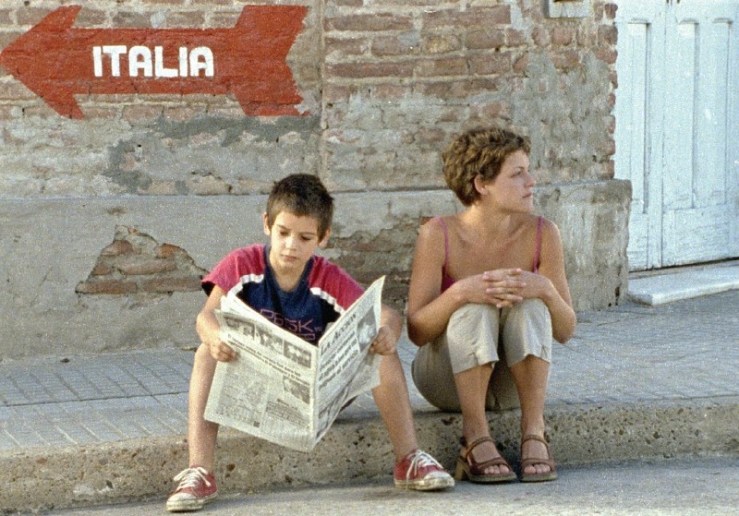
Murga was born in Paraná, in Argentina’s Entre Ríos Province. She fell for cinema after reveling in Godard’s Breathless, and raced to Buenos Aires at the age of 17 to enter film school. After gigs at a production company, her university, and as an assistant director, she completed her debut film in 2002. A remarkably assured feature, Ana and the Others (Ana y los Otros) nails the peculiar alchemy that takes place when returning to a hometown after years away. The familiar is turned strange, and Ana wanders her city like a bemused tourist, inquiring after a photo shop (no one remembers it), and deflecting questions about high-school classmates she barely remembers. Murga takes a distanced approach, filming Ana (Camila Toker) in long shot, either in static frames or steady pans and tracks. Her motivations are unclear, and it is only well into the feature before we realize she’s back in town for a class reunion.

The film is marked by a touching uncertainty, the loss of home analogous to a lost version of yourself. It’s eventually revealed that her main reason for coming home is to search for an old flame, Mariano. As she sifts through her memories, of fainting at her first (and second) kiss, while also selling her family home, past, present and future merge together in a deeply moving way. Her search for Mariano is clearly a search for home, for rootedness, and it’s the maturity of this debut that keeps their reunion from our view. Coping with the past is an on-going process, and Murga wisely declines to give closure. A personal work, it’s set in Paraná and echoes Murga’s own travels, and resonates, I’m sure, with just about anyone who’s left home. (Ana and the Others was released on DVD by VeneVision, but is now out of print. It’s readily available on various online retailers though).

Five years later, Ms. Murga poked her back onto the festival scene with A Week Alone (2007), another enigmatic narrative located in the Entre Rios province, but this time set in a gated community. With their parents away on vacation, an extended family of teens and toddlers wander around their posh existence with bemused obliviousness. The world outside is a stranger. Maria, the oldest, had actually been to Buenos Aires, but didn’t like it. In controlled tracking shots similar to Ana’s, Murga delineates their daily routines with exactitude, from the order they walk to school to their instinctive reliance they have on their maid (ask them to make their own Nesquik, and they flinch). With the complex’s armed guards and pools, it feels like a fascist club Med. Their life is a closed-circuit, and as such, a romance flickers between two cousins. Outside entanglements don’t exist.

This theme of upper-class isolation is subsumed under the beauty of Murga’s patient eye, and the studied naturalness of the performers. Cahiers du Cinema published a diary from Murga, and she explains how she weaves this spell:

In my shoots, I often have the sensation that I am capturing something unique, that I’ve got to be constantly on the look out for that moment of unique truth that an actor might just produce. I say truth in the sense of the real…that I’m also giving documentary testimony to what’s going on…beyond the limits of the screen. This doesn’t mean there’s less construction or less control. I think that has to do with the search for naturalism. At times I feel like my work is all about the preparation of fertile ground so the truth that’s hidden in a scene…can really spring forth and blossom.

This formulation echoes Orson Welles’ famous quote that, “The director is simply the audience…his job is to preside over accidents.” Prepare the ground, wait for miracles. This rigorousness and openness, her exacting framings coupled with an openness to improvisation and other “accidents” is the tension that gives her work such amazing vitality. The characters avoid any stereotyping, as Murga teases out their natural charisma. This is not a hatchet job on the blue bloods, but a serious, nuanced interrogation of a class cold war.

This vitality comes to the fore when the maid’s brother, Fernando, intrudes upon the children’s upper class life. They don’t know how to speak to him, leave them out of their games, and give him a wide berth. The only figure capable of bridging this gap in the film is the youngest girl, Sofi. Murga lays out her humanist tendencies throughout – sleeping in the maid’s room, questioning her about her religion (this subdivision is thoroughly secular) and urging her to display her singing voice. As with Ana, there is no tidy conclusion. The class fissures crack wide open, but Sofi offers a hint of reconciliation, or at least understanding. It’s a moment of grace in this otherwise hauntingly ambiguous social fable.

While she was busy completing A Week Alone, Murga was selected for the 2008/2009 Rolex Mentor and Protege Arts Initiative, where she was paired with Martin Scorsese as a mentor. Along with getting his feedback on her work, she was able to accompany him on the set of his next feature, Shutter Island, which is the period from which her Cahiers diary was derived. Scorsese offered to help Murga shop A Week Alone, and his name tops the credits (“Martin Scorsese Presents”). She’s working on a new project, The Third Side of the River, which is about a minor who confesses to a murder, and the distinct possibility that he is lying about it. It would seem to extend her interest in childhood, the ambiguity of motivations, and looks to continue her social critique of the Argentinain state. With the influence of Scorsese in her head, this could be incredible. Bring it on.

THE WARNER ARCHIVE: FIRST IMPRESSIONS

April 7, 2009

MV5BNGM3MWMwOWQtZjkyNS00NWU5LThlMjUtOWIwNzExMzU0NTgzL2ltYWdlXkEyXkFqcGdeQXVyMTE2NzA0Ng@@._V1_

With services like Netflix, it feels like the whole history of cinema is available at our fingertips. This sense is false, of course.  As Dave Kehr and Jonathan Rosenbaum have pointed out, of the 157,485 films listed in the American Film Institute’s Catalog of American Feature Films, only 5,884 are available on home video (this doesn’t even include the sorry state of foreign film distribution in the US). So while the advent of DVD has vastly increased the audience for classic film, where towns without a repertory theater can still watch Murnau and Hawks, the breadth has suffered. Which is why the advent of the Warner Archive is a such a cause for celebration.

The archive manufactures out-of-print titles on demand. This cuts out the cost of mass production and warehousing, while still allowing customers access to the product. According to Warner’s George Feltenstein, they have 6,800 films in their archive, and only 1,200 are on DVD (4,100 made it to VHS). Currently only 150 titles are available in the program, but each month around 20 more will be added to the list. It’s the brainchild of Feltenstein, the (deep breath) senior vice president for theatrical catalog marketing at Warner. Long regarded as one of the best in the business at pushing classics onto home video, from the VHS and laserdisc days to the present, this latest initiative is possibly his greatest achievement yet. With DVD sales flagging, it’s a smart way to wring more revenue out of their archive, and with some success will hopefully urge other studios to offer similar programs.

The initial offering of films is a fascinating grab bag of Greta Garbo silents, Joan Crawford weepies, and brat pack oddities. I decided to buy three of the features, each at the $20 price point (most titles are also available for download at $14.95). I bought Leo McCarey’s 1942 propaganda-comedy Once Upon a Honeymoon, Jacques Tourneur’s 1955 ‘Scope Western Wichita (see right), and Budd Boetticher’s 1958 Westbound (to round out my collection of his Ranown series with Randolph Scott, image below). The films are burned and not pressed, meaning they are DVD-R’s and not finalized DVDs. This caused some concern as to their playability, and the packaging contains a warning that they might not work on some PCs. All three films played fine on both my standalone player and my Toshiba laptop (only very old systems would have a problem, I’d guess).

These discs are barebones, with no extras and the most basic of menus. Chapters are programmed every ten minutes regardless of the shot. The transfer quality, however, was high across the board, with Wichita looking especially sharp in its anamorphic transfer. Honeymoon showed some wear and tear in the original element, but only one sequence late in the film could be considered subpar. I was thoroughly satisfied with the quality overall, and will undoubtedly go back to the well for more. If any commenters would like to suggest other titles to consider taking a look at, let me know! I’ve got my eye on the two Cukors (The Actress and Bhowani Junction), the passel of Raoul Walsh’s (Along Great Divide, A Distant Trumpet, A Lion is in the Streets), and the smattering of Frank Borzages (Three Comrades, Mannequin, The Shining Hour).

Once Upon a Honeymoon is a delirious wonder of a film, a screwball anti-Nazi propaganda caper that still manages to be tremendously moving. It’s an improbable mix of comedy and tragedy, a high-wire act that teeters but never falls into camp. A failure upon first release, McCarey told Peter Bogdanovich that “I didn’t like it because the public didn’t like it.” Following the massive success of The Awful Truth (1937) and Love Affair (1939), the box office thud must have come as a shock, especially considering the quality of the material, and the presence of Cary Grant and Ginger Rogers at the top of their games. His populism can’t mask his pride though, as he admits one quote later, “I died laughing at the movie. The acting was too good.” There are any number of uproarious sequences to bear that out, including the one containing the top photo. This sequence finds Ginger Rogers speaking in an aristocratic accent, and going by the name Katherine Butt-Smith (“it’s pronounced Butte”, is the common refrain). Grant is a radio announcer, slumming as a reporter to get a scoop on her marriage to the Nazi Baron von Luber (Walter Slezak, in his first role in Hollywood). He poses as an Austrian fitter for Rogers’ wedding dress. Right before his entry though, Rogers calls her mother, and unveils her natural Irish-Brooklyn name and accent, Katie O’Hara. Her mother, none too pleased, laments her coming  nuptials, “You were doing so well in burlesque…”

This sets up one of the recurring motifs in the film, of Katie’s shifting identity, from Aristocrat/fascist to Working-class/Democrat. This is strung out throughout the film, culminating when she gives up her passport to her Jewish maid to ensure her escape.  Early on, the mode is still primarily comic, and Grant’s entrance sets forth another motif, that of the escalating sexual tension between himself and Ginger. Here it is figured in the measuring tape, hilariously manuevured by Grant into the most suggestive of shapes. His intent is clear very early on, and McCarey offers one of many self-reflexive jokes when Grant’s gropes cause Rogers to groan, “This is getting ridiculous”. And how! McCarey takes the sexualization of objects to another level later in the film, when Grant, about to leave Gingers’ train cabin, tells her how lonely he’ll be, “just me and my saxophone.” This innuendo is made literal later in the sequence, and Grant squeals on the horn while Rogers squeals with laughter with the Baron.

The film is layered with these kinds of motifs, brilliantly laid out in further detail by Robin Wood in a Jan.-Feb. 1976 article for Film Comment (“Democracy and Shpontanuity”, available at your local public library’s microfilm archive!). In any case, it’s an uproarious piece of work, and I haven’t even mentioned the Shakespeare-Irving Berlin quote-off. If, as Robin Wood said, that Rio Bravo justifies the existence of Hollywood, then Once Upon a Honeymoon justifies the existence of the WB Archive.