MORE TO BE SAID: ALLAN DWAN

April 19, 2011

Screen Shot 2020-01-29 at 3.49.19 PM

“It is too early to establish any coherent pattern to Dwan’s career as a whole, but it may very well be that Dwan will turn out to be the last of the old masters. …there may be much more to be said…” -Andrew Sarris, The American Cinema

My weakness was that I’d take anything. If it was a challenge to me, I’d take a bad story and try to make it good.” -Allan Dwan to Peter Bogdanovich, Who the Devil Made It

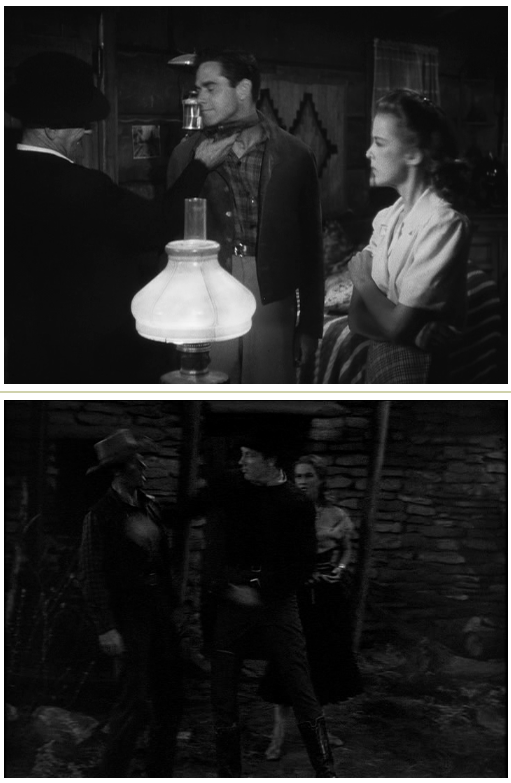
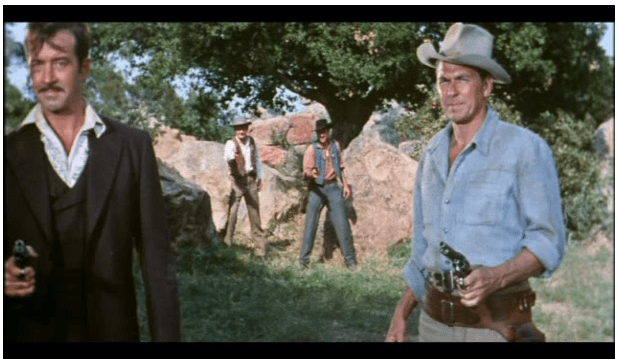
Allan Dwan has one of the more intimidating IMDB pageswith 405 directorial credits listed, spanning the years 1911 -1961. As with my on-going infatuation with Raoul Walsh, my haphazard path to Allan Dwan began with a random repertory screening, this time at Anthology Film Archives. The French filmmaker and critic Serge Bozon (La France), programmed an evening of idiosyncratic Westerns that handle male friendship in starkly different terms: Dwan’s Tennessee’s Partner (1955) and Jacques Tourneur’s Canyon Passage (1946). The former is a tender and forthright charmer, while the latter is an opaque and elliptical mystery. As I’ve been frequently enraptured by Tourneur recently (see here), I was surprised to find I found myself more wrapped up in the laconic rhythms of the Dwan film (although both are equally worthy). I then quickly queued up his two other 1955 features, Pearl of the South Pacific and Escape to Burma – and so I begin another auteurist binge.

Tennessee’s Partner (’55) was part of a string of low-budget action films that producer Benedict Bogeaus was packaging together for RKO. Jacques Tourneur had already pitched in with Appointment in Honduras (1953), while Don Siegel kicked off the remarkable string with Count the Hours that same year. Dwan would direct ten of these cheapies (three in ’55 alone), almost all of which used the same proficient crew of old pros, including cinematographer John Alton, art director Van Nest Polglase, editor James Leicester and composer Louis Forbes. In his study of Tourneur, The Cinema of Nightfall, Chris Fujiwara notes that “According to Dwan, Bogeaus’ budgets were never more than around $800,000 to $850,000, and the schedules were about fifteen days.” As Dwan told Bogdanovich:

Ben Bogeaus had lost his shirt on a bunch of pictures that he produced, and for a long time he did nothing. But he had been friendly with a fellow who became the general manager for RKO studios under Howard Hughes, and when they decided to encourage independent producers to come in and make pictures, they also loet Bogeaus in because of the previous relationship with the studio manager. The president of the company was…my old friend Jim Grainger. Now Bogeaus was notoriously extravagant in the early days, and they weren’t too confident that he could safely handle the kind of budget he’d have to use, so to give himself some security, Grainger reached out for someone with experience to go in and work with Bogeaus.

The mandate was to finish under budget and on time, and Bogeaus, no longer extravagant, became rather notorious for cutting corners. On Dwan’s last film, Most Dangerous Man Alive (1961), Bogeaus hired the crew on the lower wages of a two-part television pilot, even though it was intended as a theatrical feature all along.

This cheapness extends to the aspect ratio, for instead of paying for the CinemaScope process, RKO introduced the cut-rate SuperScope process, which essentially crops a 4×3 frame into 16×9. Glenn Kenny broke it down at MUBI:

Howard Hughes hired brothers Irving and Joseph S. Tushinsky to concoct a process. It is possibly one of the most ass-backward you will ever encounter. (My information derives from Robert E. Carr and R.M. Hayes’ invaluable book, Wide Screen Movies.) In SuperScope, the film is shot using standard 35mm cameras, lenses, film. Filmmakers were instructed that all action be framed “into a 2:1 aspect ratio with equal cropping from the top and bottom of the frame.” “The film was then cropped to 2:1; a 2:1 anamorphic squeeze was added, and the film was printed by Technicolor in ‘scope format with .715′ height and .715′ width. A narrow black strip appeared on the right side of release print frames to fill in the difference in the .715′ SuperScope width and the .839′ width of CinemaScope.”

Borne out of necessity as well as inclination, these films are sparse and economical, allowing the well-worn genre codes to fill in the blanks in the scripts and the open spaces in the sets. Escape to Burma and Pearl of the South Pacific are minor but diverting efforts, with characteristically impressive work by John Alton. Burma is the stronger of the two, introducing the latticework facade of Barbara Stanwyck’s Burma outpost in the opening, letting Alton’s shadows seep through it in the middle, and then ending with gun muzzles intruding into its intricate grille work. Pearl has some stunning location footage matched with awkwardly cheap studio shots, but still manages to wring dense, fully figured characters out of its pulp cut-outs.

Not much happens in Tennessee’s Partner, with most of the action taking place inside the emotions of John Payne and Ronald Reaganthe two eminently likable leads. Payne is Tennessee, the slick house cardsharp in a high-class brothel, or “Marriage Market”, run by Duchess (Rhonda Fleming). Duchess takes 10% of his winnings after he cleans out the rubes, but she’d like it more if he kissed her with passion. Instead, she gets the sloppy macho tongue slapping of a narcissist only after his own pleasure. Then Cowpoke (Ronald Reagan) totters into town, a mild mannered romantic who arrives to get married. Everyone is an archetype, identified only by a nickname. Howard Hawks certainly saw this movie before making Rio Bravo, another pared down Western heavy on nicknames and the vagaries of male friendship. It’s unnecessary to dwell on narrative-halting backstory when entire lives are present in a name. Whether Cowpoke or Tennessee, or Colorado, Feathers and Dude in Rio Bravo, you have a sense of these characters as soon as they step on-screen and introduce themselves. This allows Dwan and Hawks to focus on the inter-personal present.

One of Tennessee’s cleaned out poker mates tries to knock him off, and Cowpoke, just entering town, guns down the attacker instead. Tennessee and Cowpoke end up in jail on suspicion of murder. Instead of plotting escape, they sit in a tight two shot and talk, in a restful pace, about their lonely lives. Cowpoke laments his solitary life on the road, and Tennessee the constant pressure of having to maintain his perch, with young gunslingers always trying to take him down. It’s lonely at the top and the bottom, and the two men slowly bask in their mutual alienation.

The film progresses in this inverted manner – its heart on its sleeve and its story shunted to the background. Dwan said, “I’ve always preferred stories of intimacy. Spectacle is only useful commercially.” Tennesee’s Partner is a sweet distillation of this inclination. It’s a lovely, lulling experience to watch John Payne as his features soften the more he gets to know his pal. The cynical devil-may-care dash is replaced with nervous concern – as Cowpoke’s fiance turns out to be a gold-digger Tennessee knew back in San Francisco. The story moves on his inability to communicate his concernreflecting also his mulish refusal to admit his love of Duchess. It’s a movie about accepting and validating male emotionality. There is a moment when Payne lays his hand on Reagan’s shoulder, affirming their bond and their love, that stuns in its simplicity and grace.
J. HOBERMAN’S AN ARMY OF PHANTOMS

March 15, 2011

Scene-Fort-Apache-John-Ford

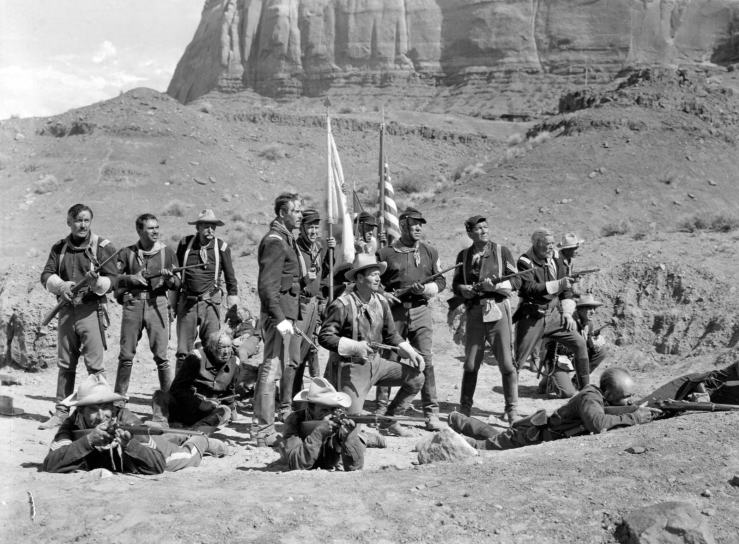
Under siege. John Ford’s Fort Apache established one of the major Cold War film archetypes, as J. Hoberman explains in An Army of Phantoms, his breathless, careening cultural history of the period (which the New Press released today). Covering the initial years of the political frost, from the mid-1940s through 1956, it’s the prequel to his 2003 The Dream Life, which ranged from 1960 to the release of Blow Out in 1981. He is preparing a third volume, Found Illusions: The Romance of the Remake and the Triumph of Reaganocracy, that will cover the rest of the 80s and the end of the Cold War. His stated inspiration is Siegfried Kracauer’s From Caligari to Hitler, and Hoberman’s less deterministic project will likely cozy up to it on film reference shelves in the coming decades as an essential and idiosyncratic work of cultural studies.

The phrase “cultural studies” tends to make me recoil in various poses of disgust. It’s the lapsed academic in me. As David Bordwell said in a Cinema Scope interview, ” most film scholars aren’t interested in film as a creative art. I know it sounds odd to say that, but I think it’s true. Most scholars are interested in film as an expression of cultural trends, interests, processes, etc. or of political moods, tendencies, etc.” Much of what I encountered of cultural studies in school reduced films to fit ideological agendas, starting with a theory and then squeezing the movie to fit that theory. The art object itself was lost in the process.

What Hoberman is doing here is undoubtedly cultural studies, describing how social and political events shaped the era, and in turn the tone and texture of Hollywood’s product, but it is a supple and nuanced version of the discipline. Since he is coming from a film critic’s background, he never loses sight of the unruly complexity of the movies themselves. The wealth of production history Hoberman lays down here is one of its most invaluable aspects, and has me continually dogearing pages (Full disclosure: I took a Film Criticism seminar that Hoberman taught at NYU).

For example, in his thumbnail portrait of The Thing (1951), he places it in the context of Edgar G. Ulmer’s The Man From Planet X, an alien cheapie that beat it into theaters, heralding 1951 as “the year that the saucers landed and the extraterrestrials arrived.” The Thing’s pre-production also “coincided with the emergence of Senator McCarthy and the early stages of the Korean War.”, resulting in a “congealed hysteria.” Politics and film inform each other, but they are not irreducible to the other. Hoberman is adapting French philosopher and sociologist Jacques Ellul’s concept of sociological propaganda:

a vague, spontaneous, all-pervasive, yet half-conscious form of social bonding and ideological proselytizing advanced by advertising, newspaper editorials, social service agencies, patriotic speeches, and anything else that might use the phrase ‘way of life.’”

It is the haziness of being a part of an epoch, the received wisdom that we mouth daily because we don’t have time to reflect on everything we say. It is a flexible, elusive concept, the perfect prism from which to pursue the indirect but palpable influence of the social and political spheres on film. Those are his theoretical walking orders, but Hoberman fills the book  with the clammy details of the dream factory. After spotty snowfall in Cut Bank, Montana, the crew re-located “to an arctic landscape created on the RKO ranch in Encino – another sort of ordeal with sweaty, parka swaddled actors tramping over the artificial snow that had been created from rock salt, ground-up Masonite, and crystallized photographic solution.”

The Thing’s scenario was comic-book Fort Apache, the group under siege by a marauding, unknowable force. The parallels with Communist infiltration (and the bloody “police action” in Korea) were starkly clear, and The Thing’s “effete little Nobel Prize-winning scientist affecting a blazer, turtleneck, and goatee” is nothing less than a “wannabe Russian”. The Thing makes gestures toward anti-communism, but more than anything else it’s a Howard Hawks film, a buzzing group of insecure he-men talking their way through their problems and through the Red Menace. This Fort Apache scenario of terror from without is one of the repeated motifs of the book (Only the Valiant, which I wrote up earlier, introduces subversion from within into the cavalry Western), although many others wind through it, including The Next Voice You Hear, whose vision of God-as-entertainment actualized Hollywood’s fondest dreams of itself. Hoberman draws out the cruel irony of how the real universal communicator, television, almost puts Hollywood out of business. The third major strand is provided by Kiss Me Deadly and screenwriter A.I. Bezzerides’ term for nuclear power, The Great Whatzit, which Hoberman uses throughout as both a metaphor for nuclear weapons as well as the undefinable anxieties which haunted the generation.

All of these ideas are buttressed by meticulous research, with reams of contemporary opinions from VarietyThe New York Times and especially The Daily Worker, as film and  political history start to smack up against each other. Everything converges in his tour-de-force explication of the House Un-American Activities Commission hearings, whose impact on the movie business is laid out in granular detail, as studio heads tried to triangulate between Sen. McCarthy and the panicky artist-progressives who pushed out their money-making product. Never have I read such a thorough examination of this period, and the moral gray areas that subpoenaed witnesses had to traverse. There is no cheap moralizing or blanket condemnations of those who named names, only a fanatically detailed, contextually rich rundown of the cultural currents that led to their decisions.

I’d advise you not to open the Great Whatzit, but please open the book.

Screen Shot 2020-01-28 at 5.52.57 PM

DIGGING THROUGH THE WARNER ARCHIVE: WILD ROVERS AND RESTORED MINNELLI

March 8, 2011

Screen Shot 2020-01-28 at 5.40.59 PM

Despondent cineaste Jack Andrus should buck up. First, he’s seated in an eye-blazingly Technicolor red chair, which one assumes is also of sensuously high-grain leather. Second, he’s being played by Kirk Douglas at his most flamboyantly masculine, a dream come true for characters of dissolutely manic personalities like Jack. Third, the Warner Archive has released a fine remastered DVD of the film that houses him, Vincente Minnelli’s convulsively beautiful Two Weeks in Another Town. For the rest of us, they also recently put out a remastered version of Minnelli’s The Cobweb (1955) and an un-restored but handsome-looking edition of Blake Edwards’ Wild Rovers (1971). We’ll start with the last first just to get Jack’s goat, but also because the Minnelli greats have already been covered by more seasoned minds, although I’ll still get my thoughts in.

In 1969, MGM hired James Aubrey as president to cut costs and bring the studio back to profitability (John Houseman nicknamed him “The Smiling Cobra”). Blake Edwards had the unfortunate task of directing Wild Rovers under his reign, and this after the box office failure of his Paramount musical Darling Lili (1970), which was hounded by reports of spiraling costs and studio meddling (Edwards would use this experience as the basis for S.O.B. (1981)).  For Wild Rovers, Edwards envisioned a three hour Western epic, in which it would be important to “show the vastness, the loneliness, the boredom and natural beauty of the West of that period.” (quoted in Sam Wasson’s book-length study of Edwards, A Splurch in the Kisser).

It tells the story of two down-at-heel cattle ranch hands, Ross Bodine (William Holden) and Frank Post (Ryan O’Neal), who decide to rob a bank and end up on the run from the ranch owner’s sons, John and Paul Buckman (Tom Skerritt and Joe Don Baker). The tone is detached, almost bemused tragedy, as Ross and Frank ride toward their annihilation in landscape shots where they are advancing dots, or in widely spaced medium shots within the Panavision frame, in which intimacy is impossible.

Edwards did not have a chance of getting his vision on the screen. While available production histories don’t state how much he was allowed to shoot, the film was taken away from him by Aubrey in post-production, and released in 1971 at around 106 minutes (this according Vincent Canby’s NY Times review. The Variety review lists it at 110, and Wasson at 113). In American Cinematographer, Herb Lightman bemoaned and identified the cuts (quoted in Wasson):

Gone is the opening montage…Gone is the gutsy man-to-man breakfast sequence. The dramatic confrontation between Karl Malden and his sheepherder arch enemy…has been telescoped into a quick montage with voice-over narration. One complete sequence which… provided motivation for the entire last half of the picture, has been deleted. The downbeat…ending has been trimmed and tied off with a reprise of the horse-breaking montage that numbs the tragedy….”

A so-called “director’s cut” was put out on VHS in 1993, which extended the run time to 137 minutes, although I don’t know how much input Edwards actually had into this re-release. Wasson reports that Aubrey cut  “twenty minutes from the finished film”, so it could be close to complete. The Warner Archive has released the 137 minute version in a decent anamorphic transfer, and it seems to contain all the footage Lightman mentions, although there is audio from the horse-breaking montage still in the final scene, which may be a remnant of Aubrey’s scissorhands.

Opening with an Overture, and broken up with an intermission, Edwards clearly had an epic in mind. He told the NY Times that, “it was my best film, and he [Aubrey] butchered it.” Perhaps the film in his head was, but the reconstructed version still seems an ambitious misfire, a fascinating relic that exposes the seams between classical and New Hollywood. The visual style seems firmly implanted in the widescreen aesthetic of the classical era, with limited camera movement but intricate blocking inside the frame. Cinematographer Philip Lathrop told American Cinematographer that “One thing I want to do is avoid the slick mechanical gadgetry that we use so much in making pictures today-things like helicopters and obvious dolly shots and zoom lenses. I think that these would be very false in relation to a period Western.” For the most part this holds true, but in the horse-breaking sequence, and in the sheepherder shootout, there are overlapping montages of extreme slow-motion, seemingly lifted from The Wild Bunch of a few years before. It’s impossible to know whether these were Aubrey-implemented to modernize the film

Then there is the discordant lead pairing of William Holden and Ryan O’ Neal, a clash in acting styles and eras. Holden plays his mischievous ne’er do well as gruff and straightforward where O’Neal is arch and playful, and they seemingly talk past each other, killing any Butch Cassidy-type camaraderie. Edwards was clearly aiming for something more operatic than a straight buddy-comedy,  but the emotional colorations he reaches for, “how uncertain life really is”, as Holden says, feels forced and sterile coming out of this duo. In a final adieu to a classical past, he films the alienated finale in the moon-scape of John Ford’s Monument Valley.

***

The Cobweb and Two Weeks in Another Town are delirious Freudian melodramas with wildly expressive mise-en-scene. You could watch these Technicolor marvels on mute and perfectly understand the emotions billowing through them. The Cobweb (1955) is set in a stately mental hospital, where the line between patient and doctor is distressingly blurry. It’s all a matter of curtains. Office and personal relationships break down when the HR director/dictator Miss Inch (Lillian Gish), the bored, breathy housewife Karen (Gloria Grahame) (married to hospital head Stewart McIver (Richard Widmark)), and the sensitive counselor Meg Rinehart (Lauren Bacall) propose different curtain designs for the library.

The breakdown in their society was heralded by the opening scene, of a neurotic patient (John Kerr, in a role originally offered to James Dean), hitching a ride back to the grounds by Karen. Their conversation breaks down the professional walls between the sane and insane, while also explicating the cathartic virtues of art. Kerr asks Grahame if the burstingly red flowers in her backseat are for a funeral, and she replies, in what could be a statement of purpose for all of Minnelli’s cinema (except, maybe, for the last phrase): “Why do flowers have to be for anything? Isn’t it enough that they have color and form and that they make you feel good?”

James Naremore, in his Films of Vincente Minnelli, asserts that all four of the “art melodramas” that Minnelli made with producer John Houseman (The Bad and the Beautiful, The Cobweb, Lust for Life and Two Weeks in Another Town), “employ a simplified version of an argument Edmund Wilson helped to popularize in his infulential 1941 volume of literary criticism, The Wound and the Bow. In each film, a character who suffers from a repressed psychic ‘wound’ uses art as a release for thwarted libidinal energy.” In this case Miss Inch and Karen plow their sexual and psychological insecurities into the curtains, while Kerr’s paintings seem to release the tensions and inhibitions of the entire patient population.

Karen and Kerr split from their car ride, only to have their relationships relentlessly paralleled. Minnelli crosscuts between Karen and her husband Stewart, and Kerr and his budding flirtation with the agoraphobic Sue (Susan Strasberg). Ruptures in one affair ripple into the other, everything sewn together into one cinematic cloth, or I should say, curtain. Stocked with stunning widescreen compositions and offhand grace notes (I was particularly moved by Gish’s trembling upper lip when her boss and nemesis gracefully retires), it’s what my former academic self would call a “rich text.” French critic Serge Daney wrote a  short, packed essay on The Cobweb, “Minnelli Caught in his Web” (translated by Bill Krohn in Joe McElhaney’s Vincente Minnelli: The Art of Entertainment, and viewable in Google Books), and two statements reverberate. One: “Today no one would know how to democratically house so many characters in one film”. Two, to bring it back to Wild Rovers, “Just from the way Minnelli confines his actors in extremis to a common space, one can tell that the crisis in the studio system will not be long in coming.”

And then there’s Two Weeks in Another Town (1963), in which that crisis is giving everyone in the movie business a nervous breakdown. Edward G. Robinson’s aging Kruger is a director on his last legs, churning out an international co-production to keep his wife in furs. His former star Jack Andrus has already had his psychotic break, living out his days in a mental hospital not unlike the one in The Cobweb. Kruger invites Andrus to Cinecitta studios in Rome to play a bit part in his bloated spectacle. The events that led to Andrus’ original violent freak out are coming back to haunt him, and they’re all wearing red (and a green scarf). His ex-wife Carlotta (Cyd Charisse) is also in Rome, a gold-digging enchantress who walks with a belly-dancer’s circular sway. Andrus’ fears and paranoia grow more monstrous as the film progresses,  with Minnelli matching his character’s madness with incredible feats of set and costume design, as the color red slowly tightens a vise around Andrus’ granite head. Even monks walking past him in the street wear blood-red robes. He ends up in Carlotta’s grasp at a narcotized party, surrounded by blase models, as if he was, like Odysseus, made sluggish by these slinky sirens’ song (note their red hair, and Carlotta’s stroking of an Ancient sculpture). It ends in a gorgeous bit of back-projected madness as Andrus purges the harpies of his unconscious, emerging Phoenix-like from his debauch with a perfectly-pressed white trenchcoat slung over his arm.

THE HORROR: ONLY THE VALIANT

March 1, 2011

Screen Shot 2020-01-28 at 5.30.41 PM

The next few months promise an embarrassment of film criticism riches. On March 15th, J. Hoberman’s An Army of Phantoms drops, the second entry in his breathless and exhaustive cultural history of Cold War cinema. In April, the long-overdue first collection of Dave Kehr’s writing, When Movies Mattered, will grace bookshelves. I’ll have cowed reviews of both near their release, but for now I’ll stick to a title Hoberman singles out in Phantoms, and which he programmed for his series at BAM: Gordon Douglas’ despairing cavalry Western, Only the Valiant (1951, also available on a DVD from Lionsgate).

Based on a novel by Charles Marquis Warren, it stars a visibly strained Gregory Peck as Captain Richard Lance, a by-the-book commander tapped to escort an Apache warrior, Tucsos (Michael Ansara), to another fort, an invitation for an attack on the unsettled frontier. At the last minute his assignment is given to his lieutenant, William Holloway. Holloway is killed, and even Lance’s girlfriend Cathy (Barbara Payton) believes he begged off of the mission.

Tucsos escaped, and is planning an attack before re-enforcments arrive to the Captain’s Fort Winston. So, in a suicidal rear-guard action, he brings a small detail of men to hold off the  Apaches at a narrow pass at the sarcastically named Fort Invincible. Taking only men Fort Winston can spare, it’s a group of drunks and brawlers, who resent Lance for the death warrant he signed for them.

It is unrelentingly grim, with each set designed to look like a graveyard. Even the relatively protected Fort Winston is haunted, here by the ailing commanding officer Colonel Drumm, who lays on his deathbed as he sends his troops to theirs. This necrotic atmosphere further decays in the move to Fort Invincible, with the detail divided on whether to fight Apaches or kill Lance. This sense of hopelessness creeps into every frame. At Fort Winston, there is an opening lineup of troops at Fort Winston, welcoming Lance’s return, which extends to the vanishing point of the shot. Once the detail gets to Fort Invincible, the lineups get smaller as troops get picked off one by one, and soon the graves outnumber the living.

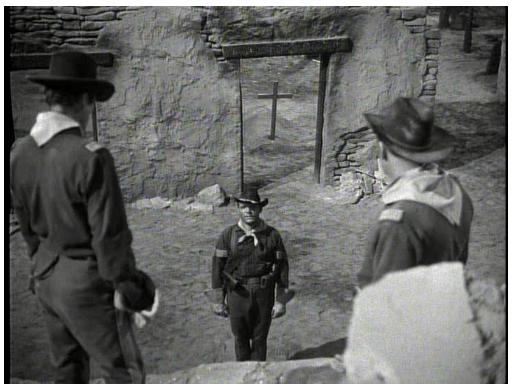
Hoberman places the film both in the context of the cavalry Western and the Korean War. John Ford’s Fort Apache is one of the touchstones of An Army of Phantoms, artfully reflecting the siege mentality of the cold war, presenting a “vision of total mobilization with an appropriate emphasis on order and eternal vigilance: militarized suburbia. The bombing of civilian populations in World War II suggested that the next war might have no front – or, rather, that the front might be in America’s living room.” While the cavalry posts of Fort Apache, Rio Grande and She Wore a Yellow Ribbon are functional mini city-states, with space for romantic subplots and ritualized dances, Only the Valiant takes place in a world without leisure time. As Hoberman reported, Only the Valiant was released soon after President Truman dismissed General Douglas MacArthur from his command,  and the war entered the stage of a long, bloody stalemate, as fears of WWIII continued to percolate. People were dying and no ground was being gained. This is the desperate situation of the men in Only the Valiant.

The shambolic, pained performance of Gregory Peck adds another shade of dread to the film. Peck wanted nothing to do with the project. He was loaned out by David O. Selznick against his wishes, but the great producer was in financial trouble, and netted $90,000 in the deal. Peck felt it was a cut-rate script made by an undistinguished director, but he showed up for work anyway. Biographer Gary Fishgall claims that Peck was taking Seconal to help him sleep, while also drinking heavily throughout production. There are also widely reported stories that he had an affair with his lead actress, Barbara Payton, although he later banned her from the set unless she was in a scene, at least according to Payton’s autobiography, I Am Not Ashamed (the title refers to her later career as a prostitute). He suffered a physical collapse a month after shooting, during a costume fitting for David and Bathsheba. The doctors at Cedars of Lebanon diagnosed “nervous anxiety”, and told him he did not have a heart attack.

Bitter and out of sorts, Peck is magnetically unsympathetic in Only the Valiant, distressingly passive in the face of slander and death threats, and seems to have vengeance on his mind in his selection of the Fort Invincible detail. There is a powerfully disconcerting scene where Peck’s Captain walks down the line of his rag tag crew and tells them why he chose them. It’s a scene of chilling vindictiveness, and not unlike an impromptu HUAC hearing. Gordon Douglas was a staunch anti-communist, having already directed the nuclear commie spy film Walk a Crooked Mile in 1948, and would line up I Was Married to a Communist in the FBI later in 1951.

All of the characters’ fears coalesce in the mountain pass near Fort Invincible. Shot in sequences of lantern-lit flickering darkness, this gaping maw brings out the worst in the men. They splinter and attack each other, warring within and without. The further they descend into primal violence the more it feels like a gothic horror film or monster movie. One of the young recruits,  a cowardly bugler, creeps through the pass on a pitch black night, and in the bottommost portion of the frame a bloody hand jumps out to a jolt of strings on Franz Waxman’s score. One expects a Mummy or Wolfman to reveal its wretched face, but no, it’s just another dead man.

ADVENTURES IN VOD: WILLIAM WITNEY & ROY ROGERS

January 11, 2011

witney

In December, a truckload of William Witney-directed Roy Rogers films were dumped onto Netflix Instant. I was clued into this trove by a conversation between Jaime Christley and Vadim Rizov on Twitter, an indication of why I’m addicted to this unruly microblogging service. As a source of cinephile news-gathering, it’s essential, and more than enough reason to endure the self-righteous posturing that flares up every so often.  Witney’s one of the anonymous artisans who pumped out movie serials for the Mascot and Republic studios, often in tandem with John English. He’s credited with 130 film and television projects at IMDB, and it’s a rather daunting corpus to approach without direction. With supporters as diverse as Quentin Tarantino and Dave Kehr, I took this Netflix cache as a sign I should dig in further (the only one I’d seen before is his so-so Apache Rifles, which I wrote about here). So I sat down with the earliest films on the list: Roll On Texas Moon (1946) and Home In Oklahoma (1946).


As usual, the quality control on these streams leaves something to be desired. First, the version of Roll on Texas Moon presented is the 53 minute television cut. The theatrical version runs 68 minutes. Poking through the site, it seems most of them contain the television versions, although there are a few full edits, which run closer to 70 minutes, including Home In Oklahoma. The first thing to strike me about these programmers is they’re deceptively dark tone. Roy Rogers is an aw shucks stand-up gentleman, and Dale Evans a bright-eyed sprig of independent femininity, but the world they inhabit is violent and strange.

In Roll on Texas Moon, there is a long standing feud between the sheep-herders and the cattle-men that once exploded into a bloody range war. Gabby Hayes, the lovable old coot axiom of the Rogers films, is a cow man, and can’t stand those “dag blasted woolies.” Someone is rustling the sheep on the Ramshead farm, threatening to escalate tensions into a shooting battle once again. Eventually an evening of dinner and song ends in a Mexican standoff. The culprits are eventually brought to justice, but not before a ram is shot in the face offscreen, and a vigilante force led by Rogers faces down the band of desperadoes. Each side suffers heavy losses in the shootout. These are remarkably grim images for a lightly comic Western-musical.

While it’s been cut down, it’s obvious Witney has a natural flair for framing action. When a chase ramps up, he lays down a blazing fast tracking shot (aided by some under-cranking) that pulls back right in front of a pursuing Rogers, or his stuntman pulling off some incredible side-saddle riding. Then he cuts to the reverse angle, zooming forward towards the dastardly evildoer. The sense of danger, for both the cameraman and the rider, is palpable. In isolating each figure in their tendon wrenching moment of tension, and by using an unusual head-on angle, he has the riders speeding right at (or away from) the audience. It’s an enveloping kind of action cinema.


This continues in Home In Oklahoma, which is presented in its uncut 72 minute length. This time the chases are necessitated because of the muckraking journalism of Rogers, here the editor of the Hereford Star. Evans is the city girl, an impulsive Torchy Blane type, from a St. Louis paper reporting on the death of a big-time ranch owner. The set-up is pure Nancy Drew, with the defining clue coming in the family hymnal. But the pleasures of these films are not in the story-telling, as Witney has to speed through gobs of exposition before he can break out an arcing crane shot of a rollicking ranch breakfast or capture Rogers crooning the bittersweet, unsatisfied tune, “I Wish I Was a Kid Again” (short form: as a kid I dreamed of adulthood, as an adult I dream of my childhood).

In keeping with the incipient brutality of the worlds Rogers and Evans must live in, the main villain, a lovely sadist named Jan (Carol Hughes), attempts to kill a small boy in order to inherit his ranch. She also ruthlessly shoots a few less-able men in the back. These hapless corpses take their tumbles in some extraordinary stunt work by Witney’s crew, who are seemingly game for anything. One brave soul falls over a small waterfall, while two bruisers take turns tackling each other on an open-air platform on a moving train. This is rough and tumble cinema made with fearlessness and charm, as well as the inimitable tones of the Sons of the Pioneers.

I’m very curious to explore the rest of his career – and if anyone has recommendations of essential titles, or a copy of Witney’s autobiography they’re able to sell at a reasonable price, I’m all ears. In a Door, Into a Fight, Out a Door, Into a Chase is only available at upwards of $40, and the samples available on Google Books are tantalizingly rich. Another exciting subject for further research.

TRUE GRITS

December 14, 2010

true grits

Regrettably, this post is not about the cookbook True Grits: Recipes Inspired By the Movies of John Wayne. My apologies to writers Lee Pfeiffer and Michael Lewis, although I do intend to make  “They Were Eggspendable” (p. 6) and “Hondocakes” (p. 12) for breakfast this weekend. No, instead I’ll be considering Charles Portis’ 1968 novel, True Grit, and the film adaptation by producer Hal Wallis and director Henry Hathaway the following year. All of this was spurred, of course, by the Coen Brothers’ take on the material, still named True Grit, which comes out on December 22nd.

Portis’ novel is anchored by the starched voice of Mattie Ross, a stiff-backed Presbyterian who recalls the grim events that followed the murder of her father, Frank. Narrating the tale as a prim spinster in 1928, she details, with stark Old Testament morality, how she earned her revenge as a young girl from Dardenlle, Yell County Arkansas (she intones her birthplace to strangers like a prayer) in 1873. She is decisive and declamatory, with an eye for irrelevant bits of history. When the trail of the murderer snakes through Indian Territory to a supply store , she dryly notes: “The store is now part of the modern little city of McAlester, Oklahoma, where for a long time ‘coal was king.’ McAlester is also the international headquarters of the Order of the Rainbow for Girls.” There is a bit of the schoolmarm in her, eager to educate as much as to “avenge her father’s blood.”

It is her voice that captivates, a preternaturally calm control stabbed with stubborn wit, rarely exhibiting the childishness of her age. As Ed Park wrote in his epic ode to Portis in The Believer, “Her steadfast, unsentimental voice—Portis’s sublime ventriloquism—maintains such purity of purpose that the prose seems engraved rather than merely writ.”  I could only detect one scene of playfulness – when she asks her two lawmen to act out a ghost story around the fire. These two men, Marshal Rooster Cogburn and Texas Ranger LaBoeuf (he prononunces it “LaBeef”), are far more immature than Mattie, at one point wasting a third of their corn dodgers for an impromptu shooting competition (not dissimilar to Montgomery Clift and John Ireland’s macho shoot-off in Red River).

Cogburn is an inveterate drunkard and former member of Quantrill’s Raiders, a Confederate guerrilla group. He’s also a Federal Marshal who had killed over 20 men since his short time wearing the badge, a fact which led Mattie to choose him to help her find the killer, Tom Chaney. Incapable of a domesticated life (“Men will live like billy goats if they are let alone”), he thrives on the deprivation of the outdoors. LeBoeuf is handsome, conceited, and a bit of a dandy. Upon first seeing him Mattie remarks, “His manner was stuck-up and he had a smug grin that made you nervous when he turned it on you.” Despite that, “he made me worry a little about my straggly hair and red nose”, one of the other rare notes of vulnerability in her bullish persona.

Mattie is a shifty, opaque creation, and endlessly fascinating. She’s a whip-smart girl who turns personal history biblical (her vengeance on Chaney, who is physically marked like Cain, recalls the Old Testament God), and biblical history local (she quotes verse to settle daily disputes). She stubbornly sits still on the ledge in-between, refusing to concede her pragmatism or her divine beliefs as rattlesnakes nip at her flesh.

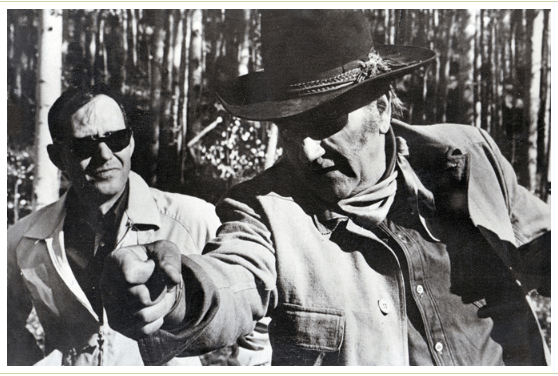
Before the book was published, Portis’ agent passed out galleys to the major studios, setting off a minor bidding war. According to Randy Roberts and James Stewart Olson in John Wayne: American, Wayne’s production company, Batjac, submitted a bid of $400,000, but it was issued after the deadline had closed. The rights were awarded to Hal B. Wallis, whom Wayne soon wooed to land the part of Rooster Cogburn. The role of Mattie Ross was originally offered to Mia Farrow, who turned it down, supposedly on the advice of Robert Mitchum, and it was eventually given to Kim Darby, a little-known TV actress.  Robert Duvall snarls through the film as gang leader Ned Pepper, and Dennis Hopper has a bit part as a squealer at the same time Easy Rider was unspooling, a portentous straddle of Old/New Hollywood.  Wallis switched the shooting location from Arkansas to Montrose, Colorado, in the western slopes of the Rockies, over Portis’ objections.

Hathaway and Wallis lightened the tone of of Portis’ more fatalistically comic work, turning it into an agreeably swashbuckling affair centered on Cogburn, whose rough edges and thieving past are sanded down to an inoffensive nub (Dave Kehr opted to call it “cutesy-poo”). There is no voice-over, which eliminates many of Mattie’s idiosyncratic asides, and the ace DP Lucien Ballard’s cinematography here is made up of bright and airy postcard shots that looks like a well-funded autumnal Coors commercial. It lacks the textural menace of nature in the book, in which cold and hunger attack as much as Chaney.

Wallis’ True Grit, then, is an entirely new work, with only a surface relationship to Portis’, and shouldn’t be limited, or belittled, solely in comparison to the book’s greatness. It was transformed into a John Wayne star vehicle as he was transitioning into more cantankerous character parts, so the film was rigged up into a sturdy, eager to please example of old Hollywood craftsmanship. Stocked with stellar supporting performances from Duvall, Hopper, Strother Martin, and even Glen Cambpell as the preening pretty boy LeBouef, it’s a companionable if not resonant bit of Saturday afternoon entertainment.

In a revealing exchange, Henry Hathway recalled the arguments he had with Wayne over wearing the eye-patch:

When he was first put to it, Wayne told me, ‘I’m not gonna wear that patch on my eye.’ He said, “I’m not an actor to begin with, I’m a reactor, and no way will I wear a patch.”

This is a wonderful pocket self-analysis from Wayne of his work – he’s such a superb and sensitive performer because of how he reacts to the actors around him. Some of his best work is in backgrounds – think of his proud, fatherly gaze and reluctant gait in Rio Bravo as he stands outside his circle of friends singing in jail – maneuvering his bulky body to convey the resignation of old age and the burdens of leadership. He’s one of the finest collaborative actors, whether it’s sparking off Montgomery Clift in Red River or bending towards Maureen O’Hara in Rio Grande like a weed to the sun. In donning the eye-patch, he becomes the buffoon being reacted to, a gallumphing showboat rather indifferent to the performers around him (Kim Darby is unmoored and affectless as a result). But his self-parodistic grunting and hamming stirred the dozing Academy voters, who awarded him his first and only Oscar for best actor.

WOODY STRODE AND SERGEANT RUTLEDGE (1960)

Originally published at Movie Morlocks, the official blog of Turner Classic Movies

August 3, 2010

Screen Shot 2020-01-24 at 4.41.33 PM

When John Ford decided to cast Woody Strode in the title role of Sergeant Rutledge, Warner Bros.  pleaded with him to cast a better known actor like Sidney Poitier or Harry Belafonte. Ford replied, “They aren’t tough enough.” That story, relayed by Joseph McBride in his Searching for John Ford biography, defines the mystique of Woodrow Wilson Woolwine Strode. With his taciturn manner and wiry athleticism, he was an immediately arresting presence on-screen. He brought more than an intimidating physicality though, secreting a constant melancholy behind those hooded eyes and chiseled face.

His tough-guy credentials were unassailable. He was a tight end at UCLA, blocking for star running back Kenny Washington. In their senior year of 1939, they shared the field with Jackie Robinson (they were called  “The Gold Dust Trio”) and went undefeated, ranking 7th in the year-end AP poll. But in the years immediately following graduation, they were blocked from joining the NFL because of their race. From 1934 – 1946, there was a gentlemen’s agreement of sorts between league owners not to sign black athletes, despite the success of players like Fritz Pollard in the ’20s.  In the prime of their careers, Strode and Washington played for the Hollywood Bears of the Pacific Coast Football League (PCFL).  In 1946, they broke the re-instated NFL color barrier by signing with the L.A. Rams after an intense campaign by sportswriter William Harding. (for the full story, read Alexander Wolff’s great article in Sports Illustrated). Strode told Wolff, “They didn’t take Kenny because of his ability. They didn’t take me on my ability. It was shoved down their throats.”

Strode was already 32 years old, and he was cut after one forgettable season (Pro Football Reference shows he played in 10 games, and caught only 4 passes, although he was probably a solid blocker). Washington lasted for three intermittently productive years. It was a disillusioning experience:

“Integrating the NFL was the low point of my life,” Strode told SI in an unpublished interview before his death. “There was nothing nice about it. History doesn’t know who we are. Kenny was one of the greatest backs in the history of the game, and kids today have no idea who he is.”
“If I have to integrate heaven, I don’t want to go.”

In 1948, he moved to the Canadian Football League (CFL), to greater success. Playing both offense and defense, he led the Calgary Stampeders over the Ottawa Roughriders to win the Grey Cup, 12 – 7. He played for two more years, and helped pay the bills by working as a professional wrestler during the offseason.

By 1951, he was ‘rasslin full time. In his autobiography, Goal Dust, he reminisced about balancing fighting and entertainment:

It’s a thin line between the showmanship and the straight wrestling. Straight wrestling is too dull. If I’ve got a headlock on you and stop your circulation, you’ll faint. They fans won’t pay to see that. The real artists can hit you without doing any damage. They can throw a punch and land it right on your skin. That’s how good you have to be. The guys who miss are not good.

While honing his acting skills in the ring, he started to get regular work on television and film as an exotic other, his first regular gig a stint on “Ramar of the Jungle” as a native named “Big Boy”.  His film work was more of the same stereotyped nonsense until he nabbed a part in Lewis Milestone’s Pork Chop Hill in 1959. It was on that set where he caught John Ford’s eye, as told to Frank Manchel, excerpted in Volume 25, Vol. 2 of The Black Scholar:

[Pork Chop Hill] is the first dramatic thing that I had done, and he [Ford] was on the same lot with me, and he sent his chauffer over to find me. So I went over to see him, and he says, ‘I hear you’re trying to be an actor.’ At that point I was wrestling for a living, and I said, ‘Oh, I’m just making a little money.’ He said, ‘I’ll tell you what, Woody. I got a little job for you, and I’ll tell you about it when I get through with this picture I’m doing.

Ford was finishing up The Horse Soldiers (1959), and in the meantime Strode caught bit parts in Spartacus (1960) and The Last Voyage (1960). Eventually Ford, who always referred to his profession as a “job of work”, must have admired Strode’s similar attitude, handed him the title role to Sergeant Rutledge.  For contractual reasons, Jeffrey Hunter and Constance Towers were given lead billing, while Strode was merely listed as a featured player, but he is the heart and soul of the film. It is a courtroom drama that documents the court-martial trial of Sergeant Braxton Rutledge, an officer in the Ninth Cavalry Regiment (nicknamed the “Buffalo Soldiers”), accused of the rape and murder of a white teenage girl (Toby Richards) and her father, his superior officer. Hunter is the earnest, conflicted defense lawyer who argues the case in front of the distracted, buffoonish panel of Army judges.

The script, by James Warner Bellah and Willis Goldbeck, was inspired by a Frederic Remington picture “of black calvarymen on the western frontier.” Without access to their first draft, Joseph McBride reports on Bellah’s novelization of the film as “patronizing”, and that “Rutledge seems less intelligent in the book than he does on-screen, and the author finds a familiar outlet for his prurient racist fantasizing….” Suffice it to say that Ford made major revisions to the screenplay before it was finalized – McBride reports he spent ten days with the writers fixing it up. Strode remembers the script fondly: “it was so well written…. When I say them lines, I still feel it. Do you hear me?”

It is Ford’s most straightforward film about race, placing Strode’s soldier as a good worker (his highest compliment) railroaded  by a justice system riven by bigotry. But there is ambivalence threaded throughout Sergeant Rutledge that makes it much more than a simple message movie. It is clear Ford is making a case for racial equality, but beyond the conclusion of this one individual case, he doesn’t offer much hope. The panel of judges are amusing but clueless drunks, the lead prosecutor a race baiter, and the Buffalo Soldiers themselves despair as to their place in society. As Moffat, one of the 9th Regiment, is dying, he tells Rutledge, “Some day. You always talkin’ about some day, like it gonna be Promised Land here on earth. Brax! We’re fools to fight the white…white man’s war.”

Rutledge tries to reassure him that they are not fighting the white man’s war, but that they fight in order “to make us proud.” Ford’s grand theme had always been about building communities (the church-raising scene in My Darling Clementine is the peak of this strain), but there was a skepticism regarding official institutions that ran throughout (the sheriff at the beginning of Clementine is a coward), but he found men who could do their jobs in spite of it all. The 9th regiment is not sacrificing their lives for the United States, but for their self-respect, and in this sense falls in line with the tension in Ford’s work between the individual and the community that he’d been mining his entire career. Earp leaves town at the end of Clementine, leaving the civilizing to others, but Rutledge soldiers on in order to empower more young black men. In his most dramatic speech, and probably the finest piece of acting he put on film, Strode responds to the prosecutor’s goading about his refusal to desert. It was “because the Ninth Cavalry was my home. My real freedom. And my self-respect. And the way I was desertin’ it, I wasn’t nothing but a swamp-runnin’ ni**er. And I ain’t that! Do you hear me? I’m a man.”

In collaboration with the great cinematographer Bert Glennon (Stagecoach, Wagon Master), Ford shoots Strode from dramatic low angles and pushes the artifice to an expressionist degree during the witness’s flashback testimony. It is Ford’s most theatrical film, or at least the most self-reflexively artificial, allowing him to shoot heroic shots of Strode that might have made John Wayne blush. There are some shots that look like Strode is posed in front of a moonlight drenched Casper David Friedrich painting.

But the most telling sequences come at the end. After the rote romantic clinch between Jeffrey Hunter and Constance Towers is finished outside the courthouse, the Buffalo Soldiers march in formation past them, and towards the camera. It is a remarkable hand-off between the ostensible, contractually obligated stars, and the real ones. The final shot shows the regiment riding over Monument Valley, and regardless of the fact that the film was a flop, it contained indelible images. In 1971, Strode told Charlayne Hunter of the New York Times that, “You never seen a Negro come off a mountain like John Wayne before. I had the greatest Glory Hallelujah ride across the Pecos River that any black man ever had on the screen. And I did it myself. I carried the whole black race across that river.”

THE RIFLEMAN (GUEST STARRING DENNIS HOPPER)

Originally published at Movie Morlocks, the official blog of Turner Classic Movies

June 1, 2010

c946df573db05e3afab8b162b4eb6fb2

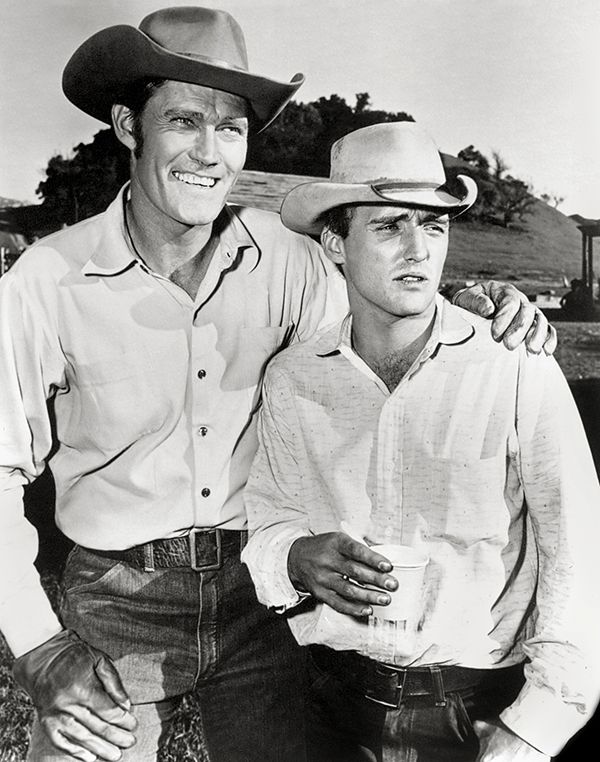
Fifty episodes of THE RIFLEMAN (1958 – 1963) are available for viewing on Hulu, and it’s a phenomenally rich show for auteurists (and everyone else). Sam Peckinpah was the lead writer (and directed two episodes), while Joseph H. Lewis (Gun Crazy) directed a large chunk of the rest. It’s a dynamically shot program, with agile use of push-ins and close-ups, and a strong use of depth-of-field, all swiftly illustrating Peckinpah’s surprisingly violent universe. And then there are the actors, which along with Chuck Connors’ granite-faced realist includes R.G. Armstrong, Warren Oates, and a baby-faced Dennis Hopper in the pilot episode, “The Sharpshooter.”

I learned of Hopper’s passing soon after viewing his tender, soft-spoken performance as the titular marksman Vernon Tippert, and it’s as fine a tribute to his talents as any (for a complete overview, check out Matt Zoller Seitz’s great video montage up at Moving Image Source).  Hopper was only 22, but he was already a television veteran, having done guest spots on “Cheyenne” and “Zane Grey Theater” (along with theatrical bit parts in Rebel Without a Cause and Giant). Tippert is a sad-eyed youth, driven from town to town to hustle shooting contests by his grizzled, greed-addled uncle Wes. The Rifleman, Lucas McCain (Connors), and his son Mark (Johnny Crawford), arrive in the town of North Fork after the (never explained) death of his wife. Lucas is there to compete in a Turkey Shoot in order to raise money to buy a ranch, and Vernon is there to win money for his uncle and the town’s mob boss (Leif Erickson) who is rigging the contest to win his bets. McCain tanks the event to avoid the violence aimed at Mark, but he runs the gang out of town with his rapid-fire rifle by the end.

Tippert is unfailingly polite, almost courtly in his manner, especially when dealing with the McCains, who have achieved a level of familial stability alien to him. He meekly walks into the dining room, hands clasped in front, before accepting an invitation to eat lunch with Mark.  Hopper speaks lowly, tentatively, and keeps his eyes locked down at the table, even though Mark hasn’t hit adolescence. He moves like a wounded pup. Then they trade stories of loss – Mark mentions the death of his mother, Vernon tells him he never had one. He starts to lock eyes, and after Mark asks him, “Does it bother you that you never had a ma or pa?”, he replies, “I reckon.” Then he turns his head down and traces a figure on the table with his finger. He continues, “sometimes it bothers me considerable.” He jolts back up in his seat when the waitress appears, out of his reverie, and jump-starts the narrative. It’s a bracingly raw scene that rides entirely on Hopper’s cagey vulnerability.  Because while Crawford is an appealing presence, he does little more than read his lines on cue with an ingratiating smile.

The whole episode is startling, from its cynicism regarding state institutions (the Sheriff (R.G. Armstrong) is little more than a pawn) all the way to its frank discussions of death and loneliness. While “The Sharpshooter” came from Peckinpah’s script, a whole host of collaborations occurred to get it to the screen. The production company Levy-Gardner-Laven had a title for a TV show, but no script. After cycling through some bad teleplays, Jules Levy invited Peckinpah to their Culver City studios for a meeting. According to Peckinpah biographer David Weddle (If They Move…Kill Him is my main source), Sam said he had a script laying around to match their concept, and brought in “The Sharpshooter.” In his original script, McCain is childless, and it ends with him intentionally losing the contest because of the gang’s threats, and leaving town in shame. Arnold Laven, who directed the episode, recalled:

That was the end of the story…the cynicism and the reality placed against the romantic image of the West. We loved the writing, but the ending, you just couldn’t get that sponsored in 1958. I don’t know if you could get it sponsored today, to tell you the truth – a guy who doesn’t have the courage of the West – to stand up for what is right.

Laven suggested adding the child, which would give Lucas an acceptable reason for bowing to the pressure of the gang. Peckinpah incorporated this, and then added the heroic shootout which would set the pattern for the series: McCain continually derides the use of violence, but is forced into using it at the end of almost every episode. The reluctant warrior bit has worked since the age of Cincinnatus, and Peckinpah and co. wring every variation out of the material.

Peckinpah’s touch becomes even more evident in his directorial debut on the show, “The Marshal”, which features an embryonic version of his stock company. The episode includes R.G. Armstrong, Warren Oates, and James Drury, who would all later appear in his feature debut, Ride the High Country. The episode concerns the character of Micah Torrance (Paul Fix), a former peace officer turned alcoholic. His addictions are contrasted to the Sheltin Brothers (Drury and Oates), two probable psychopaths who are out to kill Torrance for shooting them years before. The Sheltins are pure id, hollerin’ and screamin’ and tearin’ up the local bar (twice). They are two sides of dissolution, implosion and explosion. Laven advised Peckinpah on his early directorial work, and he remembered:

Sam’s Rifleman shows had an inherent underlying violence. There was something unreal when the Rifleman would shoot three guys, there was a pattern it stayed within. But Sam made it much more deadly, much more real.  It was a little unsettling…

Peckinpah comes up with some great lines that surround the bloodshed. Torrance pines for a drink: “I’ve got a case of the whips and jingles.” The Sheltins are asked to sign the hotel log: “We ain’t spellin’ men.” In a similar strategy to John Wayne’s character in Rio Bravo, McClain treats Torrance with tough love, working him hard on the farm and refusing to show him pity. Eventually he comes around, and, like Dean Martin, returns to join the law. Fix would go on to play Marshal Torrance for the rest of the series.

There is so much more material here I haven’t had time to explore, including Joseph H. Lewis’ contribution, which early on seems to be the most visually complex. And then there’s producer-director Arnold Laven’s anonymous craft, which he also brought to shows like Hill Street Blues and The A-Team. Laven passed away just last year (read The Guardian obit here), and his career seems to scream out for re-evaluation, or any evaluation at all.

I’ll leave you with the opening credit sequence, which in its purity and abstraction, is the best ever, in my opinion. Chuck Connors’ eyebrows speak multitudes. Watch here.

RAOUL WALSH REMAKES HIMSELF

February 9, 2010

raoul walsh

The top image is from High Sierra (1941), of Humphrey Bogart slugging Alan Curtis in the jaw with his pistol. The bottom image is from the same scene in its remake, Colorado Territory (1949), of Joel McCrea knocking out James Mitchell with a meaty right hand. Both films were directed by Raoul Walsh – the first a gangster movie, the second a Western. Historically speaking, High Sierra is more important for its crystallization of the Humphrey Bogart persona: mulish, bitter, doomed. His good-bad guy Roy Earle was originally slated to be played by both Paul Muni and George Raft, until their queasiness with the script paved Bogart’s way to stardom. And so, it receives a fine DVD transfer and continuous play on TV and at repertory theaters.  Colorado Territory has no such claim to history, except as a superior piece of genre filmmaking, so it receives a beat-up, fuzzy transfer in the Warner Archive. So it goes.

It’s fascinating to compare the two films in how they approach narrative, set-design, and performance. Let’s get the basic story out of the way (spoilers!) before I chart some of the divergences: a feared heist-artist gets out of jail, and is hired for one more big job by his aging, sickly boss. On the way to his target, he falls in love with a fresh-faced gamine, who eventually rejects him for a younger guy back home. Taking up with the salty dance-hall girl who loved him all along, he tries to escape with his latest haul, but gets chased into the mountains and gunned down from afar.

The shift in time-period (from contemporary to turn-of-the-century) completely changes Walsh’s visual palette. Most of High Sierra takes place in bland indoor spaces: a cabin hideaway, a grubby motel room, a swank hotel lobby. These are spaces of transit, areas that Earle can abandon at a moment’s notice. The only semi-permanent space is the suburban home where his club-footed teenage crush resides (played with sickly sweet naivete by Joan Leslie), where a rather unendurable stretch of doe-eyed sentiment lands, running completely counter to Bogart’s cynical demeanor in the rest of the film. It is not one of screenwriter John Huston’s finer moments, and drags down the film for me as a whole. The author of the novel, W.R. Burnett (Little Caesar), was brought on for rewrites to satisfy Paul Muni, but I think most of the blame for the clunky structure can be placed on Huston. This section excepted, however, the sets emphasize impermanence, banality, and lassitude, which Bogart slides into with ashen brutality. It’s an incandescent performance, but the film doesn’t hold up around him.

Colorado Territory is the inverse. McCrea is a competent, but much less nuanced performer, so Walsh invests Bogart’s menace in the set design, compresses the storyline to emphasize his athleticism, and opens up the visual space for more propulsive action. He builds around him – and creates a much more complete work of art. McCrea’s Wes McQueen is truly defined by the landscape here, where in High Sierra Bogart is left adrift in a sea of John Huston’s exposition.

The main settings in Colorado Territory are a  decrepit Spanish mission town, a moving train, and a more extended stay in the mountains (shot in and around Gallup, New Mexico). The mission town is abandoned, just a complex latticework of collapsed roofs, beams and crosses (the art direction was by Ted Smith, the set decoration by Fred M. MacLean). It’s a far denser space than Earle’s cabin hideaway, and potently expresses the sense of imminent destruction that High Sierra mainly locates in Bogart’s brilliant broken down mutterings. And where Bogart’s heist takes place in static medium shots for a hotel safe-cracking, McCrea’s occurs in a thrilling moving train takedown – a hurtling sequence that pushes the pace forward through the end of the film. It telescopes Earle/McQueen’s crush on the young girl into a few sparkling scenes (moved along by Dorothy Malone’s more mature, flirtatious performance), introduces a melancholic backstory with a few well-placed lines (the memory of a lover’s face), and emphasizes his physicality with a gruesome bullet-plucking scene. Virginia Mayo rips it out with suspicious skill, a clever way to fill in her previous life with nary a word spoken. Her dance hall gal  is conflicted and fiery throughout, unlike High Sierra’s Ida Lupino, who switches from bad girl to agreeable wife material with one slice of the editor’s guillotine.

Wes McQueen is thoroughly subjugated to the nature around him, a speck on the locomotive at his successful heist and a dot in the valley before he’s gunned down. High Sierra pulls a similar comparison, but with less narrative compression. There are detours into a city park as he moonily stares at the sky, and to his old family farm where he talks catfish with a young boy – excess scenes that exist merely to fill in backstory. In Colorado Territory, Walsh finds a way to squeeze in these details in the midst of the action – making for a spring-loaded, densely told tale, crisply shot by Sid Hickox, who Walsh called “the best and fastest cameraman of them all.” (and who also shot White Heat the same year). Walsh valued speed above all, having directed near 140 films in his astonishingly varied career.

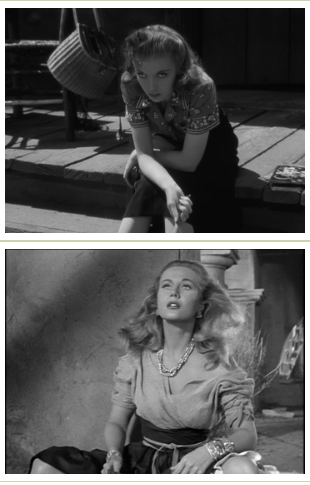
This post has been mainly about contrasts – but I’ll end with similarities. These films were shot 8 years apart, but Walsh uses some of the same setups to remarkable effect. First there is the introduction of the respective dance-hall girls – who are first shown obscured. Ida Lupino is hidden behind a tree, and then Walsh cuts to a shot of her feet before panning up to her suspicious face. Virginia Mayo is also introduced seated, her head down as she musses her hair, before another dramatic head-raiser, eyes blazing.

raoul walsh2

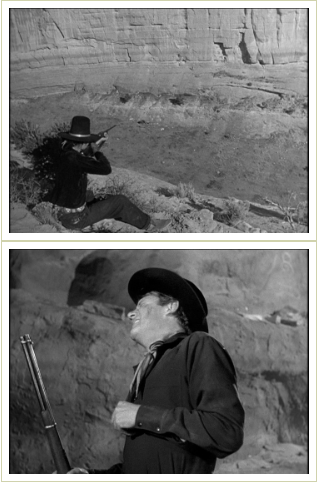
Then there is the final shoot-outs, which are both remarkable for their extreme long shots from the killer’s POV, emphasizing the distance and ease with which the deed is carried out. Their murder is impersonal, enacted by a stranger, almost as if the land was reclaiming them for itself. The top two are from High Sierra, the bottom two are from Colorado Territory:

raoul walsh3raoul walsh4

JOHN FORD’S WAGON MASTER (1950)

September 22, 2009

hqdefault

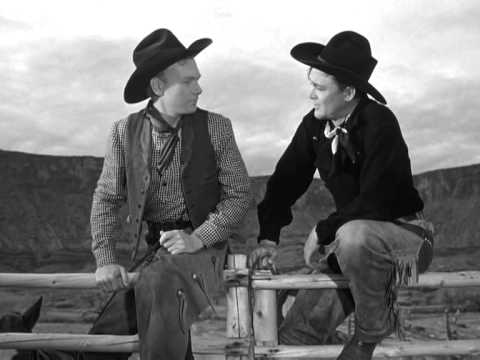
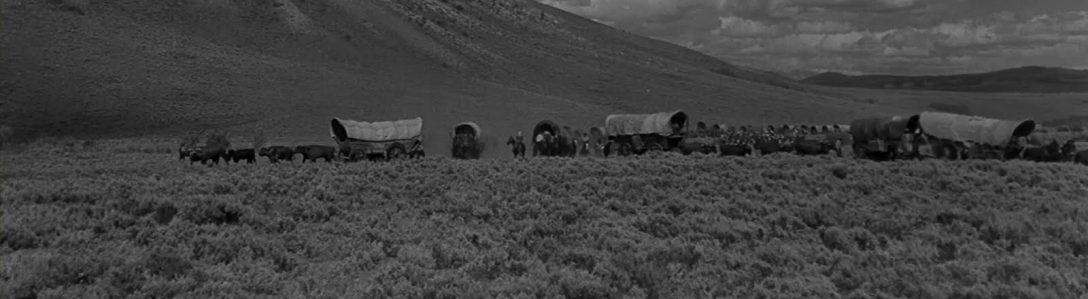
Two horse traders straddle a wooden gate in a stationary medium shot. The boyish one, Sandy (Harry Carey, Jr.) doffs his hat in an exaggerated curtsy to the passing Mormon travelers. The ruddy-faced Prudence (Kathleen O’Malley) peeks back nervously from her cart, embarrassed to display her interest in the cute stranger. Sandy whoops it up even more in response, waving his cap with adolescent bravado. He turns to fence-mate Travis (Ben Johnson), lamenting the fate of “all those women and children” making the journey across the desert towards the San Juan river. Travis gibes, “yeah, and that red-headed gal” too.  After the wagons recede into the distance in a painterly long-shot composition lensed by DP Bert Glennon, Sandy turns to Travis and starts singing: I left my gal in old Virginny. And Travis finishes the phrase, fall in line on the wagon train. Without further deliberation (aside from another verse), he tells Sandy, “looks like we got a job.”

It’s no surprise it took this long for Wagon Master to appear on DVD. It contains no stars, and the entire film proceeds on this soft-spoken, economically paced path. But thankfully Warner Brothers brought out this sublime piece of Fordian drama last week, in a stunning transfer that includes an anecdote-rich audio commentary with Peter Bogdanovich, Harry Carey, Jr., and an early sixties interview with Ford himself.


In the simple scene I described, John Ford compresses the story material, Sandy and Travis decide to lead a Mormon wagon train, into a ballet of gestures and emotions. He turns a basic scene of exposition into an expression of character: Sandy is impulsive and sentimental, Travis is contemplative and decisive. He conveys this through the twirl of Sandy’s hat, the curl on Travis’ upper lip, and the ease in which they fall into song. It’s an adventure they cannot pass up, for the moral reasons Sandy sets forth, but also for the pure romance of the journey. When Glennon returns to the shot of the wagons receding into the distance, Johnson’s horse races parallel to the fence towards the vanishing point, the plot effortlessly moving forward.

On the audio commentary, Harry Carey, Jr. notes that John Ford was in a great mood during the shoot. So good he thought he might be ill (he was not known for his cheery disposition). Perhaps feeling a little more freedom on this low-budget outing, he made the production a family affair, as biographer Joseph McBride has helpfully noted. He gave his brother Francis, a silent star, a role as a mute drummer, the script was co-written by his son Patrick, his daughter Patricia was the assistant editor, “and the assistant directors included his brother Eddie O’ Fearna, brother-in-law Wingate Smith, and nephew Francis Ford, Jr.”

The mood is laid-back charm and casual mastery. This starts, of course, with Ford’s eye for the landscape of Moab, Utah, but it seeps into the performances of Ben Johnson and Carey, Jr., who were both ace horse riders. Johnson caught Ford’s eye as Henry Fonda’s stunt-man on the set of Fort Apache, McBride relates, when he saved three actors in a munitions wagon from being dragged by spooked horses into a “sheer rock wall.” Ford rewarded him with a seven-year contract. Johnson repays him with a performance in Wagon Master of refined nonchalance, as if he were silently etched out of the Utah landscape by sandstorms, and wasn’t set into motion until Ford and Glennon’s cameras started rolling. This gritty reserve is beautifully played off of Carey Jr.’s aw shucks bashfulness. Ward Bond provides the comic relief as Elder, the hot-headed Mormon always on the verge of cursing and eyed by his own elder, a silently admonitoryAdam Perkins (the extraordinary visage of Russell Simpson). This, as McBride suggests, could have been a subtle jibe by Ford at Bond’s support of the House Un-American Activities committe, which Bond was enthusiastically endorsing at the time. In casting him as a man persecuted and expelled from society because of his ideology, Ford must have been aware of the satiric parallel.

But as much as Ford could ease out the natural humor and personality of his performers, his overriding concern is always that of the community, and Wagon Master is probably his purest statement on the matter. It’s at least the favorite of his films, as the director stated many times. Sandy and Travis become the unlikely leaders of a group of outcasts, all rejected by some facet of society. The two horse traders are derided for their shady profession, while the Mormon’s are being kicked out of town because of their faith. Along the way, the wagon train picks up a trio of drunken medicine show performers, and has a run-in with a sympathetic group of Navajos, who consider Mormons to be lesser thieves than the regular run of white men. Ford envisions this traveling society through his favorite means: the ceremonial dance. He stages two versions – the first a Mormon hoedown, which depicts Carey’s continuing flirtation with Prudence and Travis’ nascent pursuit of Denver (Joanne Dru), the medicine show girl. The beat is kept by a wooden leg, and the group joyously unites in a twirling show of arms, legs, and hopes of utopia. The second is set in the Navajo camp, another circle dance that shocks the straight-laced Mormon women, but which Sandy is enthusiastically joins. These two sequences, along with the music of the Sons of the Pioneers that weave throughout the film (and are occasionally sung by the characters themselves, make the film a kind of “horse opera”, as Tag Gallagher playfully mentions in his critical study John Ford: The Man and his Films.

This is a film where the plot takes a backseat to gesture, landscape, and character. There is a conflict and a resolution, ably provided by Charles Kemper as the huffing and puffing Uncle Clegg, leader of a family of thieves, but it’s handled so swiftly and without emphasis it’s obvious Ford’s concerns are elsewhere. He’s focused on the manner in which Ben Johnson whittles a stick of wood, Joanne Dru stares from the back of a wagon, or Harry Carey twirls his hat. After watching Wagon Master for the first time, you’ll consider it minor, a trifle of Western whimsy. Then images will linger in your mind, and you’ll wonder why. It’s a mastery that sneaks up on you, that speaks quietly and calmly about a world within our reach. The image that stuck with me this time is Ford pushing in slowly on Joanne Dru, after she rejected an oblique offer of marriage, reflectively smoking at the back of a wagon, weighing the value of her independence. Next time it will be something different, and, of course, something extraordinary.