UNFOLLOWING THE GOLDEN RULE: GOOD SAM (1948)

August 26, 2014

Annex - Cooper, Gary (Good Sam)_NRFPT_02

“I’ve tried to break him of it…but he just loves people!”  -Lucille (Ann Sheridan) complaining about her husband Sam (Gary Cooper) in Good Sam

In 1948 Leo McCarey was coming off the biggest hits of his career, as Bing Crosby’s singing priest in Going My Way (1944) and The Bells of St. Mary’s (1945) topped the box office. Both films were amiable attempts at humanizing Catholicism, moving from the inaccessible Latin mass to the lucid curative powers of pop crooning. They also feature McCarey’s talent for improvisation – Bells features a Nativity scene enacted by children who replace “O Holy Night” with “Happy Birthday”. For Good Sam, McCarey again returned to a religious theme, placing a man of saintly selflessness in the bourgeois suburbs. Sam’s insistence on giving away his time and money to those around him frustrates his wife Lucille, who has to deal with the human consequences of his do-goodism. That is, she has to care for all the strays he brings home as their nest egg slowly dissipates. Lucille is the cynical realist to Sam’s idealist Christian (they’re Episcopalian), but their love allows them to bridge the philosophical gap. It is, for the most part, a bitterly funny film. It posits the impossibility of saintliness in a materialist society, and McCarey mourns this loss through comedy rather than tragedy. Decades later, after the film had disappeared from view, McCarey stated, “the moment was ill chosen to make a film about apostleship.” This fascinating, frequently hilarious apostle-out-of-time feature  is now available on Blu-ray from Olive Films.

Capture

McCarey went independent after directing Going My Way for Paramount.  He formed Rainbow Productions to make The Bells of Mary’s, which was distributed by RKO. He had valuable experience with an independent artist early on. His first job in Hollywood was as an assistant to Tod Browning. McCarey recalled, “From film to film, I had the opportunity to propose ideas because the scenarios we were shooting were all original. It was a unique apprenticeship working with a man who wrote, directed, and edited his films himself.” The Bells of St. Mary’s grossed even more money than Going My Way, and sits at number fifty-one on the all time list (adjusted for inflation), one spot above The Lord of the Rings: Return of the King. McCarey secured the same beneficial arrangement for Good Sam – a Rainbow Production released through RKO.

Good Sam originated with McCarey’s wife Stella. “I was working with Sinclair Lewis on another story and that’s when my wife told me, ‘Why don’t you make a picture about yourself? You’re always doing the most unbelievable things trying to help others.’” McCarey shared the story credit with John Klorer, with the script attributed to Ken Englund, who co-wrote Danny Kaye’s Secret Life of Walter Mitty the year before, another comic tale of a guy too kind to fit into corporate society.

Gary Cooper was going to play Sam Clayton from the start, and he is superb as the reticent nice guy (similar to his Professor in Ball of Fire). On their off days on the Good Sam shoot, Cooper and McCarey were friendly witnesses for HUAC (you can find their testimony here). Good Sam is their comic depiction of the value of religion to American life, of how it looked to them without people living by the Golden Rule. In such a world, saintliness becomes a joke. In his testimony, McCarey joked about why Going My Way and The Bells of St. Mary’s weren’t hits in Russia:

McCarey: Well, I think I have a character in there that they do not like.

Mr. Stripling: Bing Crosby?

McCarey: No; God.

McCarey originally had Jean Arthur in mind for the part of Lucille, though she was unable to take the part. He had run into Ann Sheridan at the Kentucky Derby, who was eager to shed the label of “The Oomph Girl”. She had more than oomph to offer. Sheridan recalled their encounter in Modern Screen: “McCarey’s one of my idols; when I was a stock girl at Paramount he was a big shot there, and I’d always yearned to work with him. I have this mental picture of McCarey in Kentucky. He was standing up and lifting a julep glass when I came into his line of vision. ‘Annie’, he hollered, ‘how are you?’ ‘Fine’, I hollered back. ‘Let’s do a movie together’, he said. I said, “You’re on”, and kept walking”

Annex - Cooper, Gary (Good Sam)_NRFPT_08

McCarey recounts the same meeting in a different issue of Modern Screen, in an article entitled, “My Love Affair with Ann Sheridan”. He was “struck for the nine-hundredth time with what a smick-smack, forthright, clear-eyed, redheaded, realistic gal this Annie Sheridan is.” McCarey claims that after she read the script she said she’d do it for nothing. Warner Brothers loaned her to Rainbow Productions after she agreed to add an extra picture to her WB deal. Though these articles were likely massaged by RKO PR, Sheridan’s excitement at playing a woman without “oomph” palpates off the screen. She is spectacular as Lucille: acidic, absurdist and reluctantly loving. McCarey came up through the slapsticks honing reaction shots, from Charley Chase and Max Davidson to Laurel and Hardy, mastering the art of looking askance at the world crumbling around you. Ann Sheridan has a barrage of exasperated looks to deal with Sam’s gullibility/generosity.

Annex - Cooper, Gary (Good Sam)_NRFPT_07

Early on Sam invites a mechanic over for breakfast – and ends up paying for his neighbor’s repairs. Sheridan is a marvel of amusement and disdain. Upon the mechanic’s entrance she stares at Cooper mischievously, lowering her head and rolling her eyes up, backed by a disbelieving smirk – entertained by the absurdity of her cluttered life. Then the mechanic hands her dirty plates to clear, and the humor turns to contempt. Her eyebrows shoot down and her jaw drops in disbelief. Then a quick recovery into thick, dripping sarcasm. She asks for “the Crunchies too please” in a fake-civilized tone with a plasticine smile. Her hands full of plates, she raises her left arm so the cereal box can be shoved in her armpit – a perfect picture of overburdened domesticity. Staring needles at him, she says “Thank you” in a sing-song voice, and absconds with the dishes. This all happens in fifteen seconds, packing hilarity into every frame.

Her tour-de-force occurs about forty-five minutes in, when the deluge of needy humanity finally breaks her down. But not into tears – she expresses her defeat in an explosive laughter jag. Sheridan consistently shows how Lucille knows how to distance herself – to treat her life as a performance. The inciting incident is the capper to a day of good deeds with bad results. Sam had let his neighbors borrow his car over the weekend. It turns out they got into an accident, and the victim is suing. As Sam is the owner of the car, he will be the subject of the suit. When Sam comes home from work, he is ready to apologize to Lucille for all the hassles he brings home to her, oblivious to the fact that the neighbors are sitting in the living room. Sam’s apology, and his rare criticisms of others, send Lucille into convulsions. “No more Nelsons ruining our dinner, no more Butlers ruining our car”, he says, as Sheridan subtly shakes her head “no”, ramping up the joke she is about to play on him. When he calls Butler a “Four-eyed four-flusher”, she begins to break, the right side of her mouth curling up into a smile, soon followed by the left. She muffles a laugh through her nose. Soon she cracks and then, the torrent. Sam can’t understand why his sweet talk is making her laugh, so he asks, “Does my love border on the ridiculous?” Through choked chuckles she says, “Yes, in a way, yes.” It’s an uproarious scene that emerges out of everyday frustrations.

PWC18

Sam’s generosity keeps backfiring, and eventually he’s squandered the entire nest egg, making it impossible for them to buy Lucille’s dream home. It is Sam’s turn to snap, and he hits the bottle. An alkie wanders into a bar, looking for a drink. The bartender wants to throw him out, but Sam still believes that “all he needs is a helping hand”. The drunk responds, “I can’t remember when I heard a more stupid remark. You’re not really helping me, all you’re doing is boosting your own ego. …You can afford to be condescending.” The idea that altruism is equivalent to self-love sends him into a spiral. He switches clothes with the bum, and seems ready for obliterate himself. A Salvation Army marching band agrees to take him home – the first kind act he’s received all day. This would be a bittersweet, complicated ending, a man of shaken faith receiving a salve.

However, McCarey and RKO opted for a miraculously happy closer that erases the satiric depiction of self-serving materialist United States of the previous two hours. It clumsily channels the communal spirit of the It’s a Wonderful Life finale, but McCarey was always better with couples than communities. As Robin Wood pointed out, he rarely even has time for families (Sam and Lucille have kids, although you’d barely know it). This particular miracle rings false, making Good Sam one of the only times McCarey places his faith in God above that of his characters. In his greatest work, they are intertwined, as in the transcendent, sanctified union of Love Affair, or the unspoken affection of a priest and a nun in The Bells of St. Mary’s.

The January 17, 1948 Showman’s Trade Newsreel reported that McCarey “decided upon an entirely new ending”, and that “preview audiences will be given their choice of two finishes”. What is not known is the content of the alternate ending, or what process led to McCarey re-shooting those pivotal sequences. There is some archival work to be done here, or perhaps a lucky discovery in some old subbasement.

OEDIPUS WEST: THE MAN FROM LARAMIE (1955)

June 17, 2014

The Man from Laramie poster 1

The five Westerns that Jimmy Stewart made for director Anthony Mann proceed with the inexorable grim fates of Greek tragedy. The Man From Laramie (1955), their final collaboration, circles around the perverse machinations of the Waggoman family, rich ranch owners who are overflowing with cattle and Oedipal anxieties. Stewart is the rootless antagonist who triggers their fears into violence. These are characters weighted with symbolic significance, from the blinded patriarch to his spoiled, elaborately dressed son, but the film never sinks under that weight. Mann’s widescreen cinematography of the parched New Mexico desert keeps nature in balance with the corroded psyches of his protagonists. The West is not an expressionist tool for Mann, but a hard reality that is irreducible to his film’s characters. As Andre Bazin wrote in his 1956 review of The Man From Laramie, “when his camera pans, it breathes.” This breathing is made visible in the superb limited edition Blu-ray from Twilight Time, remastered from the original negative in a 4K scan, and presented in its original 2.55:1 aspect ratio for the first time on home video. It’s available exclusively through Screen Archives.

01PDVD_014

Anthony Mann and his screenwriter Philip Yordan were very consciously going after mythic resonances in their Westerns together. Yordan said he was trying to, “find again the purities of heroes of ancient tragedies, of Greek tragedies, and on this I was in perfect agreement with Anthony Mann.” Adapted from Thomas T. Flynn’s 1954 novel by Yordan and Frank Burt,  The Man From Laramie circulates around the Waggoman family, a doomed gene pool overflowing with hubris. Patriarch Alec Waggoman (Donald Crisp) is an aging dictatorial ranch owner, one who built up his land through intimidation, but now desires a life of quietude. His son Dave (Alex Nicol) denies him any peace, a short-fused man-child decked out in leather fringe who lashes out against any perceived slight. Dave is Alec’s sole heir, while it is Vic Hansbro (Arthur Kennedy) who in actuality manages the ranch, keeping Dave out of scrapes and hoping for a large slice of inheritance himself. When Will Lockhart (Stewart) rolls into town, all of the festering insecurities of the Waggoman family ooze into the open. Lockhart comes from his own broken home on a mission of vengeance – seeking the man who sold repeating rifles to the Apache, rifles that gunned down his Army cavalry brother.

01PDVD_007

Lockhart’s presence activates the Waggoman’s pre-ordained doom, foretold in one of Alec’s dreams, in which a tall slender man kills his son and destroys his family. As in Oedipus Rex, Alec misreads the symbolism of the dream, and suffers his inevitable fate. The family atmosphere is suffocating, but the world of the CinemaScope frame is airy and free. Lockhart is introduced  in a long shot in the desert, traveling from left to right in the frame, pausing to peer at the horizon. He appears as if he is the traditional Western hero, exerting his will over the land. But as the narrative will prove, no one has control other than the fates, and nature rolls along on its own, indifferent to the violence executed amid its beauty. Bazin again:

In most Westerns, even in the best ones like Ford’s, the landscape is an expressionist framework where human trajectories come to make their mark. It Anthony Mann it is an atmosphere. Air itself is not separate from earth and water. Like Cezanne, who wanted to paint it, Anthony Mann wants us to feel aerial space, not like a geometric container, a vacuum from one horizon to the other, but like the concrete quality of space. When his camera pans, it breathes.

Humanity’s imprint on the land is transient. In the opening, Lockhart finds scraps of his brother’s cavalry troop, bits of torched wagon wheel and army uniform. All signs of life have been effaced, and soon there will be nothing. The same can be said for Waggoman’s ranch, Alec’s gesture towards permanence threatened with extinction thanks to Dave and Vic’s rivalry for Alec’s affections.

The Man From Laramie (1955) 4

As the film’s instigating force, Lockhart is a man of abiding hatred. As his old coot sidekick will tell him, “hate’s unbecoming on a man like you. On some people it shows.” While Mann prefers to depict the arid landscape in long shot, his few close-ups are used to emphasize Lockhart’s humiliation. In the inciting act, Dave Waggoman orders Lockhart to be tied up and dragged through a fire. Jimmy Stewart’s face turns into an agonized rictus, his voice a swallowed down yelp. The Man From Laramie is a brutally violent film, and Mann claims to have pushed the Stewart and his character to his limit:  “That [film] distilled our relationship. I reprised themes and situations by pushing them to their paroxysms. So the band of cowboys surround Jimmy and rope him as they did before in Bend of the River, but here I shot him through the hand!.” The Man From Laramie is a gorgeous paroxysm, one that depicts suffocating, doomed intimacy in the open air. It features one of Stewart’s finest performances, pitched between his natural gentle demeanor, seen in his guarded flirtation with the Waggoman niece (Cathy O’Donnell), and  blinkered, self-destructive rage, whenever his physical boundaries are violated. He is a docile animal except when cornered, when he attempts to carve his own fate out of others’ flesh.

389-2

FEAR AND SELF-LOATHING IN MEXICO: BRING ME THE HEAD OF ALFREDO GARCIA (1974)

March 25, 2014

9L37VZhf4zkI2NWFKBu383NYogu

The story of Bring Me the Head of Alfredo Garcia is told through the fabric of Warren Oates’ white polyester suit. It’s a flamboyant object covering up a quivering, self-loathing mass of flesh. And soon it gets covered in enough blood to match his insides. Director Sam Peckinpah dove right into production on Alfredo Garcia after the scorched earth war that was the Pat Garrett and Billy the Kid shoot, on which he battled MGM head James “The Smiling Cobra” Aubrey over final cut and lost. Thanks to producer Martin Baum, he had complete freedom on  Bring Me the Head of Alfredo Garcia, and what he produced is a bloody burlesque of his own delusions of masculine grandeur. Now out in a limited edition Blu-ray from Twilight Time (available exclusively through Screen Archives), which faithfully reproduces the rotting browns of Peckinpah’s Mexico City, the movie remains one of the grimmest self-portraits in movie history. Or, as Howard Hampton memorably put it, “the picture glows with the dying light by which failure sees its true reflection.”

warren-oates-from-point-to_head

Driving up to film The Ballad of Cable Hogue in 1970, dialogue supervisor Frank Kowalski pitched Peckinpah on a story idea. He had a title and a basic scenario, about an assassination that required proof: the target’s severed head. They worked on the concept for years, even in England when Peckinpah was making Straw Dogs. The script was eventually written by frequent collaborator Gordon Dawson, a producer since Cable Hogue. With The Getaway (1972) a bona fide hit, Martin Baum was able to secure funding from United Artists just on the story idea. Baum had just formed the independent Optimus Productions, and secured a distribution deal with UA. They were given forty-six days and a budget of $1.5 million. Without any studio oversight, and a sympathetic producer in Baum, Peckinpah would be able to make Alfredo Garcia his way – which meant organized chaos. Peckinpah was a functional alcoholic, though his erratic behavior was indulged by some, and exhausted others. Dawson refused to work with Peckinpah after Alfredo Garcia, telling biographer David Weddle that the director was, “into a lot of weird doctors. Every time you wanted to get him out of his trailer he was hooked up to an IV of some sort.” Garner Simmons, who was on set for the production, reports a more convivial atmosphere. Emilio Fernandez, who plays El Jefe, the patriarch who orders the hit on Alfredo Garcia, was complimentary on the set, saying, “John Ford was my master and mi compadre. Sam Peckinpah is my son — no, my grandson.”

hero_EB20011028REVIEWS08110280301AR

At this point the myth of Peckinpah has seemed to eclipse Peckinpah the artist, with his off-camera adventures more well-documented than the films. On Bring Me the Head of Alfredo Garcia, the two seem to blur. Warren Oates plays Bennie, an insecure hack who croaks “Guantanamera” to drunk tourists in Mexico City, playing to the crowd for tips. Like Peckinpah’s vision of the company Hollywood man, he’s pitching the lowest common denominator to the masses. In his white leisure suit and windshield-sized sunglasses he’s the most clownish of Peckinpah’s anti-heroes, indicative of the self-loathing undertone to the film. Peckinpah is sending up his own reputation as a loose cannon, depicting Bennie’s escapades as curdled burlesque, as when he attempts to cure crabs by pouring whiskey down his pants.

Bring me the head of Alfredo Garcia 1

If Bennie is the director, El Jefe is the studio head, with his hired goons Sappensly (Robert Webber) and Quill (Gig Young) his unit producers, who enforce their will with humorless efficiency, much like Aubrey, a fixer brought in to cut costs. Sappensly and Quill wear suits and win influence with money more than force, as the mob business has become as corporatized as the studio structure. The coldly impersonal depiction of mob bureaucracy recalls Point Blank, though Bennie is no killing machine like Lee Marvin’s Walker. He’s an insecure alkie who get his revenge in spite of himself. His only strength lies in Elita (Isela Vega), a nightclub singer who has taken pity on this sad sack. Their love is impossible, almost alien to the world they inhabit. They live in a dank hole that Bennie seems happy to decay inside until Sappensly and Quill make their offer. He can make thousands if he can locate Alfredo Garcia, with the intimation of even more if he is “discovered” dead. Bennie sees this as his escape from loserdom, a way into the light of riches. Hence long passages of Bennie and Isela snuggling underneath a tree, dreaming of couple things like vacations, when earlier their lives were constricted to bars and flophouses.

Bring-me-the-head-of-alfredo-garcia-Warren-Oats

These dreams are delusions, and are very literally buried in the ground, where his leisure suit starts to gain layers of sweat, dirt and blood, getting closer to the color of his own sunburnt skin. Bennie goes a little mad, engaging in spurned-lover arguments with the detached head of Alfredo Garcia, who was once Elita’s lover. Peckinpah frames Bennie’s (and his own) future as one of a ranting crank, railing at the injustices of his life. It is bitterly mordant commentary on Peckinpah’s own career. The style and tempo are as uncertain as Bennie’s psyche. There is a lot of panning and zooming in the frame, as if Peckinpah is unclear of what he wants to focus on. It is a sloppy looking movie, bobbing and weaving to find its center, which usually ends up on Warren Oates’ deeply lined face, as if each indignity carved a new valley in his forehead. Peckinpah’s patented slow motion is used sparingly in the action sequences, weaning himself off the tic that made him famous. Instead the gunfights end in a few trigger squeezes, each click bringing Bennie closer to his desired end.

garcia-08-bring-me-the-head-of-alfredo-garcia-1974

BATTLE LINES: ZULU (1964)

February 18, 2014

960 zulu blu-ray3

In the closely watched race of American directors most misidentified as European, Cyril (Cy) Endfield finishes close behind Joseph Losey and Jules Dassin. Dassin is well-known for his French heist film Rififi, Losey for his Pinter adaptations,  and Endfield for his English colonial war picture Zulu (1964). All had their Hollywood careers annihilated by the blacklist, and their national identity with it, having to flee overseas to continue working. In Endfield’s necessarily vagabond career, his most lasting working relationship was with Welsh tough guy actor Stanley Baker, with whom he made six features, including the cynical two-fisted action films Hell Drivers and Sands of the Kalahari (I wrote about the latter here). Zulu was the one Endfield looked back on most fondly, though, with a script he carried around for four years before he could get it made in the manner he wanted. It is available on Blu-ray from Twilight Time through Screen Archives Entertainment, in something approximating its original glory. The film depicts the Battle of Rorke’s Drift, when 150 British colonial troops defended a garrison against thousands of Zulu warriors, as a grim procedural – heroism rendered nauseous and ashamed.

cy-endfield

Endfield was a polymath with a gift for card tricks and inventions as well as directing – he impressed fellow magic lover Orson Welles so much he was hired as an assistant at Mercury Productions. Later he invented a portable word processor called the Microwriter, and a computerized pocket organizer called the Agenda. A tinkerer since birth, he clearly shared Welles’ viewpoint that the movie set was “the biggest toy-train set any boy ever had.” The product of Scranton, Pennsylvania, he became attracted to magic when he was 12 or 13. Endfield told Jonathan Rosenbaum that, “the element that attracted me was the dexterity aspect of it.” After seeing a magician at summer camp he designed his own card tricks and gained notoriety by describing the tricks in magazines. He would continue to hone his gift even while attending Yale (where he joined the Young Communist League) and moving to NYC to pursue a career in theater – which was just a bigger stage for illusions. He was aligned with the New Theatre League, a left wing federation of small theaters and theatrical groups organized in 1935. Its main role was to distribute scripts of “Living Newspapers” to its affiliated groups in support of nationwide political campaigns, whether in aid of Spanish Democracy or boycotting the Hearst Press. Everyone from Leonard Bernstein to Brecht lent a hand in the cause. This is the period that probably landed him on HUAC watchlists. He denied ever becoming a member of the party into the 1990s, which Rosenbaum discovered to be false, a lie presumably made so not to scare off any future employers.

Of his Hollywood work, the easiest to see is Try and Get Me! (aka The Sound of Fury, 1950), one of his most explicitly political films made right before his exile. A furious noir about a botched kidnapping, it poses violence as the natural state of American life, ending in a lynching scene of infernal grotesquerie. A theater manager showing the film told Endfield “I never have a performance when I don’t get two or three people coming around to tell me it’s a disgrace to run this kind of anti-American picture.” Named a communist in a HUAC report, Endfield fled the country before he had to start naming names. For the first few years in England he used a front for his films, using his friend’s name Charles de Lautour, for two films, and used it as a co-directing credit on a third, Child in the House (1956), which would be the first pairing of Endfield and Baker. It is an uncharacteristic kitchen sink drama for the duo, who would spend the next five on various self-destructive adventures throughout the British Empire.

add4aa50ce4692810ab6a1b5687673a1

Hell Drivers (’57) finds Baker as an ex-con trucker vengefully taking down his former mob boss’ rackets, while Sea Fury and Jet Storm (which I regrettably have yet to see), involve explosive tankers and a grieving father who threatens to take down an airplane. Zulu is their largest scale operation, for which Baker formed his own production company, Diamond Films. Baker, now an established star, was personally invested in the project, proud as he was of the Welsh character of the company that defended the outpost. Though it was made up of English, Irish, Scottish and Welsh soldiers, B company of the 24th regiment was based in Brecon, South Wales, and so retained a Welsh character, which was exaggerated in the film. Baker brought Endfield’s script to producer Joseph Levine while he was filming Sodom and Gomorrah (1962), who quickly agreed. It was shot on location in South Africa, with the cooperation of the Zulu nation. Chief Buthulezi acted as the Zulu leader in the film, and in his autobiography Michael Caine says a Zulu princess acted as a consultant on their war strategy from the period.

extra large

It is subject matter fraught with racial tension, a fabled British military victory that involved the slaughter of thousands of black colonial subjects. Endfield avoids a triumphal tone, stripping it of context, and presents it as an abstract depiction of the human condition – as abject as that in the finale of Try and Get MeThe film has had a noticeable cultural impact in the black community. Afrika Bambaataa recalled watching Zulu as a kid, and named his youth organization and hip hop incubator the “Zulu Nation” after their model. He had kids battle each other “in a nonviolent way, like rapper against rapper rather than knife against knife.” Bambaataa remembers the impact the movie had him, how the Zulus, “fought like warriors for land that was theirs.”

Endfield utilizes all of his technical facility in filling the 70mm frames, using dollies down the lines of interchangeable soldiers. The script aims to collapse class difference in the arc of the relationship between Stanley Baker and posh English lieutenant Michael Caine, who was here cast in his first major role. Baker recommended him to Endfield after seeing him in the play Next Time I’ll Sing to You, then all the rage on the West End. Caine was supposed to audition for the role of the Cockney sergeant, but Endfield had already cast the part, but liked Caine’s blonde-haired blue-eyed looks for the high-horse lieutenant. The class lines between Baker and Caine collapse along with the outpost’s initial defenses. As does any lingering racial resentments, as both sides’ troops are gutted, exhausted, and respectful of the other side by the end of the Brits’ bloody Pyrrhic victory.

OF TIME AND THE FAMILY: THE LONG DAY CLOSES (1992)

February 4, 2014

long-day-closes-1

My memories are all knotted up with the movies. At times I fear I remember films more than reality. My first date with my future wife is nothing now but place names (Blue Ribbon Bakery, Film Forum) and an atmosphere of skittish anticipation. None of the words I spoke to her remain in my gray matter, though I recall the college fight song John Barrymore belted out in the B-Musical Hold That Co-Ed, the film which capped our evening. That tune imprinted itself, though not as much as that transformative parting kiss. No film captures the poetic arbitrariness of memory than Terence Davies’ The Long Day Closes, released last week in a sumptuous Blu-ray transfer from Criterion. Davies weaves together impressions from his mid-1950s Liverpool childhood in suggestive flashes, from the play of light upon a carpet to the audio of some of his favorite moviehouse memories (The Magnificent Ambersons and Meet Me in St. Louis feature prominently).  Davies claimed it was the happiest period in his life, set in the years after his father’s death, and before the crippling doubts of adolescence. The Long Day Closes is a rapturous experience, capturing the ebb and flow of sense memory in rich, tactile images, all underscored with the knowledge of their passing. These moments are gone and they will last forever.

NDzxx

Terence Davies began the archaeological dig into his past with the three short films Children (1976), Madonna and Child (1980) and Death and Transfiguration (1983), known collectively as “The Terence Davies Trilogy”. These followed his alter-ego Robert Tucker through victimized childhood, depressed maturity, and lonely death. It continued in Distant Voice, Still Lives, in which Davies removes himself from the screen, instead investigating the aftereffects a violent patriarch has on his mother and three of his siblings. In the Criterion liner notes, Davies tells Michael Koresky (who wrote a forthcoming book on the director for the University of Illinois Press) that, “I couldn’t put in many things that happened, because nobody would have believed it. He was so violent.”

vlcsnap-2010-04-21-00h21m56s252

The Long Day Closes captures the slow restitution of a family following his death, though the patriarch is never mentioned. His mother (Marjorie Yates) is layered in the delicate latticework shadows of cinematographer Michael Coulter, blending her into the home, as if its foundation. She is introduced making tea, lilting the melody to “If You Were the Only Girl (In the World)”. It’s a song of escape, continuing, “and I were the only boy/Nothing else would matter in the world today.” Her face is content, almost blissful, imagining such swooning romanticism, a remnant of her youth. Davies uses songs as time machines, conjuring the emotions of their original reception and mourning their loss in the same move. He begins in the opening shot, as Nat King Cole sings Hoagy Carmichael’s ode to evanescent love, “Stardust”, over the image of a decrepit rain-soaked street. In his supple tenor Cole intones, “Love is now the stardust of yesterday/The music of years gone by”, as Davies dollies his camera to a collapsed staircase. Alec Guinness fades onto the soundtrack from The Ladykillers, “I understand you have rooms to let,” before a young boy’s voice yells “Mom!”, and the film proper begins. All that follows will decay, Davies shows, the staircase becoming a wreck, and the song “Stardust” itself will become the stardust of yesterday.

The film becomes a series of fragmentary impressions from Davies’ childhood, music and sense memories connected by camera movement. An observer since childhood, Davies depicts himself as separate from the rest of the family, too young to go out to dances or bars, his evenings spent staring out windows waiting for his siblings to come home. He also awakens to his own homosexuality when admiring a shirtless construction worker across the way. Then his is immediately overwhelmed with shame – further distancing him from society at large. His afternoons are spent in school or the cinema, both avenues for escape. Davies connects all these flickering memories in fluid camera movements, as if remembering in one breath. These worlds are connected through Davies’ graceful camera movements, which traverse space the way his songs travel in time.

The_Long_Day_Closes_slide_18

In one bravura sequence, the boy is sitting rapt in the balcony of a movie theater, framed inside the cone of the projector’s light. The camera cranes downward, and the movement continues after a dissolve to an amusement park, the ferris wheel lights in place of the projector. The family walks in a military line perpendicular to the camera, agog at the sights, the shape of their lockstep single line formation repeated in the image of air rifle barrels at a carny game. The camera, still tracking rightward, then cuts to the boy in his mother’s arms, as she sings the Irish folk song “She Moved Through the Fair”, about a ghostly lover returning to see her beau. Mother and child sit in front of a flickering light, presumably a fire, as the Mother’s eyes brim with tears. The constant flicker against her tearful face is reminiscent of Major Amberson’s stare into flames in The Magnificent Ambersons. In that scene he was facing death, and in Welles’ voice-over, he was “engaged in the profoundest thinking of his life. He realized that everything that had worried him or delighted him during his lifetime, all his buying and building and trading and banking, that it was all trifling and waste, beside what concerned him now.” Mother is no industrialist, but she is engaging in the same, profound thinking. She tells her son, “my dad used to sing that”, and shudders with remembrances of her own childhood, one Davies is not privileged to see. She is of firmer stock than the Major, and is capable of handling the dissipations and disappearances of time, those which Davies mourns so beautifully..

FAVORITE HOME VIDEO RELEASES OF 2013

December 24, 2013

Humanity and Paper Balloons (1937)

Physical media is aging gracefully. If it dies, it will leave a beautiful corpse. Sales continue to crater, but DVDs and Blu-Rays have never looked so ravishing. And while the vast majority of film history is still absent on video, it dwarfs the spotty selections available on streaming services to date, although that may change in the distant future. For right now, though, those round shiny discs remain essential to the education of any curious film lover. This year they’ve introduced me to hidden gems of the classical Hollywood era as well as the tragically short career of a subversive Japanese master. Below the fold I’ve listed ten discs that expanded and deepened my understanding of the movies in 2013.

A note on my arbitrary selection process: it’s impossible to view even a fraction of a given year’s releases, so it’s likely you could compose a far superior list from what I haven’t seen. Each title passes a basic level of technical competence, but are not necessarily reference quality discs. For the most part I’m grateful to have them available at all. I’ve never had much use for bonus features (I could be watching another movie instead!), so many of those listed below are bare bones releases.

Annex - Baxter, Warner (Road to Glory, The)_NRFPT_03

1. The Dawn Patrol (1930, Warner Archive DVD)/The Road to Glory (1936, Fox Cinema Archives DVD)

These two Howard Hawks WWI dramas depict the war machine as a circular assembly of death, its soldiers staying sane by focusing obsessively at the mission at hand. Never before available on DVD, these are Hawks’ most despairing titles, with Richard Barthelmess and Warner Baxter, respectively, carrying the weight of a world’s dead flyboys on their shoulders. Hawks lost many friends in WWI, and his brother died in a plane crash before filming began on The Dawn Patrol. These are his personal documents of mourning, before he detaches his art from the real world and enters into his communal Hawkisan fantasy lands,  like the fictional Barranca of Only Angels Have Wings (1939) made only a few years later. I went longer on these two films in Moving Image Source if you’d like to read more.


a Sadao Yamanaka Ninjo kami fusen Humanity and Paper Balloons DVD Review PDVD_005

2. The Complete (Existing) Films of Sadao Yamanaka (Eureka/Masters of Cinema DVD)

Sadao Yamanaka was a galvanizing force in Japanese cinema during the 1930s. He used his prickly sense of humor to modernize the jidai-geki, or period drama. He sought to dirty up distinguished drama and capture the dead-end reality of working class life. He wrote, “If what drinkers say is lively when utilised in a film, I may insist that drinking is part of my profession.” He directed 22 films before being conscripted into the Japanese army, when he died of an intestinal disease at the age of 28 in Manchuria. Only three of his features survive, collected in this astonishing set from the heroic UK outfit Masters of Cinema (you must have an all region DVD player to view). Tange Sazen: The Million Ryo Pot, Kochiyama Soshun, and Humanity and Paper Balloons raise hanging out and doing nothing into an art form. My Movie Morlocks review is here.

shoah

3. Shoah (1985, Criterion Collection, DVD and Blu-Ray)

A film that exceeds language, given the Criterion treatment. This space gives me the opportunity to quote my favorite piece of writing this year, by J. Hoberman in Film Comment: “Sure, Shoah is a great movie. It’s also a terrible fate, an absolute isolation, the stones in your passway, the abyss beneath your feet, the cop at your door, the iceberg that sank the Titanic, the sign Dante placed at the Gate of Hell, the being of nothingness, the dream you can never recall. You can see Shoah and even if you forget it you’ll never stop thinking about it because Shoah is.”

upstream-1927-john-ford-image-06

4. Lost and Found: American Treasures from the New Zealand Film Archive (National Film Preservation Foundation/Image Entertainment, DVD Box Set)

A miracle. In 2010 film preservationists Leslie Lewis and Brian Meacham were sent to investigate the American nitrate film holdings in the New Zealand Film Archive. They discovered an astonishing cache of titles long thought lost. That includes the nearly intact John Ford feature Upstream (1927)and the first three reels of The White Shadow (1924) – the earliest surviving feature that Alfred Hitchcock worked on (as assistant director, scenarist, jack-of-all-trades). The Ford is a delightful backstage comedy gorgeously restored by Park Road Post Production in Wellington, New Zealand, overseen by 20th Century Fox and the Academy Film Archive. Those two titles alone make this an essential set, but it also includes a madcap Mabel Normand slapstick short and a cache of old newsreels that contain, in my most treasured treasure, footage of an ostrich drawn carriage.

Tristana-large

5. Tristana (1970, Cohen Media Group, Blu-Ray)

One of Luis Bunuel’s most intractable, lingering mysteries. Catherine Deneuve stars as an orphan girl raised with imperious lechery by Fernando Rey. Their power struggle shifts as Deneuve begins to harness the malleability of Rey’s desire, shaping it to her own needs. But they both remain irreducible ciphers. Rey is politcally progressive (he won’t set foot in church) and resolutely classist (he clings to his bourgeois entitlements), while Deneuve is an angelic, innocent victim who is also a cunning manipulator Bunuel creates calm, lucid surfaces under which he masks the unknowability of his inflexible characters. The film is also the subject of one of my favorite Bunuel quotes: “Catherine Deneuve is not precisely my type of woman, but when she is crippled and made-up, I find her very attractive.” Cohen Media Group made a striking debut this year with this gorgeous transfer. Their release of Intolerance on Blu-Ray was also wel received, although I have not yet viewed it.

tumblr_lw49ywpGiL1qzbra9o1_500

6. Experiment in Terror (1962, Twilight Time, Blu-Ray)

You could pull any frame from this B&W Blake Edwards thriller and nab an arresting image. Edwards followed up Breakfast at Tiffany’s with this downbeat procedural, in which a bank teller is blackmailed into robbing her employer. Pigeonholed as a director of light comedy, Edwards wanted to stretch stylistically, and this contains everything baroquely expressionist interiors, where every piece of set design reflects Lee Remick’s emotional state, to the docudrama realism of the exteriors, in which cop Glenn Ford tracks down the case. For sheer visual bravura, this is my disc of the year. My Movie Morlocks review is here.

Whispering_Pages4-labyrinth-hi-res

7. Sokurov: Early Masterworks (Cinema Guild, DVD and Blu-Ray)

I’ve never been able to get a good read on the work of Aleksandr Sokurov, the splenetic spiritualist who dregs up the ghosts of Russia in front of image-distorting lenses. This is why I continue to explore his work with pleasure, in the search for transcendental understanding, or at least an inkling of what the hell is going on. He’s the one director, pace Manny Farber on Godard, that makes me feel like a stupid ass on a consistent basis. This is a frustrating and beautiful set on the way towards enlightenment. For the record, I found To Save and Protect to be gratingly impenetrable, Stone productively mysterious, and Whispering Pages to edge into greatness.

76152718

8. Olive Films Noir (DVD and Blu-Ray)

The small Olive Films label has continued to release obscure and wonderful Paramount titles in bare bones editions. This past year saw them put out a passel of phenomenally downbeat and obscure films noir, with all of the following being highly recommended:  Failed-actor-turned-director Mark Stevens’ self-lacerating Cry Vengeance; Hubert Cornfield’s ode to Los Angeles freeway gridlock Plunder Road ; John H. Auer’s seedy survey of one Chicago night in City That Never Sleeps; the prison-break character actor death march of Crashout; and the red scare laffs of Shack Out on 101.

assault-on-precinct-13-1976

9. Assault on Precinct 13 (1976, Shout! Factory, Blu-Ray)

The horror imprint of the Shout! Factory label, Scream Factory, has done fine work this year in upgrading many of John Carpenter’s greatest films to Blu-Ray. None come greater, though, than Assault on Precinct 13his terse condensation of Howard Hawks’ Rio Bravo. My Movie Morlocks review is over here.

mary-kate

10. The Quiet Man (1952, Olive Films, Blu-Ray)

What was once only available in smeary editions on DVD is now available closer to its Technicolor glory on Blu-Ray. For those who can’t stand John Ford’s penchant for knockabout comedy and sentimentality, this is your Waterloo. For everyone else (and me), its pure pleasure.

I wrote essays included in the Olive Films Blu-Ray of The Bells of St. Mary’s and the TCM/Sony DVD of John Ford: The Columbia Films Collection, so I did not include them in my top ten. So, full disclosure and all that, but I think both are essential releases. 

Discs I wish I had seen: Me and My Gal, The Big Parade, The Best Years of Our Lives, How Green Was My Valley, the rest of the Criterion Collection

THE BITTER NOIRS OF MARK STEVENS: CRY VENGEANCE (’54) AND TIMETABLE (’56)

August 6, 2013

76152718

Second-tier actor Mark Stevens directed two first-rate film noirs in the 1950s, Cry Vengeance (1954) and Timetable (1956). Made when his acting career was in decline, these are self-lacerating works in which Stevens casts himself as a physically and morally disfigured criminal, as if doing penance for his Hollywood failures. In both films America is a prison his characters are desperate to escape, a repository of the fearful past. The destinations of his flight take on symbolic weight, from the vertiginous heights of Ketchikan, Alaska in Cry Vengeance (shot on location), to the neon claustrophobia of the studio Tijuana in Timetable. Stevens, a former handsome romantic lead, plays his obsessives with bitter quietude, his delivery a strangled monotone, as if he is devouring his own charisma. These are strikingly melancholy works made in near anonymity for Allied Artists (formerly known as Poverty Row studio Monogram), and thanks to Olive Films Cry Vengeance is now available in an appropriately funereal B&W Blu-ray. Timetable is in public domain hell, and is viewable in various samizdat versions on YouTube.

1p3Az

Born Richard William Stevens in Cleveland, his name was changed to Stephen Richards as a contract player for Warner Brothers. Most able-bodied men were enlisted to fight in WWII, but Stevens had long-time back problems that exempted him, stemming from a diving accident that incapacitated him for months as a teen. It bothered him all his life, lending his motions a stuttered, tortured quality appropriate to noir heroes. He gained his modicum of fame after he jumped to 20th Century Fox. It was there that Daryl Zanuck dubbed him “Mark Stevens”, and his short-lived career as a leading man began, from Henry Hathaway’s noir The Dark Corner (1946) to the Oscar-nominated melodrama The Snake Pit (1948). They also tried him in light musicals (Oh You Beautiful Doll (’49)), but they  released him from his contract in 1950. Hathaway blamed The Dark Corner’s box office failure on Stevens, saying he, “never quite cut it. Too arrogant, cocksure.” Once one of the top ten actors “Most Likely To Achieve Stardom” in a 1946 Motion Picture Herald poll, Stevens had to take whatever work was available. In the early ’50s he moved on to a few mid-budgeted action-adventures at Columbia and Universal-International before he finally went bust at the big studios, and had to move into the independents, while expanding his work in TV. He nabbed a starring role in the short-lived ABC series News Gal (1951), and went on to a prolific career on the small screen, from the newspaper drama Big Town (1954 – 1956, which he also produced) all the way to guest spots on Magnum P.I. and Murder She Wrote.

en9036

He acted in two films for Allied Artists before becoming a director, the cheap Korean War drama Torpedo Alley (1952), directed by the insanely prolific Lew Landers, and the vigilante Western Jack Slade (1953). It was through these productions that Stevens met producers Lindsley Parsons and John H. Burrows, who gave him the opportunity to direct. Production began on Cry Vengeance in September 1954 at the KTTV studios in Los Angeles. Location photography would be shot in San Francisco and Ketchikan, Alaska. The script by Warren Douglas and George Bricker involves former police detective Vic Barron (Stevens), released from a three-year jail stint after being framed for taking bribes. He was set up after pursuing mobster Tino Morelli (Douglas Kennedy), and lost his wife and child in a car bomb, along with half his face. He is hell-bent on revenge. Horrifically scarred, Vic is a tense ball of hatred, his first act as a free man to purchase a revolver at the local pawn shop.

8404593420_c47d8bcfab_z

He is a ghost to his old friends in San Francisco, speaking in mono-syllables with a stooped, mechanical gait. Their sympathy clangs off his rigid exterior until he starts throwing haymakers to escape their impotent pity. The thrum of San Francisco is replaced by the chill of Alaska, as Vic tracks Morelli north, hiding as a single father in the small fishing town of Ketchikan, aping the movement of city to country in Nicholas Ray’s noir On Dangerous Ground (1952). The entrance from the airport into town is a vertiginous wooden walkway emblazoned with chamber of commerce ads like “Salmon Capital of the World”. It is a neighborly small town, where even the bar owner Peggy (Martha Hyer) is a conscientious community member. Even Morelli is softened by the ocean air, going so domestic even his hired goon has turned into a modified babysitter for his little girl.

But the past is never past, and so bleach-haired killer Roxey (a serpentine Skip Homeier) stalks into town with addled floozy Lily (Joan Vohs) in tow, ready to rub out Vic and Morelli for fun and profit. Vic is courting death, whether his own or Morelli’s, he doesn’t seem to care. Walking with tin man stiffness in the natural light of Alaska, he sees Roxey as another unnatural man with a similar talent for self-destruction, so they test each other’s gift for annihilation in a perilous chase up through a paper mill, higher and higher into obliteration.

[MAJOR SPOILERS AHEAD]

In Timetable (1956) Stevens plays an outwardly adjusted American male, but who is inwardly even more twisted than Vic. For this film Stevens set up his own production company, Mark Stevens Productions, of which Timetable is the only result (while commonly known as Time Table, the AFI Catalog notes that “All available contemporary sources” list the title as one word, which I will follow). Mark Fertig discovered the fate of this venture in his extensively researched profile of Stevens in Noir City:

Mark Stevens Productions was formed in 1955, with huge plans: there was to be a filmed version of the dark western novel Feud at Five Rivers, a new primetime series for future Mister Ed star Alan Young, and a pilot based on the radio drama The Mysterious Traveler, set for Vincent Price. Stevens also expanded into the music business, launching Mark Stevens Music (publishing), Mark Records (distribution), and Marelle Productions (retail). None of the ventures panned out — Mark Stevens Productions officially brought just one film to theaters, Time Table(though at times Stevens claimed others, including Cry Vengeance and The Bitter Ride). All four companies crashed within a year when, as described in a Twentieth Century Fox press release for the 1964 film Fate is the Hunter, “outside management of his company forced him into bankruptcy.”

Timetable‘s Charlie Norman is close to Stevens’ heart – a hard-working striver stuck in middle-management who eventually gives up and leaves for foreign lands. Norman is an insurance investigator who goes rogue to mastermind a train payroll heist before lighting out for Tijuana. Stevens is a frustrated actor and director who eventually leaves Hollywood for Majorca, spending his days running restaurants and his nights cranking out adventure novels. He even told Los Angeles Times in 1956 that, “I don’t like to act, I’m not a very good actor and I’m not kidding myself about it.”

klugjack

It is this self-doubt and makes Stevens such a riveting performer in Cry Vengeance and Timetable, a sense of exhaustion perfectly apt for his profoundly alienated characters. Norman has what seems to be the ideal American life – a solid job and a doting wife in the big city, but it is all a fragile facade. The film begins with a bravura heist sequence, one we are led to believe Norman is investigating. But less than thirty minutes into the film he is revealed to be the architect of the robbery. His reason, he later tells his astonished wife, is that “The house becomes a prison, the job a trap.” For Mark Stevens acting became his prison, and Cry Vengeance and Timetable are a bracing ventilation of all of his resentments toward his chosen art.

THE HORROR BLUS: TERRORVISION AND THE MONSTER SQUAD

March 12, 2013

Terrorvision 4

27 years after its theatrical release, TerrorVision (1986) was released on DVD and Blu-Ray for the first time by Shout! Factory last month. An outrageously garish horror-satire of 1980s consumer culture in the guise of a low-budget creature feature, it was savaged by critics and disappeared from public view.  The Monster Squad (1987) came out in a new Blu-ray from Olive Films on the same day in February, and that nostlagic ode to the classic Universal monster movies had been difficult to see before a DVD release in 2007. Both are steeped in horror film history and iconography, but while TerrorVision adopts old styles to investigate its present, The Monster Squad is only concerned with burnishing the past.

TerrorVision was a rushed production for schlockmeister producer Charles Band, head of the short-lived Empire Pictures (Trancers, Re-Animator). Based in Rome, he cranked out cheap horror and sci-flicks at the old Dino de Laurentiis studio that drafted off the success of Hollywood hits, releasing Ghoulies  a year after Gremlins (’84). He sold the studio in 1988, but went on to form the similarly Corman-minded Full Moon Features in 1989, which produced the Puppet Master series. Ted Nicolaou was an editor for Band in the Empire days, and was eager for an opportunity to direct.  Band didn’t have a backlog of scripts – instead he collected ideas for titles and poster images that he thought would someday make a sellable movie. So he showed Nicolaou the poster art (an eye poking out of a satellite), and assigned him to write and direct.

What Nicolaou created was not the usual straightforward Empire Pictures material, though, but a day-glo satire of an acquisitive yuppie family in Malibu, thrust into the maw of a blob-monster straight from a 50s Sci-Fi B. Working with the Italian set designer Giovanni Natalucci, Nicolaou emphasized the artificiality of their lives, from the cardboard sky down to the rainbow colored tower of hair on the Putterman daughter, Suzy (Diane Franklin). He then encouraged his actors to perform with as much artifice as the setting, leading to a hilariously grotesque film in form and content. Even the theme song is a head-spinner, a chirruping synth chant from art-rockers The Fibonaccis. Needing content no matter the style, Band let him go ahead with it.
Stanley (Gerrit Graham) and Raquel (Mary Woronov) Putterman are your normal everyday Americans living the dream, parents of Suzy and Sherman (Chad Allen), and owners of an ornate mansion decorated with cartoon erotica and classical statuary with water-spitting nipples. They are swingers, after all, and whose dress consists of an explosion of pleather, spandex and leisure suits. Concerned only with their libidos, they leave their kids to be raised by the new Satellite TV being installed. Suzy is a Cyndi Lauper clone whose aforementioned hair is sprayed into a conical totem, while Sherman plays at GI Joe, indulged by his survivalist ex-serviceman grandfather (Bert Remsen), keen on selling jerky lizard tails and sleeping in a reinforced bunker. The most tactile and real-seeming thing in the movie is the deformed alien Jabba the Hut that  is accidentally beamed into their dish. And as hungry as the Puttermans are for kitschy art, orgy technology (including a gigantic jacuzzi pool) and fast food, this monster is equally eager for the taste of human flesh. The consumers become the consumed, but they certainly enjoy themselves before they get masticated. Graham and Woronov go full camp, stretching their rubber faces into parodies of pleasure before they too get sucked down the hole of over-indulgence.

The Monster Squad (1987) is an entirely different animal, presenting a cheery Spielbergian suburb filled with harried but loving parents. The force threatening to undermine this all-American burg is not aliens but monsters awakening from hibernation: Dracula, The Mummy, The Wolfman, Frankenstein and the Creature From the Black Lagoon (Universal wouldn’t allow the use of they copyrighted makeup designs to Tri-Star, but they are passable approximations constructed by Stan Winston). Kind of a horror Avengers, they come back to life in order to destroy a magical amulet that would return them to the netherworld from whence they came.It’s up to the scrappy movie-obsessed horror kids to squelch their plans.

Director Fred Dekker wrote the script with Shane Black (whose Lethal Weapon was filmed the same year), and it has the usual array of coming-of-age cliches, from the self-deprecating fat kid (Brent Chalem) to the mettle-testing old dark house at the end of the block. There is nothing surprising here, except maybe one kid’s “Stephen King Rules” t-shirt, but Dekker clearly loves the material, and gets some Abbot and Costello Meet Frankenstein bumptiousness from the cast of young newcomers. Chalem steals the movie with a swift kick to the groin of the Werewolf (Jon Gries, also in TerrorVision), sealed by the immortal line, “Wolfman has nards!”. It’s the one scene I remembered from my childhood, a still-juvenile joke that also happens to neatly encapsulate how these kids are mastering their fears. It was inspiring stuff at the time, and as fondly as Monster Squad looks back at the Universal monsters, so do 80s kids like myself look back at the movie, creating a nostalgia-feedback loop.  Sadly Chalem didn’t go on to have much of a career, playing rote “fat kid” roles on TV with names like “Spud” (Punky Brewster, 1987) and  “Tubby” (Dance ‘Til Dawn1988). He moved on from acting to become a legal assistant, but died at the age of 22 from pneumonia: “Brent was one of those kids everybody knew,” said family friend Marsha Rosenblum. “He made friends with everybody he met.”


Man of the West: Booklet Essay

product_2357

Man of the West is riven with pain. Made in 1958 during the twilight of the Western genre, it is reflective and interiorized, mapping twisted psychological landscapes over the flattened physical ones. Director Anthony Mann was obsessed with transposing King Lear into the Western, with Lear figures appearing in The Furies (1950), The Man From Laramie (1955), and Man of the West. Mann had dreams of making a more faithful Western adaptation of Lear, and would pursue it the rest of his life. He was working on a version simply titled The King at the time of his death in 1967.

In The Furies and The Man From Laramie these dissipated patriarchs are corrupted cattle barons, while in Man of the West it is a sociopathic dementia-addled bandit named Dock Tobin (Lee J. Cobb) – who has three sons instead of Lear’s daughters. Gary Cooper plays Dock’s nephew Link, who was once in murderous thrall to Dock, but has since reformed and married. After a thwarted train robbery Link is absorbed back into Dock’s orbit, and is forced to confront the sins of his youth.

Man of the West was initiated by producer Walter C. Mirisch, who had moved his independent production unit from Allied Artists over to United Artists. He had an affection for aging, totemic Western stars, but tried to pair them with more “adult”, and violent, subject matter. Mirisch’s first production for UA was Fort Massacre (1958), a siege Western starring Joel McCrea. McCrea played a cavalry commander pushed to madness by his hatred of the Apache. The next star Mirisch wanted to dirty up was Cooper. So he sent him the novel The Border Jumpers by Will C. Brown, which Cooper approved. Instead of handing script duties to a genre veteran, Mirisch gave the job to Reginald Rose, who came out of high-toned television dramas, and who had written the popular film adaptation of 12 Angry Men (1957).

The script was a hard and violent character study, so Mirisch then brought on Anthony Mann to bring out its psychological subtleties. Mann had recently completed a remarkable series of five Westerns with James Stewart, ending with The Man From Laramie. In Laramie Stewart wandered into the Oedipal anxieties of a power hungry cattle family, the Western landscape a battleground of macho neuroses. The family unit in Man of the West is even more perverse, an all-male gang of thieves led by a half-mad old coot.

Dock Tobin seems to have cracked since Link’s departure, his crew a sloppy bunch of thugs and idiots, including a sweaty mute (Royal Dano) and a jumpy pervert (Jack Lord) Unlike Lear, there is no one left to inherit his ramshackle kingdom (an isolated ranch).  The re-appearance of Link ignites his old dreams, and so the old man ranting in a rocking chair flails to life, scheming a big bank job. He immediately begins remembering their past exploits: ”God forgive us we painted their walls with blood that time”.  But the bank no longer exists — it’s just another figment of past glories swirling in Dock’s head.

This is one of Mann’s most precisely choreographed films, with figures constantly activating each quadrant of the CinemaScope frame. The extended night sequence set at Dock’s ranch shows his command of composition. Link, along with two civilians, have been stranded by a botched train heist. The only home within walking distance is Dock’s, so LInk plays along with Dock’s delusion until he can figure a way out. At their first meeting in the ranch house the Tobin gang and Link stand stock still as Dock weaves his way between them, as if Dock had stopped time through his reminiscences. As the evening progresses it moves from Dock’s dreams to a living nightmare. The stillness of the Tobin gang remains (Jonathan Rosenbaum has compared these compositions to Antonioni), but the threat of violence ratchets up when Billie (Julie London) enters the room. Mann begins to utilize low-angle, looming close-ups, while the flickering of the lamplight captured by DP Ernest Haller gives the room an infernal feel. Eventually Link is held at knifepoint as Billie is forced to strip. It only stops when Dock asserts his newfound virility and orders everyone out, emptying out the frame. The whole sequence is a series of constricting horizontals, a visual template that reappears in the final shootout, done in between the floor slats of crumbling ghost town homes.

The whole film feels like an ending. For Westerns at large, for Anthony Mann’s artistic peak , and for the career of Gary Cooper. It is one of Cooper’s greatest performances, borne out of intense physical debility. At the time of shooting Cooper was almost sixty, and suffering from intense back pain, which he blamed on an old hip injury. For him the production was a test of how much pain he could endure. Mirisch marveled at his professionalism: “That particular day, I saw that Coop was very upset. When I asked him what the trouble was, he told me his back pain was just excruciating. …He told me that the pain of riding his horse down that street was almost unendurable. I could see it in his face. I suggested to him that he let his double…do the ride in a long shot. But he wouldn’t hear of it. He said, ‘No, I have to do it. You have to be close on me.’ And he did do the ride down that street himself.” It is unclear if his poor health was related to the prostate cancer that ultimately killed him in 1961, but his body was failing him. His performance is heroic – one of tensed, grimacing fragility, his reformed outlaw clinging to life out of sheer will.

Though he does not portray the Lear role, he conveys its complicated emotions more than Lee J. Cobb’s more straightforward, harrumphing villainy. Cooper is conflicted, violent, and obsolete, introduced gawking at the new railroad carving through the West. He recoils from the smoke belched out by these iron leviathans. He has to board the beast, and these opening sequences are almost slapstick, as Cooper fumbles with his seat and repeatedly lunges into the passenger ahead of him. He only regains his authority by entering into Tobin’s demented dream of their shared violent past. Cooper forces his body into its familiar ramrod posture to once again face down the bad guys, with his mortality pressing down on every frame.

THE LOOK OF LOVE: THE BELLS OF ST. MARY’S (1945)

51tj6RapBXL._SX342_

Originally published in a booklet for the 2013 Olive Films Blu-ray release.

As WWII was winding down, the most popular character in America was the singing priest Chuck O’Malley. As portrayed by Bing Crosby, O’Malley was an amiable reformist, trying to bring Catholicism out of the cathedral and onto the streets. Created in collaboration with director Leo McCarey, Going My Way (1944) and The Bells of St. Mary’s (1945) were the highest grossing films of their year, and amassed ten Academy Awards between them. Adjusted for inflation, The Bells of St. Mary’s made more money domestically than The Dark Knight Rises (2012). Father O’Malley is a kind of Catholic superhero, trying to modernize the religion before it lapses into irrelevancy.

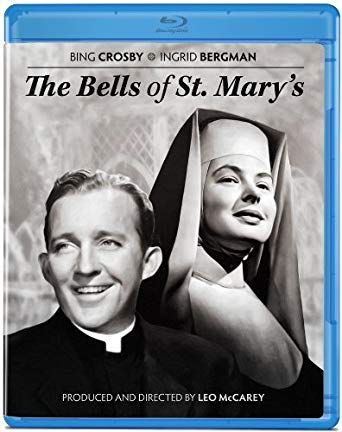
Following Going My Way, McCarey was one of the highest paid men in America, and he could call his own shots. He formed a production company, Rainbow, and started planning the sequel, The Bells of St. Mary’s, which he sold to RKO (Going My Way was distributed through Paramount). He developed the story with screenwriter Dudley Nichols, which focuses on the efforts of Sister Mary Benedict (Ingrid Bergman) to acquire a new building for her crumbling school, which will soon be shut down because of code violations. Father O’Malley is the new parish priest who must try and corral her ambition.

Bergman was under contract with David O. Selznick, so RKO had to pay him $175,000 to borrow her services, as well as sell him the rights to Little Women and A Bill of Divorcement. Bergman recalled how Selznick attempted to dissuade her from accepting the role, arguing that she “would just be a stooge for Bing Crosby’s singing.” She was enraptured by McCarey’s energy, though, and felt that, “If you didn’t like him, there was something wrong with you.” It was a hefty sum for RKO to pay, but Bergman had just won the Best Actress Oscar for Gaslight, and teaming her up with Crosby was the safest box office bet in town. Crosby was an altar boy as a teenager, and attended a Jesuit secondary school, but dropped out of Gonzaga to pursue a career in music. Conversant with both laissez-faire parishioners and strict observers, he was the ideal personality to bridge the gap between the traditionalist and progressive wings of the Catholic church.

While the episodic Going My Way has a tendency to meander, The Bells of St. Mary’s is anchored by the bubbling rapport between Crosby and Bergman. In a reversal of traditional gender roles, O’Malley is presented as a tender nurturer, while Sister Mary is strict and assertive, even teaching a young boy how to box. Crosby is introduced to St. Mary’s school through a series of humiliations. He is chastised by the maid (Una O’Connor), who clucks “I see you don’t know what it means to be up to your neck in nuns”. In Going My Way he owns every room he’s in with his laid back charm, whereas when he lays back here, he accidentally hits a buzzer and rouses the whole convent. Upon entering the conclave, he proceeds to sit down on a shrieking kitten. And when he gives his welcome address to the nuns, another cat toys with a straw hat behind him, causing the sisters to erupt in laughter.

Despite these indignities, Father O’Malley is still eager to assert his masculinity, so after two kids end up in a brawl, he expresses pride that they stood up for themselves. He tells Sister Mary, “On the outside, it’s a man’s world.” Mary replies, “How are they doing, father?” Their shifting power relations are expressed through the direction of their gaze. Mary begins her retort with modesty, eyes looking down, but by the end of her pointed phrase they drift up and stare straight off-screen at O’Malley, with the edges of her mouth curling into a grin. In his reaction shot O’Malley exhales and looks down, mumbling, “not doing too good” under his breath. This oblique reference to the horrors of WWII is also a decisive moment in their relationship. From here on out they exchange roles – Mary will exert aggression, and O’Malley compassion, accepting his subordinate role in the school’s pecking order.   He becomes a matchmaker for an estranged husband and wife whose daughter attends the school, while Sister Mary teaches her kids how to swing a baseball bat and throw a punch.

McCarey modeled Bergman’s character after his aunt, also named Sister Mary Benedict, a member of the Immaculate Heart Convent in Hollywood. Bergman portrays her with impish exuberance, an admitted tomboy who still finds pleasure in upsetting the expectations of how a nun is supposed to act. Bergman is very loose and inventive, and contributed eagerly to the improvisations that McCarey encouraged. Off-hand gestures, like how she flips a baseball off her wrist in a sporting goods store, or exaggerates her footwork during a boxing lesson, were made possible by McCarey’s improvisatory process. During down time, the director would sit at a piano and spitball ideas with the cast, encouraging acts of wild spontaneity. Bergman was already feeling free, not having to worry about her figure since she was clothed in a nun’s habit for the entire feature. “I was like a child with money”, she recalled, “and in the country of the greatest ice cream.”

McCarey put this improvisatory process on the screen with the Christmas Play, which Sister Mary is overseeing. She lets the children write it themselves, and informs O’Malley that, “Every time they do it, the dialogue is different.” The children are clearly making it up as they go along, as Bobby (the son of musical director Robert Emmett Dolan) hems and haws his way through the story of the birth of Jesus, ending in a tableaux of golf-club wielding shepherds. Instead of closing with “O Holy Night”, the kids sing “Happy Birthday”. Despite being set at a Catholic school, The Bells of St. Mary’s is quite secular, presenting the church as more of a social services organization than a religious one.

This is made explicit with the subplot of Patsy Gallagher (Joan Carroll), whose single mother pays the bills through prostitution. O’Malley takes her in as a student without asking questions, and tracks down her errant pianist father. This whole section plays like canned melodrama, a staid commercial for the value of church in the community. It almost seems as if McCarey included these scenes so he could get away with the more subversive antics of the rest of the movie.

One of the next turning points in the film occurs during a secular song. Sister Mary is singing a traditional Swedish folk tune by the piano with the nuns gathered all around her. O’Malley is attracted to the scene by her lilting soprano. He steps towards the circle, and McCarey cuts into a shot from his POV. It is the most artful composition in this otherwise classically framed film, in which two black habits join in the foreground to make a “V” shape, with Sister Mary’s face centered in the middle, as if in a cameo necklace. It is a devotional image, but this is not a religious psalm, but a love song.

Her eyes are shaded downward as she trills the lyrics, which roughly translate to: “Spring breezes whisper and caress loving couples/Streams rush by/But they are not as swift as my heart”. As she winds the song to a close, her voice lowers. But she inches up her head and finally sees O’Malley, which makes her voice fly up the scale to hit her highest note, which breaks up into a chuckle and a grin: “Oh, Father O’Malley!” In recognizing his gaze, she breaks the spell, but the tenor of their relationship has changed.

Their reciprocal glances continue to build in intensity, as word comes down that Mary will be transferred to another convent out West. It is ordered by her doctor, but O’Malley has to pretend it was his decision. This betrayal of trust triggers her shift from secular to spirtual, folk song to prayer. Before her departure, she kneels in in the chapel. Her eyes are directed upwards as she pleads,“Dear Lord, remove all bitterness from my heart”. It is a rare acknowledgment of God’s presence in a film otherwise occupied with the physical. As she passes by O’Malley outside the doors of the convent, her stare is unwavering, as she searches for some flicker of regret in his face. But there is none.

As she is about to depart, her prayer is answered. O’Malley calls her back, and gives her the truth. He did not order her re-assignment. Sister Mary closes her eyes in ecstasy, a beaming smile lighting up her face. She simply says, “Thank you, father. You’ve made me very happy.” They hold each other with their gazes, neither breaking away. For the first time their looks are equal. This is as close as they can come to a declaration of love.

Aware of the erotic tension of this goodbye, Ingrid Bergman planned a practical joke on the final day of shooting. In one of the last takes she threw her arms around a stunned Crosby and kissed him passionately on the lips. Reportedly one of the priests on the set jumped up and yelled, “You can’t use that!” McCarey didn’t, but this missing negative should be as sought after as the original cut of The Magnificent Ambersons. Something else to pray for.