2010: A FIRST QUARTER VIEWING CALENDAR

January 5, 2010

It’s time to stagger into the new year with eyes thrust forward. No more list-making and list-arguing and dwelling on the decade that was. Let us break free from our immediate history and nostalgia’s uncomfortably warm grip to embrace the rambunctious year to come. We’re going to squeeze out its tender juices one month at a time, with a touch too much enthusiasm that will emit a pungent, ripe scent of dreams yet to be dashed. Yes, these are the images I will rush to imbibe in the first quarter (and a bit more) of 2010:

January-ish

A Sixth Part of the World (1926) & The Eleventh Year (1928) (DVD, Edition Filmmuseum)

(DVD, Edition Filmmuseum)

Available now from the Edition Filmmuseum, this damnably seductive looking package contains the films Dziga Vertov made immediately prior to his epochal Man With a Movie Camera. The Filmmuseum describes the first as a “poetic travelogue”, and the second as a “visual symphony.” Michael Nyman provides the score, and bilingual booklets are included. This is an all-region release, and is 29.95 Euros, which is more USD than I can afford. I take donations.

Sweetgrass(Theatrical, Cinema Guild)

I’ve been aching to see this elegiac nature film ever since it premiered at the New York Film Festival. Opening this week in NYC and then slowly rolling out across the country in limited release, it tracks two modern-day cowboys as they drive a herd of sheep through the Montana mountains. Recently it nabbed the cover of my favorite film magazine, Cinema Scope, which has a fascinating interview with the director, Lucien Castaing-Taylor, an assistant professor in Visual and Environmental Studies at Harvard. Cinema Guild is looking like the film distributor of the year. Along with Sweetgrass, they’ve also acquired Jacques Rivette’s superb Around a Small Mountain and critical favorite Everyone Else

***

January 22

Legion (Theatrical, Screen Gems)

Ever since the ridiculously pulpy trailer hit a few months back, I’ve been intoxicated with its possibilities. Visual effects guru Scott Stewart (Iron Man, Sin City), graduates to the director’s chair and opts for total insanity. God deems the human race a lost cause, and sends his angels to destroy the world. Paul Bettany still has love for the flesh, so he swoops in, tears off his wings, and defends the denizens of a roadside bar (including Dennis Quaid and Charles S. Dutton) from annihilation. Somehow flamethrowers are involved.

***

January 26

King Lear (DVD, E1)

Orson Welles performs as Lear for this episode of “Omnibus” broadcast live on CBS in 1953.

***

February 15

British Noir Double Feature: The Slasher & Twilight Women (DVD, VCI)

Ever since Film Forum in NYC held a retrospective of British film noir a few months back, I’ve wanted to dig in further. I know nothing about these two other than this: The Slasher stars Joan Collins and received an IMDB comment of “Risible”. Twilight Women stars Laurence Harvey as a nightclub singer accused of murder. Sounds promising enough for me…

Also on this date:

*Clint Eastwood: 35 Years, 35 Films at Warner Brothers (DVD, Warner Brothers)

*Contempt (Blu-Ray, Lionsgate)

*Lola Montes (Blu-Ray, Criterion)

*Ran (Blu-Ray, Lionsgate)

***

February 19

Shutter Island (Theatrical, Paramount)

Scorsese’s adaptation of Dennis Lehane’s insane asylum ghost story was pushed out of Oscar season into the dumping grounds of February. This looks more like horror movie material than award-bait, which leaps this entry up the list. DiCaprio is a Boston cop investigating the disappearance of an asylum inmate. Then he starts to go crazy himself, presumably, with shades of Shock Corridor. From the trailer it looks like Scorsese is having fun – working with waking hallucinations and impish performances from Max Von Sydow and Ben Kingsley.

***

February 22

A ridiculous booty of home video releases:

*City Girl (Blu-Ray, Masters of Cinema)

*M (Blu-Ray, Masters of Cinema)

*Make Way For Tomorrow (DVD, Criterion)

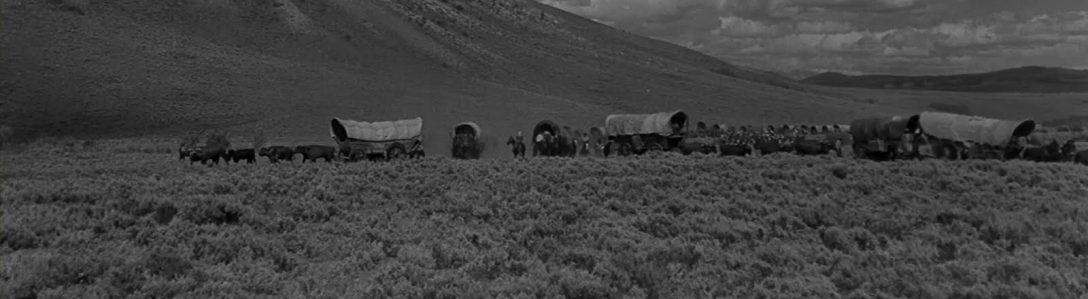
Note: Make Way for Tomorrow is one of the greatest movies ever made, and its image heads this post.

*There’s Always Tomorrow (DVD, Masters of Cinema)

***

March 12

Greenberg(Theatrical, Focus Features)

Going in blind because of my fondness of Ben Stiller and respect for Noah Baumbach (The Squid and the Whale). It reads like a rote mid-life crisis comedy, but I’ll have some faith in the combined talent here.

***

March 19

Vincere(Theatrical, IFC Films)

My good friend assures me this is a sub par work from Marco Bellocchio, and its melodramatic trappings don’t sound suited to his bitterly sardonic gifts. It’s the story of Ida Dalser, the wife whom Benito Mussolini discarded and ignored. But having thoroughly enjoyed his last three features: The Wedding Director, My Mother’s Smile, and Good Morning, Night, I’m going to have an open mind.

***

March 22 (the day my wallet begs for mercy)

*Bigger Than Life (Blu-Ray, Criterion)

*Days of Heaven (Blu-Ray, Criterion)

***

March 29

*Red Cliff (Blu-Ray [2-Disc International Version], Magnolia)

One of my favorites from last year was released in a truncated version stateside, which cut out over 2 hours of material. Magnolia is releasing the whole behemoth on Blu-Ray, where the scope of Woo’s accomplishment becomes more apparent. Every element is essential to this ancient war epic. You can read my more ponderous thoughts on this film at Moving Image Source.

Letters From Fontainhas: Three Films by Pedro Costa (DVD, Criterion)

One of the most important and divisive filmmakers working in the world finally gets his home video due in the U.S. This includes Ossos (1997), In Vanda’s Room (2000), and Colossal Youth (2006). A trilogy of films where Costa charts the lives of immigrants living in the slums of Fontainhas, near Lisbon. I’ve only seen Colossal Youth, which is a monumental, demanding work. I only saw it on a muddy screener, so I don’t even feel like I’ve truly experienced its languorous rhythms. Anyway, sure to be one of the most important releases of the year.

***

April 5

Piranha (DVD, Shout! Factory)

My Joe Dante education proceeds apace. I continue to think Matinee is a masterpiece.

***

April 16

Piranha 3D (Theatrical, Dimension)

After I receive my Joe Dante education, I can try Alexandre Aja’s (High Tension, The Hills Have Eyes (’06)) take on the material. In 3D. With an out-of-retirement Christopher Lloyd and my new favorite character actor, Adam Scott.

***

April 23

MacGruber (Theatrical, Universal)

In this SNL-derived parody of MacGyver, Val Kilmer plays a villain named Dieter Von Cunth. That’s enough for me. Also, director Jorma Taccone is part of the “Lonely Island” trio that produces all of SNL’s digital shorts, for a long time the only worthwhile part of the show.

***

May 1

Piranha (Blu-RayShout! Factory)

Oh, Shout! Factory, you’re really playing with my emotions here. Wait until May just to watch the Blu-Ray? OK, fine. But I’m seeing the Aja version first.
THE SAMUEL FULLER COLLECTION, PART 2: AN INTERVIEW WITH CHRISTA FULLER

October 27, 2009

crimson kimono


Today finds me further entrenched in The Samuel Fuller Collection, a seven-disc box set which comes out today from Sony Pictures Home Entertaintment and the Film Foundation, and for which I had a hugely entertaining interview with Christa Fuller, Sam’s wife. Before I get to her exuberant personality, a few more notes about the movies…

An auteurist’s delight, the set traces Fuller’s career from assembly-line scriptwriter to writer-producer-director tyro. The leap from the innocuously pleasant It Happened in Hollywood (1937) to the delirious noir Underworld U.S.A. (1961) is fascinating, and the drips of his personality discernible in his screenwriting work from Hollywood through Shockproof (1949) and Scandal Sheet (1952) is something of a revelation. Fuller’s blunt-edged prose is handled deftly by Phil Karlson’s hopped-up realism in the latter, while Douglas Sirk’s gleaming surfaces and detached irony are an odd, endlessly fascinating fit for Shockproof, which should be some kind of auteurist case study.

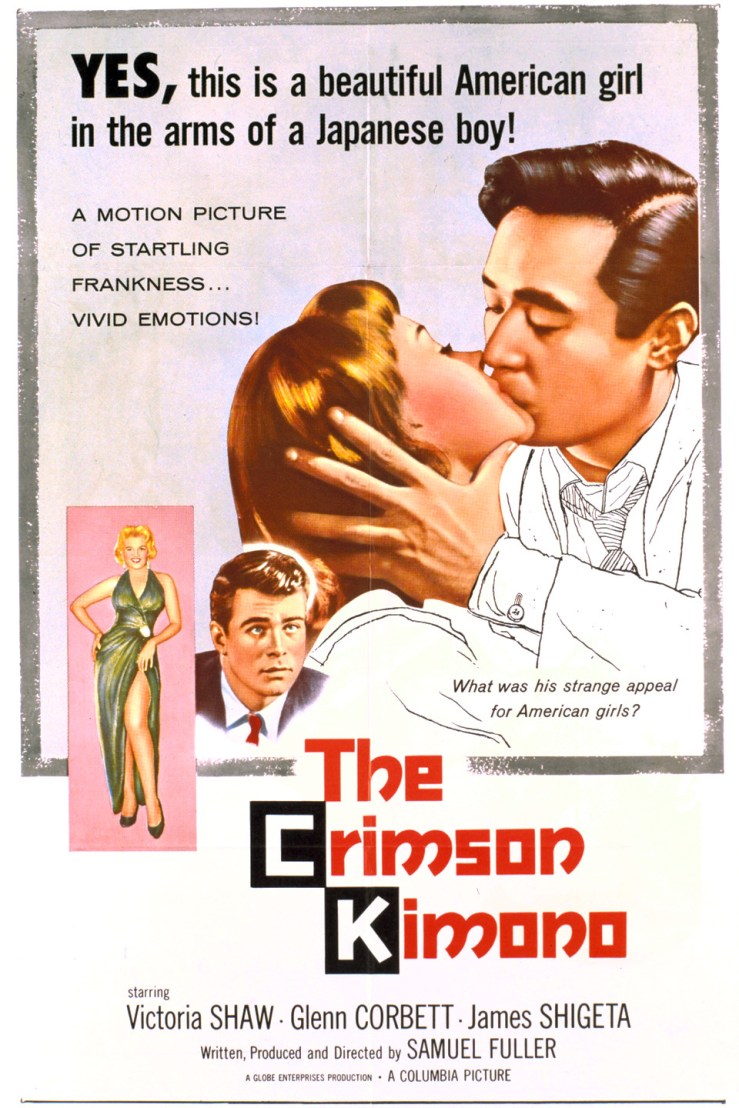
Then there is the full-on eau de Fuller with The Crimson Kimono (1959) and Underworld U.S.A. Kimono is a nuanced take on inter-racial romance shot through with Korean war guilt and stunning location photography of L.A.’s Chinatown. Underworld U.S.A. is all clenched fists and close-ups, documenting the all consuming revenge kick that takes down Cliff Robertson and anyone near him. His tormentors are thrown up as shadows on an alley wall, his own brick-screen idols that he’ll track down one by one with bitter ferocity.

Below the fold is the interview with the delightful Christa Fuller, Sam’s wife for over thirty years and a great thinker and actress in her own right (her film debut was in Godard’s Alphaville), about her late husband’s career in newspapers, the Army, and Hollywood.

What have you learned about Fuller since you completed editing his autobiography, A Third Face?

A Harvard archivist went looking for Sam’s  papers, and he found something that Sam never told me. He was married to Buster Keaton’s wife who committed bigamy. He was 26 years old, had just sold Hats Off! [1936, Sam’s first scriptwriting gig], and she dragged him to Tijuana and married him.  After he found out she was still married to Buster, the marriage was annulled. He never told me. The archivist found the annulment papers and the newspaper announcement. Buster Keaton at the time claimed he was so drunk he didn’t remember having married her.

Sam was so disgusted he never told me. He even cut her face out of a photo. It’s just her and a woman’s sleeve, and he never told me about it. I was shocked. He told me when we met in Paris that he’d never marry or go out with actresses. He hadn’t told me why. He probably forgot about it. He was traumatized by it. So the marriage was annulled, and that’s how he was briefly related to Buster Keaton.

Was Sam’s writing style influenced by his time in the newspaper business? Power of the Press and Scandal Sheet (and later, Park Row), seem to show a strong influence from this time in his life.

Totally. Sam was broken into the newspaper business by John Huston’s mother, Rhea Gore. John and Sam worked at the New York Evening Graphic together, along with Walter Winchell. It was run by Emile Gauvreau, the crazy Irishman with eight beautiful daughters (Charles MacArthur and Ben Hecht based their play and film, “The Front Page”, on him). And he was a health nut, he went barefoot from Nyack to New York every day. At the time they called the paper the “Porno” Graphic. And John Huston’s Mom, Rhea, broke Sam into crime reporting. John said he spent more time with his mother than he did. Rhea, even though she divorced Walter Huston and married into a railroad fortune, continued working as a newspaper woman. She was very ballsy, cutting through red tape, bribing cops to get the story. She’s a Sam Fuller character herself.

John didn’t get along with his mother, left the paper, ran off to Hollywood and started writing for William Wyler. He came to Hollywood before Sam. Sam started as a copyboy for Arthur Brisbane, one of the most powerful men he worked for. He was the brain behind William Randolph Hearst, and Sam was his personal copyboy when he was 14. Hearst wouldn’t make a move without him. Sam lost his father when he was 11, and Brisbane was a father figure to him. Sam had a lot of these father figures.

The newspaper office was like his living room, growing up…

Totally! Sam always wanted to run his own paper somewhere in New Hampshire and write his own editorials, and convey his own vision of the world.

What did Fuller think of some of the early adaptations of his work, like Power of the Press?

There’s some great dialogue in that. Like “Freedom’s dynamite, it to be handled with care”! It does sound like him. Scorsese said that Sam was so deeply American, the kind of America that is vanishing. When we lived in Europe together, it always struck me that Sam was innocence abroad. I think he was kind of like a Mark Twain character. Europeans have layers of perversion, and Sam was really innocent there.

What was his relationship like with the studio heads, and how did he manage to get such envelope-pushing material onto the screen, like the relationship between a Japanese-American man and a white American woman in The Crimson Kimono?

Such a beautiful film. Alain Resnais made Hiroshima Mon Amour around the same time, about a white woman with a Japanese man. The same year an article in an Oxford newspaper dubbed TheCrimson Kimono as “Los Angeles Mon Amour.” The head of the studio said to Sam, why don’t you make the white guy a little bit on the mean side, so we understand why she prefers the Japanese man. And Sam said, hell no. They have a lot of affinities, they’re both nice guys, fought in Korea together, and I’m not making the white guy on the mean side so the bible belt will buy it.

In Forty GunsSam wanted the heroine to die, and at the end he should have to shoot her, the woman he loved. Zanuck said “Barbara Stanwyck is a star, you cannot kill the star.” So Sam had to attach a happy ending. He had to compromise, they all had to. But Sam was a very moral guy. He never lied. He berated himself, undervalued himself. He didn’t want to marry me, saying “I’m 54 you’re 22, I don’t like younger women, ten years from now I’ll be an old fart, I’m a has-been.”  He talked himself out of it. He didn’t promise me anything. Because he didn’t bullshit me, I stayed with him. It’s hard to take, but it’s easier on a relationship. And that was courageous. Maybe it was the courage of a fool, but it worked.

He didn’t promise me lines in his films. I had to give up many of my own ambitions to make the marriage work. Even though Sam was a feminist and worked with women, it’s such a nerve-wracking business. I did squeeze in a master’s degree in literature and taught French for four years, and started a doctorate on Samuel Beckett. But then this White Dog thing happened, and we moved to Europe, and I never finished it. Instead I finished Sam’s autobiography.

Will you go back to the Ph.D.?

No, I’m still intrigued with Sam’s characters. I love Beckett, but there’s something so modern, so way ahead of his time in Sam’s work. I’m intrigued by he got away with it, and through so many ups and downs. Why do they call a European movie an art movie and his movies B-movies?

Howard Hawks bought the rights to Fuller’s first novel, The Dark Page, could you talk about that time in his life?

Hawks bought the novel while Sam was still in the war. I’ve got a letter Hawks wrote to Zanuck raving about Sam’s writing, and he bought the novel. This is one of the items I posted on the fan page for The Dark Page on Facebook. They republished the book last year in Scotland, the same company also re-published No Bed of his Own, by Val Lewton , the producer of Cat People. The first time he saw his book in print was in an army edition of The Dark Page, which ends up as a scene in The Big Red One.

Was Sam upset when Hawks sold the rights to his book to MPI?

Hawks was a businessman, Sam wasn’t. He bought it for 15 grand, and I think he sold it for 100, netting 85. He wanted to do it with Humphrey Bogart and Edward G. Robinson before it fell through. Of course if you’re a writer and Hawks buys it, and you’re young…

The plot is similar to many of his works,  including his novel Crown of India, where an older man trains a younger man, teaches him the ropes, and then the younger man has to expose the older man, and use his lessons against him. Totally Oedipus. The son always wants to outsmart the father. I’ve seen it with all the young directors that came and almost destroyed Sam, some of them. They always wanted something. There’s no innocence when somebody comes and says, “I admire you.” Sam was a very simple person, he never wanted to become a cult figure. Truffaut said about Sam that he’s simple without being simplistic, and that’s very rare. Well said.

Curtis Hanson was one of the nicest disciples. We knew him when he was 18 years old, when Sam and I first got married, he always knocked on Sam’s window. He wound up spending hours with him. Then there was Peter Bogdanovich. Sam helped him write Targets. Peter acknowledges it, but Sam didn’t want any credit.

Sam had his own father figures, but Sam was a gentleman, a civilized man, and I could see how he handled his Oedipus complexes. He never destroyed these father figures. He had all kinds, from Arthur Brisbane, and later on when he came to Hollywood, Peter Pan – Herbert Brenon, was one of his first. The German director E.A. Dupont, who directed Piccadilly, who helped him on I Shot Jesse James, was another. John Ford was one as well.

What was Sam’s relationship with Ford?

Ford loved Sam as a writer and always wanted to work with him. Sam thought John was the greatest director in the world. He worshipped him. John was very proud of Sam, and would call him every year on D-Day and say, “Fuck the Big Red One!” That was a running gag because Ford was in the Marines. Sam just had an unlimited admiration for him – he’s pure Americana.

Another father figure was General Terry De La Mesa Allen. He made the cover of Time and Newsweek. He was so famous at the time. All the dogfaces, all the soldiers loved him. He fought alongside them. He was so famous John Ford pleaded with Sam to meet him. Sam organized a luncheon or dinner, and I have pictures of Ford with General Allen. When he made the covers of Time and Newsweek, he was so modest. “I’m no hero”, he said, “dead men made me a general.” Listen to that line. Gives me goosebumps.

That sounds like a line right out of one of Sam’s war films…

He influenced Sam the most. All these years of battle, and Sam volunteered for it. People tend to forget, that when Sam volunteered in WWII, he was a writer and an artist. The whole war scene hit him differently than other soldiers. I think that Sam’s nervous system was shaken forever. People forget that he was in every major battle in WWII, including Omaha Beach. And war hysteria never left him. Sam had a very short fuse. People are never the same after an experience like that, for the rest of their lives.

Did he ever talk to you about his battle experiences, or was it something he kept to himself?

No, he talked about it constantly! That’s why people thought he was a macho guy, but Sam was very sensitive, he cried before me when we saw a film. And I think he was covering up his sensitivity by talking like he did, about killing Nazis and such. He really suffered for the rest of his life from war hysteria.

You acted in Dead Pigeon On Beethoven street, one of his lower budgeted European productions (for German TV)…

It was Pulp Fiction twenty years before Pulp Fiction. Sam always wanted to make a comedy, and this was a private eye spoof made for German TV. Sam couldn’t make a realistic German film about German cops. What does he know? And what is realism anyway? Wim Wenders said you should strike the world realism from the dictionary. At the time they had the Profumo Affair, where two call girls brought down the English government. So Sam wrote me a part of a girl who sets up politicians and blackmails them. At the time, Fassbinder, who was so obsessed with American cinema, he showed Sam that he made a Western. And it was awful. He showed it to Sam, in Cologne.

Never released?

No. And Fassbinder wanted to play the part of Charley Umlaut in Dead Pigeon, but they had already cast the role. The English loved it, they thought it was funny, it played at the London Film Festival. But the French, they expected Sam to make a straight film noir. You always get pigeonholed. Because Sam fought in WWII, he was punished for it. He had to do straight film noir. They wouldn’t let him do comedy, and he had such a great sense of humor, and such a great sense of the absurd.

Thieves After Dark was booed at the Berlin Film Festival in 1984, when John Cassavetes got the Golden Bear for Love Streams. But John loved the film, and we wound up spending the whole night with John and Gena Rowlands eating herring and drinking beer. And he said, “I loved the picture”. And I guess the French didn’t like the idea of Sam making comments about French unemployment. I saw it again, and it’s a very good film. They have a love-hate relationship with Hollywood. I remember when I was there, and they called John Ford a fascist. I just hated it. After I met Sam I saw Shock Corridor with a friend of mine who was a movie critic, and he said “Fuller is a genius, but he’s a fascist”.  Sam was the opposite of a fascist.

DIGGING INTO THE WARNER ARCHIVE: EXPERIMENT PERILOUS and THE TALL TARGET

September 29, 2009

experiment perilous

The Warner Archive is murdering my bank account. The latest culprits are Jacques Tourneur’s Experiment Perilous (1944) and Anthony Mann’s The Tall Target (1951). After my first purchase, documented here, I’ve tried to stay away from the service, what with its un-restored prints and overpriced DVDs ($20 is a lot for a burned disc), but they are pumping out an endless array of rare goodies that would tempt even the cheapest cinephile. I couldn’t stay away for long.

I was drawn to Experiment Perilous because of the praise of Chris Fujiwara, who in his definitive study of the director, The Cinema of Nightfall, described it as “one of Tourneur’s most personal and beautiful films.” It’s also one of his most unknown, at least from my perspective, having not heard of it until it popped up on WB’s release schedule. It’s most famous, perhaps, for containing a mesmerizing performance from Hedy Lamarr, her own favorite, as she relays in her decadently titled autobiography, Ecstasy and Me.The print used on the DVD contains adequate sharpness, but has suffered a decent amount of wear and tear over the years. There is a consistent amount of scratches and dust marks, but nothing terribly distracting. It’s watchable, if nowhere near pristine.

In 1944, Tourneur was coming off the lower budgeted success of his Val Lewton horror films, having churned out the remarkable duo I Walked with a Zombie and The Leopard Man the year before. Handed an A-picture budget from RKO, he delivered Experiment Perilous, a Victorian age psychological thriller often compared to Gaslight, which was released the same year. It’s an adaptation of the novel by Margaret Carpenter, which screenwriter Warren Duff altered by moving the setting from the present day to the turn of the century. It was rumored that Hedy Lamarr’s request to wear period costumes necessitated the change, but Fujiwara reports that it was more of  narrative decision:

Executive producer Robert Fellows offered a more reasonable explanation: ‘It was felt that the slightly archaic quality of the heroine, who appears in the book as a cloistered and frustrated orchid, would lend itself to a clearer expression on the screen if presented against a less realistic background.’

Hedy Lamarr’s Allida is not just a “cloistered and frustrated orchid”, but is quite possibly mad. Or at least her older husband Nick Bedereaux (Paul Lukas) seems to think so. He employs Doctor Bailey (George Brent) to look into her curious peccadilloes, which include sending herself daisies and then denying doing so, and hallucinating that she is being followed.

Tourneur opens the film with a train ride, in which Bailey is introduced to Nick’s bird-like spinster sister Cissie. In a voice-over, he opines that Cissie herself might be insane, as she clucks at him about her home and family like he was an old friend. Tourneur frames him against a mud-spattered window, and then captures their mottled shadows on his suit jacket (see right). This minor contact with the Bedereaux family has soiled him, and this mark dooms him to further entanglement in their sordid story.

Once home, he joins a fashionable dinner party, admiring a snake-haired female statue his pal Clagg unveiled. Tourneur emphasizes Bailey’s connection to this image of the Medusa, joining him first in medium-shot, then pushing into a close-up. Clagg’s attempt to demonize womanhood through his art speaks to Nick’s impotent attempt to harness Allida’s sexuality, and Bailey’s low-key Perseus is here to slay that demonization.


Tourneur lavishes most of his attention on the Bedereaux home, in the stunning set design of Albert S. D’Agostino and Jack Okey. This vision is of an accumulation of knickknacks and rooms within rooms, a gilded prison to keep Allida busy and away from the prying eyes and more virile bodies of possible pursuers. Fujiwara notes:

The incredible profusion of bric-a-brac in the Bedereaux house not only makes us aware that Allida is merely another piece – albeit the centerpiece – in Nick’s collection but also creates a stifling atmosphere that correlates with Allida’s panic.

Just inspect the image I started the piece with. Allida is in the right foreground, arguing with Alec, a young poet-admirer, who stands askance at the fireplace. Nick is reflected in the far left-hand side of the mirror, blurred and indistinct. Alec, paired with Nick by the mirror, is simply another man trying to impose his vision of Allida onto her. Alec’s vision is romantic, but it is still controlling and allows Allida no voice of her own. Shunted off into the far corner of the frame, Allida is alone and increasingly fragile, the painting in the background a subtle rhyme to the mens’ artistic, almost directorial designs on her.

It’s a densely visual film – any frame I grabbed would be rich with symbolic significance. Tourneur’s narrative strategies are as oblique as his images are direct, as he obscures motivations and elides major events (the two murders which drive the plot are never shown), repressing them into Hedy Lamarr’s dewy-eyed stare and Paul Lukas’ skittish motormouth. It all adds up to a dreamlike reverie on sexual obsession and death, richly upholstered.

***

The Tall Target will always have a special place in my memory as the first (and so far only) film I saw at the Cinematheque Francaise. There was an Anthony Mann series running during my (only) trip to Paris, and viewing this historical noir in a the finely appointed theater (not the same place as the New Wavers sat, but the recent Frank Gehry-designed space) was a damn near transcendent experience. The inky blacks of Paul C. Vogel’s Alton-esque cinematography seemed to melt out of the frame (the Warner Archive disc captures these deep blacks remarkably well.

This counterfactual bit of history has Inspector John Kennedy (Dick Powell) attempting to thwart an assassination attempt on Abraham Lincoln before his inauguration, on a train ride from Springfield, Illinois to Washington, D.C. The pacing is unnaturally taut, the performances, from Adolphe Menjou’s sickly sweet Colonel to Ruby Dee’s resolute slave, are stellar across the board, and Mann wrings incredible tension out of a scenario we already know the conclusion to (spoiler: Lincoln doesn’t get assassinated). Utilizing low-angles to convey a sense of cramped intimacy, he often frames the figures against the ceiling of the train.

This strategy leads to an astonishingly subtle tracking shot that turns Powell from predator to prey in the brief flash of his pupils. Entering a train car, Powell is in search of a gun, as he’d already been targeted by a Confederate goon. In a long shot, he waltzes in, keeping his eye on the pockets of the passengers. He espies a revolver in the pocket of a passed out schlub, and he casually sits down on the adjacent armrest. Mann cuts in to a medium shot of Powell, and then a close-up of the gun. The man rolls over onto it, making it impossible for Powell to grab it.  He winces, stands up, and continues on his way.

Mann then pushes in to an extreme low angle close-up, framing Powell’s head tightly against the lamps above his head. It is a smoothly disorienting shot, eliminating the passengers and focusing on Powell’s increasingly strained and wrinkled forehead. Then, in a flicker of his eye to the left of the screen, almost indecipherable upon first viewing, Powell registers fear. The camera arcs around him to the left, settling onto a close-up of a gun pushing into his back, ending the sequence on a note of symmetrically grim irony. It’s a 1 minute sequence of incredible grace and narrative economy, introducing Kennedy’s ruthlessness and the motif of exchanging guns, which leads to perilous consequences later on. This minor Mann would be a major work for any other artist.

FRINGE BENEFITS FROM THE DECLINE OF DVD

June 30, 2009

KillZone

According to a recent report from the research group Screen Digest, DVD sales declined by 4.7% in 2008, and that Blu-Ray “barely made a dent in the missing revenue”. They conclude that the new format won’t spur “minimal sector growth” until 2010. It’s rapidly becoming clear that VOD (video on demand) will eventually become the dominant form of home entertainment. In a Wall Street Journal article about Netflix CEO Reed Hastings, it claims he is “is quickly trying to shift Netflix’s business — seeking to make more videos available online and cutting deals with electronics makers so consumers can play those movies on television sets.” Hastings sees the DVD by mail business to start declining in four years, and hence his deals to stream movies on the XBox and other set-top devices, like the Roku. Packaged discs will not disappear entirely, but will likely lose a large percentage of their market share.

The benefit to consumers in the short term…sales! I recently talked about my cherry-picking of Battleground from the demise of the Virgin Megastores in NYC, but this new downer of a report spurred me to check out what was left of DVD retailers in Manhattan. I waltzed into a small reseller on 14th Street, which was having a massive sale where you could purchase 2 discs for 10 dollars. I ended up with Wilson Yip’s Kill Zone (aka SPL)John Woo’s Hard BoiledThe Buster Keaton Collection from Columbia, and Gremlins 2 (a personal favorite)…all for a total of $20.

In a bit of serendipity, I had just seen HK action guru Wilson Yip’s latest film, Ip Man (2008) at the New York Asian Festival, always one of the highlights of the year (I also recommend Breathless and Crush and Blush). Viewing Kill Zone(2005) and Ip Man back to back was an education in action choreography. Yip can be crushingly conventional in terms of exposition and character development, but when the gloves come off he’s a real virtuoso. Utilizing the same fast-cutting, restlessly mobile camera techniques of recent Hollywood fare (two aspects of what David Bordwell calls “intensified continuity” (click on the link for more detail)), Yip manages to stage fight scenes of greater spatial coherence and physical impact than Hollywood counterparts like Paul Greengrass or J.J. Abrams. The stunning finale of the entertainingly overwrought policier Kill Zonea much ballyhooed showdown between Sammo Hung and star Donnie Yen, takes place in an empty night club, and the fight literally takes center stage.

Maintaining the quick editing pace, Yip still utlizes the classical setup of a long establishing shot (the two combatants face each other), a medium over-the-shoulder shot-countershot (exchanging blows), and then close-ups to emphasize emotional peaks (or in this case, kicks to the solarplexus). The key to this scene is that Yip does not cut in the middle of a gesture – every blow is landed and registered, and his adherence to the classical style keeps their movements oriented in the space. The stage setting alludes to their battle as a dance, as if Hung and Yen were Rogers and Astaire. I suppose they’re fighting it out to see who will lead the next dance.


Astaire’s routines were always filmed in long shot, with his whole body in the frame, and Yip nods to this technique, added with the camera movement required by the more amped up standards of intensified continuity. After the classically edited setup, Yip cuts to an extreme long shot that slowly tracks in to the flailing players as they toss each other to the floor, the dust kicking up like chalk. He also finds a clever way to make Brazilian Jiu-Jitsu (based on ground submissions) look exciting. Yen flings the hefty Hung leftward to the ground, battling for the guard position. Yip, in a strikingly low angle at eye-level to the mat, tracks slowly with the duo as Yen eventually wins out and lands a series of rights. The sequence continues, and ramps up appreciably with small-scale wire work and a dramatic conclusion that wraps up one of the dramatic subplots (Hung’s nascent fatherhood). It’s a tour-de-force.

One excuse given as to why films like Taken or the Bourne series don’t have this same kind of coherence is that the actors aren’t as physically trained as martial arts pros like Hung and Yen, and necessarily need stunt doubles, necessitating even faster cuts and less spatial coherence. However, American action films don’t necessarily have to have nuanced fighting styles – just watch the series of haymakers Gregory Peck and Charlton Heston unload on each other in The Big Country (which can be seen in the video slideshow of Dennis Lim’s excellent history of fight choreography at Slate). It’s a stylistic choice, and right now Hollywood filmmakers are making the wrong one. I was initially thrilled by the Bourne series’ propulsive energy, but the more time that passes, the more its fractured editing seems like a dodge.

Ip Man continues Yip’s pattern. This more ambitious title, an bio-pic about Grandmaster Ip Man, who trained Bruce Lee and popularized the Wing Chun style of martial arts (interestingly enough, Wong Kar-Wai’s next project is also a bio-pic about the Grandmaster). The film focuses on his life during the Occupation of China during the Second Sino-Japanese war. Grandmaster Ip Man (Donnie Yen) lives a quiet life with his family before the Japanese Imperialists destroy his small town and reduce his pals to coal miners. Ip Man then commences to beat the holy hell out of evey Japanese person in sight. Yip is not big on subtletly, and one of Japanese Genral Miura’s obsequious assistants tips over into racist stereotypes (big teeth, round glasses, into torture, etc.).

However, once more Yip brings the goods in the action sequences: crisp, elegant, and coherently orchestrated bouts of mayhem. Yen also exhibits a wider emotional range here, his stoic laid-backness tinged with regret and anger. He won’t win any awards, but it’s a solid, nuanced performance. In any case, these two works will have me work backwards into Yip’s career. Next up is Flash Point, the middleman between Kill Zone and Ip, and it promises more fluid Donnie Yen bone-breaking. Ah, the neverending riches of cinema.