Best Friends Forever: Girlfriends (1978)

March 7, 2017

GIRLFRIENDS (1978)

Claudia Weill described her companionable film Girlfriends (1978) with a quote from the Eleanor Bergstein novel Advancing Paul Newman: “This is a story of two girls, each of whom suspected the other of a more passionate connection with life.” Or to put it in modern parlance, it’s a comedy of FOMO (fear of missing out). Girlfriends portrays the NYC friendship between the Jewish brunette Susan Weinblatt (Melanie Mayron) and the WASP blonde Anne Munroe (Anita Skinner). Susan is delaying family life to pursue a career in photography, while Anne speeds into marriage and kids while putting her writing to the side. They envy the other’s freedom and security, respectively, and their once unbreakable bond begins to fray. Girlfriends began as a documentary project on Jewish American identity, with funding from the AFI, but instead Weill funneled all her research into an independent feature, one so well-received it was picked up by Warner Bros. for distribution. Though the set-up can be a bit schematic, Weill has the patience of a documentarian and allows the actors to build their characters from types into complex personalities (shooting on location in shabby NYC apartments helps with the verisimilitude). The cast is superb all around, from Mayron and Skinner to the men who pursue them with varying degrees of success (an anxious Bob Balaban, flighty Christopher Guest and a charismatic Eli Wallach). Girlfriends is streaming on FilmStruck, and is also airing on Turner Classic Movies Wednesday March 8 at 9:15am.

Claudia Weill studied Modern European History and Literature at Harvard, but decided to pursue the arts. She took painting classes from Oskar Kokoschka in Salzburg and studied still photography under Walker Evans at Yale. Her facility with the camera led her into documentary filmmaking, and she shot and co-directed (with Shirley MacLaine) The Other Half of the Sky — a China Memoir (1975), which was nominated for an Academy Award. Afterward she was looking for a new challenge, as she told the Institute of Contemporary Arts: “I had spent years following people around with my camera, kind of waiting for them to say what they wanted to say and then spending months in the editing room manipulating that into a film. So all I wanted to do was to make a film that had a script first.”

GIRLFRIENDS (1978)

After abandoning the documentary project, Weill sketched out the idea of a fiction feature with her friend Vicki Polan (who receives screenwriting credit). The story starts with Susan and Anne sharing their lives together in an Upper West Side apartment. They are mutual support systems working in tandem, cocooning each other with overlapping dialogue. They are always cutting each other off, trying to restate what the other is thinking better than they can articulate. This friendship is punctured when Anne falls fast for Martin and gets married. Their whole system collapses, and their mode of communication shifts. Now there are boilerplate “how are you doing” phone calls, awkward vacation photo sessions on couches where Susan is the third wheel and passive-aggressive fights about who is not keeping in touch with whom. So instead Susan focuses on her photography. She starts out shooting weddings and bar mitzvahs for Rabbi Gold (Eli Wallach), and they engage in playful flirtation until it gets too inconvenient for the married man. Men in power are always obstacles to be parried or endured, though the Rabbi is a particularly sympathetic one. Before the rushed split, Wallach is delightfully desperate as the hip rabbi, even trying out a smooth Marcel Marceau impression, which charms Susan (maybe because she was drinking).

GIRLFRIENDS (1978)

But without a roommate Susan is barely making ends meet in the Upper West Side apartment, and she feels abandoned and alone. Susan is a bit of a self-dramatist and whiner, so she receives every setback as a mortal blow. Melanie Mayron plays her with a perpetual slouch, as if anticipating bad news before it happens. With her frizzy hair and sarcastic attitude Susan makes the ideal of the sassy supportive girlfriend in the run of the mill romcom. But Weill makes her the centerpiece. So while nice-girl Anne buggers off to the Middle East on vacation with mousy Martin (Bob Balaban), the film stays with Susan, pitching her work to sleazy magazine editors, taking on a spacey performance artist roommate and throwing herself at the witty-ish, good-looking enough Eric (Christopher Guest) at a party. She would rather not make life-altering decisions so she delays them until they resolve on their own or force her to respond. Like Eric inviting her to move in, or even what photos she should show in her first solo exhibition. She’d prefer to float than to focus. But a switch in her thinking is reflected in the interior design – the array of unpacked boxes and hastily tacked-up posters of the undergrad slowly shifts into the arranged life of an adult, with honest-to-god furniture and a hammock. She now seeks comfort from home instead of just a place to crash. While Susan stresses and redecorates, Anne is trying to restart her writing career with a toddler crawling up her leg and a caring if ineffectual husband. They reconnect as if no time has elapsed, though on different terms. Instead of living inside each other’s thoughts, they have become alien to each other, and so more fascinating. This sparks curiosity and openness, and that friendship sparks anew.

GIRLFRIENDS (1978)

Weill received $80,000 from the NEA and New York State Council on the Arts to make the film, which The New York Times reported was “the first independent American dramatic film to be primed with grants.” The shoot took six weeks in 1975, but the post-production process dragged on for years because they ran out of money. It stopped and started depending on what private funding they could cobble together, until it was finally completed and sent on the 1978 festival circuit. It was an immediate success, and within two weeks of screening for distributors, it was acquired by Warner Bros. In 1978 there was a moment where films for, by and about women were finding success. Studios were trying to replicate the success of Annie Hall (1977), An Unmarried Woman (1978), and The Turning Point (1977). There were also a group of female filmmakers coming out with films, including Joan Rivers’ Rabbit Test (1978), Joan Micklin Silver’s Chilly Scenes of Winter (1979), Joan Wagner’s Moment by Moment (1978) and Joan Tewksbury’s Old Boyfriends (1979). The New York Times wrote an article, “Women Directors: Will They, Too, Be Allowed to Bomb?” It turns out the answer is no, not really. Weill would make one feature with Hollywood support, It’s My Turn (1980, starring Jill Clayburgh and Michael Douglas), before turning to a long career in television.

Workin’ Man’s Blues: Man is Not a Bird (1965)

February 28, 2017

MAN IS NOT A BIRD, A (1966)

Dušan Makavejev made his directorial debut with Man is Not a Bird (1965), a raucous portrait of a Yugoslav mining city currently streaming on FilmStruck as part of the Directed by Dušan Makavejev theme. Made with the full cooperation of the residents of Bor, an industrial town in eastern Serbia, the movie is filled with hypnotist acts, marriage breakdowns, circus routines and brief, bitter affairs. It is based on the real lives of people that Makavejev interviewed before shooting, while indulging the director’s love of the carnivalesque, injecting Makavejev’s absurdist humor into a film that, by subject matter anyway, inherits the tradition of the Communist social realist films of previous decades. But these worker-heroes, while awarded and celebrated by the local government, have made messes of their personal lives. Makavejev said that with this film he “was trying to explain that you can have global changes but people can still stay the same, unhappy or awkward or privately confused.”

Makaveyev grew up in Belgrade and graduated college with a degree in psychology, though he was attracted to film ever since he saw a German dub of Snow White and the Seven Dwarfs (1937)when he was a child. He became associated with a group of filmmakers named novi film, or later the “black wave,” which sought to break free of socialist realism and its cheery, patriotic depiction of labor. The Avala Film Studio was looking for first-time filmmakers and gave Makaveyev a chance. The director, according to biographer Lorraine Mortimer, compiled “more than three-hundred pages of facts and anecdotes from factory heads, unions, party members, policemen, technicians, miners, metalworkers, and others.”

MAN IS NOT A BIRD, A (1966)

The story’s main character Jan Rudinski (Janez Vrhovec), a celebrity metal refinery engineer, known for reducing installation times by miraculous amounts. He’s come to Bor to install a turbobooster which will supposedly speed up the processing time at the copper refinery. Jan takes a room with a local family, whose beautiful daughter Rajka (Milena Dravic) begins a bored and successful flirtation. Circulating around this main spoke is the story of Barbulovic (Stojan Arandjelovic), a stoker at the factory, and his wife (Eva Ras). Barbulovic is a bibulous type, prone to drooling over the local nightclub singer. His wife sees his mistress wearing her dress in town, and a very public beating ensues. Their relationship disintegrates from there, as the wife is emboldened to wrench herself away from her husband’s ironclad rule. All the while Jan’s tryst with Rajka fizzles out due to Jan’s devotion to his job. As these relationships self-combust, the factory promotes its record-breaking copper production, and the town attracts a famous hypnotist and a traveling circus act to while away the hours.

MAN IS NOT A BIRD, A (1966)

Man is Not a Bird was shot in thirty-six days under what Makavejev described as “horrible” working conditions – he recalled that there was acid smoke that dissolved the stockings of his female film crew within an hour. But, he would go on to say that this “strange and literally dark and dirty place” exuded a “charming vitality and unexpected humor.” There are scores of charming throwaway moments, as when a random worker is shown smuggling out copper wire by twirling it around himself like a prima ballerina, or when a hypnotist convinces these hard-bitten men that they are weightless cosmonauts, and they flop around like loosed guppies. But Makavejev and his cinematographer Aleksandar Petkovic get a lot of mileage out of the smoke plumes and dirt constantly emanating out of Bor, a place of no illusions (or amenities). There is a mix of dollied long takes, hand-held shakiness and bird’s eye views, getting every possible perspective and texture of the town, getting everything from street scenes to factory machinery montage.

Jan Rudisnki is a fascinating character, an engineering superstar who could have headlined the social realist Communist films of the 1940s, but now he has aged into apathy. He enters into the affair with Rajka reluctantly, performs his work with gruff speed and agrees to speed up the installation process only to prop up the Rudinski brand, which is enough to win him another medal. To Rajka he’s a diversion and possibly a ticket out of town, but when he displays more interest in copper than her, she moves on to her next suitor, a slick mustachioed worker who keeps flirting with her at the barbershop she works at. While not as wealthy, he at least expresses interest in her existence. So after Jan receives his latest medal from the government, at a ceremony of pomp and Beethoven that the workers barely tolerate (Barbulovic stumbles through it looking for his wife – who has taken a cue from the hypnotist and broken his spell over her), he goes to an empty restaurant to get serenaded by a sarcastic Serbian folk troupe. It ends with Jan breaking a mirror and getting reflected in a shard, one of the showier shots in an otherwise “gritty” film. He is a shattered man, though only for one night. He puts himself together again before he’s off to the next emergency job, where he can be celebrated by another local pol.

MAN IS NOT A BIRD, A (1966)

Throughout the film the workers are celebrated in words while ignored in reality. Throughout the film two giant photographs of a workers’ worn and calloused hands are being ferried through the neighborhood, moving slowly towards the auditorium. They appear as non sequiturs in the background, but turn out to be backdrops for Jan’s awards ceremony. But at the final rehearsal, as the stagehands are erecting them, an anonymous producer asks what they are doing there and demands they be taken down. They are swiftly removed and the classical choir stands in front of a blank wall instead. The local government lionizes labor and work, but prefers it to be invisible. Makavejev’s film aims to restore something of a work-life balance to his characters’ lives, however dirty and dark and funny.

This coal-dark gem was just the beginning of Makavejev’s career – five more of his features are streaming on FilmStruck if you’d like to see more.

Coup d’etat: The Embassy (1973)

February 21, 2017

1973_Embassy_image1

There is a coup d’etat in an unnamed country, and a group of dissenting artists and intellectuals pour into an embassy, seeking asylum. Chris Marker’s The Embassy (1973) is a provocative short film, shot on Super8, that manages to conjure an entire fascist state out of twenty minutes of footage of a few apartment rooms. It was made as a reaction to the overthrow of Salvador Allende’s government in Chile, though the surprising location of the film is obscured until the final two shots. For the majority of the runtime you are in an unknown space, disoriented and thrust into internecine battles of the political left, still bickering as a country falls around them. Information is doled out solely by the narrator/filmmaker, who is inside the embassy shooting home movies of the panic within. The camera is handheld and mostly kept at a distance, it never gets inside arguments but circles outside them, hearing snippets but never the heart of the matter. But when facts do start trickling in, like how the new military government is executing dissidents at the nearby soccer stadium, ideological battles give way to plans for survival. The Embassy is streaming on FilmStruck in the Directed by Chris Marker theme, which collects 23 of his remarkable shorts and features.

Marker was gripped by the possibilities of the 1970 election of Salvador Allende, who was elected out of an alliance of leftist parties who called themselves Popular Unity. He wanted to make a film about the impact of the new government, but then discovered that Chilean filmmaker Patricio Guzman (The Battle of Chile [1975-1979]) had been documenting it from the start. Guzman recalls meeting Marker in Santiago in 1972:

“I liked your film,” he told me.

I was overwhelmed with a feeling of terror, a mixture of insecurity and respect. Not so long before I had finished El primer año (The First Year) – my first feature documentary, about the first 12 months of Salvador Allende’s government.

“I came to Chile with the intention of filming a cinematographic chronicle,” Marker confessed. “Since you’ve already made it, I’d rather buy it from you and exhibit it in France.”

So Marker took back a print and distributed The First Year in France, creating posters, dubbing the audio track, even recording an introduction to put the film in context. When Guzman was having trouble securing film stock to use for The Battle of Chile, he wrote Marker a letter asking for help. A month later he received “43,000 feet (approximately 14 hours) of 16mm black-and-white film, plus more than 134 perforated magnetic tapes for a Nagra”, direct from Kodak in a delivery arranged by Marker. This essential document of the coup and its aftermath might never have been shot without Marker’s intervention.

The 1973 coup by the Chilean military and national police (executed with covert support by the CIA) facilitated Augusto Pinochet’s eighteen-year dictatorship, in which thousands of dissidents and opponents disappeared, a deadly legacy the country will be reckoning with for decades to come. All of Marker’s energies, and that of his film cooperative SLON (Société pour le lancement des oeuvres nouvelles, or Society for launching new works) were directed to Chile. In addition to aiding Guzman’s works, he was providing commentary and coordinating the production of La Spirale (1973-1975), which collected international news reports on the coup and shaped them into a self-indicting commentary (directed by Belgian sociologist Armand Mattelart and his SLON colleagues Jacqueline Meppiel and Valerie Mayoux). His 1974 documentary The Loneliness of the Long Distance Singer captures a Yves Montand concert that was a benefit for Chilean refugees.

In the midst of all of these major projects he shot The Embassy in Paris inside of a small apartment. It is remarkable what Marker is able to convey inside that cramped space. The only elements he has at his disposal are that tiny location, a small group of actors, and a voice-over which dispenses information in slow bursts. An unnamed embassy is being filled with exiles from an unknown coup, a collection of actors, artists and intellectuals congregate around a kindly ambassador and his wife. The working class is not present, the voice-over informs us, because factories are never built very close to embassies. There are rumors that dissidents are being executed at the nearby soccer stadium, while the unnamed new leader is making pronouncements on television: “Forbiddance of all political parties without exception. Dissolution of all unions without exception. Cause for denunciation, reward included. Declaration of principles for a new constitution, whose broad lines are obviously chauvinistic, racist and corporatist. It displays the favorite themes of the fascistoid groups, or the less-read newspapers, the ones we were joking about because they were historically one century behind.”

There is a bitterness to the film about the worldwide left’s failure to cohere around Allende’s platform, about the left’s failure to cohere around anything. In a movie of furtive moments and fearful gestures, the most decisive one is from the famous actor in the house, who shouts, “You are all motherfuckers, as dumb as corpses crawling in the grave. The only lesson to draw is that all political directions have gone bankrupt.” The argument trails off from there, no one willing to confront that nihilism head on. Instead the self-exiles gain safe passage out of the country, restoring some of their feeling, leaving with smiles on their faces, fights to be fought outside the country’s borders, safe from harm.The narrator closes the film with, “From the window of our room, I shot my last images: the small truck that carried the refugees into exile and of this city where we once knew liberty.” The camera pans outside to a landscape, with the Eiffel Tower and the Paris skyline clear as day. This is an alternate history, or an alternate future history, re-framing all that came before as a warning. It could happen here.

Mad Love: Beauty and the Beast (1946)

February 14, 2017

BEAUTY AND THE BEAST (1946)

Next month Disney will release their live action adaptation of Beauty and the Beast, starring Emma Watson and Dan Stevens. It is sure to be sumptuous and well-appointed and all that, but it’s unlikely to approach the carnal magic of Jean Cocteau’s 1946 version (streaming on The Criterion Channel of FilmStruck), ideal viewing for this Valentine’s Day. Made soon after the close of WWII, with France still lacking many basic supplies, Cocteau’s Beauty and the Beast conjured the uncanny out of odds and ends: busted cameras, cracked lenses, unstable film stock. Somehow DP Henri Alekan captured the look Cocteau sought, the ““soft gleam of hand-polished old silver.” The fable unspools in this soft gleam, with the elusiveness of a dream you try to remember upon waking. Cocteau wrote in his production diary that, “My method is simple: not to aim at poetry. That must come of its own accord. The mere whispered mention of its name frightens it away. I shall try to build a table. It will be up to you then to eat at it, to examine it or to chop it up for firewood.” For generations audiences have been examining his handmade table, and finding it to be more surreal and darkly romantic every year.

Cocteau’s biographer Francis Steegmuller summarizes the working conditions on the set: “Old cameras jammed, old lenses developed flaws, no two batches of film were alike, electric current failed or was bureaucratically cut off; there was small choice of fabrics for costumes; sheets without patches were sought everywhere for the farmyard laundry scene; the curtains of Beauty’s bed were stolen from the set.” It was made for the Gaumont studio, but before it had fully recovered from the privations of war. So Cocteau had to rely on his crew of artisans to patch up mistakes, find workarounds for shortages and fabricate the fantastic illusions of Beast’s castle out of what was left over. The film is a triumph of ingenuity and craft. The most obvious example is the astonishing makeup used on the Beast (Jean Marais), designed by Hagop Arakelian. The Beast is given a round, open face, with room for Marais’s expressive eyes to emote through the thatch of fur. Two little fangs punch down out of his mouth, undermining his cuteness. Though Belle initially is repulsed by his appearance, she grows to acquire a fondness for the Beast, treating him as a puppy dog. This is only believable if the makeup allows for the actor’s charisma to display itself. Makeup more stiff, or grotesque, would render Belle’s slow infatuation ridiculous. Instead it flows naturally from the film’s dream world. Marais fondly remembered working with the man who applied the mask:

For my mask, we went to Pontet, an elderly gentleman, a real genius, one of those men who make you realize that one can be passionately in love with one’s work whatever it may be. He devoted a great deal of thought to how the mask could be given the look of my own face and not interfere with its mobility. He made a cast and worked on it endlessly. I often went to see him with Moulouk, and the dog taught us things: the unevenness and shagginess and spottiness of the fur that make it seem so alive are due to Moulouk. M. Pontet made my mask like a wig, hair on a webbing base, but in three parts—one down to the eyes, a second as far as the upper lip, and the third to the base of the neck . . . It took me five hours to make up—that meant thirteen hours a day in the studio. Because of the fangs attached to my teeth, all I could eat was mush, and that by the spoonful. Between takes, I scarcely dared open my mouth, lest the makeup become unglued; no one understood what I said, and that exasperated me.

Belle’s character, played with sweetness and light by Josette Day, is aided immeasurably by the costumes of Christian Bérard. The costumes are somehow of their time and outside of it, both practical and fantastical. Cocteau described it as, “[Bérard] makes us realize that a costume is not merely a costume but something dependent on many circumstances which change quickly and compel you to change with them. Men and women dressed by Bérard look as though they lived at a definite place, in a definite period, and not as though they were going to a fancy dress ball.” Belle is initially uncomfortable in her finery the first time the Beast joins her for dinner. She had previously been something of an ascetic, wearing the simple cloth of a maid (which she essentially was for her family). So while initially lost in the piles of tulle, Belle begins to fully embody them, fill them out body and soul, until she is as elegant as the outfits – they enrich each other. When Belle tries to gift one of the Beast’s necklaces to her gold-digging sisters, it turns to a smoking piece of rope. It is only Belle who can wear them, her suit of armor.

BEAUTY AND THE BEAST (1946)

The most transfixing sequences in the film remain Belle’s initial explorations of the Beast’s castle. It is here that Cocteau uses the simplest of cinematic tricks to convey images of uncanny magic. He reverses the film so it looks like candelabras are lighting themselves (held by arms whose bodies are obscured by drop cloth). Belle glides down a hallway on a wheeled platform hidden under her dress, as curtains billow around her. Superimpositions place Belle and the Beast in the sky, as they fly away to their lives as King and Queen. The familiarity of these tricks gives them this power, an innocence in both form and story that is sublimely beautiful. Manoel de Oliveira is after something similar in The Strange Case of Angelica (2010), with his own superimposed lovers flying through the air.

BEAUTY AND THE BEAST (1946)

It is remarkable how enduring these sequences are, how they retain their mystery. Beast’s castle is magical but also monstrous and menacing, cloaked in darkness and hissing with smoke. The place is charmed with a talking door and a magic mirror, but they speak with the same monotone voice, neither friend nor foe, just some inanimate objects doing a job. It never opens up with the grandeur of the Disney animated version, where the whole kitchen cabinet becomes her cheering section. No, Belle is on her own, left to decide if the Beast is a manipulative monster or a sensitive soul. And in re-watching the film, the ending was more ambiguous than I had remembered. The Beast’s curse is lifted yes, and he turns into a beautiful Prince, but Belle is slightly disappointed in the transformation. For the human Beast looks quite like one of her suitors from the farm at home. Belle hesitates to go away with him – she was looking for an escape but might be going in circles. But, with no other options, she flies into his arms and up into the sky to live as husband and wife, future king and queen. But perhaps not happily ever after.

Bop Gun: Black Sun (1964)

February 7, 2017

BlackSun_1964_image_03

With La La Land nominated for fourteen Academy Award nominations and likely to dominate movie chatter in the coming weeks, I wanted to track down some lesser known uses of jazz on film, for those seeking alternatives. Looking through FilmStruck, I came upon Koreyoshi Kurahara’s Black Sun (1964) on the Criterion Channel, which is about a jazz-mad squatter living in the rubble of post-war Japan, with a score performed by the Max Roach Quartet. The Roach Quartet is playing squalling compositions by Toshiro Mayuzumi, indicative of how East and West headbutt each other throughout the feature. The Japan as shown in the film is still in ruins after WWII, a ghostly, emptied out space filled with rubble and sewage.

It’s a movie that burns with the violent energy of the obsessed fan – focusing on Mei (Tamio Kawachi), a worshipper at the bebop altar, his bedroom in a bombed out church plastered with album covers of Coltrane, Mingus and Rollins. He even named his dog after Thelonious Monk. This music represents an outsider culture and a model for living, but this intense devotion is also an essentializing one. When Mei finally meets a black man for the first time, he assumes he is, if not a musician, than a jazz enthusiast. Neither are the case, as Gill (Chico Roland) is an American GI on the run for killing a fellow soldier. Gill is in no mood for chatter or the latest Abbey Lincoln platter. With a bullet in his thigh and the MPs on his tail, he croaks out instructions with the beleaguered intensity of a man on death’s door. Mei cannot speak English, and considers Gill’s rejection a personal affront, undermining as it does his vision of black Americans. So the two men battle and bicker across Tokyo as they flout their mutual bigotry and begrudging respect. For as much as they cannot comprehend the other’s background, they both recognize their unsuitability for living in the mainstream of American or Japanese life. They have both been rejected, for their race, their class or their favorite Miles Davis recording period. So they stick together as the cops close in and the dragnet tightens. All they have is each other.

BlackSun_1964_image_02

Black Sun is something of an informal sequel to The Warped Ones (1960), a youth-in-revolt jolt that had Tamio Kawachi playing a similarly jazz-besotted and criminally minded character for director Kurahara. In The Warped Ones, Kawachi played Akira, a thief and a thug who mainlines bebop to get him through the day. It was something of a sensation in 1960, and a prime example of the sun tribe, or taiyozoku, genre of youth films. Sun tribe referred to the rebellious generation of post-war Japanese youth, coined from Shintaro Ishihara’s 1955 novel Season of the Sun. Michael Raine further elaborated for Criterion:

The word taiyozoku (Sun Tribe) referred to a postwar generation before it was applied to the cinema. It was coined to describe the rich, bored, and vicious characters populating the pages of writer Shintaro Ishihara’s books, such as Season of the Sun (1955) and Crazed Fruit (1956). Those characters embodied all that Japan’s postwar disillusioned youth desired, and that Japan’s new conservative government feared: absent parents and an excess of money, leisure, and sex.

In Black Sun, which has the same director, writer (Nobuo Yamada) and cinematographer (Mitsuji Kanau) as The Warped Ones, Mei doesn’t have much money, but certainly chooses a life of leisure, spending his days in an abandoned, crumbling church with his dog Monk, listening to the latest jazz albums. The film opens with Mei buying a copy of the new Max Roach album – which he then drops and is immediately stomped on by a haughty bourgeois wife in high heels. That is the closest we get to middle class Japanese society. The rest of the film is set on the fringes, either in Mei’s hidey-hole, a dank jazz club or the industrial zones outside of town.

Mei’s whole life seems to wrapped up in the music. He named his dog after Thelonious Monk, and built him a little home out of an oil drum, complete with concert posters. His squat is plastered with images of his heroes: Sonny Rollins, John Coltrane, Charles Mingus – these men seem to be his ideal of humanity. Mei is wracked with nervous energy when he is not listening to jazz. It is the only thing that can calm him. So when Gill enters his sacred space – a black man in his jazz shrine – he is shocked to discover he is nothing like the men on his walls. Gill is wounded physically and mentally, speaking in gasps and wails, and has no time or interest in the music. Mei is less offended by the machine gun Gill points at him than the fact that Gill does not like jazz. An outrage! Kurahara and his DP Kanau try to convey Mei’s manic energy in the 2.35 frame (which bows a bit at the edges), with bird’s eye views, jittery handheld and fusillades of montage (especially of magazine cutouts of jazz greats – I think this is the only time Charles Mingus’ “The Clown” album cover has received screen time).

Having no reference point for black life outside of the culture of jazz, he cannot process Gill’s individuality. So Mei brazenly uses the “n” word – a racism brought readily to the surface at any undermining of the blackness he had in his head. But since Mei or Gill have no one else to help them, they stick together. At first it is out of inertia and happenstance, but eventually they find common ground in wanting to stay alive. To do so they both embrace and undermine the racial animus in the city. In the most shocking sequence in the movie Mei paints himself in blackface, and Gill in whiteface. Then they drive through town with Gill playing the trumpet to distract the MPs from recognizing him. It is a burlesque of a minstrel show, and disturbing in how impossible it is to parse. Gill is being used as a mascot, playing trumpet in clown makeup (after seeing that Mingus cover art for “The Clown”), so he is both employing and clowning the stereotype of blacks as “natural” musicians.

BlackSun_1964_image_01

The film continues on a dizzying trajectory, sinking into the sewers and rising into the sun. Director Kurahara depicts postwar-Japan as a decaying mess of bombed out buildings and burning trash. The world outside them is literally filled with garbage (Mei’s dad is shown burning refuse in the beginning of the film), while their escape leads them through a landfill which is leaking into the nearby canal. Mei digs out a bullet from Gill’s thigh in an underground tunnel below the landfill as the cops search for them above, but it’s a brief respite. The film ends with a bitter image of freedom – Gill floats up, up, and away on a hot air balloon, curling around the sun as the life bleeds out of him. The film doesn’t end as much as burn out.

Musical ESP: On A Clear Day You Can See Forever (1970)

January 31, 2017

ON A CLEAR DAY YOU CAN SEE FOREVER (1970)

From the rubble of the studio system came On a Clear Day You Can See Forever (1970), a past-life regression musical that was somehow hoped to do Sound of Music-level box office. Vincente Minnelli’s penultimate film was severely recut by Paramount before its release, turning an idiosyncratic film into a nonsensical one, and it soon disappeared from consciousness. It is now one of Minnelli’s film maudits, a cursed film during which Minnelli learned that his wife was leaving him and that his first spouse, Judy Garland, had passed away. Watching it on FilmStruck now under the Icons: Yves Montand theme, I was wowed by Minnelli’s unerring eye for production design that illustrates the manias of his characters, while Barbra Streisand turns in a dynamic performance that ranges from her modern day neurotic to a psychic seductress in Regency-era England. So while there isn’t much music for a musical, and major subplots are ditched halfway through, On a Clear Day You Can See Forever (streaming through May 12, 2017) is valuable viewing for admirers of the Streisand or Minnelli arts.

Minnelli was working on a stage version of the story of Mata Hari, which flopped and never made it beyond previews, when Paramount approached him with the idea of adapting On a Clear DayIt was a Broadway musical with book and lyrics by Alan Jay Lerner (My Fair Lady) and music by Burton Lane. It was nominated for three Tony awards in 1965, but according to Minnelli’s autobiography I Remember it Well, it “hadn’t been a huge success on Broadway.” Not surprising with such a loopy concept, about a college girl with ESP who, when hypnotized by her psychiatrist to help quit smoking, regresses back to her past lives. The doctor ends up falling in love with one of her older selves, while Daisy wishes he would keep his eyes on her in the present.

ON A CLEAR DAY YOU CAN SEE FOREVER (1970)

It would be Minnelli’s most expensive production to date, with a budget of $10 million, as he had to shift back and forth between period settings and the present. The key was finding the right actress to play the girl, named Daisy Gamble in the film. After Audrey Hepburn turned them down, they landed Streisand, a serendipitous bit of casting. Streisand, as quoted in Mark Griffin’s A Hundred or More Hidden Things: The Life and Films of Vincente Minnelli, thought she was perfect for the part: “I am a bit coarse, a bit low, a bit vulgar, and a bit ignorant. I am also part princess, sophisticate, elegant and controlled.” She had seen the show on Broadway and declared it to be “just heaven,” and that the “two parts are close to my schizophrenic personality. They appeal to the frightened girl and the strong woman in me.”

Though she clashed with William Wyler on the set of Funny Girl, she had no such problems with Minnelli, who had nothing but kind things to say about her in his autobiography: “I listened to what Barbra suggested, and implemented some of her suggestions. I found her creative and bright, and we got along beautifully.” This comfort translates to the screen. The modern day Daisy is bumptious and scatter-brained, honking away with a thick Brooklyn accent. When regressed to her past lives, she turns into the mellifluous and cultured Lady Melinda Winifred Waine Tentrees, a psychic from Regency-era England who is on trial for espionage and treason due to her unnatural psychic gifts. Streisand softens and lengthens her delivery, a performance of flexible chameleonic glee. Streisand is marveling in every second of it, getting to go high and low in the same film.

ON A CLEAR DAY YOU CAN SEE FOREVER (1970)

The role of skeptical psychiatrist Dr. Marc Chabot was given to Yves Montand, after flirtations with Frank Sinatra, Dean Martin, and Richard Harris. He is suitably professorial and befuddled, though he is merely a scratching post for Streisand to scratch.  The film’s second assistant director John Poer recalls a harmonious set, “Streisand was then and is now a prickly person to deal with but not a foolish one. She’s a very intelligent person, and everybody quickly learned that even though she often had opinions about the way things should be done that conflicted with what was going on with the show, she was very often right.”

The movie as it exists today consists of a seres of past life regressions that the doctor performs in his study. He is still too embarrassed to admit that he is fascinated with the possibility of reincarnation, and that he might be falling in love with a centuries-dead past life of Daisy’s. His classroom is minimalist space-age, except for a teak-wood looking desk tucked up on stage – it’s something that could have been a re-purposed game show set. Chabot’s office is warm and seemingly endless, a cavern of books and shag carpeting. These two spaces show off Chabot’s thirst for fame and the academic legitimacy he seeks. Daisy enters the classroom as if she’s in a Laurel & Hardy bit. Chabot is hypnotizing a student on stage, but she passes out instead, and starts enacting the hypnotic suggestions unbeknownst to him. She is profusely apologetic for her hypnotic suggestiveness – she keeps passing out until class is adjourned and she has the whole room rolling with laughter. All she is there for, she tells the doctor, is a trick to quite smoking. She’s hoping hypnosis can set her free and please her fiancé.

But when she sits down for a session, Daisy begins to find hidden items for the doctor and predict when the phone will ring. Expecting that this was some sort of parlor trick, he invites her back, but instead she continues to show immense psychic abilities. It is then that he hypnotizes her and learns of her prolific past lives. The shift to Regency-era England is when the film gets gaudy and gauzy, and Streisand gets to show off her decolletage in Cecil Beaton gowns. These past life regression sequences were heavily edited, and Lady Melinda’s story gets horribly truncated – there is no resolution to her tale of seduction and accused treasonous behavior. Instead the movie abandons that for the concerns of the present day and Daisy’s growing awareness that Dr. Chabot is using her to get to Melinda. It all feels very unfinished, but like a room undergoing renovation, you can construct the final ideal product in your mind, and it is one of strange beauty.

A Man’s World: Ginza Cosmetics (1951)

January 24, 2017

ginza-cosmetics

Ginza Cosmetics (1951) is an unassuming, nearly plotless wander through Tokyo from director Mikio Naruse. It is remarkable for how unremarkable it is, focusing on the everyday lives of bar hostesses at a failing nightclub. Anticipating the setting of his 1960 masterpiece When a Woman Ascends the Stairs, Ginza Cosmetics takes place in a world absent of functional men. They have all been lost to gambling, infidelity or the war. The ones that are left are damaged beyond recovery, appendages to a barstool. So the women make do with what is available to them, treating romance as their business and making arrangements with bucktooth middle-managers to create the illusion of intimacy. The film, diffuse in its focus, touches on these faux-mances but also finds time for the afternoon wanderings of a latchkey kid and his exhausted bar hostess mother, whose schedules are almost exact inverses. When he is wandering the city, she is holed up inside a bar, and when he is in bed asleep, she is finally freed into the night. Ginza Cosmetics is streaming on the Criterion Channel of FilmStruck, along with eleven other Naruse titles.

Ginza Cosmetics is generally regarded as the beginning of a career revival for Naruse, who says, “I seemed to have relaxed” starting with that film. I haven’t seen any of the 1940s work which is held in such low esteem (perhaps it’s due for reevaluation?), but Ginza Cosmetics exudes what seems to be a newly found calm.According to Catherine Russell’s The Cinema of Naruse Mikio, the director described the film as one on which he tried “to avoid sentimentality.” And in that he succeeds. The spoke in this loosely organized tale is Yukiko (Kinuyo Tanaka), an aging bar hostess with an adorably cherubic son named Haruo (Yoshihiro Nishikubo). The bar is in danger of shutting down, so Yukiko spends her time tracking down deadbeat customers, luring investment from lecherous businessmen and fruitlessly trying to keep Haruo in her sight. The other women at the bar, Le Bel Ami, each have their own little tales. Shizue (Ranko Hanai) has shacked up with a grim-looking older man to enable greater freedoms – one of them is to invite one of her younger, more handsome suitors to visit. This turns out to be Ishikawa (Yuji Hori), a sensitive factory worker who Yukiko is tasked with showing around Tokyo for an afternoon. There is a flicker of attraction, but it is soon snuffed by Yukiko having to rush home to find her wandering son. What would be a major plot device in any regular melodrama is here just another dream deferred.

The screenwriter of Ginza Cosmetics, Kishi Matsuo, was a former film critic who wrote admiringly of Naruse’s 1930s films – he described Chocolate Girl (1932) as “pleasurable Americanism.” The script was adapted from an Inoue Tomoichiro short story, but Naruse requested it be made more realistic, using the Hayashi Fumiko story “Fallen Women” as a model. Fumiko would later be a source for some of Naruse’s greatest films, including When a Woman Ascends the Stairs. According to Audie Bock, “Kishi rewrote, embellishing with locations, characters, and conversations he and Naruse knew from their own Ginza back-street bar-hopping.” While much was shot on sets, a lot of the fascination of the film is seeing the location shooting in and around Tokyo, some parts still rebuilding from WWII.

It’s tempting to guess which stories came from Naruse’s drinking days – I would surmise the story of the tone deaf sadsack baited into singing by bored bar girls is one. This painfully shy, painfully untalented young man has a crush on Yukiko, who holds sympathy but nothing else for him. Tanaka gives a finely gradated performance, displaying the borders of Yukiko’s essential kindness. She will endure the man’s singing without complaint, but not the hand around her waist. The most telling sequence about her character is the one of the drunk who skips out on a bill. Yukiko tracks him down at a neighboring bar, and is suckered into believing that one of his friends will come with the money. Instead he sneaks out the back door. Though she is close to aging out of the job – “Once you hit 40, you can’t really do it,” she says – Yukiko still manages to believe the best, or at least the bare minimum, in her fellow men and women. But she is often mistaken.

Another phantom man in her life is Fujimura (Masao Mishima), a one-time guardian angel who helped pay for the birth of her son, after the father fled. Now fallen on hard times, Fujimura shows up to ask for cash. Men want to use her as a sop for their loneliness or a handy bank account. Ishikawa does not ask anything of her, and so Yukiko becomes intrigued. He is the first fully functional male she’s encountered in ages. Yukiko escorts him around town, showing him her city, finally able to share her enthusiasms to a sympathetic ear. But this is all very brief, just a scene or two, until Yukiko has to rush back home and search for Haruo, who has once again wandered off. Yukiko’s younger sister takes over the tour guide duties, and the amorous interest as well. Barely a flutter passes over Tanaka’s face at the passing of this brief flirtation. It speaks to the million tiny heartbreaks that Yukiko must have suffered through the years that this latest one barely registers. So she returns to work the next day, the routine renewed, her situation unchanged. She has a job, a roof over her head, and Haruo. It will be enough, for now at least.

Killing Them Softly: The Executioner (1963)

January 17, 2017

Executioner_1963_V1_

Over the last few months I have been exploring the films of Luis Garcia Berlanga, an acerbic Spaniard who turned Franco-era fascist bureaucracy into grim comedy. In Bienvenido, Mr. Marshall (1953) a poor town dresses up as a romantic Andalusian village to impress impending American visitors, while in Placido (1961) a group of moralizing middle-class businessmen use the homeless as props for a publicity blitz. The grimmest of Berlanga’s works I’ve watched so far, however, is The Executioner (1963) a squirm-inducing death penalty comedy in which murder is just another way to get ahead. Displaying the full range of Berlanga’s gift for caricature, deep-focus joke-building and disgust with the Franco regime, it’s a comedy in which the laughs die in your throat. All three of these works are now streaming on The Criterion Channel of FilmStruck.

In short The Executioner is about an undertaker who marries an executioner’s daughter. The undertaker is José Luis Rodríguez (Nino Manfredi), who works that dead end job while living in a cramped apartment with his brother’s family. Every woman he meets scampers away when they learn about his job. When towing away the corpse of a killer he meets the executioner Amadeo (José Isbert), who, blessed by the state, kills his victims with a garrote. Nearing retirement, Amadeo lives with his daughter Carmen (Emma Penella), who cannot secure a man because they blanch when they hear about her father’s vocation. With no other options on the horizon, José and Carmen get married. But then comes the news that Amadeo’s fancy new state housing will be revoked after his retirement. It can only be secured if José takes on the job of executioner, only José is repulsed and terrified by the proposition. But with a baby on the way and intense familial pressure, José accepts the position anyway, in the hopes that he’ll never have to perform his assigned task. He even takes to breaking up arguments in the street in the hopes of lowering the city’s murder rate. But alas, he is finally called to perform his duty, and despite all his promises to resign, can no longer avoid his fate. It is just easier to get along in this life if you do what the government asks, even if they are asking you to take another’s life. 

Franco’s government recognized the incendiary nature of the film, which was made soon after he had executed three of his political opponents, Communist Party member Julián Grimau and anarchists Francisco Granados Mata and Joaquín Delgado Martínez.. The Spanish ambassador to Italy Alfredo Sanchez Bella, after  seeing it at the Venice Film Festival, wrote a letter to Franco disparaging it as, “one of the greatest libels ever made against Spain, an incredible political pamphlet, not only against the regime but against all society too.” It is rather remarkable that only fifteen minutes were cut by censors, and that it was still released into theaters at all in Spain. Perhaps it was allowed through due to that last phrase, “but against all society too.” Perhaps the censors missed the pointed attack on Franco due to the film’s overall nihilism, in which everyone has their reasons to tacitly endorse murder. Or maybe they just admired its craft.

Executioner_1963_V2_

Despite the brutality of the film’s subject, it can be a very funny movie. This is due to Berlanga’s ability to give every bit part a humorous detail or color, getting jokes out of everyone. There is a an old couple sitting in the background in the park listening to the radio. José and Carmen walk by, and start dancing to the tunes in the foreground. Incensed that José and Carmen are dancing to his music for “free”, he shuts the radio off and stalks away, snapping at them to get their own music. This is a remarkable act of stinginess, to be protective of the sound vibrations emanating inside a public park. How bitter and cantankerous this old duo must be! But they are just another passing character in Berlanga’s parade of short-tempered Spaniards. Another brilliant set piece occurs during José and Carmen’s wedding, a budget affair that uses the scraps from the bourgeois wedding that happened immediately before theirs. So the happy couple walks up a red carpet as it is being rolled up, kneel at an altar as the candles are being snuffed out by an altar boy, and shuffle towards the sole source of light until that, too, is eliminated, and their nuptials are sealed in the dark. It is a brilliant scene of visual gags that cruelly depicts the income inequality that will later force José into his act of violence. The ever-inventive cinematography was shot by the legendary Tonino Delli Colli, a previous collaborator of Sergio Leone (The Good, the Bad, and the Ugly [1966] and Once Upon a Time in the West [1968]) and Pier Paolo Pasolini (The Decameron, 1971).

José Isbert was a beloved character actor, his persona that of a befuddled rustic. To put him in the role of an executioner was already a provocation, and Isbert ported over his usual charms to the role, making Amadeo a charming figure despite the details of his job. Amadeo is relentlessly upbeat, vigorously nostalgic grandpa, even though what he is nostalgic for are the days when those on death row had more respect for his job. He keeps a framed photo of one of his victims on the wall, and unpacks his garotte equipment on the kitchen table, as if he were a handyman rather than a government sanctioned killer. He is, he claims, only doing a job that needs to get done. If it wasn’t him doing the garroting, it would be someone else. So he might as well take the paycheck. This is the attitude of everyone in the film, passing the buck of morality until there is no one left to pick it up. The final holdout is José, not out of bravery but cowardice. He insists that he will resign before executing the condemned man. But, the warden explains to him, with the way the bureaucracy worked it would take at least a week to find a different executioner, putting the condemned through even more mental torture. The shortest, easiest path through that bureaucratic red tape is to kill the man. Sure it would undermine José’s whole moral compass, but the warden has a prison to run, and Franco had his country to govern. Don’t ask questions, but do your job. What does it matter if you lose your soul along the way.

A Poet’s Life: Pyaasa (1957)

Originally published at StreamLine, the official blog of FilmStruck

January 10, 2017

Guru Dutt is a tragic figure in Bollywood history, a tremendously talented actor and filmmaker who committed suicide at the age of 39. He was able to direct eight films before his passing, the most famous of which is Pyaasa (1957), an intensely moving melodrama about a struggling poet, Vijay (played by Dutt). It is a movie about failure, as Vijay’s poems are roundly rejected, while his vagabond lifestyle alienates him from his immediate family. Broke and depressed, Vijay wanders the lower depths of the city and finds the first honest people he’s ever met, they just happen to be prostitutes and hucksters. As proper society would rather he disappear, Vijay pursues his art anyway, to destructive and unpredictable consequences. Filmed with a delirious mobility, the camera is always dollying from long distances into huge closeups, the distance between two unrequited lovers closed by the lens. With sinuous, unforgettable music by S.D. Burman and evocatively nihilistic Urdu poetry by Sahir Ludhianvi, FilmStruck is streaming Pyaasa as part of its “Classic Bollywood” package, and if you are looking to start exploring Bollywood cinema, this is a wise place to begin.

Guru Dutt was trained as a dancer before switching to acting, joining the Prabhat studio in 1944 as an actor, choreographer and assistant director. He would eventually set up his own production company, making everything from adventure films to comedies. He began writing what would become Pyaasa soon after the Partition of India in 1947, which was originally titled “Conflict,” and in which Vijay is a painter, not a poet. The script was finished nearly a decade later by Abrar Alvi, when Dutt had the clout to produce it on his own. It opens with Vijay lounging in a meadow, declaiming verse to the natural world around him, at least until a fellow park goer stalks by and kills a bug. His solitary life of solitude and meditation is constantly getting interrupted by these godforsaken humans. This is the bitter Vijay we meet at the beginning, already a failure, with publishers only accepting his book of poems if they can use it as scrap. When Vijay at least gets an officious publisher to hire him as an assistant, it turns out he is married to Vijay’s first love. Meena (Mala Sinha) is stranded in a loveless marriage with Ghosh (Rehman), an opportunistic owner of a book imprint who might be keeping Vijay around just to make him miserable. During his nightly wanders, Vijay runs into Gulabo (Waheeda Rehman), a prostitute who has been collecting his poetry unbeknownst to him. All of Vijay’s plans collapse – he loses his job, his family, and all of his savings, forcing him to live on the streets. His poetry is starving him, and Vjiay grows ever more bitter, showing up at a school reunion to sing a dark song about failure, which includes the lines: “I confess I have been crushed by life’s sorrows.”  The indignities pile up until Vijay would rather disappear than endure another day as himself.

Dutt was an enigmatic, quiet personality, and something of a perfectionist on the set, reportedly trashing two-to-three reels of footage that were already edited, re-casting some parts, and starting over from scratch. Character actor Mehmood recalled how many reshoots Dutt insisted on, “when he himself was acting, he would shoot take after take. He should be in the Guinness Book of World Records for giving retakes.” This was not just some vanity move, however. Dutt was trying to nail down certain moods for each sequence, and his patience gives the film its melancholic pull. Waheeda Rehman explains the reasons for the retakes: “He would not okay a shot if just one actor got it right, he’d make sure we all performed to his satisfaction. If we didn’t understand something, he would enact the whole scene. Because he understood rhythm and music and he understood the film medium very well, he knew how to get us to act in the right way.”

DP V.K. Murthy, who would execute Dutt’s vision on the set, told Nasreen Munni Kabir (for Guru Dutt: A Life in Cinema) that, “It’s the Indian method of working. We constructed the sets all right, but we conceived the shot on the set.” These are remarkable improvisations which play with different POVs and registers. Waheeda Rehman plays the prostitute Gulabo, who falls for Vijay’s words before doing the same in person. The first time she meets him she is unaware of his identity, but she is still drunk on the power of his poems. So instead she treats him as a john in a bracingly erotic sequence. Rehman follows him through a park, her eyes greedily devouring him in an invitation for her services, the camera following the direction of her gaze at Vijay’s quizzical visage. There are any number of heart-stopping sequences, including a shot inside a nightclub (with a baby crying in the back) where tears run down the camera lens. This is a deeply sad movie with a qualified happy ending, one not originally included. Guru Dutt’s brother Devi recalls: “The end of Pyaasa was changed. He changed the ending because of the way the distributors reacted. They felt the ending was too heavy. The financiers requested, ‘Why don’t you have a happy ending?’ It now has a sort of happier ending.”

That “sort of” is instructive, because Vijay’s character is so profoundly disillusioned in humanity that no ending to that film could feel truly “happy.” Instead, it ends now with something like an exile and identity wipe, anything to escape the grips of the family, friends and community that had driven him to thoughts of suicide. It isn’t explicit, but there is a languorously slow sequence of Vijay walking over a bridge and on to a train depot, both possible sites of self-annihilation. Eventually a train car does bear down on him, to catastrophic consequences. Vijay lives in a reduced state, a martyr to his art, and he departs “to a place from where he shall not need to go any further.”

Pyaasa was a massive success, and one that Dutt could never replicate. He wrote about his creative isolation in an article entitled “Classics and Cash”:  “In the formula-ridden film world of ours one who ventures to go off the beaten track is condemned with the definition which Matthew Arnold used for Shelley: ‘an angel beating wings in a void.’” Dutt would continue to produce and act, but would only direct one more feature. Kaagaz Ke Phool (1959), the first Indian film shot on CinemaScope, was his A Star is Born, a gorgeously doomed tale of an actress’s rise and her director’s fall. It ends with Guru Dutt dead in his director’s chair. He would overdose on sleeping pills five years later.

Potemkin Village Blues: Bienvenido Mr. Marshall! (1952)

Originally published at StreamLine, the official blog of FilmStruck

January 2, 2017

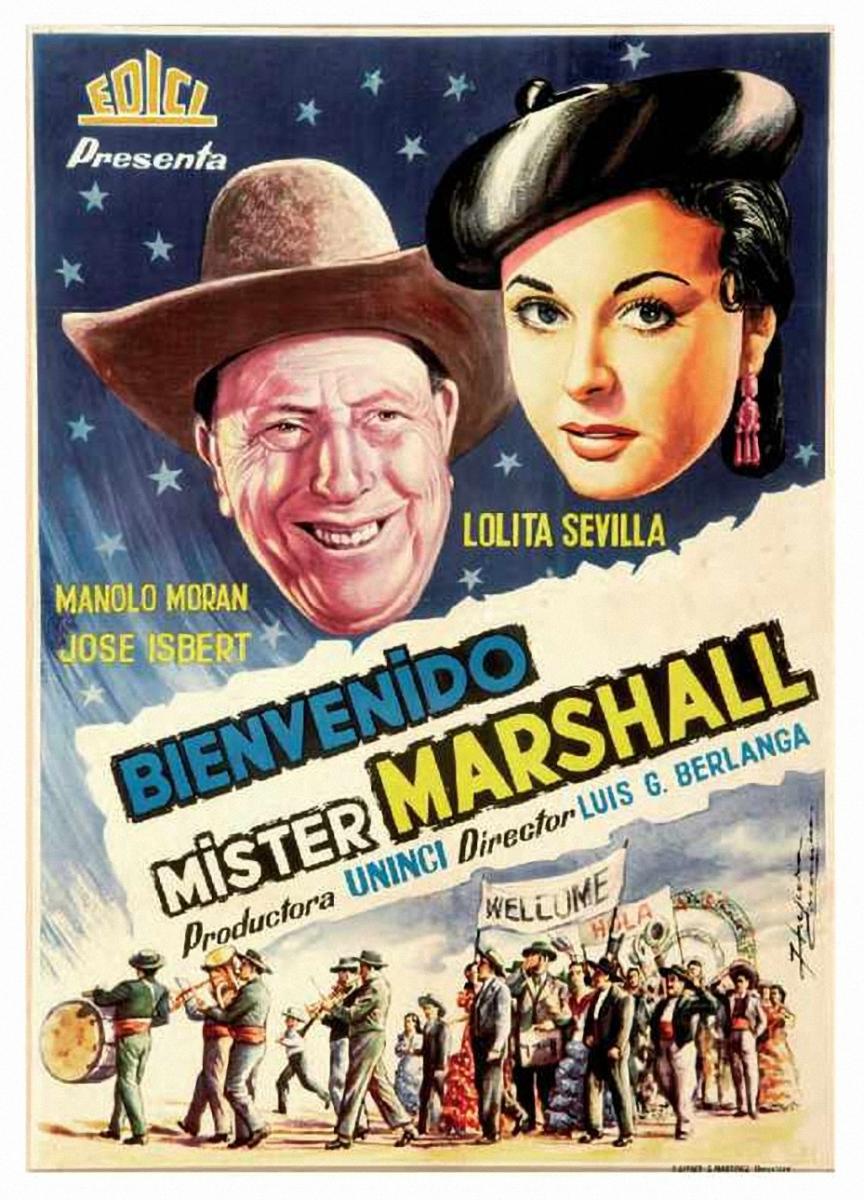
Last week I listed Luis Garcia Berlanga’s Placido (1961) as one of my film discoveries of 2016. A devilishly funny account of Christmastime sanctimony, it was the first film I had seen by Berlanga. Luckily, The Criterion Channel on FilmStruck is streaming four more of his films so I can get further acquainted with this acidic Spaniard. The earliest work on display is Bienvenido Mr. Marshall! (aka Welcome Mr. Marshall!, 1952), Berlanga’s breakout feature, which lovingly satirizes a small Spanish town trying to lure Marshall Plan funds from the U.S. It won the second place International Prize at the Cannes Film Festival, but was famously denounced by jury member Edward G. Robinson as “anti-American.” The film is more anti-Catholic Church and Generalissimo Franco than anything else, however, as the Americans are phantoms wielded as symbols by the local government and clergy – described as both wealthy benefactors and agents of moral decay. What the film lampoons most spectacularly and thoroughly is Franco’s attempt to promote Spain in a single image: an Andalusian Spain that was all flamenco and bullfights. Before the Americans’ arrival, the town hides the drunks, throws up fake facades and wears Andalusian costumes to pretend they are a tourist paradise rather than a poor farming town. As in Placido, Berlanga uses thumbnail caricatures to populate his village, hilarious creations like the half-deaf mayor, a broke colonialist aristocrat and a rotund hustler/producer who turns their town into a Walt Disney-fied version of Spanishness.

Bienvenido Mr. Marshall! was the first film that Berlanga directed on his own. He had previously co-directed That Happy Couple with his writing partner Juan Antonio Bardem (Javier Bardem’s uncle), a bittersweet comedy about a newly married couple trying to make ends meet in Madrid. Bardem was a close friend from film school – they had both graduated from the Institute of Cinematic Investigation and Experience (IIEC) in Madrid. Mr. Marshall was originally intended to be another collaboration, a musical folk comedy set to promote young flamenco singer Lolita Sevilla. But the plot kept shifting during development, the main inspirations being the rural dramas of Emilio Fernandez and Jacques Feyder’s Carnival in Flanders (similarly about a small town changing its colors to accept a rich foreign visitor). Then absurdist playwright Miguel Mihura was brought in to tweak the script, lending it its self-reflexive narration (it opens with an omniscient voice who introduces the villagers by telling the film to stop, zoom in, and move through the town – as if the screenwriter was on the mic). Bardem dropped out due to money disputes with the production company, and Berlanga was set to direct himself.

The film is set in Villar del Río, a poor farming town that is turned upside down when government officials arrive and tell them that U.S. representatives will be visiting on a tour to determine funding for the Marshall Plan. Instead of giving their children some American flags and their women some flowers to lay at the Americans’ feet, theatrical impresario Manolo (Manolo Morán) has a grander plan – turn their city into the Andalusian paradise that exists only in tourism board photos. So the town builds new facades to cover their dingy stone houses, orders bull-fighting costumes on credit, and changes their sleepy cul-de-sac into a romantic music-filled postcard of Franco’s Spain. The idea is enthusiastically embraced by the town’s creaky old mayor Don Pablo (José Isbert), who is desperate to give his town some shine. Isbert has a gravelly Tom Waits voice and uses a prop hearing device like a conductor’s baton. He’s forever crouching in closer to hear another insane suggestion from one of his constituents, making Don Pablo a sympathetic fool. He is the richest of a poor lot, but also sweet and gullible, trying his best and constantly failing to improve Villar del Río’s lot.

So when Manolo rolls into Villa del Rio with this flamenco chanteuse Carmen (Lolita Sevilla, her character cut down significantly from the original concept), it seems like a gift from the heavens. Here is a man who knows how to deal with Americans, or at least other rich people. So the whole town is drafted into a performance they’d prefer not to be involved in. But there are promises of massive donations from the Americans, so they don the insulting outfits with reluctant enthusiasm, and stand in line to tell Don Pablo the one object they’d like to receive from the USA’s largesse. They work day and night for their grand illusion, and the only moment in the film in which everything works as it should is during the rehearsal of the Americans’ arrival. It is a grand pageant of flamenco, Spanish folk music and wide-brimmed hats, a raucous celebration that the whole town rises up for, knowing that they were performing for an audience only of themselves.

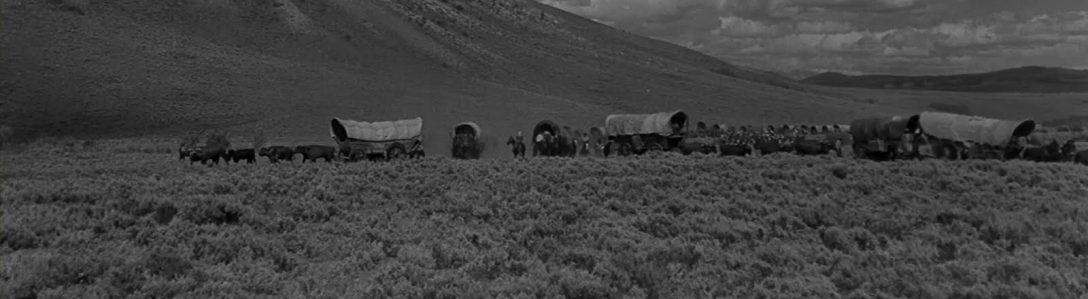
That group high lasts into their dreams. For the night before the big U.S.A. day, there are three delirious dream sequences where the villagers live out their violent fantasies of American life. The priest Don Cosme (Luis Pérez de León) has been fearful of the arrival, preaching to his choir that Americans are spiritually delinquent heretics who will despoil their simple hard working town. His dream is a nightmare montage of U.S. culture: he is arrested by hooded KKK members, interrogated in a film noir police station under one bright swinging light and sentenced before a judge of the “Un-American Activities Committee” on an expressionist B&W set. He wakes up as he is about to be hung from a rope (it is probably this sequence that Edward G. Robinson objected to). Don Luis (Alberto Romea), the last of  a long line of aristocratic colonizers, is always complaining how Indians ate his ancestors, and clearly considers all Americans to be equally savage. His dream has him plant his flag on U.S. soil only to be put into a pot to be boiled. Before he is plated for dinner his cats wake him up. Don Pablo had just come out of a Western at the one-screen cinema, so his dream has him engaged in a chaotic shootout at an Old West saloon, dying in a showgirl’s arms.

Villar del Río wakes up the next morning and tries to meet their fantasies of the United States with what they believe the Americans’ fantasy of Spain is – that is, wide-brimmed hats, flamenco in the streets, wild displays of emotion. It is a collision of misunderstandings, if only the U.S. representatives would show up. The film ends in an anticlimax that brutally returns Villar del Río to reality. No longer a political plaything, the town sloughs off Franco’s projected image of Spain, its own visions of America, and gets back to the hard work of being itself.