The Tramp: Boudu Saved From Drowning (1932)

May 16, 2017

BOUDU SAVED FROM DROWNING (1932)

“From Boudu I have learned that one of the attitudes to take toward society is to loathe it.” – Michel Simon

In Boudu Saved From Drowning (1932) Michel Simon plays a bearded bum who has lost interest in humanity. Boudu would prefer to stroll in the park with his dog or drown at the bottom of the Seine than re-enter the world of neckties and table manners and responsibility. But he is dragged into it by a bourgeois bookseller who hopes to “save” him from his “plight.” But instead of praise Boudu brings chaos, destabilizing the household from within. Simon closely collaborated with director Jean Renoir on the production, and it is a tour de force performance, with Simon a loose-limbed satyr, extending his gangly frame in all the wrong directions so as to most annoy his hosts. It is something of a thematic sequel to La Chienne (1931), which Renoir and Simon completed the previous year and which I wrote about last week. They both center Simon as a sympathetic monster, one who commits despicable acts but only because they are being true to themselves. It is Boudu’s nature to drift, so if he is not allowed to drown in the undercurrent, he will coast above it, roiling all the lives he touches along the way.

Boudu Saved From Drowning was the first production for Les Productions Michel Simon, which the actor created in January of 1932, having hopes of many collaborations with Renoir. At the time the director said, as quoted in Pascal Merigeau’s Jean Renoir: A Biography: “We have a superb understanding of each other; he hates the outrageous complications of the world of film as much as I do…and we really want to remain independent. We have the capital, the screenplays, and we know what we want. You know what a wonderful comic actor Simon is; so we’re going to make a comedy every year.” It turned out that Boudu was the first and last film for the company.

The film was based on a play by René Fauchois that debuted in 1919, though Simon had performed as Boudu in the 1925 revival. Renoir deviated wildly from the original, retaining only the first two acts, and, as Merigeau reports, adding a prologue and epilogue. Fauchois was so enraged by Renoir’s changes that he rushed a new stage version of the play, with an added fourth act, that premiered while the film was still in theaters. The biggest difference in the productions is the fate of Boudu. Fauchois’s original has him successfully saved by the bookseller, married to his maid and a new member of the middle class. Renoir’s Boudu rejects this life, opting for a radical, disruptive freedom.

MCDBOUD EC009

As with La ChienneBoudu opens with theatrical artifice – that of a satyr and nymph playacting in front of a drop cloth. He pursues and she resists, until he pulls her in for a kiss, the camera pulls back, and there is a dissolve to the spiral staircase of the Lestringuez residence. There is a pan left to the window, where round bookshop owner Edouard (Charles Granval) is trilling sweet nothings and pawing at his mistress (and maid) Chloë (Sévérine Lerczinska) before his wife Emma (Marcelle Hainia) sarcastically enters. The household is now associated with stagecraft and fakery, while Boudu is introduced in nature, lazing under a tree while his dog plays in a pond (water imagery surrounds Boudu throughout). When his dog wanders off, Boudu disconsolately goes out on a search. But no one is willing to help a bum, as cops and civilians run away at the sight of him. He wanders the background of shots as a rich lady gets the attention of the whole park with a story of her missing pekingese. Experimenting with deep focus, Renoir and his DP Georges Asselin often isolate Boudu in the distance, a tiny figure hiding behind trees or propping himself up in a door frame. The closer to the front of the frame he is, the more trouble he causes. It is technically brilliant but registers casually, offhand. André Bazin wrote that, “One of the most paradoxically appealing aspects of Jean Renoir’s work is that everything in it is so casual. He is the only film maker in the world who can afford to treat the cinema with such apparent offhandedness. … If one had to describe the art of Renoir in a word, one could define it as an aesthetic of discrepancy.”

Still hurting from the loss of a dog, or for other reasons never stated, Boudu wanders to a bridge and jumps off. Across the street Edouard is watching ladies with his telescope and witnesses the suicide attempt. Shocked into action, he rushes to the scene and dives to rescue Boudu from the water. Edouard becomes something of a local hero, Boudu’s rescue representative of the right mindedness of the bourgeoisie. But Boudu had no interest in being rescued – he’d either die or float downriver, and either outcome would be OK with him. Instead he’s stuck at the Lestringuez home as a charity case, a way for the family to feel good about themselves, and justify the morality of the middle class. He is a totem of their sensitivity.

MCDBOSA EC001

In return Boudu proves his unsuitability for civilized life, spreading shoe polish over the bed linens, flooding the kitchen, and in the ultimate outrage, spitting in a volume of Balzac. Boudu is a monster and a man of principle. He doesn’t grow or change or learn a thing over the course of the film’s running time, but remains irrepressibly himself, destroying property and blithely telling uncomfortable truths. He also seduces Chl0ë AND Emma, but the artistically minded Edouard doesn’t mind that intrusion too much, he seems to take it as a compliment. And sex, which has become business to Chloë and infrequent for Emma, becomes a source of pleasure again for both of them.  In fact the Lestringuez family is not wrecked by Boudu’s depredations, but awakened by them. Boudu trashing their place makes them drop their artificial posing and look at each other truthfully, at least for a little while.

Boudu returns to nature, first flinging off his fitted suit and putting on the tattered clothes of a scarecrow, and then flinging his fedora into the Marne River. Then the camera detaches itself from Boudu’s POV, a privileged moment of documentary. The last we see him, Boudu lies back in the grass and looks at the sky. But the camera pans and follows the trajectory of his hat, floating down the river. We see the activity of the waterway, rowers practicing, the current flowing and the particular haze surrounding a blade of grass. Bazin puts it better than I can:

“What moves us is not the fact that this countryside is once again Boudu’s domain, but that the banks of the Marne, in all the richness of their detail, are intrinsically beautiful. At the end of the pan, the camera picks up a bit of grass where, in close-up, one can see distinctly the white dust that the heat and the wind have lifted from the path. One can almost feel it between one’s fingers. Boudu is going to stir it up with his foot. If I were deprived of the pleasure of seeing Boudu again for the rest of my days, I would never forget that grass, that dust, and their relationship to the liberty of a tramp.”

This is the fourth part of a series covering the films of Jean Renoir, 16 of which are streaming on FilmStruck. The first entry on Whirlpool of Fate (1925) is here. The second entry on Nana (1926) is here. The third entry on La Chienne (1931) is here.

Life is Beautiful: La Chienne (1931)

May 9, 2017

CHIENNE, LA (1931)

The characters in La Chienne (1931) do not learn or grow, but remain indelibly themselves. Each act of pettiness, adultery or murder is a logical extension of personality, fated in DNA.  It is the earliest of director Jean Renoir’s canonical works, bitterly funny and desperately sad, which unravels a love triangle in which all three members cling to unsustainable illusions. A mild-mannered cashier (Michel Simon) and brutish pimp (Georges Flamant) both project their dreams of escape onto a no-nonsense prostitute (Janie Marèse), who is unwilling to satisfy their divergent desires (the cashier asks for love, the pimp money – neither ask what she wants). None are capable of enough empathy to consider the other’s position, so they continue in mutual incomprehension, and on to frustration and violence. Renoir bookends the film with a puppet show, framing the trio as marionettes not in control of their destiny, tugged along by their natures. While this leads them to tragedy, it also provides them with a radical kind of freedom, the sloughing off of all control.  

This is the third part of a series covering the films of Jean Renoir, 16 of which are streaming on FilmStruck. The first entry on The Whirlpool of Fate is here. The second entry on Nana is here.

According to Renoir, he was only allowed to make La Chienne, his second sound film, after he could prove that he could work quickly and under budget. So he was assigned to adapt the Georges Feydeau comedy On purge bébé (1931), which he wrote, directed and edited in three weeks. His producers Pierre Braunberger and Roger Richebé formed the production company Les Etablissements Braunberger-Roger Richebé in 1930. Braunberger was a longtime friend who had worked with Renoir since Whirlpool of Fate in 1925. It was reportedly Richebé who asked Renoir to use On purge bébé as a test for La Chienne, though Renoir biographer Pascal Merigeau could not find anything to support Renoir and Branuberger’s claims to that effect. In any case On purge bébé was made very quickly, but though Renoir dismisses it as a commercial job, it is really quite funny, especially if you are interested in Michel Simon reaction shots after he accidentally swallows some laxatives. And it is here he begins his collaboration with sound engineer Joseph de Bretagne, which continued through The Golden Coach in 1952. Renoir was insistent in recording sound live instead of in post, and On purge bébé was infamous for its toilet flushing sound. Renoir wrote: “In my concern for realism, I used the flush of a real toilet in the studio. The result produced the sound of a cataract that thrilled the production representatives and elevated me to the level of a great man.”

CHIENNE, LA (1931)

Les Etablissements Braunberger-Roger Richebé announced that they acquired the rights to Georges de La Fouchardiere’s La Chienne on April 11, 1931. Renoir adapted the script himself and directed the film. There is some question as to whether the film was reedited by the producers, but Renoir claimed he got the cut he wanted, and Merigeau concluded that it “was probably edited by Renoir and Marguerite [Renoir], then by Denis Batcheff under the direction of Paul Fejos.” The film concerns Maurice Legrand (Simon), a passive weak-chinned cashier at a women’s hosiery factory who paints as a hobby. A masterfully fastidious performance by Simon, his Maurice is little more than a recessive nasal murmur, a man who speaks not to be heard but to get quicker into silences. He is married to Adèle (Madeleine Berubet), a demanding shrew who is endlessly comparing Maurice to her first husband, who died in WWI. Coming home from an office party, Maurice stumbles into a spat between Lulu (Marèse) and her pimp Dédé (Flamant). (In a tragic footnote, soon after filming Marèse would die in a crash, in a car that Flamant was driving.) Thinking that he is being gallant, he knocks Dédé over and escorts Lulu home. To seem more interesting, Maurice tells Lulu that he is a painter. Dédé encourages Lulu to cultivate that relationship and leech him of money, thinking he is a famous artist in America. Needing some quick cash, Dédé steals a couple of unsigned canvases and invents an artist to assign it to: “Clara Wood.” Clara Wood becomes an in-demand artist, and Lulu takes on the role. Maurice is flattered that his art is getting attention, and pleased it’s generating income for Lulu. Temporarily, all parties get their ego stroked. But then Maurice miraculously is freed of his marital bonds, and sheepishly asks Lulu to marry him. She can playact no longer, and laughs in his face. It is the end of their “selfless” performances, and the reveal of their truest selves.

CHIENNE, LA (1931)

The Guignol puppet at the beginning of the film declares, “The play we shall perform is neither drama nor comedy. It contains no moral message, and has nothing to prove. The characters are neither heroes nor villains. They’re plain folk like you or me,” implicating the viewer in the tonal shifts to come, for the film is focalized through Maurice, a typically sympathetic lead character. But as the film progresses he reveals depths of insecurity beyond even Dédé, a man who slaps Lulu around out of boredom. But the wonder of the film is that it never sits in judgment; even the most heinous actions occur due to the convergence of personality and circumstance, and Renoir’s camera keeps its distance, peeking through curtains or café windows. This framing is remote, almost aloof. As Bazin wrote, “There is a deliberate attempt here to use a frame within the frame to underline the importance of all that lies beyond the screen.” As this petty drama unfolds, there are others behind and at all sides of the camera, just out of view.

The last few sequences evade language, and invite cliché. They take place years later, with Maurice reduced to vagrancy and homelessness, and yet still capable of his pinched smile. He wishes for his own death and yet opines that “life is beautiful” as one of his old “Clara Wood” canvases is sold to a wealthy buyer. The ending is brutally ironic and entirely sincere. Maurice has erased himself from society while his work is sold under an imaginary name. But he gets a tip for opening a car door, enough to buy a hot meal, and that, at least temporarily, is a beautiful thing.

Party Girl: Nana (1926)

May 2, 2017

Nana (1926) Directed by Jean Renoir Shown: Catherine Hessling

Jean Renoir considered Nana (1926) to be “my first film worth talking about.” An ambitious adaptation of the Emile Zola novel, Nana (Catherine Hessling) is an actress of limited means adept at manipulating men’s hearts, failing as a stage star but lavishly succeeding as an actor in her own life (a theme Renoir would return to throughout his career). After his scrappy independent production The Whirlpool of Fate (1925) failed to get much distribution, Renoir went big, making Nana a million franc French-German co-production.  It is an enormous step up in scale, going from shooting around his childhood haunts in Whirlpool to juggling multiple locations around Europe, as well as the egos of his international cast. Still experimenting stylistically, Nana, like Whirlpool, has expressionist touches at the edges of a realist drama. This tension is centered in the performance of Hessling (Renoir’s wife, real name Andrée Heuschling). A devotee of Gloria Swanson, she is elaborately made up and gives a performance of grand gestures and herky jerky movement. Renoir admiringly compared her to a “marionette.” It works for the character – a woman not in charge of her own life – but for audiences used to more naturalistic acting, it faced ridicule. But Nana is no joke, but a bold experiment in which Renoir toys with performance and camera movement to convey the unsaid.

 This is the second part of a series covering the films of Jean Renoir, 16 of which are streaming on FilmStruck. You can find the first entry on The Whirlpool of Fate here.

NANA (1926)

According to Pascal Merigeau’s Jean Renoir: A Biography, the production company Films Renoir was incorporated on September 1, 1925. The previous month Nana had been announced. Renoir was still negotiating with the Emile Zola estate, but eventually paid them 75,000 francs for the rights to the story. In order to secure German funding, they needed to cast German actors. Through the help of producer Pierre Braunberger, the role of Count Muffat, Nana’s main suitor, went to Werner Krauss, known today as Doctor Caligari in The Cabinet of Dr. Caligari (1920). They also cast the German actress Valeska Gert (The Joyless Street, 1925) as Nana’s maid, Zoe. This helped convince Delog Film Kommanditgesellschaft, Jacobi & Co. to pay for the costs of the German shoot, since there would be a built-in local audience. It didn’t pan out that way, but it allowed for the film to continue.

Gert would later describe Hessling as “an authentic Parisian, chic, capricious [who] used a outrageous amount of makeup, which, at the time, only Gloria Swanson was doing.” Hessling was an untaught talent, and had no intention of taking lessons, unless the Americans called. She told her friend Alice Fighiera that if they called, “it will mean I’ve got talent. If they don’t, none of it’s worth the trouble.” She is introduced rising above the stage on a winch, in one of the first dolly shots of the film. Renoir and his DPs Jean Bachelet and Edmund Corwin use the technique as a slow reveal, a setup and punchline. Catherine is raised but cannot descend all the way to the stage, a knot keeps her dangling frustratingly above solid ground. Her flailing struggles make her look like a puppet. After the show a few suitors are shown waiting at her dressing room. The camera slowly dollies backward to reveal that the whole floor and staircase is clogged with potential paramours.

NANA (1926)

Only one manages to shoulder his way inside her room, the wealthy Count Muffat, who has enough cash to underwrite Nana’s career at the struggling theater. A blooming fetishist, Muffat becomes aroused by the hair stuck in her comb, and is at her beck and call the rest of the feature – by the end she has him on all fours barking like a dog. Like Charles Foster Kane, he funds her dramatic work, only for her to be laughed off the stage. Nana is completely without self-criticism, she truly believed her flouncy over-affected caricature could fly as a portrait of an upper class lady. When her life as an artist flops, she begins her second, more lucrative, life as a courtesan, with a group of lapdogs on her string. The other most notable victim is Vandeuvres (Jean Angelo), the last remaining scion of a distinguished family. He sullies his name in a poorly thought out racetrack swindle; to win Nana’s heart is through her pocketbook, or so he believes.

But there is no way to Nana’s heart, for even she doesn’t know the directions. Hessling plays her with an armor of artifice, always playacting to the room. One never knows what is authentic emotion or simply a flirtatious technique. Emblematic of her capriciousness is a shot where Nana wields a pool cue, lines it up against a fine piece of china as if setting up a shot, and then smashes it. Renoir would write in My Life and My Films that “In Nana she carried it [stylization] to the uttermost extreme. She was not a woman at all, but a marionette. The word, as I use it, is a complement.”  This doll crushes every man like that fine china, not that they don’t deserve it. Muffat is a dour married man who blows up his marriage out of boredom and a hair fetish. Vandeuvres is another of the idle death-wish rich, using Nana as an excuse for self-incineration. The only cad worthy of pity is a callow youth named Georges (Raymond Guérin Catelain), whose love seems innocent and true, and his delicate constitution can’t handle seeing Nana play pseudo S&M games with the masochistic Muffat.

Nana is surprised by her own emotions at the loss of two of her suitors, both of whom take their own lives. During an extraordinary sequence at a Parisian ball, Nana tries to recapture her previous decadence, losing herself in a feverish can-can, an attempt to sweat out her emotions. But she cannot stop them. Renoir ends the film with some of his most complicated and basic techniques. There are double exposures revealing ghosts of lovers past, haunting her with their modes of demise. Her body, unused to such feeling, shuts down. And without depicting a dramatic collapse, or giving her one last command performance, Renoir simply turns out the lights.

Jean Renoir: Whirlpool of Fate (1925)

April 25, 2017

WHIRLPOOL OF FATE (1925)

In a fortuitous sequence of events, right after I acquired Pascal Mérigeau‘s biography of Jean Renoir, FilmStruck started streaming 16 of the director’s features and shorts. I’ve skimmed over the surface of Renoir’s career, having seen the acknowledged masterpieces like The Rules of the Game (1939) and Grand Illusion (1937), but never managed to explore much beyond that. So over the next few weeks I will be discussing an individual Renoir film, providing production info gleaned from Mérigeau‘s exhaustively researched tome. First up is the hypnagogic melodrama Whirlpool of Fate (the original French title is La Fille de l’eau, The Girl in the Water, 1925), starring his Gloria Swanson-worshipping wife Andree Heuschling (using the screen name Catherine Hessling). Though he received a co-directing credit on 1924′s Catherine (aka Backbiters), Fate is the first film where he had complete control, and he used it to experiment with a range of tones and techniques, from poetic realism to flights of expressionist fancy.

The scenario for Whirlpool of Fate was written by Renoir’s friend Pierre Lestringuez, and was shot in and around Paul Cézanne’s property, La Nicotiere, in the town of Marlotte. Cézanne was a family friend, and Jean spent many afternoons there as a youth, counting his Sundays there “among my happiest memories” (as recalled in My Life and My Films). So he was intimately familiar with the grounds, and he gets a fairy tale beauty out of the streams running through the area. The film opens with a houseboat cruising down a waterway on a sun dappled morning, shot by cinematographers Jean Bachelet (who would later shoot The Rules of the Game) and Alphonse Gibory.

On board are Gudule (called Virginie in some versions, played by Heuschling), her father and her roustabout uncle Jeff (Pierre Lestringuez). The father dies in a freak accident, and Jeff squanders the family inheritance on booze, and often shows up drunk and physically abusive towards Gudule. So she runs away from home, and takes up with a small time crook nicknamed “The Weasel.” They travel the countryside together, nicking food from nearby farms when they can get away with that. Just when Gudule is acclimating herself to a new life, she falls down a steep quarry wall and loses her memory. The Weasel disappears, and instead she is cared for by Georges (Harold Levingston), the son of a bourgeois family who brings her food and drink to stay alive. Suffering from terrible fevers, Gudule begins experiencing severe hallucinations – or incredible lucid dreams, in which Renoir experiments with double (and triple) exposures, associative editing and random shots of lizards. Once she comes to, Gudule regains her memory, only to run into Jeff again. She can’t fully re-emerge into adulthood until Jeff agrees to let her go.

WHIRLPOOL OF FATE (1925)

The film is a charming travelogue of La Nicotiere, with a barely-there episodic narrative guiding Gudule through the wooded paths. Heuschling/Hessling was a great admirer of Gloria Swanson, and she applies her lipstick into a pert bowtie shape that mimics that of Swanson’s in Zaza (1923). She admirably underplays her melodramatic role, and her calm carries the film through it’s many twists and turns. Already Renoir was operating a film set like a family get together, emphasizing fun above all. Mérigeau writes that “A team was being put together, and with it one of the essential prerequisites of a Renoir film: Jean Renoir at the head of the gang, whose members constituted a kind of family, producing a self-organizing system.” It was shot at the familial locale of La Nicotiere and filled with friends and family, including painter André Derain, who plays a distressed innkeeper with a toothache.

What reputation the film has today rests on its dream sequence, which Renoir directed “in a studio where he had had a cylinder built and painted completely black so that a camera placed on a dolly permitted a 360-degree panoramic view and could follow a horse at a gallop. On the same roll of film, he next shot superimposed clouds.” This sequence has the charm of a Melies short in its analog magic. In its most abstractly beautiful section, Gudule is floating against a black sky, her translucent gown fluttering in the wind. Then she flutters back down to earth, emerging from a columnar set from which a lizard just poked out its head. It conveys weightlessness above all, appropriate for Gudule, whose body has brought her nothing but pain and sorrow thus far. An enterprising theatrical producer named Jean Tedesco would book programs of excerpts from feature films, essentially mixtapes of his favorite sequences. In 1925 he included the dream sequence from Whirpool in one of his programs. At first Renoir was annoyed at the bootlegging, but the scene was wildly applauded at the screening, which grew even louder when they saw the duo in the theater. This for a film that had received minimal bookings in Paris, to muted response. It was the same abroad. Tedesco continued to play the dream sequence in Paris to much acclaim.

Renoir considered Nana (1925) to be his first true feature, and I will write about that one next week, but Whirlpool of Fate is not worthy of disavowal, what with its inventive cinematography (both the natural light of the “realist” outdoor sequences and the madly expressionist studio dream sequence) and the laid-back brio of the performers. Renoir already seemed to have a knack for eliciting relaxed performances, and it was a pleasure to spend time with the Renoir family on this intimate affair.

RENOIR NOIR: NIGHT AT THE CROSSROADS (1932)

September 9, 2014

LA NUIT DU CARREFOUR (1932)

“Every detail, every second of each shot makes La Nuit du carrefour [Night of the Crossroads] the only great French thriller, or rather, the greatest French adventure film of all.” -Jean-Luc Godard, Cahiers du Cinema (December 1957)

Night of the Crossroads was the first film adaptation of Georges Simenon’s phenomenally popular Inspector Maigret novels, and was lent a thick, hallucinatory atmosphere by director Jean Renoir. Yet, sandwiched as it is between Renoir’s classics with Michel Simon, La Chienne (1931) and Boudu Saved from Drowning (1932), it has escaped much serious critical attention. It does not even get an entry in Andre Bazin’s collected writings on Renoir. Anthology Film Archives arranged a very rare screening of the feature this past weekend, with Simenon’s son John in attendance to discuss the production beforehand. It’s a traditional whodunit, except all of the motivations are missing. Instead of attributing the crime to a single perpetrator, the whole town becomes culpable through their xenophobia and greed. As Renoir’s character Octave says in The Rules of the Game, “everyone has their reasons”. To that Night of the Crossroads would add, “for murder.”

La-nuit-du-carrefour-1932

This narrative opacity was originally attributed to missing reels. Godard wrote that Jean Mitry “lost three reels after shooting was completed.” Renoir was asked to confirm the rumor, and said, “It’s possible, but even at the time, you know, it wasn’t very clear. I don’t think anyone of us understood anything. Least of all me.” As Renoir implies, the legend is not necessarily true. In Richard Brody’s article on the film for The New Yorker, he reports that the “fragmentary construction” was due to “his running out of money during production.” The project was all improvising – working around the financial limitations. Andre Brunelin wrote that the production was “a business of make do and mend. Decor had to be made out of anything at hand, it was all painting and knock-up.” This was no unauthorized fly-by-night operation, however. It had full support of Georges Simenon, who was friends with Renoir and collaborated on the screenplay.

B607

The story concerns a murder in a small town outside Paris. A local insurance agent (Jean Gehret) discovers his car has been swapped with another. When the locals search the neighborhood, they find his vehicle with a corpse behind the wheel. It is stowed inside the garage of a Danish brother and sister who are already despised in the community for their eccentricity and foreignness. Inspector Maigret is brought in and stirs up all of the local resentments, putting more lives at stake.

carrefour01

It was shot from January – March of 1932, three weeks at a crossroads near Bouffemont, outside of Paris, and the remaining time at the Europa Films studio in Billancourt. The location was choked with fog and rain –  perfect for the tale of secret identities and cloaked motivations. Before the screening, John Simenon confirmed that his father approved of the project, and especially of the casting of Pierre Renoir, Jean’s brother, as Maigret. He had the right height and bearing, if not the described muscularity of the book’s Inspector. With his prominent widow’s peak and hawk like face, Pierre Renoir strikes a strange figure, one of bookish, watchful intensity. His role is an observer that lets the villagers stumble into their confessions. His main move is to listen attentively, his interrogation method one of waiting out silences. The Danish man is Carl, a gangly Frankenstein’s monster type with an appropriately ghastly artificial eye, who happens to paint commercial art for a living. He keeps house for his sister Else (Winna Winifried), a hothouse flower quick with come-ons. One of the more perverse shots has a her flirting with her pet tortoise in an overhead shot. Their house is a dusty catacomb of ash, useless tchotchkes, and secret hiding places. One of them slides open when Else leans in to to kiss a nonplussed Maigret. Her shoulder pushes a painting across the wall, revealing a bottle of Veronal and a gun.

nuit-du-carrefour-1932-cine-sonoro

The street is hidden in fog, drugs are secreted behind paintings, and whole backstories are missing because of the budget shortage. But this expository lack fits the whole theme of the film – one which renders the last act revelations truly surprising, since we don’t know who half the characters are. Renoir uses this chaotic situation to experiment with a variety of techniques. There are deep focus shots with characters posed in background doorways in windows, winding tracking shots executed by mounting cameras onto cars, and a grand experiments in sound, in which audio acts as a kind of metronome. In his interrogations, Maigret knows the time is up when his empty glass is filled up by his dripping office faucet. To compress the time of the original investigation, Renoir cuts back and forth from Maigret running down leads to shots of commuters feet shuffling in front of a newspaper vendor. Their yelling out of “Morning edition!”, “Afternoon edition!” and “Evening news!” keeps the timing down. The abstracted shot of legs is then rhymed later with the hidden assailant, seen as a pair of feet stomping through mud puddles, and as an arm placing a poisoned beer onto a table. Some of these spy game machinations recall Feuillade, which Renoir was undoubtedly familiar with, though on a much simpler scale.

nuit-du-carrefour-1932-02-g


Renoir also had the advantage of more mobile cameras, and he used them to the fullest extent. There is a camera-mounted car chase sequence of unbelievable beauty. All is shrouded in darkness as two Model-Ts chase each other around the turns, the brightest illumination provided by the exploding muzzles of gunfire. It is thrilling to be plunged into darkness, and felt like I was riding Space Mountain at Disney World for the first time. Except this thrill is not a celebration of modernity, but a resigned condemnation of it. All of the town is implicated in the murder. The bourgeois insurance company family , the artistically inclined Danes and the group of working class mechanics all pursued their self-interest into criminality.Maigret offers some hope – telling Else, “in two years [of jail time] you will be truly free.” Though what she will do with that freedom is seriously in doubt. All Maigret can do is grin and bear it, and wait for the next case.

THE WOMAN ON THE BEACH (1947)

April 27, 2010

wotb2

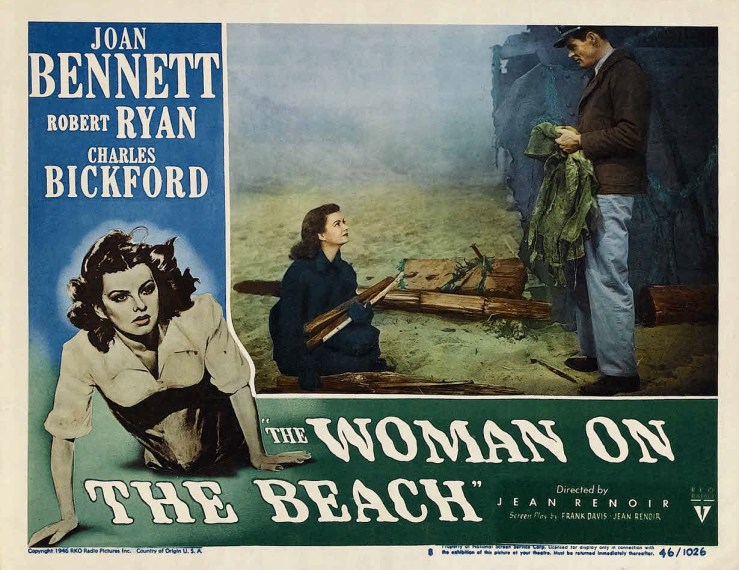
While the TCM Classic Film Festival was wrapping up out in L.A., I was pursuing my own personal Jean Renoir festival back in NYC. The Brooklyn Academy of Music is currently exhibiting a must-see retrospective that will hopefully tour a city near you. My personal highlight of the series so far is The Woman on the Beach, his last production in Hollywood, and by far his strangest, a somnabulist’s vision of a violent love triangle.  Its peculiar, almost abstracted plot was aided by extensive re-shoots after a disastrous preview screening, which trimmed out the exposition, leaving only the trio of lovers’ impulsive, and occasionally inexplicable actions.  Renoir had already pushed the visuals  in an oneiric direction, foggy, emptied-out landscapes of hollowed-out hulls and vertiginous cliffs. He even challenged his sound man to record the dialogue at an unusually low level, to emphasize the characters’ loneliness.

The pared-down result of the studio interference then, actually reinforces Renoir’s stylistic choices, and quite possibly made it a better film. This is exactly what Janet Bergstrom argues in her superb production history: “Oneiric Cinema: The Woman on the Beach”, which she published in the Film History journal in 1999. It is my main source for this post.

The story concerns a shell-shocked Navy vet, Scott (Robert Ryan), whose recurring nightmares of being torpedoed keep him in a constant state of anxiety. Attempting to banish these neuroses, he quickly proposes to his girlfriend Eve (Nan Leslie). After her skittish response, in which she is clearly shaken by his unhinged intensity, Scott begins a flirtation with Peggy Butler (Joan Bennett), who has been scarred by violence in her own manner. During a fight with her husband Tod (Charles Bickford), a painter, she accidently severed his optic nerve, blinding him for life. Bonding over their mutual traumas, they engage in a furtive affair, while Scott still manages a combative friendship with Tod. Ultimately driven to the brink of madness by their insecurities, Scott and Tod come into conflict…

Renoir recognized the strangeness of his conception of this film, describing it as “the sort of avant-garde film which would have found its niche a quarter of a century earlier, between Nosferatu and Caligari.” And emphasizing that its “subject was the opposite of everything I had been working toward in the cinema up to that point.” He went on:

The Woman on the Beach was a perfect theme for treating the drama of isolation. Its simplicity made all kinds of development possible. The actions of the three principal characters were wholly stripped of colourful detai; they took place in empty landscapes and in a perfectly abstract style…In all my previous films I had tried to depict the bonds uniting the individual to his environment…now I was embarked on a study of persons whose sole idea was to close the door on that absolutely concrete phenomenon which we call life.”

Renoir closes this door when he uses a dream sequence to introduce Robert Ryan. He begins as a nightmare. With the strains of “Home on the Range” ironically cooing in the background, Ryan imagines himself on a ship – followed by a massive explosion. He sinks to what looks like the bottom of an aquarium, where Eve is waiting for him in an evening gown with open arms. Right before he embraces her, there is another explosion. His war experiences are explicitly blocking him from a life with Eve, and dooming him to one of apparitions and hallucinations. He is like the character of Cesar from Caligari, motoring through his inexplicable deeds without a will of his own.

So when he begins to obsess that Tod is lying about his blindness, or insist upon a fishing trip in a rainstorm, he is operating solely on his unconscious drives – the neuroses engendered from battle. Peggy is on a similar path, wracked with guilt over stealing her lovers’ sight, and destroying his successful career as a painter. She is filled with hate for herself and with Tod, which can exhibit itself in improbably nurturing ways. As always with Renoir, “everyone has their reasons”, and it’s impossible to pin any of the characters down as the villain. All show flashes of sympathy and rage – Peggy snuggling on the couch with Tod, reminiscing about their youthful days in NYC, or Scott snapping from protective lover to vengeful cuckold. All three actors are fascinating to watch, and Renoir carefully balances their power relations in his fluid compositions [the most explicit is the interior boat shot above, where Scott and Peggy embrace inside while Tod is isolated in a separate plane outside the porthole].

Ryan is earnest and bereft, all-too-aware of his crumbling psyche and his inability to heal it. He has a seaman’s bearing that bends under the weight of the Butler household’s demands. Bickford is prickly and condescending as Tod, a bellowing ironist with an uneasy gait, his vast array of ascots unable to hold back the bile he irresistibly spews, mainly at his wife, who he delights in harming. Bennett is enigmatic and cold, her love of Tod turned to hate, but who still recognizes its original provenance. She shares her husband’s sarcasm and cynicism, but stays in the marriage because of an unshakable nostalgia and loyalty. With her melancholy eyes mixing pity and desperation, she casts the most elusive portrait of the three. Bennet was the one who demanded Renoir direct the film, after producer Val Lewton recommended Jacques Tourneur and Robert Wise, among others. She remained steadfast.

The film was first finished on July 1946, and a preview screening took place on August 2. The reaction was so negative that major revisions took place. The second version of the film was not released until June 8, 1947. Early in the pre-production process, the Production Code Adminstration (PCA) demanded the removal of any explicit reference to a “sex affair between Peggy and Scott and to omit any of the passionate kisses indicated in the present story.” Renoir reluctantly obliged. As Bergstrom notes:

“when ‘human desire’, as Lang would call it in his 1953 remake of La Bete Humaine, could not be acknowledged as the dominant theme, Scott’s neurosis because of his war experiences had to carry much more weight in his abrupt turn from the stability of his life with Eve toward his unsettling, moth-to-the-flame meetings with Peggy and Tod.”

Along with this repression of the sexual theme, Renoir dropped some boilerplate sub-plots that turned Peggy into a generic femme fatale.

Following some re-editing,  RKO solicited suggestions from other directors. John Huston “recommended that the film tell one story and that Scott’s neurosis should be eliminated.” Mark Robson advised “going back to Renoir’s original version because the film as it now exists is too confusing and choppy to make much sense.” Neither suggestion was agreeable to the studio, so RKO hired writer Frank Davis to re-work some scenes, beginning on September 23, 1946. Renoir greeted him with hope: “I have found my ideal collaborator.”

With Davis, a great deal of footage was re-shot. Renoir tells Pierre Lestringuez that it was nearly half the film. Nine years later he told Rivette and Truffaut that it was a third of the film, “essentially the scenes between Joan Bennett and Robert Ryan.” For unknown reasons, they also re-cast the role of Eve, replacing Virginia Huston with Nan Leslie, necessitating re-shoots for all of those scenes as well. It was a laborious and inevitably annoying process, but one with curiously positive results. As Bergstrom writes, and I agree, the film becomes almost Langian in its determinism and sparseness, rare for Renoir, but an appropriate reflection of his alienation from the studio system at this time. What was originally going to be a routine melodrama of sex and death becomes something more mysterious, where a trio of damaged lovers work out their unconscious drives on-screen, turning it into a  bewitching kind of trance film.

The Woman on the Beach is available in a Region 2 DVD from the French company Editions Montparnasse. Glenn Kenny reviews the disc here.