Colgate Comedy Hour, September 18, 1955

Originally Published in La Furia Umana (Spring 2012)

On September 18th, 1955, Jerry Lewis and Dean Martin hosted the Colgate Comedy Hour for the 27th time. It would be six months before they began shooting Hollywood or Bust, after which their preposterously successful union dissolved. But from 8 – 9PM on a studio set at NBC, they continued to work their alchemical comic magic, two perfectly poised bodies wreaking ingratiating destruction.

These Colgate Hours are the closest approximation we can get of their fabled live performances, which were filled with unrehearsed pranks and ebullient anarchy.  At the 21 minute and 35 second mark, a sketch begins that captures my imagined vision of their stage shows – a tongue-in-cheek tour-de-force of tightly sprung tension and a series of controlled manic releases. The camera descends on a stock shot of a pool room “just off Broadway”, where Dean is trying to win his money back in a game of nine ball. Told to hurry up and shoot, he raises his right hand and twists his wrist in an implied flip of the bird. His mates quiet down, and Martin will vainly attempt to conduct silence the rest of the sketch, mainly with his hands. It’s his rhythm and control that spurs and sustains the whole 20 minute piece.

Jerry enters wearing an oversized rain slicker and hat, visually already a man-child, and fumbles with the umbrella in a bit of business by the door.  Then Jerry’s alien presence stoops right beside Dean with a slack jawed stare, cowed only by a returned glance of disgust. Jerry steps back in this duet of mutual humiliation, and starts whistling. Dean calmly raises his right index finger and stops it in Jerry’s mouth, as if to staunch a spring in a dike. Dean is suave civilization, Jerry a particularly uninhibited embodiment of nature.

With Dean still trying to line up his shot, though, nature finds a way. Jerry bends over the table to eye it himself, and rainwater gathered in his peaked cap spills onto the felt. The dike has been loosed. Jerry directs the water into a corner pocket, which then blasts out of the opposite corner, spraying Dean in the face.

Jerry, his head bowed like a chastised puppy, becomes eager for instruction. Dean waves his hand left, and Jerry swivels his head in that direction, a bobble head of pure need. Hypnotized by Dean’s hand movements, he follows them wherever they point in a brilliant bit of pantomime. Maneuvered in front of a chair, Jerry robotically plops down after Dean’s quick wrist flip.

Order never lasts long in the Martin and Lewis altiverse, so Jerry wriggles out from Dean’s control by throwing over the elements for modern technology. Dean again tries to set up his Sisyphean shot, but Jerry’s order at the soda machine causes the clanking noises of a faulty Victorian-era furnace. Jerry’s bottle-opening screeches while his straw-sucking blasts as if over a loudspeaker. This is the repetition of the whistling bit, only amplified. Again Dean attempts to orchestrate silence (but not before an improv that almost makes Jerry break – passive aggressively dropping some soda in his mouth), twisting the straw into a knot and shoving it back into the bottle. Jerry, acknowledging his defeat, then repeats the earlier pantomime to himself, tracing those steps until he once again plops into the chair.

Martin & Lewis engage in a constant push-pull, but never manage to create any space between themselves, the gags inexorably bringing them closer together. Dean’s hands are sticky from the soda, so Jerry tries to help, covering them both in a penumbra of baby powder.  Now they are even visually connected, with a dusting of white covering their shoulders. The jokes increasingly become more hysterical and self-reflexive, with Jerry suddenly pretending to be a standup comic (he bombs) and then a songwriter (he kills). Dean is now the one left confused and adrift, his jerky reactions to hearing Jerry’s song on the radio (“Yetta I Can’t Forget Her”) nearly as spastic as his partner’s. As their identities shift and merge, by the end of the sketch they accept their contradictory unity and sing a song, called, aptly enough, “Side By Side”.

That they broke up less than a year later changes nothing. At that moment in time, they were an inseparable, insuperable comic force, a combustible union that would explode, reassemble and repeat ad infinitum; a glorious chaos that seemed it might never end. Until, impossibly, it did.
Wild at Heart: Jerry Lewis In Memoriam

Originally Published in the November-December 2017 issue of Film Comment

By R. Emmet Sweeney

Jerry Lewis’s comedy tapped the energy of nightclub improv and an anarchic urge to bring the house down at any cost

Jerry Lewis started out as a record act. He would throw on some vinyl and do rubber-faced pantomime to pop hits of the day in front of audiences–the kind of routine Andy Kaufman would adapt to his own absurdist ends decades later. It was one of the lower forms of comedy, employed by those performers without sufficient material to pad out a set. But then he met Dean Martin, and multiple Jerry Lewises emerged on contact: the kid, the spastic, the genius, the monkey, the ego, the depressive, the loner, the sexist, the artist. We lost all of those Jerry Lewises and more when he passed away in August at age 91.

What Martin and Lewis had was something alchemical, and it turned their audiences into screaming mobs, like Beatlemania before the fact. Dean was the eye candy who also happened to possess a rapier wit, while Jerry was the idiot with an innate sense of timing and structure. It was a deconstruction of the usual nightclub routine, as Martin’s suave crooner would be continually undermined and tested by Lewis’s nasal-voiced waiter smashing plates and causing chaos. Early on in their 1946 run at the Havana-Madrid club in New York, Jerry was constantly coming up with ideas to make Dean laugh, and one night he came up with a plan to switch off the house lights in the middle of “Pennies from Heaven.” Though the band stopped playing, Dean didn’t miss a beat, flicking on his Zippo close to his face and finishing the song in rhythm. They had an innate sense of timing, down to each inhale. According to Jerry, Dean “watched me breathe. He knew my breath…knew to lay back until just the right moment.”

The act was largely improvised, and audiences craved the energy and unpredictability they provided, as opposed to the more highly controlled Hope and Crosby team. Whether acknowledged or not, it’s hard to avoid drawing a line from the Martin and Lewis improvisational form to the one pioneered by Del Close for Second City in the 1970s and ’80s. Though Martin and Lewis never codified their method to same degree as Del Close’s “Harold” structure, the duo abided by a general movement in the moment to combine the threads of their improv. As Lewis put it, “the act might have looked like chaos, but we could always get back to where we needed to get on a moment’s notice. We had that down to a gnat’s ass.”

In 1948, Martin and Lewis brought their act to Hollywood, debuting at Slapsy Maxie’s nightclub. The trip was also an opportunity to hear pitches from the movie studios. They ended up signing with Hal Wallis and Paramount, but the best offer might have been the one made by Republic Pictures. In his 2006 book Dean & Me (A Love Story), Lewis wrote that Republic “basically wanted to shoot our act in a nightclub. (An interesting idea–in hindsight!!).” It’s astonishing to think we could have had a feature-length documentary of their legendarily madcap stage routine but instead ended up with My Friend Irma (1949) as their first film appearance.

Nothing against My Friend Irma, which is perfectly pleasant and introduced Lewis’s Barry Fitzgerald impersonation to the world, but it shunted Martin and Lewis into supporting roles, their bits contained in a couple of side sequences. The closest we have to their stage act are their hosting appearances on The Colgate Comedy Hour, which have a flavor of anarchy, things pushed to the point of breaking down. There’s a great bit in an episode from November 12, 1950, where Martin is a dancing instructor and Lewis a student. Lewis dances like a marionette with his strings cut, so to keep any partner from harm he’s given a mannequin to dance with. After the dummy gets flailed to the ground, Martin jibes, “Don’t you know how to pick up a girl?” Lewis cracks a smile, and the audience suffers convulsive laughter. The sheer noise is astonishing.

Martin and Lewis’s movies together provide their own kind of laughter, especially those with director Frank Tashlin that recontextualize their rapport in his Looney Tunes aesthetic (e.g., Artists and Models). They broke up acrimoniously in 1956 over issues of creative control, as both were jockeying to be solo stars. Their influence on the baby boom kids, however, was incalcuable, bringing antic long-form improv to the masses. Lewis provided the vaudeville heritgae (his parents played the circuit) and Martin brought the more modern ironic cool, always distancing himself from the chaos (“I copied Bing Crosby 100 percent,” he told reporter Pete Martin). It was a perfect combination of the old and the new, executed with a relentless, unpredictable rhythm that both stars would try to replicate with others over the rest of their careers. Dean found Frank Sinatra, while Jerry found his other selves.

Jerry Lewis, or what became the common image of Jerry Lewis, was established post-Dean. Martin anchored him to an identifiable reality, but now the spastic loner, the out-of-joint kid with the nasal whine and rubber body, no longer had any physical boundaries. It is this particular Lewis that spawned Jim Carrey, who presents an equally acrobatic take on the idiot, though with more violent tendencies (Carrey wrote a touching memorial to Lewis in Time magazine). Whether it’s Herbert H. Heebert in The Ladies Man or Julius Kelp in The Nutty Professor, the Lewis figure is in a natural state of apartness and is in a fraught, oft destructive battle to join to the main stem of society. Herbert says, “Being alone can be very lonely. But at least with people around, you can be lonely with noise.”

Lewis’s directorial debut, The Bellboy (1960), is a tour de force of being lonely with noise, as his titular character is ignored by the Hotel Fontainebleau customers, rendering him silent as he navigates the labyrinthine hotel space, which he expands and contracts through his imagination–turning an empty auditorium into a chiming orchestra through the force of his conductor’s wand. The Bellboy established Lewis’s disjunctive use of time and space. As Chris Fujiwara wrote in his Contemporary Film Directors book, Jerry Lewis, “in his films, the gag–or, more generally, the moment, scene, episode, event, or block–distracts from and disconnects the plot.”

The Bellboy’s orchestra is unrelated to the action of the hotel, just like the big dance number in The Ladies Man, of Hubert entering one “Miss Cartilage”‘s room only to find that a vast white set and an MGM-musical-inspired sequence await him. His world is a discontinuous one, and the fragmentation extends to his identity, like the Julius Kelp/Buddy Love split in The Nutty Professor, or his portrayal of six uncles in The Family Jewels.

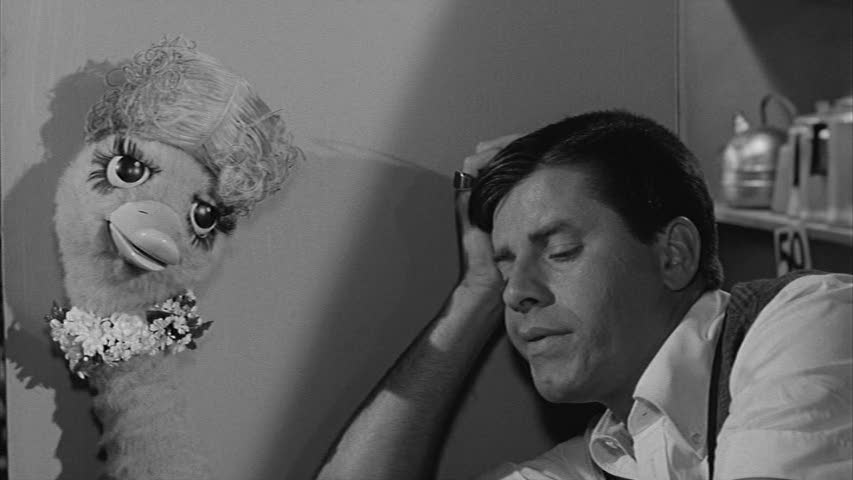
The break with Martin caused a gap in Lewis’s artistic practice, which he filled by other means. Fujiwara wrote that Lewis translated “Martin’s absence into a purely cinematic figure to play against.” He splits personalities and plays off of himself, or fractures the space and time of the film so he can play off an invisible orchestra–or have a heart-to-heart with a Southern Belle puppet as in his improbably moving scene with “Magnolia” in The Errand Boy. The fact that Magnolia might be his most fully realized female characater doesn’t say much for his treatment of women (nor does his late-in-life statement that they aren’t funny), but it does speak to the impossible sexuality of the Jerry Lewis man-child, ancestor of the Sandler/Apatow man-children that audiences so so fervently embraced in the 1990s and 2000s. His fear of women essentially is the plot of The Ladies Man, in which he works as a houseboy in an all-girls rooming house. The narrative gets derailed by gags and digressions and tour-de-force crane shots of the multistory dollhouse set, but in the end he hasn’t changed at all, his masculinity as fragile as ever.

All of which amounts to a fraction of the Jerry Lewises we could mourn. I’d like to think that Martin and Lewis have finally reunited and locked back into their old rhythms, cracking each other up to the roiling roar of a crowd. But just as in his movies, Lewis refuses such a tidy ending in Dean & Me: “I miss him every day I’m still here. I’ve considered the idea of our getting together again someday, but I believe when we die we are just put away and life goes on.”

JERRY LEWIS TAKES MANHATTAN

November 24, 2009

errandboy-5-723120

The nasal whine of Jerry Lewis is slowly screeching it’s way back into the American consciousness. He won the Jean Hersholt Humanitarian award at the last Oscar ceremony, and he’s returning to Broadway as the director of a musical version of The Nutty Professor, set for the 2010-11 season. And over the past few weeks, Anthology Film Archives held a retrospective of his directorial work, from The Bellboy through Cracking Up (aka Smorgasbord). The series was timed with the release of Chris Fujiwara’s concise study of his style published by the University of Illinois Press. It’s been a crash course in Lewis’ comedy, as I only have a passing knowledge of his movies, specifically the ones with Frank Tashlin (Artists and Models first and foremost). What became immediately clear is his astonishing technical command.

Regardless of whether I was laughing (which was about half the time), I was struck by the precision of his staging and the intricacy of his sound design. He’s adept at both crowding the frame with detail and locating a joke in the chaos (in the crowded elevator scene in The Errand Boy), or emptying out spaces and placing the gag in long shot (in the setting up the chairs bit in The Bellboy). His use of sound is just as fascinating, as he’ll often expose the mechanics of the film itself. There’s the sequence in The Ladies Man where he unplugs a microphone and the screen goes silent for a sequence of exaggerated pantomime, or the dubbing gag in The Errand Boy, where he loops his voice over a singing starlet.

As Fujiwara notes, “A main principle of Lewis’s films is not to fill in everything…”. His sets are spacious and garish,always calling attention to their artificiality, as in the dollhouse-like set of The Ladies Man (image right) , or in the “overhead crane shot in Kelp’s laboratory in The Nutty Professor, the camera reaches a distance hard to reconcile with the presumed real dimensions of the space, letting us know explicitly that this is a fantasy space, a movie set, a space of experimentation with identity.” He creates a theatricalized space to fit his constantly performing characters, and “Identity in Lewis is always performed; there is no private self.” And what an identity.

The Lewis “idiot” character is an empty vessel, either completely silent, as in The Bellboy, or a creation of studio hacks (The Errand Boy and The Patsy). His characters rarely have complete arcs, as he structures his films around a series of disconnected vignettes, bits of business that have little to do with the ostensible plot. The Bellboy is the extreme instance of this non-narrative approach, which so spooked the studios they tacked on an introduction explaining the concept (Jerry Lewis is a bellboy who wanders around doing nutty things). The Nutty Professor is his only film to crack into the national imaginary, probably because it  has the strongest story arc – he’s trying to win over Stella Stevens. His other films raise “problems”, only to discard them later, as with Lewis’s fear of women in The Ladies Man. He gives these plot devices little notice, content to construct elaborate gags around his invisible man.

The theme that inevitably emerges throughout all of these films is of the construction of Lewis’s own fame, and the unreality of his life. In The Bellboy he appears as himself, and The Errand Boy and The Patsy echo Lewis’ own rise to fame. It’s this overpowering sense of self-regard that turns off so many of his detractors, but his obsession with his identity springs organically out of his candy-colored style, so intent on revealing the artifice behind his own films’ making.

But is he funny? Well, your mileage may vary, but yes, absolutely. His “building-block” structure results in a lot of failed gags, but since they bump into each other in a quick profusion, there’s something to please everybody.  I’m not partial to his rubber-faced reaction shots, which bury his punchlines into the ground, but adore some of his slow-burn conceptual bits, such as his dressing down routine with Buddy Lester in The Ladies Man, where a simple hat adjustment ends up destroying Lester’s psyche.

His physical humor can also grate, as his long-take style pulls out a gag like taffy. A large suitcase doesn’t have handles, and he spends minutes sliding and tumbling trying to get a handle. This simple bit should hit and move on, but he holds it for every variation of physical degradation. It’s both admirable and exhausting, although some build from such unpromising material into a mad delirium. Take the dinner scene in The Patsy. Lewis takes one joke, he doesn’t know when to stop tipping, and keeps hammering it until he’s unloading his entire wad to a school of hovering violin players (see below). This is where the slow burn pays off, where one simple gag leads to Lewis repeatedly topping himself, instead of the stolid repetition of the suitcase bit.

The truly wonderful thing about Lewis’s work, though, is that even if a particular joke is tanking, there are always beautiful compositions and resourceful actors to fall back on. Lewis had a penchant for casting old Hollywood types in his films, guys who hadn’t worked regularly in years but he respected (he talks about this in a candid extended interview in Fujiwara’s book – in which he memorably describes his “steel balls”). Just look at some of the faces in The Patsy: Everett Sloane, Peter Lorre, George Raft (as Lewis’s reflection) Keenan Wynn, and John Carradine.

This could have been a silent film and the faces would have told the story. This is another aspect of Lewis that elicits criticism – his sentimental streak. And for the most part, it’s warranted, as he inserts stilted speeches about the power of innocence and beauty in the mouths of his female protagonists. But at certain moments, emotion arises naturally out of the action, either through his love of an actor or himself. Two moments stick out in particular. One in The Ladies Man, where Lewis and Raft do a soft-shoe in the living room. Lewis refuses to believe Raft is Raft, and to prove it, George twirls them around the impromptu dance floor. Lewis goes to a high angle, darkens the room, and isolates them in a spotlight, an absurd and surprisingly sad image of Raft dancing into the twilight of his career.

The other occurs near the end of The Errand Boy, when Lewis wanders into the prop room and starts chatting about his emotions with a southern belle duck puppet who calls herself Magnolia (see the top image to this post). She’s possibly the most fully realized of his female characters, which doesn’t say much for his writing for actresses, but speaks volumes for this improbably moving scene. It is played as straight drama, as Jerry tells her the story of his life, his childhood in Jersey, his dreaming of Hollywood, and his disillusionment upon getting there. Then he discusses the pain behind all of his pratfalls and screw-ups, “I’ve done nothin’ but cause everybody trouble.” Then he pulls himself back, and wonders why a puppet is talking to him. Poised between sentimentality and idiocy, with an undertow of sadness, it manages to condense Lewis’s cynicism about show business, his penchant for proliferating identities, and his childlike belief in the power of imagination into one insane and beautiful sequence. He’s one of a kind, for better or worse.