Carpenter Craft

Originally published at the BAM (Brooklyn Academy of Music) blog on February 5, 2015

By R. Emmet Sweeney

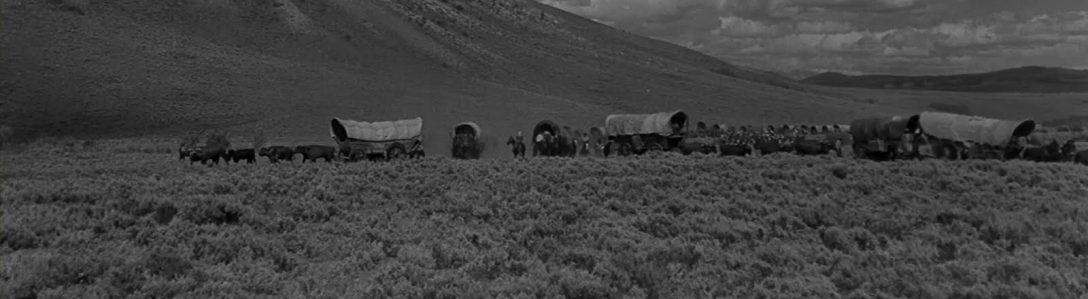
He came of age in film school at the same time as the Steven Spielberg/George Lucas “movie brats,” but John Carpenter is generally excluded from triumphal histories of 1970s New Hollywood cinema. Yet Carpenter’s genre reinventions have become as equally influential as those of his cinéaste brethren. While Lucas and Spielberg tried to supersize the 1930s adventure serial, Carpenter took the professionals-on-a-mission films of Howard Hawks and fractured them for the Reagan era. He developed a style of slow-burn—precisely choreographed widescreen features that were irresistible tension-and-release machines. But while Jaws and Star Wars appealed to all audiences, Carpenter’s subversive streak led to films deeply suspicious of the American dream, creating entertainments that stick in your throat.

John Carpenter was born into an artistic family on January 16, 1948 in Carthage, NY. His father Warren was a musician and teacher who moved the family to Bowling Green in 1953 after accepting a position teaching music history and theory at Western Kentucky University. After a few years of college at Western Kentucky, John transferred to USC to study filmmaking, where he co-wrote the Oscar-winning short The Resurrection of Broncho Billy (1970).

Carpenter would drop out of USC to complete production of his first feature, the absurdist space-madness comedy Dark Star (1974), written with future Alien scribe Dan O’Bannon. Shot on a shoestring with blinking cardboard sets and an alien made out of a beach ball, it skewers self-important space opera three years before Star Wars. His first fully-funded production was Assault on Precinct 13 (1976), a siege film loosely based on Hawks’ Rio Bravo in which a black cop, a white convict, and a no bullshit secretary hole up in an isolated prison to fight off a gang attack. Carpenter shows a mastery of the wide Panavision frame, making it a film of constricting horizontals: of shotgun barrels and gang members strung along a street like holes in a belt.

Then came the depth charge of Halloween (1978), conceived with Assault’s assistant editor Debra Hill (a producer through Escape From New York), which was well funded enough for Carpenter and DP Dean Cundey to play with a Panaglide Steadicam rig, which patiently tours the well-appointed bourgeois interiors soon to be sullied by Michael Myers.

Carpenter and Cundey then made a string of creeping-dread classics dependent on groups dissolving from within—collapsing the Hawksian ideal of creating a family out of the professional unit. The Fog (1980) pitted a collection of outcasts against leprous ghost pirates, out for vengeance for past colonialist sins. Escape from New York (1981) forces apolitical nihilist Snake Plisskin (Kurt Russell) to play nice with the authoritarian US government as well as the crazies on Manhattan island prison. (In the jokey, underrated 1996 sequel Escape from L.A., Plisskin turns into something of an accidental revolutionary). In Carpenter’s The Thing (1982, adapted from the same novella as the Hawks classic), an Arctic research team discovers a shape-shifting alien, and paranoia destroys them. It’s the first part of a loose “Apocalypse” trilogy that also includes Prince of Darkness (1987; Satan will end the world) and In the Mouth of Madness (1994; HP Lovecraft-inspired bestsellers will end the world).

The box office failure of The Thing led Carpenter to take assignment jobs, including the efficient if impersonal Stephen King killer car movie Christine (1983), and the beautiful alien road movie romance Starman (1984), in which the NSA is the villain. They Live (1988) provides his most explicit political statement, with aliens turning the Me Generation populace into literal consumerist zombies. It is urgent, blunt force pulp commentary that has Rowdy Roddy Piper slugging complacency in the face.

A narrative of decline has emerged around his post-1980s work, but that is why retrospectives like this are so necessary. The gonzo super-natural Western Vampires (1998) and Ghosts of Mars (2001) are gloriously scuzzy throwbacks to his Assault days, while The Ward (2010) is an elegantly composed haunted psych ward movie that entraps its inmates inside low-angle tracking shots.

Carpenter has retained his subversive vitality, taking archetypally American weird tales and investing them with a destabilizing dread.
J. HOBERMAN’S AN ARMY OF PHANTOMS

March 15, 2011

Scene-Fort-Apache-John-Ford

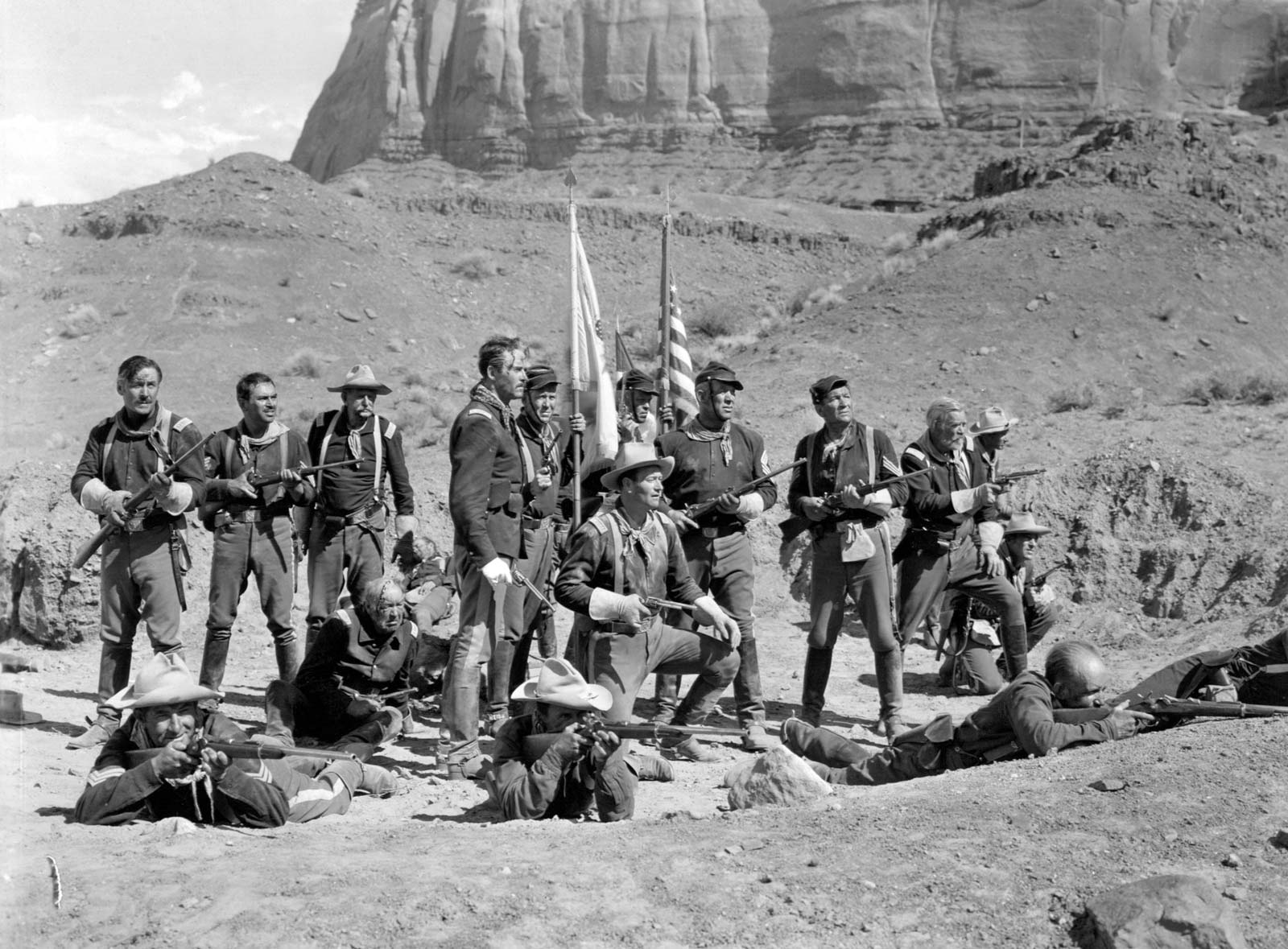
Under siege. John Ford’s Fort Apache established one of the major Cold War film archetypes, as J. Hoberman explains in An Army of Phantoms, his breathless, careening cultural history of the period (which the New Press released today). Covering the initial years of the political frost, from the mid-1940s through 1956, it’s the prequel to his 2003 The Dream Life, which ranged from 1960 to the release of Blow Out in 1981. He is preparing a third volume, Found Illusions: The Romance of the Remake and the Triumph of Reaganocracy, that will cover the rest of the 80s and the end of the Cold War. His stated inspiration is Siegfried Kracauer’s From Caligari to Hitler, and Hoberman’s less deterministic project will likely cozy up to it on film reference shelves in the coming decades as an essential and idiosyncratic work of cultural studies.

The phrase “cultural studies” tends to make me recoil in various poses of disgust. It’s the lapsed academic in me. As David Bordwell said in a Cinema Scope interview, ” most film scholars aren’t interested in film as a creative art. I know it sounds odd to say that, but I think it’s true. Most scholars are interested in film as an expression of cultural trends, interests, processes, etc. or of political moods, tendencies, etc.” Much of what I encountered of cultural studies in school reduced films to fit ideological agendas, starting with a theory and then squeezing the movie to fit that theory. The art object itself was lost in the process.

What Hoberman is doing here is undoubtedly cultural studies, describing how social and political events shaped the era, and in turn the tone and texture of Hollywood’s product, but it is a supple and nuanced version of the discipline. Since he is coming from a film critic’s background, he never loses sight of the unruly complexity of the movies themselves. The wealth of production history Hoberman lays down here is one of its most invaluable aspects, and has me continually dogearing pages (Full disclosure: I took a Film Criticism seminar that Hoberman taught at NYU).

For example, in his thumbnail portrait of The Thing (1951), he places it in the context of Edgar G. Ulmer’s The Man From Planet X, an alien cheapie that beat it into theaters, heralding 1951 as “the year that the saucers landed and the extraterrestrials arrived.” The Thing’s pre-production also “coincided with the emergence of Senator McCarthy and the early stages of the Korean War.”, resulting in a “congealed hysteria.” Politics and film inform each other, but they are not irreducible to the other. Hoberman is adapting French philosopher and sociologist Jacques Ellul’s concept of sociological propaganda:

a vague, spontaneous, all-pervasive, yet half-conscious form of social bonding and ideological proselytizing advanced by advertising, newspaper editorials, social service agencies, patriotic speeches, and anything else that might use the phrase ‘way of life.’”

It is the haziness of being a part of an epoch, the received wisdom that we mouth daily because we don’t have time to reflect on everything we say. It is a flexible, elusive concept, the perfect prism from which to pursue the indirect but palpable influence of the social and political spheres on film. Those are his theoretical walking orders, but Hoberman fills the book  with the clammy details of the dream factory. After spotty snowfall in Cut Bank, Montana, the crew re-located “to an arctic landscape created on the RKO ranch in Encino – another sort of ordeal with sweaty, parka swaddled actors tramping over the artificial snow that had been created from rock salt, ground-up Masonite, and crystallized photographic solution.”

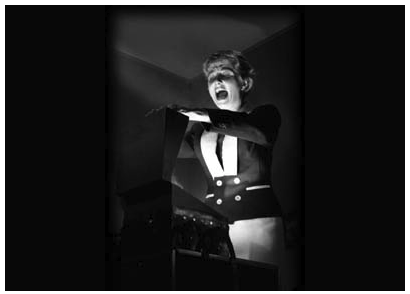
The Thing’s scenario was comic-book Fort Apache, the group under siege by a marauding, unknowable force. The parallels with Communist infiltration (and the bloody “police action” in Korea) were starkly clear, and The Thing’s “effete little Nobel Prize-winning scientist affecting a blazer, turtleneck, and goatee” is nothing less than a “wannabe Russian”. The Thing makes gestures toward anti-communism, but more than anything else it’s a Howard Hawks film, a buzzing group of insecure he-men talking their way through their problems and through the Red Menace. This Fort Apache scenario of terror from without is one of the repeated motifs of the book (Only the Valiant, which I wrote up earlier, introduces subversion from within into the cavalry Western), although many others wind through it, including The Next Voice You Hear, whose vision of God-as-entertainment actualized Hollywood’s fondest dreams of itself. Hoberman draws out the cruel irony of how the real universal communicator, television, almost puts Hollywood out of business. The third major strand is provided by Kiss Me Deadly and screenwriter A.I. Bezzerides’ term for nuclear power, The Great Whatzit, which Hoberman uses throughout as both a metaphor for nuclear weapons as well as the undefinable anxieties which haunted the generation.

All of these ideas are buttressed by meticulous research, with reams of contemporary opinions from VarietyThe New York Times and especially The Daily Worker, as film and  political history start to smack up against each other. Everything converges in his tour-de-force explication of the House Un-American Activities Commission hearings, whose impact on the movie business is laid out in granular detail, as studio heads tried to triangulate between Sen. McCarthy and the panicky artist-progressives who pushed out their money-making product. Never have I read such a thorough examination of this period, and the moral gray areas that subpoenaed witnesses had to traverse. There is no cheap moralizing or blanket condemnations of those who named names, only a fanatically detailed, contextually rich rundown of the cultural currents that led to their decisions.

I’d advise you not to open the Great Whatzit, but please open the book.

Screen Shot 2020-01-28 at 5.52.57 PM