Carpenter Craft

Originally published at the BAM (Brooklyn Academy of Music) blog on February 5, 2015

By R. Emmet Sweeney
He came of age in film school at the same time as the Steven Spielberg/George Lucas “movie brats,” but John Carpenter is generally excluded from triumphal histories of 1970s New Hollywood cinema. Yet Carpenter’s genre reinventions have become as equally influential as those of his cinéaste brethren. While Lucas and Spielberg tried to supersize the 1930s adventure serial, Carpenter took the professionals-on-a-mission films of Howard Hawks and fractured them for the Reagan era. He developed a style of slow-burn—precisely choreographed widescreen features that were irresistible tension-and-release machines. But while Jaws and Star Wars appealed to all audiences, Carpenter’s subversive streak led to films deeply suspicious of the American dream, creating entertainments that stick in your throat.

John Carpenter was born into an artistic family on January 16, 1948 in Carthage, NY. His father Warren was a musician and teacher who moved the family to Bowling Green in 1953 after accepting a position teaching music history and theory at Western Kentucky University. After a few years of college at Western Kentucky, John transferred to USC to study filmmaking, where he co-wrote the Oscar-winning short The Resurrection of Broncho Billy (1970).

Carpenter would drop out of USC to complete production of his first feature, the absurdist space-madness comedy Dark Star (1974), written with future Alien scribe Dan O’Bannon. Shot on a shoestring with blinking cardboard sets and an alien made out of a beach ball, it skewers self-important space opera three years before Star Wars. His first fully-funded production was Assault on Precinct 13 (1976), a siege film loosely based on Hawks’ Rio Bravo in which a black cop, a white convict, and a no bullshit secretary hole up in an isolated prison to fight off a gang attack. Carpenter shows a mastery of the wide Panavision frame, making it a film of constricting horizontals: of shotgun barrels and gang members strung along a street like holes in a belt.

Then came the depth charge of Halloween (1978), conceived with Assault’s assistant editor Debra Hill (a producer through Escape From New York), which was well funded enough for Carpenter and DP Dean Cundey to play with a Panaglide Steadicam rig, which patiently tours the well-appointed bourgeois interiors soon to be sullied by Michael Myers.

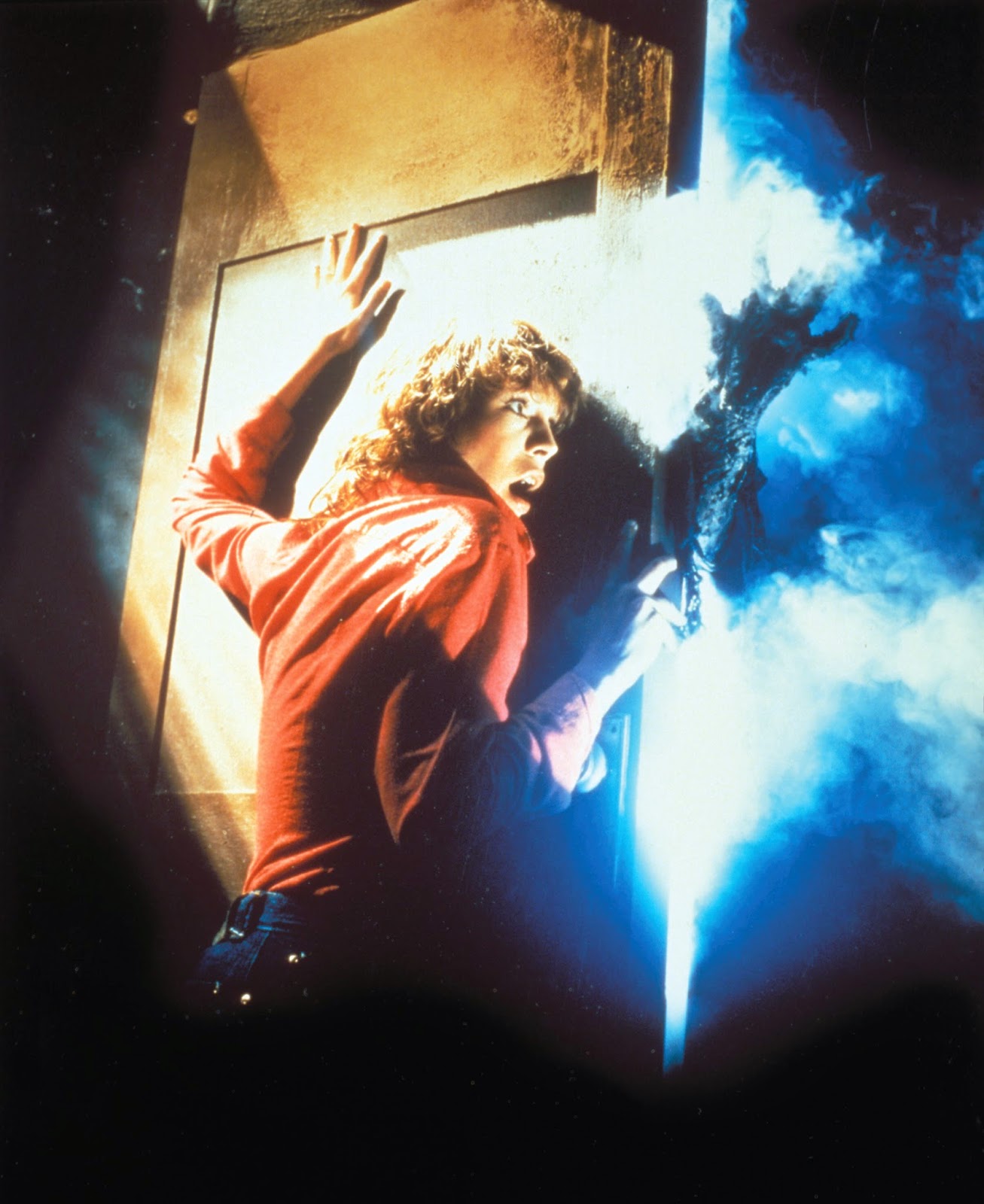
Carpenter and Cundey then made a string of creeping-dread classics dependent on groups dissolving from within—collapsing the Hawksian ideal of creating a family out of the professional unit. The Fog (1980) pitted a collection of outcasts against leprous ghost pirates, out for vengeance for past colonialist sins. Escape from New York (1981) forces apolitical nihilist Snake Plisskin (Kurt Russell) to play nice with the authoritarian US government as well as the crazies on Manhattan island prison. (In the jokey, underrated 1996 sequel Escape from L.A., Plisskin turns into something of an accidental revolutionary). In Carpenter’s The Thing (1982, adapted from the same novella as the Hawks classic), an Arctic research team discovers a shape-shifting alien, and paranoia destroys them. It’s the first part of a loose “Apocalypse” trilogy that also includes Prince of Darkness (1987; Satan will end the world) and In the Mouth of Madness (1994; HP Lovecraft-inspired bestsellers will end the world).

The box office failure of The Thing led Carpenter to take assignment jobs, including the efficient if impersonal Stephen King killer car movie Christine (1983), and the beautiful alien road movie romance Starman (1984), in which the NSA is the villain. They Live (1988) provides his most explicit political statement, with aliens turning the Me Generation populace into literal consumerist zombies. It is urgent, blunt force pulp commentary that has Rowdy Roddy Piper slugging complacency in the face.

A narrative of decline has emerged around his post-1980s work, but that is why retrospectives like this are so necessary. The gonzo super-natural Western Vampires (1998) and Ghosts of Mars (2001) are gloriously scuzzy throwbacks to his Assault days, while The Ward (2010) is an elegantly composed haunted psych ward movie that entraps its inmates inside low-angle tracking shots.

Carpenter has retained his subversive vitality, taking archetypally American weird tales and investing them with a destabilizing dread.
FRAME UP: BONJOUR TRISTESSE, THEY LIVE and TWILIGHT’S LAST GLEAMING

November 13, 2012

Screen Shot 2020-02-05 at 5.24.15 PM

From the multiplicity of locations to place a camera, the director and his collaborators have to settle on one. This decision, born of practical training and on-set instinct, can turn a routine shot into an extraordinary one. Three recent Blu-ray releases display the talents of the canniest of decision makers: Otto Preminger’s Bonjour Tristesse (1958), John Carpenter’s They Live (1988) and Robert Aldrich’s Twilight’s Last Gleaming (1977). Preminger and Carpenter are naturals in the CinemaScope sized frame, both alternating between B&W and color to emphasize their images’ deceptive surfaces. Aldrich uses the boxier 1.85 ratio, but chops it up into split-screens which convey a dizzying information overload that accompanies the creeping surveillance state of that film’s USA.

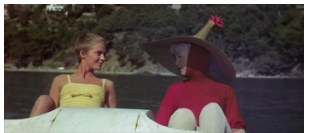
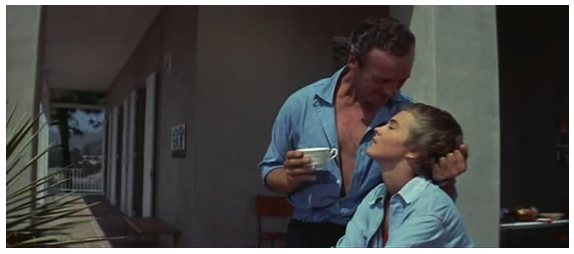
In Jean-Luc Godard’s Contempt, Fritz Lang famously said that CinemaScope was only fit for snakes and funerals, so his character clearly hadn’t yet seen Bonjour Tristesse (1958). Out today on Blu-Ray in a sublime transfer from Twilight Time (available through Screen Archives), Otto Preminger’s film uses the wide frame to emphasize surfaces, whether it’s of Jean Seberg’s impassive face or the doorways and windows that promise a depth that never materializes. Preminger bought the rights to Francoise Sagan’s novel in 1955, and gave S.N. Behrman a crack at the screenplay before turning it over to Arthur Laurents, who received sole screen credit. The story tells of Cecile (Jean Seberg), a carefree teen spending a summer on the French Riviera with her playboy  father Raymond (David Niven, with chest hair perpetually flared). They act more like swingers than family, urging each other into wild romantic escapades and laughing at the wreckage.  But when Raymond falls for their old pal Anne (Deborah Kerr), Cecile becomes wildly jealous and aims to break them up. Her efforts, tragically, succeed.

Screen Shot 2020-02-05 at 5.25.37 PM

The story is told in flashback, with the present-tense Cecile in black and white, a joyless mannequin twirling through the nightclubs of Paris. She stares dead-eyed into the camera, her arm around another interchangeable Lothario, as she speaks of happier times in voice-over. This is when the color starts to peek through, a strikingly melancholy optical printing effect, as sections of the frame next to her head burst into the color of the Riviera, flickerings of memory coming to life. B&W gives way to hot reds and shimmering blues. The effort already shows in the flashback of Raymond and Cecile’s mirthmaking, having to constantly remind each other that they’re having fun.

Screen Shot 2020-02-05 at 5.25.45 PM

Exteriors are what matter. Early on Raymond’s chirpy French girlfriend Elsa (a hilarious Mylene Demongeot) gets badly sunburned, and this reminder of physical deterioration makes Elsa not long for Raymond’s world. Soon he ignores her for the regal Anne. Preminger emphasizes the openings and closures in their Riviera cottage, where windows, doors and hallways are made visible in every shot, intimating the depths beneath the skin that Raymond and Cecile fear to tread. They are almost always outside, whether on the beach or out on the town.

Screen Shot 2020-02-05 at 5.25.54 PM

The first assistant director Serge Friedman recalled that Preminger did not have the shot choreography planned out, but would have “to do a lot of thinking before he could find the right place.” One of the most memorable shots utlilizes the full ‘Scope frame at a dinner party. A maid is arranged in the  far left edge foreground, secretly chugging a beer behind the bar, while Raymond and his clan are grouped to the right, in the middle distance, nattering on about a casino. Their total obliviousness to the world around them is encapsulated in that slyly funny frame.  Chris Fujiwara, in his Preminger study The World and its Double, writes that “the floor of the set was treated with gelatin to allow the camera to move as freely as possible”, regardless of where he chose to move it. His method is improvisatory, but the result is controlled and structured – even Elsa’s skin troubles are rhymed in the devastating final shot, when Cecile rubs in face cream to preserve her beauty, which is all she has left.

Screen Shot 2020-02-05 at 5.26.01 PM

Another film of deceptive surfaces is John Carpenter’s They Live (1988),  now out on Blu-Ray from Shout! FactoryA scathing  sci-fi satire of Reagan-era America, Carpenter uses the CinemaScope-equivalent aspect ratio (2.35:1) make his compositions as herd-like as the zombified consumer society he is depicting, of crowds and lines and glimmering store lights. The hero in this debased trickle down society is, appropriately enough, played by mulleted (and likely roided) pro wrestler Rowdy Roddy Piper. An unemployed drifter who still believes in the American dream, he is introduced as a hero from a Western, dropped off by a train in a dynamic diagonal composition, as did Charles Bronson in Once Upon a Time in the West.

Screen Shot 2020-02-05 at 5.26.09 PM

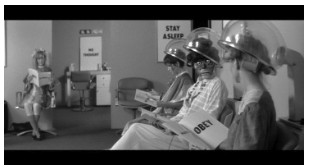
He realizes the truth upon donning some magic shades, which reveal a B&W world of alien brainwashing. Billboards scream OBEY and WATCH TV, hidden messages that are also beamed through TV screens to lull the populace into consumer comas. As with Bonjour, the sober B&W represents brute reality, and color the world of exteriors. Carpenter’s project is not one of subtlety, but a kind of satiric shock and awe. Piper’s pal, played by Keith David, is introduced behind a line of iron rebar, and they live in a smoggy abandoned lot across from a church.  They Live is a proto-Occupy Wall Street in its emphasis on extreme income inequality, visualized in alternating rows – of Piper and David’s construction sites and the aliens’ tuxedoed gentry imbibing champagne at a gala dinner.

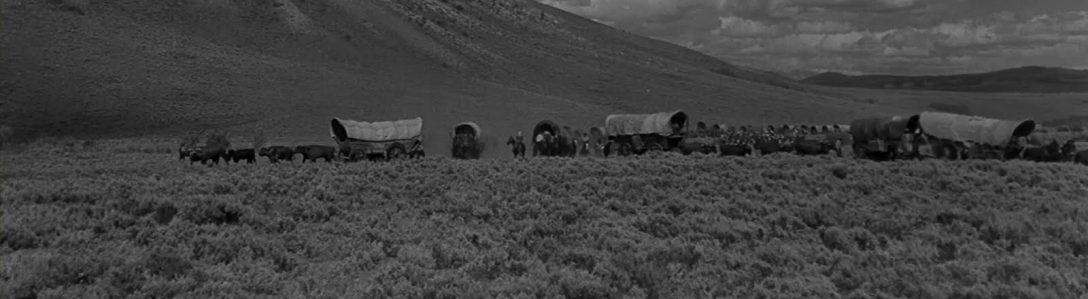
Released today on Blu-ray from Olive Films, Twilight’s Last Gleaming may be even more timely in its visualization of image overload. A paranoid political thriller still haunted by the death toll of Vietnam, it places Burt Lancaster as a dissident Army vet who breaks into and gains control of a nuclear missile silo. Unless President Charles Durning releases a secret National Security Council memo to the public that reveals the cynical reasoning behind the war, Lancaster will fire the nukes.  A furious film, director Robert Aldrich finds an equally furious style. Instead of parallel editing between the White House, Richard Widmark’s hawkish general (modeled after Curtis LeMay) and the silo, Aldrich uses an increasingly complicated series of split screens (of two and four), in which actions unspool simultaneously, as if you are watching the live feed from the President’s Situation Room. The footage of Durning sitting with his cabinet (which includes an avuncular Melvyn Douglas and a sepulchral Joseph Cotten) as they watch a special forces raid on the silo recalls the photograph of Obama’s team watching the raid on Osama Bin Laden. Or maybe it’s the first found footage movie, a scarier version of The Blair Witch Project in which the bogeyman isn’t one pissed off ghost but the entire social and political system in which we live and work.