Interview: Johnnie To on “Mad Detective”

By R. Emmet Sweeney

IFC News

July 11th, 2008

Since the formation of his Milkyway Image production company in 1996 in Hong Kong, Johnnie To has been the most imaginative (and prolific) director of genre films in the world. Mainly known stateside for self-reflexively stylish gangster flicks like “The Mission” (1999) and “Exiled” (2006), he’s also produced a slew of hit romantic comedies (including the delirious 2002 supernatural love story “My Left Eye Sees Ghosts”). Whatever the subject, his films hum with the skill of a committed craftsman, every shot jiggered for maximum lucidity and intensity. There’s no wasted motion in a To film — every gun crack or eye-poke carries the weight of the character behind it.

To’s collaborated with screenwriter and Milkyway co-founder Wai Ka-Fai on his most daring projects, including the bodybuilding Buddhist thriller “Running on Karma” (2003), and they reteam again for “Mad Detective,” which recently screened at the New York Asian Film Festival and which opens in New York on July 18th. A knotty noir about a burnt-out cop (Lau Ching Wan) who claims he can see people’s inner personalities as distinct individuals, it shoehorns black comedy and psychological musings into its pistol operatics. I got the chance to chat over email with Mr. To about the film as well as his sublime new pickpocket tale “Sparrow” (also a part of this year’s NYAFF, and currently without U.S. distribution), and his next project, a remake of Jean-Pierre Melville’s “Le Cercle Rouge.”

What’s your working relationship like with Wai Ka-Fai? He’s given a co-director credit on “Mad Detective.”

To put it simply, Wai Ka-Fai is the brain of Milkyway, whereas I consider myself the hands that handle the execution. All the ideas come from Wai Ka-Fai, although I handle everything that’s related to shooting. For “Mad Detective,” Wai and I were on the set together because the story was very complicated. We conferred with each other frequently to make sure I didn’t shoot incorrectly. Without Wai, there wouldn’t be “Mad Detective.”

How do you prepare to film a major action set piece like the final shootout in “Mad Detective,” or the long opening take in “Breaking News”? Do you storyboard every shot beforehand, decide on the blocking once you arrive on set, or both?

I don’t storyboard. Everything is kept in my head. For “Breaking News,” after initial location scouting, I planned out the sequence step-by-step while rehearsing with the cast and crew. I don’t like to plan things too early because it takes away the fun of actual shooting.

I understand you filmed “Sparrow” over a three-year period. Could you describe the production process?

“Sparrow” was a personal and fun project for me. I would shoot whenever I had ideas, be it a scene or an image. Basically we shot for three years, but it was for a few days every 3-4 months between projects. Without the Berlin Film Festival’s invitation, I probably would’ve gone on shooting! I really appreciated the actors’ patience and their ability to stay relatively the same over a period of three years.

What was your original conception for the film? Did it change over the course of the shoot?

When I shot “The Mission,” it was about a group of bodyguards. Then I made “PTU,” which was about a group of cops. So I thought it’d be fun to make another film about teamwork, but this time without guns and blood.

Could you comment on the score? It seems highly indebted to Michel Legrand’s work for Jacques Demy.

For me, “Old Hong Kong” meant a combination of Eastern and Western culture. So I thought the sound of “exotic oriental” would be perfect for the film, something similar to the score of “The World of Susie Wong.” The last scene in the film is an homage to Jacques Demy, so our composer followed that direction as well.

Your work uses the richness of the film grain to such an expressive extent, I’m curious as to what your thoughts are on digital photography. Do you ever see yourself shooting in HD?

I am a 35mm person. But recent developments in digital cameras has impressed me, like with the Nikon D3. Also, I liked a lot of what David Fincher did in “Zodiac.”

The “Bourne” films have created a bit of a stir in the U.S. for their hyperactive editing schemes. As someone who places great importance on editing, I wondered if you had seen these films, and what you think of their style?

I’m not familiar with the “Bourne” films, but I think editing is very crucial to storytelling, not simply for providing a sense of motion and speed. Too much of Hong Kong cinema has focused on that in the past and in the end, audiences don’t care about the story anymore.

You’re an incredibly prolific worker, and I’ve read that you’ve started preparing a remake of Jean-Pierre Melville’s “Le Cercle Rouge.” What do you value in Melville as a filmmaker?

The remake is currently in development and the script is written by Wai Ka-Fai.

I think my work and Melville’s bear a lot of resemblance to each other, not just visually but also philosophically. I must admit I didn’t know much about Melville when I was young. I saw all his films when they first came out because I was a fan of Alain Delon!

“Mad Detective” opens in New York on July 18th.
SKYSCRAPER SOULS: DON’T GO BREAKING MY HEART (2011)

June 21, 2011

Screen Shot 2020-01-31 at 12.01.41 PM

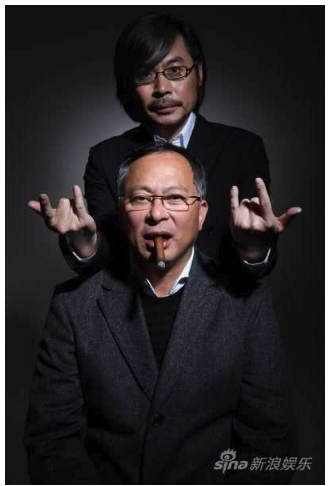
The evil geniuses over at Hong Kong’s Milkyway Image productions (above, looking evil) have begun their takeover of the Mainland.   Johnnie To (seated) and his long time co-director and screenwriter Wai Ka-fai (flashing the horns) have had their last decade of gangster sagas (Election, Triad Election, Exiled, et. al.) banned or censored in China. So in an effort to expand their audience, they are making two Chinese co-productions, both romantic dramas, back-to-back. Don’t Go Breaking My Heart was released in March of this year (and is now available on DVD and Blu-Ray), and Romancing in Thin Air recently wrapped production in Yunan province, and should open early in 2012.

Regarding Don’t Go Breaking My Heart, Johnnie To told the South China Morning Post that, “we believe in our ability to bring our own style of filmmaking to audiences up there.” But then went on to hedge that, “It’s not exactly the kind of film that could best bring our skills to play – but if we were to do something else, like a police thriller, we would have to attend to a lot of potential problems with the censors.” A director, like any artist, is also a full-time hustler, and has to follow the money in order to get their work made. With Hong Kong’s film industry in an across the board decline and the Mainland still flush with cash, Milkway Image is making artistic concessions to keep afloat. The strange thing about To’s comment is that they’ve made superb romantic comedies before, including the smash hit Needing You in 2001 and the wonderful cult item My Left Eye Sees Ghosts (’02). Their skills certainly play well in that genre, although it’s clearly not where his creative interests lie right now. In the downtime between the Chinese super-productions, he shot a low-budget HK thriller starring Lau Ching-wan, Life Without Principle, whose release date is unknown.

Even with all the concessions to Chinese censors, Don’t Go Breaking My Heart is an impeccably constructed and eccentric comedy. The plot concerns a love triangle set during the 2008 financial meltdown, in which a spunky stock market analyst (Gao Yuanyuan) is torn between the wooing styles of a suave investment banker (Louis Koo) and an earnestly charming alcoholic architect (Daniel Wu). To sets up their dynamic in an exchange of point-of-view shots in the opening scene in Hong Kong. Gao wedges herself onto a bus during a morning commute, while Koo cruises by in his luxury convertible. Gao has moved from Suzhou in the north, and tries to teach herself Cantonese during the ride (the majority of the film is in Mandarin, another concession to Chinese audiences). Koo pulls up next to the bus at a stoplight, and eyes her through the window, with Gao briefly accepting his gaze.  This establishes the central visual motif, of looking, and physically communicating, through panes of glass.

Gao gives up her seat to a pregnant woman, who then turns out to be the wife of her ex-boyfriend. The wife then panics at Gao’s presence, and her ex urges her to leave the bus before his wife gets hysterical. She leaves, jittery and angry, and trips and falls in the middle of the street. This is where a bearded and homeless looking Wu steps in, directing traffic around her while helping to pick up her papers. Koo, who had followed her off the bus, loses her in the scrum, and Wu starts a flirtation that secures a date the following week. This sequence cements Koo as distant and voyeuristic, and Wu as selfless to the point of masochism.

To extends the motif of looking/looked-at the following business day, when Koo notices that Gao works in the skyscraper across the street a few floors above him. To get her attention, he makes a smiley face collage out of post-it notes on his window, and once he attracts her glance, he does a mini-magic act and pantomimes where to meet her for some coffee. Enraptured by his bravado, and by how he breaks the spell of their mutual voyeurism, she agrees to their date. However, another woman on a lower floor also saw Koo’s performance, and she intercepts him before his rendezvous with Gao. This interloper is revealed in one of the final counter-shots in the sequence, the perfect punchline to reveal how much POV shots can hide. Gao and Wu learn the effects of this perspectival narcissim, when both are stood up for dates (Gao by Koo, and Wu by Gao).

The triangle goes through some convoluted twists and turns over its 115 minute running time (including a mandated trip to China), and the narrative convulsions can be tiresome. But when the material strains credulity, To and Ka Fai’s staging and composition never fails them. After Gao’s company goes bankrupt, Wu’s architecture firm takes over his space, and in order to finally win Gao’s hand, he puts on a skyscraper magic show of his own, with more elaborate effects (he’s in the middle distance in the image below). It is the only way Wu can wrest  screen space away from the image-savvy Koo.


To and Ka-fai are wise enough to leave both Wu and Koo as ambiguous figures. Neither is a simple good guy or douche, as is the norm in romantic comedies. Wu is gentle and understanding, but also exhibits neediness and passivity. Koo is charismatic and handsome, but also an arrogant philanderer. Both men obsess over one-upping the other, until their love is transformed into escalating bouts of childish violence. It seems Gao might be better off alone. In the end, she makes her choice between the two sods while once again looking out a skyscraper window, but this time the only thing she can see is her reflection.