THE 2011 NEW YORK FILM FESTIVAL, PART 1

September 27, 2011

nyff 2011

The 49th New York Film Festival begins this Friday, September 30th, with a main slate of 27 features and an abundance of sidebar and retrospective screenings, including a massive survey of Nikkatsu Films. All of my favorite entries so far share an obsessively detailed sense of place, locations that subsume central characters and emerge as active agents of memory, myth and fate. Dreileben, a group of three features made for German television, is set near the Thuringian Forest, folkloric heart of German culture, and former home to Wagner, Schiller, Bach and Goethe. Ancient fables are invoked as templates for the tragic circlings of the unlucky few who come in contact with a man-made monster.  The Turin Horse utilizes a perpetually wind-thwacked dust bowl as a bluntly metaphorical vision of the barren, anxious souls of its poverty-stricken leads, while Two Years at Sea follows the hermit and former merchant seaman, Jake Williams, as he goes his silent bearded way in the beatific and lonely Caingorm Mountains of Scotland.

Dreileben began as a series of e-mail exchanges between directors Christian Petzold, Dominik Graf and Christoph Hochhäusler, which were published in Revolver magazine in 2007. All three men are grouped under, or have pushed back against, the “Berlin School” of German cinema. Marco Abel wrote in Cineasteabout the genesis of this somewhat misleading description: ” The label, coined by German film critic Rüdiger Suchsland, originally referred to what is now known as the first generation of the Berlin School: [Angela] Schanelec, Christian Petzold, and Thomas Arslan. All three attended and graduated in the early 1990s from the Deutsche Film und Fernsehakademie Berlin (dffb)…and were taught by avant-garde and documentary filmmakers Harun Farocki and Hartmut Bitomsky.” The style is associated with cool, restrained dramas that analyze the minute psychological dramas of everyday life, and are generally ignored by local audiences.  Hochhäusler was part of a second wave of directors, who studied at the Hochschule für Fernsehen und Film München, along with Benjamin Heisenberg (The Robber) and Maren Ade (Everyone Else). The turn to genre subjects (The Robber and Arslan’s In the Shadows), as Dennis Lim (NYFF programmer) notes in a Cinema Scope piece, could be “partly a reaction to the marginalization of the early films.”

Dominik Graf has criticized the Berlin School for their avoidance of emotion, as he told Abel in an interview in Senses of Cinema“This is part of my debate with the Berlin School directors. I tell them that I have the feeling—not always!—that they are not doing anything in order to move away from their glass-like, distanced position towards the world and feelings.” Dreileben is the extraordinary result of this generational debate.The three films circle around one motivating event: the escape of convicted killer Frank Molesch (Stefan Kurt) from a mental hospital. The first film, Christian Petzold’s Beats Being Dead, profiles a bitter affair of one of Molesch’s young potential victims. The second, Graf’s Don’t Follow Me Around, follows a police psychiatrist around anyway, who is on the case of pursuing Molesch, but also gets entangled in a decades old love triangle. The closer, Hochhäusler’s One Minute of Darkness, tracks the killer as he stumbles through the Thuringian woods, a gentle monster roused to violence by the fumblings of the humans around him.

Beats Being Dead is the zombie-like love story between Ana (Luna Mijovic), a working class Serbian immigrant, and Johannes (Jacob Matschenz), a brilliant medical student screwing around for a summer, working at an empty hospital (which Molesch eventually visits). Petzold based the story on the German myth of Ondine, the water nymph who would lose her immortality if she bore a mortal man’s child. Ana and Johannes meet, in various states of undress, by the water. They gravitate to each other instantly, magnetically, their mutual seduction occurring during a series of hypnotic walks to and fro, down the tree-lined paths that separate them physically and economically. The spectre of money and class is never far from the surface in Petzold’s films (see his Postman Always Rings Twice adaptation, Jerichow), and here it is the key that wakes them both up from their trance. Ana, with mascara streaming down her face, has been felled from the euphoric heights of love and made human. Johannes, less than that.

Don’t Follow Me Around is Graf’s play for a communicative cinema, shot in soft, sun dappled 16mm, shifting from the hard-edged 35mm and HD of Petzold and Hochhäusler. In it, police psychologist Johanna (Jeanette Hain), travels to the forest to investigate Molesch’s disappearance, and stays with her old friend Vera (Susanne Wolff) and her husband Bruno (Misel Maticevic). During long nights of wine-fueled reminiscence, they discover they had both loved the same man before they met, sending them deeper into the past. The presiding myth here is of Emperor Barbarossa, mentioned by Johanna’s father before she leaves. He says that Emperor Frederick of Barbarossa, “and all his soldiers have been sleeping for 1,000 years in the mountains, waiting for Germany to finally become an empire again.” Johanna’s father says this as a historian’s idea of a joke before her departure, but what Graf’s story awakens is not an ancient leader but repressed memories. Johanna’s lost love emerges as a ghost by her side, an unwanted guest to eliminate with as much prejudice as Molesch, still roaming the countryside.

The trilogy comes to a brooding close with One Minute of Darkness, in which the forest emerges fully as a character – magical, threatening and aloof. Here Molesch is Barbarossa, stumbling into a tourist’s bedroom that contains maps of the Emperor’s caves and a book of “Wagner’s Thuringen” on the desk. He faces the myths, and he goes on to embody them. His gambol through the verdant wood has him hallucinate a masked creature and tend delicately to a young runaway, as sympathetically as Karloff’s Frankenstein. In Hochhäusler’s patient thriller, Molesch is cross-cut with lumpy inspector Marcus Kreil (Eberhard Kirchberg), the man who had imprisoned him the first time on circumstantial evidence. The jumps between Molesch and Kreil are between incantatory fantasy (the shape-shifting forest, a satanic inferno) and banal reality (a family BBQ). These two strands, woven throughout the whole series, come thudding tragically together as Ondine comes undone, the immortal brought down to the cold earth.

***

The Turin Horse and Two Years at Sea are two disparate versions of the solitary life. In the first, the outside world is a face-wrinkling terror that is best seen through a window, the dividing line between a father and daughter and encroaching obsolescence. In the second, there is no difference between outside and inside, as winding branches and tall grass take over lounge chair and an RV is magically lifted in the arms of a tree. Bela Tarr claims that The Turin Horse is his last film, and it acts as a summation of his work. It begins with the story of Nietzsche’s last sane days, written by frequent collaborator László Krasznahorkai. Nietzsche sees a horse being beaten by its owner. He rushes to stop the abuse, weeping. He would spend the rest of his days as an invalid. The narrator goes on, “of the horse, we know nothing.” Thus begins the Old Testament penitence of the father and daughter. The silvery B&W cinematography by Fred Kelemen begins – a low angle of the bedraggled horse, with matted hair like a stray dog, pulling the carriage of Ohlsdorfer, the father (János Derzsi, whose craggy bearded visage has the perpetually stunned look of oncoming senility like Richard Bennett in The Magnificent Ambersons). Thus begins a murderous daily routine in gale force winds, with Ohlsdorfer returning home to his gouged-out shack, with walls that look like they’ve been gnawed on by muscular beavers. His already wizened daughter (Erika Bók) undresses him, cooks him his nightly scorched potato, and shuffles off to bed.

This is their entire life, both of them perpetual work machines chipping away at their life expectancy one day at a time. Tarr sets up the visual dichotomy early on, of inside/out. The camera, and the characters are constantly peering outside its frame, denoting an absolute otherness to the nastiness outside. The daughter sees their first guest, a nihilist philosopher-drunk over to buy some palinka (a Hungarian fruit brandy), depart through the precious window. His thunderous presence dissipates to a shadow seen through glass, his sub-Nietzchean pronouncements (twisting Nietzsche’s “beyond good and evil” and death of God pronouncements into a world of eternal subjugation – similar to how the Nazis perverted his work) already forgotten. Ohlsdorfer had already called “rubbish” on him anyway. Their only purpose, their only thoughts, are geared towards work. And once the horse stages a quiet rebellion, refusing to eat or move, their lives of sullen, productive enervation now become entropic and drawn to dissolution. Eventually they go through the looking-glass, and become the travelers on the other side of the window, searching for an escape. Presumably finding only worse deprivations on the other side of the hill, they return, irrevocably changed. The camera, for the first time, shows the outside of the cabin, and the daughter looking out, trapped.

Jake Williams, the subject of Ben Rivers’ Two Years at Sea (in the Views from the Avant-Garde) program, is totally, frighteningly free. Living alone in the Scottish mountains, he is shown cleaning, reading, chopping wood and sleeping – without saying more than a few words. His living quarters have become intertwined with the nature around him, birds and plants and insects have as much a foothold on his property as he does. Shot in anamorphic B&W (although projected on compressed video, sadly), the film is immersive and cordial. It’s clear that Jake wouldn’t mind if you napped along with him, lulled along by his blissed out existence. The pacing gets so gently buzzed it’s no surprise when his mini-RV gets raised heavenward by unseen hands (or winches). The film consists of staged re-enactments of Jake’s daily life, with hints of his past appearing in photos lying on a desk. Stills of children, a woman, an old man shoveling snow, these are the narratives and mysteries that clang around in Jake’s head that we don’t have access to. We project stories onto his invitingly open face, or at least I did, of a wife who couldn’t hack the back-to-nature bit and hustled her kids back to civilization. Or maybe the photos were simply (likely) planted by Rivers to enact such fevered speculation. Whatever the reason, it is a film that encourages such idle thoughts and wild guesses. Filled with flickering light and the squiggles of processing stains, Rivers is playing with the form as well as narrative expectations, mirroring the play of light on leaf with light through film. This comes to the fore in the astounding final shot, a long take of Williams’ face as he nods off in front of the fire, his eyelids and the flames both fluttering, closing to another day and to my prying eyes.
THE MINNELLIUM: YOLANDA AND THE THIEF (1945)

September 20, 2011

Screen Shot 2020-01-31 at 5.51.10 PM

Vincente Minnelli had been interested in making a surrealist musical since his days as a Broadway set designer and director. After he saw successful stagings of “Four Saints in Three Acts” (with libretto by Gertrude Stein) and “Pins and Needles” (starring members of the International Ladies Garment Workers Union), he was convinced he could make it work. In 1938, he tried to woo musical comedy star Bea Lillie to take the lead role in a “surrealist revue” he titled “The Light Fantastic”. In a letter to Lillie, quoted in Minnelli’s autobiography, he wrote, “It sets out to prove that the world today is completely screwy. A surrealist fantasy set in jig time.” The project was shelved, and he moved on to direct “Very Warm For May”, the first Jerome Kern-Oscar Hammerstein collaboration in eight years.

Once in Hollywood, and flush with studio goodwill off the hits Meet Me In St. Louis (1944) and The Clock (1945) (he had also directed the majority of the revue-style Ziegfeld Follies, which the studio tinkered with until ’46), he finally put his “Light Fantastic” inspiration into action, resulting in Yolanda and the Thief (1945), one of the strangest and most enchanting films ever released by a Hollywood studio. Released earlier this year on DVD by the Warner Archive, Yolanda and the Thief  is also screening at the Brooklyn Academy of Music in October, as part of a complete retrospective of the director’s work (presented along with the Locarno Film Festival).

The genesis of Yolanda did not begin with Minnelli, but with children’s author Ludwig Bemelmans, the creator of the Madeleine series. In July, 1943, he co-wrote a fanciful short story called “Yolanda and the Thief” for Town & Country magazine with Jacques Thery. Producer and songwriter Arthur Freed purchased the rights the same year, and installed Bemelmans in an office at MGM to hash out a script from the material. He produced a treatment, but it went through three more rewrites before a fourth draft by Irving Brecher was accepted.

In the fantastical South American Ruritanian country called Patria, a beautiful heiress named Yolanda Aquaviva (Lucille Bremer) will inherit the family fortune and the defacto throne on her 18th birthday. Raised in a Catholic orphanage, she is naive in  the dirty ways of the world, and Johnny Riggs (Fred Astaire) takes full advantage. He overhears Yolanda praying to her guardian angel, and so Johnny pretends to be the embodiment of this protective spirit. Yolanda immediately believes his schtick, and is soon convinced to sign over power of attorney to this sweet-faced con artist. Johnny’s heart may be as soft as his shoes, and he’s not sure if he can go through with the theft…

Lucille Ball was originally slated for Yolanda, but after Minnelli was hired, Lucille Bremer took the role, since she had worked well with the director as the older sister in Meet Me In St. Louis. While he had little involvement in the scripting process, Minnelli immediately went to work on the visual design, which pulls from a dizzying array of influences and styles, from children’s picture books to Salvador Dali. Minnelli wrote that “I tried to get the quality of Bemelman’s books and illustrations, a curious mixture of worldliness in high places and a primitive naiveté, using his sometimes crude prism colors right out of a child’s paint box and combining them with beautifully subtle monotones.”

No concession is made to realism, with the waking sequences as garish and artificial as the centerpiece dream ballet. The opening sequence includes plastic ferns, papier-mache rock formations, a llama, and children sitting in green, yellow and red robes with a pinkish-orange sunset matte-painting beckoning them to greater flamboyance. This transitions to the orphanage, in which a parade of red-dressed, black hatted girls add skipping accents to a regal castle edifice. The nuns, in contrast, are in a dull blue-gray, building blocks of the building itself.

When Yolanda first appears in her family’s palace, out of the orphanage’s garb for the first time, she wears a simple cream-colored dress, which brightens the grays of the marble and fading murals. Her dotty Aunt Amarilla (a sublime Mildred Natwick, “Do my fingernails and immediately bring them to my room”) greets her wearing a blue-gray shade similar to that of the sisters, again blending into the background, part of the institution.

Yolanda’s next outfit is worn to visit Johnny for the first time, whom she believes to be an angel. Appropriate to such a worshipful occasion, she wears a black lace number, with a veil-like mantilla . A white rose adds a pop of contrast. In order to convince her of his otherworldliness, Minnelli shows Johnny arranging his own lighting, angling a lampshade so the rays seem to emit from his forehead. Positioned in front of heavenly mural behind him, he is a picture of vain celebrity, but Yolanda falls for the ruse, and also, Minnelli winks, he hopes we fall for his technical tricks.

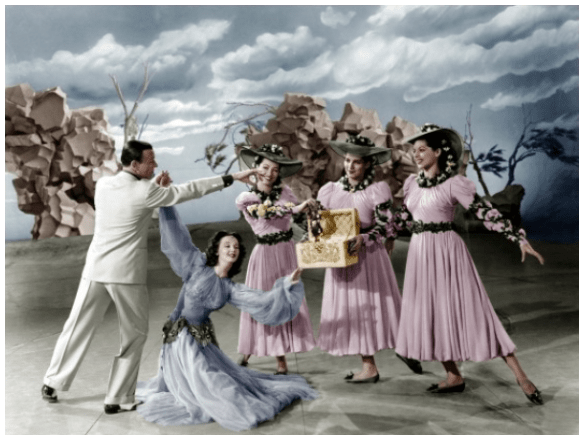
The dream ballet is where Minnelli is fully allowed to display his Surrealist influences, with a Dali-esque landscape the setting for irruptions of unconscious illogic. The sequence begins in what looks like the film-world’s reality, as Astaire walks down the town’s main thoroughfare. The first puncture of this reality occurs when Astaire is asked for a cigarette. It’s the same rumpled man who had asked earlier in the film, but Astaire obliges anyway. After he lights one, a third hand appears from the blackness, cig in hand. He lights it, but more hands appear, until there are six arms sharing puffs from one mouth. The coins he had flipped to some street urchins start falling from the sky in rhythmic patterns, as the street set disappears for one streaked with lines of gold. Washerwomen in flame red skirts (recalling the orphanage outfits) ensnare him in reams of white laundry, as the rhythm set by the coins continues.

Echoing the reams of white fabric, a figure emerges from a pond, fabric flowing up and around her, as if in her own personal hurricane (this is a reversed image of Bremer walking backward into the water). She leads him into a desiccated Dali landscape of mutated white clumps and bare trees looming over an empty space, leading nowhere. Minnelli: “I wanted to suggest South American baroque without actual architectural forms, and used a series of rock formations in fantastic shapes.” Astaire removes the drapery of Bremer’s body, revealing her face. She is again wearing a cream-colored dress, as in her first, welcoming, arrival. The fabric that entangled him, he is able to free her from. It is a dramatization of Johnny’s fears of entrapment and attraction, visualized in spare, haunting landscapes.

This wildly imaginative sequence is a logical extension of the fantastic real world, and, as Jane Feuer wrote in The Hollywood Musical: “The transition to the dream in Yolanda is one instance of a play on the boundaries between fantasy and ‘reality’ which  informs the entire film. It is through cinematic technique that the boundaries between worlds are able to be blurred, placed en abime.”

Audiences were not receptive, and according to the AFI Catalog, Yolanda and the Thief  lost $1.5 million on its initial release. Minnelli muses that “much of the public couldn’t accept a simple story in an avant-garde setting.” Likely so, but it should be appreciated now in its oneiric Technicolor glory. Minnelli, a humble sort, should have the last word: “Film buffs say the picture was ahead of its time. I like to think so.”

HIGH & LOW: HARUN FAROCKI AND JOHN LANDIS

September 13, 2011

Screen Shot 2020-01-31 at 5.48.13 PM

Two sixty-something masters of their domain have new work showing in the U.S. John Landis, a dean of the low farting arts, has his morbid comedy Burke and Hare playing cable-on-demand services and a limited theatrical run. Harun Farocki, of the high brow-furrowing arts, has a new exhibition at the Museum of Modern Art entitled Images of War: At a Distance. Landis has been tagged with artistic decline, something Hollywood directors have to deal with as soon as they sprout their first grey hair (Burke is his first narrative feature since 1998, was financed and made in the U.K., and released there in Oct. 2010). This kind of ageism doesn’t appear in the gallery world, where Farocki is now being embraced after decades as an experimental video artist. The MoMA exhibition is running his most recent work on a loop, Serious Games I-IV (2009-2010), but also providing nearby monitors that are showing nearly all of his previous videos (which they acquired for their library). As artists, they are similar mainly in their dissimilarity, but both have a deep and playful sense of film history.

Burke and Hare tells the frequently adapted tale of the two eponymous Williams, who murdered 17 people in Edinburgh during 1827-1828, and sold the corpses to an anatomy lecturer.  It is a production of Ealing Studios, that venerable institution of British comedy (famous for Alec Guinness’ multiple personality marvels like Kind Hearts and Coronets (1949)). Landis takes full advantage of the studio’s connections by hiring some of the great British stage and screen actors to fill out his cast. The leads are semi-familiar faces Simon Pegg (Burke), Andy Serkis (in the flesh this time as Hare) and Isla Fisher (Ginny Hawkins), but small roles are enlivened by Ronnie Corbett (from BBC’s long-running sketch show “The Two Ronnies“), stand-up comic Bill Bailey, Stephen Merchant, Tim Curry and Christopher Lee.

These casting decisions are not marketing filler, for each of these faces fills a particularly exaggerated space in Landis’ palette of caricatures. Serkis purses his lips to bring out the frogginess of his features, with the battered top hat adding to the impression of a dissolute Mr. Toad from Wind in the Willows. His Hare is the insatiable id of the duo, pushing them onward to more profitable indignities while remaining dutifully horny towards his equally greedy wife (Jessica Hynes). Burke is the apparently sympathetic one, Pegg’s kindly weasel features reluctantly acceding to Hare’s plans, as it’ll give him the cash he needs to wrangle Ginny, who wants to put on an all-female version of Macbeth. Isla Fisher is the most conventionally attractive, but her disconcertingly manic energy, and bizarre artistic ambition, place her with the freaks.

The supporting actors all provide comic accents to this unfortunate quartet. Corbett plays Captain McLintoch, of the Edinburgh militia, who is in charge of wrangling the local body snatchers. At 5′ 1″ and 80 years old, he waddles in front of his young recruits like an asthmatic Napoleon. His face squeezes into helmet and uniform reluctantly, jolly rolls of wrinkles unwillingly curling down his neck. Corbett is delightfully game, berating his charges with drill sergeant anger, and eager to flash his superiors a disarmingly adorable grin. He plays it straight and walks away with the movie. Then there is Tim Curry’s tortoise-headed scientist, Stephen Merchant’s stork-like dope, and the blustering Christopher Lee, who is no animal but simply himself, which is enough.

Landis lovingly arranges his menagerie into cleanly executed frames of clean executions (Bill Baily plays the sarcastic hangman and narrator). The jokes move swiftly, and the actors maintain a jittery pace that injects life into the material even when it sags. It’s the best comedy I’ve seen this year.

Harun Farocki’s videos aren’t funny, per se, but they are certainly playful. The centerpiece of the MoMA exhibition is Serious Games I-IV (2009-2010), which focuses on the military’s use of video games, but I immediately latched onto a few other video works. The first is On the Construction of Griffith’s Films (2006). This simple but brilliant short (2min. 30 sec.) splits D.W. Griffith’s use of shot-countershots into two screens, so you can see the eyeline matches line up next to each other. It begins with an example of a one-shot scene from The Lonedale Operator (1911), where “a door connects two shots, or separates them.” Then five years later Farocki broke down the varying camera angles and setups that Griffith innovated in Intolerance (1916), where there was “an exchange of glances, instead of words.” With close-ups and shot-countershots, actors could convey emotion without the use of inter-titles. Doorways still connect shots now, but the space has become elastic. Farocki shows a scene between Mae Marsh and Robert Harron, and a repeated sequence of shot-countershot. Farocki writes how cinema creates “structures of its own making, parallel worlds.” As you watch Marsh and Harron glance at each other in their little boxes, it’s possible to see Farocki’s fascination with two-channel video pieces, giving him the ability to have his parallel worlds communicate simultaneously, instead of the cuts made necessary in single-screen narrative cinema.

He brought this two-screen conversation to the fore in Counter-Music (2004), his version of a city symphony, set in Lille, France. This densely allusive piece uses Dziga Vertov’s Man With a Movie Camera and Walter Ruttman’s Berlin, Symphony of a City as comparison points against a modern metropolis. Instead of footage shot on the street, he re-purposes footage from a sleep study lab, security cameras, heat maps and CG modelings of car and train traffic. These are images made without a cameraman, capturing the daily life of the city without the intervention of an artist. It is, Farocki contends, something Ruttman and Vertov dreamed about.

One of the early connections Farocki makes is inspired by test footage pushing forward inside a sewer pipe, checking for the integrity of welds. In a deadpan voice-over, he he has “recollections of a film with Raquel Welch”, of the ship flying through a human body in Fantastic Voyage. To him, this shot of the sewage pipe shows, “man as a world, the city as a body”. These systems and constructions are extensions of human thought, and therefore our body. But what kind of body have we created?

This multiplicity of images would have stunned Vertov and Ruttman, but not the sterility of their content. In one evocative passage Farocki runs a clip of some of Vertov’s textile workers on the left channel, working balletically around a giant machine, while on the right channel a single modern office worker sits silently in front of a glimmering screen. The man and his world have been overtaken by his body. Another comparison: between circling traffic and loitering teens. As industry jobs decline, Farocki opines, we circulate to instead of sitting about, and whoever doesn’t move makes themselves suspicious. Sitting still is a kind of revolutionary act. Near the end, a boy in a sleep study, covered in sensors and wires, struggles awake and waves to the camera, happy to be conscious.

These are wildly divergent artists, but both draw from their obsessive cinephilia to fuel their art. Landis mines the history of British comedy to sculpt the physical comedy of his cast of grotesques, while Farocki uses Intolerance (and Fantastic Voyage) to define his approach to cinema and to the cities that we inhabit. Go see both, and ignore their brows.

ACTION ITEMS: DIRECT-TO-VIDEO, INTO MY HEART

September 6, 2011

Screen Shot 2020-01-31 at 5.40.44 PM

Under the cover of disrespectability, direct-to-video (DTV) action movies are quietly throttling their theatrical brethren. Despite having budgets one-tenth of studio spectacles, these DTV scrappers excel where it matters most: the craft of shooting a fight scene. As the enigmatic film critic/ex-con Outlaw Vern stated in his review of The Marine 2, “Some of us are starting to suspect that there’s been a switcheroo, that the DTV format – once designated as a 100% crap zone – has become the more reliable place to find good [English language] action movies.”

Inspired, I watched Assassination Games (2011, on DVD/Blu today), Universal Soldier: Regeneration (2009) and Ninja (2009), where tussles are filmed to showcase the athleticism of the leads. The threadbare Bulgarian sets are coherently mapped out in master shots, so the close-ups of fist-to-face never throw off the geography of a scene. The camera generally keeps the combatants’ bodies completely in the frame, emphasizing a physicality generally lost in contemporary Hollywood (Jason Statham excepted), in which fights are reduced to a blur of cuts before a hired goon collapses. David Bordwell has identified this rapidly edited style as “intensified continuity”, an amplification of classical style that he places as starting “after 1960 or thereabouts.” These DTVers still fall in Bordwell’s post-1960s rubric, with shot lengths shorter than the classical era, but they offer a more authentic intensity, returning to feats of athleticism over editing.

The workhorses of DTV these days are Dolph Lundgren, “Stone Cold” Steve Austin and Christian Slater (who has 8 (!) movies listed as coming out this year), although Jean-Claude Van Damme is ramping up his schedule after his flirtation with respectability in JCVD (Lundgren and Van Damme will also cash a check for Expendables 2).  The only consistent indicator of quality, however, has been the presence of English actor Scott Adkins and Israeli director (and Power Rangers auteur) Isaac Florentine.  Both are trained martial artists, and their work together prizes lucidity of motion above all else (including the plot). In Undisputed II III, which I enthused about last year, Florentine used high-speed cameras to isolate Adkins’ attacks and reversals in an MMA-inspired fight tournament. Ninja, which was made between the two, brings their analytic fighting aesthetic to an urban setting (Sofia, Bulgaria rather unconvincingly standing in for NYC). They ditch the super-slo-mo, but keep the clean lines and camera distance, keeping Adkins’ body whole in the frame, like Fred Astaire demanded of his directors.

Adkins plays Casey, a military brat orphan raised in a Dojo in Japan. His nemesis is Masazuka (Tsuyoshi Ihara), another prized student with daddy issues. Desperate to knock off Casey to impress their Sensei (Togo Igawa), Masazuka breaches the Dojo’s code of conduct and is expelled. Naturally, he dons a vulcanized ninja outfit and becomes a top assassin for an evil corporation (who also operate a cheesy death cult of some sort). These B-DTV trappings are mere action scene delivery systems, and it’s best not to let Adkins emote too much (the most he can muster is a frown of mild indigestion), but once the flesh starts flaying, Ninja satisfies. Take, for instance, the first battle between Casey and Masazuka, at the Dojo. It begins in long shot, with the full width of the house visible behind them.  Florentine maintains the distance as the fight with wooden training swords commences. He only cuts in closer when Masazuka lands a couple of blows, a punch and a slice that shatters Casey’s fake blade. After each of these accents Florentine returns to the long shot, re-orienting viewers to the space. It is a quick but effective sequence, representative of their work.

This can be seen more spectacularly in a brawl in a subway car (caught at the mythical “Noble St.” stop), into which Casey and lady friend Namiko are chased by the evil corporation’s thugs. Here a long shot is impossible, so Florentine opts for measured pans up and down, and a more-frequent use of slow-motion. Every element is isolated and accounted for – you see every gun kicked away and every blow landed. Low angles predominate, in which the ceiling offers another claustrophobic foe. In one sequence a mirthless baddie tosses a civilian towards Casey, and he leaps to avoid her. Cut to him continuing the leap up and through a guard rail, a bit of impromptu parkour. He lands and then ducks as the jerk throws a haymaker towards the camera. Cut to a reverse low angle, and after another block Casey is kicked halfway down the aisle, and the camera follows him all the way as it hovers close to the ground. This is a few seconds of screen time and yet it thrills with its logic and effortless flow.

Logic is not something one would associate with the Universal Soldier franchise, but this Regeneration, the third entry (or fifth, depending on whether you count a few TV movies), is as relentlessly rational a movie about half-robotic super soldiers can possibly be. It “stars” Jean-Claude Van Damme and Dolph Lundgren, although combined they don’t have more than 30 minutes of screen time. MMA fighters Mike Pyle and Andrei “The Pitbull” Arlovski, as Captain Burke and the robo-monster NGU, respectively, would get the box cover in an honest marketing campaign. But this is DTV, where descending stars cash checks for cameo appearances and top billing.

This adorable hucksterism aside, Regeneration is a bracingly brutal piece of work, with director John Hyams weaving his tracking shots through the post-Soviet rubble of  Chernobyl (again, shot in resourceful Sofia, Bulgaria). Instead of the detail-oriented approach of Florentine, Hyams opts for a kind of dystopic realism, the creation of the dust-choked atmosphere more important than the grace of an individual fighter. There are very few close-ups and a profusion of long, gliding takes. Peter Hyams (2010, Timecop), John’s father, is the cinematographer, and his technical chops and experience no doubt helped in creating these elaborate shots on a budget.

Its sci-fi trappings aside, this a straight-up kidnapping drama. The Russian president’s two children have been nabbed by an insurgent group, who then take over the Chernobyl nuclear plant and threaten to blow it up, along with the kids, if their fellow rebels in prison are not released. As it happens, they also have retained the services of Dr. Colin (a wonderfully neurotic Kerry Shale), who has the tech to produce the eponymous Universal Soldiers. The U.S. military gets involved, because that’s what they do, and create their own UniSols to free the kids. Van Damme is Luc Devereaux, an ex UniSol dealing with post-traumatic stress syndrome, who now lives in a mental health facility. Devereaux is dragged back into action, and Van Damme plays this broken down hero’s confusion with admirable vulnerability. Of course, once injected with the UniSol drugs, he becomes an insatiable killing machine, which in turn drains the last of the human out of him. It’s a surprisingly sad and despairing film, as much a reflection on Van Damme’s beat-up body as JCVD was.

The action is shot elegantly, never more so than in a minute-long SteadiCam take that opens the final act. Van Damme is blasting his way through the war zone, and sprints right. The camera races along with him. Two masked gunmen blast away in the left foreground, as Van Damme evades their bullets in the background. Then he leaps through a window and disappears. The camera follows the shooters in their confusion, until Van Damme bursts through a door and kills them. It’s surprising that the star is hidden from view in this manner, leaving the audience stranded with two villains, building a mini-drama out of his whereabouts. Instead of cutting to Van Damme’s hiding place, the Hyams clan opt to maintain the tension of the unbroken shot, which then continues. Van Damme pushes forward into building and stalks the hallway. As he inspects an adjacent room to the left, the camera does a 180 and picks him up as he re-enters, swinging right and left to capture the gunfights on either side. Peter Hyams continues these balletic weaves until Van Damme has slaughtered a small village. It is not triumphal but ruthlessly efficient.

Assassination Games teams up Adkins and Van Damme, in a touching DTV passing of the torch. Now, the film received a limited theatrical run in four cities, so it is technically not direct-to-video. However, it was shot in Eastern Europe (Bucharest this time), by DTV hack Ernie Barbarash, so it is at least spiritually direct-to-video, which is all that matters. This is the kitschiest of the DTV films I watched recently, but it still had its pleasures. Adkins plays retired hitman Roland Flint, who gave up his gig after his wife was attacked in the line of duty (she is played, comatose throughout, by Van Damme’s daughter Bianca van Varenberg). When he learns that the perpetrator, Polo (Ivan Kaye), is being released from prison, he re-enters the competitive assassination biz. However! Vincent Brazil (Van Damme) has been hired to kill Polo as well, and sullen stare downs ensue.

Barbarash does not show the visual flair of Florentine and Hyams, with bland, centrally framed (although still intelligible) set-pieces, but he has a playful sense of genre codes that enlivens the proceedings. Brazil is the effete assassin, who hides a secret ultra-modern apartment behind a bookshelf in his grimy Romanian walk-up. He has violins encased in glass, a pet turtle, and is fond of sharpening his knives topless. This is grandly ridiculous, although Van Damme is not one to camp it up. It’s a role that, from the current crop of DTV icons, Val Kilmer could have joyously hammed. Flint is a non-entity in comparison, a guy who loves his wife and not, apparently, much else. And with firearms his weapon of choice, Adkins does not get to display much of his uncanny athleticism, just his impeccable five-o-clock shadow. It’s a bizarre, amiable failure, too reserved to embrace its camp aesthetic, and unable to unleash the kinetic talents of its actors.

Admittedly I’ve only taken a small sample of direct-to-video titles, but there is more visual clarity in this group than in any English-language action movie I’ve seen the last few years (and I like the Luc Besson-produced titles like Taken, Unknown, et al.). The low budgets force producers to return to basics: showcasing the physical gifts of your leads and coming under budget. DTV movies sell based on the actors, so if they want to succeed they need to film them as legibly and forcefully as possible. And with low budgets, directors don’t have the time to shoot all the coverage that Hollywood directors engage in, which gives editors multiple shots and angle to play with in their action scenes. Here they keep film costs low, and give their cutters few options, but grateful viewers like myself far more.

THE PROLIFERATING FICTIONS OF RAÚL RUIZ

August 30, 2011

Screen Shot 2020-01-31 at 3.44.57 PM

“In true travel, what matters are the magical accidents, the discoveries, the inexplicable wonders and the wasted time.” -Raúl Ruiz, paraphrasing Serge Daney in Poetics of Cinema

No director wasted time more spectacularly than Raúl Ruiz, who passed away last week at the age of 70. The restively prolific Chilean, who fled to Paris after Augusto Pinochet’s rise to power, made over 100 films, and was working on two at the time of his death (the Australian film journal Rouge compiled an invaluable annotated filmography through 2005). Obsessed with the multiplicative nature of storytelling, his work branched narratives, opened up parallel worlds and rendered dreams more real than reality. They often feel like a serial drama happening all at once, the plot twists layered one on top of the other in a dissolve or superimposition. Raised on robust American trash like Flash Gordon, Ruiz’s films are overflowing with wild incident (he later wrote scripts for the brash anti-realism of Mexican telenovelas). He embraced their  irruptions of logical narrative order, and also found delight in the “mistakes” of higher-budgeted productions :

For years I watched so-called Greco-Latin films (toga flicks, with early Christians devoured by lions, emperors in love, and so on). My only interest in those films was to catch sight of planes and helicopters in the background, to discover the eternal DC6 crossing the sky during Ben Hur’s final race, Cleopatra’s naval battle, or the Quo Vadis banquets. That was my particular fetish, my only interest. For me all those films, the innumerable tales of Greco-Latinity, all partook of the single story of a DC6 flying discreetly from one film to the next.

Ruiz always followed the plane, that is, he let the image determine the story, rather than vice versa. If a plane entered the frame, that dictated that a new tale had to be written: “It [the image-situation] serves as a bridge, an airport, for the multiple films that will coexist in the film that is finally seen.”

Ruiz did not emerge with this theoretical grounding in place, however. In watching a few of his early works, the influence of Neorealism and the American Independent Film of Cassavetes comes through stronger than Flash Gordon. His first short film, La Maleta (The Suitcase, 1963) is a grim Kafkaesque tale revealing a violently competitive Chilean society. It was presumed lost, but resurfaced at the 2008 Valdivia Film Festival, re-edited by Ruiz. It follows a gaunt silent man as he cleans up his spartan apartment. Ruiz follows him in tight handheld 16mm shots, registering the actor’s perpetually sour visage. He cheerlessly labors with unintelligible grunts (there is almost no dialogue), hauling a trunk on his back to another grim-looking room. Ruiz reveals another sallow businessman trapped inside the case, who then exacts an ironic revenge for his unusual imprisonment. There is one Ruizian moment within this social commentary, though, involving human experimentation with plastic tubing and water bubbles. This eruption of an inexplicable dream-image presages his bolder leaps from narrative.

His first feature, Los Tres Tristes Tigres (Three Sad Tigers, 1968), named after a Spanish tongue-twister, continues the handheld, back to the street aesthetic. It follows Tito (Nelson Villagra), a lower middle-class hustler who pimps out his sister Amanda (Shenda Roman) while doing errands for a struggling real estate developer. This is a hang-out movie, with Ruiz clearly influenced by Cassavetes’ Shadows (1959). Tito and Amanda stumble around Santiago, setting up men to fall for Amanda’s charms while failing at landing any bigger scores. The loose structure allows Ruiz to string together a series of short stories, a more straightforward version of his later re-combinatory approach to storytelling. There is also a striking scene at a strip club, in which empty bottles cover the floor, and Tito’s drunken friend instructs the lighting guy to direct his lamp towards this field of debauchery. The bottles are too intricately arranged to be natural, a shot of pure artifice in this otherwise “realist” drama. It won the Golden Leopard at the 1969 Locarno Film Festival, and the unvarnished performances of the two leads still effectively bear witness to the wounds of everyday disappointments.

After the CIA-aided overthrow of Salvador Allende in 1973, Ruiz moved to Paris, where he would continue to elaborate his theories of storytelling. I have only managed a glancing familiarity with his work (having seen 9 of his wide-ranging corpus), but the trio of Hypothesis of a Stolen Painting (1978), Three Crowns of the Sailor (1982) and City of Pirates (1983) seem to give full flowering to his experiments in narrative fracturing. Hypothesis was made for French television, and is on the surface a parody of stuffy masterpiece gazing (the on-air host, Jean Rougeul, falls asleep at one point), but becomes an elaborately proliferating mystery. That is, Ruiz, along with writer/artist Pierre Klossowski, invented a painter (Tonnerre) and his cycle of historical canvases, which contain a puzzle that Rougeul and an anonymous announcer try to solve. Re-enacting the paintings with live models, secret patterns emerge. Rougeul urges that the only way to see them is to ignore the story and simply examine the image, which reveals hidden symbols and matching gestures in the un-looked at segments of the frame. The visible narratives of the painting mutate under each inspection, revealing troubling absences and cloudy motivations in each composition. One of Tonnerre’s works has been stolen however, thus much of the mystery is speculative, and thereby unreliable.

The narrator of Three Crowns of the Sailor is equally unreliable. Ruiz took the stories of his merchant seaman father, Coleridge’s “The Rime of the Ancient Mariner” and Erich Maria Remarque’s “A Night in Lisbon” and placed his Sailor (Jean-Bernard Guillard) as the protagonist of all of them. The Sailor cannot re-board his beloved phantom ship, the Funchalense, until he receives three Danish crowns. He intends to earn them from Tadeusz, a theological student who has just murdered his teacher and is eager to leave the country. The Sailor will grant him passage if Tadeusz will listen to the story of his life, leading up to his requesting of the crowns. What ensues is a convulsion of myth and bullshit and braggadocio, as the logorrheic Sailor recounts his adventures with whores, reverse-aging doctors and men who sweat worms. The various stories overlap, details leaching from one to the next. The Sailor even tells a variation in which he dies in a car crash. The stories are shot in rich candy colors, while the present day scenes are shot in Bela Tarr black and white. Ruiz develops a fun house visual style that uses extreme foreground close-ups in between his already-patented circling tracking shots. Faces loom absurdly large, the lines in their faces as prominent as the waves in the sea, human folly and imagination shaping the world to their own ends.

While Three Crowns is still moored in reality because of its flashback structure, City of Pirates proceeds entirely on dream logic, with the images dictating the story. It is the purest example of Ruiz’s approach to cinema that I’ve seen. The centering force is Isidore (Anne Alvaro), a wide-eyed, perpetually perplexed woman who drifts through landscapes like Maya Deren in Meshes in the Afternoon. She is first seen as part of a family unit, in a resort house by the sea. Images of the uncanny abound, including a ball that can hear, a séance that summons the police, and a POV shot from inside her dad’s mouth. This pileup of unnatural visuals unsettles Isidore, and she desires escape. After she does an I Walked With a Zombie stutter down the seaside, she elopes with a serial-killing Peter Pan who becomes her fiance. His face is angelic, so his story is irrelevant. She floats with him through white laundry and into the Isle of Pirates, where again her reverie breaks down and she must confront images of imprisonment and decay. Shot in soft, glowing pastels by Acacio de Almeida, and with Ruiz slowing down the pace to a REM sleep crawl, it’s a film that will live in your dreams.

One of his more approachable puzzle boxes (albeit at 4 hours and 20 minutes) is Mysteries of Lisbonin theaters now,  a grand melodrama about an orphan’s convoluted parentage.  Adapting the 1852 Portuguese novel by Camilo Castelo Branco (also a favorite of Manoel de Oliveira, who put Branco’s Doomed Love on screen), Ruiz stays within a stable narrative world, but it is a world of constantly shifting identities and slippery truths, changing with each character’s perspective. Joao is the child in search of his parents, the result of a forbidden union in the aristocracy. This act instigates a cascade of conspiracies, kidnappings and murder that has reverberations over thirty years. Mini-dramas open up inside the grand narrative, digressions within digressions, where Ruiz can have his play with story and reveal his characters as constructions, their personalities cogs in the story-machine. Father Denis (Adriano Luz) acquires no less than three of his own – to prolong the story and his own survival. Mysteries of Lisbon is an expansion of similar ideas he explored in his Proust adaptation, Time Regained (1999), which also pushes his restlessly arcing camera around characters of brittle and fungible identities.

The loss of Raúl Ruiz is an immeasurable one, and the sole consolation is the presence of more new Ruiz movies. Before his untimely death, he had completed La noche de enfrente (The Night Ahead), which, according to Screen Daily, is “a Chile-set film inspired by his childhood.” Whether or not this is his last film to be discovered, his work is inexhaustible, revealing as it does the secret life of stories, the forking paths tales could proceed down, each leading to a parallel world. Instead of taking the road less traveled, he took them all.

BLONDE AMBITION: JOAN BLONDELL IN THE CROWD ROARS (1932)

August 23, 2011

Screen Shot 2020-01-31 at 3.41.30 PM

Joan Blondell made herself at home in the cinema. Regardless of the plot or set decoration, Blondell would adjust her sheer stockings and plop into a seat as if she was at a cuckolded boyfriend’s pad. This Warner Brothers working class goddess buckled knees with this studied insouciance,  a glamour of gum-smacking nonchalance. Our blog-a-thon has been counting down the days until the Blondell-bonanza on August 24th, her day on TCM’s Summer Under the Stars. Earlier this week Jeff discussed the James Cagney-Blondell pairing Blonde Crazy (1931), and today I’ll take a look at their subsequent film together, Howard Hawks’ The Crowd Roars (1932).

Hawks had just completed work on Scarface (1931), his large-scale gangster film for producer Howard Hughes, and as the film was encountering censorship battles across the country, the director was busy with his next project. He took the conflict of the 1917 play, “The Barker: A Play of Carnival Life”, by Kenyon Nicholson, and adapted it to one of his hobbies, auto-racing. Nicholson’s story concerns a carnival barker who lives with a young mistress. His brother is coming to visit, and he wants to hide the affair. So he has his girlfriend sic one of her cohorts on his sibling to seduce and distract him. With a few tweaks, Hawks and his horde of screenwriters John Bright, Niven Busch, Kubec Glasmon and Seton I. Miller transplanted the tale to the race track. Production lasted from December 1931 – February 1932, and was released on April 16th 1932.

The Crowd Roars stars James Cagney as championship driver Joe Greer, a four-time winner of the Indianapolis 500 and sometime lover of Lee Merrick (Ann Dvorak, also fresh off of Scarface), who grows impatient with his immaturity. When Joe starts mentoring his racing-hopeful brother Eddie (Eric Linden), Joe cuts Lee out of his life, not wanting to be distracted from the training. In a fit of pique, Lee encourages her friend Anne (Joan Blondell) to flash her wares to Eddie, so Joe can experience how it feels to be separated from a loved one.

When shooting was slated to begin Ann Dvorak was cast as the vampy Anne and Blondell was to portray the long-suffering Lee. However, as Todd McCarthy wrote in his fabulous biography, Howard Hawks: The Grey Fox of Hollywood:

Once they got down to work, however, Blondell announced, “I can’t play a neurotic,” and Dvorak decided, “I can’t play an ingenue,” so, with Hawks’s agreement, they swapped roles without even telling the studios.

In retrospect this seems like an obvious switch to make, although it meant Blondell was willingly taking on a lesser role, as Anne has roughly half the screen-time as Lee. This indicates a striking self-awareness on Blondell’s behalf, knowing that she can make a bigger impact in the smaller part better suited to her talents. She was managing a persona that was already well established, having cranked out 10 films in 1931, her wide-eyed and acid tongued striver a familiar and welcome sight for Depression-scarred audiences. Blondell was given second-billing behind Cagney despite her diminished presence in the film (in the trailer below, she’s “The Peppiest Blonde Who Ever Broke a Heart”), since Dvorak was still breaking in as a lead (Scarface was her first) and Blondell had already garnered box office success with Cagney on Blonde Crazy.

The Crowd Roars is a classic Hawksian scenario of male camaraderie and competition, with self-worth won on the job. The setting here is the race track, instead of the airport of Ceiling Zero (1936) or fishing boats of Tiger Shark (1932). While the film has stunning racing photography by Sid Hickox (shot at real Indianapolis, Ventura and Ascot tracks), Eric Linden’s limp turn as Eddie leeches the central conflict of tension, and the female characters are not as fully developed as Dvorak was in Scarface, or Carole Lombard in Twentieth Century (1934) a few years later. Lee is present to be hysterically in love with Joe, and Anne ultimately ends up married and neutered to Eddie. There are hints of the past and present Hawksian women to come though, in Anne and Lee’s banter about Joe, privileging a female perspective on the male lead in a few scenes. Feminist film theorist Laura Mulvey, in her essay on Gentlemen Prefer Blondes, does note it for giving Dvorak and Blondell “enough screen time and dialogue together to establish a real friendship which only later, as the story spirals out of control, becomes overtaken be plot points.”

Watching Crowd Roars now, it’s hard to conceive Blondell as the rather shrill wilting lily Lee. Anne, as thinly sketched as she is, dominates every scene she’s in, a sexual dynamo until the third act unconvincingly turns her into a housewife. Although they share only a few scenes together, Cagney and Blondell maintain the sparks they lit on Blonde Crazy. Cagney is a marvel, as usual, swatting Joe Greer’s problems away with jittery flits of his hand, while Blondell is constantly fidgeting with her stockings and urging Dvorak to dump him. Hawks told Joseph McBride about working with Cagney:

“Cagney was so much fun to work with because you never know what Cagney was going to do. When I work with Cary Grant, I can go home and write a scene for Cary and know how he’s gonna to handle it the next day, but Cagney had these funny little attitudes, you know, the way he held his hands, and things like that.”

You first see Cagney playing with Dvorak’s hands, mocking her for wanting a wedding ring, and then throughout the film he uses a flat-palmed Queen’s wave as kiss-off, a curious, electrifying gesture of contempt. Hawks doesn’t discuss Blondell, but she’s equally resourceful in her few scenes.

She is introduced after a close-up of a telegram from Joe, informing Lee that he’ll be delaying his return in order to train Eddie. Lee crumples the note and throws it in the trash. Blondell is splayed out on a divan in the background, and sashays slowly to the foreground, implanting a hand on her hip. She grabs the note dismissively and strides right, bobbing her head to snap off her complaints like, “playing nursemaid to a kid, huh?”. She sits down on the bed, and crosses her legs, her feet resting on an ottoman, to continue her harangue. Angrily throwing back the note, she walks to the middle of the frame, bends over, and adjusts her stockings before snapping, “You can take those hard-drinking, hard-riding men and put them in a truck and shove them over a cliff, as far as I’m concerned.” It’s a play of anger and self-regard that rivals Cagney’s regal kiss-off to Lee. Blondell continues these moves later in the film, propping her gams up on a table, and pulling up her hose, in order to entrance Eddie. This time her primping is an act, although one Blondell has established that Anne is happy to perform.

Blondell’s performance is one of constant small surprises, matching Cagney’s bantam rooster routine gyration for gyration. While The Crowd Roars is a second-tier Hawks film, the director’s openness to improvisation makes it a particularly riveting one, and reveals Blondell to be a wonderfully inventive actress as well as an indelible personality.

LUCILLE BALL AT RKO

August 16, 2011

Screen Shot 2020-01-31 at 3.36.03 PM

To celebrate Lucille Ball’s 100th birthday on August 6th, Warner Archive released three films from her time as “Queen of the Bs” at RKO. She appeared in 21 films for the studio between 1938 and 1942, nabbing seven credits in ’38 alone. Made quickly and forgotten even faster, these occasionally flat farces are enlivened by Ball’s bracingly physical performances and the brisk pacing instilled by a trio of talented studio directors.  The Lucille Ball RKO Comedy Collection, Vol. 1,  includes Go Chase Yourself  (1938), Next Time I Marry (1938) and Look Who’s Laughing (1941).

After being let go from Columbia after a string of bit parts, Ball was brought to RKO upon the recommendation of producer Pandro S. Berman, who gave her supporting roles in the Astaire-Rogers musicals Roberta (1935), Top Hat (1935) and Follow the Fleet (1936). She continued in small roles in “A” pictures, memorably in Stage Door (1937), but with her salary bumped to $2,000 a week, RKO ramped up her schedule to include B productions in between her prestige jobs. The first of these was Go Chase Yourself(1938), a Joe Penner vehicle directed by veteran Edward F. Cline, who had started out with Mack Sennett and Buster Keaton.

Penner was a Hungarian-born comic who hit it big on the radio in the early ’30s. In Radio’s Forgotten Years Elizabeth Mcleod described his work as, “utter slapstick foolishness, delivered in an endearingly simpering style that’s the closest thing the 1930s had to Pee-wee Herman.” By 1938 his popularity had faded, and he would die of heart failure three years later at the age of 36.

His shtick does not translate well in Go Chase Yourself, in which he plays a gullible bank clerk who unknowingly gets mixed up in a robbery. He has a slow, mewling delivery that is out of step with the manic tempo, with scenes flitting by before he can land a punchline. And with his shy, shuffling gait he seems to recede into the frame. He is not helped by director Cline’s disinterest, composing everything in flat frontal shots.

Somehow Penner’s foundling has a wife, and Lucille Ball invigorates the drab proceedings with her lightbulb flashing eyes and brassy insouciance. Her character has had enough of the Penner character’s idiocies, understandably, and rails at him with superova-strength nags. It’s a small, thinly sketched role, but Ball enlarges her henpecking wife into somebody more righteous and destructive, an inkling of the chaos Lucy would later unleash.

She gets more room to stretch out in the charming It Happened One Night (1934) knockoff, Next Time I Marry (1938). In this class-jumping marriage comedy, Ball gets her first starring credit as Nancy Crocker Fleming, a dizzy heiress who has to marry an American to earn her inheritance. Her fiancee is the mincingly European Count Georgi (Lee Bowman), so Nancy looks for an All-American doofus to get the cash.

The eye-opening opener finds Nancy cruising by a WPA ditch-digging project in New Jersey, asking each worker if they’re married. She hits her jackpot with Anthony (James Ellison), a philosophical bum (he quotes Omar Khayyam) curious to see where this adventurous dame will lead him. He is friskier than she had expected, brandishing their marriage license and forcing her to go on an RV trip across the Southwest, with Count Georgi and the press corps on their tail.

Packed with incident and surprisingly rich characterizations, it’s a worthy imitator of the Frank Capra classic. The NY Times agreed, saying, “No student of the motion picture in its more thoughtfully budgeted branches can afford to miss it.”  Ball is given a juicy screwball character and she runs with it, flipping from an impudently immature socialite into a lovestruck klutz with aplomb. Both run on nervous energy, they just flow in different directions. James Ellison’s rough-hewn masculinity is a good foil for Ball’s machinations, the calm before her storm. Next Time I Marry was Garson Kanin’s second film as a director (he would be best remembered for his screenwriting career with his wife Ruth Gordon, which produced Adam’s Rib), and his work is swiftly paced and sensitive to his performers’ talents. In her biography Lucille, Kathleen Brady interviewed Kanin about the film:

She [Lucille Ball] was extremely inventive to the point I was surprised she didn’t want to write. Like most good actresses, she did not like to be directed. She did not need to be. She was her own self.

This self isn’t very evident in Look Who’s Laughing (1941), a radio star corralling exercise for ace director Allan Dwan. Ball is shunted into an admiring girlfriend role here, as Edgar Bergen and “Fibber McGee and Molly” take up most of the screen time. Here is Dwan in an interview with Peter Bogdanovich:

“M.C.A. wanted to get their people into motion pictures – they were beginning to build into this giant outfit they eventually became. And they did it by making packages. Instead of just representing people, they put people together. They had Edgar Bergen and ‘Fibber McGee and Molly’ – big radio stars – and they bought me away from my agent so I’d be one of their clients and part of a package. And so when they went to RKO, they supplied the whole works – stars, director and everything.”

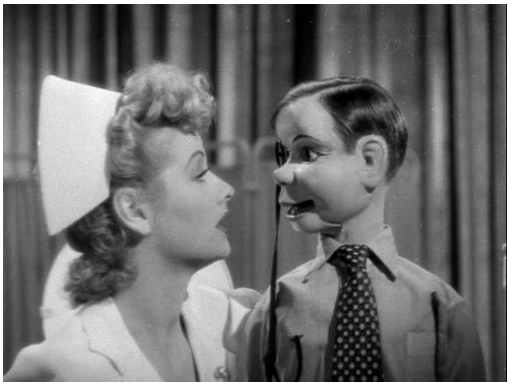
After the studios were divested of their movie theaters in the 1948 Paramount Decision, this became the normal way of doing business, and remains so today. The agency delivered RKO a package, and the studio agreed to fund it. Look Who’s Laughing is an excuse for viewers to see these still wildly popular radio personalities in the flesh, so the plot conceives a way for Bergen (playing himself) and his dummy Charlie McCarthy to crash the world of Fibber McGee and Molly in Wistful Vista, somewhere in the Midwest.

After wrapping up another season on the radio, with Lucille Ball as his loving assistant Julie, Bergen and McCarthy fly out on vacation, but crash land in Wistful Vista. Fibber McGee is scheming to get an airplane manufacturer into the town, and Bergen’s business contacts could be the deciding factor. But of course there are some backdoor shenanigans by the theatrically villainous Gildersleeve (Harold Peary), and it takes a bit of deceptive seduction from Julie to right the wrongs.

The leads were radio stars for a reason. The Charlie McCarthy doll has more screen presence than the mono-tonal Bergen (and says the best line, “What fools we morons be”, to a soda jerk), while  Fibber McGee and Molly’s gentle bickering couple routine is anodyne and forgettable, the template for so many of today’s sitcoms in which a incompetent husband is indulged by a wise woman (they are the real life husband and wife Jim and Marian Jordan). I have no doubt their work is stronger over the airwaves.

Lucille Ball, while given little to do except look alluring in a nurse’s outfit and yearn after Bergen’s dead-eyed stare, pushes against the boundaries in her character. As with the other titles in the box set, she was assigned a type and invigorated it, this time injecting a frank sexuality and clumsiness to the stock “His Girl Friday” character. Lucille said, “I started as a model because I looked like a model, and ‘the other woman’ or ‘the career girl’ because I have a deep aggressive voice that has no softness or romance to it.” She took the talent at her disposal, sharpened them, and then tripped over them for a laugh.

LANCE HENRIKSEN: NOT BAD FOR A HUMAN

August 9, 2011

Screen Shot 2020-01-31 at 3.22.57 PM

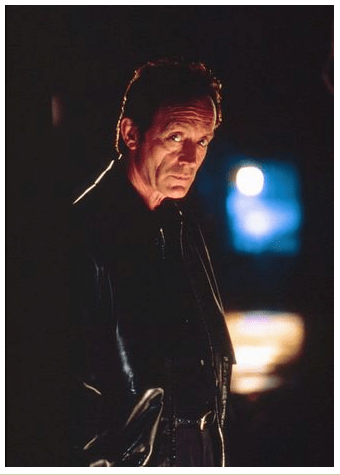
You know this gaunt growler. He lurks in the disreputable direct-to-video section of your local video store, if it still exists, or pops up on Netflix in a low-budget creeper rated with one reluctant star. He is, of course, Lance Henriksen, a tireless worker and a real character of a character actor. In his wild, circuitous life he’s compiled a trunk-full of  anecdotes and chastened life lessons. With the help of co-writer Joseph Maddrey, he packed all of them into his autobiography, Not Bad For A Human. It lays bare his poverty-stricken youth and job-hustling acting career with a disarming lack of vanity and a rhythmic sense of cursing.

“‘You know, Lance, you’re not going to work much until you’re older.’ Why’s that Charlie? ‘Because you look funny.” – Charles Durning to Henriksen, on the set of Dog Day Afternoon


Henriksen had a face he needed to grow into. His Easter Island head needed the ballast of sagging cheeks and the proliferating slashes of wrinkles to ease his transition from awkwardly handsome man to sage and unsettling elder. The transformation was complete with the addition of a cigarette-scarred rasp to his low rumble, able to modulate between wise or psychotic with the turn of a script page.

One of Henriksen’s many forthright confessions is that he wouldn’t be able to read those scripts until he was thirty. He was born in NYC on May 5th, 1940 to James Henriksen and Marguerite Healey. James was never around, and Marguerite worked waitressing jobs to keep her kids fed. She flailed for stability, with “great dreams for her life, but she had no education and she kept marrying men for the sake of being taken care of.” She married five times. In between men there were financial troubles, and one way to make money was acting on television:

There was this talk show in New York where you’d go on the air and tell a bleeding heart story, and listeners would call in and make contributions. My mother got me on that show when I was a little kid, and we would tell these awful lies. It was like we were were a family of grifters…

Lance bounced between family members, but once his maternal grandmother Floss died, he had no reliable guardians to speak of. He ended up at an orphanage at Hastings-on-Hudson and, as Henriksen recounts:

They were impatient with me because I couldn’t read. I was just a little kid, but they got me up in front of the class and I couldn’t read, so they humiliated me. And that was the end of reading. I just thought, Fuck reading. in my heart, I just…turned it off. And school. Fuck school.

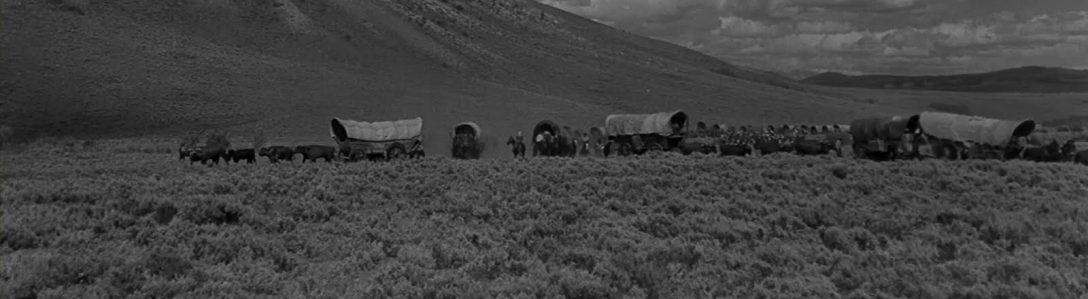
He worked as a shoeshine boy and lived on the streets of New York, only finding the sense of community he sought in the movies. His favorite at that time was Howard Hawks’ Western The Big Sky (1952). The love between Kirk Douglas and Dewey Martin as they venture through the Grand Teton Mountains struck a chord with the lonely and adventurous Henriksen. When he watched it, he said he was a “Method movie viewer”, bringing a “knapsack, a canteen, a frying pan…and what I thought was a sleeping bag…. I brought all the stuff into the theater with me…and I watched the movie maybe eight times. I’d fall asleep for a while and wake up and watch it some more.”

After years of wandering, through San Francisco and a short stint in the Navy, he ended up in New York with a yen for acting. Still unable to read, he would have a friend recite his dialogue parts into a recorder, from which he would memorize lines. Eventually he taught himself to read, although he claims a nagging sense of inferiority at his lack of education throughout his career.

He was immediately drawn to the physicality of Method acting, and became a part of The Actors’ Studio community, although he was never an official member. Henriksen says Lee Strasberg simply, “wasn’t my kind of guy.” He also rejected studying with Sandy Meisner, who asked him to quit acting for five years if he wanted him as a teacher. Henriksen didn’t think he could afford to live under those circumstances and responded, “Yeah, okay, I’ll do it…but if you fail me, I’m gonna kick your ass.” Meisner declined to accept him as a student.

As with reading, Henriksen learned acting through osmosis and practice. His process was to immerse himself totally in his characters, building elaborate backstories not included in the script, and designing his own costumes and props that he would react to spontaneously in scenes. Inside of this invented world he would feel free to act instinctually instead of mechanically. Part of this process required playing his characters on and off set. When he was playing Wally Schirra in The Right Stuff, a good-hearted family kid, he went looking for his biological father and reunited him with his mother: “My mom really liked Wally. Here she had this son who was attentive to her, didn’t swear around her, took her out to dinner…I think she wishes Wally would have stayed around!”

The impressive thing about Henriksen’s ethic is that he applied it to every project, whether a prestige Hollywood item like The Right Stuff or a ridiculous action film like Stone Cold (1991). Henriksen has invented a useful vocabulary for the roles he would take on. There were the “fart-catcher” roles, which were essentially background players who would absorb the leads’ precious gases. Then there were the “alimony films”, which he took on after his two divorces, and the “jet-lag” gigs, for the low-budget Eastern European movies. For the latter, “I wouldn’t even get an eight hour turn-around before I had to start reciting all this shit.” The first of these was Antibody (2002), in which he plays an “FBI agent who gets injected into the bloodstream of a terrorist.” Henriksen has an extraordinary ability to compartmentalize his performance from the films he appears in. His method allows him to act the movie he has constructed in his head, which the final product rarely lives up to.

Stone Cold falls outside these categories, one of the few films in which he had complete creative control. A vehicle for NFL bust Brian Bosworth, the creative chaos on the set allowed him to finally act without restrictions. The original director was fired and Craig R. Baxley was hired to replace him. He was dissatisfied with the dialogue for his character, the villain Chains Cooper, and requested he be able to improvise all of it.  Baxley agreed and Henriksen, “got so deep into the role that I’d just say whatever came into my mind.” He was given similar freedom on Jim Jarmusch’s Dead Man, which along with Aliens is one of the few films worthy of his talents. He told Jarmusch that “I don’t want to say one line that you’ve written for this character in the script. I want to improvise the whole thing”. The director trusted him, although Lance’s conviction went to frightening lengths. Jarmusch remembers:

He stayed in character a lot of the time, which was a little scary. Some actors can just walk off the set and become themselves again, but Lance puts so much of himself into a performance that it takes him a little while [to get out of character]. It’s always percolating. And like all really fine actors, he doesn’t act out the stuff; he reacts.

Henriksen is one of the great reactors of the cinema, even if the environment around him isn’t worth reacting to. On my last trip home, my Dad was flipping through the channels and found the direct-to-video alimony film Sasquatch (aka The Untold, 2006). His first reaction was, “any movie with Lance Henriksen has got to be good.” As I watched Lance on-screen,  manfully staggering after a man in a rubber suit with wide-eyed desperation, grief over his daughter’s death doubling the carved lines on his face, it was clear my Dad’s dictum was correct. Lance Henriksen justifies the existence of any movie he appears in, however threadbare.

I’ll leave him with the last word:

If I get another script that says “The Sasquatch looks around the tree”, I’m going to go, “No way, leave me alone, man.”

VINTAGE VIOLENCE: SANDS OF THE KALAHARI (1965) AND LIVE LIKE A COP, DIE LIKE A MAN (1976)

August 2, 2011

Screen Shot 2020-01-31 at 2.59.28 PM

A baboon and Santa Claus are witnesses to man’s descent into savagery. In Sands of the Kalahari (1965, out on DVD today from Olive Films), a charter plane crashes in the African desert, and its passengers battle each other (and some observant simians) for survival. Live Like a Cop, Die Like a Man (1976, a recent Raro Video DVD release)  finds a couple of pretty boy Dirty Harries gunning down suspects before they have time to commit crimes. Poor Old St. Nick can only grin and bear these assaults on individual freedom. Both films display the brutalizing depths wisecracking civilized types can descend to when they feel above or outside the law.

After the international success of Zulu (1964), director Cy Endfield and actor/producer Stanley Baker reunited in South Africa for Sands of the Kalahari. Endfield, born in Scranton, PA,  had been working in the UK for over a decade after being declared a former Communist by the House Un-American Activities Committee. I discussed his second-to-last Hollywood film, the inflammatory noir The Sound of Fury (1950, aka Try and Get Me), back in February. He used a variety of pseudonyms in the years after he was put on the blacklist, since British producers still wanted U.S. distribution.

Endfield (credited as Charles de la Tour) first worked with Baker on Child in the House (1956), a family drama adapted from the novel by Janet McNeill. They hit it off, and returned with Hell Drivers (where Endfield used his real name for the first time), a taut trucking adventure that established the fatalistic tone of their future collaborations. They continued to elaborate their interest in self-destruction in the thrillers Sea Fury (1958)and Jet Storm (1959) before hitting it big on Zulu.

Like Jet Storm (set on a plane in which a grief-stricken passenger (Richard Attenborough) intends to blow himself up) and ZuluSands of the Kalahari contends with a small group grappling with the prospect of  imminent death. The story was adapted by Endfield from William Mulvihill’s novel of the same name. When a commercial flight is canceled at a Johannesburg airport, a few of the international travelers charter their own plane out: there is the fadingly charismatic pilot Sturdevan (Nigel Davenport); the unfailingly logical, and vaguely Eastern European Dr. Bondrachai (Theodore Bikel); ex-German soldier and monkey lover Grimmelman (Harry Andrews); professional British lady Grace Munkton (Susannah York); functioning alcoholic Bain (Stanley Baker); and the immediately shirtless big-game hunter O’Brien (Stuart Whitman).

The plane runs into a swarm of locusts and crashes into the dunes of the Kalahari desert. After the junky jet explodes, the group is stranded in the middle of the most inhospitable place on earth, with sharp-toothed monkeys monitoring their every move. O’Brien sheds his shirt and takes over, and slowly goes mad Heart of Darkness style, growing obsessed with the absolute power he can maintain in this exotic outpost of humanity. Ms. Munkton swoons over his rippling pectorals, but the other passengers aren’t so impressed, and get picked off one by one. What O’Brien ultimately wants is to dominate nature itself, and when humanity fails to pose a challenge, he opts to wage a war against the baboons.

Endfield takes full advantage of the Panavision frame, using the early urban sequences for centered compositions filled with background action, while the desert sections are unbalanced and emptied out. The opening is in medium-shot, while the desert sequences are in long-shot. As the enormity of their situation dawns upon his characters, Endfield pulls further away. It is a nasty little picture, attuned to the brutality of the scenario more than others of its ilk, including the (quite good) Five Came Back (1939, dir. John Farrow), Desperate Search (1950, dir. Joseph H. Lewis), and Flight of the Phoenix (1965, dir. Robert Aldrich). Endfield said, “The only way to do it was to show the essentialism of survival, which was impossible given censorship rules. Otherwise it seems like ‘Swiss Family Robinson’.” (from Brian Neve’s career spanning interview).

I shudder to think what an uncensored Sands of the Kalahari would look like, because this is pretty raw material. In one queasy sequence, the remaining men club a wounded impala to death with stones, as Endfield frames them in rare close-up with maniacal grimaces on their faces. In another, O’Brien guns down baboons from their mountainside dwellings, and their corpses fall to the ground like a mealy potatoes.

The main conflict is between O’Brien’s hyper-macho Darwinism and the other men’s reluctant egalitarianism. There is no true competitor, as the Doctor is a coward, the German resorts to the violence he disdains, and Bain is brave but a bit of a dolt. Endfield clearly agrees with the milquetoasts, but is fascinated by O’Brien’s animality. Shunning escape, he chooses to live alone in the desert, growing a patchy beard and awaiting the showdown with the primates whose homeland he has invaded. This final battle is gruesome and short, and in the end Endfield pulls away in his longest long shot, until O’Brien is just another dot on the landscape. Nature, as ever, is unperturbed.

Live Like a Cop, Die Like a Man does not exhibit that kind of formal control, but its tilt-a-whirl frenzy holds its own insane appeal. Directed by Italian exploitation specialist Ruggero Deodato (Cannibal Holocaust), it’s a near plot-less exercise in gonzo action sequences. Fred (Marc Porel) and Tony (Ray Lovelock – who also sings the Dylan-esque theme song) are model-handsome cops spearheading a special operations force in Rome. These two grinning sociopaths gleefully snap necks of suspects who survive their chases, and resort to torture for small bits of information. They are the exploitation version of Dirty Harry, who at least had motivation for his sundering of the law. These two are simply insane, although they go about it in an amiable cop show manner, as if CSI: Miami’s David Caruso just started choking out schlubs in the interrogation room.

Without characterization or narrative to speak of, the juice here is in the location shooting of the action scenes, which deliver wildly dangerous stunts on the streets of Rome, often shot without permits. The stunner is the opening motorcycle chase, an epic jaunt through the Via del Corso that weaves through traffic, crashes through cafes, thunders on top of cars, and scares an old blind man. Interspersing camera mounted cycle shots with the death-defying stunt-riders, it’s a full kinesthetic assault that matches its other model, The French Connection (1971), for white-knuckle realism. When the action scenes end, it’s just another campy exploitation movie, but when the cameraman hits the ground running once more, it’s wise to start paying attention.

FRANK BORZAGE’S AMERICA: THE VANISHING VIRGINIAN (1942)

July 26, 2011

Screen Shot 2020-01-31 at 2.36.41 PM

Rebecca Yancey (Kathryn Grayson) taps into popular sentiment with the modernist anti-landscape above. The second daughter of Cap’n Bob Yancey (Frank Morgan), longtime district attorney in Lynchburg, Virginia, Rebecca is trying to escape the role of a proper lady, with the suffragettes’ equal opportunity rhetoric ringing in her ears. Set in 1913, Frank Borzage’s The Vanishing Virginian (1941) is equal parts bittersweet nostalgia and progressive optimism. Just released on DVD from Warner Archive, along with Borzage’s follow-up, Seven Sweethearts (1942), it is a lovely bit of propagandistic Americana, released two months after the U.S.’s entry into WWII.

In the February 1942 issue of Boys’ Life, “Chief Scout Librarian” Franklin Mathiews called The Vanishing Virginian “a model movie in the way of the [sic] diversion for a war-weary world.” An MGM publicity flack couldn’t have made the marketing pitch any clearer. An escape to a mythical American South, screenwriter and Dallas newspaperwoman Jan Fortune adapted the memoirs of Rebecca Yancey Williams into a digressive series of vignettes of the Yancey family’s gentle misadventures . Cap’n Bob is considering running for a 6th term as city prosecutor, while his wife Rosa (Spring Byington) urges him to retire and focus on his family. Bob is modeled after Robert Davis Yancey, a mayor and seven-term commonwealth’s attorney in Lynchburg. Frank Morgan plays him as an endearingly absent-minded old coot, with a dizzying array of Ron Burgundy-esque exlamations: “Bilous Bonaparte!”, “Roaring Romulus!”, “Howling Hades!”, “Naked Neptune”, “Nostalgic Nicodemus!”, et. al. In Men of Mark of Virginia, Yancy is described as politically moderate, “an old-line Democrat, but he opposes the extreme views of Mr. Hearst and his followers.”

In the film he is a paternalistic egalitarian, frequently invoking the Bill of Rights and then going home to his black servants, presumably his former slaves. Then he intentionally botches the only case we see him prosecute, after he determines the all-white jury will not conduct a fair verdict for the black defendant. The servants are characters of Southern wish-fulfillment, slaves happy to stay with their masters, but Borzage and the actors  give them a depth and dignity that pushes against their essentialization.  Leigh Whipper plays “Uncle Josh Preston”, a sweet old man with beatific eyes whose mild manner masks an iron will. In a film where most of the movement is inside the frame (there are some great choreographed family pratfalls), each tracking shot carries extra force, and the most complex one occurs after Uncle Josh collapses. The camera trails back from Bob carrying his prone figure, and then there is a cut to a movement forward to the church that will forever house him. This latter image contains no human figure, a shock in a film configured around the family. The clapboard church is privileged to hold the frame, and Josh’s spirit with it.

Whipper was the first black member of the Actors’ Equity Association in 1913, making his film debut in Oscar Micheaux’s groundbreaking “race films” Within Our Gates (1920) and Symbol of the Unconquered, and was one of the founding members of the Negro Actors’ Guild of America (1939). The Louise Beavers character, “Aunt Emmeline”, is more stereotypical, a “mammy” type who smiles at her employers’ jokes and scuttles in the background. But at a funeral of one of her friends, Borzage continually cuts to close-ups of Beavers’ face, where Emmeline’s bottled up sadness and rage quivers to the surface.

The eldest Yancey girls, Rebecca and Margaret (Natalie Thompson) push back against their parents’ social conservatism, with Margaret eager to study law, and Rebecca a singer. Rosa responds that a woman lawyer would be as absurd as a female driver. When James Shirley (Johnny Mitchell), a young progressive defense lawyer, comes into town, he attracts both of the girls’ attention. His mother Marcia is one of the leaders in the women’s suffrage movement, and causes Rosa no end of marital and political heartburn, having also been a young love of Bob’s. Marcia is based on Nancy Astor, a Virginia-born lady who became the first woman elected to British Parliament in 1919. These stories slowly weave in and out, with none given pride of place. Borzage gives the film the same lazy rhythm as the lives he’s trying to portray.

In the end, horses and carriages have given way to cars and the women who drive them, including Rebecca. Bob continues to run for election, accepting the new social landscape as it shifts around him. In the final shot, the town gathers ’round him to honor his service, as in the end of another paternalistic dream of Southern community, John Ford’s The Sun Shines Bright (1953). Each profiles a doddering relic holding their towns together with principles that time and politics are rendering obsolete. It is up to the viewer to decide which of their disappearing beliefs is worth mourning.

***

Seven Sweethearts is a bizarre item, a Hungarian operetta re-staged in Michigan, with the perpetually-smarmy Van Heflin as the ostensibly dashing lead. Kathryon Grayson is his small-town inamorata, and Borzage stages a number of scenes to show off her impressive coloratura soprano vocals. The story goes that Heflin is an entry-level reporter, getting a story on a Tulip festival in the small Michigan town of Little Delft. It’s a Dutch town where the neighbors practice their French horn during work hours and where Viennese composers never pay rent. S.Z. Sakall is the proprietor of the local hotel, and the single father of seven beautiful daughters (all with male names – since he was hoping for boys). It is tradition that no girl can be married until the eldest is hitched, so the younger girls are itching for Reggie (Marsha Hunt) to tie the knot. Creaky wackiness ensues, and Heflin is ill-suited for the thin air of this sub-Lubitsch atmosphere. It just seems to make him queasy. Borzage speeds through it with seemingly little investment, but I enjoyed the too-in-love Honeymoon couple and the broad caricature of the supporting cast, especiall Sakall’s jolly windbag.

At TCM.com, Jeremy Arnold reported an unsavory postscript to this sweetheart tale:

“In 1949, Hungarian playwright Ferenc Herczeg sued MGM, Pasternak, and screenwriters Walter Reich and Leo Townsend for $200,000, claiming they had plagiarized his play Seven Sisters, which he had written in 1903 and which Paramount had adapted into a 1915 movie starring Madge Evans. Herczeg was imprisoned in a concentration camp in Hungary when Seven Sweethearts was produced and released, and consequently he didn’t learn of the film’s existence until years later. The suit was settled out of court.”