DVD TUESDAY: LATE LANG

May 3, 2011

Screen Shot 2020-01-29 at 4.00.19 PM

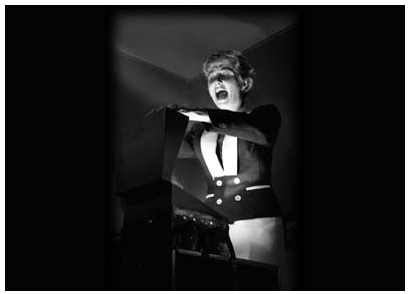
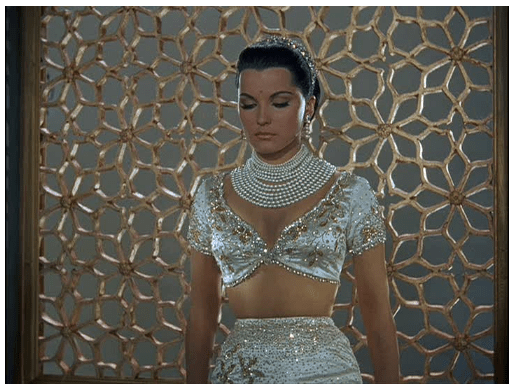
In a bit of home video serendipity, the films Fritz Lang made in Hollywood and Germany from 1956 – 1959 were all recently released on DVD. The Warner Archive put out re-mastered versions of his last two Hollywood films While the City Sleeps (1956) and Beyond a Reasonable Doubt (1956), while the UK Masters of Cinema label produced a luminous edition of his two-part Indian epic, The Tiger of Eschnapur (1959) and The Indian Tomb (1959). All four films snare their main characters in webs of malevolent fate. The first two pin their characters inside geometrically arranged compositions, granted the illusion of motion in a world constantly boxing them in. This is garishly illustrated in the Indian Epic, as seen above, with elaborate imagery of imprisonment emerging from the set design. They use strikingly different methods to pursue similar ideas of fate and desire, from threadbare pulp to embroidered imperialist myth.

After the financial failure of the astonishing Moonfleet (1954), which had his highest Hollywood budget at $1.9 million,  Lang was finding it difficult to attract studios’ attention. So when producer Bert Friedlob offered him a modest two-picture deal with distribution through RKO, he accepted. The two titles were prepared simultaneously, according to Lang biographer Patrick McGilligan, and the director split his time between the screenplays – working with Casey Robinson on While the City Sleeps and Douglas Morrow on Beyond a Reasonable Doubt. Both were shot in SuperScope, and the Warner Archive is releasing them in a 2:1 aspect ratio, which looks just about right to me.

Both plots contain what Tom Gunning called “a double goal, in which the main action the characters undertake is given a double motivation by an authority figure.” For While the City Sleeps, the main plot follows a serial killer, in which the sexually repressed mama’s boy Robert Manners (John Drew Barrymore) is tracked down by the investigative reporter Edward Mobley (Dana Andrews). The double goal is given by the petty new newspaper owner Walter Kyne (Vincent Price), who dangles a new executive manager position to whomever can crack the case. The reporters’ betrayals and insane drive to scoop the story often overshadow the killer plot, and seem almost more inhuman.

In Beyond a Reasonable Doubt, the Dana Andrews character Tom Garrett is on trial for murder. The shadow story is that his former news editor Austin Spencer hatched a plan to manufacture circumstantial evidence for the trail, in order to get a conviction. Once convicted, Spencer would reveal the ruse, proving that innocent people could be condemned to death without a smoking gun.  As Gunning writes, in his indispensable study The Films of Fritz Lang, “in both cases suspenseful stories of crime and punishment are framed within journalistic investigations.” Both films interrogate their own premises through these creator figures that, like Lang, initiate stories they soon discover they don’t have control of.

Walter Kyne, played with an oily buffoonery by Vincent Price, inherits the company after his father’s untimely demise. Clearly a pampered, narcisstic creature, he promptly chooses to use the newspaper as his own private penny dreadful theater, siccing the reporters against each other in his perverted “contest”. Lang sets out the space of the office as entirely open and visible – everyone can see each other’s performances at all times. In an early sequence the manager of the wire service, Mark Loving (George Sanders) is seen whispering into his secretary’s ear. They are framed in a glass window as if on television, and Mobley is watching them from across the room. He calls her to break it up. Everyone is the center of their own panopticon, everyone in the office having the all-seeing powers of a previous Lang mastermind like Dr. Mabuse.

As the reporters race around to save their future inside these all-public spaces, the killer Manners still stalks the streets. Mobley lures him into town with a baiting television broadcast – the televisual as another kind of all-seeing eye boring into even the psycho’s shabby apartment. Let out into the open, Manners stalks Mobley, and stumbles into another space of hyper-visibility, the bar down the street. Stumbling downstairs, he finds the ace investigative reporter and TV personality canoodling with the woman’s advice columnist Mildred Donner (Ida Lupino). Even the killer cannot escape this public theater that Kyne has introduced.

Beyond a Reasonable Doubt flattens the theatrical world of While the City Sleeps into strips of men standing next to walls. Where there was depth in the newspaper office, here there is nothing but static two and three-shots, everything pushed close to the foreground of the frame. It is so pared down it amounts to the characters simply standing and telling the story to the camera, as in the modernist distancing of Manoel de Oliveira’s Francisca, in which his characters stare at the camera and read the dialogue from Agustina Bessa-Luís’s 1979 novel Fanny Owen. Jacques Rivette saw something similar in his review of the film for Cahiers du Cinema in 1957:

The first point that strikes the unsuspecting spectator, a few minutes into the film, is the diagrammatic, or rather expository aspect instantly assumed by the unfolding of the images: as though what we were watching were less the mise en scene of a script than simply the reading of the script, presented to us just as it is, without embellishment.

[…] No concession is made here to the everyday, to detail: no remarks about the weather, the cut of a dress, the graciousness of a gesture; if one does become aware of a brand of make-up, it is for purposes of plot. We are plunged into a world of necessity…

This world of necessity was partly brought about by the low budgets Lang was working with, but he turned that to his thematic advantage, the spartan set decoration and limited set-ups illustrating the mechanics of the crime thriller itself. The editor and writer are shown planting evidence and documenting the planting of this evidence, authoring their own crime movie in the middle of a crime movie. Eventually they get caught in the machinery of their construction, and the brutal ending shows a man lost inside of his own story.

Where Beyond a Reasonable Doubt is spartan, the “Indian Epic” is overstuffed, a lavish spectacle that is beloved (and screened) at the same level as It’s a Wonderful Life in Germany, according to this article in Rouge (Lang’s is the third version of the film. He was slated to direct the first version in 1921, scripted by his future beau Thea Von Harbou, but producer Joe May took the reins instead to great success. Tom Gunning has written an exemplary essay that includes all this and more in the Masters of Cinema set). A German architect named Harald Berger (Paul Hubschmid) is contracted to expand the made-up fortress city of Eschnapur in India. He soon falls in love with the religious dancer Seetha (Debra Paget), whom the Crown Prince Chandra (Walter Reyer) is madly in lust with. This love triangle pulsates for over three hours in various permutations of escape and capture.

As a representation of India, the movies are ridiculous, a hodgepodge of sparkly costumes and wild misrepresentations of religious ceremonies. But as a lesson in how visual style can convey inner tensions, it’s rather wonderful. It begins in the set design of Willy Schatz, who helped create the never-ending web imagery that will snare every character in turn. In one telling sequence, Seetha has been corralled by the Prince into one of his chambers. She is kneeling in front of a gold cage, the imagery more than obvious. But the next cut is to the Prince leering through one of the web-like grates in the wall, looking more imprisoned than Seetha, who is situated outside the cage. But the Prince is tied by heredity to this intricately designed fortress-mansion, and is doomed to love a woman who will never love him back.

These set patterns weave their way throughout the film, with geometric shapes filling the space behind the Prince’s head during Berger’s arrival, a real cobweb that hides a fleeing Berger and Seetha, and the high-angle shots which turn regular courtyards into clashes of giant rectangles. The fortress contains prisons within prisons, until Berger is stashed below the surface of the mansion, in a deep well in a network of catacombs located beneath the mansion. The space envelops everybody, rendering them mute and impotent against their implacable fate. The happy ending involves another escape, but since the film is based on a cyclical rhythm of freedom and capture, perhaps Lang just elided their eventual return to this venus fly trap of cities, which wraps the characters in its vise-grip jaws, never letting them go.

TRIBECA FILM FESTIVAL: DETECTIVE DEE AND THE MYSTERY OF THE PHANTOM FLAME (2010)

April 26, 2011

Screen Shot 2020-01-29 at 3.54.20 PM

The Tribeca Film Festival still exists. Having succeeded in its intent to help revitalize the economy of lower Manhattan after 9/11, the festival has spread out across the city, and has maintained its commerce-over-art stance. As a business venture it seems like an unqualified success, and has gained a little more respect as a market for distributors along the way. But as for the films themselves, it’s always been a bit of an embarrassment. Heavy on celebrity directorial debuts (this year: Billy Corgan and Vera Farmiga) and slumming stars in sub-Sundance “indies”, the movies are essentially waiting lines for the after-parties. With a festival this huge, there is always something to be salvaged, usually in the shorts or genre programs. But in recent years I haven’t been willing  to pay the price (Steve Dollar in GreenCine and Matt Singer and Stephen Saito at IFC News are two doing such yeoman’s work). The only title in TFF’s program I was aching to see was Tsui Hark’s Detective Dee and the Mystery of the Phantom Flame (2010), and as it was already available on DVD and Blu-Ray in Asia, I watched it at home instead of braving the beautiful crowds.

Detective Dee is the 50th film produced by Tsui Hark’s Film Workshop company, and has been hailed as a return to form by no less a Hark expert than Subway Cinema guru Grady Hendrix. A madcap mixture of Sherlock Holmes, steampunk, martial arts and historical melodrama, it’ll be sure to top any gargantuan Hollywood entertainment this year for most invention per square inch of screen space. It hearkens back to Hark’s salad days of Shanghai Blues (1984) and Peking Opera Blues (1986)  hyperkinetic magpie films that combined the classical art forms of his youth with high (and low)-flying action. Detective Dee is subdued by comparison, but still manages to pack in a trilogy’s worth of twists and turns. After his failed attempt to ape Johnnie To’s sleek geometrical violence in the omnibus film Triangle (2007), it’s an unmitigated delight to see him return to his wild pseudo-historical mode – “nationalism on speed”, as Stephen Teo described it in Hong Kong: The Extra Dimensions.

Detective Dee is based on the Tang Dynasty official Di Renjie, who was immortalized in an 18th Century Chinese detective novel entitled The Celebrated Cases of Judge Dee. The Dutch diplomat and writer Robert Van Gulick translated it into English, and then modeled his own crime series on the character of Judge Dee, which ran from 1946 – 1967. From 2004 – 2007, the CCTV network of China ran a drama series based on the stories of his life, entitled Amazing Detective Di Renjie, which stimulated the interest for the big screen adaptation.

It is A.D. 690, and Wu Zetian (Carina Lau) is about to be coronated as Empress, the first and only female ruler of China. However! Two of her subjects burst into flames while working on the erection of a 66-story high Buddha statue. On the advice of the Imperial Chaplain (who appears as a talking deer, naturally), the Empress releases the legendary Detective Dee (Andy Lau) from prison, who had been jailed for opposing her rise to the throne. Dee was close to the Empress’ husband, the Emperor, who died under suspicious circumstances. Assisted by the albino swordsman Minister Pei (Deng Chao) and the Empress’ security officer Jing’er (starlet Li Bingbing), Dee uncovers an intricate conspiracy that relies on phosphorous emitting beetles and a face-morphing doctor named Donkey Wang.

Jumping from setpiece to setpiece, Tsui never lets the pace flag, although the set design shifts from the brilliantly gothic “Phantom Bazaar”, a foggy netherworld of rotting wood and noxious swamp, to the cartoon-y CG of the group shots outside the Empress’ mansion. In the first edition of Planet Hong Kong (2000), David Bordwell described Hark’s style as, “an exercise in extremes – manic knockabout, brutal violence, sentiment, irony, in-jokes. Period detail jostles superhero fantasy, lush costumes are swathed in fake fog, dazzling special effects are compromised by banal wirework. This is the man who told his scriptwriters to make something new happen every three minutes.” It is exhilarating and exhausting, inventive and chintzy. Even Sammo Hung’s fight choreography in Detective Dee swings from extremes – there is the “banal wirework” that Bordwell complains about, but also a strikingly original fight scene set in the Phantom Bazaar. The Imperial Chaplain shows up as a spectre in a brass-mask, a malevolent monster from a Peking Opera, perhaps. Filmed in menacing low light, the three investigators pin down the shape-shifter, only to have it wriggle away and morph into more nightmarish forms, from Opera villain to a glowing stingray-like beast, and then ultimately into a Ray Harryhausen-esque stop-motion death-bird.

That I had to conceive of such phrases speaks to the child-like joys present in Detective Dee. It’s the kind of serial style adventure that George Lucas and Steven Spielberg have been attempting to recapture for decades. Dee lacks their polish, but makes up for it with its delirious imagination and complete lack of self-consciousness – an eager-to-please delight that would slot right in next to a screening of The Adventures of Captain Marvel or Daredevils of the Red Circle. There is no higher compliment.

MORE TO BE SAID: ALLAN DWAN

April 19, 2011

Screen Shot 2020-01-29 at 3.49.19 PM

“It is too early to establish any coherent pattern to Dwan’s career as a whole, but it may very well be that Dwan will turn out to be the last of the old masters. …there may be much more to be said…” -Andrew Sarris, The American Cinema

My weakness was that I’d take anything. If it was a challenge to me, I’d take a bad story and try to make it good.” -Allan Dwan to Peter Bogdanovich, Who the Devil Made It

Allan Dwan has one of the more intimidating IMDB pageswith 405 directorial credits listed, spanning the years 1911 -1961. As with my on-going infatuation with Raoul Walsh, my haphazard path to Allan Dwan began with a random repertory screening, this time at Anthology Film Archives. The French filmmaker and critic Serge Bozon (La France), programmed an evening of idiosyncratic Westerns that handle male friendship in starkly different terms: Dwan’s Tennessee’s Partner (1955) and Jacques Tourneur’s Canyon Passage (1946). The former is a tender and forthright charmer, while the latter is an opaque and elliptical mystery. As I’ve been frequently enraptured by Tourneur recently (see here), I was surprised to find I found myself more wrapped up in the laconic rhythms of the Dwan film (although both are equally worthy). I then quickly queued up his two other 1955 features, Pearl of the South Pacific and Escape to Burma – and so I begin another auteurist binge.

Tennessee’s Partner (’55) was part of a string of low-budget action films that producer Benedict Bogeaus was packaging together for RKO. Jacques Tourneur had already pitched in with Appointment in Honduras (1953), while Don Siegel kicked off the remarkable string with Count the Hours that same year. Dwan would direct ten of these cheapies (three in ’55 alone), almost all of which used the same proficient crew of old pros, including cinematographer John Alton, art director Van Nest Polglase, editor James Leicester and composer Louis Forbes. In his study of Tourneur, The Cinema of Nightfall, Chris Fujiwara notes that “According to Dwan, Bogeaus’ budgets were never more than around $800,000 to $850,000, and the schedules were about fifteen days.” As Dwan told Bogdanovich:

Ben Bogeaus had lost his shirt on a bunch of pictures that he produced, and for a long time he did nothing. But he had been friendly with a fellow who became the general manager for RKO studios under Howard Hughes, and when they decided to encourage independent producers to come in and make pictures, they also loet Bogeaus in because of the previous relationship with the studio manager. The president of the company was…my old friend Jim Grainger. Now Bogeaus was notoriously extravagant in the early days, and they weren’t too confident that he could safely handle the kind of budget he’d have to use, so to give himself some security, Grainger reached out for someone with experience to go in and work with Bogeaus.

The mandate was to finish under budget and on time, and Bogeaus, no longer extravagant, became rather notorious for cutting corners. On Dwan’s last film, Most Dangerous Man Alive (1961), Bogeaus hired the crew on the lower wages of a two-part television pilot, even though it was intended as a theatrical feature all along.

This cheapness extends to the aspect ratio, for instead of paying for the CinemaScope process, RKO introduced the cut-rate SuperScope process, which essentially crops a 4×3 frame into 16×9. Glenn Kenny broke it down at MUBI:

Howard Hughes hired brothers Irving and Joseph S. Tushinsky to concoct a process. It is possibly one of the most ass-backward you will ever encounter. (My information derives from Robert E. Carr and R.M. Hayes’ invaluable book, Wide Screen Movies.) In SuperScope, the film is shot using standard 35mm cameras, lenses, film. Filmmakers were instructed that all action be framed “into a 2:1 aspect ratio with equal cropping from the top and bottom of the frame.” “The film was then cropped to 2:1; a 2:1 anamorphic squeeze was added, and the film was printed by Technicolor in ‘scope format with .715′ height and .715′ width. A narrow black strip appeared on the right side of release print frames to fill in the difference in the .715′ SuperScope width and the .839′ width of CinemaScope.”

Borne out of necessity as well as inclination, these films are sparse and economical, allowing the well-worn genre codes to fill in the blanks in the scripts and the open spaces in the sets. Escape to Burma and Pearl of the South Pacific are minor but diverting efforts, with characteristically impressive work by John Alton. Burma is the stronger of the two, introducing the latticework facade of Barbara Stanwyck’s Burma outpost in the opening, letting Alton’s shadows seep through it in the middle, and then ending with gun muzzles intruding into its intricate grille work. Pearl has some stunning location footage matched with awkwardly cheap studio shots, but still manages to wring dense, fully figured characters out of its pulp cut-outs.

Not much happens in Tennessee’s Partner, with most of the action taking place inside the emotions of John Payne and Ronald Reaganthe two eminently likable leads. Payne is Tennessee, the slick house cardsharp in a high-class brothel, or “Marriage Market”, run by Duchess (Rhonda Fleming). Duchess takes 10% of his winnings after he cleans out the rubes, but she’d like it more if he kissed her with passion. Instead, she gets the sloppy macho tongue slapping of a narcissist only after his own pleasure. Then Cowpoke (Ronald Reagan) totters into town, a mild mannered romantic who arrives to get married. Everyone is an archetype, identified only by a nickname. Howard Hawks certainly saw this movie before making Rio Bravo, another pared down Western heavy on nicknames and the vagaries of male friendship. It’s unnecessary to dwell on narrative-halting backstory when entire lives are present in a name. Whether Cowpoke or Tennessee, or Colorado, Feathers and Dude in Rio Bravo, you have a sense of these characters as soon as they step on-screen and introduce themselves. This allows Dwan and Hawks to focus on the inter-personal present.

One of Tennessee’s cleaned out poker mates tries to knock him off, and Cowpoke, just entering town, guns down the attacker instead. Tennessee and Cowpoke end up in jail on suspicion of murder. Instead of plotting escape, they sit in a tight two shot and talk, in a restful pace, about their lonely lives. Cowpoke laments his solitary life on the road, and Tennessee the constant pressure of having to maintain his perch, with young gunslingers always trying to take him down. It’s lonely at the top and the bottom, and the two men slowly bask in their mutual alienation.

The film progresses in this inverted manner – its heart on its sleeve and its story shunted to the background. Dwan said, “I’ve always preferred stories of intimacy. Spectacle is only useful commercially.” Tennesee’s Partner is a sweet distillation of this inclination. It’s a lovely, lulling experience to watch John Payne as his features soften the more he gets to know his pal. The cynical devil-may-care dash is replaced with nervous concern – as Cowpoke’s fiance turns out to be a gold-digger Tennessee knew back in San Francisco. The story moves on his inability to communicate his concernreflecting also his mulish refusal to admit his love of Duchess. It’s a movie about accepting and validating male emotionality. There is a moment when Payne lays his hand on Reagan’s shoulder, affirming their bond and their love, that stuns in its simplicity and grace.

DVD TUESDAY: ROPE OF SAND (1949)

April 12, 2011

Screen Shot 2020-01-29 at 3.26.28 PM

Olive Films continues to raid the Paramount vaults, this time with William Dieterle’s 1949 Casablanca clone Rope of Sand. Released on April 5th, along with Edward Dmytryk’s The Mountain (1956), it’s another strong DVD presentation from the company. The spotless print is presented in a progressive transfer that showcases the inky blacks of cinematographer Charles Lang. Producer Hal B. Wallis left Warner Brothers in 1944 to form his own production company, Wallis-Hazen, and was eager to recreate his biggest hit for his new distributor Paramount. He bought Walter Doniger’s Casablanca-esque script and wrangled three of that film’s actors: Paul Lorre, Paul Henreid and Claude Rains. The leads were given to Burt Lancaster, who was under contract to Wallis, and Corinne Calvet, a French siren the producer hoped to mold into the next Ingrid Bergman. The result is a prickly bit of entertainment, a threadbare and more nihilistic version of its model.

There is much less at stake in Walter Doniger’s screenplay. In Casablanca Bogart wrestles with aiding the French Resistance, and in Rope of Sand Burt Lancaster is trying to steal a cache of diamonds from a South African mine. Lancaster plays Mike Adams, a former hunting guide turned depressive. A few years back one of his clients wandered off onto the protected area of the mine, hoping to strike it rich. He succeeded in in finding a rich vein of jewels, but dies of dehydration. Davis is then caught by the mine’s security force, led by Paul Henreid’s Commandant Vogel. Vogel tries to beat the location of these diamonds out of him, but to no avail. Stripped of his license, and unable to obtain a passport, Davis is a man adrift. He returns to the mine to rip off the diamond load and get his revenge on Vogel. Claude Rains plays Arther Martingale, a mine functionary who plays both sides off each other, with the help of Corinne Calvet as the ambitious prostitute Suzanne Renaud.

Davis is a stridently unlikeable character: selfish, brutish and a little dense. Lancaster was evidently unhappy with the production, as his biographer Kate Buford reported that it was “he one he would remember as the worst movie in which he ever appeared.” Eager to play out the string of his Wallis contract, he gives Adams a cold, dumb brutality that hedges against the threat of audience identification. There are no anti-heroics here, just a profoundly unconvincing happy ending.

Director William Dieterle and cinematographer Lang follow Casablanca‘s visual template, of cluttered baroque interiors and roving tracking shots inside bustling nightclubs. Lang uses lower light than the earlier film, perhaps compensating for the lack of background activity. While Casablanca has an expressive face sitting on every barstool, the world of Rope of Sand is relatively de-populated. Peter Lorre, who crawls into the film as a philosophizing fence, enters an empty frame. With less to explore, Dieterle’s camera movements are adumbrated compared to Curtiz’s long traveling shots down the bar. What Dieterle emphasizes instead are power relations, mainly expressed through a simple but effective method of blocking his actors along with alternating camera angles.

Screen Shot 2020-01-29 at 3.28.54 PM

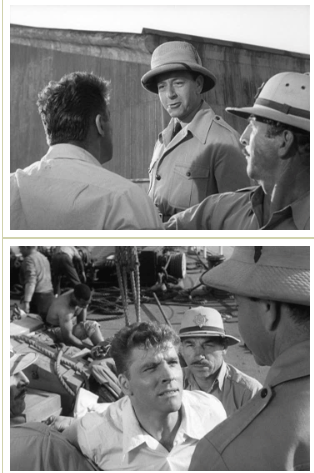
When Mike Davis returns to South Africa on a freighter, Vogel is there to meet him with plum-voiced taunts. Davis is physically restrained by a pair of strapping deck hands, as Vogel looks imperiously downward. The camera peeks down at Davis, and upward at Vogel, quickly sketching their respective positions in the narrative. By the end, they are framed on equally level angles as their fortunes meet in the middle. Dieterle’s framing of Corinne Calvet undergoes a similar shift, tracking her transformation from a tool of Martingale’s to a woman who asserts her will.

The image that top-lines this post shows Calvert posing for Claude Rains, an erotic puppet that he’ll use to arouse the jealousies of Henreid and Lancaster. This becomes visualized in a poker game, before which Rains whispers devious nothings into Calvert’s ear. When she sits down, Rains is placed behind and to the right of her, his mouth still in visual range of her ear. Then the camera slowly dollies forward, and Calvet moves her head to the right, obscuring Rains’ face – the puppeteer lost in his art. Then there is a cut to Lancaster, with empty space around him – the only man outside of all human entanglement.

The controlling imagery surrounding Calvet continues when she goes home with Henreid, who pins her in-between two hanging canvas frames. She is a decoration to Henreid’s narcissistic martinet, window dressing to his tin-horn dictatorship. Little does he know that she’s under Rains’ employ, or that she is rapidly falling in love with the brusque Lancaster, for reasons that remain obscure aside from narrative necessity. By the end of the film the imagery of control and display fall away in Calvet’s scenes, and she shares equal screen space with Lancaster.

With thoughtful little stylistic strategies like these, Dieterle is able to lift his second-run scenario into something with a semblance of vitality. And thanks to the shit-eating grin of a performance by Claude Rains, as well as the reliably creepy work by Peter Lorre, Rope of Sand pulls itself together to be a diverting shadow of Casablanca.

AN INTERVIEW WITH DAVE KEHR

Originally published at Movie Morlocks, the official blog of Turner Classic Movies

April 5, 2011

Screen Shot 2020-01-29 at 3.10.44 PM

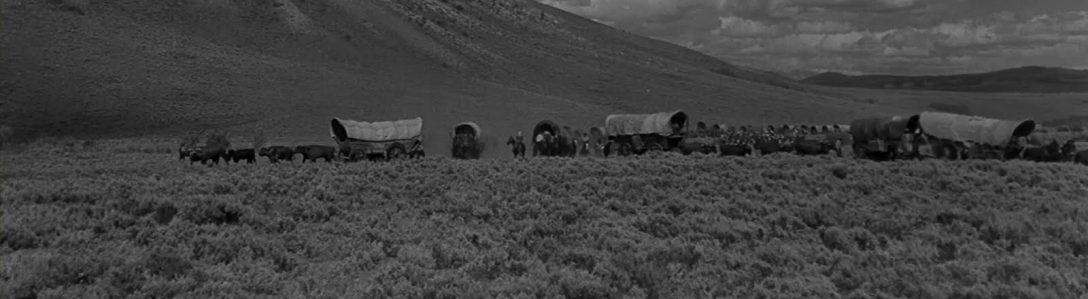
It’s taken as long as the caravan journey in The Big Trail, but we finally have a collection of film criticism from Dave Kehr, who currently writes the essential DVD and Blu-Ray column at the NY Times.  When Movies Mattered (University of Chicago Press) gathers his work from his period at the Chicago Reader, from 1974 – 1986. For years I’ve consulted his capsule reviews to guide my viewing habits, still available at the Reader website, but his long-form pieces have long been out of circulation. So this is a cause for celebration, although the resulting party would drive other critics to drink out of jealousy rather than selflessness. His prose is patient and lucid, laying bare stylistic and thematic mechanisms with the graceful invisible style of one of his favored Hollywood auteurs.

I was able to sit down with Mr. Kehr to talk about some of his favorite directors, as well as those not given much critical attention. So we range from Raoul Walsh to Godard and from Eastwood to Paul W.S. Anderson. Something for everyone! And it should be noted that the University of Chicago Press is doing an incredible job, releasing not just Kehr’s book, but also the most recent writings of Jonathan Rosenbaum and David Bordwell & Kristin Thompson.

RES:  It’s easy to get caught up in Raoul Walsh’s energy, but it’s hard to pin down his specific style. Could you break it down?

DK:  Well, he goes through a few different periods. If you’ve seen Regeneration, from 1915, the longest feature that survives, he’s really doing Griffith.  There are standard set-ups, moving into close-ups for moments of emotional intensity or alienation. And then we don’t have anything until 1922, something called Kindred of the Dust which is at the Eastman House. In that one he’s already doing wider angles, longer takes, and more staging of action in depth. He’s doing a lot less cutting. He’s moved in a different direction than Griffith at that point. That becomes very obvious in Thief of Baghdad (1924) and What Price Glory(1926). He becomes more about bodies moving through space and less about shots following shots.

The Big Trail (1930) is a huge breakthrough for him. The effect of working in what was essentially CinemaScope in 1930 makes him reconsider everything. Suddenly he’s got this equipment that will give him dead sharp focus over a range of like 5 miles. And he sees the possibilities instantly, which is what I find so fascinating. It has these incredible deep focus compositions, so you can see every aspect of a shot unfolding in the same image. There is a shot of the wagons being lowered down the mountains in the background, and people approaching in the foreground. Conceptually it’s incredible; multiple planes, multiple focal points. A lot of the stuff people think Welles and Tati invented is already pretty much there in The Big Trail. The other thing he finds there is this sense of background motion which becomes really important for him. He’ll have static figures having a conversation in the foreground, but have a lot of crossing in the background, with isolated pockets of action. You get the feeling these extras could star in their own movie. He develops that in a lot of different ways  in the early ‘30s.

RES: How did he carry the lessons of framing for widescreen back to Academy ratio after The Big Trail?

DK: Well, then he starts working on the deep focus. He works with James Wong Howe on Yellow Ticket (1931) which is a really fascinating film, and I wish Fox would make a print of it. They don’t quite have lenses that are fast enough, and they don’t have enough light, but conceptually they are 100% in Gregg Toland, Billy Wilder, Orson Welles land. They’ve got it all figured out. There are shots in that movie that could have come straight out of Citizen Kane.

RES: Did Andre Bazin ever write anything about Walsh?

DK: Not to my knowledge. These films were pretty hard to see. The Fox stuff dropped out of circulation after the studio fire.  I don’t think people were looking at these movies.

RES: When Walsh began making widescreen films again later in his career, do you see any shift in style from The Big Trail?

DK: It’s like he picks up where he left off. Even before that, when he makes his 3D movie, Gun Fury (1953). He had been making movies in 3D all the time. The irony being that he was blind in one eye. He doesn’t do anything differently in Gun Fury than the way he was staging stuff in The Lawless Breed which comes out the same year. He has that natural sense of depth. He identified cues of perspective and how to nestle characters within a space. It works brilliantly in 3D when you see it projected.

RES: How would you characterize his handling of actors?

DK: Well he likes a very distinctive kind of performer. He didn’t do a lot with Douglas Fairbanks, but he was at the same studio, Triangle, for five years. But when he finally does get to direct him there’s an immediate chemistry: this is the man in action. This is the Walsh hero. He carries this over in different forms. With Fairbanks it’s all light and jolly and weightless. It’s the same with James Dunn in Sailor’s Luck. There’s always something that kicks these people into action, and it can be a conventional goal, or it could be this animal sense of, “I have to keep moving.” And in the case of Sailor’s Luck I think it’s sex. The sexual attraction between those two characters is staggering. Obviously a year later you couldn’t do anything remotely like it. They just have to get together.

Then you get to Errol Flynn, who kind of picks up the Fairbanks stuff, but it’s a little darker, a little nuttier. He’s kind of angry and violent. In Flynn’s first few films he’s juvenile in an irresponsible way, taking unnecessary chances that’ll get him in trouble. And as he works with Walsh, from They Died With Their Boots On (1941) through Operation Burma (1945), that character grows up in really interesting ways.

Flynn achieves manhood for Walsh’s heroes in Operation Burma, and then you get those baroque variations from the late ‘40s and early ‘50s. Most famously, White Heat (1949), where the character is plainly psychotic. He’s no longer just dangerous, he’s fucking crazy. That performance is so gutsy. It seems so modern to this day. Chewing on a chicken leg as he walks over to the trunk to shoot the guy….

RES: Even in something like The Strawberry Blonde, Cagney is a little insane.

DK: It’s got that Walsh energy, but it’s more coiled and manic than Flynn, and certainly more than Victor McGlaglen. There’s always the sense that something is pushing these guys forward. It could be something as benign as that spirit of adventure of Fairbanks, or as psychotic as what Cagney does.

RES:  I heard you will be writing a new regular column for Film Comment starting a few issues from now. Will it be about directors like Walsh, who have not been written about much?

DK: Yes. For some reason research on American directors stopped with Andrew Sarris. Probably something to do with the fact that theory came swooping in around that same time, and we all had to pretend there was no such thing as authors for a few years. In the meantime directors are dying left and right and prints are dropping out of circulation. The older I get the more amazed I am by the size of the classical Hollywood cinema, how many interesting people there were, and how many films. It’s gigantic. I don’t think any writer has gotten their head around the enormity of this thing.

RES: Have you selected some filmmakers you’ll discuss?

DK: Two of the people I was planning on writing about… One was a guy who worked at Republic in the 30s and 40s named John H. Auer. And another guy named William Nigh who started at Warners in the teens, worked at MGM and ended up on Poverty Row in the 30s and 40s. He had an interesting late career. I thought I would call the column “The Auer is Nigh”, but they didn’t like it…[laughs]

RES: Are there any unpretentious action directors working today worth paying attention to?

DK:  Yeah. Paul W.S. Anderson I think is pretty talented. I always enjoy his films. I’m not sure he’s any kind of thematic auteur, but he certainly knows how to shoot action. And David Twohy, who did Pitch Black (2000) and A Perfect Getaway (2009). This is a sad example. The guy has directed four movies in the last eleven years . How many films would Raoul Walsh have made in that time? You just don’t have the chance to get good anymore.

RES: I’m happy you named Paul W.S. Anderson, who I get a lot of shit for liking. He’s always attracted to constrained spaces…

DK: Yeah, he’s kind of Langian. He loves these underground chambers. In every movie there’s people penetrating a gigantic spaceship [Event Horizon (1997)] or the bowels of the corporate headquarters in the Resident Evil movies. His first film just came out on DVD, Shopping, which is an art film compared to what came later.

RES: You devote a whole section to Jean-Luc Godard in your book, who at that time (the early-to-mid 80s) was re-engaging with, and questioning, narrative. You wrote that he was “concerned with breaking through a media poisoned world to something clear, clean and transcendent.” How would you contrast that with his recent work, which seems like a return to more experimental formal structures, interested in layering images and ideas rather than “breaking through”?

DK: Passion (1982) is probably my favorite of the late Godards. That one almost seems like a Dreyer film, completely spiritual. It’s all about the transcendent, how do we get out of here, what’s in the next room if there is one. After that he falls back into the argumentative mode.

Film Socialism (2010), which is in three parts, seems to correspond to three stages of his career. You get the opening sequence, which is the big beautiful and lyrical piece, of the stunning images he was doing in the 80s and 90s. Then you get the up close and personal family interaction stuff that he was doing in Numero deux (1975) and the films from the 70s that nobody sees anymore. And then it ends up with an essay-ish section which is very much like the Histoire(s) du Cinema. So he seems to be conscious of playing with his different manners. A retrospective film.

RES: Another of your pieces that struck me was your review of Sudden Impact (1983), and Eastwood in that period. I assume he was not taken seriously as a director at that time. Could you talk about Eastwood’s place in relationship to the New Hollywood, whom you often seem to be reacting against?

DK:  I was somewhat alienated from the whole Bob Rafelson, Easy Rider thing. I don’t think I would write those things as negatively now as I did then. It was a polemical moment.  I liked Clint because of his association with Don Siegel. I thought his first film showed an awful lot of personal investment, and particularly in the way he was looking at himself as an object. It’s a theme that continues, consistently imagining his own disappearance, his own death, obsessively. Sudden Impact is the best of the Dirty Harrys because it gives him such a powerful, other form, a Dirty Harriet, which it was often called at the time. He more than meets his match. Directed masculine energy meets undirected female anger.

RES:  The way Eastwood pares away any affect in his performances, I think you even called it “Bressonian” in your review, really stands out in Firefox (1982) in which he barely emotes, like one of Bresson’s models.

DK: I know, and that’s a great example of him imagining his own disappearance. Because at the end of the movie he flies off away from the camera into this little dot.

RES: Another interesting aspect is how, as a secret agent in Firefox, he’s supposed to be a good actor, but he keeps screwing up. He’s portraying himself as a bad actor.

DK:  Which is what I loved about Pink Cadillac (1989). That was a movie I got a lot of crap for liking, but this is a movie about why Clint likes acting, and why he’s not very good at it.

RES: His movies are so rich because of how he interrogates his own persona…

DK: Yeah, once he stops doing that, his work really dries up for me. His last great film was Gran Torino (2008), which is the summation of that theme, a film I found emotionally devastating. Literally handing over the keys to the new generation. Again he’s imagining his own death and irrelevance, but this time something comes after that.

RES: Could you talk a bit more about his work post-Gran Torino? It seems the craft is still there but not the same level of personal involvement.

DK: I don’t find them very personal at all. It seems like he’s taking whatever hot, Oscar-ish script of the moment is. He’s getting people like Brian Grazer to make his movies, and they’re prestige oriented stuff.

RES: What about the WWII diptych, which I felt was very strong.

DK: Yeah, the first one I thought was good, the second was really good. In Flags of Our Fathers (2006) he was aiming a little too hard for social significance – it didn’t feel like an Eastwood film. Letters from Iwo Jima (2006) is just the opposite .

RES: You felt the same about Invictus (2009) and Hereafter (2010)…

DK: Invictus I just couldn’t get into at all and Hereafter I thought was actually bad. Very disappointing. We’ll see about J. Edgar. Sounds like another Oscar candidate.

RES: Another director you devote two pieces to is Blake Edwards…

DK: Edwards was important because he was a full-fledged studio auteur who was still working at a peak level when I was writing those pieces. Just the perfect example of someone was could make very personal films in a very commercial context.

RES: Would you put him with Eastwood as the last of that breed?

DK: I suppose. I don’t want to sound all apocalyptic or anything. Joe Dante is still in there plugging. And John Carpenter…he’s a real independent. He released through studios but made maybe one studio produced film,The Thing (1982) through Universal. He has that studio ethic without being a studio guy. He fought to keep his independence so he could make movies as if he were working for an old studio.

RES: I wonder when we’ll get to see Carpenter’s The Ward (2010)…

DK: It’s played all over Europe. And Monte Hellman’s got a new picture with no distribution [UPDATE: Monterey Media has acquired Hellman’s ROAD TO NOWHERE]. And Joe’s last picture [The Hole (2010)] never got distribution.

RES: Was The Hole’s fate decided because studios booked all the 3D screens?

DK: He explained it to me. The problem selling it was it wasn’t scary enough for teenagers and it was too scary for twelve year olds. A tweener.

RES: Continuing with more recent work, you wrote that great piece on The Cable Guy (1996) recently, so could you expand your thoughts on Apatow’s output? He has his champions.

DK: He does, but I don’t think he’s that innovative. He’s never done anything as far out as The Cable Guy again. He wrote a lot of it and didn’t put his name on it, but he learned his lesson on that one. Keep it friendly, keep it nice.

RES: Funny People (2009) did seem very personal…

DK: It did, but not in such great ways. It kind of gets preachy on you. I didn’t like how he was layering the characters where the people at the center were these three dimensional, psychologically complex types, but the further you got from them the more grotesque and cheap sitcom-y they got. When they finally meet the husband, he’s this total cartoon. He’s no real competition, there’s no real drama between those two guys. The guy’s a joke. It was an easy way out of that dramatic situation. I generally find the Farrelly’s more interesting, although they kind of ran out of steam. They’re not as funny as they used to be.

RES: I’m a big Stuck on You (2003) partisan.

DK: Yeah, I like that. And Kingpin (1996), I just love it.

RES: Is is their anarchic qualities you admire?

DK: That’s where the real energy is now. Comedy and horror is where you can break the rules. You don’t have people breathing down your neck because executives don’t care about these genre things, they don’t watch them half the time.

RES: That’s why I’m a big fan of the Will Ferrell/Adam McKay comedies, especially Step Brothers (2008), which becomes incredibly anarchic.

DK: Yeah, I have to see that. Ferrell, I can’t quite figure him out. There’s something a little condescending in what he does. It’s not mean spirited, he just likes playing stupid people. He lets you know he’s smarter than they are all the time. Something about that bothers me. You can see him working down, where you could never see Stan Laurel working down.

RES: Step Brothers takes that as its subject. They are literally overgrown children, these men in their 40s, so I think it takes on that criticism. By the end of the film the narrative totally dissipates, into a series of non-sequitur gags. The Other Guys (2010) is more conventional…

DK: I saw that. It was a buddy cop movie that kept telling you, “this is a parody of a buddy cop movie.” But it was doing all the things a buddy cop movie does.

RES: It got caught up in the plot for some reason…

DK: Isn’t this a great parody?  No, it’s just like everything else.

RES: There was a flare-up recently in your blog’s lively comments section recently, this time about Tony Scott, who also has his critical defenders.

DK: I guess so. I was kind of amazed to discover that all of the Lisandro Alonso fans also like Tony Scott. I can’t reconcile this. Looks like the same guy to me who made Top Gun (1986). Just run and gun, shoot, shoot shoot, and maybe we can massage this into something that makes sense but we’ll worry about it later.

RES: So you didn’t find any coherent visual scheme.

DK:  I couldn’t find a pattern in what Pat Graham was talking about in Unstoppable (2010), supposedly mirrored, up and down panning shots. If they’re there, I totally missed it. One little trick for getting a quick sense of a director’s visual style is to fast forward through the movie.

RES: Do you do that often?

DK: Not often, but once in a while. So you’re not distracted by the trivialities of plot and character and acting [laughs]. But a quick fast-forward through and you get a good sense of the visual vocabulary. I just ran Unstoppable, the ten minute version, and there didn’t seem to be anything particularly organized about it. He takes these really banal screenplays and embroiders them with these big effects, which is what everybody does. He’s a little more creative technically, he’s willing to go the extra mile of bringing in the helicopter.

RES: I admit I’ve enjoyed his last few movies. I’d say he’s the main exponent of Bordwell’s “intensified continuity”. He’s able to take this style and pare it down where it moves and still makes sense, even if there is no overarching visual structure.

DK: But there are those push-ins at the end of close-ups, for no effect. It doesn’t mean anything. He uses it here but doesn’t use it there. It’s what someone called “refreshing the screen”. It’s just to keep something happening to keep kids from getting bored. Stimulating the optic nerves to keep people interested.

RES: I can’t argue that. But I also think he’s an efficient storyteller.

DK: That’s the kind of filmmaking I value. I just don’t get him, or “the working class metaphysics.”

RES: That quote from Mark Peranson in Cinema Scope (read here) really got under your skin.

DK: That phrase stuck in my craw. It’s too easy. What’s working class about that movie? It’s not about the Hawksian pleasures of doing your job or the Walshian pleasures of community. It’s your typical Hollywood heroes acting in complete isolation. The thematic is tired old therapy stuff. By stopping this train we’ll become better husbands and fathers.

RES: Let’s talk about your blog, and the great community you’ve created there.

DK: I don’t think I created anything. It’s just there aren’t that many places where you can discuss these issues without having the same tired argument over and over again, “is the director the author of the film?” I’m too old, I don’t want to talk about that anymore.

RES: The discussions get intense sometimes. Do you think it recreates the polemical atmosphere of the Kael-Sarris period of your writing, of “When Movies Mattered”?

DK: I hope so. The thing about Tony Scott was a pretty good example of that. I really enjoyed that, it got tense.

RES: In the blog you mentioned that I Saw the Devil (2010) is the natural endpoint of the revenge film cycle kicked back off by Tarantino. Could you elaborate on that?

DK: It’s just hard to imagine things going any further. It’s the old gag where the cop is as crazy as the criminal, but in this case the competition is about who can cause the other greater pain. The pain is registered with such force and originality, it really shook me up. He’s not nearly the craftsman that Park Chan-wook is, but his color sense is magnificent in that great opening shot of the face created in the rear view mirror.  You don’t know whose point of view it is until a half-hour into the movie. It has that old-fashioned craftsmanship that cares about composition and texture and color. You see it in the Korean films coming out now, which I guess is inspired by Park Chan-wook. It’s not happening in many other places now.

RES: Is there anywhere else?

DK: Well, we seem to be living in this post-mise-en-scene world, with a few pockets of it remaining. Johnnie To mainly, the couple guys in Korea, David Fincher, David Twohy, and I’m sure a few others but not that many. Now it’s all about acting and framing the performance. Most mise-en-scene is just finding some way to separate the actor from the background. And that’s all they’re thinking about, how to isolate this face. I was sitting through Sucker Punch (2011) last week, and I thought, what am I doing here? I could have watched three Allan Dwan films in the time it took me to watch it!
DVD DOUBLE BILL: THE VANQUISHED AND STARS IN MY CROWN

March 29, 2011

Screen Shot 2020-01-28 at 6.18.36 PM

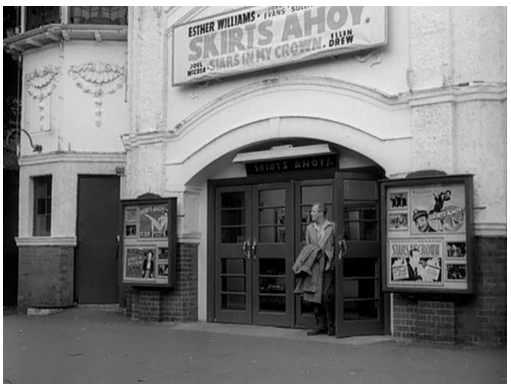
In the third and final short film in Michelangelo Antonioni’s The Vanquished (I Vinti, 1953), a youthful British strangler walks out of a double bill at The Saffron theater. The headliner is the Esther Williams musical comedy Skirts Ahoy (1952), with Jacques Tourneur’s Stars in My Crown (1950) as the “B” picture. Aubrey (played by Peter Reynolds), is the fame-seeking young poet exiting the cinema, ready to commit his so-called perfect crime. But did perky Esther Williams or the avuncular Joel McCrea make him do it? I encourage one and all to stage your own version of this twofer and see if any homicidal rage bubbles up. Please report in the comments. But alas, Antonioni doesn’t answer this pressing question in The Vanquished itself. What is undeniably true is that both The Vanquished and Stars in my Crown both received recent DVD releases, from RaroVideo and the Warner Archive, respectively. It’s a dreamlike bit of capitalist coincidence, and one of those secret joys of cinephilic pursuits.

RaroVideo is a cult Italian DVD label that initiated a North American wing earlier this month, starting out with Fellini’s I Clownsthe Fernando Di Leo Collection and the pretty 1974 horror film The Perfume of the Lady in Black. Today they drop The Vanquished. In the ever-shrinking DVD market, they are an idiosyncratic godsend, plucking high- and low-brow gems from Italian film libraries.

The Vanquished is an omnibus film, containing three short films of teenage rebellion and murder in three different cities: France, Italy and England. Released the same year, 1953, as Marlon Brando’s leather-clad rebellion in The Wild One,  it was partaking of the worldwide paranoia regarding juvenile delinquency that would peak with Rebel Without a Cause two years later. Adapting three real-life crimes, the production was hit with official protests, and severe changes were made to the script before production. It was Antonioni’s second feature, following 1950′s Chronicle of a Love Affair, and without any leverage he had to bow to their demands. Because of imposed re-shoots and other post-production difficulties, The Vanquished was released into theaters months after The Lady Without Camelias, which is often credited as his second film as a director, although it was the third he shot.

The French section was modeled after the “Affaire J3″, in which a young man, Alain Guyader, was killed by his schoolmates during a picnic in the woods near Paris. Google Books has made available an article on the murder in LIFE magazine from June 4th, 1951. Through the years of rationing during and following WWII, “J3″ was the government’s code for cardholders from the ages of 15 to 18. The anonymous writer notes that now, “the term has become the symbol for a tragic story of adolescent intrigue, confusion and murder”, opining on the “fearsome look the trial provided into the curious dream world in which these adolescents lived and played at adult affairs.” That is, they acted like they were in a movie, this time a WWII French Resistance film.

The scandal of it all was that these children were from solidly bourgeois families, so the usual bromides about violence originating in poverty couldn’t be trotted out. This was something new, and newly ascribed to this generation being raised during a world war, inured to bloodshed. They are what the film’s tacked-on introduction describes as the “burnt-out generation”. This group of teens played at being black marketeers and revolutionaries: “When studies seemed unexciting, they created their own excitement, hatching plans to organize a great new Maquis [a rural guerilla bands in the Resistance]  if the Russians would come. They would make a fortune in the black market…and would run arms to the Middle East.” This adolescent cell grew tired of Guyader’s boasts, including his declarations that he was “a man of his times” as well as made up love affairs with other members of the group. Setting up a mock trail, the Maquis declared “he was too vain and would have to die.” They scripted their own drama.

This episode in The Vanquished was the subject of a “defamatory press campaign” and protested by the family members of the “J3″ teens. The French Ministry of Commerce refused to grant an export visa, blocking the transportation of the negative to Italy. Although it eventually got through, France still banned the film until 1963. Antonioni’s handling of the material is anything but exploitative – opting for a talky naturalism, with long-take group shots of the kids joining and breaking-up in endless waves. It skimps on the details of the murder in favor of a disconcerting reverie. The group has already decided to kill, so they spend their time gallivanting through the verdant woods, talking of their lame parents and fickle crushes. It is indebted to neorealism, with its use of real locations and unaffected performance,  but Antonioni’s penchant for intensely psychologized spaces and architecture crops up in the final scene. The murder takes place in the ruins of a castle, reflecting the fractured fairy tales cycling through these embryonic Red Brigadeers’ heads.

The Italian episode was hacked to pieces. The original scenario, as described by Stefania Parigi, was to follow a “hotheaded fascist who sets up his own suicide in such a way that the blame seems to lie with the Communists.” This was based on the story of Achille Billi, a young fascist who was murdered and dumped into the Tiber River. The April 25th, 1949 issue of Life magazine has a photo of the funeral, captioned FASCISM REVIVES. The photo shows an overflowing crowd (credited as over 5,000) giving his coffin the Fascist salute. The producers gutted the scenario, first changing the main character to a violent leftist who bombs an arms depot (this version is presented as an extra on the disc), and then removing politics entirely, requiring re-shoots to change him into a small-time smuggler. The result is a rather ridiculous, neutered scenario – a high schooler ends up  bossing around a grizzled bunch of black marketeers. But it certainly looks stunning, filmed mostly at night in low-light chiaroscuro by Enzo Serafin.

The final section, with our beloved Aubrey, was based on the crime committed by 19 year old Herbert Mills, who strangled an older prostitute in the suburbs of London, “for no apparent reason” (Parigi, liner notes). This section seems to have been left untouched, and in an Antonioni anomaly, is a rather straightforward Hitchcockian mystery. Reminiscent of Robert Walker’s epicene character in Strangers on a Train, Aubrey is after the perverse pleasure of getting away with murder, a decadent Raskolnikov. It becomes clear early on that he is guilty, the question becomes how he did it, and whether he’ll get away with it. Peter Reynolds, playing Aubrey, is a self-deluding delight as the muckracking murderer, who smirks his way to the newspaper as he trumps up publicity for the crime he just “witnessed.” Maybe Aubrey saw Strangers on a bill right before Stars in My Crown, and wanted his own slice of notorious fame and fortune (Antonioni might have had this short in mind during Blowup, with its concluding shot of a tennis match).  J. Hoberman, in his Cold War histories,  would say they were just participating in the violent dream life of nations.

In Stars in My Crown, the dream is of an idealized past. The whole film is a flashback reminiscence of John Kenyon (Dean Stockwell), whose voice-over forthrightly idealizes the small Southern town of Walesburg that he grew up in. Jacques Tourneur famously took a pay cut to direct this modest triumph, and it was the favorite of his films. What is immediately striking is the unreliability of the narration – which is focalized solely through Kenyon’s perspective. In his opening voice-over, he states, “According to the words of the song we are promised a city of gold in the hereafter. I used to think that was a long time to have to wait. But I know now that there is a city of gold right here on Earth for every one of us. The city of our youth.” We can return to our memories of childhood to construct our vision of heaven. The story to follow will be an act of Kenyon’s imagination, his personal Utopia.

Joel McCrea is the Pastor who raises Kenyon, a folksy preacher who can joke and fish as well as read the gospel. He is a man of the world as well as a man of God, and his wife Harriet (Ellen Drew) is equally wise, beautiful in body and soul. McCrea is a jovial oak, laying down roots with every stride of his giant frame, bringing the community around him in the tight medium-shots that Tourneur frames the majority of the film inside. These frames are egalitarian spaces in which any member of the town can take center stage, from the half-wit Chloroform (Arthur Hunnicut) to Uncle Famous (Juano Hernandez), the African-American livestock farmer who has acted as the entire town’s generous godfather.

The relationship between the Pastor and Harriet is one of the most genuinely loving depictions of marriage ever put on film. One scene, and a few gestures, stand out. Kenyon contracts Typhoid, and the adoptive mother and father take turns watching over him. Pastor tells Harriet to take a rest. She goes to her bed, and fights back a sob, wondering aloud if the boy understands how she loves him like her own. McCrea, standing above her, silently lets her work through her emotions. Then, he notices her taking out two hairpins, to get ready for bed, as she continues her monologue. Without a word he takes over this ritual, silently plucking out the remaining pins, and then straightening her hair as it tumbles down. The Pastor’s gestures allow Harriet to allow her entire body to grieve – he has seamlessly taken over the practical rituals of her evening in order to let this take place. It is both comfort and freedom, and an indication of the complex density of their bond.

Antonioni and Tourneur present nightmares and dreams of youth in this impromptu double bill. If you’re feeling frisky, you can also add Tourneur’s Days of Glory (1944), just released by the Warner Archive. Released in the short window of Hollywood pro-Soviet propaganda towards the end of WWII, it presents a bustling anti-Nazi resistance cell in Russia, led by Gregory Peck in his first starring role. Saddled by a ponderous script and the Manichean dictates of the propaganda machine, it’s a minor, frustrating work, but Tourneur still manages some striking scenes of communal living. Managing deep focus in this makeshift hovel, he establishes multiple planes of action as the group oils their guns, boils their soup, and plots for Soviet victory. It’s a canned, albeit elegant, dream of romantic revolutionaries, the flip side of the canned nihilistic violence in THE VANQUISHED. STARS IN MY CROWN is the only fantasy here that is worth believing in.

THE NEAREST THING TO HEAVEN: LOVE AFFAIR (1939)

March 22, 2011

Screen Shot 2020-01-28 at 5.55.54 PM

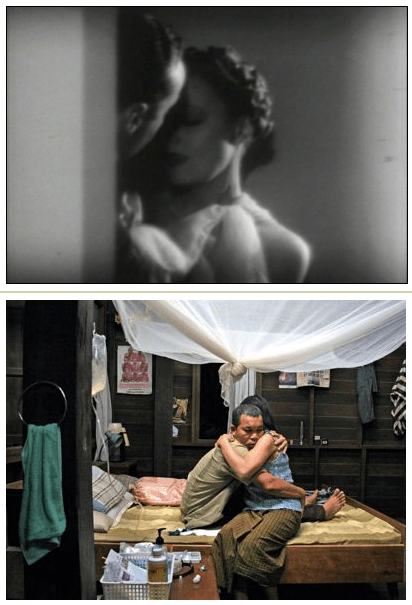
When two deeply affecting films are viewed in quick succession, they start to speak to each other. This weekend I watched Uncle Boonmee Who Can Recall His Past Lives (2010) and Love Affair (1939), both for the second time. They have a radically contrasting approach to narrative, but both use visual patterning to pursue a kind of naturalized transcendence. In both, an idealized vision or emotion is brought down to earth, made approachable and concrete. Love Affair takes the melodramatic conceit of romantic love, based on separation and a purely spiritual longing, and places it in reluctant bodies, who squirm and flirt and have to work for a living. Boonmee flattens the space between life and death, man and animal, ancient and modern. Ghosts are as natural as the oxen in the woods, and its characters react accordingly, with benign acceptance. In their own way, both films convey what my late, great undergraduate Philosophy professor, M.C. Dillon, wrote in Beyond Romance:

We are our bodies. Including the traces that other bodies have visited upon ours and the traces our bodies deposit in the world as marks of its passage. It is as bodies that we are and are known. In that broad sense, all our knowledge of each other is carnal knowledge.

Boonmee takes the supernatural and makes it tactile, while Love Affair brings romaticism into the intricate choreography of actors’ hands. I previously wrote about Boonmee here, so the following incoherent ramblings will focus on Love Affair.

The plot of Love Affair uses the classic scenario of romantic love, as laid down in the songs of the twelfth-century troubadors in the South of France. They sang of unrequited attractions, impossible to act on because of the custom, as Dillon writes, of using marriage as a means of consolidating family wealth. Dillon goes on to quote the Countess of Champagne, delivering a judgment in a court of love convened in 1174:

We say and affirm…that love may not extend its rights over two married persons. For lovers grant each other all things mutually and freely without constraint of any motive of necessity, whereas the married are in duty bound reciprocally to submit to the will of the other, and to refuse each other nothing.

Love and marriage are mutually exclusive, and this in turn fueled the thwarted erotic imaginations of the eras poets. All of the great romantic stories, Abelard and Heloise, Tristan and Isolde, are premised on separating the lovers. Dillon: “The point is that the intense experience of love they sought could not survive without the barriers that kept their fantasies alive by preventing them from knowing one another.” (Manoel de Oliveria’s masterful duo of Doomed Love and Francisca lays bare the masochistic tendencies of this mode). The ensuing centuries have done little to alter this pattern, aside from changing the tragic ending into one of happy heterosexual couple-dom. The barrier between couples remains, cycled through endless cliches, usually divisions in class or temperament. These tales typically end when the lovers first get to know each other.

Love Affair subtly tweaks this pattern, with director Leo McCarey introducing visual motifs to bring this love for all time into a love for right now. Charles Boyer and Irene Dunne gain a carnal knowledge of each other, in Dillon’s sense, in their first moments together, revealing themselves through their relation to space and their musical gestures. Their first meeting is through a porthole window on board a cruise ship, a tiny opening that halos faces, a partial, idealized view. It is a typically romantic image, Dunne’s face framed like a cameo necklace, and separated from Boyer by a thick wooden wall. In a usual romance, this first meet-cute would presage a long interval of Boyer searching for this mystery woman. Instead, Dunne walks around the corner, in an imposingly squared off fur coat, and continues her sarcastic banter. She goes from a beatific face to a fully embodied woman, and Boyer is immediately taken, grabbing her arm and urging her to listen to his own romantic woes.

It is from this moment that McCarey orchestrates a symphony of hand gestures to indicate their growing bond. In their first meeting, Dunne playfully taps her fingers on her purse, one of her strong moves of studied indifference. Later, the conversation turns to their respective fiancees, and Dunne lifts her pearl necklace to her mouth, a nervous, childish tic, revealing a bubbling insecurity. The flirtatious game they are playing against each other soon turns in to an effortless vaudeville act – their bodies simply work well together. After their initial dinner date, a photographer snaps an embarrassing candid, and with a choreographed bit of sleight of hand, Boyer hands the film to Dunne, who drops it in the ocean while pretending to straighten her hair. In this wave of hand motions, they have gone from antagonists to physical intimates, without a romantic word seeping from their lips, their dialogue being a thick flurry of quips and put-downs.

In the following sequence, Boyer tries to charm a little boy with a game of patty cake, but instead the kid dishes about the gossip surrounding Boyer’s amorous conquests. He feigns hitting the kid before walking away – here his hands fail him, able to work only with Dunne. This visual motif reaches its peak when they visit Boyer’s grandmother in Spain, who is played with quivering intensity by Maria Ouspenskaya. Dunne asks to see her chapel, and kneels in a gauzy, be-fogged light (Rudolph Mate was the D.P.). As she stares intensely at the statue of the Virgin Mary, beseeching silently for answers to her romantic plight, Boyer sits uncomfortably, peering at her. The telling moment occurs when Dunne concludes her prayer, and Boyer does the same, but nervously adjusts his tie as he finishes the sign of the cross. He is shaken out of his self-possession for the first time, just as Dunne was by grasping her pearls. Later, Boyer asks his grandmother to play the piano, and she responds, laughing, “look at my hands”, in apology for her coming performance.

But she continues with a lovely ballad which unites them all. McCarey begins with a close-up of Ouspenskaya’s wrinkled hands stringing out the notes and cuts to a single smiling shot of her, before framing a medium shot of all three, with Boyer and Dunne at opposite sides of the piano. As the music flows from her fingers, Dunne starts humming the tune, and so begins an exchange of glances in shot-countershot. First is Boyer’s adoring gaze on Dunne, followed by Ouspenskaya’s knowing grin towards him. They are all connected by their looks and by the grandmother’s expressive hands, which say more than either Boyer or Dunne have been able to in their circling flirtations. It is an expression of love flowed through Ouspenskaya’s fingers into Boyer’s gaze, and emerging from Dunne’s voice. This impossibly moving sequence is shattered by the brusque bellowing of the crusie ship’s horn, indicating the couple’s departure. The grandmother trails off from the melody, the spell broken, and breaks down in tears. Her grandson is leaving, and the piano’s flowing channel of emotion has been stopped up. From now on Boyer will have to express this bodily emotion on his own, and it’s unclear, after the scene in the chapel, whether he’s capable of it.

The expressive hands disappear once the couple departs the ship, but not before McCarey inserts one final image in this motif, of their clasped hands pulling apart. This begins the classically romantic section of separation, but in this case it is self-imposed. Both Boyer and Dunne realize that their union would mean the end of their comfortable lifestyles – they would lose their rich husband and family, respectively. So they pledge to learn how to make a living, and wed afterward. Dunne becomes a nightclub singer, Boyer a commercial (and later artistic) painter. One ingenious shot finds Boyer painting a Schlitz billboard when his agent yells up to him that he sold his first canvas. Their separation does not “prevent them from knowing one another”, in the usual romantic mode, but provides an opportunity to know themselves better.

In this section McCarey shifts to imagery of reflections in windows and mirrors, representing each character’s self-doubt about the solidity of their dreams. They pledge to meet at the Empire State Building in six months, after building a career. The melodrama’s machinations put more roadblocks in their path, but it ends in a joyful affirmation of embodied love. This final revelation begins in a revival of their first flirtatious meetings, when every word meant its inverse and meaning had to be read on their faces. But then in an extraordinary panning shot, Boyer sees the reflection of one of his own paintings, erasing the doubts represented in the earlier mirror shots, and proving the irreducible nature of their love. In the final image, they dry each other’s eyes with Ouspenskaya’s shawl, a talisman of their unspoken emotions, expressed previously only through gesture. Now they can cry freely.

For a film singing with images, I will end on dialogue, in which Dunne starts with the mystical and ends with a man, shuddering in her embrace:

“I was looking…up. To the 102nd floor. It was the nearest thing to heaven. You see, you were there.”

***

For M.C. Dillon (1938 – 2005), who taught me how to live. When I told him I was going to Graduate School for Cinema Studies, he was befuddled – he implied that it was useless, and that I should pursue Philosophy – but then told me a story. He said when he was in the Navy, he had a stop-over in Monaco and attended a diplomatic party. There, he claimed, he danced the evening away with Grace Kelly.

J. HOBERMAN’S AN ARMY OF PHANTOMS

March 15, 2011

Scene-Fort-Apache-John-Ford

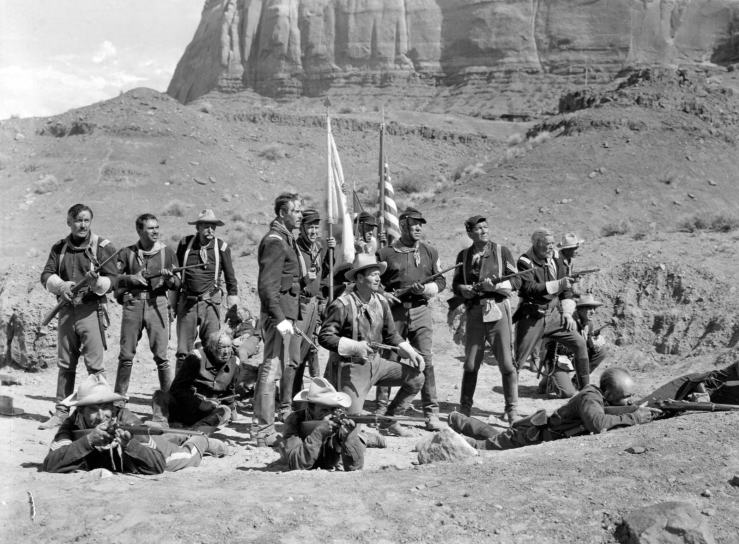
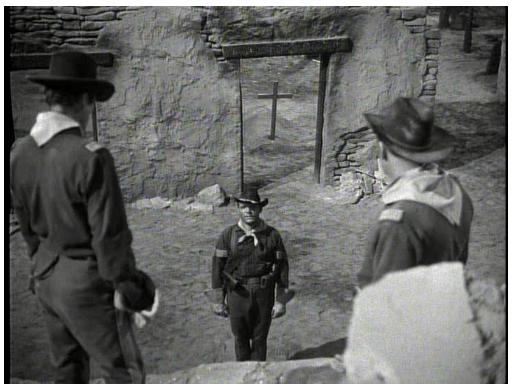
Under siege. John Ford’s Fort Apache established one of the major Cold War film archetypes, as J. Hoberman explains in An Army of Phantoms, his breathless, careening cultural history of the period (which the New Press released today). Covering the initial years of the political frost, from the mid-1940s through 1956, it’s the prequel to his 2003 The Dream Life, which ranged from 1960 to the release of Blow Out in 1981. He is preparing a third volume, Found Illusions: The Romance of the Remake and the Triumph of Reaganocracy, that will cover the rest of the 80s and the end of the Cold War. His stated inspiration is Siegfried Kracauer’s From Caligari to Hitler, and Hoberman’s less deterministic project will likely cozy up to it on film reference shelves in the coming decades as an essential and idiosyncratic work of cultural studies.

The phrase “cultural studies” tends to make me recoil in various poses of disgust. It’s the lapsed academic in me. As David Bordwell said in a Cinema Scope interview, ” most film scholars aren’t interested in film as a creative art. I know it sounds odd to say that, but I think it’s true. Most scholars are interested in film as an expression of cultural trends, interests, processes, etc. or of political moods, tendencies, etc.” Much of what I encountered of cultural studies in school reduced films to fit ideological agendas, starting with a theory and then squeezing the movie to fit that theory. The art object itself was lost in the process.

What Hoberman is doing here is undoubtedly cultural studies, describing how social and political events shaped the era, and in turn the tone and texture of Hollywood’s product, but it is a supple and nuanced version of the discipline. Since he is coming from a film critic’s background, he never loses sight of the unruly complexity of the movies themselves. The wealth of production history Hoberman lays down here is one of its most invaluable aspects, and has me continually dogearing pages (Full disclosure: I took a Film Criticism seminar that Hoberman taught at NYU).

For example, in his thumbnail portrait of The Thing (1951), he places it in the context of Edgar G. Ulmer’s The Man From Planet X, an alien cheapie that beat it into theaters, heralding 1951 as “the year that the saucers landed and the extraterrestrials arrived.” The Thing’s pre-production also “coincided with the emergence of Senator McCarthy and the early stages of the Korean War.”, resulting in a “congealed hysteria.” Politics and film inform each other, but they are not irreducible to the other. Hoberman is adapting French philosopher and sociologist Jacques Ellul’s concept of sociological propaganda:

a vague, spontaneous, all-pervasive, yet half-conscious form of social bonding and ideological proselytizing advanced by advertising, newspaper editorials, social service agencies, patriotic speeches, and anything else that might use the phrase ‘way of life.’”

It is the haziness of being a part of an epoch, the received wisdom that we mouth daily because we don’t have time to reflect on everything we say. It is a flexible, elusive concept, the perfect prism from which to pursue the indirect but palpable influence of the social and political spheres on film. Those are his theoretical walking orders, but Hoberman fills the book  with the clammy details of the dream factory. After spotty snowfall in Cut Bank, Montana, the crew re-located “to an arctic landscape created on the RKO ranch in Encino – another sort of ordeal with sweaty, parka swaddled actors tramping over the artificial snow that had been created from rock salt, ground-up Masonite, and crystallized photographic solution.”

The Thing’s scenario was comic-book Fort Apache, the group under siege by a marauding, unknowable force. The parallels with Communist infiltration (and the bloody “police action” in Korea) were starkly clear, and The Thing’s “effete little Nobel Prize-winning scientist affecting a blazer, turtleneck, and goatee” is nothing less than a “wannabe Russian”. The Thing makes gestures toward anti-communism, but more than anything else it’s a Howard Hawks film, a buzzing group of insecure he-men talking their way through their problems and through the Red Menace. This Fort Apache scenario of terror from without is one of the repeated motifs of the book (Only the Valiant, which I wrote up earlier, introduces subversion from within into the cavalry Western), although many others wind through it, including The Next Voice You Hear, whose vision of God-as-entertainment actualized Hollywood’s fondest dreams of itself. Hoberman draws out the cruel irony of how the real universal communicator, television, almost puts Hollywood out of business. The third major strand is provided by Kiss Me Deadly and screenwriter A.I. Bezzerides’ term for nuclear power, The Great Whatzit, which Hoberman uses throughout as both a metaphor for nuclear weapons as well as the undefinable anxieties which haunted the generation.

All of these ideas are buttressed by meticulous research, with reams of contemporary opinions from VarietyThe New York Times and especially The Daily Worker, as film and  political history start to smack up against each other. Everything converges in his tour-de-force explication of the House Un-American Activities Commission hearings, whose impact on the movie business is laid out in granular detail, as studio heads tried to triangulate between Sen. McCarthy and the panicky artist-progressives who pushed out their money-making product. Never have I read such a thorough examination of this period, and the moral gray areas that subpoenaed witnesses had to traverse. There is no cheap moralizing or blanket condemnations of those who named names, only a fanatically detailed, contextually rich rundown of the cultural currents that led to their decisions.

I’d advise you not to open the Great Whatzit, but please open the book.

Screen Shot 2020-01-28 at 5.52.57 PM

DIGGING THROUGH THE WARNER ARCHIVE: WILD ROVERS AND RESTORED MINNELLI

March 8, 2011

Screen Shot 2020-01-28 at 5.40.59 PM

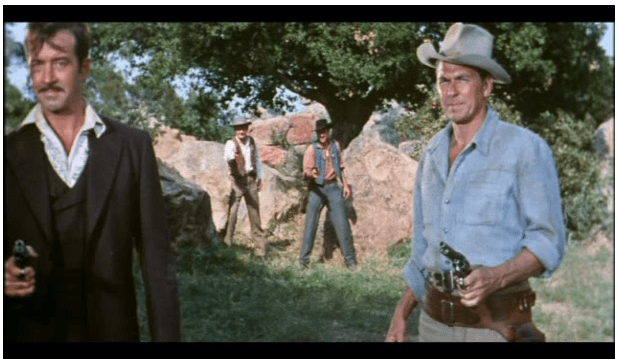
Despondent cineaste Jack Andrus should buck up. First, he’s seated in an eye-blazingly Technicolor red chair, which one assumes is also of sensuously high-grain leather. Second, he’s being played by Kirk Douglas at his most flamboyantly masculine, a dream come true for characters of dissolutely manic personalities like Jack. Third, the Warner Archive has released a fine remastered DVD of the film that houses him, Vincente Minnelli’s convulsively beautiful Two Weeks in Another Town. For the rest of us, they also recently put out a remastered version of Minnelli’s The Cobweb (1955) and an un-restored but handsome-looking edition of Blake Edwards’ Wild Rovers (1971). We’ll start with the last first just to get Jack’s goat, but also because the Minnelli greats have already been covered by more seasoned minds, although I’ll still get my thoughts in.

In 1969, MGM hired James Aubrey as president to cut costs and bring the studio back to profitability (John Houseman nicknamed him “The Smiling Cobra”). Blake Edwards had the unfortunate task of directing Wild Rovers under his reign, and this after the box office failure of his Paramount musical Darling Lili (1970), which was hounded by reports of spiraling costs and studio meddling (Edwards would use this experience as the basis for S.O.B. (1981)).  For Wild Rovers, Edwards envisioned a three hour Western epic, in which it would be important to “show the vastness, the loneliness, the boredom and natural beauty of the West of that period.” (quoted in Sam Wasson’s book-length study of Edwards, A Splurch in the Kisser).

It tells the story of two down-at-heel cattle ranch hands, Ross Bodine (William Holden) and Frank Post (Ryan O’Neal), who decide to rob a bank and end up on the run from the ranch owner’s sons, John and Paul Buckman (Tom Skerritt and Joe Don Baker). The tone is detached, almost bemused tragedy, as Ross and Frank ride toward their annihilation in landscape shots where they are advancing dots, or in widely spaced medium shots within the Panavision frame, in which intimacy is impossible.

Edwards did not have a chance of getting his vision on the screen. While available production histories don’t state how much he was allowed to shoot, the film was taken away from him by Aubrey in post-production, and released in 1971 at around 106 minutes (this according Vincent Canby’s NY Times review. The Variety review lists it at 110, and Wasson at 113). In American Cinematographer, Herb Lightman bemoaned and identified the cuts (quoted in Wasson):

Gone is the opening montage…Gone is the gutsy man-to-man breakfast sequence. The dramatic confrontation between Karl Malden and his sheepherder arch enemy…has been telescoped into a quick montage with voice-over narration. One complete sequence which… provided motivation for the entire last half of the picture, has been deleted. The downbeat…ending has been trimmed and tied off with a reprise of the horse-breaking montage that numbs the tragedy….”

A so-called “director’s cut” was put out on VHS in 1993, which extended the run time to 137 minutes, although I don’t know how much input Edwards actually had into this re-release. Wasson reports that Aubrey cut  “twenty minutes from the finished film”, so it could be close to complete. The Warner Archive has released the 137 minute version in a decent anamorphic transfer, and it seems to contain all the footage Lightman mentions, although there is audio from the horse-breaking montage still in the final scene, which may be a remnant of Aubrey’s scissorhands.

Opening with an Overture, and broken up with an intermission, Edwards clearly had an epic in mind. He told the NY Times that, “it was my best film, and he [Aubrey] butchered it.” Perhaps the film in his head was, but the reconstructed version still seems an ambitious misfire, a fascinating relic that exposes the seams between classical and New Hollywood. The visual style seems firmly implanted in the widescreen aesthetic of the classical era, with limited camera movement but intricate blocking inside the frame. Cinematographer Philip Lathrop told American Cinematographer that “One thing I want to do is avoid the slick mechanical gadgetry that we use so much in making pictures today-things like helicopters and obvious dolly shots and zoom lenses. I think that these would be very false in relation to a period Western.” For the most part this holds true, but in the horse-breaking sequence, and in the sheepherder shootout, there are overlapping montages of extreme slow-motion, seemingly lifted from The Wild Bunch of a few years before. It’s impossible to know whether these were Aubrey-implemented to modernize the film

Then there is the discordant lead pairing of William Holden and Ryan O’ Neal, a clash in acting styles and eras. Holden plays his mischievous ne’er do well as gruff and straightforward where O’Neal is arch and playful, and they seemingly talk past each other, killing any Butch Cassidy-type camaraderie. Edwards was clearly aiming for something more operatic than a straight buddy-comedy,  but the emotional colorations he reaches for, “how uncertain life really is”, as Holden says, feels forced and sterile coming out of this duo. In a final adieu to a classical past, he films the alienated finale in the moon-scape of John Ford’s Monument Valley.

***

The Cobweb and Two Weeks in Another Town are delirious Freudian melodramas with wildly expressive mise-en-scene. You could watch these Technicolor marvels on mute and perfectly understand the emotions billowing through them. The Cobweb (1955) is set in a stately mental hospital, where the line between patient and doctor is distressingly blurry. It’s all a matter of curtains. Office and personal relationships break down when the HR director/dictator Miss Inch (Lillian Gish), the bored, breathy housewife Karen (Gloria Grahame) (married to hospital head Stewart McIver (Richard Widmark)), and the sensitive counselor Meg Rinehart (Lauren Bacall) propose different curtain designs for the library.

The breakdown in their society was heralded by the opening scene, of a neurotic patient (John Kerr, in a role originally offered to James Dean), hitching a ride back to the grounds by Karen. Their conversation breaks down the professional walls between the sane and insane, while also explicating the cathartic virtues of art. Kerr asks Grahame if the burstingly red flowers in her backseat are for a funeral, and she replies, in what could be a statement of purpose for all of Minnelli’s cinema (except, maybe, for the last phrase): “Why do flowers have to be for anything? Isn’t it enough that they have color and form and that they make you feel good?”

James Naremore, in his Films of Vincente Minnelli, asserts that all four of the “art melodramas” that Minnelli made with producer John Houseman (The Bad and the Beautiful, The Cobweb, Lust for Life and Two Weeks in Another Town), “employ a simplified version of an argument Edmund Wilson helped to popularize in his infulential 1941 volume of literary criticism, The Wound and the Bow. In each film, a character who suffers from a repressed psychic ‘wound’ uses art as a release for thwarted libidinal energy.” In this case Miss Inch and Karen plow their sexual and psychological insecurities into the curtains, while Kerr’s paintings seem to release the tensions and inhibitions of the entire patient population.

Karen and Kerr split from their car ride, only to have their relationships relentlessly paralleled. Minnelli crosscuts between Karen and her husband Stewart, and Kerr and his budding flirtation with the agoraphobic Sue (Susan Strasberg). Ruptures in one affair ripple into the other, everything sewn together into one cinematic cloth, or I should say, curtain. Stocked with stunning widescreen compositions and offhand grace notes (I was particularly moved by Gish’s trembling upper lip when her boss and nemesis gracefully retires), it’s what my former academic self would call a “rich text.” French critic Serge Daney wrote a  short, packed essay on The Cobweb, “Minnelli Caught in his Web” (translated by Bill Krohn in Joe McElhaney’s Vincente Minnelli: The Art of Entertainment, and viewable in Google Books), and two statements reverberate. One: “Today no one would know how to democratically house so many characters in one film”. Two, to bring it back to Wild Rovers, “Just from the way Minnelli confines his actors in extremis to a common space, one can tell that the crisis in the studio system will not be long in coming.”

And then there’s Two Weeks in Another Town (1963), in which that crisis is giving everyone in the movie business a nervous breakdown. Edward G. Robinson’s aging Kruger is a director on his last legs, churning out an international co-production to keep his wife in furs. His former star Jack Andrus has already had his psychotic break, living out his days in a mental hospital not unlike the one in The Cobweb. Kruger invites Andrus to Cinecitta studios in Rome to play a bit part in his bloated spectacle. The events that led to Andrus’ original violent freak out are coming back to haunt him, and they’re all wearing red (and a green scarf). His ex-wife Carlotta (Cyd Charisse) is also in Rome, a gold-digging enchantress who walks with a belly-dancer’s circular sway. Andrus’ fears and paranoia grow more monstrous as the film progresses,  with Minnelli matching his character’s madness with incredible feats of set and costume design, as the color red slowly tightens a vise around Andrus’ granite head. Even monks walking past him in the street wear blood-red robes. He ends up in Carlotta’s grasp at a narcotized party, surrounded by blase models, as if he was, like Odysseus, made sluggish by these slinky sirens’ song (note their red hair, and Carlotta’s stroking of an Ancient sculpture). It ends in a gorgeous bit of back-projected madness as Andrus purges the harpies of his unconscious, emerging Phoenix-like from his debauch with a perfectly-pressed white trenchcoat slung over his arm.

THE HORROR: ONLY THE VALIANT

March 1, 2011

Screen Shot 2020-01-28 at 5.30.41 PM

The next few months promise an embarrassment of film criticism riches. On March 15th, J. Hoberman’s An Army of Phantoms drops, the second entry in his breathless and exhaustive cultural history of Cold War cinema. In April, the long-overdue first collection of Dave Kehr’s writing, When Movies Mattered, will grace bookshelves. I’ll have cowed reviews of both near their release, but for now I’ll stick to a title Hoberman singles out in Phantoms, and which he programmed for his series at BAM: Gordon Douglas’ despairing cavalry Western, Only the Valiant (1951, also available on a DVD from Lionsgate).

Based on a novel by Charles Marquis Warren, it stars a visibly strained Gregory Peck as Captain Richard Lance, a by-the-book commander tapped to escort an Apache warrior, Tucsos (Michael Ansara), to another fort, an invitation for an attack on the unsettled frontier. At the last minute his assignment is given to his lieutenant, William Holloway. Holloway is killed, and even Lance’s girlfriend Cathy (Barbara Payton) believes he begged off of the mission.

Tucsos escaped, and is planning an attack before re-enforcments arrive to the Captain’s Fort Winston. So, in a suicidal rear-guard action, he brings a small detail of men to hold off the  Apaches at a narrow pass at the sarcastically named Fort Invincible. Taking only men Fort Winston can spare, it’s a group of drunks and brawlers, who resent Lance for the death warrant he signed for them.

It is unrelentingly grim, with each set designed to look like a graveyard. Even the relatively protected Fort Winston is haunted, here by the ailing commanding officer Colonel Drumm, who lays on his deathbed as he sends his troops to theirs. This necrotic atmosphere further decays in the move to Fort Invincible, with the detail divided on whether to fight Apaches or kill Lance. This sense of hopelessness creeps into every frame. At Fort Winston, there is an opening lineup of troops at Fort Winston, welcoming Lance’s return, which extends to the vanishing point of the shot. Once the detail gets to Fort Invincible, the lineups get smaller as troops get picked off one by one, and soon the graves outnumber the living.

Hoberman places the film both in the context of the cavalry Western and the Korean War. John Ford’s Fort Apache is one of the touchstones of An Army of Phantoms, artfully reflecting the siege mentality of the cold war, presenting a “vision of total mobilization with an appropriate emphasis on order and eternal vigilance: militarized suburbia. The bombing of civilian populations in World War II suggested that the next war might have no front – or, rather, that the front might be in America’s living room.” While the cavalry posts of Fort Apache, Rio Grande and She Wore a Yellow Ribbon are functional mini city-states, with space for romantic subplots and ritualized dances, Only the Valiant takes place in a world without leisure time. As Hoberman reported, Only the Valiant was released soon after President Truman dismissed General Douglas MacArthur from his command,  and the war entered the stage of a long, bloody stalemate, as fears of WWIII continued to percolate. People were dying and no ground was being gained. This is the desperate situation of the men in Only the Valiant.

The shambolic, pained performance of Gregory Peck adds another shade of dread to the film. Peck wanted nothing to do with the project. He was loaned out by David O. Selznick against his wishes, but the great producer was in financial trouble, and netted $90,000 in the deal. Peck felt it was a cut-rate script made by an undistinguished director, but he showed up for work anyway. Biographer Gary Fishgall claims that Peck was taking Seconal to help him sleep, while also drinking heavily throughout production. There are also widely reported stories that he had an affair with his lead actress, Barbara Payton, although he later banned her from the set unless she was in a scene, at least according to Payton’s autobiography, I Am Not Ashamed (the title refers to her later career as a prostitute). He suffered a physical collapse a month after shooting, during a costume fitting for David and Bathsheba. The doctors at Cedars of Lebanon diagnosed “nervous anxiety”, and told him he did not have a heart attack.

Bitter and out of sorts, Peck is magnetically unsympathetic in Only the Valiant, distressingly passive in the face of slander and death threats, and seems to have vengeance on his mind in his selection of the Fort Invincible detail. There is a powerfully disconcerting scene where Peck’s Captain walks down the line of his rag tag crew and tells them why he chose them. It’s a scene of chilling vindictiveness, and not unlike an impromptu HUAC hearing. Gordon Douglas was a staunch anti-communist, having already directed the nuclear commie spy film Walk a Crooked Mile in 1948, and would line up I Was Married to a Communist in the FBI later in 1951.

All of the characters’ fears coalesce in the mountain pass near Fort Invincible. Shot in sequences of lantern-lit flickering darkness, this gaping maw brings out the worst in the men. They splinter and attack each other, warring within and without. The further they descend into primal violence the more it feels like a gothic horror film or monster movie. One of the young recruits,  a cowardly bugler, creeps through the pass on a pitch black night, and in the bottommost portion of the frame a bloody hand jumps out to a jolt of strings on Franz Waxman’s score. One expects a Mummy or Wolfman to reveal its wretched face, but no, it’s just another dead man.