WOODY STRODE AND SERGEANT RUTLEDGE (1960)

Originally published at Movie Morlocks, the official blog of Turner Classic Movies

August 3, 2010

Screen Shot 2020-01-24 at 4.41.33 PM

When John Ford decided to cast Woody Strode in the title role of Sergeant Rutledge, Warner Bros.  pleaded with him to cast a better known actor like Sidney Poitier or Harry Belafonte. Ford replied, “They aren’t tough enough.” That story, relayed by Joseph McBride in his Searching for John Ford biography, defines the mystique of Woodrow Wilson Woolwine Strode. With his taciturn manner and wiry athleticism, he was an immediately arresting presence on-screen. He brought more than an intimidating physicality though, secreting a constant melancholy behind those hooded eyes and chiseled face.

His tough-guy credentials were unassailable. He was a tight end at UCLA, blocking for star running back Kenny Washington. In their senior year of 1939, they shared the field with Jackie Robinson (they were called  “The Gold Dust Trio”) and went undefeated, ranking 7th in the year-end AP poll. But in the years immediately following graduation, they were blocked from joining the NFL because of their race. From 1934 – 1946, there was a gentlemen’s agreement of sorts between league owners not to sign black athletes, despite the success of players like Fritz Pollard in the ’20s.  In the prime of their careers, Strode and Washington played for the Hollywood Bears of the Pacific Coast Football League (PCFL).  In 1946, they broke the re-instated NFL color barrier by signing with the L.A. Rams after an intense campaign by sportswriter William Harding. (for the full story, read Alexander Wolff’s great article in Sports Illustrated). Strode told Wolff, “They didn’t take Kenny because of his ability. They didn’t take me on my ability. It was shoved down their throats.”

Strode was already 32 years old, and he was cut after one forgettable season (Pro Football Reference shows he played in 10 games, and caught only 4 passes, although he was probably a solid blocker). Washington lasted for three intermittently productive years. It was a disillusioning experience:

“Integrating the NFL was the low point of my life,” Strode told SI in an unpublished interview before his death. “There was nothing nice about it. History doesn’t know who we are. Kenny was one of the greatest backs in the history of the game, and kids today have no idea who he is.”
“If I have to integrate heaven, I don’t want to go.”

In 1948, he moved to the Canadian Football League (CFL), to greater success. Playing both offense and defense, he led the Calgary Stampeders over the Ottawa Roughriders to win the Grey Cup, 12 – 7. He played for two more years, and helped pay the bills by working as a professional wrestler during the offseason.

By 1951, he was ‘rasslin full time. In his autobiography, Goal Dust, he reminisced about balancing fighting and entertainment:

It’s a thin line between the showmanship and the straight wrestling. Straight wrestling is too dull. If I’ve got a headlock on you and stop your circulation, you’ll faint. They fans won’t pay to see that. The real artists can hit you without doing any damage. They can throw a punch and land it right on your skin. That’s how good you have to be. The guys who miss are not good.

While honing his acting skills in the ring, he started to get regular work on television and film as an exotic other, his first regular gig a stint on “Ramar of the Jungle” as a native named “Big Boy”.  His film work was more of the same stereotyped nonsense until he nabbed a part in Lewis Milestone’s Pork Chop Hill in 1959. It was on that set where he caught John Ford’s eye, as told to Frank Manchel, excerpted in Volume 25, Vol. 2 of The Black Scholar:

[Pork Chop Hill] is the first dramatic thing that I had done, and he [Ford] was on the same lot with me, and he sent his chauffer over to find me. So I went over to see him, and he says, ‘I hear you’re trying to be an actor.’ At that point I was wrestling for a living, and I said, ‘Oh, I’m just making a little money.’ He said, ‘I’ll tell you what, Woody. I got a little job for you, and I’ll tell you about it when I get through with this picture I’m doing.

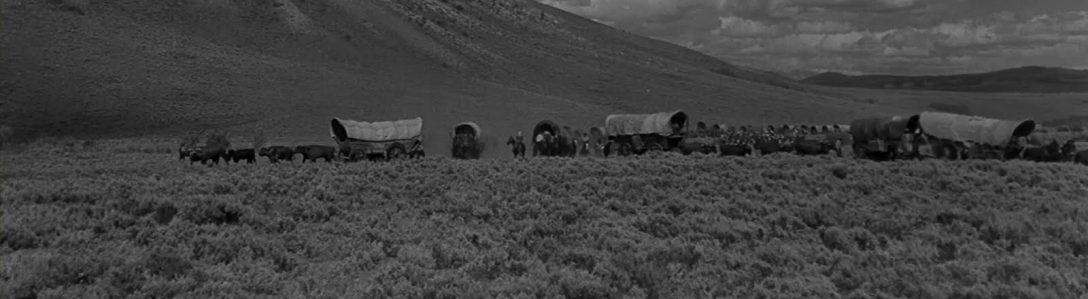
Ford was finishing up The Horse Soldiers (1959), and in the meantime Strode caught bit parts in Spartacus (1960) and The Last Voyage (1960). Eventually Ford, who always referred to his profession as a “job of work”, must have admired Strode’s similar attitude, handed him the title role to Sergeant Rutledge.  For contractual reasons, Jeffrey Hunter and Constance Towers were given lead billing, while Strode was merely listed as a featured player, but he is the heart and soul of the film. It is a courtroom drama that documents the court-martial trial of Sergeant Braxton Rutledge, an officer in the Ninth Cavalry Regiment (nicknamed the “Buffalo Soldiers”), accused of the rape and murder of a white teenage girl (Toby Richards) and her father, his superior officer. Hunter is the earnest, conflicted defense lawyer who argues the case in front of the distracted, buffoonish panel of Army judges.

The script, by James Warner Bellah and Willis Goldbeck, was inspired by a Frederic Remington picture “of black calvarymen on the western frontier.” Without access to their first draft, Joseph McBride reports on Bellah’s novelization of the film as “patronizing”, and that “Rutledge seems less intelligent in the book than he does on-screen, and the author finds a familiar outlet for his prurient racist fantasizing….” Suffice it to say that Ford made major revisions to the screenplay before it was finalized – McBride reports he spent ten days with the writers fixing it up. Strode remembers the script fondly: “it was so well written…. When I say them lines, I still feel it. Do you hear me?”

It is Ford’s most straightforward film about race, placing Strode’s soldier as a good worker (his highest compliment) railroaded  by a justice system riven by bigotry. But there is ambivalence threaded throughout Sergeant Rutledge that makes it much more than a simple message movie. It is clear Ford is making a case for racial equality, but beyond the conclusion of this one individual case, he doesn’t offer much hope. The panel of judges are amusing but clueless drunks, the lead prosecutor a race baiter, and the Buffalo Soldiers themselves despair as to their place in society. As Moffat, one of the 9th Regiment, is dying, he tells Rutledge, “Some day. You always talkin’ about some day, like it gonna be Promised Land here on earth. Brax! We’re fools to fight the white…white man’s war.”

Rutledge tries to reassure him that they are not fighting the white man’s war, but that they fight in order “to make us proud.” Ford’s grand theme had always been about building communities (the church-raising scene in My Darling Clementine is the peak of this strain), but there was a skepticism regarding official institutions that ran throughout (the sheriff at the beginning of Clementine is a coward), but he found men who could do their jobs in spite of it all. The 9th regiment is not sacrificing their lives for the United States, but for their self-respect, and in this sense falls in line with the tension in Ford’s work between the individual and the community that he’d been mining his entire career. Earp leaves town at the end of Clementine, leaving the civilizing to others, but Rutledge soldiers on in order to empower more young black men. In his most dramatic speech, and probably the finest piece of acting he put on film, Strode responds to the prosecutor’s goading about his refusal to desert. It was “because the Ninth Cavalry was my home. My real freedom. And my self-respect. And the way I was desertin’ it, I wasn’t nothing but a swamp-runnin’ ni**er. And I ain’t that! Do you hear me? I’m a man.”

In collaboration with the great cinematographer Bert Glennon (Stagecoach, Wagon Master), Ford shoots Strode from dramatic low angles and pushes the artifice to an expressionist degree during the witness’s flashback testimony. It is Ford’s most theatrical film, or at least the most self-reflexively artificial, allowing him to shoot heroic shots of Strode that might have made John Wayne blush. There are some shots that look like Strode is posed in front of a moonlight drenched Casper David Friedrich painting.

But the most telling sequences come at the end. After the rote romantic clinch between Jeffrey Hunter and Constance Towers is finished outside the courthouse, the Buffalo Soldiers march in formation past them, and towards the camera. It is a remarkable hand-off between the ostensible, contractually obligated stars, and the real ones. The final shot shows the regiment riding over Monument Valley, and regardless of the fact that the film was a flop, it contained indelible images. In 1971, Strode told Charlayne Hunter of the New York Times that, “You never seen a Negro come off a mountain like John Wayne before. I had the greatest Glory Hallelujah ride across the Pecos River that any black man ever had on the screen. And I did it myself. I carried the whole black race across that river.”
INTRODUCING OLIVE FILMS

July 27, 2010

Screen Shot 2020-01-24 at 1.45.40 PM

Like a herd of cattle ready to run down a restive kidnapper, Olive Films bursts into stores today with a phalanx of five DVDs licensed from Paramount Pictures: Union Station (1950), Appointment With Danger(1951), Dark City (1951), Crack in the World (1965), and Hannie Caulder (1971). A wholesale distributor and retailer of independent and art-house releases, Olive is now expanding its own acquisitions slate, starting with this brawny group of  genre titles. With multiple studios now experimenting with the mixed blessings of burn-on-demand technology (more releases, but higher prices and less quality control) for their library titles, it’s encouraging that a company is still willing to put out fully authored discs, in strong new transfers.

With the forthcoming, and essential, Josef Von Sternberg collection coming from Criterion, it’s clear that Paramount is becoming more aggressive in licensing its material.  Olive will release 27 Paramounts over the next year or so, including Nicholas Ray’s The Savage Innocents, Otto Preminger’s legendary and fascinating flop Skidoo, and Ingmar Bergman’s Face to Face. I spoke with the Director of Acquisitions and Sales at Olive, Frank Tarzi, and he confirms that much more is on the way. Olive has closed deals with multiple studios, and their future slate shows off adventurous and eclectic taste, with Tarzi confirming the following: Robert Aldrich’s Twilight’s Last Gleaming, Billy Wilder’s Fedora, Rainer Werner Fassbinder’s Despair, The Stationmaster’s Wife (uncut), and I Only Want You to Love Me (uncut), Abel Gance’s J’Accuse, Claude Chabrol’s Ophelia, and, most exciting of all, Jean-Luc Godard’s complete Histoire(s) du cinema.

But enough of the tantalizing future.  Union Station is a taut, architectural noir from Rudolph Maté, the ace Polish cameraman who lensed Carl Dreyer’s Passion of Joan of Arc and Vampyr. His career in Hollywood never reached those aesthetic heights, but he was a consummate craftsman with an eye for visual detail. Here he’s given a police procedural about the kidnapping of a blind girl, and although set in Chicago, much of it was shot at Los Angeles’ Union Station (Thom Anderson pinched some scenes for Los Angeles Plays Itself, his history of L.A. on film).

Maté maps out the station with a near 180 degree pan, taking in the information booth and the crowds before settling on the STATION POLICE HEADQUARTERS sign. In the same shot, he then tilts up to a filigreed window which houses the station’s security services, where William Holden barks irritated orders to his indolent staff. Knowing every inch of his turf, he seems to blend into the walls when peering around corners for the jowly perps he’s tailing. The attention to spatial detail turns the film into a documentary of Union Station, with the plot just an excuse for exploration.

Holden’s expertise is gained through repetition, and he looks appropriately bored throughout. It’s just his job, after all. In the study that essentially defined “film noir”, Raymond Borde and Etienne Chaumeton’s Panorama of American Film Noir, 1941-1953 (first published in 1955), the writers compare it unfavorably to He Walked By Night, but find some saving (violent) graces:

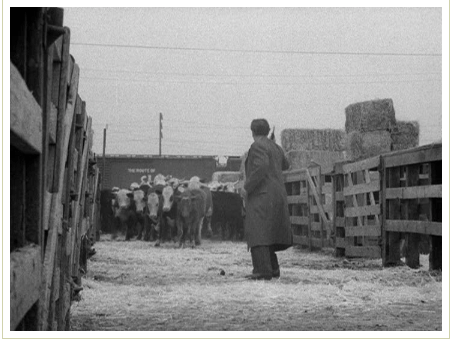
“The film is interesting, though, for showing how the security services of a big train station work. Aside from the ill-treatment inflicted on a blind girl by her kidnapper, there are two scenes of momentarily authentic noir cinema: a gangster flattened during his escape by a stampeding herd of steers maddened by gunfire [top image]; the pressing invitations to spill the beans exercised by the cops on an untalkative accessory to a crime. After giving him a working over using state-of-the-art methods, they drag him onto a platform overlooking the railroad track. “Make it look accidental,” the police inspector orders. When a train passes beneath, they grab hold of the “tough boy” and make as if to push him off [see left]. The guy immediately screams that he’ll “talk,” and he’s led away distraught, ready to sell out father and mother alike.”

Dark City is an altogether seedier affair, a story of greedy low-lifes who bilk a sucker out of his cash, driving him to suicide. No big deal, except the dead man’s psychopathic brother targets them for strangling. Charlton Heston, in his first starring role, is the most sympathetic low-life, Danny. But when the competition is Jack Webb at his sleaziest, playing a dirtbag named “Augie”, it’s not much of an accomplishment. Directed by Hungarian emigre William Dieterle in looming close-ups and dramatic chiaroscuro from DP Victor Millner (who has an incredible resume), it’s a woozy, sluggish and occasionally haunting noir about guilt, failure, class and forgetting. Danny is a college grad and army vet, and so, the police captain tells him, he has no excuse to live the life he does, not like the street boys he runs with.

Heston plays him as somnolent and dreamy, his every line pulled out with stubborn slowness, like Robert Mitchum on vicodin. It’s a hypnotically effective performance, of a man who no longer wants anything to do with his body. He repeatedly tells his ignored girlfriend Fran (Lizabeth Scott), of his need to be alone, but she still loves him anyway. James Naremore, who has written the best recent book on noir, More Than Night, offers an adolescent memory of the film in his introduction“What I remember best are the fetishized details – Lizabeth Scott’s unreal blondness and husky voice in Dark City, or Edmond O’ Brien’s rumpled suit as he runs desperately down the crowded street in D.O.A. [directed by Rudolph Maté]“. To that I’ll add one more: Harry Morgan’s fake upturned nose, a physical marker of his pugilist past and the cause of his punchy good humor. He’s been knocked silly once too many, but Morgan’s ebullient and melancholic turn makes him much more than a punchline.

Appointment With Danger re-teams Webb and Morgan, the future Dragnet partners, and this time they’re both hoods. They are planning a heist with the heavy-lidded Paul Stewart, but an errant corpse spied by a nun sets the plot machinery in motion. Alan Ladd is the cynical motor, an expressionless slab who is smart enough not to impede the snappy dialogue by Richard L. Breen (who would later pen the Dragnet movie) and Warren Duff (“Love is between a man and a .45 pistol that won’t jam”). He plays a postal inspector, one of the raft of government employees feted in procedurals of this era (including Holden in Union Station).

I relinquish the rest of this review to three separate pieces from Manny Farber:

“Appointment With Danger is a fascinating textbook on the Average American Flop – his speech, mien, sage misanthropy, doubt. It is also a well-done report on the geography of Gary, Indiana, a place that seems crowded with failures.”

***

“Tight plotting, good casting, and sinuously droopy acting by Jan Sterling, as an easily had broad who only really gets excited about – and understands – waxed bop.”

***

“A YMCA scene that emphasizes the wonderful fat-waisted, middle-aged physicality of people putting on tennis shoes and playing handball.”

***

And I will note one last notable occurrence: Harry Morgan’s quavering face as he gives a speech about his estranged son, protesting that he will not run off to St. Louis to avoid the heat of being named to the cops. His features are close to collapsing, but he re-harnesses them in a flush of machismo. He mentions his son’s bronzed booties. Webb than takes one of them and beats Morgan to death.

JOSEPH H. LEWIS AND SO DARK THE NIGHT (1946)

July 20, 2010

Screen Shot 2020-01-24 at 1.12.26 PM

“Do you miss it – directing?

-I miss it only when I see things on the screen that make me want to vomit.”

Peter Bogdanovich interviewing Joseph H. Lewis, Who the Devil Made It

I should let this magical quote stand on its own, but I’m a writer, so I’ll write.  Last week, TCM devoted a night to the films of Joseph H. Lewis, including some rare items surrounding his acknowledged masterpiece, Gun Crazy (1950). The tastiest morsel was So Dark the Night (1946) (made soon after the modest success of the equally awesome, but better known, My Name is Julia Ross (1945)). A rural psychological thriller, it’s an extreme example of Lewis’ idiosyncratic visual sense (the son of a NYC optometrist, he grew up with lenses). As he went on to tell Bogdanovich:  “What interested me most was telling the story through the eyes of a camera. I didn’t like words – wherever I could, I cut words out, and told it silently through the camera.”

So Dark the Night is structured around his silent, highly expressive storytelling (major spoilers ahead!). Famed Paris detective Henri Cassin (Steven Geray) takes a break from sleuthing to soak in the rustic charms of the country town of St. Margot. He’s welcomed as a celebrity by the Michaud family, who operate the inn he’s vacationing at. Daughter Nanette (Micheline Cheirel), with dreams of city life, begins flapping her eyelashes in his general direction. Lewis first frames her as a pair of hands fidgeting with a sheet on a laundry line, who then pulls down to reveal her eyes and arched brows. Then she scoots to the right, her beaming mug filling half the frame (with a limited budget for sets, Lewis is big on close-ups). Cassin was also bifurcated upon introduction, shot from the legs down as he strolls around an idyllic urban street. His full body isn’t shown until he kneels to chat with a shoeshine boy. Both are visually split, a motif that continues throughout, and which pays off thematically in the bravura twist ending.

But back to the flirtation. Cassin returns her interested gaze in a medium shot, Nanette reciprocates, and then Lewis cuts to a montage of the detective’s chrome car. There are close-ups of the bulbous headlights, the erect front grille, the sloped handle, and the ornate hubcap – a burst of pure visual metaphor that is shocking in the context of a Hollywood thriller. Cassin is reduced by Nanette into images of luxury, industry, sex…as well as escape.

The sequence continues with an extraordinary tracking shot, following Cassin as he traverses Nanette’s gaze and crosses into the inn itself. Jean-Pierre Coursodon rhapsodizes about this shot in his (out of print) AMERICAN DIRECTORS. He translated this bit himself in the comments section of DaveKehr.com:

“The camera moves across the courtyard, reaches the corner of the house, and continues tracking inside the inn’s main room without a cut, as though it had moved in right through an invisible wall. By removing the fourth wall — in deliberate disregard of realism — Lewis suggests that, together with the protagonist, , we are entering a stage upon which a drama will soon be enacted…”

In this one scene, Lewis sets up the central romance, undercuts said romance with images of division and materialism, and displays a self-reflexive theatricality that foreshadows the action to come. This, my dear readers, is masterful filmmaking.

Soon the plot machinations do their work, and Cassin has two corpses on his hands in a seemingly unsolvable case. Through it all, Nanette is repeatedly composed inside the inn’s window frame, and Cassin is seen cut-up behind his bed’s headboard. There is also some balletic action with push-ins and pull-outs, with the camera repeatedly pulling away from Cassin, and moving forward to Nanette’s boyfriend, who’s eager to quash the detective’s amorous dreams. Not to mention his ominous use of downward tilts, which reveal a third dead body and a knocked out guard in succession (which rhyme with Cassin’s initial bow down to the street urchin).

All of it effortlessly builds up to the moment when Cassin solves the case – and implicates himself as the only possible suspect, despite lacking any memory of the crime. He is, of course, schizophrenic, hence the dense visual patterns that sliced him up. The extraodinary final images explode the cataract of split compositions that Lewis had been creating throughout, as Cassin is shot by the police through the pane of glass that previously showed Nanette whole. He staggers up to the pane, and in the reflection sees a flashback of himself as he existed before the murders. With a fireplace poker he smashes the whole edifice down, and with it the motifs Lewis had been building the whole film. Coursodon reads even more into it:

“the climactic scene in which the the protagonist eradicates both his reflection and the recalled image of his former self by smashing the window in a gesture of revulsion [recalls] Oedipus’ blinding of himself after finding out the truth.”

This mythical interpretation of Cassin’s final act gibes with Coursodon’s reading of the tracking shot as announcing a theatrical space.  Cassin’s extreme rationality solves the case, but destroys his life. His final words: “I caught him, I killed him” are a kind of perverse triumph of the mind over its own physical limitations. And no-one got more delight, or more success, out of creatively overcoming the limitations of low budgets than the self-described “artist without a diploma”, Mr. Joseph H. Lewis.

DIGGING INTO THE WARNER ARCHIVE: …ALL THE MARBLES (1981)

Originally published at Movie Morlocks, the official blog of Turner Classic Movies

July 13, 2010

Screen Shot 2020-01-24 at 1.06.24 PM

The Warner Archive continues to empty out WB’s library onto their premium-priced burned-on-demand DVDs, and it’s impossible to keep up. I currently have my wavering cursor over the buy button on Sam Fuller’s Verboten (reviewed in this Sunday’s NY Times by Dave Kehr), and the double-feature disc of Hell’s Heroes (1930) and Three Godfathers (1936, Boleslawski, not Ford). But one of the releases I have nabbed is of Robert Aldrich’s final film, …All the Marbles (1981). Released in a strong transfer, which faithfully reproduces Joseph Biroc’s elegiac grey-blue photography of industrial decline, it is, without hyperbole, the greatest women’s wrestling movie of all time. Please correct me if I’m wrong.

Peter Falk plays Harry Sears, the manager and crusty philosopher king of the California Dolls tag team (Vicki Frederick and Laurene Landon) who are slowly punching their way up the ranks. Driving their beat up sedan through decaying Midwestern factory towns, and hustling their way around shyster promoters and county fair pervs, it’s a genial tour of the areas hardest hit by the early 80s recession. The early scenes were shot in Youngstown and Akron, Ohio, and Aldrich films their travels in long shot, images of a car rolling past idling factories and roadside dives, as the team’s conversations are piped in on the soundtrack. At one point Iris (Frederick), after her partner Molly (Landon) complains about the rigors of the road, looks at a passing steel foundry and says, “how’d you like to work in there?”

While on the surface the film follows the normal sports film trajectory (defeat, recovery, victory), visually the film presents a panorama of working class types blowing off steam and struggling to survive. It’s a bracingly bittersweet combination, embodied in Falk’s folksy and violent performance. His Harry Sears is an engaging huckster, raised, as he tells the Dolls, on a combination of Will Rogers and Clifford Odets. Constantly on the phone trolling for gigs, he uses his quote repository to keep his marks off-balance, and as a shield against revealing his own tattered emotions. He’s always spouting lines like how their journey will last “longer than a breath, shorter than a life”, trying to keep his team focused on the present moment, ignoring the failed past and fragile future.  When asked who Rogers and Odets are, he deadpans, “a dance team,” before popping in the cassette tape of Pagliacci’s aria “Vesti la giubba.” Then he’ll pivot from his aesthete mode by playing craps with fixed dice and flashing intense spasms of rage, destroying a promoter’s Benz with a baseball bat and even coming to blows with Iris. An autodidact, father figure and inveterate con man, he’s the perfect character for Falk’s gravelly bravado.

Molly and Iris are less well-defined, more women of action than drama. Molly is a benumbed blonde, addicted to painkillers but still emitting a heartbreaking type of child-like innocence. She’s using the Dolls, more than the others, as a family unit. In the ring she has a more mat-based game, whereas Iris takes more technical risks. Iris is world-weary and hard-working, resigned to working with Harry but desirous of a life above his penny ante tricks. Frederick does fine work summoning up Iris’ patchwork dignity, grasping on to the wispy strands of integrity in her sport to prop up her fading hopes (the film only hints at how fixed pro wrestling is).

It’s Harry who again drags her back down to reality, pulling off a variety of semi-dirty tricks and mounting some old Hollywood razzle dazzle to swing the crowd and nab the Tag Team title. The final fight takes place at the MGM Grand, and the rhinestone-encrusted, child-choir scored entrance seems a tongue-in-cheek homage to MGM Musicals of yore. He even gets former Pittsburgh Steeler Mean Joe Greene and Laker announcer Chick Hearn to narrate the bout, escalating the event to a level of legitimacy heretofore unknown to female fisticuffs. Iris has to accept that image sells and accommodation is integral to that sale.

Both actresses are tall and athletic, and clearly game enough to hold their own in the ring, so the high-angle shots Aldrich uses to spot in the stunt doubles flow seamlessly into the rest of the fights. The matches themselves are crisply edited and shot at a distance. In addition to the geometric overhead shots, Aldrich cuts in to POV shots for impact and medium shots for the majority of the slaps and falls. The action is fast-paced and as passable as the women’s division in the WWE these days. Iris even whips out some impressive aerial maneuvers in the final bout, landing a hurricanrana to gain an early advantage. The convincing nature of the fights was thanks to the help of advisor Mildred Burke, the World Women’s Champion from 1937 – 1957.

The Pagliacci aria plays throughout in what seems like another of Sears’ pretentious affectations of knowledge, until he explains to the gals the story of the opera. Pagliacci was a traveling performer like themselves, and, in his interpretation, the lesson of the character is to “hang in there, even if your heart is breaking.” This sentiment could be ascribed to some of Aldrich’s other conflicted heroes, including the idealistic Lt. Debuin (Bruce Davison) in Ulzana’s Raid, or even Charles Castle in The Big Knife (which Aldrich adapted from Odets). In any case, …All the Marbles is an eccentric, moving, and profoundly appropriate close to Aldrich’s career.

UNDERRATED EASTWOOD: FIREFOX (1982)

July 6, 2010

Screen Shot 2020-01-23 at 5.49.06 PM

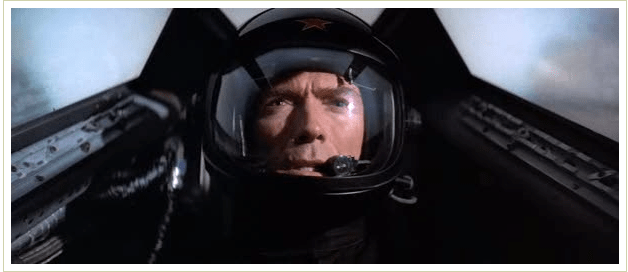
Beginning on July 9th, the Film Society at Lincoln Center in NYC will be mounting their misleadingly titled“Complete Clint Eastwood” series, which will run all the films he directed, but only a select few of his key acting turns (it’s a superb program regardless). It’s in honor of his 80th birthday, which our own Susan Doll celebrated a few months back. With Clint well represented on home video, it’s easy for anyone outside NYC to curate their own Eastwood retrospective, and one that I suggest deserves re-evaluation is his 1982 spy thriller, Firefox. His entire early 80s output, from Bronco Billy (1980) through Sudden Impact (1983), is extraordinary and relatively forgotten, but Firefox, perhaps due to its bizarre sci-fi trappings, has been judged harshly and dumped into the late-night cable dustbin.

Eastwood plays Mitchell Gant, a retired Air Force pilot suffering from hallucinations of his time as a POW in the Vietnam War. He’s called back into action after the U.S. learns that the USSR had completed construction of a high-tech MiG-31 plane, code-named Firefox. Able to fly at 6-times the speed of sound, invisible to radar, and with a weapons system commanded by the pilot’s mind, eliminating reaction time during dogfights, it could swing the arms race and the momentum of the Cold War. Gant is tasked to steal it because of his language skills, since the plane’s system will work only with someone thinking in Russian. In comparing it to his more satiric Eiger Sanction, Eastwood said, “Firefox was more ‘square’, more traditional. It was about bad guys with pink eyes, but ordinary characters faced with an impossible mission.”

Gant is so ordinary as to be anonymous. Thrust rather unwillingly into the teeth of the Cold War, he is a bundle of anxiety. Eastwood works out various permutations of uneasiness on his face, raising his lips in grimaces and lowering them in scowls representative of a man supremely uncomfortable in his own skin. Shuttled from disguise to disguise and personality to personality (from an American heroin dealer to a tourist to a Russian pilot) acts as a subtle commentary on his own constructed personas. The ironic anti-heroism of his Man With no Name and the obsessive obstreperousness of Dirty Harry, then, are merely other skins, and his queasy performance reflects his ambiguous relationship to them. All of his films, it seems, are re-evaluations and deconstructions of his own personality, and Firefox is one of the earliest and smartest examples of this (taken up later by Sudden Impact straight through to Unforgiven and Gran Torino).

Gant isn’t a heroic figure as much as a man buoyed by circumstance. He never seems in control, pushed forward by his CIA handlers, then handed off to his resistance contacts in Russia, always instructed carefully, never in charge of his own fake lives. In fact, Gant is repeatedly chastised for his performances, encouraged to feign sickness to cover-up his awkward acting chops. His awkwardness and ever-present fear make this film more in the vein of John Le Carre than James Bond, and Bruce Surtees’ low-light photography perfectly expressive of its harshly deterministic narrative. Each of the men he meets is invested body and soul for the future of Russia, and stoically give up their lives for their cause, while Gant is a confused hired gun doing the job because he’s the only one who can. He seems without ideology, disturbed by the resistance fighters heroic sacrifices, giving their lives on the slim chance that Gant will succeed. It’s a utilitarian spy movie,  a morbid landscape where bodies are disposed of after they fulfill their mission, a grim game where deaths are freely given for the slim hope of success. Dave Kehr has even described the film’s terseness as “Bressonian” in his Chicago Reader capsule review, and it’s hard to disagree, or even think of another 80s action movie where that could even be remotely applicable.

In an interview with Michael Henry, he says that Firefox “is the only one of my pictures I used storyboards on.” And while he specifically mentions how he mapped out the final plane special effects sequences, the film as a whole seems finely structured. The major movement is from the dark spy sequences to the bright blue skies of the flight out of Russia, but there are micro-movements inside, including some expertly paced cross-cutting sequences. The opener cuts between the U.S. government war room and the attempt to convince Gant to join the mission at his woodsy home.

It quickly dispenses with the back-story while introducing the idea that Gant is a small pawn in major geo-political movements. This becomes clear during the final cross-cutting sequence, which shifts between the Soviet and U.S. war rooms tracking Gant’s movements in the air, with Gant himself caught in the middle, speaking Russian to an obliging super-plane.

Gant seems happiest in this final movement, cut off from humanity, and submerging his personality into a machine.He’s destroying his individuality while ostensibly flying to freedom. The images brighten as thematically the film grows even darker – self-annihilation as a kind of euphoric release.

THE NEW YORK ASIAN FILM FESTIVAL & JAPAN CUTS

June 29, 2010

Screen Shot 2020-01-23 at 5.29.03 PM

The New York Asian Film Festival (June 25th – July 8th) is more essential than ever. With distribution companies shutting their doors to Asian cinemas of all types,  there are very few outlets to watch the continent’s resourceful, often brilliant genre cinema on the big screen. For nine years programmer Grady Hendrix and his crew have been filling the void, and for the past few has joined forces with the Japan Cuts Festival of Contemporary Japanese Cinema (July 1 – 16th)  to provide the most eclectic and revelatory overview of Asian film in the U.S. It’s a heady mix of spectacle, grotesquerie, slapstick and resolute artistry. Every year you’ll see something you’d never seen the likes of before.

For me, this year’s edition surprised me with its Chinese slate, and specifically the skittish performances of actor Huang Bo, recepient of this year’s redundantly titled  Star Asia Rising Star Award. My knowledge of contemporary Chinese cinema doesn’t extend far beyond the arthouses and underground film clubs that show Jia Zhangke and the documentaries of Zhao Dayong. So getting exposed to Huang in the antic Crazy Racer and morbidly funny Cow expanded my limited horizons.

A squat, frog-faced actor with a quick smile and a quicker temper, Huang plays stubborn fools with a clumsiness and slack-jawed innocence reminiscent of Buster Keaton. Crazy Racer (the sequel to Crazy Stone (2006), which I haven’t seen) is a time-shifting crime-comedy in the Pulp Fiction mode, with Huang’s disgraced bike racer bumping into two bumbling assassins, a Thai drug dealer, the Chinese mob and beatings with a frozen fish. The twisty narrative is imaginative and cleanly executed, and director Ning Hao doesn’t bother dawdling over too much sentiment. Cow has Huang playing a similarly alienated character, but in a completely different context. His Niu-Er is a simple peasant caught up in the Sino-Japanese war. His village gets slaughtered, the only surviving creature a foreign cow donated to give milk to the Chinese troops. Navigating some dramatic tonal shifts, Huang manages to insert a violence into his pratfalls and a resignation in his stubbornness that keeps the film from descending into treacle. He elicits laughs that catch in your throat, inserting a jaggedness to the sentiment that makes the whole improbable set-up go down a lot smoother. Plus the cow is pretty good too.

Revelatory in another sense is SOPHIE’S REVENGE, which is a blatant Sex & the City knockoff produced by and starring Zhang Zhiyi. She plays the Carrie role with an overwhelming barrage of animal-themed hats and cow-eyed stares. While the cartoon-y stylization and wonderfully violent fantasy sequences take some of the sting out of the blatant consumerism of this day-glo contraption, the story suffers from an inert supporting cast and a story too cliched for even the Sex gals to endure. While no great shakes as a film – as a cultural object it’s fascinating, as it creates a photo-shopped super-rich city of chrome and flowers and whimsy where women are sexually independent and the rural poor exist only in the “arty” shots of the hunky photographer.

Moving to Hong Kong, the best film in the festival is the uncut version of John Woo’s RED CLIFF, but I’ve already written about it here at Morlocks and also at Moving Image Source, so I won’t spill more words on it. But I will recommend Gallants, a quirkily nostalgic martial arts film featuring oldsters Bruce Leung and Chen Kuan-Tai. Waiting for their near-ancient master to awake from a coma, Leung and Chen turn the gym into a restaurant, until a callow teen sparks a feud with the high-tech workout joint across town. It’s a pleasant and comfy piece of work, sliding into the normal revenge plot mode with tongue gently pressing against cheek.

Little Big Man, Jackie Chan’s diverting take-off on the series of swashbuckling origin stories (including Red Cliff), finds the cherubic 56 year old actor playing a coward. He plays dead during the heroic battles in order to stay alive, and captures a wounded opposing General after all the bodies fall. Failing to push its subversive premise very far, the film ends up celebrating the same kind of warrior ethos it is ostensibly parodying. But it features a few agile Chan fight scenes, and that should be enough.

The only Korean feature I was able to preview was the loopy romantic comedy, Castaway on the Moon, which is unable to sustain its whimsy past the one-hour mark, upon which it devolves into standard love story pabulum. Mr. Kim attempts suicide by jumping into the Han river, only to find himself on an isolated island. Not too upset to be cut off from society, he starts living off the land and communicating with a shut-in, Mrs. Kim, who watches him through a telescope at a high-rise apartment. There is some good obsessive work with black bean noodles, bird poop and the real utility of credit cards, but once the separated duo start communicating, invention flags and director Lee Hey-Jun gropes for cliche.

The Japan Cuts program tends to be more reserved and dramatic, leaving the madness to NYAFF, and this year is no exception. The main highlight for me has been Yoji Yamada’s About Her Brother, an expertly staged family melodrama starring the superb Sayuri Yoshinaga and Tsurube Shofukutei. They play sister and brother, respectively, with the latter drinking himself into a debauched oblivion. Yamada, now 78, is in perfect control of the medium, setting up familial relations and foreshadowing events through composition and staging. Beginning with a quick montage of recent Japanese history (including clips from Yamada’s own 48-feature long Tora-san series), the film slowly unveils Tsurube as the inebriated black sheep of the family, upending a family wedding with the destructive power of his singing voice.

He prefaces this destruction with a quietly witty shot – a wine glass in the left foreground marking doom. Later, Tsurube’s knee juts up into the middle of the frame, another subtly amusing jibe at his need to be the center of attention. But this isn’t a comedy of reformation. Yamada never allows Tsurube to be judged so simplistically, eventually offering a subtle critique of the middle-class values that would attack his particular kind of independence. If you need more reasons to see it, David Bordwell is a fan and wrote about it briefly here.

The festival started on June 25th, but there’s plenty more to see. And while it’s likely you won’t catch them in cinemas again anytime soon, many will be available at your local Chinatown on DVD, and will be for sale at on-line retailers like YesAsia.

MARTIAL FINE ARTISTS: NINJA II – SHADOW OF A TEAR

December 31, 2013

Screen Shot 2020-01-23 at 1.52.09 PM

The best action movie of 2013 went direct to video. Ninja II: Shadow of a Tear comes out today on DVD and Blu-ray, and was released on VOD earlier in the month. It is the seventh DTV collaboration between director Isaac Florentine and actor Scott Adkins, trained martial artists driven to bring clarity to the fight film, showcasing athleticism rather than camera blur. This is a ninja revenge movie without filigree, stocked with some of the most intricate moves this side of Fred Astaire, arranged by fight choreographer Tim Man. For his dance sequences Astaire demanded to be framed in long shots, to convey the full expression of his body, and Florentine takes a similar approach with Adkins. As Adkins told me in an interview yesterday: “We want to show the action, we don’t want to hide it. We know when they do the shakycam and everything we know why they do that. What you’re actually seeing looks shit, so you shake the camera to give the impression something amazing is happening. All you’re actually seeing is nothing. We try not to do that, we want to show the performers, the highly trained, physical performers, doing what they do best. In a very balletic, graceful way.”

The first Ninja (2009) was a broad comic book-style action movie, with a corporate death cult threatening the safety of NYC. Casey Bowman (Adkins) is the orphan raised in a dojo who tears down their international conspiracies with the help of fellow student Namiko (Mika Hijii). With its kitschy hooded villains and unconvincing Bulgaria-for-NYC locations, it’s more Adam West than Christian Bale, superhero-wise. If you are a cheese aficionado, it is a profound experience, but even if not, there are some miraculous fight sequences, including a closed-quarters slobberknocker in a subway car (which Jason Statham borrowed for Safe). For the sequel, they wanted to make “an old-school martial arts film”, as Adkins put it. This time around Bowman has married Namiko, and they run the Japanese dojo in which he was raised. A brutal attack destroys this idyll, and Bowman snaps, violently tracking down the drug lord Goro (Shun Sugata), whom he suspects of the crime. It’s a simple narrative line to hang a series of wildly inventive fight sequences on.

The revenge plot and use of ninjitsu is reminiscent of the Sho Kosugi ninja trilogy from the 1980s (Enter the Ninja (’81), Revenge of the Ninja (’83) and Ninja III: The Domination (’84)). All three were produced by Menahem Golan and Yoran Globus’ Cannon Films, and it was Golan that gave Florentine his first directing job (Desert Kickboxer (’92)). Florentine even casts Sho Kosugi’s son Kane in a pivotal role as Casey’s enigmatic friend and rival Nakabara. Adkins comes out of a kickboxing background, so his version of a ninja mixes in showy kick acrobatics with the Japanese styles. His influences also differ from Florentine. While the Israeli-born director emerged out of endearingly slapdash Cannon Films canon, Adkins grew up idolizing Bruce Lee and Van Damme before turning to martial arts himself. A real student of the form, he listed his fight film favorites as Enter the Dragon, Fist of Legend, Drunken Master 2 and Armor of God. Their interests complement each other, as Florentine learned how to stretch a buck while Adkins studied how to make bodies look fluid on-screen.

In one interesting experiment they attempt a one-take fight scene, set at a rival Japanese dojo. Casey is there snooping out information on two local thugs, and takes out all five men in an unbroken forty second shot. It is not as ambitious as those of Tony Jaa in The Protector or Choi Min-Sik in Oldboy, but it serves a different purpose. This is not a showstopper but a scene-setter, displaying Casey’s easily snappable temper and setting up the array of fighting styles to come. He takes them out with brawling punches, soaring spin kicks, and a submission arm-bar. Adkins, who admitted to being exhausted after shooting seven takes of this, is a stylistic chameleon, with the looks and power of a brute force brawler but with the ability to execute nimble air strikes. With a handheld camera Florentine and his longtime DP Ross W. Clarkson float around Adkins, a member of the bout rather than an observer. The camera privileges the fighter, but also engages in its own choreography, dancing with the brawlers. Adkins mentioned this camera choreography as party of his fight film philosophy:

A lot of people, the way they get it wrong is they document the action, as if making a documentary. From that side, that side, and that side, with a long lens or whatever. That’s not the way to do it. You need to get the camera in, with the action performers, moving in unison with them, and the camera should be as choreographed as the performers are. You’re part of the action, not watching it from afar. That’s what good action filmmaking is all about.

Their showstopper in Ninja 2 is a barroom brawl that tips its cap to Drunken Master and Kickboxer. Casey is drinking himself into oblivion when a loudmouth drunk splashes him with booze. Needing little provocation, he proceeds to decimate every loser in the joint. Ninja II uses inebriated fighting to darker comedic ends than the Jackie Chan and Van Damme films. The Chan and JCVD personas have something of the beatific innocent about them, their moves very clearly for show – a performance. Adkins is a more brooding type, his most fully formed character the anti-heroic convict Boyka in the Undisputed series, who fights not to please, but as an instinctual survival mechanism. The same is true of Casey, whose only remaining identity is tied to the dojo and the study of ninjitsu (although the film shows only a smidgen of that form). In the bar he completely loses his self control, revealing himself to be nothing other than a very nimble town lush. But he does it with style. Florentine keeps the camera at a distance, occasionally isolating the more spectacular feats with cut-ins and slow motion. But every blow is visible, as his regular editor Irit Raz (Florentine always works with the same crew) cuts the sequence percussively, on every meaty kick or knife-wielding snik.

There are countless other memorable battles here, which is remarkable considering the restraints of time, money, and Adkins’ aching back, which he seriously injured on the set. But despite all the limitations of DTV productions, Florentine and Adkins are relentlessly pursuing, and have nearly perfected, a pure form of the fight film, returning the genre to its roots as simply capturing fine-tuned bodies in collision-course motion. Hopefully we get to see their next distillation in 2014, with the highly anticipated Undisputed IV tentatively slated for release.

WILD THROBBINGS OF THE HEART: ERIC ROHMER’S THE GREEN RAY

June 8, 2010

Screen Shot 2020-01-23 at 1.15.19 PM

The greatest cinephile deal going right now is for Arrow Films’ 8-Disc Box Set of Eric Rohmer films, which includes all six entries in his Comedies & Proverbs series, along with Love in the Afternoon and The Marquise of O.  At Amazon UK (a region 2 disc, you’ll need an all-region player to spin it), it’s priced at 11.93 pounds, which is 17.27 USD. That’s the highest sublimity-per-dollar ratio you’ll find anywhere! Guaranteed.

So with summer approaching, ready to expunge sweat from heretofore unknown pores, I watched Rohmer’s The Green Ray (1986, titled Summer in the U.S.) in my un-air conditioned apartment on a 90 degree day. Delphine (Marie Rivière) is planning a vacation to the Greek isles when her friend backs out two weeks before departure. Scrambling to find an alternate getaway, she gloms on to another friend’s trip to Cherbourg.

This begins a frustrating, lonely journey as Delphine bounces from resort town to resort town, each densely populated sun-dappled spot making her feel more alone than the last. She refuses to mask her pain with play-acting or empty flirtations, holding firm to her ideal of romantic love. Her interest in superstitions and the supernatural is curiously stoked by the fortuitous appearance of green playing cards and a mention of Jules Verne’s novel The Green Ray. She senses a pattern in these shades (the kind of game playing one is used to seeing in Rivette), which leads her to embrace the spirit of the Rimbaud epigram that begins the film: “Let the moment come/When hearts will be one.” (“Song From the Tallest Tower”, translated by Wyatt Mason)

For most of the movie though, her attitude resembles the second stanza in the poem:

Just say: let go,

Disappear:

Without hope

of greater joy.

Let nothing impede

August retreat

Delphine would like nothing more than to disappear. The three fulcrums of the story are her walks into nature, in which she’s trying to fade away. In Cherbourg, she wanders around a leafy path, stopping in front of a wooden gate. Alone with her thoughts, Rohmer cuts to a montage of tree branches swaying in the wind, before cutting back to her face. In a film that’s mostly two shots, or shot counter-shots, of people conversing, these quick cuts to empty spaces are privileged, emphasizing her oppressive solitude. She cries in close-up. Unable to disappear, she leaves town instead – and the second shot finds her strolling through the Alps, pausing to graze her hand against the hard-packed snow. In a rare long shot, her silhouette is visible against the backdrop of craggy peaks, her tears elided. She cuts her visit short, and soon finds herself in Biarritz, strolling down a stone staircase in a red poncho, hoping to find some kind of peace by the caves – but the tide is high. In an interview on the DVD, Rohmer calls this her “descent into hell”.

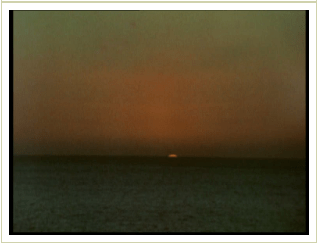
Rohmer uses splashes of red throughout the movie – on Delphine’s bag, a suitor’s sweater, a Cherbourg dress – and finally ending in the poncho – marking her lowest point. While the reds spiral downward into despair, the greens offer a way out. She finds a green-backed Queen of spades on the streets of Paris, a green ad for a seance  that reads,”Regain contact with yourself and others…”, and a green-backed King of Hearts. She even mentions that a medium told her that green would be her color for the year. Finally, she overhears an older group of tourists discussing Jules Verne’s The Green Ray, in which she hears that the final ray of light the sun emits before sinking below the horizon is green. It is only visible on perfectly clear days, and according to Verne, a Scottish legend claims that:

“this ray has the virtue of making him who has seen it impossible to be deceived in matters of sentiment; at its apparition all deceit and falsehood are done away, and he who has been fortunate enough once to behold it is enabled to see closely into his own heart and read the thoughts of others.”

Helena Campbell, the heroine of The Green Ray, refuses to marry the pretentious knob Aristobulus Ursiclos until she sees the ray and understands her own heart. Rohmer clearly pulled some aspects of Delphine from Helena. Verne again:

“De Maistre has said, “there are in me two beings: myself and another.” The “myself” of Miss Campbell was a serious, reflecting being, looking upon life from the point of view of its duties rather than its rights. The “other” was a romantic being, somewhat prone to superstition…”

Along with this similarity of temperament, they share a fractured itinerary. Helena forces her two Uncles to travel from isle to isle, in order to find the perfect sea horizon to view the ray which Aristobulus keeps clumsily blocking. They are constantly on the move. Delphine is on her own jagged path, seemingly more out of lassitude than romantic intensity, but both girls end up searching out the ray for a kind of transcendent self-determination.

Delphine encounters a series of Ursicloses along the way, from the strapping and shirtless to the meek and leather-jacketed. She dismisses them all with skittish indeterminacy, running away rather than causing a scene. It is only when exhausted in body and soul, collapsed in a molded plastic seat at the Biarritz train station, that she opens herself up, as open as her copy of Dostoyevsky’s THE IDIOT (and she very well may aspire to Prince Myshkin’s absolute lack of self-regard and Christ-like innocence…she at least relates to his rejection by society).

An exchange of looks with a cabinet-maker leads her to an impulsive jaunt to  St. Jean de Luz, where she passes the gift shop “Le Rayon Vert” (The Green Ray), until  she settles on a bench with her man and tries to answer a question. She’s just waiting for the light…

The beauties of this final sequence ought not be put in words (or I’m not the one who’s capable), as it captures the moment “when hearts be one” with a joyfulness and lack of artifice that would make Rimbaud and Myshkin weep. I’ll let Jules Verne and Rohmer have the last act:

Helena felt instilled with new life as she inhaled the fresh breezes; her beautiful, clear eyes sparkled with health as she gazed on the rippling waters of the Atlantic stretching far and wide, and her pale cheeks were faintly tinged with pink. How lovely she looked! And how charming her whole appearance! Oliver Sinclair walked a little way behind, and regarded her in silence; he who had often accompanied her in her long walks without the slightest embarrassment, now scarcely dared look at her for the wild throbbing of his heart!

Screen Shot 2020-01-23 at 1.20.22 PMScreen Shot 2020-01-23 at 1.20.35 PMScreen Shot 2020-01-23 at 1.20.43 PM

THE RIFLEMAN (GUEST STARRING DENNIS HOPPER)

Originally published at Movie Morlocks, the official blog of Turner Classic Movies

June 1, 2010

c946df573db05e3afab8b162b4eb6fb2

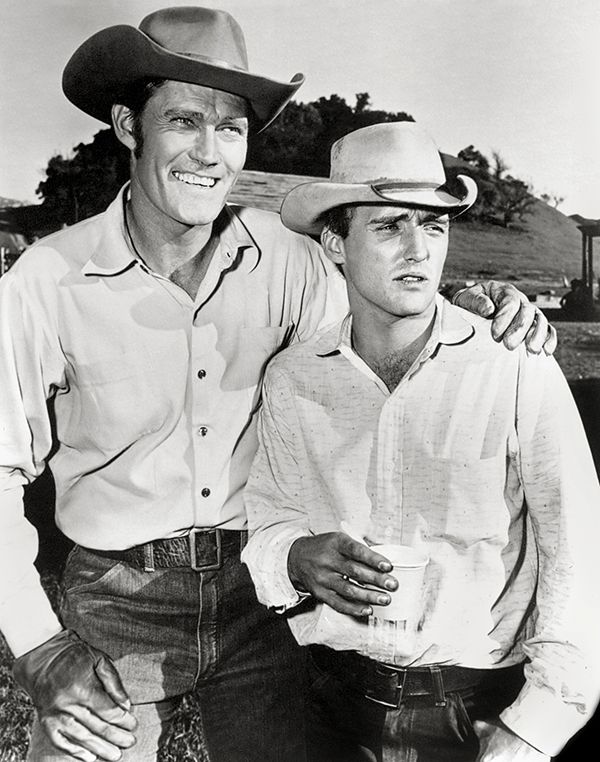
Fifty episodes of THE RIFLEMAN (1958 – 1963) are available for viewing on Hulu, and it’s a phenomenally rich show for auteurists (and everyone else). Sam Peckinpah was the lead writer (and directed two episodes), while Joseph H. Lewis (Gun Crazy) directed a large chunk of the rest. It’s a dynamically shot program, with agile use of push-ins and close-ups, and a strong use of depth-of-field, all swiftly illustrating Peckinpah’s surprisingly violent universe. And then there are the actors, which along with Chuck Connors’ granite-faced realist includes R.G. Armstrong, Warren Oates, and a baby-faced Dennis Hopper in the pilot episode, “The Sharpshooter.”

I learned of Hopper’s passing soon after viewing his tender, soft-spoken performance as the titular marksman Vernon Tippert, and it’s as fine a tribute to his talents as any (for a complete overview, check out Matt Zoller Seitz’s great video montage up at Moving Image Source).  Hopper was only 22, but he was already a television veteran, having done guest spots on “Cheyenne” and “Zane Grey Theater” (along with theatrical bit parts in Rebel Without a Cause and Giant). Tippert is a sad-eyed youth, driven from town to town to hustle shooting contests by his grizzled, greed-addled uncle Wes. The Rifleman, Lucas McCain (Connors), and his son Mark (Johnny Crawford), arrive in the town of North Fork after the (never explained) death of his wife. Lucas is there to compete in a Turkey Shoot in order to raise money to buy a ranch, and Vernon is there to win money for his uncle and the town’s mob boss (Leif Erickson) who is rigging the contest to win his bets. McCain tanks the event to avoid the violence aimed at Mark, but he runs the gang out of town with his rapid-fire rifle by the end.

Tippert is unfailingly polite, almost courtly in his manner, especially when dealing with the McCains, who have achieved a level of familial stability alien to him. He meekly walks into the dining room, hands clasped in front, before accepting an invitation to eat lunch with Mark.  Hopper speaks lowly, tentatively, and keeps his eyes locked down at the table, even though Mark hasn’t hit adolescence. He moves like a wounded pup. Then they trade stories of loss – Mark mentions the death of his mother, Vernon tells him he never had one. He starts to lock eyes, and after Mark asks him, “Does it bother you that you never had a ma or pa?”, he replies, “I reckon.” Then he turns his head down and traces a figure on the table with his finger. He continues, “sometimes it bothers me considerable.” He jolts back up in his seat when the waitress appears, out of his reverie, and jump-starts the narrative. It’s a bracingly raw scene that rides entirely on Hopper’s cagey vulnerability.  Because while Crawford is an appealing presence, he does little more than read his lines on cue with an ingratiating smile.

The whole episode is startling, from its cynicism regarding state institutions (the Sheriff (R.G. Armstrong) is little more than a pawn) all the way to its frank discussions of death and loneliness. While “The Sharpshooter” came from Peckinpah’s script, a whole host of collaborations occurred to get it to the screen. The production company Levy-Gardner-Laven had a title for a TV show, but no script. After cycling through some bad teleplays, Jules Levy invited Peckinpah to their Culver City studios for a meeting. According to Peckinpah biographer David Weddle (If They Move…Kill Him is my main source), Sam said he had a script laying around to match their concept, and brought in “The Sharpshooter.” In his original script, McCain is childless, and it ends with him intentionally losing the contest because of the gang’s threats, and leaving town in shame. Arnold Laven, who directed the episode, recalled:

That was the end of the story…the cynicism and the reality placed against the romantic image of the West. We loved the writing, but the ending, you just couldn’t get that sponsored in 1958. I don’t know if you could get it sponsored today, to tell you the truth – a guy who doesn’t have the courage of the West – to stand up for what is right.

Laven suggested adding the child, which would give Lucas an acceptable reason for bowing to the pressure of the gang. Peckinpah incorporated this, and then added the heroic shootout which would set the pattern for the series: McCain continually derides the use of violence, but is forced into using it at the end of almost every episode. The reluctant warrior bit has worked since the age of Cincinnatus, and Peckinpah and co. wring every variation out of the material.

Peckinpah’s touch becomes even more evident in his directorial debut on the show, “The Marshal”, which features an embryonic version of his stock company. The episode includes R.G. Armstrong, Warren Oates, and James Drury, who would all later appear in his feature debut, Ride the High Country. The episode concerns the character of Micah Torrance (Paul Fix), a former peace officer turned alcoholic. His addictions are contrasted to the Sheltin Brothers (Drury and Oates), two probable psychopaths who are out to kill Torrance for shooting them years before. The Sheltins are pure id, hollerin’ and screamin’ and tearin’ up the local bar (twice). They are two sides of dissolution, implosion and explosion. Laven advised Peckinpah on his early directorial work, and he remembered:

Sam’s Rifleman shows had an inherent underlying violence. There was something unreal when the Rifleman would shoot three guys, there was a pattern it stayed within. But Sam made it much more deadly, much more real.  It was a little unsettling…

Peckinpah comes up with some great lines that surround the bloodshed. Torrance pines for a drink: “I’ve got a case of the whips and jingles.” The Sheltins are asked to sign the hotel log: “We ain’t spellin’ men.” In a similar strategy to John Wayne’s character in Rio Bravo, McClain treats Torrance with tough love, working him hard on the farm and refusing to show him pity. Eventually he comes around, and, like Dean Martin, returns to join the law. Fix would go on to play Marshal Torrance for the rest of the series.

There is so much more material here I haven’t had time to explore, including Joseph H. Lewis’ contribution, which early on seems to be the most visually complex. And then there’s producer-director Arnold Laven’s anonymous craft, which he also brought to shows like Hill Street Blues and The A-Team. Laven passed away just last year (read The Guardian obit here), and his career seems to scream out for re-evaluation, or any evaluation at all.

I’ll leave you with the opening credit sequence, which in its purity and abstraction, is the best ever, in my opinion. Chuck Connors’ eyebrows speak multitudes. Watch here.

MEMORIAL DAY MOVIES: THEY WERE EXPENDABLE (1945)

May 25, 2010

Screen Shot 2020-01-23 at 1.03.49 PM

“This isn’t going to be some goddamned two-bit propaganda flick.”

-John Ford to Vice Admiral John Bulkeley, USN

John Ford put off making They Were Expendable for over two years. He was busy with his Field Photo Unit making war documentaries, and he wasn’t eager to to go off active service. He was completing post-production on The Battle of Midway (1942), and dealing with the negative reaction to December 7th (directed by Gregg Toland), a Pearl Harbor re-enactment whose depiction of a less than prepared Navy led to its shelving, and to the future censoring of the Photo Unit’s output. Joseph McBride, in his magisterial biography Searching for John Ford, writes that “the navy reacted to the long version of December 7th ‘by confiscating the print and ordering Ford to lock up the negative.”

MGM was developing They Were Expendable this whole time, hiring Sidney Franklin to polish Frank “Spig” Wead’s script and assigning Ford associate James Kevin McGuiness as the executive to oversee the project. Wead was a former Navy aviator who turned to writing about flyboys after a tragic fall down the stairs broke his neck (he wrote Hawks’ great Ceiling Zero, and Ford filmed his life story in the underrated The Wings of Eagles (1957)). The raw material for the story was the exploits of John D. Bulkeley, a lieutenant in command of Motor Torpedo Boat Squadron Three, based in the Philippines, as reported in a best-selling book by W.L. White, and then an essay in Life magazine. With a skeleton crew and no lines of support, Bulkeley took down multiple Japanese planes and ships, and famously spirited General Douglas MacArthur from Corregidor to Mindanao (from where he escaped to Australia) over 620 miles of open water.

McBride opines that another reason for Ford delaying production until ’45 was that he couldn’t film such a downbeat subject in an appropriate manner while the war was still raging. For Bulkeley’s story ultimately ends in defeat, as the U.S. is forced to retreat, and the majority of Bulkeley’s crew is killed. McBride quotes Bulkeley:

I was very bitter about the thing. …We went over there with 111 men and only 9 men came back alive. [The War Department] put 80,000 soldiers over there, and that was a political decision on the part of the president and [Secretary of War Henry L.] Stimson that we were going to show the Asiatic race that we supported them, that we did not back off the Japanese. But the war plan was totally, utterly hopeless. You could not send a battle fleet out there and defeat the Japs and bring aid and so forth to the Philippines. We were not only too far away, we weren’t ready. To try to defend the Philippines was stupid, we couldn’t do it. But we had to put up a fight.

To film a realistic portrait of this event would be impossible in ’42, but in ’45 he pulled it off – and it’s one of the most mournful, moving, and static war films ever made. Very little happens. Men leap on and off PT Boats, rag on a callow ensign, and occasionally exchange fire with Japanese planes and battleships (I now realize I’ve inadvertently copied James Agee, who said: “all you have to watch is men getting on or off PT Boats, and other men watching them do so. But this is made so beautiful and so real that I could not feel one foot of the film was wasted.”) The love interest, Donna Reed, glows incandescently for a few scenes with John Wayne, and is then re-located by command. She does not return. The narrative is jagged, with dead-end detours followed by long sinuous set-pieces, lensed by cinematographer Joseph August. The action scenes are evenly-lit in razor sharp deep focus, while the interiors are sepulchral and shadowed – both the harrowing surgery sequence (held on Reed’s clenched, disbelieving face), and the staff dinner (again centered on a Reed close-up, adjusting her necklace for a reminder of normalcy), are shot in heavy chiaroscuro, as if the characters didn’t want to see the world outside their doors.

On the surface Robert Montgomery was an offbeat casting choice to take on the Bulkeley role (here named Brickley), as he rose to stardom as a light comedian. But in his naval service he was assigned to Bulkeley as executive officer during PT boat combat in the Southwest Pacific in 1943, earning a bronze star. His performance is of implacable good humor, a stalwart, impenetrable veneer that quickly compartmentalizes disappointment to do the job at hand. John Wayne plays the blustery, self-destructive Rusty Ryan, whom Brickley keeps together through force of will. When Ryan, hiding a blood disease contracted after a hand injury, is about to lunge into battle (and begin, one expects, a major subplot surrounding the disease), Brickley sees the hand, and forces him into a hospital. Professionalism trumps drama here at every turn. Aware that they are cannon fodder, they enter the breach again and again, trying to give their side just a few more seconds to turn the tide. It is an insane kind of dignity, which perhaps makes it even more admirable. So when Rusty places his hand on Brickley’s shoulders, and squeezes, right before they are to take their leave for Australia, it speaks for all the men they lost, and the few they might have saved. It’s one of the most beautiful moments in John Ford’s cinema, and so, of all cinema.