BLU-RAY BONANZA: ACCIDENT AND VENGEANCE

December 29, 2009

vengeance

After a lengthy hold-out, I’ve galloped into the loving arms of Blu-Ray. It’s the right time to jump in, as the studios are (rather desperately) pushing the format hard, cutting prices across the board. You can pick up a player for around $150, with many library titles on sale for $10 (most new releases are set at $25). Starting in 2010, Warner Brothers will release every new theatrical release exclusively in “Blu-Ray combo packs”, which will contain the high-def disc along with the standard-def DVD (forcing consumers to buy the Blu-Ray and push them to upgrade). With HDTV prices finally starting to come down as well, Blu-Ray is finally a financially feasible option for cash-strapped cinephiles like myself.

I ended up purchasing a PS3 to pair with my Panasonic plasma in order to sate my long-suppressed video-gaming urges, as well as for its stellar Blu-Ray playback and new Netflix streaming capability. I flirted with the idea of an all-region player, as recommended by the folks at DVD Beaver, but wasn’t convinced there were enough region-locked releases to justify it, especially considering that the excellent Masters of Cinema series is region-free, as are all of the Hong Kong releases.  So while I’m missing out on gems like ITV’s The Red Shoes, I console myself with games like Metal Gear Solid, Netflix, and the rush of new domestic releases (Criterion’s forthcoming Days of Heaven and Bigger Than Life Blu-rays are especially tempting).

After dipping into some of the sales (I picked up The Searchers and Robocop on the cheap), I decided to check in on my favorite production company, Milkyway Image. Johnnie To’s stalwart outfit has been churning out inventive genre pieces since 1996, the kind of work Hollywood has forgotten how to make (aside from flukes like Armored). I sampled two of their recent releases on Blu (available at HK retailers like YesAsia).

Soi Cheang’s Accident premiered at this year’s Venice Film Festival, and it’s a sleek paranoid thriller in the vein of Coppola’s The Conversation. The central gimmick has the obsessive-compulsive Brain (Louis Koo) lead a group of assassins (including Milkyway axiom Lam Suet) on murders that are staged to look like accidents. They build elaborate traps for their marks to waltz into, and their hands are clean. It’s the perfect setup for producer Johnnie To’s penchant for displaying process, the small details that build up to a murder, as he also shows off in Vengeance. I’m not familiar with Cheang’s work (he’s known most for his gangster film Dog Bite Dog), but he is adept with the Milkyway house style, which favors underplayed acting, minimal exposition, and a smooth delineation of space.

After Cheang sets up the group’s unerring precision in a bravura Rube Goldberg murder, he starts to expose the paranoia that drives Brain. His first action is to pick up a cigarette butt that “Uncle” (Fung Shui-Fan) leaves at the scene of their crime. He’s determined to erase any trace of their presence. When their next job goes tragically wrong, he becomes convinced it was the result of a conspiracy led by an insurance agent (Richie Ren). He then embarks upon an elaborate wire tapping scheme, moving into a unit underneath Ren’s apartment and listening to his every waking (and napping) moment. He even sketches the floor plan of his nemesis’ apartment on his ceiling.

Cheung , along with screenwriters Szeto Kam-Yuen and Tang Lik-Kei, withhold enough information to keep the truth of the matter ambiguous. Brain is either a canny chess-player – seeing many moves ahead – or an untreated paranoid schizophrenic – creating antagonistic worlds in his strained noggin. Louis Koo is perfect for the role, a blank slate of wiry tension and a football-field sized forehead that could contain multitudes of tortured grey matter. Cheung uses the motif of a solar eclipse to express the obfuscation of his mind’s eye, working multiple variations on the idea until the literally gut-wrenching climax.

Johnnie To’s latest film, Vengeancewas released last week on DVD and Blu-Ray by MegaStar (IFC has the film’s U.S. rights, with no release date as of yet), and it feels like a stand-in for the Le Cercle Rouge remake he never got off the ground. To’s love of Jean-Pierre Melville has never been so close to the surface. His protagonist, the mummified cool of Johnny Hallyday, is named Costello, just like Alain Delon in Le Samourai, and maintains his near-silent devotion to revenge, this time after the slaughter of his daughter’s family. But Johnnie To is also adept at wonderful scenes of hanging around, the interstitial moments between battles that To veins with humor and pathos. He surrounds Hallyday with his stellar repertory crew (Suet, Anthony Wong, Lam Ka-tung are the killers Hallyday hires to help him, while Simon Yam is the flamboyant villain), and has them enact their usual honor-among-thieves routine, which I could watch until the end of time. Anthony Wong has perfected a resigned weariness that plays beautifully off of Suet’s overeager child and Lam Ka-tung’s suave clotheshorse.

Set in Macau and starring a French rock star, it continues To’s interest in cross-cultural exchange, and is perhaps a nod to his increased visibility in the Western world. The film mixes English, French, and Cantonese, and the issue of (mis)communication becomes a major theme. This is established early on, when his daughter (Sylvie Testud), unable to speak, uses a French newspaper to get her thoughts across (later there is a bravura shootout set among composted newspapers). Then he has to bridge the language gap with Anthony Wong’s gang, in which he switches to English. The final act of the film charts his communication with himself, as he loses his memory and tries to trigger it again with a series of note-covered Polaroids. The final shoot-out is a brilliant encapsulation of the evolution of this theme, as he chases a target whose facial features he repeatedly forgets. It is a scene of constant self-communication and negotiation, as he checks and re-checks the bodies of the assailants in his way. There is also a minor motif of eye-holes and eclipses, similar to those in Accident, images related to the opening-up and closing-off of sight – just another few layers of meaning to To’s incredibly dense revenge drama. The image on both releases is phenomenal, the shimmering pastel blues of Accident and the deep blacks of Vengeance rendered with depth and incredible sharpness. They have my strongest recommendation.

LIST: U.S. FILMS OF 2009

December 22, 2009

informant-watching-recommendation-videoSixteenByNineJumbo1600

My lists for the top films of the year and of the decade have been posted over at Indiewire, so feel free to rush over there and criticize my choices in the comments back here. Only two English language films made my year-end roundup (The Informant! and Orphan), but there was a whole slew of valuable work churned out in the States that I’d like to recognize in this dusty corner of the internet. The lag time in distribution means that the finest in international cinema arrives in waves – the highlights of three years of festivals hit all at once (Aleksandr Sokurov’s The Sun took four years to reach theaters, for example).  I highlighted many of these on my list (go check out The Headless Woman, my topper, just out on DVD from Strand), but it necessitated knocking out a number of strong Hollywood films that were actually made in 2009. So, here’s my favorite local product:

1. The Informant!, Directed by Steven Soderbergh

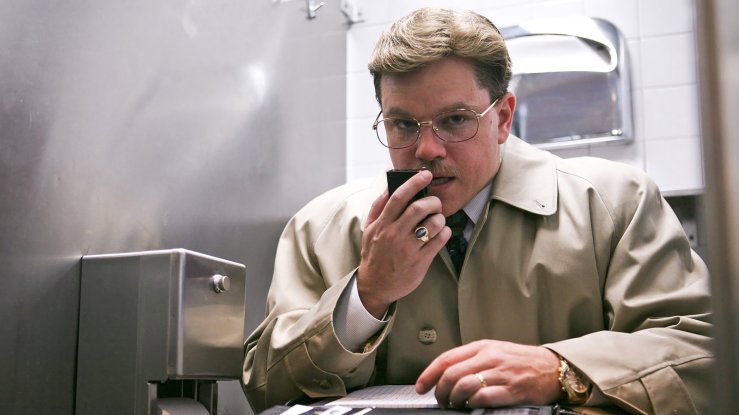
An ebullient little character study of a small middle manager and his penchant for charmingly embroidered lies. Soderbergh and screenwriter Scott Z. Burns’s ingenious use of voice-over has the wiseacre Mark Whitacre constantly digressing from the drama in his life (whistleblowing on Archer Daniels Midland, among other things) in order to establish his monumental self-denial. It’s a clever device that pays off brilliantly in the end, when his interior monologue finally matches up with his actions – and Whitacre’s face turns ashen. Matt Damon pulls this tricky act off without a hitch. His Whitacre is a smiling gladhander,  a lumpen edifice of Midwestern charm impossible to dislike despite his endless faults. Damon is surrounded by a stellar cast, led by Scott Bakula and Joel McHale as trusting FBI agents, and supported by a potpourri of comics playing straight including Patton Oswalt, Paul F. Tompkins, and both Smothers Brothers.

***

2. Orphan, Directed by Jaume Collet-Serra

An elegantly designed horror movie with a whiff of satire, it has been clanging around my cortex for most of the year. The premise is from the genre 101 playbook: a rich bourgeois couple adopts a child. She turns out to be a murderous psychopath. Her insidious actions uncork the husband and wife’s long simmering insecurities, unleashing her alcoholism and his unbending passivity and wandering eye. There are so many deliciously macabre notes in the film: her “outsider art”-type watercolors that hide bloody massacres in the margins, the sides of beef being unloaded in the background during marriage counseling, and the entirety of 12 year old Isabelle Fuhrman’s performance – which is astonishing in its ferocity. She kills you with a dead-eyed stare and glacial smirk, just a bit of business before dinner. The satire is aimed at the conspicuously consumptive parents, who have built a modern box in the boonies to escape themselves and the holes in their souls that money can’t seem to fill.  In any case, a total delight.

***

3. The Fantastic Mr. Fox, directed by Wes Anderson

Another bauble in Anderson’s closet of exotic objects. This is perhaps his most detailed and expressive, since he can control all of his subjects down to their whisker hair. Every little detail holds a clue to these character’s personalities, from Ash’s train set to Mr. Fox’s bandit mask. Ash is caught in childhood, desperate to break out but still in love with play. Mr. Fox is caught between family and his essential fox-ness, that is, his need to steal and kill chickens. Both characters are torn between maturity and playfulness, and each will have to find a balance between the two that allows them to function in their makeshift society. That they succeed is due to the love of their lives – Meryl Streep’s graceful, stubborn and wise Mrs. Fox. It’s one of his most finely wrought family tales, impeccably (voice) acted.

***

4. Armored, directed by Nimrod Antal

A late entry that snuck in under the wire. Has the constrained feel of a legit 40s B-movie, steeped in sweat and work and a heist gone bad. A group of armored truck drivers led by Matt Dillon plans on faking the heist and taking the money for themselves. Sounds smart until a homeless man and a curious cop send the ethically curious in the crew into revolt. Once the deed goes sour, there is an extended showdown between Columbus Short (the moral one and Iraq war veteran) and the rest of the goons. He locks himself in a truck and Dillon starts to pound the hinges out with steel pipes. The insistent clanging marks off the time until one of them dies. It’s inevitable, but still they work, grunt, curse and bleed. Laurence Fishburne grunts better than most, but Dillon growls with authority, Skeet Ulrich’s wispy beard matches his weaselly cowardice, and Short exudes nice-guy calm. A refreshingly well-rigged little thriller.

***

5. The Limits of Control, directed by Jim Jarmusch

Dreamy patterning, etched on the sharkskin suits of Isaach de Bankole, as he traverses the cities of Spain. I forget the color coding, but suit-jacket, shirt, and pants re-combine shades at each location, as he listens to the pseudo-philosophical treatises of his contacts. Jarmusch recombines his cinematic idols with equal panache. de Bankole is an assassin in the mold of Alain Delon in Jean-Pierre Melville’s Le Samourai, concerned with the purity of his own code, which is impenetrable to the long-winded talkers he gets his instructions from (Tilda Swinton, John Hurt, Gael Garcia Bernal, among others). But along the way there is a lot of opaque game-playing straight out of the Jacques Rivette of Out 1, clues that lead nowhere, a mystery only about mystery. The cinematography of Christopher Doyle is sleek and intoxicating, the words are alternately maddeningly self-indulgent and engagingly inquisitive. Movies don’t come more rewarding or frustrating than this.

***

Now we enter the speed round:

6. Funny People, directed by Judd Apatow

Creativity as utter loneliness, rendered with a fusillade of dick jokes. And good ones.

***

7. Up, directed by Pete Docter and Bob Peterson

Of love and talking dogs, but more of the former, thankfully.

***

8. Me and Orson Welles, directed by Richard Linklater

A lovely re-imagining of Welles’ Broadway production of Julius Caesar. Christian McKay is incandescent as Welles, and inside it’s lilting rhythms is a rather dark portrait of the creative process.

***

9. Invictus, directed by Clint Eastwood

A lesson in structure. The divisions in South Africa rendered in Mandela’s security team, in his personal relationship with his daughter, and then through rugby’s world cup. Sports as politics.

***

10. A Perfect Getaway, directed by David Twohy

Clever. Screenwriter as main character in honeymoon gone awry chase film. Hammers home metaphor that writers cannibalize subjects for their own purposes. But with humor, which saves it. Timothy Olyphant wins the day as yammering special forces specimen.

Honorable mentions: Drag Me to Hell, The Box, Pandorum, Gamer, Crank: High Voltage, Star Trek, Adventureland

Special Note: I did see and admire some aspects of The Hurt Locker (i.e., the sniper scene) but have been baffled by the overwrought praise sent its way for this otherwise rote war movie. So as an act of spite, it’s not on this list.

MEN ARE SUCH FOOLS (1938), AND THE USES OF TWITTER

December 15, 2009

menaresuchfools-ft

Twitter has its uses, including its function as cinephilic program guide. I follow an eccentric crew of film writers and scholars on the service, and often something like the following will pop up:   “DVR alert: TCM, 10:15 am Eastern, Men Are Such Fools”  rare Busby Berkeley, 1938, non-musical, w/Bogart; never seen it.” This was posted by The New Yorker’s film editor, Richard Brody, under his handle @tnyfrontrow (I go by @r_emmet). Noting that the film was starting in minutes, I dialed up my unnaturally understanding wife, who heroically hit the record button on this esoteric nugget with seconds to spare. If you read the right people, you’ll get a handful of idiosyncratic tips like this each day, a kind of TV Guide poetry to go along with links to their writing  and other pieces they admire. There’s also plenty of pointless chatter (dinner plans, puns, and hyperbolic opinionating), but those are easy enough to filter out with an impassive unfollow click. Some essential feeds to read: MoviesOnTCMThe Auteurs DailyDavid Lynch, and Indiewire. They’re a good place to start anyhow, and then you can radiate out out from there, depending on your tastes.

Men Are Such Fools is more of a curiosity than anything else – as Brody noted, it has a small Bogart appearance in one of Berkeley’s rare non-musical films. The central drama is dry and unconvincing. Warner Brothers was trying to push Priscilla Lane and Wayne Morris as romantic leads, having paired them earlier in the year in Love, Honor and Behave, in which Morris played a milquetoast husband tested by Lane’s more assertive wife. The Warner publicity team cooked up a romance between the two, filming them at nightspots to build any kind of buzz (this according to Daniel Bubbeo’s The Women of Warner Brothers). The two dated briefly, but the flirtation didn’t last long.

Wanting to push them quickly, they paired them with Berkeley in this adaptation of a Faith Baldwin story, who was eager to show off his skill set outside of the musical: “I wanted to prove,” he later said, “that I could handle a straight dramatic assignment…, and that is why I did films like Comet Over Broadway[1938], They Made Me a Criminal [1939], Fast and Furious [1939], and Men are Such Fools. I had done dramatic work during my period of working on the stage back east and knew that I could do a good job with dramatic or comedy films.” (Bob Pike and Dave Martin, The Genius of Busby Berkeley, quoted in Jeremy Arnold’s article for TCM) Motivated or not, Men Are Such Fools looks like a job for hire. It’s a blandly put together bit of drama that sings for seconds at a time due to a fine roster of supporting players.

Lane is an appealing performer, with flickers of aggression animating her bright eyes and sweet demeanor. She’s an ambitious secretary at an advertising agency, bucking for a promotion on the lucrative fruit extract deal while her suitor, Morris, is an overbearing goon with a monstrous inferiority complex. A fraternity dolt with too much time on his hands, Morris browbeats Lane into marriage with a charming combination of physical intimidation and boyish whining. There was not much appealing to the the character as written, but Morris’ plasticine features and gangly athlete’s body emphasize its most retrograde aspects, as he looms over her with goofy intimidation tactics that come damn near spousal abuse. But Lane convincingly grins her way through it – as if she was enduring it for a secret plan of her own. Not that she is innocent – for Lane clearly is a careerist, flirting her way to snag the extract account and into the upper echelon of the company. But how this aggressive, selfish, and likeable loner could fall for a mouth-breather like Morris’ character strains credulity.

But while this romance generally rankles, there are some side players that lifted it out of the normal run of B-movie fodder. First and foremost is Mona Barrie, who slinks her way into the role of Bea Harris, an acid-tongued copywriter who aids Lane on her way to the top. She looks at the world with her eyebrow askance and poison pen at the ready like a dimestore Dorothy Parker. She leans into her bon mots with delectation, savoring each insult like she was sucking on a Jacques Torres caramel. Before she tells Lane that “all men are polygamists”, she speaks of her past as a battered wife and then lonely divorcee with an offhand cynicism that is breathtaking. She built herself up from nothing into a management position and she dashes it off like another puff of her cigarette. It’s a lovely, layered performance that adds a whip-smart intelligence to the film, for the few minutes she’s in it.

The second sterling turn here is contributed by Bogart, who has the unforgiving role as the other man to the Morris-Lane couple. Tagged as a womanizing entertainment tycoon type, he swoops in with a disarming honesty, “I’m probably a cad. Are you by any chance a weak woman?”, and ends up winning the audience over, if not Lane, by tipping into love with his enigmatic employee. He’s intended to be a bit of a bastard, but he’s clearly a more interesting, and oddly warmhearted cad than Morris’ overgrown man-child. Bogart knew he deserved larger roles, and Berkeley concurred:

“Bogie was never any trouble to me at all,” recalled Berkeley. “He felt, and I agreed with him, that he should be working in better films, but whatever discontent he felt, he took out on the bosses, not on the people he was working with. As far as I know, he never refused to play a part. His credo was to keep working, and I agreed with him on that point, too.” (Tony Thomas, The Busby Berkeley Book, quoted by Arnold)


Without an impulsive tweet, I wouldn’t have been able to add these distinctive performances to my own character actor pantheon. Now I’ll be able to track Mona Barrie wherever she pops up on the TCM schedule. Let me know if any of you have further recommendations for films with Ms. Barrie, as I’m developing a furtive crush.

BEST OF THE DECADE: 1900 – 1910

Originally published at Movie Morlocks, the official blog of Turner Classic Movies

December 8, 2009

dreamland

The decade is almost at a close, and a deluge of film lists has started the conversation about who were the vital movie artists over the past ten years. All of them are worth scrolling through to stoke some self-righteous anger or gratifying head nods, but before I pull together my chin-scratcher about the end of the oughts, I thought I’d take a look back at the first decade of the previous century. This is the period where cinematic language was transitioning between what Tom Gunning famously termed the “cinema of attractions”, which favored spectacle over story, and the emotionally motivated narratives of D.W. Griffith.  Consider this list a  work-in-progress, a wish for more suggestions and thoughts on this wondrous period, when the future of the art was up for grabs. I ended up with twelve films of varying lengths and complexity, but all of them are valuable not just for their place in history, but their vibrancy as moving images. These are unranked, in chronological order.

***

How It Feels To Be Run Over (1900, Directed By Cecil M. Hepworth)

A forty second joke based on an experiment in point-of-view and audience expectations. The camera is set at a low angle on a country road, and when the first horse-and-buggy turns the corner, one expects it to crash right into us, since we’ve been cued by the title to take the POV of the camera. But no, Hepworth, with a dry sense of humor, has it drive right by for a simple actualité, something not out of place in a Lumiere retro. Soon, though, another carriage comes hurtling towards the lens, and this time it doesn’t stop, busting straight over the camera (and us), before one of the earliest uses of intertitles flashes on-screen over our blackout: !!! Oh Mother Will be Pleased.” And it’s the end.

With its misdirection, canny use of the camera as audience surrogate, and slapstick sense of humor, it’s a compact little masterpiece.

***

What Happened on 23rd St. New York City (1901, Edwin S. Porter and George S. Fleming)

Another documentary scene that then explodes into fiction. On 23rd St. near the Flatiron Building, New Yorkers pass by the camera and look in sheepishly, or glance quickly and then scamper away. It again has the feel of an early Lumiere brothers picture. But Porter, the pioneer of narrative filmmaking, couldn’t help but slip in a little slip of a story: thus, the dangers of the air shaft are proven underneath the billowing waves of a young woman’s skirt. Yes, she steps over the shaft and shamefacedly shows the world her abundant undergarments. A direct ancestor to Marilyn Monroe’s scene in The Seven Year Itch:

***

Jack and the Beanstalk (1902, Edwin S. Porter & George S. Fleming)

Another early triumph from Porter, this lucid re-telling of the fable displays adept use of double-exposures and theatricalized space while maintaining continuity from shot to shot, in one of the earliest instances of sustained storytelling. But the joys here are beyond such historical accomplishments. There is real unpolished magic in the hop-skipping cloth cow, whose exuberant jig tips over a prop rake before he’s sold down the river. There’s a delight in performance here that’s impossible to resist . Then there’s the set design, which goes from cardboard cut-outs to densely layered fantasy in the final shot, a child’s paradise of sailboats, pinwheels, and dense (plastic) jungle undergrowth.

***

A Trip to the Moon (1902, Georges Melies)

No more words need be spilled on this immortal work of film magic, just watch and awe at the moon’s grimacing face. There is no cinema without Melies.

***

The Great Train Robbery (1903, Edwin S. Porter)

Essential to view with the proper tinting and coloring, but even in sub-par YouTube versions, it’s essential. My favorite scene is in the dance-hall, where a group of locals whoop it up, even employing a revolver or two to goose things along. It has the ritual feel of the dance sequences in John Ford’s work.

***

The Georgetown Loop (1903, American Mutoscope and Biograph)

Ladies and gents wave their hankies at the camera as a train wends its way through Colorado. Absolutely hypnotic, for the undulating lines of the camera, which piggyback on one of the first “tracking shots”. The passengers are brazenly, confrontationally happy, thrilled with the advances of technology and the nearness of their hankies, which they wave out of the window with reckless abandon. The patterns these fluttering white blobs create is often breathtaking.

***

Coney Island at Night (1905, Porter)

Sensing a theme here? Porter rather owned this decade. This is one of the documentary subjects he churned out, but it also just happened to be uncannily beautiful. Tracing the arcs of the lights in Coney Island in pitch-blackness, the camera slowly pans around the flow of electricity. A serene, melancholy oddity of devastating effectiveness. It presents Coney Island in an abstracted, incredibly pure state: just a blast of illumination to bring us all back to our childhoods: pure dreamland.

***

The Consequences of Feminism (1909, Alice Guy)

A raucously funny comedy of the sexes, in which gender roles are reversed and the woman walk around with machismo sweating out of their pores. They drop their kids off with their husbands before heading the gentlewomen’s club to talk stocks with their tight knit pals. The ending reverses field, restoring the role of man and undercutting Guy’s social commentary, but the sheer joy in which she depicted these super-virile women gives her true motives away.

***

Le Printemps (1909, Louis Feuillade)

An oddity from the king of serialized conspiracies and violence, this is a cutesy short symbolizing the coming of spring in a variety of forms: from woodland sprites to cherubs to plain ruddy-faced angels. Shot with an oval masking so the film’s frame looks like a lover’s pendant, it contains stunning nature photography, verdant and shot through with dew.

***

Princess Nicotine, or the Smoke Fairy (1909, J. Stuart Blackton)

Totally bonkers, this  short finds a belligerent smoker conversing with the fairies living in his tobacco stash. One ducks under the cigar box, the other in his pipe. With ingenious use of gigantic props to convey the size difference, along with a mastery of special effects (double-exposures, split-screens, etc.), it’s  perhaps the first film to show the dangers of smoking – or at least the dangers of fighting with tobacco-nymphs.

***

Those Awful Hats (1909, D.W. Griffith)

A timeless subject – the evils of elaborate hats worn at cinemas – is turned into a delightfully surreal short by D.W. Griffith. A parade of flowery-hatted women enter a rather ratty theater, when the patrons get jumpy at their blocked view. It’s not until a jaws-of-life type deus-ex-machina disposes of the offending headwear that things start getting weird.

***

A Corner in Wheat (1909, Griffith)

A masterclass in parallel editing, as Griffith compares the plight of the poor wheat farmers as compared to the capitalist wheat king, whose stock speculations have sent his net worth soaring. With sterling cinematography from Billy Bitzer of the hard bitten life relentlessly cut with debauched parties with wide-eyed bozos, from breadlines to cocktail lines, it’s no surprise this finely tuned cinematic machine springs a trap for the spiritually poor Wheat King. A beautiful and devastating piece of work – and achieving a level of suspense far beyond Porter’s more linear technique.

THE AESTHETICS OF FOOTBALL

December 1, 2009

Behind-The-Camera-With-Mark-Stacy

A few weeks backI examined the directorial decisions that went into Fox’s World Series broadcast. Every play in baseball contains an inherent drama easy for a camera to pick out – the duel between pitcher and catcher. This offers an easy, lucid way for the production team to escalate tension, and the natural rhythm between pitches dictates the pace. Football, with its spread out action and endless commercial breaks, presents a more difficult challenge in creating and maintaining a rhythm and a narrative. There are almost too many shots for a director to choose from. There are 22 players on the field at all times, and any one of them can become the focal point.

Drew Esocoff is the director for NBC’s Sunday Night Football broadcast, with Fred Gaudelli as the executive producer. Esocoff describes himself as the quarterback to Gaudelli’s head coach, executing the game plan as tightly as possible and improvising when necessary. I took a closer look at this past Sunday night’s game to see how their relationship might play out. It was the Baltimore Ravens at home facing the defending champion Pittsburgh Steelers, both teams on the outskirts of the wild-card race and in desperate need of a win.

The biggest story of the game, and one Gaudelli obsessively focused on, was the status of the Steelers starting quarterback, Ben Roethlisberger. Still suffering the effects from a concussion the previous week (he felt exercise-induced headaches), he was held out of this critical game as a precaution. His backup Charlie Batch was dinged up with a wrist injury, so Pittsburgh was left with Dennis Dixon, a second year man out of Oregon with one pass attempt to his name. The NFL has been hit with a series of negative reports on their handling of concussions, which has led to a more conservative approach to treating the injury. Roethlisberger’s benching was just the latest iteration of this ongoing saga. With Dixon’s underdog story and the wider impact of the concussion issue, Gaudelli has a lot to work with here, although it leaves the Ravens out of the spotlight. This continues in the announcer’s open, which lays the groundwork for the entire contest. Al Michaels leads with the Roethlisberger/Dixon story, while Collinsworth adds a minor note about the Ravens’ possible heavy use of the blitz. Again, the game is treated as secondary to the Steeler QB situation.

The opening kickoff sequence sets the stage for how Esocoff will handle the game. He opens with the equivalent of pitcher-catcher, with two 10 second shots of the kicker and return man. Then he opts for a quick cutaway to Ray Lewis on the sidelines- probably hoping for some of his legendary pre-game intensity that never arises. He quickly shifts to what will become the main theme of the game, a 1 second close-up of Dixon followed by a 5 second shot of Roethlisberger applauding by his bench. Then he returns to Dixon in a frontal close-up – an extended 10 seconds of tension building before he returns to a brief shot of the back of Lewis. Then he locks in the default action camera, the slightly high-angle sideline view that is the default for all broadcasts of the sport.

This opening bit of montage exhibits the sheer profusion of elements that the director has to balance in a football game. Esocoff attempts to set-up the opening play, the arc surrounding the Steeler QB situation, as well as establishing the competition between the two teams. But the latter gets lost in the shuffle, the few rote shots of Lewis seemingly out of place, jammed in between the Dixon-Roethlisberger drama out of obligation more than anything else. He is also shot from the back and rather immobile, a faceless on-looker to the drama on the other sideline. At least this is what the opening sequence conveys.

This continues on into the main action of the game. In the 2nd Quarter, with Baltimore up 7-0, the Steelers have the ball at the Ravens’ 35 yard line. It’s first down. Dixon fakes the handoff, rolls right, and slings it to Santonio Holmes streaking across the middle of the field for a touchdown. This is the first emotional peak for the narrative that Gaudelli has set up, and Esocoff nails it down. He cuts from the sideline cam to a medium shot of Dixon pointing to the sky, and then a rapid montage of Roethlisberger beaming, Dixon’s Dad screaming in the stands, and another medium-shot of Dixon getting smacked by his ebullient teammates. This is a well-balanced bit of editing, emphasizing Dixon’s shockingly effective drive rather than Roethlisberger’s sideline antics, but incorporating it enough to massage the ongoing storyline.

It’s also worth considering the more banal plays, how a director handles the endless number of 1 yard runs and incomplete passes that constitute half  of the action. In a Ravens drive midway through the 3rd quarter, they are holding onto a 14-10 lead and just received a punt deep in their own territory. Baltimore QB Joe Flacco runs onto the field in a close-up before a zoom-out reveals the offensive line that recently led to a tweaked ankle. Esocoff opts for a slo-mo replay of his twisting leg in a super-zoom the network annoyingly calls its NBCEE IT camera. Then he cuts to a live, low-angle close-up shot of Flacco’s heavily bandaged right angle, following him right up to the center before cutting to a wide shot of the play, a short wide-receiver screen to Derrick Mason.

This is television sports at its lucid best. Chris Collinsworth remarks upon the nicks Flacco had been dealing with all year as the slo-mo replay flashes on-screen. With Esocoff’s cameraman getting a clean shot of Flacco’s ankle, it sets up a mini-arc that can be teased out the rest of the game, one which can finally be used as a counterpoint to the Steeler QB narrative which had dominated up until this point. It’s Esocoff improvising with finesse, and an example of how much more difficult it is to craft a clean story in the NFL than in MLB, which is more appealingly geometric and partitioned for the cameras.

So while I prefer the calm build-up of Bill Webb’s Word Series coverage, one can’t help but be impressed with the high-wire act Esocoff has to perform every Sunday night – a game with herky-jerky pacing that occasionally takes flight into moves of balletic beauty in the midst of 22 helmeted behemoths. He doesn’t even have the benefit of the human face, obscured by enameled hardened plastics. It’s a marvel he gets anything resembling continuity within this jumble of action, but he does in selected spurts, all of which seems moot next to the individual glories of a Drew Brees touchdown pass or Chris Johnson’s burst through the line. But Esocoff and Gaudelli set-up the edifice that contains these athletic glories, and they should be honored like the solid craftsmen they are.

JERRY LEWIS TAKES MANHATTAN

November 24, 2009

errandboy-5-723120

The nasal whine of Jerry Lewis is slowly screeching it’s way back into the American consciousness. He won the Jean Hersholt Humanitarian award at the last Oscar ceremony, and he’s returning to Broadway as the director of a musical version of The Nutty Professor, set for the 2010-11 season. And over the past few weeks, Anthology Film Archives held a retrospective of his directorial work, from The Bellboy through Cracking Up (aka Smorgasbord). The series was timed with the release of Chris Fujiwara’s concise study of his style published by the University of Illinois Press. It’s been a crash course in Lewis’ comedy, as I only have a passing knowledge of his movies, specifically the ones with Frank Tashlin (Artists and Models first and foremost). What became immediately clear is his astonishing technical command.

Regardless of whether I was laughing (which was about half the time), I was struck by the precision of his staging and the intricacy of his sound design. He’s adept at both crowding the frame with detail and locating a joke in the chaos (in the crowded elevator scene in The Errand Boy), or emptying out spaces and placing the gag in long shot (in the setting up the chairs bit in The Bellboy). His use of sound is just as fascinating, as he’ll often expose the mechanics of the film itself. There’s the sequence in The Ladies Man where he unplugs a microphone and the screen goes silent for a sequence of exaggerated pantomime, or the dubbing gag in The Errand Boy, where he loops his voice over a singing starlet.

As Fujiwara notes, “A main principle of Lewis’s films is not to fill in everything…”. His sets are spacious and garish,always calling attention to their artificiality, as in the dollhouse-like set of The Ladies Man (image right) , or in the “overhead crane shot in Kelp’s laboratory in The Nutty Professor, the camera reaches a distance hard to reconcile with the presumed real dimensions of the space, letting us know explicitly that this is a fantasy space, a movie set, a space of experimentation with identity.” He creates a theatricalized space to fit his constantly performing characters, and “Identity in Lewis is always performed; there is no private self.” And what an identity.

The Lewis “idiot” character is an empty vessel, either completely silent, as in The Bellboy, or a creation of studio hacks (The Errand Boy and The Patsy). His characters rarely have complete arcs, as he structures his films around a series of disconnected vignettes, bits of business that have little to do with the ostensible plot. The Bellboy is the extreme instance of this non-narrative approach, which so spooked the studios they tacked on an introduction explaining the concept (Jerry Lewis is a bellboy who wanders around doing nutty things). The Nutty Professor is his only film to crack into the national imaginary, probably because it  has the strongest story arc – he’s trying to win over Stella Stevens. His other films raise “problems”, only to discard them later, as with Lewis’s fear of women in The Ladies Man. He gives these plot devices little notice, content to construct elaborate gags around his invisible man.

The theme that inevitably emerges throughout all of these films is of the construction of Lewis’s own fame, and the unreality of his life. In The Bellboy he appears as himself, and The Errand Boy and The Patsy echo Lewis’ own rise to fame. It’s this overpowering sense of self-regard that turns off so many of his detractors, but his obsession with his identity springs organically out of his candy-colored style, so intent on revealing the artifice behind his own films’ making.

But is he funny? Well, your mileage may vary, but yes, absolutely. His “building-block” structure results in a lot of failed gags, but since they bump into each other in a quick profusion, there’s something to please everybody.  I’m not partial to his rubber-faced reaction shots, which bury his punchlines into the ground, but adore some of his slow-burn conceptual bits, such as his dressing down routine with Buddy Lester in The Ladies Man, where a simple hat adjustment ends up destroying Lester’s psyche.

His physical humor can also grate, as his long-take style pulls out a gag like taffy. A large suitcase doesn’t have handles, and he spends minutes sliding and tumbling trying to get a handle. This simple bit should hit and move on, but he holds it for every variation of physical degradation. It’s both admirable and exhausting, although some build from such unpromising material into a mad delirium. Take the dinner scene in The Patsy. Lewis takes one joke, he doesn’t know when to stop tipping, and keeps hammering it until he’s unloading his entire wad to a school of hovering violin players (see below). This is where the slow burn pays off, where one simple gag leads to Lewis repeatedly topping himself, instead of the stolid repetition of the suitcase bit.

The truly wonderful thing about Lewis’s work, though, is that even if a particular joke is tanking, there are always beautiful compositions and resourceful actors to fall back on. Lewis had a penchant for casting old Hollywood types in his films, guys who hadn’t worked regularly in years but he respected (he talks about this in a candid extended interview in Fujiwara’s book – in which he memorably describes his “steel balls”). Just look at some of the faces in The Patsy: Everett Sloane, Peter Lorre, George Raft (as Lewis’s reflection) Keenan Wynn, and John Carradine.

This could have been a silent film and the faces would have told the story. This is another aspect of Lewis that elicits criticism – his sentimental streak. And for the most part, it’s warranted, as he inserts stilted speeches about the power of innocence and beauty in the mouths of his female protagonists. But at certain moments, emotion arises naturally out of the action, either through his love of an actor or himself. Two moments stick out in particular. One in The Ladies Man, where Lewis and Raft do a soft-shoe in the living room. Lewis refuses to believe Raft is Raft, and to prove it, George twirls them around the impromptu dance floor. Lewis goes to a high angle, darkens the room, and isolates them in a spotlight, an absurd and surprisingly sad image of Raft dancing into the twilight of his career.

The other occurs near the end of The Errand Boy, when Lewis wanders into the prop room and starts chatting about his emotions with a southern belle duck puppet who calls herself Magnolia (see the top image to this post). She’s possibly the most fully realized of his female characters, which doesn’t say much for his writing for actresses, but speaks volumes for this improbably moving scene. It is played as straight drama, as Jerry tells her the story of his life, his childhood in Jersey, his dreaming of Hollywood, and his disillusionment upon getting there. Then he discusses the pain behind all of his pratfalls and screw-ups, “I’ve done nothin’ but cause everybody trouble.” Then he pulls himself back, and wonders why a puppet is talking to him. Poised between sentimentality and idiocy, with an undertow of sadness, it manages to condense Lewis’s cynicism about show business, his penchant for proliferating identities, and his childlike belief in the power of imagination into one insane and beautiful sequence. He’s one of a kind, for better or worse.

SHIRIN: KEEP YOUR EYES ON THE SCREEN

November 17, 2009

shirin

Abbas Kiarostami has retreated from the international scene for most of this past decade, working on a variety of museum installations and digital video experiments that received little to no distribution in the U.S. These pursuits, which include the installation Looking at Taziyeh, the long-take landscape film Five Dedicated to Ozu, and his latest, Shirin extend his interest in off-screen space and ways of seeing. Taziyeh is a mixed-multimedia work, with Kiarostami directing a live stage performance of a Shiite passion play (Ta’ziyeh is a folk theater form that re-enacts the murder of Hussein, the grandson of Muhammad), while giant monitors near the stage depict Iranian audience members reacting to a previous version of the play.

Kiarostami told The Guardian that “Ta’ziyeh is strictly linked to its audience – the event is actually created by the rapport between actors and spectators.”  Five Dedicated to Ozu, available on DVD from Kino (full disclosure: a company I work for), is a series of fixed-camera long takes of a beach on the Caspian Sea that capture ducks, dogs, shorelines, and reflections of the moon. It is an academic exercise imbued with Kiarostami’s wry humor and keen compositional eye. It asks for a patient, involved viewer, as it unveils split-second narratives and fugitive plastic beauties. While watching it, one can be emotionally involved in a duck’s fate, then pull back to enjoy the framing of driftwood on the horizon, or simply leave it on as an impossibly hip screen-saver.

Kiarostami extends and refines these ideas for Shirin, his latest experiment in point-of-view and meta-narrative, and was recently released on DVD by the BFI (you’ll need an all-region player to watch). He pares away the theatrical aspect of Taziyeh, limiting himself to close-up portraits of 112 Iranian women (and one Juliette Binoche – star of his forthcoming return to narrative filmmaking,  Certified Copy) as they watch an unseen movie. There are male characters in the background, but none receive the centered close-ups of the women (Homayoun Erbashi from Taste of Cherry is one of these men). Kiarostami recorded an audio-track for the film, an adaptation of Nezami Ganjavi’s epic poem, Khosrow and Shirin, but there is no corresponding video. The actresses were staring at a sketch he taped above the camera – in fact, Kiarostami didn’t know which narrative he would use during the shoot – the radio-play soundtrack wasn’t recorded until later. The actresses are going through the same process as the viewers, attempting to construct a narrative, or an emotion, from the slenderest of threads, not unlike the process of viewing Five. Watching requires an act of imagination.

The film requires a constant negotiation between narrative and image: there’s an urge to follow the audio’s story, to become involved in the romantic travails of the Iranian Prince and Armenian Princess, but then one is struck by the jade-green of an actress’ eyes, a perfect Modigliani-like oval face, a set of red bow-tied lips, or even the furtive way in which a strand of hair is brushed aside. It is a tad perverse that Kiarostami, who staunchly used non-professionals in his more conventional narrative films, opts for trained actors only when they have to sit and stare at an invisible screen. It’s a playful but rewarding decision, as the performers are all equally extraordinary, with their particular tics, shifts, and individuality. On this level, the film is pure cinema, glorying in eyes-face-mouth like a gigantic Garbo close-up from the silent era. David Bordwell points to Carl Dreyer’s Passion of Joan of Arc and Godard’s My Life to Live as precedents, especially the former, of which he says, ” almost never presents Jeanne and her judges in the same shot, locking her into a suffocating zone of her own.”

Kiarostami does his own kind of “locking into zones”. Two or three spectators surround the centered subjects, but none seem to know each other, are part of families, or interact in any way. They are all shut off in a private conversation with the artwork, imbuing them with a kind of religious fervor, an intensity around the eyes that does recall Falconetti’s saucer-welling turn in Dreyer’s masterwork. In a documentary including on the DVD, Taste of Shirin, Kiarostami is shown directing his actresses on a simple dark set (which was in his own house), urging them to “define the movie for yourself”, asking for “indifference”, and instructing “let your eyes smile, not your lips.” He choreographs their fidgeting and scratching, but asks them to do it in their own particular way. He even busts out a spoken word version of “My Favorite Things” to encourage them to personalize their twitches.

He is essentially urging these actresses to stop acting, to simply “be”. Without any context or character to draw on, they enter a beautiful kind of stasis, their emotions emerge from someplace beyond the story world. These emotions are irreducibly the actors’ own, which is perhaps why I found this to be the most moving experience I’ve had watching a Kiarostami film. This intensity of feeling, which was also a part of the Taziyeh exhibition (which I have not seen), is joined with the purest expression of his obsession with negative space, the action taking outside of the frame and inside of our heads (think of the unseen well-digger in The Wind Will Carry Us). Shirin is the first major work from his experimental period, and perhaps its logical endpoint, forever delaying a reverse shot which will never come. All that it leaves, according to Kiarostami, is cinema:

I suggest you watch another world which is more attractive than the story. I believe if you dare let go of the story, you will come across a new thing which is the Cinema itself. In fact, I suggest you let go of the story and just keep your eyes on the screen.

ROBERT RYAN: MEN IN WAR (1957)

November 10, 2009

men in war

Robert Ryan looks exhausted in Men In War, Anthony Mann’s spare Korean War drama. He focuses all of his energy on curling his upper lip, slitting his eyes, and furrowing his brow, as you see in the photo above. He’s worried, tired, broken. He delivers the dialogue with a laconic flatness, never rising above a low rumble. His Lt. Benson confronts a dead soldier with the same intonation as he does a busted radio: “This war, you’re either healthy or you’re dead”. He continues doing his job out of inertia, prodded on by the desperate stares of his men. His weary resignation shifts into a bitter nihilism before the final battle, and Ryan handles the transition by adding a tremolo to his voice and taking off his helmet, revealing his matted-down mop of hair. Working with Mann, it’s a masterful bit of sepulchral underplaying, keyed to the battered landscape and the canny enemies that hide inside it.

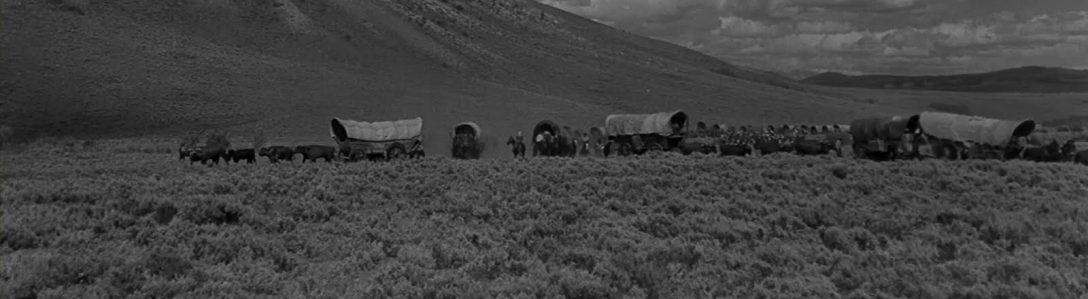
Based on Van van Praag’s WWII novel, Day Without End (1949), and adapted for the screen by Philip Yordan (in collaboration with the blacklisted Ben Maddow, who is uncredited), Men In War follows Lt. Benson and his unit as they are cut off from central command and try to fight their way out from behind enemy lines. They are joined by the amoral Sergeant Montana (Aldo Ray) and his Colonel (Robert Keith), who has been shell-shocked into silence. All of these men are literally disconnected, as the opening scene finds the radio man repeatedly calling for help as Mann pans over a smoky, desolate horizon. No answer. This opening shot sets up the soldiers’ growing alienation from the army, and the incipient danger of the landscape, from which Mann and cinematographer Ernest Haller (who does fine foggy work) will wring a series of compositions emphasizing the North Korean’s mastery of the terrain. Manny Farber:  “…the terrain is special in that it is used, kicked, grappled, worried, sweated up, burrowed into, stomped on.”  Mann focuses on boots in mud and “threading lines at twilight” that emphasis the physical toll of battle. Nature is synonymous with death, and it shows in every crease on Ryan’s brow.

Mann cements this early on, in a rhyming composition between a dead, slumped over soldier, and Ryan’s resting body in a foxhole. Ryan is the walking dead, and so are his men, but they move on. While American bodies are slumped and lifeless, devoured by their surroundings, their Korean adversaries show off their knowledge of the terrain.

They have all the tactical advantages, while Ryan’s men start to reach a hysterical pitch of complaining. There are two central conflicts, one between Benson and Montana, and the other between soldier and landscape. Montana is a shoot-first, take-no-prisoners type, whose fearlessness and brutality saves lives and bruises Benson’s already wounded nobility. Benson is trying to maintain a code of honor, but events keep spiraling out of control, with Montana’s smiling head pulling a trigger to solve the problem. Benson demands that Montana take a prisoner – and he guns him down instead. When Benson inspects the body, he discovers a pistol in the hat that would probably have taken him down. Montana simply wants to get his Colonel home safe, this doddering old man the only thing left in the world that he values. Army protocol takes a beating here, which drew the ire of the U.S. Armed Services, who publicly condemned the film and refused any assistance in its production, from on-set experts to weapons and ammunition.

The Benson-Montana showdown plays out in a rather predictable manner, but Ryan and Ray imbue it with enough bleary resignation and childish psychosis, respectively, that it’s an effective microcosm of the broader drama of man versus nature. The only sense in which Mann allows these soldiers a measure of control is in his obsessive inserts of hands – especially in the exchange of cigarettes. These close-ups show the miniature world in which Benson can gain control of. Outside, Montana is overthrowing his ethics and the DPRK Army will soon overrun his men. And eventually the world right in front of their eyeballs face the reality of blood and dog tags.


THE AESTHETICS OF BASEBALL

November 3, 2009

5_8_0920cubs20vs20brewers204020miller20park200111

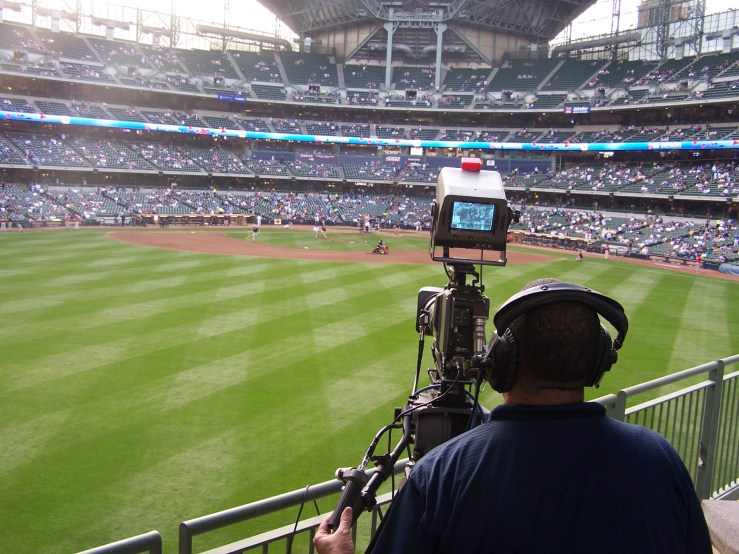
As I sit on my mysteriously stained couch watching Game 5 of the World Series, my mind wanders to the decision-making process of the game’s director, Bill Webb. He’s orchestrated 13 of these Fall Classics, with new technologies opening up more vistas of sweat and crotch grabs each time.  Webb, alongside producer Pete Macheska, makes decisions on shot selection and duration every second of the game, all of which subtly shape the viewing experience. Baseball is a game of lulling rhythms that occasionally spike into frenzied bouts of athleticism. How Webb handles the former, the batting-glove adjustments, talks at the mound, and endless foul balls, is the most fascinating aspect to his anonymous craft.

Idly charting his shot selection over the first few innings, a few patterns emerge. He averages around 5 shots per at-bat, but incrementally increases their number and cutting speed at more dramatic moments. In the top of the fourth inning, with no-one on base and a comfortable 6-1 lead, Cliff Lee is facing Nick Swisher with the count at 2-1. Webb starts with a medium shot of Swisher, cuts to a medium shot of Robinson Cano on deck, then shifts to a close-up of Lee, before settling in to the centerfield camera for the pitch. This is one of his routine setups: batter, on-deck, pitcher, pitch. It establishes the basic conflict while adding context for the next one.

Later in the inning, Webb alters his approach to match the actions of the crowd. With two outs and Brett Gardner at the plate, the crowd rises in applause to urge Lee to end the inning. Responding to the situation, Webb goes with the following shots: medium of Gardner, CU of Lee, wide shot of fans, CU of Lee, centerfield camera. In cutting back and forth between the crowd and Lee, Webb is subtly adding a narrative to this pitch, that the crowd is in a conversation with the pitcher, which he soon repays by getting Gardner to ground out to short. He generally dislikes crowd shots, and has limited their use at Fox, as he told USA Today:

‘Crowd shots I’ll do between pitches; it’s dead time,’ he says. ‘I’m not a big fan of them. During the regular season, you’ve got a lot more liberty. But in a platinum game like this, every pitch means something. You stay with what’s going on in the field.’

In other pitches, he cuts between the opposing coaches to juice the sense of conflict between each toss. He also opts for push-in close-ups on the pitcher and hitter to add an extra dollop of tension. His most aggressive technique is the split-screen, framing pitcher and hitter in the same shot, and adding the catcher’s signals in an insert between them. He thankfully uses this segmented shot sparingly. Michael Hiestand writes, again in USA Today:  “[They are] pretty busy. But, says Webb, at least viewers know what pitch is coming. And not as busy, notes Webb, as when on past Series action he split the screen four ways when bases were loaded — ‘too confusing, that was a strikeout.”

Webb also turned down the use of cameras that are suspended on cables and fly down the foul lines, which TBS used in their coverage. His aesthetic is appropriately conservative, eschewing most of the bells and whistles that Fox Sports likes to impose (their dancing NFL robot, the ill-fated glowing hockey puck), and toning down the tricks he does use:

‘Viewers may like them the first time but then the toys become redundant,’ he says. ‘The best way to cover baseball is to cover the baseball game. And the only real difference between a regular season game and the World Series is it’s more emotional. You need to make sure the technology never gets in the way of showing that emotion.’

Even in higher leverage situations with runners on base, where his shot selection is more varied, his cutting speed increases only slightly. He maintains a use of fairly long takes, even with his cut-ins (I’m curious to compare his shot length with the other networks, in case this is just the industry standard, but I suspect he’s slower than most). In only one instance did I detect any quick cutting: Ryan Howard’s walk on a full count in the first inning, where Webb  employs rapid-fire shots of the crowd, who were again riled up and waving their white towels (this was after the incredible Chase Utley and his hair hit a three-run home-run).

In a bit of serendipity, the MLB Network was showing Game 5 of the 1956 World Series, Don Larsen’s perfect game over the Brooklyn Dodgers, at the same time as 2009′s game 5. Flipping back and forth, it’s a quick and dirty way to see how camera angles effect the way one views a game. The default camera position in 1956 was an elevated view behind home plate that would pan up to catch a ball in play. There are also cameras on the first and third baselines, but they are only used for accents, either introducing a player or offering a profile of the pitcher. It distances you from the action, with no sense of balls and strikes, and no close-ups of the players. Mickey Mantle seems even more otherworldly from the back. After he breaks up the scoreless game with a mammoth home run, one feels it appropriate that his face is hidden. One shouldn’t look too close to such (drunken) godliness. The distance of the camera must have added to the mystical aura that surrounded these 50s titans.

In a fascinating article for Slate, Greg Hanlon offers a brief history of the centerfield camera, which he claims was introduced in 1950 on NBC’s Game of the Week. Apparently it took a while to become standard, but now almost every team uses this look, which provides a more intimate view of the details of the game, from the catcher’s signals to the pitcher’s fidgeting in his glove. What Hanlon explores is the distorted angle of this view, as most of these cameras are located 10 to 15 degrees off-center to left field, offering a skewed view of the ball’s path to home plate. Only the Red Sox, the Cardinals, and the Twins place it at dead center, which requires a higher camera elevation to keep the pitcher from blocking the view of the catcher. But for the majority of telecasts, including Fox’s coverage of the World Series, the view is distorted, sacrificing verity for intimacy. Hanlon says the biggest impediment to switching to dead-center views is simple architecture:

In Oakland, Calif., a wall of luxury boxes precludes placing a dead-center camera. The Crown Vision center field scoreboard provides a similar obstruction in Kansas City. In Denver, the “Rock Pile” bleacher seats make installing a dead-center camera a “seat-kill,” in producer parlance. Other stadiums have advertising signage where a camera would be placed.

ESPN attempted to install a dead-center camera for all of their 2001 broadcasts, but it was declared impractical after less than a year.

Webb simply deals with the cameras he has given, and does a wonderful job. The fact that he also directs the Mets broadcasts (my sad, sad favorite team), has no bearing on this praise. He simply stays out of the way, elegantly incorporating dramatic arcs during down time, and limiting graphic bells and whistles that clutter too many other broadcasts. All he’s missing is “..a camera operator on the fields, just to trail pitchers to the mound or batters to the box. ‘I don’t see what the problem is when there’s no action going on. … I won’t get in your way.’” Bill Webb is a master of not getting in the way.

THE SAMUEL FULLER COLLECTION, PART 2: AN INTERVIEW WITH CHRISTA FULLER

October 27, 2009

crimson kimono


Today finds me further entrenched in The Samuel Fuller Collection, a seven-disc box set which comes out today from Sony Pictures Home Entertaintment and the Film Foundation, and for which I had a hugely entertaining interview with Christa Fuller, Sam’s wife. Before I get to her exuberant personality, a few more notes about the movies…

An auteurist’s delight, the set traces Fuller’s career from assembly-line scriptwriter to writer-producer-director tyro. The leap from the innocuously pleasant It Happened in Hollywood (1937) to the delirious noir Underworld U.S.A. (1961) is fascinating, and the drips of his personality discernible in his screenwriting work from Hollywood through Shockproof (1949) and Scandal Sheet (1952) is something of a revelation. Fuller’s blunt-edged prose is handled deftly by Phil Karlson’s hopped-up realism in the latter, while Douglas Sirk’s gleaming surfaces and detached irony are an odd, endlessly fascinating fit for Shockproof, which should be some kind of auteurist case study.

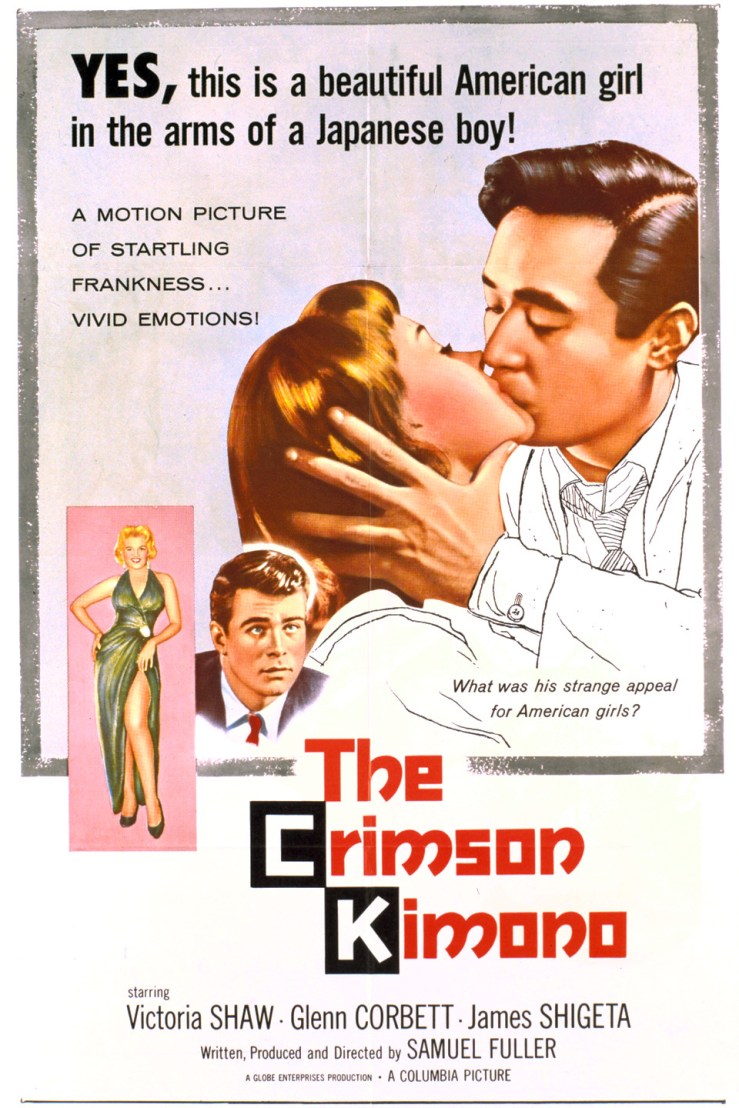
Then there is the full-on eau de Fuller with The Crimson Kimono (1959) and Underworld U.S.A. Kimono is a nuanced take on inter-racial romance shot through with Korean war guilt and stunning location photography of L.A.’s Chinatown. Underworld U.S.A. is all clenched fists and close-ups, documenting the all consuming revenge kick that takes down Cliff Robertson and anyone near him. His tormentors are thrown up as shadows on an alley wall, his own brick-screen idols that he’ll track down one by one with bitter ferocity.

Below the fold is the interview with the delightful Christa Fuller, Sam’s wife for over thirty years and a great thinker and actress in her own right (her film debut was in Godard’s Alphaville), about her late husband’s career in newspapers, the Army, and Hollywood.

What have you learned about Fuller since you completed editing his autobiography, A Third Face?

A Harvard archivist went looking for Sam’s  papers, and he found something that Sam never told me. He was married to Buster Keaton’s wife who committed bigamy. He was 26 years old, had just sold Hats Off! [1936, Sam’s first scriptwriting gig], and she dragged him to Tijuana and married him.  After he found out she was still married to Buster, the marriage was annulled. He never told me. The archivist found the annulment papers and the newspaper announcement. Buster Keaton at the time claimed he was so drunk he didn’t remember having married her.

Sam was so disgusted he never told me. He even cut her face out of a photo. It’s just her and a woman’s sleeve, and he never told me about it. I was shocked. He told me when we met in Paris that he’d never marry or go out with actresses. He hadn’t told me why. He probably forgot about it. He was traumatized by it. So the marriage was annulled, and that’s how he was briefly related to Buster Keaton.

Was Sam’s writing style influenced by his time in the newspaper business? Power of the Press and Scandal Sheet (and later, Park Row), seem to show a strong influence from this time in his life.

Totally. Sam was broken into the newspaper business by John Huston’s mother, Rhea Gore. John and Sam worked at the New York Evening Graphic together, along with Walter Winchell. It was run by Emile Gauvreau, the crazy Irishman with eight beautiful daughters (Charles MacArthur and Ben Hecht based their play and film, “The Front Page”, on him). And he was a health nut, he went barefoot from Nyack to New York every day. At the time they called the paper the “Porno” Graphic. And John Huston’s Mom, Rhea, broke Sam into crime reporting. John said he spent more time with his mother than he did. Rhea, even though she divorced Walter Huston and married into a railroad fortune, continued working as a newspaper woman. She was very ballsy, cutting through red tape, bribing cops to get the story. She’s a Sam Fuller character herself.

John didn’t get along with his mother, left the paper, ran off to Hollywood and started writing for William Wyler. He came to Hollywood before Sam. Sam started as a copyboy for Arthur Brisbane, one of the most powerful men he worked for. He was the brain behind William Randolph Hearst, and Sam was his personal copyboy when he was 14. Hearst wouldn’t make a move without him. Sam lost his father when he was 11, and Brisbane was a father figure to him. Sam had a lot of these father figures.

The newspaper office was like his living room, growing up…

Totally! Sam always wanted to run his own paper somewhere in New Hampshire and write his own editorials, and convey his own vision of the world.

What did Fuller think of some of the early adaptations of his work, like Power of the Press?

There’s some great dialogue in that. Like “Freedom’s dynamite, it to be handled with care”! It does sound like him. Scorsese said that Sam was so deeply American, the kind of America that is vanishing. When we lived in Europe together, it always struck me that Sam was innocence abroad. I think he was kind of like a Mark Twain character. Europeans have layers of perversion, and Sam was really innocent there.

What was his relationship like with the studio heads, and how did he manage to get such envelope-pushing material onto the screen, like the relationship between a Japanese-American man and a white American woman in The Crimson Kimono?

Such a beautiful film. Alain Resnais made Hiroshima Mon Amour around the same time, about a white woman with a Japanese man. The same year an article in an Oxford newspaper dubbed TheCrimson Kimono as “Los Angeles Mon Amour.” The head of the studio said to Sam, why don’t you make the white guy a little bit on the mean side, so we understand why she prefers the Japanese man. And Sam said, hell no. They have a lot of affinities, they’re both nice guys, fought in Korea together, and I’m not making the white guy on the mean side so the bible belt will buy it.

In Forty GunsSam wanted the heroine to die, and at the end he should have to shoot her, the woman he loved. Zanuck said “Barbara Stanwyck is a star, you cannot kill the star.” So Sam had to attach a happy ending. He had to compromise, they all had to. But Sam was a very moral guy. He never lied. He berated himself, undervalued himself. He didn’t want to marry me, saying “I’m 54 you’re 22, I don’t like younger women, ten years from now I’ll be an old fart, I’m a has-been.”  He talked himself out of it. He didn’t promise me anything. Because he didn’t bullshit me, I stayed with him. It’s hard to take, but it’s easier on a relationship. And that was courageous. Maybe it was the courage of a fool, but it worked.

He didn’t promise me lines in his films. I had to give up many of my own ambitions to make the marriage work. Even though Sam was a feminist and worked with women, it’s such a nerve-wracking business. I did squeeze in a master’s degree in literature and taught French for four years, and started a doctorate on Samuel Beckett. But then this White Dog thing happened, and we moved to Europe, and I never finished it. Instead I finished Sam’s autobiography.

Will you go back to the Ph.D.?

No, I’m still intrigued with Sam’s characters. I love Beckett, but there’s something so modern, so way ahead of his time in Sam’s work. I’m intrigued by he got away with it, and through so many ups and downs. Why do they call a European movie an art movie and his movies B-movies?

Howard Hawks bought the rights to Fuller’s first novel, The Dark Page, could you talk about that time in his life?

Hawks bought the novel while Sam was still in the war. I’ve got a letter Hawks wrote to Zanuck raving about Sam’s writing, and he bought the novel. This is one of the items I posted on the fan page for The Dark Page on Facebook. They republished the book last year in Scotland, the same company also re-published No Bed of his Own, by Val Lewton , the producer of Cat People. The first time he saw his book in print was in an army edition of The Dark Page, which ends up as a scene in The Big Red One.

Was Sam upset when Hawks sold the rights to his book to MPI?

Hawks was a businessman, Sam wasn’t. He bought it for 15 grand, and I think he sold it for 100, netting 85. He wanted to do it with Humphrey Bogart and Edward G. Robinson before it fell through. Of course if you’re a writer and Hawks buys it, and you’re young…

The plot is similar to many of his works,  including his novel Crown of India, where an older man trains a younger man, teaches him the ropes, and then the younger man has to expose the older man, and use his lessons against him. Totally Oedipus. The son always wants to outsmart the father. I’ve seen it with all the young directors that came and almost destroyed Sam, some of them. They always wanted something. There’s no innocence when somebody comes and says, “I admire you.” Sam was a very simple person, he never wanted to become a cult figure. Truffaut said about Sam that he’s simple without being simplistic, and that’s very rare. Well said.

Curtis Hanson was one of the nicest disciples. We knew him when he was 18 years old, when Sam and I first got married, he always knocked on Sam’s window. He wound up spending hours with him. Then there was Peter Bogdanovich. Sam helped him write Targets. Peter acknowledges it, but Sam didn’t want any credit.

Sam had his own father figures, but Sam was a gentleman, a civilized man, and I could see how he handled his Oedipus complexes. He never destroyed these father figures. He had all kinds, from Arthur Brisbane, and later on when he came to Hollywood, Peter Pan – Herbert Brenon, was one of his first. The German director E.A. Dupont, who directed Piccadilly, who helped him on I Shot Jesse James, was another. John Ford was one as well.

What was Sam’s relationship with Ford?

Ford loved Sam as a writer and always wanted to work with him. Sam thought John was the greatest director in the world. He worshipped him. John was very proud of Sam, and would call him every year on D-Day and say, “Fuck the Big Red One!” That was a running gag because Ford was in the Marines. Sam just had an unlimited admiration for him – he’s pure Americana.

Another father figure was General Terry De La Mesa Allen. He made the cover of Time and Newsweek. He was so famous at the time. All the dogfaces, all the soldiers loved him. He fought alongside them. He was so famous John Ford pleaded with Sam to meet him. Sam organized a luncheon or dinner, and I have pictures of Ford with General Allen. When he made the covers of Time and Newsweek, he was so modest. “I’m no hero”, he said, “dead men made me a general.” Listen to that line. Gives me goosebumps.

That sounds like a line right out of one of Sam’s war films…

He influenced Sam the most. All these years of battle, and Sam volunteered for it. People tend to forget, that when Sam volunteered in WWII, he was a writer and an artist. The whole war scene hit him differently than other soldiers. I think that Sam’s nervous system was shaken forever. People forget that he was in every major battle in WWII, including Omaha Beach. And war hysteria never left him. Sam had a very short fuse. People are never the same after an experience like that, for the rest of their lives.

Did he ever talk to you about his battle experiences, or was it something he kept to himself?

No, he talked about it constantly! That’s why people thought he was a macho guy, but Sam was very sensitive, he cried before me when we saw a film. And I think he was covering up his sensitivity by talking like he did, about killing Nazis and such. He really suffered for the rest of his life from war hysteria.

You acted in Dead Pigeon On Beethoven street, one of his lower budgeted European productions (for German TV)…

It was Pulp Fiction twenty years before Pulp Fiction. Sam always wanted to make a comedy, and this was a private eye spoof made for German TV. Sam couldn’t make a realistic German film about German cops. What does he know? And what is realism anyway? Wim Wenders said you should strike the world realism from the dictionary. At the time they had the Profumo Affair, where two call girls brought down the English government. So Sam wrote me a part of a girl who sets up politicians and blackmails them. At the time, Fassbinder, who was so obsessed with American cinema, he showed Sam that he made a Western. And it was awful. He showed it to Sam, in Cologne.

Never released?

No. And Fassbinder wanted to play the part of Charley Umlaut in Dead Pigeon, but they had already cast the role. The English loved it, they thought it was funny, it played at the London Film Festival. But the French, they expected Sam to make a straight film noir. You always get pigeonholed. Because Sam fought in WWII, he was punished for it. He had to do straight film noir. They wouldn’t let him do comedy, and he had such a great sense of humor, and such a great sense of the absurd.

Thieves After Dark was booed at the Berlin Film Festival in 1984, when John Cassavetes got the Golden Bear for Love Streams. But John loved the film, and we wound up spending the whole night with John and Gena Rowlands eating herring and drinking beer. And he said, “I loved the picture”. And I guess the French didn’t like the idea of Sam making comments about French unemployment. I saw it again, and it’s a very good film. They have a love-hate relationship with Hollywood. I remember when I was there, and they called John Ford a fascist. I just hated it. After I met Sam I saw Shock Corridor with a friend of mine who was a movie critic, and he said “Fuller is a genius, but he’s a fascist”.  Sam was the opposite of a fascist.