THE GERMAN POSTMAN ALWAYS RINGS TWICE

June 2, 2009

jerichow

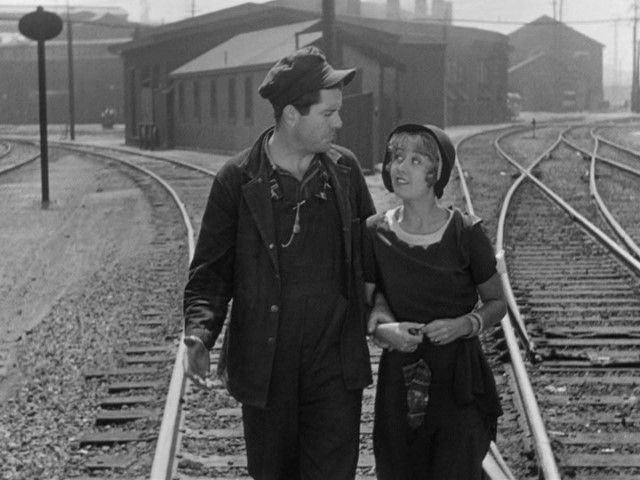
Ah, the love triangle. Perhaps the most cinematic of storytelling devices, it can be effortlessly visualized in combative group shots, a trio of conflicting motives expressed in daggered glances and dewy-eyed stares. The most venerable of these tales is told in James Cain’s novel The Postman Always Rings Twice (1934). First adapted by Pierre Chenal with the little known  Le Dernier Tournant (1939), it was then transplanted to fascist Italy in one of the earliest neorealist films (without authorization) in Luchino Visconti’s Ossessione(1943) , until it was buffed clean by Lana Turner and director Tay Garnett in 1946. It was given an explicitly sexual, neo-noir makeover by Bob Rafelson in 1981, and with that the murderous adultery had seemed to run its course. But the much buzzed about German auteur, Christian Petzold, has taken a stab at the material with the mournful and spare Jerichow.

Petzold is classed with the Berlin School of filmmaking, a movement associated with three directors (Petzold, Angela Schanelec, and Thomas Arslan) who “graduated in the early 1990s from the Berlin Film and Television Academy (dffb), and were taught by avant-garde and documentary filmmakers Harun Farocki and Hartmut Bitomsky.”  A loose grouping of similar-minded filmmakers have also been folded into the group (Valeska Grisebach among them), which was coined by German film critic Rüdiger Suchsland. The group, as Marco Abel has stated, pursue an “esthetics of reduction” that is on full display in Jerichow. The filmmakers prefer to show instead of tell in their rigorously understated stories. Petzold focuses on the first half of Postman’s story, that is, the planning and attempt to murder a pretty young housewife’s husband. The duplicitous courtroom drama, which takes up the rest of the book, is eliminated, and the tragic ending is refigured to emphasize the lovers’ moral hell. It’s instructive to compare it to the Hollywood version, which hews closer to the letter (if not the spirit) of Cain’s original.

The template is the same for both: a middle-aged drifter finds a job with an aging businessman and his dissatisfied wife. Petzold tweaks this setup to engage with his time and place: instead of working at a roadside diner, the drifter (Thomas – Benno Furmann) works for a döner chain. His employer is a boozy Turk named Ali (Hilmi Sözer) who has violent side. The ’46 version figures the husband as a more lovable, passive drunk (Cecil Kellaway), and is completely absent of the ethnic tension that rumbles underneath Jerichow. Thomas has just been dishonorably discharged from the army, and falls in with Ali by accident, a striving immigrant who has started a thriving chain of snack bars around the town of Jerichow. The traditional power structure has been flipped, but Petzold leaves this unspoken, buzzing silently underneath the doomed romance (according to a recent study, the Turks are the least integrated immigrant group in Germany, despite being the second largest in number). And instead of the spoiled pretty girl of Lana Turner’s Cora Smith, Nina Hoss’s Laura is an exhausted, weathered survivor. Deep in debt and rescued by Ali, her middle-class existence is both prison and salvation.

Aside from Jerichow‘s narrative elisions, the biggest divergence from the ’46 version is stylistic. It is interesting to see how much the equipment defines style – as Garnett’s Academy ratio image necessitates cramped, frontal groupings, while Petzold’s 1.85 widescreen frame lends his triangles to form deep into the frame. The beach scenes are pivotal. Soon after they first meet, Ali invites Thomas for a picnic on the beach with his wife Laura (Nina Hoss). Ali tipsily traipses to the edge of a cliff, slips, and hangs on for dear life. Petzold had already established Laura’s POV on Thomas standing on top of the overhang, and now he machine-guns a quick shot-countershot between the two – before their attraction has been consummated. This sequence, both in its choreography and editing, will be repeated at the end of the film, which subtly underscores the psychological changes that occurred between the two bookend sequences – the look that led to Thomas hoisting Ali to solid ground, later takes place during their clumsy murder attempt. The landscape remains the same, but the psychological landscape is riddled with guilt.

Hollywood’s Postman buzzed on Lana Turner’s glamor and little else. Tay Garnett didn’t have much of a visual sense, but it’s a tribute to the studio system that this rather uninspired piece of noir still contains multifarious pleasures, not the least of which is Lana Turner’s purring presence and Hume Cronyn’s wonderfully oily defense attorney. But it is not nearly as complete a work as Petzold’s Jerichow, which has the visual patterning to match it’s narrative – the value of the Garnett is only at the edges, while Petzold cooly burns as a  story-image-acting whole.
 

THE LATE FILM: RED LINE 7000 AND EL DORADO

May 26, 2009

s-l1600

In introducing El Dorado at the Brooklyn Academy of Music, Andrew Sarris bemoaned  Howard Hawks’ future. He peered silently at the sparse crowd, and declared that the turnout was unsurprising. The recent class he offered on Hawks at Columbia University, he told us, was the least popular of all his auteur courses. Where have all the Hawksians gone? Well, I’m right here, and BAM tried to draw them out in their recently concluded program, “The Late Film”, which screened Red Line 7000 and El Dorado on consecutive nights, a crash course in late Hawks and a lesson about what cultures decide to preserve and forget.

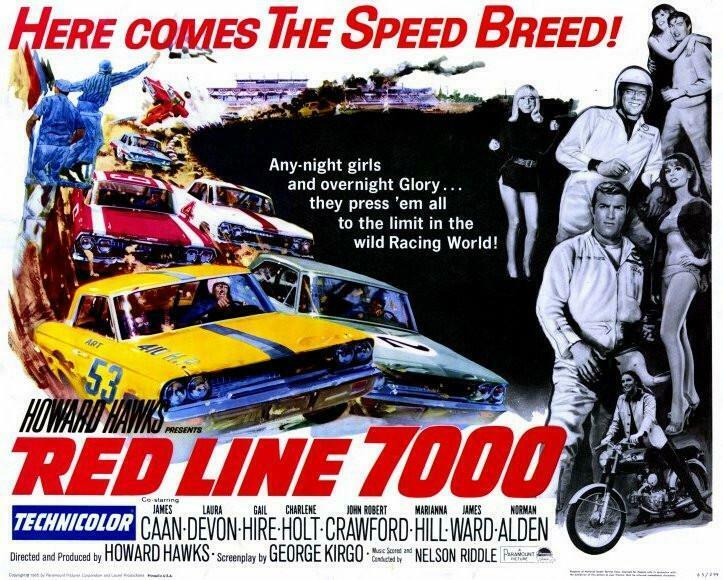
Buried on a double-bill with the youth-baiting Beach Ball,  Hawks’  Red Line 7000 completely tanked upon its release in November of 1965. It quickly disappeared from popular culture’s memory, despite the best efforts of Hawksians like Robin Wood. Production on his follow-up, El Dorado, began in October of the same year, the fastest turnaround between projects in his career (principal shooting on Red Line ended in April of ’65).  This thinly-veiled Rio Bravo remake was a box office hit upon its release in 1967, and has been a staple of cable channels and home video re-packagings ever since (the latest DVDcame out last Tuesday). Red Line 7000 has remained incredibly difficult to see, aside from the ever-present fuzzy bootleg videos.

The forgetting of Red Line 7000 was enabled by Hawks himself, who slagged the film over multiple interviews. In 1971: “I don’t like it.” In 1974: ” I didn’t like it, I thought it was awful.” In 1975: “I think it’s lousy.” His main complaint has to do with the narrative construction, which tries to weave together three different romances:

Just when you get people interested in one story, you jump to another story. Just when they’re interested in that, you jump to another. By that time they’ve forgotten the first one. They’re all mixed up and they say, “The hell with this thing!”

The nominal lead is James Caan as Max Marsh, an ace driver with deep neuroses regarding the purity of his girlfriends. He’s both attracted and repulsed by Marianna Hill as Gabrielle, an uninhibited racing fan who recently broke up with another driver, Dan McCall (James Ward). After their amicable parting, McCall pursues Holly (Gail Hire), a superstitious, mournful type who blames herself for the deaths of her three previous lovers. The third story is more tangential: that of the tomboy daughter of the crew chief (Laura Devon as Julie) in love with the strapping young driver Ned (John Robert Crawford).

Robin Wood called Red Line 7000 “the most underestimated film of the sixties”, partly because of the structure Hawks so derided:

The fact that the Ned/Julie relationship is so little integrated in the main action is not really the structural fault it at first appears. The other two relationships are parallel: in both, a strong, mature partner (Dan, Gaby) helps someone whose development has been arrested (Holly, Mike); the threads of plot continually interweave. The Ned/Julie relationship offers a contrast, and Hawks keeps it separate. Here, both partners are immature.

I believe Hawks and Wood are both right, that the film is both “lousy” and “underestimated”. The structure has interest, as Wood indicates, but it doesn’t have the performers to put life into its motions. Actors are incredibly important to Hawks, as so much of his script is improvised or written on the set with their participation. Without their engagement, his lived-in community of professionals becomes a cold line-up of earnest-sounding mannequins.

Gail Hire is the most embarrassing here, her labored rasp a caricature of Bacall’s rumbling bass in To Have and Have Not. It’s so ridiculous the audience I saw it with broke out into laughter, and I couldn’t blame them. James Ward and John Robert Crawford  are just blond-haired, blue-eyed blanks, showing none of the charisma or camaraderie essential to Hawks’ work. As Todd McCarthy states in his exemplary biography, he “labored to make the story and the actors come alive. Because of his case members’ limited experience, Hawks got much less creative input from them than he normally liked, and he had to deal with burgeoning egos.”

The film only comes alive in the Caan-Hill sequences, which show the combative sparks of his greatest romances. Hill’s insouciant sexuality baffles Caan’s repressed straight-arrow, and their mutual attraction can only be consummated on the race track. In a beautiful sequence where action replaces exposition, their combustible sexuality is revealed when he lets her take a spin around the track. Through his studied direction, she flawlessly takes the turns, until she spins out joyfully at the end, laughing violently. She tells him it was like “taming a lion”. Having to control Caan’s unstable boy is her dangerous task for the rest of the film. Hidden like a pearl for eager auteurists, this scene both confirms Hawks’s directorial hand and stands as a reminder of what the majority of the film was missing.

El Dorado is something else entirely. It has the feel of a valediction, a re-telling of Rio Bravo (1959) that takes aging as it’s central theme. John Wayne returns to the Hawks fold as Cole Thornton, an old gun-for-hire who rejects a job from corrupt landowner Bart Jason (Ed Asner). Robert Mitchum plays the town’s alcoholic sherriff, J.P. Harrah (the Dean Martin role in Rio). James Caan and Arthur Hunnicut round out the group of ragtag heroes, who try to protect the MacDonalds, a local farming family, from the predations of Jason’s acquisitive clan. Mortality is brought to the fore immediately, when Cole shoots down a MacDonald kid out of self-defense. Mortally wounded, the boy kills himself to end the pain. This random act haunts the rest of the film – it leads to the bullet lodged in Cole’s back and in J.P.’s leg, persistent reminders of their physical degradation.

If it is not as perfect as Rio Bravo – one certainly misses the presence of Walter Brennan and Angie Dickinson – for me it is as equally affecting, especially when viewed in the context of Hawks’ and Wayne’s career. As they slowly pirouette through the well-worn jokes one more time (Dry out the drunk, patronize the kid, prod the old coot), it is tinged with sadness – the bullet pressing closer to Cole’s spine with every move. It’s impossible to overstate the grace of John Wayne’s performance here, the hint of grief he exudes when Caan is searching for a gunman, the stoic regret he portrays after he kills the MacDonald kid, and the luxurious slowness in which he moves, whether simply sliding off a horse or leaping off a carriage, he carries the weight of his age with him. It’s a beautiful performance. There’s no grand send-off at the end, just a couple beaten old men, wobbling down the main drag and soaking up every last light of the moon.

MARTIN SCORSESE’S WORLD CINEMA FOUNDATION (AND FRIENDS)

May 19, 2009

1e791feb6052e280cc2a3cbaa55b75fb

Even if Martin Scorsese had never sat behind a camera, his heroic efforts at preserving film history would have earned him a spot in the cinematic pantheon. The biggest news out of the Cannes Film Festival this week, at least for nerds like myself, was the announcement regarding Mr. Scorsese’s World Cinema Foundation, which restores rare international films selected by a board consisting of directors like Wong Kar-Wai, Guillermo del Toro, and Abbas Kiarostami, among others. Film Comment editor-at-large Kent Jones was introduced as the new executive director, and a new distribution relationship with the “on-line cinematheque” The Auteurs and the Criterion Collection will allow these restorations to be viewed widely.

The Auteurs has already begun streaming four WCF films for free, and Cannes is currently screening four classics they’ve refurbished, including Edward Yang’s masterpiece, A Brighter Summer Day (Michael Atkinson has a lovely new piece up at Moving Image Source regarding it). This is in addition to Scorsese’s English language restoration arm, The Film Foundation, which produced a new print of Powell and Pressburger’s The Red Shoes now screening at the festival, and who also pushed forward the essential Budd Boetticher box set released last year. It’s an astonishing effort at keeping history and cinephilia alive. (for more info, check out GreenCine’s podcast with Scorsese and Jones).

Sure, this news is not as exciting (and shocking!) as the coverage of the genital mutilation scenes in Lars von Trier’s latest provocation, Antichrist (which has dominated the Cannes stories this year), but it might have a slight edge in having a long-term impact on film culture. In my first attempt at digging in to the Foundation’s riches, I watched two of the features on The Auteurs, Kim Ki-Young’s The Housemaid (1960), and Metin Erksan’s Dry Summer (1964).

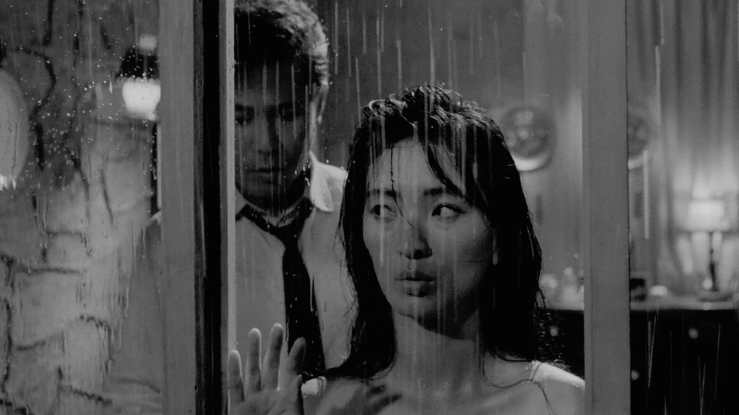
The Housemaid pulses with a delirious sexuality, focusing on the queasy thrills of smashing moral boundaries and the horrifying retribution that ensues. Kim sets the visual stakes in the opening shot: a track that pushes from outside a window into the piano room of the family’s house, establishing the idyllic, post-Korean war family before settling into a close-up of the cat’s cradle the kids are twiddling with. Cue title card. The journey of the camera mimics the later movement of the unnamed housemaid (Lee Eun-shim), whose entrance into the father’s domain signals the end of domestic bliss, and the entrance into a inescapable cat’s cradle-like net of ethical degradation.

Images of decay soon take over, usually tied to the family’s acquisitveness. The kids play on a staircase of their unfinished house, with two-by-fours looming over them. Their daughter, Aesoon, has to walk on crutches because of a mysterious disease, and their kitchen is beset by a plague (OK, just a couple) of rats. The father buys his daughter a squirrel for a pet, that particular type of rodent more acceptable for being purchased. Kim has things play out mostly in two-shots, but pushes in for the telling detail. The dad, a meek piano instructor, is teaching a young female admirer, and Kim cuts in to his hand cupping hers on the keys. This is when the new maid is seen creeping outside the window, spying on this strangely intimate lesson. Peering meekly inside, her unease growing, Kim cuts to a close-up of two rats writhing on a plate slathered with poison. No half-measures here, as the father’s passive psyche is ravaged by the sexual impulses he can’t control. Once the camera goes inside the house, the perversity can’t be contained, and Kim orchestrates an appropriately grand guignol ending.

Dry Summer, which won the Golden Bear at the Berlin Film Festival, is a more naturalistic tale from Turkey that deals with self-destruction. Except in this case it’s arrogance rather than passivity that is the central character’s undoing. Selected for the WCF by director Fatih Akin (Head On), it’s an unstinting portrayal of Turkish masculinity, instantiated in the person of the mustachioed Osman (in a deliciously bombastic performance by Erol Tas). A tad portly, and often shirtless, Osman wants what’s his, regardless of the consequences. So when he declares that the village spring is on his property, he’s fully prepared to defend it to the death after denying the other villagers access to it.

This capitalist swine is often framed in extreme close-up, exaggerating his already caricature-ready features (wide nose, bushy moustache, droopy eyes) into a monstrous ass. Erksan even gives a donkey a similar close-up to cement their physical and emotional similarity. There’s a playful air to this monster, but he’s never portrayed to be anything else, whether tossing a recently severed chicken head to frighten his sister in law, or leeringly imbibing milk as he stares up her skirt. His look is what dominates the film, and his strapping brother’s wife, Bahar (Hülya Koçyigit), is the focus of his gaze. The clash over the public/private use of land is the arc that weaves through the whole film, but Osman’s vision of masculinity is the major subplot – of his ravenous thirst for land, money, and power – regardless of the cost. So when the villagers come to ask for the water, he tosses a pail at them. When they say they’re willing to buy a portion of it, he lends an ear.

It’s not worth giving away his most devious act, since you should watch it for yourself, but suffice it to say that the donkey wouldn’t have stooped to such levels. Tas is so brilliant in articulating his character’s childlike self-absorption that it often seems more like a comedy than a tragedy, but a final act reckoning tips it firmly into the latter, and it stands as a uncompromising critique of masculine aggression, while also being shaded enough to appreciate the guile it takes to be so evil.

I had heard of The Housemaid before, but had no idea that Dry Summer existed. The fact that there is an organization out there willing to restore and distribute this kind of material – artistically exciting but commercially nonviable – in this kind of economic climate, is nothing short of miraculous.These works have me primed for the other films in their pipeline, including Al Momia (1969) from Egypt , Redes (The Wave) (1936) from Mexico, Limite (1931) from Brazil, and Forest of the Hanged (1964) from Romania. Their motto is, “Dedicated to the preservation and restoration of neglected works around the world”, which sounds like something I’d come up with in a fever dream from my more idealistic school days. Apparently Scorsese has been sharing my dreams, except he has the capital and wherewithal to do something about it.

Further Reading: Michael J. Anderson at Tativille

SUMMER BLOCKBUSTER: JOHN WOO’S RED CLIFF

May 12, 2009

zhang_wide-a3b4092002f9eba5e779c7728e9c9f05ece60276-s800-c85

The summer behemoths are upon us, and it’s impossible to look away. They leer at us from every billboard and fast food collector’s cup, daring us to ignore them and get shut out of the pop-culture conversation. They know we’ll cave, god bless their arrogant little hearts. So before I watch the shiny new Star Trek, and get sucked into the vortex of box office predictions and whiplash inducing action sequences, I wanted to put a kind word in for another blockbuster that has yet to reach our shores, John Woo’s epic two-parter, Red Cliff. Part 1 is already the highest-grossing film in China’s history, and the sequel came close. Released six months apart in July ’08 and January ’09, they’re a rousing adaptation of the Romance of the Three Kingdoms , a historical novel detailing the end of the Han dynasty.

The production marks Woo’s triumphant return to Chinese cinema after a decade-plus in Hollywood. He set the template for 90s action films with his HK triumverate of The Killer (1989), Bullet in the Head (1990), and Hard Boiled (1992), and it’s hard to overstate his impact – everybody from Michael Bay to the Wachowski Bros. to Hype Williams lifted his highly choreographed pistol operatics.  His kinetic talents were generally wasted in the states, despite some individual flourishes in Face Off and Mission Impossible 2. An artistic breakthrough came with Windtalkers (2002), his most overlooked, and his best American film. There’s a narrative density here that looks forward to the intricate relationships of Red Cliff, laid over his matchless skill for choreographing large battle sequences. His concern with professional male relationships remains, as Nicholas Cage’s tetchy marine and Adam Beach’s Native American code writer test their loyalties and reach an uneasy alliance, just as Chow Yun-Fat and Tony Leung did in Hard Boiled. Only here it’s set against a shifting WWII backdrop and a far more disparate array of characters.

Red Cliff is an extension and near-perfection of this epic-intimate moviemaking, using the personal friendship/rivalry between Tony Leung (as Zhou Lou) and Takeshi Kaneshiro (as Zhuge Liang) as the fulcrum from which to leap into the massive tale of the war of the Three Kingdoms. The plot concerns the immature Han emperor giving license to a dictatorial general, Cao Cao (Fengyi Zhang), to subdue the Western and Southern regions of the country, which were otherwise peaceful. Zhou Lou is the viceroy of the southern state, Wu, while Zhuge Liang is the military strategist for the kingdom of Xu, in the West. The two regions form an alliance in order to fend off Cao Cao. An interesting element introduced by Woo and his fellow screenwriters is that of parallels to modern counterinsurgency theory.

The head of Xu emphasizes protecting the civilian population at the expense of winning an initial battle, while Cao Cao’s imperial ambitions have him waging a pure counterterrorist operation – his only intent is killing and capturing his opponents, not winning hearts and minds. There is also commentary about Cao Cao’s overstretched and overworked army, some of whom just work for money (a nod to Blackwater, etc.) If one were to take a US-centric reading of the film, Cao Cao would represent U.S. military strategy under Gen. George Casey and Rumsfeld, and Zhou Lou and Zhuge Liang the strategy of Gen. Petraeus and Robert Gates. Judah Grunstein takes this tack at World Politics Review.

While to take the film as a straight-up allegory of U.S. policy would be overly simplistic, it certainly places paramount importance on military strategy generally. Kaneshiro’s character never engages in battle, but his ingenious war plans make him a major figure in the film. Red Cliff places great emphasis on this kind of tactical preparation, and every fight is preceded by thorough examinations of the battlefield and different modes of attack. It’s a very grounded vision for a historical epic, but it is also what gives the war scenes such lucidity – Woo makes them battles of the mind as much as of the body.

The script balances these two forces in the bodies of Kaneshiro (mind) and Leung (body). Leung is the gallant leader, expert swordsman and diplomat, while Kaneshiro always stands to the side, trying to predict Cao Cao’s every move. Woo consistently carves out different spaces for them on screen, separating them in dramatic symmetrical compositions like the ones below. Zhuge Liang and Zhou Lou are well aware throughout that after Cao Cao is defeated, their two nations will immediately be in competition – it is this kind of subtlety that adds richness and deviousness to their relationship.


Once the battle scenes begin, Woo’s old choreographic mastery comes to the fore. In an ingenius bit of visualization, Kaneshiro, perched high above, witnesses an infantry troop exercise. When massed, the camera cuts in to his POV, and his feathered wing fan flashes out before us to cover the troop formation in its exact dimensions.

Later, Kaneshiro is shown holding a small tortoise, which later proves to be the inspiration for a large operation where troops use their shields to form an improvised shell, decimating the opposing cavalry with devastating spear blows thrust from inside. These nature/war formation metaphors point to the importance of nature (topography, etc.) and the elements to any fight, and the final, incredibly bloody finale depends entirely upon the direction of the wind. This is a clever structure, a few visual notes emphasizing nature foreshadow the plot function (the wind) that will become so important later.

I’m only scratching the surface of this 4 1/2 hour work. I haven’t mentioned the atonal samisen jam, the wonderful performance by Wei Zhao as an impish princess who turns out to be a resourceful spy, the lively caricatures of Xu’s generals, and the ingenious way Zhuge Liang supplies 100,000 arrows (fog and scarecrows are involved). It’s surprising how rich the film turned out under less than ideal production circumstances. Famously, Chow Yun-Fat pulled out (he was to play Zhou You) before shooting began, and tragically, a stuntman died and six were injured during a particularly dangerous action sequence. Producer Terence Chang bemoaned his choice of special effects crews (which are, admittedly, subpar), and the script took years to write.

That a work of art was produced out of this is an incredible accomplishment, and hopefully Sony Pictures finds it in their hearts to release it stateside.  It was rumored that it would be released in a condensed, 2 1/2 hour version, but now even those murmurs have ceased. UPDATE:MAGNET FILMS (A SUBSIDIARY OF MAGNOLIA), HAS JUST PICKED UP RED CLIFF FOR DISTRIBUTION IN THE US. IT WILL RELEASE A CONDENSED 2 1/2 HOUR VERSION IN THEATERS (boo!), AND THE COMPLETE FILM ON DVD AND VOD).  In any case, the DVDs are readily available at a Chinatown near you, or at reputable e-tailers like HKFlix and YesAsia.


THE SEARCH FOR NATURALISM: CELINA MURGA

May 5, 2009

ana_y_los_otros_celina_murga

To coincide with TCM’s month-long series, Latino Images in Film, the n’er do wells here at Movie Morlocks will devote this week to an impassioned blog-a-thon on Latin American cinema (and Latin Americans in cinema…happy Cinco de Mayo, by the way). As it happens, my eyeballs have been drawn to a number of phenomenal Argentinian filmmakers recently, including Lucrecia Martel (whose mind-melting The Headless Woman gets a limited release in August) and the nomadic Lisandro Alonso. The lady I’d like to focus on here, though, has yet to land US distribution for either of her two superb features, and deserves far more of a spotlight: Celina Murga.

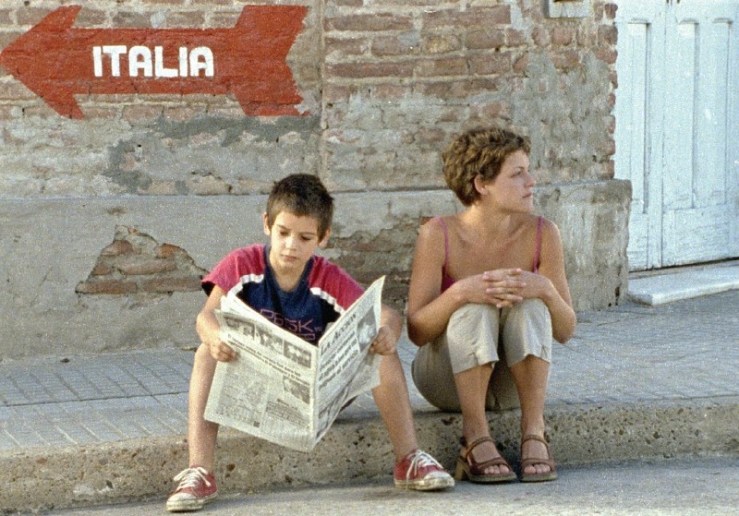
Murga was born in Paraná, in Argentina’s Entre Ríos Province. She fell for cinema after reveling in Godard’s Breathless, and raced to Buenos Aires at the age of 17 to enter film school. After gigs at a production company, her university, and as an assistant director, she completed her debut film in 2002. A remarkably assured feature, Ana and the Others (Ana y los Otros) nails the peculiar alchemy that takes place when returning to a hometown after years away. The familiar is turned strange, and Ana wanders her city like a bemused tourist, inquiring after a photo shop (no one remembers it), and deflecting questions about high-school classmates she barely remembers. Murga takes a distanced approach, filming Ana (Camila Toker) in long shot, either in static frames or steady pans and tracks. Her motivations are unclear, and it is only well into the feature before we realize she’s back in town for a class reunion.

The film is marked by a touching uncertainty, the loss of home analogous to a lost version of yourself. It’s eventually revealed that her main reason for coming home is to search for an old flame, Mariano. As she sifts through her memories, of fainting at her first (and second) kiss, while also selling her family home, past, present and future merge together in a deeply moving way. Her search for Mariano is clearly a search for home, for rootedness, and it’s the maturity of this debut that keeps their reunion from our view. Coping with the past is an on-going process, and Murga wisely declines to give closure. A personal work, it’s set in Paraná and echoes Murga’s own travels, and resonates, I’m sure, with just about anyone who’s left home. (Ana and the Others was released on DVD by VeneVision, but is now out of print. It’s readily available on various online retailers though).

Five years later, Ms. Murga poked her back onto the festival scene with A Week Alone (2007), another enigmatic narrative located in the Entre Rios province, but this time set in a gated community. With their parents away on vacation, an extended family of teens and toddlers wander around their posh existence with bemused obliviousness. The world outside is a stranger. Maria, the oldest, had actually been to Buenos Aires, but didn’t like it. In controlled tracking shots similar to Ana’s, Murga delineates their daily routines with exactitude, from the order they walk to school to their instinctive reliance they have on their maid (ask them to make their own Nesquik, and they flinch). With the complex’s armed guards and pools, it feels like a fascist club Med. Their life is a closed-circuit, and as such, a romance flickers between two cousins. Outside entanglements don’t exist.

This theme of upper-class isolation is subsumed under the beauty of Murga’s patient eye, and the studied naturalness of the performers. Cahiers du Cinema published a diary from Murga, and she explains how she weaves this spell:

In my shoots, I often have the sensation that I am capturing something unique, that I’ve got to be constantly on the look out for that moment of unique truth that an actor might just produce. I say truth in the sense of the real…that I’m also giving documentary testimony to what’s going on…beyond the limits of the screen. This doesn’t mean there’s less construction or less control. I think that has to do with the search for naturalism. At times I feel like my work is all about the preparation of fertile ground so the truth that’s hidden in a scene…can really spring forth and blossom.

This formulation echoes Orson Welles’ famous quote that, “The director is simply the audience…his job is to preside over accidents.” Prepare the ground, wait for miracles. This rigorousness and openness, her exacting framings coupled with an openness to improvisation and other “accidents” is the tension that gives her work such amazing vitality. The characters avoid any stereotyping, as Murga teases out their natural charisma. This is not a hatchet job on the blue bloods, but a serious, nuanced interrogation of a class cold war.

This vitality comes to the fore when the maid’s brother, Fernando, intrudes upon the children’s upper class life. They don’t know how to speak to him, leave them out of their games, and give him a wide berth. The only figure capable of bridging this gap in the film is the youngest girl, Sofi. Murga lays out her humanist tendencies throughout – sleeping in the maid’s room, questioning her about her religion (this subdivision is thoroughly secular) and urging her to display her singing voice. As with Ana, there is no tidy conclusion. The class fissures crack wide open, but Sofi offers a hint of reconciliation, or at least understanding. It’s a moment of grace in this otherwise hauntingly ambiguous social fable.

While she was busy completing A Week Alone, Murga was selected for the 2008/2009 Rolex Mentor and Protege Arts Initiative, where she was paired with Martin Scorsese as a mentor. Along with getting his feedback on her work, she was able to accompany him on the set of his next feature, Shutter Island, which is the period from which her Cahiers diary was derived. Scorsese offered to help Murga shop A Week Alone, and his name tops the credits (“Martin Scorsese Presents”). She’s working on a new project, The Third Side of the River, which is about a minor who confesses to a murder, and the distinct possibility that he is lying about it. It would seem to extend her interest in childhood, the ambiguity of motivations, and looks to continue her social critique of the Argentinain state. With the influence of Scorsese in her head, this could be incredible. Bring it on.

HOW I LEARNED TO STOP WORRYING AND LOVE GOING OUT OF BUSINESS SALES

April 28, 2009

battleground dvd review van johnson PDVD_013

Brick and mortar retail chains keep going bankrupt, so much so that there’s nowhere to buy DVDs near my cozy home or slightly less cozy workplace. That twitchy urge to buy movies on the day of their release will have to be repressed, and Lord only knows how this will effect my already questionably sane psyche. Tower Records buckled in 2006, Circuit City tanked last year, and now the Virgin Megastores are liquidating their inventory before disappearing into the great big box store in the sky. There’s still a few scattered Best Buys, with their limited Hollywood selection, and some Barnes and Nobles, with their inflated prices, but none near me, not that they’d salve my pain anyway. Kim’s Video, that venerable NYC outlet, is attempting to survive as a retail-only store after selling their rental archive to Sicily, but it’s only at one location, far from my prying eyes.

Gone are the days of idly browsing down aisles of glimmering plastic, killing time before an illicit rendez-vous (one hopes) or anticipated screening (more likely). How am I supposed to judge the taste of complete strangers if I can only shop online? It’s a blow to the old ego. I remember racing to the Tower Records near Lincoln Center to grab the newly pressed To Have and Have Not release in 2006, blissful in the thought that this beloved Hawks was mine, instantly! And everyone could see what a cultured and important person I was. Look! Look at what I’m buying! (this glorious aspect of conspicuous consumption also has me gaze a leery eye at the Kindle).

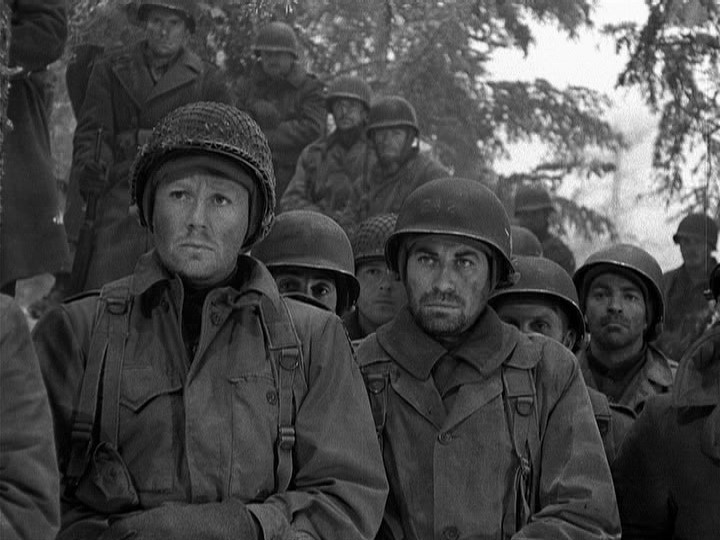
Anyway. It’s a shame, and from now on I’ll have to wait three days for shipping, or three hours for downloads farther down the line. But for now, I’ll have to settle for gonzo savings. Everything must go! The two Virgin Megastores in NYC are closing up shop, the Times Square version is already toast, with the Union Square iteration shuttering at the end of May. Everything is discounted, and near the closing date everything is 50% off. My finest piece of vulturing so far has been picking up the Warner double feature of Battleground (1949, see above image from DVD Beaver) and Battle Cry (1955).

This is another desperation move by the studios, packing multiple titles onto one discounted package. I’ve seen four combined features priced for 12 bucks (these were Steven Seagal movies, but still). These panic super-bargains can’t be good for business, but we consumers have to pounce when we can, right? Let’s celebrate in the ruins – and that’s just what I’m doing with this William Wellman and Raoul Walsh (and Tex Avery!) package.

Before Battleground was released in 1949 the received wisdom was that the public was tired of war movies, and did not want to be reminded of the devastation of that conflict. Producer Dore Schary disagreed, andpushed hard for the project while head of production at RKO in 1947. Schary is quoted as saying that, “it was imperative to do a film about World War II that would say the war was worth fighting despite the terrible losses….” He chose to tell the story of the “Battered Bastards of the Bastogne”, a group of 101st Airborne troops surrounded by Germans during the Battle of the Bulge. A hard sell after the horrible human toll of the war, skittish executives strongly objected to the project. Schary soldiered on anyway, hiring ex-grunt Robert Pirosh to write to script, under the title “Prelude to Love”, in order to dupe the higher-ups ready to quash it.

A script was completed in January 1948, right when Howard Hughes snapped up RKO, and he promptly told Schary to drop the project from the schedule. Schary resigned, bought the rights, and nabbed a gig as head of production at MGM. Unwilling to rock the boat with the new head, MGM allowed Schary to see the project through at his new studio. Internally the project was called “Schary’s folly”. As it turns out, it was a box office smash, and it is widely credited with rekindling the war film genre in the 50s.

This is definitely Schary’s film more than director William Wellman’s, who much prefers his earlier WWII picture, The Story of G.I. Joe, which doesn’t have Schary’s patriotic propaganda bucking it up. The film is still a pleasure though, its well-worn archetypes filled out with appealing performances from James Whitmore as a the tobacco spit fountain Kinnie, Van Johnson as the ebullient and conflicted Holly, Ricardo Montalban as the romantic ethnic Roderiguez, and George Murphy as the aging father figure, Pop Stazak. Filmed mostly on a soundstage, aside from the stirring opening and closing shots, the film is notable for its lack of action. Wellman told Schary that he’d “make a film about a very tired group of guys.” It focuses mainly on the moments in between skirmishes, the long wait for fateful orders, the insults traded to buck up spirits, and various bits of slapstick (clattering false teeth, Holly’s ill-fated egg obsession) undertaken to kill time. This episodic, character driven portrait of exhaustion went on to win Oscars for Pirosh’s screenplay and Paul Vogel’s fog-choked cinematography.

I’ve yet to crack open Battle Cry, but there is a wonderful Tex Avery cartoon slapped on as a bonus feature on Battleground. It’s Little Rural Red Riding Hood (1949),  a delightfully cracked tale that turns the classic story into a treatise on deranged male sexuality. The moustachioed, upturned nose city wolf falls for the uncouth lankiness of the backwoods Riding Hood, while the slackjawed yokel country wolf goes all googly eyed for the local city siren. Their ids are uncontrollable and misdirected – each going after the lady from an unattainable social class.

Source: Suid, Lawrence. Guts & Glory: The Making of the American Military Image in Film. University Press of Kentucky: 2002.

JLG IN USA

April 21, 2009

JLG in USA

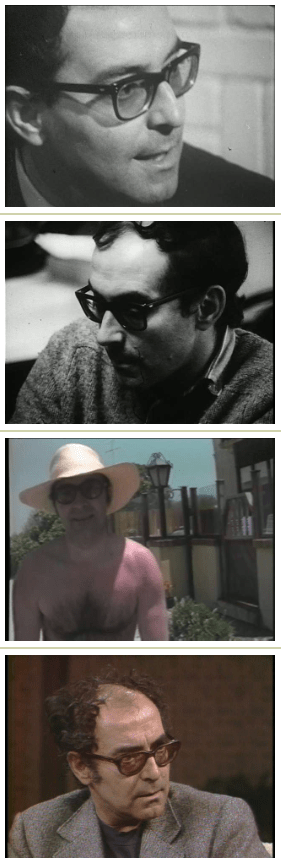
Four faces of Jean-Luc Godard,  (L-R from 1968, 1970, 1979, and 1980) taken from the tantalizing DVD artifact “JLG in USA”, which accompanies the March/April edition of The Believer (Full Disclosure: Don’t hold it against it the magazine, but my wife and I wrote a brief article in the issue). Compiled by BAM programmer and Film Desk founder Jacob Perlin, it contains four short films of interviews, lectures, and home movies recorded at the cusp of Godard’s experimental video work in the early 70s with the Dziga Vertov Group and beyond, through his return to more personal art films with Every Man for Himself in 1980. This period is still the least understood in his career, and the few films I’ve seen from his seventies work, Ici et Ailleurs (1976) and Numero Deux (1975), are both extraordinary and demanding. For those like myself eager for further info into this part of his career, it’s a fascinating and surprisingly moving look at a man going through artistic and (one assumes) personal upheaval.

The disc begins with a D.A. Pennebaker/Ricky Leacock production, “Two American Audiences”, documenting a visit by Godard to NYU on April 4th, 1968 to discuss La Chinoise, the day Martin Luther King, Jr. was assassinated. As Pennebaker is quoted in the notes: “Of course, none of us in the room knew about that then.” A month later, Godard, along with Francois Truffaut, rushed the stage at the Cannes Palais des Festivals stage, urging solidarity with the striking students. A moment out of time. Godard takes questions from a variety of delightfully hairy film students and moderator Serge Losique. Losique asks if the Maoisms spouted by La Chinoise‘s callow youth are a simple reflection of the times, a mirror, or a political call to action. Godard, whose cinema lies in the space between either/or, who revels in contradiction, admits that there is movement between both. It is not static, “it’s a movie, a movement.”

He is openly sympathetic to Maoist thought,  but his intellect is too searching to make a simple propaganda film. These sympathies are troubling, but his film work is often far more complex and nuanced than his stated political positions. He can’t help but let the artist introduce ambiguity and other complications. La Chinoise is both a parody and homage to the dreams of revolutionary youth, absurd and romantic. Godard bristles at a questioner who notes this humor, but his filmmaking gives the lie to this, with its playful digressions and in-jokes (one character’s defense of Johnny Guitar gets him expelled from the cell). His cinephilia is still in full bloom in this interview: “The average film of the silent era, or even the Hollywood film of thirty years ago – was much more subtle and intelligent than the average Hollywood film today”. He goes to oppose Gone With the Wind to Doctor Zhivago to prove his point.

The second film, Godard in America (1970), was shot by Ralph Thanhauser when Godard was deeply involved with the Dziga Vertov Project, his Marxist film cooperative that also included filmmaker Jean-Pierre Gorin. Questioned by Andrew Sarris about his new group, it’s clear his priorities have shifted the political above the aesthetic, his cinema become a tool for revolutionary thought. Or at least that’s what he claims. I have yet to see a Vertov project, although the material used in Ici et Ailleurs was footage abandoned by the group in 1970, and re-purposed by Godard to investigate the deceptive nature of filmic representation, how the images of these Palestinian fighters would have “added up to zero” since each new frame completely replaces the one before it. In the documentary, Godard and Gorin flip through their storyboards, laying out the structure that Godard would completely deconstruct six years later.

The third film, “A Weekend at the Beach with Jean-Luc Godard”, is an amusing curio shot by photographer Ira Schneider. Godard stayed at Schneider’s beach house for a weekend with Wim Wenders, Alice Waters, Jean-Pierre Gorin, among others. It’s strange seeing such an eccentric intellectual as Godard wearing a sun hat and joking with friends (I can see the US Weekly story now, “Godard: He’s just like us!”). Schneider, no fan of the obstreperous Frenchman, offers a short, drily funny voice-over in an attempt to de-mystify this object of film cult adoration. Nice try! But he still mystifies me.

The most incredible piece of footage on the disc is an interview with Dick Cavett from 1980, done for the release of Every Man for Himself. It was being received as a comeback of sorts, since it was a return to a form of narrative. Godard denies he ever left, that he was just “pushed away.” That much is true – he never stopped working, people just stopped watching. But with Isabelle Huppert, texts by Charles Bukowski (who Godard mischievously claims was unknown in the US at the time), and a plot revolving around prostitution, he got his name back in the papers. This two-part encounter with Cavett is combative, enlightening, and surprisingly touching. When Cavett quotes some critics as calling his films too “distant” (which I would call one his strengths), Godard responds that he thinks he’s getting closer, and that he’s possibly found a balance between the charismatic personality of his earlier works to the almost didactic form of his experimental work. He calls Every Man for Himself a second first film, comparing it to a return to childhood, except  this time he went through the back door or a second floor window.

There’s also plenty of his film critical insights. He predicts that Scorsese’s next film would be “beautiful” (Raging Bull); that Woody Allen’s use of B&W in Manhattan was an empty gimmick; that Jerry Lewis was a painter who was a master with space and geometry, and that his infamous Day the Clown Cried project also sounded “beautiful”. Godard gamely responds to Cavett’s stylistic questions, his use of slow-motion to capture the intimacy of a fight scene, and the freedom necessary to his dynamic use of sound, which often runs independent of the image track. In an unexpected bit of emotion, Cavett recalls an old interview inquiring about Godard’s ambition, which, after a pause of 42 seconds, he responded, “I would like not to be so lonely.” Godard reiterated this statement, and went on to say that he would always like to feel that the door to his parents’ room was open at night, so as not to be afraid of the loneliness. He said he was no longer afraid.

HAPPY 15TH ANNIVERSARY, TCM

April 14, 2009

a Clash by Night Film Noir Classic Collection boxset 2 dvd review PDVD_005

Turner Classic Movies started piping into my Buffalo family’s cable box circa 1999, just as I was schlepping downstate to grow a wispy goatee at Binghamton University. This was vexing. I was already committed to studying the movies, eyeing the school’s vague “cinema” major like it was a slab of rare steak. And now that I was leaving home, this vast library of celluloid was going to broadcast 200 miles away from my rapidly watering eyes (TCM was persona non grata on campus). And so a plan was hatched. Every month, after exhaustively parsing the schedule and cross-checking titles at IMDB, I would send my father a lengthy list of films to record through my newly minted dial-up AOL account (screename: EdAsner). I tried to instill a military vigilance regarding this burgeoning bootleg operation, and he endured my tyrannical reminders with annoyed resignation. My “Make sure you get that Bollywood triple feature tonight!” would be followed by his drawn out, perfectly enunciated sigh of defeat.

Armed with one dollar tapes from the orange-besotted Aldi’s chain, he manfully battled our VCR to a draw. A few endings were clipped, but most made it through the Sony’s maw intact.  Soon enough there was an imposing, wobbly tower of cheap cardboard and cheaper tape cluttering my Dad’s living room. They were shipped out in increments, or picked up at holiday visits. His labeling was sparse and incomplete, and most of my Christmases involved archiving the new stack of cinema accrued during the semester, toggling back and forth to see which title Mr. Robert Osborne would announce next.

My Dad endured, and snuck a few peeks at my obsessions, becoming especially enamored of Fritz Lang’s Clash By Night(1952, image at top, from DVD Beaver). He couldn’t remember the name when I talked to him last night, just images of Barbara Stanwyck, a fishing village, and its stark rendering of failed trust and nascent forgiveness. “They worked it out”, he said. “After all that.”

And so began my personal, idiosyncratic repertory house, airing nightly in a tripled dorm (three living in a space for two), which naturally provided its own version of Smell-O-Vision. Some sample offerings: Zombies on Broadway (1945) followed by Anthony Mann’s Border Incident (1949)Kiss Me Kate (1953) paired with The Story of G.I. Joe (1945), or, my favorite, a triple bill of The Lusty Men (1952)Rancho Notorious (1952 – what a year!) and The Big Knife (1955)That latter tape alone introduced me to the carnal cinemas of Nicholas Ray and Robert Aldrich, and made me re-evaluate the received wisdom about Fritz Lang’s Hollywood work.  The cramped, grimy noirs of Anthony Mann and John Alton, though, seemed especially appropriate to my living quarters, and TCM always delivered (one tape contained the chiaroscuro masterpieces T-Men (1947) and Raw Deal (1948)).

So happy 15th birthday, TCM (and a happy ten years of viewing for me). It was always a thrill to see Robert Osborne’s avuncular bearing shimmer through my shoddy 13′ TV screen, because it meant a further dip into the seemingly inexhaustible archives of the classical Hollywood cinema. Not to mention Osborne’s always useful historical notes before each screening. But what’s most important is how the channel, through its devotion to showing films uncut, and in the correct aspect ratios, is preserving film history. While learning the rudimentary tools on a Bolex 16mm at Binghamton, TCM was offering me a crash course in the history of screen editing, from the brisk shot-countershots of Preston Sturges comedies to the longer takes necessitated by the CinemaScope process, seen in later Manns like the underrated The Last Frontier (1956) and Man of the West (1958). My education at school was valuable, but if I were to quantify how much I’ve absorbed about film history and style, how much can be imparted through a flick of a cigarette, a tip of the hat, I’d say the cable channel comes out on top (sorry Mom and Dad).

I come from a generation where this was the only place to discover the glories of the studio system. DVD has been spotty at best at releasing pre-1960 films, and TCM has been extarodinarily willing to air “uncommercial” product. How else was I going to see Frank Borzage’s romantic masterpiece Man’s Castle(1933) without paying exorbitant amounts for an import? Its broadcast was one of 2008′s major highlights. So many “movie lovers” haven’t seen anything before 1970, and I shudder to think where my own taste and knowledge would’ve wandered to without the channel’s existence. So here’s to another 15 years. Don’t ever change.

THE WARNER ARCHIVE: FIRST IMPRESSIONS

April 7, 2009

MV5BNGM3MWMwOWQtZjkyNS00NWU5LThlMjUtOWIwNzExMzU0NTgzL2ltYWdlXkEyXkFqcGdeQXVyMTE2NzA0Ng@@._V1_

With services like Netflix, it feels like the whole history of cinema is available at our fingertips. This sense is false, of course.  As Dave Kehr and Jonathan Rosenbaum have pointed out, of the 157,485 films listed in the American Film Institute’s Catalog of American Feature Films, only 5,884 are available on home video (this doesn’t even include the sorry state of foreign film distribution in the US). So while the advent of DVD has vastly increased the audience for classic film, where towns without a repertory theater can still watch Murnau and Hawks, the breadth has suffered. Which is why the advent of the Warner Archive is a such a cause for celebration.

The archive manufactures out-of-print titles on demand. This cuts out the cost of mass production and warehousing, while still allowing customers access to the product. According to Warner’s George Feltenstein, they have 6,800 films in their archive, and only 1,200 are on DVD (4,100 made it to VHS). Currently only 150 titles are available in the program, but each month around 20 more will be added to the list. It’s the brainchild of Feltenstein, the (deep breath) senior vice president for theatrical catalog marketing at Warner. Long regarded as one of the best in the business at pushing classics onto home video, from the VHS and laserdisc days to the present, this latest initiative is possibly his greatest achievement yet. With DVD sales flagging, it’s a smart way to wring more revenue out of their archive, and with some success will hopefully urge other studios to offer similar programs.

The initial offering of films is a fascinating grab bag of Greta Garbo silents, Joan Crawford weepies, and brat pack oddities. I decided to buy three of the features, each at the $20 price point (most titles are also available for download at $14.95). I bought Leo McCarey’s 1942 propaganda-comedy Once Upon a Honeymoon, Jacques Tourneur’s 1955 ‘Scope Western Wichita (see right), and Budd Boetticher’s 1958 Westbound (to round out my collection of his Ranown series with Randolph Scott, image below). The films are burned and not pressed, meaning they are DVD-R’s and not finalized DVDs. This caused some concern as to their playability, and the packaging contains a warning that they might not work on some PCs. All three films played fine on both my standalone player and my Toshiba laptop (only very old systems would have a problem, I’d guess).

These discs are barebones, with no extras and the most basic of menus. Chapters are programmed every ten minutes regardless of the shot. The transfer quality, however, was high across the board, with Wichita looking especially sharp in its anamorphic transfer. Honeymoon showed some wear and tear in the original element, but only one sequence late in the film could be considered subpar. I was thoroughly satisfied with the quality overall, and will undoubtedly go back to the well for more. If any commenters would like to suggest other titles to consider taking a look at, let me know! I’ve got my eye on the two Cukors (The Actress and Bhowani Junction), the passel of Raoul Walsh’s (Along Great Divide, A Distant Trumpet, A Lion is in the Streets), and the smattering of Frank Borzages (Three Comrades, Mannequin, The Shining Hour).

Once Upon a Honeymoon is a delirious wonder of a film, a screwball anti-Nazi propaganda caper that still manages to be tremendously moving. It’s an improbable mix of comedy and tragedy, a high-wire act that teeters but never falls into camp. A failure upon first release, McCarey told Peter Bogdanovich that “I didn’t like it because the public didn’t like it.” Following the massive success of The Awful Truth (1937) and Love Affair (1939), the box office thud must have come as a shock, especially considering the quality of the material, and the presence of Cary Grant and Ginger Rogers at the top of their games. His populism can’t mask his pride though, as he admits one quote later, “I died laughing at the movie. The acting was too good.” There are any number of uproarious sequences to bear that out, including the one containing the top photo. This sequence finds Ginger Rogers speaking in an aristocratic accent, and going by the name Katherine Butt-Smith (“it’s pronounced Butte”, is the common refrain). Grant is a radio announcer, slumming as a reporter to get a scoop on her marriage to the Nazi Baron von Luber (Walter Slezak, in his first role in Hollywood). He poses as an Austrian fitter for Rogers’ wedding dress. Right before his entry though, Rogers calls her mother, and unveils her natural Irish-Brooklyn name and accent, Katie O’Hara. Her mother, none too pleased, laments her coming  nuptials, “You were doing so well in burlesque…”

This sets up one of the recurring motifs in the film, of Katie’s shifting identity, from Aristocrat/fascist to Working-class/Democrat. This is strung out throughout the film, culminating when she gives up her passport to her Jewish maid to ensure her escape.  Early on, the mode is still primarily comic, and Grant’s entrance sets forth another motif, that of the escalating sexual tension between himself and Ginger. Here it is figured in the measuring tape, hilariously manuevured by Grant into the most suggestive of shapes. His intent is clear very early on, and McCarey offers one of many self-reflexive jokes when Grant’s gropes cause Rogers to groan, “This is getting ridiculous”. And how! McCarey takes the sexualization of objects to another level later in the film, when Grant, about to leave Gingers’ train cabin, tells her how lonely he’ll be, “just me and my saxophone.” This innuendo is made literal later in the sequence, and Grant squeals on the horn while Rogers squeals with laughter with the Baron.

The film is layered with these kinds of motifs, brilliantly laid out in further detail by Robin Wood in a Jan.-Feb. 1976 article for Film Comment (“Democracy and Shpontanuity”, available at your local public library’s microfilm archive!). In any case, it’s an uproarious piece of work, and I haven’t even mentioned the Shakespeare-Irving Berlin quote-off. If, as Robin Wood said, that Rio Bravo justifies the existence of Hollywood, then Once Upon a Honeymoon justifies the existence of the WB Archive.

“HAVE A LITTLE CHEW ON ME”: OTHER MEN’S WOMEN (1931)

March 31, 2009

othermen4

Last Monday night, TCM aired all six films from Warner Bros. new box set of early William Wellman talkies, Forbidden Hollywood, vol. 3. I’m still picking my way through, but 1931′s Other Men’s Women is an obvious highlight. Possessing speed and clarity in equal measure, and blessed by energetic supporting turns by James Cagney and Joan Blondell, it’s overflowing with minor pleasures. With the railroad as its working class milieu (the original title, “The Steel Highway”, was changed shortly before it’s premiere), the film builds its rhythm from the steady hum of the locomotive, it’s whistle cooing over the lead credits. In the opening sequence, Bill White (Grant Withers) slinks into a hash shop, his wise-ass cracks clearly impressing the brassy counter girl. In between his razzes he counts out a rhythm on the table top, keeping track of some internal beat in his head. After shoveling in his eggs and coffee and telling the gal to “have a little chew on me”,  he sprints off to catch the last train that had been rumbling by in the background the whole sequence – he had been counting off its cars. Tempo is emphasized straight off, and neither Wellman nor his collaborators apply the brakes for the duration of its 70 minutes.

Maude Fulton adapted her own story for the screen, and William K. Wells is credited with  the dialogue. Fulton, unknown today, had established herself as a vaudevillian and playwright before she started contributing to film. In a fascinating 1917 profile in the NY Times, written after the success of her play, “The Brat” (which John Ford brought to the screen in 1931), her circuitous path to Broadway is outlined. Raised in the Kansas newspaper biz by her Dad, the editor of the local daily, she wrote a novel by the age of 15, “whose theme was ‘The Curse of Rum’”.  She bounced from job to job, including singing pop songs at a department store, until she learned stenography and was hired by a railway office, where she likely soaked in the bravado of the train engineers that suffuses Other Men’s Women. Bored with office work, she soon lit out for the stage in NYC. She was performing in Mam’zelle Champagne on the roof of Madison Square Garden in 1906, when the millionaire Henry K. Thaw shot and killed architect Stanford White for fooling around with his young wife, Evelyn Nesbit (who was also romanced by John Barrymore). Thaw’s trial was the first to be dubbed “The Trial of the Century.”

Before this brush with infamy, she had teamed up with dancer William Rock. “Rock and Fulton” became a minor vaudeville success from 1900-1912, their 20-minute routine playing some of the better houses in town, according to the reference book Vaudeville, Old & New. By the time she was 30, Fulton began to suffer from rheumatism and had to shift into writing full time. In the Times piece, just beginning her playwriting career, Fulton displays a disarming humility:

“I know that I have no great intellectual gifts and that I have no great talents, but I will say this for myself: I am an indefagitable worker and I aim high. If this [The Brat] is not a great play – and it isn’t – remember that it is my first, and I am not through yet.”

She never equalled The Brat’s success on stage, with her follow-up, The Humming Bird (1923) failing to make much of an impression. But both were made into silent films, and her career behind the camera began. But I digress…

Fulton’s scenario for Other Men’s Women is a basic love triangle. Jack Kulper (Regis Toomey) and Bill White are best friends and railroad engineers, but both also happen to be in love with Kulper’s wife, Lily (Mary Astor). Tensions rise  and tragedies mount until a spectacular bridge collapse caps the doom-laden tale. With the train whistle’s metronome setting the pace, Wellman wastes no time in setting up the central conflict. Jack invites Bill to stay for a few days and dry out, after his stuttering landlady kicked him to the curb. The childlike idyll of the first few days, mock-fighting and chases ’round the yard, are quickly unmasked for their flirtatiousness. Wellman utilizes an audio motif to mark the shift in atmosphere. When Jack first arrives home, he whistles to announce his arrival. The second time we hear the whistle, Bill has professed his love and Jack’s world is about to collapse. This simple inversion carries a great emotional wallop, his lilting tune turned tragic in the space of ten minutes.

Wellman is adept at this kind of repetition – eliciting slightly different tones from each one. Take Grant Withers’ catch phrase, “have a little chew on me”. Used in the opening scene with a sneer and a hint of sexuality, the next time he says it, to old pal Cagney on top of a train, it’s with complete sincerity. Later, after dismissing Blondell’s marriage proposal, she cuts him off with, “if you offer me a chew of gum I’ll knock your block off.”  For each context, the phrase works differently, and the cumulative effect makes Blondell’s retort all that funnier.  It’s even flexible enough to play a pivotal role in the final, storm swept finale.

Other Men’s Women is remembered, if at all, for being the film Cagney appeared in before The Public Enemy (also directed by Wellman) which launched him to stardom. As Bill’s close friend Ed Bailey, he’s already irrepressibly physical. In one magical scene in a club’s lobby, he’s shown stripping out of work clothes, revealing a tux underneath, and soft-shoeing laterally to the dance-floor. It’s a privileged moment for a character only present in three sequences – and he nearly taps away with the picture.It was his second film with Blondell, after they both reprised their roles from the play “Penny Arcade” in Sinner’s Holiday (1930). Ms. Blondell gets a few zingers in, including her tart: “I’m A.P.O…Ain’t puttin’ out.”

Wellman pairs the train whistle from the opening to the climactic struggle, as Jack and Bill throw hay-makers in the engine room. There is a cut to a close-up as Jack’s right cross pulls down the whistle rope, their battle now syncopated to the music of their transport. Violence and disfigurement follow, as death haunts the two friends the rest of the film,with Wellman and cinematographer Barney McGill darkening the palette until the train’s final run takes place in manic silhouettes and dense fog. As emotions and steel are wrenched apart, the crux of Wellman’s directorial personality become clear. As Dave Kehr noted in the comments section of his blog (where the best auteurist criticism is appearing these days): “His was a style based on speed, fragmentation, and violent collision — he’s on the path that leads to Sam Fuller, not Howard Hawks.”