THRILL KILL: 10 TO MIDNIGHT (1983)

September 29, 2015

ten


Charles Bronson’s association with the exploitation mavens at Cannon Films started with Death Wish II (1982), and continued through six years and seven more movies of profitable urban bloodshed. The second of these was 10 to Midnight (1983), a ultra-sleazy slasher film in which Bronson’s morally dubious cop attempts to protect his daughter from a loony who commits murders in the nude. Now out on Blu-ray from Twilight Time (available exclusively through Screen Archives), it’s a lowest-common-denominator product that gives the people what they want, and what they wanted in 1983 was healthy heaping of gently jogging nudity (male and female), a few spurts of blood, and Bronson looking constipated, apparently.

10-to-midnight

10 to Midnight began as a title without a story. Producer Pancho Kohner had been working with Bronson since St. Ives (’76), and was being pitched by Menahem Golan to come to Cannon Films to make Bronson’s next picture. In Paul Talbot’s book Bronson’s Loose!, Kohner described the strange development of the film. Initially he and Bronson wanted to adapt the novel The Evil That Men Do, but Golan was unwilling to reimburse them for the rights, so, Kohner recalled:

Golan said: ‘I’ll tell you what. We’ll go to Cannes anyway and we’ll pre-sell the next Bronson picture. When we come back in two weeks, we’ll find another story and we will not make The Evil That Men Do. What’s a good title?’ I always liked 10 to Midnight. So, we went over to Cannes and I sat in this suite at the Carlton and all the buyers came through. I explained that there was going to be great action and great danger and great revenge and it was going to be called 10 to Midnight. Everyone was pleased. We didn’t have a script yet. We got back to Los Angeles and I had to scramble to find a story that would be a Bronson project that Charlie would like. I called a friend of mine…and I asked him if he had any stories and he know of Bill Roberts’ screenplay called Bloody Sunday…. I said, ‘Would you mind if we called it 10 to Midnight?’ He said, ‘No.’ [Laughs].

10 To Midnight

William Roberts’ script was loosely based on the story of serial killer Richard Speck, who murdered eight student nurses in 1966. The screenplay transposes him into Warren Stacey (Gene Davis), a good-looking perv who gets his kicks by stripping naked and chasing down young women with a knife. Bronson plays Lieutenant Leo Kessler, a decorated investigator who has started cutting corners to imprison those he deems guilty. His partner Paul McAnn (Andrew Stevens) is more of an idealist, an educated upstart who wants to clean up the force. Both are interested in protecting Kessler’s daughter Laurie (Lisa Eilbacher), a student nurse and one of Warren’s potential targets. Note: the title has nothing to do with the story, though the posters promised “a deadline”, there is no such thing in the film.

10tomidnightpolice-1600x900-c-default

Bronson had developed a stone face as inert as Buster Keaton’s, and opted for as little physical movement as possible. Watching a Bronson film from this period is a constant test of the Kuleshov effect. If the cutaway is to  a scumbag murderer, Bronson’s impassive face must be registering anger, but if he’s looking at his daughter, then it has to be affection. The closest he comes to “acting” is when he confronts some of the more ludicrous turns of the plot. While at the morgue standing next to the latest victim, he is forced to say, “If anybody does something like this, his knife has gotta be his penis.” Though he maintains a laconic volume, there is a rhythm to his delivery that lands “penis” as a punchline. His co-star Andrew Stevens recalled, “Charlie made continual jokes, and when he has to say the line, “The knife is his penis,” he cracked up over and over. Usually standoffisih on set, Stevens reported that Bronson was feeling loose and jocular, perhaps having fun with the absurdity of the script.

10tomidnight

The crew was made up of professionals, from director J. Lee Thompson (The Guns of Navarone), to DP Adam Greenberg (The Terminator), who frame the story as more of a horror film than a thriller. Warren is positioned as a Michael Myers-type, scarred by psychological damage here left unexplained, his only source of pleasure when he is able to strip and take another life. Once naked, he is a monster, appearing as a Psycho shadow behind the shower curtain. He is something like the male id run wild, and shows off his svelte behind more often than the any of the women he goes to out to kill. He is objectified more than anyone, though the film has its quota of buxom ladies running for their demise. Roger Ebert was disgusted by the film, calling it a “scummy little sewer of a movie”, and declaring that everyone who made it, including Bronson, should be ashamed of themselves. It is a cynical market-driven product that exploits all of its characters for cheap thrills. But it is consistent in its cynicism, depicting everyone as compromised or on the take, and contains a barely suppressed lunacy that threatens to overtake the film at every turn. This spark of madness makes it hard to look away from Brosnan’s rigid visage, in the hopes of watching it break.

MARTIAL ART: PEDICAB DRIVER AND THE GOLDEN HARVEST LIBRARY ON WARNER ARCHIVE INSTANT

July 14, 2015

Last week Warner Archive snuck out a minor announcement with major implications. Six martial arts films from Golden Harvest studios were made available in HD on their Instant streaming service, in their original language and aspect ratios. Golden Harvest was the proving ground for Bruce Lee, Jackie Chan,  Sammo Hung and Jet Li, producing some of the most enduring kung fu films from the 1970s through the ’90s. These days Golden Harvest has segued from production to exhibition, and their classic titles remain frustratingly hard to see in decent transfers. Warner Brothers owns the U.S. rights to part of their catalog, and the initial six titles are only the beginning. On their Twitter feed Warner Archive promised, “we’re just starting to tackle the domestically unreleased Golden Harvest library”.  Available now to stream on Warner Archive Instant are: Downtown Torpedoes (1997), Big Bullet (1996) , The Blade (1995), Blade of Fury (1993), Pedicab Driver (1989)  & Terracotta Warrior (1989). While many of these titles are far overdue for release on DVD and Blu-ray, the fact that WB is preparing HD masters of these films is reason for optimism. I started the month-long free trial of their Instant service to check out Sammo Hung’s Pedicab Driver, an irresistible showcase for his knockabout acrobatics that packs in a public transit war, human trafficking, and Triad gangs into its 90-odd minutes.

Golden Harvest was formed in 1970 by Raymond Chow and Leonard Ho, two former employees of the Shaw Brothers studio. Shaw Brothers was then the largest production operation in China, specializing in historical martial arts films like King Hu’s Dragon Inn (1967) and Chang Cheh’s One-Armed Swordsman (1967).  Golden Harvest would become their main competitor, poaching director King Hu and most importantly Bruce Lee, who was on the cusp of superstardom. The gargantuan success of Lee’s The Big Boss (1971), The Chinese Connection (’72), The Way of the Dragon (’72) and Enter the Dragon (’73) secured the company’s financial future, allowing them to invest in talents like Sammo Hung. Hung came up through the brutal training of the Peking Opera, enrolling in Yu Zhanyuan’s China Drama Academy at the age of nine, studying acrobatics, martial arts, singing and dancing, along with future co-stars Jackie Chan and Yuen Biao. They endured painful tests like maintaining a handstand on a stool for one hour. Hung’s parents enrolled him, he told the New York Times, because, “I was never good at school and was always fighting in the streets. So they sent me to learn to fight.” He was a senior member of the “Seven Little Fortunes” performing troupe, and became known as “Big Brother” to Biao and Chan. In 1971 Golden Harvest hired him as a martial arts instructor on The Fast Sword, and thus began a two-decade association with the company, where he worked with everyone from King Hu (The Valiant Ones) to Bruce Lee (Enter the Dragon). He directed his first feature in 1977 with The Iron-Fisted Monk, and would gain success by working with Biao and breakout star Chan — directing hits like Winners & Sinners (’83) and Wheels On Meals (’84).

By ’89 Hung’s relationship with Golden Harvest was strained. His films were getting more ambitious and expensive, including the globe-hopping martial arts Western Millionaire’s Express (’86) and the post-Vietnam War commando movie Eastern Condors (’87), but the box office returns were not keeping pace. Pedicab Driver was a back-to-basics fight film set in 1930s Macau involving a group of pedicab operator friends who get mixed up with a Triad gang. There are few sets but plenty of brawling, and the tone ping-pongs from slapstick comedy to dark melodrama and back again, with the whipsawing speed representative of Hong Kong films of this period (and of pre-code Hollywood films). Sammo Hung plays Lo Tung, a leader of the pedicab union who bikes around town in a bowl cut, checked shirt and suspenders. He looks like an overgrown child in lumberjack costume, but when he throws down, his blows land like giant redwoods to the face. He pals around with a driver nicknamed Malted Candy (Max Mok) who thinks he has found his dream girl in Hsiao-Tsui (Fennie Yuen). However, she is paying off her debts to gang leader Master 5 (John Shum) by working at a brothel. When Malted Candy tries to buy Hsiao-Tsui’s freedom, he invokes Master 5′s wrath. Lo Tung, Malted Candy and their friends are faced with a fight for their lives. Approximately five hundred other things happen, including Lo Tung’s romancing of a bakery girl named Ping (Nina Li Chi), but that is the kernel of the digressive story.

Pedicab Driver contains some of the finest fight choreography of Hung’s career, combining Looney Tunes lunacy and more traditional sparring. The absurdity is stacked up front when the pedicab operators get into a brawl with rickshaw drivers in a cavernous restaurant. Hung makes his entrance by leaping over a rail with the ease of a man a fraction his size. There is supposed to be a negotiation, a splitting of work between the two tribes, but it soon devolves into fisticuffs involving Three Stooges-esque eye pokes and Star Wars parodies. At one point Yuen Biao pulls down a long fluorescent bulb from the ceiling and wields it like a lightsaber. His opponent does the same, and a brief saber duel occurs (with requisite sound effects) until both men get electrocuted  like Wile E. Coyote at an Acme Electrical Line.

The most thrilling bout in the film has no bearing on the plot. After an intensely dangerous pedicab car chase, Lo Tung and Ping crash into a gambling hall. The managers insist upon recompense until their the den boss (Lau Kar-leung) decides to settle it with a fight. This fight represents a generational battle, between a Shaw Brothers legend in Lau versus the more modern, manic and comical Golden Harvest performer in Sammo Hung. Hung begins with a sneak attack, trying to catch Lau unawares. But Lau has those quick, deep strikes that continually send Hung to the ground. Hung tries clowning for distraction, but is thrown through a wall of strategically placed bamboo. Then there is an intricate battle of dueling staffs that (see above) Hung attempts to use his acrobatic skill to evade. But again he is struck down. Eventually he is pinned with his feet over his head, and admits defeat. But Lau sets him free, admitting respect for Hung’s skill, and that he was the only fighter he ever made him afraid he might lose. It is a sweaty, sweet, passing of the torch.

The streaming video was sharp and clean, aside from some speckling during the slow-motion sequences. The subtitles had their fair share of typos, but nothing to distract from the presentation (be sure to click the CC button to turn them on).

The film shifts into darker territory with Malted Candy and Hsiao-Tsui. Master 5′s operation is built on total control of his rapt criminal network, from his indentured servants (prostitutes, hired thugs) to the addicts and johns that fill his coffers. Malted Candy initially reacts to the news of Hsiao-Tsui’s work with chauvinistic horror – she is a “bitch” for resorting to prostitution. But his friends argue him back to sanity, that it is the male populace who condones and perpetuates the sex worker trade, and that Hsiao-Tsui is just doing what she can to get by. Their brief reunion is thwarted by Master 5, who sends his anonymous top assassin (a lithe, hard-kicking Billy Chow) to erase them from his books. Billy Chow is the real villain here, a quiet psychopath who waits his turn after all the pawns have been cleared from the stage. In the climactic battle at Master 5′s mansion, he sits at a table slurping soup as Lo Tung annihilates what’s left of the hired goons. His patience comes from confidence, and the final bout between him and Lo Tung is a brutal succession of high-impact maneuvers. There is none of the subtlety and grace of the fight with Lau here, this one is all deliberately paced destruction set to the tempo of move/rest/strong move.  Lo Tung is victorious of course, a roly-poly hero beaten, bloodied, and exhausted. That’s the state of Sammo Hung after most of his features from this period, leaving it all up on the screen. Hopefully Warner Brothers and the Warner Archive will continue to create HD masters of Sammo Hung’s sacrifices.

FIGHTING SPIRIT: KUNG FU KILLER (2015) AND SKIN TRADE (2015)

May 5, 2015

KungFu00003

The summer movie season seems to begin earlier and earlier every year. 2015′s blockbustering began on April 3rd, when Furious Seven started fueling its way to a billion dollars.  Avengers: Age of Ultron opened this past weekend, and from now on men-in-capes will be throwings fists at green screens from now through August. I’m looking forward to a few of these behemoths, namely Mad Max: Fury Road and San Andreas, but for the most part I prefer to to retreat to action films more human-scaled during the sweaty months. Which is why Teddy Chen’s Kung Fu Killer is my summer movie of the year. Garnering a limited stateside theatrical release from the invaluable Well Go USA, it’s a cleverly conceived Hong Kong fight film in which Donnie Yen is released from prison to track down a serial killer of martial artists, each victim a master of a different fighting discipline. This allows for a relatively uninterrupted series of brawls in a variety of styles, honoring the whole tradition of HK martial arts films. It’s very self-consciously looking back, as it contains a who’s who list of cameos of HK film legends, from stuntman Bruce Law to the founder of Golden Harvest studio Raymond Chow.

skin-trade-set-05
In the English-speaking world, direct-to-video (or now, direct-to-VOD) films are the lone remaining source of action with more practical stunts than CG. So I took a chance on Skin Trade solely based on the cast: Dolph Lundgren, Tony Jaa, and Michael Jai White. Lundgren and White are stalwarts of the DTV cinematic universe, while Jaa is the popular Thai daredevil from Ong Bak, The Protector, and, making inroads into Hollywood, a small role in Furious 7.  Indifferently directed by Ekachai Uekrongtham on what was undoubtedly a tight budget and tighter schedule, this Thai-Canadian co-production has the feel of many DTV films where all the money went into paying the stars and acquiring explosives, with little left for the actual movie in between kabooms (it is receiving distribution from Magnet, Magnolia’s action imprint). If you skip past the first hour of exploitative sexual trafficking drama there are some formidable fight scenes in Skin Trade that pit the smaller and quicker Jaa against lumbering powerhouse Lundgren and the nimbler giant Jai White. Plus there is the pleasure of Ron Perlman, as the main mobster heavy, chewing into his Serbian accent with brio. But it’s no Kung Fu Killer.

kfj-pics-1

In recent months Donnie Yen has mentioned that Ip Man 3, now in production,may be his last action film. Now fifty-one years old, he is in a retrospective mood, and may be ready to ease the beating his body has been taking since he started as a stunt double in the early 1980s. Kung Fu Killer (aka Kung Fu Jungle) has the feel of a greatest hits routine, and the fight scenes are all killer no filler. Donnie Yen plays Hahou Mo, a martial arts master and former police instructor who was imprisoned for beating his opponent to death in a duel. In jail he follows the story of a serial murderer who seems to be targeting fellow martial artists and slaying them with their own specialty: whether it’s strikes, kicks, weapons or grappling. Hahou detects a pattern in the killer’s targets, and begs Detective Luk Yuen Sum (Charlie Yeung) to release him to help the investigation. She does, of course, and together they track down Fung Yu-Sau (Wang Baoqiang), driven mad by his wife’s sickness. One of Fung’s legs is shorter than the other, and through brutal training has overcome his physical limitations to outfight the greatest kung fu masters in the country. Wang nearly limps away with the movie in a sneeringly emotive performance that reminded me of Lon Chaney in The Penalty.

KungFu00006

The story is a delivery system for the fights, and they are all spectacular down to the slightest detail. When you get to a close-up of Yen or Wang’s knuckles, they are bruised black-and-blue. Whether this is makeup or achieved the hard way is irrelevant, but they are established in a world where flesh is vulnerable, and that is enough to heighten the stakes of each battle. To get the attention of the prison guards, Hahou initiates a brawl against seventeen inmates. Against such a large group, Yen employs the Chuy Li Fut martial art, which involves a whipping of the upper body. According to the infallible Wikipedia, Bruce Lee said it was “the most effective system that I’ve seen for fighting more than one person.” Teddy Chen has a penchant for using too many swooping master shots that blur the action, but when he gets closer to the fight itself each impact registers with clarity.

KungFu00008

Fung Yu-Sau’s second murder is against the kicking master (Shi Yanneng), which occurs atop a massive art installation of a fictional dinosaur. This quick imaginative bout starts on top of the animal’s spine and travels through its ribcage before it’s neck snapping conclusion. For the grappling expert (Kang Yu) fight, you see the Eagle Claw style of gripping and attacking pressure points, which here occurs in a modern apartment, smashing through aquariums and windows. There is a lot of jockeying for hand position here, and Chen does a good job of matching the close-ups of the grips with the general flow of the action as Fung eventually fells another master. Fung’s fight against the weapons master (Louis Fan) occurs on a movie set as they are preparing a motorcycle stunt. Fung arrives with a saber, stabs an extra through the shoulder, and the director (Joe Cheung, a character actor from In the Mood For Love and dozens of others) skedaddles. This leads to a beautifully orchestrated fencing duel goosed by wirework by exaggerate impacts.

KungFu00016

The film uses CG too much for purists, especially in the awesome final showdown between Hahou and Fung, which takes place on a highway at night, as the duo spars with bamboo reeds in between rolling under semi-trucks. I was too wrapped up in the physical feats to ding it too much for lower rent CG. The Hong Kong studios just don’t have the money to get the processing power of Hollywood FX outfits, but I’ll take Donnie Yen with some CG blood spurts if it saves him from injury and on my screen.

CAN’T STOP WON’T STOP: RUN ALL NIGHT (2015)

March 17, 2015

run-all-night-ed-harris-liam-neeson

Run All Night is a movie about tired men forced into motion. Ed Harris and Liam Neeson are happiest when sitting down, but their violent past conspires against their leisure, pitting them against each other in a fleet, melancholy NYC thriller. In theaters now, it is the third collaboration between director Jaume Collet-Serra and Neeson (following Unknown (2011) and Non-Stop (2014)), and they have proven to be ideal, adaptive collaborators. Unknown was adventurous in its Berlin location-shooting and experiments in POV. DP Flavio Labiano shot with a 35mm and Super 16mm camera locked side-by-side, a prism redirecting the same image to both cameras. They underexposed and force-processed the 16mm, creating a “broken but beautiful, dreamy kind of image” that they could use for Neeson’s amnesiac perspective. On Non-Stop they traded location challenges for the constraints of shooting on a single set — the interior of a plane making an international flight. Since it was an Agatha Christie-style whodunit, Labiano used tilt-shift lenses that would localize focus on individuals that Neeson was investigating. The story of Run All Night is less tied to Neeson’s perspective, so it is Collet-Serra’s most expansive, open-air production yet. With DP Martin Ruhe, Collet-Serra isolates Neeson and Joel Kinnaman, playing his son, in high angle establishing shots and CGI transitions that sweep through most of the five boroughs. Run All Night is a city movie, but it’s more about the old NYC that Harris and Neeson carry in their heads than the current metropolis, passing them by.

run-all-night-joel-kinnaman-liam-neeson

In Brad Ingelsby’s script Neeson plays Jimmy Conlon, a former hitman for the Westie gang once led by Shawn Maguire (Ed Harris). Jimmy tries to drown out his past with booze, and has long since become estranged from his ex-boxer/limo driver son Mike (Joel Kinnaman). Jimmy has become a punchline for the remnants of Shawn’s gang, who now hang out at a decrepit Irish Pub called The Abbey, remembering better days. Mike is reduced to playing a soused Santa at Maguire’s Christmas party to keep himself in cigarettes and porn money. But Shawn’s deadbeat son Danny (Boyd Holbrook) gets enmeshed with a track-suited group of Albanian heroin pushers, leading to a gruesome confrontation that Mike witnesses. Soon Mike is the target of Shawn’s whole operation, and the only person who can keep him alive is Jimmy. The cops, the Maguire gang, and an independent killer (Common) are all after Conlon blood. Mike has to bury his resentments against his deadbeat dad long enough to help him survive.

liam-neeson-run-all-night

As in the underseen  A Walk Among the Tombstones, Neeson has perfected a weary urbanite stroll, his shoulders a little rounded as if expecting shit to be dumped on him. Again an alcoholic (as in Walk and Non-Stop), society has pushed him farther to the edges of society. He lives in an unheated apartment next to an elevated train, warming himself by the glow of the Rangers-Devils game on the TV, the progress of which marks off the time of the movie.  Ed Harris, who was acting in eight Broadway shows a week in between shooting, looks even more exhausted and cadaverous, his character rendered moot in modern NYC. Early on he complains that he used to lend money for people to buy a butcher shop, and now that shop is an Applebee’s. There is no neighborhood left, shrunken down to his bar, The Abbey, and his few aging, paunchy friends (including friendly character actor face Bruce McGill). Shawn feels increasingly irrelevant, and spends most of the film reminiscing about what used to be. When circumstances turn him against Jimmy in a battle neither will likely survive, it feels like the two old friends are doing each other a favor. The Neeson-Harris tete-a-tetes are thrilling sequences of underplaying, as decades of friendship are eviscerated in a few words over cocktails.

635617598003002029-AP-FILM-REVIEW-RUN-ALL-NIGHT-71490858

For a director of disreputable genre pieces, Collet-Serra has attracted an extraordinary run of actors since he was forced to direct Paris Hilton in the still pretty good House of Wax (2005) remake. Aside from Neeson, Orphan featured Peter Sarsgaard and Vera Farmiga, Unknown had Bruno Ganz and Frank Langella, Non-Stop cast Julianne Moore and, in a small pre-Oscar part, Lupita Nyong’o. For despite all of the flash of his action filmmaking, his features are very patient, actorly films. They all build slowly, paying attention to the slightest of character details regardless of the outrageousness of the scenario. Orphan is extraordinary in this regard – it is as much a story of a bourgeois marital breakdown as it is a tiny person slasher movie. Sarsgaard and Farmiga give a master class in passive-aggressive sniping and upper middle class liberal self-absorption.

While Run All Night is the most character-driven of Collet-Serra’s films since Orphan, it still delivers a series of exhilarating action sequences. There is a Mike-Danny footrace through back alleys that hurtles along as the camera is pulled back on a cable. Then there’s a white-knuckle car chase through the streets of Brooklyn that manages to maintain match cuts as a cop car hurtles into a deli facade. And the centerpiece is a multi-part mini-movie in a housing project. It begins as a search for Mike’s boxing pupil “Legs” (Aubrey Joseph), a tightly edited montage of door-pounding and rejection. Then it transitions into an escape, as the police converge on the site, the father and son looking through a way out as they maneuver through the bank of stairwells. The final stage is a brutal fight between the hired assassin and Jimmy, held in a burning apartment. Flaming table legs are the weapon of choice as they two men thwomp each other into submission.

liam-neeson-joel-kinnaman-run-all-night

Early on Dirk Westervelt’s editing style feels disruptive and disorienting. His cuts occur a few beats before you expect them to, creating a jagged rhythm. It’s unusual, but as the feature progressed I stopped noticing these awkward beats. I’d have to watch it again to determine whether the editing scheme changes, or if I simply got used to the offbeat cutting. In any case, it ceased to be an issue as the story hurtled along and I was subsumed in this amalgamated NYC. The Abbey, in which the penultimate shootout begins, is cobbled together from exteriors taken from Jamaica Avenue and Woodside, Queens, while the interior was shot in Bay Ridge, Brooklyn. It is a composite city, situated so a subway is always rumbling overhead, moving forward to connect the various nodes of the story.

These nodes converge into at least one ending too many, but Run All Night provides everything it’s title implies: speed, exhaustion and darkness. Jaume Collet-Serra continues to prove himself as a resourceful genre problem-solver, adapting his technique to the demands of the story. While I would be satisfied with an endless string of Collet-Serra/Neeson collaborations, it would be fascinating to see what this elusive, chameleonic director can do with other subjects. He recently told Entertainment Weekly that “I would like to do a movie with every genre. To me, that would be the complete career—do a comedy, musical. Why not?” Make it happen, Hollywood.

LUCK OF THE DRAW: WILD CARD (2015)

Turner Classic Movies’ Movie Morlocks Blog

February 10, 2015

I take comfort in Jason Statham. For more than a decade now he has been taking his shirt off in modestly budgeted action movies, ones that usually open in the first quarter of the year. These are the months of low expectations for studios, in which they release films they don’t deem worthy of expensive marketing campaigns, usually made up of genre films of low birth. These are the months, and the films, where Statham has found his niche as a leading man (he has been in blockbusters in supporting parts, as in The Expendables franchise and the forthcoming Furious 7 and Spy). They are directed by journeymen with titles as blunt as their plots: Homefront, Redemption, Parker, Safe, and The Mechanic. They are all about lone men with particular sets of fibula cracking skills, though Statham has made simpler, lower-budgeted projects since his work with the operatic Luc Besson on The Transporter series (2002 – 2008) and the ADD-aggro Crank films (2006 – 2009). Since filming The Mechanic (2011) in New Orleans, Statham and his producing partner Steve Chasman have followed the tax credits, forming their movies around which city gave them the best deal to shoot. This economic incentive has made for atmospheric, enclosed action films that allows for such absurdities as shooting Philadelphia-for-New York City in Safe. Statham is asserting more control over his work, and his latest feature, Wild Card, is the first made for his own production company, SJ Pictures. Released day-and-date in late January on VOD and very limited theatrical, it seems to have already disappeared without a trace. But it’s a low key charmer, an episodic tour through the dregs of Las Vegas society (partly filmed in, yes, New Orleans) that’s less action movie than a downbeat character piece with brief flashes of violence to keep the fans happy.

After remaking Michael Winner’s The Mechanic (1972) with Simon West and adapting the Donald Westlake novel Flashfire for his film Parker (directed by Taylor Hackford), Statham again shows his good taste by taking the 1986 Burt Reynolds film Heat as the source for Wild Card, with William Goldman adapting his own novel for the screenplay, as he did on the ’86 film. Showing a vulnerable streak first exhibited in Steven Knight’s Redemption, Statham plays a depressive loser with the improbable name of Nick Wild. Wild has the requisite special forces background of a Statham hero, but here he’s reduced to escorting callow dot commers around the casinos while vainly dreaming of a life in Corsica — a resort life fantasy that Statham acted out in The Transporter. Instead Wild is dragged into a number of small time nettles. There are two main plots. The first is his relationship with Cyrus Kinnick (Michael Angarano), a Fiji water drinking rich kid who hires Wild to ferry him around town. The other story concerns his young friend Holly (Dominik Garcia-Lorido), who was used and abused by mob boss offspring Danny DeMarco (Milo Ventimiglia). She implores Nick to help her get revenge, though the repercussions of attacking the DeMarco family would cause their exile from Vegas. Facing the end of everything he knows, Wild tries for one big score before cutting town. Nothing works as intended.

Statham has become interested in chipping away at his persona. The opening of Wild Card is a typical Statham set-up, a brawl in a bar parking lot with a drunk tool begging for a smack in the face. Except it’s Statham who is the tool, and he does get smacked. It turns out to be a set-up so his friend can impress his girl (Sofia Vergara), but it’s an indication that Statham is ready to play around within the limitations of his brand. He is allowed to playact vulnerability, but hasn’t yet been allowed to fully follow through. In Redemption, written and directed by Steven Knight (Locke), Statham plays a Afghanistan war veteran turned homeless alcoholic who rebuilds his life with the help of a Polish nun. A dark, melancholic film that takes place almost entirely at night, it’s the closest thing to an art film that Statham has made, though it still has its share of fisticuffs. It barely got a stateside release, though Statham was enthusiastic about what the film allowed him to do. He told The Guardian that, “This is one of the most rewarding experiences that I’ve had. Most of the scripts that land on my desk are stuff you read and go, ‘Is someone really gonna make this?’ It’s been a revelation.”  Later, he continues to chafe against the market niche he has built for himself:

The dilemma is that you have to do something that people want to see. So if you’ve got a story about a depressed doctor whose estranged wife doesn’t wanna be with him no more, and you put me in it, people aren’t gonna put money on the table. Whereas if you go, ‘All he does is get in the car, hit someone on the head, shoot someone in the fucking feet,’ then, yep, they’ll give you $20m. You can’t fault these people for wanting to make money. It’s show business. Ugh, I hate that word.

While I don’t want to see Jason Statham start making domestic dramas, the way in which he is straining against the borders of his genre has become fascinating. Wild Card is unusually relaxed for a Statham film. The tempo is slow, the movie moving more on atmosphere than drama. It builds it’s own Vegas out of the New Orleans locations, a loop of marginal businesses that form the backbone of Nick Wild’s life. Director Simon West and DP Shelly Johnson have come up with a sun-drenched overexposed Vegas, one in which Wild has nowhere to hide. Wild’s office is a peeling  linoleum, fluorescent-lit tomb that he shares with a shady lawyer (a blink and you’ll miss him Jason Alexander) whom he treats with barely suppressed contempt. His escape is an All-American retro diner at which he drinks grapefruit juice and trades barbs with waitress Roxy (an appealingly grubby Anne Heche). His favorite casino is a worn out thinly carpeted  antique where he plays blackjack with dealer Hope Davis, who exhibits a entire backstories of emotion in the crinkle at the edge of a smile. These are Stathams we really haven’t seen before: grouchy office worker, shooting-the-shit gladhander, and depressive, melancholy addict. The film doesn’t push any of these facets very far, as there are intricate, impressive fight scenes to get to involving ashtrays and butter knives (choreographed by Cory Yuen – director of the first Transporter). The tension between the downbeat story and the pressure to get all the traditional Statham stuff in causes a seam to emerge in the film, it seems incomplete, almost at odds with itself. Wild Card is in no rush to get anywhere, content to let the various Stathams contradict each other, and let various plot strands disappear over the horizon. I was beguiled by its incompleteness.

MEN WITH GUNS: COLD IN JULY

cold_in_july_-_main

In one of my treasured yearly rituals, I feign relevance by writing something tangentially related to the Cannes Film Festival, which I have yet to attend. This year I make the bold move of reviewing a feature currently screening at the ongoing Cannes fest, Jim Mickle’s grizzled revenge movie, Cold in July. Opening this Friday in theaters and on VOD from IFC Films, it’s an unrepentant scuzz-fest, from Michael C. Hall’s matted-down mullet to the saturated neon that turns all of East Texas into a Red Light District. It is the fourth film from Jim Mickle (director/co-writer) and Nick Damici (actor/co-writer), two historically-minded genre aficionados who treat their lowdown material with respect and ingenuity.

cold-in-july-movie1

Their resourceful debut was Mulberry St (2006), which took a Lower East Side apartment, a few rats, and fewer dollars, and turned them into a taut locked-room zombie attack movie. With the help of producer Larry Fessenden they expanded their world in Stake Land (2010) a post-apocalyptic vampire Western, which proved their penchant for genre mash-ups and slow-burn scares (my wife bailed during the opening scene, she was so frightened – and she’s a horror author). In We are What We Are (2013) they remade the 2010 Mexican horror movie of the same name, attempting to sustain a dampened gothic mood for the whole feature.

Coldinjulybookcover

Mickle and Damici had been trying to make Cold in July since 2006, and planned it as their follow up to Mulberry St. They could not get it off the ground until last year, and one can understand the financiers’ skittishness. This adaptation of Joe R. Lansdale’s novel is multiple movies in one, moving from slasher scares to neo-noir mystery, then from black comedy to blood-soaked action. Lansdale also penned the novella of Bubba Ho-Tep , a similar pile-up of genres adapted into a movie in 2002 by Don Coscarelli (Phantasm). Though its plot gyrations lead the film down some blind alleys, its overheated visuals never waver, nor do the gruff performances of its leads: Michael C. Hall, Sam Shepard and Don Johnson.

CIJ_STILL-354

Hall plays Richard Dane, a professional picture framer and mild-mannered milquetoast who accidentally blows a home intruder’s head off with a revolver. The dead thief’s dad Ben Russell (Sam Shepard) starts harassing Dane with malicious intent. In these early sequences Russell is a ghostly psycho, popping up in the edges of frames and the bedroom of Dane’s child like an AARP Michael Myers. The Halloween vibe is cemented by the percussive synth score by Jeff Grace. But then the narrative curlicues start twirling, and Dane and Russell and up in an uneasy truce against a more entrenched evil, with uncertain support from the town sheriff, played with weight and deliberation by Damici. He’s an actor who’s able to sit still and let the film build around him, evident even more in his lead performance in Stake Land. To give away anything more would be cruel, but Don Johnson does show up with similar used-car salesman smarm as his debauched father figure in HBO’s Eastbound and Down.

Best-Cold-in-July

It is inherently disconnected movie, and it never holds together as a coherent narrative, but the individual pieces are down and dirty fun. In the opening scenes Michael C. Hall blends into the background, his dialogue a tentative muttering, as if he hoped the sound would die away before people could hear it. Dane’s house is a perfect emblem of middle class passivity, as production designer Russell Barnes piles on the flower patterns preferred by his schoolteacher wife Ann (Vinessa Shaw). Russell is silent but malevolently so, emerging as a symbol of Dane’s guilt and inferiority complex. After the plot reconfigures, Dane and Russell end up on the same level, though it’s never convincing how Dane goes from tremulous wilting flower to gun toting angel of death. The only explanation is narrative convenience – and Mickle and Damici had to do a lot of compression to squeeze the proliferation of incidents into a feature-length screenplay. The film fails as a character study, but it has any number of compensatory pleasures, from the atmospheric location shooting to watching Shepard and Johnson hang out enjoying each other’s company. They had reportedly wanted to work together for years, and they ease into the rapport of an old married couple – Shepard the silent repressed husband and Johnson the nagging level-headed wife. Shepard underplays, a reducing his character to a few “hmmphs” and head shakes, a man used to communicating solely through violence, while Johnson continues his bloviating Southern ham routine that he’s honed in Django Unchained and Eastbound and Down. Their sniping and smirking is downright adorable and Mickle lets it play out in the blackly comic middle sections.

After the monotone gray-blue of We Are What We Are, Mickle and crew really embrace the ripe pulp plot with succulent colors to match. It’s a film of saturated neons, seemingly lit by stop and brake light, a melange of rich reds/yellows/greens and an occasional comic-book royal blue emanating as moonlight. Mickle and DP Ryan Samul bathe the final shootout in sickly yellows that turn red after blood hits the ceiling, indicating the battle is soon to come to a close.

SIEGE MENTALITY: ASSAULT ON PRECINCT 13 (1976)

November 19, 2013

assault-on-precinct-13-3

The violence in Assault on Precinct 13 is a result of simple geometry. Director and writer John Carpenter sets up four narrative lines that collide at a soon-to-be-shut-down police station. Taking advantage of the wide Panavision frame, Carpenter emphasizes horizontals, from long shotgun barrels to threatening gang members strung out across a darkened road like holes in a belt. This nearly wordless group of thugs has the station surrounded, its cowering occupants an uninspiring group of rookie cops, wounded secretaries and wiseass convicts. Enclosed and in the dark, these panicked heroes learn how to turn the space to their advantage, choking off the gang’s freedom of horizontal movement and funneling them into a narrow chamber that evens the odds. Reducing the action film to its basic elements, Assault on Precinct 13 still packs the force of a blunt object to the cranium. The textured transfer on the new Blu-Ray, out today from Shout! Factory, is the ideal way to re-acquaint yourself with its concussive impact.

ASSAULT-ON-PRECINCT-13-1976-poster

Carpenter’s first feature, the sci-fi comedy Dark Star, had started as a student film project during his time at USC, completed in stops and starts when money became available. Assault marked his professional debut, with a full cast and crew to go along with producer demands. The reported budget was $100,000, and he had twenty-five days to shoot it in. Originally titled “The Anderson Alamo”,  Assault was his homage to Howard Hawks’ Rio Bravo (1959). Unable to afford an editor, Carpenter cut the film himself, using the pseudonym “John T. Chance”, the name of John Wayne’s character in the Hawks Western. Without the resources or the acting talent at Hawks’ disposal, Carpenter reduces the earlier film’s leisurely story to its central siege sequence. John Wayne, , Dean Martin, Walter Brennan and Ricky Nelson hole up in the one-horse town’s prison to guard inmate Claude Akins, whose land-grabbing brother has sent his hired goons to break him out. The prison interior becomes a proving ground, where Martin battles his alcoholism and Nelson enters maturity, and Carpenter uses Precinct 13 to similar effect. Outside of the station house all the characters are ciphers, while inside their inner lives begin to leak out.

The four narrative strands are: Ethan Bishop (Austin Stoker) is a rookie cop sent to oversee the shutdown of Precinct 13; a local gang, who has stolen a large cache of weapons, stalks through the town; a father and daughter innocently prepare for their day; three convicts are being transported through town on a bus. A sick prisoner lands the bus at Precinct 13, while the father is chased in as well, as the only eyewitness to a cold-blooded murder. Shot in various locations in Los Angeles, from Watts to North Hollywood, the exteriors are wincingly bright, exposing vice in every shot. A bulbous warden lands a blow at cuffed inmate Napoleon Wilson (Darwin Joston) before he is transferred, while the silent gang commits random acts of violence. Anarchy is in the air.

Assault-on-Precinct-13-1976

Inside Precicnt 13, a Hawskian world blooms. Bishop is eager to honor and serve the city, despite being born black in the underprivileged neighborhood of the district. He’s cool and calm as the facade of law and order comes crumbling down around him. He’s aided by Leigh (Laurie Zimmer) a world-weary secretary who matches wits with Napoleon – a convicted murderer with a deadpan retort to every calamity, and who is always in search of a smoke. Carpenter fans the erotic flare between Napoleon and Leigh with moves from To Have and Have Not, the Hawks noir with Bogie and Bacall from 1944. The actors are limited in range, but Carpenter gets Laurie Zimmer to speak in a low, husky monotone, channeling Bacall’s slinky slow motion delivery. She is the only one able to puncture Napoleon’s armor of distanced cool. When she lights his cigarette with a flick of her wrist, a glimmer of recognition flashes across his face. She is, like him, a guarded loner.

IMG_7306

There is not much time for flirtation in Assault, with death literally at the door, so Napoleon fatalistically brushes off their attraction with a joke:  “In my situation, days are like women – each one’s so damn precious, but they all end up leaving you.” Then the bullets start quietly flying out of the gang’s silencers, and the group begins to get comfortable with the idea of death. It creeps closer as the gang pushes them into the basement, their last stand dependent on a  few bullets and a tank of gas. This finale borrows from The Thing From Another World (1951), a favorite from Carpenter’s childhood that Hawks produced (and likely directed, despite being credited to Christian Nyby). Where that film climaxes with its vegetal alien stumbling on fire through a cloistered hallway, Assault does the same with a multi-cultural group of gangland killers in the cellar of a police precinct. While on the streets outside they have every angle covered, down in the depths they are funneled into a shooting gallery. The more cramped Carpenter’s frames become, the more the attackers lose their edge. At this point all the narrative lines converge into one final conflagration.

Assault on Precinct 13, furtively released in the United States as a rote exploitation item, was rapturously received in England. Carpenter became the subject of an adulatory profile in Time Out London by Tony Rayns and Scott Meek in March, 1978, months before Halloween made him a household name. Clearly frustrated at a lack of studio support, Carpenter makes complaints that still ring true today: “The money has gone way up, and a lot fewer movies are getting made. And it’s because so much money is being gambled on individual films that so many hands get to finger each project. I wonder how many films that are personal to a director are going to be made in the years to come.” Carpenter had his run, and is now back to struggling to get projects off the ground. His last feature was the severely underrated The Ward (2011, reviewed here), for which the closing lines of the Time Out London piece would be apt: “Check out for yourself what America doesn’t know it’s missing.”

NO SUCH AGENCY: THE NSA, ENEMY OF THE STATE AND EDWARD SNOWDEN

June 11, 2013

Screen Shot 2020-02-12 at 5.24.36 PM

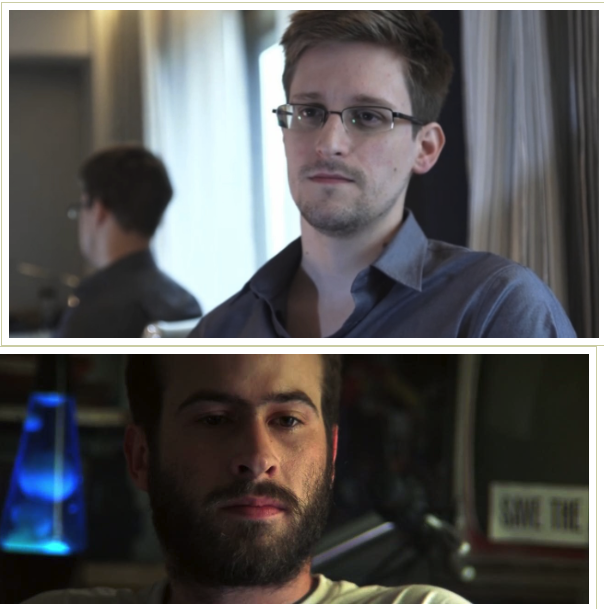
Top: Edward Snowden, bottom, Jason Lee in ENEMY OF THE STATE (1998)

“I made the judgment that we couldn’t survive with the popular impression of this agency [the NSA] being formed by the last Will Smith movie.” -ex-director of the NSA Michael Hayden to CNN, 1999

Before The Guardian’s video interview with Edward Snowden, the most damaging movie to the National Security Agency’s image was Enemy of the State (1998). Just another slam-bang Jerry Bruckheimer-Tony Scott blockbuster, it also depicted the NSA as a rogue operation that could tap the phones and bank records of American citizens at will. In the book Deep State, Marc Ambinder and D.B. Grady report that, “Not a few NSA managers at the time saw the movie and privately thought, ‘If only!’”  Following a dustup with European governments over the NSA’s global surveillance program ECHELON, Enemy of the State convinced Hayden that the NSA had to make gestures towards transparency. But as Snowden’s leaks reveal, the NSA was continuing to gather the capabilities, if not the legal authorization to target American citizens, for the tools deployed in Enemy of the State.

genehackmanasbrill

Bruckheimer and his late production partner Don Simpson began developing Enemy of the State in 1991, with a one line idea about a man whose electronic identity is stolen. After the Baltimore Sun ran a series of articles on the NSA in 1995, a time when the agency was reluctant to admit it even existed, they collaborated with screenwriter David Marconi to build it up into a story about the surveillance state, which Tony Scott dramatized through use of spy cameras and satellite footage – a layering of textures he would later push to extremes in Man on Fire and Domino. In the press notes Bruckheimer utilized some classic Hollywood double-talk, eager to please all political factions:

“I’ve always been interested in the inevitable questions surrounding the invasion of privacy. With today’s technology anything is possible and everything is probable. I don’t think the public is truly aware of what’s at stake in terms of an individual’s privacy. But the other side of the controversy remains – we need to be able to protect our borders and our citizens. The NSA has been incredibly active in preventing terrorist attacks and finding those responsible for the rash of senseless bombings that have erupted recently.”

Despite this defense of NSA practices, he was denied cooperation from the agency. So for technical assistance he enlisted Larry Cox, an 11-year veteran of the NSA. In a bizarre bit of historical coincidence, Cox would, just a few years later, be in a position to make the film’s paranoid fantasies come true.

Cox was founder and president of the menacing-sounding ORINCON Sygenex Incorporated, which was acquired in 2003 by Lockheed Martin. where he became the Vice President of Signals Intelligence. In 2005 he became the senior vice president and general manager of the Intelligence & Information Solutions Business Unit (IISBU) of SAIC (Science Applications International Corporation). SAIC employs approximately 41,000 people that “serve customers in the U.S. Department of Defense, the intelligence community, the U.S. Department of Homeland Security, other U.S. Government civil agencies and selected commercial markets.” SAIC was, along with Booz Allen Hamilton, the main contractor assigned to work on the NSA’s massive data mining Total Information Awareness project that was stripped of its funding by Congress in 2003. Cox came aboard two years later, but there are strong indications the program lived on well into his term. An expansive precursor to the Snowden-disclosed PRISM project, TIA sought to “predict terrorist attacks by mining government databases and the personal records of people in the United States.” Cox remains a consultant to the NSA Advisory Board.

At the same time that Hayden was  engaging his NSA charm offensive against Enemy of the State in 1999, the agency was starting an aggressive privatization push, which accelerated following 9/11. Needing to hire more analysts and translators, they began contracting heavily from private companies like SAIC and Booz Allen Hamilton, the latter of which Snowden worked at for three months before leaking the PowerPoint slides that outline the siphoning of TeleCom and internet data.

enemy

While many of the actions performed by the super-spies in Enemy of the State are pure science-fiction, some are now plausible. An early sequence finds cherubic agent Jack Black pulling up Will Smith’s phone records and cross-checking them against his banking statements, and within seconds forging a link to an ex-flame of his played by Lisa Bonet. The NSA cannot listen in to the conversations of U.S. citizens, but it does suck in all the metadata of their phone calls, their number and duration. While American citizens’ metadata cannot legally be targeted as part of an investigation, it is still collected and stored, ready to be used if the secret rulings of the FISA court ever deem it necessary.

It is President Obama’s contention that collecting this metadata is part of the balance of privacy and security, but that listening in to conversations is the bright line that cannot be crossed. The metadata, though, has an enormous explanatory power of its own, and combined with the NSA’s power to search credit card and bank records, can sketch an entire life. At Foreign Policy Shane Harris notes that “a study in the journal Nature found that as few as four ‘spatio-temporal points,’ such as the location and time a phone call was placed, is enough to determine the identity of the caller 95 percent of the time.”

enemy_of_the_state_1998_500x336_966862

Will Smith is able to escape the dragnet due to the help of ex-NSA hand Gene Hackman (there are many nods to his role in paranoid surveillance classic The Conversation). It is unclear what help Edward Snowden will receive, aside from legions of internet admirers. His closest analogue in the film is the environmental activist played by Jason Lee, who stumbles upon a government secret and scrambles to release it to the public before getting crushed by a commuter bus. Luckily for Snowden he is not inside a Tony Scott movie, but somewhere…else (he checked out of his Hong Kong hotel today, his current whereabouts are unknown).

The video interview hosted at The Guardian is a fascinating object, hermetic in form but expansive in implication. Conducted by Glenn Greenwald and directed by Laura Poitras (whose forthcoming untitled whistleblower doc has already achieved legendary status), it opens with a scenic picture of lolling boats in Hong Kong harbor. It’s a dis-establishing shot, since Snowden’s specific whereabouts are to remain hidden. When he appears he is a talking head, the back of which is reflected in a nearby mirror. He looks pasty and unshaven, rather the IT stereotype of a denizen of dark rooms. He speaks in calm, even tones, whether about his disillusionment with and deception of the surveillance state, or his fears of government reprisal. It is impossible to glean anything of an inner life, but it is curious that he is speaking at all, considering his stated claim of keeping attention off himself and onto changing U.S. policies. His appearance has deflected debate of this country’s privacy laws, diverted into drive-by psychologial evaluations of Snowden and attempts to identify the girlfriend he left behind (I won’t link to that), and recent polls show that 56% of the U.S. population approves of the NSA’s actions.  But there are promises of more leaks, and I’m sure Jerry Bruckheimer is takings notes for the Enemy of the State sequel to come.

NON-LETHAL WEAPON: JACKIE CHAN’S POLICE STORY (1985)

April 23, 2013

Screen Shot 2020-02-11 at 4.45.28 PM

“Nobody can beat Bruce Lee, everybody can beat me” -Jackie Chan

Failing as a stoic Bruce Lee clone early in his career, Jackie Chan discovered that audiences preferred him as a cheery masochist, enduring abuse for fun and profit. His kung-fu clowning in Snake in the Eagle’s Shadow and Drunken Master (both 1978) established a persona he would tinker with the rest of his career. When he shifted from martial arts period pieces to modern day action thrillers in the 1980s, his drifting fool becomes professionalized, an innocent goofball in uniform. His masterpiece of this period is Police Story (1985), which was recently issued on Blu-ray by Shout! Factory, along with its initial 1988 sequel, Police Story 2 (1988). Chan has made five Police Storys to date, with a sixth in production set for release later this year, but the original remains his (and my) favorite.

Before starting work on Police Story, Chan suffered through an ill-conceived Hollywood project, The Protector. Although shot in Hong Kong, Director James Glickenhaus (The Exterminator) refused to work in the local style. Glickenhaus recalled, “They never shoot masters, they shoot very short sections and they do a lot of under-cranking to speed up the movement, which I refuse to do. I told him I wanted to shoot the fights in masters and then, if they didn’t work, go back and cover them.”   Chan preferred to shoot stunts in segments, allowing time to perfect each gesture. He went along with Glickenhaus’ plan, but re-shot sequences behind his back and inserted them into the version released in Asia. It was a box office failure, and Chan wouldn’t have stateside success until the 1990s.

Following that disheartening experience, Chan exerted complete control over Police Story, as actor-director-fight choreographer. The script was written by long time collaborator Edward Tang, who Golden Harvest assigned to work with Chan on Dragon Strike (1982, aka Dragon Lord), and who has become the caretaker of the Chan persona. While Chan’s bricolage fighting style, in which everyday objects are transformed into weapon, had been developed with Yuen Woo-ping in Drunken Master, his screen personality was still in flux.

While he was in Hollywood for his first busted project, The Big Brawl, Chan spent time watching a lot of silent films: “Buster Keaton, Harold Lloyd. And what they did was amazing. Buster Keaton gave me a lot of ideas, new things I could do that were physical or funny, but wasn’t fighting.” Like Keaton in vaudeville, Chan was raised in the entertainment business, his destitute parents dropping him off at the Chinese Opera Research Institute in Hong Kong when he was six to learn the art of Peking Opera tumbling. There are many silent film homages in his blockbuster Project A (1983), including a dangling clock face gag straight out of Lloyd’s Safety Last! (1923).  In Police Story, the influence becomes more internalized, the gags less referential and more tailored for Chan’s particular skills.

In Police Story he plays Chan Ka-kui, an impetuous cop protecting a reluctant witness (Brigitte Lin) against reprisal from crime lord Chu Tao (Yuen Chor). Chan naively believes in outdated concepts of heroism, eager to risk life and limb and acres of private property in order to catch his man. He is like a child living out a heroic fantasy, ignorant of the pragmatic compromises his colleagues and superiors agree to in order to protect their asses. There is a bit of Douglas Fairbanks Sr. in this, as his characters were also men out of time, as seen in A Modern Musketeer, in which his chivalric code nets him a slap to the face. Chan’s triumphant capture of Chu in Police Story gets him a demotion to traffic cop in the sequel, due to his spectacular destruction of a shanty town as well as an entire shopping mall.

These are sequences of manic energy released into death-defying punchlines. Chan deflects violence with his body and turns it into humor, a flesh and blood Wile E. Coyote. The opening is a close-quarters shoot-out in an HK slum that escalates into a car chase/destruction derby that reduces the hovels to rubble. His car a wreck, he chases down the escaping bus by latching on to the bumper with the crook of an umbrella, feet dragging on the asphalt (the way he snaps himself onto the back of the bus recalls Yakima Canutt’s famous stagecoach stunt). In the shopping mall finale, he crashes through every available glass surface, some with the help of a motorcycle in a bit of conspicuous destruction.

These are all shot in segmented close-ups, the style so despised by Glickenhaus, but it gives Chan’s stunts a gestural clarity and immediacy absent from the usual master shot/close-up routine. This way his moves are linked, unfurling as if in one ribbon of movement, while the alternating focal lengths of Glickenhaus necessarily breaks up that rhythm. Chan’s style allows the impossible to occur with speed and fluidity, an ethos exhibited even in offhand moments. At the start of an extended telephone answering gag (he gets tongue-and-wire tied), Chan flips up a pencil with his foot and catches it with his hand. It takes a split-second of screen time but a lifetime to master, making the impossible look like a flick of the wrist.

The image quality on the Shout! Factory Blu-Ray is poor, as the prints they transferred are faded and worn. The Hong Kong release also received negative reviews, but the Shout! disc doesn’t exhibit any of the transfer artifacts mentioned there. I doubt there is better material to work with, so unless someone unearths a pristine negative, this new disc is likely the best the film can look right now.

GEORGE SHERMAN, DIRECTOR OF WESTERNS

April 2, 2013

16_1939 Wyoming Outlaw

When director George Sherman passed away at the age of 82 in 1991, he was noted only for the quantity of his output. The obituaries in both the Los Angeles and New York Times pointed out the “175″ credits he had accrued as a director for screens both large and small (IMDb lists 126), although nothing as to their quality aside from their “low-budget” origins. I recently enjoyed some of Sherman’s Three Mesquiteers Westerns that he made for Republic (which I wrote about here), but a recent column by Dave Kehr has made me ravenous for more. Reviewing Dawn at Soccoro (1954, released as part of a TCM Vault Collection), Kehr describes him as “experimental”, and the film as,  “a western that might have been imagined by Kafka.” Fortuitously, more of Sherman’s work has been reaching home video. Last month Universal released a budget-priced“Classic Westerns” set of 10 films that include two Shermans: Comanche Territory (1950) and Tomahawk (1951), while Olive Films finished off their stash of John Wayne Mesquiteers films with Wyoming Outlaw(1939).

wyomin11

The Three Mesquiteers B-Western series ran from 1936 – 1943 at Republic, and necessarily followed stock scenarios of the three ranch hands thwarting the plans of evil homesteaders and other n’er do wells. Sherman managed to helm the outliers in the series, including the zoo animal burlesque Three Texas Steers and revolutionary fantasy The Night Riders. Wyoming Outlaw is the most downbeat entry of the bunch though, a despairing portrait of institutional corruption feeding poverty and violence. The Mesquiteers, including John Wayne as Stony Brooke, are shockingly passive onlookers, unable to stop the degradation of the Parker family. Because they refuse to pay a tribute to local boss Balsinger (LeRoy Mason), the patriarch Luke Parker loses his job, and his son Will is reduced to stealing and slaughtering cattle for food. Despite their efforts to help, including muscling in on Balsinger’s thugs, the Mesquiteers stand helplessly by while Will turns outlaw and falls in a hail of bullets. For a series built on action and resolution, this is a curiously static and morally ambiguous film, more interested in Will’s forced descent into murderousness than the Mesquiteers knockabout good guy routine.

comanche-territory-movie-poster-1950-1020537123

Governments hadn’t been cleaned up in Sherman films a decade later, when he was at Universal International for the Technicolor spectacles Comanche Territory (’50) and Tomahawk (’51). Both feature attempts to swindle Native Americans out of their land, stoking a free-floating paranoia that merits Kehr’s comparison to Kafka. Sherman also imbues their background characters, like Will in Wyoming Outlaw, with an unusual level of sympathy. Comanche Territory has Macdonald Carey play Jim Bowie, who is delivering a treaty to the Comanche to allow the U.S. to mine for silver on their land. He is waylaid en route, the treaty stolen by local townspeople eager to drive the Comanche out so they can stake their own claims. Katie Howard (Maureen O’Hara) is involved in the scheme, a prickly entrepreneur who is introduced by galloping a horse down the main drag while not spilling a drop of the beer she is holding. O’Hara’s  performance is made up of a flurry of quick-twitch movements of a woman whose mind is never at rest. She dominates every frame she is in, while Carey, embodying a Western icon, recedes into the background. Katie, introduced as a rapacious capitalist and land grabber, becomes the fulcrum of the film, hoping for a pragmatic peace with the Comanche, and thus splitting off from her brother’s gang. The climactic shootout depicts the Comanche and Bowie gunning down the gang, a rare triumphalist moment for Native Americans in Hollywood film.

l_44135_5da9df1c

The opening voice-over in Tomahawk (1951) presents the clearest example of Sherman’s instinct to investigate the motivations of his heroes and villains and everyone in between. He has internalized Renoir’s line in The Rules of the Game, “everyone has their reasons”.  The camera tracks down two diagonal lines. The first is of the U.S. cavalry, over which the sonorous voice-over describes the lives they have lost for what they consider to be “freedom”. The second diagonal is of a line of Sioux, who because of the White man “suffer starvation and sickness where once there was plenty.” In between them is Jim Bridger (Van Heflin) a long-time scout who was once married to a Sioux woman, before she was slaughtered by a Colorado vigilante group led by a preacher.  He is on hand to help negotiate an agreement for the Army to build a fort on Sioux land. The talks break down over the government’s bad faith, but the fort gets built anyway, and Bridger stays on as a scout. But when a Sioux boy gets shot in the back by a racist Lieutenant, there is nothing he can do to stop the slaughter to come.

Sherman sets the horizon line low throughout, filling the frame with sky in his frequent long shots of Rapid City, South Dakota. The figures are specks against the immensity of the blue, already lost to history before they lose their bodies. The Sioux line up on this horizon line near the end, unaware that advancements in repeating rifle technology will turn their battle plan into an abattoir. The final shootout is more like a Holocaust, Van Heflin’s severe face colored with nausea.

In these Westerns Sherman cannot film a victor without depicting the resultant loss. There are no heroes or villains, just flawed people with ingrained, unshakeable beliefs and perspectives that set them into conflict. That some pass on and others survive seems incidental to these works, which simply aim to see what makes people tick, and then stop. George Sherman couldn’t stop making films, but he was not only a prolific artist, but a profound one.