ACTION ITEMS: DIRECT-TO-VIDEO, INTO MY HEART

September 6, 2011

Screen Shot 2020-01-31 at 5.40.44 PM

Under the cover of disrespectability, direct-to-video (DTV) action movies are quietly throttling their theatrical brethren. Despite having budgets one-tenth of studio spectacles, these DTV scrappers excel where it matters most: the craft of shooting a fight scene. As the enigmatic film critic/ex-con Outlaw Vern stated in his review of The Marine 2, “Some of us are starting to suspect that there’s been a switcheroo, that the DTV format – once designated as a 100% crap zone – has become the more reliable place to find good [English language] action movies.”

Inspired, I watched Assassination Games (2011, on DVD/Blu today), Universal Soldier: Regeneration (2009) and Ninja (2009), where tussles are filmed to showcase the athleticism of the leads. The threadbare Bulgarian sets are coherently mapped out in master shots, so the close-ups of fist-to-face never throw off the geography of a scene. The camera generally keeps the combatants’ bodies completely in the frame, emphasizing a physicality generally lost in contemporary Hollywood (Jason Statham excepted), in which fights are reduced to a blur of cuts before a hired goon collapses. David Bordwell has identified this rapidly edited style as “intensified continuity”, an amplification of classical style that he places as starting “after 1960 or thereabouts.” These DTVers still fall in Bordwell’s post-1960s rubric, with shot lengths shorter than the classical era, but they offer a more authentic intensity, returning to feats of athleticism over editing.

The workhorses of DTV these days are Dolph Lundgren, “Stone Cold” Steve Austin and Christian Slater (who has 8 (!) movies listed as coming out this year), although Jean-Claude Van Damme is ramping up his schedule after his flirtation with respectability in JCVD (Lundgren and Van Damme will also cash a check for Expendables 2).  The only consistent indicator of quality, however, has been the presence of English actor Scott Adkins and Israeli director (and Power Rangers auteur) Isaac Florentine.  Both are trained martial artists, and their work together prizes lucidity of motion above all else (including the plot). In Undisputed II III, which I enthused about last year, Florentine used high-speed cameras to isolate Adkins’ attacks and reversals in an MMA-inspired fight tournament. Ninja, which was made between the two, brings their analytic fighting aesthetic to an urban setting (Sofia, Bulgaria rather unconvincingly standing in for NYC). They ditch the super-slo-mo, but keep the clean lines and camera distance, keeping Adkins’ body whole in the frame, like Fred Astaire demanded of his directors.

Adkins plays Casey, a military brat orphan raised in a Dojo in Japan. His nemesis is Masazuka (Tsuyoshi Ihara), another prized student with daddy issues. Desperate to knock off Casey to impress their Sensei (Togo Igawa), Masazuka breaches the Dojo’s code of conduct and is expelled. Naturally, he dons a vulcanized ninja outfit and becomes a top assassin for an evil corporation (who also operate a cheesy death cult of some sort). These B-DTV trappings are mere action scene delivery systems, and it’s best not to let Adkins emote too much (the most he can muster is a frown of mild indigestion), but once the flesh starts flaying, Ninja satisfies. Take, for instance, the first battle between Casey and Masazuka, at the Dojo. It begins in long shot, with the full width of the house visible behind them.  Florentine maintains the distance as the fight with wooden training swords commences. He only cuts in closer when Masazuka lands a couple of blows, a punch and a slice that shatters Casey’s fake blade. After each of these accents Florentine returns to the long shot, re-orienting viewers to the space. It is a quick but effective sequence, representative of their work.

This can be seen more spectacularly in a brawl in a subway car (caught at the mythical “Noble St.” stop), into which Casey and lady friend Namiko are chased by the evil corporation’s thugs. Here a long shot is impossible, so Florentine opts for measured pans up and down, and a more-frequent use of slow-motion. Every element is isolated and accounted for – you see every gun kicked away and every blow landed. Low angles predominate, in which the ceiling offers another claustrophobic foe. In one sequence a mirthless baddie tosses a civilian towards Casey, and he leaps to avoid her. Cut to him continuing the leap up and through a guard rail, a bit of impromptu parkour. He lands and then ducks as the jerk throws a haymaker towards the camera. Cut to a reverse low angle, and after another block Casey is kicked halfway down the aisle, and the camera follows him all the way as it hovers close to the ground. This is a few seconds of screen time and yet it thrills with its logic and effortless flow.

Logic is not something one would associate with the Universal Soldier franchise, but this Regeneration, the third entry (or fifth, depending on whether you count a few TV movies), is as relentlessly rational a movie about half-robotic super soldiers can possibly be. It “stars” Jean-Claude Van Damme and Dolph Lundgren, although combined they don’t have more than 30 minutes of screen time. MMA fighters Mike Pyle and Andrei “The Pitbull” Arlovski, as Captain Burke and the robo-monster NGU, respectively, would get the box cover in an honest marketing campaign. But this is DTV, where descending stars cash checks for cameo appearances and top billing.

This adorable hucksterism aside, Regeneration is a bracingly brutal piece of work, with director John Hyams weaving his tracking shots through the post-Soviet rubble of  Chernobyl (again, shot in resourceful Sofia, Bulgaria). Instead of the detail-oriented approach of Florentine, Hyams opts for a kind of dystopic realism, the creation of the dust-choked atmosphere more important than the grace of an individual fighter. There are very few close-ups and a profusion of long, gliding takes. Peter Hyams (2010, Timecop), John’s father, is the cinematographer, and his technical chops and experience no doubt helped in creating these elaborate shots on a budget.

Its sci-fi trappings aside, this a straight-up kidnapping drama. The Russian president’s two children have been nabbed by an insurgent group, who then take over the Chernobyl nuclear plant and threaten to blow it up, along with the kids, if their fellow rebels in prison are not released. As it happens, they also have retained the services of Dr. Colin (a wonderfully neurotic Kerry Shale), who has the tech to produce the eponymous Universal Soldiers. The U.S. military gets involved, because that’s what they do, and create their own UniSols to free the kids. Van Damme is Luc Devereaux, an ex UniSol dealing with post-traumatic stress syndrome, who now lives in a mental health facility. Devereaux is dragged back into action, and Van Damme plays this broken down hero’s confusion with admirable vulnerability. Of course, once injected with the UniSol drugs, he becomes an insatiable killing machine, which in turn drains the last of the human out of him. It’s a surprisingly sad and despairing film, as much a reflection on Van Damme’s beat-up body as JCVD was.

The action is shot elegantly, never more so than in a minute-long SteadiCam take that opens the final act. Van Damme is blasting his way through the war zone, and sprints right. The camera races along with him. Two masked gunmen blast away in the left foreground, as Van Damme evades their bullets in the background. Then he leaps through a window and disappears. The camera follows the shooters in their confusion, until Van Damme bursts through a door and kills them. It’s surprising that the star is hidden from view in this manner, leaving the audience stranded with two villains, building a mini-drama out of his whereabouts. Instead of cutting to Van Damme’s hiding place, the Hyams clan opt to maintain the tension of the unbroken shot, which then continues. Van Damme pushes forward into building and stalks the hallway. As he inspects an adjacent room to the left, the camera does a 180 and picks him up as he re-enters, swinging right and left to capture the gunfights on either side. Peter Hyams continues these balletic weaves until Van Damme has slaughtered a small village. It is not triumphal but ruthlessly efficient.

Assassination Games teams up Adkins and Van Damme, in a touching DTV passing of the torch. Now, the film received a limited theatrical run in four cities, so it is technically not direct-to-video. However, it was shot in Eastern Europe (Bucharest this time), by DTV hack Ernie Barbarash, so it is at least spiritually direct-to-video, which is all that matters. This is the kitschiest of the DTV films I watched recently, but it still had its pleasures. Adkins plays retired hitman Roland Flint, who gave up his gig after his wife was attacked in the line of duty (she is played, comatose throughout, by Van Damme’s daughter Bianca van Varenberg). When he learns that the perpetrator, Polo (Ivan Kaye), is being released from prison, he re-enters the competitive assassination biz. However! Vincent Brazil (Van Damme) has been hired to kill Polo as well, and sullen stare downs ensue.

Barbarash does not show the visual flair of Florentine and Hyams, with bland, centrally framed (although still intelligible) set-pieces, but he has a playful sense of genre codes that enlivens the proceedings. Brazil is the effete assassin, who hides a secret ultra-modern apartment behind a bookshelf in his grimy Romanian walk-up. He has violins encased in glass, a pet turtle, and is fond of sharpening his knives topless. This is grandly ridiculous, although Van Damme is not one to camp it up. It’s a role that, from the current crop of DTV icons, Val Kilmer could have joyously hammed. Flint is a non-entity in comparison, a guy who loves his wife and not, apparently, much else. And with firearms his weapon of choice, Adkins does not get to display much of his uncanny athleticism, just his impeccable five-o-clock shadow. It’s a bizarre, amiable failure, too reserved to embrace its camp aesthetic, and unable to unleash the kinetic talents of its actors.

Admittedly I’ve only taken a small sample of direct-to-video titles, but there is more visual clarity in this group than in any English-language action movie I’ve seen the last few years (and I like the Luc Besson-produced titles like Taken, Unknown, et al.). The low budgets force producers to return to basics: showcasing the physical gifts of your leads and coming under budget. DTV movies sell based on the actors, so if they want to succeed they need to film them as legibly and forcefully as possible. And with low budgets, directors don’t have the time to shoot all the coverage that Hollywood directors engage in, which gives editors multiple shots and angle to play with in their action scenes. Here they keep film costs low, and give their cutters few options, but grateful viewers like myself far more.
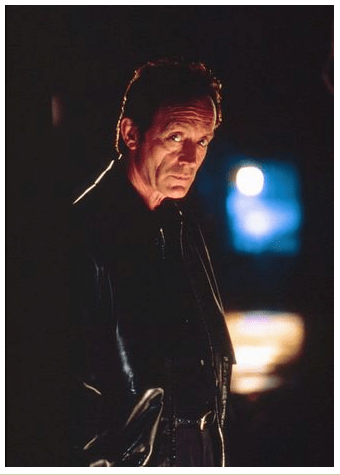
LANCE HENRIKSEN: NOT BAD FOR A HUMAN

August 9, 2011

Screen Shot 2020-01-31 at 3.22.57 PM

You know this gaunt growler. He lurks in the disreputable direct-to-video section of your local video store, if it still exists, or pops up on Netflix in a low-budget creeper rated with one reluctant star. He is, of course, Lance Henriksen, a tireless worker and a real character of a character actor. In his wild, circuitous life he’s compiled a trunk-full of  anecdotes and chastened life lessons. With the help of co-writer Joseph Maddrey, he packed all of them into his autobiography, Not Bad For A Human. It lays bare his poverty-stricken youth and job-hustling acting career with a disarming lack of vanity and a rhythmic sense of cursing.

“‘You know, Lance, you’re not going to work much until you’re older.’ Why’s that Charlie? ‘Because you look funny.” – Charles Durning to Henriksen, on the set of Dog Day Afternoon


Henriksen had a face he needed to grow into. His Easter Island head needed the ballast of sagging cheeks and the proliferating slashes of wrinkles to ease his transition from awkwardly handsome man to sage and unsettling elder. The transformation was complete with the addition of a cigarette-scarred rasp to his low rumble, able to modulate between wise or psychotic with the turn of a script page.

One of Henriksen’s many forthright confessions is that he wouldn’t be able to read those scripts until he was thirty. He was born in NYC on May 5th, 1940 to James Henriksen and Marguerite Healey. James was never around, and Marguerite worked waitressing jobs to keep her kids fed. She flailed for stability, with “great dreams for her life, but she had no education and she kept marrying men for the sake of being taken care of.” She married five times. In between men there were financial troubles, and one way to make money was acting on television:

There was this talk show in New York where you’d go on the air and tell a bleeding heart story, and listeners would call in and make contributions. My mother got me on that show when I was a little kid, and we would tell these awful lies. It was like we were were a family of grifters…

Lance bounced between family members, but once his maternal grandmother Floss died, he had no reliable guardians to speak of. He ended up at an orphanage at Hastings-on-Hudson and, as Henriksen recounts:

They were impatient with me because I couldn’t read. I was just a little kid, but they got me up in front of the class and I couldn’t read, so they humiliated me. And that was the end of reading. I just thought, Fuck reading. in my heart, I just…turned it off. And school. Fuck school.

He worked as a shoeshine boy and lived on the streets of New York, only finding the sense of community he sought in the movies. His favorite at that time was Howard Hawks’ Western The Big Sky (1952). The love between Kirk Douglas and Dewey Martin as they venture through the Grand Teton Mountains struck a chord with the lonely and adventurous Henriksen. When he watched it, he said he was a “Method movie viewer”, bringing a “knapsack, a canteen, a frying pan…and what I thought was a sleeping bag…. I brought all the stuff into the theater with me…and I watched the movie maybe eight times. I’d fall asleep for a while and wake up and watch it some more.”

After years of wandering, through San Francisco and a short stint in the Navy, he ended up in New York with a yen for acting. Still unable to read, he would have a friend recite his dialogue parts into a recorder, from which he would memorize lines. Eventually he taught himself to read, although he claims a nagging sense of inferiority at his lack of education throughout his career.

He was immediately drawn to the physicality of Method acting, and became a part of The Actors’ Studio community, although he was never an official member. Henriksen says Lee Strasberg simply, “wasn’t my kind of guy.” He also rejected studying with Sandy Meisner, who asked him to quit acting for five years if he wanted him as a teacher. Henriksen didn’t think he could afford to live under those circumstances and responded, “Yeah, okay, I’ll do it…but if you fail me, I’m gonna kick your ass.” Meisner declined to accept him as a student.

As with reading, Henriksen learned acting through osmosis and practice. His process was to immerse himself totally in his characters, building elaborate backstories not included in the script, and designing his own costumes and props that he would react to spontaneously in scenes. Inside of this invented world he would feel free to act instinctually instead of mechanically. Part of this process required playing his characters on and off set. When he was playing Wally Schirra in The Right Stuff, a good-hearted family kid, he went looking for his biological father and reunited him with his mother: “My mom really liked Wally. Here she had this son who was attentive to her, didn’t swear around her, took her out to dinner…I think she wishes Wally would have stayed around!”

The impressive thing about Henriksen’s ethic is that he applied it to every project, whether a prestige Hollywood item like The Right Stuff or a ridiculous action film like Stone Cold (1991). Henriksen has invented a useful vocabulary for the roles he would take on. There were the “fart-catcher” roles, which were essentially background players who would absorb the leads’ precious gases. Then there were the “alimony films”, which he took on after his two divorces, and the “jet-lag” gigs, for the low-budget Eastern European movies. For the latter, “I wouldn’t even get an eight hour turn-around before I had to start reciting all this shit.” The first of these was Antibody (2002), in which he plays an “FBI agent who gets injected into the bloodstream of a terrorist.” Henriksen has an extraordinary ability to compartmentalize his performance from the films he appears in. His method allows him to act the movie he has constructed in his head, which the final product rarely lives up to.

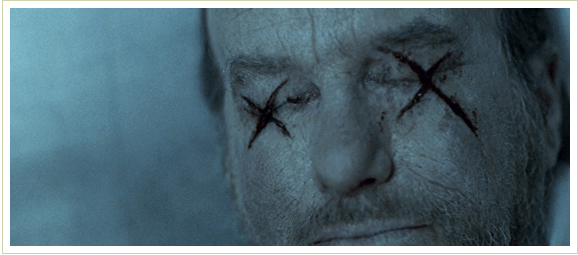
Stone Cold falls outside these categories, one of the few films in which he had complete creative control. A vehicle for NFL bust Brian Bosworth, the creative chaos on the set allowed him to finally act without restrictions. The original director was fired and Craig R. Baxley was hired to replace him. He was dissatisfied with the dialogue for his character, the villain Chains Cooper, and requested he be able to improvise all of it.  Baxley agreed and Henriksen, “got so deep into the role that I’d just say whatever came into my mind.” He was given similar freedom on Jim Jarmusch’s Dead Man, which along with Aliens is one of the few films worthy of his talents. He told Jarmusch that “I don’t want to say one line that you’ve written for this character in the script. I want to improvise the whole thing”. The director trusted him, although Lance’s conviction went to frightening lengths. Jarmusch remembers:

He stayed in character a lot of the time, which was a little scary. Some actors can just walk off the set and become themselves again, but Lance puts so much of himself into a performance that it takes him a little while [to get out of character]. It’s always percolating. And like all really fine actors, he doesn’t act out the stuff; he reacts.

Henriksen is one of the great reactors of the cinema, even if the environment around him isn’t worth reacting to. On my last trip home, my Dad was flipping through the channels and found the direct-to-video alimony film Sasquatch (aka The Untold, 2006). His first reaction was, “any movie with Lance Henriksen has got to be good.” As I watched Lance on-screen,  manfully staggering after a man in a rubber suit with wide-eyed desperation, grief over his daughter’s death doubling the carved lines on his face, it was clear my Dad’s dictum was correct. Lance Henriksen justifies the existence of any movie he appears in, however threadbare.

I’ll leave him with the last word:

If I get another script that says “The Sasquatch looks around the tree”, I’m going to go, “No way, leave me alone, man.”

VINTAGE VIOLENCE: SANDS OF THE KALAHARI (1965) AND LIVE LIKE A COP, DIE LIKE A MAN (1976)

August 2, 2011

Screen Shot 2020-01-31 at 2.59.28 PM

A baboon and Santa Claus are witnesses to man’s descent into savagery. In Sands of the Kalahari (1965, out on DVD today from Olive Films), a charter plane crashes in the African desert, and its passengers battle each other (and some observant simians) for survival. Live Like a Cop, Die Like a Man (1976, a recent Raro Video DVD release)  finds a couple of pretty boy Dirty Harries gunning down suspects before they have time to commit crimes. Poor Old St. Nick can only grin and bear these assaults on individual freedom. Both films display the brutalizing depths wisecracking civilized types can descend to when they feel above or outside the law.

After the international success of Zulu (1964), director Cy Endfield and actor/producer Stanley Baker reunited in South Africa for Sands of the Kalahari. Endfield, born in Scranton, PA,  had been working in the UK for over a decade after being declared a former Communist by the House Un-American Activities Committee. I discussed his second-to-last Hollywood film, the inflammatory noir The Sound of Fury (1950, aka Try and Get Me), back in February. He used a variety of pseudonyms in the years after he was put on the blacklist, since British producers still wanted U.S. distribution.

Endfield (credited as Charles de la Tour) first worked with Baker on Child in the House (1956), a family drama adapted from the novel by Janet McNeill. They hit it off, and returned with Hell Drivers (where Endfield used his real name for the first time), a taut trucking adventure that established the fatalistic tone of their future collaborations. They continued to elaborate their interest in self-destruction in the thrillers Sea Fury (1958)and Jet Storm (1959) before hitting it big on Zulu.

Like Jet Storm (set on a plane in which a grief-stricken passenger (Richard Attenborough) intends to blow himself up) and ZuluSands of the Kalahari contends with a small group grappling with the prospect of  imminent death. The story was adapted by Endfield from William Mulvihill’s novel of the same name. When a commercial flight is canceled at a Johannesburg airport, a few of the international travelers charter their own plane out: there is the fadingly charismatic pilot Sturdevan (Nigel Davenport); the unfailingly logical, and vaguely Eastern European Dr. Bondrachai (Theodore Bikel); ex-German soldier and monkey lover Grimmelman (Harry Andrews); professional British lady Grace Munkton (Susannah York); functioning alcoholic Bain (Stanley Baker); and the immediately shirtless big-game hunter O’Brien (Stuart Whitman).

The plane runs into a swarm of locusts and crashes into the dunes of the Kalahari desert. After the junky jet explodes, the group is stranded in the middle of the most inhospitable place on earth, with sharp-toothed monkeys monitoring their every move. O’Brien sheds his shirt and takes over, and slowly goes mad Heart of Darkness style, growing obsessed with the absolute power he can maintain in this exotic outpost of humanity. Ms. Munkton swoons over his rippling pectorals, but the other passengers aren’t so impressed, and get picked off one by one. What O’Brien ultimately wants is to dominate nature itself, and when humanity fails to pose a challenge, he opts to wage a war against the baboons.

Endfield takes full advantage of the Panavision frame, using the early urban sequences for centered compositions filled with background action, while the desert sections are unbalanced and emptied out. The opening is in medium-shot, while the desert sequences are in long-shot. As the enormity of their situation dawns upon his characters, Endfield pulls further away. It is a nasty little picture, attuned to the brutality of the scenario more than others of its ilk, including the (quite good) Five Came Back (1939, dir. John Farrow), Desperate Search (1950, dir. Joseph H. Lewis), and Flight of the Phoenix (1965, dir. Robert Aldrich). Endfield said, “The only way to do it was to show the essentialism of survival, which was impossible given censorship rules. Otherwise it seems like ‘Swiss Family Robinson’.” (from Brian Neve’s career spanning interview).

I shudder to think what an uncensored Sands of the Kalahari would look like, because this is pretty raw material. In one queasy sequence, the remaining men club a wounded impala to death with stones, as Endfield frames them in rare close-up with maniacal grimaces on their faces. In another, O’Brien guns down baboons from their mountainside dwellings, and their corpses fall to the ground like a mealy potatoes.

The main conflict is between O’Brien’s hyper-macho Darwinism and the other men’s reluctant egalitarianism. There is no true competitor, as the Doctor is a coward, the German resorts to the violence he disdains, and Bain is brave but a bit of a dolt. Endfield clearly agrees with the milquetoasts, but is fascinated by O’Brien’s animality. Shunning escape, he chooses to live alone in the desert, growing a patchy beard and awaiting the showdown with the primates whose homeland he has invaded. This final battle is gruesome and short, and in the end Endfield pulls away in his longest long shot, until O’Brien is just another dot on the landscape. Nature, as ever, is unperturbed.

Live Like a Cop, Die Like a Man does not exhibit that kind of formal control, but its tilt-a-whirl frenzy holds its own insane appeal. Directed by Italian exploitation specialist Ruggero Deodato (Cannibal Holocaust), it’s a near plot-less exercise in gonzo action sequences. Fred (Marc Porel) and Tony (Ray Lovelock – who also sings the Dylan-esque theme song) are model-handsome cops spearheading a special operations force in Rome. These two grinning sociopaths gleefully snap necks of suspects who survive their chases, and resort to torture for small bits of information. They are the exploitation version of Dirty Harry, who at least had motivation for his sundering of the law. These two are simply insane, although they go about it in an amiable cop show manner, as if CSI: Miami’s David Caruso just started choking out schlubs in the interrogation room.

Without characterization or narrative to speak of, the juice here is in the location shooting of the action scenes, which deliver wildly dangerous stunts on the streets of Rome, often shot without permits. The stunner is the opening motorcycle chase, an epic jaunt through the Via del Corso that weaves through traffic, crashes through cafes, thunders on top of cars, and scares an old blind man. Interspersing camera mounted cycle shots with the death-defying stunt-riders, it’s a full kinesthetic assault that matches its other model, The French Connection (1971), for white-knuckle realism. When the action scenes end, it’s just another campy exploitation movie, but when the cameraman hits the ground running once more, it’s wise to start paying attention.

DVD ROUNDUP: SHOUT! FACTORY AND WARNER ARCHIVE

July 5, 2011

Screen Shot 2020-01-31 at 2.24.06 PM

Edmond O’Brien enjoys a post-Independence Day fireworks display in Rio Conchos, the 1964 Western just released by Shout! Factory on DVD. With all my squawking about studios cutting back on library titles for home video, there are still plenty of rare and strange items sneaking onto those glimmering circular discs. Over the past few weeks, Shout! Factory and Warner Archive have shown they’re still fighting the good fight, and I’ll run down a few of their most intriguing recent renovation jobs.

I’ll start with Mr. O’Brien. Rio Conchos (1964) is paired with another 20th Century Fox film, the Blaxploitation-Spaghetti Western Take a Hard Ride (1975), encoded onto one dual-layered DVD. Directed by Gordon Douglas in sun-scorched CinemaScope, Conchos is a nasty job in which its ostensible hero, ex-Confederate soldier Jim Lassiter (Richard Boone), cold-bloodedly slaughters a group of Native Americans in the opening. It’s his bad luck that the repeating rifle he used was part of a cache stolen from the U.S. Army. He soon has Army Captain Haven (Stuart Whitman) and sullen Buffalo Soldier Franklyn (Jim Brown, in his first movie role) on his tail. Haven needs Lassiter to lead him to the rifle seller, so this unlikely trio heads south to Mexico, with the fast talking ex-con Juan (Tony Franciosa) as their guide.

Douglas, whose haunting Only the Valiant I wrote up earlier this year, again utilizes gothic imagery, this time setting Lassiter against imagery of decay and death. In the opener, in which Lassiter’s face is never seen, Native Americans are recovering their dead from a field of gnarled and petrified trees. These civilians are gunned down by a dot in the far background, and fall dead with their brothers. All we see of Lassiter is a reverse angle of his hat and gun, and then a pan down to the shells hitting the ground, a visual rhyme to the men he killed. The next time we see Lassiter, he is sitting, fat and happy, in a burnt out husk of a home, with the sun hollowing out the wrinkles in his jowly face – a satanically jolly figure.

He becomes a hero by default, with the passivity of Haven and the apathy of Franklyn unable to take the lead. Or perhaps because he is so familiar with evil he is the only one comfortable enough to confront it. In the infernal climax, Lassiter is right at home. In Chihuahua he meets his old Colonel Pardee (O’Brien), who has gone mad with dreams of establishing a new South in Mexico, and his half-built plantation house is the misshapen manifestation of that insanity. This time Lassiter enters another man’s decay, and fulfills the promise of those opening scenes, but destroys Pardee along with himself in a scene of grandiose self-immolation.

Speaking of grandiosity, there is Warner Archive’s handsome-looking remastered release of Dark of the Sun (1968), Jack Cardiff’s rollicking men-on-a-mission gloss that nails all of that genre’s pleasures with irresistible efficiency. You’ve got a shirtless Rod Taylor and Jim Brown, an evil German guy (Peter Carstein), and Yvette Mimieux wearing tight pants. Taylor and Brown are mercenaries hired by the Congolese government to recapture uncut diamonds in rebel-held territory, and things do not go as planned. Add chainsaws, gruff cynicism, an anthemic score and $25 million in diamonds, and you’ve got a movie out of Quentin Tarantino’s wet dreams (and he did sample the score for  Inglorious Basterds).  What makes this more than camp fodder is Cardiff’s slashing compositions, whose brash diagonals point to further adventures off-screen. Another unusual aspect to this Dirty Dozen clone is its frank depiction of violence. While it has its share of cartoon shootouts (see above), there are also awkward, grotesque deaths impossible to cheer – here civilians do die and consciences remain decidedly unclean. Rod Taylor is superb as the no-nonsense mercenary, a granite he-man who still sweats like an ox.

Another kind of masculinity is on display in Warner Archive’s The Breaking Point (1950), Michael Curtiz’s faithful adaptation of Hemingway’s novel To Have and Have Not. A spare and relentless noir about how unemployment can reduce a man to neurosis and petty crime, it bears no relation to Howard Hawks’ heavily reworked version of the story. In the Curtiz film, Harry Morgan is played by a hunched and fidgety John Garfield, in one of his finest performances. Morgan is a fishing boat captain with a wife and kids, but his business is floundering. His wife Lucy (Phyllis Thaxter) wants him to quit and work on her family’s lettuce farm (Garfield: “What’s so great about lettuce?”). Stubborn to a fault, and loyal to his partner Wesley (Juano Hernandez, whose quiet dignity was also present in Stars in My Crown the same year), he makes some extra cash by ferrying revelers over the border to Tijuana. One of those passengers is Leona Charles, a man-eater played by Patricia Neal with a knee-buckling purr. After her date abandons both of them in Mexico, Morgan doesn’t have the money to pass through inspections to get back home. So he takes on a job smuggling illegal Chinese immigrants back into the states. It is the beginning of his troubles.

Curtiz makes it a film about foreground and background interaction, with his expert blocking allowing for constant motion in every segment of the frame. It’s when the background moves forward, and into Morgan’s space, that his world starts to disintegrate. Harry and Wesley have calm spatial relations, as seen in the first photo, each carving out their own domain. It is the same way in Harry’s home, in which Lucy and his kids occupy background spaces, and approach with his tacit permission. But the entrance of Leona into his life is the breach that brings him down. Expecting just a single man, he spies a couple in extreme long shot, walking down the pier. Once they arrive, the separation between background and foreground breaks down, with Leona inviting them to puncture the space.

Within these setups, Garfield’s unraveling takes place behind his tense jaw clenches and repressed desires. He repeatedly forces himself close to Leona, only to deny himself her body again and again. It is a masochistic maneuver, testing the boundaries of his guilt. He represses his sexual urges and releases his neuroses in violence instead — taking a getaway boat driver job on a horse racing heist. By that point his doom is pre-ordained. But in the culmination of Curtiz’s work with foregrounds and backgrounds, the final shot is reserved for a wandering supporting character, pushed to the fore. Wesley’s son is seen searching the pier for his father, unseen and unknown.

***

I ran out of time this week, but Shout! Factory has also released an inspiring two-disc set of three Roger Corman Women-In-Prison movies (with a Blu-Ray slated for 8/23): The Big Doll House (1971), Women in Cages (1971) and The Big Bird Cage (1972). Fun for the whole family.

THE 2011 NEW YORK ASIAN FILM FESTIVAL AND JAPAN CUTS

June 28, 2011

mov_68FFCI_20110106174616_4

If you’re suffering from the summer blockbuster blues, there’s no greater pick-me-up than the New York Asian Film Festival, an invigorating potpourri of the finest in creative Eastern bloodletting. It marks its tenth decadent year with 45 features from nine different countries, unspooling at the Film Society of Lincoln Center from July 1st – 14th. 11 of those films are co-presented with Japan Cuts, the NYAFF’s more studious (if no less ambitious) five-year-old sister festival, held at Japan Society from July 7th – 22nd. Including the 21 other titles in Japan Cuts, there are 66 Asian movies hitting screens in July, most of which will never receive distribution in the United States (although many will be obtainable at Asian DVD retailers).

Surveys of national cinemas are usually funded by state organizations (i.e. Rendezvous With French Cinema at Lincoln Center is “supported by” the French embassy’s Cultural Services department), turning them into bland diplomatic exercises. The movies selected veer toward middlbrow arthouse or sophisticated-seeming romantic comedies – presenting how these countries want to be seen. The NYAFF and Japan Cuts buck this trend by culling movies from every genre and budget size, from popular hits (Reign of Assassins) to 4 1/2 hour indie experiments (Heaven’s Story).

NYAFF is funded by a gaggle of cultural services and corporate sponsors (scroll to the bottom of the home page to see which ones) but beholden to none, while Japan Cuts is underwritten by The Japan Foundation, a government-created cultural exchange entity that became an independent administrative institution in 2003. These benefactors continue to give ace programmers Grady Hendrix (NYAFF) and Samuel Jamier (Japan Cuts) space to select titles both lowbrow and high, sketching a more wide-ranging portrait of Asia than you’ll likely read in the newspaper.

It’s impossible to cover everything on display (including a great Tsui Hark mini-retro), but most of the revelations in this year’s slate came in the NYAFF sidebar, “Sea of Revenge: New Korean Thrillers”, so I’ll focus there. Park Chan-wook re-invented the ax murder in his wildly popular vengeance trilogy, but it wasn’t until the runaway success of Na Hong-jin’s The Chaser (2008) that a new cycle of revenge films got kicked off in Korea. The only inkling we’ve received stateside of this wave was the release of Kim Jee-Woon’s fantastical sadism duel,  I Saw the Devil (2010, Magnolia Pictures), earlier this year. The titles in the sidebar are perversely pessimistic thrillers that repeatedly take aim at Korea’s governmental institutions. It is no coincidence that the cycle began in 2008, the year which ushered in our continuing economic crisis (almost all the others landed in 2010).

The Chaser stars the plump and harried Kim Yun-Seok as Jung-Hoa dirty ex-cop who runs a second-rate prostitution ring that is bleeding cash. Two of his girls have fled, and another has quit, so he forces a feverish Mi-Jin (Seo Young-hee) out on a job. Then he notices the address, which is the same location where he sent the two girls who disappeared. His vestigial detective instincts kick in, and he begins a frenzied investigation into the john, Ji Young-Min (Ha Jung-Woo)who is soon revealed to be a mild-mannered serial killer.

The tone begins as grimly comic noir, as Jung-Ho’s short-tempered capitalist pursues the mystery out of base self-interest. He initially believes Ji has merely sold his whores, and becomes a P.I. only to save his business. When the extent of Ji’s crimes become clear, his focus sharpens and his defensive cynicism falls away. He literally runs down clues through the streets of Seoul as Na’s jittery camera struggles to keep up. The pace relentlessly carries the film through its operatically tragic conclusion. The few moments of humor are reserved for the incompetent police force, who are occupied by a protestor who threw shit in the mayor’s face (hapless Keystone Korean Kops are a recurring presence in the series). Hoarding its resources into handling that PR fiasco, sad-sack Jung-Ho is tasked with being a hero, a role he is ill-suited to execute.

Na followed this up with The Yellow Sea, NYAFF’s closing night film and a selection in the 2010 Cannes Film Festival’s Un Certain Regard section. It’s bigger and bloodier but equally swift and despairing as his boffo debut. He takes on the phenomenon of the “joseonjok“, Chinese citizens of Korean ancestry who illegally sneak back into Korea to get work. Na reverses the actor polarities from The Chaser: this time Ha Jung-Woo plays the beaten down anti-hero (Gu-nam) and Kim Yun Seok is the  mercilessly violent Chinese gang boss Myung-Ga. Gu-nam borrowed 60,000 yuan to get his wife a visa to work across the border, and he hasn’t heard from her since. Hassled by loan sharks and fraying at the seams beneath a stoic stone-face, Myung-Ga offers him a mountain of cash if he kills a man in Korea – while also giving Gu-nam the opportunity to track down his wife.

In the opening voice-over, Gu-nam speaks of his childhood. In his village, a dog infected with rabies killed its mother. Later he saw it wobble toward him and die from malnourishment. The village elders ate the corpse, and the disease spread throughout town. It is an original sin of a sort, his people cursed because of the desperation brought on by poverty. Gu-nam spends the film in atonement for this sin, enduring unspeakable physical abasements, although there is no transcendence on the other side.

With terse efficiency, Na depicts the Gu-nam’s journey across the Yellow Sea in a junk ship, hiding in a hull with the other illegals, dumped like netted lobsters on the Korean coastline. The scenes in which Gu-nam cases his mark’s home are object lessons in creating tension through narrative withholding, as we are restricted to his POV as he wordlessly pieces together the routines of the building. The aftermath of the murder opens up the narrative scope, as the POV expands from Gu-nam up to the corporate and criminal leaders who ordered the hit. He becomes merely part of a tapestry of corruption.

The cops, as in The Chaser, are comically inept, this time to a Keatonian level. In Gun-nam’s escape after the killing, he evades hundreds of police offers on foot, carrying a knife. The scene, with police cars flipping past him and baton-wielding ninnies yelling at him to stop, is a direct descendent of the Keystone Kops. It’s a spectacularly sarcastic scene, one with echoes throughout, including a cowardly local cop who accidentally shoots his partner. There is no faith in official institutions – everyone is on the take or just stupid.

I should also note the heavy use of blade violence [the following has been updated after a colleague alerted me to South Korea’s gun laws]. There are no guns in this movie – everyone gets stabbed or bludgeoned by an axe-handle, mostly by Myung-Ga – and there are some epic battles here. With South Korea’s highly restrictive ownership laws, even the underworld has trouble obtaining firearms. Without shoot-outs, each death becomes more personal, because you have to get close and smell the sweat of your opponent before taking their life. It is a ritual bloodletting to rid the world of the infection of humanity. Somehow this is getting released by 20th Century Fox, release date unknown.

The other major director in the sidebar is Ryoo Seung-Wan, a cheerier exponent of vengeance whose films have a pulsating rhythm. Represented by City of Violence (2006), The Unjust (2010) and Troubleshooter (2010, which he produced but did not direct), Ryoo churns out sleekly absorbing actioners with more self-reflexive panache than Na. City of Violence pits childhood friends against one another, pivoting on shady real estate deals (two years before the crash!), climaxing in fight scenes of comic-book abstraction. Clearly influenced by the ironic japery of Kill Bill, its centerpiece blowout is an exuberantly over-the-top homage to The Warriors. With The Unjust  he gets serious(er). A twisty, multi-layered corruption drama, it squares off a power-hungry detective and a power-hungrier prosecutor as the entire Korean justice system is jauntily sketched out as on the make. The detective, Captain Choi (Hwang Jung-Min), is tasked to frame a fall guy for the murder of a young girl, after the main suspect was unjustly killed by the police. The prosecutor (Ryoo Seung-Bum, the director’s brother) finds out, and thus begins an escalating game of blackmail that spreads throughout the city. Ryoo finds expressive uses for the slow zoom, moving from micro crimes to macro institutional corruption in one shot.

Kwok Hyeok-Jae helmed Troubleshooter (2010) which Ryoo produced and co-wrote. A hectic menage of the Bourne films and Hitchock’s The Wrong Man (or less hyperbolically, The Fugitive), it frames P.I. Tae-Sik (Sol Kyung-Gu) for murder, and he has to outrun the cops and prove his innocence before he gets his head blown off. Set to a backbeat of corruption news on his car radio, he dons disguises and endures betrayals with a breezy disregard. The busy visuals, a lot of screens within screens and flash editing, is tiresome after a while, but Sol is an amiable and ably physical performer, and the pace never flags. As for the other entries, The Man From Nowhere is a passably diverting Eastwood gloss, and I didn’t have time to watch Bedevilled.

Japan Cuts is studded with gems of its own, although the spurting bodily fluids they elicit comes from the tear ducts rather than the jugular. The most ambitious is Heavens Story, a four and a half hour labor of love for director Takahisa Zeze, the former “King of Pink” (Pink films are the softcore porn of Japan). An independent project that took him five years to make, it follows a group of characters dealing with the aftermath of a series brutal murders. It reminded me most strongly of Shinji Aoyama’s Eureka (2000) a similarly epic reckoning with grief, although their approaches are much different. Aoyama’s B&W long take naturalism is a far cry from Zeze’s blunt symbolism, but both reach to evoke the stasis induced by unutterable emotional pain, that netherworld between grieving and living. Zeze’s clumsy DV framings often fail to reach the heights he’s groping for, but there are plenty of striking images that blaze through, including an existential death match in an abandoned mining town, and the magical closing Kabuki performance that offers an escape from the cycles of violence. Another, more assured multi-character tale is Kazuyoshi Kumakiri’s Sketches of Kaitan City (2010), which documents the decline of an industrial port town in intersecting vignettes. Its highly detailed soundscape of clanging bells and alarm clocks seem to be counting down to the city’s demise.

One of the biggest surprises is Masahiro Kobayashi’s Haru’s Journey, a gentle drama about aging starring the legendary old lion Tatsuya Nakadai (High and Low, Ran et. al.). Kobayashi had been a maker of challenging festival films, including Bashing (2005) and the remarkable endurance test that is The Rebirth (2007). But here is his ode to Tokyo Story, a mainstream melodrama about Nakadai and his granddaughter, asking each of his siblings if he can live with them, and repeatedly being rejected. It’s a showcase for Nakadai, who is charmingly irascible throughout, his demeanor embodied in his lame leg, giving him a herky-jerky walk that is a warning to fellow pedestrians.  Kobayashi’s visuals are calmly controlled, often using extreme long shots to evoke this family’s emotional distance, proving he can handle melodrama with aplomb. Haru’s Journey is a lovely and bittersweet, anchored by Nakadai’s resolutely unsentimental performance.

Another unexpected departure is A Boy and His Samurai (2010), in which NYAFF and Japan Cuts regular Yoshihiro Nakamura diverts from his comic-paranoiac mode (as in the punk rock apocalypse of Fish Story (2009)) into a sweetly satisfying family film. Yusa is an overworked single mother whose child, Tomoya (Fuku Suzuki), is suddenly visited by an inadvertently time-traveling samurai named Kajima (played by Japanese TV heartthrob Ryo Nishikido). Without a clue how to live in the modern age, Kajima stays inside and becomes a super-dedicated housemaid, and eventually a world-class pastry chef.  With its gentle fish-out-of-water humor and its unassuming investigation of gender politics, it’s a preposterously entertaining  and intelligent movie.  It’s all wonderfully absurd, and put across with conviction by the engaging cast, especially the cherubic Fuku Suzuki, who just might be the cutest kid on screen since Jackie Cooper.

Considering the evidence on display, Asian cinema is as resourceful and inventive as ever, with an especially vibrant genre scene happening in Korea.  With I Saw the Devil pushing the revenge genre toward self-reflexiveness and closer to parody, the last stage in any stylistic cycle, it’s possible the next creative spurt has already started elsewhere. Maybe the exploitation action movies of the Phillippines and Thailand (like this year’s wondrously chaotic BKO: Bangkok Knockout) are hiding even more treasures.  I’ll have to wait until the next NYAFF and Japan Cuts to see what develops.

MY TOP TEN GENRE MOVIES OF 2010

December 28, 2010

genre

I was able to see more movies during the year than this guy. To honor him, I’m going to run down my favorite Genre Films of 2010. As top-ten lists rain down upon us, a general consensus emerges and recurring titles get chewed over like regurgitated cud. So while I greatly admire The Social Network (#2 on my year-end list here), I feel no need to spill more metaphorical ink over it. What doesn’t get recognized during the awards season hullaballoo are the disreputable action/sci-fi/horror movies that earn profits and low Rotten Tomatoes scores. I’m using the colloquial definition of “genre films”, of macho flicks with b-movie scenarios, but in reality everything that’s produced slots into one genre or another (David Bordwell persuasively argues that even the art film is one). So forgive my semantic fudging for the sake of headline-writing brevity. In any case, anonymous disfigured corpse from The Crazies, this is for you.

In Alphabetical Order:

Buried, directed by Rodrigo Cortes

Buried is a horror movie about thought processes, how the mind continually attempts to work itself out of danger, constantly running scenarios that will lead to the healthiest outcome. In this case, the problem is a casket, as Paul Conroy (Ryan Reynolds) has been buried alive by an Iraqi insurgent looking for ransom money. The camera never leaves the casket for the entire running time, and manages to sustain the tension of Conroy’s plight, endlessly cycling through possible rescue plans. Provided with a cell phone to stump for the money to be paid, he triangulates between family, work and the law as his desperation rises, marking up the wood panels with strategies of survival. In the end, it’s a tour-de-force about the limitations of technology and of thought itself.

***

Centurion, directed by Neil Marshall

Remnants of a slaughtered platoon of Roman Soldiers navigate their way back home through Northern Scotland while fighting their way through the rebellious Pict natives. Director Neil Marshall (The Descent) is a reliable hand for cogently framing bloody mayhem, and the climactic battle between the splinter of Romans and Pict warriors is smartly choreographed. The central battle stakes Michael Fassbender against Olga Kuryenko, and the final blow is established in wide shot as Fassbender somersaults toward his victim. Then in two percussive inserts Marshall ends the secondary fight (a spear to the undercarriage) and the main one, as Fassbender places downward pressure on the sword after his sprightly evasive maneuver. The way in which Marshall creates a rhythm and clarity to this sequence, out of boilerplate material, is indicative of the film’s scrappy ingenuity.

***

The Crazies, directed by Breck Eisner

A relentless remake of George Romero’s 1973 original, it outlines the chaos that ensues after a biological weapon crash lands in a small mid-western town, turning its residents into psychotic murderers. I prized this one for its pared down screenplay, which strips away backstory, revealing character only through action. The narrative is constantly pushing forward, just like Sheriff David Dutten (Timothy Olyphant), who tries to spirit his wife out of the newly quarantined hot zone. Olyphant has perfected a thoughtful stoicism in his work, playing heroes who do the right thing, but whose pauses and mutterings imply that he wishes doing good wasn’t so much goddamn work.

***

Devil, directed by John Erick Dowdle

Slightly roomier than Buried, this M. Night Shyamalan produced potboiler takes place almost entirely in an elevator. A group of abrasive city-folk get stuck in a lift and start turning on each other. So far, so realistic, but there’s a metaphysical morality play tacked on to justify the underlying savagery. While this is a bit of a cop-out, I’ll forgive anything to watch DP Tak Fujimoto wend his SteadiCam around a neon-lit office building, tracing the paths of fate.

***

From Paris With Love, directed by Pierre Morel

This ridiculous concoction is the jokey B-side to Taken, Morel’s humorless revenge drama from 2009. Instead of a brow-furrowing Liam Neeson, it’s a face-pulling John Travolta, who plays CIA agent Charlie Wax like a macho Jerry Lewis (his yammers are punctuated by nasal screams, and he leaves destruction in his wake, except with Travolta it’s intentional). The fight scenes have the physics of a Loony Tunes short and the plot is totally improbable. In short, it’s almost perfect. If only the lead-footed Jonathan Rhys Meyers subplot hadn’t kept diverting things from the aria of Charlie Wax.

***

Frozen, directed by Adam Green

Frozen is a fine lesson in theme and variation. The plot is minimal, three dopey college kids stranded on a ski lift, but writer/director Green elaborates an escalating series of reasons for his characters to be terrified. The calculus of escape shifts from avoiding frostbite to stanching blood loss to avoiding death-by-wolf over the course of the first hour. It is the patience with which Green allows each new variation to sink in, to allow the morbid thought processes of each vapid character to be drawn out, that nicely ratchets up the tension of this minimalist bit of indie-horror.

***

Resident Evil: Afterlife, directed by Paul W.S. Anderson

On a purely visual level, one of the most impressive films I saw this year. Fully embracing 3D technology, Anderson sets up shots to emphasize depth, from the multi-layered, multi-planar Umbrella headquarters to the relative simplicity of a hole in the ground (which Joe Dante also explored in 3D in his still-undistributed The Hole). In the opening sequence, the background and foreground planes of action are so clear there is no need for cross-cutting. And Milla Jovovich continues her superb run as Alice, working the stoic hero territory as well as, say, Timothy Olyphant.

***

Splice, directed by Vincenzo Natali

A disturbing entry in the mad (but adorable) scientist sub-genre, it finds Adrian Brody and Sarah Polly gene-splicing their way to unwanted parenthood. Their little lab-creature develops a major Electra complex, and soon ignites the relationship anxieties simmering below the surface. They explode in psycho-incestual images that are hard to shake.

***

Undisputed 3, directed by Isaac Florentine

Direct-to-video but none the worse for it, this is the third part of a series initiated by Walter Hill in 2002 (I wrote about the whole series back in June). It refreshes the fight tournament scenario by capturing a variety of attacking styles with a high-speed camera, from capoeira to taekwondo, and hires athletes rather than slumming actors. Marko Zaror steals the show as the villain, a Garcia Lorca-reading heroin addict who is my pick for cinematic asshole of the year.

***

Unstoppable, directed by Tony Scott

The pleasures of motion, rendered with lucidity. There’s a runaway train, and Denzel Washington and Chris Pine have to track it down. The forward movement is not just over lines of track but through lines of communication.  Scott’s nimble cross-cutting between CEOs, middle-managers and station chief Rosario Dawson lays down the social strata that Denzel and Pine are burning through in order to do their jobs. It is within this shorthand class structure that slam-bang montages of speeding trains raise the pulse and recall the original cinematic thrill of the Lumiere Brothers’ L’arrivée d’un train en gare de La Ciotat.

LEARNING TO LOVE RAOUL WALSH

August 17, 2010

Screen Shot 2020-01-24 at 5.17.16 PM

Raoul Walsh was nothing if not adaptable. As a teenager, he tagged along with his uncle on a trading mission to Cuba and Mexico. The schooner was damaged in a storm and had a long layover in Vera Cruz. It was there, Walsh claimed, that he learned roping from a man he only knew as Ramirez, whom he paid in Cuban rum. He stayed ashore when the ship returned to NYC, and was soon hired as a cowboy to drive cattle into Texas. His accidentally gained expertise landed him a horse riding gig on Broadway (in a version of THE CLANSMAN, later filmed by D.W. Griffith as THE BIRTH OF A NATION, in which Walsh played John Wilkes Booth), and later got him hired at the Pathe Film Studios, who also needed a horseman. Once he was primed to break out as a leading man in IN OLD ARIZONA, a jackrabbit flew through his windshield, and the glass shards gouged out an eye (he was replaced by Warner Baxter). Hence his eyepatch, and his practically-minded move behind the camera.

Dave Kehr commented on on his blog, relating to his NY Times piece on the Errol Flynn Adventures box set that TCM released with Warner Bros., that “for me Walsh belongs with Ford and Hawks as one of the Big Three American directors, but there has been surprisingly little of substance written about him in English or in French.”  I felt I should be as practical as the director and take this as a sign to dig further into Walsh’s work. There was further discussion of how little he’s esteemed in the under-30 crowd, of which I’m a member for the next few months. And it’s undeniably true. I’ve never had a conversation about Walsh with anyone of my own age group.  So until I hit that magic number in February, I’ll be assessing and re-assessing his work, to find my way through Walsh’s massive filmography and hopefully spark further discussion about this major figure in film history.

Kehr’s erudite readers also took up the challenge, especially Blake Lucas, who wrote an essay-long breakdown of Walsh’s career. Spring 2011 promises a flood of material, with an essay on Walsh in Kehr’s eagerly awaited collection When Movies Mattered, and a forthcoming biography, Raoul Walsh: The True Adventures of Hollywood’s Legendary Director(University Press of Kentucky), by Marilyn Ann Moss. I’m adding my rather undigested thoughts here, and will contribute more in the coming weeks the more I see. I watched The Big Trail  (1930), The Strawberry Blonde (1941), Battle Cry (1955), and The Tall Men (1955) in quick succession with comment below, and my bits on Me and My Gal (1932) and Colorado Territory (1949) are here and here.

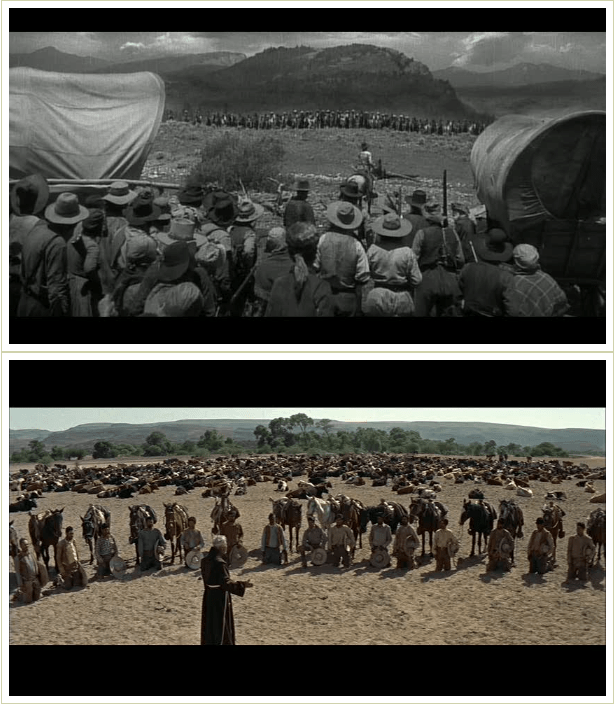
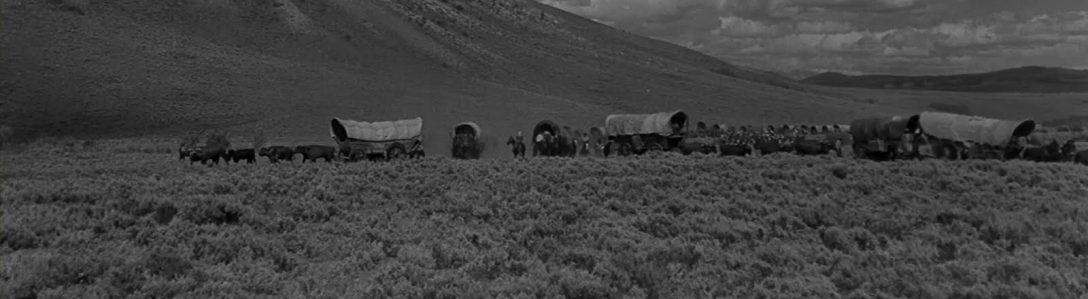
Walsh’s dynamic visual sense was as equally pragmatic as his upbringing. The stills above are from films 27 years apart, but his mastery of widescreen composition remains, whether in the 70mm Fox Grandeur format of The Big Trail, or the CinemaScope of The Tall Men. He composed in depth in arcing lines, framing his images to fit the horizontals of the format, instead of the more vertically oriented Academy Ratio that preceded and followed the box office failure of The Big Trail. The vertiginous conclusions of White Heat, High Sierra and Colorado Territory attest to his expertise in the latter. But when he had wide aspect ratios to deal with, he adapted: in his ‘Scope films his people die sideways. This might seem intuitive, but the clunky framings of early Scope experiments like The Robe, made 23 years after his commandingly wide Big Trail, shows how ahead of his time, and downright experimental his creatively practical approach was. These are images of beauty but also of narrative tension. John Wayne traverses the middle ground in the top image from Trail, caught as he is between his Native American friends and the covered wagon train he’s leading to Oregon. The crowds look like massed armies, and the centered mountain provides an ominous roadblock. But Wayne’s bright beige buckskin outfit cuts a deal and a way through.

The image from The Tall Men is less dramatic, a minor aside before the big drive to Montana. The group of vaqueros that Clark Gable hired takes a moment to pray as the cattle nap in the background. If Walsh’s heroes are “sustained by nothing more than a feeling for adventure”, as Sarris claimed, or what Kehr calls “runaway individualism”, this shot displays what this recklessness and freedom has put at stake: the lives of these pious men are on the line for these indolent cows. It is a tossed off moment of nobility for these nameless workers, whom Gable leads on an impossibly dangerous journey through Oglala Sioux territory. His Civil War colonel turned stick-up artist is once again a leader of men, and it brings riches and death.

Walsh’s men are truculently free spirits, and look for women of similar combativeness. For romantic relationships are as central to Walsh’s world as reckless  individuality. The tension between the two motors most of his work, echoing a quote from Johannes Brahms: “It is my misfortune still to be unmarried, thank God!”  The Strawberry Blonde and Battle Cry are almost exclusively concerned with this dilemma. James Cagney gives another irascible fireplug performance as Biff Grimes, a dentist and perpetual black-eye wearer. Giving remarkable detail to the speech (“that’s just the kind of hairpin I am”), clothes and bearing of lower middle-class immigrant strivers in the gay ’90s (the only richer milieu Walsh created was the 30s lower East Side of Me and My Gal), Walsh presents Biff as an all-American loser, and is one of his (and Cagney’s) most beautiful creations. Biff is quick to fight and quicker to hold a grudge, a mulish sap who contains deep reserves of dignity. He loves his lusty father, but falls hard for the measurable charms of Rita Hayworth’s social climber. Roped into being a wingman for his huckster-entrepeneur friend Hugo, he’s hooked into a date with Amy (Olivia de Havilland) instead, a budding suffragette who talks women’s rights on the first date, and who prefers to get just as frisky as the men. They are both odd fits for society, two weirdos who love running their mouths, getting into scrapes, nursing, and dentistry. So the most romantic scene in the film concludes in a tooth pull without anesthetic. It’s a hilarious, vengeful moment against Hugo, but also an inadvertent revelation of his own happiness with Amy. Love is laughter and the restraint of murderous impulses. I now place it alongside Me and My Gal as my favorite Walsh film.

Battle Cry is a war film that’s almost entirely about love affairs. Walsh keep eliding battles in order to return to town where Aldo Ray and Tab Hunter get entangled with conflicted ladies in San Diego and Wellington, New Zealand. It is a very strange film, a big-budget spectacular that eschews spectacle for moments in-between the fights. There are more shots of men sitting than shooting. It’s a case study for what Jean-Pierre Coursodon has called his “basically leisurely approach to filmmaking.” He slackens the normal pace of this WWII propaganda picture, made with the support of the U.S. Marines, to dig into one-night stands and poignant love affairs. Coursodon continues in his “American Directors” essay:

“when confronted with a war picture, and therefore a predominantly male cast, Walsh uses the flimsiest pretexts to sneak in as many women as possible. Most of Battle Cry’s 149 minutes’ running time is devoted to the likes of Mona Freeman, Nancy  Olson, Dorothy Malone, and Anne Francis pleasantly cavorting with their boyfriends in blissful oblivion of whatever is meant by the film’s title.”

It’s a film about raucous canteens, maudlin bars, and the chatter that fills it up. James Whitmore’s Captain complains that he couldn’t read Hamlet, because “he reminds me of an uncle of mine in Dayton.” Then there are the mournful wives, girlfriends, mothers and one-night stands who populate their off-hours, replacing the ghosts of their sons and lovers with the lonely, eager visages of new recruits. Some live and some die, there are break-ups and weddings, and Walsh doesn’t linger on any of it.

“The great traffic cop of the movies”, as Manny Farber called him, kept things moving, as the world went ahead without them. One of the most expressive shots for me was in The Big Trail, in which a covered wagon gets ripped downstream as it tries to ford a river.  There are no close-ups or dramatic music swells or star actors, just a family losing all they own. Then there’s a cut, and our hero must move on.

UNDERRATED EASTWOOD: FIREFOX (1982)

July 6, 2010

Screen Shot 2020-01-23 at 5.49.06 PM

Beginning on July 9th, the Film Society at Lincoln Center in NYC will be mounting their misleadingly titled“Complete Clint Eastwood” series, which will run all the films he directed, but only a select few of his key acting turns (it’s a superb program regardless). It’s in honor of his 80th birthday, which our own Susan Doll celebrated a few months back. With Clint well represented on home video, it’s easy for anyone outside NYC to curate their own Eastwood retrospective, and one that I suggest deserves re-evaluation is his 1982 spy thriller, Firefox. His entire early 80s output, from Bronco Billy (1980) through Sudden Impact (1983), is extraordinary and relatively forgotten, but Firefox, perhaps due to its bizarre sci-fi trappings, has been judged harshly and dumped into the late-night cable dustbin.

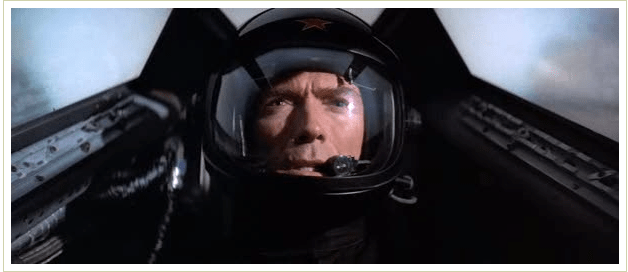
Eastwood plays Mitchell Gant, a retired Air Force pilot suffering from hallucinations of his time as a POW in the Vietnam War. He’s called back into action after the U.S. learns that the USSR had completed construction of a high-tech MiG-31 plane, code-named Firefox. Able to fly at 6-times the speed of sound, invisible to radar, and with a weapons system commanded by the pilot’s mind, eliminating reaction time during dogfights, it could swing the arms race and the momentum of the Cold War. Gant is tasked to steal it because of his language skills, since the plane’s system will work only with someone thinking in Russian. In comparing it to his more satiric Eiger Sanction, Eastwood said, “Firefox was more ‘square’, more traditional. It was about bad guys with pink eyes, but ordinary characters faced with an impossible mission.”

Gant is so ordinary as to be anonymous. Thrust rather unwillingly into the teeth of the Cold War, he is a bundle of anxiety. Eastwood works out various permutations of uneasiness on his face, raising his lips in grimaces and lowering them in scowls representative of a man supremely uncomfortable in his own skin. Shuttled from disguise to disguise and personality to personality (from an American heroin dealer to a tourist to a Russian pilot) acts as a subtle commentary on his own constructed personas. The ironic anti-heroism of his Man With no Name and the obsessive obstreperousness of Dirty Harry, then, are merely other skins, and his queasy performance reflects his ambiguous relationship to them. All of his films, it seems, are re-evaluations and deconstructions of his own personality, and Firefox is one of the earliest and smartest examples of this (taken up later by Sudden Impact straight through to Unforgiven and Gran Torino).

Gant isn’t a heroic figure as much as a man buoyed by circumstance. He never seems in control, pushed forward by his CIA handlers, then handed off to his resistance contacts in Russia, always instructed carefully, never in charge of his own fake lives. In fact, Gant is repeatedly chastised for his performances, encouraged to feign sickness to cover-up his awkward acting chops. His awkwardness and ever-present fear make this film more in the vein of John Le Carre than James Bond, and Bruce Surtees’ low-light photography perfectly expressive of its harshly deterministic narrative. Each of the men he meets is invested body and soul for the future of Russia, and stoically give up their lives for their cause, while Gant is a confused hired gun doing the job because he’s the only one who can. He seems without ideology, disturbed by the resistance fighters heroic sacrifices, giving their lives on the slim chance that Gant will succeed. It’s a utilitarian spy movie,  a morbid landscape where bodies are disposed of after they fulfill their mission, a grim game where deaths are freely given for the slim hope of success. Dave Kehr has even described the film’s terseness as “Bressonian” in his Chicago Reader capsule review, and it’s hard to disagree, or even think of another 80s action movie where that could even be remotely applicable.

In an interview with Michael Henry, he says that Firefox “is the only one of my pictures I used storyboards on.” And while he specifically mentions how he mapped out the final plane special effects sequences, the film as a whole seems finely structured. The major movement is from the dark spy sequences to the bright blue skies of the flight out of Russia, but there are micro-movements inside, including some expertly paced cross-cutting sequences. The opener cuts between the U.S. government war room and the attempt to convince Gant to join the mission at his woodsy home.

It quickly dispenses with the back-story while introducing the idea that Gant is a small pawn in major geo-political movements. This becomes clear during the final cross-cutting sequence, which shifts between the Soviet and U.S. war rooms tracking Gant’s movements in the air, with Gant himself caught in the middle, speaking Russian to an obliging super-plane.

Gant seems happiest in this final movement, cut off from humanity, and submerging his personality into a machine.He’s destroying his individuality while ostensibly flying to freedom. The images brighten as thematically the film grows even darker – self-annihilation as a kind of euphoric release.

MARTIAL FINE ARTISTS: NINJA II – SHADOW OF A TEAR

December 31, 2013

Screen Shot 2020-01-23 at 1.52.09 PM

The best action movie of 2013 went direct to video. Ninja II: Shadow of a Tear comes out today on DVD and Blu-ray, and was released on VOD earlier in the month. It is the seventh DTV collaboration between director Isaac Florentine and actor Scott Adkins, trained martial artists driven to bring clarity to the fight film, showcasing athleticism rather than camera blur. This is a ninja revenge movie without filigree, stocked with some of the most intricate moves this side of Fred Astaire, arranged by fight choreographer Tim Man. For his dance sequences Astaire demanded to be framed in long shots, to convey the full expression of his body, and Florentine takes a similar approach with Adkins. As Adkins told me in an interview yesterday: “We want to show the action, we don’t want to hide it. We know when they do the shakycam and everything we know why they do that. What you’re actually seeing looks shit, so you shake the camera to give the impression something amazing is happening. All you’re actually seeing is nothing. We try not to do that, we want to show the performers, the highly trained, physical performers, doing what they do best. In a very balletic, graceful way.”

The first Ninja (2009) was a broad comic book-style action movie, with a corporate death cult threatening the safety of NYC. Casey Bowman (Adkins) is the orphan raised in a dojo who tears down their international conspiracies with the help of fellow student Namiko (Mika Hijii). With its kitschy hooded villains and unconvincing Bulgaria-for-NYC locations, it’s more Adam West than Christian Bale, superhero-wise. If you are a cheese aficionado, it is a profound experience, but even if not, there are some miraculous fight sequences, including a closed-quarters slobberknocker in a subway car (which Jason Statham borrowed for Safe). For the sequel, they wanted to make “an old-school martial arts film”, as Adkins put it. This time around Bowman has married Namiko, and they run the Japanese dojo in which he was raised. A brutal attack destroys this idyll, and Bowman snaps, violently tracking down the drug lord Goro (Shun Sugata), whom he suspects of the crime. It’s a simple narrative line to hang a series of wildly inventive fight sequences on.

The revenge plot and use of ninjitsu is reminiscent of the Sho Kosugi ninja trilogy from the 1980s (Enter the Ninja (’81), Revenge of the Ninja (’83) and Ninja III: The Domination (’84)). All three were produced by Menahem Golan and Yoran Globus’ Cannon Films, and it was Golan that gave Florentine his first directing job (Desert Kickboxer (’92)). Florentine even casts Sho Kosugi’s son Kane in a pivotal role as Casey’s enigmatic friend and rival Nakabara. Adkins comes out of a kickboxing background, so his version of a ninja mixes in showy kick acrobatics with the Japanese styles. His influences also differ from Florentine. While the Israeli-born director emerged out of endearingly slapdash Cannon Films canon, Adkins grew up idolizing Bruce Lee and Van Damme before turning to martial arts himself. A real student of the form, he listed his fight film favorites as Enter the Dragon, Fist of Legend, Drunken Master 2 and Armor of God. Their interests complement each other, as Florentine learned how to stretch a buck while Adkins studied how to make bodies look fluid on-screen.

In one interesting experiment they attempt a one-take fight scene, set at a rival Japanese dojo. Casey is there snooping out information on two local thugs, and takes out all five men in an unbroken forty second shot. It is not as ambitious as those of Tony Jaa in The Protector or Choi Min-Sik in Oldboy, but it serves a different purpose. This is not a showstopper but a scene-setter, displaying Casey’s easily snappable temper and setting up the array of fighting styles to come. He takes them out with brawling punches, soaring spin kicks, and a submission arm-bar. Adkins, who admitted to being exhausted after shooting seven takes of this, is a stylistic chameleon, with the looks and power of a brute force brawler but with the ability to execute nimble air strikes. With a handheld camera Florentine and his longtime DP Ross W. Clarkson float around Adkins, a member of the bout rather than an observer. The camera privileges the fighter, but also engages in its own choreography, dancing with the brawlers. Adkins mentioned this camera choreography as party of his fight film philosophy:

A lot of people, the way they get it wrong is they document the action, as if making a documentary. From that side, that side, and that side, with a long lens or whatever. That’s not the way to do it. You need to get the camera in, with the action performers, moving in unison with them, and the camera should be as choreographed as the performers are. You’re part of the action, not watching it from afar. That’s what good action filmmaking is all about.

Their showstopper in Ninja 2 is a barroom brawl that tips its cap to Drunken Master and Kickboxer. Casey is drinking himself into oblivion when a loudmouth drunk splashes him with booze. Needing little provocation, he proceeds to decimate every loser in the joint. Ninja II uses inebriated fighting to darker comedic ends than the Jackie Chan and Van Damme films. The Chan and JCVD personas have something of the beatific innocent about them, their moves very clearly for show – a performance. Adkins is a more brooding type, his most fully formed character the anti-heroic convict Boyka in the Undisputed series, who fights not to please, but as an instinctual survival mechanism. The same is true of Casey, whose only remaining identity is tied to the dojo and the study of ninjitsu (although the film shows only a smidgen of that form). In the bar he completely loses his self control, revealing himself to be nothing other than a very nimble town lush. But he does it with style. Florentine keeps the camera at a distance, occasionally isolating the more spectacular feats with cut-ins and slow motion. But every blow is visible, as his regular editor Irit Raz (Florentine always works with the same crew) cuts the sequence percussively, on every meaty kick or knife-wielding snik.

There are countless other memorable battles here, which is remarkable considering the restraints of time, money, and Adkins’ aching back, which he seriously injured on the set. But despite all the limitations of DTV productions, Florentine and Adkins are relentlessly pursuing, and have nearly perfected, a pure form of the fight film, returning the genre to its roots as simply capturing fine-tuned bodies in collision-course motion. Hopefully we get to see their next distillation in 2014, with the highly anticipated Undisputed IV tentatively slated for release.

MODERN FIGHT FILMS: THE UNDISPUTED TRILOGY

June 15, 2010

469dde0af4d64d66fb29e3eb71288330

Walter Hill made his directorial debut with Hard Times (1975), a downbeat portrait of Depression-era gamblers, bare-knuckle brawlers, and the women who put up with them. In 2002, Hill made Undisputed (2002), another fight film, this time set at a prison in the Mojave desert, where a recently jailed ex-heavyweight champ faces off against an undefeated inmate fighter.  Two direct-to-video sequels were spun off of the latter, with the third hitting DVD and Blu-ray this past week (Thanks to IFC’s Matt Singer for recommending #3).

In Hard Times, Hill utilizes the wide 2.35:1 aspect ratio to stage scenes in depth, capturing desperate faces in the background cheering on the back alley brawls. During fight scenes, Hill cuts for strategically dramatic emphasis and spatial coherence. When a bald thug lands a blow, Hill cuts back and forth between reaction shots of Charles Bronson (the new fighter in town) and James Coburn (his shyster manager), interspersed with a long shot of the pier on which the scrum is taking place. In this sequence he efficiently establishes the initial goals of the plot – Bronson will destroy the baldie and set up a feud with his opposing  fur-lined coat wearing  manager.  As a fight scene, it’s crisp and coherent, almost always keeping both men’s bodies in the frame, and switching from low to high angles to establish the shifting fortunes of the “hitters”, as Coburn calls them.

In Undisputed (2002) the tempo is sped up considerably, but Hill maintains spatial continuity and dramatic interest. The opening bout is held in a cage, in which there is a similar scene in Hard Times. In both instances, the set has steeply sloped audience seating, and Hill repeatedly cuts to high-angle shots to establish the carinvalesque, Roman Colosseum feel of the bouts. Undisputed packs in far more exposition though, with repeated flashbacks (in B&W) to the back-stories of the main participants (Ving Rhames’ Iceman and Wesley Snipes’ Monroe Hutchen). There is also repeated use of white flashes to cover jump-cuts, adding to the jittery rhythm. And where Hard Times has sparing use of slow-moving pans, Undisputed utilizes a roving SteadiCam in and around the ring.  But even with all of these MTV style additions, the fights are clearly mapped out, with same use of high-low angles to chart the fortunes of the bout. Hill uses the tools of modern ADD-cinema to his advantage, packing in tons of information, from mobster Peter Falk’s love of boxing (cuts to B&W Joe Louis fights) to the details of Iceman’s arrest.

Hill introduces Iceman as a multplied image on a TV monitor, a media creation. First we see interviewer Jim Lampley behind a screen asking a question, but instead of a cut to Ving Rhames, Hill cuts to the production room and his image on television. This clever reversal sets up the gassy bravado of Rhames’ character – who is constantly performing his “warrior” image. In contrast, Snipes is depicted as all interior, quietly building temples out of toothpicks, and speaking only when absolutely necessary. The film is filled with resourceful character bits like this. Rhames and Snipes are in top form here (while Falk enjoyably swallows the scenery whole), and with Hill and fight choreographer Cole S. McKay’s  lucid setups, Undisputed is an underrated entry in the history of the fight film.

Four years later, production company Nu Image (and their subsidiary, Millenium Films), resurrected the title for a sequel, hiring Power Rangers veteran (and martial artist) Isaac Florentine to crank out a low-budget direct-to-video version. Ving Rhames was replaced by Michael Jai White (Spawn), and was re-located to Eastern Europe to take advantage of their low production costs. Instead of trying to pass off Bulgaria as Venice (as they did in the landmark Sharks in Venice), they relocate Iceman to a Russian prison, where he’s jailed on a frame-up drug charge. It’s a ruse by Russian mobster Gaga (Mark Ivanir) to set up a fight with Boyka (Scott Adkins), the champ on his highly lucrative prison fight circuit, which is broadcast to private gambling clubs.

Where the original Undisputed builds a semi-realistic version of prison life, the sequels focus entirely on the fight sequences. The plot is negligible, the supporting cast weak, but the fighting is superb. The term “B movie” is much abused these days, but the Undisputeds honor the scrappy spirit of the Republic and Monogram studios. Limited to a few sets and a flimsy narrative, these cheapies pack in more impressive physical feats than any Hollywood blockbuster that will be released this year.

Florentine, Jai White and Adkins are all trained in martial arts, and have boxes full of black belts among them. So what the film loses in character detail, it gains in athleticism, incorporating more styles in its version of mixed martial-arts. Once called “human cockfighting” by John McCain, MMA, as promoted by the Ultimate Fighting Championship, has become halfway respectable and turned into one of the most popular sports in the world.

Jai White is a low-key performer, offering none of the sarcastic menace of Rhames, but he’s lithe and powerful in the ring. Adkins is the reason these films got popular, however. A nimble Englishman donning a believable Russian accent, he possesses incredible balance and gymnastic aerial skills – the Astaire to Jai White’s Rogers. Florentine is no Walter Hill, but his fight scenes are clean and economical, mostly keeping both fighters in the frame, with the occasional close-up for emphasis. It’s bracing to watch such simple craft since quick-cut Bourne-clones ruined action movies over the past decade. Florentine’s main tic is using high-speed cameras for super slow motion in capturing Adkins’ more athletic twirlings, moments in which he’s turned into a religious icon of the ring (like the etchings his character prays to before each match). My friend Matt Singer objected to its use in his article, but I think it’s essential to the construction of these films – further illuminating the physicality of the performers.

Listening to their fan base, Adkins is turned from villain to hero in the third, and most satisfying film in the series. Not only does Adkins prove to be an appealingly mulish lead, but the film is filled with breezy supporting turns as well. Mark Ivanir is back as Gaga, played with sardonic charm, and veteran character actors (check out their resumes) Robert Costanzo and Vernon Dobtcheff provide American buffoonery and East-Euro creepiness  with as much bravado as Peter Falk did a crusty old man in the original.

Mobsters from around the world gather for an international prison fighting tournament, betting on the champ from their own country. After getting his leg snapped in Undisputed 2, Boyka is reduced to cleaning toilets while rehabbing his knee at night. He claws his way into the tournament, only to discover it was rigged by the crooked Georgian, Rezo (Dobtcheff). As if pulling names from American Gladiator, he befriends a Yank named Turbo (the I Wanna Be A Soap Star winner Mykel Shannon Jenkins) and plans on upending the whole money-grubbing show.

The tournament shows off a wide variety of fighting styles from a Brazilian’s capoeira to a North Korean’s taekwondo to the unnameable dance-fighting of Dolor (Marko Zaror), the Colombian and Arch-Villain. Prone to shooting heroin in his neck and reading Garcia Lorca under an umbrella shade, he’s a wildly entertaining villain and an equally unpredictable fighter. Pulling aspects of capoeira, boxing, and the tango together with self-regarding verve – his climactic fight against Boyka is an epic and strategic delight. Dolor attacks Boyka’s knee, destroying the Russian’s aerial attack, so Boyka switches tactics and uses a ground game of submission moves and tackles. It’s a nicely thought out piece of fighting psychology that encapsulates the Undisputed series,  a group of films that shows visual and emotional intelligence where you’d least expect it.