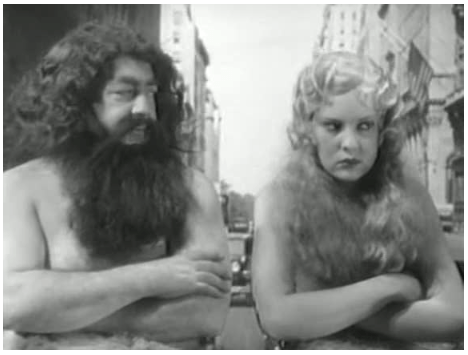
THE PERILS OF COLLEEN: COLLEEN MOORE IN SYNTHETIC SIN AND WHY BE GOOD?

November 18, 2014

B2q34l2IUAARa07

Through serendipity, skill and plain dumb luck, the last two silent films featuring comedic firecracker Colleen Moore have been restored through the work of The Vitaphone Project and Warner Brothers. Presumed lost, Synthetic Sin (1929) and Why Be Good(1929) were sitting in a Bologna archive, waiting for money and TLC to set them free. They received their restoration premieres at Film Forum in NYC, and both are risque flapper comedies in which Mrs. Moore’s high-spirited subversive tests the boundaries of accepted female behavior. Why Be Good? was just released by Warner Archive on DVD with its full Vitaphone audio (which adds synchronized sound effects and a jazzy score). Each was directed by William A. Seiter, an inventive gag man as well as a sensitive shaper of star personas, from the Dadaist antics of Wheeler and Woolsey through the stubborn independence of Ginger Rogers. One of his earlier star-whisperer jobs was for child actor Baby Peggy, in The Family Secret (1924). A preserved Library of Congress print screened at MoMA’s To Save and Project festival of film preservation last month. Though Baby Peggy and Colleen Moore are after different things (chocolate and men, respectively) they each destabilize the society around them by daring to be independent.

William A. Seiter was born in New York City in 1890, the oldest son of a prominent family who were co-owners of Higgins & Seiter, purveyors of fine china and rich cut glass.  He ran away from a steady paycheck to Hollywood in 1912. He made ends meet as one of Mack Sennett’s Keystone Cops and as a Western stuntman. He got his first featured part in the 1931 biblical short The Three Wise Men (1913). According to his daughter Jessica Seiter Niblo’s memoir Movietown Baby Grows Up, her father thought he was “so bad I just quit acting.” So instead he would crash movie sets with his friend (and future director) Sidney Franklin, pretending to be assistant directors. They faked it until they made it, and Seiter started directing comedy shorts in 1915. His first great success came with a series of comedies he directed for star Reginald Denny between 1924 and 1928. Dave Kehr described Seiter’s style in the Denny films as “a kind of domestic naturalism, with lightly comic sketches of middle-class young marrieds that anticipate the situation comedies of the Fifties.” Having learned every side of the business, he was an actor’s director. One of his actors Neil Hamilton would give Seiter the most practical of praise in Photoplay: “I cannot forget the treatment accorded me by Mr. Seiter. He is that rare personality in the business who does not believe in working after four thirty. Having been an actor himself once, he realizes that a day spent in front of the cameras, with one’s vitality being slowly consumed by the terrific heat of the lights, is no easy task.”

The Family Secret (1924) is an odd amalgam of Victorian melodrama and sitcom slapstick. It was a vehicle for Baby Peggy (real name Diana Serra Cary), who had become a superstar at age five after making over 150 shorts for Century Studios between 1921 and 1923. Universal signed her to make features, and they chose to adapt the Frances Hodgson Burnett (The Little PrincessThe Secret Garden) novel Editha’s Burglar, a Story for Children. Margaret Selfridge (Gladys Hulette) secretly marries Garry Holmes (Edward Earle) against the wishes of her father Sim (Frank Currier). Sim bans Garry from his home, and then has him arrested for burglary when Garry tries to see his wife and newborn baby (Cary). All of the creaky melodramatics halt when the story shifts from the parents to the child, and you can almost sense the entire cast relaxing. The movie then settles into a string of comic set pieces as Baby Peggy undermines any attempt at a functional household. She skips a reading lesson from her nanny and hides in the flour bin; brings home a stray dog whose fleas infest the spinsters at a tea party; wanders onto the streets and bonds with the lower classes, learning how to steal fruit from street urchins and rib the cops. It is that last section that is especially affecting. Peggy has no conception of money’s use value since she lives with it as a given. So on the outside she trades her dress for a banana. Seiter builds scenarios around Peggy’s natural mischievous innocence, and shapes a rickety melodrama into something improbably affecting.

Colleen Moore also exudes a mischievous innocence, but one that perpetually bumps up against the double standards that confront women. Moore’s freedom from restraint is alluring, but it is always in danger of becoming too alluring, in which case the movies pull back and reveal her to be a good girl after all.  Moore had long dreamed of becoming a movie star, and kept a scrapbook of her favorite performers – aspirationally leaving the last page blank for herself. She lived a few blocks away from Essanay studios in Chicago, and she appeared for them as a background extra. Her uncle Walter Howey, the managing editor for the Chicago Examiner, got her a screen test with D.W. Griffith, since Howey had helped Griffith get Birth of a Nation and Intolerance past the censorship board. The Colleen Moore persona is synonymous with that of the “flapper”, post-WWI women who flouted conventional gender roles by smoking, drinking and sleeping with whomever they wanted. This image was popularized in the 1923 Colleen Moore film Flaming Youth, in which Moore dallies with her mother’s ex-lover. Of that movie, F. Scott Fitzgerald famously remarked, “I was the spark that lit up flaming youth, and Colleen Moore was the torch. What little things we are to have caused all that trouble.” With her razor-sharp bob, bamboo-thin body and bowtie lips, she became the physical embodiment of the flapper ethos. Seemingly all elbows and knees, she was the ideal angular construction to dance the Charleston, and had the impish personality to give all that movement an air of subversiveness. Moore married producer John McCormick during the production of Flaming Youth, and together they would define what flappers looked and acted like to the majority of Americans.

By 1929 the flapper character was business as usual, but Moore was still packing them into theaters. Synthetic Sin is based on a 1927 play by Frederick and Fanny Hatton, produced by McCormick, and concerns a small town girl from “Magnolia Gap” who has dreams of becoming a legendary stage tragedienne. Though the feature looks fantastic (it was projected on DCP), it is missing most of the Vitaphone “soundtrack”, which added sound effects and popular songs of the period over the silent feature. Only the last reel of this audio remains.

When hometown hero playwright Donald Anthony (Antonio Moreno) returns home to premiere a new work, every high school drama queen clamors to play the lead. Betty (Colleen Moore) and her sister Margery (Kathryn McGuire) are the most insistent. Betty is spazzy and unsophisticated, her audition more akin to a Saturday Night Live cast hopeful. It involves  a “mad Ophelia” scene of flailing limbs and swinging wig pigtails that nearly choke her out. The showstopper, for me anyway, is Moore’s impression of classical pianist Ignacy Jan Paderewski. She dons an Einstein fright wig, applies a bushy moustache, and slams the keys like a proto-headbanger. Seiter is always interested in the clash between high and low – as in Peggy’s trip around the working class in The Family Secret.  One of his 1930s comedies, If You Could Only Cook, has an out-of work Jean Arthur convince car company president Hubert Marshall to pretend to be her husband so she can get a job as a maid.

Betty continues to travesty the high arts in Synthetic Sin by interrupting her sister’s flouncy “Grecian dance” with a gruesome blackface shuck and jive routine that might keep this movie from ever getting released on home video. Donald is convinced just enough to give Betty the part in the play – but she flops, getting laughs instead of tears. Thinking she has not suffered enough in life to become a true tragic actor, Betty travels to NYC to get a taste of the fast life. Betty is something like the first method actor. So she checks into a fleabag motel and invites every hard-looking, gun-toting gangster into her apartment for carousing. In one impressive dolly shot, Moore walks down a busy street towards a retreating camera while trying on different expressions and poses, from haughty to flirtatious, hand implanted on hip. Her attempts at vamping are hilarious – she runs her hand through her mark’s hair, staring exaggeratedly into his eyes, before getting hair gel all over her fingers and disgustedly wiping them on his lapel. Betty doesn’t belong as a criminal or a super serious artiste. She was built to be funny, though instead of getting a farce all of her own, the movie ends depressingly with Betty declaring that the only career she wants is to be Donald’s wife.

Why Be Good? proposes a different kind of conundrum. In this one Colleen Moore is well versed in the games of seduction, though deep down, the film promises us, what she really wants is marriage. Though the studio and screenwriters are still a little too wary of having a truly independent woman who can sleep with whom she wants, one look at Colleen Moore’s Charleston tells a completely different story. Moore plays the aptly named Pert Kelly, “an effervescent American girl” who is introduced winning a dance competition and then shutting everyone down with, “I’m naturally too hot for this old folks’ home.” Luckily all of the Vitaphone audio is present here to accompany her hot steppin’, and the track also has some pretty clever inventions, including a drunken rendition of “Sweet Adeline” interpreted by two muted, whining trumpets.

Though Pert is a queen by night at elaborate nightclubs like “The Boiler”, which blows steam over its already hot dancers,  by day she’s a department store clerk who pines for the personnel manager Peabody Jr. (Neil Hamilton). In an inspired bit of pantomime, she rests her head on his shadow behind an office window, and then draws his face on in lipstick. He is literally a marked man, and she will get him one way or another. The conventional ending of Why Be Good? is earned — she follows her desires and ends up with what she wants, and escapes the drudgery of department store work in the process. Of course her family just can’t understand her partying ways and interest in Peabody Jr. , but in an inspiring moment of flapper cinema, she explains to her father the whole point of this proto-feminist movement:

Pop, listen to me! This is 1929 — not 1899 — I contribute as much money to this house as you do — and as long as I think it is harmless, I’m going to wear what I like, and do what I like! …I want to go out, and dance, and have fun, as long as I can, as much as I can!

The fun ended for Moore with the coming of talkies. She divorced McCormick, her first sound films flopped, and she made her last film in 1934.

BOOB TUBE: UHF (1989)

November 11, 2014

original

UHF was released to apoplectic critics and an apathetic public on July 21st, 1989. Its opening weekend box office put it in eleventh place, behind the nearly month-old run of Weekend at Bernie’s. It would disappear from theaters a few weeks later. Today it comes out in a “25th Anniversary Edition” Blu-ray from Shout! Factory, having etched itself into the nostalgia nodes of thirty-something weirdos. I count myself among them. During those awkward pre-teen years (before “tween” made the age period sound appealing) “Weird Al” Yankovic was something of a secular god, his mild pop-culture subversiveness a convenient way to channel my milquetoast angst. In 1979 Yankovic changed The Knack’s “My Sharona” into “My Bologna” and netted a recording contract, those albums introducing the possibility of oppositional thinking into my half-formed brain. Plus he dressed funny and had polka breaks in between tunes. No downside! His crossover moment occurred on the album Even Worse (1988), which spawned the MTV music video staple “Fat”, a nearly shot-for-shot parody of Michael Jackson’s “Bad”. With the success of the album (it was his first to reach platinum) and the ubiquitous video, the brave souls at the now-defunct Orion Pictures gave him the chance to make a movie. Yankovic and his manager Jay Levey conceived UHF as a delivery system for parodies, along the lines of Kentucky Fried Movie. It turned out to be something more like a combo of SCTV and The Secret Life of Walter Mitty, but whatever it was, people hated it. Roger Ebert called it “routine, predictable and dumb — real dumb”, while Jonathan Rosenbaum described it as “awful by any standard”. But though I no longer listen to Yankovic’s albums, I still find UHF to be uproarious.

uhf1

The movie presents “Weird Al” as a sad sack dreamer named George. He’s introduced with a fantasy of himself as Indiana Jones, stealing an Oscar from a booby-trapped ancient temple. At the end of it he’s flattened by a boulder, and there’s a cut from his rubberized body to a hamburger on a skillet. He’s a fry jockey at Big Edna’s Burger World, a position from which he and his trusted doofus friend Bob (David Bowe) will be fired. He’s doomed to more hot dog-in-a-Twinkie dinners until his degenerate gambler uncle Harvey (Stanley Brock) wins a dilapidated UHF television station in a poker game. Harvey taps George to be station manager, and right before George runs the place further into the ground, their janitor Stanley Spadowski (Michael Richards) becomes a variety show sensation and shoots them to the top of the ratings. This attracts the attention of  villainous network affiliate head R.J. Fletcher (a jowl-shaking Kevin McCarthy), who unloads all of his dirty tricks to put George out of business.

UHF01

The antics to save the station are constantly interrupted by commercials and clips, a series of non sequiturs that are the raison d’etre of the film. These include ads for used car salesman Crazy Ernie (“I’m gonna club a baby seal to make a deal”) and highly specialized department store Spatula City (We sell spatulas/And that’s all!”). These are absurdist miniatures that work as well in isolation as they do in the movie. If released on YouTube today, they would light up aggregators as much as Adult Swim’s Too Many Cooks did earlier this week. Each sketch takes a different approach, from the magnificent bad punning of Conan the Librarian (who slices a late book returner in half) to the more direct parody of Geraldo Rivera with George’s apocalyptic Town Talk. Viewing it for the nth time last week, however, I was most amused by the shows that we never see. There is one scene where George is planning the schedule, padding things out around Spadowski’s runaway hit. There are the gross-out moves like “Name That Stain” or “The Wonderful World of Phlegm”, and then the more surreal items like the Friday night quartet of “Druids on Parade”, “The Volcano Worshipers Hour”, “Underwater Bingo for Teens” and “Fun With Dirt”. We don’t see a frame of these shows, but the movie manages to parody the mania for reality television a decade before it happens. Their station’s entire success is based on cheap “reality” programming, whether it’s Spadowski’s in-the-moment spazzing or competitive shows like “Bowling for Burgers” or “Strip Solitaire”.

UHF02

What cannot be ignored today, though, is its reductive depiction of race. One of George’s neighbors and friends is the martial arts instructor Kuni (Gedde Watanabe), whose humor is supposed to come from his heavily accented English and karate poses. Then there’s “Raul’s Wild Kingdom”, featuring the only Hispanic member of the cast. Speaking like Speedy Gonzalez, he lives in a hovel overrun with animals where he teaches poodles how to fly. It’s, as the kids like to say, problematic. If you can look past it, the film has wonderful performances, and I even found Yankovic to be an appealing presence, though Ebert disagrees:

his physical presence is undermined by bad posture and an indistinct speaking voice. He needs to practice throwing back his shoulders and strutting; he creates a dispirited vacuum at the center of many scenes.

I find this “indistinctness” to be interesting. He is mostly recessive until moments of extreme self-doubt, when he lashes out in violence. He screams at Bob to hit him in the face with a crowbar, and is prone to slamming his head on countertops when depressed. It’s an unstable performance, his slacker schizo something that Adam Sandler might have taken inspiration from for his weirder, more interesting comedies (Zohan, That’s My Boy). Michael Richards exhibits the physical elasticity that made him a star, though he elicits more pity than laughter in this one. His character is something of a tragic one, a lonesome mentally deficient janitor whose best friend is a mop. The true star of the film is Kevin McCarthy, who is clearly having a ball as the red meat villain R.J. Fletcher. He is sexist, sadistic and mean to people from all races and religions. McCarthy works on every variation of scowl, his mouth muscles permanently strained downward. Through all his huffing and puffing and bad mouthing, McCarthy walks away with the movie, his blustering in disbelief that “A UHF station!” beat them in the ratings a line reading whose tenor and bluster is permanently embedded in my synapses.

uhf_ver1_xlg

But then, I cannot be objective about this movie. Some of my fondest memories involve listening to a cassette tape of the UHF soundtrack with my brother. We heard the movie before we saw it, imagining the jokes in our heads. On certain long afternoons in the early 1990s, “Weird Al”‘s twenty second blast  of cock rock “Let Me Be Your Hog” was the funniest thing in the world. Divorced of its context (Uncle Harvey listening to it on the radio), it was just a strange man making pig noises and screaming to a soaring guitar riff. It was nonsense, it was bliss.

BOWLING FOR DOLLARS: KINGPIN (1996)

October 21, 2014

still-of-bill-murray-and-woody-harrelson-in-kingpin-(1996)-large-picture

Farrelly Brothers movies are akin to family gatherings. They are filled with extreme neuroses, unexpected violence, and deep undercurrents of affection. Their films are even populated with friends and relatives from their Rhode Island home. Listen to any of their audio commentaries and you’ll find that half the actors are bankers and car salesman who grew up with them back east. Every time I see a Farrelly feature I think of how Manny Farber described Howard Hawks’ “weird mother hen instinct.” The Farrellys have it as well, just weirder.  Dumb and Dumber was their directorial debut and an enormous hit, a tale of ignorant male friendship that lowered scatalogical slapstick so far it went below lowbrow and out the other side. It’s also their first attempt at depicting the bonds of brotherhood, in which Jim Carrey and Jeff Daniels perform a kind of radical acceptance of each other’s flaws — through complete stupidity, but still (they treated the same theme with greater complexity in Stuck on You, their greatest film and biggest bomb).  The long-gestating but certainly not maturing sequel, Dumb and Dumber To, comes out next month.

The Farrellys follow-up to the original Dumb and Dumber, though, will never get a sequel, though it did come out on Blu-ray last week. Kingpin is another tale of success-challenged males learning to live with the other’s failure, this time in the lacquered middle-aged crisis world of bowling. Though where Dumb and Dumber is an abstract performance piece, as Carrey and Daniels could have been performing in front of a blank wall to similar effect, Kingpin tries to embed its outrageous characters into a semblance of the real world. Each bowling alley and auto-body shop is lovingly detailed, and essential to the development of its sad sack characters. The lead failure Roy Munson, Jr. (Woody Harrelson) is from the made-up small town of Ocelot, Iowa, a corroded rust belt city where he was once its proudest son as State Bowling champion, while ending up in a pit-stained flophouse in Scranton, PA dodging his scrofulous landlord’s bill. He sees a way out in the smooth stroke of Amish naif Ishmael (Randy Quaid), who he thinks can win the big bowling competition in Reno, and take down his longtime nemesis Ernie McCracken (Bill Murray).

woody-harrelson,-vanessa-angel,-bobby-farrelly-and-peter-farrelly-in-kingpin-(1996)-large-picture

Kingpin was not an easy project for the Farrelly’s to make. Dumb and Dumber’s massive success was attributed to Jim Carrey, and so the Farrelly’s could not get one of their own projects off the ground. So instead they pursued a script by veteran comedy writers Barry Fanaro and Mort Nathan (both of The Golden Girls writing staff). As sports fans they related to the material – they always include bizarre athlete cameos, and the one in Kingpin is something else, Roger Clemens as a raging redneck named “Skidmark”. Since disgraced by Major League Baseball’s Mitchell Report for using anabolic steroids, his short scene as a rageaholic gains retrospective…resonance, let’s say. The lead casting was also problematic, with big stars not wanting to dirty their image with the Farrelly’s outrageous material. Peter Farrelly was roommates with Woody Harrelson during his Cheers days, and had tried to get him to act in Dumb and Dumber, but Harrelson thought the script was “too silly”. So on Kingpin Peter tried again, and finally clinched the deal on a pool hall pit – if Peter sank a complicated bank shot Woody would agree to take the part. Peter nailed it, and Woody did the movie.  They had targeted Chris Farley to play Ishmael, but he was tied up in another project, so they went with the more offbeat casting of Randy Quaid, who offered an aw shucks gullibility to the role. Farley would have been outstanding but more aggressive – Quaid’s meek interpretation and ungainly gangliness offered more of a match with Woody’s performance of low-key insecurity.

still-of-bill-murray-in-kingpin-(1996)-large-picture

Perhaps the biggest coup to Quaid’s signing was that he had Bill Murray’s direct number. Usually you have to leave a message at some automated mailbox to which he may or may not respond, but Quaid was able to call Murray and relay the Farrelly’s interest in having him on the film to play the womanizing bowling champ McCracken. In his enigmatic manner he agreed, and then sent no more communication until the day of the shoot, when he arrived in character in that teapot-lid comb-over. His hair is one of the biggest characters in the film, though it just makes fleeting appearances. It is pure stringy, thinning magnificence, and when the comb-over tips off his bald pate, it seems to reach three lanes over. Murray improvised all of his scenes, including the oft-quoted inspirational nonsense: “You’re on a gravy train with biscuit wheels”.  The Farrelly’s have famously loose sets, aided by their nepotistic ways as well as their belief that the actors should be allowed the freedom to experiment – and look ridiculous.

While the country was experiencing an economic boom in this period, the focus on the rust belt depicts the areas left behind. When Munson returns to Ocelot, they place an emphasis on the town’s decay, from the shuttered ice cream shop to the corroding gas station of Munson’s long-gone father.  Movies of third-tier sports have a tendency to capture America in decline, as in Robert Aldrich’s …All the Marbles, about struggling female pro wrestlers criss-crossing the Midwest. Munson’s home of industrial rot is contrasted with the unreal artificiality of Reno, which is depicted almost entirely inside the neon mall of the National Bowling Stadium. Ernie McCracken is the human avatar of Reno, a slick amoral womanizer who is worshiped for his amorality.

This doesn’t mean the Farrelly’s stint on their patented body-horror comedy – wringing endless jokes out of Munson’s prosthetic hand, which ends up in as many sticky situations as the Addams Family’s Thing. Their movies are ones of extremity, in which bodies and psyches are broken down.  Whether it’s idiots in Dumb and Dumber, disabled drunks in Kingpin, schizophrenics in Me, Myself and Irene or conjoined twins in Stuck on You, the Farrellys are obsessed with both physical and psychical deformity. There is a bit of the freak show in their work, something confrontational in how they present these debilities without a shred of pity or condescension. They are full fledged people with the equal ability to screw up as any of us. One of their favorite character actors was Danny Murphy, a quadriplegic who appears in Kingpin as a smirkingly violent goon who flicks on the bowling ball return that cuts off Munson’s hand. When you watch him in Kingpin, he is not “the guy in a wheelchair”, but “that asshole who chopped of Munson’s hand”. And that’s how he preferred it. Murphy appeared in all of their films from then on in a variety of roles, from sympathetic to villainous, until his death this past August.

still-of-randy-quaid-and-vanessa-angel-in-kingpin-(1996)-large-picture

The exception in Kingpin’s parade of unusual physical specimens is Claudia (Vanessa Angel), a hard-bitten blonde who escapes her abusive hustler boyfriend to join Roy and Ishmael on their journey to Reno. She is unique because of her supposed physical perfection, which for Claudia ironically also keeps her outside of proper society. She is somehow too beautiful, so that no one can act normally around her. She then naturally uses her looks to manipulate people, since they are already manipulated before even speaking to her. She uses her body as a weapon throughout the film, to distract opposing teams, and then to beat the stuffing out of Roy in one of the film’s slapstick highlights.

Kingpin is a great bowling movie because it is a movie about failure. Neither Roy or Ishmael wins the big match in Reno. All of the training montages and team building exercises were for naught. At least by traditional metrics of success. But in the Farrelly world, the trio has endured each other’s flaws and accepted them, through ritualized exchanges of humiliations, mostly hook hands to the face and kicks to the balls. Translated through Farrelly slapstick-sentiment, it’s something like love.

still-of-woody-harrelson,-randy-quaid-and-vanessa-angel-in-kingpin-(1996)-large-picture

UNFOLLOWING THE GOLDEN RULE: GOOD SAM (1948)

August 26, 2014

Annex - Cooper, Gary (Good Sam)_NRFPT_02

“I’ve tried to break him of it…but he just loves people!”  -Lucille (Ann Sheridan) complaining about her husband Sam (Gary Cooper) in Good Sam

In 1948 Leo McCarey was coming off the biggest hits of his career, as Bing Crosby’s singing priest in Going My Way (1944) and The Bells of St. Mary’s (1945) topped the box office. Both films were amiable attempts at humanizing Catholicism, moving from the inaccessible Latin mass to the lucid curative powers of pop crooning. They also feature McCarey’s talent for improvisation – Bells features a Nativity scene enacted by children who replace “O Holy Night” with “Happy Birthday”. For Good Sam, McCarey again returned to a religious theme, placing a man of saintly selflessness in the bourgeois suburbs. Sam’s insistence on giving away his time and money to those around him frustrates his wife Lucille, who has to deal with the human consequences of his do-goodism. That is, she has to care for all the strays he brings home as their nest egg slowly dissipates. Lucille is the cynical realist to Sam’s idealist Christian (they’re Episcopalian), but their love allows them to bridge the philosophical gap. It is, for the most part, a bitterly funny film. It posits the impossibility of saintliness in a materialist society, and McCarey mourns this loss through comedy rather than tragedy. Decades later, after the film had disappeared from view, McCarey stated, “the moment was ill chosen to make a film about apostleship.” This fascinating, frequently hilarious apostle-out-of-time feature  is now available on Blu-ray from Olive Films.

Capture

McCarey went independent after directing Going My Way for Paramount.  He formed Rainbow Productions to make The Bells of Mary’s, which was distributed by RKO. He had valuable experience with an independent artist early on. His first job in Hollywood was as an assistant to Tod Browning. McCarey recalled, “From film to film, I had the opportunity to propose ideas because the scenarios we were shooting were all original. It was a unique apprenticeship working with a man who wrote, directed, and edited his films himself.” The Bells of St. Mary’s grossed even more money than Going My Way, and sits at number fifty-one on the all time list (adjusted for inflation), one spot above The Lord of the Rings: Return of the King. McCarey secured the same beneficial arrangement for Good Sam – a Rainbow Production released through RKO.

Good Sam originated with McCarey’s wife Stella. “I was working with Sinclair Lewis on another story and that’s when my wife told me, ‘Why don’t you make a picture about yourself? You’re always doing the most unbelievable things trying to help others.’” McCarey shared the story credit with John Klorer, with the script attributed to Ken Englund, who co-wrote Danny Kaye’s Secret Life of Walter Mitty the year before, another comic tale of a guy too kind to fit into corporate society.

Gary Cooper was going to play Sam Clayton from the start, and he is superb as the reticent nice guy (similar to his Professor in Ball of Fire). On their off days on the Good Sam shoot, Cooper and McCarey were friendly witnesses for HUAC (you can find their testimony here). Good Sam is their comic depiction of the value of religion to American life, of how it looked to them without people living by the Golden Rule. In such a world, saintliness becomes a joke. In his testimony, McCarey joked about why Going My Way and The Bells of St. Mary’s weren’t hits in Russia:

McCarey: Well, I think I have a character in there that they do not like.

Mr. Stripling: Bing Crosby?

McCarey: No; God.

McCarey originally had Jean Arthur in mind for the part of Lucille, though she was unable to take the part. He had run into Ann Sheridan at the Kentucky Derby, who was eager to shed the label of “The Oomph Girl”. She had more than oomph to offer. Sheridan recalled their encounter in Modern Screen: “McCarey’s one of my idols; when I was a stock girl at Paramount he was a big shot there, and I’d always yearned to work with him. I have this mental picture of McCarey in Kentucky. He was standing up and lifting a julep glass when I came into his line of vision. ‘Annie’, he hollered, ‘how are you?’ ‘Fine’, I hollered back. ‘Let’s do a movie together’, he said. I said, “You’re on”, and kept walking”

Annex - Cooper, Gary (Good Sam)_NRFPT_08

McCarey recounts the same meeting in a different issue of Modern Screen, in an article entitled, “My Love Affair with Ann Sheridan”. He was “struck for the nine-hundredth time with what a smick-smack, forthright, clear-eyed, redheaded, realistic gal this Annie Sheridan is.” McCarey claims that after she read the script she said she’d do it for nothing. Warner Brothers loaned her to Rainbow Productions after she agreed to add an extra picture to her WB deal. Though these articles were likely massaged by RKO PR, Sheridan’s excitement at playing a woman without “oomph” palpates off the screen. She is spectacular as Lucille: acidic, absurdist and reluctantly loving. McCarey came up through the slapsticks honing reaction shots, from Charley Chase and Max Davidson to Laurel and Hardy, mastering the art of looking askance at the world crumbling around you. Ann Sheridan has a barrage of exasperated looks to deal with Sam’s gullibility/generosity.

Annex - Cooper, Gary (Good Sam)_NRFPT_07

Early on Sam invites a mechanic over for breakfast – and ends up paying for his neighbor’s repairs. Sheridan is a marvel of amusement and disdain. Upon the mechanic’s entrance she stares at Cooper mischievously, lowering her head and rolling her eyes up, backed by a disbelieving smirk – entertained by the absurdity of her cluttered life. Then the mechanic hands her dirty plates to clear, and the humor turns to contempt. Her eyebrows shoot down and her jaw drops in disbelief. Then a quick recovery into thick, dripping sarcasm. She asks for “the Crunchies too please” in a fake-civilized tone with a plasticine smile. Her hands full of plates, she raises her left arm so the cereal box can be shoved in her armpit – a perfect picture of overburdened domesticity. Staring needles at him, she says “Thank you” in a sing-song voice, and absconds with the dishes. This all happens in fifteen seconds, packing hilarity into every frame.

Her tour-de-force occurs about forty-five minutes in, when the deluge of needy humanity finally breaks her down. But not into tears – she expresses her defeat in an explosive laughter jag. Sheridan consistently shows how Lucille knows how to distance herself – to treat her life as a performance. The inciting incident is the capper to a day of good deeds with bad results. Sam had let his neighbors borrow his car over the weekend. It turns out they got into an accident, and the victim is suing. As Sam is the owner of the car, he will be the subject of the suit. When Sam comes home from work, he is ready to apologize to Lucille for all the hassles he brings home to her, oblivious to the fact that the neighbors are sitting in the living room. Sam’s apology, and his rare criticisms of others, send Lucille into convulsions. “No more Nelsons ruining our dinner, no more Butlers ruining our car”, he says, as Sheridan subtly shakes her head “no”, ramping up the joke she is about to play on him. When he calls Butler a “Four-eyed four-flusher”, she begins to break, the right side of her mouth curling up into a smile, soon followed by the left. She muffles a laugh through her nose. Soon she cracks and then, the torrent. Sam can’t understand why his sweet talk is making her laugh, so he asks, “Does my love border on the ridiculous?” Through choked chuckles she says, “Yes, in a way, yes.” It’s an uproarious scene that emerges out of everyday frustrations.

PWC18

Sam’s generosity keeps backfiring, and eventually he’s squandered the entire nest egg, making it impossible for them to buy Lucille’s dream home. It is Sam’s turn to snap, and he hits the bottle. An alkie wanders into a bar, looking for a drink. The bartender wants to throw him out, but Sam still believes that “all he needs is a helping hand”. The drunk responds, “I can’t remember when I heard a more stupid remark. You’re not really helping me, all you’re doing is boosting your own ego. …You can afford to be condescending.” The idea that altruism is equivalent to self-love sends him into a spiral. He switches clothes with the bum, and seems ready for obliterate himself. A Salvation Army marching band agrees to take him home – the first kind act he’s received all day. This would be a bittersweet, complicated ending, a man of shaken faith receiving a salve.

However, McCarey and RKO opted for a miraculously happy closer that erases the satiric depiction of self-serving materialist United States of the previous two hours. It clumsily channels the communal spirit of the It’s a Wonderful Life finale, but McCarey was always better with couples than communities. As Robin Wood pointed out, he rarely even has time for families (Sam and Lucille have kids, although you’d barely know it). This particular miracle rings false, making Good Sam one of the only times McCarey places his faith in God above that of his characters. In his greatest work, they are intertwined, as in the transcendent, sanctified union of Love Affair, or the unspoken affection of a priest and a nun in The Bells of St. Mary’s.

The January 17, 1948 Showman’s Trade Newsreel reported that McCarey “decided upon an entirely new ending”, and that “preview audiences will be given their choice of two finishes”. What is not known is the content of the alternate ending, or what process led to McCarey re-shooting those pivotal sequences. There is some archival work to be done here, or perhaps a lucky discovery in some old subbasement.

BUMBLING ANGEL: THE HORN BLOWS AT MIDNIGHT (1945)

December 3, 2013

Horn00010

For Jack Benny The Horn Blows at Midnight was a punchline, the crowning clunker in his failed movie career. He made it the object of self-deprecating scorn on his radio and TV shows, and as late as 1957 on The Jack Benny Program he staged a slow burning sketch that ended with a security guard spotting Benny on a studio lot: “-Jack Benny? -Yes. -The one that starred in The Horn Blows at Midnight? -Yes, yes. I made that for Warner Brothers years ago. Did you see it? -See it? I directed it!” As his last feature in a starring role, Benny kept the film alive as a joke, but as the recent Warner Archive DVD release shows, it’s worthy of more than his deadpan putdowns.

A true oddity that seeped through the Warner Brothers studio filter, it depicts heaven as a corporate bureaucracy in which Jack Benny is just another angelic cog, a variation of which Albert Brooks used in Defending Your Life. Earth is an anonymous planet slated for destruction by harried middle manager Guy Kibbee, who sends Benny to do the deed. After a series of mortal mishaps, Benny gets stuck in NYC, and cultivates a liking for the finer things in flesh-bound life. The script is a pileup of increasingly improbable gags, which director Raoul Walsh speeds through with verve and a definite lack of religious deference. Aided by the kaleidoscopic special effects of Lawrence Butler, the celestial choir is turned into a faceless mass of cardboard cutouts, making life in the swing clubs and ballrooms all the more desirable.

Horn00003

The Horn Blows at Midnight avoided accusations of blasphemy in the Production Code era by framing the story as Benny’s dream, after he zonks out on stage during rehearsals for a dreary radio program sponsored by “Paradise Coffee”.  The movie was briefly banned in England, but no serious objections were raised in the States that I could find. The bonkers story idea came from Aubrey Wisberg, previously known for his WWII propaganda programmers like They Came to Blow Up America and Betrayal From the East. Raoul Walsh had just completed a trio of dark thrillers with Errol Flynn (Desperate Journey (’42), Northern Pursuit (’43) and Uncertain Glory (’44)), and this lighter assignment must have come as a surprise. Actor Richard Erdman recalled that the production was “the talk of the Warner Brothers lot” but that it was “considered ruined because Walsh was the wrong director for the light-footed comedy.” But Walsh had excelled in knockabout hijinks in his silent smash What Price Glory (’27) through his 1930s masterpieces like The Bowery and Me and My Gal. While Horn is not on their gut busting level, it still exhibits Walsh’s interest in framing gags.

Horn00011

The most elaborate occurs in the finale, when Benny is draped over the edge of a skyscraper and tumbles into a giant mechanical Paradise Coffee logo, complete with milk and sugar. Working with effects man Lawrence Butler, Walsh cuts between sets, miniatures and mattes to create a dizzying sense of verticality on a budget. The complex matte paintings of the city were made by the uncredited Charley Bonestell, who included moving cars with headlights in his creations. Walsh balances all of these crafts into a delirious whole, as he depicts the city’s advertisements about to devour Benny. Neither fascistic heaven nor capitalist Earth is safe for a good man like Benny – he’s either lost in a crowd or ground into bits by a sugar spoon. Before the town eats him up though, he is inducted into the many sensorial pleasure of urban life as a grounded angel.

Horn00001

Benny, as the angel Athanael, deploys his patented slow-burn reactions to the marvels of modern Earth-city life. The movie is split into a series of fish-out-of-water sketches, many of which seemed improvised on the spot. Walsh biographer Marilyn Ann Moss reports that the script (by Sam Hellman and James V. Kern) was not completed by the time shooting started. Used to filming on the fly from his silent days, it’s likely scenarios were conceived on the set. And while Benny never held the film in high regard, he felt fondly towards Walsh. One of the irascible director’s prized possessions was a silver cigarette case that Benny gave him, engraved with, “Dear Raoul, This case is for cigarettes so that you don’t have to roll your own.”

The sketches seem to arise from necessity, churning jokes out of whatever location is available. They got a diner, so one sequence finds Benny eating everything in stock in revolting combinations. He doesn’t have an Earth-bound palate, you see. Pickles and ice cream slink down his gullet, similar to Will Ferrell’s creative eater in Elf. As on so many SNL sketches though, it takes one joke and extends it into infinity. By the time Benny unwittingly skips out on the tab, the laughs are but a memory. More lasting is a clever bit at a nightclub. In need of quick cash to pay off his meal, this former member of the biggest band sits in on a “hot” jazz group at a local dance hall. Coming from the regimented sight-reading of the heavenly choir, he is totally adrift at this manic improvisation. When it’s his turn to solo for a few bars, he stands and repeats the same facile phrases over and over. He gets fired before he can finish, the ill-tempered jitterbuggers ready to riot over this square’s lack of rhythm. Heaven, it turns out, does not get jazz.

Horn00008

Audiences did not get The Horn Blows at Midnight. While not the gigantic flop that Jack Benny implies (his biographer claims it made back its money), it was still perceived as a failure. In a 1948 editorial in The Screen Writer, the trade publication of the Screen Writers Guild, Collier Young responds to criticisms of studio “story experts”: “Mr. Taylor’s article does generally presuppose that the writer…is total master of his craft. Thus it follows that all ‘story experts’ are heavy-handed louts who wander about the studio with stray pages from The Horn Blows at Midnight sticking between their toes.” But rather than the toejam of ignorant studio flacks, The Horn Blows at Midnight is yet another example of the genius of the Hollywood system. A group of craftsmen were left to their own devices and created an anarchic absurdity.

LEE TRACY: A WELCOME NUISANCE

November 12, 2013

Nuisance00005

“It didn’t take those women at the stage door to convince me I was nobody’s hero. I’d looked into a mirror once or twice. These light eyes, these limp features, these scars all over my face!”

-Lee Tracy, Picture Play Magazine, 1933

Although his career lasted until 1965, the image of Lee Tracy will forever be of a chatterbox on the make, established during his prolific run of pre-codes in the early 1930s. Whether he plays a tabloid reporter or ambulance chasing lawyer, Tracy’s characters were always looking for an angle as sharp as the crease in his fedora. His catalytic personality, a shotgun blast of nasal putdowns, led him to leading man roles, overcoming the perceived shortcomings of his pockmarked face, thinning hair and bantamweight build. Audiences, though, liked to root for this ruthless underdog. The Warner Archive released three Tracy pre-codes on DVD last week: The Half Naked Truth (’32) Turn Back The Clock (’33) and The Nuisance (’33). In The Half Naked Truth, Tracy is a con-man/publicist as he turns hoochie coochie dancer Lupe Velez into a Broadway star. A hidden gem directed by Gregory La Cava, I wrote about it last year. So today I’ll focus on the latter two. He is cast against type in Turn Black the Clock, a proto It’s A Wonderful Life where his meek tobacconist is granted a time-traveling chance to re-live his life for money instead of love. The Nuisance, though, is a prime rat-a-tat Tracy, in which he hammers the local train company with phony injury claims, with the aid of his drunken doctor pal Frank Morgan. Cinematographer Gregg Toland and director Jack Conway make sure the camera moves with as much agility as Tracy’s tongue.

Tracy was born in Atlanta on April 14th, 1898, but moved from town to town because of  his father’s job as a railroad superintendent. He graduated from the Western Military Academy in 1918, and served as an officer in WWI. Despite his training in electrical engineering, he was drawn to the stage, and got his first job in a vaudeville skit for $35 a week. He gained notoreity on Broadway with his fast-paced performance in the aptly titled 1924 production of The Showoff. He was also the first to play Hildy Johnson on stage in Ben Hecht and Charles MacArthur’s smash hit The Front Page (1928). He was passed over for Pat O’Brien for the film version, but he had caught the eye of Hollywood casting directors and began his film career in earnest in 1929, with the fortuitous coming of sound. 

Turn_Back_The_Clock_filmTurn_Back_the_Clock_2

His adenoidal patter, which he modulated into a high-pitched whinny when agitated, was ideal for the early days of sound, in which cameras were often static. When Tracy talked, the whole film seemed to move along with it. Turn Back the Clock (’33) needed his assistance. Shot in unvarying static two shots, it’s boring to look at, but Tracy always manages to keep things interesting, with his active hands punctuating his anxieties. The story taps into Depression-era traumas, of the second-guessing that gutted those millions have families who lost their nest egg. Tracy plays a struggling tobacconist who bemoans dumping his rich high school girlfriend for his poor, loving wife. After a conk on the head, he gets his wish, waking up a decade earlier when the fateful decision was made. Now he gets to live his whole life over – and opts for easy money over love. This past also includes an early appearance by The Three Stooges, so maybe all that time-travel was worth it. It is a romantic film, and pushes Tracy into moments of rare vulnerability. Where his most famous work puts him on the attack, here he is a defensive second-guesser, utilizing his motormouth comebacks to squabble with his wife rather than swindle capitalists. Re-framed in this context, Tracy’s whole schtick becomes small and petty – and the film’s conclusion builds to the stripping away of his arrogant veneer.

But that sneering veneer is why I love him, so I gained far more pleasure from The Nuisance, in which Tracy is back in motormouth conman mode. As shady lawyer J. Phineas Stevens, he’s not an ambulance chaser, but more of a sprinter. He has his own ambulance to cut through traffic in order to beat the real ones to the scene, to kindly drop his business card into the prone victims’ hands. Tracy’s publicists were clearly trying to pump up Tracy’s sex appeal through “dangerous” roles like this one. In a 1933 Picture Play, the writer Helen Klumph recounts this inconceivable anecdote of neighborhood girls with a crush on Tracy:

“I thought Clark Gable and Roman Novarro and Robert Montgomery were your type.”  “Mamma likes them”, one girl spoke up as the others nodded in agreement. “I do sometimes, but they’re sticky”, another added. “Too intense”, another chimed in. “They talk like crooners. We like jazz.” In other words…they adore Lee Tracy because their parents don’t approve.

Klumph’s article is accompanied with this photo of a beaming Tracy – not exactly James Dean material here. Although a world in which Lee Tracy is a heartthrob is one I want to live in:

picturepl39stre_0861

I digress. In The Nuisance Tracy’s main target is the city’s train company, whom he’s soaked for millions in phony personal injury claims. His dipsomaniac doctor, played with brittle brilliance by Frank Morgan, fakes x-rays for every injury in the book, though his favorite is spinal thrombosis.Further aided in his crimes by Floppy (Charles Butterworth), an expert at taking dives in front of cars, Stevens can practically write his own check after any fender bender in town. That’s until Dorothy (Madge Evans) is sicced on him by the District Attorney to smell out his schemes. And with her gams he gives up the trade secrets quick.

Nuisance00001

Nuisance00005 Nuisance00007

The Nuisance is aided by the highly mobile camerawork of Gregg Toland, who snakes through Stevens’ office to capture Tracy speaking in unbroken takes. Toland and director Jack Arnold also build a simple but compelling arc out of Stevens bending over his prone victims. In the beginning it is pure business, forcing dazed commuters into his schemes. In the next composition it is personal, with Stevens looming over Dorothy’s body, hoping to score a date. But in the third variation, he and Dorothy tilt over the Doctor’s prone frame after a car accident. It’s the same basic setup, but Tracy inches closer towards the victim each time, conveying the increasing emotional cost of his lifestyle. After the usual madcap series of twists and revelations, Stevens and Dorothy end up in each other’s arms – as he promises her he’ll go straight. But then Floppy takes a dive, Lee Tracy’s eyes light up, and he says that this will be his last scam – an unbelievable lie. But Dorothy has to shrug and accept it, and his audience hopes his new swindle will hit screens soon.

ON THE CHEAP: HOLLYWOOD BOULEVARD (1976)

July 30, 2013

hollywood boulevard

Roger Corman’s career would be impossible today. There is no more infrastructure for low-budget genre experimentation, as filmmakers must increasingly rely on crowd-funding to get their modest projects off the ground (even Spike Lee took that route last week), with little hope of distribution. The only outfit as prolific as Corman’s New World Pictures is The Asylum, the mock-busters behind Sharknado, except their model doesn’t encourage the young but re-animates the old for a quick buck. Larry Fessenden’s Glass Eye Pix shares Corman’s huckster spirit and eye for talent, but only has the funds to make 2-3 films a year (New World could crank out 10). And while there is plenty of creativity on display in direct-to-video action movies (like Jesse V. Johnson and Isaac Florentine), they are totally isolated from Hollywood at-large, never graduating to larger productions like Corman alumni Martin Scorsese and Joe Dante. What we are robbed of from this lack is gonzo oddities like Dante and Allan Arkush’s Hollywood Boulevard (1976), a no-budget satire of an exploitation film production. Streaming on Netflix (cropped from 1.85 to 1.33, sadly), it’s a loving take-down of Corman’s shoestring flicks “shamelessly loaded with sex and violence”, per the tagline.

hollywood-boulevard-movie-poster-1976-1020193545

“This doesn’t have a lot of the conventional virtues of a movie.” -Joe Dante on Hollywood Boulevard

Joe Dante and Allan Arkush were trailer editors for Roger Corman’s New World Pictures in the early 70s, and eager to direct. Together with friend and producer Jon Davison, they approached Corman about helming their first feature. Davison bet Corman that they could make the cheapest film in New World history. Corman gave them 10 days and $60,000 ($246,225 in today’s dollars) to shoot Hollywood Boulevard. Another catch was that Corman still needed them to cut the trailers, so Dante recalled that they agreed to “make the movie in the daytime, if we did the trailers at night.” Realizing they did not have the cash for the kind of action scenes a Corman feature required, they came up with the idea to make it about a B-movie Studio, and re-purpose footage from old New World titles. As trailer cutters, they were familiar with every last crash and fireball in the studio’s archive. Dante and Davison were already veteran re-purposers, having edited together the monstrous 7-hour collage The Movie Orgy (1968) out of scarps of B-movies, commercial outtakes, and public access TV (I wrote about this masterpiece here). To cut down on shooting time Dante and Arkush would prepare separate set-ups simultaneously. When Dante shouted “cut” on one scene, Arkush would yell “action!” on another. It’s one of the rare films in which the feature acts as a documentary of its own production, as the characters in the film deal with the same budget deficits  as it’s creators. Dante referred to it as a “home movie”.

kaplan-hollywood-blvd

The only film set Dante had been on was Death Race 2000 (1975), so he hired the two actors he met there, Mary Woronov and Paul Bartel. They play bitchy  actress Mary McQueen and delusional director Erich Von Leppe, respectively, the star employees of Miracle Studios (slogan: “If it’s a good picture, it’s a miracle!”). Woronov is all legs and bile, while Bartel deploys his plummy baritone to absurdities like his thematic breakdown of Atomic War Brides: “What we’re trying to do here is combine the legend of Romeo and Juliet with high speed car action and a sincere plea for international atomic controls in our time.”

hollywood-boulevard-1976-8

McQueen’s female co-stars have been dying off, which opens the door for Candy Wednesday (Candice Rialson), just off the bus and ready for work – any work. She is aided by huckster agent Walter Paisley, played with sleazy screwball brio by future Dante-axiom Dick Miller. She is quickly promoted from stunt woman to actress, landing a part in the Machete Maidens of Mora Tau, a Polynesian naked women-with-guns farrago that’s a take-off on The Big Doll House (1971). When Candy watches her debut at the local drive-in with Walter and her screenwriter boyfriend, she has to sit through New World features The Terror (1963, also with Dick Miller) and Battle Beyond the Sun (1962), which are skewered with Mystery Science Theater relish. In the most terrifying moment in the movie, Candy is so enraged by the film, and the inclusion of a rape scene, that she storms into the projection booth, demanding the film be stopped. Then the projectionist attacks her, implying that the audience’s thirst for sex and violence is not so innocent.

candicerialson1

The entire film is a blunt attack on Hollywood heartlessness, especially about its abuses of women, from the cattle call of actresses for a nude scene to the total indifference Von Leppe displays towards deaths on his productions. There’s always another girl to replace them, as Candy shortly learns. Narrative is incidental to Hollywood Boulevard, but it eventually shifts from backstage black comedy into satiric slasher flick, with plot details borrowed from the Bela Lugosi vehicle The Death Kiss (1932). Miracle Pictures makes bad movies, but their lives become one, as the body count mounts due to a robed killer straight out of their prop room. In the delirious finale, the murdereress is disrobed and crushed by the Hollywood sign, a blunt metaphor (and weapon) for the town’s attitude towards women.

With the demise of double-bills and the death of drive-ins, the market for cheap programmers has dried up, whether inspired like Hollywood Boulevard or rote like the films it burlesques. But without this cheap testing ground filmmakers don’t have the luxury of making mistakes like their predecessors – not when it’s impossible for the most successful of directors to make more than one film every couple of years. Perhaps the growth of VOD will create more demand for product that someone like Fessenden can exploit, but it doesn’t seem likely.  Even Dante is finding it hard to make features these days. If his next film ends up on Kickstarter, don’t be surprised, but at least donate.

SCENT OF DESPERATION: WHIFFS AND I WILL, I WILL…FOR NOW

April 16, 2013

10225

Since its inception Hollywood has been the plaything of the super rich, an ideal medium for ego stroking and favor doling. William Randolph Hearst famously bankrolled the career of his talented mistress, Marion Davies, while Howard Hughes worked out his fetish for flying machines and bra technology. Many of these captain of industry vanity projects have been forgotten, however, including the output of one-time Fabergé fragrance CEO, George Barrie. A born entrepreneur, he built up a cosmetics company from his garage and invented Brut cologne, allowing him to fund a series of sex comedies in the 1970s. An amateur songwriter, he used the films as excuses to promote his tunes, and received Oscar nominations for his work in A Touch of Class (1973) and Whiffs (1975). The Warner Archive recently released un-restored versions of Whiffs and I Will, I WillFor Now (1976) on DVD, both starring Elliott Gould, giving a sense of what corporations thought scent consumers wanted to watch in the 1970s.

Barrie was born in Brooklyn in 1912 and raised in Pittsfield, Massachusetts, and had to ditch his music education after marrying his first wife Lucille. His first job was selling door-to-door for Rayette, a hair products manufacturer, and started stashing money away. Before long he started up Caryl Richards cosmetics in a New Jersey garage, which he named after his two kids. He “took to the road and sold a line of products that hadn’t even been designed yet”, and by 1961 he had sales over $7 million. In 1964 the conglomerate purchased Fabergé, where Brut cologne became an international phenomenon – which Barrie stoked with a string of sports star endorsements, including Joe Namath, Billie Jean King and Muhammad Ali. Convinced that celebrity equaled sales, he was able to get Cary Grant to join the company’s Board of Directors.

Barrie produced his films under a “Brut Productions” shingle, while Brut Records put out albums by comedian Robert Klein and Brut Television co-produced the popular spy thriller series “The Protectors” starring Robert Vaughn. There was even a Brut Publishing imprint, whose initial offering People Magazine describes as “a manual on the psychology of marriage and sex”, clearly riding the ample coattails of The Joy of Sex (published in 1972). They were offering an entire Playboy lifestyle, not just a cologne, a more ambitious version of today’s Axe Body Spray’s frat boy chic.

The first Brut Production film was the downbeat Western, Cry for Me Billy (1972), but the first to register as a success was the 1973 sex comedy A Touch of Class, which netted Glenda Jackson the Oscar for Best Actress and Barrie (with lyricist Sammy Kahn) a nomination for best song for “All That Love Went to Waste”. After a couple of horror exercises (Night Watch and Laurence Harvey’s Welcome to Arrow Beach),  Whiffswas a return to comedy for Brut, a feeble attempt to 1365892634_2rekindle some anti-authority M*A*S*H magic. It shoves Elliott Gould into the role of Army chemical test subject Dudley Frapper, who is fired when his body breaks down. On his way out he steals some laughing gas and  joins up with civilian guinea pig Chops (Harry Guardino) to knock over some local banks. Wanting the patina of politics without offending anyone, Whiffs is too tame for satire,  and all that’s left is feeble slapstick. Director Ted Post (Hang ‘em High) is in check cashing mode, filming everything in flatly lit two shots, leaving Gould writhing on the floor in drawn out agony. It’s supposed to be chemical testing gag, but Gould is an ungainly physical comedian, and his flailing elicits pity rather than laughter.  Only Eddie Albert as a befuddled Army captain seems remotely engaged, and he sells the funniest line in this misbegotten enterprise: ““We don’t want to kill the enemy, we just want to make them…a little sick.”

picture

With that busted attempt at capturing the youth market, Barrie returned to the Touch of Class model of risqué rom-com for I Will, I WillFor Now (one of the most ungainly titles in film history). Like Whiffs, though, it wants to capitalize on counter-culture trends, like open relationships and sex counseling, but without any explicit behavior to turn off potential consumers. It’s another neutered project, although one composed with energy by old studio stalwart Norman Panama, who started out writing screenplays for Bob Hope. This time Gould plays Les Bingham, an executive for an urban development company, and recently divorced from his art student wife Katie (Diane Keaton). Gould seems to be a thinly veiled version of Barrie, stalking through a garish office of modeled white plastic out of 2001: A Space Odyssey. It looks exactly like Barrie’s digs as described in that People magazine piece:

His business quarters, tailored to his taste, are a space-age vision in mirrored walls, fluorescent colors, chrome and Lucite; his gleaming black, crescent-shaped desk stands cluttered with perfumes, hairsprays and records. Nearby is his “playroom,” equipped with two Baldwin pianos (there is an electric piano on Barrie’s company jet), an organ, bongos and drums, where he composes and holds jam sessions. By 5 p.m., when Barrie is in town, business associates begin arriving for the ritual “happy hour,” a designation Barrie rejects. “All my hours are happy,” he insists.

d25a16d1e7ecf98d608aa412f167ddd7.image.300x234All of Les’ hours are happy as well, at least until he runs into Katie again at her hippie sister’s wedding, and their attraction burbles to life once again. In this variation on the screwball comedy of remarriage, the duo choose to go sign a mutually binding contract instead of getting married again – they have the option to decline after 6 months. And so they go through the motions of a happy couple until their mutual antagonisms bubble again to the surface. Instead of calling it quits, they abscond to a beachside sex clinic – but instead of the promised raw sexual honesty you get feeble farce, including a accidental (and chaste) wife swap. Panama juices the pace to get the most out of the material (which he co-wrote), while the cast all seems to be having a blast, especially Paul Sorvino, who plays one of Katie’s suitors. After her final rejection, and pathetically holding a gun to his head, he bursts out with a creditable rendition of Pagliacci.

Both Whiffs and I Will, I Will…For Now are compromised, pre-test marketed material made to extend the brand of Brut cologne, and nobody went to see them. They are differing versions of what the Brut “lifestyle” was supposed to consist of, both mildly subversive and theoretically erotic. It’s about possibilities rather than realities, images rather than actions.  Neither were likely as effective as that simple Joe Namath ad, though, which has more sexual energy in Broadway Joe’s feathered mane than those two films combined. Perhaps recognizing the need for real danger in their product, Brut co-produced James Toback’s mob psychodrama Fingers (1978) before dissolving their film division soon after. In 1984 the McGregor Corporation purchased Fabergé, and George Barrie retired.

TWO’S A CROWD: THE WHOLE TOWN’S TALKING (1935)

December 11, 2012

Screen Shot 2020-02-05 at 5.41.03 PM

In an early Christmas present, the Museum of the Moving Image screened a 35mm print of John Ford’s unaccountably hard-to-see The Whole Town’s Talking (1935) this past Saturday. Unavailable on home video, aside from out-of-print VHS tapes going for $60 on Amazon, it deserves to be as well known as his Oscar winning drama from the same year, The Informer (his third film in ’35, Steamboat ‘Round the Bend, is no slouch either). A box office hit which revived the career of Edward G. Robinson, its descent into relative obscurity is puzzling, aside from the larger trend of studios choosing to ignore their own history. It has not even been released on Sony/Columbia’s DVD burn-on-demand service, which was made for titles like this.  In any case, it is an elegantly constructed farce that showcases the astounding range of Robinson, who can play delicate meekness and gruff murderousness for equal laughs.

John Ford made The Informer at RKO, Steamboat ‘Round the Bend for Fox, and The Whole Town’s Talking for Columbia, a free agent playing the field for quality projects and paychecks. While Ford had to fight for The Informer to get made at RKO, The Whole Town’s Talking was pitched to Harry Cohn at Columbia by independent producer Lester Cowan. He was selling Robert Riskin and Jo Swerling’s script, which was adapted from a short story by moneymaker W.R. Burnett (Little Caesar). Riskin was a frequent collaborator of Frank Capra, and The Whole Town’s Talking is sandwiched in between his work in It Happened One Night (1934) and Mr. Deeds (1936). His script for Ford exhibits a Capra feel, in that it concerns a mild-mannered worker or vagabond thrust into extraordinary circumstances, as in Deeds or Meet John Doe.

Arthur Jones (Edward G. Robinson) has never once been late to work at the J.G. Carpenter accounting firm, but his regimented life becomes upended when escaped mobster “Killer” Mannion (also Robinson), turns out to look exactly like Jones. The cops immediately arrest Jones, and he becomes a minor celebrity for being a murderer’s look-a-like. Then Mannion decides that Jones could be of use to him, and the two engage in a roundelay of identity swaps that confuses the cops, their friends and in the end, themselves.

wholtownFord sets up the city as fidgeting mass of humanity, so large and indistinguishable that two people could swap identities with ease. He opens the film with a tracking shot that surveys the faceless workers at J.G. Carpenter, all hunched over their desks and pecking away at their number machines. Later, when Jones is apprehended, the police and the press are depicted as yammering mobs, filling the frame with shouts and bravado as Robinson cowers in a corner. Robinson plays Jones as a man who desperately wants to fit in and disappear like the rest of his colleagues, quiet and recessive.

From the beginning, though, fate is against him. His alarm clock breaks, and he arrives at work late for the first time in almost a decade. Standing out alongside him is Miss Clark (Jean Arthur), who sashays into work even later, in a nimbus of cigarette smoke. Jean Arthur’s entrance here is a marvel of physical control, sucking in one last draw before the door, flicking away the butt an instant before entering, and then exhaling the smoke in the instant after crossing the threshold – a perfect puff of insouciance. It unravels as one continuous gesture, a perfect performance that takes only a few seconds of screen time.

How does such a magical scene happen? Arthur described John Ford’s directing style on the film to Joseph McBride in in his essential Searching for John Ford bio:

Ford always had a handkerchief or a pipe hangin’ out of his mouth. He chewed on it and you never knew what he said. And Robinson had a pipe that he’d chew. They’d stand there, these two guys, and never give you any directions at all or anything much. I’d say, ‘How do I know what I’m gonna do if you don’t talk?’ And they said, ‘Well, we talk with our brains. We don’t need to verbalize things.’…You know what he’s thinking anyway. He’s just – it’s all over him. A darling, darling man. I don’t think he gave much direction, but everybody seemed to understand what they were supposed to do.

Ford trusted his collaborators, which comes across in the moments of offhand beauty like Arthur’s entrance. As Miss Clark she is the willing outsider, Jones an accidental one, although he fervently desires to win her hand, leaving facile anonymous love poems on her desk.

It is only when he encounters Mannion, and discovers a similar animalistic quality in himself, that she shows any interest. He awakens this flicker of attraction in her after boozing it up with the boss, who is looking to curry Jones’ minor celebrity into publicity for the firm. He plies Jones with cigars and whiskey, and Robinson gives a master class in queasy reaction shots. He holds the cigar as if it were radioactive, his hand underneath, pinching it with thumb and forefinger. Ford holds the reaction even longer after he knocks back a shot of liquor, his face full of micro-narratives of disgust, fear and a flickering of acceptance. It is an uproarious sequence that ends with a woozy Jones  smooching Miss Clark and kissing off the rest of the office with a slurred, “so long, slaves!”. Jean Arthur’s smile at this subversive action reveals that she has ID’d one of her own kind.

When she encounters Mannion, she senses the sociopath instead of the subversive. Robinson plays Mannion with a five ‘o clock shadow and an inferiority complex. He speaks in staccato bursts and narrows his eyes into slivers, but at the merest hint of criticism he blows up. Mannion’s darkness cloaks the farce – there are real mortal consequences to all the ridiculous circling of the sub-Keystone cops and press corps. In order for Jones to survive and win the girl, he is forced to kill, or at least abet a killing, and it is that ferocity which attracts her. It is this violent undertone which gives The Whole Town’s Talking its curious power, and is what connects it to the wider current of Ford’s work.  Jones/Mannion are the comic versions of what will later emerge as the dueling impulses of The Searchers’ sadistic hero Ethan Edwards.

VIVA LA CAVA: THE HALF NAKED TRUTH AND BED OF ROSES

November 27, 2012

Screen Shot 2020-02-05 at 5.34.58 PM

One of the advantages of being home for the holidays are the huge gaps of time that open up when work and other daily annoyances fade from view. In the lazy hours surrounding Thanksgiving I hunkered down in front of my family’s DVR and monolithic tube TV, searching the TCM schedule for something to while away the hours with. One particular item caught my eye, an early morning screening of Gregory La Cava’s Bed of Roses (1933). The description mentioned steamboats and female con-artistry, two of my favored subjects, so I clicked record in sweaty anticipation. The film turned out to be far more than an amiable time-killer, but an astoundingly subversive pre-code with some of La Cava’s finest lowdown dialogue. Wondering what other gems lay hidden in early 1930s La Cava, I also tracked down The Half Naked Truth (1932), which was a looser but still uproarious bit of scam artist screwball.

The Half Naked Truth was the fifth film Gregory La Cava directed for RKO, and the third straight produced by David O. Selznick. Following two dramas on which he didn’t receive a screenwriting credit (Symphony of Six Million and Age of Consent), La Cava was handed The Anatomy of Ballyhoo, the 1931 memoir of press agent Harry Reichenbach. Filled with outrageous incident, La Cava and Corey Ford’s script is a marvel of escalatingly elaborate scams, testing the limits of American gullibility, although much was probably re-written on the set. In a 1937 letter proposing La Cava be hired as a director-producer, Selznick wrote: “La Cava would drive me crazy as a director with the rewriting he does on set, for as you know I don’t like any projection-room surprises or shocks, but if he were his own producer we could take chance that he would shock himself.” Selznick never made him producer, but conveyed the kind of on-set improvisation that led to La Cava’s freest movies, which crackle with possibility.

Changing the name to The Half Naked Truth, the movie follows Jimmy Bates (Lee Tracy) on his rise from carnival barker to Broadway impresario. Eager to prove that not only is there a sucker born every minute, but probably every second, Bates invents outrageous backstories for his gal Teresita (Lupe Velez) and pal Achilles (Eugene Pallette) at every stop, from scorned orphan to Turkish Princess, and it makes him money every time. He states his position to the carnival owner: “the world wants excitement, sensation, baloney!”. Part of a spate of comic con man movies that flowered during the Depression, including Hard to Handle (’33, with James Cagney) and The Mind Reader (’33, starring Warren William), The Half Naked Truth made light of the fact that the only possible way to make a living was to lie, cheat or steal.

Lee Tracy is ideal casting as the motormouth promoter (despite later being sued by Selznick for repeatedly showing up late to the set). He spits out hilariously ridiculous lines with a mix of bravado and self-absorption, as when he tells Lupe Velez to, “stick with me baby, the next stop is Broadway”, as the fair burns down behind him due to his previous scheme’s spectacular failure. By the time he brings a lion into a hotel room or invents a nudist colony that parades through NYC, it becomes clear he can sell anything to anyone.

After directing the bizarre liberal fascist fantasy Gabriel Over the White House (1933, read J. Hoberman’s An Army of Phantoms on that one), La Cava was assigned another scamming Depression-era character in Bed of Roses (1933), this time a cynical prostitute hustler played by Constance Bennett. The original script by Wanda Tuchock was spruced up by La Cava and Eugene Thackrey (both receive “dialogue” credits), and is a boozy dip into the world of drunk-rolling Johns and blackmailing rich patrons. Lorry Evans (Bennett) is a jaw-droppingly amoral character who uses her formidable sexual allure to rob a boll weevil exterminator and cotton barge captain (Joel McCrea), before having herself installed in high-rise luxury by publisher Stephen Paige (John Halliday).

While Jimmy Bates bent the law to climb the ladder of success, Lorry is an out and out criminal, and Constance Bennett’s buzzed, almost slow-motion performance makes it seem positively alluring. The strengthening Production Code had just begun, and some were concerned about the film’s tone. In April of ’33,  Studio Relations Committee head Dr. James Wingate urged the film’s producer Merian C. Cooper to, “show some positive qualities of retribution and regeneration that will counter-balance this apparent glorifying of an unscrupulous adventuress.” It is unknown what changes were made to the original script, although later scenes of Lorry living an ascetic lifestyle to “prove” she could go straight were likely added due to urgings such as these.

The role of “unscrupulous adventuress” was a departure for Bennett, with The Motion Picture Herald describing it as, “quite different from Connie’s usual society stuff”, and Mordaunt Hall of the New York Times wrote in his review that it was, “disconcerting to see her emerging from a reformatory”. But Bennett seems to relish the opportunity to go slumming, with a shoulder raised and back arched, as if a bow pulled taut before flinging itself at its target. Bennett is aided in her tawdry crimes by Pert Kelton, who plays the even seamier Minnie with a spot-on imitation of Mae West, her suggestive nasal drawl and thunderous hip swagger enough to bring a few middle-western rubes to their knees.

What gives Bed of Roses an emotional kick, however, is the no-nonsense romance between Lorry and the cotton barge captain, Dan. Their meet-cute has Dan fish Lorry out of the bay after she escapes from the cops, with Lorry then tossing him into the drink for impugning her virtue. The romantic climax is no top of the Empire State Building affair, but a charged exchange of sharpened words in a shabby tenement.

The mix of McCrea’s open-hearted sweetness and Bennett’s world-weary resignation elicits not sparks but genuine warmth, and their courtship is without illusions. Neither care for past improprieties – Dan brushes off the revelation of Lorry’s whoring past with a shrug – both are only concerned for what the present may bring. It’s a tough and loving and uproarious work, and should be placed alongside My Man Godfrey (1936) as Gregory La Cava’s best. And after forcing my parents to watch it the day before Thanksgiving, my mother would agree. She said it was her new favorite movie.