THE PROWLER (1951) AND THE UNREALITY OF THE AMERICAN DREAM

March 23, 2010

the-prowler

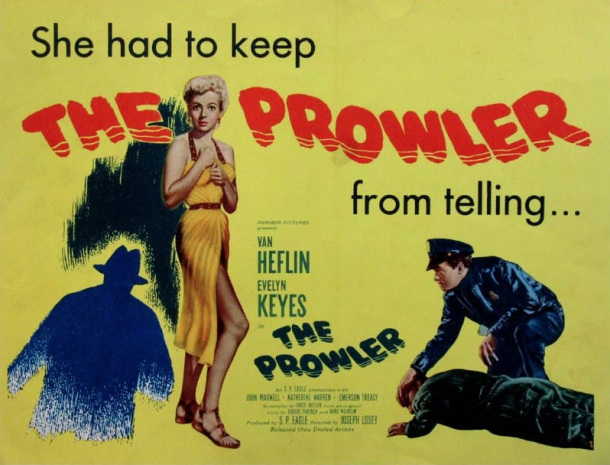
The Prowler was made by disillusioned men. Director Joseph Losey, screenwriter Dalton Trumbo, and visual consultant John Hubley were all eventually blacklisted by the House Un-American Activities Committee. Trumbo was already tarred, so his writing credit was given solely to Hugo Butler – while Losey and Hubley were pushed out of Hollywood soon afterward (Losey made one more film, The Big Night, before moving to Europe, while Hubley turned to uncredited work in commercials). Every major American institution is treated with a disdainful eye in The Prowler, a despairing document reflecting the state of the political Left in 1951, making it one of the bleakest film noirs ever made. James Naremore quotes Losey in describing the Hollywood liberal that year:

The Left in Hollywood was utterly demoralized by Truman, the atomic bomb, and the HUAC investigations, and it was beginning to recognize “the complete unreality of the American dream”.

The protagonists of this sleazy little drama are Webb Gardner (Van Heflin), an oafish cop fueled by class resentment, and Susan Gilvray (Evelyn Keyes), a plasticine blonde bored with her milquetoast husband. Or, as Manny Farber described them, “an amoral rookie cop” and a “hot, dumb, average American babe.” Either way, they were born to torment each other. In the opening shot, Susan stares off camera, shrieks, and pulls down the shades. There’s a prowler outside, and we’re out there with him. After this self-reflexive jape, literally putting us in the shoes of a voyeur and jokingly incriminating the whole movie-going enterprise, Losey pulls back to the larger narrative.

Susan calls the police to investigate the prowler, and Webb arrives along with his folksy, contented middle-class partner, Bud (John Maxwell). Sweeping the grounds outside, Webb circles around to the window in her bathroom. In a reversal of the opening shot, the camera is placed inside the window looking out, and Van Heflin takes our offending place where the peeper was first spotted. It establishes his perversity – he’s got a smarmy grin on his face – and re-enforces the possibility of ours. It’s the first of many shots where Webb is shown in transitional spaces – doorways, hallways and windows. The problem is that he always gets closer.

When he returns later that evening, she allows him in her living room, which the script described as “comfortably and tastefully furnished in Barker Brothers’ more expensive style of four years ago. There are overstuffed chairs and a couch; two bad landscapes on the wall” (quoted in “Un-American” Hollywood by Frank Krutnik).

Susan lives in one of the knockoff Spanish Haciendas favored by the upper middle classes in L.A. following WWII. The design is bland, second-hand, and forgettable. In a sly bit of set design, Diego Rivera’s The Flower Carrier [left] hangs over her dining room table, an artwork depicting labor exploitation tamed and turned by middle class apathy into mute wallpaper. Krutnik weaves a whole interpretation around the placement of the painting, which is available to read in his book’s Google preview.

This is the life Webb had been seeking, a life of quiet contentment in a “tastefully furnished” apartment, with a well-dressed blonde at his side. Over coffee, his class resentments come pouring out. He mews that being a cop is no better than a ditch-digger, money being his only bottom line. Susan ignites his jealousies further by revealing how she grew up in Indiana, in the same town as Webb, only she came from a wealthier family on a well-tended street.

It is this revelation that turns Susan into a prize – the ivory tower hidden from him because of his station in life. He becomes aggressive, animal, relentless. Susan resists meekly, than gives herself over entirely. Her own American dream, of raising a family, foundered in her husband’s infertile loins. Reduced to the life of a cloistered housewife, Webb’s meaty pawing feels like freedom. The husband only lives as a voice on the radio, as he’s the host of a popular nighttime music show, and an unwelcome presence during Webb’s ungainly seductions. In a small note of resistance, Losey cast Trumbo as the husband’s voice, his nasal tenor a ghostly presence even before his body gets knocked off in the Double Indemnity– inspired plot.

The Prowler spreads its sarcasm over the entire roll-call of American myths. Marriage, small-town life, the police force, and even capitalism itself are shown as empty, repressive forces. Susan and Webb are driven to each other, and then self-desctruct, all because of their unrequited love of the American dream. They want a perfect middle-class life, and Webb is more than ready to kill for it.

Van Heflin and Evelyn Keyes provide two sterling performances of American indolence and greed. Heflin is especially mesmerizing, his wide-set eyes, gangly limbs, and lasciviously parted lips looking like a grotesque caricature of masculinity. His arms and legs seem to flail out of sequence when he stalks around Susan’s home like an uncaged gorilla, and his apartment is a bubbling cauldron of 50s macho-ness. There’s a target practice sheet on the wall, muscle mags on the desk, and an electronic razor incessantly buzzing around his reddened mug. Then when Susan calls seeking reconciliation for one of their flaps, he strokes the phone’s receiver around the edge of his mouth, his eyes burning with a look of sexual ecstasy. It becomes clear later that he’s been planning a murder. Evelyn Keyes has less to work with. Andrew Sarris describes the dilemma of the actress in a Losey film (thanks to Glenn Kenny for pointing me to this quote in his blog post on The Prowler):

The feminine role in Losey’s world is strictly subordinate because of the histrionic hysteria of his actors. Men simply cannot cope with their lives and social institutions, and they crack up with very lyrical results. Meanwhile the women stand by to pick up the pieces. They cope because of their ability to compromise with reality, an ability Losey frankly admires. Unfortunately, the best roles are the least stable. Hence, Losey’s actresses are usually denied the great scene-stealing moments of psychic dissolution.

This is all true for The Prowler, with Keyes having to swing between lassitude and disconsolate passion – no emotional match for Heflin’s demoniac dissembler. But in her own minor key, she is superb. In her cool apathetic demeanor she delivers lines with a lack of affect, as if her personality had been worn down over time. Her personal desires have been co-opted by those of her society, hence her bizarre decision to hook up with Webb and start a family on the edges of the world they so desperately wish to enter.

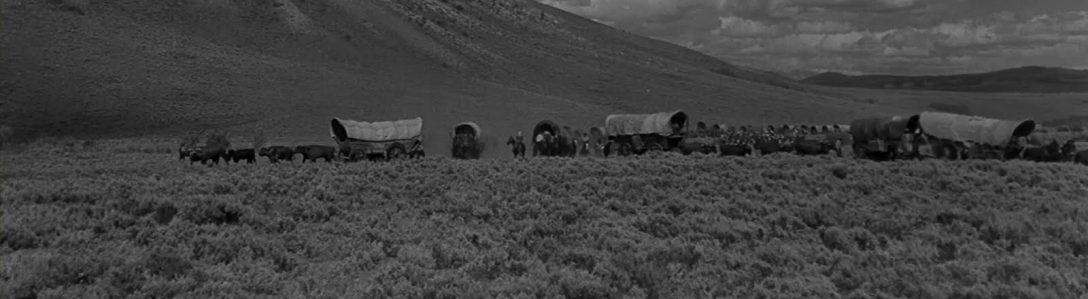
By the end they are pushed out of the middle-class suburbs and literally start to disappear. They are forced to go to a ghost town abandoned after a gold rush, where they enact a grim parody of the social roles of husband and wife – she does the dishes, he gets the food – and there’s a baby on the way. This section of the film is heightened both visually and narratively, as the events become more overtly symbolic and hallucinatory. The “door” to their room is a sheet that is beaten down by a raging storm. Webb has no other boundaries to cross, and now he simply wants the world to stay away. But the wind and rain keep busting in, and a simple country doctor brings their whole pathetic existence to a close – climaxing on a long climb up a short hill.

COLD CALCULATION AND SENSUALITY: GLORIA GRAHAME AND FRITZ LANG

August 11, 2009

large_human_desire_01_blu-ray_

On March 19th, 1953, Gloria Grahame was awarded the Best Supporting Actress Oscar for The Bad and the Beautiful (1953). Production on Fritz Lang’s The Big Heat (1953) began two days earlier, according to TCMDB. Little did she know during this string of dizzying successes that a couple of French cineastes were busy defining her image in perpetuity. In 1955, Raymond Borde and Etienne Chaumeton’s Panorama du film noir americain was published, a landmark study of a particular strain in American filmmaking that previous French critics had coined “film noir”. The term wouldn’t break into common parlance in the U.S. until the 1970s, but it would come to define Gloria Grahame’s career.

Borde and Chaumeton declared  her the ideal femme fatale, one who intimated “cold calculation and sensuality” in her performances (for more on this book’s impact, check out James Naremore’s More Than Night: Film Noir in its Contexts). She wielded her sly, cheshire-cat grin, nasal sing-song voice and girlish vanity as canny masks for her character’s various vices and insecurities. Her exuberant energy, almost anarchic at times, threatens to overwhelm the subtlety of her characterizations, and her unselfconscious sexuality made even the most sophisticated writer adopt the violent romanticism of a noir protagonist: Francois Truffaut wrote, “…as is the case of most of the Cahiers writers, the beautiful eyes of Gloria Grahame make you die of love….”, while academic Tom Gunning, in his magisterial Films of Fritz Lang, can’t help but add an aside that Grahame’s ability to make a fur coat swish “is one of the few arguments against animal rights activists.”

Along with Crossfire (1947) and In a Lonely Place (1950), The Big Heat is the defining film noir role of her career, and she delivers an astonishing performance. The Big Heat was based on a novel by William P. McGivern, originally serialized in the Saturday Evening Post. The script was written by Sydney Boehm before Lang was officially hired on to the project in mid-February of 1953. Lang biographer Patrick McGilligan notes that Boehm was a police reporter on the New York Evening Journal, and that “his specialty was crime…”. The script he delivered was a spare, unflinching tale of corruption, that which kills the wife of Detective Dave Bannion (Glenn Ford), and leads to his vigilante-like quest to take down Mike Lagana’s (Alexander Scourby) crime syndicate. Gloria Grahame plays Debby Marsh, the mistress to Lagana’s right-hand man, Vince Stone (a lip-trembling Lee Marvin).It’s a perfect scenario for Lang’s continued emphasis on systemic evils and unchangeable destiny (think Mabuse or You Only Live Once), and it results in one of his darkest, richest films (read the Gunning for an in-depth investigation of its formal and thematic strategies).

Lang’s perfectionist tendencies on set were notoriously difficult on actors, and there are very strong indications that he and Grahame did not get along. McGilligan says vaguely that there was “friction”, and in an interview with Charles Higham and Joel Greenberg about the film, Lang says, “…and there’s a whole story about Gloria Grahame and the picture I’d rather not discuss.” Which says all that needs to be said. Grahame was reputedly a “spitfire”, and Lang probably spat back. Regardless of their working relationship, their mutual genius is up there on the screen, and Grahame’s Debby Marsh is a marvelous creation, a girlish exterior hiding a sardonic sense of humor as well as a weary cynicism. When Bannion self-righteously asks her where her money comes from, Marsh replies, “I’ve been rich and I’ve been poor – believe me, rich is better.” This depressing realist comes out later in the film.

Graham enters the story lolling on the couch, answering the phone for Stone with mock sincerity, telling him “His Highness” Lagana is on the line, before strolling over to the mirror to check on her makeup. She exudes teenage rebelliousness and vanity, except her wit has more sting than your normal brat. Her burlesque of Stone’s relationship with Lagana reaches an absurd pitch when she starts singing a little ditty comparing Lagana to a lion tamer as she shuffles off to mix cocktails, indicating how “whipped” Stone really is, despite all his bravado. Grahame’s perky subversiveness gives Marsh select moments of independence, even if Stone doesn’t always pay attention to her jokes: “When Vince talks business I get my legs waxed”. She takes refuge from her life in humor and her physical appearance, which is the only way she can gain power in this sexist society. It is only after Bannion stands up to Stone that Marsh dallies with escaping her kept lifestyle.

After following the scarily stoic Bannion to his hotel room, Marsh opens up about her transcendent unhappiness. Grahame’s sexual invitation, as she composes herself on the bed, all shaded eyes and perfect posture, is duly swatted away by the detective. It is this flirtatious crime that leads to the Marsh’s famous scarring – a close-up of a bubbling coffee pot and an off-screen scream is all it takes for that scene of improbable violence to be inflicted by Lee Marvin. As Gunning notes, after this scarring Marsh avoids mirrors and acts as Bannion’s id, committing the murder he’s unable to. Meeting up with the scheming widow who is extorting from Lagana, and who holds the evidence to the syndicate’s downfall, Grahame greets her with the wonderfully sarcastic line, “We’re sisters under the mink”, as they face each other in matching furs. Marsh’s decadence is now ironic, another punchline, but this time in service of her redemption – and she goes on to return the coffee (see right).

McGilligan notes that the box office returns were “average” and the reviews “fair”, but Columbia Pictures were satisfied enough with the result to sanction a re-teaming of Ford and Grahame in Human Desire the next year, an adaptation of Emile Zola’s La Bete Humaine (filmed by Jean Renoir in 1938 – Lang had already remade Renoir’s La Chienne (1931) as Scarlett Street (1945)). The Zola novel would have been rich material for Lang, with the central character a mentally unstable “sex killer” in a world self-destructing around him. This being 1953 Hollywood, however, this subject would never be approved for production. So, as Lang told Peter Bogdanovich:

“In an American movie, you cannot make the hero a sex killer. Impossible. So Glenn Ford has to play it, you know, like a Li’l Abner coming back from Korea-100 percent red-blooded American with very natural sex feelings-if such a thing exists.”

This project was totally a contract job, but Lang had held out hope that he could land Peter Lorre as the lead, and perhaps coax a darker performance out of the material. Unfortunately, Lorre declined, and Glenn Ford stepped in to an impossible task – to portray a straight-laced aw-shucks American in a story of sexual obsession and death. His performance is incongruous and jarring. Lang’s visual mastery is in full force, though, with a wordless opening consisting of the cold geometry of train tracks, indicating the web of fate he’ll soon be caught in. It’s a film to savor for it’s purely plastic virtues, as producer Jerry Wald drove the final stake into its narrative conception:

…one day he called us [Lang and Alfred Hayes] in and said, “You are both wrong.” I said, “What have we done this time, Jerry?” He said, “Look. This is called La Bete Humaine, the human beast. But everybody is bad in your picture. ” “Naturally, because Zola wanted to show that in every human being is a beast.” He said, “You both don’t understand it. The woman is the human beast.” What can you do against the producer?

Glenn Ford plays Jeff Warren, a clean-cut soldier returning from the Korean War. He’s seduced by Gloria Grahame’s Vicki, who is chained to her drunken, murderous husband Carl Buckley  (Broderick Crawford), who’s eager to pin a death on her. Vicki attempts to seduce Warren so he’ll knock off Buckley and end her virtual imprisonment.

Gloria Grahame does not add the electricity of her turn in The Big Heat, but opts for a more reserved and maudlin tone, emphasizing Vicki’s opacity and unreadability, perhaps in an attempt to undercut Wald’s misogynist reading of Zola’s book. She is an enigma to Warren and to the audience, her character’s perversity kept in check until the final reels, where her proof of love, and proof of sexual attraction, is to kill.

I don’t like to emphasize the ghoulish backstory of Grahame’s life, but at this point in her career  her obsession with plastic surgery started to affect her performances. Her upper lip, the subject of multiple rumored procedures, looks almost paralyzed, and it alters her speech. She still receives a grand introduction, though, lazing about the premises, and then showing off her new stockings to a preoccupied Crawford. Despite her physical incapacity and the limits of the material, Grahame delivers moments of subtle beauty, including her final, incantatory pitch for true love (which she equals with Crawford’s death). Even when Lang and Grahame are working with subpar material, their intelligence finds it’s way on-screen. It was received rapturously by Cahiers (which Lang was always surprised by), and it inspired one of Andrew Sarris’ finest pieces of writing:

Where Renoir’s The Human Beast is the tragedy of a doomed man caught up in the flow of life, Lang’s remake, Human Desire, is the nightmare of an innocent man enmeshed in the tangled strands of fate. What we remember in Renoir are the faces of Gabin, Simon, and Ledoux. What we remember in Lang are the geometrical patterns of trains, tracks and fateful camera angles. If Renoir is humanism, Lang is determinism. if Renor is concerned with the plight of his characters, Lang is obsessed with the structure of the trap.

In any case, viva Gloria Grahame, quintessential noir actress and so much more, an artist of whirring energy and sensuality, who was able to transform her girlish charm into characters dangerous, wounded, and majestically alive.

BASTILLE DAY CINEMA: REIGN OF TERROR (1949)

July 14, 2009

MV5BZDQyYjFkYWEtNjkyNC00MGNmLTk2YmUtOThkNmU1NTQ2NzgyXkEyXkFqcGdeQXVyMTQ2ODE0NDA@._V1_SY1000_CR0,0,1337,1000_AL_

What better way to celebrate Bastille Day than to honor the greatest French Revolution film noir of all time on its 60th anniversary?  None, I say! The baroque madness of Reign of Terror is shared by three great Hollywood artisans: director Anthony Mann, cinematographer John Alton, and production designer William Cameron Menzies. Mann and Alton cranked out  T-Men for the Eagle-Lion studio in 1948, which became a minor hit, earning $1.6 million on an investment of $424,000. Eager to cash in, the studio had the duo squeeze out the magnificent Raw Deal later that same year.

Looking to class up their operation, Eagle-Lion entered a distribution deal with independent producer  Walter Wanger to churn out some serious minded historical spectacles. Having worked on the John Ford-Gregg Toland collaboration The Long Voyage Home and Hitchcock’s Foreign Correspondent, among others, he was supposed to bring respect to this neighbor to Poverty Row. He was given seven figure budgets for two films: Tulsa (1949, a Susan Heyward Western), and The Bastille.

It soon became clear that Eagle-Lion had overextended itself, and The Bastille was downgraded from an ‘A’ picture to a programmer (the budget was supposedly hacked to around $750,000). Working quickly to change the film from a big-budget spectacle to a historical potboiler, Mann handed Aeneas MacKenzie‘s heavily researched script to Philip Yordan. MacKenzie specialized in period piece paegantry, having written Michael Curtiz’s The Private Lives of Elizabeth and Essex (1939) and who later went on to write the script for The Ten Commandments. Yordan went in for more pulpy fare, and became a trusted scribe for Mann, working with him all the way through The Fall of the Roman Empire in 1964. It’s usually an impossible task to assign authorship to scripts that have gone through multiple rewrites, but in this case I think it’s safe to say that Yordan’s fingerprints are all over this. The tongue-in-cheek humor (Robespierre: “Don’t call me Max!”…note that Yordan also wrote Johnny Guitar (1954)) and noir machinations seem to be miles away from the stodgy reconstruction of Ten Commandments.

Perhaps I should briefly note the plot…an emissary of the Marquis de Lafayette, one Charles D’Aubigny (Robert Cummings) has been tasked to go undercover and filter information from Robespierre back to the leader of the opposition, Barras (Richard Hart). His contact is an old flame, Madelon (Arlene Dahl). Standing in his path are Robespierre himself (Richard Basehart) as well as his lieutenants, Fouche (an unforgettably obsequious Arnold Moss) and Sant-Just (Jess Barker). Without the period trappings, it’s a police procedural, with a climactic chase and all the rest.

Confronted with a sudden lack of funds, Mann’s team had to improvise, and they did it brilliantly. There are a few visual motifs that Mann sets up with Alton, including a simple one involving mirrors, denoting duplicity and vanity, and generally marking the characters for doom. In the first image, Robespierre’s ally is snuffed out after admiring his visage. In the second and third, Madelon is shunted into the background as a trembling ghost – as she has yet to fully gain D’aubigny’s trust. The last shows Robespierre’s face in full plumage before it gets blasted off.

William Cameron Menzies had to whip up a crowd of thousands with a cast of hundreds. Leger Grindon’s book, Shadows of the Past, from which I’m drawing the production history, notes that in filming the National Convention:

The designer squeezed a hundred extras onto a small rising gallery of benches, flooded the set with irregular shafts of light, and then photographed and enlarged the scale of the image. These shots were integrated through rear projection with the foreground of the Convention. The crowd fills the flat space of the background and spills, limitless, over the edges of the image.

His inventive use of rear-projection in conjunction with his other tricks truly pulls off a sense of dizzying magnitude. In its uncanny vastness, Menzies’ tricks adds to the feeling of vertigo that the characters are trapped in, and which might possibly would have been lost in the higher budgeted version.

Alton’s cinematography is all claustrophobic menace, with an unusual amount of distorting extreme close-ups that emphasize the caricatured nature of the whole enterprise (while also obviating the need for elaborate sets). The grotesque figures that Alton frames lend the film a comic book sensibility, pulled straight from the pages of Classic Comix. One could draw a line straight from Frank Miller’s oeuvure to this film, for better or worse, right down to it’s darker than dark palette and shocking violence (a gunshot to Robespierre’s mouth is excised in some prints of the film. There is also kitty kicking, torture, and various other thwacks to the head).


According to Grindon, Reign of Terror opened in 1949 during the week of Bastille Day in Los Angeles. It performed modestly, pulling in under $40,000 before closing after 11 days. Before releasing the film in NYC, Eagle-Lion completely changed the marketing for the film, emphasizing the action elements while barely mentioning the French Revolution backdrop. The title was changed to The Black Book when it was released that autumn in New York (it’s been released under both titles on home video, although Reign of Terror has become the standard, as evidenced by the recent VCI release, which is supposed to display the best image quality currently available). Despite another middling box office showing, it eventually turned a profit after two years of bookings.

TCM is screening the film on September 7th at 1PM, so there’s no excuse. Rent the DVD or settle in with TCM, but by all means watch this sterling example of creativity seeking ingenious ways around a lack of cash.

HAPPY 15TH ANNIVERSARY, TCM

April 14, 2009

a Clash by Night Film Noir Classic Collection boxset 2 dvd review PDVD_005

Turner Classic Movies started piping into my Buffalo family’s cable box circa 1999, just as I was schlepping downstate to grow a wispy goatee at Binghamton University. This was vexing. I was already committed to studying the movies, eyeing the school’s vague “cinema” major like it was a slab of rare steak. And now that I was leaving home, this vast library of celluloid was going to broadcast 200 miles away from my rapidly watering eyes (TCM was persona non grata on campus). And so a plan was hatched. Every month, after exhaustively parsing the schedule and cross-checking titles at IMDB, I would send my father a lengthy list of films to record through my newly minted dial-up AOL account (screename: EdAsner). I tried to instill a military vigilance regarding this burgeoning bootleg operation, and he endured my tyrannical reminders with annoyed resignation. My “Make sure you get that Bollywood triple feature tonight!” would be followed by his drawn out, perfectly enunciated sigh of defeat.

Armed with one dollar tapes from the orange-besotted Aldi’s chain, he manfully battled our VCR to a draw. A few endings were clipped, but most made it through the Sony’s maw intact.  Soon enough there was an imposing, wobbly tower of cheap cardboard and cheaper tape cluttering my Dad’s living room. They were shipped out in increments, or picked up at holiday visits. His labeling was sparse and incomplete, and most of my Christmases involved archiving the new stack of cinema accrued during the semester, toggling back and forth to see which title Mr. Robert Osborne would announce next.

My Dad endured, and snuck a few peeks at my obsessions, becoming especially enamored of Fritz Lang’s Clash By Night(1952, image at top, from DVD Beaver). He couldn’t remember the name when I talked to him last night, just images of Barbara Stanwyck, a fishing village, and its stark rendering of failed trust and nascent forgiveness. “They worked it out”, he said. “After all that.”

And so began my personal, idiosyncratic repertory house, airing nightly in a tripled dorm (three living in a space for two), which naturally provided its own version of Smell-O-Vision. Some sample offerings: Zombies on Broadway (1945) followed by Anthony Mann’s Border Incident (1949)Kiss Me Kate (1953) paired with The Story of G.I. Joe (1945), or, my favorite, a triple bill of The Lusty Men (1952)Rancho Notorious (1952 – what a year!) and The Big Knife (1955)That latter tape alone introduced me to the carnal cinemas of Nicholas Ray and Robert Aldrich, and made me re-evaluate the received wisdom about Fritz Lang’s Hollywood work.  The cramped, grimy noirs of Anthony Mann and John Alton, though, seemed especially appropriate to my living quarters, and TCM always delivered (one tape contained the chiaroscuro masterpieces T-Men (1947) and Raw Deal (1948)).

So happy 15th birthday, TCM (and a happy ten years of viewing for me). It was always a thrill to see Robert Osborne’s avuncular bearing shimmer through my shoddy 13′ TV screen, because it meant a further dip into the seemingly inexhaustible archives of the classical Hollywood cinema. Not to mention Osborne’s always useful historical notes before each screening. But what’s most important is how the channel, through its devotion to showing films uncut, and in the correct aspect ratios, is preserving film history. While learning the rudimentary tools on a Bolex 16mm at Binghamton, TCM was offering me a crash course in the history of screen editing, from the brisk shot-countershots of Preston Sturges comedies to the longer takes necessitated by the CinemaScope process, seen in later Manns like the underrated The Last Frontier (1956) and Man of the West (1958). My education at school was valuable, but if I were to quantify how much I’ve absorbed about film history and style, how much can be imparted through a flick of a cigarette, a tip of the hat, I’d say the cable channel comes out on top (sorry Mom and Dad).

I come from a generation where this was the only place to discover the glories of the studio system. DVD has been spotty at best at releasing pre-1960 films, and TCM has been extarodinarily willing to air “uncommercial” product. How else was I going to see Frank Borzage’s romantic masterpiece Man’s Castle(1933) without paying exorbitant amounts for an import? Its broadcast was one of 2008′s major highlights. So many “movie lovers” haven’t seen anything before 1970, and I shudder to think where my own taste and knowledge would’ve wandered to without the channel’s existence. So here’s to another 15 years. Don’t ever change.