PICNIC-ING

January 24, 2012

Screen Shot 2020-02-03 at 11.31.11 AM

The intrepid Twilight Time label continues their line of limited edition Blu-Ray releases with an absolutely gorgeous version of Picnic, Columbia’s romantic smash of 1955-1956. Sold exclusively through on-line retailer Screen Archives, it presents James Wong Howe’s Technicolor cinematography in eye-titillating detail. Based on William Inge’s Pulitzer Prize winning play from 1953, Picnic is a garishly entertaining melodrama that sets earthy he-man William Holden after prim beauty queen Kim Novak, upending a small Kansas town in the process.

The play,  directed by Joshua Logan, ran for 477 performances, and gave Paul Newman his first big break in a co-starring role alongside Ralph Meeker and Janice Rule. After a bidding frenzy, Columbia Pictures purchased the rights in September, 1953 for around $350,000. Logan, coming off of directing and co-writing the Broadway juggernauts South Pacific (1949) and Fanny (1954), was tapped to direct the movie adaptation, despite his limited screen experience, having only co-directed (with Arthur Ripley) the 1938 Joan Bennett-Henry Fonda drama I Met My Love Again. The screenplay by Daniel Taradash met immediate disapproval by the Production Code Administration, which sought to eliminate any hint that Holden and Novak have pre-marital sex, although the finished film leaves little doubt as to their amorous adventures.

Holden plays Hal, an ex-college football star turned hobo, riding the rails into Kansas to find his rich frat brother Alan (Cliff Robertson). Walking with a tipsy swagger as if he was leaking testosterone, he stumbles past phallic imagery (grain elevators and swinging chutes) into the Owens household, where he immediately enraptures the teenage bookworm Millie (a delightfully snot-nosed Susan Strasberg) and their repressed schoolmarm neighbor Rosemary (a hysterically campy Rosalind Russell). The eldest Owens daughter, Madge (Kim Novak), is expected to marry into Alan’s wealth, but is innately attracted to Hal’s raw, destructive physicality. At the end of a Labor Day picnic, these unspoken attractions burst forth in a torrent of passion and recrimination.

Logan was never comfortable in casting Paul Newman as the lead roustabout Hal, telling him, according to Newman biographer Marian Edelman Borden, that he “did not carry any sexual threat at all”. So the part went to Holden, who at 37 seems miscast as a callow young brute, although his perpetually exposed torso was still toned enough to believably seduce an entire household (was this a template for Pasolini’s Teorema?). Newman’s old stage role of Alan was given to the appropriately starchy Robertson.

Picnic was the beginning of Kim Novak’s major star push from Columbia head Harry Cohn, who depended on James Wong Howe to make her look irresistible. After bowing as a blonde, Cohn wanted to make her a redhead as the discontented Madge, and asked Wong to make some screen-tests of various shades. Picnic, in CinemaScope and Technicolor, is worthwhile viewing for the shifting highlights of this hair alone. Depending on the lighting, it can look Titian red, and then a kind of dark golden blonde, halfway between cinnamon and honey. In one loaded shot, Novak collapses in a new dress, a sobbing puff of blue tulle. This composition, of auburn hair, blue dress, and gray-green eyes, contains the entire chromatic shift of the film, from calm blues and grays to intense, libidinous reds and back again.  This maniacal attention to color detail is part of what attracted the French New Wave to the film. After seeing Picnic, Rivette enthused rather confusingly that Joshua Logan was “Elia Kazan multiplied by Robert Aldrich” (perhaps meaning that Logan merges the realism of Kazan (Picnic was shot on location in Kansas) with moments of pure style (the Aldrich of Kiss Me Deadly)). Truffaut said of Logan, “He is a pure director, a man we know will not be walked on.”

This hypnotic aspect of Novak’s hair is one small example of the film’s mastery of color design. Together with Logan and the production design team led by Jo Mielziner (who deservedly won an Oscar), the film abounds in soft pastels, of a cream and wedgwood blue that adorns the Owens home and the suits of their male admirers. This palette continues through the centerpiece picnic sequence of the film, a bizarre bit pitched between Renoir pastoral, pure Americana corn and small-town Lynchian freak-out, which Jonas Mekas described as “a gaudy display of boobus Americanus.”  Screaming babies, seemingly cast for their old-man sourpusses, are inter-cut with an orgy of fairground games of increasing absurdity. Sack races and pie-eating give way to zombie-like warblers and a  girl-carrying competition. The crowds behind these manic episodes overflow with grays and light-blues, with Novak wearing a cream-colored dress and Russell a light-blue jacket.

The blues get darker in the dusk of day’s end, which is then pricked by irruptions of red. Russell removes the jacket, revealing a blouse of blood-red flowers. These match the bouquet of roses Novak cradles after she wins a beauty contest, sailing downriver in a Queen’s red robe. As these colors set off Novak’s hair, so it initiates a purging of passions, with Russell doing screaming harridan routine, Strasberg puking in a corner, and Novak, ready to embrace her sexuality, enacting a sensuous slow-dance to “Moonglow”, a pantomime of what Logan can’t show on-screen. After this lightfooted pas de deux, which expresses inner states through action, the film starts unloading leaden slabs of exposition, love expressed in words instead of glances.

Reading the images tells a more interesting story. Muted colors return the day after the picnic, with Novak making her climactic decision in a gray-blue jacket, the image of sobriety. The bus she steps onto, however, is streaked with red – pointing towards an uninhibited, uncertain future.
WARNER ARCHIVE ROUNDUP: SMILIN’ THROUGH (1941) AND WELCOME TO HARD TIMES (1967)

January 17, 2012

Screen Shot 2020-02-03 at 11.25.36 AM

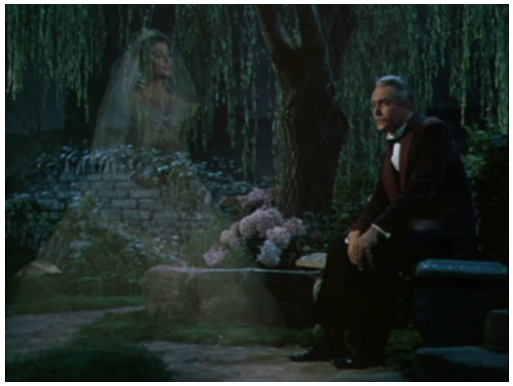
The Warner Archive continues to summon the ghosts of Hollywood past onto DVD, a bit of studio witchery we should all get behind. One of their most intriguing recent séance jobs is Frank Borzage’s Smilin’ Through(1941), a haunting WWI melodrama. Despite the mammoth Murnau, Borzage and Fox box set, there are still great stretches of Borzage’s career missing on home video (including essential titles like Man’s Castle (’33, hopefully a Sony MOD candidate) and Moonrise (’48), which is streaming on Netflix)). Smilin’ Through, though flawed, has moments of doomed romanticism that rival anything else in his work, with superimpositions establishing the intractable hold the past exerts on the present. A similar theme is lugubriously told in Welcome to Hard Times (’67), a Western in which old studio hand Burt Kennedy flails to channel A Fistful of Dollars on a low budget. Originally made-for-TV, MGM decided to release it into theaters before airing it on ABC, after which it disappeared. Featuring a spate of studio standbys, including Henry Fonda and Aldo Ray, it’s a fascinating failure in which MGM hires old studio craftsman to make a film that blatantly reaches for the youth market.

Frank Borzage had moved from Warner Brothers to MGM in 1937, starting with Big City, and continued there through Seven Sweethearts (’42, also on the Warner Archive), after which he became an independent contractor. The Warner Archive has released seven of these titles, all of which (excepting the well-regarded Mortal Storm (’40)) are due a second look. His stay at MGM was not a smooth one, with the usual studio interference and hijinks (producer Victor Saville famously claimed to have directed the majority of The Mortal Storm, an idea debunked by biographer Herve Dumont).  In January 1941 Borzage was removed from a re-telling of Billy the Kid after initial location shooting (he was replaced by David Miller), and was shifted to a Joan Crawford project, Bombay Nights, which never materialized. He didn’t sit idle long, with production on Smilin’ Through starting in early May.

The project was a rather moldy chestnut, based on a 1919 play by Jane Cowl and Jane Murfin, that had already been adapted twice for the screen, in 1922 (starring Norma Talmadge) and 1932 (with Norma Shearer). The scars of a 19th century love triangle are torn open on the eve of WWI, as Sir John Carteret (Brian Aherne) refuses to sanction the marriage of his adopted daughter Kathleen (Jeanette MacDonald) to Kenneth Wayne (Gene Raymond, MacDonald’s husband), whose father had destroyed Carteret’s marriage decades before. Borzage opens the film on the Diamond Jubilee of Queen Victoria, celebrating 60 years of her rule. The camera pans left to a church, with the ramrod figure of Aherne the only figure not gesticulating in a celebratory fashion. He sourly says, “I don’t like anniversaries”, the weight of the past present in each of his deliberate steps.

He is momentarily levered back into the present by the appearance of Kathleen, the niece of the woman he loved, Moonyean (also played by MacDonald). Entranced by her forthrightness (and resemblance to Moonyean), he temporarily eases his obsession with the past, which manifested in conversations with his ghostly deceased love, and embraces an attentive, active role as a father. Immediately upon making this decision, and loosing the grip of his memory, Borzage collapses time in a gorgeous, layered montage of spring flowers and children’s games. Kathleen’s childhood is compressed into thirty seconds, the narrative resuming once Carteret is once again ensnared by his loss of Moonyean.

The world of the film becomes a kind of necropolis, with Kathleen first meeting Kenneth in the abandoned mansion of his father, Jeremy. They dust off his decanter of wine, untouched since his death, and hold hands for the first time while staring up at his portrait, deeply ensconced in Carteret’s memories of his dead nemesis. Carteret is entombing his family in his obsessive memory, and can only free them by telling his story, and moving on. Borzage privileges this moment in an extended flashback of his doomed wedding day, an unburdening and a confessional, that ends with Carteret cradling Moonyean in a Pieta-like pose, allowing himself to mourn for the first time, instead of simply nursing his hatred. It ends on a transporting image, of a ghostly Carteret-Moonyean and a physical Kathleen-Kenneth passing in the night, going in different directions on time’s arrow, but both savoring the moment.

Please read Kent Jones’ wonderful career overview in Film Comment for a fuller view of Borzage’s career.

***

In 1967, MGM was trying to crank out genre films on a budget by making deals with television networks, while still reaping the box office rewards from theatrical release. Kerry Segrave wrote in Movies at Home that the studio had renegotiated its deal with ABC, allowing the final three of their six co-productions to be released theatrically before they hit the tube. These were Day of the Evil Gun (starring Glenn Ford and Arthur Kennedy, 1968), Hot Rods to Hell(with Dana Andrews, 1967) and Welcome to Hard Times (1967). Warner Archive has just released Hard Times in a handsomely remastered DVD, and is an artifact of a studio’s shfit to producing tele-films and catering to the burgeoning youth market. Director/writer Burt Kennedy, famous for scripting Budd Boetticher’s psychologically astute Ranown cycle of Westerns, had moved from helming TV shows to becoming a reliable worker on cheap genre films. Right before Hard Times, Kennedy cranked out Return of the Seven (1966), a sequel to The Magnificent Seven (1960), and afterward he made a couple of popular comic-Westerns with James Garner, Support Your Local Sheriff! (1969) and Support Your Local Gunfighter (1971). Hard Times is the likely nadir of Kennedy’s work in this period, a slackly paced adaptation of E.L. Doctorow’s first novel (Doctorow told the NY Times that the film was the “second worst movie ever made.” The worst? Swamp Fire (’46) starring Johnny Weissmuller).

The film concerns the Mayor and de facto Sheriff of the Western town of Hard Times, Will Blue (Henry Fonda), a dyed-in-the-wool cynic who only acts out of base self-interest. When a drunken hell-raiser (Aldo Ray, credited as “The Man From Bodie”), razes the town to the ground, Blue just watches from a distance, not willing to get involved. Blue and a local medicine show carny build up Hard Times again by turning it into a good-times destination for local miners. As business booms, Blue braces for the return of “The Man From Bodie”. The film opens with a bang, in a near-silent sequence that is an homage to (or straight rip of) the start of Rio Bravo. Instead of a drunken Dean Martin, it’s a buzzing Aldo Ray, who smashes a bottle in close-up, drinking from the shards that are left. Ray is framed to be a force of nature, presaged by a dramatic clap of thunder and causing  raging fires. Ray starts out as intimidating, but is reduced to cartoon villainy by this overdetermined symbolism, a hacky attempt to provide the stylish ultra-violence the young crowds desired, and were delivered in the Leone Spaghetti Westerns. Even the film’s cynicism seems half-baked, as Fonda’s brittle, passive exterior gives way to a conclusion of straining sentimentality. And opening sequence aside, the film is indifferently put together, despite the incredible rogues gallery of faces Kennedy had to work with. In addition to Fonda and Ray there is Warren Oates, Elisha Cook Jr., Lon Chaney Jr., Keenan Wynn and Royal Dano. As these weathered, instinctively expressive faces slide past the screen in this ill-conceived oater, it feels like a roll call at classical Hollywood’s funeral.

GOING BACK TO THE WELLMAN: SAFE IN HELL, MY MAN AND I, and LAYFAYETTE ESCADRILLE

November 22, 2011

safe in hell

William A. Wellman was an attractive guy who happened to make a lot of movies, one of those directors who led an entire life before entering the cinema (as salesman, hockey player, soldier). For Wellman and so many other early Hollywood craftsmen, directing was, as John Ford described it, just another “job of work”. Wellman was one industrious worker, credited with 83 shorts and features from 1920 – 1958. He excelled at compact stories of blue-collar types getting sore at each other (or what Manny Farber called “hard-visaged ball bearings standing around – for no damned reason and with no indication of how long or for what reason they have been standing.”), able to create a humming rhythm out of wisecracks and violence. The studios, however, tasked him with tackling much more, leading him to clumsily apply his blunt style to melodramas and comedies (his ’37 Star is Born is especially sluggish). His career is wildly uneven but well worth looking into, especially the period in the 30s where he was cranking out saucy and speedy pre-coders like Night Nurse and Other Men’s Women (both 1931). The Warner Archive has just released a third film from his stellar ’31: Safe in Hell  (along with later Wellman efforts My Man and I (1952) and his final film Lafayette Escadrille (1958)).

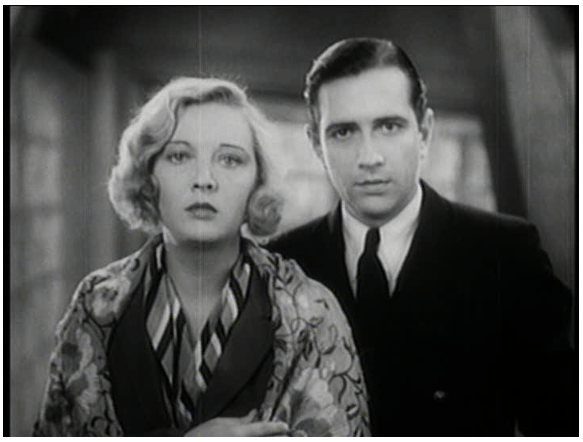
Safe in Hell was shot from mid-September to October 18th of 1931, and was released December 12th. A quickie produced by First National Pictures (which had merged with Warners), it’s a seamy pre-code drama about a prostitute who believes she has committed murder, and then flees to a Caribbean island that does not have an extradition treaty with the United States. The lead role of the whore without a heart of gold was originally slated for Broadway legend Marilyn Miller, and was then assigned to rising star Barbara Stanwyck, who gave a deliciously sardonic performance in Wellman’s Night Nurse earlier that year (she ended up in Frank Capra’s Forbidden instead). The role fell to Dorothy Mackaill, who Ralph Flint of the NY Times said was, “on return from her summering at Hawaiian resorts, [and] was pressed into service.”

Mackaill was a British born actress, who cut her teeth as a dancer in the Ziegfeld Follies before forging a productive career on-screen in the silent era, notching the leading role in the 1924 The Man Who Came Back, and in Alfred Santell’s 1926 The Dancer of Paris. Work dwindled with the arrival of sound, and First National declined to extend her contract at the end of 1931. That marked the beginning of the end of her career in pictures. It’s unclear why the studio felt she wasn’t fit for sound, as her performance in Safe in Hell is impressively wild and unhinged, wrenching the underwritten part into something tangible and affecting.

She plays Gilda Karlson, an in-demand prostitute in New Orleans, who is paid an unwelcome visit by a john, the one who led her into vice. She conks him over the head with a vase, and, thinking she killed him, is frittered away to the Caribbean by her merchant marine boyfriend Carl (Donald Cook). She is ensconced in a shady hotel populated by a murderer’s row of lowlifes, each ogling her with lip-smacking impunity. Wellman catches the crew (including my favorite name and face: Gustav von Seyffertitz) in a series of leering reaction shots, before they slowly turn their chairs around and await her return trip downstairs. With Carl away on a job, the seedy patrons urge Gilda to sink back into her old ways, and the rest of the drama details this dilemma.

Wellman gets the story rolling with alacrity, establishing Gilda’s character by opening on a close-up of her gams sitting next to a phone – the two necessary implements of her job. Within a few scenes a man is presumed dead and Gilda is stowed away on a ship, heading South, her eyes visible through a slit in a box, as she quips, “I always traveled 1st class!”. The hotel in the Caribbean is run by Nina Mae McKinney, a wildly talented black actress who was shunted into supporting or “musical” roles because of the institutional racism of the period (she was later known in Europe as the “Black Garbo”). Here she sings the theme song with a smile while serving her customers. The bellboy is played by another grievously under-used black actor, Clarence Muse, who injects a patrician weariness and humor into his stock character. He tells Gilda that they serve liquor, since they are in “a civilized country”, unlike the Prohibition era U.S.

The film loses its spark in the closing third, in which sexual deviancy is replaced by an unconvincing shift to the value of constancy, robbing the starkly downbeat ending of much of its power. An uneasy mix of entertaining smarm and queasy sentimentality, Safe in Hell  is probably the least of Wellman’s great 1931 run (The Public Enemy, Other Men’s Women, Night Nurse), but it still exerts a strange fascination. I should note that the Warner Archive transfer looks soft and scratched up, most likely taken from an old TV master. It is not up to the usual standards of the company’s releases, but the fact that this rarity is available at all is reason enough to celebrate.

***

My Man and I (1952) is a showcase for Ricardo Montalban, who plays Chu Chu Ramirez, an itinerant Mexican farmer who gains his citizenship, but is unable to escape racist attitudes. This earnestly melodramatic film was co-written by novelist John Fante, who (according to Doug Bonner) modeled the love story between Montalban and Shelley Winters on the romance from his most famous novel, Ask the Dust. Chu Chu, an almost idiotically optimistic character, immediately believes he can save Nancy (Winters) from her alcoholism through sheer force of will. Wellman militates against the ridiculous goody-two-shoes nature of Chu Chu’s character by placing him in cramped, dense frames, with looming faces present in the foreground (one of them belonging to Jack Elam, playing the cynical Celestino), used especially in Chu Chu’s flophouse. This sense of visual claustrophobia runs counter to Chu Chu’s continually stated belief in the American melting pot, which he proves by constantly wielding his citizenship letter from the President. In his scenes with Nancy, Wellman uses low-light, throwing dramatic shadows against the wall, visualizing the dark pit of despair that Nancy cannot escape from. Despite his best efforts, Wellman cannot entirely free the film from the hackneyed script, which transitions into a traditional courtroom drama, with all of its moralizing banalities. The ultimate saving grace, though, is the presence of Claire Trevor as an unsatisfied housewife whose husband hires the buff (and often shirtless) Montalban to clear a field, and whose withering putdowns and shivering carnality electrify every scene she appears in.

***

Wellman often said that Lafayette Escadrille was the worst movie he ever made, and I won’t argue the point. The story of American soldiers who sign up to fight in the French Air Force in WW1 was a personal one, as Wellman had served in the unit. He even cast his son, William Wellman, Jr., in one of the supporting roles. But Warner Bros. forced him to add a happy ending, and cast the handsome teen idol mannequin Tab Hunter in the lead role. The idea was to bring in a younger audience, but all it did was dilute Wellman’s vision more. What was intended as a melancholic homage to the American dead of WWI was turned into a raucous boys-on-the-town movie, and it’s a mainly joyless affair. There are some nicely shot flying scenes, and a very young Clint Eastwood picking lice out of his hair, but otherwise it is a lost cause. This is a shame, because one of his previous passion projects, the monochromatic Track of the Cat (1954), is one of his greatest visual accomplishments. Escadrille was his last film, but no matter, he got the job done more often than not.

DIETERLE WATCH: LOVE LETTERS, FASHIONS OF 1934, JUAREZ

November 15, 2011

dieterle watch

The previously hazy career of William Dieterle is slowly being brought into focus, as the Warner Archive and repertory screenings grant incrementally wider access to this neglected German-American filmmaker. The Archive has just released Fashions of 1934 (’34) and Juarez (1939), while the 92Y Tribeca recently screened a gorgeous new print of Love Letters (1945, scheduled to air on Jan. 21st at 10PM on TCM). The Warner Archive discs display opposite poles of his career, the dynamic fantasist and the staid historical dramatist, while the hallucinatory Love Letters lies somewhere in between.

Fashions of 1934 reunites Dieterle with William Powell, whom he had worked with two years earlier on Jewel Robbery (which I wrote about earlier this year). Powell again plays a suave member of the criminal class, but instead of a dapper thief he’s con-man Sherwood Nash, dealing knock-off couture gowns to department stores around town. Along to help him are Bette Davis as the eager fashion designer Lynn and Frank McHugh as his trusty dissembler Snap. In order to keep ahead of the trends, they fly to Paris to spy on the elite fashion housesAs the cops and the real designers close in on them, it’s up to Sherwood to lie his way out once again. Like Jewel Robbery, Fashions is a fairy tale of criminality, only focused through a male POV this time. Both define thievery and pirating as a kind of harder working entrepreneurship that leads straight to our preferred dream life.

It seems like the entire budget was funneled into the Busby Berkeley-directed musical number towards the end of the feature, but Dieterle makes the most of the drab office sets at his disposal. He focuses on Powell’s posture, his leans over the desks and chairs indicating the relative state of his pocketbook and love life. The dialogue is rolled out in an unvaryingly speedy pace, with the only indication of an emotional shift present in Powell’s relationship to furniture. Even when urging Lynn to marry another man, his voice betrays nothing – it is his body that gives him away. In seduction mode, he tilts forwardas if heading into an oncoming wind, offering his body to his suitably awed targets. It works with the store owners who agree to stock his knock-offs, as well as the vamp who bamboozles a French designer. With Lynn though, he always stands ramrod straight, often in group shots with Snap. It is only when he kneels down at the end in supplication that he can win her hand.

Davis was not happy with the film, saying that she “was glamorized beyond recognition”, and she does seem uncomfortable, never quite locking in to the screwball tempo set by Powell. Despite her reservations, the film was fairly well received, with positive notices from influential gossip columnist Louella Parsons (“very excellent”) and the New York Times: “The story is lively, the gowns are interesting and the Busby Berkeley spectacles with Hollywood dancing girls are impressive. ” The Berkeley musical, wrenched in as part of Sherwood’s plot to increase demand for ostrich feathers, is suitably insane, turning the female models into mutating patterns of harps, flowers and oarsmen. The harp-women are fun and disturbing, but it is Sherwood’s demonic energy in conjuring his dreams into reality that lingers.

Juarez (1939), a dramatization of the Mexican Revolution, lacks the speed and physical expressiveness of Fashions, collapsing under the weight of its ambition. This was a major project for Warner Brothers, and Dieterle assuredly didn’t have the freedom as on his previous quickies. The AFI Catalog lists the massive amounts of resources poured into the feature:

The picture represented Warner Bros. most ambitious project to date. According to the production files, every detail was exhaustively researched for historical accuracy. The files contained long lists of reference books in both English and Spanish. Press releases refer to the film’s extensive research. According to modern sources, the writers had a bibliography of 372 volumes, documents and period photographs. Art director Anton Grot drew 3,643 sketches from which engineers prepared 7,360 blueprints for the exteriors and interiors of the settings. A complete Mexican village was built on the Warner Ranch in Calabasas, CA.

Dieterle did not excel in the realist mode, with his light touch being weighed down with the anvil of historical “truth”, at least that according to studio researchers. It’s no surprise that the result is leaden and monotonously expository, which is not aided by Paul Muni’s grotesque makeup job as Benito Juarez, looking like he got a jumbo Botox injection. Every character states their motivation and provides historical context within the same sentence. The saving graces occur in the prissy arrogance of Claude Rains as Napoleon III, and the sensitive handling of Carlotta’s (Bette Davis) descent into madness, which rekindles for a moment Dieterle’s skill at eliciting hyper-real, dreamlike performances.

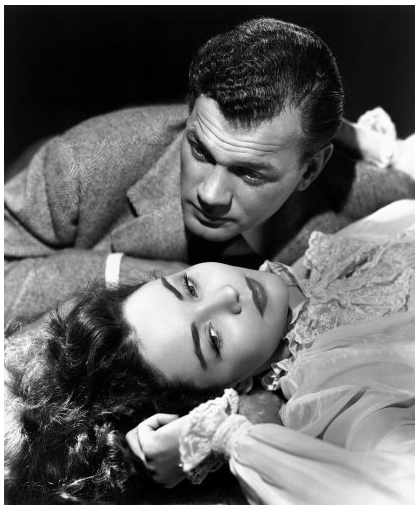
This skill is on full display in Love Letters (1945), a delirious romantic melodrama that Dieterle made when he was a freelancer, taking on short-term deals with studios. Producer Hal Wallis tapped him to direct the treatment, starting a professional relationship that would last until 1953. According to Bernard F. Dick’s biography of Wallis,  the producer purchased the rights to Chris Massie’s novel, Pity My Simplicity, in 1944, for $35,000, and was adapted for the screen by Ayn Rand (whose novel Fountainhead was released in ’43). It tells the story of Quinton (Joseph Cotten), an army man who ghost writes love letters for his friend while at the front. Although they have never met, Quinton falls in love with the woman he is writing them to, Victoria Morland (Jennifer Jones). After a tragic murder, Victoria is struck with amnesia, whereupon Quinton finally meets her, and falls desperately in love. But what will happen when she remembers her past?

Both Cotten and Jones were loaned out from David O. Selznick, with plenty of strings attached. Jones was negotiated to receive $100,000 for nine weeks of work, and Selznick had final approval over her hairstyle, makeup and wardrobe. He also stipulated that Lee Garmes be hired as director of photography, who had just shot Jones in Since You Went Away (1944). Within these restrictions Dieterle crafts an unsettling love story that equates the spiritual and the ghostly. It begins in the content of his letters, in which he writes he envisions “life as a dream of beauty”, and his friend tells him that Victoria is a “pin-up girl of the spirit”. For Quinton, Victoria is a disembodied vision of love, a Platonic ideal to strive toward.

Then this ideal comes jarringly to earth. After Quinton is wounded in war, framed against the gauzy curtains of the army hospital, he returns home. At a party, the blonde hostess (Ann Richards) tells him “I see things that may happen to you”, with both their faces in a close-up. The world is contracting and shuddering around him. He inherits his Aunt’s cottage, and when he arrives the table is mysteriously set. A ghost servant! No, it is only Mac, a gruff Scottish butler whom Quinton had forgotten, and who he calls “gargoyle”. The border between life and death, and past and present (as Quinton rummages through his childhood toys) seems awfully thin indeed. It is within this atmosphere that he meets Victoria, whose identity has been subsumed inside an amnesiac who calls herself “Singleton”. Singleton has no past or future, an unearthly presence to match the fantasy “spirit” of the letters. Quinton’s great fear is that Victoria will regain her body, and he will again have to re-enter the fraught thicket of memory and psychology that embodiment will bring. He envies her “contagious serenity”, and fervently believes that she has “lost a world, but gained a soul”. This use of Quinton’s fantasy to motor the plot is a similar device to Jewel Robbery, in which Kay Francis’ erotic desire seems to will William Powell’s thief into existence.

The pace is subdued compared to his 30s films, but the deliberation is appropriate to document the slow re-emergence of Victoria and the subtle fissures between worlds. Dieterle instead utilizes elaborate set design and tight compositions to convey the sense of the uncanny. The film is shot entirely on backlots, an artificial world for incomplete people, shot in dramatic chiaroscuro by Garmes. There are endless shots of lamps lit and extinguished, intermittently illuminating a red splotch on a white dress that will end Quinton’s dream and re-start Victoria’s reality.

WARNER ARCHIVE ROUNDUP: LATE FILMS

October 18, 2011

last run

Every week the Warner Archive dusts off a bundle of forgotten studio productions onto DVD and hopes they find an audience. Recently they released a quartet of late films from veteran studio auteurs, and they all deserve to be seen. They are Robert Aldrich’s The Legend of Lylah Clare (1968), Richard Fleischer’s The Last Run (1971), George Cukor’s Travels With My Aunt (1972) and Blake Edwards’ The Carey Treatment(1972), all presented in handsome remastered editions. These are directors who had been weaned in the classical studio era, and who were now facing the reality of producer-brokered “package deals” and the escalating power of the lead actors. Many of these were fraught productions, and none will rank with the best of the respective director’s work, but they all, somehow, end up as solidly crafted entries on their brilliant resumes.

The Last Run was originally a project set up for John Boorman at MGM, who was to produce and direct. As the AFI Catalog reports, star George C. Scott requested that John Huston replace Boorman, as he had worked with Huston on The List of Adrian Messenger (’63). After three weeks of shooting, however, Huston quit the picture, “after arguments with Scott over rewrites”. Richard Fleischer became the third and final director on the project, and lead actress Tina Aumont was replaced by Trish Van Devere.  It is unknown if any of the footage Huston shot remains in the film.

It is clear that Scott exerted a lot of control, even marrying two of his female co-stars (he left wife Colleen Dewhurst for Van Devere after shooting), and yet Fleischer still imbues the film with the cool, clean lines that had highlighted his work since The Clay Pigeon and Follow Me Quietly (also in the Warner Archive) in 1949. He traced these lines along the well-worn track of the story, the starkly familiar tale of aging getaway driver Harry Garmes (Scott) accepting one more job, “to see if my nerves and brain are still connected.” He picks up escaped prisoner Paul Rickard (Tony Musante) and his girl Claudie (Van Devere), but it appears Paul was sprung in order to be assassinated. Harry has to decide whether to aid their escape, and risk his life, or return to his solitary life on the Portuguese coast. It’s an easy choice unless you are in an existential road movie, in which the death-drive trumps lazy afternoons in the gorgeous coastal city of Albufeira.

Scott was 43 at the time of filming, but he looks at least 60, with thinning gray hair, a prominent paunch and wrinkles carving up his sagging face. As Harry Garmes, you can see every indignity in his life manifest on his body. His son died at the age of 3, and then his wife up and left him alone with his car obsession. He is subsumed in feelings of loss, using work as an escape. The loveliest moment in the film occurs when Garmes is forced to sleep over in a room Claudie has just departed. Her bra, panties and pantyhose are sitting wet in the sink. With lugubrious patience he takes them out, unrolls them, and hangs them on the laundry line by the dresser. In his ashen face you can see the memories flickering by, of when this banal act was routine, of intimacy once taken for granted and now enshrined in an alien past.

Fleischer does an unobtrusive job in choreographing the love triangle, re-configuring the three jousting players around the frame as their power-relations shift and shudder. These cramped, sticky compositions are a stark contrast to the opening shots of Garmes on the road in his BMW, in which the edges of objects all point outside the frame, towards escape. Now the eye just circles inside low-lit hotel dives, the eye cycling around these three increasingly dour criminals, the only way out a bullet in the chest, to turn the triangle into a line.

***

George Cukor was still a prestige name in Hollywood in 1972 (the trailer included on the DVD trumpets his name), although he didn’t have a hit since My Fair Lady (1962). So when the intended star of Travels With My Aunt, Katherine Hepburn, was “frustrated by budget cuts and demanded several script alterations”, per the AFI, the studio declined her requests, and she quit. Maggie Smith stepped in, and was nominated for the Best Actress Oscar for her efforts.

The film is a buoyant adaptation of the comic Graham Greene novel, about milquetoast Briton bank manager Henry (Alec McCowen) who is whisked away on an international adventure by his dotty Aunt Augusta (Smith). Augusta is trying to acquire $100,00o by any means necessary to ransom one of her ex-lovers, Visconti (Robert Stephens, Smith’s husband until ’74), away from his kidnappers. In order to get this money, she re-acquaints herself with her multitude of formerly amorous companions (including North African fortune-teller Wordsworth (Lou Gossett)), as well as engaging in some minor money laundering and art theft.

This international romp (mostly shot in Spain) gets a lot of mileage out of Maggie Smith’s fluttering bohemian routine, but Cukor also manages to invest her character with a tragic sense of time’s passing. Augusta, who sucks life to the marrow, is a creature of the present tense (“I’ve always preferred an occasional orgy to a nightly routine”), but she is granted a powerfully moving reminiscence at “Le Train Bleu”, the Belle Epoque restaurant at the Gare de Lyon train station in Paris. She is speaking to Henry about her youth, and then the camera pans right, and suddenly the years have worn away, and it is a young Visconti who is walking towards a window. Outside a teenaged Augusta, in a schoolgirl’s outfit, exchanges giddy glances with him. She ditches her class and races inside, into a swirl of noise and movement, until Visconti lifts her away into light-footed waltz. It was a time of endless possibility, which has now shrunken for Augusta into re-living her past flings and scrounging for cash. This is the melancholy that underlies all of the film’s high-flying farce.

***

Director Blake Edwards  wanted his name taken off of The Carey Treatment (1972), an efficient medical thriller adapted from an early Michael Crichton novel (A Case of Need, by his pseudonym Jeffrey Hudson). Edwards was unhappy with the cuts MGM had made to the film, just as with Wild Rovers the year previously, but his name remained on the prints. I don’t know what was excised, but what remains is a solidly built contraption anchored by a smugly sexualized performance by James Coburn.

Coburn plays Dr. Peter Carey, a womanizing rogue taking up a new job as a pathologist in a Boston hospital. His adeptness at manipulating women becomes the recurring theme of the film, beginning when his erotic gaze is leveled Georgia Hightower (Jennifer O’ Neill), the clinic’s dietician. Carey’s seductive charm is later utilized in his independent investigation into the death of the hospital president’s daughter, after a botched illegal abortion. Carey’s friend David Tao (James Hong) is wrongfully tagged with the murder. Carey flirts his way through town, becoming more sexually aggressive until it turns to intimidating violence, as when he asks the victim’s old roommate if she is a virgin, and then nearly drives them into the ocean to scare her into talking. He discovers the killer through a bit of homo-erotic flirtation, receiving an aggressive deep-tissue massage from an intrigued meathead until he gets the information he was after.

It is difficult to locate Edwards’ personality, aside from the sardonic shot of a mouse stuck in a jar in the extreme right foreground, the faces that look into it distorted into gargoyles. It’s otherwise a workmanlike production, nothing more than a wonderfully acted episode of House, what with a harrumphing Pat Hingle and nervous Regis Toomey on board to support Coburn’s wildcat act.

***

Still riding the late career renaissance brought on by the camp theatrics of Whatever Happened to Baby Jane (1962), Robert Aldrich directed The Legend of Lylah Clare with even less consideration of good taste. A wild kitsch re-imagining of Vertigo, it invents tragic Hollywood star Lylah Clare (Kim Novak), who died before she was to marry her long-time director Lewis Zarkan (Peter Finch). 20 years later, Zarkan discovers an actress who looks strikingly like Lylah, the bespectacled Elsa Brinkmann (also Kim Novak). He decides to make a biopic of Lylah Clare’s life, with the unknown Elsa to star. Elsa, however, is prone to channeling Lylah’s husky tenor and mannerisms with disturbing accuracy, and Zarkan becomes entranced, his obsession leading him to make the same mistakes that led to Lylah’s death all those years ago…

Hallucinatory and ridiculous, Lylah Clare is an often uproarious send-up of Hollywood self-seriousness, with its menagerie of skulking gargoyle performances. Peter Finch is the head freak, a narcissistic blowhard who believes his genius trumps reality- he looks pretentious even after he shaves off his pointy devil goatee. He gets the best lines: “Stop poncing about like an oversexed dwarf!” and “You are moving like a deeply offended Tibetan yak!”Then there’s his brittle and viciously jealous assistant Rossella (Rossella Falk), the worm-like producer Bart (Milton Selzer),  Ernest Borgnine as the infectiously boorish studio chief Barney Sheehan, “I make movies, not films!”, and Coral Browne as battle-ax gossip columnist Molly Luther, plus a cameo by Dick Miller as a journalist!

Aldrich often freezes them inside Zarkan’s mausoleum of a house, standing rook still like slowly oxidizing statues. Unable to see life beyond the glories of years past, they try to recreate it with Elsa, who is too open to suggestion to withstand their entreaties. As her life dissolves into Lylah’s, the film gets more strident and less bitchy, ditching the satire for a dime store version of Vertigo’s doubled identities. The presence of Novak only highlights this film’s shortcomings at metaphysical speculations. While it’s not terribly deep, I still had great fun skimming along its sarcastic surfaces.

THE MINNELLIUM: YOLANDA AND THE THIEF (1945)

September 20, 2011

Screen Shot 2020-01-31 at 5.51.10 PM

Vincente Minnelli had been interested in making a surrealist musical since his days as a Broadway set designer and director. After he saw successful stagings of “Four Saints in Three Acts” (with libretto by Gertrude Stein) and “Pins and Needles” (starring members of the International Ladies Garment Workers Union), he was convinced he could make it work. In 1938, he tried to woo musical comedy star Bea Lillie to take the lead role in a “surrealist revue” he titled “The Light Fantastic”. In a letter to Lillie, quoted in Minnelli’s autobiography, he wrote, “It sets out to prove that the world today is completely screwy. A surrealist fantasy set in jig time.” The project was shelved, and he moved on to direct “Very Warm For May”, the first Jerome Kern-Oscar Hammerstein collaboration in eight years.

Once in Hollywood, and flush with studio goodwill off the hits Meet Me In St. Louis (1944) and The Clock (1945) (he had also directed the majority of the revue-style Ziegfeld Follies, which the studio tinkered with until ’46), he finally put his “Light Fantastic” inspiration into action, resulting in Yolanda and the Thief (1945), one of the strangest and most enchanting films ever released by a Hollywood studio. Released earlier this year on DVD by the Warner Archive, Yolanda and the Thief  is also screening at the Brooklyn Academy of Music in October, as part of a complete retrospective of the director’s work (presented along with the Locarno Film Festival).

The genesis of Yolanda did not begin with Minnelli, but with children’s author Ludwig Bemelmans, the creator of the Madeleine series. In July, 1943, he co-wrote a fanciful short story called “Yolanda and the Thief” for Town & Country magazine with Jacques Thery. Producer and songwriter Arthur Freed purchased the rights the same year, and installed Bemelmans in an office at MGM to hash out a script from the material. He produced a treatment, but it went through three more rewrites before a fourth draft by Irving Brecher was accepted.

In the fantastical South American Ruritanian country called Patria, a beautiful heiress named Yolanda Aquaviva (Lucille Bremer) will inherit the family fortune and the defacto throne on her 18th birthday. Raised in a Catholic orphanage, she is naive in  the dirty ways of the world, and Johnny Riggs (Fred Astaire) takes full advantage. He overhears Yolanda praying to her guardian angel, and so Johnny pretends to be the embodiment of this protective spirit. Yolanda immediately believes his schtick, and is soon convinced to sign over power of attorney to this sweet-faced con artist. Johnny’s heart may be as soft as his shoes, and he’s not sure if he can go through with the theft…

Lucille Ball was originally slated for Yolanda, but after Minnelli was hired, Lucille Bremer took the role, since she had worked well with the director as the older sister in Meet Me In St. Louis. While he had little involvement in the scripting process, Minnelli immediately went to work on the visual design, which pulls from a dizzying array of influences and styles, from children’s picture books to Salvador Dali. Minnelli wrote that “I tried to get the quality of Bemelman’s books and illustrations, a curious mixture of worldliness in high places and a primitive naiveté, using his sometimes crude prism colors right out of a child’s paint box and combining them with beautifully subtle monotones.”

No concession is made to realism, with the waking sequences as garish and artificial as the centerpiece dream ballet. The opening sequence includes plastic ferns, papier-mache rock formations, a llama, and children sitting in green, yellow and red robes with a pinkish-orange sunset matte-painting beckoning them to greater flamboyance. This transitions to the orphanage, in which a parade of red-dressed, black hatted girls add skipping accents to a regal castle edifice. The nuns, in contrast, are in a dull blue-gray, building blocks of the building itself.

When Yolanda first appears in her family’s palace, out of the orphanage’s garb for the first time, she wears a simple cream-colored dress, which brightens the grays of the marble and fading murals. Her dotty Aunt Amarilla (a sublime Mildred Natwick, “Do my fingernails and immediately bring them to my room”) greets her wearing a blue-gray shade similar to that of the sisters, again blending into the background, part of the institution.

Yolanda’s next outfit is worn to visit Johnny for the first time, whom she believes to be an angel. Appropriate to such a worshipful occasion, she wears a black lace number, with a veil-like mantilla . A white rose adds a pop of contrast. In order to convince her of his otherworldliness, Minnelli shows Johnny arranging his own lighting, angling a lampshade so the rays seem to emit from his forehead. Positioned in front of heavenly mural behind him, he is a picture of vain celebrity, but Yolanda falls for the ruse, and also, Minnelli winks, he hopes we fall for his technical tricks.

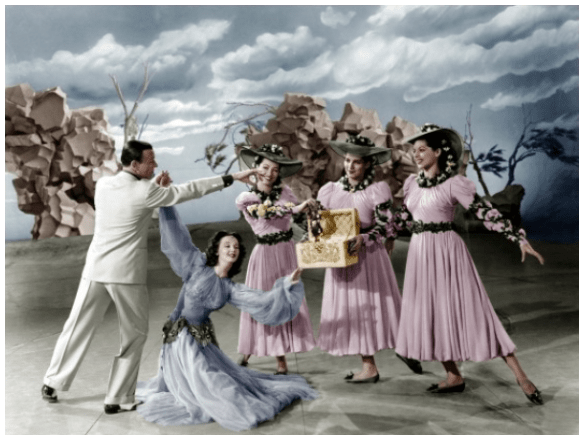
The dream ballet is where Minnelli is fully allowed to display his Surrealist influences, with a Dali-esque landscape the setting for irruptions of unconscious illogic. The sequence begins in what looks like the film-world’s reality, as Astaire walks down the town’s main thoroughfare. The first puncture of this reality occurs when Astaire is asked for a cigarette. It’s the same rumpled man who had asked earlier in the film, but Astaire obliges anyway. After he lights one, a third hand appears from the blackness, cig in hand. He lights it, but more hands appear, until there are six arms sharing puffs from one mouth. The coins he had flipped to some street urchins start falling from the sky in rhythmic patterns, as the street set disappears for one streaked with lines of gold. Washerwomen in flame red skirts (recalling the orphanage outfits) ensnare him in reams of white laundry, as the rhythm set by the coins continues.

Echoing the reams of white fabric, a figure emerges from a pond, fabric flowing up and around her, as if in her own personal hurricane (this is a reversed image of Bremer walking backward into the water). She leads him into a desiccated Dali landscape of mutated white clumps and bare trees looming over an empty space, leading nowhere. Minnelli: “I wanted to suggest South American baroque without actual architectural forms, and used a series of rock formations in fantastic shapes.” Astaire removes the drapery of Bremer’s body, revealing her face. She is again wearing a cream-colored dress, as in her first, welcoming, arrival. The fabric that entangled him, he is able to free her from. It is a dramatization of Johnny’s fears of entrapment and attraction, visualized in spare, haunting landscapes.

This wildly imaginative sequence is a logical extension of the fantastic real world, and, as Jane Feuer wrote in The Hollywood Musical: “The transition to the dream in Yolanda is one instance of a play on the boundaries between fantasy and ‘reality’ which  informs the entire film. It is through cinematic technique that the boundaries between worlds are able to be blurred, placed en abime.”

Audiences were not receptive, and according to the AFI Catalog, Yolanda and the Thief  lost $1.5 million on its initial release. Minnelli muses that “much of the public couldn’t accept a simple story in an avant-garde setting.” Likely so, but it should be appreciated now in its oneiric Technicolor glory. Minnelli, a humble sort, should have the last word: “Film buffs say the picture was ahead of its time. I like to think so.”

BLONDE AMBITION: JOAN BLONDELL IN THE CROWD ROARS (1932)

August 23, 2011

Screen Shot 2020-01-31 at 3.41.30 PM

Joan Blondell made herself at home in the cinema. Regardless of the plot or set decoration, Blondell would adjust her sheer stockings and plop into a seat as if she was at a cuckolded boyfriend’s pad. This Warner Brothers working class goddess buckled knees with this studied insouciance,  a glamour of gum-smacking nonchalance. Our blog-a-thon has been counting down the days until the Blondell-bonanza on August 24th, her day on TCM’s Summer Under the Stars. Earlier this week Jeff discussed the James Cagney-Blondell pairing Blonde Crazy (1931), and today I’ll take a look at their subsequent film together, Howard Hawks’ The Crowd Roars (1932).

Hawks had just completed work on Scarface (1931), his large-scale gangster film for producer Howard Hughes, and as the film was encountering censorship battles across the country, the director was busy with his next project. He took the conflict of the 1917 play, “The Barker: A Play of Carnival Life”, by Kenyon Nicholson, and adapted it to one of his hobbies, auto-racing. Nicholson’s story concerns a carnival barker who lives with a young mistress. His brother is coming to visit, and he wants to hide the affair. So he has his girlfriend sic one of her cohorts on his sibling to seduce and distract him. With a few tweaks, Hawks and his horde of screenwriters John Bright, Niven Busch, Kubec Glasmon and Seton I. Miller transplanted the tale to the race track. Production lasted from December 1931 – February 1932, and was released on April 16th 1932.

The Crowd Roars stars James Cagney as championship driver Joe Greer, a four-time winner of the Indianapolis 500 and sometime lover of Lee Merrick (Ann Dvorak, also fresh off of Scarface), who grows impatient with his immaturity. When Joe starts mentoring his racing-hopeful brother Eddie (Eric Linden), Joe cuts Lee out of his life, not wanting to be distracted from the training. In a fit of pique, Lee encourages her friend Anne (Joan Blondell) to flash her wares to Eddie, so Joe can experience how it feels to be separated from a loved one.

When shooting was slated to begin Ann Dvorak was cast as the vampy Anne and Blondell was to portray the long-suffering Lee. However, as Todd McCarthy wrote in his fabulous biography, Howard Hawks: The Grey Fox of Hollywood:

Once they got down to work, however, Blondell announced, “I can’t play a neurotic,” and Dvorak decided, “I can’t play an ingenue,” so, with Hawks’s agreement, they swapped roles without even telling the studios.

In retrospect this seems like an obvious switch to make, although it meant Blondell was willingly taking on a lesser role, as Anne has roughly half the screen-time as Lee. This indicates a striking self-awareness on Blondell’s behalf, knowing that she can make a bigger impact in the smaller part better suited to her talents. She was managing a persona that was already well established, having cranked out 10 films in 1931, her wide-eyed and acid tongued striver a familiar and welcome sight for Depression-scarred audiences. Blondell was given second-billing behind Cagney despite her diminished presence in the film (in the trailer below, she’s “The Peppiest Blonde Who Ever Broke a Heart”), since Dvorak was still breaking in as a lead (Scarface was her first) and Blondell had already garnered box office success with Cagney on Blonde Crazy.

The Crowd Roars is a classic Hawksian scenario of male camaraderie and competition, with self-worth won on the job. The setting here is the race track, instead of the airport of Ceiling Zero (1936) or fishing boats of Tiger Shark (1932). While the film has stunning racing photography by Sid Hickox (shot at real Indianapolis, Ventura and Ascot tracks), Eric Linden’s limp turn as Eddie leeches the central conflict of tension, and the female characters are not as fully developed as Dvorak was in Scarface, or Carole Lombard in Twentieth Century (1934) a few years later. Lee is present to be hysterically in love with Joe, and Anne ultimately ends up married and neutered to Eddie. There are hints of the past and present Hawksian women to come though, in Anne and Lee’s banter about Joe, privileging a female perspective on the male lead in a few scenes. Feminist film theorist Laura Mulvey, in her essay on Gentlemen Prefer Blondes, does note it for giving Dvorak and Blondell “enough screen time and dialogue together to establish a real friendship which only later, as the story spirals out of control, becomes overtaken be plot points.”

Watching Crowd Roars now, it’s hard to conceive Blondell as the rather shrill wilting lily Lee. Anne, as thinly sketched as she is, dominates every scene she’s in, a sexual dynamo until the third act unconvincingly turns her into a housewife. Although they share only a few scenes together, Cagney and Blondell maintain the sparks they lit on Blonde Crazy. Cagney is a marvel, as usual, swatting Joe Greer’s problems away with jittery flits of his hand, while Blondell is constantly fidgeting with her stockings and urging Dvorak to dump him. Hawks told Joseph McBride about working with Cagney:

“Cagney was so much fun to work with because you never know what Cagney was going to do. When I work with Cary Grant, I can go home and write a scene for Cary and know how he’s gonna to handle it the next day, but Cagney had these funny little attitudes, you know, the way he held his hands, and things like that.”

You first see Cagney playing with Dvorak’s hands, mocking her for wanting a wedding ring, and then throughout the film he uses a flat-palmed Queen’s wave as kiss-off, a curious, electrifying gesture of contempt. Hawks doesn’t discuss Blondell, but she’s equally resourceful in her few scenes.

She is introduced after a close-up of a telegram from Joe, informing Lee that he’ll be delaying his return in order to train Eddie. Lee crumples the note and throws it in the trash. Blondell is splayed out on a divan in the background, and sashays slowly to the foreground, implanting a hand on her hip. She grabs the note dismissively and strides right, bobbing her head to snap off her complaints like, “playing nursemaid to a kid, huh?”. She sits down on the bed, and crosses her legs, her feet resting on an ottoman, to continue her harangue. Angrily throwing back the note, she walks to the middle of the frame, bends over, and adjusts her stockings before snapping, “You can take those hard-drinking, hard-riding men and put them in a truck and shove them over a cliff, as far as I’m concerned.” It’s a play of anger and self-regard that rivals Cagney’s regal kiss-off to Lee. Blondell continues these moves later in the film, propping her gams up on a table, and pulling up her hose, in order to entrance Eddie. This time her primping is an act, although one Blondell has established that Anne is happy to perform.

Blondell’s performance is one of constant small surprises, matching Cagney’s bantam rooster routine gyration for gyration. While The Crowd Roars is a second-tier Hawks film, the director’s openness to improvisation makes it a particularly riveting one, and reveals Blondell to be a wonderfully inventive actress as well as an indelible personality.

FRANK BORZAGE’S AMERICA: THE VANISHING VIRGINIAN (1942)

July 26, 2011

Screen Shot 2020-01-31 at 2.36.41 PM

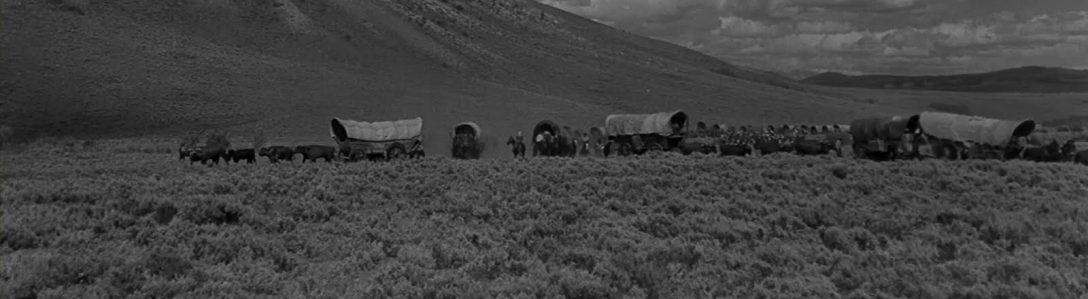
Rebecca Yancey (Kathryn Grayson) taps into popular sentiment with the modernist anti-landscape above. The second daughter of Cap’n Bob Yancey (Frank Morgan), longtime district attorney in Lynchburg, Virginia, Rebecca is trying to escape the role of a proper lady, with the suffragettes’ equal opportunity rhetoric ringing in her ears. Set in 1913, Frank Borzage’s The Vanishing Virginian (1941) is equal parts bittersweet nostalgia and progressive optimism. Just released on DVD from Warner Archive, along with Borzage’s follow-up, Seven Sweethearts (1942), it is a lovely bit of propagandistic Americana, released two months after the U.S.’s entry into WWII.

In the February 1942 issue of Boys’ Life, “Chief Scout Librarian” Franklin Mathiews called The Vanishing Virginian “a model movie in the way of the [sic] diversion for a war-weary world.” An MGM publicity flack couldn’t have made the marketing pitch any clearer. An escape to a mythical American South, screenwriter and Dallas newspaperwoman Jan Fortune adapted the memoirs of Rebecca Yancey Williams into a digressive series of vignettes of the Yancey family’s gentle misadventures . Cap’n Bob is considering running for a 6th term as city prosecutor, while his wife Rosa (Spring Byington) urges him to retire and focus on his family. Bob is modeled after Robert Davis Yancey, a mayor and seven-term commonwealth’s attorney in Lynchburg. Frank Morgan plays him as an endearingly absent-minded old coot, with a dizzying array of Ron Burgundy-esque exlamations: “Bilous Bonaparte!”, “Roaring Romulus!”, “Howling Hades!”, “Naked Neptune”, “Nostalgic Nicodemus!”, et. al. In Men of Mark of Virginia, Yancy is described as politically moderate, “an old-line Democrat, but he opposes the extreme views of Mr. Hearst and his followers.”

In the film he is a paternalistic egalitarian, frequently invoking the Bill of Rights and then going home to his black servants, presumably his former slaves. Then he intentionally botches the only case we see him prosecute, after he determines the all-white jury will not conduct a fair verdict for the black defendant. The servants are characters of Southern wish-fulfillment, slaves happy to stay with their masters, but Borzage and the actors  give them a depth and dignity that pushes against their essentialization.  Leigh Whipper plays “Uncle Josh Preston”, a sweet old man with beatific eyes whose mild manner masks an iron will. In a film where most of the movement is inside the frame (there are some great choreographed family pratfalls), each tracking shot carries extra force, and the most complex one occurs after Uncle Josh collapses. The camera trails back from Bob carrying his prone figure, and then there is a cut to a movement forward to the church that will forever house him. This latter image contains no human figure, a shock in a film configured around the family. The clapboard church is privileged to hold the frame, and Josh’s spirit with it.

Whipper was the first black member of the Actors’ Equity Association in 1913, making his film debut in Oscar Micheaux’s groundbreaking “race films” Within Our Gates (1920) and Symbol of the Unconquered, and was one of the founding members of the Negro Actors’ Guild of America (1939). The Louise Beavers character, “Aunt Emmeline”, is more stereotypical, a “mammy” type who smiles at her employers’ jokes and scuttles in the background. But at a funeral of one of her friends, Borzage continually cuts to close-ups of Beavers’ face, where Emmeline’s bottled up sadness and rage quivers to the surface.

The eldest Yancey girls, Rebecca and Margaret (Natalie Thompson) push back against their parents’ social conservatism, with Margaret eager to study law, and Rebecca a singer. Rosa responds that a woman lawyer would be as absurd as a female driver. When James Shirley (Johnny Mitchell), a young progressive defense lawyer, comes into town, he attracts both of the girls’ attention. His mother Marcia is one of the leaders in the women’s suffrage movement, and causes Rosa no end of marital and political heartburn, having also been a young love of Bob’s. Marcia is based on Nancy Astor, a Virginia-born lady who became the first woman elected to British Parliament in 1919. These stories slowly weave in and out, with none given pride of place. Borzage gives the film the same lazy rhythm as the lives he’s trying to portray.

In the end, horses and carriages have given way to cars and the women who drive them, including Rebecca. Bob continues to run for election, accepting the new social landscape as it shifts around him. In the final shot, the town gathers ’round him to honor his service, as in the end of another paternalistic dream of Southern community, John Ford’s The Sun Shines Bright (1953). Each profiles a doddering relic holding their towns together with principles that time and politics are rendering obsolete. It is up to the viewer to decide which of their disappearing beliefs is worth mourning.

***

Seven Sweethearts is a bizarre item, a Hungarian operetta re-staged in Michigan, with the perpetually-smarmy Van Heflin as the ostensibly dashing lead. Kathryon Grayson is his small-town inamorata, and Borzage stages a number of scenes to show off her impressive coloratura soprano vocals. The story goes that Heflin is an entry-level reporter, getting a story on a Tulip festival in the small Michigan town of Little Delft. It’s a Dutch town where the neighbors practice their French horn during work hours and where Viennese composers never pay rent. S.Z. Sakall is the proprietor of the local hotel, and the single father of seven beautiful daughters (all with male names – since he was hoping for boys). It is tradition that no girl can be married until the eldest is hitched, so the younger girls are itching for Reggie (Marsha Hunt) to tie the knot. Creaky wackiness ensues, and Heflin is ill-suited for the thin air of this sub-Lubitsch atmosphere. It just seems to make him queasy. Borzage speeds through it with seemingly little investment, but I enjoyed the too-in-love Honeymoon couple and the broad caricature of the supporting cast, especiall Sakall’s jolly windbag.

At TCM.com, Jeremy Arnold reported an unsavory postscript to this sweetheart tale:

“In 1949, Hungarian playwright Ferenc Herczeg sued MGM, Pasternak, and screenwriters Walter Reich and Leo Townsend for $200,000, claiming they had plagiarized his play Seven Sisters, which he had written in 1903 and which Paramount had adapted into a 1915 movie starring Madge Evans. Herczeg was imprisoned in a concentration camp in Hungary when Seven Sweethearts was produced and released, and consequently he didn’t learn of the film’s existence until years later. The suit was settled out of court.”

SUMMER BLOCKBUSTER: DAREDEVILS OF THE RED CIRCLE (1939)

May 10, 2011

Screen Shot 2020-01-29 at 4.06.17 PM

This year’s summer movie season was inaugurated by the gentle guttural drawl of Vin Diesel in Fast Five, the latest iteration of the jokey car fetishist franchise. Listening to Diesel’s lazy growl battle The Rock’s aggressive, crystalline enunciation offers more diversionary pleasures than most Hollywood money-grabbers. But the most fun I’ve had this year is watching a minor hit from the summer of 1939, the movie serial Daredevils of the Red Circle, which I picked up a $.99 VHS copy of on Amazon. The history of the summer blockbuster is usually traced to Jaws and Star Wars – in which Steven Spielberg and George Lucas filmed B-movie scenarios with A-level budgets and cemented the studios’ preference for the holy teen demographic. Lucas has previously stated that the Flash Gordon serial was one of the influences on Star Wars, and both men further indulged their serial fantasies with the Indiana Jones franchise. While  Spielberg and Lucas continue their attempts to recapture their sense of childhood wonder, always undercut by a winking self-consciousness, the originals are still around, providing unpretentious pleasures their wildly successful descendents have never quite been able to match.

Daredevils of the Red Circle began shooting on March 28th, 1939, and finished a month later, with enough footage to fill 12 episodes released that June. The first is a three-reeler, close to a half-hour, but the rest are two reels clocking in around 17 minutes each. It was budgeted by Republic Pictures at $126,855, but directors William Witney and John English completed it for $126,118. English and Witney had just completed The Lone Ranger Rides Again (1939), the sequel to their smash hit serial The Lone Ranger (1938)  (the current spate of sequels and remakes is nothing new). In his autobiography, In a Door, Into a Fight, Out a Door, Into a Chase,  Witney writes that after a two week vacation, Republic producer Bob Beche called him into his office for the next project, which would be Daredevils. When he heard the pitch from the screenwriting team led by Barry Shipman, he said, “I think you guys should stop drinking and give yourselves a chance to get over the DTs.”

The story follows the adventures of three circus daredevils: the leader (and high diver) Gene Townley (Charles Quigley), the nimble escape artist Tiny Dawson (Bruce Bennett) and the strongman Burt Knowles (David Sharpe). After their trapeze act is firebombed by the notorious Harry Crowel (a skeletal, menacing Charles Middleton), and Gene’s kid brother dies in the blaze, the trio starts investigating Crowel – who has been calling himself by his prisoner number, 39013. 39013 has been attacking the holdings of Horace Granville (Miles Mander), the rich industrialist who had fingered him for arrest. The Daredevils offer Granville assistance, and with the help of his daughter Blanche (Carole Landis) and their dog Tuffy, they attempt to bring 39013 to justice.

The story is an efficient delivery system for action acrobatics, if not narrative logic, and Witney and English take advantage of their athletic leading men. Bennett was an Olympian shot-putter, while David Sharpe was the stunt coordinator and main stuntman for Republic. Of Sharpe, Witney wrote, “It was a director’s dream to have a leading man capable of doing his own fight sequences. It meant you could keep the camera close to him and it gave us a chance to show him off.” The directors take full advantage of this in fight sequences of unusual physicality and intensity. Witney mentions getting the camera close, but he and English often use wide shots with few inserts and fewer cuts, letting the actors and stuntmen careen through industrial landscapes and drab offices with reckless abandon. The closer shots he mentions must be the numerous times he gets Sharpe to bust through a locked door as deadly gases are seeping in.

There is a joy in just letting these expert tumblers loose, epitomized in a late bit in episode 11 where Sharpe, having failed to break into a room where a hired goon cowers, slips around a corner and knocks the thug out through the side window. Sharpe begins to crack a smile at all the fun he’s having, before Witney-English cut to the next bit of wild action. This is the smile that Harrison Ford puts in quotes in Indiana Jones, but here it’s an accidental bit of non-fiction entering the screen. Sharpe’s character is a no-nonsense bruiser, who doesn’t crack a smile in any other bit of action. Unable to repress his happiness in his work, and with Witney-English eager to move on the next shot, this arrested upturn in Sharpe’s mouth remained in the film, and I can’t think of a better example of Godard’s dictum, “film is truth 24 frames per second”, even if it desperately wants to be lying. Along with Sharpe’s exertions, there are dives into oil fires, leaps from speeding cars and innumerable crashes into inanimate objects. This is dangerous and thrilling stuff, held together with flimsy but fleet story material that knew to keep moving forward.

Witney and English recombine basic scenario elements in each two-reeler, with minute variations to keep things rolling. The trio will inevitably get locked inside a room with death stalking them, fight off thugs at an industrial site, demean Granville’s black servant (this racist role is endured by Fred “Snowflake” Toones), and do it all with nary a crease in their natty suits. The use of repetition and variation brought the structure of these works to the forefront, and it is one of the central pleasures of the serial form. In their haste to crank out the serials, Republic created the forerunners of 70s structuralism, who, Hollis Frampton foremost among them, made films in which the structure and shape of the films was the content. The work of Witney and English made their structures just as visible, unintentionally laying bare the devices of their making, a kind of unconscious self-consciousness.

Another remarkable facet of Daredevils in particular is its emphasis on the hopes and fears tied into technology. Almost all of the major fight setpieces take place in a factory or major industrial site. The first episode ends in spectacular fashion, when a tunnel connecting Catalina Island to Los Angeles springs a leak, and Blanche Granville is stuck inside. Using the wonderful miniature work of Babe Lydecker, their tunnel is flooded. Then there are the brawls at an electrical station, an oil derrick and a gas plant, the sabotage of an experimental laser, and 39013′s expert makeup job to pass himself off as Granville. There is a thin line between technological advancement and abject terror, and the unease with the rapid changes of the era is palpable in every frame. The Daredevils offer split-second escapes from the apocalypses of the imagination, and do it with an unguarded smile.

DVD TUESDAY: LATE LANG

May 3, 2011

Screen Shot 2020-01-29 at 4.00.19 PM

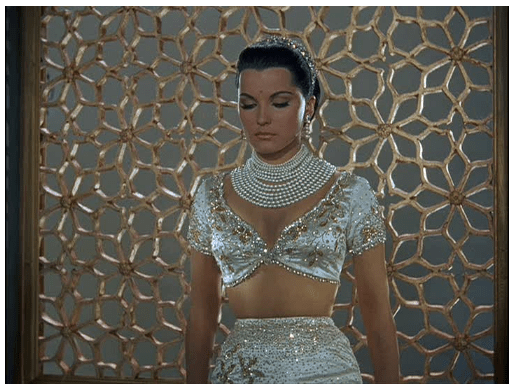
In a bit of home video serendipity, the films Fritz Lang made in Hollywood and Germany from 1956 – 1959 were all recently released on DVD. The Warner Archive put out re-mastered versions of his last two Hollywood films While the City Sleeps (1956) and Beyond a Reasonable Doubt (1956), while the UK Masters of Cinema label produced a luminous edition of his two-part Indian epic, The Tiger of Eschnapur (1959) and The Indian Tomb (1959). All four films snare their main characters in webs of malevolent fate. The first two pin their characters inside geometrically arranged compositions, granted the illusion of motion in a world constantly boxing them in. This is garishly illustrated in the Indian Epic, as seen above, with elaborate imagery of imprisonment emerging from the set design. They use strikingly different methods to pursue similar ideas of fate and desire, from threadbare pulp to embroidered imperialist myth.

After the financial failure of the astonishing Moonfleet (1954), which had his highest Hollywood budget at $1.9 million,  Lang was finding it difficult to attract studios’ attention. So when producer Bert Friedlob offered him a modest two-picture deal with distribution through RKO, he accepted. The two titles were prepared simultaneously, according to Lang biographer Patrick McGilligan, and the director split his time between the screenplays – working with Casey Robinson on While the City Sleeps and Douglas Morrow on Beyond a Reasonable Doubt. Both were shot in SuperScope, and the Warner Archive is releasing them in a 2:1 aspect ratio, which looks just about right to me.

Both plots contain what Tom Gunning called “a double goal, in which the main action the characters undertake is given a double motivation by an authority figure.” For While the City Sleeps, the main plot follows a serial killer, in which the sexually repressed mama’s boy Robert Manners (John Drew Barrymore) is tracked down by the investigative reporter Edward Mobley (Dana Andrews). The double goal is given by the petty new newspaper owner Walter Kyne (Vincent Price), who dangles a new executive manager position to whomever can crack the case. The reporters’ betrayals and insane drive to scoop the story often overshadow the killer plot, and seem almost more inhuman.

In Beyond a Reasonable Doubt, the Dana Andrews character Tom Garrett is on trial for murder. The shadow story is that his former news editor Austin Spencer hatched a plan to manufacture circumstantial evidence for the trail, in order to get a conviction. Once convicted, Spencer would reveal the ruse, proving that innocent people could be condemned to death without a smoking gun.  As Gunning writes, in his indispensable study The Films of Fritz Lang, “in both cases suspenseful stories of crime and punishment are framed within journalistic investigations.” Both films interrogate their own premises through these creator figures that, like Lang, initiate stories they soon discover they don’t have control of.

Walter Kyne, played with an oily buffoonery by Vincent Price, inherits the company after his father’s untimely demise. Clearly a pampered, narcisstic creature, he promptly chooses to use the newspaper as his own private penny dreadful theater, siccing the reporters against each other in his perverted “contest”. Lang sets out the space of the office as entirely open and visible – everyone can see each other’s performances at all times. In an early sequence the manager of the wire service, Mark Loving (George Sanders) is seen whispering into his secretary’s ear. They are framed in a glass window as if on television, and Mobley is watching them from across the room. He calls her to break it up. Everyone is the center of their own panopticon, everyone in the office having the all-seeing powers of a previous Lang mastermind like Dr. Mabuse.

As the reporters race around to save their future inside these all-public spaces, the killer Manners still stalks the streets. Mobley lures him into town with a baiting television broadcast – the televisual as another kind of all-seeing eye boring into even the psycho’s shabby apartment. Let out into the open, Manners stalks Mobley, and stumbles into another space of hyper-visibility, the bar down the street. Stumbling downstairs, he finds the ace investigative reporter and TV personality canoodling with the woman’s advice columnist Mildred Donner (Ida Lupino). Even the killer cannot escape this public theater that Kyne has introduced.

Beyond a Reasonable Doubt flattens the theatrical world of While the City Sleeps into strips of men standing next to walls. Where there was depth in the newspaper office, here there is nothing but static two and three-shots, everything pushed close to the foreground of the frame. It is so pared down it amounts to the characters simply standing and telling the story to the camera, as in the modernist distancing of Manoel de Oliveira’s Francisca, in which his characters stare at the camera and read the dialogue from Agustina Bessa-Luís’s 1979 novel Fanny Owen. Jacques Rivette saw something similar in his review of the film for Cahiers du Cinema in 1957:

The first point that strikes the unsuspecting spectator, a few minutes into the film, is the diagrammatic, or rather expository aspect instantly assumed by the unfolding of the images: as though what we were watching were less the mise en scene of a script than simply the reading of the script, presented to us just as it is, without embellishment.

[…] No concession is made here to the everyday, to detail: no remarks about the weather, the cut of a dress, the graciousness of a gesture; if one does become aware of a brand of make-up, it is for purposes of plot. We are plunged into a world of necessity…

This world of necessity was partly brought about by the low budgets Lang was working with, but he turned that to his thematic advantage, the spartan set decoration and limited set-ups illustrating the mechanics of the crime thriller itself. The editor and writer are shown planting evidence and documenting the planting of this evidence, authoring their own crime movie in the middle of a crime movie. Eventually they get caught in the machinery of their construction, and the brutal ending shows a man lost inside of his own story.

Where Beyond a Reasonable Doubt is spartan, the “Indian Epic” is overstuffed, a lavish spectacle that is beloved (and screened) at the same level as It’s a Wonderful Life in Germany, according to this article in Rouge (Lang’s is the third version of the film. He was slated to direct the first version in 1921, scripted by his future beau Thea Von Harbou, but producer Joe May took the reins instead to great success. Tom Gunning has written an exemplary essay that includes all this and more in the Masters of Cinema set). A German architect named Harald Berger (Paul Hubschmid) is contracted to expand the made-up fortress city of Eschnapur in India. He soon falls in love with the religious dancer Seetha (Debra Paget), whom the Crown Prince Chandra (Walter Reyer) is madly in lust with. This love triangle pulsates for over three hours in various permutations of escape and capture.

As a representation of India, the movies are ridiculous, a hodgepodge of sparkly costumes and wild misrepresentations of religious ceremonies. But as a lesson in how visual style can convey inner tensions, it’s rather wonderful. It begins in the set design of Willy Schatz, who helped create the never-ending web imagery that will snare every character in turn. In one telling sequence, Seetha has been corralled by the Prince into one of his chambers. She is kneeling in front of a gold cage, the imagery more than obvious. But the next cut is to the Prince leering through one of the web-like grates in the wall, looking more imprisoned than Seetha, who is situated outside the cage. But the Prince is tied by heredity to this intricately designed fortress-mansion, and is doomed to love a woman who will never love him back.

These set patterns weave their way throughout the film, with geometric shapes filling the space behind the Prince’s head during Berger’s arrival, a real cobweb that hides a fleeing Berger and Seetha, and the high-angle shots which turn regular courtyards into clashes of giant rectangles. The fortress contains prisons within prisons, until Berger is stashed below the surface of the mansion, in a deep well in a network of catacombs located beneath the mansion. The space envelops everybody, rendering them mute and impotent against their implacable fate. The happy ending involves another escape, but since the film is based on a cyclical rhythm of freedom and capture, perhaps Lang just elided their eventual return to this venus fly trap of cities, which wraps the characters in its vise-grip jaws, never letting them go.