DTV ACTION ITEMS (PART 3): INMATE AT THE ASYLUM, AN INTERVIEW WITH DIRECTOR RICHARD SCHENKMAN

May 15, 2012

Screen Shot 2020-02-03 at 4.45.33 PM

This is the third and final post in  DTV ACTION ITEMS, a three-part series on direct-to-video action movies. Click here for Part 1, an interview with Outlaw Vern, and here for Part 2, a profile of actor Stone Cold Steve Austin.

The Asylum is the most disreputable studio in that most disreputable of markets: direct-to-video. They made their name cranking out cheaply made “mockbusters”, thinly veiled ripoffs of Hollywood blockbusters starring Z-list celebrities, many of which air in constant rotation on the SyFy channel. Last month Universal Studios sued them for copyright infringement on The Asylum’s Battleship take-off, American Battleship, starring Mario Van Peebles and Carl Weathers. Despite a hilariously cocky press release defending their film (” Looking for a scapegoat, or more publicity, for its pending box-office disaster, the executives at Universal filed this lawsuit in fear of a repeat of the box office flop, John Carter of Mars. The Universal action is wholly without merit and we will vigorously defend their claims in Court. Nonetheless, we appreciate the publicity.”), they changed the title to American Warships, which will be released on video May 22nd.

They are a crew of brilliantly amoral hucksters pranking Hollywood for fun and profit — a commendable goal for sure, but are the movies worth watching? When I spoke to Outlaw Vern two weeks back, he didn’t think so, nothing that “I get a laugh from the titles and covers like everybody else, but the parts I’ve seen have been terrible and not in a fun way.” One of their upcoming releases may indicate an uptick in quality, for Abraham Lincoln vs. Zombies (out on DVD/Blu on May 29th) is a taut, resourceful piece of survival horror, completely lacking the forced campiness of most of The Asylum product. First-time Asylum director Richard Schenkman is an industry veteran who has made everything from indie comedies (The Pompatus of Love) to sci-fi (The Man From Earth), and his experience pays off. The pace is snappy, the action well-staged, and lead actor Bill Oberst is gruffly engaging as Honest Abe. I’d be surprised if its Hollywood counterpart, Abraham Lincoln: Vampire Hunter, is as energetically entertaining. I spoke with Mr. Schenkman about his path into moviemaking, his opinion of The Asylum, and his experience shooting Abraham Lincoln vs. Zombies.

How did you get into the movie business?

All I ever wanted to do was make movies. From the time I was a very small child. So while there were bumps and detours along the road, and while unfortunately when I was young it was much harder to break into independent film than it is today, that was the only direction I’ve ever traveled.

Who were your idols growing up?

When I was a little kid, Jerry Lewis. I guess the first book of filmmaking I ever read was his book The Total Filmmaker. That was when I really began to understand the difference between writing, directing, producing and cinematography. Because when I was very little I thought I wanted to be a cinematographer. When I started reading American Cinematographer magazine and Jerry Lewis’ book, I began to understand what everybody did, and realized what I wanted to do was write and direct. I didn’t want to be a cinematographer; there was too much math involved. So like a lot of people I tried to make little films, I did films with GI Joes and clay, and tried to get friends involved to make live action films. In those days it was so much harder, because you had to shoot on film, it was expensive and you had to send it to the lab, and when it came back you had to cut it with a blade and splice it with glue. It was much more complex and difficult. I have a daughter in fifth grade and she has friends, peers, making films. Eleven, twelve-year-olds. If I was growing up today my whole life would have been different. I would have been making films from the time I was ten, eleven years old.

Was your first paying job working on Playboy documentaries?

No, I started out at MTV. That was my first real job. I was very lucky. I was at MTV when it first started, so I got to have an enormous amount of creative input.

Is that where you learned how to be creative on a budget?

Yes. That was absolutely how I learned it. I’d get an idea on Monday, and I’d write the script and get it approved on Tuesday. I’d go produce the audio for it on Wednesday, the video on Thursday, and it would air Friday night. It was fantastic. The pace was crazy and the hours were long, but it was very very exciting.

How did you transition into filmmaking from there?

I took a bunch of money that I’d made and did a 35mm short, and came to Los Angeles. And said, “OK, great, this is going to get me an agent”. But nobody told me back then that there was no point in going out there with a short until you had written a feature script. I thought I would find work as a director but it didn’t work like that, and it still doesn’t. But it’s much easier to find all that out now. So I went back New York with my tail between my legs, having spent all my money on the short, and wondered what to do next. And that’s when the phone rang. An old executive from MTV had come to Los Angeles to become the new president of the Playboy Entertainment Division. So he brought me out. And again, it was, for a time, a really exciting opportunity. For I was both an executive, the in-house head of production, and a working writer/producer/director. I was able to hire a lot of people to create material, but I was able to jump out there and make stuff myself. It was like being a kid in a candy store.

You had more money to work with there, right?

I did, yes. And, for a time, I had extraordinary autonomy. I was given a pile of money, not a lot, about $400,000. And this money I was given that was just supposed to go towards interstitials for the channel, and I was able to stretch that money so far, that I made full-length shows. More and more the production came under my purview. A lot of short-form stuff. I tried to explain to them how inexpensively they could be making feature films, and own that segment of the market. You know, the softcore, very sexy movies. I was trying to make the point that if we improve the quality of them, made them ourselves, with real actors, working with real scripts, we could really expand the genre – making real movies. Every year for a few years they would put it into the budget, and at the last minute pull it back out. The year after I left they started doing it, and had a huge success with it the first few years.

Were you interested in genre films growing up?

Not particularly. I’ve always loved every kind of movie, as long as it was fairly smart or entertaining. A lot of horror movies are stupid. Too many horror movies, they think it’s enough to scare people, that they don’t really have to make sense, and not have anybody you can identify with. I suppose that’s why I was never much of a genre fan. I’m definitely not one of these guys who grew up seeing every zombie movie and Nightmare movie. I’ve seen lots of them, and the classics are great movies, like The Exorcist. But I’ve never gone for cheap jumps and scares, that always bugs me. To me, Alien is scary.

So the power of suggestion, not having to show everything…

Yes, but also just legitimately frightening you, the way Hitchcock would. Not just go, quiet, quiet, quiet, BOO! I don’t think that’s very clever.

So what appealed to you about Abraham Lincoln vs. Zombies?

The historical mash-up aspect of it. Definitely. I saw it was an opportunity to do a bunch of research and figure out fun and clever ways of working this fictional story into real history. To me that was the fun of the project. How do we insert this story into what we all know to be true? And so my first idea, when I was initially told about the assignment, was the Gettysburg Address. When we think about Abraham Lincoln what do we think about? Holding the nation together, freeing the slaves, and the Gettysburg Address. I just thought, wouldn’t it be great if this zombie adventure tied into the creation and delivery of the Gettysburg Address? That became the spine of the story.

How did you end up getting the job, since you are not a genre guy?

My friend Karl Hirsch is a writer/director/editor who’s done a lot of work for The Asylum over the years, although I don’t think he’s ever done a feature. He’s done some editing of their movies and trailers. They have a relationship, and they came to him, kind of out of the blue, and said, “we’re going to do a direct-to-video title called Abraham Lincoln Vs. Zombies. Are you interested?” He was debating whether he wanted to do it or not, because he had other projects, and he knew it would be very, very challenging. He and I were having breakfast, and he told me about it. So I told him, “Oh, man you have to! That sounds like so much fun. How can you turn that down?” He said, “because there’s not going to be any money, there’s not going to be any time”. And I said, “It’s making a movie!” So I said, “I’ll help you write it. I’ve been trying to find a way to get my foot in the door with The Asylum anyway, because they’re making so many movies, and it would just really be a gas to work on.” And that’s what happened. I pitched him the Gettysburg Address idea, and we beat it out together, along with his wife Lauren, and submitted it. Asylum said, “Yes, we’ll do this.”

And when we were working on a treatment, an eight page, eight act treatment, when midway through that Karl got offered a huge documentary project that he could not turn down. And I said I’d really love to stay on, at least as the writer. Everybody seemed fine with that. David Latt at The Asylum had seen a couple of what he thought were my more indie films, like The Pompatus of Love, although I consider it more of a comedy. So I was offered to stay on as a writer, and pretty early on I said, “I’d love to direct this.” At one point, about a half-hour left before the thing needed to start shooting, they said, “well, there’s going to be no money, no time, nothing that you’re used to having, but if you want to direct it, you can.” I said, “I’m up for the challenge.” In some good news, the line producer Devin Ward figured out how to put the movie together to shoot in Savannah, Georgia, and he got us Fort Pulaski to shoot at. That decision to shoot on location makes the movie exist on any level in terms of quality. If we had to shoot in Los Angeles it really would have been crap.

How much time did you have to shoot?

We had 15 days on location and then a further half-day on a green screen stage. Looking back, how we did it, I have no idea.

Did you have any qualms about making the film for The Asylum, considering their reputation?

The short answer is no, because they make movies. Lots of people talk about making movies, but The Asylum actually makes movies. Here’s the thing from the outside you might not know about The Asylum. Everybody there is really nice, really smart, really hard working, and really loves movies. And everybody there is busting their ass to do as good a job as they can. The people in special effects are there like 20 hours a day trying to make these effects look beautiful. And by the way, some of the effects you have seen in the past in some Asylum movies, and thought, “by God that’s terrible”, a lot of those were done out of house, by people they took a chance with who didn’t deliver, and then they were out of time and out of money. It’s a hard working dedicated bunch of people, all of whom, I think, would like their movies to be better. And I honestly would not be surprised if starting with the movies that are coming out in April-June, if you see a bit of improvement. There is a development executive there, Micho Rutare, who has been there about a year – he’s been pushing very hard for the scripts to be better. As I said, on the technical side, everyone there is challenging themselves to improve the technical quality. I would be surprised if Nazis at the Center of the Earth and Abe Lincoln do not start a trend towards movies that are at least trying to be better.

You were approaching this as a real movie…

I was not encouraged in any way to make a quote unquote Asylum movie. In fact, the way Micho described it was, write an $80 million movie, and then figure out how to do it with nothing. In other words, I was specifically encouraged not to write for the budget. And I was told flat out, “we do not need camp, we do not need intentionally made camp anyway”. Which I had no interest in regardless.

There are no ex-celebrities in the film, right?

No. Basically, we did the movie locally. They are all local actors, except for Bill Oberst, who came from L.A.  Everybody else was local, or if they weren’t local, they got themselves to Savannah somehow, and worked as locals.

I think that would make people take it more seriously. When you see a face you recognize before, it automatically becomes something else. With unknown actors, you become more involved in the story.

There’s that argument. There have always been directors who prefer to work with unknowns or even non-professionals for just that reason. I don’t know where I stand on it. To me, you hire the best actor you can. Frankly, in terms of marketing the film there’s something to be said for getting a known actor. The film’s being produced by its distributor. So they know exactly where they’re selling it, how they’re selling it, and to whom they’re selling it. And they don’t really expect to do much in terms of cable on this title. They do their business in DVD/VOD and foreign sales, and so the movie’s made to fit the place in the market, and within its budget. And the budget is dictated by what their expectations are of how it’s going to sell.

How did the shoot go? Were the budget constraints frustrating?

It’s so funny about a movie shoot. It’s like giving birth to a baby. You end up forgetting just how much it hurt. But if you didn’t forget, you’d never have another baby. If every woman only had one baby, our population would be decimated. So, there’s some mechanism that causes you to forget just how unpleasant it was. And I have to say a couple of months out, I’m beginning to forget how unpleasant it was [laughs]. But it was a very, very difficult shoot. Everybody worked really hard, the community of Savannah really rose up to try and help us get this movie made. People did us all kinds of favors, and the production value we achieved using these local locations is extraordinary. The movie looks like it cost far more than it did. And a lot of that is simply the locations. Having said that, we had a very, very small crew, and almost nonexistent budgets for props, special effects. So you’re asking creative people to pull off miracles every single day. You’re saying to them, “there’s no time to prep, and no money to buy or rent anything, but we need a cool switchblade folding scythe for Lincoln that is going to look mean on screen but not actually hurt anybody. Could you have that by tomorrow?”

The special effects and makeup guys must have worked like crazy…

That’s the thing, it was a zombie movie with no special effects department. Yes, we had a makeup team who worked ridiculously hard, and we had a bunch of day players come in on heavy zombie days. But the casting director and her daughter were on set most days, helping do makeup. And I don’t think they were paid for that. They did it to support the film, and we had a lot of that. Just to support local production in Savannah, to support the project. A lot of people really liked the script, and even though it was, quote unquote, just a zombie movie, I think people really got into the story, and the respect with which we were treating history. I know that sounds crazy to say, but we really were trying to be respectful of history, and the historical characters that were in the film.

Did you at any point look of the promotional images from Abraham Lincoln: Vampire Hunter?

No. I specifically avoided it until I was done. I never read the book. If there are any similarities at all, they’re an unfortunate accident. I honestly know nothing about it. I haven’t seen the full trailer, but I did see the teaser trailer after we wrapped.

I would guess your movie is more historically accurate than that’s going to be.

That would be great! That would be hysterical. Obviously in my mind, it would be nothing short of wonderful if my movie was better than that movie in any aspect at all. If there’s one thing, like “Their Lincoln is better”, or “it’s more historically accurate”, or “It makes a little more sense”, or anything. It was a huge book by a successful writer, a huge budget movie with extraordinarily talented and successful people making it, so if there’s any way my movie compares to theirs favorably, it would be just great. But I don’t expect to come out on the winning side of most comparisons.

How was working with the actors?

They were lovely. Starting with Bill Oberst – he really took it seriously. He was the kind of guy showing up already knowing Lincoln’s speeches by heart. And he actually played Lincoln before on stage. He’s a very dedicated actor, one of the most dedicated I’ve met. He’s also very talented in terms of acting ability and technical skills. He would show up, and let’s say through some scheduling snafu he had prepared for a different scene. Even if he had a page and a half speech to do, he would go off for 5-10 minutes and come back and have the thing memorized. I’ve never seen anything like it.  A true professional and a great leader for the rest of the crew. We had a lot of young actors, a lot of inexperienced actors, and while everyone was super-thrilled to be there, it was great to have someone as experienced and serious as Bill heading up the team.

Especially because you didn’t have time for many takes, right?

That’s kind of a myth, the whole, “we do one take and move on” thing, like Eastwood. In my experience, the time does not go into takes, to do another take is five minutes. That’s not where you lose your time. You lose time getting a shot set-up and trying to load equipment into a huge fort that doesn’t have an elevator, you can’t bring vehicles into, and is open for business for vistors at the same time. That’s where the time goes.

So you had to work around the schedule of the fort?

Yes. It was crazy! Visitors came and went, cannons went off, and we had to shoot around that. We had to get twenty people into makeup with a two-person crew, that was challenging. But the only time I’m forced to say, “we’ve got to move on”, is, for example, you’re against a really hard deadline like lunch, or wrap. If you’re five minutes over, you’re into penalties, and that sort of thing. But having said all that, we didn’t do a lot of takes. I try to rehearse, so…

You had rehearsal time?

Um….no. We did not have rehearsal time before production time. But while the crew was lighting I tend to rehearse with the actors as much as I can.

You worked well with your DP?

We had a terrific camera department. We had two cameras going all the time, and we did that with a camera crew of three, basically. Which is half as many as you’d usually have on a two camera shoot. We had a DP, and two camera assistants. Everybody operated, even I operated sometimes, and we had two cameras almost every shot. It’s the only way we could have ever finished the movie.

While stressful, are you satisfied with how it turned out?

I am happy with how it turned out. Of course there are scenes I would have loved to shoot again. People who’ve seen it so far say it’s a very entertaining film. As retrospect becomes longer, the shoot grows less and less difficult and more and more fun in my mind. It’s always fun to make a movie, because there’s this constant sense of achievement. Every time you get a shot, and it looks good, or complete a scene, or wrap your day. Those are all measurable achievements.

Did you have to improvise a lot on the set?

Sometimes, yes. I try not to improvise utterly on the fly. If I have to improvise I try to do it a day in advance, so that I can write it out and give it to people.

Can you give an example of something you had to improv?

We had a walk and talk along the railroad tracks. We wanted to do it as a tracking shot beside the tracks. Then it occurred to me, can’t we could build some kind of a rig, and take the dolly and customize it so we can track on the railroad tracks? I mean, they’re here, they’re used to having giant things wheeled along them. A couple of our guys got together and dismantled the dolly and reassembled in such a way that it could roll on these railroad tracks. So we did the walk and talk. Then the camera operator was just goofing around, and showed me what it looked like if you rolled the thing pointed forward. He was running in front of it like it was a train coming towards him. Then we realized it could actually roll over a person. I had a scene that needed to be scrapped because we lacked a key prop, and I basically had a character who needed to die a coward’s death. It occurred to me that we could have him run away from a fight, run along the railroad tracks, not realize a train was coming, and get run over by it. And we could get the key shot from the POV of the train by using this rig. So we hurriedly got the guy in wardrobe, and we shot the last part of it.

Would you work with The Asylum again?

Oh yeah. In fact I’m hoping to roll right into another project with them.  I hope to work for them again very soon.

JOHN CARPENTER’S THE WARD (2011)

June 14, 2011

249011_175121749210079_173855242670063_396378_4155729_n

After a ten-year absence from the screen, John Carpenter’s welcome return is with a haunted insane asylum quickie entitled The Ward (released on cable VOD June 8th, it will receive a limited theatrical run starting July 8th). Following the box-office failure of his underrated Western-in-space yarn Ghosts of Mars (2001), Carpenter felt “burned out” and took a step back from Hollywood. He was unofficially retired, aside from happily cashing the checks from studio remakes of his work (Assault on Precinct 13, the forthcoming They Live). But after directing two episodes in Showtime’s Masters of Horror series, with tight budgets, compressed schedules and little oversight, “it was actually fun again” (interview with Fangoria). He looked for a similar setup for a possible feature, and found it when actress Amber Heard invited him to direct her in The Ward, an indie horror film funded by Echo Lake for a modest$10 million (the estimate at IMDB). He did not write the script or the score, and The Ward misses his sense of group dynamics that he studiously gleaned from Howard Hawks. Instead it’s a solid job of craftsmanship, punching up Michael and Shawn Rasmussen’s hacky story mechanics with an effortlessly controlled visual scheme that creates a circular, suffocating sense of claustrophobia.

It’s 1966 in North Bend, Oregon, and Kristen (Amber Heard) is found kneeling in front of a handsome farmhouse as it burns to the ground. As the guilty, raving firebug, she is committed to a mental institution presided over by Dr. Stringer (Mad Men’s Jared Harris).  She is isolated in a locked down section of the institute, along with four other female crazies: Emily (Mamie Gummer), Sarah (Danielle Panabaker), Zoey (Laura-Leigh) and Iris (Lyndsy Fonseca). She warily enters their combative circle, and it is not long before she is greeted by a mummified ghost with a thirst for inmate bloodshed. The more she discovers about this poorly groomed spirit the more questions are raised about Kristen herself.

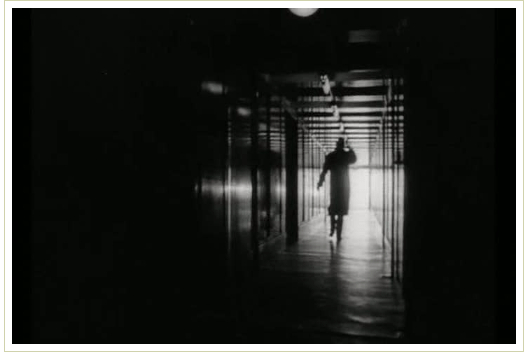
John Carpenter to I Am Rogue: “I wanted to have a good time. I could make a shadowy corridor, which is something I want to do.” Having only a few sets to work with, Carpenter makes the most of them with unsettling repetitions, evoking the ritualized circular movements of these girls’ daily lives. Even their escape attempts walk down well-trodden pathways, and always end up back where they started. Carpenter’s opening shot trawls down the hallway that leads to their cells, followed by eerily emptied out hospital rooms. This establishes the set as one of the protagonists of the film, and it ensnares its inhabitants in short order. Throughout, the institute is strangely depopulated, a result of the low budget, but it fits the interorized space he’s creating.

Carpenter fetishistically returns to the low-to-the-ground hallway tracking shot throughout the film, as it pushes in both directions, a forever thwarted promise of escape and ever-present threat of return. Kristen repeatedly tries to exit the double doors at the end of the hall, each time blocked by the brusque orderly. She succeeds one final time, with Zoey as a hostage, but this exit signals her psychological breakdown.The other major repeating setup is a high-angle view in the cells, looking down at Kristen and the previous tenant, Tammy. This establishes a vertical axis of escape as opposed to the tracking shots’ horizontals pushing through the frame. This pays off when Kristen and Emily scamper their way through an air vent above their section, but this axis ultimately pushes them down, and they end up in the basement morgue, even further from freedom. The girls are caught in these two axes of up and down, forward and backward, an endless circling with no exit. It’s a simple template well elaborated by Carpenter and his DP Yaron Orbach.

The cast, a marketer’s dream team of starlets (it’s Shutter Island Gossip Girl, or something), is surprisingly effective. Amber Heard does a fine no-frills job as Kristen, playing against her delicate beauty by exuding a bulldog intensity, pushing forward regardless of the consequences. Panabaker does a fine if cliched narcissistic bitch routine, while Laura-Leigh has little more to do than mew at her stuffed bunny. The real standout is Mamie Gummer’s Emily,  a jumpy, skittish yelper, and the only lady that truly seems unhinged. Her moon-face and wild eyes fixate on Heard early on, threatening violence or a suffocating kind of love.

The dialogue they churn through is of the boiler-plate variety, chewy exposition to move the ladies into the next fright. The ghost, though, is refreshingly physical, with the CGI reserved for long shots or disapperaing acts. For the most part it’s a make-up aided product, and you can feel the weight of its leprous fingers as they twitch the electroshock machine past its breaking point. The explanation for the wraith’s behavior, as is usual these days, is explained by a final twist that invalidates all of the action that came before it. It cannot, however, undo the understated brilliance of Carpenter’s relentlessly logical visuals, whose intimations of spiritual and physical entrapment lingers long after the script’s manufactured shock fades away.

NOT A SUPERSTITIOUS SUCKER: NIGHT OF THE DEMON (1957)

October 26, 2010

night of the demon

“I detest the expression ‘horror film.’ I make films on the supernatural and I make them because I believe it.”  – Jacques Tourneur, Positif

The lead character in Tourneur’s Night of the Demon, psychiatrist Dr. John Holden (Dana Andrews), declares that he is “not a superstitious sucker.” He is a sardonic skeptic of mystical powers and things that go bump in the night. Unfortunately for him, Tourneur is a master of visualizing dread, at uncanny images that disturb the orderly corridors of consciousness. So Night of the Demon, my selection for this week of supernatural selections at Movie Morlocks (it airs on TCM on October 29th at 6PM), finds Holden’s self-righteousness crumble in the face of Tourneur’s terrifying control of the medium. As Raymond Bellour wrote, Holden’s “problem is trying not to believe in the devil, while ours is trying to accept belief in the cinema.”

All inquiries into Tourneur run through Chris Fujiwara’s critical study, The Cinema of Nightfall, and the following is deeply indebted to his essay on the film. If you have the time, ditch this essay and read the book.

Holden flies to London to study the activities of a Satanic cult led by the urbane Julian Karswell (a coldly charismatic Nigel MacGinnis). He was to join Professor Harrington (Maurice Denham) in the venture, but the latter died under mysterious circumstances, torn apart as if by wild animals. Soon Karswell is warning Holden against investigating any further, and predicts his death in three days’ time. Beginning to suffer from auditory and visual hallucinations, Holden accepts the help of Harrington’s niece Joanna (Peggy Cummins), and attempts to uncover the truth behind Karswell’s morbid declaration (the ending was strikingly re-purposed in Sam Raimi’s Drag Me to Hell).

The film was based on the short story “Casting the Runes”, by M.R. James (available to read here). Charles Bennett, the scriptwriter on many of Hitchcock’s British films (Blackmail, The 39 Steps) bought the rights and worked with executive producer Hal E. Chester to bring it to the screen.  Chester was reputed to have re-written parts of Bennett’s script, and cut around 13 minutes out of the 95 minute British feature for the American release, re-titled Curse of the Demon (both versions are available now on DVD). Chester also had producer Frank Bevis re-shoot scenes to feature the title monster more prominently, alienating Bennett and Tourneur in the process. Tourneur:

The scenes in which you really see the demon were shot without me. The audience should never have been completely certain of having seen the demon.

He went on to tell Joel E. Siegel that he only wanted “four frames” of the monster to be shown in the film, during the ending on the train tracks. “People would have to sit through it a second time to be sure of what they saw.” Tourneur wanted very fleeting glimpses of the monster, to let the horrors unfold off-screen, in the viewer’s mind, as in his superb work with producer Val Lewton (Cat People, The Leopard Man). This strategy would also keep doubt alive about the ultimate reality of the creature. For while Tourneur believed in the supernatural, he wanted his viewers to come to their own conclusions.

The monster, modeled on demonology books from “3,400-year-old prints copied exactly”, was created by art director Ken Adam. Adam: “I designed the monster, but under protest. I agreed completely with Tourneur.” (from Christopher Frayling’s Ken Adam and the Art of Production Design). The demon looks grotesque enough in stills, but its immobility on film gives it the unfortunate rubber-suited ridiculousness of a Godzilla knock-off. It does not tonally fit into Tourneur’s elegant frames.

From Harrington’s first appearance it’s clear the characters in the film will be at the mercy of their environment, and that the world is disturbingly outside of their control. His car appears as a halo of light in between a thatch of dark forest, he mops his nervous brow in a medium-shot profile, and then a cut to a POV shot looking up, as branches emerge into his headlights and descend back into blackness (Bellour compares this opening flicker effect to film running through a projector). Once he arrives at the Karswell’s, to tell him he’s giving up the investigation, fearful for his life, Tourneur cuts to an extreme high angle, with Harrington dwarfed by a gaudy chandelier in the foreground. He is already swallowed up by the world, the darkness ready to take him next. After he leaves the demon makes its first, and very controversial, appearance.

It is from this sequence that Fujiwara, contra Tourneur,  makes an intriguing case for the demon’s presence, that it “fits into the film’s structural play with ambiguity of point of view.” That is, Harrington first spies the creature in a POV shot, but then there is a cut to a long shot, with Harrington in the frame watching the monster. The latter backs away from subjective identification with Harrington, taking an exterior perspective, and, “his [Harrington’s] presence in the frame splits the viewer’s gaze into two – one that identifies with Harrington’s look and one that frames Harrington himself and the image constructed by this other gaze.” Fujiwara notes a similar play with POV in the rest of the feature, including Holden’s optically wavering hallucinations, and the uncanny appearance of an aging hand that is seen by no-one in the film’s universe. The viewer is constantly weighing the verity of each shot, as well as the idea that it might be impossible to determine the difference between what the characters see or imagine.

Holden ends as dazed and confused as the viewer, no longer safe in his assumptions about a rational world, or in man’s ability to discover absolute truths. His last line is, “it’s better not to know”, and then he disappears behind a passing train.

THE CLAUSTROPHOBIC CINEMA OF PAUL W.S. ANDERSON

September 24, 2009

the-rotting-corpse-paul-w-s-anderson-more-movies-81221f817c

The old Hollywood studio-hand W.S. Van Dyke — who directed, amongs countless other things, “The Thin Man” — once advised a young Orson Welles to “just keep it close, and keep it moving.” And an unlikely inheritor of this wisdom is Paul W.S. Anderson, whose latest work to hit screens is this week’s “Pandorum,” which he executive produced, leaving the directing to German up-and-comer Christian Alvart. Rivaled only by Uwe Boll for the title of worst-reviewed director of the past decade, Anderson’s also been one of the most resourceful. Working with the flimsiest material (video game adaptations and remakes) in the least respectable of genres (sci-fi, horror), he’s managed to construct a remarkably coherent body of work. With his longtime producer Jeremy Bolt and a loose coterie of actors, he’s created a series of films that focus on the expressiveness of claustrophobic spaces and the physical grace of his (mainly) female protagonists.

Anderson’s interest in confined spaces may have come to him in childhood. He was born and raised in Newcastle upon Tyne, in the northeast of England, which was a major coal mining town through the first half of the 20th century. He told the New York Times’ Dave Kehr about “the lure of going down there into the dark. It’s in my blood. My grandfather, who brought me up, was a coal miner. I visited the mines with him. I remember it vividly. It was horrible. I’m glad I didn’t go into the family business.” Instead, he went to school, graduating from the University of Warwick with a degree in film and literature. He continued on to earn an MBA, with the hopes of running his own production company.

Anderson’s entrée into show business was as head writer for “El C.I.D.,” a wonderfully titled ITV cop drama starring Alfred Molina. Then he met up with Bolt, a philosophy student at the University of Bristol, Ken Russell’s driver and a fledgling film mogul. In 1992, they formed the production company Impact Pictures, and started looking for cash for their first feature, “Shopping.”

A strange mélange of rebellious youth drama and dystopic sci-fi, “Shopping” cast an angelic Jude Law in his first starring role across from his future ex-wife Sadie Frost. Gleefully amoral, Jude (as Billy) and Sadie (as Jo) head a group of homeless “ram-raiders,” kids who crash cars into storefronts, and steal whatever tickles their fancy. Anderson (no W.S. yet) envisions the city as a succession of inky black tunnels, smoky warehouses and abandoned industrial sites. He explores these spaces with all his film school tricks, including canted angles, extreme chiaroscuro lighting, and circling camera movements to underline Billy and Jo’s aimless self-destruction.

Their rebellion is cultural more than political: after rifling through a stolen car, Jo brandishes a cassette tape with religious fervor and screams, “Billy Joel, fuck that!” Then, they blare some Jesus Jones over the radio. Billy’s brooding is in stark contrast to Jonathan Pryce’s enigmatic police chief, the first in a parade of fascistic government figures to make an appearance in Anderson’s films. This central drama is under-written, but Anderson successfully captures a mood of bruised teenage romanticism. Banned in some U.K. theaters for its violence, “Shopping” still managed to nab a spot at the Sundance Film Festival. Despite only receiving an edited, direct-to-video release in the U.S., the film earned enough attention for Anderson to move across the pond.

In a 1992 article at the Independent, Anderson said, “I get very angry when I go to Leicester Square and all the movies are American.” Three years later, he went to Hollywood, never to return to his native England. His big break came with the adaptation of “Mortal Kombat,” an incredibly bloody video game that Anderson played at arcades while he was in college. It was a self-consciously silly film — he said he wanted to make it a cross between “Enter the Dragon” and “Jason and the Argonauts.” It reflects the hand-made, amateur ethos of that combination, maintaining a jokey, self-reflexive tone not unlike “Big Trouble in Little China.” (The 2006 Impact Pictures-produced “D.O.A.:Dead or Alive” has a similar spirit). The main set is a labyrinthine, fantastical underground lair, where the tournament’s fighters wander with bemused nonchalance, even when they stumble upon a Ray Harryhausen-esque six-armed behemoth planning their demise. Here, Anderson utilizes his constricted set as a genre playground, mutating to throw fighters together or supply the material for a clunky bon mot from the dry-witted Johnny Cage (Linden Ashby) or the gun-toting Bridgette Wilson. It made over $120 million worldwide.

The film’s success gave Anderson the leverage to bring over Bolt, and the Impact Pictures logo has been slapped on all of their subsequent features. Having a producer’s credit doesn’t equal freedom, however, and Anderson’s next two films, “Event Horizon” (1997) and “Soldier” (1998), suffered from bad luck and studio interference. “Horizon” contains another classic Anderson setting, an abandoned spaceship that is manifesting a malevolent force from within, the first of his sets that is a character in itself. With glowering performances from Sam Neill, Lawrence Fishburne and Jason Isaacs (a member of Anderson’s nascent stock company), menacing production design from Joseph Bennett and a restrained, longer-take style from Anderson (still no W.S.), it has all the elements of a quality slow-burn chiller. But it’s saddled with a shaky third act made even more incomprehensible by studio-mandated cuts, and it ends up a compromised failure.

The “Soldier” shoot was even more harrowing. Intended as Anderson’s first landscape movie, it was slated to shoot outdoors until the El Niño hurricane swooped in and pushed everything into studio soundstages. This changed the entire visual scheme of the film, which takes place in the same world as “Blade Runner” (both scripts were written by David Webb Peoples). Star Kurt Russell broke his ankle the first week of shooting, compounding the difficulties. The visual palette is drab greens and browns, and the sets have an airless, slapped together feel, which is devastating for a filmmaker of Anderson’s interests. Kurt Russell’s grizzled, monosyllabic performance is a compensatory pleasure.

After “Soldier” flopped, Anderson went back to his basics, a video game adaptation set in the tight quarters of an underground biological warfare lab. The result was “Resident Evil” (2002), for which he wrote his first screenplay since “Shopping.” He received a modest $30 million budget from the German company Constantin Films (a relationship that has continued through “Pandorum”), and he churned out a beautifully controlled piece of zombie mayhem.

An amnesiac Alice (Milla Jovovich) goes down a corporate rabbit hole to a facility that produces the T-Virus, an experimental weapon that happens to turn dour government types into drooling brain eaters. Aided by a brusque security team and an enigmatic artificial intelligence named the Red Queen, Alice tries to lead the troops back to the surface. Anderson told Collider that “I’ve always liked strong women characters in films. When I first came to Hollywood, there was this kind of rule that was expounded by several people within the industry that I heard many times that female led action movies don’t work.” He continues to prove them wrong.

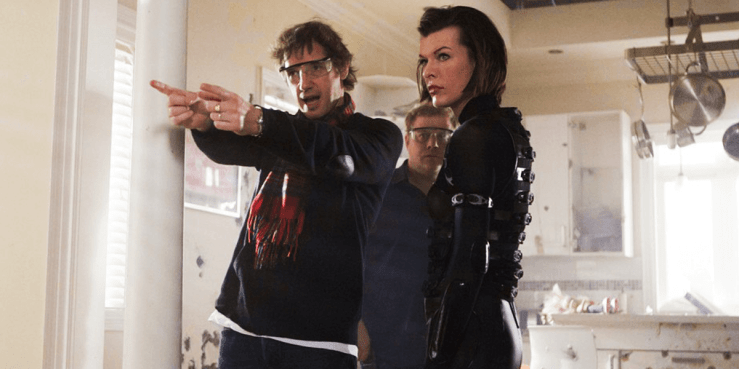
The casting of Jovovich was especially fortuitous. Her piercing blue-green eyes open the film, while her brusque line readings and lithe athleticism carry it to its close. You can’t blame W.S. (this is where he adopts the initials, the same year as that other Paul Anderson’s “Punch-Drunk Love”) for falling in love with her. (They were married in real life this past August.) Successful enough to inspire two sequels, the “Resident Evil” trilogy is a bloody, oozing love letter to Ms. Jovovich, keeping the camera close to her expressively stony face as she dropkicks zombie dogs, incinerates mutated crows and slices through the rest. She bottles her desperation up into a twinge at the side of her mouth, and grows increasingly jaded in each iteration of the series as the world edges closer to dissolution. It’s a profoundly pessimistic franchise.

Anderson wrote all three entries, but handed off directing duties to the sequels as the landscapes expanded beyond his favored darkened corridors. He carefully matched locales with genres, so 2004′s “Resident Evil: Apocalypse”‘s action-film ethos is set in the teeming urban warfare of Raccoon City, handled with speed and aplomb by Alexander Witt, a second unit director for “The Bourne Identity” and “Casino Royale.” For the third film, 2007′s “Extinction,” Anderson pairs the wide-open desert spaces surrounding Las Vegas with a spaghetti western element (as well as a thrilling “Birds” homage), outfitting Jovovich in a duster and leather boots, and bringing back “Mortal Kombat”‘s Linden Ashby to play a sharpshooting cowboy. Russell Mulcahy (“Highlander”) was tapped as the director, and his visual scheme of airy long shots, subordinating the characters to the emptied out horizon lines, is very effective in conveying the debilitating spread of the virus.

The “Resident Evil” trilogy is Anderson’s greatest accomplishment, and appropriately for his aims, it’s a modest one. They are nasty, brutish and short pieces of genre business, infused with lively character performances, resourceful production design and a bracingly downbeat worldview, all anchored by the unfussy bulldozer performances of Jovovich. His other directorial project in this period, 2004′s “Alien vs. Predator,” brought in more money than any of the “Evils,” but it’s a muddle in comparison, a joyless exercise in geometrical gore. “The Dark,” a ghost story he produced in ’05, is a far superior slice of Andersonian claustrophobia. Directed by John Fawcett, it’s a classically structured horror film that moves with sinuous tracking shots around a collapsing family, constructing a vision of hell out of candle wax and unlit rooms.

He found himself on solid footing again with “Death Race” (2008). With a small budget, dour stars (a superb Jason Statham and Joan Allen), a minimum of CGI and a maximum of twisted steel, it’s as fleet footed as “AvP” is sluggish. The booby-trapped race track might be his most sadistic work in a confined space yet, centering on a demolition derby with video game inspired power-ups to juice the carnage. Allen is especially menacing as another of Anderson’s fascistic overlords, leaning in to intimidate her prey with a low, gruff whisper before flipping the switch that snaps their necks. This is also what Mr. Paul W. S. Anderson does best. He keeps it close, keeps it moving, and then something goes boom.


SHUTTER ISLAND’S ANCESTORS

March 9, 2010

Screen Shot 2020-01-20 at 5.24.08 PM

In the flurry of interviews Martin Scorsese granted running up to the release of Shutter Island, he rattled off a long list of movies he screened for his cast, including Laura, Out of the Past, Cat People, I Walked With a Zombie, and The Seventh Victim. The first two were studied by DiCaprio and Ruffalo to look good in a rumpled suit (thanks to Dana Andrews and Robert Mitchum), while the last three, of course, were churned out by Val Lewton’s miraculous horror unit at RKO, a remarkable run of terror keyed off of the suggestion of violence rather than the blood and guts themselves. But the main wellspring of Scorsese’s recent box-office champ are two later Lewtons, which he also mentions: Isle of the Dead (1945) and Bedlam (1946) [Spoilers abound below].

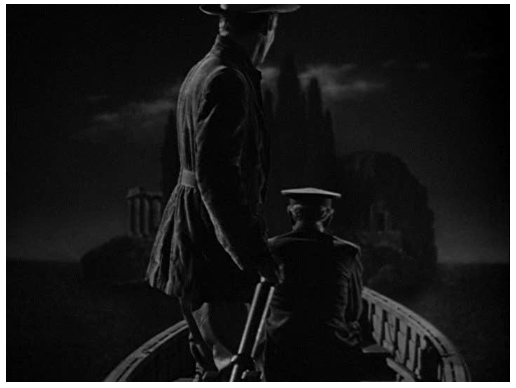
the-isle-of-the-dead-1886.jpg!LargeThe screengrab above is from an early shot of Isle of the Dead, a dead-ringer for Leonardo DiCaprio’s opening journey towards a ghostly island of his own in Shutter Island (the model for both of which is Arnold Böcklin’s series of “Isle of the Dead” paintings, the 1886 version is seen to the left). Greek General Pherides (Boris Karloff) and reporter Oliver Davis (Marc Cramer) row over to a cemetery to lay flowers on the grave of Pherides’ wife. They discover an empty coffin, and stumble upon the bizarre household presided over by Albrecht (Jason Robards, Sr.), an archaeologist who ordered peasants to go grave robbing. Now repentant, he lives on the island and offers shelter for any lonely wanderers. Then one of the guests dies of the plague, and Pherides and Davis are stuck quarantined inside, along with superstitious maid Kyra (Helen Thimig), consumptive wife Mary (Katherine Emery), her young nurse Thea (Ellen Drew) and stuffy husband Aubyn (Alan Napier).

Karloff’s Pherides is a clear influence on DiCaprio’s Det. Teddy Daniels. Both are violent men of authority who are driven to paranoia and madness, linked to romances past. As the days of confinement continue, Pherides falls under the spell of Madame Kyra, who accuses Thea of being a “vorvolaka”, an evil spirit who sucks the life out of her victims. Her evidence is Thea’s employer Mary, who has been slowly dying for years. Karloff’s eyes begin to bug out as Pherides clings to this fantasy as the true solution to their predicament – kill Thea and the “plague” will dissipate. Daniels is also imprisoned, but in an insane asylum, as he attempts to solve the mystery of a missing inmate during a biblical thunderstorm. DiCaprio plays it queasy and sweaty, while Karloff goes for a more operatic insanity, but they are both dangerous obsessives driven to insanity by the horror in their own souls.

Why I think Isle of the Dead is a scarier film, if not necessarily a more coherent one, is a result of Lewton’s visual understatement, with the aid of director Mark Robson and DP Jack MacKenzie. The film contains ultra low-key lighting, and when the supposed “vorvolaka” does appear, in a harrowing sequence of live burial, fleeting tulle garments, and tridents shoved into chests – it’s conveyed through terrifying glimpses.

It’s miraculous the film has the power it does, considering the difficulties during production. Karloff required spinal surgery after eight days of shooting, shutting down the production for months. In the interim, Lewton knocked off the delightful Body Snatcher, and when the shoot picked up again, the script was scrapped and re-made somewhat on the fly. No one on the production was happy with the finished product (future Lewton-ites aside), until perhaps the notices came rolling in, when James Agee called it “one of the best horror movies ever made.” It also affected a young Scorsese, who in an oft-recalled anecdote, remembers running out of the theater as a kid in sheer terror before the end, too scared to continue.

In any case Karloff and Lewton were a good match, as Karloff’s intro to the short story collection Tales of Terror attests:

The mightiest weapon of the terror tale is the power of suggestion – the skill to take the reader by means of that power into an atmosphere where even the incredible seems credible.

That could have been the Lewton team’s motto, and the two were to work again for the last time on Bedlam one year later. This film has an even closer relationship with Shutter Island, as it focuses on torturous treatment in an insane asylum, and the lead character’s incarceration. Lewton modeled the film off of plate 8 of William Hogarth’s series of paintings and engravings, “The Rake’s Progress”, which depicted subject Tom Rakewell’s final degradation at Bethlehem Hospital (aka Bedlam). Almost too slavish to Hogarth’s engraving, Lewton and director Mark Robson dissolve in and out of stills of the artwork before each new sequence, adding a static element to Lewton’s usually sinuous works. It’s a weird film in any context, though, with lead Nell Bowen (Anna Lee) a whitewashed reference to the Restoration England actress (and probable prostitute) Nell Gwyn. In this film, Nell is merely a kind of jester for the rich Lord Mortimer (Billy House), and tags along at the “loony” show George Sims (Karloff) mounts for the Lord’s pleasure. Sims runs the “Bedlam” insane asylum, allowing the inmates to rot in a barnyard atmosphere of scattered hay and the constant threat of death. Nell’s conscience is pricked by the earnest young Quaker Hannay (Richard Fraser), who sees a spark of pity in her.

The closest analogue to Karloff’s sadistic Sims in Shutter Island is probably Max Von Sydow’s malevlolent-seeming Dr. Naehring, who is intimated to have a Nazi past and moves with the same stiff bearing as Karloff’s schemer. The inmate population is the same however, a menagerie of terrifying grotesques, erudite madmen, and flailing arms in dimly lit, humid hallways. While Bedlam’s tone varies rather wildly from Restoration comedy to moralist grandstanding to atmospheric horror, it is never safe – and there are some agelessly wonderful bits, including the loony lawyer inmate who dreams of projecting his flip book onto a screen, only “It’s because of these pictures that I’m here.” That is, the cinema made him to madness. A truth Mr. Scorsese, Val Lewton and myself can certainly relate to.