PLEASURES OF THE PRE-CODE: FORBIDDEN HOLLYWOOD VOLUMES 4 AND 5

July 24, 2012

Screen Shot 2020-02-05 at 12.36.19 PM

This astounding publicity shot of a screwfaced James Cagney reluctantly probing the shoulder of a coolly admiring Claire Dodd should sell anyone on the value of Hard To Handle (1933), or of the two new volumes of WB’s Forbidden Hollywood DVD series that is releasing it. The way Cagney separates his left ring and pinky fingers – as if he couldn’t bear to put the effort into using all five digits – exemplifies his casual mastery (even in PR shoots!) in fleshing out the con-artist cads he played throughout this period. And this is only one of the pleasures found within volumes 4 and 5 of the series, which includes a trio of treats from director William Dieterle, and snappy banter from the likes of Barbara Stanwyck and Joan Blondell. The last edition appeared in 2009, containing a bevy of depression-scarred William Wellman films, but as DVD sales have continued to crater, so has the prominence of this series, with the new editions being released on WB’s movies-on-demand line, the Warner Archive.

Volume 4 includes Jewel Robbery (1932), Lawyer Man (1932), Man Wanted (1932) and They Call It Sin (1932). The first three were directed by William Dieterle in his first flurry of creativity after arriving from Germany in 1931. I have enthused about Jewel Robbery in this space before, but it is truly a marvel, an effervescent sex (and drugs) comedy that is also one of Hollywood’s rare explorations of female desire. Kay Francis wishes for adventure, and in swoops the slick-haired and slicker-tongued thief William Powell, waiting to sweep her away. Lawyer Man (shot in 21 days) finds Powell back as a smooth talker, this time as an idealistic New York City lawyer brought low by the corruption in the system and in his loins. His sole connection to his former straight life is his ever-loyal and plucky secretary Lola, played with usual verve by Joan Blondell.

Blondell is the star of Miss Pinkerton (1932), part of Volume 5, which also includes Hard To Handle (’33), Ladies They Talk About (’33) and The Mind Reader (’33). As with Kay Francis in Jewel Robbery, Blondell plays a gal eager for adventure, although instead of a society dame, she’s a gum-smacking nurse. While dressing down to her negligee in the employee lounge, she dreams of an escape from routine and the smell of chloroform. Then she is plucked to minister to a sick old crone in an old dark house. It turns out the crone’s nephew may have been murdered there, and the detective in charge (George Brent) has tapped Blondell to glean any info she can from its nervous inhabitants. The story is a third-rate whodunit, but it’s directed by the prolific pro Lloyd Bacon with speed and plenty of comically looming shadows, and Blondell is as charming as ever, blazing through the dusty plot mechanics with a brassy bravado.

Then there’s Hard To Handle, a breezy comedy about an endearing shyster. Cagney is loose and playful as Lefty Merrill, a two-bit scam artist who goes from promoting a phony “treasure hunt” (which causes a riot) to becoming the CEO of his own giant PR firm. The art of the con is essential knowledge for the advertising biz, as Cagney lies his way up the ladder. His rise is paralleled with his gal pal Ruth (Mary Brian), an aspiring model whose scheming mother Lil (Ruth Donnelly) plans to marry her to the richest husband possible. As Lefty’s fortune’s rise and fall and rise again, so does Lil’s interest. Everyone has an angle, but this is no cynical satire, but rather a bubbly romantic comedy. Director Mervyn LeRoy simply lets Cagney spin like a top, his machine-gunning speech patterns timed to nimble half-pirouettes, a man in constant motion, forever searching for a score. Scrounging for money was simply a fact of life, with no moral qualms attached.

Ladies They Talk About is saddled with moralizing speeches, by radio pedagogue David Slade (Preston Foster). A non-denominational preacher, he gains fame (and one assumes) fortune from railing against the vices pre-code Warner Brothers capitalized so heartily on. But while Slade wins in the end, there is plenty of titillation in between his hollow victory. The focus of his efforts is Nan Taylor (a particularly slinky Barbara Stanwyck), who got arrested for acting as a decoy for a gang of bank robbers. Initially posing as innocent, Slade sets up a PR assault to set her free, until she offhandedly admits her guilt, and Slade lets her go to jail. One of the earliest women-in-prison movies, Ladies They Talk About excels in scenes of female camaraderie, as Stanywck strikes up an instant friendship with another tough broad played by Lillian Roth. She takes her on a tour of the cell block, a hard-bitten crew of murderers and thieves given a roll-call in close-up, no innocents here. Directors Howard Bretherton and William Keighley give a sense of their daily routine in an impressive tracking shot across multiple cells. A particularly grim vision of femininity as imprisonment, Nan’s union with Slade retrospectively looks like she’s trading one cell for another.

Warren William’s characters, however, thoroughly enjoy the patriarchy and wring every advantage possible out of it. In The Mind Reader (shot in 22 days), William plays another con-artist of the carny kind, pulling teeth “painlessly” at a county fair, selling hair tonic on the road, and finally hitting the jackpot in the fortune telling business. He slaps a towel on his head, calls himself “Chandra”, and William has women pledging their bank accounts to him. Busy milking the rubes, he also finds time to fall in love with boring good-girl Sylvia (Constance Cummings), who only marries him if he promises to quit the con game. He agrees, and pathetically goes door-to-door selling wire brushes.  William tells a friend, “I’m on the straight and narrow…you know…the wife.” Bored and broken, William realizes he’s a cheat at heart, and returns to soothsaying even though he knows it could destroy his life. In the shattering penultimate sequence, William is shown drunk in Tijuana, the perfectly oiled William coiffure mussed into a mess. Overcome by self-loathing, he re-directs it toward the crowd, berating them for believing his lies of their future, believing that his own had all but run out.

A cornucopia of deviant money-grubbing borne out of the Great Depression, volumes 4 and 5 of Forbidden Hollywood are ideal viewing for our never-ending Great Recession, with the added value of sublime performances from Kay Francis, James Cagney, Joan Blondell and Barbara Stanwyck. There is no finer way to spend an economic apocalypse than in their company.
GOING BACK TO THE WELLMAN: SAFE IN HELL, MY MAN AND I, and LAYFAYETTE ESCADRILLE

November 22, 2011

safe in hell

William A. Wellman was an attractive guy who happened to make a lot of movies, one of those directors who led an entire life before entering the cinema (as salesman, hockey player, soldier). For Wellman and so many other early Hollywood craftsmen, directing was, as John Ford described it, just another “job of work”. Wellman was one industrious worker, credited with 83 shorts and features from 1920 – 1958. He excelled at compact stories of blue-collar types getting sore at each other (or what Manny Farber called “hard-visaged ball bearings standing around – for no damned reason and with no indication of how long or for what reason they have been standing.”), able to create a humming rhythm out of wisecracks and violence. The studios, however, tasked him with tackling much more, leading him to clumsily apply his blunt style to melodramas and comedies (his ’37 Star is Born is especially sluggish). His career is wildly uneven but well worth looking into, especially the period in the 30s where he was cranking out saucy and speedy pre-coders like Night Nurse and Other Men’s Women (both 1931). The Warner Archive has just released a third film from his stellar ’31: Safe in Hell  (along with later Wellman efforts My Man and I (1952) and his final film Lafayette Escadrille (1958)).

Safe in Hell was shot from mid-September to October 18th of 1931, and was released December 12th. A quickie produced by First National Pictures (which had merged with Warners), it’s a seamy pre-code drama about a prostitute who believes she has committed murder, and then flees to a Caribbean island that does not have an extradition treaty with the United States. The lead role of the whore without a heart of gold was originally slated for Broadway legend Marilyn Miller, and was then assigned to rising star Barbara Stanwyck, who gave a deliciously sardonic performance in Wellman’s Night Nurse earlier that year (she ended up in Frank Capra’s Forbidden instead). The role fell to Dorothy Mackaill, who Ralph Flint of the NY Times said was, “on return from her summering at Hawaiian resorts, [and] was pressed into service.”

Mackaill was a British born actress, who cut her teeth as a dancer in the Ziegfeld Follies before forging a productive career on-screen in the silent era, notching the leading role in the 1924 The Man Who Came Back, and in Alfred Santell’s 1926 The Dancer of Paris. Work dwindled with the arrival of sound, and First National declined to extend her contract at the end of 1931. That marked the beginning of the end of her career in pictures. It’s unclear why the studio felt she wasn’t fit for sound, as her performance in Safe in Hell is impressively wild and unhinged, wrenching the underwritten part into something tangible and affecting.

She plays Gilda Karlson, an in-demand prostitute in New Orleans, who is paid an unwelcome visit by a john, the one who led her into vice. She conks him over the head with a vase, and, thinking she killed him, is frittered away to the Caribbean by her merchant marine boyfriend Carl (Donald Cook). She is ensconced in a shady hotel populated by a murderer’s row of lowlifes, each ogling her with lip-smacking impunity. Wellman catches the crew (including my favorite name and face: Gustav von Seyffertitz) in a series of leering reaction shots, before they slowly turn their chairs around and await her return trip downstairs. With Carl away on a job, the seedy patrons urge Gilda to sink back into her old ways, and the rest of the drama details this dilemma.

Wellman gets the story rolling with alacrity, establishing Gilda’s character by opening on a close-up of her gams sitting next to a phone – the two necessary implements of her job. Within a few scenes a man is presumed dead and Gilda is stowed away on a ship, heading South, her eyes visible through a slit in a box, as she quips, “I always traveled 1st class!”. The hotel in the Caribbean is run by Nina Mae McKinney, a wildly talented black actress who was shunted into supporting or “musical” roles because of the institutional racism of the period (she was later known in Europe as the “Black Garbo”). Here she sings the theme song with a smile while serving her customers. The bellboy is played by another grievously under-used black actor, Clarence Muse, who injects a patrician weariness and humor into his stock character. He tells Gilda that they serve liquor, since they are in “a civilized country”, unlike the Prohibition era U.S.

The film loses its spark in the closing third, in which sexual deviancy is replaced by an unconvincing shift to the value of constancy, robbing the starkly downbeat ending of much of its power. An uneasy mix of entertaining smarm and queasy sentimentality, Safe in Hell  is probably the least of Wellman’s great 1931 run (The Public Enemy, Other Men’s Women, Night Nurse), but it still exerts a strange fascination. I should note that the Warner Archive transfer looks soft and scratched up, most likely taken from an old TV master. It is not up to the usual standards of the company’s releases, but the fact that this rarity is available at all is reason enough to celebrate.

***

My Man and I (1952) is a showcase for Ricardo Montalban, who plays Chu Chu Ramirez, an itinerant Mexican farmer who gains his citizenship, but is unable to escape racist attitudes. This earnestly melodramatic film was co-written by novelist John Fante, who (according to Doug Bonner) modeled the love story between Montalban and Shelley Winters on the romance from his most famous novel, Ask the Dust. Chu Chu, an almost idiotically optimistic character, immediately believes he can save Nancy (Winters) from her alcoholism through sheer force of will. Wellman militates against the ridiculous goody-two-shoes nature of Chu Chu’s character by placing him in cramped, dense frames, with looming faces present in the foreground (one of them belonging to Jack Elam, playing the cynical Celestino), used especially in Chu Chu’s flophouse. This sense of visual claustrophobia runs counter to Chu Chu’s continually stated belief in the American melting pot, which he proves by constantly wielding his citizenship letter from the President. In his scenes with Nancy, Wellman uses low-light, throwing dramatic shadows against the wall, visualizing the dark pit of despair that Nancy cannot escape from. Despite his best efforts, Wellman cannot entirely free the film from the hackneyed script, which transitions into a traditional courtroom drama, with all of its moralizing banalities. The ultimate saving grace, though, is the presence of Claire Trevor as an unsatisfied housewife whose husband hires the buff (and often shirtless) Montalban to clear a field, and whose withering putdowns and shivering carnality electrify every scene she appears in.

***

Wellman often said that Lafayette Escadrille was the worst movie he ever made, and I won’t argue the point. The story of American soldiers who sign up to fight in the French Air Force in WW1 was a personal one, as Wellman had served in the unit. He even cast his son, William Wellman, Jr., in one of the supporting roles. But Warner Bros. forced him to add a happy ending, and cast the handsome teen idol mannequin Tab Hunter in the lead role. The idea was to bring in a younger audience, but all it did was dilute Wellman’s vision more. What was intended as a melancholic homage to the American dead of WWI was turned into a raucous boys-on-the-town movie, and it’s a mainly joyless affair. There are some nicely shot flying scenes, and a very young Clint Eastwood picking lice out of his hair, but otherwise it is a lost cause. This is a shame, because one of his previous passion projects, the monochromatic Track of the Cat (1954), is one of his greatest visual accomplishments. Escadrille was his last film, but no matter, he got the job done more often than not.

TO SAVE AND PROJECT: THE MOVIE ORGY (1968) AND AFRAID TO TALK (1932)

October 25, 2011

the movie orgy

For nine years running, MoMA’s To Save and Project international festival of film preservation has showcased the latest celluloid surgery jobs by archives the world over. It’s the one place where film stock is still a fetish, each new print ogled with the entitled leer of a sozzled Miss Universe judge. So I was sent to my oft-used fainting couch when it was announced that a digital restoration would open this year’s fest (which runs through Nov. 25th).   This prestigious pole-position was granted to Joe Dante’s The Movie Orgy (1968), a delirious mash-up of pop culture detritus, from psychotic b-movies to baffling Bufferin commercials.

Dante and Jon Davison edited the entire feature by hand, splicing in new scenes when intriguing material passed their way. Eventually the project ballooned to 7 hours, but with its broad humor, broads, and critique of the military-industrial complex, it toured college campuses under a Schlitz beer sponsorship. By the end of its run the print had more stitches than Frankenstein’s monster, without the salve of Karloff’s soulful stare. It would be unlikely to survive another trip through a projector. So Dante shoved the benighted thing through a film-to-tape transfer, and after some screenings on the West coast has finally brought his beast to the East. Now at a svelte 4 1/2 hours, it’s a marvel of gonzo editing. It contains an actual narrative, collapsing the apocalypses  of a bunch of sci-fi/teen rebel/horror cheapies into one mega-Armageddon, while finding time for mini-comedies and grace(less)-notes in between.

For this main narrative, I spotted the following titles: Speed Crazy (1959), Attack of the 50 Foot Woman (1958), Teenagers From Outer Space (1959), College Confidential (1960), The Giant Gila Monster (1959), Earth Vs. The Flying Saucers (1956), and Beginning of the End (1957). There are many more I couldn’t identify, but these images of nuclear paranoia are spread throughout, until Dante and Davison edit them together in a blaze of melodramatic parallel editing that would make D.W.  Griffith a little nauseous.

W.C. Fields, George Burns and Groucho Marx act as a bemused chorus during the chaos, used in reaction shots in response to whatever absurd travail Dante places before them (maybe Peter Graves gunning down locusts or Andy Devine singing “Jesus Loves You” with a cat and a gerbil). It’s the Kuleshov effect used for juvenile laughs, which I fully endorse. Dante uses this gag in other forms, once in an Eisenstinian montage, cutting from a dog training short to one for the Marines, or equally bluntly, from kids setting up a projector to a striptease. Dante is in full control of the editing-as-joke mechanism, and he wrings some hilarious bits out of it. Another routine worked through multiple variations is condensing an entire feature into a descriptive one-shot. In a B-dog-movie called (something like) “Rusty Comes Home”, he shows one scene of a dog running to a boy. “You came back!”.  Cut to “The End” credit.

Then there are the insane commercials, including a mind-melting series from Bufferin, in which a military recruiter sends a kid to war and a landlord evicts an elderly couple. Both use the pill to ease their guilty consciences. In the latter a building implodes behind the landlord as he pops his aspirin. These play more like parody than ad copy. The true star of Dante’s opus though, is Brett Halsey, the star of Speed Crazy (1959). Under the sensitively absent direction of William Hole, Jr., Halsey furrows his brow and strangles out his motto, “Don’t crowd me!”, thousands of times. Whether he’s chatting up a gum-smacking dame (in which crowding would seem to be the point) or stabbing a square authority figure, he repeats the phrase incessantly, as if Halsey forgot the rest of his lines. But he had already appeared in 20 movies, the absurdity of his repetition a likely result of compressed shooting times and a thin script. By the end, the audience was erupting in scattered cheers whenever Halsey appeared on-screen, as I would like to do for this entire low-brow masterpiece. Because of its endless copyright infringement, The Movie Orgy will never appear on home video, so rush to see it if it ever plays near you.

***

The other highlight of the festival for me was Edward L. Cahn’s Afraid to Talk (1932), a brutally despairing corruption drama, based on the play Merry-Go-Round by Albert Maltz and George Sklar. Made during the depths of the Great Depression, it exhibits a totalizing distrust of authority, with Chicago city officials displayed as more comprehensively criminal than the gangsters they are ostensibly supposed to pursue. Jig Skelli (Edward Arnold) kills kingpin Jake Stranskey (Robert Warwick) to take over his racket. When he’s rousted for the crime, he simply flashes Stranskey’s records, which implicate every major  Chicago official as on the take, from the DA’s office to the Mayor’s. Needing a scapegoat, the cops pin the murder on bell boy Eddie Martin (Eric Linden), almost beating him to death to force a confession.

Cahn and DP Karl Freund (Metropolis) visualize the back-scratching corruption of the government through shifting group shots. At police chief Frank Hyers’ (Ian Maclaren) well-appointed pad, the top officials often gather around the table to pop champagne and talk jubilantly of their double dealings. Hyers is framed to his left by the Mayor (a red-faced Berton Churchill) and Assistant DA Wade (Louis Calhern). On the right District Attorney Anderson (Tully Marshall) and a rotating cast of underlings. They are framed in long shot, with a receding hallway behind them. Down that hallway comes an indistinguishable mass of Fedora’d newspapermen, walking in lockstep, resigned to regurgitate the party line.

This grouping of power is contrasted to configurations of weakness, specifically in the initial interrogation of Eddie, who is the point of a triangle between Wade and Anderson. Later in this sequence Eddie’s wife Peggy (Sidney Fox) is subjected to an intensely close two-shot, in which Wade leans over her prone body as she rests her head in her hands. These different figural arrangements reach a climax in Eddie’s second interrogation, when his confession needs to be forced. There the cops, after flicking the overhead lamp to tick-tock over their heads, converge to make an airtight boundary around him, the image just one hulking mass of black wool suit. In this shot all of Eddie’s subjectivity is erased, to be halfway restored in the still-pessimistic conclusion. The governmental pack is thinned out, but the structures that allowed for Eddie’s blotting out are still firmly in place, as the news ticker trumpets another mission accomplished.

BLONDE AMBITION: JOAN BLONDELL IN THE CROWD ROARS (1932)

August 23, 2011

Screen Shot 2020-01-31 at 3.41.30 PM

Joan Blondell made herself at home in the cinema. Regardless of the plot or set decoration, Blondell would adjust her sheer stockings and plop into a seat as if she was at a cuckolded boyfriend’s pad. This Warner Brothers working class goddess buckled knees with this studied insouciance,  a glamour of gum-smacking nonchalance. Our blog-a-thon has been counting down the days until the Blondell-bonanza on August 24th, her day on TCM’s Summer Under the Stars. Earlier this week Jeff discussed the James Cagney-Blondell pairing Blonde Crazy (1931), and today I’ll take a look at their subsequent film together, Howard Hawks’ The Crowd Roars (1932).

Hawks had just completed work on Scarface (1931), his large-scale gangster film for producer Howard Hughes, and as the film was encountering censorship battles across the country, the director was busy with his next project. He took the conflict of the 1917 play, “The Barker: A Play of Carnival Life”, by Kenyon Nicholson, and adapted it to one of his hobbies, auto-racing. Nicholson’s story concerns a carnival barker who lives with a young mistress. His brother is coming to visit, and he wants to hide the affair. So he has his girlfriend sic one of her cohorts on his sibling to seduce and distract him. With a few tweaks, Hawks and his horde of screenwriters John Bright, Niven Busch, Kubec Glasmon and Seton I. Miller transplanted the tale to the race track. Production lasted from December 1931 – February 1932, and was released on April 16th 1932.

The Crowd Roars stars James Cagney as championship driver Joe Greer, a four-time winner of the Indianapolis 500 and sometime lover of Lee Merrick (Ann Dvorak, also fresh off of Scarface), who grows impatient with his immaturity. When Joe starts mentoring his racing-hopeful brother Eddie (Eric Linden), Joe cuts Lee out of his life, not wanting to be distracted from the training. In a fit of pique, Lee encourages her friend Anne (Joan Blondell) to flash her wares to Eddie, so Joe can experience how it feels to be separated from a loved one.

When shooting was slated to begin Ann Dvorak was cast as the vampy Anne and Blondell was to portray the long-suffering Lee. However, as Todd McCarthy wrote in his fabulous biography, Howard Hawks: The Grey Fox of Hollywood:

Once they got down to work, however, Blondell announced, “I can’t play a neurotic,” and Dvorak decided, “I can’t play an ingenue,” so, with Hawks’s agreement, they swapped roles without even telling the studios.

In retrospect this seems like an obvious switch to make, although it meant Blondell was willingly taking on a lesser role, as Anne has roughly half the screen-time as Lee. This indicates a striking self-awareness on Blondell’s behalf, knowing that she can make a bigger impact in the smaller part better suited to her talents. She was managing a persona that was already well established, having cranked out 10 films in 1931, her wide-eyed and acid tongued striver a familiar and welcome sight for Depression-scarred audiences. Blondell was given second-billing behind Cagney despite her diminished presence in the film (in the trailer below, she’s “The Peppiest Blonde Who Ever Broke a Heart”), since Dvorak was still breaking in as a lead (Scarface was her first) and Blondell had already garnered box office success with Cagney on Blonde Crazy.

The Crowd Roars is a classic Hawksian scenario of male camaraderie and competition, with self-worth won on the job. The setting here is the race track, instead of the airport of Ceiling Zero (1936) or fishing boats of Tiger Shark (1932). While the film has stunning racing photography by Sid Hickox (shot at real Indianapolis, Ventura and Ascot tracks), Eric Linden’s limp turn as Eddie leeches the central conflict of tension, and the female characters are not as fully developed as Dvorak was in Scarface, or Carole Lombard in Twentieth Century (1934) a few years later. Lee is present to be hysterically in love with Joe, and Anne ultimately ends up married and neutered to Eddie. There are hints of the past and present Hawksian women to come though, in Anne and Lee’s banter about Joe, privileging a female perspective on the male lead in a few scenes. Feminist film theorist Laura Mulvey, in her essay on Gentlemen Prefer Blondes, does note it for giving Dvorak and Blondell “enough screen time and dialogue together to establish a real friendship which only later, as the story spirals out of control, becomes overtaken be plot points.”

Watching Crowd Roars now, it’s hard to conceive Blondell as the rather shrill wilting lily Lee. Anne, as thinly sketched as she is, dominates every scene she’s in, a sexual dynamo until the third act unconvincingly turns her into a housewife. Although they share only a few scenes together, Cagney and Blondell maintain the sparks they lit on Blonde Crazy. Cagney is a marvel, as usual, swatting Joe Greer’s problems away with jittery flits of his hand, while Blondell is constantly fidgeting with her stockings and urging Dvorak to dump him. Hawks told Joseph McBride about working with Cagney:

“Cagney was so much fun to work with because you never know what Cagney was going to do. When I work with Cary Grant, I can go home and write a scene for Cary and know how he’s gonna to handle it the next day, but Cagney had these funny little attitudes, you know, the way he held his hands, and things like that.”

You first see Cagney playing with Dvorak’s hands, mocking her for wanting a wedding ring, and then throughout the film he uses a flat-palmed Queen’s wave as kiss-off, a curious, electrifying gesture of contempt. Hawks doesn’t discuss Blondell, but she’s equally resourceful in her few scenes.

She is introduced after a close-up of a telegram from Joe, informing Lee that he’ll be delaying his return in order to train Eddie. Lee crumples the note and throws it in the trash. Blondell is splayed out on a divan in the background, and sashays slowly to the foreground, implanting a hand on her hip. She grabs the note dismissively and strides right, bobbing her head to snap off her complaints like, “playing nursemaid to a kid, huh?”. She sits down on the bed, and crosses her legs, her feet resting on an ottoman, to continue her harangue. Angrily throwing back the note, she walks to the middle of the frame, bends over, and adjusts her stockings before snapping, “You can take those hard-drinking, hard-riding men and put them in a truck and shove them over a cliff, as far as I’m concerned.” It’s a play of anger and self-regard that rivals Cagney’s regal kiss-off to Lee. Blondell continues these moves later in the film, propping her gams up on a table, and pulling up her hose, in order to entrance Eddie. This time her primping is an act, although one Blondell has established that Anne is happy to perform.

Blondell’s performance is one of constant small surprises, matching Cagney’s bantam rooster routine gyration for gyration. While The Crowd Roars is a second-tier Hawks film, the director’s openness to improvisation makes it a particularly riveting one, and reveals Blondell to be a wonderfully inventive actress as well as an indelible personality.

ESSENTIAL PRE-CODE: JEWEL ROBBERY (1932)

Originally published at Movie Morlocks, the official blog of Turner Classic Movies

July 12, 2011

Screen Shot 2020-01-31 at 2.29.09 PM

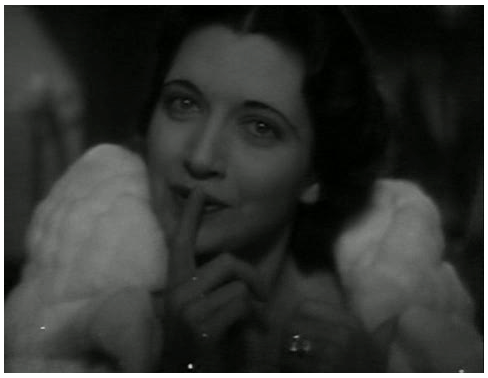
Kay Francis dreamily asks for your complicit silence. She is about to commit an illicit act, and it would be gentlemanly not to speak of it.   So I shan’t, although I will spill fawning words about the film that encloses her, William Dieterle’s Jewel Robbery (1932). It is screening as part of Film Forum’s Essential Pre-Code series (and airs on TCM on occasion), a near annual festivity of tough-talking immorality that begins this Friday, July 15th. Released the same year as Ernst Lubitsch’s similarly themed Trouble in Paradise (and double-billed with it on August 7/8),  Dieterle’s debonair crime fantasy was necessarily overshadowed, but should be reckoned with as a major work in its own right.

A play by the Hungarian Ladislaus Fodor (“Ekzerrabalas a Vaci-uccaban”, 1931), was purchased by Warner Brothers on February 8th, 1932, with production beginning less than a month later, on March 2nd (credit to Roger Bryant’s biography, William Powell). To lens this sophisticated charmer set in Vienna, the studio tapped their European emigre, the German-born William Dieterle. Dieterle, a prolific actor and director in the Weimar cinema, came to Hollywood to shoot German language versions of WB productions. His first original film for the studio, the Lost Generation drama The Last Flight (1931, which I wrote about here), was a success, and he went on an incredibly creative run throughout the 1930s (I would also recommend 6 Hours To Live (1932) and The Devil in Love (1933)).

For the leads, he was gifted William Powell and Kay Francis. $100,000 of the $291,039 budget went to Powell, more than a third of the entire cost. Francis received a comparatively paltry $27,000 (reported by Bryant). Powell plays the unnamed “Robber”, a fastidiously well mannered thief. Francis would get a supporting role in Trouble in Paradise later in the year, but here she is the slinky, shallow and slightly bored housewife Baroness Terri. Stuck with the wealthy but gout-ridden Baron Franz (Henry Kolker), she dreams of escape. Her fantasies incarnate when Powell swoops in to the jewelry store to relieve her of the “Excelsior Diamond” which she was about to squeeze out of the Baron. Entranced by his swaggering, well-coiffed masculinity, the robbery turns into a battling flirtation. Powell, equally intrigued, starts a game of break-ins into the Baroness’ quarters, forcing her to make a choice between comfort and passion.

Dieterle instills a martial rhythm, matching the military precision in which Powell’s Robber executes his heists. He cuts when a screen is filled or an action performed – no lingering on atmosphere. During production, reports Bryant, Warner executive Darryl Zanuck showed concerned about this speedy style. On March 26th he wrote producer Lucien Hubbard to, “keep your eye very close on the rushes of Dieterle…as he has a habit of shooting his most important scenes with the camera moving or sweeping around or going back and forth and you miss the most important point of all.” Ever the diplomat, he sang a different tune to Dieterle, on April 5th: “The rushes continue to be very excellent, and I like the manner in which you are continuing to put movement and action in all the scenes … Keep this up. This is very fine.”

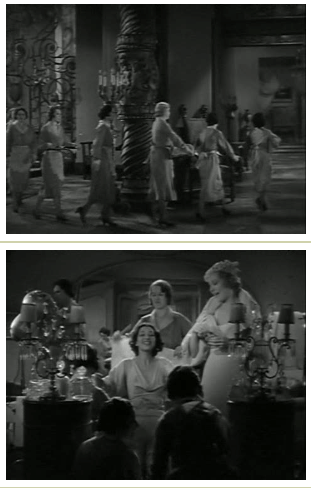
In a rapid opening montage, Dieterle shows a series of safe doors shutting and locking. With equal precision, a group of jewelry shop employees scuttle to line up diagonally across the frame. Dieterle repeats this line-up image in the next two sequences.  As soon as the last man enters the frame, he cuts to the pretentious owner bragging about the new security system. Of course, a few seconds later, he is robbed.

Screen Shot 2020-01-31 at 2.32.02 PM

The next lineup occurs in the Baroness’ home, as a who army of maids tromps down a grand staircase to minister to her needs. In the first scene, the line of men was protecting a diamond, in the second, the line is pampering Kay Francis. This jewel/Baroness metaphor continues when one of her helpers carries her into a massage chair to be buffed into beauty – a delicate object cleaned up to be presented to the world.

Screen Shot 2020-01-31 at 2.32.09 PM

Powell’s men form the third line-up, a dapper parade of black-suited shysters. And they are here not to protect, but to steal. As the Baron, Baroness and friends try to escape the store, a group of top-hatted criminals enter from the back, doff their caps in unison, and aim guns at chests. It is this shift in the line-up pattern that that then shifts the narrative. No longer coddled, Baroness Teri is shocked out of her comfort zone, and into one of romantic fantasy.

Screen Shot 2020-01-31 at 2.32.19 PM

Powell’s perfection has an air of unreality about it, a charming, un-threatening adventurer conjured out of Teri’s imagination. After he frisks a revolver out of a lovely pearl-inlaid box, he tells the stunned patrons, “Would you kindly put up your hands”. And then, to calm their troubled nerves, he gives them all some pot to smoke (a joint is later passed to the police department, who fully investigate its possibilities). The idea that this is just a beautiful dream of Teri’s continues when she is whisked away, or willingly kidnapped, to his ornate apartment getaway, which is filled with his ill-gotten gains. As they sit down for dinner, she asks him for his name, and he gently refuses. To admit to a name would pin down his identity, and snuff out the mystery which fuels her desire. He is anything she wants him to be. I don’t think I’ve seen a film that portrays female fantasy with such sensitivity.

***

The other must-sees, or at least, the titles I’ve been most obsessed with recently, are three early stunners from Raoul Walsh:  Me and My Gal (1932), The Bowery (1933) and Sailor’s Luck (1933). 1932 was a good year. I wrote my first post here at Movie Morlocks on Me and My Gal, and lets see if it embarrasses:

Walsh shot the film in a scant nineteen days, and he doesn’t even mention it in his rakish autobiography, Each Man In His Time.

Perhaps it’s the speed of the schedule that led to its inventive, magpie spirit. Plenty of material needed to be created on the spot (there was obviously little pre-production time), and the film is flooded with ideas (some borrowed, some new) – ideas for pratfalls, camera movements, parodies. The movie contains direct addresses to the camera (by a tight J. Farrell MacDonald), self-reflexive voice-overs, and endless bits of comic business, from Will Stanton’s drunk act to the stinging bon mots flung from Bennett to Tracy.

A little sloppy, but not bad. The movie, as always, astounds. The Bowery is a more personal project for Walsh, revisiting the street that he used to rubberneck at as a curious upper-middle class kid in New York. In his autobiography he writes about how he cast real winos and bums to fill the backgrounds of his shots, in which he experiments with deep focus, a technique he would investigate the rest of his career. Then there’s Sailor’s Luck, which sets a giddy land-speed record for sexual innuendo and bumptious ethnic humor.

DIGGING INTO THE WARNER ARCHIVE: THE LAST FLIGHT (1931)

April 13, 2020

Screen Shot 2020-01-21 at 5.02.13 PM

To celebrate their one-year anniversary, the Warner Archive held a decent sale last month, netting five discs for $55. One of the titles I snapped up is The Last Flight,  William Dieterle’s 1931 film about disillusioned WWI fly-boys on a European bender.  French director and critic Nicolas Saada called it “possibly one of the greatest films ever made” over at Dave Kehr’s site, while filmmaker and blogger David Cairns posted an enthusiastic review at his Shadowplay journal. Along with a hearty endorsement from a friend who’s a Richard Barthelmess buff, I had high expectations for this rather unknown early talkie.

The Last Flight was Dieterle’s first Hollywood production, after a varied career in Germany, which was highlighted early on in his stint with Max Reinhardt’s theatrical troupe, starting in 1919. He switched to film in ’23, and later co-directed Reinhardt’s silver-screen adaptation of A Midsummer Night’s Dream (1935). His varied resume from this period includes directing and acting alongside Marlene Dietrich in Man By the Roadside (1923), performing in F.W. Murnau’s Faust (1926), and starting up his own production company with his wife Charlotte Hagenbruch (for whom he made Sex in Chains (1928)).

He made the leap to Hollywood by directing German versions of American films. He spoke to Tom Flinn about this period:

I was hired to make synchronizations. Sound had just come in, and Hollywood was afraid of losing foreign markets. So they hired German, French and Spanish units to make foreign versions of important features…. The four films we were to make had already been completed. All the sets were still standing and dressed – we used the same costumes and everything. The big difference was that we had just ten days to make each picture.

His work on these foreign-language quickies must have impressed the suits at Warner Bros., because he was soon hired on to direct The Last Flight, which John Monk Saunders adapted into a screenplay from his own novel, Single Lady (1931) (Moira Finnie wrote a detailed history of the writer’s life and career here). Saunders had already won an Oscar for Howard Hawks’ The Dawn Patrol (1930), and had provided the stories to Best Picture winner Wings (1927, William Wellman) and critical favorite The Docks of New York (1928, Josef von Sternberg).  A fellow-traveler with the Lost Generation despite living in the U.S., Saunders was broken-hearted over spending WWI as a flight instructor in Florida, and his ex-wife Fay Wray described him as someone “who wanted to live dangerously and die young.”  He acted out his untapped aggressions on the page, and The Last Flight is heavily influenced by Hemingway’s The Sun Also Rises – it’s a boozy portrait of post-war disillusionment and decadence.  Instilled with a snarky, slangy, and deflective dialogue, the tremors of violence in The Last Flight are repressed under layers of protective irony.

This was a challenging, rather prestigious debut for the German emigre to take on, but Dieterle succeeds skillfully. Instead of anchoring Saunders’s script with heavy symbolism, he glides along the surface just like the characters, employing rapid-fire montages, agile tracking-shots, and close-ups as punctuation. Every other shot seems to be an exclamation, punchy and precise. The way they order martinis is accompanied by a smooth track to the left, each man’s intonation rising in a barbershop quartet of mockery. After finding out a dame’s name, Dieterle repeats the shot from a more frontal angle, and he glides left as they repeat her name, with the same mocking tone. This establishes their unity as a comedic team, and sets the template for their deconstructive use of language. Every word has a double-meaning, twisted into a sarcastic punchline. This glossy, fast-paced style allows the fliers’ grim reality to creep in through the corners. Dieterle doesn’t find a way to leaven some of Saunders’ clunkier metaphors – like their army doctor’s intoning about how they are “spent bullets” – but this draggy thematic exposition is the exception rather than the rule.

The story revolves around four friends from the Air Force, recently discharged after suffering physical and mental trauma in WWI. Richard Barthelmess plays Cary Lockwood, the informal leader of the trio, a tremulous and reckless pilot who burned up his hands upon a crash landing, who would die rather than accept pity from a stranger. Then there’s Shep Lambert (David Manners), whose gift from the war is a twitching eye, which he can only combat by constantly getting drunk (asked what his plans are, he says, “Get tight.” After that? “Stay tight.”) Bill Talbot (Johnny Mack Brown) runs on adrenaline, constantly proving his masculinity on the new battlefield of the city, tackling horses and then meeting his final fate in a bullfight. Lastly there’s Francis (Elliott Nugent), a meek wallflower type who’s tasked to babysit some turtles. He only comes alive with a gun in his hand.

They form a circle around Nikki (Helen Chandler), a flighty socialite who speaks in nonsense rhymes that hide a spiky intelligence, or, as Lockwood describes her, “the kind of girl who sits down on phonograph records.” Chandler is a revelation here, ditzy and distant, chin pointed up as she floats around rooms in a dream-like state of childish denial and innocence. She’s introduced as a woman apart, standing alone with a cup of tea, oblivious to the tuxedoed airmen staring at her from across the room. But what Chambers eventually makes clear through her coded speech and slow-motion gestures is that her distance is a choice, and a kind of defense mechanism. Her words keep the humorously wooing men at a distance:  “anyone kisses me too hard…it’ll split my lip.” Chambers is radiant and inscrutable, as hard-hearted as the men but seemingly more wise.

The whole setup feels like a Howard Hawks film – what with the group of professional-minded men struggling with their self-respect while jousting with an independent-minded woman – and it even acts as a kind of prequel to the more loving fly-boys in Only Angels Have Wings (1939), where Barthelmess plays another disgraced flier clumsily groping for redemption. But unlike in Hawks, there is very little hope for the survival of the group. These are, as Saunders sometimes over-emphasizes, broken men, with little hope of re-integrating into society. They drink and drink until they crack-up, camaraderie the only thing keeping them alive.

“HAVE A LITTLE CHEW ON ME”: OTHER MEN’S WOMEN (1931)

March 31, 2009

othermen4

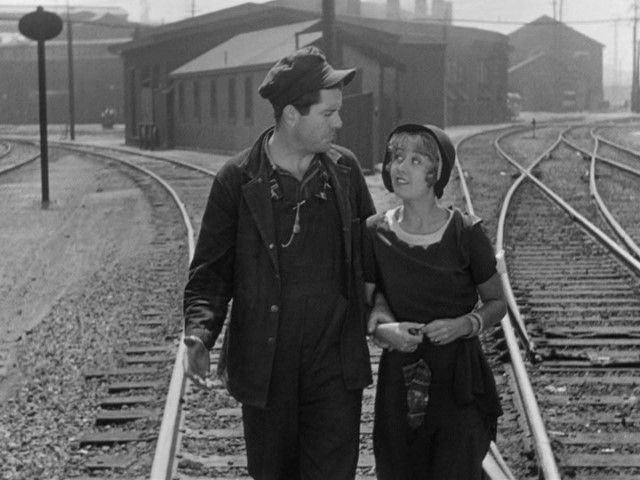
Last Monday night, TCM aired all six films from Warner Bros. new box set of early William Wellman talkies, Forbidden Hollywood, vol. 3. I’m still picking my way through, but 1931′s Other Men’s Women is an obvious highlight. Possessing speed and clarity in equal measure, and blessed by energetic supporting turns by James Cagney and Joan Blondell, it’s overflowing with minor pleasures. With the railroad as its working class milieu (the original title, “The Steel Highway”, was changed shortly before it’s premiere), the film builds its rhythm from the steady hum of the locomotive, it’s whistle cooing over the lead credits. In the opening sequence, Bill White (Grant Withers) slinks into a hash shop, his wise-ass cracks clearly impressing the brassy counter girl. In between his razzes he counts out a rhythm on the table top, keeping track of some internal beat in his head. After shoveling in his eggs and coffee and telling the gal to “have a little chew on me”,  he sprints off to catch the last train that had been rumbling by in the background the whole sequence – he had been counting off its cars. Tempo is emphasized straight off, and neither Wellman nor his collaborators apply the brakes for the duration of its 70 minutes.

Maude Fulton adapted her own story for the screen, and William K. Wells is credited with  the dialogue. Fulton, unknown today, had established herself as a vaudevillian and playwright before she started contributing to film. In a fascinating 1917 profile in the NY Times, written after the success of her play, “The Brat” (which John Ford brought to the screen in 1931), her circuitous path to Broadway is outlined. Raised in the Kansas newspaper biz by her Dad, the editor of the local daily, she wrote a novel by the age of 15, “whose theme was ‘The Curse of Rum’”.  She bounced from job to job, including singing pop songs at a department store, until she learned stenography and was hired by a railway office, where she likely soaked in the bravado of the train engineers that suffuses Other Men’s Women. Bored with office work, she soon lit out for the stage in NYC. She was performing in Mam’zelle Champagne on the roof of Madison Square Garden in 1906, when the millionaire Henry K. Thaw shot and killed architect Stanford White for fooling around with his young wife, Evelyn Nesbit (who was also romanced by John Barrymore). Thaw’s trial was the first to be dubbed “The Trial of the Century.”

Before this brush with infamy, she had teamed up with dancer William Rock. “Rock and Fulton” became a minor vaudeville success from 1900-1912, their 20-minute routine playing some of the better houses in town, according to the reference book Vaudeville, Old & New. By the time she was 30, Fulton began to suffer from rheumatism and had to shift into writing full time. In the Times piece, just beginning her playwriting career, Fulton displays a disarming humility:

“I know that I have no great intellectual gifts and that I have no great talents, but I will say this for myself: I am an indefagitable worker and I aim high. If this [The Brat] is not a great play – and it isn’t – remember that it is my first, and I am not through yet.”

She never equalled The Brat’s success on stage, with her follow-up, The Humming Bird (1923) failing to make much of an impression. But both were made into silent films, and her career behind the camera began. But I digress…

Fulton’s scenario for Other Men’s Women is a basic love triangle. Jack Kulper (Regis Toomey) and Bill White are best friends and railroad engineers, but both also happen to be in love with Kulper’s wife, Lily (Mary Astor). Tensions rise  and tragedies mount until a spectacular bridge collapse caps the doom-laden tale. With the train whistle’s metronome setting the pace, Wellman wastes no time in setting up the central conflict. Jack invites Bill to stay for a few days and dry out, after his stuttering landlady kicked him to the curb. The childlike idyll of the first few days, mock-fighting and chases ’round the yard, are quickly unmasked for their flirtatiousness. Wellman utilizes an audio motif to mark the shift in atmosphere. When Jack first arrives home, he whistles to announce his arrival. The second time we hear the whistle, Bill has professed his love and Jack’s world is about to collapse. This simple inversion carries a great emotional wallop, his lilting tune turned tragic in the space of ten minutes.

Wellman is adept at this kind of repetition – eliciting slightly different tones from each one. Take Grant Withers’ catch phrase, “have a little chew on me”. Used in the opening scene with a sneer and a hint of sexuality, the next time he says it, to old pal Cagney on top of a train, it’s with complete sincerity. Later, after dismissing Blondell’s marriage proposal, she cuts him off with, “if you offer me a chew of gum I’ll knock your block off.”  For each context, the phrase works differently, and the cumulative effect makes Blondell’s retort all that funnier.  It’s even flexible enough to play a pivotal role in the final, storm swept finale.

Other Men’s Women is remembered, if at all, for being the film Cagney appeared in before The Public Enemy (also directed by Wellman) which launched him to stardom. As Bill’s close friend Ed Bailey, he’s already irrepressibly physical. In one magical scene in a club’s lobby, he’s shown stripping out of work clothes, revealing a tux underneath, and soft-shoeing laterally to the dance-floor. It’s a privileged moment for a character only present in three sequences – and he nearly taps away with the picture.It was his second film with Blondell, after they both reprised their roles from the play “Penny Arcade” in Sinner’s Holiday (1930). Ms. Blondell gets a few zingers in, including her tart: “I’m A.P.O…Ain’t puttin’ out.”

Wellman pairs the train whistle from the opening to the climactic struggle, as Jack and Bill throw hay-makers in the engine room. There is a cut to a close-up as Jack’s right cross pulls down the whistle rope, their battle now syncopated to the music of their transport. Violence and disfigurement follow, as death haunts the two friends the rest of the film,with Wellman and cinematographer Barney McGill darkening the palette until the train’s final run takes place in manic silhouettes and dense fog. As emotions and steel are wrenched apart, the crux of Wellman’s directorial personality become clear. As Dave Kehr noted in the comments section of his blog (where the best auteurist criticism is appearing these days): “His was a style based on speed, fragmentation, and violent collision — he’s on the path that leads to Sam Fuller, not Howard Hawks.”

ME AND MY GAL (1932)…AND AN INTRODUCTION

March 10, 2009

me-and-my-gal-1932-foxMy heart flutters as I begin my first week here at Movie Morlocks. I’ll need time to settle into my new Tuesday digs before I can work out any cinephilic kinks, so please forgive my youthful enthusiasms and wild hyperbole. I’ll settle down eventually, but not quite yet.

Let’s get the introduction out of the way. By general life expectancy standards, I’m young, so the current economic crisis hasn’t destroyed my non-existent wealth. Any previous possibility of easy living was scuttled by my decision to attend NYU to study cinema. Bad move! Now destitute, my only solace is the moving image and the multifarious pleasures it brings. That’s what I’ll be writing about here, hopefully in a lucid and engaging manner.

Speaking of economic devastation, Film Forum in NYC has recently concluded a wonderful series of Depression-era films entitled “Breadlines & Champagne.” An eclectic mix of social-realist dramas, high-society screwball comedies, and gangster operatics, it was a revelatory peek into the incredible richness and diversity of the films from that early sound, pre-code period. I received the greatest kick from Raoul Walsh’s unclassifiable 1932 experimental gangster- romantic comedy, Me and My Gal.

I initially sought it out because it was a particular favorite of Manny Farber, the brilliant painter and film critic who passed away last year. He has an essay on Raoul Walsh in his invaluable collection, Negative Space, in which he names Me and My Gal as his favorite Walsh film:

“The movie has a double nature, looking exactly like 1931 just after the invention of sound, and one that has queer passages that pop out of the storyline, foreshadowing the technical effects of 60′s films. These quirky inclusions, the unconscious oddities of a director with an unquestioning belief in genre who keeps breaking out of its boundaries, seem timeless and suggest a five-cent movie with mysterious depth.”

It is this “breaking out” that makes Gal so remarkable, a mash-up of styles and attitudes that never condescends to its material but wrings every possible variation out of it. The plot follows Spencer Tracy’s police officer, Danny Dolan, on the beat at New York’s Pier 13, as he woos waitress Helen Riley (Joan Bennett) while searching for escaped mobster Duke Castenega (George Walsh, Raoul’s brother). Duke is holed up with Helen’s sister Kate, and Dolan attempts to bring him in without destroying the family. It’s a fairly routine plot, lifted from a segment of the 1920 Fox film While New York Sleeps. The project went through a variety of hands before it landed with Walsh, having been previously attached to William K. Howard, Alfred Werker, and Marcel Varnel. According to the AFI reference book “Within Our Gates: Ethnicity in American Feature Films 1911 – 1960″, Walsh shot the film in a scant nineteen days, and he doesn’t even mention it in his rakish autobiography, Each Man In His Time.

Perhaps it’s the speed of the schedule that led to its inventive, magpie spirit. Plenty of material needed to be created on the spot (there was obviously little pre-production time), and the film is flooded with ideas (some borrowed, some new) – ideas for pratfalls, camera movements, parodies. The movie contains direct addresses to the camera (by a tight J. Farrell MacDonald), self-reflexive voice-overs, and endless bits of comic business, from Will Stanton’s drunk act to the stinging bon mots flung from Bennett to Tracy.

This was cinematographer Arthur Miller’s first job at Fox, which would eventually lead to his magnificent work with John Ford. In an interview with Leonard Maltin, he discusses a trick shot composed during a robbery sequence:

I had the camera on a rubber-tire dolly, and just hit it. Now, this wasn’t original, because I had seen the earthquake picture over at the Chinese theater, and I saw what effect it gave. That’s what they did all through it; you’d hear the rumble first, everything would start to shimmy, and then it would hit. They rolled their dolly.

It’s this kind of innovative spirit, repurposing industrial tricks on a smaller, what Manny Farber would call a “termite” level, that animates this consistently surprising film. Another techniqe Walsh borrows is the interior monologue, which was used extensively in Robert Z. Leonard’s 1932 adaptation of Eugene O’ Neill’s Strange Interlude, in which the majority of the drama was enacted in voice-over. A curiosity and a flop, it made for rich parodic material. The scene that elicited the biggest laughs at the screening I attended (big, roiling guffaws), was a priceless ironic take on this technique. Dolan is on his first date with Helen, and they end up alone at her apartment, after she winks away her eager-to-please dad (MacDonald). Dolan mentions a film he’s seen, “Strange Inner Tube”, and caddishly lays his head on her lap. They slide down next to each other on the couch when the voice-overs start, each reflecting on their seduction techniques while uttering only banalities to each other. Eventually Dolan psyches himself up to go for the lips, and dives in for a kiss. He receives a smack in return, and their combative courting process proceeds apace.

It’s a wonderfully funny sequence, playfully mocking the staid “prestige” pictures that would receive the big studio push this cinematic mutt would not. What truly makes it sing, though, are the performances from Spencer Tracy and Joan Bennett. Bennett is saucily obstinate, pursing her bow-tie lips before unleashing a cataract of insults. As for Tracy, well, he’s sublime, as is the rest of the cast, who spout a symphony of lower East Side argot that Walsh orchestrates with speed and brio. That’s one of the film’s major pleasures – it’s sense of place, which is another aspect Farber loved about it. He gets the last word:

It is only fleetingly a gangster film, not quite outrightly comic: it is really a portrait of a neighborhood, the feeling of human bonds in a guileless community, a lyrical approximation of Lower East Side and its uneducated, spirited stevedore-clerk-shopkeeper cast. There is psychological rightness in the scale relationships of actors to locale, and this, coupled with liberated acting, make an exhilarating poetry about a brash-cocky-exuberant provincial. Walsh, in this lunatically original, festive dance, is nothing less than a poet of the American immigrant.