PARADISE LOST: TOP OF THE LAKE

May 7, 2013

TOP OF THE LAKE

Approximately every English-language publication in existence has run an “Is Television Better than the Movies” piece over the past few years. I will bravely buck the whims of headline writers and declare I don’t know why we have to choose. For every Louie or The Wire, there are eight billion CSIs, and a similar ratio holds for the silver screen, as long as your definition of “movies” expands beyond Hollywood. Part of the made-up race to declare TV king involves the influx of big-screen talent to the small,  including David Fincher (House of Cards), Kiyoshi Kurosawa (Penance) and  Michael Mann (Luck). The most successful auteur-to-TV transition I’ve seen so far though, is Jane Campion’s in her BBC/Sundance Channel miniseries Top of the Lake, starring Mad Men‘s Elisabeth Moss. Now available to stream on Netflix, it’s yet another police procedural, but the mystery is incidental to its exploration of the toll paid by women’s bodies in the hyper-masculine backwoods of Queenstown, New Zealand, where a young girl would prefer to disappear than endure it.

Jane Campion’s last feature film was Bright Star, a lovely evocation of the romance between John Keats and Fanny Brawne. It was made four years ago, and with funding tightening up worldwide, she decided to return to her roots. Campion got her career started on  television, directing the Australian Broadcasting Corporation show Dancing Daze (1986), which led to TV movies and eventually her theatrical debut, Sweetie (1989). So when BBC2 offered her the chance to develop her own series, she was ready, and with long-time writing partner Gerard Lee, created the vice-ridden town of Lake Top and placed it in the former setting of Hobbits and Orcs, the scenic tourist trap Queenstown.

top-of-the-lake6

Lake Top is lorded over by the Mitchum family, led by psychotic patriarch Matt (Peter Mullan) and his two lithe and punchy boys. Matt’s twelve-year-old daughter Tui (Jacqueline Joe) nearly drowns herself in the titular lake, and is found to be pregnant. A statutory rape investigation opens, and Tui runs off and disappears into the woods. Australian Detective Robin Griffin (Elisabeth Moss), a specialist in crimes of sexual abuse, is brought back to her hometown to help the case. While all this is happening, an enigmatic guru named GJ (Holly Hunter) starts a commune for burnt-out women in a collection of shipping containers by a plot of land by the lake called Paradise.

628x471

These ladies were initially going to be the focus of the series. Campion told the New Zealand Herald that:

I thought I would like to write a story about a post-menopausal women’s camp, where women went who felt … they had fallen out of social reality because they were un****able, or unsexy or whatever, and I think being un****able in our society is [to be] fairly invisible, because it’s such a sexualised society.

In the finished series, the camp becomes a fulcrum about which the characters pivot. At various stages Robin and Tui find solace in disappearing there, as their sexualization in Lake Top makes them intensely visible, both of them magnets for the animalistic males of the Mitchum clan and their backwoods buddies. For the Mitchums, the camp is a testing ground, to see how far they can push their power. Peter Mullan is a riveting grotesque, he looks like a hippie MMA fighter with his greasy gray shoulder length locks topping a brick shithouse body. Mullan is a holy terror, whipping himself in acts of sanctification, in penance for the drug-fueled short-fuse mania of his daily life, in which he receives any opposition to his will as a mortal threat.

Holly Hunter is done up in the straight gray hair of Campion herself, her bearing that of a mystic, but her advice is filled with brutal pragmatism. The word she says most frequently is “no”. No your man will not return and it’s possible your life will not improve. The therapy is in being and being together, the camaraderie of women living a daily life free of an objectifying eye, at least until they feel willing to be objectified.

top of the lake

Robin has no such choice. She is constantly on display, not just for her looks but for her past. She had left Laketop years ago because of a brutal crime she suffered as a teen. Her attackers still live and work in town, and Robin tries to use that attention to aid the investigation. She drinks at the local pub, rousing the hicks’ hackles, luring out the sickest and most violent of them. But it is not just the bogans (New Zealand slang for redneck) who circle her lustily – local Detective Al Parker (David Wenham) is a more civilized harasser. His hand-holding and concerning gazes are paternalistic until they are not. The fragility and permeability of Robin’s body is further emphasized by the cancer that is ravaging her mother’s brittle frame. All the women in town seem to be dissolving.

It is a feministTwin Peaks, even name-checking David Lynch’s Blue Velvet at one point, kicking up the unconscious pathologies and unspoken desires of the eccentric residents of a serenely beautiful town. Campion often films the characters in extreme long shot against the misty blue mountains, almost invisible except for their forward motion. That is the only way Tui can survive – keep moving before the men in town can erase her forever.

top

ADVENTURES IN VOD: WILLIAM WITNEY & ROY ROGERS

January 11, 2011

witney

In December, a truckload of William Witney-directed Roy Rogers films were dumped onto Netflix Instant. I was clued into this trove by a conversation between Jaime Christley and Vadim Rizov on Twitter, an indication of why I’m addicted to this unruly microblogging service. As a source of cinephile news-gathering, it’s essential, and more than enough reason to endure the self-righteous posturing that flares up every so often.  Witney’s one of the anonymous artisans who pumped out movie serials for the Mascot and Republic studios, often in tandem with John English. He’s credited with 130 film and television projects at IMDB, and it’s a rather daunting corpus to approach without direction. With supporters as diverse as Quentin Tarantino and Dave Kehr, I took this Netflix cache as a sign I should dig in further (the only one I’d seen before is his so-so Apache Rifles, which I wrote about here). So I sat down with the earliest films on the list: Roll On Texas Moon (1946) and Home In Oklahoma (1946).


As usual, the quality control on these streams leaves something to be desired. First, the version of Roll on Texas Moon presented is the 53 minute television cut. The theatrical version runs 68 minutes. Poking through the site, it seems most of them contain the television versions, although there are a few full edits, which run closer to 70 minutes, including Home In Oklahoma. The first thing to strike me about these programmers is they’re deceptively dark tone. Roy Rogers is an aw shucks stand-up gentleman, and Dale Evans a bright-eyed sprig of independent femininity, but the world they inhabit is violent and strange.

In Roll on Texas Moon, there is a long standing feud between the sheep-herders and the cattle-men that once exploded into a bloody range war. Gabby Hayes, the lovable old coot axiom of the Rogers films, is a cow man, and can’t stand those “dag blasted woolies.” Someone is rustling the sheep on the Ramshead farm, threatening to escalate tensions into a shooting battle once again. Eventually an evening of dinner and song ends in a Mexican standoff. The culprits are eventually brought to justice, but not before a ram is shot in the face offscreen, and a vigilante force led by Rogers faces down the band of desperadoes. Each side suffers heavy losses in the shootout. These are remarkably grim images for a lightly comic Western-musical.

While it’s been cut down, it’s obvious Witney has a natural flair for framing action. When a chase ramps up, he lays down a blazing fast tracking shot (aided by some under-cranking) that pulls back right in front of a pursuing Rogers, or his stuntman pulling off some incredible side-saddle riding. Then he cuts to the reverse angle, zooming forward towards the dastardly evildoer. The sense of danger, for both the cameraman and the rider, is palpable. In isolating each figure in their tendon wrenching moment of tension, and by using an unusual head-on angle, he has the riders speeding right at (or away from) the audience. It’s an enveloping kind of action cinema.


This continues in Home In Oklahoma, which is presented in its uncut 72 minute length. This time the chases are necessitated because of the muckraking journalism of Rogers, here the editor of the Hereford Star. Evans is the city girl, an impulsive Torchy Blane type, from a St. Louis paper reporting on the death of a big-time ranch owner. The set-up is pure Nancy Drew, with the defining clue coming in the family hymnal. But the pleasures of these films are not in the story-telling, as Witney has to speed through gobs of exposition before he can break out an arcing crane shot of a rollicking ranch breakfast or capture Rogers crooning the bittersweet, unsatisfied tune, “I Wish I Was a Kid Again” (short form: as a kid I dreamed of adulthood, as an adult I dream of my childhood).

In keeping with the incipient brutality of the worlds Rogers and Evans must live in, the main villain, a lovely sadist named Jan (Carol Hughes), attempts to kill a small boy in order to inherit his ranch. She also ruthlessly shoots a few less-able men in the back. These hapless corpses take their tumbles in some extraordinary stunt work by Witney’s crew, who are seemingly game for anything. One brave soul falls over a small waterfall, while two bruisers take turns tackling each other on an open-air platform on a moving train. This is rough and tumble cinema made with fearlessness and charm, as well as the inimitable tones of the Sons of the Pioneers.

I’m very curious to explore the rest of his career – and if anyone has recommendations of essential titles, or a copy of Witney’s autobiography they’re able to sell at a reasonable price, I’m all ears. In a Door, Into a Fight, Out a Door, Into a Chase is only available at upwards of $40, and the samples available on Google Books are tantalizingly rich. Another exciting subject for further research.

ADVENTURES IN VOD: NORMAN LEAR AND COLD TURKEY (1971)

December 21, 2010

cold turkey

That’s a lot of Van Dykes. This rather frightening menagerie was arranged by Norman Lear, who wrote and directed the slapstick satire Cold Turkey in 1971. A cult item that used to circulate solely on out-of-print VHS tapes, now MGM has released it through Amazon on a burned-on-demand DVD as well as through their video-on-demand service (rental is $2.99, purchase is $9.99). It’s amazing how quickly a film can go from rare to ubiquitous these days.

Lear had transitioned from variety show gag-man to more full-length narrative work by the time of Cold Turkey, which was shot just before he became an institution with All in the Family. His entry into show business had been greased when Jerry Lewis saw a blind date sketch he had written, and he was hired to produce material for the Martin & Lewis run on the Colgate Comedy Hour (1950 – 1953).  These extraordinarily raucous 60 minutes buzzed on the improvisatory bravado of the actors, but Lear set them up in scenarios primed for chaos. In one opener, a ballroom dance descends into a brawl when Jerry spritzes ink on a brute’s white shirt. An irate wife arm-drags Lewis to the ground, and then Dean socks her down with him. Then the whole set degrades into a brawl.

There’s a feeling the show could collapse at any moment, as Martin & Lewis constantly break character, inserting snide self-reflexive remarks in the middle of the sketches. In one bit, Lewis has trouble moving a suitcase through a doorway, so he simply steps off the stage set and around to the next room, breaking the fourth wall and delighting the audience. It’s unclear whether it’s staged or improvised, but it could be either in the anything goes atmosphere created by Lear, co-writer Ed Simmons and the actors. Many of these episodes are up on YouTube, as well as on a variety of public domain DVDs. A number are also on Netflix Instant, in faded prints.

Afterward, Lear bounced around variety shows, including The Martha Raye Show (1955) and The Tennessee Ernie Ford Show (1957-1958). Bud Yorkin was a producer on the latter, and he and Lear formed the Tandem production company together. This led to their coup of casting Frank Sinatra in their film adaptation of Neil Simon’s Come Blow Your Horn (1963). Yorkin directed and Lear wrote it, along with their follow up, Divorce American Style (1967). After being loaned out to William Friedkin for The Night They Raided Minsky’s (1968), Lear was handed the director’s job for the first and only time on Cold Turkey. In an interview with the Archive of American Television, Lear said Yorkin was busy with other projects, so he took the gig.

The story was adapted from a novel, I’m Giving Them Up For Good, by Margaret and Neil Rau, and it centers on an outrageous contest put on by a major tobacco company. Bob Newhart, as flaccid publicity flack Merwin Wren, has the inspired idea to offer a city $25 million dollars if every resident would agree to quit smoking for 30 days. Feeling confident no town could possibly succeed, it was an easy way to leverage public opinion in the tobacco business’ favor (herein lie similarities to the dire Thank You For Smoking).

One depressed Iowa town, Eagle Rock, takes up the challenge, however, led by Reverend Clayton Brooks (Dick Van Dyke), the golden boy former track star. He riles up the crowd with dreams of gleaming office buildings and all sorts of government cheese. Van Dyke plays him with stuttering obliviousness. He’s a do-gooder blind to his own ambition. Only his wife, the secret smoker Natalie (Pippa Lee) sees through his facade. As the town closes in on the prize money, it becomes a media sensation, bringing in tourist money and documentary film crews from across the country.

Filmed on location in Greenfield, Iowa, using many local residents in the cast, Lear aims for a wide angle take-down of corporate and small-town pieties. Newhart’s glad-hander is as officious as the mini John Birch Society clone, here called the Christopher Mott Society, that the Reverend placates by hiring to inspect cars for smokes as they enter the city. An especially aggressive older lady investigates for Commies, too. Money talks to all walks of life, and Lear’s favorite visual device is the grotesque close-up of citizens’ and CEOs’ greedy grimaces.

The touchstones seem to be Wilder and Altman. The bitter caricature of media exploitation is straight from Ace In the Hole, and the multi-character scope of the narrative, and clothesline compositions (TM Dave Kehr) seem reminiscent of MASH, which was released a year earlier (a few unreliable sources like Wikipedia say Cold Turkey was filmed in 1969 and held for release until ’71, out of concern for its box office potential, which would pre-date MASH).

Lear uses the close-up as a punchline constantly, often taking the air out of a slow-burning joke, not giving things adequate time to build. In his opening sermon, the Reverend reads from his notes, and starts mouthing the copy from a Peruvian tourism ad, an antecedent to Ron Burgundy’s instinctual reading of the teleprompter in Anchorman, but Cold Turkey muffs the setup. As the Reverend reads, it just scans as non-sequitur. But after the service, the joke is explained to be the mistake of his wife, who was transcribing when reading a magazine. If there was a slower setup before the speech, this could have killed, but instead it opted for ex post facto explanations, slowing the story in the process.

But because of its sprawl and the sheer volume of jokes, there’s plenty to get distracted by. There’s Randy Newman’s score (his first), Robert Downey’s slapstick work as second-unit director (where parents slap their babies), Bob Newhart’s reaction shots (sublime) and the endless list of  character actors: Edward Everett Horton in his final role as a flatulent mute cigarette king, Jean Stapleton as a harried wife, M. Emmet Walsh as a rabble-rousing socialist, Tom Poston as a drunk and Paul Benedict as a Buddhist therapist.

NETFLIX INSTANTS: HORIZONS WEST AND CHINA GATE

December 7, 2010

horizons

In November, Netflix introduced a “streaming only” option to their membership plan, for $7.99 a month, another marker in the slow death of the DVD. Their “Instant” offerings are frequently presented on faded and cropped masters likely made during the VHS days, but the rarity of their hodgepodge collection makes it a near-essential outlet for those interested in American film history. Unless one lives in a cinephilic megacity like New York or L.A., VOD offerings like Netflix Instant and DVD-on-demand outfits like the Warner Archive are the only (legally) easy way to view older titles.

The decline of art and repertory theaters make these services more important than ever. While driving around Buffalo during my Thanksgiving trip home, I passed by the marquee of the art theater I worked at as a disconsolate teen. It’s where I first saw In the Mood For Love and became aware of a cinematic world outside blockbuster-era Hollywood. The letters that greeted me were: Harry Potter/Morning Glory/Inside Job. Through my nostalgic prism this was a bile-inducing travesty, but if I was growing up there now I’d have a much vaster range of titles to watch through Netflix than what I was offered at the upstanding Dipson chain of theaters (you should all go to the old North Park movie palace if you drive through Buffalo).

To underline that fact, there has been a swift uptick in the amount of rare Golden Era Hollywood titles added to the Netflix Instant archives recently. Director Joe Dante posted a tantalizing list of newly available films in the comments section of Dave Kehr’s blog a few days ago. I watched two of them this week, Budd Boetticher’s Horizons West (1952) and Sam Fuller’s China Gate (1957).

I had only known Boetticher’s film previously as the title of Jim Kitses’ seminal critical study of the Western, which is required reading for most genre courses in college. It was made four years before he was paired with screenwriter Burt Kennedy and star Randolph Scott for Seven Men From Now, which kicked off their brilliant and psychologically tortured series of revenge Westerns. They are spare, interiorized dramas tinged with expressionist visual flourishes, like the hanging tree in Ride Lonesome. In comparison, Horizons West is more conventional, with a flatter visual scheme and more transparent character motivations. But there are intimations of his future masterpieces. It is presented in its correct 1.37:1 aspect ratio, in a faded but watchable color transfer.

It tells the story of the Hammond brothers, returning home to Austin from the defeated Confederate army. Robert Ryan is Dan, the older and bitter sibling (“I don’t like to lose”), while Rock Hudson is Neil, the optimist eager to take over the family farm. Dan soon joins a gang of deserters and thieves, and builds them up from cattle rustlers to very persuasive land speculators. Soon Dan imagines building a “Western empire”, where his wife Lorna can be his queen. But before all that he has to run roughshod over his family, and steal Lorna away from the uber-capitalist Northern dandy Cord (a bitchy, superb Raymond Burr).

It is a plot-heavy scenario, with little time for the slow-burn breakdowns of Randolph Scott, but Robert Ryan’s greedy megalomaniac gets the most screen time, and there is a doomed aura to his character that could have been investigated further in a more pared down script (“-I want to make money. -What changed you? -The war, I guess.”). Ryan is a disillusioned war veteran eager to exploit the wide open capitalism of postwar Texas, and succeeds wildly, only to become more violent. His slowly wrinkling face trends downward into a snarl, emphasizing a kind of resigned brutality that Ryan is a master at portraying. It’s a provocative sketch of the haunting leads that Burt Kennedy would crystallize in his later scripts for Boetticher.

Sam Fuller’s China Gate (1957) comes during one of his peaks, a few years after Pickup on South Street (1953) and the same year as Forty Guns and Run of the Arrow. It’s another of his slam-bang pulp plots laced with punchy dialogue, bravado camera movements, and a simmering social conscience. Shot in CinemaScope by Joseph Biroc, Netflix Instant presents it cropped in 1.33:1, something of a tragedy. But it is otherwise unavailable on DVD in America, so this bowdlerized version is all we have for now. In the opening paragraph of the chapter on China Gate in Fuller’s autobiography, A Third Face, he makes the characteristic statement:

Young writers and directors, seize your audience by the balls as soon as the credits hit the screen and hang on to them! Smack people right in the face with the passion of your story! Make the public love your characters or hate them, but, for Godsakes, never – never! – leave them indifferent!

In the opening sequence of China Gate, a young boy wanders through the ruins of a small village in North Vietnam during the First Indochina War. He hides a puppy inside his shirt, only letting him out to eat some scraps on the ground. Then a starving man spies the animal, and desperate for food, chases the boy with a knife wielded high. The kid hides in a nearby bunker housing soldiers and loses him. Fuller strategically wields swooping crane shots, moving in to create tension and then back out to establish the horrifically scarred landscape.

The boy is the child of “Lucky Legs” (Angie Dickinson), an alcoholic single mother of Chinese-Caucasian descent (“I’m a bit of everything and a lot of nothing”). She survives by smuggling booze across the border to China along with, it is strongly implied, prostitution. The French Foreign Legion hires her as a scout on a mission to bomb an major rebel arms cache. The detail is led by Sergeant Brock (Gene Barry), a racist who abandoned Lucky after he discovered their child looked Chinese. Also in this group of mercenaries is Nat King Cole (Goldie), who did the part for scale, simply because of his enthusiasm for the project, according to Fuller. Cole also sings the lovely, funereal theme song, written by composer Victor Young before his death (the lyrics were by Harold Adamson, and the film’s full score was completed by Max Steiner).

It is filled with the bitter, grotesque ironies of war, such as the former French gendarme getting gunned down after an extended monologue about his previous life, which closed with, “This is the way to live!” These soldiers of fortune are brutalized and scared, with one Hungarian suffering from hallucinations of Russian troops stalking him. Brock orders that he be killed. Another dies in a fluke accident, and whose last words are, “I hope there’s a heaven. It would kill me to have to come here again.”

It’s bleak and blackly comic, a desperate and prescient anti-war film made seven years before the Gulf of Tonkin incident and the ramping up of U.S. troops in the region. I’ll give Fuller the last word:

My tale is full of human foible and confusion. I deliberately wanted that confusion. I was still thinking of Clare Booth Luce’s remark that ‘anyone who isn’t thoroughly confused, isn’t thinking clearly.’

FURTHER ADVENTURES IN VOD

August 18, 2009

poster-780

After exploring Hulu for cinematic surprises two weeks back, I discovered the nifty search engine SpeedCine [Speed-Sinny], which claims to make  “it easy to find legal feature-length movies on your computer”. Founded by film publicist Reid Rosefelt, it trawls the web for films that can be viewed on VOD for free or through rental, purchase, or subscription. It’s very simple to use, and with a quick click on the FREE button, and a leisurely scroll through its large A-Z library, I uncovered a wide variety of oddities and masterpieces that won’t cost you a dime (the FAQ informs us that not all titles are listed in the index, that some can only be found through the search function. Mysterious! Let me know if you find any hidden nuggets through this feature). These free titles are all ad-supported on various sites, with commercials popping up at different intervals. Most sites offer their “top” titles as rentals or purchases only (without ads), while shuffling their lesser known material into the “free”, ad-supported category.

Searching for free titles filters out the Herculean efforts of The Auteurs to bring a cinematheque to your computer (at a reasonable $5 a film, with a few titles gratis), but I discussed them earlier this year. They’re the most forward thinking VOD operators around, with the best content, so by all means check them out. But this week I’m focusing on the questionably curated free VOD sites that SpeedCine introduced me to, like Crackle, Jaman, Fancast, and EZ Takes, all of which vary wildly in quality.  I’ll profile each of these sites on various arbitrary categories (streaming quality, commercial interruptions, etc.) and offer some viewing recommendations on each. In any case, SpeedCine is a remarkably useful tool for those interested in excavating the vast trove of cinema available on these here tubes.

I’m judging these sites based on a Poor, Average, Great scale in the following categories:

Streaming Quality (for their Free titles): Looking for the evil presence of digital blocking and artifacting. The cleaner the better.

Commercial Interruptus: On the length and frequency of the ads.

Burnt-In Logos:    On how much the company logos obscure the screen.

Aspect Ratio:   Whether the films are presented in their correct AR.

Selection:   The quality of work in their Free library

***

Jaman

Movie Viewed: Born to Win, Ivan Passer, 1971

A wonderfully acted story of a small-time operator and heroin addict played by George Segal. It is Czech emigre Passer’s first film in the U.S., following up 1965′s sublime Intimate Lighting, and it’s a similarly digressive tale, although toned far darker. Segal floats from scam to scam, running into his estranged, prostituted wife (a suitably zonked out Paula Prentiss), a fellow doper (Jay Fletcher), and a middle-class bohemian gal who takes a shine to him (Karen Black). Segal is brilliant, his brittle energy burning out by the end of the film, leaving a husk of a man shivering in an abandoned park. Replete with gloriously grimy location footage of the city’s druggie years, it’s a haunting, and strangely, often hilarious slice of NYC life in 1971. Robert DeNiro has a small role as a cop, which is why his blown-up face is misleadingly on the cover of the DVD.

Streaming Quality:      Poor. Not only was the print in bad shape (I’m curious as to the quality of the dubious-looking DVD), but the stream was consistently marred by digital blocking.

Commercial Interruptus:     Great! The film opens with one minute long commercial, and the film follows with no interruptions. The best setup for ad-supported streaming video I’ve seen so far.

Logos:     Average. The Jaman logo is transparent and placed at the top right hand side of the screen. It hides itself well.

Aspect Ratio:     Great. 1.33 is hard to screw up. Jaman didn’t.

Selection:     Poor. The only other titles worth looking at in their free library are Stagecoach and Meet John Doe, and they are both presented in fuzzy public domain prints.

Overall: Jaman has embraced the renting VOD philosophy, leaving the Free, ad-supported section rather fallow. Born to Win is a must-see, though, regardless of the shaky viewing conditions.

***

Crackle

Movie Viewed: The Stone KillerMichael Winner, 1973

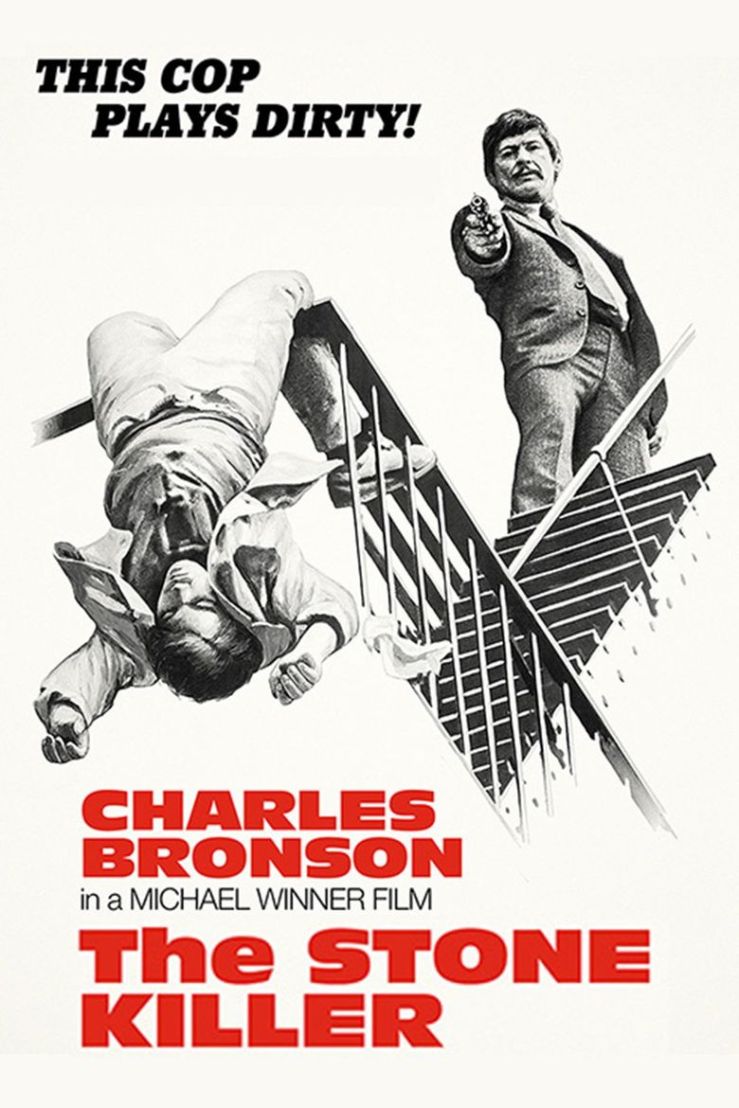
I was rather bummed about missing all of Anthology Film Archives’ 70s Buried Treasures series, programmed by Blue Underground founder William Lustig, so I was relieved when I clicked through SpeedCine and saw The Stone Killer listed. Charles Bronson is as inexpressive as ever in this right-wing actioner, but Michael Winner keeps the pace moving with expressive smash cuts while the idiosyncratic cast (Norman Lear, John Ritter, Martin Balsam) add varying notes of laconic style. Bronson is a violent cop marched out of NYC because he gunned down one too many perps, and before he can settle into his new L.A. gig, he’s drawn into the middle of a mob war. Also, a hippie commune is caricatured as a small-top circus who interpretive dance around camels. Conservative politics, solid action film mechanics, and a skyscraper stunt fall, all one could want from Bronson in the 70s.

Streaming Quality:      Great. Along with Hulu, it’s the sharpest, least artifact-y free VOD site around.

Commercial Interruptus:     Poor. 15 second ads appear approximately every 10 minutes. This is the price paid for higher video quality.

Burnt-In Logo: Great. The transparent logo is small and nestled in the bottom right hand corner. In widescreen films it doesn’t overlap with the image.

Aspect Ratio: Great. 1.85:1, correct and accounted for.

Selection: Great!  Along with The Stone Killer, I espied Bunny Lake is MissingComanche StationCalifornia SplitFat CityFull ContactHard TimesMickey OneOur Man in HavanaRide Lonesomeand Starman.

Summary: Crackle has really embraced ad-supported VOD, and the quality of the stream as well as the titles proves it. Along with Hulu, it’s the best site for free streaming movies. It’ll be interesting to see whether their model will end up more successful than Jaman’s rental-based model. Time will tell. The only downside: I memorized a Last House on the Left ad by the time my movie was over. Not a good thing.

***

Fancast

Movie Viewed: A Pocketful of Miracles, Frank Capra, 1961

From this point on, I did not view the films in their entirety, only the first 15 or 20 minutes to get a sense of the quality. That said, I would definitely want to return to this, Frank Capra’s final film, if only for the ridiculous display of character actor talent. Ahem: Peter Falk, Thomas Mitchell, Edward Everett Horton, Jack Elam…and it stars Bette Davis.

Streaming Quality: Poor. Image is fuzzy and there is artifacting visible on the edges of every object. Impossible to watch full-screen, tolerable in the normal size.

Commercial Interruptus:     Poor. Started off with a 15 second ad, then 10 minutes in there were back-to-back ads (one 30 sec., the other 15). I didn’t stick around to see what happened later…

Burnt-In Logo: Great! There isn’t one!

Aspect Ratio: Great! 2.35:1.

Selection: Average. Other titles included Witchfinder General (aka Conqueror Worm)Dillinger (1973 version), Kiss Me, Stupid,and Phaedra.

Summary: The last resort. If there’s no other way to view a film, by all means watch it on Fancast, but the poor streaming quality and excessive ads make it a less than pleasurable experience.

***

AMC B-Movies

Movie Viewed (20 min.): Dark StarJohn Carpenter, 1974

This off-beat sci-fi comedy was scratching me where I itch when I had to move over to the next site. Made at the low low price of $60,000, this was a student film project that took off (relatively speaking) when it’s stoner comedy Star Wars vibe struck a chord with college audiences. I’ll be going back to this one…

Streaming Quality: Average. Since the source material is poor, it’s impossible to judge fairly, but the feed was strong and clear, with a lack of major artifacting from what I could see. After a full viewing, I might have to bump this up a  notch.

Commercial Interruptus:  Great. Oddly enough, while their TV counterpart breaks up their films with ads, this internet portal has no commercials at all. Huzzah!

Burnt-In Logo: Poor. Uh-oh. There’s a giant honking AMC.com logo perched at the bottom middle-right of the screen. In a 1.33 film like Dark Star, it’s right in the middle of the action. It’s larger and further towards the middle than the other logos. Bad form.

Aspect Ratio: Great. With caveats. It appears to me that this print was cropped slightly on the sides, as some of the opening credits get cut off. Undoubtedly this is a problem on the original print, so I can’t really deduct imaginary points here. Plus I might be wrong.

Selection: Average. I’m playing it safe, since the rest of these schlocky titles are not my thing. Just a matter of taste. Although I like The Devil Dolland Shake, Rattle & Rock sounds rather irresistible (Fats Domino fights for the kids’ right to boogie).

Summary: A solid locale for VOD, lacking only in content. Which is a bit of a lack. But that’s just personal taste. The tech specs are up to snuff, and the lack of ads is refreshing.

***

Indie Movies Online

Movie Viewed (15min.): Greaser’s PalaceRobert Downey Sr., 1972

An absurdist western with midget romance, the plot summary tells us, and who am I to disagree? Dave Kehr says it’s “Reminiscent of Simon of the Desert, only without the ideas”. I’ll leave it to you to parse.

Streaming Quality: Great. Smooth and silky.

Commercial Interruptus:     Great. Starts with an ad for the site, but the feature had no ads at all for the time I was viewing.

Burnt-In Logo: Great. No logo at all.

Aspect Ratio: Average. The 1.85 image was non-anamorphic, letterboxed so there’s black bars on all four sides of a 16×9 screen. This was a result of the master they received, and no fault of their own, but I’m docking them anyway. Just for fun.

Selection: Poor. There’s literally nothing else I’d like to watch there. Seriously.

Summary: All the tech specs are great, but unfortunately its library is rather bare.

***

EZ Takes

Movie Viewed (20min.): The Outlaw, Howard Hughes, 1943

Famous for Jane Russell’s breasts and Howard Hawks’ firing. Also famous for the variety of public domain prints circulating the internet. Uh oh.

Streaming Quality: Poor.  This is like watching the movie through a hailstorm.

Commercial Interruptus:     Average. One 15 second ad to start, nothing afterward.

Burnt-In Logo:     Great. No logo.

Aspect Ratio: Great. 1.33:1 lives on.

Selection: Average. There’s no shortage of material, although most of it looks to be PD: D.O.A., My Man Godfreyand The Umbrellas of Cherbourg (licensed from Koch). As much as I love VOD, watching Cherbourg on streaming video should be some kind of crime.

Summary: EZ Takes seems to use their free feeds as advertisements for their downloads, which they state are DVD quality. Since the streams are so poor, there’s little reason to use this as a VOD site, although it’ll do for a quick fix if desperate.
MOVIES ON HULU: AN INVESTIGATION

August 4, 2009

MV5BZGM3ZDNjYTYtOTFiMS00NzcxLWJjN2UtNzhmN2Q5OTVmMmYxXkEyXkFqcGdeQXVyMjUyNDk2ODc@._V1_

The fabulously popular streaming video site Hulu is useful for keeping abreast of contemporary pop-culture effluvia, sure, but if one peeks into their dusty old movies section, there’s an eclectic collection of auteur rarities, 50′s horror, Poverty Row Westerns, and public domain slapstick comedies to be unearthed. With only 3.77% of the titles listed on TCMDB available on home video, dutiful cinephiles need to devour repertory screenings, lobby intractable studios, and pluck the desirable titles out of what is available, and so Hulu is another prime portal to chip away at our film-historical ignorance. I had used it primarily to catch up with TV series I had fallen behind on (like the ubiquitous 30 Rock), but in researching my piece on Bruce Surtees last week, I discovered that Don Siegel’s The Beguiled was streaming for free on the site. Delving into their archives produced a fascinating hodgepodge of titles, some of which are quite hard to see otherwise. Below the fold is a list of titles ready to view on Hulu that I’m eager get to know, and others with which I’m already in committed relationships (with selected commentary, and each title links to its page on Hulu).

Blackmail, 1929

The 39 Steps, 1935

Secret Agent, 1936

Sabotage, 1937

The Lady Vanishes, 1938

Five Hitchcocks. No explanation necessary.

Anne of the Indies, 1951

This is a pirate swashbuckler starring Louis Jourdan and Jean Peters from director Jacques Tourneur, and rated highly by Chris Fujiwara in his definitive study of the director, Jacques Tourneur: The Cinema of Nightfall. This is not on DVD, but occasionally pops up on the Fox Movie Channel, where it’s still sitting on my DVR. Fujiwara says that “Anne of the Indies often gives the impression of a perpetual-motion machine: characters appear and disappear in flurries of back-and-forth activity. [snip] Through these hesitations and shifts, the film suggests the avoidance of something inexpressible, acknowledging that the narrative is based on a lack that can be filled only be fantasy.” Intrigued? Yes. Yes you are.

Bachelor Flat, 1961

No less a personage than Andrew Sarris claimed that this CinemaScope comedy is Frank Tashlin’s best film. Better than Artists and Models and Will Success Spoil Rock Hunter? Is that even possible? Apparently, yes, led by Tuesday Weld’s impossibly moon-shaped face and a wily dachsund’s dinosaur bone obsession.

The Beguiled, 1971

I briefly discussed Don Siegel’s libidinous masterpiece last week, but I’m eager to recommend it again. An autumnal American gothic set at a boarding school for girls during the Civil War, it unleashes the violent power of adolescent sexuality, against which Clint Eastwood has little hope.

Bigger Than Life, 1956

James Mason imprisoned in 1950s America, gets hooked on cortisone and becomes a macho gargoyle. A major work from Nicholas Ray.

Breezy, 1973

Underrated Eastwood. With his second feature, Clint detours into light comedy with dark undercurrents. William Holden’s decadent playboy falls for the whims of an 18 year old hippie (Kay Lenz). Holden’s cratered face and Lenz’ airy chatter fill the screen.

Cul-de-Sac, 1966

Roman Polanski’s black comedy follow-up to Repulsion.

Fixed Bayonets, 1951

Early Sam Fuller (right before the great Park Row (1952)), and his second Korean War film, after The Steel Helmet (1951). This one is set in the snowy climes of Heartbreak Ridge, and is highlighted by the pearls of sweat accumulating on the soldier’s faces as they cross an iced minefield. Extreme close-ups for extreme times.

His Girl Friday, 1940

Everything is at an angle, from Rosalind Russel’s wide-brimmed hats to Cary Grant’s smirk that almost tumbles to the floor. The dialogue burns through their defenses, until love is in the air. One of Howard Hawks’ greatest films, and so one of the greatest ever.

The Knack…and how to get it, 1965

Richard Lester perfects the mod film.

The Last Man on Earth, 1964

Vincent Price perfects the Richard Matheson story “I Am Legend”. Sorry Will Smith!

The Stranger, 1946

Mr. Arkadin, 1962

Two samplings of Orson Welles, the first his stab at commercial relevancy, the second a European co-production with echoes of Citizen Kane. Both suffering from studio/producer interference. I prefer the latter’s fake noses and tipsy cinematography to the former’s expressionist flourishes, but I won’t hold it against you if you disagree.

Night of the Living Dead, 1968

The series that won’t die. George Romero will debut his latest zombie-fest, Survival of the Dead, at this year’s Toronto Film Festival. See what all the fuss is about.

The Private Life of Sherlock Holmes, 1970

Before subjecting yourself to Guy Ritchie’s roided up version of the Holmes legend, sample Billy Wilder’s mellow, melancholy take on the natty inspector.

Rings on Her Fingers, 1942

In an attempt to cash in on the success of The Lady Eve, Fox tried their own con-artist romantic comedy, and signed on Henry Fonda to re-create the magic. Rouben Mamoulian was no Preston Sturges at this point in his career, although the results are sure to be diverting.

The Spikes Gang, 1974

Richard Fleischer’s light-hearted bank robbing movie finds fatherly outlaw Lee Marvin taking on three young kids (including Ron Howard) to form the least intimidating gang in the Wild West.

The Taking of Pelham, 1 2 3, 1974

White Lightning, 1973

Or, the curious case of Joseph Sargent. Sargent, a TV lifer, took some time out in the 70s to crank out a couple of genre whitelightningclassics. Then he moseyed on back to the small screen. White Lightning is a rousingly entertaining Southern revenge drama, starring Burt Reynolds at his aw shucks peak. Taking of Pelham is a no-nonsense police procedural recently remade by Tony Scott. His unfussy direction and his talent for working class argot shines in both features, with White Lightning taking the crown because of a stronger emotional pull, especially in an extraordinarily surreal sequence in an unwed mothers home. Also because of Ned Beatty, whose laid-back menace slithers out of every sweat-oozing pore.

Thunder Birds, 1942

A William Wellman pilot melodrama, with Gene Tierney. That’s enough for me.

Time Limit, 1957

The only film Karl Malden directed. Rest in peace.

The Train, 1965

John Frankenheimer’s sturdy actioner starring Burt Lancaster. He has to transport some fine art under the noses of Nazi scum. Frankenheimer knows how to handle pace and Lancaster’s torso.

Vigilante Force, 1976

Another Southern good-ole-boy action film, this one a cheap knockoff of Phil Karlson’s Walking Tall (1973), directed by George Armitage, who later went on to film Grosse Point Blank 20 odd years later. Instead of Joe Don Baker in Walking Tall though, the lead vigilante is Jan Michael Vincent. Not a good trade-off, although Kris Kristofferson is around to add some shirtless, mellow menace, a young Bernadette Peters belts out a few numbers on the periphery, and there is some jaw-dropping stunt falls in the final (ridiculous) shootout. It also musters a handful of memorable lines. The town in CA just opened an oil field, and two government employees talk shop: “Thank God for the energy crisis! Thank Allah!” And another on the influx of wildcatter oilmen: “If I wanted to live with degenerates I’d move to L.A.” Truer words have never been spoken.