STILL SINGING: SINGIN’ IN THE RAIN and COVER GIRL

July 17, 2012

Screen Shot 2020-02-04 at 3.03.04 PM

Singin’ In the Rain (1952) is 60 years young in 2012, a birthday which Warner Brothers is celebrating with a dazzlingly remastered Blu-ray that comes out today. Richly textured with popping primary colors, this is the best the film will look outside a screening of a new 35mm print. Last week, the boutique home video distributor Twilight Time released a Blu-ray of Cover Girl (1944), the first film in which Gene Kelly and Stanley Donen were given free rein to choreograph their own dance routines, under the auspices of director Charles Vidor. Licensed from Columbia Pictures, the transfer of this Technicolor film is dark with fluctuating color intensities – Rita Hayworth’s hair doesn’t quite blaze off the screen like it should. That technical quibble aside, these releases are a wonderful excuse to revisit the work of Kelly and Donen, and what struck me this time around was the violence of some of their routines, borne out of a melancholy that would come to the fore in their final collaboration, It’s Always Fair Weather (1955).

Cover Girl was promoted as the first musical to integrate its musical numbers into the plot, arising out of and advancing the story. There are sure to have been predecessors, but this was the biggest hit, and became the most influential. The story is a boiler plate backstage musical, with dancing girl Rita Hayworth rocketing to stardom after winning a magazine cover girl contest, and having to struggle with leaving her nightclub manager Gene Kelly for the bright lights of Broadway. The story arc is a predictable drag, but the film has some incredible compensatory pleasures, from its score to its choreography.

Rita Hayworth’s Svengali Harry Cohn was not enthused with the casting of Gene Kelly and his “tough Irish face”, and Columbia originally wanted to borrow Dennis Morgan from Warners to play the lead. Kelly was slated to appear in Dragon Seed (1944), but when that project was postponed, MGM extended his loan out to Columbia, and movie history was made.

It’s a film of firsts. It was Jerome Kern and Ira Gershwin’s first pairing for a film production, writing the future standard “Long Ago and Far Away”. And then there is Kelly and Donen being granted creative control of their routines, a canny move by producer Arthur Schwartz. You can see the duo bursting with inventiveness, eager to break out of the stodgy confines of the story. The most famous is the “Alter Ego” dance routine, in which Kelly confronts his conscience over Hayworth stepping out with another man, dancing a duet with his super-imposed image on the dark studio streets of New York, the rage-filled inverse to the title Singin’ in the Rain softshoe. He chases himself across the street, each mirror-image seeming to pull the string on the other, until the “real” Kelly destroys the superimposed one by smashing his image with a garbage can. Cover Girl doesn’t dare play out the self-destructive impulses this sequence implies.

Singin’ In the Rain is such a contradictory pleasure, a film that parodies the artificiality of film construction, but in turn uses that construction to create one of the most giddily entertaining movies of the period. This is encapsulated in the “You Were Meant for Me” ballad, sung in an abandoned sound stage. We see Kelly arrange the set, flicking on the fill lights and industrial-strength fan, and watch Debbie Reynolds ascend a ladder and arch her back to appropriately catch the artificial wind and rays. But by the end of the sequence, as Jane Feuer wrote in her seminal The Hollywood Musical, “the camera arcs around and comes in for a tighter shot of the couple…reframing to exclude the previously exposed equipment. We regress from an expose of romantic duets to an example of a romantic duet.” I would quibble with her use of “regress”, but there is definitely some sleight-of-hand here, except we have already been shown how the trick works.

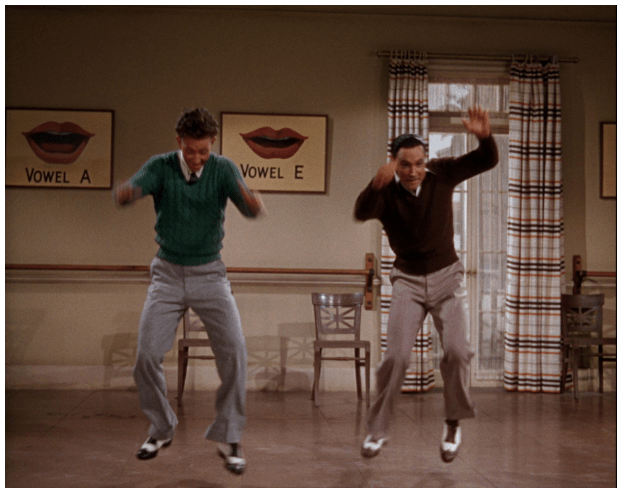
This trick also appears in my favorite number in the film, and one of the two original songs (along with “Make ‘Em Laugh”, “Moses Supposes”.The pleasure of the sequence comes out of the seeming sponteneity of their actions, from twirling a tie to using curtains as veils. But of course this sequence was meticulously planned out. It’s hard to make something look this easy. Violently anarchic, this elocution lesson ends up, as in the “Alter Ego” number, with up-ended trash cans and a feeling of ecstatic release. This is pitched in a comic rather than dramatic mode, with Kelly and Donald O’Connor parodying the nasal stuffiness of the teacher by inventing a nonsense rhyme and tap-dancing the room into submission.This introduces another favored Hollywood trope, that of upsetting the apple cart of “high art” with the more spontaneous, communal pleasures of the low arts; in Singin’ in the Rain, it’s vaudeville. This theme is brought to its apex in Vincente Minnelli’s The Band Wagon, but it’s present here too, most famously in the opening montage, in which Kelly’s gaseous voice-over about “Dignity, always dignity”, is replaced with the reality of his hoofing it as a vaudevillian and stunt man.

“Alter Ego” allowed Kelly to cut loose without the less schooled dancer Hayworth, and the same is true here, with Kelly paired with the astoundingly athletic O’Connor, and they end up stamping an office table, tapping on a pair of wooden chairs before trashing the room. When Kelly is paired with a classically trained dancer in Cyd Charisse for the “Broadway Melody” routine, it can only be done in a fantasy sequence, so the down-to-earth quality of Kelly’s character is not upset by the delicacy of his sublime work with Charisse. Her impossibly sharp angles and Kelly’s rounded movements melt into an inflammatory erotic reverie, punctuated by those delirium inducing ascending crane shots. It is another privileged moment when Kelly loses his grip, and it is moments like these that make up  It’s Always Fair Weather, in which army buddies reunite and realize their past friendship may have been a sham.  Kelly threatens to finally fall apart completely, but instead he simply loses his audience, and that film signaled the end of the classical Hollywood musical.

JAPAN CUTS: THE NEW YORK FESTIVAL OF CONTEMPORARY JAPANESE CINEMA

July 10, 2012

Screen Shot 2020-02-04 at 2.58.55 PM

For the sixth year running, the Japan Cuts film series in New York City presents an eye-opening glimpse of contemporary filmmaking from across the Pacific, the vast majority of which will never receive distribution in the United States. Programmed in concert with the ongoing New York Asian Film Festival (which I covered for Film Comment), it runs from July 12 – 28 at the Japan Society, and will screen 37 features and two shorts. The normally sober-minded fest has gone pop this year, booking a slate bubbling with hyperactive rom-coms and sci-fi extravaganzas, but there is also a sidebar of films responding to the Fukushima nuclear disaster, as well as a tribute to the expressively stone-faced actor Koji Yakusho, who will appear in-person for the screening of The Woodsman and the Rain (2011).

Japanese studios wring established brands as dry as any Hollywood outfit with a superhero license, as the caffeinated pleasures of Love Strikes! (2011) can attest. It’s a manic romantic comedy adapted from a hit TV show (Moteki, 2010), which was in turn the small screen version of a blockbuster manga comic book by Mitsuro Kubo. Toho, the largest Japanese production and distribution company, dominates the native box office with re-dos such as these, especially the endless iterations of anime behemoths Pokemon and Doraemon.

Love Strikes! was a solid hit in 2011, and it is a cross-promotional machine, playing clips from what seems like every J-pop band of the last twenty years. But instead of a bubblegum-tween romance, it’s pitched towards an older crowd, aiming for the instant nostalgia of the early-30s set. The main character is Yukiyo Fujimoto (the mousy Mirai Moriyama), a 31-year-old virgin who quotes Goethe and reads way too deeply into teen pop lyrics. He gets a job at an internet culture magazine, but is thrown through a loop when the perky hip chick Miyuki (Masami Nagasawa) responds to his music nerd musings on Twitter (Yukiyo: “Someone register her as a world heritage site”). Director Hitoshi Ohne (ported over from the TV show), slathers the screen with scrolling Twitter pages and karaoke lyrics, topped off with Fujimoto’s self-doubting voice-over.

The highlight of this ADD-cinema is an impromptu music video featuring girl group trio Perfume, who dance through Tokyo with Yukiyo to their hit “Baby Cruising Love”, enacting his budding self-actualization. I was largely won over by this shock and awe pop assault, deluded male fantasy though it is, thanks to its witty screenplay by Ohne and an energetic performance by Nagasawa (justly deserving of the festival’s Rising Star award), who injects her thankless object-of-nerd-lust role with an unexpected aggressiveness and spunk. The third act devolves too far into passive male wish-fulfillment, but Ohne keeps the visuals popping around it.

The Closing Night film of the festival is another Toho-stravaganza, the sci-fi spectacular Space Battleship Yamato (2010), a live-action adaptation of the much beloved 1974 animated series. Directed by visual effects specialist Takashi Yamazaki, director of the Japan Academy prize winner Always, it pushes the limits of Japanese FX technology, sometimes to the breaking point. The story is ultra-nationalist, pushing themes of self-sacrifice to self-destructive lengths (the Yamato was the lead Japanese battleship in WWII). It follows one-time rebel Susumu Kodai (Takuya Kimura), who learns to love the military after the country is attacked, and about to be decimated by, the alien Gamilas. With a $29.4 million dollar budget, it is a major production, but the scale of the film needs Hollywood-style cash, and some of the alien worlds lack detail and dimensionality, giving them a video-game flatness. The film has a lack of self-consciousness in its propaganda, kind of Starship Troopers played straight, which to be honest has a refreshing pulp quality to it, as men speak in clipped moralistic phrases and rush around feverishly blinking panels.

Koji Yakusho doesn’t need flash to sell tickets. With his prominent cheekbones, piercing stare, and air of calm reserve, he could be a model, an assassin, or a model assassin, but instead he has chosen roles of subtle dramatic gradations, including the rumpled detective in Kiyoshi Kurosawa’s Cure, or the crusty old patriarch in  Chronicle of My Mother (2011), another Toho-hit, in which he grapples with the growing senility of his mother. It’s a solid family drama, the kind of well-crafted multi-generational weepie even second-tier Japanese directors like Masato Harada can churn out with ease. Although not on the level of Yoji Yamada’s About Her Brother (2010) or Hirokazu Kore-eda’s Still Walking (2008), Harada uses distanced camerawork and detailed 50s era art direction to emphasize the distance he has set up between his own family members. Kirin Kiri is endearingly batty as his equally withholding mother, and their inevitable emotional breakthrough is underplayed so well that Yakusho’s grin has the same impact of a full-throated sob.

Yoshihiro Nakamura is a director who deals with Toho but has been able to maintain an individual artistic identity. While making cash-grabbers for Toho like last year’s dreadful-looking Eiga Kaibutsukun (watch the trailer – if you dare) he has also pursued a productive collaboration with mystery novelist Kotara Isaka , whose twisting Rube Goldberg narratives Nakamura has adapted multiple times over the years. His breakthrough film in the West was the briskly entertaining Fish Story (2009, available on DVD and streaming on Netflix) in which a long-forgotten punk song from 1975 inadvertently prevents the Earth from getting creamed by an asteroid in the present. Then in 2010 Nakamura adapted Isaka’s Golden Slumber (2010), a rather plodding conspiracy narrative that piles on subplots without Fish Story’s fleet pacing. Golden Slumber was Isaka’s first novel translated into English, with the title changed to Remote Control.  Last year found Nakamura take a break from Isaka’s work, and made his simplest and most affecting film, A Boy and his Samurai (aka Chonmage Purin, 2010). A sweetly sentimental fish out of water comedy, it plops a time-traveling samurai into modern Japan, who promptly becomes a master pastry chef.

This year has Nakamura return to Isaka’s work, adapting one of his short stories for Chips (aka Potechi, 2012), a svelte 68 minute comedy that combines the deadpan humor and narrative web of Fish Story with the naked emotionality of A Boy and His Samurai. Partly funded by the Sendai Miyagi Film Commission, Chips was shot in Sendai, and was recruited to help bring business back to the city, so devastated by the earthquake and subsequent tsunami of 2011. That is why Chips is included in the Japan Cuts sidebar, “Focus on Post 3.11 Cinema”, which consists of four fiction films attempting to respond to those events, including Toshi Fujiwara’s No Man’s Zone and Masahiro Kobayashi’s Women on the Edge. You can read more about them in Dennis Lim’s NY Times piece here.

Chips begins with Imamura (Nakamura regular Gaku Hamada) and Kurosawa (Nao Ohmori) watching an empty stage in the park. Imamura is the funny one, and Kurosawa the serious one, playing off the personas of their famed director namesakes. Their circuitous actions will fill the stage of the screen, set in motion when Imamura answers the phone during one of his petty thievery jobs, one of those small actions that has epic existential effects in Nakamura’s world. The girl who answers is threatening to commit suicide. He talks her down, but then the two of them are sitting during another robbery, and another phone rings. This time they are ensnared in a blackmail ring involving the baseball player Ozaki. Stories sprout new stories, all of them tinged with loss, from the prospective suicide to the final revelation, which opens up doubt about Imamura’s own identity. Imamura’s life becomes doubled with Ozaki’s, ending at a baseball game that unfurls with the compressed ritual intensity of kabuki theater, one that will shake the two men’s destinies apart. It is a wildly melodramatic and deeply sad conclusion, which pushes Imamura into a place where he is cheering for the destruction of his own identity. All this is accomplished with an unobtrusive fixed camera, usually focused on Hamada’s slackjawed moon face, which looks as if it is in a perpetual state of stunned surprise, which is a decent description of Nakamura’s audience as well.

Toshiaki Toyoda has staked out a less accommodating stance with the studios, and has become persona non grata since his arrest for drug possession in 2005. His new film Monsters Club is an unsettling re-telling of the Unabomber story, complete with a mail-bomb POV shot, from construction to explosion. Shot over two weeks without a script in snow clogged mountains, its method of shooting was as mad as its main character. Although it opts for rote pop-psychology explanations by the end, the visuals are far more unsettling, especially the hallucinations of colored shaving cream covered swamp people designed by transgender Japanese artist Pyuupiru.

This year’s Japan Cuts holds fascinating insights into how the Japanese commercial cinema works these days, which is not too far off from our own much-maligned Hollywood model of the necessity of “brand-awareness”. As Love Strikes! shows, though, these pre-digested products don’t have to be creatively diluted, as long as they fulfill their promotional duties first. Yoshihiro Nakamura is the most intriguing figure here, one who seems to be able to float back and forth between Toho-blessed A-pictures and his own little curios, much like the soon to be retired Steven Soderbergh. It will interesting to see how long he can survive the balancing act, before getting burned out and frustrated like his American counterpart.

THE BATTLE HYMN OF REPUBLIC PICTURES

July 3, 2012

Screen Shot 2020-02-04 at 2.55.14 PM

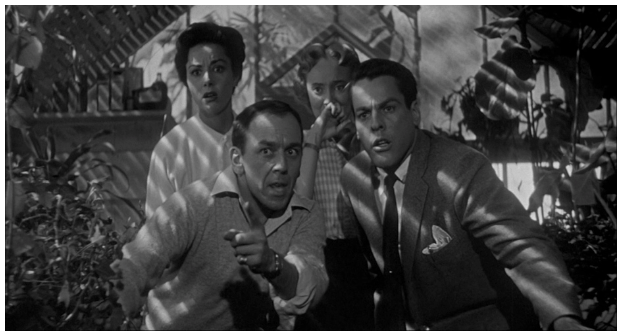
On July 18th, Olive Films will begin their roll-out of the Republic Pictures library with DVD/Blu-Ray releases of High Noon (1952) and Invasion of the Body Snatchers (1956). Republic has long been one of the most underutilized holdings in the home video market, passing from corporation to corporation with little concern for the treasures it contained. But upstart Olive has closed a massive licensing deal with Republic parent Paramount Pictures, and is set to release a flood of material (from B-Westerns to prestige pics) in 2012 that had mostly been overlooked in the digital age. While these first two releases have been well-represented on DVD, it is their premiere on Blu-Ray, and there are plenty of rare gems coming down the pike (all transferred in HD), including Nicholas Ray’s Johnny Guitar,  Fritz Lang’s Secret Beyond the Door and Orson Welles’ Macbeth.

Herbert J. Yates began his career in film processing in 1915. By the 1930s his Consolidated Film Laboratories was a major developer of B-film. As the Great Depression sent many Poverty Row studios into the red, Yates took them over, combining six companies (Monogram, Mascot, Liberty, Majestic, Chesterfield and Invincible) into one Republic in 1935. They made money off of disreputable serials and Westerns, giving daredevil action directors like William Witney endless opportunities to hone their craft on a shoestring budget.

Witney started his career at Mascot, riding horses in films for his brother-in-law, and director, Colbert Clark. Witney directed his first film, The Painted Stallion (1937), for Yates, and remembers the set-up in his autobiography, In A Door, Into a Fight, Out a Door, Into a Chase:

Republic’s main office was in New York where taxes were lower than in California, and Consolidated Film Industries, which made all the release prints, was located next door in Fort Lee, New Jersey. The office in New York City was located at 1776 Broadway…

Then, after Yates bought out the last of the executives from the six former companies, Witney writes, “I will say one thing for him. He screwed a lot of very smart men.” Witney wasn’t one of them, working productively for the company in serials (Daredevils of the Red Circle, The Adventures of Captain Marvel), Roy Rogers Westerns and teen-sploitation (Juvenile Jungle, Young and Wild) until the company was sold in 1959. It was because of money-making B-pictures like Witney’s that Yates had the money to invest in prestige productions like Orson Welles’ Macbeth and John Ford’s The Quiet Man and (the less expensive) The Sun Shines Bright. Yates rubbed Ford the wrong way, as the curmudgeonly director told biographer Joseph McBride, regarding The Sun Shines Bright:

Well, they didn’t ruin it, they couldn’t ruin it. But they cut a lot out of it. You’re working with a stupid lot of people, the executive producers, so what the hell, you’ve got to expect it.

But whatever his shortcomings as a producer and a shameless money-grubber, Herbert J. Yates, through accident or circumstance, funded some of the glories of the Hollywood Classical Cinema, both the high art of Ford and the low of Witney, and for that he deserves our reluctant thanks.

Yates sold his company’s library in toto to National Telefilm Associates (NTA) in ’59, bowing to the rising dominance of television. They had severely curtailed production, and were mainly making their money selling TV rights anyhow.  A Dec. 23rd, 1957 issue of Billboard announces the sale of syndication rights to NBC of 218 features and 15 serials for $3,5000,000, with the writer noting that, “the move by Republic to put its package in active sales is concurrent with reports that the studio is in the process of terminating film production.” At this point the demand for B-pictures had disappeared, as the 1948 anti-trust Paramount Decision had divested the studios of their theater ownership. They could no longer “block-book” their product and force theater managers to run whatever they sent them.

NTA made money syndicating the TV rights, with the rise of cable TV in the 1980s reinvigorating profits, leading them to change their name to Republic in 1986, and producing their own TV shows like Beauty and the Beast (1987). In 1994, Aaron Spelling Productions purchased NTA/Republic, and essentially used it as a distribution arm, and as a name to sell its own projects, completely divorced from the low-budget studio it once was. Now Republic Pictures Home Video would release a Spelling mini-series like James Michener’s Texas on VHS, while Johnny Guitarlanguished in the vaults. This was followed by some swift multinational swallowings, as Blockbuster purchased Spelling, and then Viacom bought Blockbuster. The Republic library then became the custody of the Viacom-owned Paramount Home Entertainment, all by the end of 1995.

There had been sluggish attempts to release the Republic library on home video during this period. Spelling licensed it to Artisan Video in 1995, who released The Quiet Man and a few others until the company was gobbled up by Lionsgate in 2003. Artisan’s rights expired in 2005, reverting briefly back to Paramount, but Lionsgate then decided to renew this license for another six years, starting in 2006. For what must have been effective but arcane accounting reasons, Lionsgate effectively sat on the Republic library. They released the comparatively unknown Arch of Triumph (1948), Only the Valiant (1951), and One Touch of Venus (1948) on DVD, but left the vast, and vastly better known, titles sitting on the shelf.

Once Lionsgate’s laissez-faire reign ended this year, Olive Films leapt into the fray, manically licensing Republic titles from Paramount, and almost immediately putting them into production. In the first few months of their stewardship, Olive will have released more of the Republic library than Artisan, Lionsgate and their forebears combined. As fast as they are releasing them, there are some quality control concerns, but the early returns are encouraging.  Both High Noon and Invasion of the Body Snatchers have received high marks from tech review site Blu-Ray.com, as well as my own eyes. The transfers are clean and sharp with rich contrast. Paramount’s archival wing had obviously had done strong HD transfers on these, and Olive presents them with no digital blow-drying. High Noon comes with a making-of documentary, while Invasion contains no extras, which is the norm for the company. And while Olive has had notoriously poor cover art in the past, their Republic discs all seem to have original poster artwork – a huge improvement over some of their early Photoshop jobs.

While it would have been ideal for Paramount to push its massive resources behind the restoration and release of the Republic library, perhaps it’s more appropriate for the scrappy and relatively under-funded Olive Films to do the job. Releasing its discs quickly, efficiently and with little marketing muscle, the Republic Pictures library has finally found a licensor that can match its huckster spirit, and that has the smarts to take advantage of other companies’ mistakes.

ANDREW SARRIS, 1928-2012

Originally published at Movie Morlocks, the official blog of Turner Classic Movies

June 26, 2012

Screen Shot 2020-02-04 at 2.50.41 PM

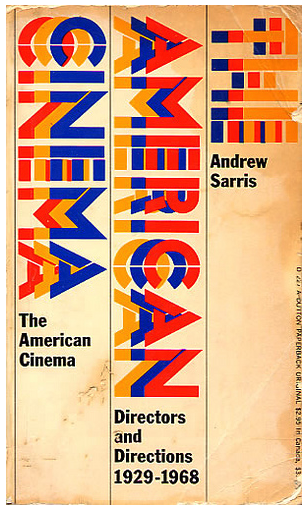
The influence of Andrew Sarris’ film criticism has become so omnipresent it is now invisible, part of the received wisdom of how we approach and watch movies. This has only become clearer after his death last week at the age of 83.  You can see his mark in the marketing of the upcoming “Hitchcock Masterpiece” Blu-Ray collection from Universal, and in every movie review that even mentions the name of the director. The auteur theory will be his legacy, regardless of how often it is misinterpreted as some kind of iron law rather than the policy of “perpetual revaluation” that he proposed it as.  Enough has been written about auteurism though, and not enough about the constant sense of discovery in reading his seductively winding prose. He approached films like an explorer, traveling down a multitude of paths, be it historical, stylistic or even personal, searching methodically for flashes of insight or originality, whether from the director or any of the film’s collaborative artists. His sentences would gather long strings of actors, colors and themes, as list-happy as in The American Cinema, seemingly sussing out his opinion along the way – a perambulating, open-air kind of criticism where interruption, digression and contradiction are welcome.

There are plenty of moving and detailed remembrances of Mr. Sarris around the internet (Matt Singer has gathered tributes at Indiewire, as has David Hudson at the Fandor Keyframe blog), so instead I asked a number of writers and academics to choose their favorite excerpts of his writing (Tom Gunning recited his from memory!), and to add comments if they had any. Below I have listed their responses, while including my own favorite Sarrisms at the end.

Guest Selections of Sarris’ work

Tom Gunning,  A. and Betty L. Bergman Distinguished Service Professor at the University of Chicago, Department of Art History, Department of Cinema and Media Studies

Entry on Ernst Lubitsch (Pantheon), The American Cinema:

For Lubitsch, it was sufficient to say that Hitler had bad manners, and no evil was then inconceivable.

Besides  showing how  concise and precise he could be, it shows Sarris’ ultimate values. In an era when it was claimed films were valuable only if they had Big Ideas (e.g.. Ingmar Bergman) or made Big Statements (e.g. Stanley Kramer), Sarris upheld  film style, not simply as a decorative function, but as the true means of expressing a judgement on the world and the people in it. He showed that the great directors of American cinema were great because they had style. Sarris had style. -Tom Gunning

***

Adrian Martin, writer, film critic, teacher

Q&A at the University of Washington, 1987 (transcription at Film Comment):

People talk about Platoon being a great war film. A great war film is Madame de… – the Stendhalian battle of love.

***

Miriam Bale, editor of Joan’s Digest, freelance critic and programmer

Review of Robert Aldrich’s …All the Marbles (Village Voice, 1981):

I cannot explain my feelings exactly, but when I left that theater of gutter trash, The National Theater, after a showing of …All the Marbles, I felt cleansed, exhilarated, almost sanctified.

***

Michael J. Anderson, Ph.D. candidate at Yale University, proprietor of the blog Tativille

Entry on John Ford (Pantheon), The American Cinema:

A Ford film, particularly a late Ford film, is more than its story and characterizations; it is also the director’s attitude toward his milieu and its codes of conduct.  There is a fantastic sequence in The Searchers involving a brash frontier character played by Ward Bond. Bond is drinking some coffee in a standing-up position before going out to hunt some Comanches. He glances toward one of the bedrooms, and notices the woman of the house tenderly caressing the Army uniform of her husband’s brother. Ford cuts back to a full-faced shot of Bond drinking his coffee, his eyes tactfully averted from the intimate scene he has witnessed. Nothing on earth would ever force this man to reveal what he had seen. There is a deep, subtle chivalry at work here, and in most of Ford’s films, but its never obtrusive enough to interfere with the flow of the narrative. The delicacy of emotion expressed here in three quick shots, perfectly cut, framed and distanced, would completely escape the dulled perception of our more literary-minded critics even if they designed to consider a despised genre like the Western. The economy of expression that Ford has achieved in fifty years of film-making constitutes the beauty of his style. If it had taken any longer than three shots and a few seconds to establish this insight into the Bond character, the point would not be worth making. Ford would be false to the manners of a time and a place bounded by the rigorous necessity of survival.

***

Gina Telaroli, filmmaker and video archivist

Review of Psycho (Village Voice, August 11, 1960):

Psycho should be seen at least three times by any discerning film-goer, the first time for the sheer terror of the experience, and on this occasion I fully agree with Hitchcock that only a congenital spoilsport would reveal the plot; the second time for the macabre comedy inherent in the conception of the film; and the third for all the hidden meanings and symbols lurking beneath the surface of the first American movie since “Touch of Evil” to stand in the same creative rank as the great European films.

A wonderful riff on the importance and joys of repeat viewings, with my favorite movie as the subject. -Gina Telaroli

***

C. Mason Wells, IFC Center

Entry on Buster Keaton (Pantheon), The American Cinema:

The difference between Keaton and Chaplin is the difference between poise and poetry, between the aristocrat and the tramp, between adaptability and dislocation, between the function of things and the meaning of things, between eccentricity and mysticism, between man as machine and man as angel, between the girl as a convention and the girl as an ideal, between the centripetal and the centrifugal tendencies of slapstick.

***

Brynn White, film researcher and writer

Review of Marnie (Village Voice, July 9, 1964):

Eisenstein may be spinach, pure iron for aesthetic corpuscles, and Dreyer high protein for the soul, but Hitchcock has always been pure carbohydrate for the palate.

Cinema was, as this quote literally illustrates, Andrew Sarris’s subsistence. Its a hearty twist on the Sarris categorization impulse, complete with unrealized fantasies of an auteur nutritional pyramid or all-you-can-eat buffet. To see Sarris and Molly Haskell introduce a film in all their symbiotic majesty was perhaps the most delectable treat; the duo’s fluid extemporization offered an intimate peek into a long evolving, near cosmic shared life in cinephilia, more seemingly pure than today’s blogs and internet forums. He showed film lovers how to build a happy home, body and mind in the dark. He excused us for letting the medium into our bloodstreams. -Brynn White

***

David Phelps, film critic and programmer

Entry on Raoul Walsh (The Far Side of Paradise), The American Cinema:

The Fordian hero knows why he is doing something even if he doesn’t know how. The Hawksian hero knows how to do what he is doing even if he doesn’t know why. The Walshian hero is less interested in the why or the how than the what. He is always plunging into the unknown, and he is never too sure what he will find there. There is a pathos and vunerability in Walsh’s characters lacking in the more self-contained Ford and Hawks counterparts. Where Ford shifts from the immediacy of the slightly depressed heroic angle to the horizon line of history, and Hawks remains at eye level, Walsh often moves to the slightly elevated angle of the lost child in the big world…If there is no place in the cinema for the virtues and limitations of Raoul Walsh, there is even less place for an honestly pluralistic criticism.
The last line is, of course, revealing: the filmmakers may plug into big themes of Americana, but it’s for the critic to take the role of Walshian explorer in a morass of movie-history, to be “less interested in the why or the how than the what”—as Sarris’ own passage shows in discussing thematics with blithe concern for anything other than how they structure the movements of the movie and the experience watching it. -David Phelps

***

Raya Martin, filmmaker

“Godard and the Revolution” (Village Voice, April 30, 1970):

The death of an artist is too high a price to pay for the birth of a revolutionary, even when the revolution seems to make more sense than ever before.

***

Michael Lieberman, filmmaker, filmgoer

Entry on Jean Renoir (Pantheon), The American Cinema

Renoir’s career is a river of personal expression. The waters may vary here and there in turbulence and depth, but the flow of personality is consistently directed to its final outlet in the sea of life.

After BAMcinematek’s 2010 retrospective of Renoir, I glanced over these two sentences, repeatedly. How often had a writer managed to nail the heart of the matter of a great artist, while also elevating their work? In that typically brisk and gorgeous summation, Sarris did just that. -Michael Lieberman

***

Aaron Cutler, critic

Review of Easy Rider (Village Voice, July 3, 1969)

We are simply too close to the popular cinema of today to read it correctly. If American movies today seem too eclectic, too derivative, and too mannered, so did they seem back in the twenties, the thirties, the forties and the fifties…Out of all the mimicry of earlier times emerged very personal styles, and there is no reason to believe that the same thing will not happen again and again. Hence beware of all generalizations, including this one, perhaps especially this one, because it is just remotely possible that after all the false cries of doom, the cinema might actually be racing to the creative standstill so long predicted for it. But I doubt it. It is not the medium that is most likely to get old, tired, and cynical, but its aging and metaphysically confused critics. This particular critic has never felt younger in his life.

What made Andrew Sarris a great critic, more so than any body of knowledge, I think, was his consistent approach to movie-reviewing: To be as generously open-minded as possible within personal limits, of which one always does one’s best to stay good-naturedly self-aware. -Aaron Cutler

***

My Selections

“Preston Sturges Recalled by Andrew Sarris” (Film Culture, No. 26, Fall 1962):

What distinguishes Preston Sturges from his contemporaries is the density and congestion of his comedies. The Breughel of American comedy directors, Sturges created a world of peripheral professionals – politicians, gangsters, executives, bartenders, cab drivers, secretaries, bookies, card sharps, movie producers, doctors, dentists, bodyguards, butlers, inventors, millionaires and derelicts. These were not the usual flotsam and jetsam of Hollywood cinema, but self-expressive cameos of aggressive individualism. With the determinism of the Sturges plots, these infinitely detailed miniatures served as contingent elements, and it is these elements, and the single-take, multiple viewpoint sequences formally demanded by these elements, which establishes the comedies of Preston Sturges once and for all as comedy/not tragedy.

***

The Films of Josef Von Sternberg, p.15 (The Museum of Modern Art, 1966):

No director in the history of the cinema can match Sternberg’s preoccupation with the harmonies of hand signals. This realm is usually restricted to actors only, but Sternberg ignored the tabu at his own peril. To light a cigarette, to grasp a coffee cup, to fondle one’s furs is, for Sternberg, equivalent to baring one’s soul.

***

Review of Seven Women (Village Voice, May 26, 1966):

Seven Women is a genuinely great film from the opening credit sequence of a Mongolian cavalry massing and surging in slashing diagonals across the screen to Anne Bancroft’s implacable farewell to Mike Mazurki’s Mongolian chieftain: ‘So long, you bastard.’ No lingeringly bitter tea of General Yen for Ford.

***

Review of Gertrud (Village Voice, June 2, 1966)

How can you have cinema when two people sit and talk on a couch as their life drifts imperceptibly out of their grasp? The academicians are right of course. Dreyer simply isn’t cinema. Cinema is Dreyer.

***

Review of El Dorado (Village Voice, July 27, 1967):

So much is coming to an end in El Dorado. Wayne, Hawks, Hollywood, the heroic western, the classical cinema. Or, as Shaw has said of Shakespeare, ‘The lot of the man who sees life truly and thinks about it romantically is despair.’ Fortunately, El Dorado is a western that sticks to its guns by affirming the spirit of adventure instead of trampling it in the dust of a fashionable misanthropy. Humor and affirmation on the brink of despair are the poetic ingredients of the Hawksian western. And now memory. Especially memory. Only those who see some point in remembering movies will find El Dorado truly unforgettable.

***

Review of Up The Down Staircase (Village Voice, October 19, 1967):

There is a five-or-six-minute sequence in Up the Down Staircase that is better than anything I have seen on the screen this year. The sequence begins with an act of compassion at a high-school dance and ends with an adolescent’s suicide the next day. The lyrical link between the two time sequences is composed of a gliding camera movement that follows the young girl as she shuffles away from and back to the teacher’s letter box in which she has deposited a note of heartfelt gratitude the night before. The teacher summons her for a cruel lesson in ‘composition.’ As he corrects her grammatical (and emotional) errors, Mulligan’s camera glances at the girl’s poignantly inexpressive face and then cuts to her hand clutching the sleeve of her coat. Between them, Robert Mulligan and Ellen O’Mara have resurrected the behavioral beauty of those old Hollywood movies that amaze us with their privileged moments in the midst of punk scenarios.

***

Opening line of his review of Weekend (Village Voice, October 24, 1968)

Weekend consolidates Jean-Luc Godard’s position as the most disconcerting of all contemporary directors, a veritable paragon of paradoxes, violent and yet vulnerable, the most elegant stylist and the most vulgar polemicist, the most remorseful classicist and the most relentless modernist, the man of the moment and the artist for the ages.

***

Entry on Max Ophuls (Pantheon), The American Cinema (1968):

This is the ultimate meaning of Ophulsian camera movement: time has no stop. Montage tends to suspend time in the limbo of abstract images, but the moving camera records inexorably the passage of time, moment by moment. As we follow the Ophulsian characters, step by step, up and down stairs, up and down streets, and round and round the ballroom, we realize their imprisonment in time. We know they can never escape, but we know also that they will never lose their poise and grace for the sake of futile desperation. They will dance beautifully, they will walk purposively, they will love deeply, and they will even die gallantly, and they will never whine or whimper or even discard their vanity.

THE HAZY LIVES OF NOBUHIRO YAMASHITA

June 19, 2012

Screen Shot 2020-02-04 at 12.30.34 PM

The characters in a Nobuhiro Yamashita film do a lot of standing around. They are waiting for something, whether it be a friend, a bus, or simply for the day to end. Yamashita’s films are about killing time, in the hope that the following morning will contain less of it. But each day seems to grow longer, and these young men and women continue to stand, until they have forgotten what they were waiting for in the first place. These are films attuned to the rhythms of in-between moments , reveling in their awkward absurdity and percolating anxiousness. Yamashita’s films are frequently hilarious but of a kind that sticks in the throat, as life sails by his weightless, indecisive characters. Operating in near-anonymity out of Japan, with little festival or international distribution, Yamashita has forged a consistently funny and bittersweet body of work that is deserving of a vastly wider audience.

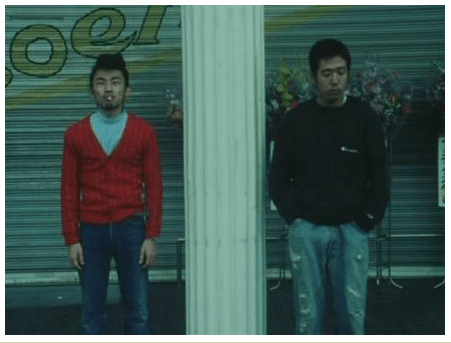
Nobuhiro Yamashita was born in Aichi Prefecture, Japan in 1976. It is the country’s most heavily industrialized area, perhaps leading Yamashita toward his ambivalent attitude towards work, as his characters are all either unemployed or terrible at their jobs. He went to film school at the Osaka University of Arts, where he met his frequent collaborator, screenwriter Kosuke Mukai. They made a series of short films together before completing Hazy Life, which was accepted into the Rotterdam Film Festival’s Tiger Award Competition for young filmmakers in 2000. A startlingly assured debut for a 24-year-old, it is very much under the sway of Jim Jarmusch, a series of deadpan blackout sketches about two aimless youths stuck between immaturity and adulthood.

Minami (Yamashita axiom Hiroshi Yamamoto) enters life pompadour first, as the film opens with his conical hair horn poking into the frame. The next shot is a street-level  of his high-heeled boots, a man of style if not, at this point, any perceptible substance. He walks across a parking lot to grab a soda, where he stands next to the schlubby Machida, in usual college slob wear, dingy sweatshirt and jeans. It is their first meeting, set up by Yamashita in fixed camera shots and symmetrical compositions, which repeat throughout, the form following the enervating sameness of their days and nights. Minami recruits Machida to help him dub amateur porn on VHS tapes for a nominal fee, after which they become friends, more out of inertia than pleasure. They are standing next to each other, so they might as well hang out. They each fantasize about taking an active role in life, of going on dates, assaulting a deli clerk and joining a motorcycle gang, but by the end of the film all they have are dreams, as they sit on a bus bench and rationalize, “at least we’re alive”.

Ramblers (2003) is Yamashita’s third feature, made after No One’s Ark (2003), which I have yet to track down. Ramblers is the last film he would make in Osaka, before he decided he needed to make a living and moved to Tokyo to work for the studios. Once again working with Mukai (who adapted the script from a manga by Yoshiharu Tsuge), it tells another story of two young men thrust together in order to wait. This time it is a director, Kinoshita (Hiroshi Yamamoto) and a writer, Tsuboi (Keishi Nagatsuka) who meet up in a sleepy mountain town to set up the production of a feature. They are waiting for a third collaborator to arrive…who is indefinitely delayed. The duo has to kill time, so they go fishing, practice their golf putting, encounter a series of obstreperous locals, and briefly fall in love with a young runaway who breezes through their life. Atsuko (Machiko Ono) appears to them like a mythical creature, running naked down the beach as they sit and shoot the breeze. Someone has robbed her while she was in the water, and Kinoshita and Tsuboi immediately let this apparition into their daily routine of putzing around. Their emotions briefly buoyed, she just as quickly disappears, jumping on a bus that actually arrives, something inconceivable to a Yamashita character. Alone once again, they begin running out of money, their hotels (and their managers) becoming comically decrepit, until they are forced to leave, the Atsuko interlude more shared myth than reality.

Yamashita’s first contract job once arriving in Tokyo was Cream Lemon (2004), made for the Fullmotion production company, known for their erotic “pink” movies. It’s an adaptation of the hentai manga (or pornographic comic book) of the same name, but Yamashita and Mukai turned it into an unsettling art film. It is the story of a step-brother and sister who fall in love, but instead of a parade of sex scenes, Yamashita stretches out the moments beforehand, when the two nervous siblings send out feelers of mutual desire. It remains a film about waiting, this time of the anxious moments yearning for another’s touch.

Then came Yamashita’s one major box office success, the ebullient high school musical Linda Linda Linda (2005), which is the only film of his to receive a limited release in the U.S. The script by Wakako Miyashita had won a screenwriting competition, which garnered the attention of producer Hiroyuki Negishi, who then brought in Yamashita. Yamashita and Mukai were allowed to re-write the scenario, but this is the first of their films to lack their deliberate pacing and obsession with in-between moments. This is very much a mainstream comedy, but is a thoroughly delightful one, and shows Yamashita to be adept at energetic pop entertainment. It concerns a high school girl band who needs to recruit a new vocalist three days before a festival performance. They settle on Korean exchange student Son (Bae Doo-na), whose shaky grasp of Japanese is the source of the film’s manic comedy of mis-communication. Add that to the insanely catchy theme song adapted from The Blue Hearts’ pop-punk “Linda Linda”, and there’s little secret to the film’s popularity.

He returned to more familiar ground in The Matsugane Potshot Affair (2006), a sprawling black comedy about a fictional small town (shot around the snowy climes of Nagano) that is slowly falling apart. It returns to the slow-burn, fixed camera set-ups from his independent days, but set across a wider locale, as this time an entire town watches their lives pass them by. Families are crumbling, the police are clueless, and the coroner incompetent. The opening sequence ends with a declared death coming back to life. The fulcrums to the story are fraternal twins, one a directionless cop, the other a farmer who knocks a woman unconscious in a hit and run. Their respective disdain for action leads them to slip further and further into crime and ignorance. Bags of gold, heads in bags, and mice in the ceiling act as triggers for their slow mental decline. Unable to alter the deep grooves of their daily routines, they are doomed to circle in their morally deficient hometown, with neither the will nor the imagination to escape. Yamashita’s protagonists have aged, and their indolence no longer has roguish charm but has curdled into sour regrets.

Shortly after the release of Matsugane Yamashita told Midnight Eye that, ” these past three years the films I’ve made have always been ‘based on’ something. I do feel that it’s about time that I do something that I’m completely involved in from scratch. If not, I don’t know if I will continue to feel so comfortable for very long.” Since Matsugane, he made the lovely rural school comedy (and manga adaptation) A Gentle Breeze in the Village (2007, and his first film without a script by Mukai), the ’70s student radical drama My Back Page(2011), adapted from a novel, and he has a new comedy, Kueki Ressha (2012) opening in Japan in July, which is also based on a book (and was written without Mukai). Since his arrival in Tokyo in 2004, he has not produced an original script, and his comfort level must be dwindling. His films have never been shown at Cannes, nor at most of the other major festivals, so he cannot depend on foreign investment to produce his work. He has to make what the Japanese studios will support, making the possibility of another Hazy Life close to nil. But unlike his protagonists, Yamashita has proven to be adaptable, deepening high school musicals and sentimental teen romances with his outsider sympathies and eye for oddball detail. He is, as ever, a director to keep an eye on.

THE TOP TEN FILMS OF ALL TIME (SORT OF)

June 5, 2012

Screen Shot 2020-02-04 at 12.21.55 PM

Later this summer Sight & Sound magazine will unveil the results of their once-a-decade poll of the greatest films of all time. In 2002 they queried 145 critics, writers and academics, who placed Citizen Kane #1, the same place it’s been since 1962.  Re-affirming the greatness of Citizen Kane, and ranking in general, tends to inflame Manichean arguments taking the form of “this over that”. Is Citizen Kane “better” than Tokyo Storyor Vertigo? This attitude treats movies like sporting events, where one film is the clear “winner”.  These lists are intended to start conversations, but instead they end them (I find it’s far more fun to look at individual lists, where personal idiosyncracies shine through, as with James Tobacks’s selection of Jimmy Hollywood in the Director’s Poll). Part of the issue is seeing the same titles every time, embalming them in a canon of good taste, historical artifacts rather than living works of art. This ends up reducing the films the poll set out to glorify. So I am presenting an Alternate All Time Top Ten,  composed of films and directors that have never been represented on the Sight and Sound poll before. These aren’t better or worse than the films that will land on the S&S poll, just different, and hopefully will spark new conversations. I encourage you to post your own alternate lists in the comments.

The list is presented in alphabetical order.

Beau Travail (1999), directed by Claire Denis

When I saw this at the Market Arcade theater in Buffalo, probably in 2000, I was introduced to a new world of movie-making, one of sensuous power that proceeded by a logic of images rather words. An erotic reverie that transposes Herman Melville’s Billy Budd to the French Foreign Legion in Africa, it builds tension through the arch of bodies and the glint of hard sun on sand. A transformative moment for me, although my Dad didn’t like it.

***

The Clock (1945)directed by Vincente Minnelli

Minnelli’s first non-musical is still impeccably choreographed, as Judy Garland and Robert Walker meet-cute in NYC and fall into a whirlwind romance. Walker plays an earnest midwesterner on a two-day leave from the army, who falls instantly in love with Garland’s sophisticated urbanite. Compressing the entire wooing process into two nights, Minnelli heightens the tension of together-separate with big boom shots which pick the lovers out of the crowd, and then lose them in it.

***

Coeur Fidele(Faithful Heart, 1925), directed by Jean Epstein

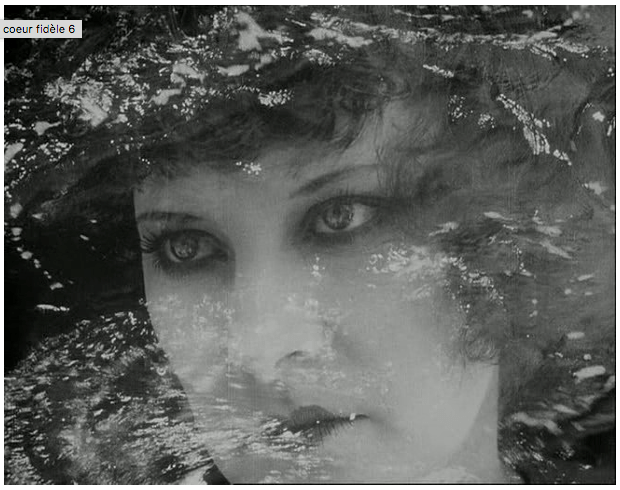
The current Jean Epstein retrospective at Anthology Film Archives in New York City has been my first exposure to this feverish stylist, and my goodness are they sensual viewing experiences (as much as Beau Travail, say). This one, available on UK DVD/Blu, is about a foundling girl (Gina Manes) whose cheap adoptive parents marry her off to an evil bastard named Little Paul (Edmond Von Daele). She’s in love with sensitive guy Jean (Leon Mathot), who seems to spend most of his time staring at the sea (as do most Epstein characters). Filled with looming close-ups, dreamy super-impositions and sequences of fast-cutting that would make Tony Scott blush, it’s an experimental melodrama that floored me with its earnest audacity.

***

Duck Amuck (1953), directed by Chuck Jones

Where Daffy Duck meets his maker. This modernist masterpiece finds the titular mallard go ballistic when the animator keeps changing the backgrounds to his scenes. A Three Musketeers pastiche all of a sudden becomes a folksy farm routine and then a mountain skiing escapade. Eventually Daffy goes ballistic, yelling at the screen, until the hand of Jones comes in with his eraser… One of the funniest films ever made, which also just happens to be a wittily self-reflexive essay on the author as sadist (or as Bugs Bunny, which amounts to the same thing).

***

Four Nights of a Dreamer (1971), directed by Robert Bresson

The funniest Bresson is also now my new favorite. Jacques (Guillaume des Forets) is an ascetic young painter enraptured by Marthe (Isabelle Weingarten), who attempts suicide after her boyfriend cuts off contact. Jacques promises to act as a go-between between Marthe and her man, as a way to get closer to her. They start strolling along the Seine most nights, zombies in unrequited love, hypnotized by a glass pleasure boat that sails down its waters, trailing its bossa nova tune.

***

The Green Ray (Le Rayon Vert,1986), directed by Eric Rohmer

The perfect summer movie! The wispy Marie Riviere plays Delphine, a neurotic young professional whose friend backs out of a trip to the Greek isles two weeks before departure. Already bummed out by her sometime (mostly never) boyfriend, she wanders from beaches to the mountains in a depressive state, forcing relaxation upon herself, but only ending up in tears. Riviere is a bewitchingly annoying presence, her sulkiness matched by her hectoring lectures on vegetarianism. She is an open wound, cringing at every touch. The healing process begins through another meet-cute in a train station (Rohmer must be a Clockfan!), and the intervention of a Jules Verne short story. There magic in books and sky, so Delphine finally chokes down her pain begins emerging into the world outside her head.

***

Make Way For Tomorrow (1937), directed by Leo McCarey

Bark (Victor Moore) and Lucy (Beulah Bondi) Cooper have lost their house, and depend on the kindness of their children to take them in. It doesn’t work out that way in McCarey’s devastating drama of aging and loss, which was the model for S&S poll mainstay Tokyo Story. Orson Welles famously said it could make a stone cry. It is so affecting because it is so clear-eyed and unsentimental, with no last act redemptions. It is simply a story of two people in love whose lives fall apart.

***

Me and My Gal (1931), directed by Raoul Walsh

The first movie I wrote about here at Movie Morlocks, and one of the most energetic every made. Each frame pops with invention, whether it’s Spencer Tracy’s slangy NYC argot, trick shots or parodies of popular movies of the day, there’s something happening every frame. The whole production seems drunk, from Walsh on down to the gaffer, tossing around ideas and shooting the bull until the shooting day ended. The result is chaotic, messy and joyful – filled with the most life per square inch of film stock in history.

***

Mysteries of Lisbon (2010), directed by Raul Ruiz

A summation of Ruiz’s work, with its nested stories, unstable identities and swirling camera movements, and one that is endlessly pleasurable. I’m rather anxious to see the 6-hour TV version. Adapted from the 19th Century novel by Camilo Castelo Branco, it tells the circuitous story of an orphan and his parentage, one which spans lifetimes and consumes hundreds of identities. It is a a ballet where every step both reveals and conceals, Ruiz’s camera unveiling truth at one edge and a lie at the other.

***

When A Woman Ascends the Stairs(1960), directed by Mikio Naruse

Hideko Takamine’s face is one of the great monuments of cinema, and here she gives a performance of shuddering uncertainty. She plays Keiko, a fiercely independent bar hostess in Ginza forced intent on opening her own place. But the world of men keeps throwing up obstacles to her self-actualization, her impassive expressions intimating only hints of the roiling uncertainty inside.

EDWARDIAN COMEDY: S.O.B., VICTOR/VICTORIA, SKIN DEEP

May 29, 2012

Screen Shot 2020-02-03 at 5.06.13 PM

John Ritter’s spastic freak-out in a parking garage in Skin Deep is an archetypal Blake Edwards image. What characters repress or ignore will always be expressed through their bodies, with or without their consent.  The Warner Archive recently re-issued three Edwards comedies on DVD: S.O.B. (1981), Victor/Victoria (1982) and Skin Deep (1989). While new transfers of these visually elegant works would have been welcome, they gave me an excuse to watch them for the first time, so I’ll keep my complaining to a minimum. All three films involve varying levels of performance, and bodies that either accept or reject the facades imposed upon them. The most furious rejection occurs in S.O.B., a flesh-eating virus coated letter to Hollywood.

The origin of S.O.B. lies in the failure of Edwards’ 1970 Darling Lili, a WWI spy movie musical that went over budget and then under performed. A common occurrence, but one that Edwards was virulently attacked for due to some extenuating circumstances. In his critical study A Splurch in the Kisser, Sam Wasson writes that the Commonwealth United Corporation lent Paramount parent Gulf + Western “a certain humongous sum” to complete production that G +W were unable to pay back, so the studio was especially incensed. Wasson writes that head of production at Paramount Bob Evans said that Edwards was responsible “for the most flagrant misappropriation of funds I’ve seen in my career.” Licking his wounds, but still ambitious, Edwards followed it up with the epic Western Wild Rovers (1971), another big budget disappointment that was cut down by nearly 40 minutes by new MGM head James Aubrey, whom John Houseman had nicknamed “The Smiling Cobra”. After battling with Aubrey again over the medical thriller The Carey Treatment (1972), from which he tried to get his name removed, Edwards was a frustrated man. He moved to Switzerland, only to return to filmmaking two years later for The Tamarind Seed (1974), three Pink Panther sequels, and the enormous hit Ten (1979).

With Inspector Clouseau and Bo Derek’s slow-motion trot restoring him to studios’ good graces, he was finally able to get his savage satire, Hollywood S.O.B. funded. Something of a “secret legend” in town, according to Wasson, it was picked up and then ditched by Orion, before upstart Lorimar, transitioning from TV to film, agreed to back the title-shortened S.O.B., Victor/Victoria, and a sci-fi comedy Far Out that was never made. In an appropriate irony, Lorimar had recently made a deal with Paramount to distribute their films, the studio that S.O.B.is targeted at.

The film is set in motion by the attempted suicide of director Felix Farmer (Richard Mulligan), whose family friendly musical Night Wind tanks horribly. Left in a catatonic funk, his image conscious wife Sally (Julie Andrews, playing off her Mary Poppins persona) abandons him as he wanders his beachfront home clutching the trades, blaring headlines like, “NY CRITICS BREAK WIND”. Rings of PR maneuverings circle around him, from his assistants, to Sally’s team (led by a brassy Shelly Winters) outward to the studio’s, who sends out cynical fixer Tim Cully (William Holden) to corral Farmer and get him to re-edit the film. It’s three circles of self-obsessed hells, with Felix the ignored center. All three are oblivious to Farmer’s depression, and he wanders off to the garage to give himself a carbon monoxide cocktail. But his body betrays him, and he survives. Edwards frames him in backgrounds and corners early on, a wraith irrelevant to his life as an image. The entire film industry is out to defend or destroy his image, while the flesh and blood Farmer is out to polish himself off.

This is mirrored in another unobserved death, as an anonymous runner collapses on the beach outside his home – his body laying in plain sight of sun-bathers for days before he is identified as a corpse. The most sympathetic character in the movie is the dog who yelps for his fallen master (who turns out to be a character actor). Image trumps reality, and Farmer cracks under its pressure. Edwards arranges an ace menagerie of gargoyles to feast off of him, including Robert Vaughan as the cross-dressing vampire of a studio head, Robert Preston as an acidic drugged-up doctor, and Holden as the infernal ring leader, a grizzled vet so jaded he’s cynical about his cynicism.

When Farmer cracks through this PR babble, he changes roles from tortured artist to crackpot prophet, one he acts out with brio, preaching to the lowest common denominator: “We sold them schmaltz – they want sadomasochism!” He proposes re-shooting Night Wind and turning it into soft-core pornography, which Sally agrees to only after weighing the PR hit of a long lawsuit. No matter how much Farmer panders to the audience’s basest impulses, in the end the system returns him to the background, incinerated in a Viking funeral as that sympathetic dog yelps once more.

Victor/Victoria represents the inverse of S.O.B., Edwards’ ideal of performance, one in which identities can be perfected on stage, and the image and the man (or woman in drag), can become one. It is a remake of the Weimar musical comedy Viktor und Viktoria, directed by Reinhold Schünzel, about a down on her luck opera singer who becomes a star as a male drag queen, pretending to be a man pretending to be a woman. In Edwards’ version, it is one Victoria Grant (Julie Andrews) on poverty row, plucked from obscurity from recently fired nightclub singer Toddy (Robert Preston). Chicago gangster King Marchand (James Garner) is hot to book her at his club and into his bed – convinced she’s a woman.

The movie buzzes on a colliding series of contradictions, of which the gender bending is the most obvious. Victoria is an opera singer who makes money at burlesque; King is homophobic and in love with Victor; Toddy is gay but has to pretend to sleep with Victoria. Constructing the Paris of 1934 entirely on a backlot, Edwards has a controlled environment to run these experiments in the expansive 2.40:1 frame, chaotic in café and bar fights, a mess of arms and legs, and only unified on stage, in which Victor/Victoria and Toddy each get their moments of self-actualization. Victoria, after her scandalous debut in which she ripped off a wig to become a “man”, returns to womanhood and cedes the stage to Toddy, who becomes an unselfconscious queen in the raucously funny finale, more woman than Victoria could ever hope to be.

Skin Deep finds Edwards in more heterosexual terrain, as womanizing Pulitzer Prize-winning writer Zach (John Ritter) loses his wife, his career and his sanity. He is introduced as a torso leaning back on a barber’s chair, his head off-screen behind the entryway, as a blonde hairdresser undresses and mounts him in a very unprofessional manner. This is all seen in long shot, from the perspective of the first of many spurned lovers, who will soon have him in bed with a gun to his head. In these brisk opening minutes Edwards establishes images that show Zach as literally brainless, a human pleasure receptor and not much else.

Edwards will use off-screen space, as well as elliptical editing, to indicate Zach’s short attention span and disconnection from the world. In a rapid montage Zach will hear his wife’s divorce demands, and a few shots later, they will be enforced by the judge, his defense invisible, and his force of will indicated by Ritter’s slackjawed stare. Zach becomes more and more self-obsessed and debilitatingly horny, unable to write or maintain any emotional connections (except with an exceedingly understanding bartender, Barney (Vincent Gardenia)). The jokes play off of Zach’s spiraling disconnection, from waking up bleary eyed in a women’s aerobics class to wandering into a black tie party in an Aladdin costume. He even can’t get shocked into self-awareness: the top image shows him recovering from a session with her electric massaging machine. The most notorious joke is one in which Zach entirely disappears except for his erection – a glow in the dark condom provides for a new definition of sword fight. These tame gross-out moments seem to anticipate the Farrelly Brothers  – there’s even an unconscious dog gag that re-appears in There’s Something About Mary.

The ending of the film is disappointingly traditional, coming in the form of a deux ex machina tidal wave that sets Zach on the straight and monogamous path. The natural end for the repeated imagery of a mind-body split would be a beheading of one form or another, but I think it’s safe to say that wouldn’t get past the producers. In any case it is still a tightly shot and structured comedy whose laughs spin organically from Edwards’ mise-en-scene, of a man divided against himself. Maybe if he just watched Victor and Victoria he wouldn’t have had to go through all that trouble.

HATE BINGES: THE BIG HEAT AND THE LAWLESS

May 22, 2012

Screen Shot 2020-02-03 at 4.55.38 PM

The post-WWII economic expansion exploded in 1950, as the GI Bill’s low mortgage rates stoked a housing boom and pent-up consumer demand propped up retail. Success was there for the taking, but not for all. Two early 50s films that are hitting home video in impressive transfers,  Joseph Losey’s The Lawless (1950, on DVD 5/29 from Olive Films) and Fritz Lang’s The Big Heat (1953, now out on Blu-Ray from Twilight Time), documented some of the anxieties caused by this enormous upheaval in American life, what would be the start of the greatest stretch of economic growth in U.S. history. More money meant more crime, and The Big Heat is a nightmare rendering of the American Dream, as good cop  Glenn Ford loses his nuclear family and just goes nuclear. The Lawless is an earnest morality play about the plight of migrant fruit pickers in Southern California, doing the work Americans left for office gigs (by 1956 a majority of U.S. workers held white rather than blue collar jobs).

The Big Heat is premised on a divide, the one between Detective Dave Bannion’s middle class abode, a blandly utilitarian ranch house, and the glittering homes and hangouts of the criminal class, like hired muscle Vince Stone’s (Lee Marvin) plush penthouse apartment. As Tom Gunning wrote in his seminal Films of Fritz Lang, The Big Heat, “moves through this contradictory environment whose smooth surfaces mask the fissure  between the good life for the few and the cramped and hectic worlds of the mass of people”.

It was based on a novel by William P. McGivern, originally serialized in the Saturday Evening Post. The script was written by Sydney Boehm before Fritz Lang was officially hired on to the project in mid-February of 1953. Lang biographer Patrick McGilligan notes that Boehm was a police reporter on the New York Evening Journal, and that “his specialty was crime…”. The script he delivered was a spare, unflinching tale of corruption, that which kills the wife of Detective Dave Bannion (Glenn Ford), and leads to his vigilante-like quest to take down Mike Lagana’s (Alexander Scourby) crime syndicate. Lang renders Boehm’s straightforward revenge tale with an abstracted intensity, the cold open suicide rendered in massive disembodied close-up of a hand on a revolver, followed by an off-screen gunshot. Lang does not use an establishing shot, breaking the film into pieces that Detective Bannion will struggle to re-connect.

Ford is unduly stressed throughout, on the perpetual edge of exhaustion, his speech clipped into little shotgun blasts of bile that anticipate Charles Bronson’s monotonal delivery a decade or so later. Even when in possession of his nuclear home, he seems uneasy, the jollity forced. His wife, played by Jocelyn Brando, emits a generic housewifely cheer, as if Bannion just wandered onto the set of the Donna Reed Show (which wouldn’t premiere until 1958, but please indulge me). When Bannion’s home is emptied out, it feels more like reality, and the middle-class fantasy the dream. Seeing the rage in Bannion’s eyes, an ex-partner on the force tells him, “you’re on a hate binge.” And so he is, blithely stampeding into Lagana’s nightclubs and mansion, more locales in which he doesn’t belong, with his old dark trenchcoat and faded fedora, suspicious of everyone and belonging nowhere. It is with the entry of Debby Marsh, that childishly erotic creation of Gloria Grahame, that Bannion finds another lost soul, uncomfortable in furs and then in her own skin, when Vince Stone famously scars her face with a pot of coffee (off-screen, like the suicide). Their bond is brief but intense, as each have been ripped away from their place in society. Debby tells a fellow female schemer that they are “sisters under the mink”, but she and Bannion are comrades in hate.

The Lawless was the second film Joseph Losey directed in Hollywood, and he would only be able to make three more before he was blacklisted and had to move overseas. He followed up the anti-war fable The Boy With Green Hair (1948) with this socially conscious drama, which he shot on location in Marysville and Grass Valley, CA in 18 days. He would continue to exploit real locations in his work, used to spectacular effect inThe Prowler (1951) and his remake of Lang’s (1951), in which Southern California becomes a tomb of broken American dreams.

The script was written by Daniel Mainwaring (using his  pseudonym as a mystery novelist, Geoffrey Homes), who would also come under some scrutiny by HUAC, although he was able to work sporadically during that period. Mainwaring’s script hearkens back to the social-realist films of the ’30s, like King Vidor’s ode to communal living, Our Daily Bread, within a completely different political landscape. Anything that smacked of Communism was suspect, so the film’s plea for racial tolerance, and unflattering portrayal of the local police force, came under scrutiny from the Production Code Administration’s Joseph Breen. Here is his amazing note to the film’s distributor, Paramount, as reproduced in the AFI Catalog:

The shocking manner in which the several gross injustices are heaped upon the head of the confused, but innocent young American of Mexican extraction, and the willingness of so many of the people in your story to be a part of, and to endorse, these injustices, is, we think, a damning portrayal of our American social system. The manner in which certain of the newspapers are portrayed in this story, with their eagerness to dishonestly present the news, and thus inflame their readers, is also, we think, a part of a pattern which is not good. The over-all effect of a story of this kind made into a motion picture would be, we think, a very definite disservice to this country of ours, and to its institutions and its ideals….This whole undertaking seems to us to be fraught with very great danger.

However great the danger, Paramount did not greatly alter the film, in which circulation-obsessed newspapermen rile up the public into a frenzy around the story of Mexican “fruit tramp” Paul Rodriguez (Lalo Rios), accused of killing a cop. Already convicted in the court of public opinion, only the stalwart editor Larry Wilder (MacDonald Carey) stands to defend the kid, inflaming the populace to ransack his office. It’s a scene of destructive power, one of the few instances where the theme is illustrated by action rather than static speechifying. This reckless, irrational demolition of a newspaper office, fueled by race hatred, dwarfs the liberal pieties of the rest of the film, which turns Wilder into the hero at the expense of Rodriguez. In plotting action, mostly in long takes, Losey proves he could express his social critique through more subtle means, which he would succeed at in the haunting machinations of The Prowler, one of the great films of 50s middle-class malaise, right alongside The Big Heat.

DTV ACTION ITEMS (PART 3): INMATE AT THE ASYLUM, AN INTERVIEW WITH DIRECTOR RICHARD SCHENKMAN

May 15, 2012

Screen Shot 2020-02-03 at 4.45.33 PM

This is the third and final post in  DTV ACTION ITEMS, a three-part series on direct-to-video action movies. Click here for Part 1, an interview with Outlaw Vern, and here for Part 2, a profile of actor Stone Cold Steve Austin.

The Asylum is the most disreputable studio in that most disreputable of markets: direct-to-video. They made their name cranking out cheaply made “mockbusters”, thinly veiled ripoffs of Hollywood blockbusters starring Z-list celebrities, many of which air in constant rotation on the SyFy channel. Last month Universal Studios sued them for copyright infringement on The Asylum’s Battleship take-off, American Battleship, starring Mario Van Peebles and Carl Weathers. Despite a hilariously cocky press release defending their film (” Looking for a scapegoat, or more publicity, for its pending box-office disaster, the executives at Universal filed this lawsuit in fear of a repeat of the box office flop, John Carter of Mars. The Universal action is wholly without merit and we will vigorously defend their claims in Court. Nonetheless, we appreciate the publicity.”), they changed the title to American Warships, which will be released on video May 22nd.

They are a crew of brilliantly amoral hucksters pranking Hollywood for fun and profit — a commendable goal for sure, but are the movies worth watching? When I spoke to Outlaw Vern two weeks back, he didn’t think so, nothing that “I get a laugh from the titles and covers like everybody else, but the parts I’ve seen have been terrible and not in a fun way.” One of their upcoming releases may indicate an uptick in quality, for Abraham Lincoln vs. Zombies (out on DVD/Blu on May 29th) is a taut, resourceful piece of survival horror, completely lacking the forced campiness of most of The Asylum product. First-time Asylum director Richard Schenkman is an industry veteran who has made everything from indie comedies (The Pompatus of Love) to sci-fi (The Man From Earth), and his experience pays off. The pace is snappy, the action well-staged, and lead actor Bill Oberst is gruffly engaging as Honest Abe. I’d be surprised if its Hollywood counterpart, Abraham Lincoln: Vampire Hunter, is as energetically entertaining. I spoke with Mr. Schenkman about his path into moviemaking, his opinion of The Asylum, and his experience shooting Abraham Lincoln vs. Zombies.

How did you get into the movie business?

All I ever wanted to do was make movies. From the time I was a very small child. So while there were bumps and detours along the road, and while unfortunately when I was young it was much harder to break into independent film than it is today, that was the only direction I’ve ever traveled.

Who were your idols growing up?

When I was a little kid, Jerry Lewis. I guess the first book of filmmaking I ever read was his book The Total Filmmaker. That was when I really began to understand the difference between writing, directing, producing and cinematography. Because when I was very little I thought I wanted to be a cinematographer. When I started reading American Cinematographer magazine and Jerry Lewis’ book, I began to understand what everybody did, and realized what I wanted to do was write and direct. I didn’t want to be a cinematographer; there was too much math involved. So like a lot of people I tried to make little films, I did films with GI Joes and clay, and tried to get friends involved to make live action films. In those days it was so much harder, because you had to shoot on film, it was expensive and you had to send it to the lab, and when it came back you had to cut it with a blade and splice it with glue. It was much more complex and difficult. I have a daughter in fifth grade and she has friends, peers, making films. Eleven, twelve-year-olds. If I was growing up today my whole life would have been different. I would have been making films from the time I was ten, eleven years old.

Was your first paying job working on Playboy documentaries?

No, I started out at MTV. That was my first real job. I was very lucky. I was at MTV when it first started, so I got to have an enormous amount of creative input.

Is that where you learned how to be creative on a budget?

Yes. That was absolutely how I learned it. I’d get an idea on Monday, and I’d write the script and get it approved on Tuesday. I’d go produce the audio for it on Wednesday, the video on Thursday, and it would air Friday night. It was fantastic. The pace was crazy and the hours were long, but it was very very exciting.

How did you transition into filmmaking from there?

I took a bunch of money that I’d made and did a 35mm short, and came to Los Angeles. And said, “OK, great, this is going to get me an agent”. But nobody told me back then that there was no point in going out there with a short until you had written a feature script. I thought I would find work as a director but it didn’t work like that, and it still doesn’t. But it’s much easier to find all that out now. So I went back New York with my tail between my legs, having spent all my money on the short, and wondered what to do next. And that’s when the phone rang. An old executive from MTV had come to Los Angeles to become the new president of the Playboy Entertainment Division. So he brought me out. And again, it was, for a time, a really exciting opportunity. For I was both an executive, the in-house head of production, and a working writer/producer/director. I was able to hire a lot of people to create material, but I was able to jump out there and make stuff myself. It was like being a kid in a candy store.

You had more money to work with there, right?

I did, yes. And, for a time, I had extraordinary autonomy. I was given a pile of money, not a lot, about $400,000. And this money I was given that was just supposed to go towards interstitials for the channel, and I was able to stretch that money so far, that I made full-length shows. More and more the production came under my purview. A lot of short-form stuff. I tried to explain to them how inexpensively they could be making feature films, and own that segment of the market. You know, the softcore, very sexy movies. I was trying to make the point that if we improve the quality of them, made them ourselves, with real actors, working with real scripts, we could really expand the genre – making real movies. Every year for a few years they would put it into the budget, and at the last minute pull it back out. The year after I left they started doing it, and had a huge success with it the first few years.

Were you interested in genre films growing up?

Not particularly. I’ve always loved every kind of movie, as long as it was fairly smart or entertaining. A lot of horror movies are stupid. Too many horror movies, they think it’s enough to scare people, that they don’t really have to make sense, and not have anybody you can identify with. I suppose that’s why I was never much of a genre fan. I’m definitely not one of these guys who grew up seeing every zombie movie and Nightmare movie. I’ve seen lots of them, and the classics are great movies, like The Exorcist. But I’ve never gone for cheap jumps and scares, that always bugs me. To me, Alien is scary.

So the power of suggestion, not having to show everything…

Yes, but also just legitimately frightening you, the way Hitchcock would. Not just go, quiet, quiet, quiet, BOO! I don’t think that’s very clever.

So what appealed to you about Abraham Lincoln vs. Zombies?

The historical mash-up aspect of it. Definitely. I saw it was an opportunity to do a bunch of research and figure out fun and clever ways of working this fictional story into real history. To me that was the fun of the project. How do we insert this story into what we all know to be true? And so my first idea, when I was initially told about the assignment, was the Gettysburg Address. When we think about Abraham Lincoln what do we think about? Holding the nation together, freeing the slaves, and the Gettysburg Address. I just thought, wouldn’t it be great if this zombie adventure tied into the creation and delivery of the Gettysburg Address? That became the spine of the story.

How did you end up getting the job, since you are not a genre guy?

My friend Karl Hirsch is a writer/director/editor who’s done a lot of work for The Asylum over the years, although I don’t think he’s ever done a feature. He’s done some editing of their movies and trailers. They have a relationship, and they came to him, kind of out of the blue, and said, “we’re going to do a direct-to-video title called Abraham Lincoln Vs. Zombies. Are you interested?” He was debating whether he wanted to do it or not, because he had other projects, and he knew it would be very, very challenging. He and I were having breakfast, and he told me about it. So I told him, “Oh, man you have to! That sounds like so much fun. How can you turn that down?” He said, “because there’s not going to be any money, there’s not going to be any time”. And I said, “It’s making a movie!” So I said, “I’ll help you write it. I’ve been trying to find a way to get my foot in the door with The Asylum anyway, because they’re making so many movies, and it would just really be a gas to work on.” And that’s what happened. I pitched him the Gettysburg Address idea, and we beat it out together, along with his wife Lauren, and submitted it. Asylum said, “Yes, we’ll do this.”

And when we were working on a treatment, an eight page, eight act treatment, when midway through that Karl got offered a huge documentary project that he could not turn down. And I said I’d really love to stay on, at least as the writer. Everybody seemed fine with that. David Latt at The Asylum had seen a couple of what he thought were my more indie films, like The Pompatus of Love, although I consider it more of a comedy. So I was offered to stay on as a writer, and pretty early on I said, “I’d love to direct this.” At one point, about a half-hour left before the thing needed to start shooting, they said, “well, there’s going to be no money, no time, nothing that you’re used to having, but if you want to direct it, you can.” I said, “I’m up for the challenge.” In some good news, the line producer Devin Ward figured out how to put the movie together to shoot in Savannah, Georgia, and he got us Fort Pulaski to shoot at. That decision to shoot on location makes the movie exist on any level in terms of quality. If we had to shoot in Los Angeles it really would have been crap.

How much time did you have to shoot?

We had 15 days on location and then a further half-day on a green screen stage. Looking back, how we did it, I have no idea.

Did you have any qualms about making the film for The Asylum, considering their reputation?

The short answer is no, because they make movies. Lots of people talk about making movies, but The Asylum actually makes movies. Here’s the thing from the outside you might not know about The Asylum. Everybody there is really nice, really smart, really hard working, and really loves movies. And everybody there is busting their ass to do as good a job as they can. The people in special effects are there like 20 hours a day trying to make these effects look beautiful. And by the way, some of the effects you have seen in the past in some Asylum movies, and thought, “by God that’s terrible”, a lot of those were done out of house, by people they took a chance with who didn’t deliver, and then they were out of time and out of money. It’s a hard working dedicated bunch of people, all of whom, I think, would like their movies to be better. And I honestly would not be surprised if starting with the movies that are coming out in April-June, if you see a bit of improvement. There is a development executive there, Micho Rutare, who has been there about a year – he’s been pushing very hard for the scripts to be better. As I said, on the technical side, everyone there is challenging themselves to improve the technical quality. I would be surprised if Nazis at the Center of the Earth and Abe Lincoln do not start a trend towards movies that are at least trying to be better.

You were approaching this as a real movie…

I was not encouraged in any way to make a quote unquote Asylum movie. In fact, the way Micho described it was, write an $80 million movie, and then figure out how to do it with nothing. In other words, I was specifically encouraged not to write for the budget. And I was told flat out, “we do not need camp, we do not need intentionally made camp anyway”. Which I had no interest in regardless.

There are no ex-celebrities in the film, right?

No. Basically, we did the movie locally. They are all local actors, except for Bill Oberst, who came from L.A.  Everybody else was local, or if they weren’t local, they got themselves to Savannah somehow, and worked as locals.

I think that would make people take it more seriously. When you see a face you recognize before, it automatically becomes something else. With unknown actors, you become more involved in the story.

There’s that argument. There have always been directors who prefer to work with unknowns or even non-professionals for just that reason. I don’t know where I stand on it. To me, you hire the best actor you can. Frankly, in terms of marketing the film there’s something to be said for getting a known actor. The film’s being produced by its distributor. So they know exactly where they’re selling it, how they’re selling it, and to whom they’re selling it. And they don’t really expect to do much in terms of cable on this title. They do their business in DVD/VOD and foreign sales, and so the movie’s made to fit the place in the market, and within its budget. And the budget is dictated by what their expectations are of how it’s going to sell.

How did the shoot go? Were the budget constraints frustrating?

It’s so funny about a movie shoot. It’s like giving birth to a baby. You end up forgetting just how much it hurt. But if you didn’t forget, you’d never have another baby. If every woman only had one baby, our population would be decimated. So, there’s some mechanism that causes you to forget just how unpleasant it was. And I have to say a couple of months out, I’m beginning to forget how unpleasant it was [laughs]. But it was a very, very difficult shoot. Everybody worked really hard, the community of Savannah really rose up to try and help us get this movie made. People did us all kinds of favors, and the production value we achieved using these local locations is extraordinary. The movie looks like it cost far more than it did. And a lot of that is simply the locations. Having said that, we had a very, very small crew, and almost nonexistent budgets for props, special effects. So you’re asking creative people to pull off miracles every single day. You’re saying to them, “there’s no time to prep, and no money to buy or rent anything, but we need a cool switchblade folding scythe for Lincoln that is going to look mean on screen but not actually hurt anybody. Could you have that by tomorrow?”

The special effects and makeup guys must have worked like crazy…

That’s the thing, it was a zombie movie with no special effects department. Yes, we had a makeup team who worked ridiculously hard, and we had a bunch of day players come in on heavy zombie days. But the casting director and her daughter were on set most days, helping do makeup. And I don’t think they were paid for that. They did it to support the film, and we had a lot of that. Just to support local production in Savannah, to support the project. A lot of people really liked the script, and even though it was, quote unquote, just a zombie movie, I think people really got into the story, and the respect with which we were treating history. I know that sounds crazy to say, but we really were trying to be respectful of history, and the historical characters that were in the film.

Did you at any point look of the promotional images from Abraham Lincoln: Vampire Hunter?

No. I specifically avoided it until I was done. I never read the book. If there are any similarities at all, they’re an unfortunate accident. I honestly know nothing about it. I haven’t seen the full trailer, but I did see the teaser trailer after we wrapped.

I would guess your movie is more historically accurate than that’s going to be.

That would be great! That would be hysterical. Obviously in my mind, it would be nothing short of wonderful if my movie was better than that movie in any aspect at all. If there’s one thing, like “Their Lincoln is better”, or “it’s more historically accurate”, or “It makes a little more sense”, or anything. It was a huge book by a successful writer, a huge budget movie with extraordinarily talented and successful people making it, so if there’s any way my movie compares to theirs favorably, it would be just great. But I don’t expect to come out on the winning side of most comparisons.

How was working with the actors?

They were lovely. Starting with Bill Oberst – he really took it seriously. He was the kind of guy showing up already knowing Lincoln’s speeches by heart. And he actually played Lincoln before on stage. He’s a very dedicated actor, one of the most dedicated I’ve met. He’s also very talented in terms of acting ability and technical skills. He would show up, and let’s say through some scheduling snafu he had prepared for a different scene. Even if he had a page and a half speech to do, he would go off for 5-10 minutes and come back and have the thing memorized. I’ve never seen anything like it.  A true professional and a great leader for the rest of the crew. We had a lot of young actors, a lot of inexperienced actors, and while everyone was super-thrilled to be there, it was great to have someone as experienced and serious as Bill heading up the team.

Especially because you didn’t have time for many takes, right?

That’s kind of a myth, the whole, “we do one take and move on” thing, like Eastwood. In my experience, the time does not go into takes, to do another take is five minutes. That’s not where you lose your time. You lose time getting a shot set-up and trying to load equipment into a huge fort that doesn’t have an elevator, you can’t bring vehicles into, and is open for business for vistors at the same time. That’s where the time goes.

So you had to work around the schedule of the fort?

Yes. It was crazy! Visitors came and went, cannons went off, and we had to shoot around that. We had to get twenty people into makeup with a two-person crew, that was challenging. But the only time I’m forced to say, “we’ve got to move on”, is, for example, you’re against a really hard deadline like lunch, or wrap. If you’re five minutes over, you’re into penalties, and that sort of thing. But having said all that, we didn’t do a lot of takes. I try to rehearse, so…

You had rehearsal time?

Um….no. We did not have rehearsal time before production time. But while the crew was lighting I tend to rehearse with the actors as much as I can.

You worked well with your DP?

We had a terrific camera department. We had two cameras going all the time, and we did that with a camera crew of three, basically. Which is half as many as you’d usually have on a two camera shoot. We had a DP, and two camera assistants. Everybody operated, even I operated sometimes, and we had two cameras almost every shot. It’s the only way we could have ever finished the movie.

While stressful, are you satisfied with how it turned out?

I am happy with how it turned out. Of course there are scenes I would have loved to shoot again. People who’ve seen it so far say it’s a very entertaining film. As retrospect becomes longer, the shoot grows less and less difficult and more and more fun in my mind. It’s always fun to make a movie, because there’s this constant sense of achievement. Every time you get a shot, and it looks good, or complete a scene, or wrap your day. Those are all measurable achievements.

Did you have to improvise a lot on the set?

Sometimes, yes. I try not to improvise utterly on the fly. If I have to improvise I try to do it a day in advance, so that I can write it out and give it to people.

Can you give an example of something you had to improv?

We had a walk and talk along the railroad tracks. We wanted to do it as a tracking shot beside the tracks. Then it occurred to me, can’t we could build some kind of a rig, and take the dolly and customize it so we can track on the railroad tracks? I mean, they’re here, they’re used to having giant things wheeled along them. A couple of our guys got together and dismantled the dolly and reassembled in such a way that it could roll on these railroad tracks. So we did the walk and talk. Then the camera operator was just goofing around, and showed me what it looked like if you rolled the thing pointed forward. He was running in front of it like it was a train coming towards him. Then we realized it could actually roll over a person. I had a scene that needed to be scrapped because we lacked a key prop, and I basically had a character who needed to die a coward’s death. It occurred to me that we could have him run away from a fight, run along the railroad tracks, not realize a train was coming, and get run over by it. And we could get the key shot from the POV of the train by using this rig. So we hurriedly got the guy in wardrobe, and we shot the last part of it.

Would you work with The Asylum again?

Oh yeah. In fact I’m hoping to roll right into another project with them.  I hope to work for them again very soon.
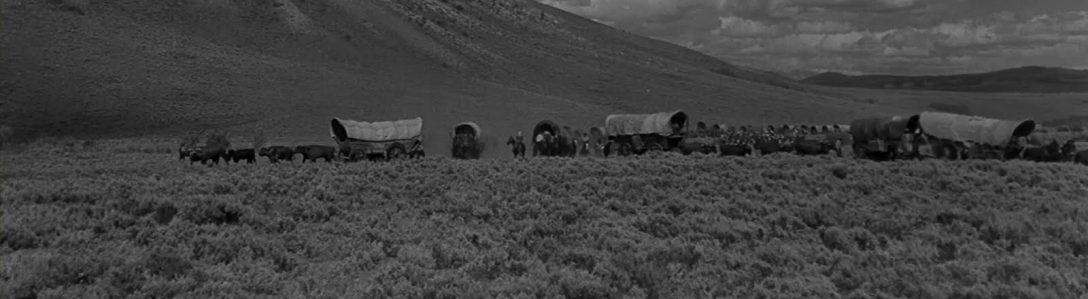
DTV ACTION ITEMS (PART 2): INTRO TO STONE COLD STEVE AUSTIN STUDIES

May 8, 2012

Screen Shot 2020-02-03 at 4.40.53 PM

This is Part 2 of 3 in my series on direct-to-video action movies.

In last week’s post, direct-to-video action expert Outlaw Vern modestly proclaimed that, “for the time being I think Stone Cold Steve Austin is the most prolific star with a good track record [in DTV].” In Part 2 of my industry shaking series on DTV fight films, I exhaustively investigate this claim. Steve Austin (born Steve Anderson) was the biggest star in professional wrestling for most of the past 15 years, perfecting the persona of a blue-collar hellraiser with a rabid anti-authoritarian streak. A series of injuries to his neck and back forced him to retire from the ring, and he’s been churning out DTV bare-knuckle brawlers  since 2009, after his one big bid for the theatrical market, The Condemned (2007), failed at the box office. While he hasn’t matched the insanely successful screen career of frequent WWE foe Dwayne “The Rock” Johnson, Austin is forging a worthy one of his own, albeit on the fringes of the movie business.

Steve Anderson was born in Austin, Texas on December 18th, 1964. His biological father James abandoned the family when he was barely a year old, leaving his mother Beverly to raise Steve and his two brothers. They moved around the state, first to Victoria, then to Edna, each town smaller than the last. In his autobiography The Stone Cold Truth, Austin writes that Eden, “had three or four red lights and a Dairy Queen.” Beverly re-married to a “wonderful man” named Ken Williams: a rancher, country singer and insurance salesman. Ken was also a football player who received a scholarship to Rice University. Steve followed in his step-dad’s footsteps, playing defensive end at North Texas State while nursing a dream to become a pro wrestler. After graduation, he enrolled in Gentleman Chris Adams’ wrestling school, which he attended on his off hours from unloading freight at the docks in Dallas.

A strikingly handsome blonde-haired blue-eyed physical specimen, he was hired by the USWA (United States Wrestling Association). Since there was already a Steve Williams in the territory (one Dr. Death), he had to change his name. Local booker Dutch Mantell suggested “Steve Austin” fifteen minutes before his first match, and it stuck. Initially starting out as a pretty-boy villain (or heel, in wrestling parlance), he rose to be hired by the nationally broadcast WCW (World Championship Wrestling) in 1991, where his narcissistic “Stunning Steve Austin” character failed to create much heat. He was fired after four years.

It was not until 1996, a year into his contract with the then-WWF, that the “Stone Cold” character fully emerged. Drawing on the real-life bitterness from his failed run at WCW, Austin developed a character that embodied a kind of redneck class warfare, a hard-drinking, hard-fighting SOB who would undermine the boss at every available opportunity. His feud with WWF CEO Vince McMahon brought the company record ratings and media exposure, and plenty of opportunity for hilariously over the top subversions – like pouring cement into Vince’s sports car or swatting him over the head with a bedpan. While Austin’s fame also came from his incredible work rate and storytelling ability inside the ring, his ability to tap into underclass rage was the driving ratings force. How could he embarrass the CEO this week?

As the now-WWE (after a tussle with the World Wildlife Fund) expanded their reach, they formed their own production company, WWE Studios. The Rock was the centerpiece of their efforts, as early on it was clear he was eager to expand his brand. They produced or co-produced The Scorpion King (2002), The Rundown (2003), and Walking Tall (2004) before The Rock moved on to bigger things. While The Rock was becoming Dwayne Johnson, movie star, Austin was bickering with WWE’s bookers, and he left the company in 2002 due to a combination of exhaustion and creative differences. By the time they reconciled and he received his one-and-only starring role in a WWE production, in 2007′s The Condemned, he was no longer a cultural phenomenon, but merely wrestling-famous. The Most Dangerous Games-style fight-or-die movie  croaked at the box office, taking in $7 million.

With WWE no longer interested in producing his films, Austin turned to DTV. Joseph Nasser was a prolific producer of trashy TV movies, executive producing such gems as Paparazzi Princess: The Paris Hilton Story (2008) and Anna Nicole (2007), before he started investing in Stone Cold, with whom he has made five fist ballets since 2009. Clearly a canny opportunist, he’s also produced the inspirational religious dramas What Would Jesus Do? (2010) and the Thomas Kinkade-branded Christmas Lodge (2011)). But all we care about here is Austin 3:16, the gospel of which Nasser thought could still make him some quick cash.

The first Nasser-Austin collaboration is Damage (2009) which is also their most ambitious. Austin already has his film persona in place here, which retains the working class resentments of “Stone Cold”, but removes the venomous verbosity. In its place is a bemused, solitary stoicism, a fiercely moral version of Clint Eastwood’s Man With No Name, a wise cracking anti-hero haunted by the past, who values family above all (but never gets the girl). In Damage this character is called John Brickner, an ex-con out on parole from a manslaughter charge in Seattle (shot in Vancouver, as always), drifting from low-paying construction jobs to lower paying bouncer gigs. He’s drawn to an underground fighting ring to make some quick cash, and teams up with slimy promoter Reno (Justified’s Walton Goggins) and his gal Frankie (Laura Vandevoort).

Director Jeff King and writer Frank Hannah are proudly bound to the boxing genre, recalling everything from Gentleman Jim to Body and Soul to Hard Times, with its shady promoters, sympathetic diner waitresses, dangerous pier-side brawls, and just to throw in a side of melodrama, a little girl who needs a heart transplant! All of them are on the take, and all have their reasons, up in their ears in debt and lashing out in desperation. Put across with earnest intensity, it honors its predecessors by playing it straight, which works thanks to the authentically idiosyncratic performances, including the manically weaselly Goggins and extra-crusty Donnelly Rhodes as a fallen priest. The fight scenes are blunt but effective, serving their purpose as expressions of character rather than spectacles-in-themselves.

The Stranger (2010) is the kind of garbled mess that gives DTV a bad name, a paranoid thriller that finds an amnesic Austin racing through Vancouver (posing as Seattle) trying to kick-start his memory. Shot in dilapidated offices and back alleys in what looks like a long inebriated weekend, there’s nothing resembling narrative coherence here, although there is the compensatory pleasure of Austin wearing a big hobo beard. Hunt to Kill (2010) is a welcome return to technical competence and satisfying genre kicks. This one is of the kidnapped-in-the-woods variety. Austin plays a divorced Texas (aka Vancouver) border patrol agent haunted (!) by the death of his deputy (a snickering cameo by Eric Roberts),  who is desperate to insulate his teen daughter from any danger. Of course, they both get kidnapped by raving psychos and go on a forced march through the forest. Strictly abiding by the Rambo playbook, Austin picks off the crazies one-by-one, which director Keoni Waxman (Anna Nicole) and Damage scribe Frank Hannah move along with admirable speed and precision. There is an especially brutal and well-staged fight between Austin and kickboxer Gary Daniels, a drama of reversals and counter-moves that looks like a lead-footed ballet.

There is more light-stepping in Tactical Force (2011), which contains an ingenious B-movie scenario from writer/director Adamo P. Cultraro. This time Austin is the head of an aggressive LAPD swat team that act like a swaggering group of Dirty Harrys, destroying property and criminals’ internal organs with impunity. You can sense Austin cutting loose a bit, channeling some of the absurd humor of his later WWE run, as this character has none of the morality of his other films. Here is a purely destructive force, and is the closest thing to a “Stone Cold” performance in his growing oeuvre.

The SWAT team is suspended after an especially creative outing to a grocery store (in which frozen steaks and BB guns are brandished as weapons), and sent for re-training at a warehouse. Unbeknownst to them, Russian and Italian gangs are there violently negotiating for the rights to a mysterious suitcase (whose contents, as in Pulp Fiction’s McGuffin, are never revealed). Provided only with blanks, the SWAT team is suddenly caught in their crossfire, with little hope for escape. Masking the low budget by filming in one location, and pushing the pace through cross-cutting, this is a resourceful, snarky Tarantino clone aided by the athleticism of its cast. In addition to Austin, the presence of MMA bruiser Keith Jardine and martial artists Michael Jai White and Darren Shahlavi add a bit of physical grace to a film otherwise situated as a snappy dialogue comedy.

My favorite of the Austin DTVers might be Recoil, though, which Nasser just released on DVD and Blu-Ray this past March. Dusting off the Phenix City Story and Walking Tall scenario, Austin is a very haunted vigilante stalking through the Pacific Northwest (read: Vancouver) town of Hope to rid it of the vise-like grip of vice imposed by the biker gang “The Circle”, led by Danny Trejo. After his family was brutally murdered by dirtbags, Austin is eager to return the favor. The film is crisply shot by Terry Miles, whose measured pacing and clear lines make even the smallest of exchanges alive with murderous possibility. It begins with some simple match cuts early on, when he rhymes Austin cleaning the muzzle of his gun with the way he stirs his coffee. Then it builds to deadlier range, when Austin’s first encounter on the street ends with muzzle pointed towards a head. This occurs in a quicksilver although perfectly legible series of movements, emphasizing the quickness and lack of consequences to death in this town.

Later, Miley will match a squeeze of lemon in tea to the local handyman Kirby being forced to squeeze his hand around a knife. The everyday is continually associated with violence, seeped deeply into this town’s being. It culminates in an epic slobberknocker between Austin and Trejo, an operatic brawl which starts as a regular grappling, MMA-style battle and ends with two men taping their hands together,  one single mass of fighter, seemingly beating itself into senselessness. Relentlessly logical in its visual connections, this image of, not one man clapping, but one man brawling, is a rather brilliant way for this movie about a town devouring itself to end.

Unsurprisingly, Outlaw Vern appears to be correct. Steve Austin is a reliable indicator of DTV quality, with four out of his five efforts worthy of attention. With two more films scheduled for release this year, The Package  (co-starring Dolph Lundgren), and Maximum Conviction (with Steven Seagal)it will be interesting to see if he continues to elaborate upon his stoic straight-edge persona, or if  the cocky and logorrheic “Stone Cold” that he flashed in Tactical Force will creep back in to once again strike fear into CEOs the world over.