THE 48TH NEW YORK FILM FESTIVAL, PART 1

September 21, 2010

nyff1

The 48th New York Film Festival begins this Friday night, with David Fincher’s The Social Network, and I’ll be hemorrhaging words about it for the next few weeks. J. Hoberman finished his term as a programmer last year, and the more populist-oriented Todd McCarthy (formerly of Variety, now at Indiewire) took his spot on the team, chaired by Richard Peña, and rounded out by Dennis Lim, Melissa Anderson and Scott Foundas. Since Hoberman is one of my favorite humans, I was prepared for an ever-so-slightly less challenging slate this time around. But no! This year’s titles look awfully impressive sight unseen, a mix of savvy veterans  (Godard! Oliveira! Kiarostami!), peaking  auteurs  (Apichatpong, Reichardt, Puiu) and the promise of relative unknowns (Frammartino,  Grau, Heisenberg, Loznitsa).   Even the sidebars look bountiful, with the NY premiere of Joe Dante’s The Hole and Frederick Wiseman’s Boxing Gym.  With the addition of the oft-overlooked but stacked Views From the Avant-Garde section, the NYFF will gently dominate my life for the next month.

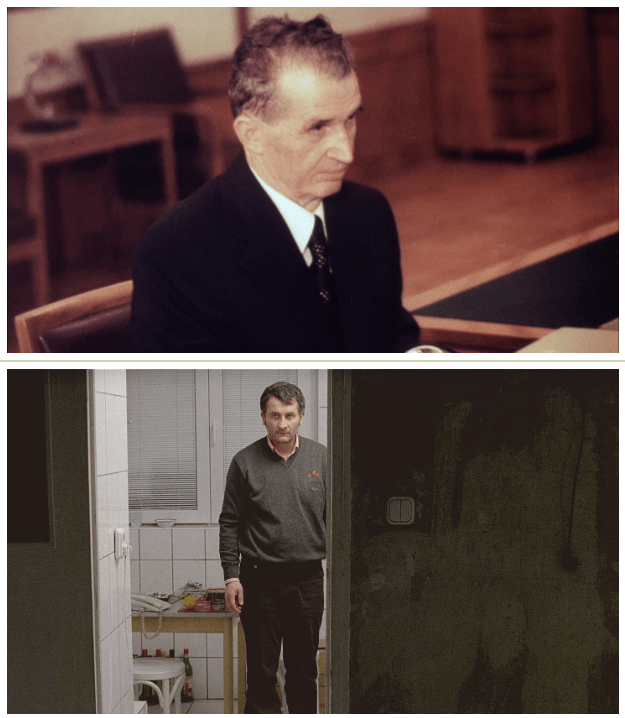
The first festival titles I viewed this year are two Romanian tours-de-force about ordinary men and what may lie behind their vacant stares (yes, Romanian cinema continues to astound). The Autobiography of Nicolae Ceausescu, part of the Special Events sidebar, is a triumph of archival research and editing. Director Andrei Ujica and editor Dana Bunescu compiled footage of the deposed Romanian president from the National Television and National Film Archives in Bucharest. They found home movies of his vacations along with propaganda footage shot at home and abroad. Ujica and Bunescu edited this footage together to create an unintentional “autobiography”, and built up a complex soundtrack for the almost entirely silent footage.

Ujica told Dennis Lim that “The film does have a commentary but it’s a nonverbal commentary. It’s in the construction of the sound and in the intervention of the music.” These manufactured scenes are bookended by grainy video footage of Ceausescu and his wife being interrogated after the 1989 revolution, before they are executed. The grim pallor of his face in this opening shot echoes throughout the multiple representations of his hale and hearty visage that follow.

His unseen interrogator says, “it was your masquerade”, and then the film proper begins, with  footage of Gheorghe Gheorghiu-Dej’s funeral, the former General Secretary of the Romanian Communist Party. Then Ceausescu is inaugurated, and the most striking thing about him is his hair. Swirling but immovable, it sits awkwardly and flamboyantly on his impassive boyish face. Tracking this follicular edifice’s slow decay is one of the film’s multifarious pleasures. It appears at various PR affairs, from the beautiful chaos of the Harvest Festival, where he plays fairground games half-heartedly, to his absurd historical recreation of Romania’s 15th Century King Mircea, which he stages for visiting dignitaries. He is attracted to showmanship, although he himself appears to be an inscrutable bore, his most common expression a half-smirk. He even stoops to cheating at volleyball during a game with friends (he pulls down the net to allow his weak kills to get over).

We see what he wants us to see, so politics are reduced to communist talking points, he won’t budge beyond name-checking Marx and Lenin, or his insistence on removing NATO troops from Europe. Very little is heard or mentioned about domestic initiatives – he seems entirely reactive, only inspired when the world seems to be against him. His most impassioned speech is delivered against the Warsaw Pact invasion of Czechoslovakia in 1968, where he forcibly condemns the “socialist incursion”, and insisted on putting an “end to interference.” While clearly a move based on the fear of invasion for his own fragile nation, it’s a forceful and effective speech, and on the right side of history. But that’s it for an intellectual spark. The rest of the film shows a man becoming more insular and paranoid, retreating into a cult of personality. All we see is scene after scene of Ceausescu smiling uncomfortably next to world leaders, a near daily affirmation of his own importance. He receives visits from Nixon, jets to England to meet the Queen, and is celebrated by Kim Il-Sung in North Korea a number of times, to ridiculously overblown fanfare. His trip to Universal Studios just seems like more of the same puffed up artificiality.

By the end, his face is a mask of boredom, a zombie on the national stage who keeps his country in a similar narcoleptic state. Ujica carefully deploys pop songs, including a memorable appearance from “I Fought the Law” to suggest the alien Western forces that are bleeding in to the edges of Ceausescu’s hermetic frame. By the end, when Ceausescu  looks emaciated inside his ill-fitting suits, his face ravaged with wrinkles and his hair imploding like a collapsed souffle, even his fellow lonely presidents have had enough (in one meeting Gorbachev angrily checks his watch). In the final shot of the post-revolution footage, with Nicolae and his wife Elena looking hollowed out and irascible, he is no longer the totalitarian nightmare of the Romanian imaginary, but just an old man scared to die.

Ceausescu makes quite a pair with Cristi Puiu’s Aurora, another study of a Romanian zombie. It is Puiu’s follow-up to the extraordinary Death of Mr. Lazarescu, and where that film is a portrait of a breakdown in Romania’s public services, this is an experiment that tries to document the breakdown of his country’s psyche. It is the second part of what he calls his “Six Stories from the Outskirts of Bucharest”, dedicated to Eric Rohmer and his Six Moral Tales, of which Lazarescu is the first. Puiu describes this series as about “moral crisis and how inefficiently and artificially the Western model has been applied to a country that had just emerged from the darkness of communism.”

Puiu himself plays the lead character, Viorel, a furtive, ill-tempered man who wanders around Bucharest fulfilling obscure tasks known only to himself. He collects a debt and picks up a firing pin for a shotgun. His face is stony, his wardrobe a consistently tasteful sweater-over-dress shirt combination. He is middle-class, in the midst of renovating his apartment. But instead of fixing up the place he keeps emptying it out, pawning his stuff on family and friends. It seems his is preparing to empty himself out instead. But Puiu reveals nothing of  his motives – Viorel is to remain entirely unknowable and irreducibly human, regardless of the violent acts he commits.

Puiu shoots him constantly from a distance, framed inside of doorways and other transitional spaces, the unbalanced images focused on the sliver of well-lighted spaces he broods in. The visuals are as opaque as the character, bisected and hard to navigate, plus Puiu frequently pans away from major actions, the camera acting like an abused but loving dog, keeping a distance but always wanting to creep closer. Puiu told his cameramen to “follow the character, and to look at him with a feeling that resembles a father watching his child learn to walk.” This is a more compassionate version of my comparison, but still apt. There is a constant tension of what will be revealed inside the frame or about the characters, a puzzle that kept me intensely engaged, especially with its rude bursts of absurdist humor, including a flash of an overweight woman getting a wax, and the brusque apathy of police officers refusing to care about the facts that audiences have been trained to fixate on. It’s a welcome provocation, shifting the weight of analysis from the characters to the viewer, a film to obsess over.

Next week I’ll have a lot more to pontificate on, including Oki’s Movie, Uncle Boonmee, Certified Copy, Film Socialisme, and unless I get shut out, The Social Network.
VCI. DVD. OMG.

September 7, 2010

vci

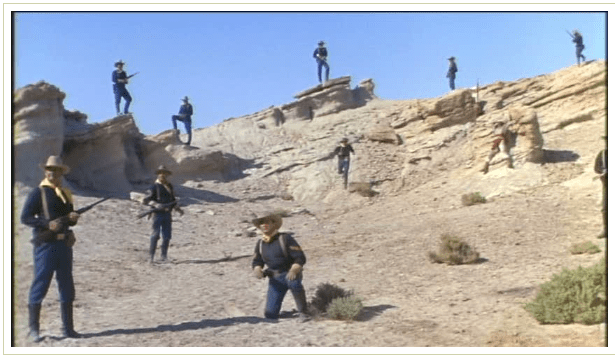
Last week VCI Entertainment released two obscure DVDs into the wild: William Witney’s Apache Rifles (1964, above) and Four in the Morning (1965), which features Judi Dench in her first leading role. Neither are deathless masterpieces, but each are valuable in their own inimitable way. Witney, a prolific director of movie serials for Republic Pictures (he specialized in Roy Rogers and Dick Tracy films, among scores of others), has a small (and growing) auteurist cult, receiving plaudits from Quentin Tarantino in recent years. In 2000, he told the NY Times that, “William Witney is ahead of them all, the one whose movies I can show to anyone and they are just blown away.”

A blunt descendant of The Searchers, it casts Audie Murphy as an Indian-hating U.S. Calvary Captain thrown into a moral quandary when he falls in love with a woman who is half Comanche. Making good use of the desert landscape, Witney starts off with wide shots during Murphy’s vengeful phase, and slowly closes in until the psychologically wrought final sequences take place in intimate two-shots. The first half is shoot outs, the second half fistfights (including a particularly brutal one with L.Q. Jones).

Released the same year as John Ford’s Cheyenne Autumn, Witney’s film is a smaller-budgeted effort to improve the representation of Native Americans on film, although the Apache “Red Hawk” is played by the Italian-American Michael Dante, and the unfortunate ending has him embracing the tribe’s forced relocation to Texas. But the rest of the film is a no-nonsense actioner that pragmatically diagnoses the causes of ethnic violence. That is, the Apache’s land equals money for the town’s miners, and so a higher standard of living for the community. So the “savagery” of the Native Americans is played up by the town leaders in order to provoke a fight. Murphy negotiated a truce with the Apaches mandating that work cease on the local mines, but it swiftly collapses when an Apache is falsely accused of murder. Self-interest always wins out.

Audie Murphy does not have the tools to navigate the minute psychological turns of his character – his bland handsomeness rather dulls the edge of his supposedly violent nature, tempering the drama of his shift in attitude to the Apaches. Witney surrounds him with capable bit players (Jones, Ken Lynch, Bob Brubaker), and matches cuts on action to keep things moving, a whirling film without a center.  To compare Murphy to John Wayne in The Searchers is to see the greatness of John Wayne.

Four in the Morning is a morose bit of British kitchen sink realism, following three tales of working class woe through a single evening. Judi Dench is a harried young mother tending to her wailing and teething infant while her husband gets loaded (she won the “Most Promising Newcomer” award at the BAFTAs). Ann Lynn plays a lonely nightclub gal who strolls the London docks with the eagerly flirtatious Brian Phelan, and they soon alienate each other with a series of power-shifting mind games. In between these two stories, director Anthony Simmons details the fate of a female corpse that washed ashore, documenting the bureaucratic wrangling to send her to the grave.

As a narrative it’s overdetermined and suffocatingly miserabilist, but the stark B&W images of the mud-spattered London ports by DP Larry Pizer subtly expresses the aimless malaise of its characters (Pizer also shot Mannequin 2: On the Move. It’s a job, after all). The scuffed top of the coffin that carries away the Jane Doe says far more, and carries more metaphorical weight, than the overwrought script. If Simmons trimmed the overly theatrical dialogue and let the camera speak, Four in the Morning might be known as more than a footnote in Dench’s career.

The only relationship between these two films is that, luckily, VCI got their industrious hands on them. Of the innumerable companies that release public domain titles, VCI is the only one to put care into their releases. Apache Rifles, as you can see, looks a bit soft, while Four in the Morning has nice sharpness, but exhibits some digital artifacts while in motion. But they are eminently watchable presentations, considering that VCI is dealing with original materials of questionable quality and working on a low budget. Apache Rifles is also festooned with an interview with Michael Dante, and a short, informative documentary about the film.

VCI started in 1961 as a non-theatrical booking company known as United Films, distributing studio titles to college campuses and ships at sea. In 1976 the owner/founder Bill Blair started up a division he named Video Communications, Inc., and they claim to be the first business to sell films directly to home theater owners. They clearly have a strong sense of film history, having also released Douglas Sirk’s Summer Storm and Lewis Milestone’s A Walk in the Sun earlier this year. A rescuer of orphaned films otherwise languishing in flickering boxes on YouTube, VCI is doing cinephilic yeoman’s work, and they should be thus honored.

RAOUL WALSH, ADVENTURER

August 31, 2010

Walsh3

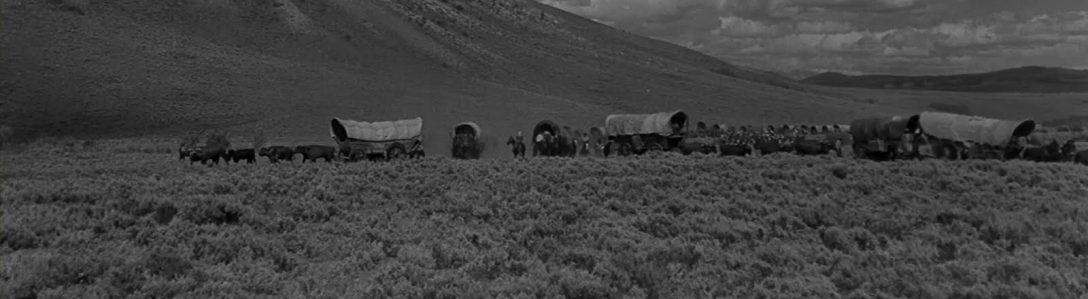
For a man who toiled in the studio system for close to 50 years, cranking out genre quickies and prestige productions with equal aplomb, Raoul Walsh’s work remains astonishingly coherent. My grab-bag syle of viewing has made this resoundingly clear. This week I watched his earliest work, Regeneration (1915) and The Thief of Bagdad (1925) through two films he made in 1953: The Lawless Breed and Gun Fury. The above still is from Along the Great Divide, a spare, Oedipal Western from 1951. All of them, in one guise or another, deals with Walsh’s major concern, the benefits (freedom) and costs (self-absorption, loneliness) of individuality.

In Along the Great Divide (available from the Warner Archive), men are subsumed under vaulting rock formations, isolated and doomed. Kirk Douglas, in his first Western, plays a neurotic U.S. Marshal intent on protecting a cattle rustler accused of murder (Walter Brennan) from his would-be lynchers, and on bringing him to justice. He pushes his deputies as hard as his prisoners, eventually alienating all of them over a harsh drive through the desert. Douglas represses his world-devouring charisma into a bottled-up rage, unleashed only when a bemused, sardonic Brennan starts incessantly humming a tune, “Down In the Valley”, that the Marshal’s Dad used to sing, triggering unwelcome memories.

Filmed in the emptied out High Sierras and the Mojave desert, Walsh shoots his actors in long shots against the alien landscape, reduced to motile dots during shoot-outs. When he comes in close, people are breaking down. The group’s loyalties are in constant flux, and love affairs fall apart on the second half of a shot-countershot. After cooing over a sunset, Virginia Mayo turns a gun on Douglas, eager to save her father (Brennan) from the noose. Everyone acts out of base self-interest, and it is revealed that the Marshal’s obsessive fealty to the law is merely his guilt-ridden reaction to his failure to protect his father. There is a complete interpersonal breakdown, with every man and woman looking after their own interests. As Renoir famously said in the The Rules of the Game, “everyone has their reasons.”

The faces are the landscapes in his debut feature Regeneration (on DVD from Image), a raw urban melodrama of gang life on the lower east side of NYC. Walsh told Peter Bogdanovich:

…I got a thing called Regeneration, a gangster picture, which is right up my alley because I knew all those bloody gangster kids and everybody in in New York. …I went down around the waterfront and around the docks and into the saloons and got all kinds of gangster types, people with terrible faces, hiding in doorways.

In his autobiography he said that, “There were enough bums and winos around to cut down on extras.” Equipped with these authentic visages, Walsh produced a downbeat piece of  social realism that runs underneath the stock drama, a mixture of fiction and documentary that is being mined today by international auteurs like Lisandro Alonso and Pedro Costa (Dennis Lim has a fine overview of this contemporary trend). It tells the story of John McCann (the immortally named Rockliffe Fellowes), a kid whose parents abandon him to fend for himself on the poverty-stricken streets. He turns into a brutal young hood, who softens only under the glare of social worker Mamie Rose (Anna Q. Nilsson), who tries to reform him. As a Walshian hero, though, McCann can never entirely be domesticated, the lure of dissolute freedom is too great. For Walsh, it was a natural decision to use “real” people to fill the cast, a cost-cutting maneuver that also allowed him to film those “terrible faces” which attracted him so much.

Previously employed as an actor by D.W. Griffith, as John Wilkes Booth in A Birth of a Nation and a host of Biograph shorts, there is a strong influence in Regeneration from his mentor. Walsh remembers that he learned “not to allow leads to ‘eat up the scenery’ by overacting’ from him, and describes one of the final sequences of the film:  “I had the camera move in for a close-up in the best Billy Bitzer style.” The close-ups are extraodinary, intimate portraits that impede the story, unnecessary to the action but essential to understand the time and place. More is revealed in a shot of a tattered t-shirt on McCann’s drunken stepfather than any inter-title could convey. Poverty is portrayed matter-of-factly, without condescension or embellishment, and it is this oppressive sense of reality that lends Regeneration its sizable force.

The Thief of Bagdad (streaming on Netflix Instant)was a mega-production, and while it’s more of a triumph for set designer William Cameron Menzies and Douglas Fairbanks’ chest, it continues Walsh’s interest in outsiders, albeit in a brighter, more rakish tone than Regeneration or even Along the Great Divide. Fairbanks’ thief is a charming rogue, but a solitary one, getting tips from a variety of magical grotesques, but his feats of strength and wit are all accomplished alone.

Walsh made two westerns with Rock Hudson in 1953, which deal with opposing visions of masculinity. In The Lawless Breed (on Wesley Hardin escapes the religious strictures of his father, only to fall into the  life of an outlaw. While in Gun Fury (on DVD) Hudson is an upstanding type, a fumbling fiance forced into vengeance when his wife is kidnapped.

The Lawless Breed seems like a dry run for The Tall Men a few years later, as Hardin has a dream of owning a farm and living the quiet life, while his dancehall gal is skeptical. The same dynamic is present between Clark Gable and Jane Russell in the later film, but what they make playful and flirtatious is rendered stolid and melodramatic here. The creaking script makes excuses for all of Hardin’s murders, straining visibly to whitewash his character into a spotless hero. This pushes against Walsh’s instinct to problematize the heroic instinct, and the resulting film is an intriguing failure. The shootouts are crisp and well-staged, but there is no tension or shading in Hardin’s character, with little of the ambivalent violence of Gable, who is a shown as a thief in the opening shot of The Tall Men.

Hudson made Gun Fury with Walsh the same year, which was shot in 3D. It has the most inventive use of 3D technology I’ve seen, mainly in the use of depth effects, which he was already a master at in the lowly 2D format. But here images in the foreground gain a new solidity, with dust kicking up in front of our eyes as a horse cuts through the back third of the frame. There’s a density and volume to the images that is absent from the recent 3D cycle, achieved through the constant interplay between background and foreground that elasticizes the screen space.

Hudson plays Ben Warren, left for dead by a brutal gang who abscond with his wife-to-be Donna Reed. Warren is no fighter, getting gunned down while futzing with a shotgun, and accepts the help of a former member of the gang, and a Native American who had suffered at their hand. The narrative is sleek and focused, pushing Warren forward even when he’d rather not, an accidental hero who’s not very good at his role.

For now, this will be my last post on Walsh, and it’s been nothing less than a revelation for me. His “invisible” style is never less than expressive, from the heights of Manpower to the lengths of the ‘Scope Tall Men, he has an instinctual touch for how to pack his frames for maximum dramatic impact. His heroes are bruised, his women are cynical, but when Walsh alights on a rich vein of dialect (Me and My Gal, Strawberry Blonde), he can be downright hilarious. He’s a shifting target, but I’m in the beginning stages of tracking him down.

JOSEPH H. LEWIS AND SO DARK THE NIGHT (1946)

July 20, 2010

Screen Shot 2020-01-24 at 1.12.26 PM

“Do you miss it – directing?

-I miss it only when I see things on the screen that make me want to vomit.”

Peter Bogdanovich interviewing Joseph H. Lewis, Who the Devil Made It

I should let this magical quote stand on its own, but I’m a writer, so I’ll write.  Last week, TCM devoted a night to the films of Joseph H. Lewis, including some rare items surrounding his acknowledged masterpiece, Gun Crazy (1950). The tastiest morsel was So Dark the Night (1946) (made soon after the modest success of the equally awesome, but better known, My Name is Julia Ross (1945)). A rural psychological thriller, it’s an extreme example of Lewis’ idiosyncratic visual sense (the son of a NYC optometrist, he grew up with lenses). As he went on to tell Bogdanovich:  “What interested me most was telling the story through the eyes of a camera. I didn’t like words – wherever I could, I cut words out, and told it silently through the camera.”

So Dark the Night is structured around his silent, highly expressive storytelling (major spoilers ahead!). Famed Paris detective Henri Cassin (Steven Geray) takes a break from sleuthing to soak in the rustic charms of the country town of St. Margot. He’s welcomed as a celebrity by the Michaud family, who operate the inn he’s vacationing at. Daughter Nanette (Micheline Cheirel), with dreams of city life, begins flapping her eyelashes in his general direction. Lewis first frames her as a pair of hands fidgeting with a sheet on a laundry line, who then pulls down to reveal her eyes and arched brows. Then she scoots to the right, her beaming mug filling half the frame (with a limited budget for sets, Lewis is big on close-ups). Cassin was also bifurcated upon introduction, shot from the legs down as he strolls around an idyllic urban street. His full body isn’t shown until he kneels to chat with a shoeshine boy. Both are visually split, a motif that continues throughout, and which pays off thematically in the bravura twist ending.

But back to the flirtation. Cassin returns her interested gaze in a medium shot, Nanette reciprocates, and then Lewis cuts to a montage of the detective’s chrome car. There are close-ups of the bulbous headlights, the erect front grille, the sloped handle, and the ornate hubcap – a burst of pure visual metaphor that is shocking in the context of a Hollywood thriller. Cassin is reduced by Nanette into images of luxury, industry, sex…as well as escape.

The sequence continues with an extraordinary tracking shot, following Cassin as he traverses Nanette’s gaze and crosses into the inn itself. Jean-Pierre Coursodon rhapsodizes about this shot in his (out of print) AMERICAN DIRECTORS. He translated this bit himself in the comments section of DaveKehr.com:

“The camera moves across the courtyard, reaches the corner of the house, and continues tracking inside the inn’s main room without a cut, as though it had moved in right through an invisible wall. By removing the fourth wall — in deliberate disregard of realism — Lewis suggests that, together with the protagonist, , we are entering a stage upon which a drama will soon be enacted…”

In this one scene, Lewis sets up the central romance, undercuts said romance with images of division and materialism, and displays a self-reflexive theatricality that foreshadows the action to come. This, my dear readers, is masterful filmmaking.

Soon the plot machinations do their work, and Cassin has two corpses on his hands in a seemingly unsolvable case. Through it all, Nanette is repeatedly composed inside the inn’s window frame, and Cassin is seen cut-up behind his bed’s headboard. There is also some balletic action with push-ins and pull-outs, with the camera repeatedly pulling away from Cassin, and moving forward to Nanette’s boyfriend, who’s eager to quash the detective’s amorous dreams. Not to mention his ominous use of downward tilts, which reveal a third dead body and a knocked out guard in succession (which rhyme with Cassin’s initial bow down to the street urchin).

All of it effortlessly builds up to the moment when Cassin solves the case – and implicates himself as the only possible suspect, despite lacking any memory of the crime. He is, of course, schizophrenic, hence the dense visual patterns that sliced him up. The extraodinary final images explode the cataract of split compositions that Lewis had been creating throughout, as Cassin is shot by the police through the pane of glass that previously showed Nanette whole. He staggers up to the pane, and in the reflection sees a flashback of himself as he existed before the murders. With a fireplace poker he smashes the whole edifice down, and with it the motifs Lewis had been building the whole film. Coursodon reads even more into it:

“the climactic scene in which the the protagonist eradicates both his reflection and the recalled image of his former self by smashing the window in a gesture of revulsion [recalls] Oedipus’ blinding of himself after finding out the truth.”

This mythical interpretation of Cassin’s final act gibes with Coursodon’s reading of the tracking shot as announcing a theatrical space.  Cassin’s extreme rationality solves the case, but destroys his life. His final words: “I caught him, I killed him” are a kind of perverse triumph of the mind over its own physical limitations. And no-one got more delight, or more success, out of creatively overcoming the limitations of low budgets than the self-described “artist without a diploma”, Mr. Joseph H. Lewis.

DIGGING INTO THE WARNER ARCHIVE: …ALL THE MARBLES (1981)

Originally published at Movie Morlocks, the official blog of Turner Classic Movies

July 13, 2010

Screen Shot 2020-01-24 at 1.06.24 PM

The Warner Archive continues to empty out WB’s library onto their premium-priced burned-on-demand DVDs, and it’s impossible to keep up. I currently have my wavering cursor over the buy button on Sam Fuller’s Verboten (reviewed in this Sunday’s NY Times by Dave Kehr), and the double-feature disc of Hell’s Heroes (1930) and Three Godfathers (1936, Boleslawski, not Ford). But one of the releases I have nabbed is of Robert Aldrich’s final film, …All the Marbles (1981). Released in a strong transfer, which faithfully reproduces Joseph Biroc’s elegiac grey-blue photography of industrial decline, it is, without hyperbole, the greatest women’s wrestling movie of all time. Please correct me if I’m wrong.

Peter Falk plays Harry Sears, the manager and crusty philosopher king of the California Dolls tag team (Vicki Frederick and Laurene Landon) who are slowly punching their way up the ranks. Driving their beat up sedan through decaying Midwestern factory towns, and hustling their way around shyster promoters and county fair pervs, it’s a genial tour of the areas hardest hit by the early 80s recession. The early scenes were shot in Youngstown and Akron, Ohio, and Aldrich films their travels in long shot, images of a car rolling past idling factories and roadside dives, as the team’s conversations are piped in on the soundtrack. At one point Iris (Frederick), after her partner Molly (Landon) complains about the rigors of the road, looks at a passing steel foundry and says, “how’d you like to work in there?”

While on the surface the film follows the normal sports film trajectory (defeat, recovery, victory), visually the film presents a panorama of working class types blowing off steam and struggling to survive. It’s a bracingly bittersweet combination, embodied in Falk’s folksy and violent performance. His Harry Sears is an engaging huckster, raised, as he tells the Dolls, on a combination of Will Rogers and Clifford Odets. Constantly on the phone trolling for gigs, he uses his quote repository to keep his marks off-balance, and as a shield against revealing his own tattered emotions. He’s always spouting lines like how their journey will last “longer than a breath, shorter than a life”, trying to keep his team focused on the present moment, ignoring the failed past and fragile future.  When asked who Rogers and Odets are, he deadpans, “a dance team,” before popping in the cassette tape of Pagliacci’s aria “Vesti la giubba.” Then he’ll pivot from his aesthete mode by playing craps with fixed dice and flashing intense spasms of rage, destroying a promoter’s Benz with a baseball bat and even coming to blows with Iris. An autodidact, father figure and inveterate con man, he’s the perfect character for Falk’s gravelly bravado.

Molly and Iris are less well-defined, more women of action than drama. Molly is a benumbed blonde, addicted to painkillers but still emitting a heartbreaking type of child-like innocence. She’s using the Dolls, more than the others, as a family unit. In the ring she has a more mat-based game, whereas Iris takes more technical risks. Iris is world-weary and hard-working, resigned to working with Harry but desirous of a life above his penny ante tricks. Frederick does fine work summoning up Iris’ patchwork dignity, grasping on to the wispy strands of integrity in her sport to prop up her fading hopes (the film only hints at how fixed pro wrestling is).

It’s Harry who again drags her back down to reality, pulling off a variety of semi-dirty tricks and mounting some old Hollywood razzle dazzle to swing the crowd and nab the Tag Team title. The final fight takes place at the MGM Grand, and the rhinestone-encrusted, child-choir scored entrance seems a tongue-in-cheek homage to MGM Musicals of yore. He even gets former Pittsburgh Steeler Mean Joe Greene and Laker announcer Chick Hearn to narrate the bout, escalating the event to a level of legitimacy heretofore unknown to female fisticuffs. Iris has to accept that image sells and accommodation is integral to that sale.

Both actresses are tall and athletic, and clearly game enough to hold their own in the ring, so the high-angle shots Aldrich uses to spot in the stunt doubles flow seamlessly into the rest of the fights. The matches themselves are crisply edited and shot at a distance. In addition to the geometric overhead shots, Aldrich cuts in to POV shots for impact and medium shots for the majority of the slaps and falls. The action is fast-paced and as passable as the women’s division in the WWE these days. Iris even whips out some impressive aerial maneuvers in the final bout, landing a hurricanrana to gain an early advantage. The convincing nature of the fights was thanks to the help of advisor Mildred Burke, the World Women’s Champion from 1937 – 1957.

The Pagliacci aria plays throughout in what seems like another of Sears’ pretentious affectations of knowledge, until he explains to the gals the story of the opera. Pagliacci was a traveling performer like themselves, and, in his interpretation, the lesson of the character is to “hang in there, even if your heart is breaking.” This sentiment could be ascribed to some of Aldrich’s other conflicted heroes, including the idealistic Lt. Debuin (Bruce Davison) in Ulzana’s Raid, or even Charles Castle in The Big Knife (which Aldrich adapted from Odets). In any case, …All the Marbles is an eccentric, moving, and profoundly appropriate close to Aldrich’s career.

THE NEW YORK ASIAN FILM FESTIVAL & JAPAN CUTS

June 29, 2010

Screen Shot 2020-01-23 at 5.29.03 PM

The New York Asian Film Festival (June 25th – July 8th) is more essential than ever. With distribution companies shutting their doors to Asian cinemas of all types,  there are very few outlets to watch the continent’s resourceful, often brilliant genre cinema on the big screen. For nine years programmer Grady Hendrix and his crew have been filling the void, and for the past few has joined forces with the Japan Cuts Festival of Contemporary Japanese Cinema (July 1 – 16th)  to provide the most eclectic and revelatory overview of Asian film in the U.S. It’s a heady mix of spectacle, grotesquerie, slapstick and resolute artistry. Every year you’ll see something you’d never seen the likes of before.

For me, this year’s edition surprised me with its Chinese slate, and specifically the skittish performances of actor Huang Bo, recepient of this year’s redundantly titled  Star Asia Rising Star Award. My knowledge of contemporary Chinese cinema doesn’t extend far beyond the arthouses and underground film clubs that show Jia Zhangke and the documentaries of Zhao Dayong. So getting exposed to Huang in the antic Crazy Racer and morbidly funny Cow expanded my limited horizons.

A squat, frog-faced actor with a quick smile and a quicker temper, Huang plays stubborn fools with a clumsiness and slack-jawed innocence reminiscent of Buster Keaton. Crazy Racer (the sequel to Crazy Stone (2006), which I haven’t seen) is a time-shifting crime-comedy in the Pulp Fiction mode, with Huang’s disgraced bike racer bumping into two bumbling assassins, a Thai drug dealer, the Chinese mob and beatings with a frozen fish. The twisty narrative is imaginative and cleanly executed, and director Ning Hao doesn’t bother dawdling over too much sentiment. Cow has Huang playing a similarly alienated character, but in a completely different context. His Niu-Er is a simple peasant caught up in the Sino-Japanese war. His village gets slaughtered, the only surviving creature a foreign cow donated to give milk to the Chinese troops. Navigating some dramatic tonal shifts, Huang manages to insert a violence into his pratfalls and a resignation in his stubbornness that keeps the film from descending into treacle. He elicits laughs that catch in your throat, inserting a jaggedness to the sentiment that makes the whole improbable set-up go down a lot smoother. Plus the cow is pretty good too.

Revelatory in another sense is SOPHIE’S REVENGE, which is a blatant Sex & the City knockoff produced by and starring Zhang Zhiyi. She plays the Carrie role with an overwhelming barrage of animal-themed hats and cow-eyed stares. While the cartoon-y stylization and wonderfully violent fantasy sequences take some of the sting out of the blatant consumerism of this day-glo contraption, the story suffers from an inert supporting cast and a story too cliched for even the Sex gals to endure. While no great shakes as a film – as a cultural object it’s fascinating, as it creates a photo-shopped super-rich city of chrome and flowers and whimsy where women are sexually independent and the rural poor exist only in the “arty” shots of the hunky photographer.

Moving to Hong Kong, the best film in the festival is the uncut version of John Woo’s RED CLIFF, but I’ve already written about it here at Morlocks and also at Moving Image Source, so I won’t spill more words on it. But I will recommend Gallants, a quirkily nostalgic martial arts film featuring oldsters Bruce Leung and Chen Kuan-Tai. Waiting for their near-ancient master to awake from a coma, Leung and Chen turn the gym into a restaurant, until a callow teen sparks a feud with the high-tech workout joint across town. It’s a pleasant and comfy piece of work, sliding into the normal revenge plot mode with tongue gently pressing against cheek.

Little Big Man, Jackie Chan’s diverting take-off on the series of swashbuckling origin stories (including Red Cliff), finds the cherubic 56 year old actor playing a coward. He plays dead during the heroic battles in order to stay alive, and captures a wounded opposing General after all the bodies fall. Failing to push its subversive premise very far, the film ends up celebrating the same kind of warrior ethos it is ostensibly parodying. But it features a few agile Chan fight scenes, and that should be enough.

The only Korean feature I was able to preview was the loopy romantic comedy, Castaway on the Moon, which is unable to sustain its whimsy past the one-hour mark, upon which it devolves into standard love story pabulum. Mr. Kim attempts suicide by jumping into the Han river, only to find himself on an isolated island. Not too upset to be cut off from society, he starts living off the land and communicating with a shut-in, Mrs. Kim, who watches him through a telescope at a high-rise apartment. There is some good obsessive work with black bean noodles, bird poop and the real utility of credit cards, but once the separated duo start communicating, invention flags and director Lee Hey-Jun gropes for cliche.

The Japan Cuts program tends to be more reserved and dramatic, leaving the madness to NYAFF, and this year is no exception. The main highlight for me has been Yoji Yamada’s About Her Brother, an expertly staged family melodrama starring the superb Sayuri Yoshinaga and Tsurube Shofukutei. They play sister and brother, respectively, with the latter drinking himself into a debauched oblivion. Yamada, now 78, is in perfect control of the medium, setting up familial relations and foreshadowing events through composition and staging. Beginning with a quick montage of recent Japanese history (including clips from Yamada’s own 48-feature long Tora-san series), the film slowly unveils Tsurube as the inebriated black sheep of the family, upending a family wedding with the destructive power of his singing voice.

He prefaces this destruction with a quietly witty shot – a wine glass in the left foreground marking doom. Later, Tsurube’s knee juts up into the middle of the frame, another subtly amusing jibe at his need to be the center of attention. But this isn’t a comedy of reformation. Yamada never allows Tsurube to be judged so simplistically, eventually offering a subtle critique of the middle-class values that would attack his particular kind of independence. If you need more reasons to see it, David Bordwell is a fan and wrote about it briefly here.

The festival started on June 25th, but there’s plenty more to see. And while it’s likely you won’t catch them in cinemas again anytime soon, many will be available at your local Chinatown on DVD, and will be for sale at on-line retailers like YesAsia.

WILD THROBBINGS OF THE HEART: ERIC ROHMER’S THE GREEN RAY

June 8, 2010

Screen Shot 2020-01-23 at 1.15.19 PM

The greatest cinephile deal going right now is for Arrow Films’ 8-Disc Box Set of Eric Rohmer films, which includes all six entries in his Comedies & Proverbs series, along with Love in the Afternoon and The Marquise of O.  At Amazon UK (a region 2 disc, you’ll need an all-region player to spin it), it’s priced at 11.93 pounds, which is 17.27 USD. That’s the highest sublimity-per-dollar ratio you’ll find anywhere! Guaranteed.

So with summer approaching, ready to expunge sweat from heretofore unknown pores, I watched Rohmer’s The Green Ray (1986, titled Summer in the U.S.) in my un-air conditioned apartment on a 90 degree day. Delphine (Marie Rivière) is planning a vacation to the Greek isles when her friend backs out two weeks before departure. Scrambling to find an alternate getaway, she gloms on to another friend’s trip to Cherbourg.

This begins a frustrating, lonely journey as Delphine bounces from resort town to resort town, each densely populated sun-dappled spot making her feel more alone than the last. She refuses to mask her pain with play-acting or empty flirtations, holding firm to her ideal of romantic love. Her interest in superstitions and the supernatural is curiously stoked by the fortuitous appearance of green playing cards and a mention of Jules Verne’s novel The Green Ray. She senses a pattern in these shades (the kind of game playing one is used to seeing in Rivette), which leads her to embrace the spirit of the Rimbaud epigram that begins the film: “Let the moment come/When hearts will be one.” (“Song From the Tallest Tower”, translated by Wyatt Mason)

For most of the movie though, her attitude resembles the second stanza in the poem:

Just say: let go,

Disappear:

Without hope

of greater joy.

Let nothing impede

August retreat

Delphine would like nothing more than to disappear. The three fulcrums of the story are her walks into nature, in which she’s trying to fade away. In Cherbourg, she wanders around a leafy path, stopping in front of a wooden gate. Alone with her thoughts, Rohmer cuts to a montage of tree branches swaying in the wind, before cutting back to her face. In a film that’s mostly two shots, or shot counter-shots, of people conversing, these quick cuts to empty spaces are privileged, emphasizing her oppressive solitude. She cries in close-up. Unable to disappear, she leaves town instead – and the second shot finds her strolling through the Alps, pausing to graze her hand against the hard-packed snow. In a rare long shot, her silhouette is visible against the backdrop of craggy peaks, her tears elided. She cuts her visit short, and soon finds herself in Biarritz, strolling down a stone staircase in a red poncho, hoping to find some kind of peace by the caves – but the tide is high. In an interview on the DVD, Rohmer calls this her “descent into hell”.

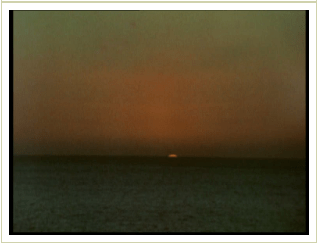
Rohmer uses splashes of red throughout the movie – on Delphine’s bag, a suitor’s sweater, a Cherbourg dress – and finally ending in the poncho – marking her lowest point. While the reds spiral downward into despair, the greens offer a way out. She finds a green-backed Queen of spades on the streets of Paris, a green ad for a seance  that reads,”Regain contact with yourself and others…”, and a green-backed King of Hearts. She even mentions that a medium told her that green would be her color for the year. Finally, she overhears an older group of tourists discussing Jules Verne’s The Green Ray, in which she hears that the final ray of light the sun emits before sinking below the horizon is green. It is only visible on perfectly clear days, and according to Verne, a Scottish legend claims that:

“this ray has the virtue of making him who has seen it impossible to be deceived in matters of sentiment; at its apparition all deceit and falsehood are done away, and he who has been fortunate enough once to behold it is enabled to see closely into his own heart and read the thoughts of others.”

Helena Campbell, the heroine of The Green Ray, refuses to marry the pretentious knob Aristobulus Ursiclos until she sees the ray and understands her own heart. Rohmer clearly pulled some aspects of Delphine from Helena. Verne again:

“De Maistre has said, “there are in me two beings: myself and another.” The “myself” of Miss Campbell was a serious, reflecting being, looking upon life from the point of view of its duties rather than its rights. The “other” was a romantic being, somewhat prone to superstition…”

Along with this similarity of temperament, they share a fractured itinerary. Helena forces her two Uncles to travel from isle to isle, in order to find the perfect sea horizon to view the ray which Aristobulus keeps clumsily blocking. They are constantly on the move. Delphine is on her own jagged path, seemingly more out of lassitude than romantic intensity, but both girls end up searching out the ray for a kind of transcendent self-determination.

Delphine encounters a series of Ursicloses along the way, from the strapping and shirtless to the meek and leather-jacketed. She dismisses them all with skittish indeterminacy, running away rather than causing a scene. It is only when exhausted in body and soul, collapsed in a molded plastic seat at the Biarritz train station, that she opens herself up, as open as her copy of Dostoyevsky’s THE IDIOT (and she very well may aspire to Prince Myshkin’s absolute lack of self-regard and Christ-like innocence…she at least relates to his rejection by society).

An exchange of looks with a cabinet-maker leads her to an impulsive jaunt to  St. Jean de Luz, where she passes the gift shop “Le Rayon Vert” (The Green Ray), until  she settles on a bench with her man and tries to answer a question. She’s just waiting for the light…

The beauties of this final sequence ought not be put in words (or I’m not the one who’s capable), as it captures the moment “when hearts be one” with a joyfulness and lack of artifice that would make Rimbaud and Myshkin weep. I’ll let Jules Verne and Rohmer have the last act:

Helena felt instilled with new life as she inhaled the fresh breezes; her beautiful, clear eyes sparkled with health as she gazed on the rippling waters of the Atlantic stretching far and wide, and her pale cheeks were faintly tinged with pink. How lovely she looked! And how charming her whole appearance! Oliver Sinclair walked a little way behind, and regarded her in silence; he who had often accompanied her in her long walks without the slightest embarrassment, now scarcely dared look at her for the wild throbbing of his heart!

Screen Shot 2020-01-23 at 1.20.22 PMScreen Shot 2020-01-23 at 1.20.35 PMScreen Shot 2020-01-23 at 1.20.43 PM

FESTIVAL SEASON: OUR BELOVED MONTH OF AUGUST (2008)

April 6, 2010

5279575.0

The inaugural TCM Classic Film Festival kicks off on April 22nd, and there’s going to be wall-to-wall coverage here once it begins. Jeff Stafford has already posted a wide-ranging, must-read interview with Norman Lloyd, who’ll be introducing Saboteur on the 25th. But like the Cannes Film Festival a few weeks later (May 12 – 23), I’ll be unable to attend, marooned as I am on the East Coast. But I’ll be checking back here at Movie Morlocks for reports on the TCM-fest, and there will be an endless array of outlets covering Cannes. But what about seeing the films, the vast majority of which won’t receive stateside distribution?

The on-line cinematheque The Auteurs has come through for me on at least one title on my list, with an assist by Stella Artois. They’re streaming nine former Cannes selections for free thanks to that mediocre Belgian beer sponsor. These include Our Beloved Month of August (2008)a Portuguese experiment highly regarded by  Cinema Scope’s Mark Peranson and Robert Koehler, Jonathan Romney of Sight & Sound, and filmmaker C.W. Winter (The Anchorage, which I wrote about recently), who placed it on his best-of-the-decade list. It was never picked up for the U.S., and I was ecstatic to find it offered along with a group of higher-profile past Cannes selections including L’Avventura, Mon Oncle, and Amarcord.  The kind of curatorial adventurousness that led to August being included among this canonical group is sorely needed in programming these days, and The Auteurs should be praised (once again), for loosing this strange beast upon American eyes.

Miguel Gomes had an idea for a movie. It was to be an atmospheric melodrama about a small-town girl and her fraught relationships with her guitar-playing cousin and over-protective father. As Gomes tells Peranson, the funding dried up when their money-man died before signing the authorization to release the cash. With a crew already assembled, Gomes began filming the people and rituals of Arganil instead, the municipality in central Portugal in which he was to set his movie. He documents karaoke performances in central squares, father-son accordion duos in underground bars, the history of a local newspaper, and the perils of Paulo, the local drunk legend whose outrageous fictions permeate the rest of the stories. Paulo (pictured at the head of the post), is an inveterate liar, or in other words a storyteller, and Gomes records his exploits as recounted by a variety of locals before getting the embroidered tales from the man himself (they involve beatings from Moroccans, blackouts, and bridge jumping).

Gomes interweaves the checkered production history of his film in the midst of these slices of life. He frames himself as a deadpan morose type, spouting one word answers to his angsty producer Joaquim Carvalho when asked why he hasn’t found any actors (he’s looking for “people”). Or else he’s playing a horseshoe-like game called “quoits” and ignoring the two girls trying to nab his attention for a part in his film. These sections are entirely staged by Gomes, while in the Arganil portraits, as Peranson notes, the actors are making their own mise-en-scene. In the documentary portions, they are leading Gomes, while in the self-reflexive “production” scenes, Gomes is leading the actors. He is simply placing everything in the frame – from the chance conversations of a bickering couple to the equipment Gomes is using to record that scene. He tells Peranson:

The film is a clash between cinema with this part of the country, so us and everything that was with us should appear. Normally there is behind the camera and in front of the camera, and this time I wanted to put everything in front of the camera, and even what’s in the middle should appear—which is the camera.

Everything placed in front of the camera becomes cinema, whether it is based on reality or in Gomes’ head – each is mediated in its own way, as the case of Paulo makes clear. His “reality” is as melodramatic as the story that follows, as Gomes shifts his film into a narrative mode.

Gomes makes the leap to fiction when some of the villagers start acting out his original screenplay. A local girl who was a lookout for forest fires becomes Tania, a teenaged vocalist. Joaquim Carvalho, already seen as the film’s producer, becomes Tania’s father, a keyboardist. Fabio, profiled as a star athlete on the local hockey team who dabbles on the guitar, becomes Helder, Tania’s cousin and new guitarist for Estrelas do Alva, a traveling band. They play the lovelorn pop songs we’ve seen from the karaoke scenes, but now in service to a plot, and their lyrics soon gain resonance as the character relationship deepen and fracture.

Fabio and Tania slowly fall in love, while the father’s protectiveness starts to seem more than fatherly… This incestuous trio becomes a metaphor for the stifling nature of Tania’s small town life, but also for the intense intimacy engendered by the creative process. Estrelas do Alva could also be read as a stand-in for Gomes’ own film crew, stranded, like Tania and her family, in Arganil and prodded to make art without much financial backing. While the tempo is slow (the movie runs to two and a half hours), it is necessary to tease out the rhymings between the two sections of the film, and to build the fabric of their “real” and “fictional” lives.

What at first seems like a laid-back travelogue turns out to be a finely structured piece of modernist cinema, jauntily self-reflexive while humorously obliterating the distinction between fiction and documentary. It’s hard to describe how a movie can be so relaxed and yet so thematically rich. It teases structural puzzles that are never resolved, like Rivette, and yet render the simple beauties of pop songs with an earnestness out of MGM Musicals. It’s frankly unlike anything I’ve ever seen, and while Robert Koehler rightly groups it with his “cinema of in-betweenness” of Lisandro Alonso, Uruphong Rakasad, Ilisa Barbash and Lucien Castaing-Taylor, et.al., there is a undefinable generosity here that separates August from the works of those equally demanding (and essential) filmmakers.  It is warm, teasing, intellectual, and filled with pathos. An absolute original and an easy (and free!) way of jumping into the vanguard of international cinema.

MY SON JOHN (1952)

February 2, 2010

MYSONJOHNLC5

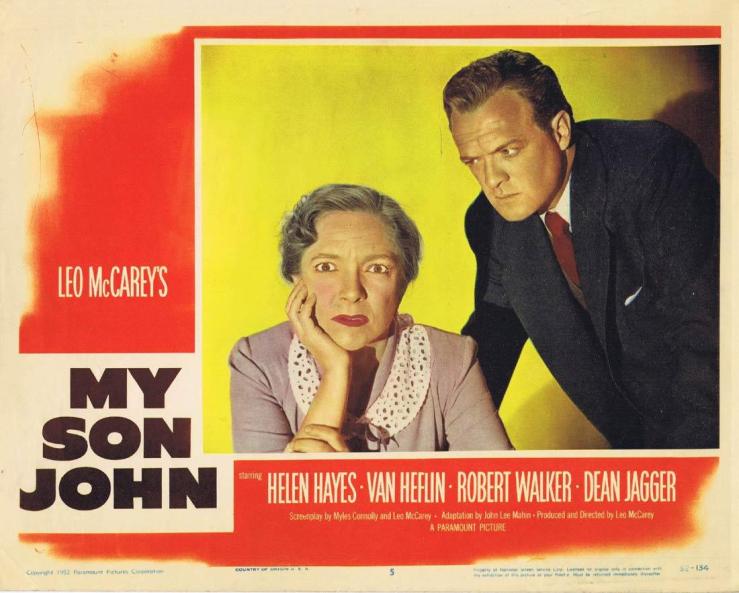
Last Wednesday, TCM presented the first television screening of Leo McCarey’s My Son John in decades. It screened as part of the “Shadows of Russia” series, which tracked Hollywood’s depiction of the country from Tsarist times through Soviet rule. Programmed by the NY Post’s Lou Lumenick and the Self-Styled Siren‘s Farran Smith Nehme, it offered a wonderful chance to catch up with McCarey’s underrated rarity. The reason for its obscurity lies in its politics. Produced during the height of the House Un-American Activities Committee (for which McCarey was a friendly witness), it is strongly anti-communist, and has been dismissed in many corners as mere McCarthy-era hysteria. As Robin Wood wrote in Sexual Politics and Narrative Film, the film is generally presented in a condescending manner: “typically introduced with an apologetic chuckle signifying, ‘Nowadays, of course, we can laugh at this.’” The usually sage Robert Osborne adopted this attitude in his introduction to the telecast, referring to it as an embarrassment, and our own astute Morlock Jeff emphasizes the “hysteria” over its other virtues in his article on the movie.  I have to respectfully disagree with my colleagues.

To reduce the film to a kitschy red scare product ignores the complex dynamics occurring in the family unit. Dean Jagger plays the father, Dan Jefferson, an earnest American Legion member who can’t conceive of a world outside his small-town newspaper. He’s an ingratiating buffoon with a quick temper and a taste for the beer barrel at the Legion hall, likeable enough until he starts singing nativist jingles and tossing his son across the room. He is an intentionally ridiculous character, as McCarey told Peter Bogdanovich in Who The Devil Made It?, as unbending in his conservative beliefs as John is with his communist ones. Personally, McCarey may have gravitated more to the father’s view, but his artistic temperament, which cherished improvisation and spontaneity, would never allow a such a monolithic man to be a hero (hence Renoir’s famous quote that McCarey understood people better than any other Hollywood director). Instead he is thrown through a series of farcical scenes – the song, a drunken rant, an absurd whack of the bible – that display his child-like pettiness and his inability to adapt to the times. His paranoia is proven accurate, but this does not alter the boorish nature of his character. His wife Lucille is the one who uncovers her son’s secret, and is the true dramatic center of the film.

Lucille, played spiritedly by Helen Hayes after a 17 year absence from the screen, is the pragmatic one, calming Dan’s fears, enduring his rages, and attempting to understand John’s point of view. She is patient with her husband but also fiercely independent, evidenced when she secretly dumps the pills he foists on her for her “anxiety”. She coddles him like an impudent pup, with a condescending kind of love. He provides the bombast, but she is in control of the relationship. Hayes’ performance is a bit of a high wire act, managing swings from manic energy to swooning depression with a few broad strokes – her darting eyes and sing-song voice ease the way down to the tragic conclusion. I think she succeeds wonderfully, evincing a rock-ribbed faith in God (in the eyes), paired with a mischievous sense of humor (her staccato laugh).

There is an especially moving scene where John is describing the world’s duty to help raise up the poor, and she finds a connection to Catholicism’s similar tenets to tend to those living in poverty. The joy in her face at this empathetic moment is beautiful and devastating , because she has yet to understand the basic incompatibility of their world views, and hence their imminent separation (and also because of the intensity of McCarey’s close-ups). Her inability to transcend the barrier between these ideologies turns her into the central tragic figure of the film, and is why Dave Kehr calls it McCarey’s most “emotionally demanding movie after Love Affair“. Her capitulation to Dan, when she tells him he was right about their son, is another scene of devious power, with Lucille’s ashen face on a different plane from Dan’s obliging attempts at apology for his drunken antics the night before. It is a drama of generational feuding and familial fissure more than anything else, as Martin Scorsese has also noted.

John is played by the incredible Robert Walker with icy disdain, a callow kind of condescension that college boys convey upon returning home from their first few philosophy classes (I recognized a bit of myself in him). It ended up as his final performance. Walker died near the end of the shoot, necessitating a total rewrite of the final sequences, and some awkward matte work which included some shots from the final carousel sequence in Hitchcock’s Strangers on a Train. It is these final scenes that have marred the reputation of My Son John more than anything else, as John’s dramatic turn away from communism had to be cobbled together out of scraps of old footage and stand-ins, rendering this already difficult arc impossible to pull off. Without an actor to improvise off of, the subtleties of McCarey’s character work fall away, the family drama fades into the background, and McCarey’s staunch anti-communism dominates, turning the last act into more of the straight propaganda film its critcs claim it is. But it still contains echoes of the emotionally wrenching work that came before, in the few shots of Helen Hayes’ eyes.

McCarey claims it could have been his best film if Walker had survived, perhaps an impossible claim with The Awful Truth and Make Way for Tomorrow on his resume, but it lies at the center of his thematic world – at the nexus of personal freedom and familial responsibility that winds through his greatest work. It may not be his best film, but it is an essential one.

AKIRA KUROSAWA AT 100

January 19, 2010

stray dog
Akira Kurosawa is a director I’ve long taken for granted. I’ve never bothered to look much farther beyond the recognized classics: Rashomon, Seven Samurai, Kagemusha, Ran. The latter two floored me with their blood-red blood in my image-besotted youth, but I repressed that enthusiasm to make the usual auteurist arguments – belittling Kurosawa in order to praise Ozu, as if it were a zero-sum game. It’s absurd of course, and because of it I’ve missed out on the minor contours of Kurosawa’s career, the mini-masterpieces, curiosities and salvageable disasters that make auteur criticism worthwhile in the first place. His 100th birthday (on March 23rd) has spurred a series of retrospectives and releases that have finally shamed me into exploring more of his career. Film Forum in NYC is holding a massive retro, and Criterion released a 25-disc box-set, AK 100. I have no more excuses, so I sat down for Stray Dog and The Idiot.

Stray Dog, from 1949, is hot. It’s a meltingly humid summer in Tokyo, and everyone is sweating through their clothes and guarding their electric fans with rabid ferocity. The heat is making people quick-tempered, and then Detective Murakami (Toshiro Mifune) has his gun stolen, a Colt. The rookie cop is desperate to recover it before he’s fired. It’s a perfect set-up to explore the various underbellies of Tokyo as handkerchiefs are applied to perspiring foreheads. The film has been compared to Jules Dassin’s The Naked City in its raw depiction of urban life, but Kurosawa’s technique is far more experimental than Dassin’s social-realist gangster film. In the first ten minutes, Kurosawa uses a quick flashback, whip pans, a voice-over about the godforsaken heat, and a close-up montage of legs getting onto a bus. This low-angle shot of Murakami’s lower half will rhyme with the muddy shoes of a murderer, one of the many linkages Kurosawa provides between the two.

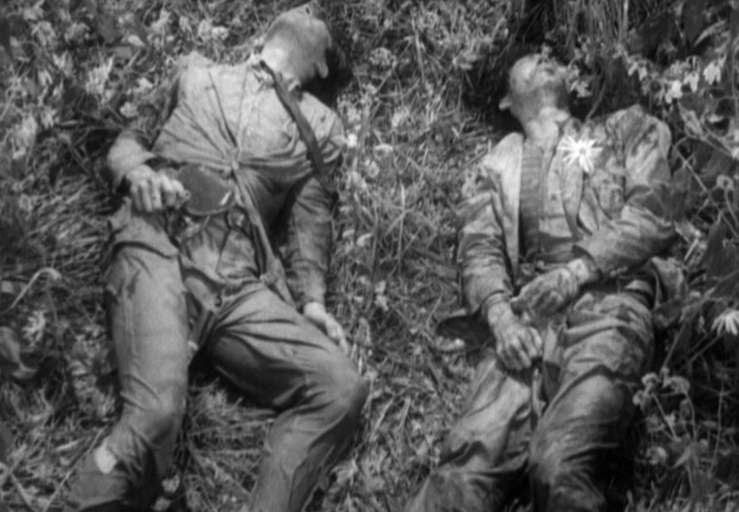
As Murakami lurks through the docks, a seedy nightclub, a ballpark, and a gloomy hotel, he discovers that the perp  has been cutting through civilians with his Colt. And also that both men were robbed of their belongings when they returned home from WWII. They are, essentially, the same person, connected through gun and history. Kurosawa is relentless in pairing the two, embroidering patterns around them until they’re inseparable on-screen. Their final battle is staged in a series of symmetrical framings, with the two collapsing to the ground in unison (see top image). It’s the most successful example of this well-worn trope that I can remember (although Eastwood does a decent job of it in Tightrope).

Paired with the oppressive, impeccably art-desgined atmosphere of pore-choked Tokyo, it’s a remarkable film, frank in its eroticism and its violence. The only influence Kurosawa cops to is Georges Simenon, who he modeled the script after, but the scene on the docks and the nightclub struck me as spaces straight out of a Josef Von Sternberg movie, clogged with smoke, pancaked makeup and decorative netting. These are impassable spaces that one can get lost in. Peek at the shot of the nightclub dancers collapsed in the upstairs room, where legs, arms, and heads no longer connect in an abstracted zone of pure eroticism. This shot could be inserted into The Shanghai Gesture and no one would blink.

Amid all of this, Kurosawa maintains his marvelous sense of pacing and tension, cross-cutting between Murakami’s interrogation of the killer’s girl with his boss’ run-in with the thug himself, connecting the two spaces with an incessant pouring rain and a faint radio melody playing over the phone when the deed occurs. Kurosawa then links this musical piece to the final chase, when the music of a lady practicing her piano pipes in over the frenzied showdown, a sound initially coming from nowhere that calls back to the previous scene – adding an uncanny sense of doom to their tussle. The film is loaded with these kinds of linkages, just charting the uses of flowers, guns, and shoes in the film could fill up a master’s thesis.

After Kurosawa broke people’s minds with the complex flashback structure of Rashomon (1950), he undertook what might be his greatest economic and critical failure, an adaptation of Dostoyevsky’s The Idiot. Having read this recently, I was amazed at how closely he hewed to the book, aside from setting the film in contemporary Hokkaido. His Prince Myshkin is named Komeda, played with slow-footed grace by Masayuki Mori, whose experience in the war has left him an “idiot”, unable to tell a lie and as sensitive as a child. He is taken with a photo of Taeku Nasu (a smoldering Setsuko Hara), a kept woman about to be sold off for marriage. Komeda loves her out of pity, while Akama (the great Toshiro Mifune) lusts after her with a white-hot rage. This is the central triangle that radiates out to affect the major families of Hokkaido, all entranced by Komeda’s inhuman ability to empathize with everyone, that is, his kindness.

The respect Kurosawa has for the material is almost stifling, but the depth of feeling is palpable. He has his actors speak in a slow, halting style, wringing every subtlety out of the phrases, while utilizing symmetrical framings, deep focus, and frequent close-ups to register every minute change in their battles for power. The film has a ritualistic feel, akin to the work of Dreyer – he’s aiming for a religious intensity that can come off as stilted, but for me was riveting. But I should note that close-ups of Setsuko Hara have the same effect on me, regardless of the film. But it’s the most intense film I’ve seen from Kurosawa, the most emotionally committed and his only film that attempts to reach the sublime (that I’ve seen). For that alone, it’s a must see, even if you deem it ridiculous.