SHEEP SHOW: SWEETGRASS

January 12, 2019

sweetgrass

Early yesterday, news broke that Eric Rohmer passed away at the age of 89. Dave Kehr has a fine obituaryup at the NY Times, and I would recommend Michael J. Anderson’s essay on My Night at Maud’s and The Green Ray for an analysis of his styleThe Six Moral Tales will remain his legacy, but I found his swan song, The Romance of Astree and Celadonto be equally extraodinary. Suzi penned a lovely tribute to the recently deceased film critic Robin Wood yesterday, and who else but Eric Rohmer was the publisher of Wood’s first essay (on Psycho) for Cahiers du Cinema. Rohmer’s influence on filmmaking and criticism is incalcuable, and his art will live on as long as we value film as an art form.

Now back to the regularly scheduled sheep programming…

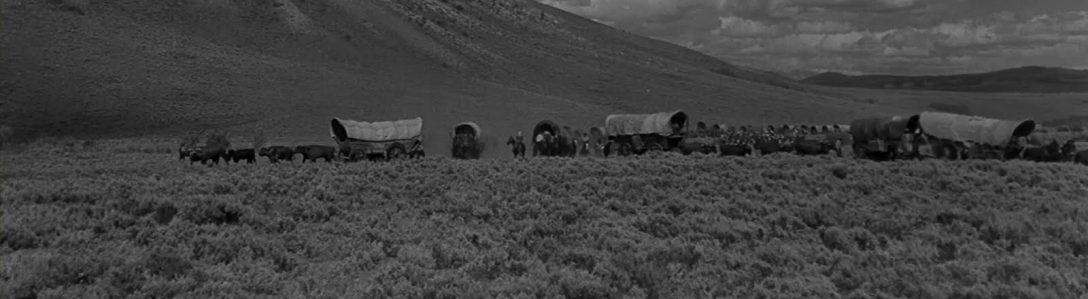
The first quarter viewing calendar I posted last week is off to a rousing start. Sweetgrass opened in NYC after its local premiere at the New York Film Festival, and it’s an overpoweringly tactile experience. Cinema Guild is expanding it to ten more cities through the spring, so check the schedule….now. Lucien Castaing-Taylor and Ilisa Barbash recorded 200 hours of footage of two Norwegian-American sheepherders as they led their flock through Montana’s Absaroka-Beartooth mountains for summer pasture. There are no interviews and the only explanatory text appears at the end of the film before the credits roll. It is a ravishing document of a dying tradition, and one that sets its boots deep in the sheep shit as well as in the rolling plains. This is no romantic gloss of the West, but an immersion in it. Castaing-Taylor and Barbach spent two years filming in and around Big Timber, Montana, which produced a series of short films, but the feature took eight years of editing (and double foot surgery for Lucien after lugging all his equipment over the mountains).

The duo are professors in Visual Anthropology and Sensory Ethnography at Harvard, and their work has previously only been exhibited in art galleriesFrom Sweetgrass, it’s clear that they aim to straddle the boundary between social science and the arts, both documenting culture and reflecting upon it. There are some very artfully composed shots in Sweetgrass, of cowboys framed against the horizon and sheep inching down a mountain in extreme long-shot, that would seem to be outside of an anthropologist’s purview. In a great interview with Cinema Scope, Castaing-Taylor elaborates:

Ambiguity, or any kind of aesthetic opacity that isn’t readily translatable into the limpid clarity of expository prose, is somehow lacking for anthropologists, in their quest for “cultural meaning.”…I’m not desperate for Sweetgrass to be recuperated as a work of visual anthropology, but simply because it doesn’t tell you what it’s about, and because there aren’t that many words in it, doesn’t mean for me mean it isn’t a work of anthropology. It actually feels profoundly so to me, but maybe more a philosophical anthropology.

Castaing-Taylor is working against the grain of his profession to get at the poetry of his subjects’ existence along with the exterior that can be studied. The three subjects under their camera’s microscope here: John, an older, gentle herder; Pat, the hot-headed, younger herder; and a whole mess o’ sheep. Castaing-Taylor had placed between four and eight lavolier microphones on the men and the sheep at all times, and captured some extraordinary footage on his DV camera. Since this was filmed in 2001-2002, the image quality suffers. One often wishes he had the budget for a 35mm setup, but then the remarkable intimacy would be lost. The sound design is often stunning, however, edited by experimental musician Ernst Karel, it’s a cascade of sheep noises – their bleats, honks, skronks, and death rattles.

The only calming sounds in the film, other than the cricket-y silence of nightime, comes from John, a craggy-faced loner who speaks more to the sheep than to Pat. His voice is low and rumbly, and he rarely raises it above a whisper. In  a sequence of great beauty, he urges his “girls” not to stray out of line, repeating the phrase over and over until it sounds like a declaration of love. Filmed against the dusky night sky, it’s a scene of delicate romance.

Then there’s Pat, a younger guy on the verge of a nervous breakdown. Sick of the sleepless nights, whining sheep, bum knee and an injured dog, he calls up his mom and unleashes a torrent of complaints, which he also unleashes on the herd (he calls them “bitches” as opposed to John’s “girls”). But it’s impossible not to be sympathetic to his plight – this is an incredibly exhausting, isolating, and dangerous job. With John only talking to his animals, Pat is alone, unstable, and completely lost.

The ultimate stars, though, aside from the vistas of Montana, are the sheep. The opening shot finds one of these incurious beasts raise its head and stare directly into the camera, daring us to imagine the world within its miniscule brain.

2010: A FIRST QUARTER VIEWING CALENDAR

January 5, 2010

It’s time to stagger into the new year with eyes thrust forward. No more list-making and list-arguing and dwelling on the decade that was. Let us break free from our immediate history and nostalgia’s uncomfortably warm grip to embrace the rambunctious year to come. We’re going to squeeze out its tender juices one month at a time, with a touch too much enthusiasm that will emit a pungent, ripe scent of dreams yet to be dashed. Yes, these are the images I will rush to imbibe in the first quarter (and a bit more) of 2010:

January-ish

A Sixth Part of the World (1926) & The Eleventh Year (1928) (DVD, Edition Filmmuseum)

(DVD, Edition Filmmuseum)

Available now from the Edition Filmmuseum, this damnably seductive looking package contains the films Dziga Vertov made immediately prior to his epochal Man With a Movie Camera. The Filmmuseum describes the first as a “poetic travelogue”, and the second as a “visual symphony.” Michael Nyman provides the score, and bilingual booklets are included. This is an all-region release, and is 29.95 Euros, which is more USD than I can afford. I take donations.

Sweetgrass(Theatrical, Cinema Guild)

I’ve been aching to see this elegiac nature film ever since it premiered at the New York Film Festival. Opening this week in NYC and then slowly rolling out across the country in limited release, it tracks two modern-day cowboys as they drive a herd of sheep through the Montana mountains. Recently it nabbed the cover of my favorite film magazine, Cinema Scope, which has a fascinating interview with the director, Lucien Castaing-Taylor, an assistant professor in Visual and Environmental Studies at Harvard. Cinema Guild is looking like the film distributor of the year. Along with Sweetgrass, they’ve also acquired Jacques Rivette’s superb Around a Small Mountain and critical favorite Everyone Else

***

January 22

Legion (Theatrical, Screen Gems)

Ever since the ridiculously pulpy trailer hit a few months back, I’ve been intoxicated with its possibilities. Visual effects guru Scott Stewart (Iron Man, Sin City), graduates to the director’s chair and opts for total insanity. God deems the human race a lost cause, and sends his angels to destroy the world. Paul Bettany still has love for the flesh, so he swoops in, tears off his wings, and defends the denizens of a roadside bar (including Dennis Quaid and Charles S. Dutton) from annihilation. Somehow flamethrowers are involved.

***

January 26

King Lear (DVD, E1)

Orson Welles performs as Lear for this episode of “Omnibus” broadcast live on CBS in 1953.

***

February 15

British Noir Double Feature: The Slasher & Twilight Women (DVD, VCI)

Ever since Film Forum in NYC held a retrospective of British film noir a few months back, I’ve wanted to dig in further. I know nothing about these two other than this: The Slasher stars Joan Collins and received an IMDB comment of “Risible”. Twilight Women stars Laurence Harvey as a nightclub singer accused of murder. Sounds promising enough for me…

Also on this date:

*Clint Eastwood: 35 Years, 35 Films at Warner Brothers (DVD, Warner Brothers)

*Contempt (Blu-Ray, Lionsgate)

*Lola Montes (Blu-Ray, Criterion)

*Ran (Blu-Ray, Lionsgate)

***

February 19

Shutter Island (Theatrical, Paramount)

Scorsese’s adaptation of Dennis Lehane’s insane asylum ghost story was pushed out of Oscar season into the dumping grounds of February. This looks more like horror movie material than award-bait, which leaps this entry up the list. DiCaprio is a Boston cop investigating the disappearance of an asylum inmate. Then he starts to go crazy himself, presumably, with shades of Shock Corridor. From the trailer it looks like Scorsese is having fun – working with waking hallucinations and impish performances from Max Von Sydow and Ben Kingsley.

***

February 22

A ridiculous booty of home video releases:

*City Girl (Blu-Ray, Masters of Cinema)

*M (Blu-Ray, Masters of Cinema)

*Make Way For Tomorrow (DVD, Criterion)

Note: Make Way for Tomorrow is one of the greatest movies ever made, and its image heads this post.

*There’s Always Tomorrow (DVD, Masters of Cinema)

***

March 12

Greenberg(Theatrical, Focus Features)

Going in blind because of my fondness of Ben Stiller and respect for Noah Baumbach (The Squid and the Whale). It reads like a rote mid-life crisis comedy, but I’ll have some faith in the combined talent here.

***

March 19

Vincere(Theatrical, IFC Films)

My good friend assures me this is a sub par work from Marco Bellocchio, and its melodramatic trappings don’t sound suited to his bitterly sardonic gifts. It’s the story of Ida Dalser, the wife whom Benito Mussolini discarded and ignored. But having thoroughly enjoyed his last three features: The Wedding Director, My Mother’s Smile, and Good Morning, Night, I’m going to have an open mind.

***

March 22 (the day my wallet begs for mercy)

*Bigger Than Life (Blu-Ray, Criterion)

*Days of Heaven (Blu-Ray, Criterion)

***

March 29

*Red Cliff (Blu-Ray [2-Disc International Version], Magnolia)

One of my favorites from last year was released in a truncated version stateside, which cut out over 2 hours of material. Magnolia is releasing the whole behemoth on Blu-Ray, where the scope of Woo’s accomplishment becomes more apparent. Every element is essential to this ancient war epic. You can read my more ponderous thoughts on this film at Moving Image Source.

Letters From Fontainhas: Three Films by Pedro Costa (DVD, Criterion)

One of the most important and divisive filmmakers working in the world finally gets his home video due in the U.S. This includes Ossos (1997), In Vanda’s Room (2000), and Colossal Youth (2006). A trilogy of films where Costa charts the lives of immigrants living in the slums of Fontainhas, near Lisbon. I’ve only seen Colossal Youth, which is a monumental, demanding work. I only saw it on a muddy screener, so I don’t even feel like I’ve truly experienced its languorous rhythms. Anyway, sure to be one of the most important releases of the year.

***

April 5

Piranha (DVD, Shout! Factory)

My Joe Dante education proceeds apace. I continue to think Matinee is a masterpiece.

***

April 16

Piranha 3D (Theatrical, Dimension)

After I receive my Joe Dante education, I can try Alexandre Aja’s (High Tension, The Hills Have Eyes (’06)) take on the material. In 3D. With an out-of-retirement Christopher Lloyd and my new favorite character actor, Adam Scott.

***

April 23

MacGruber (Theatrical, Universal)

In this SNL-derived parody of MacGyver, Val Kilmer plays a villain named Dieter Von Cunth. That’s enough for me. Also, director Jorma Taccone is part of the “Lonely Island” trio that produces all of SNL’s digital shorts, for a long time the only worthwhile part of the show.

***

May 1

Piranha (Blu-RayShout! Factory)

Oh, Shout! Factory, you’re really playing with my emotions here. Wait until May just to watch the Blu-Ray? OK, fine. But I’m seeing the Aja version first.

BLU-RAY BONANZA: ACCIDENT AND VENGEANCE

December 29, 2009

vengeance

After a lengthy hold-out, I’ve galloped into the loving arms of Blu-Ray. It’s the right time to jump in, as the studios are (rather desperately) pushing the format hard, cutting prices across the board. You can pick up a player for around $150, with many library titles on sale for $10 (most new releases are set at $25). Starting in 2010, Warner Brothers will release every new theatrical release exclusively in “Blu-Ray combo packs”, which will contain the high-def disc along with the standard-def DVD (forcing consumers to buy the Blu-Ray and push them to upgrade). With HDTV prices finally starting to come down as well, Blu-Ray is finally a financially feasible option for cash-strapped cinephiles like myself.

I ended up purchasing a PS3 to pair with my Panasonic plasma in order to sate my long-suppressed video-gaming urges, as well as for its stellar Blu-Ray playback and new Netflix streaming capability. I flirted with the idea of an all-region player, as recommended by the folks at DVD Beaver, but wasn’t convinced there were enough region-locked releases to justify it, especially considering that the excellent Masters of Cinema series is region-free, as are all of the Hong Kong releases.  So while I’m missing out on gems like ITV’s The Red Shoes, I console myself with games like Metal Gear Solid, Netflix, and the rush of new domestic releases (Criterion’s forthcoming Days of Heaven and Bigger Than Life Blu-rays are especially tempting).

After dipping into some of the sales (I picked up The Searchers and Robocop on the cheap), I decided to check in on my favorite production company, Milkyway Image. Johnnie To’s stalwart outfit has been churning out inventive genre pieces since 1996, the kind of work Hollywood has forgotten how to make (aside from flukes like Armored). I sampled two of their recent releases on Blu (available at HK retailers like YesAsia).

Soi Cheang’s Accident premiered at this year’s Venice Film Festival, and it’s a sleek paranoid thriller in the vein of Coppola’s The Conversation. The central gimmick has the obsessive-compulsive Brain (Louis Koo) lead a group of assassins (including Milkyway axiom Lam Suet) on murders that are staged to look like accidents. They build elaborate traps for their marks to waltz into, and their hands are clean. It’s the perfect setup for producer Johnnie To’s penchant for displaying process, the small details that build up to a murder, as he also shows off in Vengeance. I’m not familiar with Cheang’s work (he’s known most for his gangster film Dog Bite Dog), but he is adept with the Milkyway house style, which favors underplayed acting, minimal exposition, and a smooth delineation of space.

After Cheang sets up the group’s unerring precision in a bravura Rube Goldberg murder, he starts to expose the paranoia that drives Brain. His first action is to pick up a cigarette butt that “Uncle” (Fung Shui-Fan) leaves at the scene of their crime. He’s determined to erase any trace of their presence. When their next job goes tragically wrong, he becomes convinced it was the result of a conspiracy led by an insurance agent (Richie Ren). He then embarks upon an elaborate wire tapping scheme, moving into a unit underneath Ren’s apartment and listening to his every waking (and napping) moment. He even sketches the floor plan of his nemesis’ apartment on his ceiling.

Cheung , along with screenwriters Szeto Kam-Yuen and Tang Lik-Kei, withhold enough information to keep the truth of the matter ambiguous. Brain is either a canny chess-player – seeing many moves ahead – or an untreated paranoid schizophrenic – creating antagonistic worlds in his strained noggin. Louis Koo is perfect for the role, a blank slate of wiry tension and a football-field sized forehead that could contain multitudes of tortured grey matter. Cheung uses the motif of a solar eclipse to express the obfuscation of his mind’s eye, working multiple variations on the idea until the literally gut-wrenching climax.

Johnnie To’s latest film, Vengeancewas released last week on DVD and Blu-Ray by MegaStar (IFC has the film’s U.S. rights, with no release date as of yet), and it feels like a stand-in for the Le Cercle Rouge remake he never got off the ground. To’s love of Jean-Pierre Melville has never been so close to the surface. His protagonist, the mummified cool of Johnny Hallyday, is named Costello, just like Alain Delon in Le Samourai, and maintains his near-silent devotion to revenge, this time after the slaughter of his daughter’s family. But Johnnie To is also adept at wonderful scenes of hanging around, the interstitial moments between battles that To veins with humor and pathos. He surrounds Hallyday with his stellar repertory crew (Suet, Anthony Wong, Lam Ka-tung are the killers Hallyday hires to help him, while Simon Yam is the flamboyant villain), and has them enact their usual honor-among-thieves routine, which I could watch until the end of time. Anthony Wong has perfected a resigned weariness that plays beautifully off of Suet’s overeager child and Lam Ka-tung’s suave clotheshorse.

Set in Macau and starring a French rock star, it continues To’s interest in cross-cultural exchange, and is perhaps a nod to his increased visibility in the Western world. The film mixes English, French, and Cantonese, and the issue of (mis)communication becomes a major theme. This is established early on, when his daughter (Sylvie Testud), unable to speak, uses a French newspaper to get her thoughts across (later there is a bravura shootout set among composted newspapers). Then he has to bridge the language gap with Anthony Wong’s gang, in which he switches to English. The final act of the film charts his communication with himself, as he loses his memory and tries to trigger it again with a series of note-covered Polaroids. The final shoot-out is a brilliant encapsulation of the evolution of this theme, as he chases a target whose facial features he repeatedly forgets. It is a scene of constant self-communication and negotiation, as he checks and re-checks the bodies of the assailants in his way. There is also a minor motif of eye-holes and eclipses, similar to those in Accident, images related to the opening-up and closing-off of sight – just another few layers of meaning to To’s incredibly dense revenge drama. The image on both releases is phenomenal, the shimmering pastel blues of Accident and the deep blacks of Vengeance rendered with depth and incredible sharpness. They have my strongest recommendation.

LIST: U.S. FILMS OF 2009

December 22, 2009

informant-watching-recommendation-videoSixteenByNineJumbo1600

My lists for the top films of the year and of the decade have been posted over at Indiewire, so feel free to rush over there and criticize my choices in the comments back here. Only two English language films made my year-end roundup (The Informant! and Orphan), but there was a whole slew of valuable work churned out in the States that I’d like to recognize in this dusty corner of the internet. The lag time in distribution means that the finest in international cinema arrives in waves – the highlights of three years of festivals hit all at once (Aleksandr Sokurov’s The Sun took four years to reach theaters, for example).  I highlighted many of these on my list (go check out The Headless Woman, my topper, just out on DVD from Strand), but it necessitated knocking out a number of strong Hollywood films that were actually made in 2009. So, here’s my favorite local product:

1. The Informant!, Directed by Steven Soderbergh

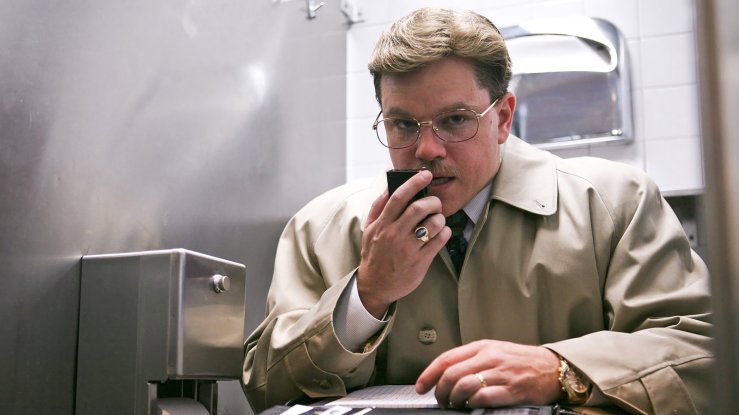
An ebullient little character study of a small middle manager and his penchant for charmingly embroidered lies. Soderbergh and screenwriter Scott Z. Burns’s ingenious use of voice-over has the wiseacre Mark Whitacre constantly digressing from the drama in his life (whistleblowing on Archer Daniels Midland, among other things) in order to establish his monumental self-denial. It’s a clever device that pays off brilliantly in the end, when his interior monologue finally matches up with his actions – and Whitacre’s face turns ashen. Matt Damon pulls this tricky act off without a hitch. His Whitacre is a smiling gladhander,  a lumpen edifice of Midwestern charm impossible to dislike despite his endless faults. Damon is surrounded by a stellar cast, led by Scott Bakula and Joel McHale as trusting FBI agents, and supported by a potpourri of comics playing straight including Patton Oswalt, Paul F. Tompkins, and both Smothers Brothers.

***

2. Orphan, Directed by Jaume Collet-Serra

An elegantly designed horror movie with a whiff of satire, it has been clanging around my cortex for most of the year. The premise is from the genre 101 playbook: a rich bourgeois couple adopts a child. She turns out to be a murderous psychopath. Her insidious actions uncork the husband and wife’s long simmering insecurities, unleashing her alcoholism and his unbending passivity and wandering eye. There are so many deliciously macabre notes in the film: her “outsider art”-type watercolors that hide bloody massacres in the margins, the sides of beef being unloaded in the background during marriage counseling, and the entirety of 12 year old Isabelle Fuhrman’s performance – which is astonishing in its ferocity. She kills you with a dead-eyed stare and glacial smirk, just a bit of business before dinner. The satire is aimed at the conspicuously consumptive parents, who have built a modern box in the boonies to escape themselves and the holes in their souls that money can’t seem to fill.  In any case, a total delight.

***

3. The Fantastic Mr. Fox, directed by Wes Anderson

Another bauble in Anderson’s closet of exotic objects. This is perhaps his most detailed and expressive, since he can control all of his subjects down to their whisker hair. Every little detail holds a clue to these character’s personalities, from Ash’s train set to Mr. Fox’s bandit mask. Ash is caught in childhood, desperate to break out but still in love with play. Mr. Fox is caught between family and his essential fox-ness, that is, his need to steal and kill chickens. Both characters are torn between maturity and playfulness, and each will have to find a balance between the two that allows them to function in their makeshift society. That they succeed is due to the love of their lives – Meryl Streep’s graceful, stubborn and wise Mrs. Fox. It’s one of his most finely wrought family tales, impeccably (voice) acted.

***

4. Armored, directed by Nimrod Antal

A late entry that snuck in under the wire. Has the constrained feel of a legit 40s B-movie, steeped in sweat and work and a heist gone bad. A group of armored truck drivers led by Matt Dillon plans on faking the heist and taking the money for themselves. Sounds smart until a homeless man and a curious cop send the ethically curious in the crew into revolt. Once the deed goes sour, there is an extended showdown between Columbus Short (the moral one and Iraq war veteran) and the rest of the goons. He locks himself in a truck and Dillon starts to pound the hinges out with steel pipes. The insistent clanging marks off the time until one of them dies. It’s inevitable, but still they work, grunt, curse and bleed. Laurence Fishburne grunts better than most, but Dillon growls with authority, Skeet Ulrich’s wispy beard matches his weaselly cowardice, and Short exudes nice-guy calm. A refreshingly well-rigged little thriller.

***

5. The Limits of Control, directed by Jim Jarmusch

Dreamy patterning, etched on the sharkskin suits of Isaach de Bankole, as he traverses the cities of Spain. I forget the color coding, but suit-jacket, shirt, and pants re-combine shades at each location, as he listens to the pseudo-philosophical treatises of his contacts. Jarmusch recombines his cinematic idols with equal panache. de Bankole is an assassin in the mold of Alain Delon in Jean-Pierre Melville’s Le Samourai, concerned with the purity of his own code, which is impenetrable to the long-winded talkers he gets his instructions from (Tilda Swinton, John Hurt, Gael Garcia Bernal, among others). But along the way there is a lot of opaque game-playing straight out of the Jacques Rivette of Out 1, clues that lead nowhere, a mystery only about mystery. The cinematography of Christopher Doyle is sleek and intoxicating, the words are alternately maddeningly self-indulgent and engagingly inquisitive. Movies don’t come more rewarding or frustrating than this.

***

Now we enter the speed round:

6. Funny People, directed by Judd Apatow

Creativity as utter loneliness, rendered with a fusillade of dick jokes. And good ones.

***

7. Up, directed by Pete Docter and Bob Peterson

Of love and talking dogs, but more of the former, thankfully.

***

8. Me and Orson Welles, directed by Richard Linklater

A lovely re-imagining of Welles’ Broadway production of Julius Caesar. Christian McKay is incandescent as Welles, and inside it’s lilting rhythms is a rather dark portrait of the creative process.

***

9. Invictus, directed by Clint Eastwood

A lesson in structure. The divisions in South Africa rendered in Mandela’s security team, in his personal relationship with his daughter, and then through rugby’s world cup. Sports as politics.

***

10. A Perfect Getaway, directed by David Twohy

Clever. Screenwriter as main character in honeymoon gone awry chase film. Hammers home metaphor that writers cannibalize subjects for their own purposes. But with humor, which saves it. Timothy Olyphant wins the day as yammering special forces specimen.

Honorable mentions: Drag Me to Hell, The Box, Pandorum, Gamer, Crank: High Voltage, Star Trek, Adventureland

Special Note: I did see and admire some aspects of The Hurt Locker (i.e., the sniper scene) but have been baffled by the overwrought praise sent its way for this otherwise rote war movie. So as an act of spite, it’s not on this list.

MEN ARE SUCH FOOLS (1938), AND THE USES OF TWITTER

December 15, 2009

menaresuchfools-ft

Twitter has its uses, including its function as cinephilic program guide. I follow an eccentric crew of film writers and scholars on the service, and often something like the following will pop up:   “DVR alert: TCM, 10:15 am Eastern, Men Are Such Fools”  rare Busby Berkeley, 1938, non-musical, w/Bogart; never seen it.” This was posted by The New Yorker’s film editor, Richard Brody, under his handle @tnyfrontrow (I go by @r_emmet). Noting that the film was starting in minutes, I dialed up my unnaturally understanding wife, who heroically hit the record button on this esoteric nugget with seconds to spare. If you read the right people, you’ll get a handful of idiosyncratic tips like this each day, a kind of TV Guide poetry to go along with links to their writing  and other pieces they admire. There’s also plenty of pointless chatter (dinner plans, puns, and hyperbolic opinionating), but those are easy enough to filter out with an impassive unfollow click. Some essential feeds to read: MoviesOnTCMThe Auteurs DailyDavid Lynch, and Indiewire. They’re a good place to start anyhow, and then you can radiate out out from there, depending on your tastes.

Men Are Such Fools is more of a curiosity than anything else – as Brody noted, it has a small Bogart appearance in one of Berkeley’s rare non-musical films. The central drama is dry and unconvincing. Warner Brothers was trying to push Priscilla Lane and Wayne Morris as romantic leads, having paired them earlier in the year in Love, Honor and Behave, in which Morris played a milquetoast husband tested by Lane’s more assertive wife. The Warner publicity team cooked up a romance between the two, filming them at nightspots to build any kind of buzz (this according to Daniel Bubbeo’s The Women of Warner Brothers). The two dated briefly, but the flirtation didn’t last long.

Wanting to push them quickly, they paired them with Berkeley in this adaptation of a Faith Baldwin story, who was eager to show off his skill set outside of the musical: “I wanted to prove,” he later said, “that I could handle a straight dramatic assignment…, and that is why I did films like Comet Over Broadway[1938], They Made Me a Criminal [1939], Fast and Furious [1939], and Men are Such Fools. I had done dramatic work during my period of working on the stage back east and knew that I could do a good job with dramatic or comedy films.” (Bob Pike and Dave Martin, The Genius of Busby Berkeley, quoted in Jeremy Arnold’s article for TCM) Motivated or not, Men Are Such Fools looks like a job for hire. It’s a blandly put together bit of drama that sings for seconds at a time due to a fine roster of supporting players.

Lane is an appealing performer, with flickers of aggression animating her bright eyes and sweet demeanor. She’s an ambitious secretary at an advertising agency, bucking for a promotion on the lucrative fruit extract deal while her suitor, Morris, is an overbearing goon with a monstrous inferiority complex. A fraternity dolt with too much time on his hands, Morris browbeats Lane into marriage with a charming combination of physical intimidation and boyish whining. There was not much appealing to the the character as written, but Morris’ plasticine features and gangly athlete’s body emphasize its most retrograde aspects, as he looms over her with goofy intimidation tactics that come damn near spousal abuse. But Lane convincingly grins her way through it – as if she was enduring it for a secret plan of her own. Not that she is innocent – for Lane clearly is a careerist, flirting her way to snag the extract account and into the upper echelon of the company. But how this aggressive, selfish, and likeable loner could fall for a mouth-breather like Morris’ character strains credulity.

But while this romance generally rankles, there are some side players that lifted it out of the normal run of B-movie fodder. First and foremost is Mona Barrie, who slinks her way into the role of Bea Harris, an acid-tongued copywriter who aids Lane on her way to the top. She looks at the world with her eyebrow askance and poison pen at the ready like a dimestore Dorothy Parker. She leans into her bon mots with delectation, savoring each insult like she was sucking on a Jacques Torres caramel. Before she tells Lane that “all men are polygamists”, she speaks of her past as a battered wife and then lonely divorcee with an offhand cynicism that is breathtaking. She built herself up from nothing into a management position and she dashes it off like another puff of her cigarette. It’s a lovely, layered performance that adds a whip-smart intelligence to the film, for the few minutes she’s in it.

The second sterling turn here is contributed by Bogart, who has the unforgiving role as the other man to the Morris-Lane couple. Tagged as a womanizing entertainment tycoon type, he swoops in with a disarming honesty, “I’m probably a cad. Are you by any chance a weak woman?”, and ends up winning the audience over, if not Lane, by tipping into love with his enigmatic employee. He’s intended to be a bit of a bastard, but he’s clearly a more interesting, and oddly warmhearted cad than Morris’ overgrown man-child. Bogart knew he deserved larger roles, and Berkeley concurred:

“Bogie was never any trouble to me at all,” recalled Berkeley. “He felt, and I agreed with him, that he should be working in better films, but whatever discontent he felt, he took out on the bosses, not on the people he was working with. As far as I know, he never refused to play a part. His credo was to keep working, and I agreed with him on that point, too.” (Tony Thomas, The Busby Berkeley Book, quoted by Arnold)


Without an impulsive tweet, I wouldn’t have been able to add these distinctive performances to my own character actor pantheon. Now I’ll be able to track Mona Barrie wherever she pops up on the TCM schedule. Let me know if any of you have further recommendations for films with Ms. Barrie, as I’m developing a furtive crush.

BEST OF THE DECADE: 1900 – 1910

Originally published at Movie Morlocks, the official blog of Turner Classic Movies

December 8, 2009

dreamland

The decade is almost at a close, and a deluge of film lists has started the conversation about who were the vital movie artists over the past ten years. All of them are worth scrolling through to stoke some self-righteous anger or gratifying head nods, but before I pull together my chin-scratcher about the end of the oughts, I thought I’d take a look back at the first decade of the previous century. This is the period where cinematic language was transitioning between what Tom Gunning famously termed the “cinema of attractions”, which favored spectacle over story, and the emotionally motivated narratives of D.W. Griffith.  Consider this list a  work-in-progress, a wish for more suggestions and thoughts on this wondrous period, when the future of the art was up for grabs. I ended up with twelve films of varying lengths and complexity, but all of them are valuable not just for their place in history, but their vibrancy as moving images. These are unranked, in chronological order.

***

How It Feels To Be Run Over (1900, Directed By Cecil M. Hepworth)

A forty second joke based on an experiment in point-of-view and audience expectations. The camera is set at a low angle on a country road, and when the first horse-and-buggy turns the corner, one expects it to crash right into us, since we’ve been cued by the title to take the POV of the camera. But no, Hepworth, with a dry sense of humor, has it drive right by for a simple actualité, something not out of place in a Lumiere retro. Soon, though, another carriage comes hurtling towards the lens, and this time it doesn’t stop, busting straight over the camera (and us), before one of the earliest uses of intertitles flashes on-screen over our blackout: !!! Oh Mother Will be Pleased.” And it’s the end.

With its misdirection, canny use of the camera as audience surrogate, and slapstick sense of humor, it’s a compact little masterpiece.

***

What Happened on 23rd St. New York City (1901, Edwin S. Porter and George S. Fleming)

Another documentary scene that then explodes into fiction. On 23rd St. near the Flatiron Building, New Yorkers pass by the camera and look in sheepishly, or glance quickly and then scamper away. It again has the feel of an early Lumiere brothers picture. But Porter, the pioneer of narrative filmmaking, couldn’t help but slip in a little slip of a story: thus, the dangers of the air shaft are proven underneath the billowing waves of a young woman’s skirt. Yes, she steps over the shaft and shamefacedly shows the world her abundant undergarments. A direct ancestor to Marilyn Monroe’s scene in The Seven Year Itch:

***

Jack and the Beanstalk (1902, Edwin S. Porter & George S. Fleming)

Another early triumph from Porter, this lucid re-telling of the fable displays adept use of double-exposures and theatricalized space while maintaining continuity from shot to shot, in one of the earliest instances of sustained storytelling. But the joys here are beyond such historical accomplishments. There is real unpolished magic in the hop-skipping cloth cow, whose exuberant jig tips over a prop rake before he’s sold down the river. There’s a delight in performance here that’s impossible to resist . Then there’s the set design, which goes from cardboard cut-outs to densely layered fantasy in the final shot, a child’s paradise of sailboats, pinwheels, and dense (plastic) jungle undergrowth.

***

A Trip to the Moon (1902, Georges Melies)

No more words need be spilled on this immortal work of film magic, just watch and awe at the moon’s grimacing face. There is no cinema without Melies.

***

The Great Train Robbery (1903, Edwin S. Porter)

Essential to view with the proper tinting and coloring, but even in sub-par YouTube versions, it’s essential. My favorite scene is in the dance-hall, where a group of locals whoop it up, even employing a revolver or two to goose things along. It has the ritual feel of the dance sequences in John Ford’s work.

***

The Georgetown Loop (1903, American Mutoscope and Biograph)

Ladies and gents wave their hankies at the camera as a train wends its way through Colorado. Absolutely hypnotic, for the undulating lines of the camera, which piggyback on one of the first “tracking shots”. The passengers are brazenly, confrontationally happy, thrilled with the advances of technology and the nearness of their hankies, which they wave out of the window with reckless abandon. The patterns these fluttering white blobs create is often breathtaking.

***

Coney Island at Night (1905, Porter)

Sensing a theme here? Porter rather owned this decade. This is one of the documentary subjects he churned out, but it also just happened to be uncannily beautiful. Tracing the arcs of the lights in Coney Island in pitch-blackness, the camera slowly pans around the flow of electricity. A serene, melancholy oddity of devastating effectiveness. It presents Coney Island in an abstracted, incredibly pure state: just a blast of illumination to bring us all back to our childhoods: pure dreamland.

***

The Consequences of Feminism (1909, Alice Guy)

A raucously funny comedy of the sexes, in which gender roles are reversed and the woman walk around with machismo sweating out of their pores. They drop their kids off with their husbands before heading the gentlewomen’s club to talk stocks with their tight knit pals. The ending reverses field, restoring the role of man and undercutting Guy’s social commentary, but the sheer joy in which she depicted these super-virile women gives her true motives away.

***

Le Printemps (1909, Louis Feuillade)

An oddity from the king of serialized conspiracies and violence, this is a cutesy short symbolizing the coming of spring in a variety of forms: from woodland sprites to cherubs to plain ruddy-faced angels. Shot with an oval masking so the film’s frame looks like a lover’s pendant, it contains stunning nature photography, verdant and shot through with dew.

***

Princess Nicotine, or the Smoke Fairy (1909, J. Stuart Blackton)

Totally bonkers, this  short finds a belligerent smoker conversing with the fairies living in his tobacco stash. One ducks under the cigar box, the other in his pipe. With ingenious use of gigantic props to convey the size difference, along with a mastery of special effects (double-exposures, split-screens, etc.), it’s  perhaps the first film to show the dangers of smoking – or at least the dangers of fighting with tobacco-nymphs.

***

Those Awful Hats (1909, D.W. Griffith)

A timeless subject – the evils of elaborate hats worn at cinemas – is turned into a delightfully surreal short by D.W. Griffith. A parade of flowery-hatted women enter a rather ratty theater, when the patrons get jumpy at their blocked view. It’s not until a jaws-of-life type deus-ex-machina disposes of the offending headwear that things start getting weird.

***

A Corner in Wheat (1909, Griffith)

A masterclass in parallel editing, as Griffith compares the plight of the poor wheat farmers as compared to the capitalist wheat king, whose stock speculations have sent his net worth soaring. With sterling cinematography from Billy Bitzer of the hard bitten life relentlessly cut with debauched parties with wide-eyed bozos, from breadlines to cocktail lines, it’s no surprise this finely tuned cinematic machine springs a trap for the spiritually poor Wheat King. A beautiful and devastating piece of work – and achieving a level of suspense far beyond Porter’s more linear technique.

SHIRIN: KEEP YOUR EYES ON THE SCREEN

November 17, 2009

shirin

Abbas Kiarostami has retreated from the international scene for most of this past decade, working on a variety of museum installations and digital video experiments that received little to no distribution in the U.S. These pursuits, which include the installation Looking at Taziyeh, the long-take landscape film Five Dedicated to Ozu, and his latest, Shirin extend his interest in off-screen space and ways of seeing. Taziyeh is a mixed-multimedia work, with Kiarostami directing a live stage performance of a Shiite passion play (Ta’ziyeh is a folk theater form that re-enacts the murder of Hussein, the grandson of Muhammad), while giant monitors near the stage depict Iranian audience members reacting to a previous version of the play.

Kiarostami told The Guardian that “Ta’ziyeh is strictly linked to its audience – the event is actually created by the rapport between actors and spectators.”  Five Dedicated to Ozu, available on DVD from Kino (full disclosure: a company I work for), is a series of fixed-camera long takes of a beach on the Caspian Sea that capture ducks, dogs, shorelines, and reflections of the moon. It is an academic exercise imbued with Kiarostami’s wry humor and keen compositional eye. It asks for a patient, involved viewer, as it unveils split-second narratives and fugitive plastic beauties. While watching it, one can be emotionally involved in a duck’s fate, then pull back to enjoy the framing of driftwood on the horizon, or simply leave it on as an impossibly hip screen-saver.

Kiarostami extends and refines these ideas for Shirin, his latest experiment in point-of-view and meta-narrative, and was recently released on DVD by the BFI (you’ll need an all-region player to watch). He pares away the theatrical aspect of Taziyeh, limiting himself to close-up portraits of 112 Iranian women (and one Juliette Binoche – star of his forthcoming return to narrative filmmaking,  Certified Copy) as they watch an unseen movie. There are male characters in the background, but none receive the centered close-ups of the women (Homayoun Erbashi from Taste of Cherry is one of these men). Kiarostami recorded an audio-track for the film, an adaptation of Nezami Ganjavi’s epic poem, Khosrow and Shirin, but there is no corresponding video. The actresses were staring at a sketch he taped above the camera – in fact, Kiarostami didn’t know which narrative he would use during the shoot – the radio-play soundtrack wasn’t recorded until later. The actresses are going through the same process as the viewers, attempting to construct a narrative, or an emotion, from the slenderest of threads, not unlike the process of viewing Five. Watching requires an act of imagination.
The film requires a constant negotiation between narrative and image: there’s an urge to follow the audio’s story, to become involved in the romantic travails of the Iranian Prince and Armenian Princess, but then one is struck by the jade-green of an actress’ eyes, a perfect Modigliani-like oval face, a set of red bow-tied lips, or even the furtive way in which a strand of hair is brushed aside. It is a tad perverse that Kiarostami, who staunchly used non-professionals in his more conventional narrative films, opts for trained actors only when they have to sit and stare at an invisible screen. It’s a playful but rewarding decision, as the performers are all equally extraordinary, with their particular tics, shifts, and individuality. On this level, the film is pure cinema, glorying in eyes-face-mouth like a gigantic Garbo close-up from the silent era. David Bordwell points to Carl Dreyer’s Passion of Joan of Arc and Godard’s My Life to Live as precedents, especially the former, of which he says, ” almost never presents Jeanne and her judges in the same shot, locking her into a suffocating zone of her own.”

Kiarostami does his own kind of “locking into zones”. Two or three spectators surround the centered subjects, but none seem to know each other, are part of families, or interact in any way. They are all shut off in a private conversation with the artwork, imbuing them with a kind of religious fervor, an intensity around the eyes that does recall Falconetti’s saucer-welling turn in Dreyer’s masterwork. In a documentary including on the DVD, Taste of Shirin, Kiarostami is shown directing his actresses on a simple dark set (which was in his own house), urging them to “define the movie for yourself”, asking for “indifference”, and instructing “let your eyes smile, not your lips.” He choreographs their fidgeting and scratching, but asks them to do it in their own particular way. He even busts out a spoken word version of “My Favorite Things” to encourage them to personalize their twitches.

He is essentially urging these actresses to stop acting, to simply “be”. Without any context or character to draw on, they enter a beautiful kind of stasis, their emotions emerge from someplace beyond the story world. These emotions are irreducibly the actors’ own, which is perhaps why I found this to be the most moving experience I’ve had watching a Kiarostami film. This intensity of feeling, which was also a part of the Taziyeh exhibition (which I have not seen), is joined with the purest expression of his obsession with negative space, the action taking outside of the frame and inside of our heads (think of the unseen well-digger in The Wind Will Carry Us). Shirin is the first major work from his experimental period, and perhaps its logical endpoint, forever delaying a reverse shot which will never come. All that it leaves, according to Kiarostami, is cinema:

I suggest you watch another world which is more attractive than the story. I believe if you dare let go of the story, you will come across a new thing which is the Cinema itself. In fact, I suggest you let go of the story and just keep your eyes on the screen.

THE AESTHETICS OF BASEBALL

November 3, 2009

5_8_0920cubs20vs20brewers204020miller20park200111

As I sit on my mysteriously stained couch watching Game 5 of the World Series, my mind wanders to the decision-making process of the game’s director, Bill Webb. He’s orchestrated 13 of these Fall Classics, with new technologies opening up more vistas of sweat and crotch grabs each time.  Webb, alongside producer Pete Macheska, makes decisions on shot selection and duration every second of the game, all of which subtly shape the viewing experience. Baseball is a game of lulling rhythms that occasionally spike into frenzied bouts of athleticism. How Webb handles the former, the batting-glove adjustments, talks at the mound, and endless foul balls, is the most fascinating aspect to his anonymous craft.

Idly charting his shot selection over the first few innings, a few patterns emerge. He averages around 5 shots per at-bat, but incrementally increases their number and cutting speed at more dramatic moments. In the top of the fourth inning, with no-one on base and a comfortable 6-1 lead, Cliff Lee is facing Nick Swisher with the count at 2-1. Webb starts with a medium shot of Swisher, cuts to a medium shot of Robinson Cano on deck, then shifts to a close-up of Lee, before settling in to the centerfield camera for the pitch. This is one of his routine setups: batter, on-deck, pitcher, pitch. It establishes the basic conflict while adding context for the next one.

Later in the inning, Webb alters his approach to match the actions of the crowd. With two outs and Brett Gardner at the plate, the crowd rises in applause to urge Lee to end the inning. Responding to the situation, Webb goes with the following shots: medium of Gardner, CU of Lee, wide shot of fans, CU of Lee, centerfield camera. In cutting back and forth between the crowd and Lee, Webb is subtly adding a narrative to this pitch, that the crowd is in a conversation with the pitcher, which he soon repays by getting Gardner to ground out to short. He generally dislikes crowd shots, and has limited their use at Fox, as he told USA Today:

‘Crowd shots I’ll do between pitches; it’s dead time,’ he says. ‘I’m not a big fan of them. During the regular season, you’ve got a lot more liberty. But in a platinum game like this, every pitch means something. You stay with what’s going on in the field.’

In other pitches, he cuts between the opposing coaches to juice the sense of conflict between each toss. He also opts for push-in close-ups on the pitcher and hitter to add an extra dollop of tension. His most aggressive technique is the split-screen, framing pitcher and hitter in the same shot, and adding the catcher’s signals in an insert between them. He thankfully uses this segmented shot sparingly. Michael Hiestand writes, again in USA Today:  “[They are] pretty busy. But, says Webb, at least viewers know what pitch is coming. And not as busy, notes Webb, as when on past Series action he split the screen four ways when bases were loaded — ‘too confusing, that was a strikeout.”

Webb also turned down the use of cameras that are suspended on cables and fly down the foul lines, which TBS used in their coverage. His aesthetic is appropriately conservative, eschewing most of the bells and whistles that Fox Sports likes to impose (their dancing NFL robot, the ill-fated glowing hockey puck), and toning down the tricks he does use:

‘Viewers may like them the first time but then the toys become redundant,’ he says. ‘The best way to cover baseball is to cover the baseball game. And the only real difference between a regular season game and the World Series is it’s more emotional. You need to make sure the technology never gets in the way of showing that emotion.’

Even in higher leverage situations with runners on base, where his shot selection is more varied, his cutting speed increases only slightly. He maintains a use of fairly long takes, even with his cut-ins (I’m curious to compare his shot length with the other networks, in case this is just the industry standard, but I suspect he’s slower than most). In only one instance did I detect any quick cutting: Ryan Howard’s walk on a full count in the first inning, where Webb  employs rapid-fire shots of the crowd, who were again riled up and waving their white towels (this was after the incredible Chase Utley and his hair hit a three-run home-run).

In a bit of serendipity, the MLB Network was showing Game 5 of the 1956 World Series, Don Larsen’s perfect game over the Brooklyn Dodgers, at the same time as 2009′s game 5. Flipping back and forth, it’s a quick and dirty way to see how camera angles effect the way one views a game. The default camera position in 1956 was an elevated view behind home plate that would pan up to catch a ball in play. There are also cameras on the first and third baselines, but they are only used for accents, either introducing a player or offering a profile of the pitcher. It distances you from the action, with no sense of balls and strikes, and no close-ups of the players. Mickey Mantle seems even more otherworldly from the back. After he breaks up the scoreless game with a mammoth home run, one feels it appropriate that his face is hidden. One shouldn’t look too close to such (drunken) godliness. The distance of the camera must have added to the mystical aura that surrounded these 50s titans.

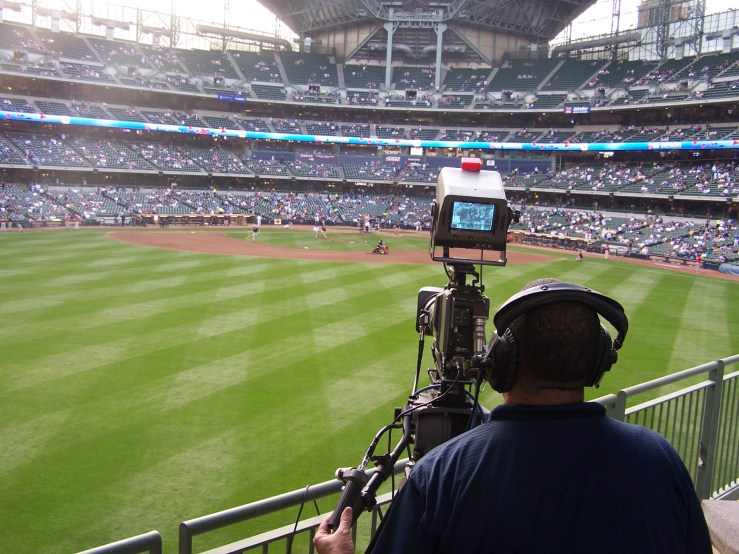
In a fascinating article for Slate, Greg Hanlon offers a brief history of the centerfield camera, which he claims was introduced in 1950 on NBC’s Game of the Week. Apparently it took a while to become standard, but now almost every team uses this look, which provides a more intimate view of the details of the game, from the catcher’s signals to the pitcher’s fidgeting in his glove. What Hanlon explores is the distorted angle of this view, as most of these cameras are located 10 to 15 degrees off-center to left field, offering a skewed view of the ball’s path to home plate. Only the Red Sox, the Cardinals, and the Twins place it at dead center, which requires a higher camera elevation to keep the pitcher from blocking the view of the catcher. But for the majority of telecasts, including Fox’s coverage of the World Series, the view is distorted, sacrificing verity for intimacy. Hanlon says the biggest impediment to switching to dead-center views is simple architecture:

In Oakland, Calif., a wall of luxury boxes precludes placing a dead-center camera. The Crown Vision center field scoreboard provides a similar obstruction in Kansas City. In Denver, the “Rock Pile” bleacher seats make installing a dead-center camera a “seat-kill,” in producer parlance. Other stadiums have advertising signage where a camera would be placed.

ESPN attempted to install a dead-center camera for all of their 2001 broadcasts, but it was declared impractical after less than a year.

Webb simply deals with the cameras he has given, and does a wonderful job. The fact that he also directs the Mets broadcasts (my sad, sad favorite team), has no bearing on this praise. He simply stays out of the way, elegantly incorporating dramatic arcs during down time, and limiting graphic bells and whistles that clutter too many other broadcasts. All he’s missing is “..a camera operator on the fields, just to trail pitchers to the mound or batters to the box. ‘I don’t see what the problem is when there’s no action going on. … I won’t get in your way.’” Bill Webb is a master of not getting in the way.

THE SAMUEL FULLER COLLECTION

October 20, 2009

it-happened-in-hollywood.117025

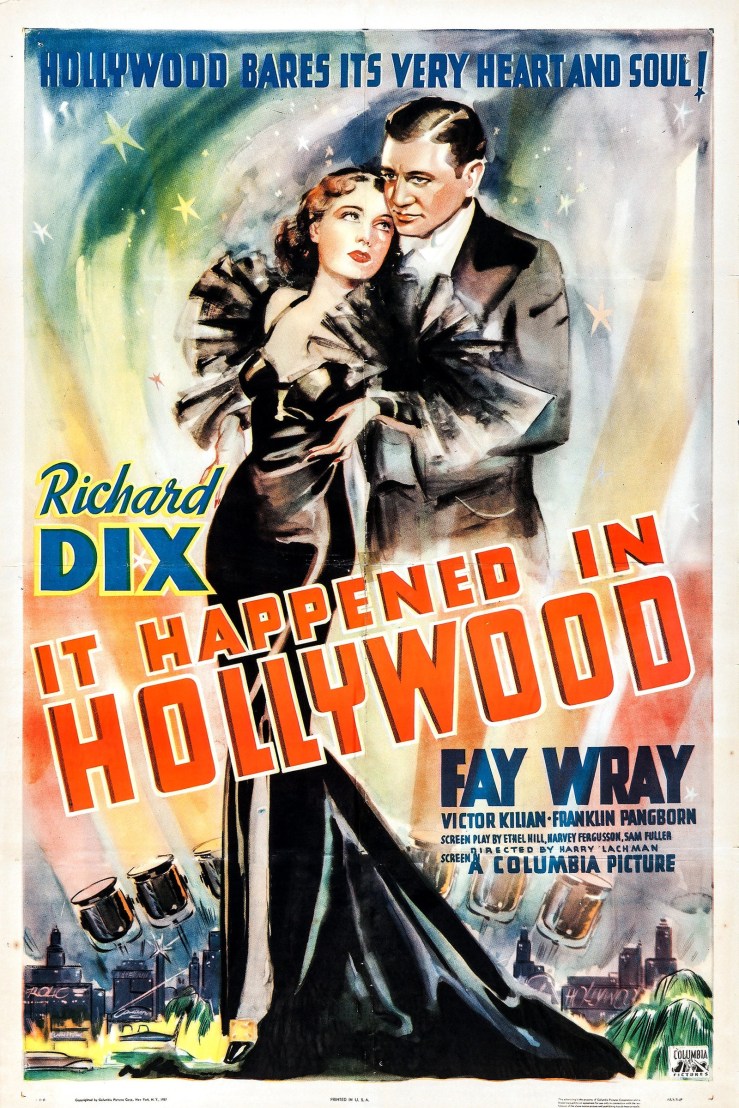
For the next two weeks I’ll be knee-deep in The Samuel Fuller Collection, a seven-disc set being released on October 27th by Sony Pictures, in association with Martin Scorsese’s heroic film preservation organization, The Film Foundation. It’s a doggedly auteurist production that traces the contours of Fuller’s entire career, presenting five of his writing gigs (It Happened in Hollywood (1937), Adventure in Sahara (1938), Power of the Press (1943), Shockproof (1949) and Scandal Sheet 1952)) along with two lesser-known directorial efforts (The Crimson Kimono (1959) and Underworld, U.S.A. (1961)). In this marketplace it’s downright courageous to release these later subterranean slices of Fuller, and just about saintly to include some of his early writing jobs. As the juvenilia of other great artists like Picasso are studied in the context of his life’s work, so should the early scribbling of this brusquely unique American. Without an institution like the Library of America to preserve and present a director’s work in the proper context (instead of being thrown to the wind in various star-themed sets), it’s up to studios to flog their geniuses, and their priorities clearly lie elsewhere. So much of the credit to this release must lie with Scorsese and his Film Foundation, who also released the essential Budd Boetticher Collection last year, and produced the Columbia Pictures Film Noir Classics set due November 3rd.  In convincing Sony to release these films in cleaned-up masters, he’s keeping the spirit of serious film appreciation alive.

The earliest film in the set is a sprightly little comedy spiced with melancholy, It Happened in Hollywood(1937). It was Fuller’s second credit in Hollywood, after he wrote the scenario for Hats Off (1937), an elaborate bit of slapstick he conceived for Boris Petroff, who directed Mae West’s variety shows on Broadway. In his autobiography, A Third Face, he says about Hats Off that, “the finished film had just about nothing to do with my original story. Petroff fashioned a movie that made people forget about their problems. I’d wanted to expose man’s foolish belligerency.” That characteristic, foolish belligerency, is what pops up again and again in these early screenplays, regardless of the damage done to his scripts by the studios. Each film in the set, to varying degrees, contain a vague anti-authoritarian streak, whether the conservative mulishness of Richard Dix in It Happened in Hollywood or the violent resentment of Paul Kelly in Adventure in Sahara. But let’s start with the former, which is one of the minor delights of the set.

Directed with studied reserve by Harry Lachman, it’s a self-reflexive bit of Hollywood fantasy. He wrings a couple of surprising effects out of the material. The first is the opening, which shows Dix rescuing Gloria Gay (a luminous Fay Wray) on his noble horse Toby. It’s unclear that this is a film-within-a-film until the laughter and cheering of kids fill the audio track. Then the camera slowly pulls back from the screen and into the children’s hospital where Bart is holding court to an enraptured crowd. This clever shot establishes the construction of Bart’s image, how it is shaped by the frame and his fans outside of it. He is not a free man.

Based on the career of Tom Mix, it follows Tim Bart (Richard Dix, drawling as if his tongue were bathed in molasses), a hugely popular silent Western star who flops upon the transition to sound. With his ranch about to be sold, the only thing rooting him to Hollywood is the adoration of his sole remaining fan, an infirm boy who calls himself Billy the Kid. In a wild attempt to make Billy’s wish come true and meet all of his silver screen heroes, Bart gathers a menagerie of celebrity stand-ins and arranges a faux star-studded bash, a clever bit of burlesque celebrating Hollywood’s unseen working class. The affected hauteur of the Marlene Dietrich impersonator while rejecting a morose fake-Clark Gable is particularly amusing.

Lachman achieves a surreal carnival effect at the stand-in party, especially on a slow tracking shot down the dinner table, as W.C Fields, Charlie Chaplin, and Victor McLaglen impersonators cavort and mug as if they were in an old vaudeville routine. Fuller’s touch is all over this film, especially in its skepticism towards the idea of heroism and the idealizations that surround it (Fuller’s original title was Once a Hero). Tim Bart’s heroism is a clear construct, a virtue built by the studios and disposed of when technological advances make other stories more appealing. His aura is built by the production machine, and just as easily destroyed. There’s a devastating montage of all of Bart’s paraphernalia getting incinerated, cardboard cut-outs and sheriff badges going up in flames. That it was based on the story of Tom Mix gives the whole enterprise a feel of a low-budget valediction, and Bart’s improbable resurrection as a star at the end can be forgiven as a kind of wish-fulfillment fantasy for that faded star. Fuller is credited as screenwriter on the film along with Ethel Hill and Harvey Fergusson.

Adventure in Sahara is an altogether different story, a dire little tale of mutiny in the French Foreign Legion. C. Henry Gordon plays a sadistic commander who drills his soldiers to death. Jim Wilson (Paul Kelly) hears of his brother’s death at this fascist’s hands, and enlists to seek revenge. He succeeds in leading a mutiny, kicking the officers out into the desert. But Gordon returns, and someone will have to pay… The film was directed rather anonymously by D. Ross Lederman, and the script was written by Maxwell Shane, as Fuller receives only a story credit. Aside from Wilson’s anti-fascist, anti-authoritarian bent, very little of Fuller’s personality shines through. The film twists itself in knots trying to show respect for military protocol as well as individual freedoms, and it turns into ideological mush. Gordon gives a deliciously hammy performance however, answering all questions with a beady eye and a crick in his neck. Fuller’s anecdote about his inspiration for the story is more entertaining than the movie itself:

He [Sam Briskin, head of Columbia] asked me if I could write an adventure movie for the studio. He may as well have been asking me if I could bake a seven-layer cake…. I took out a cigar and slowly prepared to light it, buying a few moments to figure out a way out of this mess. Briskin never took his beady eyes off me. I lit the cigar, blew the smoke out of my mouth, and proudly announced, “William Bligh meets Victor Hugo!” ‘Who the hell are they?’ snarled Briskin.

While working on his novel, The Dark Page, Fuller was knocking out scripts on the side to make a living. One of these was 1943’s Power of the Press, directed by Lew Landers, original story by Fuller, screenplay by Robert Hardy Andrews. This film stands as a curious precursor to his ode to journalism, Park Row(he was previously a crime reporter for the New York Evening GraphicThis film, mediated by Landers and Andrews, replaces his snarling wit with a series of moralistic speeches about the perils of isolationism. It is about a publishing magnate, John Cleveland Carter, who has a late change in heart about his yellow journalism practices, which threatens the domain of an oily fifth-columnist, Rankin. Gangland killings ensue, and after the dust settles, it’s a mild-mannered power battle between Rankin and Guy Kibbee, who plays a Horace Greeley worshipping small-town editor with whom Carter endowed his paper.

There are an endless number of comparisons to Rankin and his goons with Nazis. They run the place “like the Gestapo”, Rankin’s assistant is “a Himmler” and so on. The flavorful performances, Lee Tracy’s soulless managing editor first and foremost, prettify the propaganda machinery, but it eventually grinds to a halt with a series of static monologues about free speech and the dangers of isolationism. Fuller’s politics were probably similar at the time, but he would have never staged them so slowly or humorlessly. The only character with a whiff of Fuller’s life force is Eddie (Gloria Dickson), Carter’s secretary and the brains behind Kibbee’s goal to clean up the New York Gazette. She bulldozes through the publisher without a thought to her status or role, simply following her impulse.  Gloria is a little stiff as a performer, but if you squint hard enough, you can see the outlines of Barbara Stanwyck in Forty Guns.

Next week I’ll (hopefully) have an interview with Christa Fuller, Sam’s wife, as well as a discussion of the remaining titles in the set.

THE 2009 NEW YORK FILM FESTIVAL

October 13, 2009

hye-ja_wide-fde574854a398541a30f8bce882e23312e077f4c-s800-c85

The coverage of this year’s New York Film Festival was weirdly tendentious, culminating in A.O. Scott’s bizarre NY Times dispatch in which he claims (I paraphrase), that there is a cabal of scheming festival programmers who hate humanity and eagerly promote films which espouse a “principle of innate depravity.” I’m (slightly) exaggerating his argument, but he adopts a strikingly strident tone for a diverse slate of movies, grandly sweeping complex works of art into his “festival” category so he can haughtily ignore them. What he yearns for, it seems, are films of “high-minded middlebrowism.” Don’t we have the next two months of Oscar-bait to satisfy that particular need? I’d much rather have a rare screening from an experimental young Filipino filmmaker like Raya Martin than the latest Sam Mendes chin-scratcher that will be released nationwide the following week.

Two of the films he dismisses under the “innate depravity” tag are Bong Joon-ho’s hugely entertaining Mother and Claire Denis’ mesmerizing White Material. I love innate depravity! Mother is a unique blend of police procedural and melodrama of suffocating motherly love. Opening on a shot of the galvanic lead, Kim Hye-ja (famous in Korea for her portrayal of maternal roles), sinuously dancing in a glade of flowing high grass, Bong is announcing the film’s playfully enigmatic tone. The shot is an amusing non-sequitur until the plot reveals its seedy secrets.

Kim is the unnamed mother of Do-jun (Weon Bin), a soft-spoken simpleton who can barely string a sentence together. Their relationship is combative and creepy. Mother stalks his every move, inching up to him as he pisses against a wall, lifting a bowl of “medicine” to his lips. As the urine pools on the sidewalk, she tries to cover it up with a street side hunk of trash. This kind of suffocating attention is twisted inside out when Do-jun is accused of murder. Artlessly bulldozing her way through the crime scene and the victim’s friends, she styles herself a one-woman truth commission. She is an incredibly unreliable narrator, riveted on clues that lead to digressive dead ends and a motley crew of supporting characters. Do-jun’s erstwhile “friend” Jin Tae (Jin Gu) is the most fascinating of these ghouls, a self-styled Dirty Harry who milks the mother for money while doggedly, and quite violently, pursuing the lurid clues in the case.

Bong moves among these different plot strands with startling precision, steadily layering motifs (of pooling liquids that build in malevolence, from the aforementioned urine up to the blood on a dirt floor) until they effortlessly evoke the complicated moods of its compromised protagonists. The way he levers the mother’s acupuncture kit into a moment of tragedy is a master class in scripting and composition. It’s the most devilishly enjoyable film I’ve seen in quite a while. Luckily it has been acquired by Magnolia and will be released early in 2010.

Denis’ immersive, knotty White Material is a return to the more allusive, abstract style of L’intrus after the more straightforward family drama of 35 Shots of Rum, with Material’s multiple flashbacks and fragmentary narrative. Set in an unnamed African country (although shot in Cameroon) suffering from a protracted civil war, Isabelle Huppert’s Marie is hanging on to her family’s coffee plantation long after safety would dictate she return to France. Denis’ first film without cinematographer Agnes Godard since 1990s No Fear No Die(Bruno Dumont’s regular DP Yves Cape takes the reins here), it still maintains her tactile, overwhelmingly physical sense of space. The camera lingers on Marie’s “white material”, her upholstered seats, gold-plated lighters, and cotton blue dresses.

Denis lolls back and forth between these spaces of buzzing comfort and the pastoral scenes of rebel activity outside. Violence is generally kept off-screen, while ragtag groups of teens, and some small children, carry machetes and rifles along the rugged countryside. As the country descends into chaos, the boundary between house and country breaks down, and Denis repeats an earlier montage of household items: iron, bathtub, dress. Two armed African children enter the space, steal her clothes, muddy the tub, and are spirited away. There’s an extraordinary sequence where the child soldiers revert to an innocent state, play games, and fall asleep in Marie’s home, and Cape’s camera caresses their victimized bodies as if of a loving parent. Denis later dedicates the film to these “rascals” who have had their lives stolen from them.

This incursion marks the inevitable breakdown of the line between colonizer and colonized, and soon Marie, increasingly hysterical and determined to keep the only success of her life, is doomed to fall under the sway of the country’s destruction. It’s woozy and masterful, exploding into pure metaphorical chaos as the paternalism of France, the greed of the government, and the horrifying violence of the rebels break down the bonds of a corrupted society. It demands to be seen again, and I hope a distributor takes a chance on it. Hey, Denis’ previous film, the sublime family drama, 35 Shots of Rum, has had a successful run in NYC, so here’s hoping.

Quick takes:

Another favorite at the festival was Jacques Rivette’s small gem Around a Small Mountain, which is anchored by Sergio Castellito’s phenomenally detailed performance. A traveling circus is on its last legs, and Jane Birkin returns to the fold after a tragedy drove her away decades earlier. Castellito is just a curious interloper, but one with a silent comedian’s grace. His performance is essentially a pantomime, from the wordless car repair opening to his coiled tension and release entrances and exits, it’s a tour de force of timing and charm. No distributor.

Eccentricities of a Blonde is another remarkable sliver of a film, this one from 101 year old treasure Manoel de Oliveira. In setting Eça de Queiroz’s short story of courtly love in modern-day Lisbon, he gets great anachronistic effects from a poet’s recitation, an uncle’s growling rejection of a marriage vow, and the curling irony of the final, puppet-like shot of resignation. No distributor.

Police, Adjectivefunny about language and Romania’s bumbling law enforcement bureaucracy, nailing a Kafkaesque sense of the absurd. The Romanian New Wave has legs in it yet. IFC Films will release this next year (they are also releasing Lars Von Trier’s Antichrist on October 23rd, which was neither as horrible or shocking as you might expect. It’s a tossed off domestic horror film that contains moments of beauty, terror, and ridiculousness. A decent Trier experiment).

Trash HumpersThe title says it all, but I found this fake piece of found footage to be oddly affecting. As Harmony Korine and pals don elderly people masks and debauch around flourescent-lit parking lots and basements, shot in the oatmeal murk of old VHS tape, a performative truth rang out: humping trash is funny. No distributor.

To Die Like a Man: A drag-queen melodrama filled with graceful touches. Director João Pedro Rodrigues’ playful color manpulation lifts a few of the musical sequences to the plane of back-alley Minnelli. No distributor.

So, as it turns out, there was a vast scope in this year’s slate, and I only saw 8 of the 29 entries! If I didn’t discover any stone-cold masterpieces (unlike the previous year’s Headless Woman), there was plenty of bold experiments, minor pleasures, and strangely alluring waste baskets.