2007: The Awesomest Action Scenes

By R. Emmet Sweeney

IFC News

December 10th, 2007

With as many mindless explosions and shootouts that the film industry churns out every year, there are almost more mindless condemnations of them. So we’d like to take a moment to celebrate the technical expertise and genuine imagination that are needed to create these so-called empty-headed exercises in bloodsport.

“Eastern Promises,” directed by David Cronenberg

Scene: Bathhouse Knife Fight

Courtesy of Viggo Mortensen (clad only in his tattoos) and the visual imagination of David Cronenberg comes this animalistic brawl in a steam room. Mortensen is Nikolai, a stoic bodyguard just inducted into the higher ranks of the Russian mob, whose boss (Armin Mueller-Stahl) doubts his loyalty and sets him up to be disposed of. Once Nikolai is isolated in a bathhouse, two machete-wielding men corner him in the steam. As Paul Newman learned in “Torn Curtain,” it’s difficult to kill a man, even a naked one. Almost the exact opposite of the “Bourne” trilogy’s fleet-footed edits, this scene is deliberately slow — paced so every chest heave, blood spurt and eye poke is documented — squeezing every last breath out of its thugs and asking us to enjoy it.

“Exiled,” directed by Johnnie To

Scene: Apartment Complex Shootout

Led by the stone-faced Blaze (Anthony Wong), the hunted exiles recuperate at the local backdoor doctor’s place, only to find that their mobster foes have come to get sewn up at the same joint. Blaze and his pals hide behind the makeshift hospital curtains as foe Boss Fay (Simon Yam) gets a bullet plucked out of his groin. Then, in a feast of slow motion operatics, the fabric is tossed aside, the lead flies, the shooters pirouette and the good guys rush outside in time to see their colleague Wo sacrificed mid-courtyard on a blood stained tarp, which the group tears down in a brilliant piece of tragic choreography.

“Live Free or Die Hard,” directed by Len Wiseman

Scene: F-35 Fighter Jet vs. 18-Wheeler

Plot doesn’t matter! In a spectacularly insane scene that could only be conceived during a sugar-fueled childhood argument, tough guy John McClane (Bruce Willis) battles an F-35 fighter jet with his own beat-up 18-wheeler. Grunting as if he’s passing a stone, McClane maneuvers his steel chariot up an elevated freeway as the F-35 turns the big rig into a convertible with an army’s worth of ammunition. McClane’s bald head shimmers with the top down until the freeway collapses … and he leaps on the plane which is headed for destruction! Werner Herzog is fond of using the term “ecstatic truth” when describing his films — this scene embodies what could be called ecstatic untruth.

“The Bourne Ultimatum,” directed by Paul Greengrass

Scene: Rooftop Chase

It’s a balmy day in Tangiers, and Mr. Bourne (Matt Damon) has to save the life of Nicky (Julia Stiles), who’s in the path of one of those robotic psychopathic killers the CIA likes to churn out. Instead of a starter’s gun, the race starts with a car bomb and follows the two agents’ sprint through twisting city streets, brittle apartment windows and closely packed rooftops with bristling intensity until they meet in a cramped bathroom, utilizing whatever household appliances can inflict the most damage. Greengrass’ controversial editing style, which cuts shots to impressionistic shreds, works wonderfully here to create a sequence of nigh unbearable tension.

“Hot Fuzz,” directed by Edgar Wright

Scene: Village Shootout

Combining every action movie cliché into one epic shootout, Capt. Nicholas Angel (Simon Pegg) trots into the town of Sandford to dole out bloody justice to its quaintly evil inhabitants. Both parody and homage, director Edgar Wright utilizes pointless whip pans, lens flares and quick cutting to ape every blockbuster in recent memory, with “Bad Boys 2” being the major touchstone. A gun totin’ spinster is taken down by a car door, the venom-spitting priest screams “Jesus Christ!” upon taking a slug in the shoulder and after shooting his dad in the foot (scored to a slo-mo groan), doughy deputy Butterman (Nick Frost) enacts his action flick-fueled fantasies with a tart “yeah, motherfucker!”

Interview: Johnnie To on “Mad Detective”

By R. Emmet Sweeney

IFC News

July 11th, 2008

Since the formation of his Milkyway Image production company in 1996 in Hong Kong, Johnnie To has been the most imaginative (and prolific) director of genre films in the world. Mainly known stateside for self-reflexively stylish gangster flicks like “The Mission” (1999) and “Exiled” (2006), he’s also produced a slew of hit romantic comedies (including the delirious 2002 supernatural love story “My Left Eye Sees Ghosts”). Whatever the subject, his films hum with the skill of a committed craftsman, every shot jiggered for maximum lucidity and intensity. There’s no wasted motion in a To film — every gun crack or eye-poke carries the weight of the character behind it.

To’s collaborated with screenwriter and Milkyway co-founder Wai Ka-Fai on his most daring projects, including the bodybuilding Buddhist thriller “Running on Karma” (2003), and they reteam again for “Mad Detective,” which recently screened at the New York Asian Film Festival and which opens in New York on July 18th. A knotty noir about a burnt-out cop (Lau Ching Wan) who claims he can see people’s inner personalities as distinct individuals, it shoehorns black comedy and psychological musings into its pistol operatics. I got the chance to chat over email with Mr. To about the film as well as his sublime new pickpocket tale “Sparrow” (also a part of this year’s NYAFF, and currently without U.S. distribution), and his next project, a remake of Jean-Pierre Melville’s “Le Cercle Rouge.”

What’s your working relationship like with Wai Ka-Fai? He’s given a co-director credit on “Mad Detective.”

To put it simply, Wai Ka-Fai is the brain of Milkyway, whereas I consider myself the hands that handle the execution. All the ideas come from Wai Ka-Fai, although I handle everything that’s related to shooting. For “Mad Detective,” Wai and I were on the set together because the story was very complicated. We conferred with each other frequently to make sure I didn’t shoot incorrectly. Without Wai, there wouldn’t be “Mad Detective.”

How do you prepare to film a major action set piece like the final shootout in “Mad Detective,” or the long opening take in “Breaking News”? Do you storyboard every shot beforehand, decide on the blocking once you arrive on set, or both?

I don’t storyboard. Everything is kept in my head. For “Breaking News,” after initial location scouting, I planned out the sequence step-by-step while rehearsing with the cast and crew. I don’t like to plan things too early because it takes away the fun of actual shooting.

I understand you filmed “Sparrow” over a three-year period. Could you describe the production process?

“Sparrow” was a personal and fun project for me. I would shoot whenever I had ideas, be it a scene or an image. Basically we shot for three years, but it was for a few days every 3-4 months between projects. Without the Berlin Film Festival’s invitation, I probably would’ve gone on shooting! I really appreciated the actors’ patience and their ability to stay relatively the same over a period of three years.

What was your original conception for the film? Did it change over the course of the shoot?

When I shot “The Mission,” it was about a group of bodyguards. Then I made “PTU,” which was about a group of cops. So I thought it’d be fun to make another film about teamwork, but this time without guns and blood.

Could you comment on the score? It seems highly indebted to Michel Legrand’s work for Jacques Demy.

For me, “Old Hong Kong” meant a combination of Eastern and Western culture. So I thought the sound of “exotic oriental” would be perfect for the film, something similar to the score of “The World of Susie Wong.” The last scene in the film is an homage to Jacques Demy, so our composer followed that direction as well.

Your work uses the richness of the film grain to such an expressive extent, I’m curious as to what your thoughts are on digital photography. Do you ever see yourself shooting in HD?

I am a 35mm person. But recent developments in digital cameras has impressed me, like with the Nikon D3. Also, I liked a lot of what David Fincher did in “Zodiac.”

The “Bourne” films have created a bit of a stir in the U.S. for their hyperactive editing schemes. As someone who places great importance on editing, I wondered if you had seen these films, and what you think of their style?

I’m not familiar with the “Bourne” films, but I think editing is very crucial to storytelling, not simply for providing a sense of motion and speed. Too much of Hong Kong cinema has focused on that in the past and in the end, audiences don’t care about the story anymore.

You’re an incredibly prolific worker, and I’ve read that you’ve started preparing a remake of Jean-Pierre Melville’s “Le Cercle Rouge.” What do you value in Melville as a filmmaker?

The remake is currently in development and the script is written by Wai Ka-Fai.

I think my work and Melville’s bear a lot of resemblance to each other, not just visually but also philosophically. I must admit I didn’t know much about Melville when I was young. I saw all his films when they first came out because I was a fan of Alain Delon!

“Mad Detective” opens in New York on July 18th.

FILM DISCOVERIES OF 2016

December 27, 2016

TOO LATE FOR TEARS, Dan Duryea, Lizabeth Scott, 1949

As 2016 staggers to a close, I am looking back at the pockets of film pleasure I enjoyed from the year that was. This season is clogged with lists, and here I offer another, though one more suited to the historically minded viewers of TCM and FilmStruck. It is a list of my favorite old movies that I viewed for the first time over the past twelve months. These came from all over – rare MoMA film prints, old Warner Brothers DVDs, and yes, from streaming titles on FilmStruck. It’s an eclectic grouping of arts high and low, from all over the world. I hope it points you in some different cinema directions in 2017, or at least diverts your attention from current events for a few minutes. So prematurely, let me wish you all a Happy New Year, and I hope you’ll continue reading our little blog in the year to come.

The below list is in alphabetical order


Any Which Way You Can (1980), directed by Buddy Van Horn

Raucously entertaining Clint Eastwood-orangutan buddy comedy in which a bare knuckle brawl tears down Jackson Hole, Wyoming. The sequel to Every Which Way But Loose (1978), this one shunts tough guy Philo Beddoe (Eastwood) into a mob-backed big money fight against infamous fighter Jack Wilson (William Smith). Most of the run time is spent on the road, as Eastwood pals around with his yokel brother Orville (Geoffrey Lewis) on a trip to Wyoming. Ruth Gordon is on hand as their combative battle ax mother, tougher than both her kids combined. The real star, of course, is Clyde the orangutan, an expressive primate who loves Philo and despises the cops who try to break up their fun. The chaos builds into a full-on brawling blowout that tears up the Jackson Hole countryside. All that plus a killer title song sung by Ray Charles and Clint himself.


Emperor of the North (1973), directed by Robert Aldrich

In Emperor of the North (1973) the Hobo and the Railroad Man are respective avatars of chaos and order, bloody abstractions who engage in a near-wordless duel to the death on a train rumbling through the Pacific Northwest. They have no back stories or personal motivation, they simply fight because it is in their nature, and the other one is there. Though the film is set in 1933 during the Depression, the story seems to take place outside history on a plane of pure hatred. Director Robert Aldrich expertly channels this hate in an elemental chase film in which stars Ernest Borgnine and Lee Marvin tear out chunks of each other’s flesh to perpetuate their mutually solitary ways of life. It was released last year on Blu-ray from Twilight Time.


Her Man (1930), directed by Tay Garnett

Tay Garnett’s Her Man (1930) has had a small but enduring auteurist cult, for those lucky enough to have seen the Cinematheque Francaise print that circulated in the ’50s and ’60s. In his American Cinema, Andrew Sarris wrote of its “extraordinarily fluid camera movements that dispel the myth of static talkies,” while British critic Raymond Durgnat compared it favorably to Howard Hawks’ A Girl in Every Port (1928). Poet John Ashbery saw it in Paris in the late ’50s, and it was an inspiration for his “Pavane pour Helen Twelvetrees,” which you can read here.  The film has seemingly disappeared from view since then, with David Thomson erroneously stating that it was a “lost film” in his Biographical Dictionary of Film. It wasn’t lost, but just hiding. The camera negative was discovered in the Columbia Pictures collection at the Library of Congress, and a 4K restoration was performed by Sony Pictures, with funding provided by the Film Foundation (I viewed the restoration at MoMA earlier this year). Her Man is a redemptive romance that takes place in one of the scummiest bars in Havana: the Thalia. There Garnett winds his camera through a knockabout group of con artists, drunks and killers to get to his dewy-eyed lovers, who strong-arm their way out the door.


The Heroic Trio (1993), directed by Johnnie To

A deliriously entertaining Hong Kong superhero movie starring the unbeatable trio of Anita Mui, Michelle Yeoh, and Maggie Cheung. I went to see a battered but beautiful print at the Metrograph in NYC, and was whisked away by the elegant wirework fight scenes and breathless plot mechanics that mashes up kung fu/comic book/horror tropes. Anita Mui is Wonder Woman (no relation), intent on breaking the nefarious baby stealing underworld demon king known only as Evil Master. She is reluctantly joined by fast talking mercenary Chat (aka Thief Catcher – Maggie Cheung) and Ching (Michelle Yeoh), who has access to an invisibility robe (it’s a long story). The three actresses slice through the film with grace and aplomb, but Cheung is the acid-tongued standout – introduced flying over the police’s heads on a motorcycle, and then riding a dynamited barrel into a hostage situation. It’s a well-carpentered, ever surprising entertainment that I’d take over any of the Marvel movies thus far.

russo_cleaning.jpg

In Vanda’s Room (2001)

The second film in Pedro Costa’s Fontainhas Trilogy, three remarkable features that depict the everyday life of a slum in Lisbon. Vanda Duarte, who portrayed one of the maids in Ossos, becomes the central character here, playing herself as she and her friends smoke heroin, play cards and gossip. The destruction and relocation of Fontainhas’ residents had already begun, so half the neighborhood is rubble. With the shift to digital Costa experiments in recording in very low light and extremely long takes. He is able to shape hieratic, exalted images with these limited means, turning Vanda and her friends into saints. Whether Vanda is snorting H, hacking up a cough or napping, the waver and hum of the blacks as they buffet her angelic face lend the images a religious intensity. Available to view on the Criterion Channel on FilmStruck.

MEN DON'T LEAVE

Men Don’t Leave (1990)

Paul Brickman took seven years to make his follow-up to Risky Business, and Men Don’t Leave is a finely tuned family melodrama about the loss of a husband and father – and the aftershocks of grief. But it failed to find an audience and swiftly disappeared from view. Brickman has not directed a feature since. Men Don’t Leave, now streaming on FilmStruck, should have been the start of the next phase of his career instead of an abrupt end. It is a film of empathy and grace, led by a thorny performance by Jessica Lange as a widowed, exhausted single mother trying to raise two kids and make ends meet.


My Little Loves (1974), directed by Jean Eustache

Jean Eustache’s My Little Loves (1974) is about a boy. Twelve-year-old Daniel climbs trees, flirts with girls and punches classmates in the stomach. He is poised between youth and adolescence, and the film seeks to capture all the moments, and all the silences, of this befuddling transition. After Eustache’s coruscating The Mother and the Whore (1973), a logorrheic portrait of post-May ’68 despair, My Little Loves seems startlingly quiet and gentle. But each are after a kind of completism, of leaving nothing out. Discussing My Little Loves, Eustache told his fellow filmmaker, and Cahierdu Cinema habitue, Luc Moullet, that he wanted “to reconstruct [my] childhood: every wall section, every tree, every light pole.” With the help of cinematographer Nestor Almendros, All My Loves becomes a sensorial memory object. There isn’t much of a narrative – it drifts – but it builds up the fabric and texture of Eustache’s childhood in the small rural town of Pessac (outside of Bordeaux), and the industrial city of Narbonnes, on the Mediterranean coast.

PLACIDO, Spanish poster art, 1961

Placido (1961), directed by Luis Garcia Berlanga

Placido (1961) takes place over the course of one chaotic Christmas Eve night as a provincial Spanish town desperately tries to prove its Christian charity. It is a ferociously funny black comedy about performative morality, in which the homeless are used as props to stroke the middle classes’ ego. It is directed by Luis Garcia Berlanga (The Executioner) with intricately orchestrated long takes in which a chorus of self-serving characters negotiate the social corridors of Franco’s Spain. With its rhythmic rapid-fire dialogue and cutting use of caricature, it reminded me most of Preston Sturges (and the small town misunderstandings of The Miracle of Morgan’s Creek [1944]). Placido is now streaming on The Criterion Channel of FilmStruck, along with four other Berlanga features.


A Summer’s Tale (1996), directed by Eric Rohmer

Like all of Eric Rohmer’s summer vacation films, it is about hesitation and uncertainty, the holidays a transient borderland before the return to adulthood, when decisions have to be made. A Summer’s Tale involves a moody engineering student and hopeful musician named Gaspard who is romantically entangled with three women on the beach. He is entranced by the idea of love but is rather afraid of the physical reality, and masters the art of the indeterminate reply, a master of escape. One of Rohmer’s few male protagonists (the film often feels like a throwback to the masculine bull sessions of the Moral Tales), Gaspard is reported to be a highly autobiographical character who runs through a composite of events from the director’s life. Rohmer doesn’t look back with nostalgia, but with a lucid gimlet eye, his Gaspard one of high ideals and evasive, indecisive actions. A Summer’s Tale is streaming on Netflix, and is available on DVD from Big World Pictures.

TOO LATE FOR TEARS (1949)

Too Late For Tears (1949), directed by Byron Haskin

After viewing Too Late For Tears (1949), I would advise all couples against accepting cash-stuffed valises of mysterious origin. Sure, it would be nice to be raised up out of your dead-end middle-class marriage, but there is the whole issue of the money’s origin, and the pile-up of bodies that keeping the cash may entail. Too Late For Tears is a vicious little film noir with a flinty, sociopathic performance by Lizabeth Scott, but it had been in public domain purgatory for decades, circulating in muddy transfers under its re-release title Killer Bait. The Film Noir Foundation has lobbied for its restoration for years, and with the help of a Hollywood Foreign Press grant, the UCLA Film and Television Archive was able to reconstruct the film from a 35mm nitrate French dupe negative, a 35mm acetate re-issue print, and a 16mm acetate. The result can be seen in a superb new Blu-ray from Flicker Alley.

THE GREATEST FILMS OF THE 21ST CENTURY

August 23, 2016

tumblr_mo6u6p6SVU1roxqxqo1_1280

I suffer from chronic list fatigue, initially eager to scroll through the latest re-ordering of greatest hits, but inevitably collapse into a heap before I ingest the whole thing. Enter the BBC to test my illness. Yesterday they unveiled the results of their mammoth “Greatest Films of the 21st Century” poll, in which 177 critics submitted their top movies of the current century. It confirms that David Lynch’s  fractured, terrifying Hollywood fairy tale Mulholland Drive (2001) is the consensus film of the age. It has been topping lists of this ilk for years now, and I welcome a film so mysterious as our millennium-overlord. My narcolepsy is triggered not by the quality of the works cited, but the recycled nature of the discourse it elicits, which tends to ignore the films entirely for a “this-over-that” essentialism that reduces complicated aesthetic experiences to numbers on a list. Which reminds me, now it is time for me to reduce complicated aesthetic experiences to numbers on a list! Below you’ll find my top ten films of the 21st Century that were not included in the BBC’s top twenty five, in a modest effort to expand the conversation.

cry_2

The following list of the Top Ten Films of the 21st Century is presented in alphabetical order

Cry When it Happensdirected by Laida Lertxundi (2010, 14 minutes)

Or, being lonely in Los Angeles. Shot in 16mm, it opens with a shot of two women spooning each other out of boredom, followed by a bright blue sky impinged upon by a bar of sunlight. Then the shot of the sky is repeated, but now  it’s on a tube tv in a dingy hotel room, with a black bar scrolling down the frame. Imagery of boxes and enclosures proliferate. In the room, a wordless woman slowly presses her accordion and eases out a few tones. An exterior shot of the hotel finds L.A.’s city hall reflected in its windows, trapped. When Lertxundi returns to the shot of the real sky, the chorus of The Blue Rondos’ “Little Baby” plays on the soundtrack: “Little Baby/I want you for my own/I need to see you/See you alone.”  There is a yearning for escape from these boxes, and a need for human connection, expressed in the bouncy 60s Brit-pop tune. Then, a shift – the hotel TV is plopped outside a mountain range, the sky and the Rondos both enclosed behind the screen. It is freeing, but ominous. It’s like the movie turned itself inside-out, the interplay between freedom and enclosure never resolving. They need each other, after all.

the-headless-woman-3-2-600x254_body

The Headless Womandirected by Lucrecia Martel (2008, 87 minutes)

A comfortable middle-class mother (Maria Onetto) runs over a dog, and she is later consumed with the fear that she also killed a child. De-centered from her daily life, she is isolated by Martel in shallow focus close-ups in the widescreen frame, her family haunting the edges, fuzzy spectres present mainly through the dense sound design. The accident occurred right before a major storm, and water keeps seeping in around her, whether pouring from the sky, or intimated in the cement discovered under her lawn, which used to hold a fountain. She slowly ebbs back into consciousness, only to discover that she no longer fits, so she dyes her hair.

7McMahonImage5

The Intruder (aka L’intrus), directed by Claire Denis (2004, 130 minutes)

L’intrus was inspired by a brief essay by French philosopher Jean-Luc Nancy on the physical and metaphysical fallout of the heart transplant he had received ten years previously. His question: ““If my heart was giving up and going to drop me, to what degree was it an organ of ‘mine’, my ‘own’?” Michel Subor plays a man whose body has rebelled against him, and whose concept of self is slipping. The film slips along with him, proceeding on an associative montage that jumps from Polynesia to Pusan to the French-Swiss border. Subor’s body is a border that has been breached, and the whole world is rushing in. My first published film essay was on The Intruder, for Senses of Cinema, and it is not entirely embarrassing.

img7

Mysteries of Lisbondirected by Raul Ruiz (2010, 272 minutes)

A summation of Ruiz’s work, with its nested stories, unstable identities and swirling camera movements, and one that is endlessly pleasurable.  Adapted from the 19th Century novel by Camilo Castelo Branco, it tells the circuitous story of an orphan and his parentage, one which spans lifetimes and consumes hundreds of identities. It is a a ballet where every step both reveals and conceals, Ruiz’s camera unveiling truth at one edge and a lie at the other.

maxresdefault

Resident Evil: Retribution, directed by Paul W.S. Anderson (2012, 96 minutes)

Anderson is a director-as-cartographer, obsessively mapping his post-human landscapes so whatever life-form succeeds us will know EXACTLY how to navigate the inside of the evil Umbrella corporation’s underground lair. Said lair is built for 3D, all brightly lit corridors layered with screens, the frame sliced into depths. Depth and death are everywhere, and our only hope (thankfully) is Milla Jovovich, a model-athlete who does her own stunts and is the most believable savior since Jim Caviezel in The Passion of the Christ.

3785026288_577c6f04d3

Sparrow, directed by Johnnie To (2008, 87 minutes)

A project To had been working on for three years in between his higher budgeted features. Often described as a musical without songs, it follows a group of pickpocketing brothers as they get ensnared in the web of Kelly Lin’s femme fatale, who has been forced into a union with a local crime boss. Filled with lyrical passages of a bustling HK, it then explodes into symphonically complex heist sequences. Balloons float down affixed with a safe key, criminals engage in a thieving dance underneath a downpour, with the umbrellas used in twirling Busby Berkeley-esque patterns.

step_brothers94

Step Brothers, directed by Adam McKay (2008, 98 minutes)

Gloriously anarchic, it’s the purest distillation of the Adam McKay-Will Ferrell aesthetic, which values combative performances above all else, a kind of actorly one-upmanship. After completing the relatively large-scale Talledega Nights, McKay wanted to, as he told The Oklahoman: “do a film that was almost all about characters and dialogue — no action and no ’70s nostalgia, just straight-up, nonstop riffing.” Enamored with the improvisatory nuggets mined by the team of John C. Reilly and Ferrell on Talledega, McKay conceived of a plot that would have them together on-screen for an entire film, hence the step-brotherdom. The movie, then, is a scrim for a feature-length improvisation session, which was how Ferrell and McKay were trained: McKay at the Upright Citizens Brigade, and Ferrell with The Groundlings, before they both teamed up on Saturday Night Live.

Reilly is the outlier, the one with dramatic chops whose id was let loose by the Apatow gang. He’s quite wonderful in Walk Hard, probably the most underrated of the Apatow comedies, but there’s a peculiar sophomoric magic that occurs when he spars with Ferrell, a matter of timing and sensibility. They key off each other’s self-absorbed personas, trading insults so absurd it turns into a battle of the non-sequitur (“The last time I heard that I fell off my dinosaur.”). Their delight in performing with each other is contagious, spreading to the straighter-laced parents, played by Mary Steenburgen and Richard Jenkins. Steenburgen savors each curse word, while Jenkins turns in a performance that is close to madness. His shit-eating grin while being seduced by Ferrell’s yuppie brother Derek (Adam Scott) edges into the grotesque, while his monologue about his teen T-rex impersonations is pure Dada.

The plot disappears during the sublimely ridiculous ending, set at the “Catalina Wine Mixer”. That phrase is intoned ad nauseum until it becomes pure nonsense, a children’s game, syllables rolling around the tongue. This “nonsense” spreads through the whole sequence, incorporating dreams, fantasies, and the solid organizational structure of Enterprise rent-a-car. The film would make a great double-bill with Howard Hawks’ Monkey Business, another film which reverts to childhood. It’s critical of its adults-turned-kids, while Step Brothers revels in the pre-self-consciousness of children. But both films are unafraid to look silly for the sake of a laugh and refuse to condescend to the innocence and destructiveness of youth.

stuck-on-you-2003-still-526x284

Stuck On You, directed by The Farrelly Brothers (2003, 118 minutes)

The Farrelly Brothers most autobiographical film, about two brothers from New England whose love and affection keeps them working together for decades. In the film they are conjoined twins played by Matt Damon and Greg Kinnear. Damon is a goofy putz happy to be a hometown hero, while Kinnear dreams of an acting career in Hollywood. The leads are earnest and open, while the supporting parts include Jean-Pierre Cassel as a hilariously cheapjack agent who buzzes around on a scooter, and Eva Mendes in one of the finest comedic performances of the decade. She plays an airhead with sincerity and pathos, channeling Marilyn Monroe in, you guessed it, Monkey Business. Fun fact: features a (funny!) cameo from former Presidential candidate Ben Carson.

image6

Uncle Boonmee Who Can Recall His Past Lives, directed by Apichatpong Weerasethakul (2010, 114 minutes)

Set in a small farming village in the Northeastern part of Thailand, it tracks the last days of Uncle Boonmee (Thanapat Saisaymar) during which he is visited by the curious ghosts of his relatives. It is a film of permeable borders, between Laos, Cambodia and Thailand, between life and death, man and animal. It has the same kind of space-time permeability of The Intruder, where bodies are way stations, not endpoints.

17y19tsfu5t0rjpg

Wolf Children, directed by Mamoru Hosoda (2012, 117 minutes)

Water is the implacable natural force that marks the moments of terrifying change in the lives of Hana and her two children, Ame and Yuki, as they grow up from little werewolf kids into ferocious adolescents. Hana had loved and lost Ookami, her werewolf husband, during a rainstorm. The film is not a love story but depicts the aftermath of one, and the tough work required of a single mother.  With a mix of line drawing and photorealistic CG, the mode is hyper-real with moments of lyrical beauty, as when Ame bounds into the forest with his fox companion, settling on a reflective pond. Hosoda will rhyme this reflective pond with that of a puddle, as Hana stands alone in a parking lot, having lost Ame to the animals and Yuki to the world outside. There are constant movement between rain squalls and tears and waterfalls as the family pushes and pulls between the cocoon of familial love and the lure of independence.
SKYSCRAPER SOULS: DON’T GO BREAKING MY HEART (2011)

June 21, 2011

Screen Shot 2020-01-31 at 12.01.41 PM

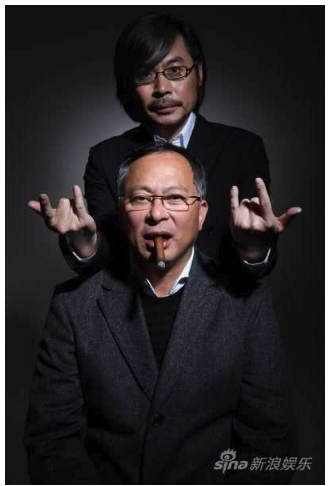
The evil geniuses over at Hong Kong’s Milkyway Image productions (above, looking evil) have begun their takeover of the Mainland.   Johnnie To (seated) and his long time co-director and screenwriter Wai Ka-fai (flashing the horns) have had their last decade of gangster sagas (Election, Triad Election, Exiled, et. al.) banned or censored in China. So in an effort to expand their audience, they are making two Chinese co-productions, both romantic dramas, back-to-back. Don’t Go Breaking My Heart was released in March of this year (and is now available on DVD and Blu-Ray), and Romancing in Thin Air recently wrapped production in Yunan province, and should open early in 2012.

Regarding Don’t Go Breaking My Heart, Johnnie To told the South China Morning Post that, “we believe in our ability to bring our own style of filmmaking to audiences up there.” But then went on to hedge that, “It’s not exactly the kind of film that could best bring our skills to play – but if we were to do something else, like a police thriller, we would have to attend to a lot of potential problems with the censors.” A director, like any artist, is also a full-time hustler, and has to follow the money in order to get their work made. With Hong Kong’s film industry in an across the board decline and the Mainland still flush with cash, Milkway Image is making artistic concessions to keep afloat. The strange thing about To’s comment is that they’ve made superb romantic comedies before, including the smash hit Needing You in 2001 and the wonderful cult item My Left Eye Sees Ghosts (’02). Their skills certainly play well in that genre, although it’s clearly not where his creative interests lie right now. In the downtime between the Chinese super-productions, he shot a low-budget HK thriller starring Lau Ching-wan, Life Without Principle, whose release date is unknown.

Even with all the concessions to Chinese censors, Don’t Go Breaking My Heart is an impeccably constructed and eccentric comedy. The plot concerns a love triangle set during the 2008 financial meltdown, in which a spunky stock market analyst (Gao Yuanyuan) is torn between the wooing styles of a suave investment banker (Louis Koo) and an earnestly charming alcoholic architect (Daniel Wu). To sets up their dynamic in an exchange of point-of-view shots in the opening scene in Hong Kong. Gao wedges herself onto a bus during a morning commute, while Koo cruises by in his luxury convertible. Gao has moved from Suzhou in the north, and tries to teach herself Cantonese during the ride (the majority of the film is in Mandarin, another concession to Chinese audiences). Koo pulls up next to the bus at a stoplight, and eyes her through the window, with Gao briefly accepting his gaze.  This establishes the central visual motif, of looking, and physically communicating, through panes of glass.

Gao gives up her seat to a pregnant woman, who then turns out to be the wife of her ex-boyfriend. The wife then panics at Gao’s presence, and her ex urges her to leave the bus before his wife gets hysterical. She leaves, jittery and angry, and trips and falls in the middle of the street. This is where a bearded and homeless looking Wu steps in, directing traffic around her while helping to pick up her papers. Koo, who had followed her off the bus, loses her in the scrum, and Wu starts a flirtation that secures a date the following week. This sequence cements Koo as distant and voyeuristic, and Wu as selfless to the point of masochism.

To extends the motif of looking/looked-at the following business day, when Koo notices that Gao works in the skyscraper across the street a few floors above him. To get her attention, he makes a smiley face collage out of post-it notes on his window, and once he attracts her glance, he does a mini-magic act and pantomimes where to meet her for some coffee. Enraptured by his bravado, and by how he breaks the spell of their mutual voyeurism, she agrees to their date. However, another woman on a lower floor also saw Koo’s performance, and she intercepts him before his rendezvous with Gao. This interloper is revealed in one of the final counter-shots in the sequence, the perfect punchline to reveal how much POV shots can hide. Gao and Wu learn the effects of this perspectival narcissim, when both are stood up for dates (Gao by Koo, and Wu by Gao).

The triangle goes through some convoluted twists and turns over its 115 minute running time (including a mandated trip to China), and the narrative convulsions can be tiresome. But when the material strains credulity, To and Ka Fai’s staging and composition never fails them. After Gao’s company goes bankrupt, Wu’s architecture firm takes over his space, and in order to finally win Gao’s hand, he puts on a skyscraper magic show of his own, with more elaborate effects (he’s in the middle distance in the image below). It is the only way Wu can wrest  screen space away from the image-savvy Koo.


To and Ka-fai are wise enough to leave both Wu and Koo as ambiguous figures. Neither is a simple good guy or douche, as is the norm in romantic comedies. Wu is gentle and understanding, but also exhibits neediness and passivity. Koo is charismatic and handsome, but also an arrogant philanderer. Both men obsess over one-upping the other, until their love is transformed into escalating bouts of childish violence. It seems Gao might be better off alone. In the end, she makes her choice between the two sods while once again looking out a skyscraper window, but this time the only thing she can see is her reflection.

BLU-RAY BONANZA: ACCIDENT AND VENGEANCE

December 29, 2009

vengeance

After a lengthy hold-out, I’ve galloped into the loving arms of Blu-Ray. It’s the right time to jump in, as the studios are (rather desperately) pushing the format hard, cutting prices across the board. You can pick up a player for around $150, with many library titles on sale for $10 (most new releases are set at $25). Starting in 2010, Warner Brothers will release every new theatrical release exclusively in “Blu-Ray combo packs”, which will contain the high-def disc along with the standard-def DVD (forcing consumers to buy the Blu-Ray and push them to upgrade). With HDTV prices finally starting to come down as well, Blu-Ray is finally a financially feasible option for cash-strapped cinephiles like myself.

I ended up purchasing a PS3 to pair with my Panasonic plasma in order to sate my long-suppressed video-gaming urges, as well as for its stellar Blu-Ray playback and new Netflix streaming capability. I flirted with the idea of an all-region player, as recommended by the folks at DVD Beaver, but wasn’t convinced there were enough region-locked releases to justify it, especially considering that the excellent Masters of Cinema series is region-free, as are all of the Hong Kong releases.  So while I’m missing out on gems like ITV’s The Red Shoes, I console myself with games like Metal Gear Solid, Netflix, and the rush of new domestic releases (Criterion’s forthcoming Days of Heaven and Bigger Than Life Blu-rays are especially tempting).

After dipping into some of the sales (I picked up The Searchers and Robocop on the cheap), I decided to check in on my favorite production company, Milkyway Image. Johnnie To’s stalwart outfit has been churning out inventive genre pieces since 1996, the kind of work Hollywood has forgotten how to make (aside from flukes like Armored). I sampled two of their recent releases on Blu (available at HK retailers like YesAsia).

Soi Cheang’s Accident premiered at this year’s Venice Film Festival, and it’s a sleek paranoid thriller in the vein of Coppola’s The Conversation. The central gimmick has the obsessive-compulsive Brain (Louis Koo) lead a group of assassins (including Milkyway axiom Lam Suet) on murders that are staged to look like accidents. They build elaborate traps for their marks to waltz into, and their hands are clean. It’s the perfect setup for producer Johnnie To’s penchant for displaying process, the small details that build up to a murder, as he also shows off in Vengeance. I’m not familiar with Cheang’s work (he’s known most for his gangster film Dog Bite Dog), but he is adept with the Milkyway house style, which favors underplayed acting, minimal exposition, and a smooth delineation of space.

After Cheang sets up the group’s unerring precision in a bravura Rube Goldberg murder, he starts to expose the paranoia that drives Brain. His first action is to pick up a cigarette butt that “Uncle” (Fung Shui-Fan) leaves at the scene of their crime. He’s determined to erase any trace of their presence. When their next job goes tragically wrong, he becomes convinced it was the result of a conspiracy led by an insurance agent (Richie Ren). He then embarks upon an elaborate wire tapping scheme, moving into a unit underneath Ren’s apartment and listening to his every waking (and napping) moment. He even sketches the floor plan of his nemesis’ apartment on his ceiling.

Cheung , along with screenwriters Szeto Kam-Yuen and Tang Lik-Kei, withhold enough information to keep the truth of the matter ambiguous. Brain is either a canny chess-player – seeing many moves ahead – or an untreated paranoid schizophrenic – creating antagonistic worlds in his strained noggin. Louis Koo is perfect for the role, a blank slate of wiry tension and a football-field sized forehead that could contain multitudes of tortured grey matter. Cheung uses the motif of a solar eclipse to express the obfuscation of his mind’s eye, working multiple variations on the idea until the literally gut-wrenching climax.

Johnnie To’s latest film, Vengeancewas released last week on DVD and Blu-Ray by MegaStar (IFC has the film’s U.S. rights, with no release date as of yet), and it feels like a stand-in for the Le Cercle Rouge remake he never got off the ground. To’s love of Jean-Pierre Melville has never been so close to the surface. His protagonist, the mummified cool of Johnny Hallyday, is named Costello, just like Alain Delon in Le Samourai, and maintains his near-silent devotion to revenge, this time after the slaughter of his daughter’s family. But Johnnie To is also adept at wonderful scenes of hanging around, the interstitial moments between battles that To veins with humor and pathos. He surrounds Hallyday with his stellar repertory crew (Suet, Anthony Wong, Lam Ka-tung are the killers Hallyday hires to help him, while Simon Yam is the flamboyant villain), and has them enact their usual honor-among-thieves routine, which I could watch until the end of time. Anthony Wong has perfected a resigned weariness that plays beautifully off of Suet’s overeager child and Lam Ka-tung’s suave clotheshorse.

Set in Macau and starring a French rock star, it continues To’s interest in cross-cultural exchange, and is perhaps a nod to his increased visibility in the Western world. The film mixes English, French, and Cantonese, and the issue of (mis)communication becomes a major theme. This is established early on, when his daughter (Sylvie Testud), unable to speak, uses a French newspaper to get her thoughts across (later there is a bravura shootout set among composted newspapers). Then he has to bridge the language gap with Anthony Wong’s gang, in which he switches to English. The final act of the film charts his communication with himself, as he loses his memory and tries to trigger it again with a series of note-covered Polaroids. The final shoot-out is a brilliant encapsulation of the evolution of this theme, as he chases a target whose facial features he repeatedly forgets. It is a scene of constant self-communication and negotiation, as he checks and re-checks the bodies of the assailants in his way. There is also a minor motif of eye-holes and eclipses, similar to those in Accident, images related to the opening-up and closing-off of sight – just another few layers of meaning to To’s incredibly dense revenge drama. The image on both releases is phenomenal, the shimmering pastel blues of Accident and the deep blacks of Vengeance rendered with depth and incredible sharpness. They have my strongest recommendation.