THE ENTERTAINER: ALLAN DWAN (PART 1)

July 2, 2013

manhandled-1030x807

“Directing movies — I’d do it for free, I like it that well.” -Allan Dwan to Kevin Brownlow, The Parade’s Gone By…

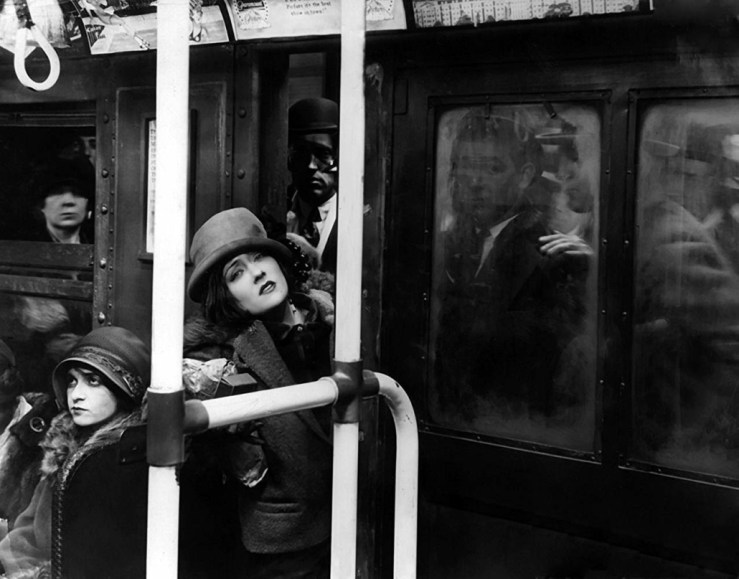
The 400 or so films that Allan Dwan directed are playgrounds for their actors, sandboxes of freewheeling experiment. Trained as an electrical engineer, Dwan was a technical innovator, but his flourishes were always in service to the specific talents of his performers.  In his self-effacing style, elaborate tracking and dolly shots never call attention to themselves, but only to the characters on-screen. Whether its suave Franchot Tone swinging off a saloon chandelier in Trail of the Vigilantes (1940) or glamour queen Gloria Swanson fighting through a packed subway car in Manhandled (1924), Dwan found hidden reserves of athleticism and wit in his stars. They would need it to motor through the  scenarios of borders, doublings and makeshift families that Dwan was assigned, which he treated as complex logic problems that are always solved, from institutional separation (political or geographic) into personal bonds (lovers, friends). He oils these Hollywood mechanics through his attention to character detail and penchant for parody, able to pack pathos and the madcap into his unstable, gleefully entertaining concoctions.

Dwan has never had the name recognition of some of his classical Hollywood contemporaries, and aside from Peter Bogdanovich’s essential interview book The Last Pioneer (1971), has had precious little written about his inexhaustible career. Some of this has to do print scarcity, as much of his silent one-reelers are lost, and his Republic Pictures films might as well have been due to rights limbo. That has all changed this year, with two major retrospectives (at MoMA in NYC and Il Cinema Ritrovato in Bologna), and a flood of writing, from Frederic Lombardi’s critical biography Allan Dwan and the Rise and Decline of the Hollywood Studios to the massive (free) dossier published by Gina Telaroli and David Phelps, a labor of love with contributors from around the world (including yours truly). After viewing twenty-some of his films over the past month, I’m about to add more to the pile.

220px-AllanDwanAllan Dwan was born in Toronto on April 3rd, 1885 as Joseph Aloysius Dwan. He told Brownlow the name change was caused by teasing at school, “they used to say Aloysius to be a girl”. After graduating from Notre Dame with a degree in electrical engineering, he caught the eye of George Spoor of Essanay Studios, as he was working on a mercury vapor arc lamp, which was easier on actors’ eyes.  Dwan supervised their use on set, and eventually submitted stories to the studio when he discovered they paid $25. Lombardi sketches the exaggerated variants of Dwan’s origin story over the years. In 1920 he said he was merely inspecting the installed lights when Spoor met him, but in the 1960s he claimed to have developed the arc lamp himself.

In any case he was subsumed into the movie business, and stumbled into directing a few weeks into his job as a writer at the American Film Manufacturing Company. One of their film crews had gone AWOL, and Dwan was sent out to investigate why. He discovered that the alcoholic director had skipped town on a binge, and was given the job on the spot. He told Brownlow, “I just let the actors tell me what to do and I get along very well. I’ve been doing it now for fifty-five years — and they haven’t caught me yet!” He was an actor’s director from the beginning.

One of his early stars was Pauline Bush, whom he claims to have directed in over 50 Westerns for the American Film Manufacturing Company (or the “Flying A”) from 1911 – 1913 and 20 films at Universal Pictures between 1913 – 1915. In Charles Foster’s history of Canadians in Hollywood, Stardust and Shadows, Dwan says “she just came in off the street and told me she wanted to become an actress.” Born in Lincoln, Nebraska in 1886, she had lit out for Los Angeles and was performing amateur theater before he discovered her. With Dwan she had risen to a modicum of fame, and used it to advance feminist causes. In a Feb. 1913 issue of the Chicago tabloid “The Day Book”,  a profile of her is headlined: “The Western Girl You Love in the Movies Is A Sure-Enough Suffraget [sic]“. She is described as an “ardent suffraget [sic], believing woman can and should do just anything a man can do. That is, she thinks a woman’s brain and ability ranks right alongside, not a few feet behind a man’s.” Dwan married her in 1915.

Dwan’s films are filled with assertive female characters, from the Gloria Swanson silents through Natalie Wood’s tiny truth-teller in Driftwood (1947) to the veritable matriarchy of Woman They Almost Lynched (1953). His ease with female power would seem to spring from this early relationship with Bush, which despite ending in divorce in 1921, remained friendly throughout the rest of their lives. Dwan sent her birthday and Christmas cards every year after their parting. Foster spoke with Bush in 1963, and she still valued Dwan’s directorial flexibility, saying, “He gave us a great deal of freedom in our actions and movement…we were all relaxed and he got the results he wanted.”

This freedom is evident in the earliest film I viewed in the MoMA series, his Flying A production The Mother of the Ranch (1911). Dwan’s films are filled with absent parents, and how the kids fill that gap, but this one regards a mother whose son is absent. He heads west to be a cowboy, but tires of the hard work and turns to cattle rustling instead. Undercutting the East’s romanticization of the cowboy lifestyle, it anticipates the comic Dwan-Fairbanks feature Manhattan Madness, in which city-boy Fairbanks brags about cowpunching skills and gets pranked by his friends. In Mother of the Ranch, the Easterner’s laziness gets him killed, and the mom arrives looking for her n’er do well offspring in vain. But in typical Dwan fashion, he doesn’t stoop to sentimental gloop, but installs her as a kind of Snow White to the remaining ranch hands, who lie to her about her son’s virtue, and take her on as their own mother. The image of Louise Lester perched atop a mound of beaming cowboys in the final shot encapsulates one of Dwan’s recurring themes, you take family where you can get it.

david-harum-1915-granger

David Harum (1915) is a more straight-forward bit of rural Americana, embracing the virtues of small town life. Based as it was on a popular 1899 novel, that was then a hit 1900 play, Dwan was probably instructed to play it straight. The stage star William H. Crane reprises his role as the kindly banker David Harum, who attempts to nurse a fatherless cashier towards adulthood. Crane is a warm presence in constant rotund motion, and Dwan employs one of the earliest tracking shots on record to capture him. He placed a camera on a truck to capture his waddle down Main Street, looking down at him from a high angle, watching as the town comes to greet and ignore him in equal measure.

The_Iron_Mask_(1929)_5

Before Dwan began his ten film run with Douglas Fairbanks in 1916 with The Habit of Happiness (Triangle Picture Co.), he had worked on female-centered films with Mary Pickford (A Girl of Yesterday, 1915) and with both Lillian (An Innocent Magdalene, 1916) and Dorothy (Betty of Greystone, 1916) Gish. It was the Fairbanks films that became blockbusters, though, irresistible entertainments that poked fun at popular genres. While Manhattan Madness parodies the Western, A Modern Musketeer (1917) does the same for the swashbuckler, with a D’Artagnan-adoring Fairbanks attempting to bring the chivalric code into the modern day, and running into the suffragette movement. Dwan remarked to Bogdanovich that he and Fairbanks tried to create, “plenty of suspense, but from the humorous side.” Audiences ate up these exuberant and lightly subversive takes on old favorites, which highlighed Fairbanks’ easy athleticism, in which which his legs seem spring loaded. Dwan would cut down the height of tables and barriers to make every Fairbanks leap look as easy as breathing. Even when Fairbanks actually played D’Artagnan in The Iron Mask (’29, their final collaboration), it was still light as a feather. When he leaps into heaven in the final reel, it seems like the most natural thing in the world.

Gloria_Swanson_Unknown_R1-976x757

When Gloria Swanson is on-screen it is impossible to ignore her, and Dwan elicits two of her greatest performances in Manhandled (1925) and Stage Struck (1926) (out of the eight films they made together, four survive). In both Dwan draws out her rambunctious comedienne, pushing her down the social ladder, from costume drama clotheshorse to working class striver. Dwan called the glamorous diva, “a clown if there ever was one”, and lets her loose as a destructive force upon the city. Swanson would later call Dwan her favorite director because of it. Manhandled opens with a tour-de-force of physical comedy, as her daily commute turns into a gauntlet of male girth. She is tenderized by the oceans of businessman in the subway car, squeezed up to the roof and shunted down to the ground. She manages to deflect serious injury through a kind of bruising ballet, wriggling through until she spots light at the end of the tunnel. For Swanson, surviving in a man’s world will take all she’s got. She plays a snappy store clerk whose beauty attracts rich suitors, and she is bemused by fantasies of wealth. She leads a double life, attending high-class parties and netting modeling gigs, while returning home to her tenement flophouse.

Annex - Swanson, Gloria (Stage Struck)_02

In Stage Struck Swanson is a meeker animal, cowed by her man crush grill cook Orme, for whom she does laundry and pines wistfully at the window. The film is a story of her self-actualization as a lustful woman, enacted in a series of close-up inserts of a home-made makeover. She takes a scissor to her floppy hat and leather shoes to look the part of a flapper, and tears up at every eyebrow pluck, a thoroughly de-glamorized vision of glamor. Her sexual will-to-power eventually throws off these outward signs of beauty and opts for pure aggression, as the next group of close-ups will be at a fairground boxing match, where Swanson lays down a beating while still having time to spout verse. It is both absurdly funny and a character’s statement of purpose – her willingness to look absurd a proof of love. Pathos and pratfalls, together forever in Dwan’s effortlessly entertaining art.

In two weeks, Part 2 of this article will attempt to discuss Dwan’s sound features.

BOXED IN: OTTO PREMINGER’S THE HUMAN FACTOR (1979)

June 25, 2013

M8DHUFA EC007

“The dullest movie ever made.” -Rex Reed, review of The Human Factor

Nothing much happens in Otto Preminger’s film adaptation of The Human Factor. A group of gray men sit in poorly upholstered rooms and talk about cheesemongers and malted milk balls. The detente between Eastern and Western powers reduces the workload of the bored British secret service agents to whinging and paper pushing. So when an inconsequential leak is uncovered, it is treated as a matter of national security, the boys gifted a bone to gnaw on. They end up gnawing on each other, their whole world reduced to a series of boxes that splits and drains them. Their deaths are as dull as their lives, but the emotions held in check by these relentlessly logical manipulators – fear, doubt, loneliness – curls the wallpaper in its repressed intensity. Newly released on DVD by Warner Archive in an un-restored transfer (the print shows plenty of wear and tear but it was certainly watchable), this final film of Otto Preminger pushes his dispassion to a radical extreme.

human-factor-movie-poster-1980-1020232860

Preminger was at a low ebb in his career, scrambling to source funding after a string of 1970s box office failures. He had a number of projects fall through, including a bio-pic of  Mao Tse-tung’s Canadian physician and a recreation of the hostage rescue at Entebbe Airport in Uganda by Israeli Defense Forces. Then he nabbed the rights to Graham Greene’s novel The Human Factor through his Sigma Productions a few weeks before the book’s release. He had previously optioned Greene’s A Burnt-Out Case in 1967, but nothing came of it. This time he pushed it through, with financing promised from the inexperienced producer Paul Crosfield, which later fell through. While on a location shoot in Nairobi, his crew’s checks started bouncing, and to avoid a mutiny he bankrolled the feature himself, selling his house and two Matisses, though still having to slash the budget by $2 million (he managed to keep one of Saul Bass’ most memorable opening montages). The Human Factor would put Preminger in debt for years.

M8DHUFA EC005

An eager Tom Stoppard was hired to adapt the screenplay. Stoppard claimed that, “if Otto had said I can’t pay you but you’ll get one or two lunches with Graham Greene, I might have done the job. I was much more nervous of displeasing Greene than I was of displeasing Otto.” He delivered a very faithful script, so much so that Greene expressed surprise, telling Stoppard he “needn’t have stuck so closely to the original.” The story concerns Castle (Nicol Williamson), a  lifelong diplomat with a wife and kids and the whole middle-class shebang. When MI6 discovers a small leak of economic information into the USSR, Col. Daintry (Richard Attenborough) and Dr. Percival (Robert Morley) begin investigating the African department, including Castle and his partner Davis (Derek Jacobi). Circumstantial evidence damns Davis, but it is Castle who was living a double life, one that begins to collapse.

M8DHUFA EC008

The dry, procedural script served Preminger’s purposes, in any case, and after failing to snag Michael Caine or Richard Burton for the lead role, he settled on Nicol Williamson. Williamson is ideal for the self-effacing part of Castle, a pasty company man of rumpled shirts and clammy handshakes. It is hard to imagine Caine or Burton disappearing into the background as humbly as Williamson. As Castle’s South African wife Sarah, Preminger tapped Supermodel Iman, for her film debut. Since his discovery of Jean Seberg in Saint Joan, Preminger considered himself an actress whisperer, but Iman never gets into the flat declamatory flow of spy-speak, her halting line readings registering as stilted.

M8DHUFA EC006

Preminger was insistent at a flat, drab look across locations, so an English country estate would looks as nondescript as Castle’s peeling suburban home or Spartan office. In Chris Fujiwara’s critical study, The World and Its Double, director of photography Mike Molloy recalls he, “started out trying to light it with a bit of mood to it and a bit of contrast, and he [Preminger] had an apoplexy at the first batch of rushes.” Fujiwara writes that he “complained of not being able to see the actors’ eyes”, making Molloy use flat and direct light. He used a 20mm lens and placed it in the corners of rooms, getting wide shots of the decrepit interiors, the actors just another piece of furniture, what Dave Kehr described as a “drama of pure surfaces…purged of the seductive highs and lows of traditional narrative texture.”

M8DHUFA EC009

In a pivotal speech, the casually sadistic Dr. Percival points at a Mondrian print and expounds: “Boxes. All part of the same picture. Each one separate, but held in perfect balance. Everyone to his own box, you in yours, I in mine. No responsibility for the next man’s box.” The upsetting of this monastic balance is Percival’s cause for justifiable homicide. Preminger seems to take his line as a formal decree, the film as a whole is a series of discrete boxes, those corner shots emphasizing the boundedness of the interiors, cells which only lead to other cells. Castle, eventually smoked out and isolated in Moscow (rendered in chintzy backdrop at Pinewood Studios), realizes he is caught in this labyrinth of logical bureaucratic design, partly of his own making. It is only then that Castle, and Preminger, can vibrate the surface of the film’s rational design, Williamson’s tears expressing a profound regret at a lost love now safely locked away in another impregnable box across the ocean.

M8DHUFA EC004

THE FEMININE IN YOUR MIND: LIFEFORCE (1985)

June 18, 2013

Lifeforce2

The summer of 1985 was a chilly one for Hollywood executives, with box office grosses declining 160 million dollars from 1984′s take. In his Los Angeles Times moratorium, Jack Mathews blamed the lack of an all-ages “sequel to a blockbuster” for the downturn, with the adult arterial sprays of Rambo: First Blood Part II sitting atop the charts. Franchise hopefuls Explorers and Return to Oz tanked, while even the successes (The GooniesCocoon) didn’t crack $100 million. The family dollar was being kept in-pocket.  It was inauspicious timing for exploitation operation Cannon Films to release one of their few big-budget items, the eroto-horror whatzit Lifeforce. They signed Tobe Hooper, fresh off of Poltergeist, to direct, Henry Mancini to write the score, and John Dykstra (Star Wars) to head the effects team. Instead of a Spielberg theme park ride, they delivered an obsessive head trip in 70mm, one which details the ways in which quivering men fail to satisfy a voracious (alien) woman’s sexual desire. Ravaged by critics, Janet Maslin memorably described it as “hysterical vampire porn”, and it made only $11.5 million on a $25 million budgetIt comes out in a loaded Blu-ray today from Scream Factory.

primary_lifeforce-500pix

Producers Menahem Golan and Yoram Globus were Cannon Films, and they signed Tobe Hooper to a three-picture deal following the success of Poltergeist. To sign the contract Hooper dropped out of Return of the Living Dead (1985), for which screenwriter Dan O’Bannon (Alien) took over as director.  In their first meeting Golan and Globus handed Hooper the novel The Space Vampires (1976) by Colin Wilson. The production began a few days later, with Hooper fondly remembering how they “bypassed all the usual development things you have to go through.” One of those “development things” they went without was having a completed script. Hooper hired O’Bannon and Don Jakoby to write it, but it was far from finished by the time the compressed shooting schedule began.The tight schedule also frustrated the effects team led by Dykstra, who later complained that a rushed film processing job introduced flaws into the delicate optical printing work (read more about his analog techniques in the film here).

lifeforcemummyplead

If Golan and Globus expected the Spielbergized Hooper of Poltergeist, they were to be disappointed. What they got instead was the uncompromising horror nerd who made Texas Chain Saw Massacre. Hooper recalled his own attitude as, “I’ll go back to my roots, and I’ll make a 70mm Hammer film.” Recognizing Colin Wilson’s novel as a variant on The Quatermass Xperiment, he made Lifeforce with ripe colors and riper melodramatics, his actors adopting the postures and tones of his favorite Hammer icons. Frank Finlay, for example, in his character of Dr. Hans Fallada, takes on the epicene inquisitiveness of Peter Cushing. The title was changed to Lifeforce and the producers cut down the film for US release by 15 minutes and replaced Mancini’s score, but it didn’t help at the box office. Hooper believes that changing the title was a mistake, that everyone then, “expected it to be more serious, rather than satirical. It isn’t quite camp, but we intended it to be funny in places.”

lifeforce-7

The film starts as exploratory sci-fi, with Col. Tom Carlsen (Steve Railsback) leading a British-U.S. space mission to investigate Halley’s Comet. As they float on wires through matte-painted backgrounds worthy of Forbidden Planet, they discover the corpses of hollowed out devil bats. Then they enter a crystalline chamber modeled on the diamond-shaped alien pod from Quatermass and the Pit (1967), where they find three perfectly preserved human bodies, one a well-proportioned woman (only known as “Space Girl”, Mathilda May) who exerts a hold on Carlsen, even in stasis. Here the horror begins, as this female is, yes, a space vampire, sucking the life force out of anyone in her path. Once she and her two male companions (including Mick Jagger’s brother, Chris) reach Earth, they leave piles shriveled up human husks in their wake, which realistically twitch in the animatronics by Nick Maley.

lifeforce-mathilda-may

Space Girl embodies female desire without socialized restraint, ignorant of Madonna/Whore complexes or slut shaming. She knows what she wants and she gets it. After she escapes a government facility, one of the doctors is asked how she overpowered him. He responds: “She was the most overwhelmingly feminine presence I’ve ever encountered.” If this were a male character, he would be a raffish romantic lead (Gerard Butler maybe?), but as a woman she could only be a (nude) world-devouring hell beast. It’s a thankless role for Mathilda May, who is tasked with striding naked with a zombified gaze for two hours, but she does get to cow the men and their toys.

The male characters are either insular pedants or macho creeps, playing with their spaceships or microscopes but utterly befuddled at the presence of an unprepossessing nude woman.  Railsback is in a perpetual cower, prematurely embarrassed at his inability to fully please the Space Girl. By the end he’s sweating and flinching so much he becomes Renfield to her Dracula. The only time he can gain some measure of control is by injecting her with gallons of sleep serum, and that’s only when she’s taken over the body of Patrick Stewart (yes, Captain Picard). She speaks through Stewart’s  mouth, ““I am the feminine in your mind, Carlson”. Railsback then kisses Stewart, in one of the more radical moments in 1980s Hollywood cinema. Railsback is, very literally, embracing his feminine side.

NO SUCH AGENCY: THE NSA, ENEMY OF THE STATE AND EDWARD SNOWDEN

June 11, 2013

Screen Shot 2020-02-12 at 5.24.36 PM

Top: Edward Snowden, bottom, Jason Lee in ENEMY OF THE STATE (1998)

“I made the judgment that we couldn’t survive with the popular impression of this agency [the NSA] being formed by the last Will Smith movie.” -ex-director of the NSA Michael Hayden to CNN, 1999

Before The Guardian’s video interview with Edward Snowden, the most damaging movie to the National Security Agency’s image was Enemy of the State (1998). Just another slam-bang Jerry Bruckheimer-Tony Scott blockbuster, it also depicted the NSA as a rogue operation that could tap the phones and bank records of American citizens at will. In the book Deep State, Marc Ambinder and D.B. Grady report that, “Not a few NSA managers at the time saw the movie and privately thought, ‘If only!’”  Following a dustup with European governments over the NSA’s global surveillance program ECHELON, Enemy of the State convinced Hayden that the NSA had to make gestures towards transparency. But as Snowden’s leaks reveal, the NSA was continuing to gather the capabilities, if not the legal authorization to target American citizens, for the tools deployed in Enemy of the State.

genehackmanasbrill

Bruckheimer and his late production partner Don Simpson began developing Enemy of the State in 1991, with a one line idea about a man whose electronic identity is stolen. After the Baltimore Sun ran a series of articles on the NSA in 1995, a time when the agency was reluctant to admit it even existed, they collaborated with screenwriter David Marconi to build it up into a story about the surveillance state, which Tony Scott dramatized through use of spy cameras and satellite footage – a layering of textures he would later push to extremes in Man on Fire and Domino. In the press notes Bruckheimer utilized some classic Hollywood double-talk, eager to please all political factions:

“I’ve always been interested in the inevitable questions surrounding the invasion of privacy. With today’s technology anything is possible and everything is probable. I don’t think the public is truly aware of what’s at stake in terms of an individual’s privacy. But the other side of the controversy remains – we need to be able to protect our borders and our citizens. The NSA has been incredibly active in preventing terrorist attacks and finding those responsible for the rash of senseless bombings that have erupted recently.”

Despite this defense of NSA practices, he was denied cooperation from the agency. So for technical assistance he enlisted Larry Cox, an 11-year veteran of the NSA. In a bizarre bit of historical coincidence, Cox would, just a few years later, be in a position to make the film’s paranoid fantasies come true.

Cox was founder and president of the menacing-sounding ORINCON Sygenex Incorporated, which was acquired in 2003 by Lockheed Martin. where he became the Vice President of Signals Intelligence. In 2005 he became the senior vice president and general manager of the Intelligence & Information Solutions Business Unit (IISBU) of SAIC (Science Applications International Corporation). SAIC employs approximately 41,000 people that “serve customers in the U.S. Department of Defense, the intelligence community, the U.S. Department of Homeland Security, other U.S. Government civil agencies and selected commercial markets.” SAIC was, along with Booz Allen Hamilton, the main contractor assigned to work on the NSA’s massive data mining Total Information Awareness project that was stripped of its funding by Congress in 2003. Cox came aboard two years later, but there are strong indications the program lived on well into his term. An expansive precursor to the Snowden-disclosed PRISM project, TIA sought to “predict terrorist attacks by mining government databases and the personal records of people in the United States.” Cox remains a consultant to the NSA Advisory Board.

At the same time that Hayden was  engaging his NSA charm offensive against Enemy of the State in 1999, the agency was starting an aggressive privatization push, which accelerated following 9/11. Needing to hire more analysts and translators, they began contracting heavily from private companies like SAIC and Booz Allen Hamilton, the latter of which Snowden worked at for three months before leaking the PowerPoint slides that outline the siphoning of TeleCom and internet data.

enemy

While many of the actions performed by the super-spies in Enemy of the State are pure science-fiction, some are now plausible. An early sequence finds cherubic agent Jack Black pulling up Will Smith’s phone records and cross-checking them against his banking statements, and within seconds forging a link to an ex-flame of his played by Lisa Bonet. The NSA cannot listen in to the conversations of U.S. citizens, but it does suck in all the metadata of their phone calls, their number and duration. While American citizens’ metadata cannot legally be targeted as part of an investigation, it is still collected and stored, ready to be used if the secret rulings of the FISA court ever deem it necessary.

It is President Obama’s contention that collecting this metadata is part of the balance of privacy and security, but that listening in to conversations is the bright line that cannot be crossed. The metadata, though, has an enormous explanatory power of its own, and combined with the NSA’s power to search credit card and bank records, can sketch an entire life. At Foreign Policy Shane Harris notes that “a study in the journal Nature found that as few as four ‘spatio-temporal points,’ such as the location and time a phone call was placed, is enough to determine the identity of the caller 95 percent of the time.”

enemy_of_the_state_1998_500x336_966862

Will Smith is able to escape the dragnet due to the help of ex-NSA hand Gene Hackman (there are many nods to his role in paranoid surveillance classic The Conversation). It is unclear what help Edward Snowden will receive, aside from legions of internet admirers. His closest analogue in the film is the environmental activist played by Jason Lee, who stumbles upon a government secret and scrambles to release it to the public before getting crushed by a commuter bus. Luckily for Snowden he is not inside a Tony Scott movie, but somewhere…else (he checked out of his Hong Kong hotel today, his current whereabouts are unknown).

The video interview hosted at The Guardian is a fascinating object, hermetic in form but expansive in implication. Conducted by Glenn Greenwald and directed by Laura Poitras (whose forthcoming untitled whistleblower doc has already achieved legendary status), it opens with a scenic picture of lolling boats in Hong Kong harbor. It’s a dis-establishing shot, since Snowden’s specific whereabouts are to remain hidden. When he appears he is a talking head, the back of which is reflected in a nearby mirror. He looks pasty and unshaven, rather the IT stereotype of a denizen of dark rooms. He speaks in calm, even tones, whether about his disillusionment with and deception of the surveillance state, or his fears of government reprisal. It is impossible to glean anything of an inner life, but it is curious that he is speaking at all, considering his stated claim of keeping attention off himself and onto changing U.S. policies. His appearance has deflected debate of this country’s privacy laws, diverted into drive-by psychologial evaluations of Snowden and attempts to identify the girlfriend he left behind (I won’t link to that), and recent polls show that 56% of the U.S. population approves of the NSA’s actions.  But there are promises of more leaks, and I’m sure Jerry Bruckheimer is takings notes for the Enemy of the State sequel to come.

BETTER THAN NOTHING: THE COMPLETE (EXISTING) FILMS OF SADAO YAMANAKA

June 4, 2013

The history of Japanese cinema can never completely be told. It is estimated that 90 percent of its pre-1945 film output was lost or destroyed, the silent era razed in the 1923 Kanto earthquake, and Allied firebombing in WWII incinerating the rest. One of the most tragic casualties of this cultural obliteration are the films of Sadao Yamanaka, of whose 27 features only 3 survive. A galvanizing figure in the 1930s, he was a passionate cinephile and member of the Narutaki Group of Kyoto that sought to modernize the jidai-geki, or period drama. His films bring the heroes of pulp novels and kabuki theater down to earth, into sake bottle level views of the everyday lives of the working poor. They speak in modern Japanese, in dialogues modeled after his drunken late night conversations with the Narutaki Group. He wrote, “If what drinkers say is lively when utilised in a film, I may insist that drinking is part of my profession.”

He took flak for turning the popular nihilistic samurai Tange Sazen into an irritable layabout, but he gained fans and friends from peers like Yasujiro Ozu. He died at the age of 28 as a military conscript in Manchuria, from an intestinal disease.  The  Masters of Cinema label has released his surviving works in a two-DVD set : Tange Sazen: The Million Ryo Pot (1935), Kochiyama Soshun (1936) and Humanity and Paper Balloons (1937).

Yamanaka was born on November 7, 1909 in Kyoto. As written in the informative Masters of Cinema booklet by Kimitoshi Sato, Yamanaka was the last of seven children. His father was a “master fan craftsman” who passed away from a brain hemorrhage when Sadao was 16. He was hired by the Makino film company two years later, on the strength of an essay he wrote in high-school, “Kyoto and the cinema industry”. He worked as an assistant, although lazily. He was nicknamed “lamp in the daylight”, a boy with a lantern jaw who according to an actor on set, “did nothing, he just stood around.”

The young Yamanaka took this standing around as an artistic credo when he moved into features at Nikkatsu. The three films that survive are group portraits of hanging out and doing nothing. Tange Sazen: The Million Ryo Pot is the third film in a series originated by director Daisuke Ito. Ito left the studio, who gave the assignment to Yamanaka. Originally a serial novel following the vengeful exploits of a one-eyed ronin (masterless samurai), in One Million Ryo Pot Yamanaka and screenwriter Shintaro Mimura (a Narutaki Group member) turns the wandering warrior into a splenetic loafer who hangs out at an amusement parlor. The writer of the novel, Fubo Hayashi, asked to have his name taken off the credits.

Sazen (reprised by Denjiro Okochi) spends his time listening to his girlfriend sing while laughing at the suckers who pay to lose at an archery game. His life of lassitude is interrupted when one of the parlor’s patrons shows up stabbed, and asks Sazen to care for his child Yasu.  Yasu happens to be dragging around a dirty old pot which another passive aggressor is looking for. The black sheep of the Yagyu clan, Genzaburo (Kunitaro Sawamuro), believes the pot contains a map to an ancient fortune, and the search will give him an excuse to get away from his wife for awhile.

It’s a setup for madcap farce, but Yamanaka delivers it in an unexpected manner. The pot plot is a red herring, as neither Sazen nor Genzaburo have any intention of searching for treasure – they use the search as a way to create havoc outside, allowing them to lie down languidly inside.  His long-take long-shots group his performers in various states of repose, and while he does not focus in depth, he composes that way, with (in) action occurring in the far reaches of the frame. Even if he didn’t have the technology yet, Yamanaka was moving towards a deep focus aesthetic, which he would fully explore in Humanity and Paper Balloons.

But first there was Kochiyama Soshun (Priest of Darkness, 1936), based on the famous kabuki drama Kochiyama and Naojiro, first staged in 1881. Also scripted by Shintaro Mimura, it again scales down the heroic figures to human size, its Soshun not a dashing con man but a small-time shyster at a town fair who dresses like a monk, while the charming young heartbreaker Naojiro is turned into a petty thief named Hirotaro, whose theft of a knife sets the plot in motion. To fit his more naturalistic style, he didn’t use kabuki actors, but instead a few from the Zenshin-za theatre troupe, a left wing outfit that, as Tony Rayns writes in the booklet,  “developed a style of historical naturalism far removed from kabuki stylisation.”

The setting here is an expansion of Tange Sazen’s amusement parlor – here it is an entire street fair filled with hustlers. Hirotaro is drawn into Soshun’s gambling den, and raises cash by stealing a samurai’s knife. While the characters’ rejection of the pot’s treasures in Tenge Sazen guaranteed them a provisional stress-free happiness, it is Hirotaro’s obsession with material gain that tips Kochiyama Soshun into tragedy, causing a series of downfalls, including his sister’s (played by a young Setsuko Hara).

It is with Humanity and Paper Balloons that Yamanaka makes his masterpiece, in which he further elaborates his deep focus style as a trap for his feckless dead enders. Increasingly independent, Yamanaka got his favored acting troupe Zenshin-za to co-produce the film, and the performances are filled with aggrieved restraint. Again adadpted from a kabuki play, Shinza the Barber (1873), it follows the trials of one stretch of street in the tenement district. DP Akira Mimura shoots the alley head-on, the makeshift street in low light, with a flood of brightness at the end of the block. Mimura is a fascinating figure – he went to high school in Chicago (receiving the nickname “Harry”) and worked as a cameraman in Hollywood in the 1920s, including on Howard Hughes’ Hell’s Angels (1930). After the war, he would be the first to film the aftermath of the atomic bomb attack, traveling with Lt. Daniel A. McGovern to Hiroshima and Nagasaki. He worked as a DP until 1975.

In Yamanka’s world there is no more “way of the samurai”. It opens with a hanging suicide in which a samurai couldn’t commit ritual seppuku because he sold his sword for cash.  Sensing an opportunity for sanctioned debauchery, the neighbors decide to have a party – as the flyboys do in Howard Hawks’ Dawn Patrol and Only Angels Have Wings. Yamanaka’s professionals are lower on the social strata – they  sell bamboo pipe replacements and host underground gambling rings – but the response is the same, to deny death through celebration.

Unno (Chojuro Kawarasaki) is a poor ronin who spends his days dutifully pestering a friend of his dead father’s, who once promised help. His nights are spent lying to his wife and battling his alcoholism, and he slides into depression. He’s a walking corpse, the ghost of the suicide hanging over him. Shinza (Kan’emon Nakamura) is an ex-barber who hosts illegal gambling parties against the local gang’s wishes. He’s routinely beaten, but he doesn’t seem to care, coasting through life with a wry smile on his face, his life turned into a cruel joke. Shinza impulsively concocts the self-destructive plan to kidnap the adopted daughter of a merchant, which Unno aids him in through sheer inertia, their parallel paths to annihilation joining in this one ill-fated maneuver. Unno’s wife is gifted the final silhouette, her blacked out figure disappearing into brightness along the road.  Yamanaka rhymes this with the image of a paper balloon floating down a roadside river, a fragile beauty that will soon be lost.

TO WED OR NOT TO WED: ILLICIT (1931) AND EX-LADY (1933)

May 28, 2013

Illicit00006gene_raymond-bette_davis-ex_lady1Today’s Hollywood has a reputation for unoriginality, but the classical era was also rife with recycling. Before Robert Riskin became Frank Capra’s favorite screenwriter, he was a struggling playwright with co-writer Edith Fitzgerald. When their 1930 sex comedy Many a Slip became a modest hit and was adapted at Universal, Warner Brothers optioned one of their un-produced plays and cranked out two movie versions in three years. Illicit (1931) and Ex-Lady (1933), both available on DVD from the Warner Archive, reveal a studio in flux, scrambling to grab the audience’s waning attention during the Great Depression. Both cast energetic young ingenues in the role of a liberated woman who thinks marriage is a prison, but gets hitched anyway for the sake of the man she loves.   Illicit stars Barbara Stanwyck and opts for escapism, taking place among the leisure class of NYC, from Manhattan townhouse hangars to Long Island mega mansions. The story gets downsized in Ex-Lady, with Bette Davis given a middle-class  job as an illustrator for an ad agency. The shift is an early and unsuccessful attempt (Ex-Lady was a flop) at Warners’ downmarket move to court blue-collar dollars, which would pay dividends soon after with saucy Busby Berkeley backstage musicals and gritty James Cagney gangster flicks.

Illicit00007Barbara Stanwyck had become a hot commodity following her breakthrough role in Frank Capra’s Ladies of Leisure (1930), and Warner Brothers ponied up $7,000 a week to Columbia Pictures to secure her services for Illicit and director Archie Mayo. Stanwyck was a self-described “party girl” in Ladies of Leisure, and in Illicit she has no life outside of night clubs and boudoirs – Annie (Stanwyck) opens the film in her lover’s airy loft and ends it begging to go back. Despite her quick wit and initial refusal to get married, any sense of freedom is illusory. What’s real are the monotonous interior two-shots that Mayo frames, in which Annie is either aside her lover Dick (James Rennie) or crying for his return. So regardless of the ebbs and flows of the plot, which presages the slapstick comedies of re-marriage in decades to come (epitomized by The Awful Truth), there is no doubt it will end in marriage.

Illicit00003

What pleasures there are derive from Stanwyck and her supporting cast, including Joan Blondell (as “Duckie) and Charles Butterworth as alcoholic comic relief. Stanwyck, still only 23 years old, is lends a mischievous unpredictability to her underwritten character. As she teasingly runs down a list of her ex-lovers to Dick, she lowers her voice into that of a sober news anchor and conducts her words with a jabbing index finger, hoping to bore jealousy straight into his heart. There is too little of Blondell, but she lends her usual wide-eyed effervescence, while Butterworth works in slow motion. His drunk looks as pallid as a corpse but with slightly faster reaction time, a character that would be dreadfully sad if he wasn’t so funny.

Louella Parsons called Illicit, ““as smart as next year’s frock, as modern as television, and as sophisticated as a Parisian hotel clerk”, so it did well enough for Warners to revive the material in 1933, re-titled Ex-Lady and directed by talented journeyman Robert Florey. Florey worked as an assistant director to Louis Feuillade, Chaplin and von Sternberg, and made a name for himself with the experimental short The Life and Death of 9413 – A Hollywood Extra (1928,), made with Slavko Vorkapich and Gregg Toland. A mournful satire of an artist getting chewed up by the movie business, Florey would go on to have a long career in the Bs and then on television. Whether it was Florey’s influence or screenwriter David Boehm (Gold Diggers of 1933)Ex-Lady provides a far more nuanced portrait of a woman’s position in society. It was Bette Davis’ first starring role, after receiving raves in a supporting part in Michael Curtiz’s Cabin in the Cotton (1932). She plays Helen, a more aggressive version of Stanwyck in Illicit. She carries on an affair with Don (Gene Raymond), but is also a highly sought after advertisement illustrator. She has a life and career outside of romantic entanglements. So when Don proposes awkwardly, “Let’s get married so I’ll have the right to be with you”, Helen retorts, “What do you mean…right? I don’t like the word ‘right’. No one has any rights about me, except me.”

Annie framed her objection to marriage as a way to keep a relationship fresh, whereas for Helen is expressly a matter of personal freedom, which is why Jeanine Basinger writes in A Woman’s View: How Hollywood Spoke to Women, 1930 – 1960 that Ex-Lady, “is a liberated statement to its audience.” This liberation also extends to her sexual desires. During a trip to Cuba, Helen is visibly aroused by a nightclub act and raises an eyebrow to Don – they slink out to a nearby bench while the camera tastefully descends behind it. Davis is clad in revealing deshabille throughout, but she gives the initiative in the most explicit scene in the film. Her desires and her abiding love for Don lead to a temporary union, built on ever-shifting compromise, overturning one of Helen’s earlier zingers that “compromise is defeat.”

There is no stability in Ex-Lady, even in its conclusion. Where in Illicit Annie says, “What have theories to do with love”, destroying her previously stated princples, the climax of Ex-Lady provides a more complicated, bittersweet view. After Helen and Don have both drifted towards other lovers, Helen opines that open relationships and marriage both hurt, but that she guesses marriage hurts less.

NATURE AND NURTURE: WOLF CHILDREN

May 21, 2013

Screen Shot 2020-02-11 at 5.06.49 PMScreen Shot 2020-02-11 at 5.06.58 PM

One of these images is from James Benning’s long-take experiment in landscape photography, 13 Lakes (2004), and the other is from the hit Japanese anime of 2012, Wolf Children. I’ll let you figure out which is which. Outgrossing Pixar’s Brave in its home country, Wolf Children crowned director Mamoru Hosoda as a legitimate heir to Hayao Miyazaki (for whom he initially developed Howl’s Moving Castle), and is now available to English speakers on Hong Kong Blu-ray and DVD. Both directors are concerned with the relationship between nature and civilization, but while Miyazaki’s eco-parables soar into faraway lands, with Wolf Children Hosoda had directed his focus on the miniature dramas of everyday life. Wolf Children uses lycanthropy as an excuse to mount a gorgeous melodrama about the hard work of motherhood, and the resulting heartbreak when children heed the call to the wilds of adult life, away from home.

Mamoru Hosoda was born on September 19, 1967 in Toyoma Prefecture, Japan. His father worked for the railroads, while he spent much of his time indoors drawing. He recalled to New People Travel that, “When it rains and snows a lot you don’t go outside, bekins07_MamoruHosoda-artbonaturally. You read books, become introverted, and you face yourself.” He graduated from the Kanazawa College of Art with a degree in oil painting. His first job was at Toei Animation, where he made what he calls “minimum wage”, but learned his craft from veterans like Sailor Moon director Kunihiko Ikuhara. It was there he made his first feature, Digimon: The Movie (2000), adapted from the popular TV show and “virtual pet” toy. The following year he was tapped by Miyazaki’s Studio Ghibli to direct Howl’s Moving Castle, but departed the project after a few months. Mark Schilling reported that Hosoda failed  “to come up with a concept satisfactory to his Studio Ghibli bosses”. It was the first time an outsider to Ghibli was tapped to produce one of their films, and Hosoda did not fit their mold. Eventually Miyazaki would come out of retirement to direct it himself. Hosoda says he didn’t get along with the staff, but that he learned a valuable lesson:

When I worked at Toei, I had a teen state of mind: I wanted to direct complicated things, really dark. I thought to deliver a message I had to make tortured works. But in fact, while working on Howl’s…, I’ve realized being simple and clear was more satisfying.

His career seems to be a series of paring downs and simplifications. From Toei he would go to Madhouse animation, where he worked from 2005 – 2011. He chipped in on long-running film series One Piece before he finally wrested creative control of a project from start to finish. Instead of the castles in the sky of Miyazaki, Hosoda was inspired by the views outside his door. The Girl Who Leapt Through Time (2006), although a loose sequel to a 1967 novel, takes place at Nakai Station in Shinjuku, 20 minutes from his Madhouse studios. Summer Wars was conceived after Hosoda got married and discovered his in-laws’ city of Ueda, Nagano, and became fascinated by their deep family ties and that it “always has blue skies”, so different from his extreme weather home of Toyoma.

Wolf-Children1

He would return home for Wolf Children, setting the feature in the rural areas of Toyoma, and using its varieties of precipitation as an elegant visual metaphor. Water is the implacable natural force that marks the moments of terrifying change in the lives of Hana and her two children, Ame and Yuki, as they grow up from little werewolf kids into ferocious adolescents. Hana had loved and lost Ookami, her Wolf Man husband, during a rainstorm. The film is not a love story but depicts the aftermath of one, and the tough work required of a single mother.  With a mix of line drawing and photorealistic CG, the mode is hyper-real with moments of lyrical beauty, as when Ame bounds into the forest with his fox companion, settling on a reflective pond. Hosoda will rhyme this reflective pond with that of a puddle, as Hana stands alone in a parking lot, having lost Ame to the animals and Yuki to the world outside. There are constant movement between rain squalls and tears and waterfalls as the family pushes and pulls between the cocoon of familial love and the lure of independence.

wolf-children-height-check

Hosoda left Madhouse to make Wolf Children, the first film his own Studio Chizu (meaning “Map”). While set in his hometown of Toyoma, he got the idea for the film in the Kichioji district of Tokyo. he told New People Travel that:

There is a Starbucks by the park with a terrace that allows me to smoke, so I go there often. One time I was sitting there gazing at the people walking to the park. There were certainly many people with children and dogs… and I came up with that idea while watching the kids and dogs, who were about the same height, coming and going, crisscrossing in front of my eyes. That is how it happened.”He returned to his home of Toyoma to tell the story of single mother Hana and her two werewolf children, Ame and Yuki.

It is this grounding in observable fact that makes Wolf Children so powerfully moving. The supernatural is incidental to Hosoda, a delivery system for the brute facts of life. Whether it’s Hana nodding off at the dinner table from overwork or Ame asking to be “comforted again” after one his numerous frights, the film is lined with the sympathetic details of raising children (Hosoda’s first child was born soon after the film was completed). This ability to simplify and focus on behavior instead of grand mythical back stories is what makes Wolf Children work so well, rich in sentiment without being sentimental.

wolfchildren1Screen Shot 2020-02-11 at 5.08.33 PM

DELVING INTO DELMER DAVES

May 14, 2013

jubal-italian-poster-alfredo-capitani

Delmer Daves is having a moment. The Criterion Collection, the closest thing the U.S. has to a cultural gatekeeper, just released 3:10 To Yuma (1957) and Jubal (1956) on DVD and Blu-ray, while the Anthology Film Archives in New York City is holding a mini-retrospective of rarely screened Daves titles, including Pride of the Marines (1945) and The Red House (1947). I had never delved into the director’s work because the ambivalent words of Andrew Sarris and Manny Farber were ringing in my head. Sarris thought his films had “stylistic conviction in an intellectual vacuum”, while Farber positioned Daves against the Spartan “Hawks-Wellman tradition” as  “a Boys Life nature lover who intelligently half-prettifies adolescents and backwoods primitives.” While encapsulating their writing approaches, Sarris’ lucidity versus Farber’s contradictory collisions, they both convey images of shallow postcard beauty. Then I saw Daves’ extraordinary The Hanging Tree (1959, on DVD from the Warner Archive), which uses a cliffside cabin as a visual metaphor for Gary Cooper’s moral atrophy, and realized his use of landscape is far more complex than Boys Life kitsch. Eager for more, I watched five Daves films over the weekend, which revealed a sensitive director of actors drawn to tales of regeneration both spiritual and physical.

On the surface Pride of the Marine appears to be a basic WWII propaganda programmer, telling the true story of working class Philadelphia boy Al Schmid (John Garfield) and his path to winning the Navy Cross for his actions in a battle at Guadalcanal, which blinded him. But Daves and screenwriter Albert Maltz (later blacklisted) are more concerned with Schmid’s fragile psyche than his kill count (200 in one night, reportedly). Much time is spent on location in Philly with Schmid’s combative courtship of Ruth (Eleanor Parker), establishing the cocoon atmosphere of life in the pre-War States. The scene in which news of the Pear Harbor bombing breaks on the radio is one of blithe self-absorption. It’s during a dinner party with Schmid and his friends and they think Pearl Harbor is located in Jersey, their whole world limited to the northeast U.S. After the battle, shot like a horror movie in quiet and shadow, Schmid is forced to discover the world anew as a blind man. He becomes bitter and withdrawn, resentful of the U.S. for sending him into that abattoir, and awakening to the racial inequalities of American life. His best pal Lee is Jewish and informs him that as a blind man Schmid would have an easier time getting a job than himself. It is only Ruth’s compassion that can re-integrate him into society, and prevent him from succumbing to nihilism. Schmid is one of many emotionally enclosed Daves protagonists forced to open up due to physical debility.

the_red_house_edward g robinson

The same is true of Edward G. Robinson in The Red House (’47), a delirious farmhouse thriller in which Robinson ritualistically intones, “don’t go into the woods”. An aging patriarch with a wooden leg, he lives with his spinster sister (Judith Anderson) and his adopted daughter Meg (Allene Roberts). Living in an isolated cabin (as alone as Cooper’s cabin in The Hanging Tree), they rarely venture into town, causing rumors to swirl. Robinson is repressing a terrible secret, and he moves with such coiled deliberation it seems he’ll break into a sweat with each utterance. The film locks into such a hypnotic rhythm it could be mistaken for tedium – it’s a series of seized-up Robinson warnings followed by Meg and her young boyfriend Nath (Lon McCallister) searching the woods for a mythical “Red House”. The landscape takes on a menacing character, as filled with traps as the world outside Philly is for Schmid. Once the circular plot breaks open and Robinson’s secret is revealed, a preternatural calm sweeps across his face as death rises to greet him.

broken1

Broken Arrow (1950) returns the social concerns of Pride of the Marines, with a script from the now blacklisted Albert Maltz fronted by Michael Blankfort, who received the credit. It is generally regarded as the first Hollywood film to give a sympathetic portrayal of Native Americans, although numerous Bs as well as John Ford’s Fort Apache (1948) could also make that claim. It displays Daves’ obsession for historical detail (he consulted his grandfather’s diaries, who crossed the country in a covered wagon), shooting the story of Cochise close to where he actually lived, on the Apache White River Reservation and the Coconino National Forest in Arizona. The setting is overwhelmingly beautiful in Technicolor, shot by Ernest Palmer, that does have a picture postcard prettiness, a fantasy land for this alternate history in which Apaches and Americans live in peaceful assimilationist harmony.

Jubal_essay_Current

The Criterion release Jubal (1956) returns to Dave’s theme of renewal, the first of three such Westerns he would make with Glenn Ford. Daves co-wrote the screenplay about vagabond cowboy Jubal (Ford) found starving in the woods by  thriving farm owner Shep (Ernest Borgnine). Jubal builds up his strength and self-respect until he becomes foreman, and begins to woo the daughter of a Mormon minister. Shep’s bored housewife Mae (Valerie French) wants a renewal of her own, leading to a destructive jealousy. This is another of Daves’ isolated locales, a tight grouping of Shep’s home, work bunks and stables nestled in the Grand Tetons of Wyoming. These buildings are together but separate, the crossing their boundaries causing dissension among the farmhands. The main dissenter is Pinky, played with perverse artifice by Rod Steiger.As Kent Jones notes in his DVD booklet essay, “It’s odd to watch the actor stretch every syllable as far as it can go (“nothing” becomes “nuh-thiiiiiihn”)”. This method madness is a poor fit for the naturalistic presences of Ford (deliberate and reticent) and Borgnine (who is spectacular as a garrulous innocent), but is still fascinating to watch to see how he chews off each particular scene.

6835081416_e3306d959c_z

Jack Lemmon also seems like a poor fit for the Daves universe, but in Cowboy (1958) he gives a nuanced performance as another damaged Daves loner sliding into self-pity. He stars alongside Ford in a cattle drive odd couple. Lemmon is a Chicago hotel clerk ready to light out for Mexico to chase a girl. Ford is an arrogant, usually rich cattle trader who agrees to take on tenderfoot Lemmon after a generous cash investment. Ford suffers the physical ailment, getting punctured by an arrow, while Lemmon suffers a spiritual malaise, his clumsy urban neurotic becoming a self-destructive wretch after completing his first drive, his romantic dreams of cowboy life dissolved in cow shit and snake bites.  Again concerned with the textures and rhythms of that historical period, Daves adapted Frank Harris’ semi-autobiographical 1930 novel On the Trail: My Reminiscences as a Cowboy. The film is littered with process, from how to put on chaps to how to make a steer stand up in a moving train car. Showing a light touch he would use in his 1960s romances, the film turns into a love story between Ford and Lemmon, as they recognize each other’s frailties in themselves. It ends with a shot of them in matching bathtubs, equality achieved at last.

PARADISE LOST: TOP OF THE LAKE

May 7, 2013

TOP OF THE LAKE

Approximately every English-language publication in existence has run an “Is Television Better than the Movies” piece over the past few years. I will bravely buck the whims of headline writers and declare I don’t know why we have to choose. For every Louie or The Wire, there are eight billion CSIs, and a similar ratio holds for the silver screen, as long as your definition of “movies” expands beyond Hollywood. Part of the made-up race to declare TV king involves the influx of big-screen talent to the small,  including David Fincher (House of Cards), Kiyoshi Kurosawa (Penance) and  Michael Mann (Luck). The most successful auteur-to-TV transition I’ve seen so far though, is Jane Campion’s in her BBC/Sundance Channel miniseries Top of the Lake, starring Mad Men‘s Elisabeth Moss. Now available to stream on Netflix, it’s yet another police procedural, but the mystery is incidental to its exploration of the toll paid by women’s bodies in the hyper-masculine backwoods of Queenstown, New Zealand, where a young girl would prefer to disappear than endure it.

Jane Campion’s last feature film was Bright Star, a lovely evocation of the romance between John Keats and Fanny Brawne. It was made four years ago, and with funding tightening up worldwide, she decided to return to her roots. Campion got her career started on  television, directing the Australian Broadcasting Corporation show Dancing Daze (1986), which led to TV movies and eventually her theatrical debut, Sweetie (1989). So when BBC2 offered her the chance to develop her own series, she was ready, and with long-time writing partner Gerard Lee, created the vice-ridden town of Lake Top and placed it in the former setting of Hobbits and Orcs, the scenic tourist trap Queenstown.

top-of-the-lake6

Lake Top is lorded over by the Mitchum family, led by psychotic patriarch Matt (Peter Mullan) and his two lithe and punchy boys. Matt’s twelve-year-old daughter Tui (Jacqueline Joe) nearly drowns herself in the titular lake, and is found to be pregnant. A statutory rape investigation opens, and Tui runs off and disappears into the woods. Australian Detective Robin Griffin (Elisabeth Moss), a specialist in crimes of sexual abuse, is brought back to her hometown to help the case. While all this is happening, an enigmatic guru named GJ (Holly Hunter) starts a commune for burnt-out women in a collection of shipping containers by a plot of land by the lake called Paradise.

628x471

These ladies were initially going to be the focus of the series. Campion told the New Zealand Herald that:

I thought I would like to write a story about a post-menopausal women’s camp, where women went who felt … they had fallen out of social reality because they were un****able, or unsexy or whatever, and I think being un****able in our society is [to be] fairly invisible, because it’s such a sexualised society.

In the finished series, the camp becomes a fulcrum about which the characters pivot. At various stages Robin and Tui find solace in disappearing there, as their sexualization in Lake Top makes them intensely visible, both of them magnets for the animalistic males of the Mitchum clan and their backwoods buddies. For the Mitchums, the camp is a testing ground, to see how far they can push their power. Peter Mullan is a riveting grotesque, he looks like a hippie MMA fighter with his greasy gray shoulder length locks topping a brick shithouse body. Mullan is a holy terror, whipping himself in acts of sanctification, in penance for the drug-fueled short-fuse mania of his daily life, in which he receives any opposition to his will as a mortal threat.

Holly Hunter is done up in the straight gray hair of Campion herself, her bearing that of a mystic, but her advice is filled with brutal pragmatism. The word she says most frequently is “no”. No your man will not return and it’s possible your life will not improve. The therapy is in being and being together, the camaraderie of women living a daily life free of an objectifying eye, at least until they feel willing to be objectified.

top of the lake

Robin has no such choice. She is constantly on display, not just for her looks but for her past. She had left Laketop years ago because of a brutal crime she suffered as a teen. Her attackers still live and work in town, and Robin tries to use that attention to aid the investigation. She drinks at the local pub, rousing the hicks’ hackles, luring out the sickest and most violent of them. But it is not just the bogans (New Zealand slang for redneck) who circle her lustily – local Detective Al Parker (David Wenham) is a more civilized harasser. His hand-holding and concerning gazes are paternalistic until they are not. The fragility and permeability of Robin’s body is further emphasized by the cancer that is ravaging her mother’s brittle frame. All the women in town seem to be dissolving.

It is a feministTwin Peaks, even name-checking David Lynch’s Blue Velvet at one point, kicking up the unconscious pathologies and unspoken desires of the eccentric residents of a serenely beautiful town. Campion often films the characters in extreme long shot against the misty blue mountains, almost invisible except for their forward motion. That is the only way Tui can survive – keep moving before the men in town can erase her forever.

top

THE CAHN FILM FESTIVAL

April 30, 2013

Screen Shot 2020-02-11 at 4.48.05 PM

As May approaches, the film world turns its eyes to the Cannes Film Festival, which will host world premiere screenings from the likes of Jia Zhangke and Alexander Payne at its Grand Théâtre Lumière. I, however, will be celebrating the Edward L. Cahn Film Festival, taking place on my mustard stained IKEA couch in Brooklyn. No accreditation was necessary aside from an active Netflix account, and travel time was limited to trips to the bathroom. Cahn, born in Brooklyn, was a promising director of incendiary corruption dramas at Universal (Afraid to Talk, Laughter in Hell) before spinning his wheels for MGM short subjects in the late ’30s. He re-emerged as a pathologically prolific director of B-Westerns and gangster films in the 1950s, at AIP and the various companies of Robert E. Kent. Seventeen of these grim 1950s features are available to stream on Netflix, but all are due to expire from the service tomorrow [UPDATE: only OKLAHOMA TERRITORY and IT, THE TERROR FROM BEYOND SPACE expired, the other 15 were renewed], along with almost 1,000 other titles. So I attempted to watch Cahn’s films with as much speed and urgency as he made them.

the-music-box-kid-movie-poster-1960-1020253923

I began with The Music Box Kid (1960), a thinly veiled bio of Dutch Schulz, mob boss of the Bronx in the 1920s and 30s. Here he’s called Larry Shaw, and played by professional handsome man Ron Foster, who would later land a recurring role on the soap Guiding Light. He exaggerates his natural vanity into a monstrous maw of need, his hawk-like features pecking approval out of people. He tells his wife he is an insurance salesman, one of many double-lives led by Cahn characters, who are constantly throwing up false identities. Interior lives are more colorful than exterior ones in his movies, which take place exclusively in under-furnished office spaces and living rooms, this result of low budgets emphasizing the transitory nature of these thugs. Each room looks newly moved into, and just as easily could be left.

cage of evil 1

Foster plays a similar character in Cage of Evil (1960), although he starts out on the right side of the law. Scott Harper is an aggressive detective assigned to a jewelry robbery, first seen beating an innocent witness for his spotty memory. A chain-smoking skittish type, his cigarettes seem to act as vents to keep him from blowing his top. After he’s passed over for a promotion, even the smokes can’t temper his anger and he flips, drawing up a scheme to snag the jewels for himself and the impassive blonde he’s been investigating (Patricia Blair). More unstable than Larry Shaw, Harper is incapable of maintaining his double life for long, resorting to panicked spasms of violence that inevitably boomerang against his own vulnerable body.

Mamie Van Doren is the duplicitous vulnerable body in Vice Raid (1960), a Detroit prostitute flown into NYC to entrap a Vice cop (Richard Coogan). Van Doren was a Marilyn Monroe clone who had descended the Hollywood ladder from star player with Universal all the way down to Poverty Row and Kent’s Imperial Pictures. She was joined by former ace studio DP Stanley Cortez, who had gone from lensing the deep focus marvels of Orson Welles’ The Magnificent Ambersons to the flat planes of Vice Raid and, later that same year, Dinosaurus!. The first meeting between Van Doren and Coogan is the purest representation of Cahn’s films in this period. Vice cop Coogan is undercover as a photographer in a dingy hotel room, hoping to lure her into making an indecent proposal. Van Doren has an act of her own, as the faux-innocent whore waiting to get collared so she can later accuse him of abuse. It’s a roundelay of false fronts, their characters as fake as the flimsy hotel set.

noose-for-a-gunman-movie-poster-1960-1020253885

As Dave Kehr wrote, where Cahn’s crime films are personal, his Westerns are perfunctory, but strange continuities still emerged in my marathon viewing. One of the haunting set-pieces of Laughter in Hell (1933) is the death-by-hanging of a group of Black prisoners, and lynching recurs as a theme, although in the post-code 1950s, racial difference has been eroded from view. There is a thwarted lynching in the rote courtroom drama Oklahoma Territory (1960), but it becomes the central image of Noose for a Gunman (1960). Case Britton (Jim Davis) is introduced as destined for hanging. The first shot is of a noose in extreme close-up to the left, with Britton riding slowly into focus at the right. As he passes by there is a sign nailed to the tree, “Reserved for Case Britton”. The town has marked him for death, the latest in Cahn’s corrupted cities. This one is controlled by rich landowner Carl Avery (Barton MacLane), who had Britton’s son killed five years before. By the end the town is overrun by outlaws and close to dissolution. Only Britton and his friend Jim (Harey Carey, Jr.) can save it from oblivion. In one offhand moment, as the friends are gathered by a hotel door, Carey grabs his left bicep with his right. It is the same gestural tic that his father performed as a silent Western star, and made famous by John Wayne at the end of The Searchers. Here it is just a silent tribute from son to father, in a programmer lost to history but found in Netflix.

Cahn’s reputation will never fully revive until his 1930s work is made available, but his Robert E. Kent productions are addictive, relentless exercises in deglamorization. America becomes a succession of drab flophouses and emptied out apartments, populated by shadows eager to erase their selves for a shot at the good life. Hope to see you next year at the Cahn Film Festival 2014. I can comfortably seat three, and it looks like Amazon Prime still has plenty of his work on offer. See you then.