TANGENTIAL FESTIVAL NOTES! (GODARD, STRAUB, CRONENBERG)

May 18, 2010

Screen Shot 2020-01-23 at 12.59.17 PM

A groggy John Huston welcomes you to today’s equally confused post. He’s an interview subject in Peter Lennon’s Rocky Road to Dublin (1967), an acidic documentary portrait of 1960s Ireland. Lennon wrote a series of articles for The Guardian about how the Catholic Church and their Republican government cronies were choking off the cultural life of his country, and he adapted his polemics to the screen with the help of regular Godard cinematographer Raoul Coutard. Intimate and barbed, Coutard’s handheld camera nudges its way into bustling pubs, sparsely attended hurling matches (soccer was banned as a “foreign sport”), and the backyards of splenetic Irish authors.  Recently released on DVD by Icarus Films, it’s a unique inverse of the silent “city symphonies” made famous by Walter Ruttmann. Maybe call it a city (and country) evisceration.

So why trot out Huston now? Lennon’s film was the last one screened at the 1968 Cannes Film Festival before Jean-Luc Godard and Francois Truffaut shut it down to support the general strike which was occurring outside its doors. There’s a short “Making of Rocky Road to Dublin” included on the disc, and there is footage of a Peter Lennon arguing with Godard and Truffaut at the screening to allow the doomed discussion of his film to continue. All of which is a rather long-winded preamble to talk about this year’s Cannes Festival. Of all of the coverage I’ve been reading, by far the most entertaining has been that surrounding Godard’s latest provocation, his new feature FILM SOCIALISME.

The fun began when The Independent reported that the film would be subtitled in “Navajo English”:

as in old Westerns where the Native Americans spoke in choppy phrases. Because the dramatakes place on a cruise ship where no one speaks the same language, Godard has fashioned his subtitles concisely to say the least. If a character is saying “give me your watch”, the subtitle will read “You, me, watch.”

This is both hilarious and conceptually apt, and will make initial screenings of the film difficult to parse for mono-linguists like myself. Critics will have to work for this one. Manohla Dargis and Ben Kenigsberg take their (provisional) shots at the NY Times and Time Out Chicago, respectively. Dargis charts out a structure: cruise ship-gas station-cities and a hint of a theme, taken from an interview at Telerama.fr: “the Americans liberated Europe by making it dependent.” The full interview with Godard, conducted by friend and former collaborator Daniel Cohn-Bendit, has been translated by Craig Keller at his blog Cinemasparagus.

Kenigsberg focuses more on the visuals, of a “woman reads Balzac at a gas station while standing next to a llama”, and says it is “stunning to look at—memorable images include a man lecturing to what appears to be an empty auditorium and a boy in a Soviet shirt conducting a phantom orchestra”, but considers it more “tossed off” than his previous essay films (recently Notre Musique (2004) and In Praise of Love (2001)).

For a thumbail reaction internationally, the Letras de Cine blog has been posting number ratings from critics worldwide, and FILM SOCIALISME has the highest average ranking (9.36 out of 10) out of every film polled (Manoel de Oliveira’s highly anticipated THE STRANGE CASE OF ANGELICA is in second with a 8.73). In any case, it’ll be a long wait to see it in a U.S. theater, which is why I was thrilled to see Dargis link to Filmotv.fr, which is streaming the film for 7 EUR through tomorrow. However, it doesn’t look like it is accessible to people in the U.S. (and Spanish critic Miguel Marias said it wasn’t working for him either, in a comment at Cinemasparagus).

Godard canceled his press conference appearance with a characteristically enigmatic fax to festival head Thierry Fremeaux, as Dargis reports:  “‘problems of the Greek type”’had prevented him from attending and that he would go to his death for the festival, but not one step more.’”

***

Some rare screenings this week as the Migrating Forms festival rolls on in NYC. First was a trio of recent shorts from Jean-Marie Straub, Artemis’s Knee (2008), The Itinerary of Jean Bricard (2008), and The Witches-Women Among Women (2009). Bricard is the last film he made with Daniele Huillet, his long-time collaborator and wife who passed away in 2006.  For context and analysis of these works, Richard Brody’s laudatory short piece at The New Yorker is the place to start. He has a handle on the source texts (by Cesare Pavese, Heinrich Schulz) and music (Mahler), that my circumscribed education has…circumscribed.

The most striking work for me is Jean Bricard, which opens on an epically long take of a camera riding along on a boat. As it passes a autumnal B&W landscape of skeletal trees dotted with bulbous nests, one expects it to resolve itself as a simple, starkly beautiful  landscape film (shot by Irina Lubtchansky and her brilliant late husband William). But then there is a jolt of humor, as the boat passes two consecutive arrows, each pointing in opposite directions. This graphic comedy rouses one out of reverie and into the story they tell, which emerges in voice-over from Mr. Bricard, a French Resistance Fighter during WWII who was recorded by sociologist Jean-Yves Petiteau in 1994. The film slowly reveals itself to be about decay and loss. As Bricard recalls an uncle who was murdered in the high grass by Vichy forces, Straub-Huillet circle round the abandoned Coton Island where he lived, framing the sunken cafes and muddy shorelines of a river raised, re-directed and polluted, essentially destroying the island and relocating its inhabitants. History and geography both show the scars of time.

***

The last item on my viewing list is an early David Cronenberg feature, Stereo (1969), also part of Migrating Forms. It’s a resourceful piece of no-budget sci-fi that utilizes the Brutalist architecture of Scarborough College in Canada to its fullest extent. Long corridors, slanting windows, and slab-like structures are the rather ascetically imposing settings for some telepathic experimentation. Cronenberg shot the film with no synchronous sound, recording a lengthy voice-over of doctors’ reports, analyzing the actions of the “patients” on-screen. These subjects are college-age kids given ESP on the operating table, and thrust into the habitrail of the campus to study the possible development of a new kind of language and family units. The voice-over informs us that a couple of the patients have had their larynxes removed in order to further force the issue of ESP language formation.

The structure an ingenious way to save on sound costs, but the voice-over eventually falls into tedium, and the frequently striking compositions of men fading into the architecture becomes the sole force of the film. The narrative loses drive, but Cronenberg never loses the lack for conjuring uncanny images. A curio, but one well-worth seeking out. It’s available as an extra on the Blue Underground DVD and Blu-Ray for his racing film, Fast Company.

MODERN FIGHT FILMS: THE UNDISPUTED TRILOGY

June 15, 2010

469dde0af4d64d66fb29e3eb71288330

Walter Hill made his directorial debut with Hard Times (1975), a downbeat portrait of Depression-era gamblers, bare-knuckle brawlers, and the women who put up with them. In 2002, Hill made Undisputed (2002), another fight film, this time set at a prison in the Mojave desert, where a recently jailed ex-heavyweight champ faces off against an undefeated inmate fighter.  Two direct-to-video sequels were spun off of the latter, with the third hitting DVD and Blu-ray this past week (Thanks to IFC’s Matt Singer for recommending #3).

In Hard Times, Hill utilizes the wide 2.35:1 aspect ratio to stage scenes in depth, capturing desperate faces in the background cheering on the back alley brawls. During fight scenes, Hill cuts for strategically dramatic emphasis and spatial coherence. When a bald thug lands a blow, Hill cuts back and forth between reaction shots of Charles Bronson (the new fighter in town) and James Coburn (his shyster manager), interspersed with a long shot of the pier on which the scrum is taking place. In this sequence he efficiently establishes the initial goals of the plot – Bronson will destroy the baldie and set up a feud with his opposing  fur-lined coat wearing  manager.  As a fight scene, it’s crisp and coherent, almost always keeping both men’s bodies in the frame, and switching from low to high angles to establish the shifting fortunes of the “hitters”, as Coburn calls them.

In Undisputed (2002) the tempo is sped up considerably, but Hill maintains spatial continuity and dramatic interest. The opening bout is held in a cage, in which there is a similar scene in Hard Times. In both instances, the set has steeply sloped audience seating, and Hill repeatedly cuts to high-angle shots to establish the carinvalesque, Roman Colosseum feel of the bouts. Undisputed packs in far more exposition though, with repeated flashbacks (in B&W) to the back-stories of the main participants (Ving Rhames’ Iceman and Wesley Snipes’ Monroe Hutchen). There is also repeated use of white flashes to cover jump-cuts, adding to the jittery rhythm. And where Hard Times has sparing use of slow-moving pans, Undisputed utilizes a roving SteadiCam in and around the ring.  But even with all of these MTV style additions, the fights are clearly mapped out, with same use of high-low angles to chart the fortunes of the bout. Hill uses the tools of modern ADD-cinema to his advantage, packing in tons of information, from mobster Peter Falk’s love of boxing (cuts to B&W Joe Louis fights) to the details of Iceman’s arrest.

Hill introduces Iceman as a multplied image on a TV monitor, a media creation. First we see interviewer Jim Lampley behind a screen asking a question, but instead of a cut to Ving Rhames, Hill cuts to the production room and his image on television. This clever reversal sets up the gassy bravado of Rhames’ character – who is constantly performing his “warrior” image. In contrast, Snipes is depicted as all interior, quietly building temples out of toothpicks, and speaking only when absolutely necessary. The film is filled with resourceful character bits like this. Rhames and Snipes are in top form here (while Falk enjoyably swallows the scenery whole), and with Hill and fight choreographer Cole S. McKay’s  lucid setups, Undisputed is an underrated entry in the history of the fight film.

Four years later, production company Nu Image (and their subsidiary, Millenium Films), resurrected the title for a sequel, hiring Power Rangers veteran (and martial artist) Isaac Florentine to crank out a low-budget direct-to-video version. Ving Rhames was replaced by Michael Jai White (Spawn), and was re-located to Eastern Europe to take advantage of their low production costs. Instead of trying to pass off Bulgaria as Venice (as they did in the landmark Sharks in Venice), they relocate Iceman to a Russian prison, where he’s jailed on a frame-up drug charge. It’s a ruse by Russian mobster Gaga (Mark Ivanir) to set up a fight with Boyka (Scott Adkins), the champ on his highly lucrative prison fight circuit, which is broadcast to private gambling clubs.

Where the original Undisputed builds a semi-realistic version of prison life, the sequels focus entirely on the fight sequences. The plot is negligible, the supporting cast weak, but the fighting is superb. The term “B movie” is much abused these days, but the Undisputeds honor the scrappy spirit of the Republic and Monogram studios. Limited to a few sets and a flimsy narrative, these cheapies pack in more impressive physical feats than any Hollywood blockbuster that will be released this year.

Florentine, Jai White and Adkins are all trained in martial arts, and have boxes full of black belts among them. So what the film loses in character detail, it gains in athleticism, incorporating more styles in its version of mixed martial-arts. Once called “human cockfighting” by John McCain, MMA, as promoted by the Ultimate Fighting Championship, has become halfway respectable and turned into one of the most popular sports in the world.

Jai White is a low-key performer, offering none of the sarcastic menace of Rhames, but he’s lithe and powerful in the ring. Adkins is the reason these films got popular, however. A nimble Englishman donning a believable Russian accent, he possesses incredible balance and gymnastic aerial skills – the Astaire to Jai White’s Rogers. Florentine is no Walter Hill, but his fight scenes are clean and economical, mostly keeping both fighters in the frame, with the occasional close-up for emphasis. It’s bracing to watch such simple craft since quick-cut Bourne-clones ruined action movies over the past decade. Florentine’s main tic is using high-speed cameras for super slow motion in capturing Adkins’ more athletic twirlings, moments in which he’s turned into a religious icon of the ring (like the etchings his character prays to before each match). My friend Matt Singer objected to its use in his article, but I think it’s essential to the construction of these films – further illuminating the physicality of the performers.

Listening to their fan base, Adkins is turned from villain to hero in the third, and most satisfying film in the series. Not only does Adkins prove to be an appealingly mulish lead, but the film is filled with breezy supporting turns as well. Mark Ivanir is back as Gaga, played with sardonic charm, and veteran character actors (check out their resumes) Robert Costanzo and Vernon Dobtcheff provide American buffoonery and East-Euro creepiness  with as much bravado as Peter Falk did a crusty old man in the original.

Mobsters from around the world gather for an international prison fighting tournament, betting on the champ from their own country. After getting his leg snapped in Undisputed 2, Boyka is reduced to cleaning toilets while rehabbing his knee at night. He claws his way into the tournament, only to discover it was rigged by the crooked Georgian, Rezo (Dobtcheff). As if pulling names from American Gladiator, he befriends a Yank named Turbo (the I Wanna Be A Soap Star winner Mykel Shannon Jenkins) and plans on upending the whole money-grubbing show.

The tournament shows off a wide variety of fighting styles from a Brazilian’s capoeira to a North Korean’s taekwondo to the unnameable dance-fighting of Dolor (Marko Zaror), the Colombian and Arch-Villain. Prone to shooting heroin in his neck and reading Garcia Lorca under an umbrella shade, he’s a wildly entertaining villain and an equally unpredictable fighter. Pulling aspects of capoeira, boxing, and the tango together with self-regarding verve – his climactic fight against Boyka is an epic and strategic delight. Dolor attacks Boyka’s knee, destroying the Russian’s aerial attack, so Boyka switches tactics and uses a ground game of submission moves and tackles. It’s a nicely thought out piece of fighting psychology that encapsulates the Undisputed series,  a group of films that shows visual and emotional intelligence where you’d least expect it.

THE MIGRATING FORMS FILM FESTIVAL

May 11, 2010

UVP_KevinJeromeEverson_WP_Erie-2

This coming Friday, May 14th, the second annual Migrating Forms film festival kicks off at Anthology Film Archives in New York City. Rather impishly scheduled to run concurrently with the Cannes Film Festival, the fest surveys film and video art the world over, collapsing the walls between the museum and the screening room, and in its own eclectic way is becoming just as essential as its burly French counterpart. And with no fear of volcanic ash related flight delays!

Expanding from five days to ten this year (my report from the inaugural edition is here), fest directors Nellie Killian and Kevin McGarry have added mini-retrospectives (of Jean-Pierre Gorin and Kerry Tribe), and invited guest programmers to take over a few nights (including a rare screening of David Cronenberg’s Stereo (1969) in the May 15th program “Soziale Plastik I” curated by Brian McCarthy). There’s also lots of exciting new work on display, including a trio of Jean-Marie Straub shorts, and films by Lucien Castaing-Taylor (co-director of Sweetgrass), John Gianvito (Vapor Trail (Clark)), Lav Diaz (whose Evolution of a Filipino Family made Cinema Scope’s best-of-the-decade list), and New York Film Festival holdovers from Harun Farockiand Ben Rivers. It’s an invigorating mix of old and emerging masters, so I don’t feel bereft in missing Cannes for the 29th year in a row. The revelation for me, though, has been the Opening Night film, Kevin Jerome Everson’s Erie.

Everson’s work is new to me, and I direct everyone to Ed Halter’s great essay in Artforum for a crash course in his style. In Erie, Everson headed to the Rust Belt to film family, friends, and willing strangers as they go about their daily business. He shot them in unbroken takes, for the length of one roll of grainy B&W reversal stock (approximately 10 minutes).  The subjects vary from workers who mount billboard advertisements (the top image) to former GM workers gabbing, a piano-vocal duo, a hospital employee cleaning medical instruments, and a teen girl riding the Maid of the Mist at Niagara Falls. Everson is concerned with capturing contemporary Black working class life, but, as Halter notes,  it is achieved through “an understated formalism rather than through traditional documentary modes.”

Everson is not a passive observer, but a silent tinkerer, constructing oblique narratives out of the lives of his participants. The image on the billboard is an invention of Everson’s, an image of his uncle from when he was stationed in West Germany in the 1960s. I only discovered this after reading Halter’s article – while viewing, I accepted it as a retro-chic car ad without any question. There are constructed notes like this in all of the shots – social realist images that contain layers of performance and theatricality. These subjects are both representing and performing their identity. Some of these constructions are more obvious than others.

There are artfully composed shots, like of his daughter sitting patiently cross-legged next to a candle (a study in obedience), or the fencing match between two foes with dancers’ bodies (a study in motion). Once it becomes clear that Everson has formalist tendencies, every shot becomes a mystery. His interview with relatives about GM plant closings, which looks like straight documentation – ends up elucidating the rest of the feature. They discuss the learning curve of the job, and the condescension of those who would say they did not have the education to earn “that much money”.  One of the women says “You didn’t go in there knowing how to build a panel. Nobody knew that. Everybody had to learn to do that.” As Halter writes,  “The discussion draws from local history but also returns to one of Everson’s primary considerations—that of labor as an ongoing mental and physical process of learning, as well as a form of discipline and performance not always understood as such from the outside.”

These retirees are reminiscing of their laboring past, while the other sections enact that past, the repetition, adaptation, and innovation that comes with learning a skill, from mastering a melody to perfecting the cleaning of a pair of forceps. This is played off beautifully in the music sequence, in which Everson walks back and forth between the vocal-piano duo and a group of krumping dancers spinning albums on a beat-up turntable. The audio bleeds back and forth, the propulsive hip-hop edging into plaintive melody. What becomes clear is that both groups are attempting to master things on a very micro level – the intonation of keys and voice, and then then body control of a dizzyingly precise nature.

Everson ends the film on image of pure poetry – a young girl riding under Niagara Falls, her face impassive, obscured by the thin poncho, until, through a lens glazed with raindrops, she breaks out in a radiant smile, just taking in the world around her. Erie screens Friday, May 14th, at 8:30.

Notes on other titles I’ve seen and can recommend:

Vapor Trail (Clark), directed by John Gianvito (screens Tuesday, May 18th, at 6:30)

A staggering act of political commitment. A four-plus hour investigation of the environmental disaster left behind by the air force at Clark Air Base, which closed after a century in operation in 1991. As attested by an article in the Stars & Stripes (“The Independent News Source for the Military Community”) earlier this year, “The bases poured fuel and chemicals from firefighting exercises directly into the water table and used underground storage tanks without leak detection equipment, the agency found” , among multiple other infractions. After Mt. Pinatubo erupted in 1991, refugees were housed on the base, drinking its water and growing food on the land. The article continues that “Records of the families, published by the Philippines Senate, said 144 people were sickened at the camp, 76 of whom died. It said at least 19 children were born with disabilities, diseases and deformities between 1996 and 1999.” The parting contract between countries absolved the U.S. of responsibility in its treatment of the land, and the Filipino government has shown no will to effect clean up.

The length of the film is due to Gianvito’s insistence on allowing the victims of the event, as well as the leaders of the People’s Task Force for Bases Cleanup, Myra Baldonado and Boojie Juatco, to speak at length without interruption and few edits. He is truly allowing them to tell their own story, for, Gianvito says,  “I couldn’t convince myself that many of the sequences, particularly with individual victims, could be cut any shorter than I was cutting them. I felt that it was a disservice to the spirit of the person I was representing to shrink them any further.”  The sheer number of stories and testaments is exhausting, but necessary in order to avoid the exploitation of these tragedies for mere tearjerking. It’s a monumental, vexing, and enraging project. I may not agree with all of Gianvito’s politics, but his commitment, passion and intelligence are overwhelming. And part 2, Vapor Trail (Subic), is coming soon.

I Know Where I’m Going, directed by Ben Rivers (screens Sat., May 22nd at 2PM – part of Group Program 6)

A road trip to parts unknown. The filmmaker visits a lumberjack and a backwoods eccentric as a scientist waxes about geologic time on the voice-over. What will be left of us when we’re gone? Concerned with length. Length of rope, length of branch, length of steps to the end of the trail. The tiny bits of measurements contrasted with the unfathomable expanses of eons.

You can view the festival trailer, by Leslie Thornton, here.

NATIVE AMERICAN IMAGES ON FILM: THE EXILES (1961)

May 4, 2010

11exil600

TCM’s month-long series, RACE & HOLLYWOOD: NATIVE AMERICAN IMAGES ON FILMbegins tonight with a trio of John Ford Westerns (Stagecoach, The Searchers, and Cheyenne Autumn). We’ll be following the program back here at Movie Morlocks with a week-long group of posts related to the topic. Suzi Doll kicked things off yesterday with an inquiry into Anthony Mann’s DEVIL’S DOORWAY, and now I’ll be looking at Kent Mackenzie’s recently rediscovered The Exiles, which screens on Thursday May 27th at 9:30PM (it shows again on June 23rd at 1:15AM).

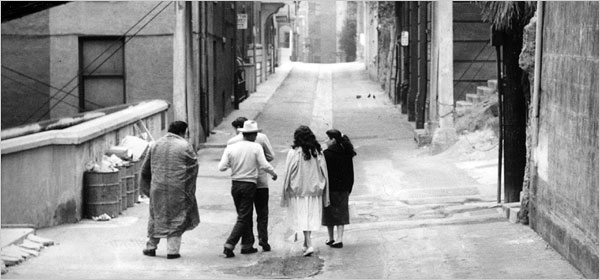
The Exiles follows a Native American husband and wife, Homer (the Hualapi Homer Nish) and Yvonne (the Apache Yvonne Williams), as they separately navigate an aimless night in the Bunker Hill area of Los Angeles. Having left the reservation for the city, they are slowly adapting to their new surroundings. Homer opts for the easy camaraderie of the Native American immigrant community, rolling from bar to bar with a group of debauched loners, led by the highly strung Tommy (Tommy Reynolds). Yvonne, visibly pregnant and left to her own devices, goes to the cinema to see The Iron Sheriff, and then wanders down the main drag, daydreaming about her uncertain future.

All three actors are non-professionals playing versions of themselves. In 1957, Mackenzie was hanging out in the bars in Bunker Hill, and befriended the three actors. He had already completed a short documentary about the neighborhood entitled Bunker Hill-1956 (about the working class community soon to be displaced by re-development), while a student at USC. Now he was planning another doc based on the re-location of Native Americans to urban areas, inspired by an article in Harper’s Magazine by Dorothy Van de Mark about government attempts to take over Indian land. As the project developed, and he heard Homer, Yvonne, and Tommy’s concerns about the image of Native Americans on film, he invited them to help write the script, do their own narration, and be partners in the production (shooting started in 1958, but due to budget shortages and other delays, was not completed until 1961). His original conception of a straight observational documentary shifted to include the slender narrative of The Exiles, similar to the re-creations of Nanook building an igloo that Robert Flaherty staged in Nanook of the North.  Mackenzie was heavily influenced by Flaherty and the WWII docs of Humphrey Jennings, closely observed, anthropologically minded films that used artifice to heighten reality. Mackenzie and his cinematographers, Erik Daarstad and John Morill, considered it a documentary in that tradition, although today a direct line can be drawn to the films of Lisandro Alonso, who also makes films made in concert with the laborers he constructs slight narratives around.

Filmed in high-contrast black and white, with a layered soundtrack completed entirely in post-production (there are some rough sync issues when it comes to dialogue), it has a dreamlike quality, enhanced by the affect-less tone of the voice-overs.  They are stream-of-consciousness reveries, run-on sentences of modest hopes and stolid resignation. Homer compares the unspooling of time outside of jail to inside, and can’t find much difference. The images that run underneath are distractingly beautiful, tableaux of a cop twirling his nightstick in front of a late night haunt, a cigarette sparking as a Tommy joyrides down a tunnel, and the blazing marquee with Sterling Hayden flashing his six-gun. The actions, however, are banal. Mackenzie, along with his actors and crew, are attempting to capture the imperceptible rhythms of a night on the town. It is clear that the characters are disconnected and adrift, but what drives the movie are the little moments, like Tommy’s assertive flirtatious patter, the slow-burn before a bar fight, and the surprisingly tender manner in which Homer hands one Tommy’s castoffs her coat. Yvonne ends her night with an understanding neighbor, offering comfort and a bed for the introspective, oft-abandoned wife.

I believe Kent Mackenzie is able to sidestep the problematic position of another white filmmaker speaking for Native Americans (and one who  presents characters who could be perceived as stereotypical “drunken Indians” – which Amy Taubin hammers the film for this in her Artforum review) . In closely collaborating with the actors on the final product, it forefronts their voices along with Mackenzie’s, and, as Native author (and one of the film’s presenters) Sherman Alexie argued in the NY Times, “The filmmakers ended up in the position of witness as much as creator.”

It had rarely been seen since its premiere at the Venice Film Festival in 1961, despite good reviews, having only been picked up for the educational market by Pathe Distribution in 1964. A few 16mm prints were struck, and by the 1970s it was only being shown in a few classrooms, all but forgotten. Kent Mackenzie died in 1980, having produced one more feature, Saturday Morningwhich filmed a group of 20 American students as they debated topics of “self and sex”, as the skeptical NY Times review described it.

The UCLA Film & Television Archive and Milestone Films rescued it from obscurity, with an assist from Thom Anderson, whose magisterial film essay Los Angeles Plays Itself, which charts the hidden (and misrepresented) history of the city on celluloiddevoted a portion of its running time to The Exiles and it’s realistic portrayal of the old Bunker Hill neighborhood.  With this minor bit of notoriety, Milestone helped to fund UCLA’s work, and the results are stunning. Jonathan Rosenbaum, in Cinema Scope, says it is “the most gorgeous restoration of an American independent film I’ve ever seen”, and I don’t disagree.

THE WOMAN ON THE BEACH (1947)

April 27, 2010

wotb2

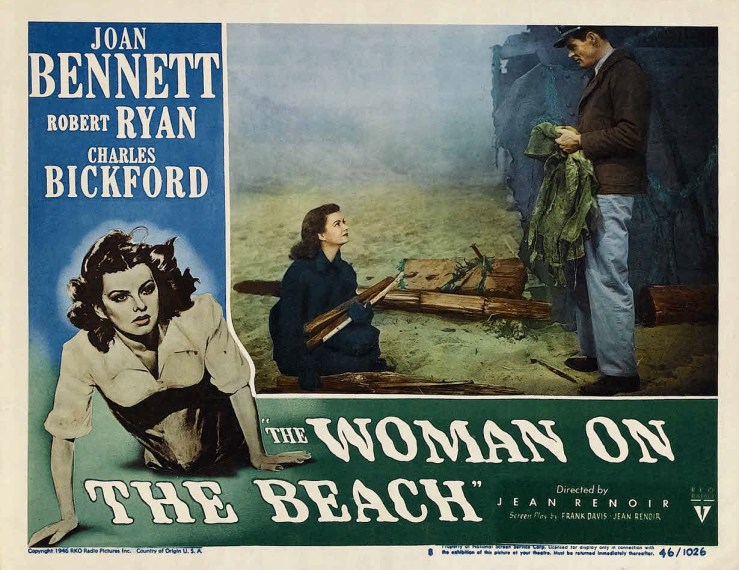
While the TCM Classic Film Festival was wrapping up out in L.A., I was pursuing my own personal Jean Renoir festival back in NYC. The Brooklyn Academy of Music is currently exhibiting a must-see retrospective that will hopefully tour a city near you. My personal highlight of the series so far is The Woman on the Beach, his last production in Hollywood, and by far his strangest, a somnabulist’s vision of a violent love triangle.  Its peculiar, almost abstracted plot was aided by extensive re-shoots after a disastrous preview screening, which trimmed out the exposition, leaving only the trio of lovers’ impulsive, and occasionally inexplicable actions.  Renoir had already pushed the visuals  in an oneiric direction, foggy, emptied-out landscapes of hollowed-out hulls and vertiginous cliffs. He even challenged his sound man to record the dialogue at an unusually low level, to emphasize the characters’ loneliness.

The pared-down result of the studio interference then, actually reinforces Renoir’s stylistic choices, and quite possibly made it a better film. This is exactly what Janet Bergstrom argues in her superb production history: “Oneiric Cinema: The Woman on the Beach”, which she published in the Film History journal in 1999. It is my main source for this post.

The story concerns a shell-shocked Navy vet, Scott (Robert Ryan), whose recurring nightmares of being torpedoed keep him in a constant state of anxiety. Attempting to banish these neuroses, he quickly proposes to his girlfriend Eve (Nan Leslie). After her skittish response, in which she is clearly shaken by his unhinged intensity, Scott begins a flirtation with Peggy Butler (Joan Bennett), who has been scarred by violence in her own manner. During a fight with her husband Tod (Charles Bickford), a painter, she accidently severed his optic nerve, blinding him for life. Bonding over their mutual traumas, they engage in a furtive affair, while Scott still manages a combative friendship with Tod. Ultimately driven to the brink of madness by their insecurities, Scott and Tod come into conflict…

Renoir recognized the strangeness of his conception of this film, describing it as “the sort of avant-garde film which would have found its niche a quarter of a century earlier, between Nosferatu and Caligari.” And emphasizing that its “subject was the opposite of everything I had been working toward in the cinema up to that point.” He went on:

The Woman on the Beach was a perfect theme for treating the drama of isolation. Its simplicity made all kinds of development possible. The actions of the three principal characters were wholly stripped of colourful detai; they took place in empty landscapes and in a perfectly abstract style…In all my previous films I had tried to depict the bonds uniting the individual to his environment…now I was embarked on a study of persons whose sole idea was to close the door on that absolutely concrete phenomenon which we call life.”

Renoir closes this door when he uses a dream sequence to introduce Robert Ryan. He begins as a nightmare. With the strains of “Home on the Range” ironically cooing in the background, Ryan imagines himself on a ship – followed by a massive explosion. He sinks to what looks like the bottom of an aquarium, where Eve is waiting for him in an evening gown with open arms. Right before he embraces her, there is another explosion. His war experiences are explicitly blocking him from a life with Eve, and dooming him to one of apparitions and hallucinations. He is like the character of Cesar from Caligari, motoring through his inexplicable deeds without a will of his own.

So when he begins to obsess that Tod is lying about his blindness, or insist upon a fishing trip in a rainstorm, he is operating solely on his unconscious drives – the neuroses engendered from battle. Peggy is on a similar path, wracked with guilt over stealing her lovers’ sight, and destroying his successful career as a painter. She is filled with hate for herself and with Tod, which can exhibit itself in improbably nurturing ways. As always with Renoir, “everyone has their reasons”, and it’s impossible to pin any of the characters down as the villain. All show flashes of sympathy and rage – Peggy snuggling on the couch with Tod, reminiscing about their youthful days in NYC, or Scott snapping from protective lover to vengeful cuckold. All three actors are fascinating to watch, and Renoir carefully balances their power relations in his fluid compositions [the most explicit is the interior boat shot above, where Scott and Peggy embrace inside while Tod is isolated in a separate plane outside the porthole].

Ryan is earnest and bereft, all-too-aware of his crumbling psyche and his inability to heal it. He has a seaman’s bearing that bends under the weight of the Butler household’s demands. Bickford is prickly and condescending as Tod, a bellowing ironist with an uneasy gait, his vast array of ascots unable to hold back the bile he irresistibly spews, mainly at his wife, who he delights in harming. Bennett is enigmatic and cold, her love of Tod turned to hate, but who still recognizes its original provenance. She shares her husband’s sarcasm and cynicism, but stays in the marriage because of an unshakable nostalgia and loyalty. With her melancholy eyes mixing pity and desperation, she casts the most elusive portrait of the three. Bennet was the one who demanded Renoir direct the film, after producer Val Lewton recommended Jacques Tourneur and Robert Wise, among others. She remained steadfast.

The film was first finished on July 1946, and a preview screening took place on August 2. The reaction was so negative that major revisions took place. The second version of the film was not released until June 8, 1947. Early in the pre-production process, the Production Code Adminstration (PCA) demanded the removal of any explicit reference to a “sex affair between Peggy and Scott and to omit any of the passionate kisses indicated in the present story.” Renoir reluctantly obliged. As Bergstrom notes:

“when ‘human desire’, as Lang would call it in his 1953 remake of La Bete Humaine, could not be acknowledged as the dominant theme, Scott’s neurosis because of his war experiences had to carry much more weight in his abrupt turn from the stability of his life with Eve toward his unsettling, moth-to-the-flame meetings with Peggy and Tod.”

Along with this repression of the sexual theme, Renoir dropped some boilerplate sub-plots that turned Peggy into a generic femme fatale.

Following some re-editing,  RKO solicited suggestions from other directors. John Huston “recommended that the film tell one story and that Scott’s neurosis should be eliminated.” Mark Robson advised “going back to Renoir’s original version because the film as it now exists is too confusing and choppy to make much sense.” Neither suggestion was agreeable to the studio, so RKO hired writer Frank Davis to re-work some scenes, beginning on September 23, 1946. Renoir greeted him with hope: “I have found my ideal collaborator.”

With Davis, a great deal of footage was re-shot. Renoir tells Pierre Lestringuez that it was nearly half the film. Nine years later he told Rivette and Truffaut that it was a third of the film, “essentially the scenes between Joan Bennett and Robert Ryan.” For unknown reasons, they also re-cast the role of Eve, replacing Virginia Huston with Nan Leslie, necessitating re-shoots for all of those scenes as well. It was a laborious and inevitably annoying process, but one with curiously positive results. As Bergstrom writes, and I agree, the film becomes almost Langian in its determinism and sparseness, rare for Renoir, but an appropriate reflection of his alienation from the studio system at this time. What was originally going to be a routine melodrama of sex and death becomes something more mysterious, where a trio of damaged lovers work out their unconscious drives on-screen, turning it into a  bewitching kind of trance film.

The Woman on the Beach is available in a Region 2 DVD from the French company Editions Montparnasse. Glenn Kenny reviews the disc here.

RAINER WERNER FASSBINDER’S WORLD ON A WIRE (1973)

April 20, 2010

40718

A heady piece of sci-fi from German wunderkind Rainer Werner Fassbinder, the long-forgotten World On A Wire (1973) resurfaced at the Museum of Modern Art last week for a short run. Produced for the German national television channel, NDR, it was adapted from the novel SIMULACRON 3, by the American Daniel F. Galouye (which was also the basis for The Thirteenth Floor (1999)). Restored in a shimmering print by The Fassbinder Foundation, it’s a visually kaleidoscopic oddity peppered with the director’s uniquely deadpan sense of humor.

The Institute for Cybernetics and Futurology has initiated the Simulacron project, who are building up an artificial universe on their computers, endowing consciousness to individual “identity units”, programmed by the researchers. It is intended to be used as a predictive device, running simulations about shifts in the economy and society. But when technical director Fred Stiller (Klaus Lowitsch) starts noticing fissures in his own reality, he begins to wonder if he is not an “identity unit” for yet another world above his own.  Or, as Fassbinder himself put it, quoted on the Foundation’s site:

“There is a very beautiful story named World on a Wire. It talks about a world where you can create projections of people with a computer. And this brings about the question to what degree we are all merely projections, because according to this thought model, the projections are equal to reality. Maybe another, larger body has created us as a thought model? We are looking at an old philosophical model that produces a certain horror. With this movie I have attempted to work as perfectly and orderly as possible, using all available technical means.”

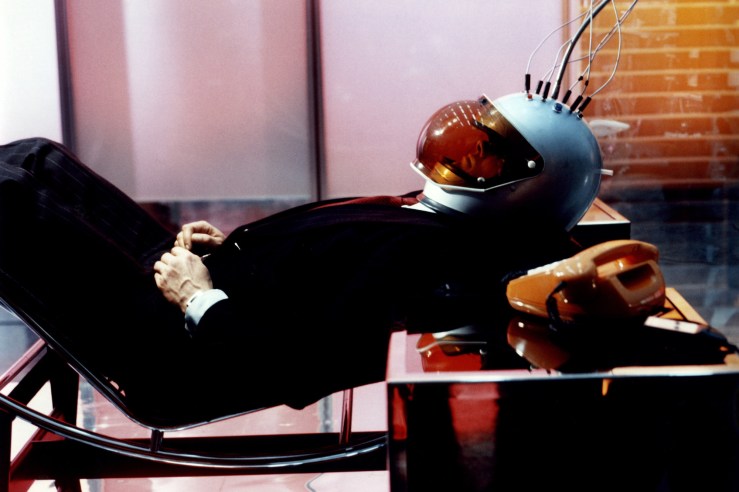
A two-part, 205 minute opus, it has plenty of lag in its stop-start narrative – but Kurt Raab’s set design and Michael Ballhaus’ cinematography makes every shot worth examining like a jeweler. As you can see in the stills, it’s a fantasia of gleaming plastics and endless refractions. Ballhaus has a penchant for placing objects in the extreme foreground with some surreal action in the far background. This shot, seen in the top photo (and to the right), establishes the world as unbalanced and strange. The normal sense of scale is thrown off, confused.

Ballhaus also places mirror-like objects in every possible composition, bisecting the frame into worlds of illusion and reality. Early on, the original technical director, Professor Vollmer, harangues a state official by shoving a hand mirror in his face and asking him what is inside. Vollmer’s mental breakdown is the tremor which sets Stiller’s world on edge.

Fassbinder frames Stiller’s investigation as a kind of existential film noir. Lowitsch is a squat fireplug of an actor, very brute and athletic for a high profile scientist. Fassbinder loves playing with and honoring genre, and Stiller’s insolent personality and blunt humor recalls both Bogart and the American animals of Sam Fuller. Vollmer’s mysterious daughter Eva (Mascha Robben) takes on the role of femme fatale, with nods to Marlene Dietrich. In a nightclub sequence early on, a Dietrich impersonator lip-synchs to “Boys in the Back Room” before re-enacting the finale to Dishonored (checking her lipstick on a saber before falling to the firing squad). Robben’s veils and breathly line readings are other oblique references to the Berlin-born star.

There’s an air of burlesque to the whole enterprise, with Fassbinder’s usual array of intense grotesques, highlighted by the scrunched mien of Gottfried John as the only “identity unit” aware of his origins. There are also cameos from Ingrid Caven as a stylish newspaper girl, recently deceased director Werner Schroeter as a callow lad at a bar, and Eddie Constantine (Alphaville), as a flummoxed gent who picks up a hitchhiking Stiller. These bits of self-reflexive japery, along with some surreal comic sequences, give the film a wild, lurching tone. At its core it’s still hard sci-fi, tackling questions of alternate worlds and the ultimate meaning of consciousness, but it’s done in the rambunctious, conglomerate style of Fassbinder – who tosses in everything he loves. His favorite friends, colleagues, genres and faces congeal into a carnivalesque vision of computerized mania.

It anticipates the alternate-world philosophical noodlings of The Matrix by 25 years, and, as J. Hoberman notes in his review, is an avatar of Avatar, as Stiller is able to enter Simulacron by putting on the helmet seen a few paragraphs above. The film’s run at MoMA ended yesterday, and it’s currently only available on a German DVD without English subtitles, but the Foundation’s website says they are “presently negotiating with our partner Criterion in the USA.” So hopefully within a year or two this forgotten curiosity will have an extended, idiosyncratic life of its own in the United States.

DIGGING INTO THE WARNER ARCHIVE: THE LAST FLIGHT (1931)

April 13, 2020

Screen Shot 2020-01-21 at 5.02.13 PM

To celebrate their one-year anniversary, the Warner Archive held a decent sale last month, netting five discs for $55. One of the titles I snapped up is The Last Flight,  William Dieterle’s 1931 film about disillusioned WWI fly-boys on a European bender.  French director and critic Nicolas Saada called it “possibly one of the greatest films ever made” over at Dave Kehr’s site, while filmmaker and blogger David Cairns posted an enthusiastic review at his Shadowplay journal. Along with a hearty endorsement from a friend who’s a Richard Barthelmess buff, I had high expectations for this rather unknown early talkie.

The Last Flight was Dieterle’s first Hollywood production, after a varied career in Germany, which was highlighted early on in his stint with Max Reinhardt’s theatrical troupe, starting in 1919. He switched to film in ’23, and later co-directed Reinhardt’s silver-screen adaptation of A Midsummer Night’s Dream (1935). His varied resume from this period includes directing and acting alongside Marlene Dietrich in Man By the Roadside (1923), performing in F.W. Murnau’s Faust (1926), and starting up his own production company with his wife Charlotte Hagenbruch (for whom he made Sex in Chains (1928)).

He made the leap to Hollywood by directing German versions of American films. He spoke to Tom Flinn about this period:

I was hired to make synchronizations. Sound had just come in, and Hollywood was afraid of losing foreign markets. So they hired German, French and Spanish units to make foreign versions of important features…. The four films we were to make had already been completed. All the sets were still standing and dressed – we used the same costumes and everything. The big difference was that we had just ten days to make each picture.

His work on these foreign-language quickies must have impressed the suits at Warner Bros., because he was soon hired on to direct The Last Flight, which John Monk Saunders adapted into a screenplay from his own novel, Single Lady (1931) (Moira Finnie wrote a detailed history of the writer’s life and career here). Saunders had already won an Oscar for Howard Hawks’ The Dawn Patrol (1930), and had provided the stories to Best Picture winner Wings (1927, William Wellman) and critical favorite The Docks of New York (1928, Josef von Sternberg).  A fellow-traveler with the Lost Generation despite living in the U.S., Saunders was broken-hearted over spending WWI as a flight instructor in Florida, and his ex-wife Fay Wray described him as someone “who wanted to live dangerously and die young.”  He acted out his untapped aggressions on the page, and The Last Flight is heavily influenced by Hemingway’s The Sun Also Rises – it’s a boozy portrait of post-war disillusionment and decadence.  Instilled with a snarky, slangy, and deflective dialogue, the tremors of violence in The Last Flight are repressed under layers of protective irony.

This was a challenging, rather prestigious debut for the German emigre to take on, but Dieterle succeeds skillfully. Instead of anchoring Saunders’s script with heavy symbolism, he glides along the surface just like the characters, employing rapid-fire montages, agile tracking-shots, and close-ups as punctuation. Every other shot seems to be an exclamation, punchy and precise. The way they order martinis is accompanied by a smooth track to the left, each man’s intonation rising in a barbershop quartet of mockery. After finding out a dame’s name, Dieterle repeats the shot from a more frontal angle, and he glides left as they repeat her name, with the same mocking tone. This establishes their unity as a comedic team, and sets the template for their deconstructive use of language. Every word has a double-meaning, twisted into a sarcastic punchline. This glossy, fast-paced style allows the fliers’ grim reality to creep in through the corners. Dieterle doesn’t find a way to leaven some of Saunders’ clunkier metaphors – like their army doctor’s intoning about how they are “spent bullets” – but this draggy thematic exposition is the exception rather than the rule.

The story revolves around four friends from the Air Force, recently discharged after suffering physical and mental trauma in WWI. Richard Barthelmess plays Cary Lockwood, the informal leader of the trio, a tremulous and reckless pilot who burned up his hands upon a crash landing, who would die rather than accept pity from a stranger. Then there’s Shep Lambert (David Manners), whose gift from the war is a twitching eye, which he can only combat by constantly getting drunk (asked what his plans are, he says, “Get tight.” After that? “Stay tight.”) Bill Talbot (Johnny Mack Brown) runs on adrenaline, constantly proving his masculinity on the new battlefield of the city, tackling horses and then meeting his final fate in a bullfight. Lastly there’s Francis (Elliott Nugent), a meek wallflower type who’s tasked to babysit some turtles. He only comes alive with a gun in his hand.

They form a circle around Nikki (Helen Chandler), a flighty socialite who speaks in nonsense rhymes that hide a spiky intelligence, or, as Lockwood describes her, “the kind of girl who sits down on phonograph records.” Chandler is a revelation here, ditzy and distant, chin pointed up as she floats around rooms in a dream-like state of childish denial and innocence. She’s introduced as a woman apart, standing alone with a cup of tea, oblivious to the tuxedoed airmen staring at her from across the room. But what Chambers eventually makes clear through her coded speech and slow-motion gestures is that her distance is a choice, and a kind of defense mechanism. Her words keep the humorously wooing men at a distance:  “anyone kisses me too hard…it’ll split my lip.” Chambers is radiant and inscrutable, as hard-hearted as the men but seemingly more wise.

The whole setup feels like a Howard Hawks film – what with the group of professional-minded men struggling with their self-respect while jousting with an independent-minded woman – and it even acts as a kind of prequel to the more loving fly-boys in Only Angels Have Wings (1939), where Barthelmess plays another disgraced flier clumsily groping for redemption. But unlike in Hawks, there is very little hope for the survival of the group. These are, as Saunders sometimes over-emphasizes, broken men, with little hope of re-integrating into society. They drink and drink until they crack-up, camaraderie the only thing keeping them alive.

FESTIVAL SEASON: OUR BELOVED MONTH OF AUGUST (2008)

April 6, 2010

5279575.0

The inaugural TCM Classic Film Festival kicks off on April 22nd, and there’s going to be wall-to-wall coverage here once it begins. Jeff Stafford has already posted a wide-ranging, must-read interview with Norman Lloyd, who’ll be introducing Saboteur on the 25th. But like the Cannes Film Festival a few weeks later (May 12 – 23), I’ll be unable to attend, marooned as I am on the East Coast. But I’ll be checking back here at Movie Morlocks for reports on the TCM-fest, and there will be an endless array of outlets covering Cannes. But what about seeing the films, the vast majority of which won’t receive stateside distribution?

The on-line cinematheque The Auteurs has come through for me on at least one title on my list, with an assist by Stella Artois. They’re streaming nine former Cannes selections for free thanks to that mediocre Belgian beer sponsor. These include Our Beloved Month of August (2008)a Portuguese experiment highly regarded by  Cinema Scope’s Mark Peranson and Robert Koehler, Jonathan Romney of Sight & Sound, and filmmaker C.W. Winter (The Anchorage, which I wrote about recently), who placed it on his best-of-the-decade list. It was never picked up for the U.S., and I was ecstatic to find it offered along with a group of higher-profile past Cannes selections including L’Avventura, Mon Oncle, and Amarcord.  The kind of curatorial adventurousness that led to August being included among this canonical group is sorely needed in programming these days, and The Auteurs should be praised (once again), for loosing this strange beast upon American eyes.

Miguel Gomes had an idea for a movie. It was to be an atmospheric melodrama about a small-town girl and her fraught relationships with her guitar-playing cousin and over-protective father. As Gomes tells Peranson, the funding dried up when their money-man died before signing the authorization to release the cash. With a crew already assembled, Gomes began filming the people and rituals of Arganil instead, the municipality in central Portugal in which he was to set his movie. He documents karaoke performances in central squares, father-son accordion duos in underground bars, the history of a local newspaper, and the perils of Paulo, the local drunk legend whose outrageous fictions permeate the rest of the stories. Paulo (pictured at the head of the post), is an inveterate liar, or in other words a storyteller, and Gomes records his exploits as recounted by a variety of locals before getting the embroidered tales from the man himself (they involve beatings from Moroccans, blackouts, and bridge jumping).

Gomes interweaves the checkered production history of his film in the midst of these slices of life. He frames himself as a deadpan morose type, spouting one word answers to his angsty producer Joaquim Carvalho when asked why he hasn’t found any actors (he’s looking for “people”). Or else he’s playing a horseshoe-like game called “quoits” and ignoring the two girls trying to nab his attention for a part in his film. These sections are entirely staged by Gomes, while in the Arganil portraits, as Peranson notes, the actors are making their own mise-en-scene. In the documentary portions, they are leading Gomes, while in the self-reflexive “production” scenes, Gomes is leading the actors. He is simply placing everything in the frame – from the chance conversations of a bickering couple to the equipment Gomes is using to record that scene. He tells Peranson:

The film is a clash between cinema with this part of the country, so us and everything that was with us should appear. Normally there is behind the camera and in front of the camera, and this time I wanted to put everything in front of the camera, and even what’s in the middle should appear—which is the camera.

Everything placed in front of the camera becomes cinema, whether it is based on reality or in Gomes’ head – each is mediated in its own way, as the case of Paulo makes clear. His “reality” is as melodramatic as the story that follows, as Gomes shifts his film into a narrative mode.

Gomes makes the leap to fiction when some of the villagers start acting out his original screenplay. A local girl who was a lookout for forest fires becomes Tania, a teenaged vocalist. Joaquim Carvalho, already seen as the film’s producer, becomes Tania’s father, a keyboardist. Fabio, profiled as a star athlete on the local hockey team who dabbles on the guitar, becomes Helder, Tania’s cousin and new guitarist for Estrelas do Alva, a traveling band. They play the lovelorn pop songs we’ve seen from the karaoke scenes, but now in service to a plot, and their lyrics soon gain resonance as the character relationship deepen and fracture.

Fabio and Tania slowly fall in love, while the father’s protectiveness starts to seem more than fatherly… This incestuous trio becomes a metaphor for the stifling nature of Tania’s small town life, but also for the intense intimacy engendered by the creative process. Estrelas do Alva could also be read as a stand-in for Gomes’ own film crew, stranded, like Tania and her family, in Arganil and prodded to make art without much financial backing. While the tempo is slow (the movie runs to two and a half hours), it is necessary to tease out the rhymings between the two sections of the film, and to build the fabric of their “real” and “fictional” lives.

What at first seems like a laid-back travelogue turns out to be a finely structured piece of modernist cinema, jauntily self-reflexive while humorously obliterating the distinction between fiction and documentary. It’s hard to describe how a movie can be so relaxed and yet so thematically rich. It teases structural puzzles that are never resolved, like Rivette, and yet render the simple beauties of pop songs with an earnestness out of MGM Musicals. It’s frankly unlike anything I’ve ever seen, and while Robert Koehler rightly groups it with his “cinema of in-betweenness” of Lisandro Alonso, Uruphong Rakasad, Ilisa Barbash and Lucien Castaing-Taylor, et.al., there is a undefinable generosity here that separates August from the works of those equally demanding (and essential) filmmakers.  It is warm, teasing, intellectual, and filled with pathos. An absolute original and an easy (and free!) way of jumping into the vanguard of international cinema.

THE MEDIA HISTORY DIGITAL LIBRARY

March 30, 2010

Screen Shot 2020-01-21 at 1.03.48 PM

A massive, invaluable resource has just dropped from the internet heavens. The historian and curator David Pierce (once head of the BFI’s National Film and Television Archive) is spearheading the Media History Digital Library project. It is a privately funded effort to digitize 300,000 journal pages, including volumes of Moving Picture World and Photoplay, all to be made available for free. These scans are slowly being uploaded to the Internet Archive, where multiple volumes are available for perusal and download. There are revelations, curiosities, and surprises on every page of these glossies and trade journals, currently ranging from 1916 – 1930. I’ve been delving into their pages for a few days now, and below are some of the more intriguing nuggets I dug up.

The earliest issues are of the MOVING PICTURE WORLD, from April to June of 1913. It’s a trade publication for exhibitors, filled with studio ads for films, news from around the country, reviews, advertising notes, and the latest in projection technology. It’s a publication for insiders, so there’s a wealth of unmediated information here, including complaints about censorship, meddling clergymen, and the scourge of in-theater advertising. In the front of the issue there’s a “Facts and Comments” section, a grab-bag of incensed opinion and human interest stories. April 5, 1913:

Aldermanic statesmanship has put forth another effort to “regulate” motion pictures in the city of New York. It is proposed to create a local board of censor ship consisting of representatives of various civic and religious bodies. This is a good exhibition of that ancient pastime known as “whipping the devil around the stump.” It stands to reason that the Board of Aldermen has no legal authority to create such a board. If, as Mayor Gaynor clearly pointed out in his recent veto, the Aldermen have no authority whatever to establish censorship of any kind, this new ordinance is practically a still-born child.

It is said that there are two influences behind all this hostility to the motion picture, one is supposed to be the vaudeville and theatrical interests and the other influence is believed to be Canon Chase of Brooklyn. It is easy to understand the opposition of the vaudeville and theatrical interests, but the antagonism of the clergyman is beyond our powers of comprehension.

…the motion picture is thoroughly amenable to public sentiment and that official censorship of any kind is not needed, even if it were legally possible.

Later in the issue, they held a combative interview with John Collier, then the General Secretary of the National Board of Censorship, asking, “What arguments can you give me to show that the work of the Censor Board is adequate?” On April 19th, they rail against Pittsburgh ministers who protested against a Sunday screening to raise money for charity, calling their complaints the “ravings of these antediluvian fanatics.”

With their business interests at stake, the censors are the repeated targets of the exhibitors’ ire, a situation that changed once the power of how the films were presented shifted from their hand to the studios.

On a lighter note, the April 19th “Facts and Comments” applauds “The telephone girls of Boston [who] have protested through the press against being shown in motion pictures in the act of constantly chewing gum.” The MPW editors bemoan “the cheap sort of wit to which they are subjected”, and go on to celebrate the “Acts of heroism in times of distress and emergency often credited to telephone girls.” The MPW has a heart.

Currently the Library contains far more Photoplay, ranging from 1925 – 1930. It’s a gossipy fan magazine with glossy head shots of the stars and puff-pieces about their fashion advice and hardscrabble upbringing. It’s a rather agreeable kind of tabloid that was targeted at women, as the reams of face cream ads attests. But they reviewed movies both highbrow and low, including a pocket appreciation of F.W. Murnau’s FAUST in the Jan. 1927 issue, calling it “one of the really fine things of the screen”, and noting its similarity to D.W. Griffith’s “Sorrows of Satan”.

Photoplay is most valuable, though, for its coverage of the star system, which was “on its deathbed” in 1930 according to a bit of hyperbole. It’s easy to chart an actor’s popularity by their treatment in the mag. For example, in July, 1930, Marlene Dietrich was given space for a head shot and a brief paragraph (below, click to enlarge), which stated:

“Two portraits of quite a batch of ladies. The girl on the left is a lot like the late lamented Jeanne Eagels, about the nose and brow, and there’s a hint of Phyllis Haver. The lady on the right is very much Garbo. Both are Marlene Dietrich, new Paramount player from Germany. Now if she can act like her features…

Then, in December 1930 (below), the publicists unleashed the buzz close to the release of Morocco, and Photoplay published a long (for them) article entitled: “She Threatens Garbo’s Throne”. What a difference a few months and the efforts of the Paramount marketing team make.

There are innumerable other arcs that can be traced in the pages contained therein. One of them is the shift to talkies, which Photoplay devoted most of an issue to in July of 1929, with an expose on the “Truth About Voice Doubling”, where they profile and unveil the voice actors behind stars like Paul Lukas and Richard Barthelmess. They also mine the slapstick like travails of early recording in the piece “Trials of the Talkies”:

“Now kisses are faked, for real ones sound like a horse pulling his hoofs out of a muddy road.”

THE PROWLER (1951) AND THE UNREALITY OF THE AMERICAN DREAM

March 23, 2010

the-prowler

The Prowler was made by disillusioned men. Director Joseph Losey, screenwriter Dalton Trumbo, and visual consultant John Hubley were all eventually blacklisted by the House Un-American Activities Committee. Trumbo was already tarred, so his writing credit was given solely to Hugo Butler – while Losey and Hubley were pushed out of Hollywood soon afterward (Losey made one more film, The Big Night, before moving to Europe, while Hubley turned to uncredited work in commercials). Every major American institution is treated with a disdainful eye in The Prowler, a despairing document reflecting the state of the political Left in 1951, making it one of the bleakest film noirs ever made. James Naremore quotes Losey in describing the Hollywood liberal that year:

The Left in Hollywood was utterly demoralized by Truman, the atomic bomb, and the HUAC investigations, and it was beginning to recognize “the complete unreality of the American dream”.

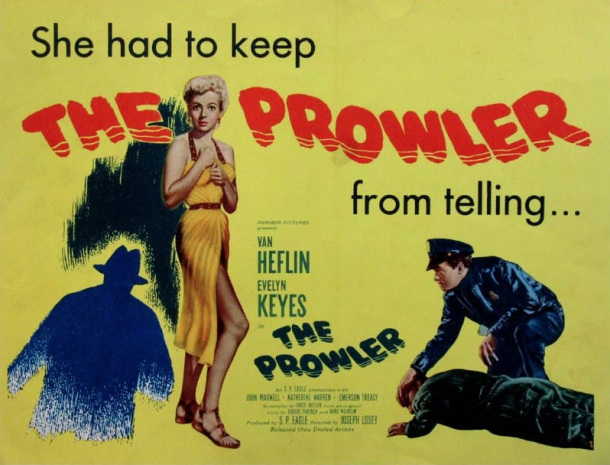
The protagonists of this sleazy little drama are Webb Gardner (Van Heflin), an oafish cop fueled by class resentment, and Susan Gilvray (Evelyn Keyes), a plasticine blonde bored with her milquetoast husband. Or, as Manny Farber described them, “an amoral rookie cop” and a “hot, dumb, average American babe.” Either way, they were born to torment each other. In the opening shot, Susan stares off camera, shrieks, and pulls down the shades. There’s a prowler outside, and we’re out there with him. After this self-reflexive jape, literally putting us in the shoes of a voyeur and jokingly incriminating the whole movie-going enterprise, Losey pulls back to the larger narrative.

Susan calls the police to investigate the prowler, and Webb arrives along with his folksy, contented middle-class partner, Bud (John Maxwell). Sweeping the grounds outside, Webb circles around to the window in her bathroom. In a reversal of the opening shot, the camera is placed inside the window looking out, and Van Heflin takes our offending place where the peeper was first spotted. It establishes his perversity – he’s got a smarmy grin on his face – and re-enforces the possibility of ours. It’s the first of many shots where Webb is shown in transitional spaces – doorways, hallways and windows. The problem is that he always gets closer.

When he returns later that evening, she allows him in her living room, which the script described as “comfortably and tastefully furnished in Barker Brothers’ more expensive style of four years ago. There are overstuffed chairs and a couch; two bad landscapes on the wall” (quoted in “Un-American” Hollywood by Frank Krutnik).

Susan lives in one of the knockoff Spanish Haciendas favored by the upper middle classes in L.A. following WWII. The design is bland, second-hand, and forgettable. In a sly bit of set design, Diego Rivera’s The Flower Carrier [left] hangs over her dining room table, an artwork depicting labor exploitation tamed and turned by middle class apathy into mute wallpaper. Krutnik weaves a whole interpretation around the placement of the painting, which is available to read in his book’s Google preview.

This is the life Webb had been seeking, a life of quiet contentment in a “tastefully furnished” apartment, with a well-dressed blonde at his side. Over coffee, his class resentments come pouring out. He mews that being a cop is no better than a ditch-digger, money being his only bottom line. Susan ignites his jealousies further by revealing how she grew up in Indiana, in the same town as Webb, only she came from a wealthier family on a well-tended street.

It is this revelation that turns Susan into a prize – the ivory tower hidden from him because of his station in life. He becomes aggressive, animal, relentless. Susan resists meekly, than gives herself over entirely. Her own American dream, of raising a family, foundered in her husband’s infertile loins. Reduced to the life of a cloistered housewife, Webb’s meaty pawing feels like freedom. The husband only lives as a voice on the radio, as he’s the host of a popular nighttime music show, and an unwelcome presence during Webb’s ungainly seductions. In a small note of resistance, Losey cast Trumbo as the husband’s voice, his nasal tenor a ghostly presence even before his body gets knocked off in the Double Indemnity– inspired plot.

The Prowler spreads its sarcasm over the entire roll-call of American myths. Marriage, small-town life, the police force, and even capitalism itself are shown as empty, repressive forces. Susan and Webb are driven to each other, and then self-desctruct, all because of their unrequited love of the American dream. They want a perfect middle-class life, and Webb is more than ready to kill for it.

Van Heflin and Evelyn Keyes provide two sterling performances of American indolence and greed. Heflin is especially mesmerizing, his wide-set eyes, gangly limbs, and lasciviously parted lips looking like a grotesque caricature of masculinity. His arms and legs seem to flail out of sequence when he stalks around Susan’s home like an uncaged gorilla, and his apartment is a bubbling cauldron of 50s macho-ness. There’s a target practice sheet on the wall, muscle mags on the desk, and an electronic razor incessantly buzzing around his reddened mug. Then when Susan calls seeking reconciliation for one of their flaps, he strokes the phone’s receiver around the edge of his mouth, his eyes burning with a look of sexual ecstasy. It becomes clear later that he’s been planning a murder. Evelyn Keyes has less to work with. Andrew Sarris describes the dilemma of the actress in a Losey film (thanks to Glenn Kenny for pointing me to this quote in his blog post on The Prowler):

The feminine role in Losey’s world is strictly subordinate because of the histrionic hysteria of his actors. Men simply cannot cope with their lives and social institutions, and they crack up with very lyrical results. Meanwhile the women stand by to pick up the pieces. They cope because of their ability to compromise with reality, an ability Losey frankly admires. Unfortunately, the best roles are the least stable. Hence, Losey’s actresses are usually denied the great scene-stealing moments of psychic dissolution.

This is all true for The Prowler, with Keyes having to swing between lassitude and disconsolate passion – no emotional match for Heflin’s demoniac dissembler. But in her own minor key, she is superb. In her cool apathetic demeanor she delivers lines with a lack of affect, as if her personality had been worn down over time. Her personal desires have been co-opted by those of her society, hence her bizarre decision to hook up with Webb and start a family on the edges of the world they so desperately wish to enter.

By the end they are pushed out of the middle-class suburbs and literally start to disappear. They are forced to go to a ghost town abandoned after a gold rush, where they enact a grim parody of the social roles of husband and wife – she does the dishes, he gets the food – and there’s a baby on the way. This section of the film is heightened both visually and narratively, as the events become more overtly symbolic and hallucinatory. The “door” to their room is a sheet that is beaten down by a raging storm. Webb has no other boundaries to cross, and now he simply wants the world to stay away. But the wind and rain keep busting in, and a simple country doctor brings their whole pathetic existence to a close – climaxing on a long climb up a short hill.