JOHN CARPENTER’S ELVIS (1979)

March 16, 2010

maxresdefault

After completing production on Halloween, which had yet to make him a household name, John Carpenter moved on to direct one of his career curiosities, a massive 3 hour TV bio-pic of Elvis Presley. Produced by Dick Clark two years after the King’s death, it was a prestige project slotted for ratings, Emmys and an overseas theatrical run, not really an item suited to Carpenter’s talents. Up until this point, he had made the no-budget sci-fi comedy Dark Star (1974), the violent siege film Assault on Precinct 13, and the ur-slasher Halloween. All are self-reflexive genre pieces with mordant humor, slow-burn set-pieces, and a good deal of blood.  So how did he land this straight-faced gig? On the rambunctious audio commentary track for Big Trouble in Little China, Carpenter claims that when the suits heard he composed his own score for Halloween, they said, “he knows music, so he should know about Elvis.”

It’s as likely an explanation as any, but whether it was studio idiocy or a canny evaluation of Carpenter’s visual style, it succeeded in pairing him with Kurt Russell for the first time.  One of the most entertaining actor-director duos of the last three decades (Escape From New York, The Thing, Big Trouble in Little China) it’s been near-impossible to see their debut together until Shout Factory! released the DVD last week. Russell was just emerging from his Disney child-star phase, appearing in the Western TV series The Quest(1976) with Tim Matheson along with a few scattered spots on Hawaii Five-O and the immortal tele-film Christmas Miracle in Caulfield, U.S.A (1977).

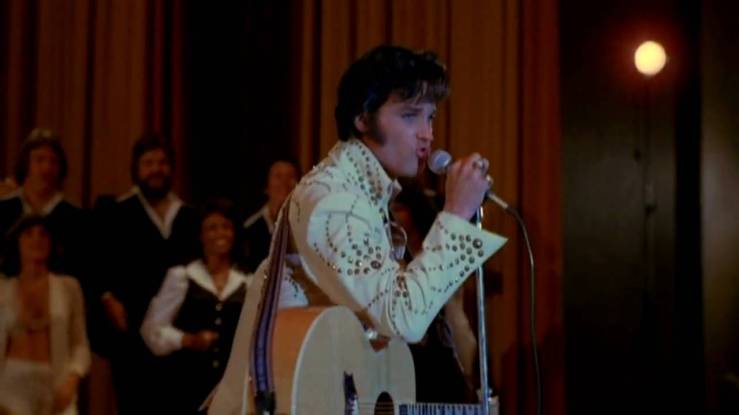
Elvis was his first big break as an adult, and he attacks the easily caricatured part with a feline physicality (his singing voice is dubbed by Ronnie McDowell). There’s little of the parodic machismo that marks his other work with Carpenter, but he nails a fatalistic kind of charisma ideal for the role. Russell’s Elvis is a split personality – absolute freedom on the stage, and morbid self-destructiveness off of it. That his stage gyrations are violent and his self-destructiveness a form of freedom, well, that just speaks to the complexity of the performance.  While the script avoids the seediest aspects of Elvis’ fall (it ends at his Vegas comeback tour in ’69), it is not a simple hagiography, positing his narcissism as the cause for his divorce and a death-wish at the heart of his personality (he frequently talks to his shadow as Jessie, his twin who died at birth). Tony Williams claims this complex portrait as a parallel to Citizen Kane in his essay in The Cinema of John Carpenter anthology. Graceland acts a bit like Xanadu in cutting Elvis off from humanity, and there is a dining room scene that is a nod to the breakfast montage in Kane, but I don’t know how much explanatory power these references hold aside from underlining Carpenter’s grasp of film history.

Carpenter aids Russell’s brooding take on the role with some clever visual patterning that turns Elvis into a man beseiged. It’s set up in Elvis’ first appearance. In a series of slow tracking shots, through an ornate casino floor and down a blood-red hallway, the camera stalks its way up to his shadow. The dark outline of his head fills the room, until there is a pan to the King himself. He’s shown watching a cowboy movie on TV, his hand twitching to the gunfire on-screen. Then there’s a shot of arrows flying straight at the TV camera, and in turn right at Elvis.

The frame erupts with Elvis’ own images of martyrdom – and unable to shake them off, he takes his trigger finger and shoots the screen dead. Not that this helps. Throughout the movie he’ll predict that Lee Harvey Oswald will kill him, and becomes increasingly alienated and alone, shedding his wife Priscilla (Season Hubley), and continually firing and re-hiring his band (including the smiling Ed Begley, Jr. and Joe Mantegna). Within the context of a standard movie bio-pic, Carpenter achieves some impressive effects here, and muddies the tone considerably with the help of DP Donald Morgan (who went on to work on Christine and Starman with Carpenter), for despite the film’s longeurs, it is always darkly handsome. They are able to stretch out on the musical sequences, working the same tension-release pattern that would soon rocket Halloween into the pantheon. Morgan’s camera frames the stage in long shot, tracking slowly back and forth to set the scene, prowling as insistently as Russell.  A select few insert shots are included to ratchet up the cutting speed as Elvis starts his crotch rotations, but the majority is shot from a distance, allowing Russell to command the stage as a complete physical presence. The high production values seem like something of a miracle considering Carpenter’s claim that they filmed the 3-hour behemoth (which included 16 songs, 188 speaking parts, and 150 locations) in 33 days.

With the amount of pages they had to burn through each day, there are inevitably some quality control issues. The childhood scenes are particularly cringe-inducing, with an overwhelmed kid actor  (Randy Gray) over-enunciating cornball dialogue in a studio-clean backwoods shack. It’s a sequence straight out of Walk Hard. But at least Shelley Winters is there as Presley’s Mom, warm and forgiving as ever. She’s given the thankless role as the only woman Elvis ever loved, so she’s saddled with pieties and overburdened with symbolism (Elvis dyes his hair the same color). But she injects a lightness to this creaky role that is a delight to watch, especially during her jumpy little dance when Elvis gets his first song on the radio. It’s a simple gesture that immediately captures the joyful nervousness of the moment.

The film rarely reaches the richness of the opening sequences again, but it’s loaded with great musical performances, a bewilderingly large cast (also including Pat Hingle as Colonel Tom Parker and Bing Russell (Kurt’s Dad) as Elvis’ father Vernon), and a fearless Kurt Russell at its center, tearing through the cliched script with carnivorous intensity.
SHUTTER ISLAND’S ANCESTORS

March 9, 2010

Screen Shot 2020-01-20 at 5.24.08 PM

In the flurry of interviews Martin Scorsese granted running up to the release of Shutter Island, he rattled off a long list of movies he screened for his cast, including Laura, Out of the Past, Cat People, I Walked With a Zombie, and The Seventh Victim. The first two were studied by DiCaprio and Ruffalo to look good in a rumpled suit (thanks to Dana Andrews and Robert Mitchum), while the last three, of course, were churned out by Val Lewton’s miraculous horror unit at RKO, a remarkable run of terror keyed off of the suggestion of violence rather than the blood and guts themselves. But the main wellspring of Scorsese’s recent box-office champ are two later Lewtons, which he also mentions: Isle of the Dead (1945) and Bedlam (1946) [Spoilers abound below].

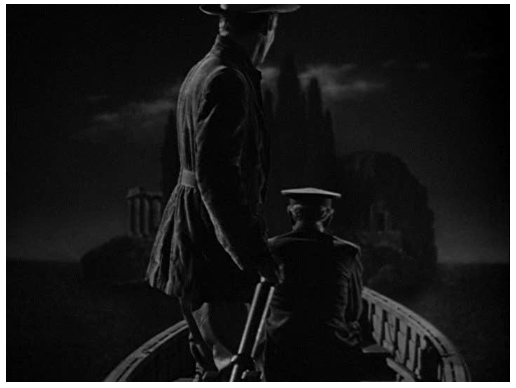
the-isle-of-the-dead-1886.jpg!LargeThe screengrab above is from an early shot of Isle of the Dead, a dead-ringer for Leonardo DiCaprio’s opening journey towards a ghostly island of his own in Shutter Island (the model for both of which is Arnold Böcklin’s series of “Isle of the Dead” paintings, the 1886 version is seen to the left). Greek General Pherides (Boris Karloff) and reporter Oliver Davis (Marc Cramer) row over to a cemetery to lay flowers on the grave of Pherides’ wife. They discover an empty coffin, and stumble upon the bizarre household presided over by Albrecht (Jason Robards, Sr.), an archaeologist who ordered peasants to go grave robbing. Now repentant, he lives on the island and offers shelter for any lonely wanderers. Then one of the guests dies of the plague, and Pherides and Davis are stuck quarantined inside, along with superstitious maid Kyra (Helen Thimig), consumptive wife Mary (Katherine Emery), her young nurse Thea (Ellen Drew) and stuffy husband Aubyn (Alan Napier).
Karloff’s Pherides is a clear influence on DiCaprio’s Det. Teddy Daniels. Both are violent men of authority who are driven to paranoia and madness, linked to romances past. As the days of confinement continue, Pherides falls under the spell of Madame Kyra, who accuses Thea of being a “vorvolaka”, an evil spirit who sucks the life out of her victims. Her evidence is Thea’s employer Mary, who has been slowly dying for years. Karloff’s eyes begin to bug out as Pherides clings to this fantasy as the true solution to their predicament – kill Thea and the “plague” will dissipate. Daniels is also imprisoned, but in an insane asylum, as he attempts to solve the mystery of a missing inmate during a biblical thunderstorm. DiCaprio plays it queasy and sweaty, while Karloff goes for a more operatic insanity, but they are both dangerous obsessives driven to insanity by the horror in their own souls.

Why I think Isle of the Dead is a scarier film, if not necessarily a more coherent one, is a result of Lewton’s visual understatement, with the aid of director Mark Robson and DP Jack MacKenzie. The film contains ultra low-key lighting, and when the supposed “vorvolaka” does appear, in a harrowing sequence of live burial, fleeting tulle garments, and tridents shoved into chests – it’s conveyed through terrifying glimpses.

It’s miraculous the film has the power it does, considering the difficulties during production. Karloff required spinal surgery after eight days of shooting, shutting down the production for months. In the interim, Lewton knocked off the delightful Body Snatcher, and when the shoot picked up again, the script was scrapped and re-made somewhat on the fly. No one on the production was happy with the finished product (future Lewton-ites aside), until perhaps the notices came rolling in, when James Agee called it “one of the best horror movies ever made.” It also affected a young Scorsese, who in an oft-recalled anecdote, remembers running out of the theater as a kid in sheer terror before the end, too scared to continue.

In any case Karloff and Lewton were a good match, as Karloff’s intro to the short story collection Tales of Terror attests:

The mightiest weapon of the terror tale is the power of suggestion – the skill to take the reader by means of that power into an atmosphere where even the incredible seems credible.

That could have been the Lewton team’s motto, and the two were to work again for the last time on Bedlam one year later. This film has an even closer relationship with Shutter Island, as it focuses on torturous treatment in an insane asylum, and the lead character’s incarceration. Lewton modeled the film off of plate 8 of William Hogarth’s series of paintings and engravings, “The Rake’s Progress”, which depicted subject Tom Rakewell’s final degradation at Bethlehem Hospital (aka Bedlam). Almost too slavish to Hogarth’s engraving, Lewton and director Mark Robson dissolve in and out of stills of the artwork before each new sequence, adding a static element to Lewton’s usually sinuous works. It’s a weird film in any context, though, with lead Nell Bowen (Anna Lee) a whitewashed reference to the Restoration England actress (and probable prostitute) Nell Gwyn. In this film, Nell is merely a kind of jester for the rich Lord Mortimer (Billy House), and tags along at the “loony” show George Sims (Karloff) mounts for the Lord’s pleasure. Sims runs the “Bedlam” insane asylum, allowing the inmates to rot in a barnyard atmosphere of scattered hay and the constant threat of death. Nell’s conscience is pricked by the earnest young Quaker Hannay (Richard Fraser), who sees a spark of pity in her.

The closest analogue to Karloff’s sadistic Sims in Shutter Island is probably Max Von Sydow’s malevlolent-seeming Dr. Naehring, who is intimated to have a Nazi past and moves with the same stiff bearing as Karloff’s schemer. The inmate population is the same however, a menagerie of terrifying grotesques, erudite madmen, and flailing arms in dimly lit, humid hallways. While Bedlam’s tone varies rather wildly from Restoration comedy to moralist grandstanding to atmospheric horror, it is never safe – and there are some agelessly wonderful bits, including the loony lawyer inmate who dreams of projecting his flip book onto a screen, only “It’s because of these pictures that I’m here.” That is, the cinema made him to madness. A truth Mr. Scorsese, Val Lewton and myself can certainly relate to.

THE CINEMA IN-BETWEEN: THE ANCHORAGE AND AGRARIAN UTOPIA

March 2, 2010

tumblr_kxbmrjSuxY1qzwof2-820x550

“He [D.W. Griffith] missed a certain beauty he thought had disappeared from film, from the way people saw life — ‘the beauty of the moving wind in the trees, the little movement in a beautiful blowing on the blossoms in the trees. That they have forgotten entirely. . . We have lost beauty.’ On that note, Griffith fell silent.” -Richard Schickel, D.W. GRIFFITH: AN AMERICAN LIFE

Griffith’s deathbed lament has turned into something of a mission statement for a disparate group of filmmakers on the experimental side of documentary practice,  who combine anthropological impulses (recording “the wind in the trees”) with a rigorously constructed visual formalism (regaining its “beauty”), blurring the boundary between fiction and non. The great French avant-gardist Jean-Marie Straub is a main influence, and seems to have popularized the quote, as recounted by director John Gianvito and critic Jonathan Rosenbaum. Griffith’s words have exerted almost as much influence as Straub and late partner Daniele Huillet’s austere long-take style. I’ve never found the original 1947 interview from which Griffith’s words were taken, so any help on this front would be much obliged.

I was led to three of these hybrid films: Sweetgrass (which I discussed here), The Anchorage, and Agrarian Utopia, by Robert Koehler in his Cinema Scope essay, “Agrarian Utopias/Dystopias“.  Here he introduces his concept of a “cinema of in-between-ness”, which is not a movement as much as a tendency, where “a zone of a cinema free of, or perhaps more precisely in between, hardened fact and invented fiction permits all manner of wild possibilities.” Most of these possibilites, he finds, are focused on “subjects about humans working on the surface of the earth.”

The remarkable thing about this trio of films (set in the U.S., Sweden, and Thailand, respectively), is how similar they are in content, focusing as they do on work, and obsolescent work at that. Sweetgrass follows the last sheepherders through the Absaroka-Beartooth mountains in Montana. The Anchorage depicts the self-sufficient life of a mother on the Stockholm Archipelago. Agrarian Utopia presents the life of itinerant farmers in northern Thailand using pre-Industrial Revolution equipment. All three are aesthetically beautiful in differing ways, and use invented scenarios in varying degrees.

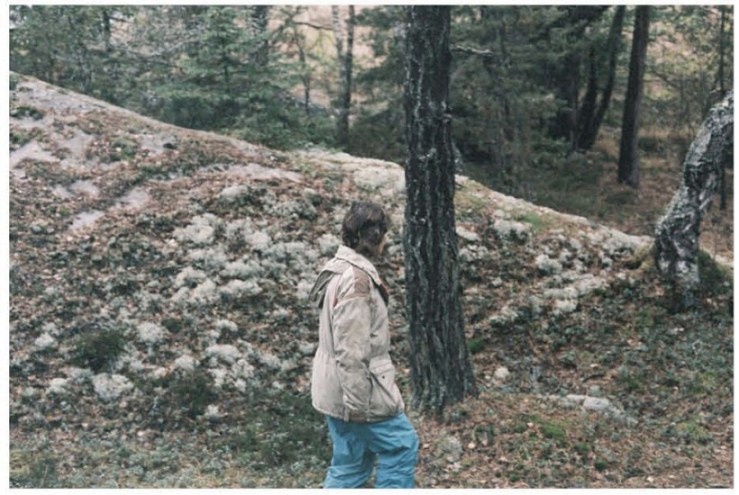
The directors of The Anchorage, C.W. Winter and Anders Edström, paraphrase Griffith’s quote in the promotional material for their film, and perhaps hew closest to its intent.  A hypnotic tour through the Stockholm Archipelago led by Edström’s mother, Ulla, it sets up the slenderest of plots while building a world of exquisite tactility (one caveat: I was only able to watch the film on a lo-res screener. And if any movie demands to be seen in the inky dark of a theater, it is this one. So I’m sure I’m missing some visual grace notes). The camera records Ulla’s routines, her morning swims, afternoon walks, and the wood-cutting and fish-gutting necessities of her existence. It is broken up by a few intrusions. The first is a loving visit from her daughter, Elin, who with her boyfriend Marcus light up her modest cabin with youth. The second is the ominous appearance of a deer hunter, whose presence makes Ulla visibly uneasy, and minute changes in her routines start to occur.

This plot is a construction (Elin, Marcus and the hunter are all played by actors), but Ulla plays herself, and her real home is the set. Then there is the attention the film pays to the light, shadow, and movement of the island, which turns sections of it into a nature documentary. The opening shot exemplifies this hyper-attentiveness. It starts in complete darkness, to a soundtrack of crunchy footfalls and plaintive birdcalls, until patches of moonlight leak through in splotches at the top of the frame. Then a ghostly outline is edged in light until the full figure of Ulla in a rough terry-cloth robe determinedly walks to the water. This sequence lasts over 8 minutes, completely attuned to the “moving wind through the trees” and how Ulla blends in to its flow. The use of Super16mm film produces a rough-hewn graininess to the image, and the colors are pastels leached of vibrancy, anticipating the winter that Ulla is praying to arrive. It’s a workmanlike kind of beauty.

The emphasis is not on Ulla’s goal – getting to the water – but on her presence as a body, and the presence of the foliage around her. It requires a re-orientation as a viewer, away from character arcs and towards a multi-planar focus, where the background holds as much interest as the human moving at its center. This can be a difficult transition to make, but the rewards are stunning.

This is not to take away from the suggestive mystery of the narrative, though, which produces a insinuating sense of unease through a voice-over and the spectre of the yellow-warning suit of a hunter. In her voice-over, Ulla notes the song of the larks, who stay around later into fall every year. Straight away this note introduces something “off” with her surroundings, which will build through her various chores and rests, until the wearing of a bathing-suit becomes indicative of an massive psychological shift, where solitude ineffably shifts into loneliness. It’s a remarkable moment in a film loaded with them.

Where The Anchorage maintains a constant distance from Ulla, Agrarian Utopia uses a more dialectic approach, shifting back and forth from long shots of workers arranged against the ground and sky, the romantic-heroic view of farming, to the close-ups and shot-countershots of the off-hours, when the anxiety of debt and the  theater of Thai political life dominates conversations. The story concerns Duen and Nuek, two itinerant farmers and their families, trying to make a buck as the bank forecloses on every scrap of land they work on. Using archaic methods of farming, including Buffalo-motored plows, it’s a lament for the death of a working community, but unlike Sweetgrass, it’s completely invented – for this way of life is already extinct. Koehler reports that Director Uruphong Raksasad hired locals to play the part of the farmers, and rented the plot for a year from the government just for the shoot.

The son of farmers himself, Raksasad is reconstructing the final days of that working community, a passion play of bent backs, stupefyingly gorgeous landscapes, and past-due loan payments. As in Sweetgrass, Raksasang entwines the beauty of the land with the physical toll of labor and the brutal economic realities of local farming. It’s a constant push-pull of aesthetics and politics, of sunsets and bounced checks. What makes all of this sing is the facility of the performers, the beauty of the Thai landscape, and Raksasad’s sheer ambition – encapsulating the demise of local agriculture and the insanity of the political scene. The populist Thaksin Shinawatra, shrouded with allegations of corruption, was ousted by a military coup in 2006, and Shinawatra has been trying to win a proxy war for power ever since, briefly popping back up in 2008 when his former party won an election. He has since been convicted in absentia for “conflict of interest” and was sentenced to two years in jail.

He’s reportedly popular with the working class, but Raksasad draws a portrait of people sick of political manuevuring and loud empty gestures. He has one worker describe the scene by saying “the opposition and government are making a movie for us to watch.” It is a despairing political portrait that erupts with moments of sublime beauty. After a storm, a giddy hand-held camera races with the local children during a mud fight, careening along with them with joyful intensity, one of the most kinetically thrilling moments I’ve had in a cinema. But then Nuek trudges back to Bangkok, weaving through curse-wielding protestors and condescending party leaders, with the mud and sun and trudgery a distant memory. Now he’s got a factory job.

THE BEST PICTURE NOMINEES FROM 1943: PART 2

February 23, 2010

MV5BZGI0NjBjNjgtZjUxNi00OTgzLThlMjAtMjZmNjE2YzY0YjMxXkEyXkFqcGdeQXVyNjc2OTM5MTU@._V1_

Last week I looked at six of the Best Picture nominees from 1943, the last year the Academy nominated ten films for Best Picture, until they expanded the category once more in 2010. Today I’ll look at the remaining four titles, with James Agee and Manny Farber again providing perspective with their reviews from the period. The idea is to approach these films with fresh eyes, outside of the reputations (or lack of) that have accrued over time.

Madame Curie (1943, directed by Mervyn LeRoy)

Sadly, the production history of this turgid biopic is far more fascinating than the film itself (most of this history comes from Christopher Frayling’s Mad, Bad and Dangerous?: The Scientist in Cinema). After their success with The Story of Louis Pasteur in 1936, Warner Bros. was circling Marie Curie’s story as a follow-up, with the Pasteur combo of director William Dieterle and actress Josephine Hutchinson penciled in for the project. But in 1937, Eve Curie’s biography of her mother was published, and interest in the story skyrocketed. Universal snagged the rights, intending Irene Dunne to star. Unable to produce an agreeable script, Universal sold the rights (along with Show Boat) to MGM in 1938 for $200,000.

MGM found it equally difficult to hammer out a script, taking five years and hiring 18 screenwriters before settling on the pages. Two of those 18 were Aldous Huxley and F. Scott Fitzgerald. The dream version of the movie had Huxley as writer, George Cukor as director, and Greta Garbo as star. Garbo was motivated to play the lead, but Huxley turned in a 145 page draft that was eventually tossed for being too “scientific”, as Tom Dardis quotes in his Some Time in the Sun.

Producers Bernard Hyman and Sidney Franklin then turned to Fitzgerald. His story, according to Frayling, wanted to focus on Madame Curie’s role as a “modern woman”. He expressed his interest to Zelda in a letter:

Madame Curie progresses and it is a relief to be working on something that the censors have nothing against…. The more I read about the woman the more I think about her as one of the most admirable people of our time. I hope we can get a little of that into the story.

Fitzgerald was fired after 18 months of work. The final writing credit was given to Paul Osborn and Paul H. Rameau, who turned in a more conventional script that focused mainly on the love story between Marie and Pierre Curie. Revisions continued right up to filming, and director Albert Lewin was replaced by Mervyn LeRoy soon before the start of production. These years of work produced some tantalizing what-ifs, but the finished product is a rather dire simplification of a remarkable life. The first half of the film finds distinguished scientists Marie Sklodovksa (Greer Garson) and Pierre Curie (Walter Pidgeon) toss moony looks at each other through gauzy lighting, while the second half compresses a lifetime of scientific discovery into a few anxious stares and lots of shouting. Neither section is convincing, aside from the small sections with Robert Walker’s obsequious lab assistant (with whom Marie Curie was rumored to have an affair). Agee is with me: “A smooth, rather horrible romanticization of a subject I am sorry to see romanticized.”

***

The More the Merrier (1943, directed by George Stevens)

A manic, strained, but rather irresistible screwball comedy that makes light of the Washington D.C. housing shortage during WWII. Connie Milligan (an uptight Jean Arthur) rents out a room in her apartment to Benjamin Dingle (a mischievous Charles Coburn), who can’t help but set her up with a strapping special ops soldier, Joe Carter (Joel McCrea), even though she’s engaged to the banal Mr. Pendergast (Richard Gaines). Already treading on Milligan’s last nerve, Dingle rents out half of his room to Carter, creating a full house and many opportunities for face-pulling farce. The scenario is so cute as to be cloying, but the actors have a ball, rendering it an amiable, although far from flawless, laffer from the period. Arthur’s obsessive-compulsive act pinballs off of Coburn’s jaunty ironist to create a crackling tension, while McCrea just looks happy to be there.

Which he wasn’t. In her biography of Stevens, Giant, Marilyn Ann Moss reveals that McCrea wasn’t comfortable at the first cast reherasal. He went so far as to have his agent call up and try to get out of the movie, but he soldiered through, and his easy, engaging demeanor is the perfect counterpoint to to the amped up Coburn-Arthur battle. The film is packed with incident, a pile-on of mistaken identity, misdirection, practical jokes, and general madcappery. There is so much stuff happening that there’s little time to flesh out the characters. They are vessels for the jokes and pratfalls, but never pop out of the story as more than silly names. Dingle is a walking plot device, instigating and solving the movie’s problems with an insouciant twinkle in his eye.

This works as long as the jokes keep hitting, but it’s impossible to sustain that paceand eventually it winds down with a dully romantic clincher lifted from The Awful Truth, and some unbelievable deus-ex-Coburn from the impish old man. Regardless of these problems, Arthur, Coburn, McCrea, and Stevens are often able to make this creaky material sing (look at the lead photo and try not to crack a smile), which is some kind of accomplishment. And as Stevens said: “There was something about the times…you know you might as well have some fun because you might not be around too long.”

Agee: “The film as a whole is a tired souffle, for unfortunately Stevens doesn’t know where to stop. Farce, like melodrama, offers very special chances for accurate observation, but here accuracy is avoided ten times to one in favor of the easy burlesque or the easier idealization which drops the bottom out of farce. Every good moment frazzles or drowns.”

Farber: “This product is like an air conditioner, in that on the hottest day of the year it is better than no conditioner at all. There is a certain foolproof quality about it: each line produces some kind of smile, even if it takes all the smart dialogue writers in Hollywood. …Director Stevens’ troubles always arise in a comedy of this sort where his compassion collides, head-on, with slapstick. This gums the last half of the picture with tendernesses that fall flat, and laughs that break wrong.”

***

The Song of Bernadette(1943, directed by Henry King)

This is all about Jennifer Jones, who passed away last December at the age of 90. The film is not much worth discussing without her. The story of Bernadette Soubiros, the child who saw visions of the Virgin Mary at Lourdes, is told with no particular skill by Henry King. The tension between state and religion is raised and dropped halfway through, and the mix of studio artificiality and location landscape is jarring. For a story about attaining grace through deprivation, there sure is a lot of money present on-screen – in all of the garish sets and artistically muddied poor people. But Jones is defiantly radiant throughout, exuding an ascetic purity through her wide-set, almond eyes that startles with its intensity. Aside from the reliably oily performance by Vincent Price as the imperial prosecutor (his decadence represented by the ever-present hanky touched to his lips), hers is the only convincing performance, the only one to hint at what religious fervor might actually look like. For Agee, she “impossibly combines the waxen circumspections of a convent school with abrupt salients of emotion of which Dostoyevsky himself need not be ashamed.”

Farber, on the other hand, writes a hilariously insightful pan: “The script for this modern religious movie epic is uninspired to the point of tedium, and has been produced as though the entire picture were on trial before the Catholic Church. It is so cautious that near the end the whole production appears to be turning to stone: when people bend they creak, lifetime associates meet and come together with all of the recognition of ambulating sculptures, and they look at each other with paralyzed faces. ” He doesn’t spare Jones either, who he says “has been directed to be retiring to the point of evaporation.”

I think he is devastatingly correct on all counts, except for Jones’ performance. In every other way the film is a grim theme park ride through Lourdes.

***

Watch on the Rhine (1943, Herman Shumlin)

This faithful adaptation of Lillian Hellman’s play is graced by Paul Lukas’ Oscar-winning performance, and is a valuable document of what the stage version must have looked like. But as cinema, it is unremarkable. Part of a wave of anti-Nazi films Warners was releasing in that period, it presents the Muller family, Kurt (Lukas), Sara (Bette Davis), and their three preternaturally intelligent children. Kurt, a German, is a faithful member of the anti-fascist underground, bouncing around Europe in a fruitless attempt to halt the Nazis’ rise. They escape to visit Sara’s mother in Washington, D.C., only to be ensnared by an opportunistic Fascist sympathizer, a Romanian named Teck (the Mercury Theater’s George Coulouris), who’s eager to give up names to the Nazis.

Adapted by Hellman’s lover Dashiell Hammett, and later polished by Hellman herself, it is said to hew very close to the original production. Hellman also brought along the director of the stage version, Herman Shumlin, to helm the film, his first (he would direct one other movie, Confidential Agent, in 1945). The slavish attention paid to the original saps the life out of the movie, consisting of a series of drawing room scenes, shot as if on a proscenium from the earliest days of cinema. Shumlin mainly has his characters stand and deliver their lines, with no dynamic choreography to goose the power relations. There is no visual correlative to the dialogue, rendering it inert. For Farber, the dialogue “has a cold, triple-duty nautre, that doesn’t seem to come out of the people who deliver it, and it is enunciated as to an audience that might not hear in the back rows of the gallery.”

Hellman’s story is an unblinkingly tough one, examining the moral compromises Kurt must make in order to defend his ideals. He diminishes himself for the cause, and his ethics go down with them. Paul Lukas renders this compromise with his trembling hand matching his ever-compassionate eyes. He underplays it all, while still conveying that he’s coming apart at the seams. No one is in doubt at Lukas’ accomplishment here. Agee calls his performance “superlative”, with Farber has a longer piece that praises it as “sufficiently mobile for the screen, and where the mobility, as expressed in pantomime, is always natural and understandable for the character played.”

THE BEST PICTURE NOMINEES FROM 1943

February 16, 2010

Heaven-Can-Wait-1-750x400

The big news at this year’s Oscar ceremony is the expansion of the Best Picture category from five nominees to ten. After the near shutout of THE DARK KNIGHT from major awards in 2009, it’s an effort by the Academy to shoehorn some money makers onto the show to goose ratings. And while the world-devouring AVATAR would have been nominated in a field of one, hits like DISTRICT 9 and THE BLIND SIDE certainly benefited from the change. This is no innovation however – there were ten best picture nominees from 1937 – 1944 (it varied between 3 – 12 before then). They cut it down to five nominations in ’45 for the first national radio telecast on ABC, perhaps to trim a few seconds off the program. Over the next two weeks, I’ll watch all the nominees (except for the out-of-print HUMAN COMEDY), from immortal classics to forgotten curios. It’s an attempt to take the pulse of mainstream film-making of the era with fresh eyes. The list of nominees is after the break.

CASABLANCA (1942), directed by Michael Curtiz [WINNER]

How to approach a film as ingrained in cultural memory as this one? By the time one arrives at a movie-going age, the film has been parodied, copied, and praised into oblivion. It’s impossible to watch free of the encrustations of its reputation, the “greatest” of this or that. But how did people see it upon its original release? I consulted my trusty James Agee and Manny Farber collections for some insight. Agee:

“Apparently Casablanca, which I must say I liked, is working up a rather serious reputation as a fine melodrama. Why? It is obviously an improvement on one of the world’s worst plays, but it is not such an improvement that that is not obvious.”

“Casablanca is still reverently spoken of as (1) fun, (2) a “real movie.” I still think it is the year’s clearest measure of how willingly, faute de mieux, people will deceive themselves.”

Farber:

The “Casablanca” kind of hokum was good in its original context in other movies, but, lifted into “Casablanca” for the sake of its glitter and not incorporated into it, loses its meaning. Thus, Sydney Greenstreet’s velvet gesturing and suave cruelty were vitally necessary to “The Maltese Falcon,”…whereas in this picture he’s not even needed. He’s there merely for Sydney Greenstreet.

“Casablanca” is as ineffectual as a Collier’s short story, but with one thing and another – like Bergman, Veidt, and Humphrey Bogart – it is a pleasure of sorts.

I would recommend reading both reviews in full, but both are measured in their praise and engaging in some amiable push-back against its canonization. Agee’s short blurb goes after some of the clunky dialogue he “snickered at”, while Farber has a longer, in-depth consideration of its faults, while still praising its “political intelligence” and the performances of Bergman (“noble and utterly clear”) and Bogart’s mouth (“which seems to be holding back a mouthful of blood”).

Neither review uses much space on director Michael Curtiz, with Farber slamming his “incapable scissors” and Agee questioning his tracking shots with an esoterically phrased metaphor: “the camera should move for purposes other than those of a nautch-dancer.” “Nautch” is a style of Indian popular dance, so presumably he thinks Curtiz’s camera movements are too showy. I would disagree with both. After watching Warner Bros.’ dazzling new Blu-Ray, the cutting appeared precise and well-paced, while the tracking shots effectively map the various shady nooks of Rick’s Café Américain, where the parade of stellar character actors tilt up their heads.

The devious, doomed performances of this procession often transcend the flimsiness of their roles: Peter Lorre, Sydney Greenstreet, Marcel Dalio, Conrad Veidt, Claude Rains, Dooley Wilson, and S.Z. Sakall imbue their caricatures with flashes of mordant wit, frazzled humor, implicit violence, and a variety of other tones. But there are so many subplots and characters that everything feels rushed – “the picture has more acts than it knows what do with for truth and beauty”, says Farber, and I agree. It slows down for minor diversions (the young couple searching for a visa) while making short shrift of Lorre’s fastidious and fascinating black-market whiz. The political subtext chugs along (isolationist slowly convinced to fight) effectively, and the cumulative impact of so many expressive faces (Bogart and Bergman paramount among them), and Curtiz’s powerful use of close-ups, echo in the memory far longer than its overstuffed narrative.

***

FOR WHOM THE BELL TOLLS (1943), directed by Sam Wood

This film needs no such equivocation. It’s a puffed up, hollowed out bore by any estimation, drained of any hint of politics or emotion. Agee and Farber both take healthy chunks out of its hide. Agee:

If you are not careful, you may easily get the impression that Gary Cooper is simply fighting for the Republican Party in a place where the New Deal has got particularly out of hand.

Farber:

For Whom the Bell Tolls is a failure – perhaps Hollywood’s most exasperating refusal to fulfill any of its obligations.

Interestingly, both writers criticize the Technicolor photography as well, with Agee saying “it still gets fatally in the way of any serious imitation of reality”, and Farber seconding, “I myself find it difficult to take seriously a movie made in technicolor.” I would say this lack of “realism” has more to do with the exaggeratedly “arty” lighting scheme (lots of silhouettes, impossibly angled shadows) and the stodgy compositional sense Sam Wood brings to the table. Everything is group shots cut in to gigantic close-ups. It’s impossible to nail down the geography any given space, and the set-design is bloated, polished, and glaringly artificial. Farber rightly says the rebels’ cave looks more like a cafe. As with all technical innovations, the right artist had to come along to make critics get over Technicolor’s seemingly garish tones (Douglas Sirk, Vicente Minnelli, among others), as Hollywood hopes James Cameron has done with 3D.

***

HEAVEN CAN WAIT (1943), directed by Ernst Lubitsch

My favorite movie of the bunch, and the one that used color “with sensitiveness and wit, I thought, for the first time.” So says Agee. He sees it as an echo of the great films of Lubitsch’s past (he idiosyncratically cites Forbidden Paradise and Three Women), but “not up to his best.” Farber writes a straight pan, attacking what he perceives as its “pictorial sterility” along with the censorship that de-fanged Don Ameche’s wolf in sheep’s clothing. These are two of Farber’s favored polemical points here, but his target is far more subtle than he’s giving credit for. In short – he’s completely wrong.

It’s true that Ameche plays a sensualist, and that none of his conquests are shown on-screen, but the film’s focus is on the uncertain adaptation of these impulses into married life, their attempted domestication into old age. Lubitsch’s short-hand of infidelities (a teenage hangover, a receipt for a bracelet), leave more room to examine the unintended consequences of his actions. The film is a warm, wise, and oft hilarious fable about the push-pull between love and lust, between aging bodies and raging libidos. It’s pulled off with a light touch under a cool palette of blues and grays (Gene Tierney’s dress, the hair at Ameche’s temples), creating a placid surface underneath which Lubitsch works his emotional magic. Ameche is effortless suavity, with a legitimate sparkle in his eye every time he spies Tierney, who exudes a world-weary charm. As they age together, spar together, and fade away together, Lubitsch has created one of the truest portraits of marriage I’ve seen on-screen. It’s a patient, funny, and inordinately wise. Add a blustery Charles Coburn and you get a masterpiece.

***

THE HUMAN COMEDY (1943), directed by Clarence Brown

Out of print, aside from $80 VHS tapes on e-bay. I haven’t seen it, so my words are from TCMDB: “A small-town telegraph boy deals with the strains of growing up during World War II.”

Agee: “The picture is mainly a mess, but as a mixture of typical with atypical failure, and in its rare successes, it interests me more than any other film I have seen for a good while.”

Farber: “If you tried to imagine the most gruesome result of a collaboration between William Saroyan and MGM, to both of whom life tends to be a chocolate soda made out of words, you couldn’t have approached the disaster of ‘The Human Comedy.’

***

IN WHICH WE SERVE (1942), directed by Noel Coward and David Lean

A stirringly effective, and surprisingly downbeat, WWII propaganda film from Noel Coward, it presents a cross-section of British society as seen through the eyes of the crew of a bombed British destroyer. The HMS Torrin is sunk at the Battle of Crete, and as the sailors hang on a lifeboat, a series of flashbacks detail their lives immediately preceding their deployment. It’s an elegant structure that packs a lot of story information in a compressed time frame, ratcheting up tension while presenting thumbnail sketches of the survivors at once. Coward plays the Captain with stone-faced dignity, and the rest of the cast underplays with equal aplomb. Celia Johnson is his long-suffering wife, eyes welling up with tears as she sends him off on yet another tanker, while his crew gets married, argues with mother, and dreams of the future.

It was one of Agee’s best films of 1942 (it opened late in ’42, not made eligible until ’43 for the awards), and Farber was also a huge fan: “There is unusual respect for the ordinariness of people’s behavior; so that they come out stronger, more admirable for being natural.”

***

THE OX-BOW INCIDENT (1943), directed by William Wellman

Unlike with Heaven Can Wait, in The Ox-Bow Incident Farber finds a Hollywood film untainted by censorship. It had its say “without losing a scene, a character or a line of dialogue to the Hays Office, the studio or the box office.” For him, this makes it an unqualified triumph, and a “thrilling experience.” This seems to be the critical consensus of the period, as Agee agrees that it was “remarkably controlled and intelligent”, although he felt that it contained a “stiff over-consciousness” that drained the film of “its own warmth and energy.” In any case, it is clearly one of the most important films of the year.

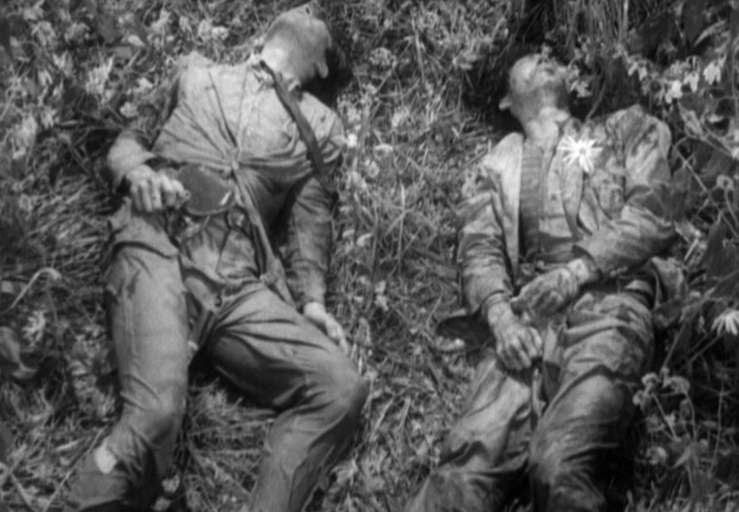
This morality play, about the lynching of three men at The Oxbow, Nevada, in 1885, is surprisingly dark as well as overtly “arty” in its intent. The main stage is an expressionist tinged clearing with a gnarled tree at its center and studio-artificial scrub brush surrounding it. Three men are caught and accused of murder, with a string of circumstantial evidence tying them to the crime. A group of locals band together for a lynching – led by a tyrannical Confederate soldier and a bloodthirsty Jane Darwell (otherwise known as Ma Joad). The liberal faction attempts to stall the slaughter and fails.

Shot by Wellman and cinematographer Arthur Miller in a spare, heavily shadowed, overtly symbolic style that he would push to delirious lengths in the great Track of the Cat, it’s a triumph of mood. The shadows distort the lynchers’ faces into rictuses of fear and terror, as if out of a Kirchner or Munch painting. It is a self-conscious work of art, almost stilted in its artificiality, but the quality of the craftsmanship is high, and Henry Fonda’s wounded gait has carried lesser films.

***

Next week I’ll take a look at the rest of the nominees:

MADAME CURIE (1943), directed by Mervyn LeRoy

THE MORE THE MERRIER (1943), directed by George Stevens

THE SONG OF BERNADETTE (1943), directed by Henry King

WATCH ON THE RHINE (1943), directed by Herman Shumlin

RAOUL WALSH REMAKES HIMSELF

February 9, 2010

raoul walsh

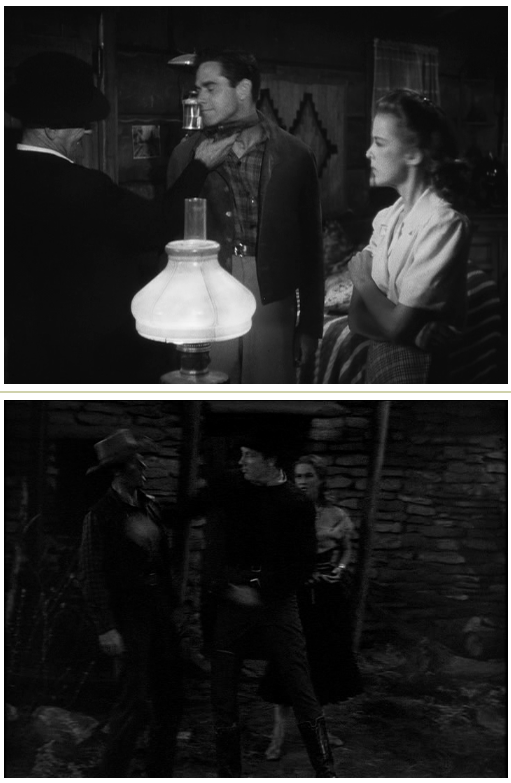
The top image is from High Sierra (1941), of Humphrey Bogart slugging Alan Curtis in the jaw with his pistol. The bottom image is from the same scene in its remake, Colorado Territory (1949), of Joel McCrea knocking out James Mitchell with a meaty right hand. Both films were directed by Raoul Walsh – the first a gangster movie, the second a Western. Historically speaking, High Sierra is more important for its crystallization of the Humphrey Bogart persona: mulish, bitter, doomed. His good-bad guy Roy Earle was originally slated to be played by both Paul Muni and George Raft, until their queasiness with the script paved Bogart’s way to stardom. And so, it receives a fine DVD transfer and continuous play on TV and at repertory theaters.  Colorado Territory has no such claim to history, except as a superior piece of genre filmmaking, so it receives a beat-up, fuzzy transfer in the Warner Archive. So it goes.

It’s fascinating to compare the two films in how they approach narrative, set-design, and performance. Let’s get the basic story out of the way (spoilers!) before I chart some of the divergences: a feared heist-artist gets out of jail, and is hired for one more big job by his aging, sickly boss. On the way to his target, he falls in love with a fresh-faced gamine, who eventually rejects him for a younger guy back home. Taking up with the salty dance-hall girl who loved him all along, he tries to escape with his latest haul, but gets chased into the mountains and gunned down from afar.

The shift in time-period (from contemporary to turn-of-the-century) completely changes Walsh’s visual palette. Most of High Sierra takes place in bland indoor spaces: a cabin hideaway, a grubby motel room, a swank hotel lobby. These are spaces of transit, areas that Earle can abandon at a moment’s notice. The only semi-permanent space is the suburban home where his club-footed teenage crush resides (played with sickly sweet naivete by Joan Leslie), where a rather unendurable stretch of doe-eyed sentiment lands, running completely counter to Bogart’s cynical demeanor in the rest of the film. It is not one of screenwriter John Huston’s finer moments, and drags down the film for me as a whole. The author of the novel, W.R. Burnett (Little Caesar), was brought on for rewrites to satisfy Paul Muni, but I think most of the blame for the clunky structure can be placed on Huston. This section excepted, however, the sets emphasize impermanence, banality, and lassitude, which Bogart slides into with ashen brutality. It’s an incandescent performance, but the film doesn’t hold up around him.

Colorado Territory is the inverse. McCrea is a competent, but much less nuanced performer, so Walsh invests Bogart’s menace in the set design, compresses the storyline to emphasize his athleticism, and opens up the visual space for more propulsive action. He builds around him – and creates a much more complete work of art. McCrea’s Wes McQueen is truly defined by the landscape here, where in High Sierra Bogart is left adrift in a sea of John Huston’s exposition.

The main settings in Colorado Territory are a  decrepit Spanish mission town, a moving train, and a more extended stay in the mountains (shot in and around Gallup, New Mexico). The mission town is abandoned, just a complex latticework of collapsed roofs, beams and crosses (the art direction was by Ted Smith, the set decoration by Fred M. MacLean). It’s a far denser space than Earle’s cabin hideaway, and potently expresses the sense of imminent destruction that High Sierra mainly locates in Bogart’s brilliant broken down mutterings. And where Bogart’s heist takes place in static medium shots for a hotel safe-cracking, McCrea’s occurs in a thrilling moving train takedown – a hurtling sequence that pushes the pace forward through the end of the film. It telescopes Earle/McQueen’s crush on the young girl into a few sparkling scenes (moved along by Dorothy Malone’s more mature, flirtatious performance), introduces a melancholic backstory with a few well-placed lines (the memory of a lover’s face), and emphasizes his physicality with a gruesome bullet-plucking scene. Virginia Mayo rips it out with suspicious skill, a clever way to fill in her previous life with nary a word spoken. Her dance hall gal  is conflicted and fiery throughout, unlike High Sierra’s Ida Lupino, who switches from bad girl to agreeable wife material with one slice of the editor’s guillotine.

Wes McQueen is thoroughly subjugated to the nature around him, a speck on the locomotive at his successful heist and a dot in the valley before he’s gunned down. High Sierra pulls a similar comparison, but with less narrative compression. There are detours into a city park as he moonily stares at the sky, and to his old family farm where he talks catfish with a young boy – excess scenes that exist merely to fill in backstory. In Colorado Territory, Walsh finds a way to squeeze in these details in the midst of the action – making for a spring-loaded, densely told tale, crisply shot by Sid Hickox, who Walsh called “the best and fastest cameraman of them all.” (and who also shot White Heat the same year). Walsh valued speed above all, having directed near 140 films in his astonishingly varied career.

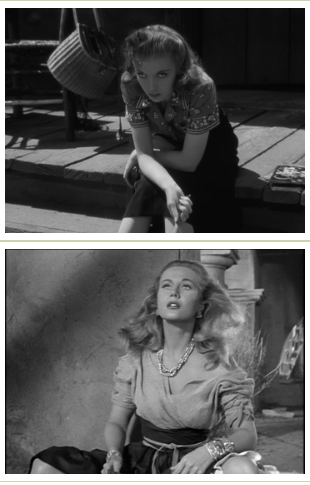
This post has been mainly about contrasts – but I’ll end with similarities. These films were shot 8 years apart, but Walsh uses some of the same setups to remarkable effect. First there is the introduction of the respective dance-hall girls – who are first shown obscured. Ida Lupino is hidden behind a tree, and then Walsh cuts to a shot of her feet before panning up to her suspicious face. Virginia Mayo is also introduced seated, her head down as she musses her hair, before another dramatic head-raiser, eyes blazing.

raoul walsh2

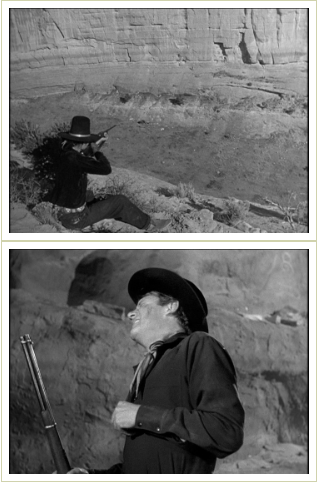
Then there is the final shoot-outs, which are both remarkable for their extreme long shots from the killer’s POV, emphasizing the distance and ease with which the deed is carried out. Their murder is impersonal, enacted by a stranger, almost as if the land was reclaiming them for itself. The top two are from High Sierra, the bottom two are from Colorado Territory:

raoul walsh3raoul walsh4

MY SON JOHN (1952)

February 2, 2010

MYSONJOHNLC5

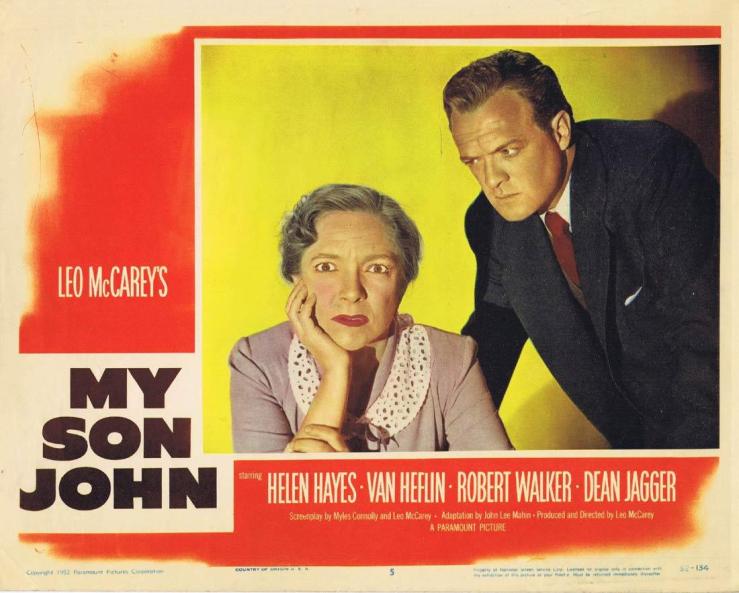
Last Wednesday, TCM presented the first television screening of Leo McCarey’s My Son John in decades. It screened as part of the “Shadows of Russia” series, which tracked Hollywood’s depiction of the country from Tsarist times through Soviet rule. Programmed by the NY Post’s Lou Lumenick and the Self-Styled Siren‘s Farran Smith Nehme, it offered a wonderful chance to catch up with McCarey’s underrated rarity. The reason for its obscurity lies in its politics. Produced during the height of the House Un-American Activities Committee (for which McCarey was a friendly witness), it is strongly anti-communist, and has been dismissed in many corners as mere McCarthy-era hysteria. As Robin Wood wrote in Sexual Politics and Narrative Film, the film is generally presented in a condescending manner: “typically introduced with an apologetic chuckle signifying, ‘Nowadays, of course, we can laugh at this.’” The usually sage Robert Osborne adopted this attitude in his introduction to the telecast, referring to it as an embarrassment, and our own astute Morlock Jeff emphasizes the “hysteria” over its other virtues in his article on the movie.  I have to respectfully disagree with my colleagues.

To reduce the film to a kitschy red scare product ignores the complex dynamics occurring in the family unit. Dean Jagger plays the father, Dan Jefferson, an earnest American Legion member who can’t conceive of a world outside his small-town newspaper. He’s an ingratiating buffoon with a quick temper and a taste for the beer barrel at the Legion hall, likeable enough until he starts singing nativist jingles and tossing his son across the room. He is an intentionally ridiculous character, as McCarey told Peter Bogdanovich in Who The Devil Made It?, as unbending in his conservative beliefs as John is with his communist ones. Personally, McCarey may have gravitated more to the father’s view, but his artistic temperament, which cherished improvisation and spontaneity, would never allow a such a monolithic man to be a hero (hence Renoir’s famous quote that McCarey understood people better than any other Hollywood director). Instead he is thrown through a series of farcical scenes – the song, a drunken rant, an absurd whack of the bible – that display his child-like pettiness and his inability to adapt to the times. His paranoia is proven accurate, but this does not alter the boorish nature of his character. His wife Lucille is the one who uncovers her son’s secret, and is the true dramatic center of the film.

Lucille, played spiritedly by Helen Hayes after a 17 year absence from the screen, is the pragmatic one, calming Dan’s fears, enduring his rages, and attempting to understand John’s point of view. She is patient with her husband but also fiercely independent, evidenced when she secretly dumps the pills he foists on her for her “anxiety”. She coddles him like an impudent pup, with a condescending kind of love. He provides the bombast, but she is in control of the relationship. Hayes’ performance is a bit of a high wire act, managing swings from manic energy to swooning depression with a few broad strokes – her darting eyes and sing-song voice ease the way down to the tragic conclusion. I think she succeeds wonderfully, evincing a rock-ribbed faith in God (in the eyes), paired with a mischievous sense of humor (her staccato laugh).

There is an especially moving scene where John is describing the world’s duty to help raise up the poor, and she finds a connection to Catholicism’s similar tenets to tend to those living in poverty. The joy in her face at this empathetic moment is beautiful and devastating , because she has yet to understand the basic incompatibility of their world views, and hence their imminent separation (and also because of the intensity of McCarey’s close-ups). Her inability to transcend the barrier between these ideologies turns her into the central tragic figure of the film, and is why Dave Kehr calls it McCarey’s most “emotionally demanding movie after Love Affair“. Her capitulation to Dan, when she tells him he was right about their son, is another scene of devious power, with Lucille’s ashen face on a different plane from Dan’s obliging attempts at apology for his drunken antics the night before. It is a drama of generational feuding and familial fissure more than anything else, as Martin Scorsese has also noted.

John is played by the incredible Robert Walker with icy disdain, a callow kind of condescension that college boys convey upon returning home from their first few philosophy classes (I recognized a bit of myself in him). It ended up as his final performance. Walker died near the end of the shoot, necessitating a total rewrite of the final sequences, and some awkward matte work which included some shots from the final carousel sequence in Hitchcock’s Strangers on a Train. It is these final scenes that have marred the reputation of My Son John more than anything else, as John’s dramatic turn away from communism had to be cobbled together out of scraps of old footage and stand-ins, rendering this already difficult arc impossible to pull off. Without an actor to improvise off of, the subtleties of McCarey’s character work fall away, the family drama fades into the background, and McCarey’s staunch anti-communism dominates, turning the last act into more of the straight propaganda film its critcs claim it is. But it still contains echoes of the emotionally wrenching work that came before, in the few shots of Helen Hayes’ eyes.

McCarey claims it could have been his best film if Walker had survived, perhaps an impossible claim with The Awful Truth and Make Way for Tomorrow on his resume, but it lies at the center of his thematic world – at the nexus of personal freedom and familial responsibility that winds through his greatest work. It may not be his best film, but it is an essential one.

AKIRA KUROSAWA AT 100

January 19, 2010

stray dog
Akira Kurosawa is a director I’ve long taken for granted. I’ve never bothered to look much farther beyond the recognized classics: Rashomon, Seven Samurai, Kagemusha, Ran. The latter two floored me with their blood-red blood in my image-besotted youth, but I repressed that enthusiasm to make the usual auteurist arguments – belittling Kurosawa in order to praise Ozu, as if it were a zero-sum game. It’s absurd of course, and because of it I’ve missed out on the minor contours of Kurosawa’s career, the mini-masterpieces, curiosities and salvageable disasters that make auteur criticism worthwhile in the first place. His 100th birthday (on March 23rd) has spurred a series of retrospectives and releases that have finally shamed me into exploring more of his career. Film Forum in NYC is holding a massive retro, and Criterion released a 25-disc box-set, AK 100. I have no more excuses, so I sat down for Stray Dog and The Idiot.

Stray Dog, from 1949, is hot. It’s a meltingly humid summer in Tokyo, and everyone is sweating through their clothes and guarding their electric fans with rabid ferocity. The heat is making people quick-tempered, and then Detective Murakami (Toshiro Mifune) has his gun stolen, a Colt. The rookie cop is desperate to recover it before he’s fired. It’s a perfect set-up to explore the various underbellies of Tokyo as handkerchiefs are applied to perspiring foreheads. The film has been compared to Jules Dassin’s The Naked City in its raw depiction of urban life, but Kurosawa’s technique is far more experimental than Dassin’s social-realist gangster film. In the first ten minutes, Kurosawa uses a quick flashback, whip pans, a voice-over about the godforsaken heat, and a close-up montage of legs getting onto a bus. This low-angle shot of Murakami’s lower half will rhyme with the muddy shoes of a murderer, one of the many linkages Kurosawa provides between the two.

As Murakami lurks through the docks, a seedy nightclub, a ballpark, and a gloomy hotel, he discovers that the perp  has been cutting through civilians with his Colt. And also that both men were robbed of their belongings when they returned home from WWII. They are, essentially, the same person, connected through gun and history. Kurosawa is relentless in pairing the two, embroidering patterns around them until they’re inseparable on-screen. Their final battle is staged in a series of symmetrical framings, with the two collapsing to the ground in unison (see top image). It’s the most successful example of this well-worn trope that I can remember (although Eastwood does a decent job of it in Tightrope).

Paired with the oppressive, impeccably art-desgined atmosphere of pore-choked Tokyo, it’s a remarkable film, frank in its eroticism and its violence. The only influence Kurosawa cops to is Georges Simenon, who he modeled the script after, but the scene on the docks and the nightclub struck me as spaces straight out of a Josef Von Sternberg movie, clogged with smoke, pancaked makeup and decorative netting. These are impassable spaces that one can get lost in. Peek at the shot of the nightclub dancers collapsed in the upstairs room, where legs, arms, and heads no longer connect in an abstracted zone of pure eroticism. This shot could be inserted into The Shanghai Gesture and no one would blink.

Amid all of this, Kurosawa maintains his marvelous sense of pacing and tension, cross-cutting between Murakami’s interrogation of the killer’s girl with his boss’ run-in with the thug himself, connecting the two spaces with an incessant pouring rain and a faint radio melody playing over the phone when the deed occurs. Kurosawa then links this musical piece to the final chase, when the music of a lady practicing her piano pipes in over the frenzied showdown, a sound initially coming from nowhere that calls back to the previous scene – adding an uncanny sense of doom to their tussle. The film is loaded with these kinds of linkages, just charting the uses of flowers, guns, and shoes in the film could fill up a master’s thesis.

After Kurosawa broke people’s minds with the complex flashback structure of Rashomon (1950), he undertook what might be his greatest economic and critical failure, an adaptation of Dostoyevsky’s The Idiot. Having read this recently, I was amazed at how closely he hewed to the book, aside from setting the film in contemporary Hokkaido. His Prince Myshkin is named Komeda, played with slow-footed grace by Masayuki Mori, whose experience in the war has left him an “idiot”, unable to tell a lie and as sensitive as a child. He is taken with a photo of Taeku Nasu (a smoldering Setsuko Hara), a kept woman about to be sold off for marriage. Komeda loves her out of pity, while Akama (the great Toshiro Mifune) lusts after her with a white-hot rage. This is the central triangle that radiates out to affect the major families of Hokkaido, all entranced by Komeda’s inhuman ability to empathize with everyone, that is, his kindness.

The respect Kurosawa has for the material is almost stifling, but the depth of feeling is palpable. He has his actors speak in a slow, halting style, wringing every subtlety out of the phrases, while utilizing symmetrical framings, deep focus, and frequent close-ups to register every minute change in their battles for power. The film has a ritualistic feel, akin to the work of Dreyer – he’s aiming for a religious intensity that can come off as stilted, but for me was riveting. But I should note that close-ups of Setsuko Hara have the same effect on me, regardless of the film. But it’s the most intense film I’ve seen from Kurosawa, the most emotionally committed and his only film that attempts to reach the sublime (that I’ve seen). For that alone, it’s a must see, even if you deem it ridiculous.

SHEEP SHOW: SWEETGRASS

January 12, 2019

sweetgrass

Early yesterday, news broke that Eric Rohmer passed away at the age of 89. Dave Kehr has a fine obituaryup at the NY Times, and I would recommend Michael J. Anderson’s essay on My Night at Maud’s and The Green Ray for an analysis of his styleThe Six Moral Tales will remain his legacy, but I found his swan song, The Romance of Astree and Celadonto be equally extraodinary. Suzi penned a lovely tribute to the recently deceased film critic Robin Wood yesterday, and who else but Eric Rohmer was the publisher of Wood’s first essay (on Psycho) for Cahiers du Cinema. Rohmer’s influence on filmmaking and criticism is incalcuable, and his art will live on as long as we value film as an art form.

Now back to the regularly scheduled sheep programming…

The first quarter viewing calendar I posted last week is off to a rousing start. Sweetgrass opened in NYC after its local premiere at the New York Film Festival, and it’s an overpoweringly tactile experience. Cinema Guild is expanding it to ten more cities through the spring, so check the schedule….now. Lucien Castaing-Taylor and Ilisa Barbash recorded 200 hours of footage of two Norwegian-American sheepherders as they led their flock through Montana’s Absaroka-Beartooth mountains for summer pasture. There are no interviews and the only explanatory text appears at the end of the film before the credits roll. It is a ravishing document of a dying tradition, and one that sets its boots deep in the sheep shit as well as in the rolling plains. This is no romantic gloss of the West, but an immersion in it. Castaing-Taylor and Barbach spent two years filming in and around Big Timber, Montana, which produced a series of short films, but the feature took eight years of editing (and double foot surgery for Lucien after lugging all his equipment over the mountains).

The duo are professors in Visual Anthropology and Sensory Ethnography at Harvard, and their work has previously only been exhibited in art galleriesFrom Sweetgrass, it’s clear that they aim to straddle the boundary between social science and the arts, both documenting culture and reflecting upon it. There are some very artfully composed shots in Sweetgrass, of cowboys framed against the horizon and sheep inching down a mountain in extreme long-shot, that would seem to be outside of an anthropologist’s purview. In a great interview with Cinema Scope, Castaing-Taylor elaborates:

Ambiguity, or any kind of aesthetic opacity that isn’t readily translatable into the limpid clarity of expository prose, is somehow lacking for anthropologists, in their quest for “cultural meaning.”…I’m not desperate for Sweetgrass to be recuperated as a work of visual anthropology, but simply because it doesn’t tell you what it’s about, and because there aren’t that many words in it, doesn’t mean for me mean it isn’t a work of anthropology. It actually feels profoundly so to me, but maybe more a philosophical anthropology.

Castaing-Taylor is working against the grain of his profession to get at the poetry of his subjects’ existence along with the exterior that can be studied. The three subjects under their camera’s microscope here: John, an older, gentle herder; Pat, the hot-headed, younger herder; and a whole mess o’ sheep. Castaing-Taylor had placed between four and eight lavolier microphones on the men and the sheep at all times, and captured some extraordinary footage on his DV camera. Since this was filmed in 2001-2002, the image quality suffers. One often wishes he had the budget for a 35mm setup, but then the remarkable intimacy would be lost. The sound design is often stunning, however, edited by experimental musician Ernst Karel, it’s a cascade of sheep noises – their bleats, honks, skronks, and death rattles.

The only calming sounds in the film, other than the cricket-y silence of nightime, comes from John, a craggy-faced loner who speaks more to the sheep than to Pat. His voice is low and rumbly, and he rarely raises it above a whisper. In  a sequence of great beauty, he urges his “girls” not to stray out of line, repeating the phrase over and over until it sounds like a declaration of love. Filmed against the dusky night sky, it’s a scene of delicate romance.

Then there’s Pat, a younger guy on the verge of a nervous breakdown. Sick of the sleepless nights, whining sheep, bum knee and an injured dog, he calls up his mom and unleashes a torrent of complaints, which he also unleashes on the herd (he calls them “bitches” as opposed to John’s “girls”). But it’s impossible not to be sympathetic to his plight – this is an incredibly exhausting, isolating, and dangerous job. With John only talking to his animals, Pat is alone, unstable, and completely lost.

The ultimate stars, though, aside from the vistas of Montana, are the sheep. The opening shot finds one of these incurious beasts raise its head and stare directly into the camera, daring us to imagine the world within its miniscule brain.

2010: A FIRST QUARTER VIEWING CALENDAR

January 5, 2010

It’s time to stagger into the new year with eyes thrust forward. No more list-making and list-arguing and dwelling on the decade that was. Let us break free from our immediate history and nostalgia’s uncomfortably warm grip to embrace the rambunctious year to come. We’re going to squeeze out its tender juices one month at a time, with a touch too much enthusiasm that will emit a pungent, ripe scent of dreams yet to be dashed. Yes, these are the images I will rush to imbibe in the first quarter (and a bit more) of 2010:

January-ish

A Sixth Part of the World (1926) & The Eleventh Year (1928) (DVD, Edition Filmmuseum)

(DVD, Edition Filmmuseum)

Available now from the Edition Filmmuseum, this damnably seductive looking package contains the films Dziga Vertov made immediately prior to his epochal Man With a Movie Camera. The Filmmuseum describes the first as a “poetic travelogue”, and the second as a “visual symphony.” Michael Nyman provides the score, and bilingual booklets are included. This is an all-region release, and is 29.95 Euros, which is more USD than I can afford. I take donations.

Sweetgrass(Theatrical, Cinema Guild)

I’ve been aching to see this elegiac nature film ever since it premiered at the New York Film Festival. Opening this week in NYC and then slowly rolling out across the country in limited release, it tracks two modern-day cowboys as they drive a herd of sheep through the Montana mountains. Recently it nabbed the cover of my favorite film magazine, Cinema Scope, which has a fascinating interview with the director, Lucien Castaing-Taylor, an assistant professor in Visual and Environmental Studies at Harvard. Cinema Guild is looking like the film distributor of the year. Along with Sweetgrass, they’ve also acquired Jacques Rivette’s superb Around a Small Mountain and critical favorite Everyone Else

***

January 22

Legion (Theatrical, Screen Gems)

Ever since the ridiculously pulpy trailer hit a few months back, I’ve been intoxicated with its possibilities. Visual effects guru Scott Stewart (Iron Man, Sin City), graduates to the director’s chair and opts for total insanity. God deems the human race a lost cause, and sends his angels to destroy the world. Paul Bettany still has love for the flesh, so he swoops in, tears off his wings, and defends the denizens of a roadside bar (including Dennis Quaid and Charles S. Dutton) from annihilation. Somehow flamethrowers are involved.

***

January 26

King Lear (DVD, E1)

Orson Welles performs as Lear for this episode of “Omnibus” broadcast live on CBS in 1953.

***

February 15

British Noir Double Feature: The Slasher & Twilight Women (DVD, VCI)

Ever since Film Forum in NYC held a retrospective of British film noir a few months back, I’ve wanted to dig in further. I know nothing about these two other than this: The Slasher stars Joan Collins and received an IMDB comment of “Risible”. Twilight Women stars Laurence Harvey as a nightclub singer accused of murder. Sounds promising enough for me…

Also on this date:

*Clint Eastwood: 35 Years, 35 Films at Warner Brothers (DVD, Warner Brothers)

*Contempt (Blu-Ray, Lionsgate)

*Lola Montes (Blu-Ray, Criterion)

*Ran (Blu-Ray, Lionsgate)

***

February 19

Shutter Island (Theatrical, Paramount)

Scorsese’s adaptation of Dennis Lehane’s insane asylum ghost story was pushed out of Oscar season into the dumping grounds of February. This looks more like horror movie material than award-bait, which leaps this entry up the list. DiCaprio is a Boston cop investigating the disappearance of an asylum inmate. Then he starts to go crazy himself, presumably, with shades of Shock Corridor. From the trailer it looks like Scorsese is having fun – working with waking hallucinations and impish performances from Max Von Sydow and Ben Kingsley.

***

February 22

A ridiculous booty of home video releases:

*City Girl (Blu-Ray, Masters of Cinema)

*M (Blu-Ray, Masters of Cinema)

*Make Way For Tomorrow (DVD, Criterion)

Note: Make Way for Tomorrow is one of the greatest movies ever made, and its image heads this post.

*There’s Always Tomorrow (DVD, Masters of Cinema)

***

March 12

Greenberg(Theatrical, Focus Features)

Going in blind because of my fondness of Ben Stiller and respect for Noah Baumbach (The Squid and the Whale). It reads like a rote mid-life crisis comedy, but I’ll have some faith in the combined talent here.

***

March 19

Vincere(Theatrical, IFC Films)

My good friend assures me this is a sub par work from Marco Bellocchio, and its melodramatic trappings don’t sound suited to his bitterly sardonic gifts. It’s the story of Ida Dalser, the wife whom Benito Mussolini discarded and ignored. But having thoroughly enjoyed his last three features: The Wedding Director, My Mother’s Smile, and Good Morning, Night, I’m going to have an open mind.

***

March 22 (the day my wallet begs for mercy)

*Bigger Than Life (Blu-Ray, Criterion)

*Days of Heaven (Blu-Ray, Criterion)

***

March 29

*Red Cliff (Blu-Ray [2-Disc International Version], Magnolia)

One of my favorites from last year was released in a truncated version stateside, which cut out over 2 hours of material. Magnolia is releasing the whole behemoth on Blu-Ray, where the scope of Woo’s accomplishment becomes more apparent. Every element is essential to this ancient war epic. You can read my more ponderous thoughts on this film at Moving Image Source.

Letters From Fontainhas: Three Films by Pedro Costa (DVD, Criterion)

One of the most important and divisive filmmakers working in the world finally gets his home video due in the U.S. This includes Ossos (1997), In Vanda’s Room (2000), and Colossal Youth (2006). A trilogy of films where Costa charts the lives of immigrants living in the slums of Fontainhas, near Lisbon. I’ve only seen Colossal Youth, which is a monumental, demanding work. I only saw it on a muddy screener, so I don’t even feel like I’ve truly experienced its languorous rhythms. Anyway, sure to be one of the most important releases of the year.

***

April 5

Piranha (DVD, Shout! Factory)

My Joe Dante education proceeds apace. I continue to think Matinee is a masterpiece.

***

April 16

Piranha 3D (Theatrical, Dimension)

After I receive my Joe Dante education, I can try Alexandre Aja’s (High Tension, The Hills Have Eyes (’06)) take on the material. In 3D. With an out-of-retirement Christopher Lloyd and my new favorite character actor, Adam Scott.

***

April 23

MacGruber (Theatrical, Universal)

In this SNL-derived parody of MacGyver, Val Kilmer plays a villain named Dieter Von Cunth. That’s enough for me. Also, director Jorma Taccone is part of the “Lonely Island” trio that produces all of SNL’s digital shorts, for a long time the only worthwhile part of the show.

***

May 1

Piranha (Blu-RayShout! Factory)

Oh, Shout! Factory, you’re really playing with my emotions here. Wait until May just to watch the Blu-Ray? OK, fine. But I’m seeing the Aja version first.