THE 2014 NEW YORK FILM FESTIVAL: HILL OF FREEDOM AND JAUJA

September 23, 2014

Originally published at Movie Morlocks, the official blog of Turner Classic Movies

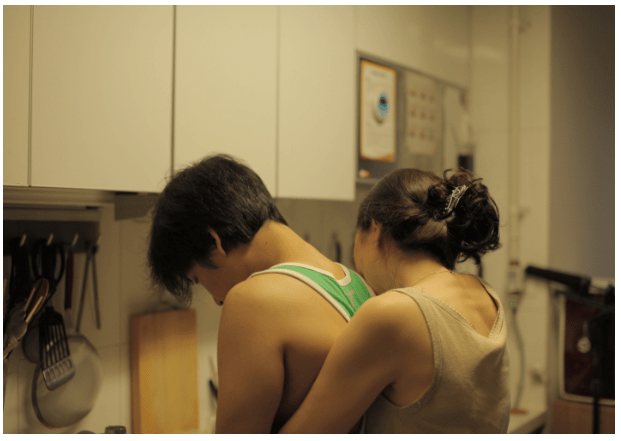
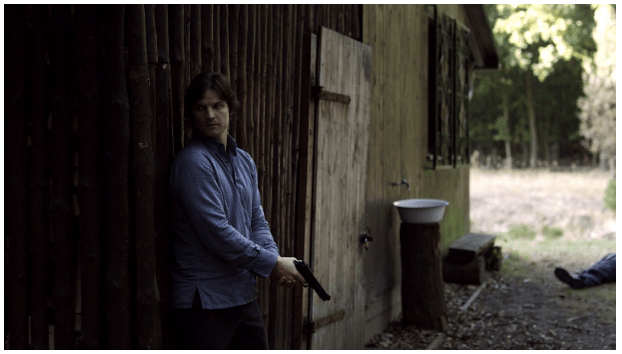
The fifty-second New York Film Festival begins this Friday night with the world premiere of Gone Girl, the David Fincher adaptation of Gillian Flynn’s  ubiquitous spousal murder mystery. But the early highlight of the thirty-film main slate concerns another missing woman, although in a less-outwardly-thrilling scenario. Hong Sang-soo’s Hill of Freedom, which screens the evenings of 9/30 and 10/8, concerns an unemployed Japanese intellectual in Korea, searching for an absent woman he once loved. It’s another variation on Hong’s recent string of films about travellers and transitional spaces (Our SunhiIn Another Country, The Day He Arrives) where drinking is the main form of communication. Hill of Freedom works hilariously well as a fish-out-of-water comedy, but also contains pockets of melancholy about time’s passage, professional failure, and the inadequacy of language. It is currently without a distributor, and unlikely to acquire one, considering how poorly his sparsely distributed output has done stateside.

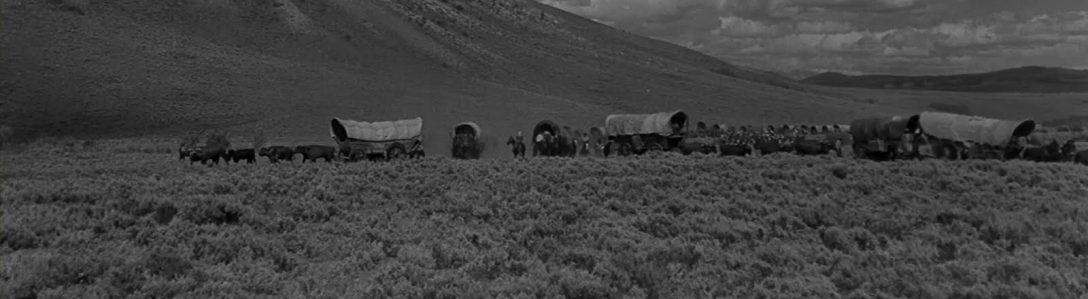
There is another gone girl in Lisandro Alonso’s Jauja (screening 10/7 and 10/9), when the daughter of a colonial Danish military engineer (Viggo Mortensen) scampers off into the Patagonian wilderness. In his three features La Libertad, Los Muertos and Liverpool, Alonso has chosen landscapes first and built narratives around the spaces and the habits of its people. Jauja is his first period piece, and an imaginative leap from the patient everydayness of his previous films. With nods to The Searchers and Heart of Darkness, Jauja follows the engineer as he plunges deeper into a country he doesn’t understand, ending in hallucinations and a legacy of confusion.

Hong Sang-soo has been paring his films down to the essentials. Never one for excess, in recent years his films have limited themselves to a few city streets, a few self-loathing men and women, and a narrative built on repetition. Hill of Freedom constricts itself to couple of blocks in Seoul, mainly taking place at a guest house and at a coffee shop. Mori (Ryo Kase) is a Japanese visitor staying at the guest house, and is searching for Kwon (Seo Young-hwa). Mori met Kwon two years before, but is only now convinced of his love for her. But unbeknownst to Mori, Kwon is off in the mountains for health reasons, so he is forced to mope around town, communicating in limited English with his deep-in-debt guest house buddy Sangwon (Kim Eui-sung) and the profoundly unhappy owner of the coffee shop (named “Hill of Freedom). The story is told in flashback, from letters that Mori wrote to Kwon after his departure from Seoul. As Kwan is leaving the post office, she drops the letters on the stairs, shuffling them out of chronological order. The film proceeds in the order Kwon reads the letters, so they jump back in forth in time during Mori’s stay. The ghost that haunts the film is the one letter Kwan leaves on the staircase – perhaps the one that reveals the truth of Mori’s intentions, but more realistically documents another night of inebriated rambles.

Mori carries a dogeared book with him throughout his visit, which he seems to treat as a sacred text, or maybe more as a binky to calm his nerves. In one of his many awkward, flirtatious conversations with the coffee shop owner Youngsun (Moon So-ri) he informs her that it is a philosophical treatise that claims “time is not a real thing.” But that “at the end, you cannot escape this frame of mind, because our brain evolved this way.” He  believes that time is an illusion, a construct of our consciousness, that perhaps in reality, outside of ourselves, events occur in the shuffled manner of the narrative. It is our brains that constantly seek to arrange them in order. Mori is a failure at this kind of arranging, and at this order. He is an unemployed loner wandering Seoul, his only hope a woman he last saw years ago and who might want nothing to do with him. And in some ways Mori seems to live in his own pocket of pre-Internet time. The settings are clearly contemporary, but no one uses a cell phone, Mori hand writes his letters, and there is nary a computer in sight.

Then there is the film’s blunt use of language. The movie is almost entirely in English, the common ground for Japanese-Korean relations in this film. But this limits their vocabulary, so each conversation is abrupt and direct. Every conversation seems to begin with the question, “Business or pleasure?” Mori hems and haws through each iteration, his visit having possibly to do with neither, ending up as more misery than pleasure. When his guest house manager tells him the banality, “I hope you will enjoy your stay”, Mori cannot respond in kind. Instead, he says, “It’s not always easy to enjoy, except when I am lucky.” The bemused manager replies, “You know, I was just saying that”, implying it was a rhetorical question. But Mori is incapable of deflecting or armoring his meanings with the subtleties of his native languages. He is forced into direct statement, as are his interlocutors. Sangwon insists that Mori admit to being sad. Mori considers people to be “great” or “poison”, with no shades of grey in between. This forced directness creates quick bonds between Mori and Sangwon, who get blitzed and dream of happiness, as well as between Mori and Youngsun, whose attraction seems to be borne out of mutual melancholy. It ends as it has to, in the middle, unresolved, our minds having to put all the broken pieces together.
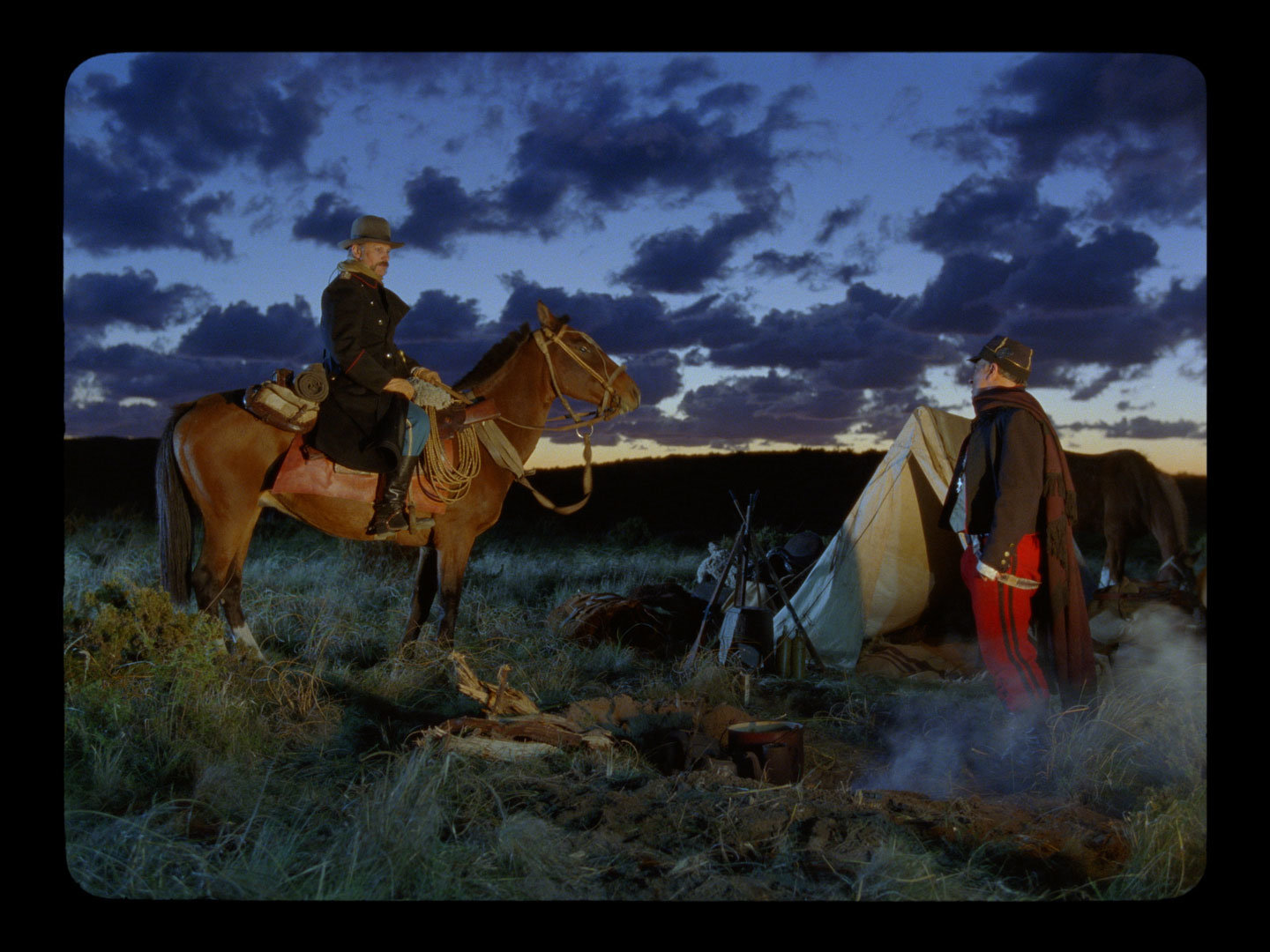
Jauja is equally concerned with blowing minds as puzzling them. With its pulsing colors and immersive deep focus cinematography, it’s cinema-as-sensorium. There’s a vibrant interplay in Alonso’s frames (in the old 1.33:1 aspect ratio) between background and foreground, usually with Viggo Mortensen in the front, his visage staring out beyond the horizon. It is 1882 on the Patagonian coast, during the “Conquest of the Desert”, a bloody campaign to drive the indigenous peoples out of the jungle, to make the region safe for European settlers. Mortensen plays Dinesen, a Danish engineer who will plan the future European-style cities that will replace the wiped-out cultures.  He is there with his daughter Ingeborg (Viilbjork Agger Malling), who soon absconds into the jungle with a young soldier. As Dinesen follows her deeper into  the country,  rumors persist that an ex-soldier, Zuluaga, has gone mad and gone “native”, slaughtering the Europeans he comes across.  Fugitive signs of Ingeborg emerge and dissipate, but Dinesen trudges on into something like madness. He is like Ethan Edwards in his metastasizing hatred of the indigenous population, and the obsessive chase for his lost girl that is less an act of courage than of bloodlust. The deformity of the European colonial project seems to alter the landscape as well as his body, from watery shores crenellated with rock formations, to the dried out gray of the mountains. By the end Mortensen is a ragged wandering ghost, led by an undernourished dog to some kind of afterlife. The ending is a time-and-space shifting mystery that lays beyond my grasp, images of a fecund forest overgrowing the past, drawing me back in.

DOC HOLIDAY: ART OF THE REAL AT THE FILM SOCIETY OF LINCOLN CENTER

April 22, 2014

ALATB_SSPRAY_WEBSITE2-1024x575

From the beginning documentary filmmaking was synonymous was artifice. For Nanook of the North (1922), Robert Flaherty re-staged scenes of an Inuit family at home, complete with an igloo constructed for the shoot. Getting to truth through fiction was an accepted practice for that non-fiction pioneer. It was a common sense approach, using all the filmmaking tools available to capture as much of a multifarious reality as he could. Today the model, best exemplified by An Inconvenient Truth, is that of a TED talk, in which a pre-determined position is supported by talking heads, explanatory slides and jaunty animations. Most of these message documentaries, well-intentioned or not, have no need for moving images at all.  Flaherty’s model has survived, but it lives at the periphery of the film world, in academic contexts like Harvard’s Sensory Ethnography Lab (SEL), or documentary boot camps like the yearly Robert Flaherty Seminar, which programs formally innovative non-fiction work by a rotating cast of curators. Programmers Dennis Lim and Rachael Rakes have gathered the tendrils of these non-fiction experiments into the definition-expanding series “Art of the Real”, which runs through April 26th at the Film Society of Lincoln Center.

Bindu-Field-Image

Lim and Rakes make wide-ranging connections, from the ethnographic experiments of Jean Rouch (Jaguar, 1954/1967) to the SEL (which receives its own sidebar). Rouch practiced what he called “ethno-fiction”, and with Jaguar, he took an anthropological film he had shot in 1954 in Niger, and asked its subjects to dub a commentary over it thirteen years later, where they try to recall their on-screen conversations and get sidetracked with jokes and digressions. The SEL similarly foregrounds the apparatus of filmmaking, as in Stephanie Spray and Pacho Velez’s Manakamana (now in theaters via Cinema Guild), which takes a series of 16mm portraits of worshippers and tourists as they ride a cable car up the mountains to a temple in Nepal. Each rides runs the length of a roll of film, and contain a parade of micro-dramas, from the fate of a sacrificial chicken to that of a melting ice cream cone. The SEL was founded in 2006 to revive a Flaherty spirit in documentary, that “promotes innovative combinations of aesthetics and ethnography”, as they say on their site. Spray is also represented by her 2009 ethnographic hangout film, As Long as There’s Breath (2009). It is the third in a series of videos she made of a Nepali family, and she has achieved such a laid back rapport it has the deadpan humor and tempo of a Jim Jarmusch movie. It’s a series of conversation sketches about the parents’ depression over their empty nest (the kids have all moved out), and the village women’s state of sexual satisfaction (low). Spray shoots them in silhouette against the mountainside, an image of aestheticized distance. But these ladies are no exotic other, and proceed to assert their agency by debating the relative merits of wooden and rubber dildos.

Castanha_5

They have adapted to performing to Spray’s camera and turned into delicate and often hilarious performers. Three other documentaries in the series take performance as their theme: Davi Pretto’s Castanha, the Closing Night film Actress (2014). João Carlos Castanha is an aging actor in Porto Alegre, Brazil. He takes gigs all over town, from bit parts in TV dramas to a drag queen MC at the local gay bar. He’s seemingly born to entertain, though he’s never ascended past the local scene. Pretto emphasizes the small spaces of his dressing rooms, smoke filled squares that are not reminders of failure, exactly, but of a dulling inertia. Castanha lives with and cares for his mother, who spends her time swearing at the condo manager at coddling her grandson Marcelo, a drug addict. The film sways between Castanha’s endless pre-show rituals, the layers of makeup and small talk with other actors, with the rush of performance, his energy refracted in the disco ball light. Pretto takes advantage of Castanha’s performativity by inventing melodramatic scenarios to graft onto his life, turning Marcelo’s story into one of violence and mystery, allowing Castanha to pose as a gangster. In an interview with Ela Bittencourt in Guernica Mag, Pretto states his approach to capturing reality:

Our lives are marvelous constructs, caught between the real and fiction. We are always inventing fictions. We create our own roles and stories that we then interpret to our friends and colleagues. And I’m not the one who came up with this idea; it’s been around for a long time. In Jung, for example. But in the end, only the fictions can heal us. Only fiction shows us a way of dealing with the strange and absurd reality in which we are presently living.

Actress_still3

Brandy Burre’s life is another marvelous construct. The subject of Robert Greene’s Actress secured a recurring part on The Wire before giving up acting to raise her children. She moved to Beacon with her boyfriend, and devoted her life to her family. As Greene picks up her story, the relationship is falling apart, and Burre is eager to return to the stage or the screen. Where Castanha is quiet and reflective, Burre is open and in the moment, talking herself through her insecurities and anxieties. It is rare for a documentary, or any film for that matter, to record so closely the everyday life of a woman above the age of 25. The joys of motherhood are all mashed together with career regrets and the mounting difficulty of a woman of her thirtysomething age to make a comeback in show business. She remembers how she was twenty-seven on the set of The Wire, while all the men were in their late thirties. She is not allowed to age gracefully, or balance her life and her work. The institutions of motherhood and show business both seem to conspire against her. Greene is well aware that Brandy is a star, and lights her like one, interrupting the handheld camera of daily life with vignettes of delicate soft focus close-ups, an upstate New York Von Sternberg and Marlene Dietrich. Brandy is stumbling her way through a life she is trying to get out of, with empathy and fragility, turning herself into her own crowning performance.

d0352cd953a6c5afdee95f9705ef359a

Mati Diop’s A Thousand Suns mourns one of Africa’s greatest performances, and charts an alternate history of its actor. Diop films Magaye Niang as he watches himself in a public screening of Touki Bouki (1973) in Senegal. A classic of the African cinema, it was about two Senegalese grifters who try to con their way out of Africa on a ship to France. It was directed by Mati Diop’s uncle, Djibril Diop Mambety. Niang is older now, introduced rustling cattle with a sewn on star on his shirt, the High Noon theme song on the soundtrack. He is a cowboy, a relic. When he tells kids at the screening that he is the actor in the movie, they don’t believe him, and say he must be dreaming. In this film Diop envisions another life for Niang, one in which he adopts the life of his Touki Bouki character and flees Senegal. The film becomes the dream the children accused Niang of living in, where the border between film and life, and life and dream, disappears as a fade to black.

441792854_640

Philipp Hartmann would admit he’s no great actor, but he’s an engagingly neurotic guide to the digressive essay film Time Goes By Like a Roaring Lion. The title is an odd phrase by Hartmann’s grandmother, conveying the violence and speed of time. Hartmann objects to getting old, and the more time passes the more he gets sucked into the past, like a time traveler. His triggers are not as poetic as Proust’s madeleine – he is set off by banal objects like a soccer magazine or a matchbook, sparking reminiscences on players’ birthdays and lovers’ faces. He uses his revulsion at his incipient death to hopscotch from the atomic clock in Braunschweig to a train graveyard in the Andes, on which an impermanent graffiti is scrawled, “The only thing that happens here is time.” When Hartmann returns to the train, the graffiti has been washed away by the rain. Through bull sessions with his friends, about Einstein’s Twin Paradox and their eternal adolescence, he looks for ways to outrun the clock, but he repeatedly encounters those driven mad by chronophobia:”Time would kill him at some point if he wasn’t faster.”

The films that make up “Art of the Real” supply an eclectic alternate history to non-fiction filmmaking, one that takes advantage of the full expressive potential of the medium. This week there is also a program of avant-garde work, including A New Product, in which Harun Farocki turns a corporate meeting on ideal workspaces into an absurdist essay on the impenetrability of neoliberal market-speak. Or if you’re in a more observational mode you can still catch  Castanha and Actress (sold out, but you can always go standby). Instead of flicking on the latest “issue” documentary on Netflix, head to Lincoln Center and see what artists are moving the form ahead by going backward – to Flaherty and beyond.

DOCUMENTARY FORTNIGHT: HIGHLIGHTS FROM MOMA’S NON-FICTION SHOWCASE

February 25, 2014

19459_0

Since 2001 the Museum of Modern Art has hosted “Documentary Fortnight”, a series devoted to formal innovations in non-fiction filmmaking. It’s where talking heads go to die. This year’s edition includes twenty features and a passel of shorts from twenty countries, covering a wide range of styles and subjects. I was taken with two documentaries that take wildly different approaches to the observational form. The Mother and the Sea is an immersive ethnographic study of pioneering Portuguese female fishing captains, while Campaign 2 (non Will-Ferrell division) is a run-and-gun vérité portrait of a Japanese city council election.  Running through February 28th, Documentary Fortnight is a one-stop-shop to witness the future of the non-fiction form.

My most anticipated title was The Mother and the Sea, the latest ethnographic deep dive from Gonçalo Tocha. At the beginning of his 2011 documentary It’s the Earth, Not the Moon, he promises to “to film everything we can” of the Portuguese island of Corvo, the westernmost point of Europe. That 3-hour epic captures the past in the present, as the history of the island emerges through dying out traditions and the reminiscences of its oldest inhabitants. Corvo was once a major whaling outpost, as well as the repository of local wisdom ranging from cheese mongering to hat knitting. Tocha tries to extend these traditions and incarnate memories through his patiently wandering camera, where static portraiture of residents conjures up whole histories in a glance. In The Mother and the Sea he takes a similar approach to the small coastal Portuguese village of Vila Chã, though with a narrowed focus. Tocha is  fascinated by the group of 1940s women who became captains of small fishing boats. He claims they were the only women in the world to captain their own ships at the time, their ages ranging from 16 to 60. He can only find scraps of published memory in the library stacks, consisting of a few articles and one heroic photo of the women standing at attention.

a_mae_e_o_mar_10

To get a fuller sense of their world Tocha docks at Vila Chã and chats with the locals. His interlocutor is Gloria, the last of the fisherwomen. At its height the town housed 120 boats and 17 women of the sea. Now there are 9 ships, with Gloria the last female skipper. She is Tocha’s key to unlocking the memories of the other villagers, triggering their sense memories of when the town was abuzz with activity. She is a living link between past and present, and so Tocha, who acted as a protagonist in It’s the Earth, is more in the background here. Gloria takes center stage, interviewing daughters of the captains, as well as her own mother. The daughter of Ines de Chula, framed against a window opening upon the sea, remembers how her mother “went to sea” after her dad abandoned the family. The term “went to sea” takes on a sacred tone whenever it is uttered, akin to taking on the raiments of priesthood.

724291

So despite the economic necessity of these ladies’ decisions, once they “went to sea” they were loathe to come back, as if they were given a taste of heaven and then had it retracted, as with some who were forbidden to continue after they were married. Their fishing licenses are filmed in silence, as if holy writ, physical proof of their transitory transcendence. Tocha shoots his film with equivalent reverence, the villagers posed in static compositions like saintly icons.

The men continued in the job as long as they were physically able, one 91-year-old speaking of it as an addiction, feeling the urge to tug at fishing line as habit forming as a pull of nicotine. The town’s top evangelist of the sea is Guilherme “Pilo” Sales, who claims he can speak to the sea. He has three daughters, none of whom took up the family business, for which he exhibits a twinge of regret. His love for the water will pass away with him.

The longest interview Gloria conducts is with her mother, Maria Ramos Canito, who “went to sea” at 17 and continued through her life. Maria is a born storyteller, polishing anecdotes to a high sheen. Her most memorable involves one of her first journeys into the sea, when she was caught in a storm with her captain Norberto. When all was thought to be lost, she kept the faith, navigating them home to safety when hysteria was taking over. Tocha’s time-traveling reels the 1940s fisherwomen into the present, and conveys the spirituality in which these fishermen and women approached their task. For the women it started as necessity, the only way to make a living on their own, as they were shut out of so many other professions. But just like the men in town, they became hypnotized by its imperturbable beauty. The film ends with Guilherme talking to the waves, thanking the sea for giving him the only life he desired.

poster

There is not much of a spiritual side to local Japanese elections, at least not in Kazuhiro Soda’s Campaign 2. In a system which limits its nominees from debating political issues in public, the candidates are reduced to standing at transit hubs and shaking the hands of rush hour passersby. This was the fate of Kazahuki Yamauchi in the first Campaign (2007), in which he had the support of the Liberal Democratic Party machine and won a seat on the Kawasaki City Council. The circus of handshakes, loudspeakers and touring vans is documented in intimate fashion by Soda, who uses a first person observational style, jutting his camera in as close as possible to the action.  It’s a run-and-gun style that motors on adrenaline. It could be wearying, except that Yamauchi is an irresistible subject, an excitable idealist motormouth with absolutely no filter. Soda knew Yamauchi from their time at Tokyo University, so there is a familiarity that breaks down any PR barriers.

oda_morning

Yamauchi lost his city council position in a 2007 party shake-up, and then he spent the next four years as a house husband, raising his son Yuki while his wife Sayuri paid the bills. Yamauchi was enraged by the political standstill over nuclear power following the tsunami and Fukushima reactor disaster in 2011, motivating his 2011 run as an independent. This time, however, he refused to engage in the usual campaigning. Instead he invests only in posters and postcards, spending $850 total. Despite a minuscule chance at victory, the mischievous Yamauchi is downright giddy as he cruises past his miserable looking competitors as they don sashes and bow deferentially to every customer cruising out of KFC. As he says, “The 3/11 disaster has changed Japan but not the politicians.” The radioactivity levels in water and vegetables are a daily story, but no politician seems prepared to challenge the hegemony of nuclear power. Yamauchi’s is a noble cause, but he seems to enjoy needling his competitors more than advancing his platform, which he does only once – at an isolated intersection the day before the election. Soda is recognized far more than Yamauchi, the original Campaign having been a success in Japan. Some politicians cozy up to Soda’s camera, one Democrat decrying the banality of their election season in damning terms before wandering right back to his election team and bowing to every commuter – who ignore him completely – a microcosm of the election at large.

yamasan_S2

“FIRST LOOK” AT THE MUSEUM OF THE MOVING IMAGE

January 14, 2014

gw4

Last week Manohla Dargis complained about the overwhelming glut of films released in New York City. The New York Times has a policy to review every new release, and in 2013 they published 900 reviews, seventy-five more than the year before. Worthwhile indies like Computer ChessThis is Martin Bonner and Museum Hours are subsumed in a flood of dreck, which rent out screens to fulfill contractual obligations before limping onto VOD. So vanity projects with deep pockets eat up theater space, rendering word-of-mouth success almost impossible, since most titles are forced out in a week. The day after Dargis’ complaint was published, the third annual “First Look” series kicked off at the Museum of the Moving Image (January 10 – 19), a program of forward-thinking work, almost none of which has distribution. These are the films left behind by the broken distribution system in the United States, a freewheeling mix of handcrafted oddities, personal essays, and deeply researched documentaries.

Even though it’s only in its third year, “First Look” has become one of my favorite yearly rituals, its cherry picking of the bleeding edge of world cinema innovation the kind of thing I’d otherwise read about with green-faced envy in a globe-trotting dispatch in Cinema Scope.  They alerted me to new films from old masters like Chantal Akerman (Almayer’s Folly) and Philippe Garrel (That Summer) as well as young talents like Goncalo Tocha (It’s the Earth Not the Moon), Jang Kun-jae (Sleepless Night) and the riches of Berlin School filmmakers Thomas Arslan and Christoph Hochhausler. They’ve continued in the celebration of the small this year, in a program populated with intensely personal visions made with a DIY spirit, from the opening night’s handmade childhood idyll Little Feet to the closing night whimsy of The Rendez-Vous of Deja Vous, a bit of strained screwball shot on the streets of Paris. Bereft of big name directors (aside from a Rohmer short), this year’s “First Look” encourages exploration – better to go in without program notes and hope for the shock of the new.

1183471_Rohmer-In-Paris-1

But let’s start with the old. Rohmer in Paris is a charmingly obsessive study of the New Wave director’s filmic ambulations around the city of lights. Director Richard Misek begins when Rohmer’s wanderings intersect with his own – Misek was unknowingly an extra in Rendezvous in Paris. He noticed himself crossing the screen while idly watching Rendezvous on TV, which then triggered his OCD, and he began mapping Rohmer’s characters as they wandered around Paris. The movie is a topographical map of these walks, layered on top of one another as if tracing the neural network of Rohmer’s mind. He also catalogues and inventories glances, staircases and doors, the first step toward an encyclopedia of Rohmer ephemera. Misek stumbles when he begins to interpret these repetitions – tracing them all back to the Spanish Quarter, and declaring that Rohmer was haunted by the New Wave and always trying to return to its bosom. This ignores how engaged Rohmer was with the present, in everything from fashion to music, and that if anything Rohmer’s films are suspended in an eternal “now” rather than looping in a return to his days at Cahiers. But this detracts little from the film’s multifarious pleasures, and the overwhelming need to re-watch his entire corpus from start to finish once you leave Misek’s headspace.

Natan,_Bernard,_French_movieproducer_on_trial_1936_circa

The other standout documentary is David Cairns and Paul Duane’s Natan, which re-inscribes the French-Romanian film impresario back into film history, after he was erased in the concentration camp at Auschwitz. Natan was a pivotal figure in France’s transition from silent to sound filmmaking. Charles Pathé was skeptical of talkies, so Natan stepped in, became a partner in the company (rebranded Pathé-Natan), and produced some of the most spectacular films of the early French sound era, including Raymond Bernard’s Wooden Crosses (available in the Criterion Collection). He had rebuilt the French film industry following WWI, and his adaptability to new technologies kept it relevant and popular against the onslaught of Hollywood’s vast resources. But with the fall of France to Germany and the installation of the anti-Semitic Vichy regime, the Jewish Natan was subjected to a debilitating whisper campaign that insinuated he was an actor in pornographic films, a charge that has been repeated to this day, despite its virulent origins. He was stripped of his citizenship and sent to Auschwitz, where he died sometime in 1943. The Natan name was scrubbed from Pathé history, and his name is nowhere to be found at the sound studio he built. A work of barely suppressed rage that is also a fine piece of scholarship, it’s the rare talking head documentary that I’d recommend without reservations. You should also check out David Cairns’ movie blog, Shadowplay, which is unfailingly lively and intelligent.

Vic-+-Flo-Saw-a-Bear

The only director in the series that I had seen work from previously is the Quebecois director Denis Côté, whose dour black comedy Curling (2010) I had enjoyed a few years back. His new feature, Vic + Flo Saw a Bear, is a more mysterious and withholding film, while retaining his off-kilter humor. It follows the post-prison life of Victoria (Pierette Robitaille), who moves in with her invalid uncle in a rural Canadian town, enduring the prying eyes of her probation officer while rekindling a relationship with her girlfriend Florence (Romane Bohringer). Florence has a past of her own, however, that shows up with a bloody vengeance. Unfurling like a fissured fable, Victoria uses her forest retreat to tame her insecurities and find whatever self she has left – but that self is invested in Florence, whose life is more out of a Richard Stark novel. In his droll, dreamy long takes Côté establishes that their love is in the past but not behind them, a curse they can’t rid themselves of, as dangerous as the psychotic gangster Jackie and her mute henchmen who’ve got a thing for breaking Flo’s limbs. It’s a love story and a death story which turn out to be the same thing.

There is much more to uncover at this year’s “First Look” showcase, including a history of the electronic Ondes Martenot instrument, Wavemakers, that I’m keen on seeing. But the pleasure of the series is going in blind and encountering the unexpected. Here’s to more surprises in First Looks to come.

TO SAVE AND PROJECT: THE 11TH MOMA INTERNATIONAL FESTIVAL OF FILM PRESERVATION

October 15, 2013

CRI_127105

For eleven years the Museum of Modern Art has been hosting “To Save and Project”, their international festival of film preservation, highlighting the major archival discoveries and restorations from the past year. An annual reminder of the vital work being done by preservationists the world over, it acts as a preview of the repertory year to come, presenting classic Hollywood titles hopefully headed for Blu-ray (Nightmare Alley) to epics from international auteurs receiving belated stateside attention (Lav Diaz’s Batang West Side). With nearly all of the 75-plus titles being screened on film, it’s also a polemical statement that celluloid remains the most stable and reliable format for preservation.Star

Take for example, Stark Love (’27), a Smoky Mountain docu-drama filmed with non-professionals that was thought lost until the export version was discovered in the Czech Film Archives in 1968. Rarely screened since, this favorite of James Agee approaches North Carolina mountain folk with an artful anthropological eye, displaying the influence of Robert Flaherty. As in Nanook of the North, director Karl Brown aimed for staged recreations of their daily lives, although Stark Love is far more melodramatic than its model. His representation of Smokey Mountain life is paternalistic and not without its exploitative aspects , as their “law of the wilderness” , the inter-titles say, “is expressed in the cruel principle MAN IS THE ABSOLUTE RULER – WOMAN IS THE WORKING SLAVE.”

stark-love-1927-granger

Brown started out as a cameraman for D.W. Griffith, and Way Down East seems to hold particular sway over the plot, in its tale of an abused young country girl given hope of a new life from an educated young man. In Stark Love Rob Warwick (Forrest James) is the resident nerd, whose reading on chivalry makes him think his community’s attitudes towards women is all wrong. He begins courting Barbara (Helen Munday, a 16-year-old Tennessean discovered in a cafe), but after Rob’s mother dies his father decides to take Barbara as his wife. The two young lovers revolt.

The casting, though advertised as authentically Smokey Mountain, came from all over the South. Forrest was a football player in Knoxville, Barbara a high school student in the same city. Brown was heavily influenced by Horace Kephart’s Our Southern Highlanders, which recounts his years living among the people of the Hazel Creek region of the Great Smoky Mountains. His images are intensely romantic, using long shots with low horizon lines, the people like underbrush against the grandeur of these landscapes. These are alternated with huge Griffithian close-ups of wrinkled faces, work etched into their brows, ready to be returned to the earth.

stark-love2

It should be noted that the surviving print is the export version, which often used variant, lesser takes. On the NitrateVille message board, film historian David Shephard recalls screening this print for Karl Brown after its discovery, with him dismissing it as “a very poor representation” of what was released domestically. The domestic version will likely never be seen, but even this export print has compositions of breathtaking beauty. One can draw a line from Flaherty and Stark Love straight through to Lisandro Alonso’s influential life of a logger La Libertad (2001, also screening in the festival) and the Harvard Sensory Ethnography Lab (Leviathan, Sweetgrass, Manakamana), which value the visual and tactile rendering of reality over the verbal recounting of facts.

hangover-square-2

John Brahm’s Hangover Square (1945) is also an intensely physical film, thanks to the lumberingly sensitive lead performance by Laird Cregar. It is a film noir about the unknowability of the self and the anxiety of creation. Cregar plays young composer George Harvey Bone, who enters a fugue state after hearing a particular tone in turn-of-the-century London. He loses hours at a time, with no memories of his actions. He is finishing a concerto (a grandiloquent, haunting piece composed by Bernard Herrmann) but is pricked by fears he might be a somnambulist murderer in the Caligari vein. Although he is not directed by a mad scientist, but his own subconscious.

Cregar had urged 20th Century Fox to purchase the rights to Patrick Hamilton’s novel, but screenwriter Barre Lyndon altered so much of the story that Cregar initially refused to appear in it.  Hamilton’s protagonist was a wannabe golf pro in 1939 London – shifting the job and time frame removes much of the wartime allegory. But the studio suspended Cregar until he relented to appear in it. The changes were demanded by Darryl Zanuck, likely wishing to avoid any political blowback, but also because it allowed them to re-use the sets from The Lodger, which Brahm had just finished shooting.

hangover square PDVD_023

This was to be Cregar’s first starring role, and his final performance. His weight was a source of agony to the actor, who had instilled a severe diet to get down to leading man weight. He died of a heart attack following abdominal surgery in December 1944, at the age of 31, one month after shooting on Hangover Square had wrapped. Our own Greg Ferrara wrote more about Cregar’s tragically short career back in July.

A visually extravagant film, Brahm uses every inch of his studio London, craning up and into dingy apartment pads and symphony halls. The fugue state is signaled by woozy POV shots, the lens smeared with vaseline. Cregar, with baby fat still padding his imposing frame, waddles through the film like a wide-eyed infant, too innocent and pure to survive in a mercenary world – embodied by gold-digging dancehall girl Netta (Linda Darnell). It’s all too much for his soul to handle, and the film ends in one of the grandest self-destructive acts in the noir canon, banging out the last chords to his composition as the music hall burns. The camera pulls up and away, as if afraid to look such abject depression in the face.

THE 2013 NEW YORK FILM FESTIVAL

October 8, 2013

secret-life-of-walter-mitty-ben-stiller-is-a-big-time-daydreamer

In its 51st edition the venerable New York Film Festival is testing its boundaries. While still a small, tightly curated affair compared to the industry bacchanals of Toronto and Cannes, they’ve been slowly increasing their scope. There are 36 official selection entries this year, thirteen more than 2011, and have expanded the Revivals and Views of the Avant Garde sections to the point where they could stand on their own. A mammoth Jean-Luc Godard retrospective is also running concurrently with the festival. The official selection was heavy on the Brits this year (with four, although I didn’t see any), and otherwise tried for their usual balance of star power (Captain Phillips) and experimentation (Norte, the End of History, all of Views).

The Centerpiece screening was the world premiere of Ben Stiller’s The Secret World of Walter Mitty, the second adaptation of James Thurber’s short story, following the 1947 Danny Kaye vehicle. Stiller’s directorial outings, from The Cable Guy (1996) to Tropic Thunder (2008), have been dark and masochistic comedies about pop culture’s corrosive power. Mitty, on the other hand, is a nostalgia piece, mourning the transition from analog to digital. Having little relation to Thurber’s moody miniature, Stiller’s Mitty takes the daydreaming office drone and shunts him into a world-hopping, mountain climbing  journey of self-discovery, kind of a middle-aged male’s Eat Pray Love. Where Thurber’s story ends with Mitty fantasizing about his own demise, Stiller’s closes with all of his dreams coming true.

DF-11070-Edit - Ben Stiller in THE SECRET LIFE OF WALTER MITTY.

It is bafflingly saccharine coming from Stiller, who had previously spent his acting capital to make scathing commentaries on self-help sludge such as this. Yet it is clearly a deeply personal work, sincere in its efforts to convince people to re-connect with the world. It is also very well crafted, especially the first third. The opening shot is wordless, with Stiller’s Mitty sitting at his laptop, stymied in his attempts to update his eHarmony profile. In one striking shot, he paces into the background and goes out of focus, forcing the audience to stare at an empty, perfectly quiet frame. It’s astonishingly bold for a $100 million would-be blockbuster. Fox hedged their bets by ladling on product placement. In addition to eHarmony, there are prominent cameos by Papa Johns and CinnaBon.

Mitty is the negative asset manager for Life Magazine, who is publishing their last issue before becoming online-only.  Prone to fantasies of action-movie heroics – he usually inserts co-worker Cheryl (Kristen Wiig) as his damsel in distress. While Mitty’s daily routine is framed in long shot with a smoothly tracking camera, when he leaps tall buildings the camera goes all Greengrass, turning into the handheld quick-cut style so favored by today’s action auteurs. The film is loaded with these clever visual ideas that contrast old and new, yet they are in service to a story that is thuddingly conventional. The reliably funny Wiig is reduced to arm candy, her role to prop up the self-pitying Sillter. The rest of the superb cast, including Adam Scott, Kathryn Hahn and Shirley McClaine, are equally underserved.

Norte 1

On the other end of the budget spectrum is Lav Diaz’s Norte, the end of history, a four-hour immersion into the Filipino justice system. Loosely based on Dostoyevsky’s Crime and Punishment, it tracks the parallel stories of a nihilistic law student dropout and a saintly laborer. Fabian (Sid Lucero) is disgusted with the state of his country, ravaged as it is by official corruption. He advocates violent revolution on the grassroots level, and puts his ideology into action when he murders the local money-lender he is indebted to. Unbeknownst to him, Joaquin (Archie Alemania) threatened the usurer with violence earlier in the day, and he is immediately arrested for the murder. Joaquin and his wife had planned to open a restaurant, but a leg injury sucked up their funds and put them in debt. Unable to afford a decent lawyer, Joaquin is convicted and sent to prison for life. Diaz shifts back and forth between these parallel tracks, as Fabian digs deeper into his ideological rabbit hole, where violence becomes an end in itself, while Joaquin works to salvage a life in prison, forging friendships through his selfless aid to others. Diaz captures a wide swathe of Filipino society, from lawyers’ cafe bull sessions to working class dinner preperation, all captured in Diaz’s patient long takes. There is a palpable tension as the two narrative lines bend towards each other, their joining a flashpoint that might put an end to it all. Norte was acquired by Cinema Guild for U.S. distribution, and it will be the first film by Diaz to be released in the United States – a true cause for celebration.

20137266_7_IMG_FIX_700x700

Hong Sang-soo movies also put me in a celebratory mood. This prolific Korean profiler of indolent man-children makes one of his chatty humiliation fests a year, and they keep getting funnier.  Nobody’s Daugher Haewon continues his shift towards featuring female characters, which started in Oki’s Movie (2010) and continues through the most recent Our Sunhi (2013). Haewon is at loose ends after her mother moves to Canada, her identity seeming to drift away with her. She’s only halfway present in all her relationships, from her intermittent affair with a married professor to her rapid infatuation with a teacher on vacation from San Diego. Even her consciousness is in doubt – the film is either a lucid dream or a sleepy reality.

MV5BMTc2NDM1OTY5NF5BMl5BanBnXkFtZTcwMTI4MzA1OQ@@._V1._SX640_SY268_

Also taking place in a liminal dream state is Stranger By the Lake, a minimalist thriller from French director Alain Guiraudie. An isolated stretch of shoreline is used as a gay cruising ground, where Franck (Pierre Deladonchamps) is a regular. He develops an intense crush on Michel (Christophe Paou), who looks like Tom Selleck circa 1985, but who is always engaged with other men. Franck returns day after day, Guiraudie depicting this daily routine as a kind of incantation, and the woods up on the hill as an enchanted fairy land, a mystery world of lush greenery and pitch black shadow. The sex is explicit but natural, outgrowths of the land. When Franck witnesses Michel soil this sacred space with a criminal act, he is attracted and repelled. Michel becomes a monster stalking through the once-sacred land, inviting all with him to disappear into the darkness. The film’s bewitching mix of naturalism and fable is inherent to Guiraudie’s work, which will hopefully gain a wider audience when Strand releases Stranger by the Lake early next year. See That Old Dream That Moves (2001) his lyrical short feature about the closing of a factory, if you can find it.

Also recommended with public screenings still to come: Corneliu Porumboiu’s hilarious meta-movie When Evening Falls in Bucharest or Metabolism (no distributor, wrote about it here); James Gray’s gorgeous turn-of-the-century melodrama The Immigrant (Weinstein); and Catherine Breillat’s autobiographical poison pill Abuse of Weakness (no distributor, wrote about it here).

“FIRST LOOK” AT THE MUSEUM OF THE MOVING IMAGE

January 1, 2013

Screen Shot 2020-02-07 at 4.24.23 PM

The beginning of the New Year means it’s time to catch up with the old. For the second year running the “First Look” series at the Museum of the Moving Image (January 4 – 13) provides an invaluable showcase for undistributed international cinema. Programmers Rachael Rakes, Dennis Lim and David Schwartz pluck adventurous work from festivals around the world, tracking developments in documentary form, the Berlin School, Korean indies and the continuing vibrancy of Portuguese film culture. In a clue as to the series’ disregard of commercial impulses, the series’ opening night film is Hors Satan, the latest by the divisive arthouse provocateur Bruno Dumont. Operating as a relatively youthful version of the New York Film Festival, First Look is an attempt to clue its audiences in to the possible future of the medium.

Screen Shot 2020-02-07 at 4.25.07 PM

If you’re looking for a crime flick alternative to Jack Reacher, you should seek out Thomas Arslan’s In the Shadows, a terse heist film worthy of both Jean-Pierre Melville  and Donald Westlake. Released in Germany in 2010, it has never been shown in the U.S. aside from sparse festival screenings. Arslan has been grouped in the “Berlin School” of filmmakers along with Christian Petzold and Angela Schanelec, as they all attended the German Film and Television Academy in the early 1990s under the tutelage of Hartmut Bitomsky and Harun Farocki (for more on the Berlin School read Marco Abel in Cineaste). Their style tends toward coolly observational reworkings of traditional genres, as last year’s “First Look” selection from the Berlin School, Christoph Hochhausler’s The City Below, rethought the corporate thriller. For In the Shadows, Arslan wrote an original script but is clearly channeling the stoic Melville hero from Le Samourai. The lead actor Misel Maticevic has more than a passing resemblance to Alain Delon, and plays a similar figure of blank professionalism. Known only as “Trojan”, Maticevic stalks through a glimmering Berlin of glass and chrome after being released from jail. Arslan often frames him in the corners of cafe windows, always watching and waiting for a lucrative gig to come his way. If the character is pure Melville the plot is straight from Westlake’s Parker novels, obsessed with the process of executing lucrative small time crimes. Trojan is constantly forming and reforming plans, covering for every contingency, sticking wedges of paper in hotel doors as a makeshift alarm systems and knifing through fights to leave as little evidence of his presence as possible. Arslan would be the ideal candidate to direct Jason Statham in the forthcoming Parker movie, but instead he’s moving on to recast another genre. This year Gold will premiere, his Klondike gold rush Western starring that brilliant blonde axiom of the Berlin School group, Nina Hoss (Barbara).

Another title for Jang Kun-jae’s Sleepless Night could be This is 30. A slender 65 minute reverie about a young married couple, this is a deceptively slight film that trembles with unspoken terrors. An unexceptional couple, the man a factory worker, the woman a yoga instructor, spend their days and nights together as one extended embrace. Actors Kim Soo-hyun and Kim Joo-ryeong ooze pheremonal attraction, each gaze and gentle graze positioned so they fit together like puzzle pieces.  The film uses the standard static camera/long take strategy of too many festival films, but these actors justify the strategy, their movements more than making up for the camera’s lack. The couple’s perennial youth must fade, however, and a hilariously picky post-dinner party argument introduces a fissure in their bond that both soon wish to ignore. The change is registered in their bodies, made clear in a final shot in which the wife looks at the husband, and he is looking at the stars.

Sleepless Night is so lived in, and such a reflection of my own life at this stage, that it feels like a documentary, whereas the actual documentaries on display are more composed and choreographed.  Inori is Pedro Gonzalez-Rubio’s follow-up to his gorgeous family drama on a Mexican coral reef Alamar, and it continues his ethnographic fascination with outsider communities. This time he follows a shrinking mountain village in Japan in which only the elderly remain. The school has turned into a walk-in clinic and the main occupation is decorating memorial shrines, with the residents seeming sanguine about the prospects of nature retaking their once bustling home. The film is a patient one that simply looks and listens, a recording of the dying light. The HD images are gorgeous, but I could have done without the overdetermined symbolism of one of the final shots – a woman’s face reflected in a ticking clock. Arraianos is Eloy Enciso’s more experimental take on the same material. He also filmed an aging community, this time on the Galicia-Portugal border. Along with documenting their traditional farming techniques and asking them to sing old folk songs, he has the villagers act out scenes from the play “The Forest” by Galician writer Jenaro Marinhas del Valle. These recitations in the forest and bars recalls the quotation heavy late works of Straub-Huillet, but with none of their wit.

One who could never be decried for his lack of wit is Thom Andersen, whose latest filmic essay Reconversion (Reconversao) examines the work of Portuguese architect Eduardo Souto de Moura. It is an education and a delightful one. Andersen’s fastidious work goes project-by-project through Souto de Moura’s career, traveling to each site as it looks today, providing historical context along with liberal quotes from the highly quotable architect. Souto de Moura is obsessed with the concept of ruins, which he considers the “natural state of the work, a work that comes to an end.” The series excavates another ruin with Xavier (1991/2001), an independent feature started in 1991, completed in 2001, and rarely screened afterward. Director Manuel Mozos was a friend and mentor to director Miguel Gomes, whose miraculous Tabu continues to wend its way across the U.S., and Gomes returned the favor by programming a series of Mozos’ work at last year’s Viennale (Vienna Film Festival). A melancholy no-budget drama about being young and lost, it follows the title character (Pedro Hestnes) as he returns from the army to a life of short-term jobs and shorter-term relationships. Abandoned by his mentally absent mother as a child, Xavier’s impulse is to drift instead of connect. A supreme hangout movie, Mozos shoots on the streets of Lisbon as Xavier and his fuckup pals kill time in cafes and bars, waiting for their lives to begin.

The most indelible entries in the shorts program, Mati Diop’s Snow Canon and Kleber Mendonca Filho’s Eletrodomestica, convey a similar atmosphere of waiting, of the in-between moments that define lives. Diop, best known for acting in Claire Denis’ 35 Shots of Rum, is also a born filmmaker (her uncle is the Senegalese director Djibril Diop Mambéty). Snow Canon is a uniquely tactile coming-of-age film, set in a cabin in a French Alps resort. Structured around a pattern of inside/outside, a young girl stares idly at the mountaintops out her window, while building an erotic life inside her head. First it is a cute male babysitter, but he is replaced by an American girl, who suffers a breakup and leaves her emotionally raw. Connecting through dress-up and fantasy, the two build an erotic tension that is only made manifest when both step into the fresh air outside, and their dreams briefly come true. Mendonca Filho’s film is a dry run for his stunning debut feature Neighboring Sounds, a rhythmically cut day-in-the-life of a middle class housewife in Recife, Brazil. Satiric where Neighboring Sounds is more observational, Eletrodomestica shows a household that worships technology to the point of absurdity, using it to cook, clean, do homework, and even self-pleasure. The First Look series is nothing if not pleasurable, a refreshingly hype-free and forward-looking fest that has the added benefit of making you look smart when one of these immensely talented filmmakers makes the next festival hit.

THE 50TH NEW YORK FILM FESTIVAL, PART 3

October 9, 2012

Screen Shot 2020-02-05 at 5.04.23 PM

The New York Film Festival is in its final week, concluding on Sunday night with a screening of Robert Zemeckis’ return to live-action filmmaking, Flight. Most of the action this past weekend, though, took place during the Views From the Avant-Garde sidebar. In its 16th year, Views provides an increasingly large snapshot of experimental film practice around the globe. Taking place in the year-old Elinor Bunin Munroe Film Center, the series takes over two screens and an amphitheater space, where audiences can jump back and forth between programs, if they can afford it.  This year’s slate includes festival mainstays like Nathaniel Dorsky, future fixtures Laida Lertxundi and Ben Rivers, and the unclassifiable duo of Apichatpong Weerasethakul and Raul Ruiz, who straddle the arthouse/avant-garde divide.

Nathaniel Dorsky presented two new 16mm shorts in his packed screening, which capture a cycle of mourning and recovery. August and After was made following the death of good friends, legendary underground director George Kuchar and Fluxus artist Carla Liss. It was shot on Fuji negative, which the company recently announced will be discontinued. Using this already obsolete stock, which Dorsky noted had a “lugubrious palette”, he captures singularly mournful images. There is a portrait of George, fading into his wheelchair, and his dumbstruck brother Mike, seemingly too tired for tears. This presages Dorsky’s interest in human forms, which he has largely echewed in recent work. Later in the piece he will enter the streets of San Francisco’s Chinatown, and capture a blur of shopping figures and fabrics and bags, evoking the feeling of being adrift in the flow of humanity. There are still beautiful textures, including the pilled flannel of a red and black checked coat, but they are subsumed in this flow. It ends though, on a vision of unsettling stillness – a kind of giving up-of a freighter lying motionless in a body of water.

April is an attempt to capture the world re-emerging following the trauma of loss. It was partly funded by a gift from Carla Liss, and shot on Eastman stock, which, Dorsky said, is not designed to be projected, but to be used to create a digital intermediate. But he was seduced by its pictorial qualities, and it is an identifiably sweet film, almost sentimental – you can sense a smile behind the camera as it winds through a San Francisco spring afternoon. Here his appreciation of human figures really becomes striking, with multiple shots of office workers and students on benches, the sun creating dappled patterns over their arms as they check their smartphones and sip their fruit smoothies. In these compositions Dorsky’s subjects look lit from within, religious icons instead of administrative assistants.

Laida Lertxundi, is another artist concerned with the beauty and terror of hanging out, being alone at home and in the universe. The world premiere of her new short, The Room Called Heaven, was conceived after she was asked to show some of the B-roll of her previous films. Looking at them, she was intrigued by how they played together, placed next to each other in incongruous conversation. Always one to speak in the present tense, though, she shot new footage, but edited it is if it was B-roll, scenes and fragments abutting one another. It is a similar editing approach as Dorsky’s, although her work is more artificial and composed. Where her previous work had obsessive visual motifs (windows, doorways, screens), here the obsession is with sound design. Her penchant for using a sole backing track (or soul, as with James Carr’s “Love Attack” in A Lax Riddle Unit), is replaced with snippets of songs and a more varied aural soundscape. There is ice is poured into a tin bucket, , a tearing page, and a blinking train stop-light. Then a woman sits, and replays the melody of the fragmented tune at a piano. The atmosphere is the same as her previous works, of a cloistered loneliness, but it achieved through different tools.

The same can be said for Apichatpong Weerasethakul’s Mekong Hotel, a drowsily hypnotic sixty minutes that acts as a distillation of his style and concerns, but shot in HD rather than his usual 35mm. In a hotel near the Mekong River, Weerasethakul held a rehearsal for an old script he had dusted off, Ecstasy Garden. It’s filled with the director’s play on borders that was so resonantly deployed in Uncle Boonmee. As in that film borders are eminently permeable, whether it be between life and death, the spirit world and the physical world, men and women, Thaliand and Laos or past and future. The film’s pace is so gentle and lulling, set to a pacific, repetitive “classical Spanish blues” guitar melody, that the video can easily set one off to another border, between sleep and dream. But make sure to rouse yourself for the majestic final shot, of jet skis doing curlicues in the river in a super long shot, while a long canoe slowly makes its way to the other shore, the speed and power of the new contrasted to the grace of the old.

Ben Rivers is a filmmaker fixated on what is old and past – because what has been forgotten he can invent. An excavator and fabulist, Rivers is interested in outsiders and their ramshackle invented utopias. In his playful short Phantoms of a Libertine, he gives clues to the past of a rake and adventurer through deadpan notes and shards of photographs. We get clues like, “Oct. ’64. Nimes. I had acute diarrhea and was waiting for a train.”

Equally labyrinthine was a super rare screening of Raul Ruiz’s The Blind Owl (1987), which McElhatten had been trying to book for years, until he found the small French distributor who possessed the sole 16mm copy. A deliriously loose adaptation of Sadegh Hedayat novel of the same name and a 1625 play by Tirso de Molina, it follows the blinkered existence of a projectionist who fantasizes himself into the film on-screen, or perhaps the screen bursts into reality, a riff on Sherlock Jr. spiked with Ruiz’s elastic sense of time and space. Scenes loop, the world bends, and life is a grotesque horror-comedy-melodrama in an Arabic cinema in Belleville. Seen at the end of a marathon day of screenings, I was halfway to dreamland myself, but that is certainly how Ruiz himself would have preferred it, as I inevitably became another player on his stage of somnolent cinephiles.

In my exhaustion, there was much that I regret to have missed, from Phil Solomon’s remake of Warhol’s Empire using Grand Theft Auto, to David Gatten’s epic The Extraodinary Shadows, but I was left full to bursting with enough shadows of my own, which will cling to me until next year’s version comes back to town.

THE 50TH NEW YORK FILM FESTIVAL, PART 2

October 2, 2012

Screen Shot 2020-02-05 at 5.00.28 PM

The 50th edition of the New York Film Festival opened this past Friday night with a Gala 3D screening of Ang Lee’s The Life of Pi. While that digital projection was warmly received, later that weekend the first showing of Brian DePalma’s Passion was canceled because of an intransigent DCP (Digital Cinema Package). As the NYFF, like festivals worldwide, becomes dominantly digital, attending some of the few celluloid screenings starts to feel like a modestly defiant gesture.  Two 35mm dinosaurs,  Manoel de Oliveira’s The Satin Slipper (1985) and  Miguel Gomes’ Tabu (2012) use Portugal’s colonial past as their subject, with both using archaic forms to emphasize themes of negation and evanescence.

Booked as part of the festival’s Masterworks sidebar, The Satin Slipper (1985) is an adaptation of Paul Claudel’s 12-hour 1929 play, which Oliveira whittled down to a svelte 410 minutes. It is only the second time that the uncut film version has screened in New York City, following a brief run at the Public Theater in 1994 (Stephen Holden’s NY Times review: “not easy viewing”). It was programmed for the New York Film Festival in 1985, following its premiere in Venice, but according to associate Film Society programmer Scott Foundas, U.S. distributors Menahem Golan and Yoram Globus (of Cannon Films) would only consent to show a cut version of two and a half hours. Other titles Golan and Globus would produce/distribute in 1985: American NinjaInvasion U.S.A. and Death Wish III. One can’t help but imagine a Cannon Christmas party with Manoel de Oliveira brushing elbows with Michael Dudikoff, Chuck Norris and Charles Bronson…

The opening line of Claudel’s opus is, “the scene of this play is the entire world”, which he attempts to capture through the strivings of 50 plus characters at the turn of the 17th century. It takes place after the disappearance of the Portuguese King Sebastian on his colonialist mission in Africa, after which King Philip II of Spain brought Portugal under his power, part of his expansion that also led him to the Americas. Against this backdrop of overreach and excess Oliveira focuses on its inverse, the painfully unrequited love between Don Rodrigue (Luis Miguel Cintra) and Dona Prouheze (Patricia Barzyk). Rodrigue is the rogue whom King Philip nominates to be Viceroy of the Americas, to rule in his stead. Meanwhile the beautiful Prouheze has been married off to the much older judge, Don Pelagio (Franck Oger), whom she honors but cannot love. To restrain her emotion, and maintain loyalty to Pelagio, Prouheze places one of her slippers with a statue of the Madonna, so that if she is tempted by lust she will approach evil “with a broken foot”. Pelagio, aware of her emotional distance, will send her to Africa to control the smitten Don Camillo in order to hold the line against the Moors. Separated by oceans, Rodrigue and Prouheze nurse their love over the decades – living lives of negation and sacrifice, hoping to be reunited in death.

In an “Author’s Note” to The Satin Slipper, Claudel writes, “The most carelessly crumpled back-drop, or none at all, will do.” Oliveira takes this to heart, staging the play as if on the budget of a community theatrical troupe, with a mostly static camera shooting long speeches with few edits, as if returning to the style of early cinema, the one-shot films of Edison or Lumiere. Only the presence of sound and the scattered slow zooms indicate this is a modern feature. The ocean is created by spinning sheaths of blue papier-mache on giant rollers, stalked by cardboard whales, while mountain ranges are simply sketched backdrops. Oliveira’s Satin Slipper is very playfully self-reflexive, pointing out the artificiality of its constructions at every turn – far more so even than his previous tales of unrequited love, Amor de Perdicao (1979)and Francisca (1981, both adaptations, of Camilo Castelo Brancoo and Agustina Bessa Luis, respectively).

He opens the film with a tour-de-force tracking shot of a crowd entering a theater, stand-ins for the viewers about to sit for close to seven hours. After a narrator, never to re-appear, introduces the play (his tongue planted in his cheek), the doors fling open and the viewers enter. The camera backs up into the theater, rolling slowly down the aisles, until it tilts upwards, revealing actors in Renaissance dress standing stock still in the balcony. Eventually one of these actors descends, and the camera pans left as he climbs up on the stage, the curtains parting to reveal not a stage set, but a film screen. He speaks of the constellations of stars visible to Don Rodrigue, tied up on a ship that is equidistant between the Old World and the New. After the camera zooms close to the image of Rodrigue on the screen, Oliveira cuts for the first time, to the image of the projector, its light shimmering over all in the audience.

As Rodrigue is reflected by the light of the moon and stars, the audience is bathed in the flickering glow of the projector, the distance between the fictional and the real collapsing. It’s constructive to compare this scene to the opening of Leos Carax’s Holy Motors, which also begins in a theater, except those viewers are passive  and motionless, dulled by the clichés that Carax will enliven for the rest of his film. Oliveira is not bemoaning the state of cinema but attempting to cultivate an active viewer, as he is quoted in Randal Johnson’s Manoel de Oliveira: “My perspective is precisely to put the spectator in the action. In this way, the spectator goes from a passive, manipulated attitude to an active attitude in which he should draw his own conclusions and undertake a criticism of what he sees.” He is attempting to thrust you into the drama as it unspools, to share the light of the stars and the projector. There are the alienation effects of a jester who is shown painting backdrops and writing characters “who exist before I am finished”, and then he is able to immerse you in the emotion of the piece, seen to no greater ends then the monologue of a woman in the moon. In a long take, while slowly zooming in, Marie-Christine Barrault’s face appears in the firmament, straight out of Melies, but speaking of “never” as a kind of eternity, sacrifice as transcendence – and one begins to recognize and identify with that spark of religious belief that once lit the world ablaze.

In Tabu, Miguel Gomes is also concerned with old forms. It is a film split in two, both shot in black and white. Part One, (entitled “A Paradise Lost”, in 35mm) follows the aging human rights activist Pilar (Teresa Madruga), as she deals with the growing dementia of her neighbor Aurora (Laura Soveral), and the seeming indifference of Aurora’s black maid Santa (Isabel Cardoso).  The second half, “Paradise”, imagines Aurora’s past life in Africa, shot in hazy, grainy 16mm. This second half is narrated in voice-over, with the images from Africa granted sound effects but no sync dialogue, giving the impression of memories half-remembered, of potent emotions but vague details. This final section is set in the 60s, just prior to the African wars of independence that wrest the Portuguese colonies free of the domination that had bound them since the days of King Sebastian.

Gomes has reversed the order of these chapters from Robert Flaherty and F.W. Murnau’s Tabu (1931), in which the “Paradise” of a lovers’ tryst in the South Seas is then a “Paradise Lost” in Chapter 2, as they attempt to adapt to life on a French colony. In placing the Lost Paradise first, Gomes shades every action in the romantic Paradise with the knowledge of its ultimate outcome – his lovers are every bit as doomed as Rodrigue and Prouzhe. For a film suffused with themes of loss, the decision to shoot on 35 and 16mm becomes a part of the grander narrative. The frames on which these women are captured, stuck in silver nitrate, are now as fragile and disappearing as the narrative in which they enact. And while Oliveira could not have forseen it while he shot The Satin Slipper, his use of 35mm has become yet another distanciation effect, its depth and beauty another indication of what our present age has lost.


THE 50TH NEW YORK FILM FESTIVAL, PART 1

September 25, 2012

Screen Shot 2020-02-05 at 4.57.45 PM

The 50th New York Film Festival, which runs from September 28th – October 10th, marks the end of an era. Richard Peña, the Program Director of the Film Society at Lincoln Center, as well as the Festival’s Committee Head, is retiring after 25 years, to be replaced by the well-respected critics and curators Kent Jones and Robert Koehler. This year’s main slate, made up of 32 features from around the world, presents directors that Peña has long championed, including Alain Resnais (You Ain’t Seen Nothing Yet) and the late Raul Ruiz (Night Across the Street), but also features artists poised to take their place in the fest’s firmament. Christian Petzold makes his long overdue main slate debut with the meticulously stunning Berlin Wall-era drama Barbara, while the astonishingly productive image-grabbers from Harvard’s Sensory Ethnography Lab make their second main slate appearance, following  Sweetgrass (2008) (Foreign Parts was a sidebar selection in 2010), with Lucien Castaing-Taylor and Verena Paravel’s immersive fishing documentary Leviathan . Also making his second appearance is Leos Carax, with his weary ode to cinema Holy Motors, his first feature since Pola X (1999), which was his NYFF debut. Petzold is a classicist, the Ethnography Lab a group of experimentalists, while Carax is a bit of both – a provocative trio to kick off this year’s festival.

Barbara is the most unassuming feature of the three, a slow-boil suspense film in which the most action occurs in the eyes of actress Nina Hoss. She plays the title character, an East Berlin doctor in 1980 who is banished to a country hospital after being incarcerated for an unknown crime. Even at this distant outpost she is hounded by the police and forced to endure humiliating searches, as she plans to escape with the help of her slick West Berlin boyfriend. Only the attentions of the sympathetic wreck Dr. Andre (Ronald Zehrfeld), and the decrepit state of a teen girl abused at the Torgau workhouse crack her determination to leave.

Petzold presents a world that is manifesting Barbara’s justifiable paranoia, one that constantly pokes and prods at her inviolable wall of privacy. He generally frames her in medium shot, with Hoss placed in corners, her eyes slathered in mascara so they pop out of her pale face, looking with the same intensity as the doctors in the reproduction of Rembrandt’s The Anatomy Lesson of Dr. Nicolaes Tulip that hangs in Dr. Andre’s office. She is alert and pensive, scanning a mise-en-scene that is rebelling against her. Her apartment’s electrical outlets blow out, the doorbell sounds like a clattering death rattle (and usually portends worse), and her bike’s tires pop at regular intervals. Then while at the office, she has to aid Dr. Andre in a lumbar puncture – with work the only place she can project her fears outward. Otherwise she is in constant surveillance of her environs, woman as prison-guard tower. Nina Hoss presents Barbara as an imposing edifice, a stone-faced sphinx who speaks in brief bursts, transmitting as little information as possible. But her eyes tell the tale, climaxing in an ecstatic close-up in the hospital, in which encrustations of anxiety fall from her face, and Barbara is ready to accept her fate.

The fate of the fish in Leviathan is never in any doubt. They will end up on our tables and in our bellies. Filmmakers Lucien Castaing-Taylor and Verena Paravel are interested in how they get there – not the facts of it, though, but the experience, and from every conceivable perspective. The duo used waterproof digital cameras and tied them to fisherman’s heads, shoved them into a pile of the writhing new catch, and dipped them underwater on long poles off the coast of New Bedford, Massachusetts. Herman Melville worked as a whaler in New Bedford, and used the town as a model for Moby Dick, in which great whales are called “leviathans”.

This association reflects on the changing industry in New Bedford, which was the number one dollar value fishing port for the 12th consecutive year, thanks to the sea scallop industry, although it’s a long way from the dominant whaling port it was at the turn of the 20th century. But while the fish are smaller, the sense of awe is still present, as Castaing-Taylor, Paravel and sound designer Ernst Karel cut between the brute reality and industrial noise of life on the boat with the awesome beauty and gurgling solitude of the nature outside of it. When the cameras bob up and under the surface of the water, catching flickering visions of seagulls manifesting out of the dark, it looks as if the world is being created before your eyes. The filmmakers told Dennis Lim in the NY Times that while Melville, as well as philosopher Thomas Hobbes (“life is nasty, brutish and short”), were the original touchstones of their work, it was the original, biblical sense of leviathan as sea monster that ultimately animated their vision. It is a primal, visceral and overwhelming work, one of those artistic breakthroughs that intimates what it might have felt to view the Lumiere’s train riding towards you for the first time.

If Leviathan feels like something bracingly new, Holy Motors is obsessed with the old – with old films, old actors and old age. After years of failing to secure funding for his work, Leos Carax fueled all of his rage at the business and love for the medium into this weary spectacular. Denis Lavant plays Oscar, a burnt-out itinerant actor who travels in a stretch limo around Paris (which has a similar tomb-like quality to that of Cosmopolis), heading to nine “appointments” in which he performs scenes in a variety of genres, from softcore porn to tearjerking melodrama to a grandly romantic musical reminiscent of Jacques Demy. His whole life is performance, and performance is life, acting for an invisible crowd that we see in the opening scene lolling contentedly in their seats.

This is no celebration, though, for Oscar is exhausted, as Michel Piccoli notes in a crucial cameo. These forms and characters that Lavant so imaginatively embodies are losing their force – these grand emotions are as outdated as the lugubrious limo that creeps through town. Oscar’s tour is a joyous kind of eulogy, a superb rendering of these spectacles that is also their last. He straps on a motion capture suit, a human disco ball in a dark room, and engages in an intensely erotic pas de deux with a similarly outfitted blonde. Their bodies heave and contract as one – but their efforts result in the slick, inhuman CG of writhing dragons. Later, a movingly melancholic Kylie Minogue breaks out into a heartsick ballad, singing of her past love for Lavant, a gorgeous number in which Carax tracks the camera up a desolate building onto the roof, where they part. All that is left afterward will be some broken glass on the sidewalk, another performance ended.  In Holy Motors cinema still works, and gloriously so, but it is fated to die anyway. The film is Carax’s form of mourning this passing, and here’s hoping this film and his career will have a lengthy afterlife.

  In the coming weeks I’ll discuss the sidebar programs, including the Views From the Avant-Garde program and an ultra-rare screening of Manoel de Oliveira’s The Satin Slipper (1985) , along with more selections from the main slate.