THE 48TH NEW YORK FILM FESTIVAL, PART 2

September 28, 2010

nyff2

The Social Network, the opening night selection at the 2010 New York Film Festival (and opening nationwide October 1st), consists of men (and one girl) talking in rooms and around tables. Facebook founder Mark Zuckerberg (Jesse Eisenberg)  is the reluctant participant in these discussions, hunched over and bristling, much preferring the inscrutable company of his own mind. The essential opacity of these thoughts to his friends and foes, Zuckerberg’s intractable isolation, is the nexus around which director David Fincher and screenwriter Aaron Sorkin spin their tale of mis-communication and betrayal.

Sorkin frames the story of Facebook’s founding through legal depositions of two concurrent lawsuits facing Zuckerberg. One from his supposed best friend and former CFO Eduardo Saverin (Andrew Garfield), the other from three schoolmates who proposed a similar social networking site called The Harvard Connection.  Their competing testimony shifts the point of view between all three of these perspectives, offering differing visions of Zuckerberg’s character, Citizen Kane style (Sorkin referenced Rashomon at the press conference, but the focus on the unstable image of one man, as opposed to an event, is far more indebted to Kane – for a further elaboration of the comparison, see Michael J. Anderson’s essay here).

The dialogue is read in staccato bursts of defensive manuevers, everyone protecting their intellectual territory. Eisenberg zooms through the script with brittle intensity, a man of supreme arrogance, intelligence and insecurity insulating himself with words. It’s a bravura performance, in which Zuckerberg’s mask of intellectual impassivity is cracked for a few brief moments, introducing doubts about how much of an asshole he really is. The puzzled, crestfallen expression on his face after his final split with Saverin is tantalizing in its ambiguity. Joined by a truly Mephistophelean turn from Justin Timberlake as Napster founder Sean Parker (look at his manipulations in the photo above), the wide-eyed innocence of Andrew Garfield, the blue-blood hauteur of Armie Hammer as both Winklevoss Twins (using the facial motion-capture technique Fincher pioneered in the underrated Curious Case of Benjamin Button), and a scene-stealing demolition job by Douglas Urbanski as former Harvard president Larry Summers, The Social Network is brimming with revealing put downs, glances and asides.

That it’s taken me this long to get to Fincher says a lot about his role here, a true collaborator with Sorkin and his cast (along with DP Jeff Cronenweth and the fine pulsating score from Trent Reznor and Atticus Ross). But the film, like all of Fincher’s work, is beautiful in strange ways. There is the infernal darkening red hues in which he shoots the Harvard sequences, a simmering hormonal pool of class resentments and hard-ons. One sequence, in which he inter-cuts a Dionysian “final club” party with Zuckerberg coding his early “FaceMash” site is revealing of the unreliability of Zuckerberg’s POV. As he builds his site, an ode to a male’s wounded ego, which allows campus libidos to vote on female students’ hotness, we get visions of stripped down co-eds cavorting in the aristocratic party that Mark would never be invited to. The party seems like his resentful projection, but it’s presented as a simple cross-cutting sequence, or his version of the truth. All three POVs should be treated as unreliable, or at least as clouded by self-interest. By the end, when Zuckerberg’s every move seems both justifiable and monstrous, I could only think of Marlene Dietrich’s closing summation in Touch of Evil: “He was some kind of a man. What does it matter what you say about people?”

***

The other triumph in the main slate was Apichatpong Weerasethakul’s Uncle Boonmee Who Can Recall His Past Lives (coming to theaters in the U.S. in  March 2011 from Strand Releasing)Set in a small farming village in the Northeastern part of Thailand, it tracks the last days of Uncle Boonmee (Thanapat Saisaymar) during which he is visited by the curious ghosts of his relatives. It is a film of permeable borders, between Laos, Cambodia and Thailand, between life and death, man and animal, and ultimately, between possible worlds. Boonmee’s caretaker, Auntie Jen (Jenjira Pongpas, from Weerasethakul’s previous Syndromes and a Century), complains about the Laotian caretaker of his farm, worried that he doesn’t bathe. Later, Boonmee is afraid that he created bad karma because “I’ve killed too many communists.” This speaks to the crackdown on Communism in the region following the war in Vietnam, in which peasants informed upon and fought against Communist cells or were accused themselves. The monkey ghosts which haunt the film can be read as the spirits of the Communists who fled into the forest, although that is only one, much too reductive interpretation.

And yes, the monkey ghosts arrive as naturally as the disfigured princess, who arrives in a deliriously beautiful set-piece that Joe staged as an homage to the royal costume dramas of his youth, although I doubt they contained the amorous catfish in his version. But they should have. Boonmee’s procession into death is also a procession into Weerasethakul’s personal memory and history, as well as the history of his films. Along with Pongpas, Sakda Kaewbuadee returns from Syndromes, as Boonmee’s nephew, and later as the monk from the previous film, as the personal blends with the artistic and historical. There are endless strands to analyze and untangle, but there are also the manifest pleasures of lolling in his gentle, comic rhythms and sparklingly beautiful compositions (it was shot on Super-16 and blown up to 35, often using day-for-night). By the time it descends into Plato’s cave and encompasses the whole history of moving images, I knew I had seen a masterpiece. And I want to watch it again right now.

***

As space is running short, some quick notes on other defining moments from the festival:

Film Socialisme, directed by Jean-Luc Godard (no distribution, screens Sep. 29th at 6PM and Oct. 8th at 3PM)

A lament for Europe, in layers of video and text. HD images of a decadent cruise through the Mediterranean are interrupted by degraded and pixelated footage of mobbed dance floors and YouTube videos of mewling cats. He gets incredible effects from reducing the video resolution, getting cubist collages of capitalist excess and moments of incredible, uncanny beauty. One image, a hand placed on a window, then pulled back, obscured by the degraded image and made ghostly and strange, spoke more to me about the cultural losses he refers to so incessantly. The cruise ship docks, replaced by a family owned gas station, whose parents (and then children) are running for election, chased down by a relentless news team. A young boy, adept at slapstick, scares them away with a stick and then conducts an invisible symphony with it. So referentially dense, it would ideally be watched with hyperlinks attached to all the quotes and film clips, as well as the concrete poetry of the partially-translated subtitles, which he puckishly described as “Navajo English”.

The RobberDirected by Benjamin Heisenberg (no distribution, screens Sep. 29th at 9:15PM)

In this propulsive genre workout, a prisoner trains in his cell to be a long-distance runner. Upon release he wins a marathon, but, alas, keeps robbing banks. Incredibly, it’s the true story of Johann Kastenberger (changed to Rettenberger in the film, and played with wiry athleticism by Andreas Lust), or “Pump Gun Ronnie”, who wore a Reagan mask during his reign of terror. The superbly controlled action sequences are shot in sinuous steadicam long takes, and one heist in particular stands out. Lust, after holding up one bank, sprints to another one, as the cop cars are busy investigating the first. Setting his camera up across the street, Heisenberg resolutely keeps his distance from any kind of psychologizing, he’s just here to emphasize the physical feats. Then Lust bursts out of the second, and a chase erupts when a cop car foolishly tries to run him down. Racing up a parking garage, and then down and outside through a cellar, it’s a white-knuckle affair shot with daredevil fearlessness. The steadicam operator was sprinting down hallways as fast as Lust, with little cutting and total spatial coherence.
THE 48TH NEW YORK FILM FESTIVAL, PART 1

September 21, 2010

nyff1

The 48th New York Film Festival begins this Friday night, with David Fincher’s The Social Network, and I’ll be hemorrhaging words about it for the next few weeks. J. Hoberman finished his term as a programmer last year, and the more populist-oriented Todd McCarthy (formerly of Variety, now at Indiewire) took his spot on the team, chaired by Richard Peña, and rounded out by Dennis Lim, Melissa Anderson and Scott Foundas. Since Hoberman is one of my favorite humans, I was prepared for an ever-so-slightly less challenging slate this time around. But no! This year’s titles look awfully impressive sight unseen, a mix of savvy veterans  (Godard! Oliveira! Kiarostami!), peaking  auteurs  (Apichatpong, Reichardt, Puiu) and the promise of relative unknowns (Frammartino,  Grau, Heisenberg, Loznitsa).   Even the sidebars look bountiful, with the NY premiere of Joe Dante’s The Hole and Frederick Wiseman’s Boxing Gym.  With the addition of the oft-overlooked but stacked Views From the Avant-Garde section, the NYFF will gently dominate my life for the next month.

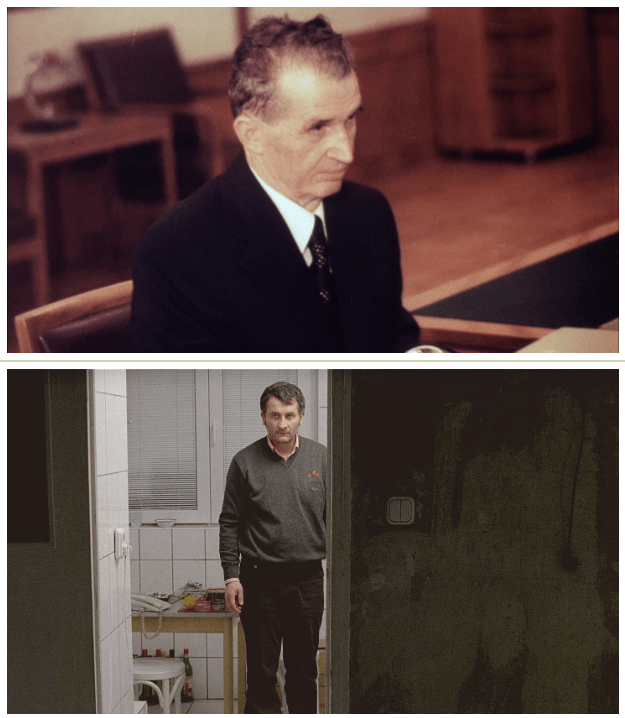
The first festival titles I viewed this year are two Romanian tours-de-force about ordinary men and what may lie behind their vacant stares (yes, Romanian cinema continues to astound). The Autobiography of Nicolae Ceausescu, part of the Special Events sidebar, is a triumph of archival research and editing. Director Andrei Ujica and editor Dana Bunescu compiled footage of the deposed Romanian president from the National Television and National Film Archives in Bucharest. They found home movies of his vacations along with propaganda footage shot at home and abroad. Ujica and Bunescu edited this footage together to create an unintentional “autobiography”, and built up a complex soundtrack for the almost entirely silent footage.

Ujica told Dennis Lim that “The film does have a commentary but it’s a nonverbal commentary. It’s in the construction of the sound and in the intervention of the music.” These manufactured scenes are bookended by grainy video footage of Ceausescu and his wife being interrogated after the 1989 revolution, before they are executed. The grim pallor of his face in this opening shot echoes throughout the multiple representations of his hale and hearty visage that follow.

His unseen interrogator says, “it was your masquerade”, and then the film proper begins, with  footage of Gheorghe Gheorghiu-Dej’s funeral, the former General Secretary of the Romanian Communist Party. Then Ceausescu is inaugurated, and the most striking thing about him is his hair. Swirling but immovable, it sits awkwardly and flamboyantly on his impassive boyish face. Tracking this follicular edifice’s slow decay is one of the film’s multifarious pleasures. It appears at various PR affairs, from the beautiful chaos of the Harvest Festival, where he plays fairground games half-heartedly, to his absurd historical recreation of Romania’s 15th Century King Mircea, which he stages for visiting dignitaries. He is attracted to showmanship, although he himself appears to be an inscrutable bore, his most common expression a half-smirk. He even stoops to cheating at volleyball during a game with friends (he pulls down the net to allow his weak kills to get over).

We see what he wants us to see, so politics are reduced to communist talking points, he won’t budge beyond name-checking Marx and Lenin, or his insistence on removing NATO troops from Europe. Very little is heard or mentioned about domestic initiatives – he seems entirely reactive, only inspired when the world seems to be against him. His most impassioned speech is delivered against the Warsaw Pact invasion of Czechoslovakia in 1968, where he forcibly condemns the “socialist incursion”, and insisted on putting an “end to interference.” While clearly a move based on the fear of invasion for his own fragile nation, it’s a forceful and effective speech, and on the right side of history. But that’s it for an intellectual spark. The rest of the film shows a man becoming more insular and paranoid, retreating into a cult of personality. All we see is scene after scene of Ceausescu smiling uncomfortably next to world leaders, a near daily affirmation of his own importance. He receives visits from Nixon, jets to England to meet the Queen, and is celebrated by Kim Il-Sung in North Korea a number of times, to ridiculously overblown fanfare. His trip to Universal Studios just seems like more of the same puffed up artificiality.

By the end, his face is a mask of boredom, a zombie on the national stage who keeps his country in a similar narcoleptic state. Ujica carefully deploys pop songs, including a memorable appearance from “I Fought the Law” to suggest the alien Western forces that are bleeding in to the edges of Ceausescu’s hermetic frame. By the end, when Ceausescu  looks emaciated inside his ill-fitting suits, his face ravaged with wrinkles and his hair imploding like a collapsed souffle, even his fellow lonely presidents have had enough (in one meeting Gorbachev angrily checks his watch). In the final shot of the post-revolution footage, with Nicolae and his wife Elena looking hollowed out and irascible, he is no longer the totalitarian nightmare of the Romanian imaginary, but just an old man scared to die.

Ceausescu makes quite a pair with Cristi Puiu’s Aurora, another study of a Romanian zombie. It is Puiu’s follow-up to the extraordinary Death of Mr. Lazarescu, and where that film is a portrait of a breakdown in Romania’s public services, this is an experiment that tries to document the breakdown of his country’s psyche. It is the second part of what he calls his “Six Stories from the Outskirts of Bucharest”, dedicated to Eric Rohmer and his Six Moral Tales, of which Lazarescu is the first. Puiu describes this series as about “moral crisis and how inefficiently and artificially the Western model has been applied to a country that had just emerged from the darkness of communism.”

Puiu himself plays the lead character, Viorel, a furtive, ill-tempered man who wanders around Bucharest fulfilling obscure tasks known only to himself. He collects a debt and picks up a firing pin for a shotgun. His face is stony, his wardrobe a consistently tasteful sweater-over-dress shirt combination. He is middle-class, in the midst of renovating his apartment. But instead of fixing up the place he keeps emptying it out, pawning his stuff on family and friends. It seems his is preparing to empty himself out instead. But Puiu reveals nothing of  his motives – Viorel is to remain entirely unknowable and irreducibly human, regardless of the violent acts he commits.

Puiu shoots him constantly from a distance, framed inside of doorways and other transitional spaces, the unbalanced images focused on the sliver of well-lighted spaces he broods in. The visuals are as opaque as the character, bisected and hard to navigate, plus Puiu frequently pans away from major actions, the camera acting like an abused but loving dog, keeping a distance but always wanting to creep closer. Puiu told his cameramen to “follow the character, and to look at him with a feeling that resembles a father watching his child learn to walk.” This is a more compassionate version of my comparison, but still apt. There is a constant tension of what will be revealed inside the frame or about the characters, a puzzle that kept me intensely engaged, especially with its rude bursts of absurdist humor, including a flash of an overweight woman getting a wax, and the brusque apathy of police officers refusing to care about the facts that audiences have been trained to fixate on. It’s a welcome provocation, shifting the weight of analysis from the characters to the viewer, a film to obsess over.

Next week I’ll have a lot more to pontificate on, including Oki’s Movie, Uncle Boonmee, Certified Copy, Film Socialisme, and unless I get shut out, The Social Network.

THE NEW YORK ASIAN FILM FESTIVAL & JAPAN CUTS

June 29, 2010

Screen Shot 2020-01-23 at 5.29.03 PM

The New York Asian Film Festival (June 25th – July 8th) is more essential than ever. With distribution companies shutting their doors to Asian cinemas of all types,  there are very few outlets to watch the continent’s resourceful, often brilliant genre cinema on the big screen. For nine years programmer Grady Hendrix and his crew have been filling the void, and for the past few has joined forces with the Japan Cuts Festival of Contemporary Japanese Cinema (July 1 – 16th)  to provide the most eclectic and revelatory overview of Asian film in the U.S. It’s a heady mix of spectacle, grotesquerie, slapstick and resolute artistry. Every year you’ll see something you’d never seen the likes of before.

For me, this year’s edition surprised me with its Chinese slate, and specifically the skittish performances of actor Huang Bo, recepient of this year’s redundantly titled  Star Asia Rising Star Award. My knowledge of contemporary Chinese cinema doesn’t extend far beyond the arthouses and underground film clubs that show Jia Zhangke and the documentaries of Zhao Dayong. So getting exposed to Huang in the antic Crazy Racer and morbidly funny Cow expanded my limited horizons.

A squat, frog-faced actor with a quick smile and a quicker temper, Huang plays stubborn fools with a clumsiness and slack-jawed innocence reminiscent of Buster Keaton. Crazy Racer (the sequel to Crazy Stone (2006), which I haven’t seen) is a time-shifting crime-comedy in the Pulp Fiction mode, with Huang’s disgraced bike racer bumping into two bumbling assassins, a Thai drug dealer, the Chinese mob and beatings with a frozen fish. The twisty narrative is imaginative and cleanly executed, and director Ning Hao doesn’t bother dawdling over too much sentiment. Cow has Huang playing a similarly alienated character, but in a completely different context. His Niu-Er is a simple peasant caught up in the Sino-Japanese war. His village gets slaughtered, the only surviving creature a foreign cow donated to give milk to the Chinese troops. Navigating some dramatic tonal shifts, Huang manages to insert a violence into his pratfalls and a resignation in his stubbornness that keeps the film from descending into treacle. He elicits laughs that catch in your throat, inserting a jaggedness to the sentiment that makes the whole improbable set-up go down a lot smoother. Plus the cow is pretty good too.

Revelatory in another sense is SOPHIE’S REVENGE, which is a blatant Sex & the City knockoff produced by and starring Zhang Zhiyi. She plays the Carrie role with an overwhelming barrage of animal-themed hats and cow-eyed stares. While the cartoon-y stylization and wonderfully violent fantasy sequences take some of the sting out of the blatant consumerism of this day-glo contraption, the story suffers from an inert supporting cast and a story too cliched for even the Sex gals to endure. While no great shakes as a film – as a cultural object it’s fascinating, as it creates a photo-shopped super-rich city of chrome and flowers and whimsy where women are sexually independent and the rural poor exist only in the “arty” shots of the hunky photographer.

Moving to Hong Kong, the best film in the festival is the uncut version of John Woo’s RED CLIFF, but I’ve already written about it here at Morlocks and also at Moving Image Source, so I won’t spill more words on it. But I will recommend Gallants, a quirkily nostalgic martial arts film featuring oldsters Bruce Leung and Chen Kuan-Tai. Waiting for their near-ancient master to awake from a coma, Leung and Chen turn the gym into a restaurant, until a callow teen sparks a feud with the high-tech workout joint across town. It’s a pleasant and comfy piece of work, sliding into the normal revenge plot mode with tongue gently pressing against cheek.

Little Big Man, Jackie Chan’s diverting take-off on the series of swashbuckling origin stories (including Red Cliff), finds the cherubic 56 year old actor playing a coward. He plays dead during the heroic battles in order to stay alive, and captures a wounded opposing General after all the bodies fall. Failing to push its subversive premise very far, the film ends up celebrating the same kind of warrior ethos it is ostensibly parodying. But it features a few agile Chan fight scenes, and that should be enough.

The only Korean feature I was able to preview was the loopy romantic comedy, Castaway on the Moon, which is unable to sustain its whimsy past the one-hour mark, upon which it devolves into standard love story pabulum. Mr. Kim attempts suicide by jumping into the Han river, only to find himself on an isolated island. Not too upset to be cut off from society, he starts living off the land and communicating with a shut-in, Mrs. Kim, who watches him through a telescope at a high-rise apartment. There is some good obsessive work with black bean noodles, bird poop and the real utility of credit cards, but once the separated duo start communicating, invention flags and director Lee Hey-Jun gropes for cliche.

The Japan Cuts program tends to be more reserved and dramatic, leaving the madness to NYAFF, and this year is no exception. The main highlight for me has been Yoji Yamada’s About Her Brother, an expertly staged family melodrama starring the superb Sayuri Yoshinaga and Tsurube Shofukutei. They play sister and brother, respectively, with the latter drinking himself into a debauched oblivion. Yamada, now 78, is in perfect control of the medium, setting up familial relations and foreshadowing events through composition and staging. Beginning with a quick montage of recent Japanese history (including clips from Yamada’s own 48-feature long Tora-san series), the film slowly unveils Tsurube as the inebriated black sheep of the family, upending a family wedding with the destructive power of his singing voice.

He prefaces this destruction with a quietly witty shot – a wine glass in the left foreground marking doom. Later, Tsurube’s knee juts up into the middle of the frame, another subtly amusing jibe at his need to be the center of attention. But this isn’t a comedy of reformation. Yamada never allows Tsurube to be judged so simplistically, eventually offering a subtle critique of the middle-class values that would attack his particular kind of independence. If you need more reasons to see it, David Bordwell is a fan and wrote about it briefly here.

The festival started on June 25th, but there’s plenty more to see. And while it’s likely you won’t catch them in cinemas again anytime soon, many will be available at your local Chinatown on DVD, and will be for sale at on-line retailers like YesAsia.

TANGENTIAL FESTIVAL NOTES! (GODARD, STRAUB, CRONENBERG)

May 18, 2010

Screen Shot 2020-01-23 at 12.59.17 PM

A groggy John Huston welcomes you to today’s equally confused post. He’s an interview subject in Peter Lennon’s Rocky Road to Dublin (1967), an acidic documentary portrait of 1960s Ireland. Lennon wrote a series of articles for The Guardian about how the Catholic Church and their Republican government cronies were choking off the cultural life of his country, and he adapted his polemics to the screen with the help of regular Godard cinematographer Raoul Coutard. Intimate and barbed, Coutard’s handheld camera nudges its way into bustling pubs, sparsely attended hurling matches (soccer was banned as a “foreign sport”), and the backyards of splenetic Irish authors.  Recently released on DVD by Icarus Films, it’s a unique inverse of the silent “city symphonies” made famous by Walter Ruttmann. Maybe call it a city (and country) evisceration.

So why trot out Huston now? Lennon’s film was the last one screened at the 1968 Cannes Film Festival before Jean-Luc Godard and Francois Truffaut shut it down to support the general strike which was occurring outside its doors. There’s a short “Making of Rocky Road to Dublin” included on the disc, and there is footage of a Peter Lennon arguing with Godard and Truffaut at the screening to allow the doomed discussion of his film to continue. All of which is a rather long-winded preamble to talk about this year’s Cannes Festival. Of all of the coverage I’ve been reading, by far the most entertaining has been that surrounding Godard’s latest provocation, his new feature FILM SOCIALISME.

The fun began when The Independent reported that the film would be subtitled in “Navajo English”:

as in old Westerns where the Native Americans spoke in choppy phrases. Because the dramatakes place on a cruise ship where no one speaks the same language, Godard has fashioned his subtitles concisely to say the least. If a character is saying “give me your watch”, the subtitle will read “You, me, watch.”

This is both hilarious and conceptually apt, and will make initial screenings of the film difficult to parse for mono-linguists like myself. Critics will have to work for this one. Manohla Dargis and Ben Kenigsberg take their (provisional) shots at the NY Times and Time Out Chicago, respectively. Dargis charts out a structure: cruise ship-gas station-cities and a hint of a theme, taken from an interview at Telerama.fr: “the Americans liberated Europe by making it dependent.” The full interview with Godard, conducted by friend and former collaborator Daniel Cohn-Bendit, has been translated by Craig Keller at his blog Cinemasparagus.

Kenigsberg focuses more on the visuals, of a “woman reads Balzac at a gas station while standing next to a llama”, and says it is “stunning to look at—memorable images include a man lecturing to what appears to be an empty auditorium and a boy in a Soviet shirt conducting a phantom orchestra”, but considers it more “tossed off” than his previous essay films (recently Notre Musique (2004) and In Praise of Love (2001)).

For a thumbail reaction internationally, the Letras de Cine blog has been posting number ratings from critics worldwide, and FILM SOCIALISME has the highest average ranking (9.36 out of 10) out of every film polled (Manoel de Oliveira’s highly anticipated THE STRANGE CASE OF ANGELICA is in second with a 8.73). In any case, it’ll be a long wait to see it in a U.S. theater, which is why I was thrilled to see Dargis link to Filmotv.fr, which is streaming the film for 7 EUR through tomorrow. However, it doesn’t look like it is accessible to people in the U.S. (and Spanish critic Miguel Marias said it wasn’t working for him either, in a comment at Cinemasparagus).

Godard canceled his press conference appearance with a characteristically enigmatic fax to festival head Thierry Fremeaux, as Dargis reports:  “‘problems of the Greek type”’had prevented him from attending and that he would go to his death for the festival, but not one step more.’”

***

Some rare screenings this week as the Migrating Forms festival rolls on in NYC. First was a trio of recent shorts from Jean-Marie Straub, Artemis’s Knee (2008), The Itinerary of Jean Bricard (2008), and The Witches-Women Among Women (2009). Bricard is the last film he made with Daniele Huillet, his long-time collaborator and wife who passed away in 2006.  For context and analysis of these works, Richard Brody’s laudatory short piece at The New Yorker is the place to start. He has a handle on the source texts (by Cesare Pavese, Heinrich Schulz) and music (Mahler), that my circumscribed education has…circumscribed.

The most striking work for me is Jean Bricard, which opens on an epically long take of a camera riding along on a boat. As it passes a autumnal B&W landscape of skeletal trees dotted with bulbous nests, one expects it to resolve itself as a simple, starkly beautiful  landscape film (shot by Irina Lubtchansky and her brilliant late husband William). But then there is a jolt of humor, as the boat passes two consecutive arrows, each pointing in opposite directions. This graphic comedy rouses one out of reverie and into the story they tell, which emerges in voice-over from Mr. Bricard, a French Resistance Fighter during WWII who was recorded by sociologist Jean-Yves Petiteau in 1994. The film slowly reveals itself to be about decay and loss. As Bricard recalls an uncle who was murdered in the high grass by Vichy forces, Straub-Huillet circle round the abandoned Coton Island where he lived, framing the sunken cafes and muddy shorelines of a river raised, re-directed and polluted, essentially destroying the island and relocating its inhabitants. History and geography both show the scars of time.

***

The last item on my viewing list is an early David Cronenberg feature, Stereo (1969), also part of Migrating Forms. It’s a resourceful piece of no-budget sci-fi that utilizes the Brutalist architecture of Scarborough College in Canada to its fullest extent. Long corridors, slanting windows, and slab-like structures are the rather ascetically imposing settings for some telepathic experimentation. Cronenberg shot the film with no synchronous sound, recording a lengthy voice-over of doctors’ reports, analyzing the actions of the “patients” on-screen. These subjects are college-age kids given ESP on the operating table, and thrust into the habitrail of the campus to study the possible development of a new kind of language and family units. The voice-over informs us that a couple of the patients have had their larynxes removed in order to further force the issue of ESP language formation.

The structure an ingenious way to save on sound costs, but the voice-over eventually falls into tedium, and the frequently striking compositions of men fading into the architecture becomes the sole force of the film. The narrative loses drive, but Cronenberg never loses the lack for conjuring uncanny images. A curio, but one well-worth seeking out. It’s available as an extra on the Blue Underground DVD and Blu-Ray for his racing film, Fast Company.

THE MIGRATING FORMS FILM FESTIVAL

May 11, 2010

UVP_KevinJeromeEverson_WP_Erie-2

This coming Friday, May 14th, the second annual Migrating Forms film festival kicks off at Anthology Film Archives in New York City. Rather impishly scheduled to run concurrently with the Cannes Film Festival, the fest surveys film and video art the world over, collapsing the walls between the museum and the screening room, and in its own eclectic way is becoming just as essential as its burly French counterpart. And with no fear of volcanic ash related flight delays!

Expanding from five days to ten this year (my report from the inaugural edition is here), fest directors Nellie Killian and Kevin McGarry have added mini-retrospectives (of Jean-Pierre Gorin and Kerry Tribe), and invited guest programmers to take over a few nights (including a rare screening of David Cronenberg’s Stereo (1969) in the May 15th program “Soziale Plastik I” curated by Brian McCarthy). There’s also lots of exciting new work on display, including a trio of Jean-Marie Straub shorts, and films by Lucien Castaing-Taylor (co-director of Sweetgrass), John Gianvito (Vapor Trail (Clark)), Lav Diaz (whose Evolution of a Filipino Family made Cinema Scope’s best-of-the-decade list), and New York Film Festival holdovers from Harun Farockiand Ben Rivers. It’s an invigorating mix of old and emerging masters, so I don’t feel bereft in missing Cannes for the 29th year in a row. The revelation for me, though, has been the Opening Night film, Kevin Jerome Everson’s Erie.

Everson’s work is new to me, and I direct everyone to Ed Halter’s great essay in Artforum for a crash course in his style. In Erie, Everson headed to the Rust Belt to film family, friends, and willing strangers as they go about their daily business. He shot them in unbroken takes, for the length of one roll of grainy B&W reversal stock (approximately 10 minutes).  The subjects vary from workers who mount billboard advertisements (the top image) to former GM workers gabbing, a piano-vocal duo, a hospital employee cleaning medical instruments, and a teen girl riding the Maid of the Mist at Niagara Falls. Everson is concerned with capturing contemporary Black working class life, but, as Halter notes,  it is achieved through “an understated formalism rather than through traditional documentary modes.”

Everson is not a passive observer, but a silent tinkerer, constructing oblique narratives out of the lives of his participants. The image on the billboard is an invention of Everson’s, an image of his uncle from when he was stationed in West Germany in the 1960s. I only discovered this after reading Halter’s article – while viewing, I accepted it as a retro-chic car ad without any question. There are constructed notes like this in all of the shots – social realist images that contain layers of performance and theatricality. These subjects are both representing and performing their identity. Some of these constructions are more obvious than others.

There are artfully composed shots, like of his daughter sitting patiently cross-legged next to a candle (a study in obedience), or the fencing match between two foes with dancers’ bodies (a study in motion). Once it becomes clear that Everson has formalist tendencies, every shot becomes a mystery. His interview with relatives about GM plant closings, which looks like straight documentation – ends up elucidating the rest of the feature. They discuss the learning curve of the job, and the condescension of those who would say they did not have the education to earn “that much money”.  One of the women says “You didn’t go in there knowing how to build a panel. Nobody knew that. Everybody had to learn to do that.” As Halter writes,  “The discussion draws from local history but also returns to one of Everson’s primary considerations—that of labor as an ongoing mental and physical process of learning, as well as a form of discipline and performance not always understood as such from the outside.”

These retirees are reminiscing of their laboring past, while the other sections enact that past, the repetition, adaptation, and innovation that comes with learning a skill, from mastering a melody to perfecting the cleaning of a pair of forceps. This is played off beautifully in the music sequence, in which Everson walks back and forth between the vocal-piano duo and a group of krumping dancers spinning albums on a beat-up turntable. The audio bleeds back and forth, the propulsive hip-hop edging into plaintive melody. What becomes clear is that both groups are attempting to master things on a very micro level – the intonation of keys and voice, and then then body control of a dizzyingly precise nature.

Everson ends the film on image of pure poetry – a young girl riding under Niagara Falls, her face impassive, obscured by the thin poncho, until, through a lens glazed with raindrops, she breaks out in a radiant smile, just taking in the world around her. Erie screens Friday, May 14th, at 8:30.

Notes on other titles I’ve seen and can recommend:

Vapor Trail (Clark), directed by John Gianvito (screens Tuesday, May 18th, at 6:30)

A staggering act of political commitment. A four-plus hour investigation of the environmental disaster left behind by the air force at Clark Air Base, which closed after a century in operation in 1991. As attested by an article in the Stars & Stripes (“The Independent News Source for the Military Community”) earlier this year, “The bases poured fuel and chemicals from firefighting exercises directly into the water table and used underground storage tanks without leak detection equipment, the agency found” , among multiple other infractions. After Mt. Pinatubo erupted in 1991, refugees were housed on the base, drinking its water and growing food on the land. The article continues that “Records of the families, published by the Philippines Senate, said 144 people were sickened at the camp, 76 of whom died. It said at least 19 children were born with disabilities, diseases and deformities between 1996 and 1999.” The parting contract between countries absolved the U.S. of responsibility in its treatment of the land, and the Filipino government has shown no will to effect clean up.

The length of the film is due to Gianvito’s insistence on allowing the victims of the event, as well as the leaders of the People’s Task Force for Bases Cleanup, Myra Baldonado and Boojie Juatco, to speak at length without interruption and few edits. He is truly allowing them to tell their own story, for, Gianvito says,  “I couldn’t convince myself that many of the sequences, particularly with individual victims, could be cut any shorter than I was cutting them. I felt that it was a disservice to the spirit of the person I was representing to shrink them any further.”  The sheer number of stories and testaments is exhausting, but necessary in order to avoid the exploitation of these tragedies for mere tearjerking. It’s a monumental, vexing, and enraging project. I may not agree with all of Gianvito’s politics, but his commitment, passion and intelligence are overwhelming. And part 2, Vapor Trail (Subic), is coming soon.

I Know Where I’m Going, directed by Ben Rivers (screens Sat., May 22nd at 2PM – part of Group Program 6)

A road trip to parts unknown. The filmmaker visits a lumberjack and a backwoods eccentric as a scientist waxes about geologic time on the voice-over. What will be left of us when we’re gone? Concerned with length. Length of rope, length of branch, length of steps to the end of the trail. The tiny bits of measurements contrasted with the unfathomable expanses of eons.

You can view the festival trailer, by Leslie Thornton, here.

FESTIVAL SEASON: OUR BELOVED MONTH OF AUGUST (2008)

April 6, 2010

5279575.0

The inaugural TCM Classic Film Festival kicks off on April 22nd, and there’s going to be wall-to-wall coverage here once it begins. Jeff Stafford has already posted a wide-ranging, must-read interview with Norman Lloyd, who’ll be introducing Saboteur on the 25th. But like the Cannes Film Festival a few weeks later (May 12 – 23), I’ll be unable to attend, marooned as I am on the East Coast. But I’ll be checking back here at Movie Morlocks for reports on the TCM-fest, and there will be an endless array of outlets covering Cannes. But what about seeing the films, the vast majority of which won’t receive stateside distribution?

The on-line cinematheque The Auteurs has come through for me on at least one title on my list, with an assist by Stella Artois. They’re streaming nine former Cannes selections for free thanks to that mediocre Belgian beer sponsor. These include Our Beloved Month of August (2008)a Portuguese experiment highly regarded by  Cinema Scope’s Mark Peranson and Robert Koehler, Jonathan Romney of Sight & Sound, and filmmaker C.W. Winter (The Anchorage, which I wrote about recently), who placed it on his best-of-the-decade list. It was never picked up for the U.S., and I was ecstatic to find it offered along with a group of higher-profile past Cannes selections including L’Avventura, Mon Oncle, and Amarcord.  The kind of curatorial adventurousness that led to August being included among this canonical group is sorely needed in programming these days, and The Auteurs should be praised (once again), for loosing this strange beast upon American eyes.

Miguel Gomes had an idea for a movie. It was to be an atmospheric melodrama about a small-town girl and her fraught relationships with her guitar-playing cousin and over-protective father. As Gomes tells Peranson, the funding dried up when their money-man died before signing the authorization to release the cash. With a crew already assembled, Gomes began filming the people and rituals of Arganil instead, the municipality in central Portugal in which he was to set his movie. He documents karaoke performances in central squares, father-son accordion duos in underground bars, the history of a local newspaper, and the perils of Paulo, the local drunk legend whose outrageous fictions permeate the rest of the stories. Paulo (pictured at the head of the post), is an inveterate liar, or in other words a storyteller, and Gomes records his exploits as recounted by a variety of locals before getting the embroidered tales from the man himself (they involve beatings from Moroccans, blackouts, and bridge jumping).

Gomes interweaves the checkered production history of his film in the midst of these slices of life. He frames himself as a deadpan morose type, spouting one word answers to his angsty producer Joaquim Carvalho when asked why he hasn’t found any actors (he’s looking for “people”). Or else he’s playing a horseshoe-like game called “quoits” and ignoring the two girls trying to nab his attention for a part in his film. These sections are entirely staged by Gomes, while in the Arganil portraits, as Peranson notes, the actors are making their own mise-en-scene. In the documentary portions, they are leading Gomes, while in the self-reflexive “production” scenes, Gomes is leading the actors. He is simply placing everything in the frame – from the chance conversations of a bickering couple to the equipment Gomes is using to record that scene. He tells Peranson:

The film is a clash between cinema with this part of the country, so us and everything that was with us should appear. Normally there is behind the camera and in front of the camera, and this time I wanted to put everything in front of the camera, and even what’s in the middle should appear—which is the camera.

Everything placed in front of the camera becomes cinema, whether it is based on reality or in Gomes’ head – each is mediated in its own way, as the case of Paulo makes clear. His “reality” is as melodramatic as the story that follows, as Gomes shifts his film into a narrative mode.

Gomes makes the leap to fiction when some of the villagers start acting out his original screenplay. A local girl who was a lookout for forest fires becomes Tania, a teenaged vocalist. Joaquim Carvalho, already seen as the film’s producer, becomes Tania’s father, a keyboardist. Fabio, profiled as a star athlete on the local hockey team who dabbles on the guitar, becomes Helder, Tania’s cousin and new guitarist for Estrelas do Alva, a traveling band. They play the lovelorn pop songs we’ve seen from the karaoke scenes, but now in service to a plot, and their lyrics soon gain resonance as the character relationship deepen and fracture.

Fabio and Tania slowly fall in love, while the father’s protectiveness starts to seem more than fatherly… This incestuous trio becomes a metaphor for the stifling nature of Tania’s small town life, but also for the intense intimacy engendered by the creative process. Estrelas do Alva could also be read as a stand-in for Gomes’ own film crew, stranded, like Tania and her family, in Arganil and prodded to make art without much financial backing. While the tempo is slow (the movie runs to two and a half hours), it is necessary to tease out the rhymings between the two sections of the film, and to build the fabric of their “real” and “fictional” lives.

What at first seems like a laid-back travelogue turns out to be a finely structured piece of modernist cinema, jauntily self-reflexive while humorously obliterating the distinction between fiction and documentary. It’s hard to describe how a movie can be so relaxed and yet so thematically rich. It teases structural puzzles that are never resolved, like Rivette, and yet render the simple beauties of pop songs with an earnestness out of MGM Musicals. It’s frankly unlike anything I’ve ever seen, and while Robert Koehler rightly groups it with his “cinema of in-betweenness” of Lisandro Alonso, Uruphong Rakasad, Ilisa Barbash and Lucien Castaing-Taylor, et.al., there is a undefinable generosity here that separates August from the works of those equally demanding (and essential) filmmakers.  It is warm, teasing, intellectual, and filled with pathos. An absolute original and an easy (and free!) way of jumping into the vanguard of international cinema.

THE 2009 NEW YORK FILM FESTIVAL

October 13, 2009

hye-ja_wide-fde574854a398541a30f8bce882e23312e077f4c-s800-c85

The coverage of this year’s New York Film Festival was weirdly tendentious, culminating in A.O. Scott’s bizarre NY Times dispatch in which he claims (I paraphrase), that there is a cabal of scheming festival programmers who hate humanity and eagerly promote films which espouse a “principle of innate depravity.” I’m (slightly) exaggerating his argument, but he adopts a strikingly strident tone for a diverse slate of movies, grandly sweeping complex works of art into his “festival” category so he can haughtily ignore them. What he yearns for, it seems, are films of “high-minded middlebrowism.” Don’t we have the next two months of Oscar-bait to satisfy that particular need? I’d much rather have a rare screening from an experimental young Filipino filmmaker like Raya Martin than the latest Sam Mendes chin-scratcher that will be released nationwide the following week.

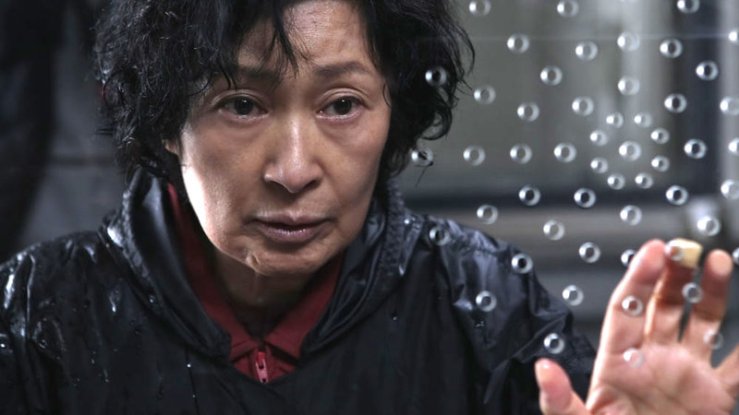
Two of the films he dismisses under the “innate depravity” tag are Bong Joon-ho’s hugely entertaining Mother and Claire Denis’ mesmerizing White Material. I love innate depravity! Mother is a unique blend of police procedural and melodrama of suffocating motherly love. Opening on a shot of the galvanic lead, Kim Hye-ja (famous in Korea for her portrayal of maternal roles), sinuously dancing in a glade of flowing high grass, Bong is announcing the film’s playfully enigmatic tone. The shot is an amusing non-sequitur until the plot reveals its seedy secrets.

Kim is the unnamed mother of Do-jun (Weon Bin), a soft-spoken simpleton who can barely string a sentence together. Their relationship is combative and creepy. Mother stalks his every move, inching up to him as he pisses against a wall, lifting a bowl of “medicine” to his lips. As the urine pools on the sidewalk, she tries to cover it up with a street side hunk of trash. This kind of suffocating attention is twisted inside out when Do-jun is accused of murder. Artlessly bulldozing her way through the crime scene and the victim’s friends, she styles herself a one-woman truth commission. She is an incredibly unreliable narrator, riveted on clues that lead to digressive dead ends and a motley crew of supporting characters. Do-jun’s erstwhile “friend” Jin Tae (Jin Gu) is the most fascinating of these ghouls, a self-styled Dirty Harry who milks the mother for money while doggedly, and quite violently, pursuing the lurid clues in the case.

Bong moves among these different plot strands with startling precision, steadily layering motifs (of pooling liquids that build in malevolence, from the aforementioned urine up to the blood on a dirt floor) until they effortlessly evoke the complicated moods of its compromised protagonists. The way he levers the mother’s acupuncture kit into a moment of tragedy is a master class in scripting and composition. It’s the most devilishly enjoyable film I’ve seen in quite a while. Luckily it has been acquired by Magnolia and will be released early in 2010.

Denis’ immersive, knotty White Material is a return to the more allusive, abstract style of L’intrus after the more straightforward family drama of 35 Shots of Rum, with Material’s multiple flashbacks and fragmentary narrative. Set in an unnamed African country (although shot in Cameroon) suffering from a protracted civil war, Isabelle Huppert’s Marie is hanging on to her family’s coffee plantation long after safety would dictate she return to France. Denis’ first film without cinematographer Agnes Godard since 1990s No Fear No Die(Bruno Dumont’s regular DP Yves Cape takes the reins here), it still maintains her tactile, overwhelmingly physical sense of space. The camera lingers on Marie’s “white material”, her upholstered seats, gold-plated lighters, and cotton blue dresses.

Denis lolls back and forth between these spaces of buzzing comfort and the pastoral scenes of rebel activity outside. Violence is generally kept off-screen, while ragtag groups of teens, and some small children, carry machetes and rifles along the rugged countryside. As the country descends into chaos, the boundary between house and country breaks down, and Denis repeats an earlier montage of household items: iron, bathtub, dress. Two armed African children enter the space, steal her clothes, muddy the tub, and are spirited away. There’s an extraordinary sequence where the child soldiers revert to an innocent state, play games, and fall asleep in Marie’s home, and Cape’s camera caresses their victimized bodies as if of a loving parent. Denis later dedicates the film to these “rascals” who have had their lives stolen from them.

This incursion marks the inevitable breakdown of the line between colonizer and colonized, and soon Marie, increasingly hysterical and determined to keep the only success of her life, is doomed to fall under the sway of the country’s destruction. It’s woozy and masterful, exploding into pure metaphorical chaos as the paternalism of France, the greed of the government, and the horrifying violence of the rebels break down the bonds of a corrupted society. It demands to be seen again, and I hope a distributor takes a chance on it. Hey, Denis’ previous film, the sublime family drama, 35 Shots of Rum, has had a successful run in NYC, so here’s hoping.

Quick takes:

Another favorite at the festival was Jacques Rivette’s small gem Around a Small Mountain, which is anchored by Sergio Castellito’s phenomenally detailed performance. A traveling circus is on its last legs, and Jane Birkin returns to the fold after a tragedy drove her away decades earlier. Castellito is just a curious interloper, but one with a silent comedian’s grace. His performance is essentially a pantomime, from the wordless car repair opening to his coiled tension and release entrances and exits, it’s a tour de force of timing and charm. No distributor.

Eccentricities of a Blonde is another remarkable sliver of a film, this one from 101 year old treasure Manoel de Oliveira. In setting Eça de Queiroz’s short story of courtly love in modern-day Lisbon, he gets great anachronistic effects from a poet’s recitation, an uncle’s growling rejection of a marriage vow, and the curling irony of the final, puppet-like shot of resignation. No distributor.

Police, Adjectivefunny about language and Romania’s bumbling law enforcement bureaucracy, nailing a Kafkaesque sense of the absurd. The Romanian New Wave has legs in it yet. IFC Films will release this next year (they are also releasing Lars Von Trier’s Antichrist on October 23rd, which was neither as horrible or shocking as you might expect. It’s a tossed off domestic horror film that contains moments of beauty, terror, and ridiculousness. A decent Trier experiment).

Trash HumpersThe title says it all, but I found this fake piece of found footage to be oddly affecting. As Harmony Korine and pals don elderly people masks and debauch around flourescent-lit parking lots and basements, shot in the oatmeal murk of old VHS tape, a performative truth rang out: humping trash is funny. No distributor.

To Die Like a Man: A drag-queen melodrama filled with graceful touches. Director João Pedro Rodrigues’ playful color manpulation lifts a few of the musical sequences to the plane of back-alley Minnelli. No distributor.

So, as it turns out, there was a vast scope in this year’s slate, and I only saw 8 of the 29 entries! If I didn’t discover any stone-cold masterpieces (unlike the previous year’s Headless Woman), there was plenty of bold experiments, minor pleasures, and strangely alluring waste baskets.