Since the formation of his Milkyway Image production company in 1996 in Hong Kong, Johnnie To has been the most imaginative (and prolific) director of genre films in the world. Mainly known stateside for self-reflexively stylish gangster flicks like “The Mission” (1999) and “Exiled” (2006), he’s also produced a slew of hit romantic comedies (including the delirious 2002 supernatural love story “My Left Eye Sees Ghosts”). Whatever the subject, his films hum with the skill of a committed craftsman, every shot jiggered for maximum lucidity and intensity. There’s no wasted motion in a To film — every gun crack or eye-poke carries the weight of the character behind it.
To’s collaborated with screenwriter and Milkyway co-founder Wai Ka-Fai on his most daring projects, including the bodybuilding Buddhist thriller “Running on Karma” (2003), and they reteam again for “Mad Detective,” which recently screened at the New York Asian Film Festival and which opens in New York on July 18th. A knotty noir about a burnt-out cop (Lau Ching Wan) who claims he can see people’s inner personalities as distinct individuals, it shoehorns black comedy and psychological musings into its pistol operatics. I got the chance to chat over email with Mr. To about the film as well as his sublime new pickpocket tale “Sparrow” (also a part of this year’s NYAFF, and currently without U.S. distribution), and his next project, a remake of Jean-Pierre Melville’s “Le Cercle Rouge.”
What’s your working relationship like with Wai Ka-Fai? He’s given a co-director credit on “Mad Detective.”
To put it simply, Wai Ka-Fai is the brain of Milkyway, whereas I consider myself the hands that handle the execution. All the ideas come from Wai Ka-Fai, although I handle everything that’s related to shooting. For “Mad Detective,” Wai and I were on the set together because the story was very complicated. We conferred with each other frequently to make sure I didn’t shoot incorrectly. Without Wai, there wouldn’t be “Mad Detective.”
How do you prepare to film a major action set piece like the final shootout in “Mad Detective,” or the long opening take in “Breaking News”? Do you storyboard every shot beforehand, decide on the blocking once you arrive on set, or both?
I don’t storyboard. Everything is kept in my head. For “Breaking News,” after initial location scouting, I planned out the sequence step-by-step while rehearsing with the cast and crew. I don’t like to plan things too early because it takes away the fun of actual shooting.
I understand you filmed “Sparrow” over a three-year period. Could you describe the production process?
“Sparrow” was a personal and fun project for me. I would shoot whenever I had ideas, be it a scene or an image. Basically we shot for three years, but it was for a few days every 3-4 months between projects. Without the Berlin Film Festival’s invitation, I probably would’ve gone on shooting! I really appreciated the actors’ patience and their ability to stay relatively the same over a period of three years.
What was your original conception for the film? Did it change over the course of the shoot?
When I shot “The Mission,” it was about a group of bodyguards. Then I made “PTU,” which was about a group of cops. So I thought it’d be fun to make another film about teamwork, but this time without guns and blood.
Could you comment on the score? It seems highly indebted to Michel Legrand’s work for Jacques Demy.
For me, “Old Hong Kong” meant a combination of Eastern and Western culture. So I thought the sound of “exotic oriental” would be perfect for the film, something similar to the score of “The World of Susie Wong.” The last scene in the film is an homage to Jacques Demy, so our composer followed that direction as well.
Your work uses the richness of the film grain to such an expressive extent, I’m curious as to what your thoughts are on digital photography. Do you ever see yourself shooting in HD?
I am a 35mm person. But recent developments in digital cameras has impressed me, like with the Nikon D3. Also, I liked a lot of what David Fincher did in “Zodiac.”
The “Bourne” films have created a bit of a stir in the U.S. for their hyperactive editing schemes. As someone who places great importance on editing, I wondered if you had seen these films, and what you think of their style?
I’m not familiar with the “Bourne” films, but I think editing is very crucial to storytelling, not simply for providing a sense of motion and speed. Too much of Hong Kong cinema has focused on that in the past and in the end, audiences don’t care about the story anymore.
You’re an incredibly prolific worker, and I’ve read that you’ve started preparing a remake of Jean-Pierre Melville’s “Le Cercle Rouge.” What do you value in Melville as a filmmaker?
The remake is currently in development and the script is written by Wai Ka-Fai.
I think my work and Melville’s bear a lot of resemblance to each other, not just visually but also philosophically. I must admit I didn’t know much about Melville when I was young. I saw all his films when they first came out because I was a fan of Alain Delon!
In 2019 Chinese comedy legend Stephen Chow released The New King of Comedy, a loose sequel to his King of Comedy (1999) from twenty years before. It was a surprising choice of material – as King of Comedy, a bittersweet pratfalling story of a struggling actor, seems small scale next to the super-productions Chow is now regularly mounting. His previous film The Mermaid was briefly the highest-grossing Chinese film of all time, a CG spectacular about mer-people fighting against redevelopment. But King of Comedy marks an important transition point in his career, the moment at which he shifted from local Hong Kong hero to worldwide juggernaut. It was the last of his small-scale nonsense comedies before moving to FX-heavy spectacles, beginning with 2001’s Shaolin Soccer. He has stayed in that CG zone ever since, adapting to mainland China blockbusters far more smoothly than could have ever been predicted by looking at the slapstick bodily-fluid-rich comedies that made him famous. The New King of Comedy is in a sense an attempt to look backward, to recapture a style and a mood that first brought him fame.
Stephen Chow was born Chow Sing-chi in 1962 and was raised in the Hong Kong neighborhood of Kowloon. His parents divorced when he was seven, so he grew up in a 300-square-foot government housing apartment with his mother and two sisters. He became obsessed with Bruce Lee as a kid, telling the Village Voice his career was “all because of Bruce Lee. I still remember the yelling, the atmosphere in the theaters. I decided to be someone like him.”
He told the Los Angeles Times that he saved enough money to take Wing Chun classes for three months before running out of cash. So he pivoted to acting, applying to TVB’s performing artist training program (TVB is Hong Kong’s largest public television channel).
The program, according to the Associated Press, was “founded in 1971 amid a shortage for TV talent when the medium was still developing in Hong Kong.” Its training is more practical than artistic, educating in TV production, hosting, make-up, dance, and martial arts. Initially rejected, Chow eventually got into the program and became the host of the kids show 430 Space Shuttle alongside another future star, Tony Leung Chiu-Wai (In the Mood for Love).
This was his entry point into acting, in which, remarkably, he started out in dramatic roles, even winning a Golden Horse award for his performance in Final Justice (1988) as a car thief. His breakout part was in All for the Winner (1990), a raucous parody of God of Gamblers (1989) in which Chow plays a mainland everyman moving to Hong Kong to live with his gambling-addicted uncle (Ng Man-tat, Chow’s frequent partner, and a TVB alumnus). Chow also happens to have x-ray vision, a helpful tool in a poker tournament. One of the iconic moments in God of Gamblers is Chow Yun-fat’s dramatic slow-motion entrance into a gambling hall, which Chow burlesques here in an acrobatic bit of pantomime. All for the Winner would outgross God of Gamblers 2, and that franchise’s producer Wong Jing was so impressed he would end up casting Chow in God of Gamblers 3.
All for the Winner set the template for what would become known as mo lei tau, or nonsense, humor. Chow became the avatar for this suddenly popular style. Shelly Kraicer in Cinema Scope defines it as “a fast, dexterous, and impossible-to-translate speaking style that creates comedy out of witty, allusive wordplay.” Non-Cantonese speakers are missing out on the subtleties of the language, but can still hear the cadence and rhythm, which has a careening stop-start quality, as well as it’s digressive and unpredictable hairpin turns in subject matter. Through his wholesale redevelopment of the Cantonese language, he provided a subversive rallying point for Hong Kong youth. La Frances Hui elaborates in the Asian American Writers’ Workshop:
“The ever-transforming slang that was a dominant feature in Chow’s films became the language of the young. In fact, language had always been a problematic issue for the westernized colony. While English had been used as the medium of instruction in most schools, a majority of the public did not speak it in everyday life. Most comfortable in Cantonese, which, unlike Mandarin, is a spoken language and cannot be directly transformed into formal written Chinese, Hong Kong people were trapped between Chinese and English and sometimes considered “native” in neither. Chow’s slang effectively gave Hong Kong’s youth a voice they could claim as their own.”
His phrases entered the lexicon, and he became a ubiquitous part of the cultural landscape, appearing in nearly fifty films in the 1990s alone, and dominating the box office charts.
Though Chow has become more widely known in the U.S. with the Looney Tunes martial arts energy of Shaolin Soccer and Kung Fu Hustle, it is these mo lei tau films that cemented his popularity in Hong Kong and throughout Asia. And despite the centrality of language to their appeal, they remain subversively, grotesquely hilarious to a non-Cantonese speaker like myself. Chow is not just an agile talker but he is a master of the slow burn. He keeps his face still, more of a Buster Keaton deadpan than a Chaplin emoter (though he cites Chaplin as one of his major influences). Whether it’s taking a chalkboard eraser to the face in megahit Fight Back to School(1991, a variation on 21 Jump Street) or repeatedly getting his groin set on fire in A Chinese Odyssey (1995, a mythological retelling of the founding of Buddhism – with lots of dick jokes), there is a delicious second or two where Chow lets the tension build, letting the audience realize his cruel fate along with him before releasing the tension with a grimace or a howl. This underplaying also allows him to fade into the background – he is always ceding ground to Ng Man-tat or another of his regular company of actors, like the droopy eyed Wong Yat-fei or reliably manic Karen Mok.
One of my favorites is another one from 1990, a supernatural comedy entitled Look Out, Officer! in which Chow is a newly hired cop who is haunted by a dead detective demanding he investigate his murder. It is just non-stop invention, from the self-reflexive way Chow arranges objects in a doctor’s office to hide his penis from the camera (a joke later used in Austin Powers) to the balloon pants that catch the emissions of a farting ghost. You are guaranteed to see something genuinely new in each 1990s Stephen Chow production.
His productivity slowed when he added directing to his duties in 1994’s From Beijing with Love, a profoundly silly James Bond parody which he co-directed with frequent collaborator Lee Lik-chi (Shaolin Soccer). And with more control his films gain more geometrical precision, with thought placed into every last prop, whether his trusty meat cleaver in From Beijing with Love or his precious acting manual in King of Comedy.
For King of Comedy, also co-directed with Lee Lik-chi, Chow pulled from his own struggles breaking into the movie business – it’s the first of his films that could be called personal. He plays Wan Tin-sau, a down-at-heel actor scrounging for gigs as an extra while working at a community rec center to pay the bills. There are some pitch perfect movie set parodies, including a John Woo gun-fu extravaganza (with Karen Mok as action star Sister Cuckoo) filled with wire-work, flapping doves, and a grenade launcher standoff. Wan, who is gunned down immediately, revives and starts staggering in the background of a shot, an attempt at upstaging that just gets him fired (he is replaced by Jackie Chan in a killer cameo). The closest thing he gets to a paying acting gig is when a group of nightclub girls need help to act convincingly as schoolgirls so they can get more tips from male customers. Wan takes the job as if he is teaching Shakespeare, and convinces one of the girls, Lau Piu-piu (Cecilia Cheung), to fall in love with him. After Sister Cuckoo gets in a fight with her male co-star, she decides to hire Wan as her co-star on a whim, and though this will fulfill all his most grandiose fantasies, it could also destroy his relationship with Lau. The film mimics Chow’s initial rejection from TVB and then his swift ascent to the top. In this alternate reality Wan/Chow never gets his big break, and instead joins a police task force mounting a sting against the triads – and successfully mounts one of his community theater productions. It’s a sweetly bizarre conclusion, and indicative of the ambivalence Chow seems to have towards the movie business and his enormous success within it.
The more famous Chow became, the more his image darkened. No longer the working class everyman who spoofs the powerful, he has become something of an isolated genius, earning a rep as a prickly perfectionist who has driven away his former friends and collaborators. In a 2009 article in the South China Morning Post entitled “No One Seems to Like Stephen Chow Anymore”, it quotes God of Gamblers director and frequent Chow producer Wong Jing as saying “he was difficult to work with” and Danny Lee Sau-yin, Chow’s co-star from his debut film Final Justice, criticized his “over-calculating” demeanor, and that if he saw him now, he would say to him “Sometimes, money can’t buy you everything. He should learn the importance of friendship”. In an interview in 2019, Ng Man-tat lamented their split: “I don’t know how to bring our friendship back. Will he come to me first or should I go to him? It’s very sad.”
Choosing to remake King of Comedy in 2019 could be seen as an attempt at changing the narrative around himself, to refurbish the bond he had made with Hong Kong youth, now made up of kids who are rebelling against the mainland that Chow is now so firmly ensconced in. The New King of Comedy is one of the lowest budget films Chow has directed, taking place mostly on film sets and with an unknown actress in the lead. Chow wanted to cast people who had lived the struggling actor’s life. And E. Jingwen, who landed the starring role, fit the bill. Chow said, “She has a lot of experience being an extra and playing minor roles, but she has never given up on her dream of being an actress. That fits the story of the character and of course, her performance was very good. I think I picked the right actress for this part.”
Like the original, The New King of Comedy opens with a shot of waves rolling in, but instead of facing the water yelling about hard work, as Stephen Chow did twenty years ago, E. Jingwen strolls right by the shore without a glance, gripping a book entitled “An Actor Prepares”. Her character of Dreamy is even more singleminded than Chow’s Wan Tin-sau, viewing everything around her as a performance. Her first interaction is with a car accident victim whom she believes is a con artist, so she tells him: “your acting lacks depth.” When he passes out with blood dripping down his nose she claims he has “already lost his audience.” Jingwen has seemed to internalize the old Stephen Chow persona, an ingratiating everyday goofball who blithely strolls into a world collapsing around her, reacting with a smile. She doesn’t even have the rec center job to fall back on, instead living with her parents, who are growing tired of her long-suffering dream. She shows up to her dad’s birthday dinner with an ax still lodged in her head from the day’s shoot.
Daisy’s story is compared to that of Marco’s (Wang Baoqiang) a former star on his way down the ladder of fame, lured to star in Snow White – Bloodbath in Chinatown, an absurdly violent remake (I would love to see this on Disney+). Wang also came up through the bottom of the ranks as an extra, giving a tremendously moving performance of a insecure artist reckoning with failure, his primadonna routine on set masking the creeping fear of failure.
Dreamy inadvertently rockets Marco back to stardom through a viral video, while her route to fame is more circuitous and grandly melodramatic. She has to navigate the drama in her own life before getting to display any on-screen. Everyone in The New King of Comedy is performing on some level – from her secretively duplicitous boyfriend to her apathetic ladder-climbing bestie, they are all playing roles, very consciously, and more successfully, than Dreamy. Just as in the original, this takes an improbable turn in its last act, one that has Dreamy finally take control of her image, transforming herself from Chow’s sadsack everyman and into a glamorous leading lady like Karen Mok’s Sister Cuckoo. All of a sudden Dreamy has entered the dreamlife. And where in the first film Chow imagined an alternate reality where he maintained his community of artists, in the sequel he displays the path taken, one of impossible fame, ridiculous wealth, and walled-off loneliness.
Though it did not top the box office like the original King of Comedy,The New King of Comedy was one of the top 20 grossers in China of 2019, once again proving Chow’s enduring appeal. If in another twenty years he makes a third, I would hope for a mo lei tau version with Ng Man-tat, a joyful reunion of the two kings of nonsense.
“Nobody can beat Bruce Lee, everybody can beat me” -Jackie Chan
Failing as a stoic Bruce Lee clone early in his career, Jackie Chan discovered that audiences preferred him as a cheery masochist, enduring abuse for fun and profit. His kung-fu clowning in Snake in the Eagle’s Shadow and Drunken Master (both 1978) established a persona he would tinker with the rest of his career. When he shifted from martial arts period pieces to modern day action thrillers in the 1980s, his drifting fool becomes professionalized, an innocent goofball in uniform. His masterpiece of this period is Police Story (1985), which was recently issued on Blu-ray by Shout! Factory, along with its initial 1988 sequel, Police Story 2 (1988). Chan has made five Police Storys to date, with a sixth in production set for release later this year, but the original remains his (and my) favorite.
Before starting work on Police Story, Chan suffered through an ill-conceived Hollywood project, The Protector. Although shot in Hong Kong, Director James Glickenhaus (The Exterminator) refused to work in the local style. Glickenhaus recalled, “They never shoot masters, they shoot very short sections and they do a lot of under-cranking to speed up the movement, which I refuse to do. I told him I wanted to shoot the fights in masters and then, if they didn’t work, go back and cover them.” Chan preferred to shoot stunts in segments, allowing time to perfect each gesture. He went along with Glickenhaus’ plan, but re-shot sequences behind his back and inserted them into the version released in Asia. It was a box office failure, and Chan wouldn’t have stateside success until the 1990s.
Following that disheartening experience, Chan exerted complete control over Police Story, as actor-director-fight choreographer. The script was written by long time collaborator Edward Tang, who Golden Harvest assigned to work with Chan on Dragon Strike (1982, aka Dragon Lord), and who has become the caretaker of the Chan persona. While Chan’s bricolage fighting style, in which everyday objects are transformed into weapon, had been developed with Yuen Woo-ping in Drunken Master, his screen personality was still in flux.
While he was in Hollywood for his first busted project, The Big Brawl, Chan spent time watching a lot of silent films: “Buster Keaton, Harold Lloyd. And what they did was amazing. Buster Keaton gave me a lot of ideas, new things I could do that were physical or funny, but wasn’t fighting.” Like Keaton in vaudeville, Chan was raised in the entertainment business, his destitute parents dropping him off at the Chinese Opera Research Institute in Hong Kong when he was six to learn the art of Peking Opera tumbling. There are many silent film homages in his blockbuster Project A (1983), including a dangling clock face gag straight out of Lloyd’s Safety Last! (1923). In Police Story, the influence becomes more internalized, the gags less referential and more tailored for Chan’s particular skills.
In Police Story he plays Chan Ka-kui, an impetuous cop protecting a reluctant witness (Brigitte Lin) against reprisal from crime lord Chu Tao (Yuen Chor). Chan naively believes in outdated concepts of heroism, eager to risk life and limb and acres of private property in order to catch his man. He is like a child living out a heroic fantasy, ignorant of the pragmatic compromises his colleagues and superiors agree to in order to protect their asses. There is a bit of Douglas Fairbanks Sr. in this, as his characters were also men out of time, as seen in A Modern Musketeer, in which his chivalric code nets him a slap to the face. Chan’s triumphant capture of Chu in Police Story gets him a demotion to traffic cop in the sequel, due to his spectacular destruction of a shanty town as well as an entire shopping mall.
These are sequences of manic energy released into death-defying punchlines. Chan deflects violence with his body and turns it into humor, a flesh and blood Wile E. Coyote. The opening is a close-quarters shoot-out in an HK slum that escalates into a car chase/destruction derby that reduces the hovels to rubble. His car a wreck, he chases down the escaping bus by latching on to the bumper with the crook of an umbrella, feet dragging on the asphalt (the way he snaps himself onto the back of the bus recalls Yakima Canutt’s famous stagecoach stunt). In the shopping mall finale, he crashes through every available glass surface, some with the help of a motorcycle in a bit of conspicuous destruction.
These are all shot in segmented close-ups, the style so despised by Glickenhaus, but it gives Chan’s stunts a gestural clarity and immediacy absent from the usual master shot/close-up routine. This way his moves are linked, unfurling as if in one ribbon of movement, while the alternating focal lengths of Glickenhaus necessarily breaks up that rhythm. Chan’s style allows the impossible to occur with speed and fluidity, an ethos exhibited even in offhand moments. At the start of an extended telephone answering gag (he gets tongue-and-wire tied), Chan flips up a pencil with his foot and catches it with his hand. It takes a split-second of screen time but a lifetime to master, making the impossible look like a flick of the wrist.
The image quality on the Shout! Factory Blu-Ray is poor, as the prints they transferred are faded and worn. The Hong Kong release also received negative reviews, but the Shout! disc doesn’t exhibit any of the transfer artifacts mentioned there. I doubt there is better material to work with, so unless someone unearths a pristine negative, this new disc is likely the best the film can look right now.
Car chase movies are necessarily clamorous things, as they orchestrate squealing rubber, huffing pistons and the screams of crumpling steel. Which is why Motorway (2012), the new film from Hong Kong director Soi Cheang now out on HK Blu-Ray, is so unusual. It’s a particularly quiet automobile action movie, focused on the finesse of driving. The defining technique of the film is a 90 degree hairpin turn executed at 8,000 RPMs but only 2 Kilometers/hr. It requires great power exerted with careful, slow consideration, which holds true for the film as a whole. Pared down to a sleek 89 minutes during a prolonged two-year post-production process, back-stories and subplots were removed in favor of a film with narrative lines as clean as the ’89 Nissan 240 SX S13 that the traffic cops are unable to stop.
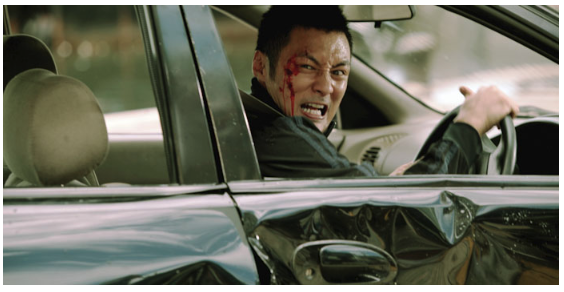
Motorway is the second film that Soi Cheang has made for Johnnie To’s Milkyway Studios, after the elaborately entertaining assassin drama Accident (2009). Where that is a clever expansion of the hitman movie, with its complicated Rube Goldberg made-to-look-like-accidents killings, Motorway is a reduction. Each of its characters is reduced to genre archetypes, with the audience using its knowledge of previous car chase films to fill in their background. The main driver is Chan Cheung (Shawn Yue), a speed freak gearhead who also works for the traffic cops in Kowloon. His partner is Lo Fung (the ever stone-faced Anthony Wong), who is near-retirement but is still haunted by the getaway driver Jiang (Guo Xiaodong) who escaped him decades previously. So of course that wheelman returns to Kowloon in order to spring his imprisoned pal Huang (Li Haitao), in order to set up the heist of a large diamond.
They are defined by their jobs and the roles as established by previous films. The enigmatic Jiang is descended straight from Ryan O’Neal in The Driver, whose every press of the accelerator seems to assuage some deep existential dread, while Chan, with his souped up vehicle and late night drag races, is a fugitive from the hyperactive Fast and Furious series – a hot-headed punk over his head. But while the characters are familiar, the chase scenes are not. They are uncannily intimate affairs, always at night under flickering neon lights, and they are paced and fought like duels. Cheang makes much out of dramatic pauses and rests. Jiang is constantly finding holes in the city to rest in, from the back of a truck to the obscured spot in a parking garage. There is a sense of vehicles as an extension of their bodies, no more so when Lo Fung rolls down his window in an effort to hear his adversary more than see him, as the darkening night corrodes his vision. The repeated close-ups of the engine block throbs with the energy of a heartbeat.
It is a thrillingly organic film, in which the lines of a map which Jiang is tracing morphs into the lines of the road, of the car, and of the street. And all of this rather quietly rendered structure does not diminish the impact of the chases. Using a camera attached low to the ground, Cheang and his cameraman capture the stunt-drivers locking horns through the streets of Hong Kong. I only detected CG in one shot, in which a car nearly tips over a cliff. Everything else was, at least in the movie-verse, authentic. Cheang told Edmund Lee at Time Out HK what he was going for:
I’m not exactly a fan of racing movies, but I have fond memories for the racing scenes in several crime thrillers, such as [William Friedkin’s] The French Connection (1971) and To Live and Die in L.A. (1985), as well as the likes of Ringo Lam’s Full Alert (1997). When you watch the old movies, you can actually feel that someone is driving the car; when you see The Fast and the Furious movies nowadays, you can’t help but feel that part of their beautiful [action sequences] have been animated. I really want to go back to the human dimension of driving. I want to find out who these drivers are as human beings.
You can sense the characters’ human qualities through their driving styles. Jiang is elusive and fond of trickery in his ancient S13, while Chan favors a more barreling forward damn-the-torpedoes style in the police sedan. Lo Fung is harder to pin down, as he is only given one opportunity to show his driving chops, called back to the wheel after decades of refusal. He prefers a more sensorial style, as indicated when he turns off the AC and lowers the window. But everything can fail, especially when one depends on machines.
For in Motorway crashes have devastating impact, the steel frames of cars as permeable as skin. The more the vehicles are mastered and become extensions of drivers’ bodies, the more vulnerable they become. Every protagonist is either bruised, battered or dead by the end, with Jiang’s rabbit-punches keeping Chan off-guard until a final showdown on a pier, in which both woozy fighters circle each other in a screeching pas de deux. Motorway is a brooding original which turns the manic breathlessness of a car chase into a subtle duel of personalities.
After a lengthy hold-out, I’ve galloped into the loving arms of Blu-Ray. It’s the right time to jump in, as the studios are (rather desperately) pushing the format hard, cutting prices across the board. You can pick up a player for around $150, with many library titles on sale for $10 (most new releases are set at $25). Starting in 2010, Warner Brothers will release every new theatrical release exclusively in “Blu-Ray combo packs”, which will contain the high-def disc along with the standard-def DVD (forcing consumers to buy the Blu-Ray and push them to upgrade). With HDTV prices finally starting to come down as well, Blu-Ray is finally a financially feasible option for cash-strapped cinephiles like myself.
I ended up purchasing a PS3 to pair with my Panasonic plasma in order to sate my long-suppressed video-gaming urges, as well as for its stellar Blu-Ray playback and new Netflix streaming capability. I flirted with the idea of an all-region player, as recommended by the folks at DVD Beaver, but wasn’t convinced there were enough region-locked releases to justify it, especially considering that the excellent Masters of Cinema series is region-free, as are all of the Hong Kong releases. So while I’m missing out on gems like ITV’s The Red Shoes, I console myself with games like Metal Gear Solid, Netflix, and the rush of new domestic releases (Criterion’s forthcoming Days of Heaven and Bigger Than Life Blu-rays are especially tempting).
After dipping into some of the sales (I picked up The Searchers and Robocop on the cheap), I decided to check in on my favorite production company, Milkyway Image. Johnnie To’s stalwart outfit has been churning out inventive genre pieces since 1996, the kind of work Hollywood has forgotten how to make (aside from flukes like Armored). I sampled two of their recent releases on Blu (available at HK retailers like YesAsia).
Soi Cheang’s Accident premiered at this year’s Venice Film Festival, and it’s a sleek paranoid thriller in the vein of Coppola’s The Conversation. The central gimmick has the obsessive-compulsive Brain (Louis Koo) lead a group of assassins (including Milkyway axiom Lam Suet) on murders that are staged to look like accidents. They build elaborate traps for their marks to waltz into, and their hands are clean. It’s the perfect setup for producer Johnnie To’s penchant for displaying process, the small details that build up to a murder, as he also shows off in Vengeance. I’m not familiar with Cheang’s work (he’s known most for his gangster film Dog Bite Dog), but he is adept with the Milkyway house style, which favors underplayed acting, minimal exposition, and a smooth delineation of space.
After Cheang sets up the group’s unerring precision in a bravura Rube Goldberg murder, he starts to expose the paranoia that drives Brain. His first action is to pick up a cigarette butt that “Uncle” (Fung Shui-Fan) leaves at the scene of their crime. He’s determined to erase any trace of their presence. When their next job goes tragically wrong, he becomes convinced it was the result of a conspiracy led by an insurance agent (Richie Ren). He then embarks upon an elaborate wire tapping scheme, moving into a unit underneath Ren’s apartment and listening to his every waking (and napping) moment. He even sketches the floor plan of his nemesis’ apartment on his ceiling.
Cheung , along with screenwriters Szeto Kam-Yuen and Tang Lik-Kei, withhold enough information to keep the truth of the matter ambiguous. Brain is either a canny chess-player – seeing many moves ahead – or an untreated paranoid schizophrenic – creating antagonistic worlds in his strained noggin. Louis Koo is perfect for the role, a blank slate of wiry tension and a football-field sized forehead that could contain multitudes of tortured grey matter. Cheung uses the motif of a solar eclipse to express the obfuscation of his mind’s eye, working multiple variations on the idea until the literally gut-wrenching climax.
Johnnie To’s latest film, Vengeance, was released last week on DVD and Blu-Ray by MegaStar (IFC has the film’s U.S. rights, with no release date as of yet), and it feels like a stand-in for the Le Cercle Rouge remake he never got off the ground. To’s love of Jean-Pierre Melville has never been so close to the surface. His protagonist, the mummified cool of Johnny Hallyday, is named Costello, just like Alain Delon in Le Samourai, and maintains his near-silent devotion to revenge, this time after the slaughter of his daughter’s family. But Johnnie To is also adept at wonderful scenes of hanging around, the interstitial moments between battles that To veins with humor and pathos. He surrounds Hallyday with his stellar repertory crew (Suet, Anthony Wong, Lam Ka-tung are the killers Hallyday hires to help him, while Simon Yam is the flamboyant villain), and has them enact their usual honor-among-thieves routine, which I could watch until the end of time. Anthony Wong has perfected a resigned weariness that plays beautifully off of Suet’s overeager child and Lam Ka-tung’s suave clotheshorse.
Set in Macau and starring a French rock star, it continues To’s interest in cross-cultural exchange, and is perhaps a nod to his increased visibility in the Western world. The film mixes English, French, and Cantonese, and the issue of (mis)communication becomes a major theme. This is established early on, when his daughter (Sylvie Testud), unable to speak, uses a French newspaper to get her thoughts across (later there is a bravura shootout set among composted newspapers). Then he has to bridge the language gap with Anthony Wong’s gang, in which he switches to English. The final act of the film charts his communication with himself, as he loses his memory and tries to trigger it again with a series of note-covered Polaroids. The final shoot-out is a brilliant encapsulation of the evolution of this theme, as he chases a target whose facial features he repeatedly forgets. It is a scene of constant self-communication and negotiation, as he checks and re-checks the bodies of the assailants in his way. There is also a minor motif of eye-holes and eclipses, similar to those in Accident, images related to the opening-up and closing-off of sight – just another few layers of meaning to To’s incredibly dense revenge drama. The image on both releases is phenomenal, the shimmering pastel blues of Accident and the deep blacks of Vengeance rendered with depth and incredible sharpness. They have my strongest recommendation.



 R. Emmet Sweeney