THE DEVIL INSIDE: THE FILMS OF KIM JEE-WOON

January 15, 2013

Screen Shot 2020-02-07 at 4.34.19 PM

For the past decade Korea has produced the most innovative genre films in the world, with directors Park Chan-wook, Bong Joon-ho and Kim Jee-woon reinvigorating revenge thrillers, police procedurals and westerns. This year Hollywood is playing catch-up, commissioning remakes of recent Korean hits and importing that influential trio to make their English language debuts. Spike Lee is shooting his version of Park’s seminal Oldboy, and Allen Hughes has signed on to redo Kim’s A Bittersweet Life (2005, and whose Tale of Two Sisters was Americanized in 2009 as The Uninvited). Bong is finishing up production on his dystopic sci-fi film Snowpiercer, starring Chris Evans, while Park’s psychological horror film Stoker, featuring Nicole Kidman, will be released on March 1st. The first out of the gate will be Kim’s action movie The Last Stand, opening this Friday, which marks the post-gubernatorial screen return of Arnold Schwarzenegger. Kim is a restless genre tweaker, using traditional templates and then pushing them to extremes. His style varies from the antic energy of his “kimchi Western” The Good, The Bad, The Weird to the elegant control of his criminal revenge saga A Bittersweet Life, but his films insistently return to the theme of self-destructive violence that pulses just below the surface of the human psyche.

Kim Jee-woon was born in Seoul in 1964. He studied at the Seoul Institute Of the Arts, but dropped out to pursue a career in the theater. He worked as an actor before moving into directing, credited with helming the productions of Hot Sea (1994) and Movie Movie (1995). Details are slim about this period of his career, but eventually he began submitting screenplays to local competitions. His first script, Wonderful Seasons, won the best screenplay award at the Premiere Scenario contest in 1997, while later that year The Quiet Familywon the 1st Cine21 Scenario Public Subscription Contest. The Quiet Family would be Kim’s first film, and he would write all of his scripts up until I Saw the Devil (2010). As Jinhee Choi writes in The South Korean Film Renaissance, he benefited from a shift in the industry. The Asian economic crisis of 1997-1998 made large corporations like Samsung skittish about investing in film production, while Daewoo sold off its theatre chains. Venture capitalists filled the void, with Ilshin Investment Co. funding 5-6 productions a year. Simply needing to fill their slate, untested directors like Kim got their shot.

The Quiet Family (1998) is a black farce about an isolated lodge and the loosely knit family who operates it. When their first customer commits suicide, they decide to hide it for fear of bad publicity. The cover up is worse than the crime, as bodies pile up with no end in sight (it was loosely re-made by Takashi Miike in his musical The Happiness of the Katakuris (2001)). Kim trawls through the halls in steadicam shots, providing blueprints of the lodge’s geography, orienting shots of normality soon to be spattered with blood. The film glides by on the charm of Song Kang-ho and Choi Min-sik, two icons early in their careers. Song was trained in improvisation for the theater, and he is already a magnetic, unpredictable presence, a menacing doofus who can whip his gangly appendages into a fighting stance at the slightest insult. Choi plays Song’s schlubby uncle, softening his bulldog face into one of resigned pliability. The whole family finds easy rationalizations for murder, and with each death they come easier and easier. Played for laughs, this quick and destructive slide into violence will pop up in the rest of his features, modulated according to his chosen genre’s mood.

He plays it for pathos in his follow-up, The Foul King (2000), in which sad sack bank employee Dae-Ho (Song Kang-ho) turns to pro wrestling to restore his dignity. An enormous hit in Korea with over 2 million ticket sales, it tapped into the angst of white collar salary slaves, where even karaoke becomes a matter of routine business.  Song Kang-ho again plays a deadbeat energized by violence, although this time the blows are choreographed, and he is a rumpled white collar rather than a live wire blue. While The Quiet Family is cartoonishly decimated by their violent actions, The Foul King is awakened by his pro wrestling performance, as if it were a male ritual needed to survive office life. Kim takes the inspirational sports movie and pushes it into Fight Club territory, with Dae-Ho feeling most alive only when going off script and bludgeoning his opponent. The cure, as in The Quiet Family, seems worse than the disease.

Kim took three years before making his next feature, workshopping his approach to the horror genre in short films. His entry in Three Extremes 2 (2002), “Memories”,  is his attempt to imitate the Japanese ghost stories that were still raking in money around the world thanks to Ringu (1998). A simple story of a husband haunted by his dead wife, Kim used it to experiment with POV, using jump cuts and flash backs to represent his main character’s troubled mind. He used these lessons in A Tale of Two Sisters (2003), melding the creepy Japanese ghost girl cliche and incorporating it into a classical Korean fairy tale, Janghwa Hongryeon. Two girls return to their country home after being discharged from a mental hospital, and are tormented by their stepmother and an unseen presence. Kim uses a gliding steadicam again to outline the geography of the house, and uses bird’s eye views to pin the girls to the ground as their self-deluding secrets come to light. Set design becomes more important – this house is far more detailed and alive than the one in The Quiet Family, with its blooming wallpaper and blood-red rugs, the house itself seems to be veined with blood.

Kim returns to a hyper-masculine world in A Bittersweet Life (2005), his first with high cheek-boned heartthrob Lee Byung-hun. Still interested in a kind of genre purity, this crime thriller, like A Tale of Two Sisters, is a classic genre narrative told without filigree. Lee plays Sun-woo, an enforcer at a luxury hotel for a local gang boss. Like the Quiet Family or Dae-ho, he has an unfulfilling job. An ascetic physical specimen who should be a Le Samourai style hitman, instead he’s tasked with rousting rival gang members from the bar and tailing his boss’ mistress. He is instructed to kill her if she is caught sleeping around, and his refusal sets in motion a series of bloody reprisals. Kim’s langorously tracking camera follows Sun-woo through his glimmering glass and steel universe, one exhausted of possibility, revealing only reflections. Lee is as drained of selfhood as the institutionalized Sisters, his motivation for revenge one of inertia. Neither Sun-woo or his boss can articulate why they are killing each other or why they can’t stop, only that it has started so it must end.

Later in 2005 Kim was a resident in the University of Iowa’s International Writing Program, marking a tonal shift in his work, his films regainng the self-reflexivity and jokiness of his first two features. The Good, The Bad, The Weird (2008) is a cartoonish spaghetti western spectacle that would make a good double feature with Django Unchained. Song Kang-ho returns to the fold as “The Weird”, a thief who steals a treasure map also valued by the Japanese army, a bounty hunter (Jung Woo-sung) and an outlaw (Lee Byung-hun). The film opens with a fist pounding on a map of Manchuria, and the film is a bloody satire on the absurd lengths men will go to defend and seek words on those maps. In the bravura opening train robbery sequence, Kim’s camera follows behind Song walks in a merchant’s disguise towards the safe car, passengers and guards ignoring him along the way. But when a man yells out, “Indpendence for Korea!” he is immediately flogged and tossed off. As the bounty hunter says, “if you have no country, you still gotta have money”, so the cynical trio circle each other, fighting over a map that leads to an unknown treasure. Any time one of the three places trust in another, there are double and triple crosses, each man out for himself and his own plot of land. Kim amps up the pacing and his cutting rate – it moves much faster than his previous films, and is filled with slashing diagonals of the three competitors crashing into the frame.

Kim’s first Hollywood deal was delayed by a year, and in the interim Choi Min-sik brought him a script by Park Hoon-jung: I Saw the Devil. It is the first film that Kim directed but did not write, although it fits snugly into his preoccupations. It takes the usual serial killer movie cliche, that the detective has to think like him in order to find him, to its logical endpoint. That is, the law in this film becomes just as sadistically violent as the serial killer, and the two engage in a grand guignol game of brinksmanship in which both try to inflict as much pain on the other without inducing death. Because dying would end their fun. Tying together various strands of his work, with its deluded protagonists, fairy tale haunted house (of cannibals) and self-destructive violence, it stands as a mid-career summing up, a transition to whatever this post-Hollywood phase brings.

The Last Stand, which I have not yet seen, is about a gang speeding on an escape route to Mexico. The only people capable to stop them are a small border-town sheriff and his deputies. It sounds like a natural extension of The Good, The Bad, The Weird, with its proto-Western scenario and focus on permeable borders. I’ve heard mixed reactions, to the film so far, but it doesn’t sound like Kim will ever be eager to return to the states. He told Korea JoongAng Daily that:

I found I was just another foreign worker here. [Laughs] I don’t have a lot of friends here and all I did was work, so in a way, I felt empathy toward foreign workers. I felt myself getting stronger when I set the goal for myself not to give up and to endure this loneliness.

He has already started development on his next Korean project, a live-action remake of Oshii Mamoru’s anime, Jin Roh: The Wolf Brigade. A version of the red riding hood tale set in an alternate history in which the Nazis won World War II and Japan is a totalitarian state, it would appear Kim is returning to his comfort zone, pushing folk tales and traditional genres to the brink of self-annihilation.

ALEKSANDR SOKUROV’S GHOST STORIES

January 8, 2013

Screen Shot 2020-02-07 at 4.29.31 PM

Aleksandr Sokurov’s Soviet Elegy (1989) begins with a tour of tombstones, the camera floating down rows of Communist phantoms. In the next sequence, Boris Yeltsin is shown stalking down a hallway, another kind of ghost, one aware of his coming obsolescence. Sokurov’s work is a series of elegies, in which ghosts of history mourn for themselves. Cinema Guild has illustrated this development in their three-disc box set of Sokurov: Early Masterworks. It contains the three features Save and Protect (1990, DVD), Stone (1992, DVD) and Whispering Pages (1994, Blu-Ray), plus three of his shorts, including Soviet Elegy. Each displays his increasingly idiosyncratic visual sense, in which he uses distorting lenses to produce stretched figures akin to El Greco saints, yearning for a God who doesn’t respond. Sokurov is often compared to Andrei Tarkovsky, the previous Russian spiritual guide/director. But while Tarkovsky often offers the possibility of transcendence, there is no such hope in Sokurov, just figures circling a void.

0000239823

These are demanding, deeply eccentric works, and none are more so than his Madame Bovary adaptation, Save and Protect. Sokurov focuses on Emma Bovary’s illict affairs, and cuts out her husband Charles almost entirely. He casts the skeletal Cecile Zervudacki as Emma, her recessed eyes and slender frame giving her the aura of an underfed zombie. Instead of brains its sex she’s after, feeding on the libidos of a series of romance-novel handsome beaus. Never satisfied, she wanders the Siberian steppe for 133 minutes in an aimless pursuit of a lasting human connection. Sokurov introduces anachronisms into the 19th century scene, as when the strains of “When the Saints Go Marching In” starts playing over an unseen radio, suggesting that Emma’s Sisyphean task will take multiple lifetimes.

Named by Susan Sontag as one of the greatest films of the 1990s, Stone takes Sokurov’s interest in the undead and applies his increasingly distorted visual scheme to it. It presents the claustrophobic scenario of a museum attendant at the Chekhov Musuem who spends all his time with a mysterious bearded stranger – the unsettled ghost of Chekhov himself. Almost entirely restricted to the interiors of the musuem, and shot in grainy B&W with image-stretching lenses that round the frame edge, the film has the constrained feel of a nightmare taking place in a snow globe, or that one is walking inside Sokurov’s own head. Of the realist writers of the late 19th century (Flaubert, Chekhov, Dickens, Tolstoy), he told Cineaste that, “This is the kind of literary world within which I could exist eternally.” With Save and Protect and Stone he attempts to. With even less narrative thread than Save and ProtectStone presents the attendant and his ghostly pal in scenes of uncanny silence, the soundtrack a melange of breathing, ambient noise and Mahler. When the two wander outside they are rendered as two silhouettes separated from the landscape, as if they were just shadows against a wall.

Whispering Pages is another elegy for and escape into realist literature, this time of Dostoyevsky’s Crime and Punishment stripped of narrative. Sokurov’s Raskolnikov is not named, nor does he act. He simply skulks around the whitish-gray black and white, which occasionally dissolves into lifeless color, of the decaying city. It is a wet city, as damp as the village in Stalker, except there is no Room which promises escape. Sokurov’s elongated figures, often shot at low angles, seem to reach toward the sky, but fail to ever touch it, or reach it. Instead they trundle through film grain and dust motes and rain, an endless array of obstacles placed in front of them. All of these elements work on erasing people from the landscape, like the way the apartments are falling apart at the seams. In one disorienting shot, the camera peers up from the ground, towards Raskolnikov at right, and a tower straight ahead. People are jumping off, down past the camera and presumably towards their death. Nothing is shown or explained, just nature reclaiming some of its own. He exchanges some glances with a neighborhood girl, but entropy takes them all. In the sodden resignation of the final shot, Raskolnikov sits at the foot of a lion statue, the giant paw obscuring his head. Eventually the human figure disappears. All that’s left is a manmade object, with no one left to admire it.

The Soviet Elegy also contains a long reading of names of Russian leaders, a cinematic memorial to the builders of the Soviet state that was now ending. This micro-portrait of Yeltsin foretells not only his Tetralogy of Power, wherein he made films on the Hitler, Lenin, Hirohito and Faust, but also these early features, in which the undead hold more sway than the living. Sokurov’s films are dreams of memories, or memories of dreams, in which the writers, characters and leaders that formed his consciousness awake and wander, and find us wanting.

Technical notes: Save and Protect and Stone were transferred from what looks like old release prints, and contain persistent flecks and scratches, as well as end of reel markings. The original negative for Whispering Pages was “completely unusable”, according to the disc, so the pleasing HD transfer was made from a negative found in Germany. No apparent digital restoration was done, so there are still plentiful flecks and scratches, but it looks the best out of the bunch. Considering the rarity of these titles, we should be grateful we can see these in any form.

“FIRST LOOK” AT THE MUSEUM OF THE MOVING IMAGE

January 1, 2013

Screen Shot 2020-02-07 at 4.24.23 PM

The beginning of the New Year means it’s time to catch up with the old. For the second year running the “First Look” series at the Museum of the Moving Image (January 4 – 13) provides an invaluable showcase for undistributed international cinema. Programmers Rachael Rakes, Dennis Lim and David Schwartz pluck adventurous work from festivals around the world, tracking developments in documentary form, the Berlin School, Korean indies and the continuing vibrancy of Portuguese film culture. In a clue as to the series’ disregard of commercial impulses, the series’ opening night film is Hors Satan, the latest by the divisive arthouse provocateur Bruno Dumont. Operating as a relatively youthful version of the New York Film Festival, First Look is an attempt to clue its audiences in to the possible future of the medium.

Screen Shot 2020-02-07 at 4.25.07 PM

If you’re looking for a crime flick alternative to Jack Reacher, you should seek out Thomas Arslan’s In the Shadows, a terse heist film worthy of both Jean-Pierre Melville  and Donald Westlake. Released in Germany in 2010, it has never been shown in the U.S. aside from sparse festival screenings. Arslan has been grouped in the “Berlin School” of filmmakers along with Christian Petzold and Angela Schanelec, as they all attended the German Film and Television Academy in the early 1990s under the tutelage of Hartmut Bitomsky and Harun Farocki (for more on the Berlin School read Marco Abel in Cineaste). Their style tends toward coolly observational reworkings of traditional genres, as last year’s “First Look” selection from the Berlin School, Christoph Hochhausler’s The City Below, rethought the corporate thriller. For In the Shadows, Arslan wrote an original script but is clearly channeling the stoic Melville hero from Le Samourai. The lead actor Misel Maticevic has more than a passing resemblance to Alain Delon, and plays a similar figure of blank professionalism. Known only as “Trojan”, Maticevic stalks through a glimmering Berlin of glass and chrome after being released from jail. Arslan often frames him in the corners of cafe windows, always watching and waiting for a lucrative gig to come his way. If the character is pure Melville the plot is straight from Westlake’s Parker novels, obsessed with the process of executing lucrative small time crimes. Trojan is constantly forming and reforming plans, covering for every contingency, sticking wedges of paper in hotel doors as a makeshift alarm systems and knifing through fights to leave as little evidence of his presence as possible. Arslan would be the ideal candidate to direct Jason Statham in the forthcoming Parker movie, but instead he’s moving on to recast another genre. This year Gold will premiere, his Klondike gold rush Western starring that brilliant blonde axiom of the Berlin School group, Nina Hoss (Barbara).

Another title for Jang Kun-jae’s Sleepless Night could be This is 30. A slender 65 minute reverie about a young married couple, this is a deceptively slight film that trembles with unspoken terrors. An unexceptional couple, the man a factory worker, the woman a yoga instructor, spend their days and nights together as one extended embrace. Actors Kim Soo-hyun and Kim Joo-ryeong ooze pheremonal attraction, each gaze and gentle graze positioned so they fit together like puzzle pieces.  The film uses the standard static camera/long take strategy of too many festival films, but these actors justify the strategy, their movements more than making up for the camera’s lack. The couple’s perennial youth must fade, however, and a hilariously picky post-dinner party argument introduces a fissure in their bond that both soon wish to ignore. The change is registered in their bodies, made clear in a final shot in which the wife looks at the husband, and he is looking at the stars.

Sleepless Night is so lived in, and such a reflection of my own life at this stage, that it feels like a documentary, whereas the actual documentaries on display are more composed and choreographed.  Inori is Pedro Gonzalez-Rubio’s follow-up to his gorgeous family drama on a Mexican coral reef Alamar, and it continues his ethnographic fascination with outsider communities. This time he follows a shrinking mountain village in Japan in which only the elderly remain. The school has turned into a walk-in clinic and the main occupation is decorating memorial shrines, with the residents seeming sanguine about the prospects of nature retaking their once bustling home. The film is a patient one that simply looks and listens, a recording of the dying light. The HD images are gorgeous, but I could have done without the overdetermined symbolism of one of the final shots – a woman’s face reflected in a ticking clock. Arraianos is Eloy Enciso’s more experimental take on the same material. He also filmed an aging community, this time on the Galicia-Portugal border. Along with documenting their traditional farming techniques and asking them to sing old folk songs, he has the villagers act out scenes from the play “The Forest” by Galician writer Jenaro Marinhas del Valle. These recitations in the forest and bars recalls the quotation heavy late works of Straub-Huillet, but with none of their wit.

One who could never be decried for his lack of wit is Thom Andersen, whose latest filmic essay Reconversion (Reconversao) examines the work of Portuguese architect Eduardo Souto de Moura. It is an education and a delightful one. Andersen’s fastidious work goes project-by-project through Souto de Moura’s career, traveling to each site as it looks today, providing historical context along with liberal quotes from the highly quotable architect. Souto de Moura is obsessed with the concept of ruins, which he considers the “natural state of the work, a work that comes to an end.” The series excavates another ruin with Xavier (1991/2001), an independent feature started in 1991, completed in 2001, and rarely screened afterward. Director Manuel Mozos was a friend and mentor to director Miguel Gomes, whose miraculous Tabu continues to wend its way across the U.S., and Gomes returned the favor by programming a series of Mozos’ work at last year’s Viennale (Vienna Film Festival). A melancholy no-budget drama about being young and lost, it follows the title character (Pedro Hestnes) as he returns from the army to a life of short-term jobs and shorter-term relationships. Abandoned by his mentally absent mother as a child, Xavier’s impulse is to drift instead of connect. A supreme hangout movie, Mozos shoots on the streets of Lisbon as Xavier and his fuckup pals kill time in cafes and bars, waiting for their lives to begin.

The most indelible entries in the shorts program, Mati Diop’s Snow Canon and Kleber Mendonca Filho’s Eletrodomestica, convey a similar atmosphere of waiting, of the in-between moments that define lives. Diop, best known for acting in Claire Denis’ 35 Shots of Rum, is also a born filmmaker (her uncle is the Senegalese director Djibril Diop Mambéty). Snow Canon is a uniquely tactile coming-of-age film, set in a cabin in a French Alps resort. Structured around a pattern of inside/outside, a young girl stares idly at the mountaintops out her window, while building an erotic life inside her head. First it is a cute male babysitter, but he is replaced by an American girl, who suffers a breakup and leaves her emotionally raw. Connecting through dress-up and fantasy, the two build an erotic tension that is only made manifest when both step into the fresh air outside, and their dreams briefly come true. Mendonca Filho’s film is a dry run for his stunning debut feature Neighboring Sounds, a rhythmically cut day-in-the-life of a middle class housewife in Recife, Brazil. Satiric where Neighboring Sounds is more observational, Eletrodomestica shows a household that worships technology to the point of absurdity, using it to cook, clean, do homework, and even self-pleasure. The First Look series is nothing if not pleasurable, a refreshingly hype-free and forward-looking fest that has the added benefit of making you look smart when one of these immensely talented filmmakers makes the next festival hit.

Man of the West: Booklet Essay

product_2357

Man of the West is riven with pain. Made in 1958 during the twilight of the Western genre, it is reflective and interiorized, mapping twisted psychological landscapes over the flattened physical ones. Director Anthony Mann was obsessed with transposing King Lear into the Western, with Lear figures appearing in The Furies (1950), The Man From Laramie (1955), and Man of the West. Mann had dreams of making a more faithful Western adaptation of Lear, and would pursue it the rest of his life. He was working on a version simply titled The King at the time of his death in 1967.

In The Furies and The Man From Laramie these dissipated patriarchs are corrupted cattle barons, while in Man of the West it is a sociopathic dementia-addled bandit named Dock Tobin (Lee J. Cobb) – who has three sons instead of Lear’s daughters. Gary Cooper plays Dock’s nephew Link, who was once in murderous thrall to Dock, but has since reformed and married. After a thwarted train robbery Link is absorbed back into Dock’s orbit, and is forced to confront the sins of his youth.

Man of the West was initiated by producer Walter C. Mirisch, who had moved his independent production unit from Allied Artists over to United Artists. He had an affection for aging, totemic Western stars, but tried to pair them with more “adult”, and violent, subject matter. Mirisch’s first production for UA was Fort Massacre (1958), a siege Western starring Joel McCrea. McCrea played a cavalry commander pushed to madness by his hatred of the Apache. The next star Mirisch wanted to dirty up was Cooper. So he sent him the novel The Border Jumpers by Will C. Brown, which Cooper approved. Instead of handing script duties to a genre veteran, Mirisch gave the job to Reginald Rose, who came out of high-toned television dramas, and who had written the popular film adaptation of 12 Angry Men (1957).

The script was a hard and violent character study, so Mirisch then brought on Anthony Mann to bring out its psychological subtleties. Mann had recently completed a remarkable series of five Westerns with James Stewart, ending with The Man From Laramie. In Laramie Stewart wandered into the Oedipal anxieties of a power hungry cattle family, the Western landscape a battleground of macho neuroses. The family unit in Man of the West is even more perverse, an all-male gang of thieves led by a half-mad old coot.

Dock Tobin seems to have cracked since Link’s departure, his crew a sloppy bunch of thugs and idiots, including a sweaty mute (Royal Dano) and a jumpy pervert (Jack Lord) Unlike Lear, there is no one left to inherit his ramshackle kingdom (an isolated ranch).  The re-appearance of Link ignites his old dreams, and so the old man ranting in a rocking chair flails to life, scheming a big bank job. He immediately begins remembering their past exploits: ”God forgive us we painted their walls with blood that time”.  But the bank no longer exists — it’s just another figment of past glories swirling in Dock’s head.

This is one of Mann’s most precisely choreographed films, with figures constantly activating each quadrant of the CinemaScope frame. The extended night sequence set at Dock’s ranch shows his command of composition. Link, along with two civilians, have been stranded by a botched train heist. The only home within walking distance is Dock’s, so LInk plays along with Dock’s delusion until he can figure a way out. At their first meeting in the ranch house the Tobin gang and Link stand stock still as Dock weaves his way between them, as if Dock had stopped time through his reminiscences. As the evening progresses it moves from Dock’s dreams to a living nightmare. The stillness of the Tobin gang remains (Jonathan Rosenbaum has compared these compositions to Antonioni), but the threat of violence ratchets up when Billie (Julie London) enters the room. Mann begins to utilize low-angle, looming close-ups, while the flickering of the lamplight captured by DP Ernest Haller gives the room an infernal feel. Eventually Link is held at knifepoint as Billie is forced to strip. It only stops when Dock asserts his newfound virility and orders everyone out, emptying out the frame. The whole sequence is a series of constricting horizontals, a visual template that reappears in the final shootout, done in between the floor slats of crumbling ghost town homes.

The whole film feels like an ending. For Westerns at large, for Anthony Mann’s artistic peak , and for the career of Gary Cooper. It is one of Cooper’s greatest performances, borne out of intense physical debility. At the time of shooting Cooper was almost sixty, and suffering from intense back pain, which he blamed on an old hip injury. For him the production was a test of how much pain he could endure. Mirisch marveled at his professionalism: “That particular day, I saw that Coop was very upset. When I asked him what the trouble was, he told me his back pain was just excruciating. …He told me that the pain of riding his horse down that street was almost unendurable. I could see it in his face. I suggested to him that he let his double…do the ride in a long shot. But he wouldn’t hear of it. He said, ‘No, I have to do it. You have to be close on me.’ And he did do the ride down that street himself.” It is unclear if his poor health was related to the prostate cancer that ultimately killed him in 1961, but his body was failing him. His performance is heroic – one of tensed, grimacing fragility, his reformed outlaw clinging to life out of sheer will.

Though he does not portray the Lear role, he conveys its complicated emotions more than Lee J. Cobb’s more straightforward, harrumphing villainy. Cooper is conflicted, violent, and obsolete, introduced gawking at the new railroad carving through the West. He recoils from the smoke belched out by these iron leviathans. He has to board the beast, and these opening sequences are almost slapstick, as Cooper fumbles with his seat and repeatedly lunges into the passenger ahead of him. He only regains his authority by entering into Tobin’s demented dream of their shared violent past. Cooper forces his body into its familiar ramrod posture to once again face down the bad guys, with his mortality pressing down on every frame.

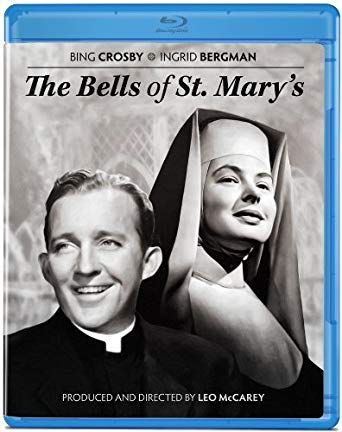
THE LOOK OF LOVE: THE BELLS OF ST. MARY’S (1945)

51tj6RapBXL._SX342_

Originally published in a booklet for the 2013 Olive Films Blu-ray release.

As WWII was winding down, the most popular character in America was the singing priest Chuck O’Malley. As portrayed by Bing Crosby, O’Malley was an amiable reformist, trying to bring Catholicism out of the cathedral and onto the streets. Created in collaboration with director Leo McCarey, Going My Way (1944) and The Bells of St. Mary’s (1945) were the highest grossing films of their year, and amassed ten Academy Awards between them. Adjusted for inflation, The Bells of St. Mary’s made more money domestically than The Dark Knight Rises (2012). Father O’Malley is a kind of Catholic superhero, trying to modernize the religion before it lapses into irrelevancy.

Following Going My Way, McCarey was one of the highest paid men in America, and he could call his own shots. He formed a production company, Rainbow, and started planning the sequel, The Bells of St. Mary’s, which he sold to RKO (Going My Way was distributed through Paramount). He developed the story with screenwriter Dudley Nichols, which focuses on the efforts of Sister Mary Benedict (Ingrid Bergman) to acquire a new building for her crumbling school, which will soon be shut down because of code violations. Father O’Malley is the new parish priest who must try and corral her ambition.

Bergman was under contract with David O. Selznick, so RKO had to pay him $175,000 to borrow her services, as well as sell him the rights to Little Women and A Bill of Divorcement. Bergman recalled how Selznick attempted to dissuade her from accepting the role, arguing that she “would just be a stooge for Bing Crosby’s singing.” She was enraptured by McCarey’s energy, though, and felt that, “If you didn’t like him, there was something wrong with you.” It was a hefty sum for RKO to pay, but Bergman had just won the Best Actress Oscar for Gaslight, and teaming her up with Crosby was the safest box office bet in town. Crosby was an altar boy as a teenager, and attended a Jesuit secondary school, but dropped out of Gonzaga to pursue a career in music. Conversant with both laissez-faire parishioners and strict observers, he was the ideal personality to bridge the gap between the traditionalist and progressive wings of the Catholic church.

While the episodic Going My Way has a tendency to meander, The Bells of St. Mary’s is anchored by the bubbling rapport between Crosby and Bergman. In a reversal of traditional gender roles, O’Malley is presented as a tender nurturer, while Sister Mary is strict and assertive, even teaching a young boy how to box. Crosby is introduced to St. Mary’s school through a series of humiliations. He is chastised by the maid (Una O’Connor), who clucks “I see you don’t know what it means to be up to your neck in nuns”. In Going My Way he owns every room he’s in with his laid back charm, whereas when he lays back here, he accidentally hits a buzzer and rouses the whole convent. Upon entering the conclave, he proceeds to sit down on a shrieking kitten. And when he gives his welcome address to the nuns, another cat toys with a straw hat behind him, causing the sisters to erupt in laughter.

Despite these indignities, Father O’Malley is still eager to assert his masculinity, so after two kids end up in a brawl, he expresses pride that they stood up for themselves. He tells Sister Mary, “On the outside, it’s a man’s world.” Mary replies, “How are they doing, father?” Their shifting power relations are expressed through the direction of their gaze. Mary begins her retort with modesty, eyes looking down, but by the end of her pointed phrase they drift up and stare straight off-screen at O’Malley, with the edges of her mouth curling into a grin. In his reaction shot O’Malley exhales and looks down, mumbling, “not doing too good” under his breath. This oblique reference to the horrors of WWII is also a decisive moment in their relationship. From here on out they exchange roles – Mary will exert aggression, and O’Malley compassion, accepting his subordinate role in the school’s pecking order.   He becomes a matchmaker for an estranged husband and wife whose daughter attends the school, while Sister Mary teaches her kids how to swing a baseball bat and throw a punch.

McCarey modeled Bergman’s character after his aunt, also named Sister Mary Benedict, a member of the Immaculate Heart Convent in Hollywood. Bergman portrays her with impish exuberance, an admitted tomboy who still finds pleasure in upsetting the expectations of how a nun is supposed to act. Bergman is very loose and inventive, and contributed eagerly to the improvisations that McCarey encouraged. Off-hand gestures, like how she flips a baseball off her wrist in a sporting goods store, or exaggerates her footwork during a boxing lesson, were made possible by McCarey’s improvisatory process. During down time, the director would sit at a piano and spitball ideas with the cast, encouraging acts of wild spontaneity. Bergman was already feeling free, not having to worry about her figure since she was clothed in a nun’s habit for the entire feature. “I was like a child with money”, she recalled, “and in the country of the greatest ice cream.”

McCarey put this improvisatory process on the screen with the Christmas Play, which Sister Mary is overseeing. She lets the children write it themselves, and informs O’Malley that, “Every time they do it, the dialogue is different.” The children are clearly making it up as they go along, as Bobby (the son of musical director Robert Emmett Dolan) hems and haws his way through the story of the birth of Jesus, ending in a tableaux of golf-club wielding shepherds. Instead of closing with “O Holy Night”, the kids sing “Happy Birthday”. Despite being set at a Catholic school, The Bells of St. Mary’s is quite secular, presenting the church as more of a social services organization than a religious one.

This is made explicit with the subplot of Patsy Gallagher (Joan Carroll), whose single mother pays the bills through prostitution. O’Malley takes her in as a student without asking questions, and tracks down her errant pianist father. This whole section plays like canned melodrama, a staid commercial for the value of church in the community. It almost seems as if McCarey included these scenes so he could get away with the more subversive antics of the rest of the movie.

One of the next turning points in the film occurs during a secular song. Sister Mary is singing a traditional Swedish folk tune by the piano with the nuns gathered all around her. O’Malley is attracted to the scene by her lilting soprano. He steps towards the circle, and McCarey cuts into a shot from his POV. It is the most artful composition in this otherwise classically framed film, in which two black habits join in the foreground to make a “V” shape, with Sister Mary’s face centered in the middle, as if in a cameo necklace. It is a devotional image, but this is not a religious psalm, but a love song.

Her eyes are shaded downward as she trills the lyrics, which roughly translate to: “Spring breezes whisper and caress loving couples/Streams rush by/But they are not as swift as my heart”. As she winds the song to a close, her voice lowers. But she inches up her head and finally sees O’Malley, which makes her voice fly up the scale to hit her highest note, which breaks up into a chuckle and a grin: “Oh, Father O’Malley!” In recognizing his gaze, she breaks the spell, but the tenor of their relationship has changed.

Their reciprocal glances continue to build in intensity, as word comes down that Mary will be transferred to another convent out West. It is ordered by her doctor, but O’Malley has to pretend it was his decision. This betrayal of trust triggers her shift from secular to spirtual, folk song to prayer. Before her departure, she kneels in in the chapel. Her eyes are directed upwards as she pleads,“Dear Lord, remove all bitterness from my heart”. It is a rare acknowledgment of God’s presence in a film otherwise occupied with the physical. As she passes by O’Malley outside the doors of the convent, her stare is unwavering, as she searches for some flicker of regret in his face. But there is none.

As she is about to depart, her prayer is answered. O’Malley calls her back, and gives her the truth. He did not order her re-assignment. Sister Mary closes her eyes in ecstasy, a beaming smile lighting up her face. She simply says, “Thank you, father. You’ve made me very happy.” They hold each other with their gazes, neither breaking away. For the first time their looks are equal. This is as close as they can come to a declaration of love.

Aware of the erotic tension of this goodbye, Ingrid Bergman planned a practical joke on the final day of shooting. In one of the last takes she threw her arms around a stunned Crosby and kissed him passionately on the lips. Reportedly one of the priests on the set jumped up and yelled, “You can’t use that!” McCarey didn’t, but this missing negative should be as sought after as the original cut of The Magnificent Ambersons. Something else to pray for.

John Ford: A Biography

I wrote this biography of John Ford for TCM’s DVD box set John Ford: The Columbia Films Collection (2013)

ford columbia

In 1967 Kenneth Tynan asked Orson Welles which directors he most admired. Welles responded: “The old masters. By which I mean John Ford, John Ford, and John Ford.” In the short history of moving images, John Ford occupies a uniquely revered position. He won a record four Best Director Oscars while remaining as popular with moviegoers as critics. His films were rousing entertainments that also picked at the contradictions of American life, of individual freedom vs. community, civilization vs. wilderness. These contradictions settle in the person of John Wayne, who forges a new society in Stagecoach (1939), violently holds it together in The Searchers (1956), and exposes the lies of its construction in The Man Who Shot Liberty Valance (1962). Ford’s films are as American as apple pie and armed aggression, and Ford is a great enough artist to encompass both.

John Martin Feeney was born in 1894 in a two-story farmhouse in Cape Elizabeth, Maine to his mother Barbara and father John. He was their tenth child, but only the sixth to survive. Both of his parents had emigrated to the United States from Spiddal, Ireland. John Sr. worked for the gas company, and made extra cash by selling bootleg whiskey to sailors and dockworkers. He eventually saved up enough money to purchase what would become Feeney’s Saloon, the new family business. John Jr. was a poor student but a devotee of the Nickelodeon theaters, and found his way into the movies when he discovered his wayward brother Francis had changed his surname to “Ford” and become a successful actor and director. After graduating high school, he briefly attended the University of Maine in the school of agriculture. He quickly decided dredging pig slop wasn’t for him, and sent his brother a wire asking for a job at Universal. He left for Southern California by train in July 1914.

His first job was as a studio ditchdigger, but he pitched in wherever he could. He was a stuntman, prop wrangler, camera operator, assistant director and actor, learning the whole business from the ground up. He even nabbed a bit part in D.W. Griffith’s The Birth of a Nation (1915) as a hooded member of the Ku Klux Klan. He made his directorial debut on the two-reel Western The Tornado (1917), credited with his nickname, “Jack Ford”. The majority of the 40-plus films he directed for Universal have been lost. The greatest losses were the 24 films he made with Harry Carey, only one of which survives (Straight Shooting (1917)). Carey was known as the “Bronx Cowboy”, a rough-and-ready hero more realistic than the spic-and-span Tom Mix. Ford described the Carey persona as, “sort of a bum, a saddle tramp, instead of a great bold gunfighting hero.” The director would look back fondly on these films, dedicating 3 Godfathers (1948) to Harry Carey, and making Carey’s son Harry Carey, Jr. part of his stock company of actors. John Wayne would pay his own homage at the end of The Searchers (1956), by mimicking Carey’s famed gesture of gripping his right elbow with his left hand.

In 1920 Universal agreed to lend Ford’s services to Fox, the studio for whom he would make more than 50 features over 30 years. In another milestone that year, he would wed Mary McBryde Smith, a North Carolina native of Scottish and Irish descent. Their marriage was a rocky one, but like a good Catholic he never divorced. Together they had two children, Barbara and Patrick.

Ford’s first film for Fox was the lyrical small town comedy Just Pals (1920), and the last the WWI comedy What Price Glory (1952). As Harry Carey’s star waned in 1921, Ford left Universal for good and signed a long-term contract with Fox. The Iron Horse (1924) was his first big-budget spectacular, an epic  re-telling of the construction of the transcontinental railroad that movingly conveys the immigrant experience (it was inspired by John’s Irish uncle Mike). 3 Bad Men (1926) is a less triumphal version of American expansionism, an intimate tragicomedy about three outlaws who escort a grieving daughter to her land claim. Darkened with chiaroscuro lighting by DP George Schneiderman, it reckons with the price paid in blood by the push Westward. As the popularity of the genre sunk, Ford wouldn’t make another Western until Stagecoach (1939).

Fox at that time was under the spell of German master F.W. Murnau, who had come stateside to film Sunrise (1927). His mobile camera and expressionistic lighting deeply affected Ford, whose works in this period bear Murnau’s influence. It is most evident in Four Sons (1928), a WWI melodrama about a Bavarian widow whose children all enlist in the war, and it re-emerges in Pilgrimage (1933) and The Informer (1935). With the Western in eclipse and the emergence of sound, Ford experimented in a variety of genres, including gangster films (Born Reckless, 1930), underwater action (Men Without Women, 1930) and jailhouse comedies (Up the River, 1930). The last featured the debuts of Spencer Tracy and Humphrey Bogart.

His films of the mid-1930s can be split into the “serious” works he made for RKO, like the IRA drama The Informer and WWI morality play The Lost Patrol (1934), and his more commercial films for Fox, like his trilogy of bucolic small town comedies with Will Rogers: Doctor Bull (1933), Judge Priest (1934) and Steamboat ‘Round the Bend (1935). He netted his first Best Director Oscar for The Informer, but today the Rogers films seem more personal. They are visions of troubled melting pot communities held together by the folksy, open-minded progressiveness of Will Rogers, the kind of society that might have sprung up after the church raising in My Darling Clementine (1946). Ford later re-made Judge Priest as The Sun Shines Bright (1953), and named it the favorite of his films.

John Ford became the John Ford of legend with the release of Stagecoach in 1939. While the number of Westerns being produced was again on an uptick after over a decade of decline, the vast majority were cheap B-pictures. So when Ford started shopping his adaptation of the Ernest Haycox short story “Stage to Lordsburg,” it took him a year and a half to land the picture with Walter Wanger for distribution through United Artists. John Wayne, a former bit player for Ford who was making B-Westerns for Poverty Row studio Republic Pictures, was tapped for the lead. It was the first film that Ford shot at Monument Valley in Utah, the pockmarked moonscape that would become the testing ground of his Western protagonists for decades to come. A swiftly paced adventure that also pokes holes in classist bourgeois values, it helped to kickstart a new cycle of Western films and launched Wayne into the stratosphere. Orson Welles screened it repeatedly to learn film form before making Citizen Kane (1941).

The film’s success led to an astonishing burst of creativity, leading to what is informally known as Ford’s “Americana Trilogy”: Young Mr. Lincoln (1939), Drums Along the Mohawk (1939), and The Grapes of Wrath (1940). A mix of Popular Front politics and Ford’s brand of populist patriotism, they span the era from the Revolutionary War to the Dust Bowl, and etch Henry Ford as a symbol of American decency, which, in Drums and Grapes, has revolutionary implications. Ford would go back to his roots for How Green Was My Valley (1941), his melancholy portrait of industrial progress, as a Welsh mining family declines along with the ascent of mechanization. Famous for beating Citizen Kane for the Best Picture Oscar, it is one of Ford’s most emotionally wrenching works, and introduces a skepticism towards “progress” that he returned to throughout his career.

It was his last feature before the onset of WWII, during which he served as a Commander in the U.S. Navy, and led the Field Photographic Branch of the Office of Strategic Services, for whom he directed a number of propaganda films, from the syphilis scare flick Sex Hygiene (1942) to the harrowing battle footage of The Battle of Midway (1942). Midway and December 7th (1943) would win Best Documentary Feature and Short awards, respectively, but the bulk of his work for the OSS was secret, filming “guerillas, saboteurs, Resistance outfits.” After being discharged, he built the Field Photo Farm, a decked-out retreat where his Navy pals gathered every Memorial Day, and which had as its centerpiece a chapel in which the names of their deceased colleagues were etched. It remained in use until the end of his life.

His first feature after the war was They Were Expendable (1945), a downbeat portrait of a stretched-thin PT boat crew defending the Philippines from Japanese attack. The elegiac script was written by Ford’s Navy pal Frank “Spig” Wead, whose tragic life he captured in the bio-pic The Wings of Eagles (1957). After Ford’s immersion in the present, the rest of the 1940s find him grappling with the myths of the American West, beginning with Wyatt Earp and My Darling Clementine (1946). Henry Fonda, that paragon of virtue, turns the Earp role into that of a civilizing figure, clearing a path for community to rise in the violent go-it-alone ethos of the frontier. In the “Cavalry Trilogy” that begins with Fort Apache (1948), Fonda plays against type as an uptight martinet who leads his troops into a slaughter. Similar to the “print the legend” decision in The Man Who Shot Liberty Valance (1962), which covers up the real identity of the title’s shooter, Fonda’s folly is hidden and he is recast as a hero. John Wayne plays the scout who buries the truth and prints the legend. In She Wore a Yellow Ribbon (1949) and Rio Grande (1950), Wayne is an aging officerat peace with the moral compromises of the job. He is headed for retirement but is wary of the generation that will follow him, clashing with his subordinates and his children. Here again Ford is a skeptic of progress.

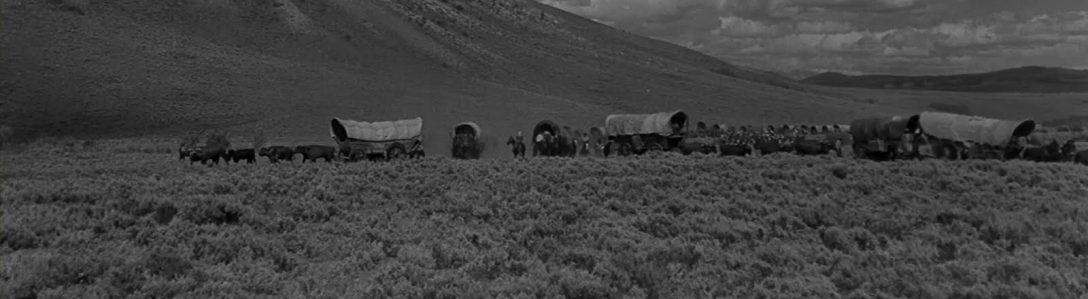
Wagon Master (1950) is one of his lesser known Westerns, but perfectly expresses Ford’s vision of community. Starring Ben Johnson and Harry Carey Jr., it follows a wagon train of Mormons and Medicine Show performers as they head west for the promised land. Ejected from every city they land in, together they create an outsider society of their own. In The Quiet Man (1952), John Wayne runs away from a violent past into the Emerald Isle, shot in eye-popping Technicolor by Winston C. Hoch. One of Ford’s passion projects, he had been trying to get it made since 1935, and finally convinced Republic Pictures’ Herbert Yates to back it after getting Wayne and Maureen O’Hara to accept pay cuts. Filled with knockabout Irish comedy and sweeping romance, it became one of Ford’s most popular pictures, and he won his final Best Director Oscar for his efforts. His other personal project for Republic, the Judge Priest remake The Sun Shines Bright (1953), disappeared quickly from theaters. A profoundly moving tale of tolerance, its plainspoken cornpone honesty did not connect with audiences.

Ford soon proved his box office bona fides with Mogambo (1953), an exotic big game hunting adventure with Clark Gable and Ava Gardner. On the shoot in Africa he contracted amoebic dysentery, which eventually led to cataract surgery and the donning of his trademark eyepatch. Always a heavy drinker, his alcoholism became chronic in this period, leading to the chaotic Mister Roberts (1955) production, for which Henry Fonda returned to the screen after eight years on Broadway. The two clashed, and the combination of drink and stress led to a ruptured gall bladder. Mervyn Leroy was called in to finish the production. The film was a hit in spite of itself.

Out of the chaos of Mister Roberts came Ford’s supreme masterpiece, The Searchers. Invigorated by his return to the Western genre and Monument Valley, it is an immersive journey into the dark heart of America. John Wayne plays Ethan Edwards, former Confederate soldier and mercenary gun for hire on a vengeful quest into Comanche territory to recover his kidnapped niece, whose parents were slaughtered. He is a virulent racist set on killing the niece sullied by the Comanche—Westward expansion envisioned as genocide. The ending is a miracle and a wish, a conversion into the communal America of My Darling Clementine and The Sun Shines Bright.

After a detour to Ireland and England with The Rising of the Moon (1957) and Gideon of Scotland Yard (1958), Ford returned to America and continued to feel his age, and make films about the process. The Last Hurrah (1958) tells the last days of a Boston politician, played with warmth by Spencer Tracy, and Two Rode Together (1961) is about an aging gunslinger Jimmy Stewart, exhausted and cynical about a town’s plan to recover their kidnapped children. Stewart returned for The Man Who Shot Liberty Valance (1962), a stately B&W memorial to the Western, in which, like Fort Apache, history is re-written to protect our country’s founding myths.

In his final decade Ford was engaging with the Civil Rights movement, reflecting on his own representation of Black and Native Americans (although personally he drifted toward Conservative Republican politics after WWII). Sergeant Rutledge gave Woody Strode a rare leading role in a chamber courtroom drama, playing a cavalry officer unjustly accused of raping a white woman. Cheyenne Autumn (1964) tells the tale of a Cheyenne tribe starved of resources by U.S. Indian Agents, and how they break through their reservation to take back their ancestral hunting grounds. Ford’s final film, 7 Women (1966), has the verve of a pulp adventure novel as Christian missionaries are besieged by Mongolian warriors, with only secular doctor Anne Bancroft to save them. It is like a feminist version of the Cavalry Trilogy, a siege narrative with nuns instead of soldiers (and with Vietnam the unspoken allegory, instead of WWII).

Ford’s health kept deteriorating, and in October of 1971 he was diagnosed with terminal cancer. While battling the disease he stayed in touch with his stock company and watched old Westerns on television. He died on August 31st, 1973, with Woody Strode holding his hand.

–by R. Emmet Sweeney

John Ford: The Columbia Films Collection

These are the liner notes I wrote for John Ford: The Columbia Films Collection (DVD, 2013)

ford columbia

The five features John Ford directed at Columbia Pictures are fascinating departures, a group of mostly city-set tragicomedies that reveal how this legendary director of Westerns was also a keen observer of his present day. From the neurotic split personalities in The Whole Town’s Talking (1935) to the  worn out politician in  The Last Hurrah (1958), these films  depict how industrialization was altering the civilization Ford  so movingly constructed in The Iron Horse (1924) and My Darling Clementine (1946), by privileging the individual above the community. This is also reflected in his late Westerns like Two Rode Together (1961), which presents the township as riven with hypocrisy. Made decades apart, these films present an alternate history of Ford as a gimlet-eyed chronicler of urban life .

 The Whole Town’s Talking was an agreeable assignment. In late 1934 Ford had finally convinced RKO to fund The Informer, after being turned down by the five major studios because of the film’s sensitive political content. To once again prove his box office bona fides, he made the lyrical Will Rogers comedy Steamboat Round the Bend (1935) for Fox, and was loaned to Columbia for The Whole Town’s Talking. Based on W.R. Burnett’s short story “Jail Breaker”, it was intended to be Edward G. Robinson’s return to box office glory.  Robinson was on suspension at Warner Bros., having rejected one script too many, and the studio was happy to loan him out to Columbia for some quick cash. Robinson biographer Alan L. Gansberg claims the actor rejected Alfred Santell as director, and demanded that Harry Cohn get John Ford from Fox.

Steamboat Round the Bend completed shooting in August of 1935, and The Whole Town’s Talking began rolling in October. Burnett’s story was adapted into a script by frequent Frank Capra collaborators Robert Riskin and Jo Swerling, and the film retains the Capraesque sensibility of a little man stumbling his way up the economic ladder. It tells the tale of mild mannered office clerk Arthur Ferguson Jones (Robinson) who just happens to be the spitting image of escaped gangster “Killer” Mannion (also Robinson). Jones is arrested, released and hired to pen a newspaper column about his brush with infamy, and when Mannion gets wind of it he leaks details of his violent exploits to his doppelganger. The column becomes a sensation, all while Jones is pining after Miss Clark (Jean Arthur), the sassy co-worker who acts as his de-facto agent and manager.

Ford presents the city as an undulating mass of humanity, people as indistinguishable suits and fedoras. The opening shot tracks through a city office, with hunched over workers typing at their clacking counting machines (perhaps a nod to King Vidor’s The Crowd (1928)). Later when Jones is arrested for looking like Mannion, he is subsumed by shouting police and press, left cowering in a corner chair. Jones yearns to disappear and be one of the mob, but his face betrays him. It is only Miss Clark who seems worthy of individuality. She is introduced in a nimbus of cigarette smoke at the office’s threshold. After taking a deep drag, she flicks away the butt, steps through the door and exhales an insouciant puff. Minutes later she is fired and rehired, and reacts to both as if it were a run in her stocking. She is, rather gloriously, her own woman.

The recessive Jones only catches her eye after getting loaded with the bosses and yelling, “so long, slaves!” to his co-workers,taking on the aggressive attitude of Mannion. The rest of the film finds Jones searching for balance, trying to say goodbye to servitude without subjugating others. Ford slowly empties out the frame, the madcap chaos of the office and police station scenes replaced by tense shotsof Jones and Mannion circling each other, deciding the ideal way to be free.

Ford would not return to Columbia for 20 years, until The Long Gray Line (1955). It is another story balancing the individual and the group, this time among the regimented life of soldiers at West Point. Producer Jerry Wald had wanted to produce a film version of West Point lifer Marty Maher’s autobiography at RKO. Bringing Up the Brass (1951) had strung together anecdotes from Maher’s 50 years as an instructor at the Point, but RKO declined to option it. Wald eventually took an executive producer position at Columbia, where he revived the project and hired Ford to direct and Tyrone Power to star.

It was Ford’s first feature since undergoing eye surgery for cataracts. During the Mogambo (1952) shoot in Africa, Ford contracted amoebic dysentry, and began suffering blurriness of vision. He stubbornly put off the operation until July 1953, when he started to fear going blind. Vision in his left eye would be impaired for the rest of his life, and necessitated that he wear his famous eye-patch. Ford biographer Joseph McBride quotes one of the director’s soundmen observing, “The Old Man can’t hear, he can’t see. All he can do is make good pictures.”

Now with only one good eye, the studio mandated he make The Long Gray Line in CinemaScope, his first experience with the new format. He was none too happy with the process, telling Peter Bogdanovich, “You’ve never seen a painter use that kind of composition. Your eyes pop back and forth, and it’s very difficult to get a close-up.” Despite his complaints, he took to the process naturally, using the film’s title as visual instruction, with rows of gray Marines set up like dominos across the wide frame. Irish immigrant Martin Maher (Power) is always set apart from these lineups, a waiter who works his way up to become an instructor of boxing and swimming, despite his lack of experience in both.

While intended as a tribute to West Point and its former graduate (and current President) Dwight D. Eisenhower (played by Harry Carey, Jr.), the film endures as a treatise on aging, as Maher watches as his boys who once lined up for lap swim end up on long lists of dead men during the two World Wars. He is helpless against these ravages of time and the violent world outside. He finds comfort in the regimented order of life at West Point, where he can always find everything in its place, usually put there by his wife Mary O’Donnell (Maureen O’Hara), who even brings over his father and brother from Ireland. O’Hara reportedly had vicious fights on the set with Ford, and her performance is equally vehement, depcting Mary as a hotheaded Irish lass who delights in needling Marty’s masculine insecurities. Early in their marriage Mary and Marty learn they can’t have children, so their love turns to the cadets. As classes come and go, and die overseas, Marty and Mary become walking memorials to the men they taught and loved. In one of the most moving scenes in Ford’s films, he shows Marty tottering through an empty kitchen, the soldiers’ absence far stronger his presence. But as Marty and Mary have built their own isolated community in West Point, it fills up again with young recruits, eager to hear Marty’s stories of the old days. It ends on a triumphal note, but as the vicious cycles of the rest of the film have made clear, these boys will also disappear.

Ford continued the theme of solitude within a crowd with the laid back police procedural Gideon of Scotland Yard (1958). The most obscure of his sound features, it follows the harried Inspector of Scotland Yard (Jack Hawkins) over the course of one day, tracking murderers as well as a fish he must bring home to dinner. It was adapted from the detective novel Gideon’s Day (also the British title of the film), the first of a series by J.J. Marric, one of the many pseudonyms of prolific pulp novelist John Creasey.

Ford was reuniting with producer Michael Kilcannin, who had helped put together the Irish anthology film The Rising of the Moon (1957) with WB the previous year. The studio system was breaking down, and with it Ford’s post-Searchers project The Valiant Virginians, which was killed when the producer pulled out his money to invest in a chain of television stations. Ford sought to ease his frustrations abroad. His interest in Gideon revived Columbia British Productions after a fourteen year layoff; the studio was last active on Alberto Cavalcanti’s Affairs of a Rogue (1948). Joseph McBride surmises that Ford took on the project because he wanted to help British actress Anna Lee, a member of his acting stock company, get off of the blacklist. In her first role since 1952, she plays Gideon’s wife, Kate. The shoot also conveniently killed time while Ford was waiting for Spencer Tracy to finish shooting The Old Man and the Sea, so he could use him in The Last Hurrah.

Shot at Elstree studios in Hertfordshire, England with an all-British cast and crew, it held little market appeal in the U.S., where Columbia treated it as a B-picture. They cut it by a third (to 54 minutes) and only distributed B&W prints of the film shot in Technicolor by DP Freddie Young (Lawrence of Arabia).

This doomed its reputation at the time, but it is overdue for rediscovery. Gideon is a clear stand-in for Ford himself, an abrasive workaholic attempting to bend an unwieldy bureaucracy to his will. Ford always called his films “a job of work”, and Gideon treats his job with the same gruff professionalism. Whether it’s catching a thrill killer or getting to his daughter’s violin recital, he is only concerned with completing the task at hand. In an expansive mood Ford once called star Jack Hawkins, “the finest dramatic actor with whom I have worked.” Trained on the London stage, Hawkins is a rumpled masculine totem who keeps his emotions sewn up underneath a begrimed suit coat. (great description!)

The film details the messy overlapping chaos of the everyday, where work bleeds into private life until it’s impossible to tell the difference. At one point Gideon has lunch with his wife, but brings an army of detectives along, literally bringing work home with him. Anna Lee puts on a brave face of indomitable domesticity, but near the end of the film instructs her daughter (Anna Massey): “Promise me one thing. Never marry a policeman.” Shot in a string of medium shots and cut at a breakneck tempo by Ford’s standards, it is the most televisual of his films. The Gideon series of novels was eventually turned into a series on the British network ITV, while Ford had moved on to film another man working inside a bureaucratic system in The Last Hurrah.

After Ford finished reading Edwin O’Connor’s novel The Last Hurrah (1956), he fired off a telegram to Harry Cohn saying he would make the film version for free (he actually did it for $125,000 and 25% of the net, according to Joseph McBride). The novel is a fictionalization of the life of James M. Curley (1874 – 1958), Boston’s Irish-American political boss. The Democrat Curley was a four-term mayor, a two-term Congressman, and a two-time convict. O’Connor named him “Frank Skeffington”, and detailed his failed campaign for a fifth term as mayor, reflecting the decline of machine politics as children of immigrants began to climb the economic ladder. Already folk heroized in O’Connor’s book (adapted to the screen by Frank Nugent), Ford buffed him further, with no trace of the mob ties or kickbacks that kept him in power. Instead he zeroed in on the character’s creeping obsolescence, as political campaigns shifted from the streets onto television. It is unreliable as history but, like The Long Gray Line, is deeply moving as a film about aging.

Ford had a tough time casting the lead role, cycling through names like James Cagney, John Wayne and even Orson Welles, before agreeing upon the common sense choice, Spencer Tracy. The two proud Irishman had not worked together since Tracy’s debut in Up the River (1930), where, McBride writes, “Tracy found the director overbearing and always resisted being part of his stock company.” After Tracy rejected a part in Ford’s The Plough and The Stars (1936), their relationship deteriorated. Katherine Hepburn interceded to secure the plum role of Skeffington for Tracy, who was then in poor health after the demanding and stressful shoot on The Old Man and the Sea (1958). Tracy was so drained during The Last Hurrah he was contemplating retirement, telling The New York Times: “Twenty-eight years is a long time. I started with John Ford and it has been suggested that since he is directing this film it might be an appropriate time for me to call it quits. You know, the beginning and the end with Mr. Ford.”

He would go on to make six more films, but this mood of melancholy retrospection was ideal for the role of Skeffington, who takes stock of the world that was and the one swiftly passing him by. Sensing that his fifth election will be his last, he asks his sportswriter nephew Adam (Jeffrey Hunter) to join him and observe the end of his era. His campaign is filled with pressing-the-flesh handshakes and ill-fitting suits. Ford usually shoots in long shot to frame Tracy in crowds, whether it’s his fluttering advisors or favor-peddling constituents. Ford compares that to his isolated young opponent, propped up by his WASP benefactors in hilariously awkward television spots. A young priest echoes what Ford himself may have thought of the coming generation: ”I prefer an engaging rogue to a complete fool.”

Adam is the only member of Skeffington’s family who might learn his traditions, as his son is an airhead playboy and his beloved wife passed on. Skeffington honors her by placing a rose in front of her portrait before leaving the house, reminiscent of Will Rogers conversing with his dead wife in Judge Priest (1934). Skeffington hearkens back to Ford’s films with Rogers, a folksy politician who is more concerned with people than power. The Last Hurrah acts as a memorial for men like Judge Priest as well as the artist who made it, with Ford perhaps reflecting on his own obsolescence. The cast is filled with old character actors from his past: Jane Darwell, John Carradine, Mae Marsh, Pat O’Brien, Donald Crisp and many more. They hover around Skeffington like friendly ghosts, easing him into the afterlife. When Skeffington loses the election, and strolls alone past the victory parade, it is a mournful inversion of the finale to The Sun Shines Bright (1953), Ford’s remake to Judge Priest. That film concludes with the whole town parading before the kindly judge, paying their respects. In this version he is rejected by the next generation, disappearing into the cheering crowds and ending up on his deathbed.

While he was filming Two Rode Together (1961) Ford was forced to bid farewell to Ward Bond, who died of a heart attack at the age of 57. He had directed Bond in over 20 features, and when he was informed of Bond’s death on the set by Andy Devine, he characteristically replied, “Well, I think you’re going to have be my horse’s ass now!” He would mourn after the shoot with an alcoholic bender that would land him in the hospital. Ford did not have fond memories of the film, calling it “the worst piece of crap I’ve done in twenty years”. His grandson Dan Ford said he made it solely for the money ($225,000 plus 25% net profits), yet, as disjointed as it is, it features darkly funny performances from Jimmy Stewart and Richard Widmark, flashing some of Ford’s gruff witWhere The Last Hurrah and The Long Gray Line mourn time’s passing, Two Rode Together is bitter about it. The story, adapted by Frank Nugent from Will Cook’s novel Comanche Captives,, follows cynical small town sheriff Guthrie McCabe (Jimmy Stewart) as he is asked to enter Comanche territory and reclaim kidnapped white children, some lost for years. Accompanying him is cavalry officer Jim Gary (Richard Widmark), a sometime friend appalled by Guthrie’s mercenary instincts to profit from parents’ desperation.

Jimmy Stewart is corrosively funny as Guthrie, as he skewers the townspeople’s misplaced hopes and casual racism against his Mexican girlfriend Elena (Linda Cristal), who once lived with the Comanche. He’s introduced tipping back in his chair in a dandified suit, his foot on a front porch post, a burlesque of Henry Fonda’s similar pose in My Darling Clementine. It’s clear from this visual rhyme that the simplicity of Fonda’s Wyatt Earp has curdled into decadence. The Comanches revert to the stereotype of simplistic savages, riven by petty jealousies and driven by the bloodlust of warrior chief Stone Calf (Woody Strode, who was part Native American).

The film is fueled by a palpable disgust with humanity, perhaps exacerbated when Ford got word of Bond’s passing. The film is at its calmest and most engaging when it focuses on the sniping friendship between Guthrie and Jim, a battle of clashing insecurities expertly deployed by Stewart and Widmark. Ford clearly enjoys watching them work, as the story slows down to a crawl to accommodate them. The highlight of the film is a nearly four-minute shot of the two men sitting creekside, where they argue about money, jealousy and the terrors of marriage proposals. Ford frames them from the ankles up, so they fill up the composition with their jousting gestures, their stogies brandished like rattling sabres. It’s a charming scene of pure performance, before the plot rears its ugly head.

Guthrie and Jim find a few of the children, but they are irredeemable, just like the townspeople. It acts as a blackly comic version The Searchers, similar to how Ford parodied The Grapes of Wrath (1940) with Tobacco Road (1941). In The Searchers Ethan Edwards is a necessary monster, brutally clearing the way for a nascent civilization, while in Two Rode Together Guthrie’s search proves him to be a wreck clearing the way for more of the same. Progress has stunted, and Guthrie’s only recourse, in the ostensibly happy ending, is to leave town with Elena for parts unknown.

Following this distorted little Western, Ford would make The Man Who Shot Liberty Valance (1962), which clarified and deepened his concerns about the narrative of progress in the old West. John Ford’s films with Columbia often have the feel of test runs for something greater, but it is that spirit of experiment that makes them so essential, with ideas flying out in every direction. Whether through CinemaScope or Academy ratio, snappy urban comedy or prestigious biopic, Ford vigilantly pursued his themes of freedom vs. conformity, nature vs. civilization, and the passage of time that would make them all obsolete. But these films will endure.


LIVES OF THE AIN’TS: IT’S A WONDERFUL LIFE (1946)

December 25, 2012

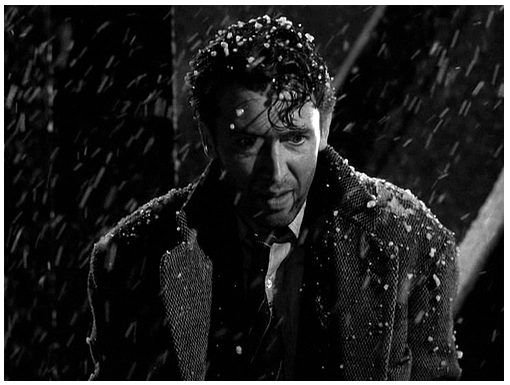
Screen Shot 2020-02-05 at 5.49.04 PM

It’s A Wonderful Life has screened so often it has become cultural wallpaper, the background noise to tree decorating and on-line discount shopping. When it shifted into the public domain in 1974, television channels could air it without paying fees, and it became program filler for twenty years before subsequent copyright battles (it is now owned by Viacom/Paramount). Familiarity can breed, if not contempt, then at least apathy, and It’s A Wonderful Life  is treated more like a nostalgia piece than a work of art. That was my ignorant attitude, at least, until I watched it again this past weekend, and for the first time fully appreciated its melancholic rendering of adulthood’s parade of dashed hopes and perpetually delayed dreams. It was Frank Capra’s  first narrative feature after four years of making propaganda films for the Army during WWII, and it feels like he imbued it with a life’s worth of disappointments, tagged with a vision of transcending these failures in an ending only Hollywood could provide.

The story for It’s a Wonderful Life was written by Philip Van Doren Stern, who sent it out in a 1943 Christmas card. A Civil War historian and sometime fiction writer, Van Doren Stern started work on his short story, then entitled The Greatest Gift, in 1939, but couldn’t find a publisher, so included it in his’43  holiday mailings. It somehow reached Cary Grant, who brought it to RKO’s attention. RKO bought the rights, and started to prepare a version in which Grant and Gary Cooper would star. After treatments by leftists Dalton Trumbo (blacklisted in 1947) and Clifford Odets (who testified before HUAC) were both rejected (were their versions too downbeat?), RKO sold the story rights to Liberty Films, a newly formed company started by Frank Capra, William Wyler, George Stevens and Samuel J. Briskin after their release from WWII service. Liberty would produce and RKO would distribute, with Jimmy Stewart, also freshly released from wartime service, to star. Liberty borrowed $1,540,000 from Bank of America to fund their first production.

Capra began shooting It’s a Wonderful Life in April of 1946, just as William Wyler began production on The Best Years of Our Lives, which dealt with the war’s aftermath more directly. Capra was not interested in memorializing the war. He told Richard Glatzer:

Yes, the war did affect me. I didn’t want to see another cannon go off; I didn’t want to see another bomb blow up. War lost its glamour for me. Just to see those trembling people in London during the Blitz, poor sick old ladies crying, crying in terror…children. There’s got to be something better than bombing old ladies and children. I lost…there’s nothing glamorous about war. I didn’t want to be a war hero, nothing. That’s why I made a movie about an ordinary guy.

George Bailey (Jimmy Stewart) is listed 4F for the war because of his bad left ear. He is an outsider to his age, missing out on WWII as well as the post-war economic boom when he fails to invest in his old school buddy’s plastics business. His only dream is to travel, but with the death of his father and the entire Building and Loan company depending on him, he stays in the sleepy town of Bedford Falls, deferring his adventurous plans year after year. There is one devastating shot when this dream finally dies. George meets his brother Harry at the train station, and learns that Harry will not be taking over his job at the Building and Loan. Stewart’s face collapses in passing, before re-composing enough to congratulate his brother on his marriage and his new life. That expression is Bailey’s private funeral for his future, one now forever bound to be anonymously lower middle class. George is Capra’s ordinary guy, one who sacrifices his own life so his brother can join the stream of history and become the subject of Hollywood hagiographies. But at least in It’s a Wonderful Life, George is the star.

Capra emphasizes George’s subordination, keeping most action in the background while George is oblivious in the fore. As kids, Harry sleds right by George and into a crack in the ice. George has to save him, and loses part of his hearing in the process, setting up his sacrificial role for life. Then there is the school dance, in which George and his girl Mary (Donna Reed) dance without noticing that the gym floor is slowly cracking open, revealing the pool underneath. The rest of the party has noticed and stepped back, but George is again oblivious, and drags Mary along with him into the drink. Capra artfully deploys this water-as-oblivion metaphor throughout, culminating in the snowstorm that marks his decision to jump into the abyss one final time, a potential suicide leap off a bridge.

Disgusted with forever being on the periphery of the American dream, George decides to end it all, which triggers the appearance of Clarence (Henry Travers) the deus ex machina angel. Only through fantasy, through the construction of a George Bailey-less alternate reality, where Bedford Falls becomes a seedy juke-joint town called Pottersville, can his existence be justified. That is, through cinema itself, for what is Clarence if not the director of this nightmare, constructing it with the flick of his finger?  His grindhouse version of Bedford Falls has Bailey as agog as a gullible teen at an opening night of Paranormal Activity, wide-eyed with terror. But instead of glorifying Hollywood trickery, what makes It’s A Wonderful Life so unbearably moving is that it urges George to escape artifice and return to banal reality and celebrate what meager joys are left to us here.  It is the saddest of happiest endings.

OLD DOGS, OLDER TRICKS: THE WILD GEESE (1978)

December 18, 2012

Screen Shot 2020-02-05 at 5.45.15 PM

For as long as there are aging matinee idols looking for a quick paycheck, there will be commando movies there to pay them. While the painfully self-conscious Expendables movies brought this prestigious genre back into box office glory, it’s a format that has been cranking along for decades. Before Stallone, the most successful old man revitalizer was Andrew V. McLaglen (son of actor Victor), who cranked out fogey action flicks from the 60s through the 80s, after a long career in TV Westerns. Cult home video outfit Severin has just released The Wild Geese (1978) on Blu-Ray, which stars the leathery trio of Richard Burton, Richard Harris and Roger Moore. McLaglen’s favorite among his films, it is a bloody imperialist fantasy in which a group of ex-Special Ops Brits parachute into Africa to rescue a deposed leader from a tyrannical despot. Fitfully released in the United States as its distributor was going through bankruptcy, it exudes more testosterone per film frame than Stallone’s pec-flexing opus.

British producer Euan Lloyd had been interested in making a commando picture like The Guns of Navarone(1961) since he became an independent producer in 1968. It wasn’t until he read Daniel Carney’s unpublished novel The Thin White Line that he decided to make one. He purchased the rights in the mid 70s, and started developing the project at United Artists. Remembering a conversation with John Ford, who called McLaglen “a general in the field” according to journalist Tony Earnshaw, Lloyd hired him to direct. Ford was a friend and collaborator with his father Victor McLaglen, but those warm feelings didn’t transfer to United Artists, who wanted Michael “Death Wish” Winner to apply his brand of reactionary nihilism to the material. Lloyd balked, and brought the project to Allied Artists, who were happy to take on a film with that cast, despite the declining fortunes of Burton, fresh off of The Exorcist II (1977).

This was a fallow period in McLaglen’s career, filled with bills paying TV work following the unintentionally sexual title The Last Hard Men (1976), starring Charlton Heston and James Coburn. Ford’s recommendation was a godsend, as he told Wheeler Winston Dixon that he thought, “’I’m back in the big time, thank God’, because I had a little slump there.” The international success of The Wild Geese extended his extraordinarily long career into the 1990s.

The setup is simple: Richard Burton is a retired special operations officer hired to rescue the deposed leader of the made up country of Zembala. He gets his old team together, including operations planner Richard Harris, explosives expert Hardy Kruger and smirking muscle Roger Moore, who looks happy to be cashing a paycheck in an inter-Bond year (between The Spy Who Loved Me (’77) and Moonraker (’79)). The extraction goes off without a hitch, but the lily-livered bureaucrats strike a deal with the Zembala dictator and leave the group to be eliminated. Burton and his merry men have to blast their way out to survive, leading to the discomfiting images of a meddling, terroristic British force slaughtering the native African population for the audience’s pleasure.

Up until this point it is an efficiently entertaining action movie, with an energized Burton and Harris ably deploying the dry wit written by Reginald Rose (12 Angry Men). After Burton knocks back a scotch with a two-handed vise grip, he tells his employer, “my liver has to be buried separately, with honors”. This is the kind of offhand self-referential humor (to Burton’s well-known boozing), that The Expendables films telegraph with belabored obviousness (see: Schwarzenegger’s groan-inducing “I’ll be back” in the sequel). There’s no attempt to hide the stars’ advancing decrepitude, as the shock of grey in Burton’s hair and the enormity of Richard Harris’ glasses attest. Only the tanned and toned Roger Moore seems unaffected by the passage of time, content to hang out in the background and chomp on his cigar regardless of circumstance – which seems to be his character’s sole motivation.

McLaglen is a direct if inelegant filmmaker, his compositions clumping people in the middle of the frame. This makes action sequences legible, but renders them monotonous when repeated throughout the length of the movie’s 134 minute run time. The last third is almost entirely made up of undifferentiated machine gun fire and collapsing bodies. Hardy Kruger, who plays the voice of conscience in the group (and is thus killed off), told Earnshaw that “Andrew butchered my performance by not understanding that you can play a part by listening.” McLaglen is always cutting to action, whether it is shooting or talking, with no rests or pauses in between.  This careening style becomes as tiring and one note as its politics, which presents military intervention in Africa as an unspoken right of the British people. The Wild Geese is a fascinating relic, part of the lineage of imperialistic action cinema that is indebted more to John Wayne’s Vietnam War flag waver The Green Berets (’68) than the influential subversiveness of Robert Aldrich’s The Dirty Dozen (’67).

TWO’S A CROWD: THE WHOLE TOWN’S TALKING (1935)

December 11, 2012

Screen Shot 2020-02-05 at 5.41.03 PM

In an early Christmas present, the Museum of the Moving Image screened a 35mm print of John Ford’s unaccountably hard-to-see The Whole Town’s Talking (1935) this past Saturday. Unavailable on home video, aside from out-of-print VHS tapes going for $60 on Amazon, it deserves to be as well known as his Oscar winning drama from the same year, The Informer (his third film in ’35, Steamboat ‘Round the Bend, is no slouch either). A box office hit which revived the career of Edward G. Robinson, its descent into relative obscurity is puzzling, aside from the larger trend of studios choosing to ignore their own history. It has not even been released on Sony/Columbia’s DVD burn-on-demand service, which was made for titles like this.  In any case, it is an elegantly constructed farce that showcases the astounding range of Robinson, who can play delicate meekness and gruff murderousness for equal laughs.

John Ford made The Informer at RKO, Steamboat ‘Round the Bend for Fox, and The Whole Town’s Talking for Columbia, a free agent playing the field for quality projects and paychecks. While Ford had to fight for The Informer to get made at RKO, The Whole Town’s Talking was pitched to Harry Cohn at Columbia by independent producer Lester Cowan. He was selling Robert Riskin and Jo Swerling’s script, which was adapted from a short story by moneymaker W.R. Burnett (Little Caesar). Riskin was a frequent collaborator of Frank Capra, and The Whole Town’s Talking is sandwiched in between his work in It Happened One Night (1934) and Mr. Deeds (1936). His script for Ford exhibits a Capra feel, in that it concerns a mild-mannered worker or vagabond thrust into extraordinary circumstances, as in Deeds or Meet John Doe.

Arthur Jones (Edward G. Robinson) has never once been late to work at the J.G. Carpenter accounting firm, but his regimented life becomes upended when escaped mobster “Killer” Mannion (also Robinson), turns out to look exactly like Jones. The cops immediately arrest Jones, and he becomes a minor celebrity for being a murderer’s look-a-like. Then Mannion decides that Jones could be of use to him, and the two engage in a roundelay of identity swaps that confuses the cops, their friends and in the end, themselves.

wholtownFord sets up the city as fidgeting mass of humanity, so large and indistinguishable that two people could swap identities with ease. He opens the film with a tracking shot that surveys the faceless workers at J.G. Carpenter, all hunched over their desks and pecking away at their number machines. Later, when Jones is apprehended, the police and the press are depicted as yammering mobs, filling the frame with shouts and bravado as Robinson cowers in a corner. Robinson plays Jones as a man who desperately wants to fit in and disappear like the rest of his colleagues, quiet and recessive.

From the beginning, though, fate is against him. His alarm clock breaks, and he arrives at work late for the first time in almost a decade. Standing out alongside him is Miss Clark (Jean Arthur), who sashays into work even later, in a nimbus of cigarette smoke. Jean Arthur’s entrance here is a marvel of physical control, sucking in one last draw before the door, flicking away the butt an instant before entering, and then exhaling the smoke in the instant after crossing the threshold – a perfect puff of insouciance. It unravels as one continuous gesture, a perfect performance that takes only a few seconds of screen time.

How does such a magical scene happen? Arthur described John Ford’s directing style on the film to Joseph McBride in in his essential Searching for John Ford bio:

Ford always had a handkerchief or a pipe hangin’ out of his mouth. He chewed on it and you never knew what he said. And Robinson had a pipe that he’d chew. They’d stand there, these two guys, and never give you any directions at all or anything much. I’d say, ‘How do I know what I’m gonna do if you don’t talk?’ And they said, ‘Well, we talk with our brains. We don’t need to verbalize things.’…You know what he’s thinking anyway. He’s just – it’s all over him. A darling, darling man. I don’t think he gave much direction, but everybody seemed to understand what they were supposed to do.

Ford trusted his collaborators, which comes across in the moments of offhand beauty like Arthur’s entrance. As Miss Clark she is the willing outsider, Jones an accidental one, although he fervently desires to win her hand, leaving facile anonymous love poems on her desk.

It is only when he encounters Mannion, and discovers a similar animalistic quality in himself, that she shows any interest. He awakens this flicker of attraction in her after boozing it up with the boss, who is looking to curry Jones’ minor celebrity into publicity for the firm. He plies Jones with cigars and whiskey, and Robinson gives a master class in queasy reaction shots. He holds the cigar as if it were radioactive, his hand underneath, pinching it with thumb and forefinger. Ford holds the reaction even longer after he knocks back a shot of liquor, his face full of micro-narratives of disgust, fear and a flickering of acceptance. It is an uproarious sequence that ends with a woozy Jones  smooching Miss Clark and kissing off the rest of the office with a slurred, “so long, slaves!”. Jean Arthur’s smile at this subversive action reveals that she has ID’d one of her own kind.

When she encounters Mannion, she senses the sociopath instead of the subversive. Robinson plays Mannion with a five ‘o clock shadow and an inferiority complex. He speaks in staccato bursts and narrows his eyes into slivers, but at the merest hint of criticism he blows up. Mannion’s darkness cloaks the farce – there are real mortal consequences to all the ridiculous circling of the sub-Keystone cops and press corps. In order for Jones to survive and win the girl, he is forced to kill, or at least abet a killing, and it is that ferocity which attracts her. It is this violent undertone which gives The Whole Town’s Talking its curious power, and is what connects it to the wider current of Ford’s work.  Jones/Mannion are the comic versions of what will later emerge as the dueling impulses of The Searchers’ sadistic hero Ethan Edwards.