GOING BACK TO THE WELLMAN: SAFE IN HELL, MY MAN AND I, and LAYFAYETTE ESCADRILLE

November 22, 2011

safe in hell

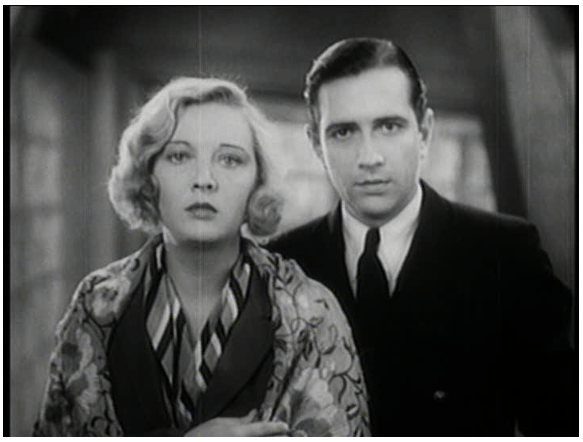
William A. Wellman was an attractive guy who happened to make a lot of movies, one of those directors who led an entire life before entering the cinema (as salesman, hockey player, soldier). For Wellman and so many other early Hollywood craftsmen, directing was, as John Ford described it, just another “job of work”. Wellman was one industrious worker, credited with 83 shorts and features from 1920 – 1958. He excelled at compact stories of blue-collar types getting sore at each other (or what Manny Farber called “hard-visaged ball bearings standing around – for no damned reason and with no indication of how long or for what reason they have been standing.”), able to create a humming rhythm out of wisecracks and violence. The studios, however, tasked him with tackling much more, leading him to clumsily apply his blunt style to melodramas and comedies (his ’37 Star is Born is especially sluggish). His career is wildly uneven but well worth looking into, especially the period in the 30s where he was cranking out saucy and speedy pre-coders like Night Nurse and Other Men’s Women (both 1931). The Warner Archive has just released a third film from his stellar ’31: Safe in Hell  (along with later Wellman efforts My Man and I (1952) and his final film Lafayette Escadrille (1958)).

Safe in Hell was shot from mid-September to October 18th of 1931, and was released December 12th. A quickie produced by First National Pictures (which had merged with Warners), it’s a seamy pre-code drama about a prostitute who believes she has committed murder, and then flees to a Caribbean island that does not have an extradition treaty with the United States. The lead role of the whore without a heart of gold was originally slated for Broadway legend Marilyn Miller, and was then assigned to rising star Barbara Stanwyck, who gave a deliciously sardonic performance in Wellman’s Night Nurse earlier that year (she ended up in Frank Capra’s Forbidden instead). The role fell to Dorothy Mackaill, who Ralph Flint of the NY Times said was, “on return from her summering at Hawaiian resorts, [and] was pressed into service.”

Mackaill was a British born actress, who cut her teeth as a dancer in the Ziegfeld Follies before forging a productive career on-screen in the silent era, notching the leading role in the 1924 The Man Who Came Back, and in Alfred Santell’s 1926 The Dancer of Paris. Work dwindled with the arrival of sound, and First National declined to extend her contract at the end of 1931. That marked the beginning of the end of her career in pictures. It’s unclear why the studio felt she wasn’t fit for sound, as her performance in Safe in Hell is impressively wild and unhinged, wrenching the underwritten part into something tangible and affecting.

She plays Gilda Karlson, an in-demand prostitute in New Orleans, who is paid an unwelcome visit by a john, the one who led her into vice. She conks him over the head with a vase, and, thinking she killed him, is frittered away to the Caribbean by her merchant marine boyfriend Carl (Donald Cook). She is ensconced in a shady hotel populated by a murderer’s row of lowlifes, each ogling her with lip-smacking impunity. Wellman catches the crew (including my favorite name and face: Gustav von Seyffertitz) in a series of leering reaction shots, before they slowly turn their chairs around and await her return trip downstairs. With Carl away on a job, the seedy patrons urge Gilda to sink back into her old ways, and the rest of the drama details this dilemma.

Wellman gets the story rolling with alacrity, establishing Gilda’s character by opening on a close-up of her gams sitting next to a phone – the two necessary implements of her job. Within a few scenes a man is presumed dead and Gilda is stowed away on a ship, heading South, her eyes visible through a slit in a box, as she quips, “I always traveled 1st class!”. The hotel in the Caribbean is run by Nina Mae McKinney, a wildly talented black actress who was shunted into supporting or “musical” roles because of the institutional racism of the period (she was later known in Europe as the “Black Garbo”). Here she sings the theme song with a smile while serving her customers. The bellboy is played by another grievously under-used black actor, Clarence Muse, who injects a patrician weariness and humor into his stock character. He tells Gilda that they serve liquor, since they are in “a civilized country”, unlike the Prohibition era U.S.

The film loses its spark in the closing third, in which sexual deviancy is replaced by an unconvincing shift to the value of constancy, robbing the starkly downbeat ending of much of its power. An uneasy mix of entertaining smarm and queasy sentimentality, Safe in Hell  is probably the least of Wellman’s great 1931 run (The Public Enemy, Other Men’s Women, Night Nurse), but it still exerts a strange fascination. I should note that the Warner Archive transfer looks soft and scratched up, most likely taken from an old TV master. It is not up to the usual standards of the company’s releases, but the fact that this rarity is available at all is reason enough to celebrate.

***

My Man and I (1952) is a showcase for Ricardo Montalban, who plays Chu Chu Ramirez, an itinerant Mexican farmer who gains his citizenship, but is unable to escape racist attitudes. This earnestly melodramatic film was co-written by novelist John Fante, who (according to Doug Bonner) modeled the love story between Montalban and Shelley Winters on the romance from his most famous novel, Ask the Dust. Chu Chu, an almost idiotically optimistic character, immediately believes he can save Nancy (Winters) from her alcoholism through sheer force of will. Wellman militates against the ridiculous goody-two-shoes nature of Chu Chu’s character by placing him in cramped, dense frames, with looming faces present in the foreground (one of them belonging to Jack Elam, playing the cynical Celestino), used especially in Chu Chu’s flophouse. This sense of visual claustrophobia runs counter to Chu Chu’s continually stated belief in the American melting pot, which he proves by constantly wielding his citizenship letter from the President. In his scenes with Nancy, Wellman uses low-light, throwing dramatic shadows against the wall, visualizing the dark pit of despair that Nancy cannot escape from. Despite his best efforts, Wellman cannot entirely free the film from the hackneyed script, which transitions into a traditional courtroom drama, with all of its moralizing banalities. The ultimate saving grace, though, is the presence of Claire Trevor as an unsatisfied housewife whose husband hires the buff (and often shirtless) Montalban to clear a field, and whose withering putdowns and shivering carnality electrify every scene she appears in.

***

Wellman often said that Lafayette Escadrille was the worst movie he ever made, and I won’t argue the point. The story of American soldiers who sign up to fight in the French Air Force in WW1 was a personal one, as Wellman had served in the unit. He even cast his son, William Wellman, Jr., in one of the supporting roles. But Warner Bros. forced him to add a happy ending, and cast the handsome teen idol mannequin Tab Hunter in the lead role. The idea was to bring in a younger audience, but all it did was dilute Wellman’s vision more. What was intended as a melancholic homage to the American dead of WWI was turned into a raucous boys-on-the-town movie, and it’s a mainly joyless affair. There are some nicely shot flying scenes, and a very young Clint Eastwood picking lice out of his hair, but otherwise it is a lost cause. This is a shame, because one of his previous passion projects, the monochromatic Track of the Cat (1954), is one of his greatest visual accomplishments. Escadrille was his last film, but no matter, he got the job done more often than not.
DIETERLE WATCH: LOVE LETTERS, FASHIONS OF 1934, JUAREZ

November 15, 2011

dieterle watch

The previously hazy career of William Dieterle is slowly being brought into focus, as the Warner Archive and repertory screenings grant incrementally wider access to this neglected German-American filmmaker. The Archive has just released Fashions of 1934 (’34) and Juarez (1939), while the 92Y Tribeca recently screened a gorgeous new print of Love Letters (1945, scheduled to air on Jan. 21st at 10PM on TCM). The Warner Archive discs display opposite poles of his career, the dynamic fantasist and the staid historical dramatist, while the hallucinatory Love Letters lies somewhere in between.

Fashions of 1934 reunites Dieterle with William Powell, whom he had worked with two years earlier on Jewel Robbery (which I wrote about earlier this year). Powell again plays a suave member of the criminal class, but instead of a dapper thief he’s con-man Sherwood Nash, dealing knock-off couture gowns to department stores around town. Along to help him are Bette Davis as the eager fashion designer Lynn and Frank McHugh as his trusty dissembler Snap. In order to keep ahead of the trends, they fly to Paris to spy on the elite fashion housesAs the cops and the real designers close in on them, it’s up to Sherwood to lie his way out once again. Like Jewel Robbery, Fashions is a fairy tale of criminality, only focused through a male POV this time. Both define thievery and pirating as a kind of harder working entrepreneurship that leads straight to our preferred dream life.

It seems like the entire budget was funneled into the Busby Berkeley-directed musical number towards the end of the feature, but Dieterle makes the most of the drab office sets at his disposal. He focuses on Powell’s posture, his leans over the desks and chairs indicating the relative state of his pocketbook and love life. The dialogue is rolled out in an unvaryingly speedy pace, with the only indication of an emotional shift present in Powell’s relationship to furniture. Even when urging Lynn to marry another man, his voice betrays nothing – it is his body that gives him away. In seduction mode, he tilts forwardas if heading into an oncoming wind, offering his body to his suitably awed targets. It works with the store owners who agree to stock his knock-offs, as well as the vamp who bamboozles a French designer. With Lynn though, he always stands ramrod straight, often in group shots with Snap. It is only when he kneels down at the end in supplication that he can win her hand.

Davis was not happy with the film, saying that she “was glamorized beyond recognition”, and she does seem uncomfortable, never quite locking in to the screwball tempo set by Powell. Despite her reservations, the film was fairly well received, with positive notices from influential gossip columnist Louella Parsons (“very excellent”) and the New York Times: “The story is lively, the gowns are interesting and the Busby Berkeley spectacles with Hollywood dancing girls are impressive. ” The Berkeley musical, wrenched in as part of Sherwood’s plot to increase demand for ostrich feathers, is suitably insane, turning the female models into mutating patterns of harps, flowers and oarsmen. The harp-women are fun and disturbing, but it is Sherwood’s demonic energy in conjuring his dreams into reality that lingers.

Juarez (1939), a dramatization of the Mexican Revolution, lacks the speed and physical expressiveness of Fashions, collapsing under the weight of its ambition. This was a major project for Warner Brothers, and Dieterle assuredly didn’t have the freedom as on his previous quickies. The AFI Catalog lists the massive amounts of resources poured into the feature:

The picture represented Warner Bros. most ambitious project to date. According to the production files, every detail was exhaustively researched for historical accuracy. The files contained long lists of reference books in both English and Spanish. Press releases refer to the film’s extensive research. According to modern sources, the writers had a bibliography of 372 volumes, documents and period photographs. Art director Anton Grot drew 3,643 sketches from which engineers prepared 7,360 blueprints for the exteriors and interiors of the settings. A complete Mexican village was built on the Warner Ranch in Calabasas, CA.

Dieterle did not excel in the realist mode, with his light touch being weighed down with the anvil of historical “truth”, at least that according to studio researchers. It’s no surprise that the result is leaden and monotonously expository, which is not aided by Paul Muni’s grotesque makeup job as Benito Juarez, looking like he got a jumbo Botox injection. Every character states their motivation and provides historical context within the same sentence. The saving graces occur in the prissy arrogance of Claude Rains as Napoleon III, and the sensitive handling of Carlotta’s (Bette Davis) descent into madness, which rekindles for a moment Dieterle’s skill at eliciting hyper-real, dreamlike performances.

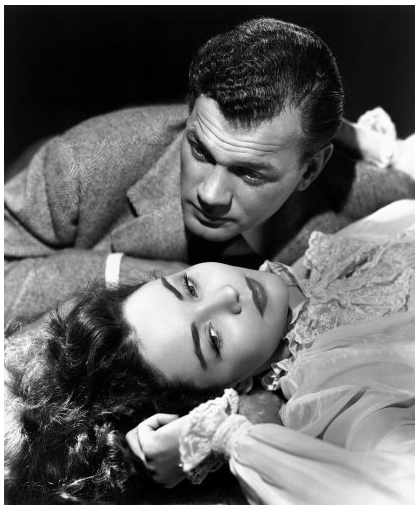
This skill is on full display in Love Letters (1945), a delirious romantic melodrama that Dieterle made when he was a freelancer, taking on short-term deals with studios. Producer Hal Wallis tapped him to direct the treatment, starting a professional relationship that would last until 1953. According to Bernard F. Dick’s biography of Wallis,  the producer purchased the rights to Chris Massie’s novel, Pity My Simplicity, in 1944, for $35,000, and was adapted for the screen by Ayn Rand (whose novel Fountainhead was released in ’43). It tells the story of Quinton (Joseph Cotten), an army man who ghost writes love letters for his friend while at the front. Although they have never met, Quinton falls in love with the woman he is writing them to, Victoria Morland (Jennifer Jones). After a tragic murder, Victoria is struck with amnesia, whereupon Quinton finally meets her, and falls desperately in love. But what will happen when she remembers her past?

Both Cotten and Jones were loaned out from David O. Selznick, with plenty of strings attached. Jones was negotiated to receive $100,000 for nine weeks of work, and Selznick had final approval over her hairstyle, makeup and wardrobe. He also stipulated that Lee Garmes be hired as director of photography, who had just shot Jones in Since You Went Away (1944). Within these restrictions Dieterle crafts an unsettling love story that equates the spiritual and the ghostly. It begins in the content of his letters, in which he writes he envisions “life as a dream of beauty”, and his friend tells him that Victoria is a “pin-up girl of the spirit”. For Quinton, Victoria is a disembodied vision of love, a Platonic ideal to strive toward.

Then this ideal comes jarringly to earth. After Quinton is wounded in war, framed against the gauzy curtains of the army hospital, he returns home. At a party, the blonde hostess (Ann Richards) tells him “I see things that may happen to you”, with both their faces in a close-up. The world is contracting and shuddering around him. He inherits his Aunt’s cottage, and when he arrives the table is mysteriously set. A ghost servant! No, it is only Mac, a gruff Scottish butler whom Quinton had forgotten, and who he calls “gargoyle”. The border between life and death, and past and present (as Quinton rummages through his childhood toys) seems awfully thin indeed. It is within this atmosphere that he meets Victoria, whose identity has been subsumed inside an amnesiac who calls herself “Singleton”. Singleton has no past or future, an unearthly presence to match the fantasy “spirit” of the letters. Quinton’s great fear is that Victoria will regain her body, and he will again have to re-enter the fraught thicket of memory and psychology that embodiment will bring. He envies her “contagious serenity”, and fervently believes that she has “lost a world, but gained a soul”. This use of Quinton’s fantasy to motor the plot is a similar device to Jewel Robbery, in which Kay Francis’ erotic desire seems to will William Powell’s thief into existence.

The pace is subdued compared to his 30s films, but the deliberation is appropriate to document the slow re-emergence of Victoria and the subtle fissures between worlds. Dieterle instead utilizes elaborate set design and tight compositions to convey the sense of the uncanny. The film is shot entirely on backlots, an artificial world for incomplete people, shot in dramatic chiaroscuro by Garmes. There are endless shots of lamps lit and extinguished, intermittently illuminating a red splotch on a white dress that will end Quinton’s dream and re-start Victoria’s reality.

NETFLIXING: SHOWTIME’S REBEL HIGHWAY (1994)

Originally published at Movie Morlocks, the official blog of Turner Classic Movies

November 8, 2011

rebel highway

In one of the stranger experiments in cable television history, Showtime’s 1994 Rebel Highway series commissioned ten filmmakers to remake a 1950s exploitation movie. It was the brainchild of Lou Arkoff (the son of American International Pictures founder Samuel Z. Arkoff) and Debra Hill (producer of Halloween). They gave directors $ 1.3 million and a 12 day shooting schedule, to roughly approximate the original shooting conditions (modified for inflation). Unlike the ’50s cheapies, though, they were given final cut, and could choose their own screenwriter, editor and director of photography. This proved irresistible to the (mostly) impressive list of talents who signed on: Robert Rodriguez (Machete), John McNaughton (Wild Things), Mary Lambert (Pet Sematary), Allan Arkush (Rock ‘N’ Roll High School), Joe Dante (Gremlins), Jonathan Kaplan (The Accused), John Milius (Conan the Barbarian), William Friedkin (The Exorcist), Ralph Bakshi (Fritz the Cat) and Uli Edel (The Baader Meinhof Complex).

All of the filmmakers, except for Rodriguez, were old enough to have lived through the era of the film they remade, engaging the aesthetics and politics of the originals in strikingly different ways, alternating between affection and parody often in the same film. Since its original airing, the series has completely disappeared from cultural memory, but Netflix Watch Instantly, that haphazard repository of moving image detritus, is now streaming every entry, and it’s well worth sampling the project’s eccentric film-historical time travel. Below, some thoughts on my favorites.

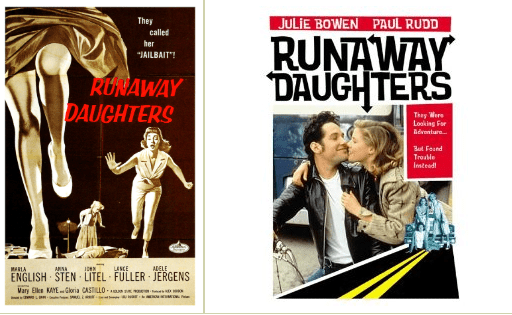
Joe Dante’s Runaway Daughters, an adaptation of Edward L. Cahn’s 1956 AIP production, is one of the few entries to completely stand on its own as a feature. It is a companion piece to Matinee, Dante’s loving evocation of a 1950s movie-huckster, modeled on William Castle, that he made the previous year. Both films were written by Charlie Haas, and share a tone of gentle satire, about the paranoia brought on by the threat of nuclear war and the space race, respectively. Runaway Daughters follows three high school girlfriends who chase down the no-good boy who loved and left.  Working class Holly (Mary Nicholson) thinks she’s pregnant, and is convinced by rich girl Angie (Julie Bowen from Modern Family) and middle-class Laura (Jenny Lewis, who later formed indie-rock band Rilo Kiley) to track the dog down. So they steal a car and hit the road, intercepting the cad before he signs up for the Navy.

Dante opens the film with an irony-drenched  found footage montage set to “Let the Good Times Roll”, from a jubilant Eisenhower and Nixon, to the NAACP hung in effigy, and closing with the repressed sexual longings of I Was a Teenage Werewolf (1957), the title character getting hairy while watching a stretching gymnast. The longing on-screen enters the narrative, as the trio of not-so-repressed girls is watching Werewolf at a drive-in, necking with impunity and ignoring the metaphors on screen. One of the neckees is Paul Rudd in one of his earliest roles, playing Angie’s bad boy squeeze, Jimmy Rusoff (named after the original screenwriter, Lou Rusoff). Dante gifts Rudd with the catch phrase from Speed Crazy (1959, a major part of Dante’s mash-up Movie Orgy (’68)), “Don’t crowd me!”, which Rudd dishes with appropriate petulance to his greasy gearhead Dad (played against type by Fabian, a late ’50s teen idol).

From this opening scene, it’s clear the girls are more mature than the films representing them, although the Red Menace makes them shaky just like everyone else. Bob (Chris Young) gets in Holly’s pants by waxing poetic over Sputnik, which has just launched into space. For the rest of the movie, though, the phalluses fail. On their journey, the girls run into drunk cops and a gang of flaccid anti-commies, the only sympathetic voice brought by an uncredited cameo from Cathy Moriarty. The lone competent male is played by Dante-axiom Dick Miller, a crusty private detective with a reflexive disdain of the young and their newfangled perversions. He asks the girls’ parents if they ask their kids “about the strange night world of twisted kicks, of weird rituals and equipment? Of whips and chains and rubber balls and dildos and handcuffs?” In this world, it is clear the ladies have to take the world into their own hands, and so they do.

***

Robert Rodriguez’s Roadracers (adapted from the immortal Arthur Swerdloff version of 1959) lacks any of the historical identifiers of Runaway Daughters, taking place completely in Hollywoodland. The most stylized entry in the series, Rodriguez has no interest in interrogating the period, only in refining his style, which at this point was still potently kinetic, coming right after El Mariachi. It stars David Arquette as cynical greaser Dude (in an appropriately mannered performance), who cruises around town with his girl Donna (Salma Hayek) and his fidgety buddy Nixer (John Hawkes). The overriding mood is provided by Invasion of the Body Snatchers, which is playing at the local cinema, and which Nixer returns to ritualistically. Dude doesn’t have to see it to know his town has been co-opted by evil. He’s chased by a sadistic cop (William Sadler) and his moderately sadistic son (Jason Wiles). Rodriguez institutes a rhythmic editing style, set up in the opening when he intercuts a rockabilly band and a car chasematching the downbeat with screeching turns. This tempo is maintained throughout, accessorized by swaggering slow-motion and low-angle anti-hero close-ups. As Dude grows more certain of the town’s rot, the images get more delirious and the action more violent, ending in a farrago of gleeful self-annihilation.

***

The most jaw-dropping part of the series is provided by the pen of Sam Fuller, who with his wife Christa provided the script for Girls in Prison, which was directed by John McNaughton (adapted from the 1956 Edward L. Cahn film). An overheated women-in-chains movie, it is graced by an opening of transcendent pulp paranoia. It  sets up the back-stories of the eponymous girls, in three bloody tales: a red-baiting newscaster gets bludgeoned to death with a hammer; a budding screenwriter (Ione Skye) mounts an Off-Broadway play, “The Witch Hunt”, that drives her father insane and leads her to savage a bigot with a broken bottle; and a budding country star (Missy Crider) is framed for the brutal stabbing of a abusive producer. Filmed with canted angles and looming shadows, it’s a wild and terrifying hallucination of a society spiked with a insatiable need for vengeance. It is impossible for the rest of the film to live up to this fever dream, but it goes through the rest of dramatic motions with enough pep and smarminess (including a deliciously vampy turn from Anne Heche) to make it a worthwhile sit.

***

Shake, Rattle and Rock is a joyful and reflective evocation of 50s rock musicals, this one a remake of the ’56 Edward L. Cahn movie about a town that tries to ban Rock ‘n’ Roll (for more on Cahn, check out Dave Kehr’s profile in a forthcoming Film Comment).  Directed by Allan Arkush in bright pastels and a wall-to-wall soundtrack of pop hits (from Fats Domino to Eddie Cochran), it is the most culturally precise movie in the series, along with Runaway Daughters. Renee Zellweger takes the lead as the rock aficionado whose parents just don’t understand. She first appears as a bouncing blur, singing along to Little Richard’s “The Girl Can’t Help It” (also used in the great Frank Tashlin film of the same name) in her bedroom, her addiction not outed to her parents until she appears dancing again on a local American Bandstand-type TV show, hosted by Danny Klay (Howie Mandel). Once Zellweger’s mom (Nora Dunn) sees this horrible gyrating, she gathers her sewing circle (including P.J. Soles from Rock ‘n’ Roll High School and a wonderfully bitchy Mary Woronov), to shut down the show and ban the music. There is also a subplot involving a black acapella group, “The Sirens”, who are trying to break through the town’s color barrier and hit it big, and who Zellweger teams up with to protect the town from her mom’s crew.

Arkush elicits effortlessly appealing performance from Zellweger, a perky ball of cashmere with a fierce sense of her personal rights. The director also has a light, and very funny, ironic touch in presenting the parents’ retrograde attitudes, but intimates that these comical buffoons are not a plot point to be overcome but the avatars of an entire culture. Instead of the expected ending of a bridged age-gap, it concludes on a note of muted despair, with freedom reluctantly deferred. It is unexpectedly the most political film of the series, robbing its characters of the young people’s bill-of-rights stated by Florine in Jean-Luc Godard’s Film Socialisme: “To be twenty years old, to be right, to keep hope, to be right when your government is wrong, to learn to see before learning to read.” For Zellweger, there is nothing to see and nothing to read, her only hope an escape to parts unknown.

For more information, please read Jonathan Rosenbaum’s review of the series, in which he compares it to the French one produced by Arte, Tous les garcons et les filles de leur age.

ADAPTATION: THE THREE MUSKETEERS (2011)

November 1, 2011

musketeers

Alexandre Dumas’ The Three Musketeers has been adapted countless times for the screen, most of them forgotten. There is a 1911 Edison production, a modernized 1933 Mascot serial that starred John Wayne as a French Foreign Legionnaire,  and now a newfangled 3D version crafted by Paul W.S. Anderson. Left out of this un-illustrious list are the canonical Douglas Fairbanks interpretation of 1924, and the popular jokey two-parter from Richard Lester in ’73 and ’74, but alas, it seems the latest Dumas gloss will go the way of Edison’s and the Duke’s, filed away as a rote remake and quietly ignored thereafter. Garnering a variety of gleeful pans and disappointing box-office returns, Anderson’s Three Musketeers nevertheless abounds in visual riches and confirms the director as one of the few to fully explore the possibilities of new 3D technologies.

Anderson told the London Free Press that Richard Lester’s Musketeers was one of the first films his father took him to see as a child. It was this childhood memory, and an interest in filming Baroque and Romanesque European architecture that set the project in motion. The idea started when Anderson and long-time producer Jeremy Bolt were marveling at the buildings in Berlin, where they were shooting Resident Evil: Afterlife, and,  Bolt told ComingSoon.net, “Paul said that we should really try and find a project where we could shoot some of these buildings for real.” The impetus for the project was purely visual, and a bit of a departure for the duo, whose previous films were mainly studio-bound. After sharing their mutual love of Lester’s lusty and slapstick take on the material, they pitched it to Constantin Films, who accepted. I would imagine the pitch included more references to the success of historical fantasies like Pirates of the Caribbean than King Ludwig II, whose Bavarian castles they would shoot in, but the influences of both are prevalent throughout.

Anderson and Bolt made a number of tweaks to Dumas’ story and Lester’s film. Most of the sexual energy of Lester’s version, which is overflowing with innuendo and Raquel Welch’s heaving bosom, is softened and diverted entirely into Milla Jovovich’s wonderfully sinuous and menacing turn as Milady, another of Anderson’s steely feminine heroes (or, here, anitheroes). In a nod to the lucrative tween audience (and inadvertently more faithful to Dumas), D’Artagnan is made younger and callower, with the Bieberesque Logan Lerman taking over the sabre. Not as spry as Fairbanks or as impish or Michael York, Lerman is a bit of a non-entity, but succeeds in not distracting from the often spectacular backdrops. The youth push is rounded out by Freddie Fox as an earnestly mincing King Louis XIII and Gabriella Wilde as D’Artagnan’s chaste love interest Constance. The three title roughnecks (Matthew Macfadyen/Luke Evans/Ray Stevenson), while not matching the oily majesty of Lester’s Oliver Reed/Richard Chamberlain/Frank Finlay, do a workmanlike job of swashbuckling, and were physical enough to perform the swordfights without stunt doubles.

This athleticism allows Anderson to get close and analytical in the sparring scenes, using slow-motion to register every thrust and parry. This facility with clean lines of action is nothing new for the director, but the spaces in which they snap into place  certainly is. The first of Anderson’s films to be shot mostly on location, his Three Musketeers emphasizes dizzying verticals as opposed to the claustrophobic horizontals of the Resident Evil series. This transition is visualized in the the first action scene, which takes place in an underground corridor that could have come out of R.E. The receding depth-of-field works brilliantly in 3D, as it did in Resident Evil: Afterlife (recently named by Stefan Drössler (director of the Munich Filmmuseum), as one of the best contemporary 3D films in a lecture at the Museum of Modern Art), and it even ends, like its zombie-killing forebear, with a Milla Jovovich action scene, as she dives through a barrage of weight-sensitive booby traps. The prize at the end, however, is the plans for an airborne killing machine, supposedly designed by Da Vinci. This hot-air balloon warship is indicative of the vertical heights Anderson will push his visuals for the rest of the film.

The castles of King Ludwig II are a reasonable match for the France of Louis XIII, since Ludwig was obsessed with Versailles and ordered the Herrenchiemsee to be built, a replica of Versailles in neo-Baroque style. These are garishly gorgeous constructions, and Anderson was allowed to film interiors as well, which he approaches in airy high and low angles, the actors receding into the depths of their own history, the ornate ceiling murals gaining the foreground to the characters’ background in the sharp 3D compositions (shot on the Arri Alexa, also Scorsese’s choice for Hugo).

The introduction of the flying warships, while clearly an effort to pump up the film’s action quotient, is also a perfect device to push Anderson’s experiments in verticality. The closing set-piece is a slow ascent followed by a steep decline, the 3D depth effects shifting so that up and down becomes the new background and foreground, a re-orienting of space that is a logical extension of the scene but dizzying to behold. When the battle crashes , the lines of Bavarian architecture re-ground the image, with the climactic swordfight taking place on the vaulting roof of a church, whose steep declines tumble the combatants back down to the earth. A marvel of cinematic architecture, Paul W.S. Anderson’s The Three Musketeers should rightfully carve out a space next to the efforts of Douglas Fairbanks and Richard Lester as the exuberantly entertaining Dumas adaptation of its age.

TO SAVE AND PROJECT: THE MOVIE ORGY (1968) AND AFRAID TO TALK (1932)

October 25, 2011

the movie orgy

For nine years running, MoMA’s To Save and Project international festival of film preservation has showcased the latest celluloid surgery jobs by archives the world over. It’s the one place where film stock is still a fetish, each new print ogled with the entitled leer of a sozzled Miss Universe judge. So I was sent to my oft-used fainting couch when it was announced that a digital restoration would open this year’s fest (which runs through Nov. 25th).   This prestigious pole-position was granted to Joe Dante’s The Movie Orgy (1968), a delirious mash-up of pop culture detritus, from psychotic b-movies to baffling Bufferin commercials.

Dante and Jon Davison edited the entire feature by hand, splicing in new scenes when intriguing material passed their way. Eventually the project ballooned to 7 hours, but with its broad humor, broads, and critique of the military-industrial complex, it toured college campuses under a Schlitz beer sponsorship. By the end of its run the print had more stitches than Frankenstein’s monster, without the salve of Karloff’s soulful stare. It would be unlikely to survive another trip through a projector. So Dante shoved the benighted thing through a film-to-tape transfer, and after some screenings on the West coast has finally brought his beast to the East. Now at a svelte 4 1/2 hours, it’s a marvel of gonzo editing. It contains an actual narrative, collapsing the apocalypses  of a bunch of sci-fi/teen rebel/horror cheapies into one mega-Armageddon, while finding time for mini-comedies and grace(less)-notes in between.

For this main narrative, I spotted the following titles: Speed Crazy (1959), Attack of the 50 Foot Woman (1958), Teenagers From Outer Space (1959), College Confidential (1960), The Giant Gila Monster (1959), Earth Vs. The Flying Saucers (1956), and Beginning of the End (1957). There are many more I couldn’t identify, but these images of nuclear paranoia are spread throughout, until Dante and Davison edit them together in a blaze of melodramatic parallel editing that would make D.W.  Griffith a little nauseous.

W.C. Fields, George Burns and Groucho Marx act as a bemused chorus during the chaos, used in reaction shots in response to whatever absurd travail Dante places before them (maybe Peter Graves gunning down locusts or Andy Devine singing “Jesus Loves You” with a cat and a gerbil). It’s the Kuleshov effect used for juvenile laughs, which I fully endorse. Dante uses this gag in other forms, once in an Eisenstinian montage, cutting from a dog training short to one for the Marines, or equally bluntly, from kids setting up a projector to a striptease. Dante is in full control of the editing-as-joke mechanism, and he wrings some hilarious bits out of it. Another routine worked through multiple variations is condensing an entire feature into a descriptive one-shot. In a B-dog-movie called (something like) “Rusty Comes Home”, he shows one scene of a dog running to a boy. “You came back!”.  Cut to “The End” credit.

Then there are the insane commercials, including a mind-melting series from Bufferin, in which a military recruiter sends a kid to war and a landlord evicts an elderly couple. Both use the pill to ease their guilty consciences. In the latter a building implodes behind the landlord as he pops his aspirin. These play more like parody than ad copy. The true star of Dante’s opus though, is Brett Halsey, the star of Speed Crazy (1959). Under the sensitively absent direction of William Hole, Jr., Halsey furrows his brow and strangles out his motto, “Don’t crowd me!”, thousands of times. Whether he’s chatting up a gum-smacking dame (in which crowding would seem to be the point) or stabbing a square authority figure, he repeats the phrase incessantly, as if Halsey forgot the rest of his lines. But he had already appeared in 20 movies, the absurdity of his repetition a likely result of compressed shooting times and a thin script. By the end, the audience was erupting in scattered cheers whenever Halsey appeared on-screen, as I would like to do for this entire low-brow masterpiece. Because of its endless copyright infringement, The Movie Orgy will never appear on home video, so rush to see it if it ever plays near you.

***

The other highlight of the festival for me was Edward L. Cahn’s Afraid to Talk (1932), a brutally despairing corruption drama, based on the play Merry-Go-Round by Albert Maltz and George Sklar. Made during the depths of the Great Depression, it exhibits a totalizing distrust of authority, with Chicago city officials displayed as more comprehensively criminal than the gangsters they are ostensibly supposed to pursue. Jig Skelli (Edward Arnold) kills kingpin Jake Stranskey (Robert Warwick) to take over his racket. When he’s rousted for the crime, he simply flashes Stranskey’s records, which implicate every major  Chicago official as on the take, from the DA’s office to the Mayor’s. Needing a scapegoat, the cops pin the murder on bell boy Eddie Martin (Eric Linden), almost beating him to death to force a confession.

Cahn and DP Karl Freund (Metropolis) visualize the back-scratching corruption of the government through shifting group shots. At police chief Frank Hyers’ (Ian Maclaren) well-appointed pad, the top officials often gather around the table to pop champagne and talk jubilantly of their double dealings. Hyers is framed to his left by the Mayor (a red-faced Berton Churchill) and Assistant DA Wade (Louis Calhern). On the right District Attorney Anderson (Tully Marshall) and a rotating cast of underlings. They are framed in long shot, with a receding hallway behind them. Down that hallway comes an indistinguishable mass of Fedora’d newspapermen, walking in lockstep, resigned to regurgitate the party line.

This grouping of power is contrasted to configurations of weakness, specifically in the initial interrogation of Eddie, who is the point of a triangle between Wade and Anderson. Later in this sequence Eddie’s wife Peggy (Sidney Fox) is subjected to an intensely close two-shot, in which Wade leans over her prone body as she rests her head in her hands. These different figural arrangements reach a climax in Eddie’s second interrogation, when his confession needs to be forced. There the cops, after flicking the overhead lamp to tick-tock over their heads, converge to make an airtight boundary around him, the image just one hulking mass of black wool suit. In this shot all of Eddie’s subjectivity is erased, to be halfway restored in the still-pessimistic conclusion. The governmental pack is thinned out, but the structures that allowed for Eddie’s blotting out are still firmly in place, as the news ticker trumpets another mission accomplished.

WARNER ARCHIVE ROUNDUP: LATE FILMS

October 18, 2011

last run

Every week the Warner Archive dusts off a bundle of forgotten studio productions onto DVD and hopes they find an audience. Recently they released a quartet of late films from veteran studio auteurs, and they all deserve to be seen. They are Robert Aldrich’s The Legend of Lylah Clare (1968), Richard Fleischer’s The Last Run (1971), George Cukor’s Travels With My Aunt (1972) and Blake Edwards’ The Carey Treatment(1972), all presented in handsome remastered editions. These are directors who had been weaned in the classical studio era, and who were now facing the reality of producer-brokered “package deals” and the escalating power of the lead actors. Many of these were fraught productions, and none will rank with the best of the respective director’s work, but they all, somehow, end up as solidly crafted entries on their brilliant resumes.

The Last Run was originally a project set up for John Boorman at MGM, who was to produce and direct. As the AFI Catalog reports, star George C. Scott requested that John Huston replace Boorman, as he had worked with Huston on The List of Adrian Messenger (’63). After three weeks of shooting, however, Huston quit the picture, “after arguments with Scott over rewrites”. Richard Fleischer became the third and final director on the project, and lead actress Tina Aumont was replaced by Trish Van Devere.  It is unknown if any of the footage Huston shot remains in the film.

It is clear that Scott exerted a lot of control, even marrying two of his female co-stars (he left wife Colleen Dewhurst for Van Devere after shooting), and yet Fleischer still imbues the film with the cool, clean lines that had highlighted his work since The Clay Pigeon and Follow Me Quietly (also in the Warner Archive) in 1949. He traced these lines along the well-worn track of the story, the starkly familiar tale of aging getaway driver Harry Garmes (Scott) accepting one more job, “to see if my nerves and brain are still connected.” He picks up escaped prisoner Paul Rickard (Tony Musante) and his girl Claudie (Van Devere), but it appears Paul was sprung in order to be assassinated. Harry has to decide whether to aid their escape, and risk his life, or return to his solitary life on the Portuguese coast. It’s an easy choice unless you are in an existential road movie, in which the death-drive trumps lazy afternoons in the gorgeous coastal city of Albufeira.

Scott was 43 at the time of filming, but he looks at least 60, with thinning gray hair, a prominent paunch and wrinkles carving up his sagging face. As Harry Garmes, you can see every indignity in his life manifest on his body. His son died at the age of 3, and then his wife up and left him alone with his car obsession. He is subsumed in feelings of loss, using work as an escape. The loveliest moment in the film occurs when Garmes is forced to sleep over in a room Claudie has just departed. Her bra, panties and pantyhose are sitting wet in the sink. With lugubrious patience he takes them out, unrolls them, and hangs them on the laundry line by the dresser. In his ashen face you can see the memories flickering by, of when this banal act was routine, of intimacy once taken for granted and now enshrined in an alien past.

Fleischer does an unobtrusive job in choreographing the love triangle, re-configuring the three jousting players around the frame as their power-relations shift and shudder. These cramped, sticky compositions are a stark contrast to the opening shots of Garmes on the road in his BMW, in which the edges of objects all point outside the frame, towards escape. Now the eye just circles inside low-lit hotel dives, the eye cycling around these three increasingly dour criminals, the only way out a bullet in the chest, to turn the triangle into a line.

***

George Cukor was still a prestige name in Hollywood in 1972 (the trailer included on the DVD trumpets his name), although he didn’t have a hit since My Fair Lady (1962). So when the intended star of Travels With My Aunt, Katherine Hepburn, was “frustrated by budget cuts and demanded several script alterations”, per the AFI, the studio declined her requests, and she quit. Maggie Smith stepped in, and was nominated for the Best Actress Oscar for her efforts.

The film is a buoyant adaptation of the comic Graham Greene novel, about milquetoast Briton bank manager Henry (Alec McCowen) who is whisked away on an international adventure by his dotty Aunt Augusta (Smith). Augusta is trying to acquire $100,00o by any means necessary to ransom one of her ex-lovers, Visconti (Robert Stephens, Smith’s husband until ’74), away from his kidnappers. In order to get this money, she re-acquaints herself with her multitude of formerly amorous companions (including North African fortune-teller Wordsworth (Lou Gossett)), as well as engaging in some minor money laundering and art theft.

This international romp (mostly shot in Spain) gets a lot of mileage out of Maggie Smith’s fluttering bohemian routine, but Cukor also manages to invest her character with a tragic sense of time’s passing. Augusta, who sucks life to the marrow, is a creature of the present tense (“I’ve always preferred an occasional orgy to a nightly routine”), but she is granted a powerfully moving reminiscence at “Le Train Bleu”, the Belle Epoque restaurant at the Gare de Lyon train station in Paris. She is speaking to Henry about her youth, and then the camera pans right, and suddenly the years have worn away, and it is a young Visconti who is walking towards a window. Outside a teenaged Augusta, in a schoolgirl’s outfit, exchanges giddy glances with him. She ditches her class and races inside, into a swirl of noise and movement, until Visconti lifts her away into light-footed waltz. It was a time of endless possibility, which has now shrunken for Augusta into re-living her past flings and scrounging for cash. This is the melancholy that underlies all of the film’s high-flying farce.

***

Director Blake Edwards  wanted his name taken off of The Carey Treatment (1972), an efficient medical thriller adapted from an early Michael Crichton novel (A Case of Need, by his pseudonym Jeffrey Hudson). Edwards was unhappy with the cuts MGM had made to the film, just as with Wild Rovers the year previously, but his name remained on the prints. I don’t know what was excised, but what remains is a solidly built contraption anchored by a smugly sexualized performance by James Coburn.

Coburn plays Dr. Peter Carey, a womanizing rogue taking up a new job as a pathologist in a Boston hospital. His adeptness at manipulating women becomes the recurring theme of the film, beginning when his erotic gaze is leveled Georgia Hightower (Jennifer O’ Neill), the clinic’s dietician. Carey’s seductive charm is later utilized in his independent investigation into the death of the hospital president’s daughter, after a botched illegal abortion. Carey’s friend David Tao (James Hong) is wrongfully tagged with the murder. Carey flirts his way through town, becoming more sexually aggressive until it turns to intimidating violence, as when he asks the victim’s old roommate if she is a virgin, and then nearly drives them into the ocean to scare her into talking. He discovers the killer through a bit of homo-erotic flirtation, receiving an aggressive deep-tissue massage from an intrigued meathead until he gets the information he was after.

It is difficult to locate Edwards’ personality, aside from the sardonic shot of a mouse stuck in a jar in the extreme right foreground, the faces that look into it distorted into gargoyles. It’s otherwise a workmanlike production, nothing more than a wonderfully acted episode of House, what with a harrumphing Pat Hingle and nervous Regis Toomey on board to support Coburn’s wildcat act.

***

Still riding the late career renaissance brought on by the camp theatrics of Whatever Happened to Baby Jane (1962), Robert Aldrich directed The Legend of Lylah Clare with even less consideration of good taste. A wild kitsch re-imagining of Vertigo, it invents tragic Hollywood star Lylah Clare (Kim Novak), who died before she was to marry her long-time director Lewis Zarkan (Peter Finch). 20 years later, Zarkan discovers an actress who looks strikingly like Lylah, the bespectacled Elsa Brinkmann (also Kim Novak). He decides to make a biopic of Lylah Clare’s life, with the unknown Elsa to star. Elsa, however, is prone to channeling Lylah’s husky tenor and mannerisms with disturbing accuracy, and Zarkan becomes entranced, his obsession leading him to make the same mistakes that led to Lylah’s death all those years ago…

Hallucinatory and ridiculous, Lylah Clare is an often uproarious send-up of Hollywood self-seriousness, with its menagerie of skulking gargoyle performances. Peter Finch is the head freak, a narcissistic blowhard who believes his genius trumps reality- he looks pretentious even after he shaves off his pointy devil goatee. He gets the best lines: “Stop poncing about like an oversexed dwarf!” and “You are moving like a deeply offended Tibetan yak!”Then there’s his brittle and viciously jealous assistant Rossella (Rossella Falk), the worm-like producer Bart (Milton Selzer),  Ernest Borgnine as the infectiously boorish studio chief Barney Sheehan, “I make movies, not films!”, and Coral Browne as battle-ax gossip columnist Molly Luther, plus a cameo by Dick Miller as a journalist!

Aldrich often freezes them inside Zarkan’s mausoleum of a house, standing rook still like slowly oxidizing statues. Unable to see life beyond the glories of years past, they try to recreate it with Elsa, who is too open to suggestion to withstand their entreaties. As her life dissolves into Lylah’s, the film gets more strident and less bitchy, ditching the satire for a dime store version of Vertigo’s doubled identities. The presence of Novak only highlights this film’s shortcomings at metaphysical speculations. While it’s not terribly deep, I still had great fun skimming along its sarcastic surfaces.

FALL CLASSICS: IT HAPPENED IN FLATBUSH and BIG LEAGUER

October 11, 2011

big leaguer

Major League Baseball is in the midst of a preposterously entertaining postseason, with major upsets and wild finishes happening almost every night. As I typed that, Nelson Cruz hit a walk-off grand slam, the first in playoff history, to give the Rangers a victory over the Tigers in the ALCS. Even better for MLB’s image (if not the ratings) is the success of small market teams like the Tampa Bay Rays and the Milwaukee Brewers, the latter of which has surged into the National League Championship Series, quieting the yearly calls for an NFL-style salary cap. With that and the cheap-team strategizing of Moneyball still in theaters, I thought I’d highlight two scrappy low-budget baseball movies which deserve more attention (read: a home video release): It Happened in Flatbush (1942) and Big Leaguer (1953).

The recent history of baseball on film is not a particularly inspiring one, with screenwriters as prone to mawkish inspirational cliché as their sports-writing brethren. The established “classics” of the genre,  like the The Natural or Field of Dreams, are unendurable parades of New Age philosophical claptrap, which make Moneyball seem as austere as Bresson in comparison. Michael Lewis’ book about the 2002 Oakland A’s described how the team utilized advanced statistical analysis to massage their low-cost club into the playoffs. It’s the first baseball-themed movie to become a substantial hit since The Rookie in 2002. Which is not to say it’s terribly good. Director Bennett Miller and screenwriter Aaron Sorkin take this absorbing, but essentially undramatic, tale of market inefficiencies and pump it up into an inspirational tear-jerker. Brad Pitt gives a finely detailed performance – see the multifarious ways in which he spits out sunflower seeds – but he’s stuck in the iron maiden of the dispiritingly conventional plot, complete with invented family drama and wise cracking sidekick (Jonah Hill). To see how it also gets the history wrong, see Kevin Goldstein’s review at Baseball Prospectus.

The best baseball films seem to be loose and episodic, as unconcerned with structure as an extra inning game. That’s part of the reason I have a fondness for It Happened in Flatbush (1942), a modest, jokey trifle about an unpopular managerial change by the Brooklyn team (the Dodgers were not cooperative with the shoot, even forbidding use of their name). It was directed by Ray McCarey, who like his brilliant brother Leo, started his career as a gag man for Hal Roach, and later worked his way over to Three Stooges shorts. Some of the slap-happiness from the Roach shorts is retained in this squirrely film, in which battle-ax owner Ms. “Mac” Mcavoy (Sara Allgood) hires disgraced former shortstop Frank “Butterfingers” Maguire (Lloyd Nolan), who cost the team the pennant years before, to take over as head coach. The script was loosely based on the 1940 season of the Cleveland Indians, during which the players agitated for manager Oscar Vitt to get canned because of his constant criticisms. It opens with an on-screen title joke that could have come from a Fatty Arbuckle short. Over a shot of crashing breakers, the text reads:

“This story is fictional but anything might happen, and usually does, on a strange island just off the eastern coast of the United States. It’s people are friendly…could even be taken for Americans, but they have a language, customs, and a tradition all their own… the name of this island is–BROOKLYN!”

The movie hums with clashing working class accents and a relatably insane obsessiveness about the game. Maguire was coaching a semi-pro league in a rural nowhere called Clovertown when McAvoy came calling. Maguire rattled off the Dodgers’s schedule with ease, saying, “I haven’t missed a box score in 7 years.” Then there is the depiction of the fan-base, animalistic and near-rabid. After a disputed call at home plate, a particularly aggressive Irish fan tumbles onto the field and decks the ump just because he can (real game footage from Ebbets Field is intercut with studio inserts). When the team has a successful road trip, they are greeted by mobs at the train station eager for a winner. The movie sparks with unbridled passion perhaps because of technical advisor Johnny Butler, who, according to the AFI catalog,  “was a veteran of twenty-three seasons of major league baseball, including two season as shortstop for the Dodgers. According to studio publicity, at the time of the film’s production, he was working as a studio policeman.”

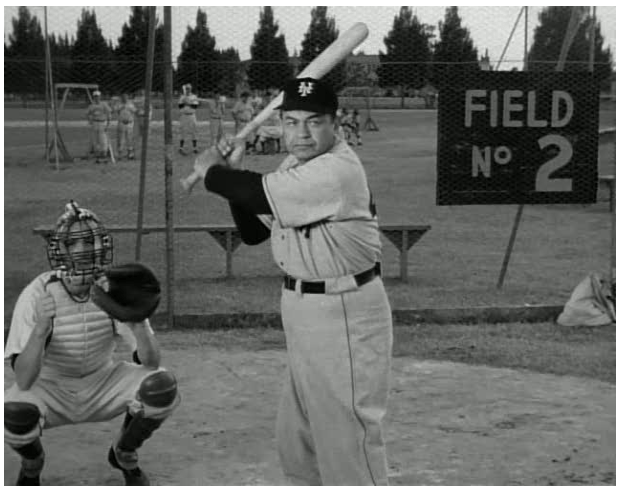
Another laid back baseball movie is Big Leaguer (1953) the directorial debut of Robert Aldrich (Kiss Me Deadly). This amiable drama concerns a summer training camp for amateur talent in Florida, put on by the New York Giants. Edward G. Robinson stars as Hans Lobert, the director of the camp and former third-baseman for the team (Lobert was a real player, who hit .274/.337/.366 over 14 seasons for five teams). Unlike It Happened in FlatbushBig Leaguer was granted full access to the Giants franchise, and was filmed on their actual training camp in Melbourne, FL, and offers cameos by legendary pitcher Carl Hubbell and head scout (and former 2B) Al Campanis. It is airier than Flatbush’s succession of busy interiors, but is granted a hackneyed script, with constant clichéd voice-over by invented sportswriter Brian McLennan (Paul Langton). Not a lot of Aldrich’s acidic personality comes through in his first venture, although the presence of combative male friendship is present, to be fuller fleshed out in his more despairing war films (Attack, The Dirty Dozen).

Aldrich gets a joyous performance out of Edward G. Robinson, who huffs and puffs his way through like an over-agitated uncle, repressing his love of his boys through hoarse-voiced criticisms. There is one shockingly funny sequence in which Richard Jaeckel, who would appear in Aldrich films until the last one in 1981 (…All The Marbles), brushes Robinson back off the plate with a high fastball. Robinson tumbles backwards with the grace of a frozen turkey. He then rages towards the camera, and in extreme close-up his hair is standing on-end, his eyes flared, ready to brawl like a hot-headed 18 year-old. Robinson brings this childishness to bear throughout, even doing a twirling jig to one of the big band tunes the kids play relentlessly.

I prefer both of these raggedly entertaining items to Moneyball’s slick insularity, and wish Pitt had as much space to play (and dance) around as Robinson does in Big Leaguer. Now if only MGM would release the 1953 film in their on-demand “Limited Edition Collection”, or if the Twilight Time label would poach  It Happened in Flatbush from the Fox library for a future DVD, this MLB postseason would truly be one for the ages.

THE 2011 NEW YORK FILM FESTIVAL, PART 2

October 4, 2011

nyff 2011 2

The 49th New York Film Festival is strutting into its first full week, rolling out red carpets and doling out free espresso to its star and art-struck audience. As posh as the whole experience is, this shouldn’t hide the adventurousness of the programming, which is rivaled in NYC only by Migrating Forms and the New York Asian Film Festival. I will try to capture the scope of the event with a bunch of short reviews (as opposed to my longer appreciation of DREILEBEN last week). Luckily, almost all have U.S. distribution, so they should eventually be available at a Netflix queue near you.

This is Not a Film (2011, directed by Jafar Panahi and Mojtaba Mirtahmasb). Screens Oct.  13 at 6PM. Distributed by Palisades Tartan.

The film of the year is an unassuming thing, shot on an HD digital video camera (and an iPhone) in Jafar Panahi’s apartment. In December 2010 Panahi was arrested and charged with “harming national security and anti-Islamic Republic propaganda.” He is now under house arrest while appealing a 6 year prison sentence and 20 year ban on traveling or making films.  This movie’s existence is a miracle, smuggled into the Cannes Film Festival in a cake, but perhaps more miraculous is its aesthetic rigor. What in the film looks like an afternoon was shot over four days, Mirtahmasb saying in the NY Times, “I refer to Godard, who said if you want to make a documentary you should automatically go to the fiction.”

It is an interpretation of Panahi’s daily life, as he putters about his apartment, bickering with a neighbor’s dog and his daughter’s invasive pet iguana. These amusing slices of life about the banalities of home imprisonment are pushed against by two major set-pieces, impeccably staged and performed. The first is Panahi acting out a scene from his new script, which the government will not allow him to make. He stops and starts, alternately inspired and despairing as he blocks the movements of his young female character, using masking tape to mark off a blueprint of the set. It is a tour-de-force of creative power and destruction, constructing a film in our heads and then letting it disappear. The closer has Panahi enter the elevator with the janitor’s relative, who is taking out the trash. This young man was in the apartment when Panahi was arrested, and tries to tell the story of that night. But he is continually interrupted by his job, ringing doorbells and corralling garbage. Panahi follows him all the way outside, but the young man never finishes his story, subsumed by his job (which Panahi is filming with his iPhone, breaking the law of his house arrest) and the sound of the fireworks outside, part of the Persian New Year festival which Iranian authorities have tried to outlaw for its Pagan origins. The sequence is a heady nexus of how work is art and art is culture and all of it is silenced.

***

Le Havre (2011, directed by Aki Kaurismaki). Screens Oct. 5 at 9PM. Distributed by Janus Films.

Bela Tarr: “[Le Havre] is deep, sad and full of jokes, but every joke is very painful. That’s what I like.” I like it too. The swift-moving sadness of aging and the succor of community are the two poles of the latest charming cinephile-bait from the Kaurismaki factory. Set in an anachronistic present of fedoras and analog cameras, Le Havre tracks the stooped steps of Marcel Marx (Andre Wilms) as he tries to nurse his wife Arletty (Kati Outinen) back to health and help illegal African immigrant Idrissa (Blondin Miguel) get to London. Marcel is a shoe-shiner, staring downward at the parade of Converse sneakers that refuse his services. His age and his skills are now both cruel (but funny!) jokes. He and his neighborhood snap to life when they learn of Idrissa’s case, working off the sense memory of all the French Resistance movies they’ve seen (as well as Marcel Carne and Arletty’s Children of Paradise (1945) made during the Occupation). Their lined faces (and what faces!) spark to life as they get a chance to act the hero for once in this benighted cutesy town. What begins in the cold reaches of Jean-Pierre Melville-ville ends in pure Hollywood-land, a place for miracles.

***

Once Upon a Time in Anatolia (2011, directed by Nuri Bilge Ceylan) Screens Oct. 8th at 5:30PM. Distributed by The Cinema Guild.

An epic ramble through the Turkish criminal justice system and the ethical brambles of a doctor and lawyer, Anatolia moves from macro to micro with elegance and astonishing formal control. Roughly speaking, the first half deals with physical illumination, the second with mental. It opens with a group of law enforcers: cops, the D.A., the coroner and their lackeys, driving suspected murderers around to find the corpse of their confessed victim. This takes all night and into the day, requiring a ballet of lights to illumine the plowed ground. The first shot is a slow zoom into a smudged window, indicating that there will be no clear sights of the truth. The captain (Yirmaz Erdogan, fuming and stamping “like a handful of bees”), continually reorients his truck’s search lights for the right angle, while a quick thunderstorm produces other revelations, not under investigation. As the doctor pees, lightning flashes, and an ancient statue stares at him, another, more permanent, judge of their actions. This play with light culminates in a stopover to a small village, in which the electricity goes out. The mukhtar, or village chief, has his daughter light lanterns and bring tea to the civil servants, and her face is the ultimate revelation. Each stares, agog, at what is clearly an angel come to Earth, another vision of the infinite during their trudge towards the irreducibly mortal. After the corpse is retrieved, everyone comes down to earth, engaging in uncomfortable bureaucratic wrangling and the reality of the lives they left behind.

***

You Are Not I (1981, directed by Sara Driver). Screens Oct. 6th at 9PM. No Distributor.

This maniacally creepy independent, an adaptation of a Paul Bowles short story, was thought lost after a leak in a New Jersey warehouse destroyed the negative. But wait! A print was found in Bowles’ holdings, and is now restored in its high-contrast grainy B&W glory (Jim Jarmusch was the DP and co-screenwriter). A nervous mental patient (Suzanne Fletcher) escapes her hospital, and wanders past a horrific car crash en route to her sister’s house. She desperately wants to eject her frazzled sibling and replace her, to create space for the patient to live alone in her own head. Driver sets a mood that is dreamlike and elliptical – the crash is a pile-up of abstracted forms on grass, and the corpses are lined up like dominoes. We are witnessing the world through the patient’s frazzled brain, so every image is unreliable. The closer is Erasherhead-hysteric, with trembling old ladies and the buzzing non-score by Phil Kline. It’s a authentically disorienting experience.

***

Twenty Cigarettes (2011, directed by James Benning). Screens on Oct. 9th at 9PM. No Distributor.

A minor but enjoyably playful video from the minimalist master James Benning. Last year’s festival brought his debut on digital, Ruhr, a massively beautiful meditation on duration. Twenty Cigarettes is more of a lark, a way for him to work and hang out with his friends at the same time, kind of an avant-garde Ocean’s 11. Benning shot portraits of twenty subjects smoking a cigarette. He cut only when they completed, at their own pace, with cigarettes as a timepiece. They are all positioned in front of flat backgrounds (except for filmmaker Sharon Lockhart, who is framed in front of sky), and the fun is in detecting personalities in the style of smoker. So you have the reluctant smokers, the speed demons, and the ones, usually older, who luxuriate in their cigs and extend the movie”s running time (it’s 99 minutes).  It’s in conversation with Andy Warhol’s Screen Tests, although Benning’s subjects are not performers, but fellow artists and friends. Warhol’s films have the sense of a happening, of a communing with wild spirits, where Benning’s film is just companionable, a sitting down and getting back in touch with friends you didn’t know you had. Which is not a bad way to spend a night at the movies.

THE 2011 NEW YORK FILM FESTIVAL, PART 1

September 27, 2011

nyff 2011

The 49th New York Film Festival begins this Friday, September 30th, with a main slate of 27 features and an abundance of sidebar and retrospective screenings, including a massive survey of Nikkatsu Films. All of my favorite entries so far share an obsessively detailed sense of place, locations that subsume central characters and emerge as active agents of memory, myth and fate. Dreileben, a group of three features made for German television, is set near the Thuringian Forest, folkloric heart of German culture, and former home to Wagner, Schiller, Bach and Goethe. Ancient fables are invoked as templates for the tragic circlings of the unlucky few who come in contact with a man-made monster.  The Turin Horse utilizes a perpetually wind-thwacked dust bowl as a bluntly metaphorical vision of the barren, anxious souls of its poverty-stricken leads, while Two Years at Sea follows the hermit and former merchant seaman, Jake Williams, as he goes his silent bearded way in the beatific and lonely Caingorm Mountains of Scotland.

Dreileben began as a series of e-mail exchanges between directors Christian Petzold, Dominik Graf and Christoph Hochhäusler, which were published in Revolver magazine in 2007. All three men are grouped under, or have pushed back against, the “Berlin School” of German cinema. Marco Abel wrote in Cineasteabout the genesis of this somewhat misleading description: ” The label, coined by German film critic Rüdiger Suchsland, originally referred to what is now known as the first generation of the Berlin School: [Angela] Schanelec, Christian Petzold, and Thomas Arslan. All three attended and graduated in the early 1990s from the Deutsche Film und Fernsehakademie Berlin (dffb)…and were taught by avant-garde and documentary filmmakers Harun Farocki and Hartmut Bitomsky.” The style is associated with cool, restrained dramas that analyze the minute psychological dramas of everyday life, and are generally ignored by local audiences.  Hochhäusler was part of a second wave of directors, who studied at the Hochschule für Fernsehen und Film München, along with Benjamin Heisenberg (The Robber) and Maren Ade (Everyone Else). The turn to genre subjects (The Robber and Arslan’s In the Shadows), as Dennis Lim (NYFF programmer) notes in a Cinema Scope piece, could be “partly a reaction to the marginalization of the early films.”

Dominik Graf has criticized the Berlin School for their avoidance of emotion, as he told Abel in an interview in Senses of Cinema“This is part of my debate with the Berlin School directors. I tell them that I have the feeling—not always!—that they are not doing anything in order to move away from their glass-like, distanced position towards the world and feelings.” Dreileben is the extraordinary result of this generational debate.The three films circle around one motivating event: the escape of convicted killer Frank Molesch (Stefan Kurt) from a mental hospital. The first film, Christian Petzold’s Beats Being Dead, profiles a bitter affair of one of Molesch’s young potential victims. The second, Graf’s Don’t Follow Me Around, follows a police psychiatrist around anyway, who is on the case of pursuing Molesch, but also gets entangled in a decades old love triangle. The closer, Hochhäusler’s One Minute of Darkness, tracks the killer as he stumbles through the Thuringian woods, a gentle monster roused to violence by the fumblings of the humans around him.

Beats Being Dead is the zombie-like love story between Ana (Luna Mijovic), a working class Serbian immigrant, and Johannes (Jacob Matschenz), a brilliant medical student screwing around for a summer, working at an empty hospital (which Molesch eventually visits). Petzold based the story on the German myth of Ondine, the water nymph who would lose her immortality if she bore a mortal man’s child. Ana and Johannes meet, in various states of undress, by the water. They gravitate to each other instantly, magnetically, their mutual seduction occurring during a series of hypnotic walks to and fro, down the tree-lined paths that separate them physically and economically. The spectre of money and class is never far from the surface in Petzold’s films (see his Postman Always Rings Twice adaptation, Jerichow), and here it is the key that wakes them both up from their trance. Ana, with mascara streaming down her face, has been felled from the euphoric heights of love and made human. Johannes, less than that.

Don’t Follow Me Around is Graf’s play for a communicative cinema, shot in soft, sun dappled 16mm, shifting from the hard-edged 35mm and HD of Petzold and Hochhäusler. In it, police psychologist Johanna (Jeanette Hain), travels to the forest to investigate Molesch’s disappearance, and stays with her old friend Vera (Susanne Wolff) and her husband Bruno (Misel Maticevic). During long nights of wine-fueled reminiscence, they discover they had both loved the same man before they met, sending them deeper into the past. The presiding myth here is of Emperor Barbarossa, mentioned by Johanna’s father before she leaves. He says that Emperor Frederick of Barbarossa, “and all his soldiers have been sleeping for 1,000 years in the mountains, waiting for Germany to finally become an empire again.” Johanna’s father says this as a historian’s idea of a joke before her departure, but what Graf’s story awakens is not an ancient leader but repressed memories. Johanna’s lost love emerges as a ghost by her side, an unwanted guest to eliminate with as much prejudice as Molesch, still roaming the countryside.

The trilogy comes to a brooding close with One Minute of Darkness, in which the forest emerges fully as a character – magical, threatening and aloof. Here Molesch is Barbarossa, stumbling into a tourist’s bedroom that contains maps of the Emperor’s caves and a book of “Wagner’s Thuringen” on the desk. He faces the myths, and he goes on to embody them. His gambol through the verdant wood has him hallucinate a masked creature and tend delicately to a young runaway, as sympathetically as Karloff’s Frankenstein. In Hochhäusler’s patient thriller, Molesch is cross-cut with lumpy inspector Marcus Kreil (Eberhard Kirchberg), the man who had imprisoned him the first time on circumstantial evidence. The jumps between Molesch and Kreil are between incantatory fantasy (the shape-shifting forest, a satanic inferno) and banal reality (a family BBQ). These two strands, woven throughout the whole series, come thudding tragically together as Ondine comes undone, the immortal brought down to the cold earth.

***

The Turin Horse and Two Years at Sea are two disparate versions of the solitary life. In the first, the outside world is a face-wrinkling terror that is best seen through a window, the dividing line between a father and daughter and encroaching obsolescence. In the second, there is no difference between outside and inside, as winding branches and tall grass take over lounge chair and an RV is magically lifted in the arms of a tree. Bela Tarr claims that The Turin Horse is his last film, and it acts as a summation of his work. It begins with the story of Nietzsche’s last sane days, written by frequent collaborator László Krasznahorkai. Nietzsche sees a horse being beaten by its owner. He rushes to stop the abuse, weeping. He would spend the rest of his days as an invalid. The narrator goes on, “of the horse, we know nothing.” Thus begins the Old Testament penitence of the father and daughter. The silvery B&W cinematography by Fred Kelemen begins – a low angle of the bedraggled horse, with matted hair like a stray dog, pulling the carriage of Ohlsdorfer, the father (János Derzsi, whose craggy bearded visage has the perpetually stunned look of oncoming senility like Richard Bennett in The Magnificent Ambersons). Thus begins a murderous daily routine in gale force winds, with Ohlsdorfer returning home to his gouged-out shack, with walls that look like they’ve been gnawed on by muscular beavers. His already wizened daughter (Erika Bók) undresses him, cooks him his nightly scorched potato, and shuffles off to bed.

This is their entire life, both of them perpetual work machines chipping away at their life expectancy one day at a time. Tarr sets up the visual dichotomy early on, of inside/out. The camera, and the characters are constantly peering outside its frame, denoting an absolute otherness to the nastiness outside. The daughter sees their first guest, a nihilist philosopher-drunk over to buy some palinka (a Hungarian fruit brandy), depart through the precious window. His thunderous presence dissipates to a shadow seen through glass, his sub-Nietzchean pronouncements (twisting Nietzsche’s “beyond good and evil” and death of God pronouncements into a world of eternal subjugation – similar to how the Nazis perverted his work) already forgotten. Ohlsdorfer had already called “rubbish” on him anyway. Their only purpose, their only thoughts, are geared towards work. And once the horse stages a quiet rebellion, refusing to eat or move, their lives of sullen, productive enervation now become entropic and drawn to dissolution. Eventually they go through the looking-glass, and become the travelers on the other side of the window, searching for an escape. Presumably finding only worse deprivations on the other side of the hill, they return, irrevocably changed. The camera, for the first time, shows the outside of the cabin, and the daughter looking out, trapped.

Jake Williams, the subject of Ben Rivers’ Two Years at Sea (in the Views from the Avant-Garde) program, is totally, frighteningly free. Living alone in the Scottish mountains, he is shown cleaning, reading, chopping wood and sleeping – without saying more than a few words. His living quarters have become intertwined with the nature around him, birds and plants and insects have as much a foothold on his property as he does. Shot in anamorphic B&W (although projected on compressed video, sadly), the film is immersive and cordial. It’s clear that Jake wouldn’t mind if you napped along with him, lulled along by his blissed out existence. The pacing gets so gently buzzed it’s no surprise when his mini-RV gets raised heavenward by unseen hands (or winches). The film consists of staged re-enactments of Jake’s daily life, with hints of his past appearing in photos lying on a desk. Stills of children, a woman, an old man shoveling snow, these are the narratives and mysteries that clang around in Jake’s head that we don’t have access to. We project stories onto his invitingly open face, or at least I did, of a wife who couldn’t hack the back-to-nature bit and hustled her kids back to civilization. Or maybe the photos were simply (likely) planted by Rivers to enact such fevered speculation. Whatever the reason, it is a film that encourages such idle thoughts and wild guesses. Filled with flickering light and the squiggles of processing stains, Rivers is playing with the form as well as narrative expectations, mirroring the play of light on leaf with light through film. This comes to the fore in the astounding final shot, a long take of Williams’ face as he nods off in front of the fire, his eyelids and the flames both fluttering, closing to another day and to my prying eyes.

THE MINNELLIUM: YOLANDA AND THE THIEF (1945)

September 20, 2011

Screen Shot 2020-01-31 at 5.51.10 PM

Vincente Minnelli had been interested in making a surrealist musical since his days as a Broadway set designer and director. After he saw successful stagings of “Four Saints in Three Acts” (with libretto by Gertrude Stein) and “Pins and Needles” (starring members of the International Ladies Garment Workers Union), he was convinced he could make it work. In 1938, he tried to woo musical comedy star Bea Lillie to take the lead role in a “surrealist revue” he titled “The Light Fantastic”. In a letter to Lillie, quoted in Minnelli’s autobiography, he wrote, “It sets out to prove that the world today is completely screwy. A surrealist fantasy set in jig time.” The project was shelved, and he moved on to direct “Very Warm For May”, the first Jerome Kern-Oscar Hammerstein collaboration in eight years.

Once in Hollywood, and flush with studio goodwill off the hits Meet Me In St. Louis (1944) and The Clock (1945) (he had also directed the majority of the revue-style Ziegfeld Follies, which the studio tinkered with until ’46), he finally put his “Light Fantastic” inspiration into action, resulting in Yolanda and the Thief (1945), one of the strangest and most enchanting films ever released by a Hollywood studio. Released earlier this year on DVD by the Warner Archive, Yolanda and the Thief  is also screening at the Brooklyn Academy of Music in October, as part of a complete retrospective of the director’s work (presented along with the Locarno Film Festival).

The genesis of Yolanda did not begin with Minnelli, but with children’s author Ludwig Bemelmans, the creator of the Madeleine series. In July, 1943, he co-wrote a fanciful short story called “Yolanda and the Thief” for Town & Country magazine with Jacques Thery. Producer and songwriter Arthur Freed purchased the rights the same year, and installed Bemelmans in an office at MGM to hash out a script from the material. He produced a treatment, but it went through three more rewrites before a fourth draft by Irving Brecher was accepted.

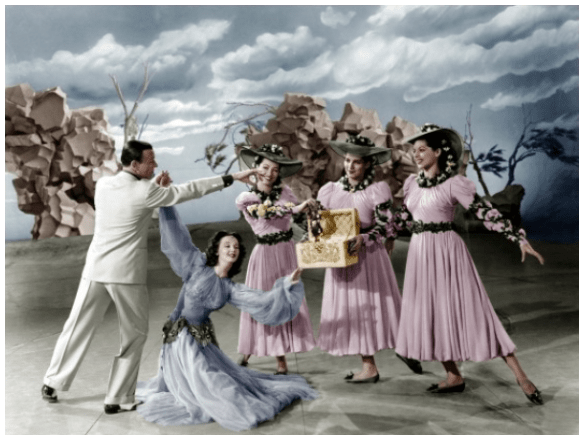
In the fantastical South American Ruritanian country called Patria, a beautiful heiress named Yolanda Aquaviva (Lucille Bremer) will inherit the family fortune and the defacto throne on her 18th birthday. Raised in a Catholic orphanage, she is naive in  the dirty ways of the world, and Johnny Riggs (Fred Astaire) takes full advantage. He overhears Yolanda praying to her guardian angel, and so Johnny pretends to be the embodiment of this protective spirit. Yolanda immediately believes his schtick, and is soon convinced to sign over power of attorney to this sweet-faced con artist. Johnny’s heart may be as soft as his shoes, and he’s not sure if he can go through with the theft…

Lucille Ball was originally slated for Yolanda, but after Minnelli was hired, Lucille Bremer took the role, since she had worked well with the director as the older sister in Meet Me In St. Louis. While he had little involvement in the scripting process, Minnelli immediately went to work on the visual design, which pulls from a dizzying array of influences and styles, from children’s picture books to Salvador Dali. Minnelli wrote that “I tried to get the quality of Bemelman’s books and illustrations, a curious mixture of worldliness in high places and a primitive naiveté, using his sometimes crude prism colors right out of a child’s paint box and combining them with beautifully subtle monotones.”

No concession is made to realism, with the waking sequences as garish and artificial as the centerpiece dream ballet. The opening sequence includes plastic ferns, papier-mache rock formations, a llama, and children sitting in green, yellow and red robes with a pinkish-orange sunset matte-painting beckoning them to greater flamboyance. This transitions to the orphanage, in which a parade of red-dressed, black hatted girls add skipping accents to a regal castle edifice. The nuns, in contrast, are in a dull blue-gray, building blocks of the building itself.

When Yolanda first appears in her family’s palace, out of the orphanage’s garb for the first time, she wears a simple cream-colored dress, which brightens the grays of the marble and fading murals. Her dotty Aunt Amarilla (a sublime Mildred Natwick, “Do my fingernails and immediately bring them to my room”) greets her wearing a blue-gray shade similar to that of the sisters, again blending into the background, part of the institution.

Yolanda’s next outfit is worn to visit Johnny for the first time, whom she believes to be an angel. Appropriate to such a worshipful occasion, she wears a black lace number, with a veil-like mantilla . A white rose adds a pop of contrast. In order to convince her of his otherworldliness, Minnelli shows Johnny arranging his own lighting, angling a lampshade so the rays seem to emit from his forehead. Positioned in front of heavenly mural behind him, he is a picture of vain celebrity, but Yolanda falls for the ruse, and also, Minnelli winks, he hopes we fall for his technical tricks.

The dream ballet is where Minnelli is fully allowed to display his Surrealist influences, with a Dali-esque landscape the setting for irruptions of unconscious illogic. The sequence begins in what looks like the film-world’s reality, as Astaire walks down the town’s main thoroughfare. The first puncture of this reality occurs when Astaire is asked for a cigarette. It’s the same rumpled man who had asked earlier in the film, but Astaire obliges anyway. After he lights one, a third hand appears from the blackness, cig in hand. He lights it, but more hands appear, until there are six arms sharing puffs from one mouth. The coins he had flipped to some street urchins start falling from the sky in rhythmic patterns, as the street set disappears for one streaked with lines of gold. Washerwomen in flame red skirts (recalling the orphanage outfits) ensnare him in reams of white laundry, as the rhythm set by the coins continues.

Echoing the reams of white fabric, a figure emerges from a pond, fabric flowing up and around her, as if in her own personal hurricane (this is a reversed image of Bremer walking backward into the water). She leads him into a desiccated Dali landscape of mutated white clumps and bare trees looming over an empty space, leading nowhere. Minnelli: “I wanted to suggest South American baroque without actual architectural forms, and used a series of rock formations in fantastic shapes.” Astaire removes the drapery of Bremer’s body, revealing her face. She is again wearing a cream-colored dress, as in her first, welcoming, arrival. The fabric that entangled him, he is able to free her from. It is a dramatization of Johnny’s fears of entrapment and attraction, visualized in spare, haunting landscapes.

This wildly imaginative sequence is a logical extension of the fantastic real world, and, as Jane Feuer wrote in The Hollywood Musical: “The transition to the dream in Yolanda is one instance of a play on the boundaries between fantasy and ‘reality’ which  informs the entire film. It is through cinematic technique that the boundaries between worlds are able to be blurred, placed en abime.”

Audiences were not receptive, and according to the AFI Catalog, Yolanda and the Thief  lost $1.5 million on its initial release. Minnelli muses that “much of the public couldn’t accept a simple story in an avant-garde setting.” Likely so, but it should be appreciated now in its oneiric Technicolor glory. Minnelli, a humble sort, should have the last word: “Film buffs say the picture was ahead of its time. I like to think so.”