ALEKSANDR SOKUROV’S GHOST STORIES

January 8, 2013

Screen Shot 2020-02-07 at 4.29.31 PM

Aleksandr Sokurov’s Soviet Elegy (1989) begins with a tour of tombstones, the camera floating down rows of Communist phantoms. In the next sequence, Boris Yeltsin is shown stalking down a hallway, another kind of ghost, one aware of his coming obsolescence. Sokurov’s work is a series of elegies, in which ghosts of history mourn for themselves. Cinema Guild has illustrated this development in their three-disc box set of Sokurov: Early Masterworks. It contains the three features Save and Protect (1990, DVD), Stone (1992, DVD) and Whispering Pages (1994, Blu-Ray), plus three of his shorts, including Soviet Elegy. Each displays his increasingly idiosyncratic visual sense, in which he uses distorting lenses to produce stretched figures akin to El Greco saints, yearning for a God who doesn’t respond. Sokurov is often compared to Andrei Tarkovsky, the previous Russian spiritual guide/director. But while Tarkovsky often offers the possibility of transcendence, there is no such hope in Sokurov, just figures circling a void.

0000239823

These are demanding, deeply eccentric works, and none are more so than his Madame Bovary adaptation, Save and Protect. Sokurov focuses on Emma Bovary’s illict affairs, and cuts out her husband Charles almost entirely. He casts the skeletal Cecile Zervudacki as Emma, her recessed eyes and slender frame giving her the aura of an underfed zombie. Instead of brains its sex she’s after, feeding on the libidos of a series of romance-novel handsome beaus. Never satisfied, she wanders the Siberian steppe for 133 minutes in an aimless pursuit of a lasting human connection. Sokurov introduces anachronisms into the 19th century scene, as when the strains of “When the Saints Go Marching In” starts playing over an unseen radio, suggesting that Emma’s Sisyphean task will take multiple lifetimes.

Named by Susan Sontag as one of the greatest films of the 1990s, Stone takes Sokurov’s interest in the undead and applies his increasingly distorted visual scheme to it. It presents the claustrophobic scenario of a museum attendant at the Chekhov Musuem who spends all his time with a mysterious bearded stranger – the unsettled ghost of Chekhov himself. Almost entirely restricted to the interiors of the musuem, and shot in grainy B&W with image-stretching lenses that round the frame edge, the film has the constrained feel of a nightmare taking place in a snow globe, or that one is walking inside Sokurov’s own head. Of the realist writers of the late 19th century (Flaubert, Chekhov, Dickens, Tolstoy), he told Cineaste that, “This is the kind of literary world within which I could exist eternally.” With Save and Protect and Stone he attempts to. With even less narrative thread than Save and ProtectStone presents the attendant and his ghostly pal in scenes of uncanny silence, the soundtrack a melange of breathing, ambient noise and Mahler. When the two wander outside they are rendered as two silhouettes separated from the landscape, as if they were just shadows against a wall.

Whispering Pages is another elegy for and escape into realist literature, this time of Dostoyevsky’s Crime and Punishment stripped of narrative. Sokurov’s Raskolnikov is not named, nor does he act. He simply skulks around the whitish-gray black and white, which occasionally dissolves into lifeless color, of the decaying city. It is a wet city, as damp as the village in Stalker, except there is no Room which promises escape. Sokurov’s elongated figures, often shot at low angles, seem to reach toward the sky, but fail to ever touch it, or reach it. Instead they trundle through film grain and dust motes and rain, an endless array of obstacles placed in front of them. All of these elements work on erasing people from the landscape, like the way the apartments are falling apart at the seams. In one disorienting shot, the camera peers up from the ground, towards Raskolnikov at right, and a tower straight ahead. People are jumping off, down past the camera and presumably towards their death. Nothing is shown or explained, just nature reclaiming some of its own. He exchanges some glances with a neighborhood girl, but entropy takes them all. In the sodden resignation of the final shot, Raskolnikov sits at the foot of a lion statue, the giant paw obscuring his head. Eventually the human figure disappears. All that’s left is a manmade object, with no one left to admire it.

The Soviet Elegy also contains a long reading of names of Russian leaders, a cinematic memorial to the builders of the Soviet state that was now ending. This micro-portrait of Yeltsin foretells not only his Tetralogy of Power, wherein he made films on the Hitler, Lenin, Hirohito and Faust, but also these early features, in which the undead hold more sway than the living. Sokurov’s films are dreams of memories, or memories of dreams, in which the writers, characters and leaders that formed his consciousness awake and wander, and find us wanting.

Technical notes: Save and Protect and Stone were transferred from what looks like old release prints, and contain persistent flecks and scratches, as well as end of reel markings. The original negative for Whispering Pages was “completely unusable”, according to the disc, so the pleasing HD transfer was made from a negative found in Germany. No apparent digital restoration was done, so there are still plentiful flecks and scratches, but it looks the best out of the bunch. Considering the rarity of these titles, we should be grateful we can see these in any form.

Man of the West: Booklet Essay

product_2357

Man of the West is riven with pain. Made in 1958 during the twilight of the Western genre, it is reflective and interiorized, mapping twisted psychological landscapes over the flattened physical ones. Director Anthony Mann was obsessed with transposing King Lear into the Western, with Lear figures appearing in The Furies (1950), The Man From Laramie (1955), and Man of the West. Mann had dreams of making a more faithful Western adaptation of Lear, and would pursue it the rest of his life. He was working on a version simply titled The King at the time of his death in 1967.

In The Furies and The Man From Laramie these dissipated patriarchs are corrupted cattle barons, while in Man of the West it is a sociopathic dementia-addled bandit named Dock Tobin (Lee J. Cobb) – who has three sons instead of Lear’s daughters. Gary Cooper plays Dock’s nephew Link, who was once in murderous thrall to Dock, but has since reformed and married. After a thwarted train robbery Link is absorbed back into Dock’s orbit, and is forced to confront the sins of his youth.

Man of the West was initiated by producer Walter C. Mirisch, who had moved his independent production unit from Allied Artists over to United Artists. He had an affection for aging, totemic Western stars, but tried to pair them with more “adult”, and violent, subject matter. Mirisch’s first production for UA was Fort Massacre (1958), a siege Western starring Joel McCrea. McCrea played a cavalry commander pushed to madness by his hatred of the Apache. The next star Mirisch wanted to dirty up was Cooper. So he sent him the novel The Border Jumpers by Will C. Brown, which Cooper approved. Instead of handing script duties to a genre veteran, Mirisch gave the job to Reginald Rose, who came out of high-toned television dramas, and who had written the popular film adaptation of 12 Angry Men (1957).

The script was a hard and violent character study, so Mirisch then brought on Anthony Mann to bring out its psychological subtleties. Mann had recently completed a remarkable series of five Westerns with James Stewart, ending with The Man From Laramie. In Laramie Stewart wandered into the Oedipal anxieties of a power hungry cattle family, the Western landscape a battleground of macho neuroses. The family unit in Man of the West is even more perverse, an all-male gang of thieves led by a half-mad old coot.

Dock Tobin seems to have cracked since Link’s departure, his crew a sloppy bunch of thugs and idiots, including a sweaty mute (Royal Dano) and a jumpy pervert (Jack Lord) Unlike Lear, there is no one left to inherit his ramshackle kingdom (an isolated ranch).  The re-appearance of Link ignites his old dreams, and so the old man ranting in a rocking chair flails to life, scheming a big bank job. He immediately begins remembering their past exploits: ”God forgive us we painted their walls with blood that time”.  But the bank no longer exists — it’s just another figment of past glories swirling in Dock’s head.

This is one of Mann’s most precisely choreographed films, with figures constantly activating each quadrant of the CinemaScope frame. The extended night sequence set at Dock’s ranch shows his command of composition. Link, along with two civilians, have been stranded by a botched train heist. The only home within walking distance is Dock’s, so LInk plays along with Dock’s delusion until he can figure a way out. At their first meeting in the ranch house the Tobin gang and Link stand stock still as Dock weaves his way between them, as if Dock had stopped time through his reminiscences. As the evening progresses it moves from Dock’s dreams to a living nightmare. The stillness of the Tobin gang remains (Jonathan Rosenbaum has compared these compositions to Antonioni), but the threat of violence ratchets up when Billie (Julie London) enters the room. Mann begins to utilize low-angle, looming close-ups, while the flickering of the lamplight captured by DP Ernest Haller gives the room an infernal feel. Eventually Link is held at knifepoint as Billie is forced to strip. It only stops when Dock asserts his newfound virility and orders everyone out, emptying out the frame. The whole sequence is a series of constricting horizontals, a visual template that reappears in the final shootout, done in between the floor slats of crumbling ghost town homes.

The whole film feels like an ending. For Westerns at large, for Anthony Mann’s artistic peak , and for the career of Gary Cooper. It is one of Cooper’s greatest performances, borne out of intense physical debility. At the time of shooting Cooper was almost sixty, and suffering from intense back pain, which he blamed on an old hip injury. For him the production was a test of how much pain he could endure. Mirisch marveled at his professionalism: “That particular day, I saw that Coop was very upset. When I asked him what the trouble was, he told me his back pain was just excruciating. …He told me that the pain of riding his horse down that street was almost unendurable. I could see it in his face. I suggested to him that he let his double…do the ride in a long shot. But he wouldn’t hear of it. He said, ‘No, I have to do it. You have to be close on me.’ And he did do the ride down that street himself.” It is unclear if his poor health was related to the prostate cancer that ultimately killed him in 1961, but his body was failing him. His performance is heroic – one of tensed, grimacing fragility, his reformed outlaw clinging to life out of sheer will.

Though he does not portray the Lear role, he conveys its complicated emotions more than Lee J. Cobb’s more straightforward, harrumphing villainy. Cooper is conflicted, violent, and obsolete, introduced gawking at the new railroad carving through the West. He recoils from the smoke belched out by these iron leviathans. He has to board the beast, and these opening sequences are almost slapstick, as Cooper fumbles with his seat and repeatedly lunges into the passenger ahead of him. He only regains his authority by entering into Tobin’s demented dream of their shared violent past. Cooper forces his body into its familiar ramrod posture to once again face down the bad guys, with his mortality pressing down on every frame.

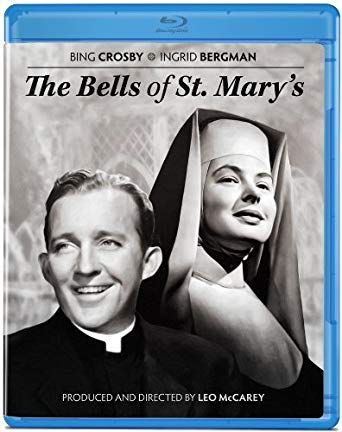
THE LOOK OF LOVE: THE BELLS OF ST. MARY’S (1945)

51tj6RapBXL._SX342_

Originally published in a booklet for the 2013 Olive Films Blu-ray release.

As WWII was winding down, the most popular character in America was the singing priest Chuck O’Malley. As portrayed by Bing Crosby, O’Malley was an amiable reformist, trying to bring Catholicism out of the cathedral and onto the streets. Created in collaboration with director Leo McCarey, Going My Way (1944) and The Bells of St. Mary’s (1945) were the highest grossing films of their year, and amassed ten Academy Awards between them. Adjusted for inflation, The Bells of St. Mary’s made more money domestically than The Dark Knight Rises (2012). Father O’Malley is a kind of Catholic superhero, trying to modernize the religion before it lapses into irrelevancy.

Following Going My Way, McCarey was one of the highest paid men in America, and he could call his own shots. He formed a production company, Rainbow, and started planning the sequel, The Bells of St. Mary’s, which he sold to RKO (Going My Way was distributed through Paramount). He developed the story with screenwriter Dudley Nichols, which focuses on the efforts of Sister Mary Benedict (Ingrid Bergman) to acquire a new building for her crumbling school, which will soon be shut down because of code violations. Father O’Malley is the new parish priest who must try and corral her ambition.

Bergman was under contract with David O. Selznick, so RKO had to pay him $175,000 to borrow her services, as well as sell him the rights to Little Women and A Bill of Divorcement. Bergman recalled how Selznick attempted to dissuade her from accepting the role, arguing that she “would just be a stooge for Bing Crosby’s singing.” She was enraptured by McCarey’s energy, though, and felt that, “If you didn’t like him, there was something wrong with you.” It was a hefty sum for RKO to pay, but Bergman had just won the Best Actress Oscar for Gaslight, and teaming her up with Crosby was the safest box office bet in town. Crosby was an altar boy as a teenager, and attended a Jesuit secondary school, but dropped out of Gonzaga to pursue a career in music. Conversant with both laissez-faire parishioners and strict observers, he was the ideal personality to bridge the gap between the traditionalist and progressive wings of the Catholic church.

While the episodic Going My Way has a tendency to meander, The Bells of St. Mary’s is anchored by the bubbling rapport between Crosby and Bergman. In a reversal of traditional gender roles, O’Malley is presented as a tender nurturer, while Sister Mary is strict and assertive, even teaching a young boy how to box. Crosby is introduced to St. Mary’s school through a series of humiliations. He is chastised by the maid (Una O’Connor), who clucks “I see you don’t know what it means to be up to your neck in nuns”. In Going My Way he owns every room he’s in with his laid back charm, whereas when he lays back here, he accidentally hits a buzzer and rouses the whole convent. Upon entering the conclave, he proceeds to sit down on a shrieking kitten. And when he gives his welcome address to the nuns, another cat toys with a straw hat behind him, causing the sisters to erupt in laughter.

Despite these indignities, Father O’Malley is still eager to assert his masculinity, so after two kids end up in a brawl, he expresses pride that they stood up for themselves. He tells Sister Mary, “On the outside, it’s a man’s world.” Mary replies, “How are they doing, father?” Their shifting power relations are expressed through the direction of their gaze. Mary begins her retort with modesty, eyes looking down, but by the end of her pointed phrase they drift up and stare straight off-screen at O’Malley, with the edges of her mouth curling into a grin. In his reaction shot O’Malley exhales and looks down, mumbling, “not doing too good” under his breath. This oblique reference to the horrors of WWII is also a decisive moment in their relationship. From here on out they exchange roles – Mary will exert aggression, and O’Malley compassion, accepting his subordinate role in the school’s pecking order.   He becomes a matchmaker for an estranged husband and wife whose daughter attends the school, while Sister Mary teaches her kids how to swing a baseball bat and throw a punch.

McCarey modeled Bergman’s character after his aunt, also named Sister Mary Benedict, a member of the Immaculate Heart Convent in Hollywood. Bergman portrays her with impish exuberance, an admitted tomboy who still finds pleasure in upsetting the expectations of how a nun is supposed to act. Bergman is very loose and inventive, and contributed eagerly to the improvisations that McCarey encouraged. Off-hand gestures, like how she flips a baseball off her wrist in a sporting goods store, or exaggerates her footwork during a boxing lesson, were made possible by McCarey’s improvisatory process. During down time, the director would sit at a piano and spitball ideas with the cast, encouraging acts of wild spontaneity. Bergman was already feeling free, not having to worry about her figure since she was clothed in a nun’s habit for the entire feature. “I was like a child with money”, she recalled, “and in the country of the greatest ice cream.”

McCarey put this improvisatory process on the screen with the Christmas Play, which Sister Mary is overseeing. She lets the children write it themselves, and informs O’Malley that, “Every time they do it, the dialogue is different.” The children are clearly making it up as they go along, as Bobby (the son of musical director Robert Emmett Dolan) hems and haws his way through the story of the birth of Jesus, ending in a tableaux of golf-club wielding shepherds. Instead of closing with “O Holy Night”, the kids sing “Happy Birthday”. Despite being set at a Catholic school, The Bells of St. Mary’s is quite secular, presenting the church as more of a social services organization than a religious one.

This is made explicit with the subplot of Patsy Gallagher (Joan Carroll), whose single mother pays the bills through prostitution. O’Malley takes her in as a student without asking questions, and tracks down her errant pianist father. This whole section plays like canned melodrama, a staid commercial for the value of church in the community. It almost seems as if McCarey included these scenes so he could get away with the more subversive antics of the rest of the movie.

One of the next turning points in the film occurs during a secular song. Sister Mary is singing a traditional Swedish folk tune by the piano with the nuns gathered all around her. O’Malley is attracted to the scene by her lilting soprano. He steps towards the circle, and McCarey cuts into a shot from his POV. It is the most artful composition in this otherwise classically framed film, in which two black habits join in the foreground to make a “V” shape, with Sister Mary’s face centered in the middle, as if in a cameo necklace. It is a devotional image, but this is not a religious psalm, but a love song.

Her eyes are shaded downward as she trills the lyrics, which roughly translate to: “Spring breezes whisper and caress loving couples/Streams rush by/But they are not as swift as my heart”. As she winds the song to a close, her voice lowers. But she inches up her head and finally sees O’Malley, which makes her voice fly up the scale to hit her highest note, which breaks up into a chuckle and a grin: “Oh, Father O’Malley!” In recognizing his gaze, she breaks the spell, but the tenor of their relationship has changed.

Their reciprocal glances continue to build in intensity, as word comes down that Mary will be transferred to another convent out West. It is ordered by her doctor, but O’Malley has to pretend it was his decision. This betrayal of trust triggers her shift from secular to spirtual, folk song to prayer. Before her departure, she kneels in in the chapel. Her eyes are directed upwards as she pleads,“Dear Lord, remove all bitterness from my heart”. It is a rare acknowledgment of God’s presence in a film otherwise occupied with the physical. As she passes by O’Malley outside the doors of the convent, her stare is unwavering, as she searches for some flicker of regret in his face. But there is none.

As she is about to depart, her prayer is answered. O’Malley calls her back, and gives her the truth. He did not order her re-assignment. Sister Mary closes her eyes in ecstasy, a beaming smile lighting up her face. She simply says, “Thank you, father. You’ve made me very happy.” They hold each other with their gazes, neither breaking away. For the first time their looks are equal. This is as close as they can come to a declaration of love.

Aware of the erotic tension of this goodbye, Ingrid Bergman planned a practical joke on the final day of shooting. In one of the last takes she threw her arms around a stunned Crosby and kissed him passionately on the lips. Reportedly one of the priests on the set jumped up and yelled, “You can’t use that!” McCarey didn’t, but this missing negative should be as sought after as the original cut of The Magnificent Ambersons. Something else to pray for.

John Ford: A Biography

I wrote this biography of John Ford for TCM’s DVD box set John Ford: The Columbia Films Collection (2013)

ford columbia

In 1967 Kenneth Tynan asked Orson Welles which directors he most admired. Welles responded: “The old masters. By which I mean John Ford, John Ford, and John Ford.” In the short history of moving images, John Ford occupies a uniquely revered position. He won a record four Best Director Oscars while remaining as popular with moviegoers as critics. His films were rousing entertainments that also picked at the contradictions of American life, of individual freedom vs. community, civilization vs. wilderness. These contradictions settle in the person of John Wayne, who forges a new society in Stagecoach (1939), violently holds it together in The Searchers (1956), and exposes the lies of its construction in The Man Who Shot Liberty Valance (1962). Ford’s films are as American as apple pie and armed aggression, and Ford is a great enough artist to encompass both.

John Martin Feeney was born in 1894 in a two-story farmhouse in Cape Elizabeth, Maine to his mother Barbara and father John. He was their tenth child, but only the sixth to survive. Both of his parents had emigrated to the United States from Spiddal, Ireland. John Sr. worked for the gas company, and made extra cash by selling bootleg whiskey to sailors and dockworkers. He eventually saved up enough money to purchase what would become Feeney’s Saloon, the new family business. John Jr. was a poor student but a devotee of the Nickelodeon theaters, and found his way into the movies when he discovered his wayward brother Francis had changed his surname to “Ford” and become a successful actor and director. After graduating high school, he briefly attended the University of Maine in the school of agriculture. He quickly decided dredging pig slop wasn’t for him, and sent his brother a wire asking for a job at Universal. He left for Southern California by train in July 1914.

His first job was as a studio ditchdigger, but he pitched in wherever he could. He was a stuntman, prop wrangler, camera operator, assistant director and actor, learning the whole business from the ground up. He even nabbed a bit part in D.W. Griffith’s The Birth of a Nation (1915) as a hooded member of the Ku Klux Klan. He made his directorial debut on the two-reel Western The Tornado (1917), credited with his nickname, “Jack Ford”. The majority of the 40-plus films he directed for Universal have been lost. The greatest losses were the 24 films he made with Harry Carey, only one of which survives (Straight Shooting (1917)). Carey was known as the “Bronx Cowboy”, a rough-and-ready hero more realistic than the spic-and-span Tom Mix. Ford described the Carey persona as, “sort of a bum, a saddle tramp, instead of a great bold gunfighting hero.” The director would look back fondly on these films, dedicating 3 Godfathers (1948) to Harry Carey, and making Carey’s son Harry Carey, Jr. part of his stock company of actors. John Wayne would pay his own homage at the end of The Searchers (1956), by mimicking Carey’s famed gesture of gripping his right elbow with his left hand.

In 1920 Universal agreed to lend Ford’s services to Fox, the studio for whom he would make more than 50 features over 30 years. In another milestone that year, he would wed Mary McBryde Smith, a North Carolina native of Scottish and Irish descent. Their marriage was a rocky one, but like a good Catholic he never divorced. Together they had two children, Barbara and Patrick.

Ford’s first film for Fox was the lyrical small town comedy Just Pals (1920), and the last the WWI comedy What Price Glory (1952). As Harry Carey’s star waned in 1921, Ford left Universal for good and signed a long-term contract with Fox. The Iron Horse (1924) was his first big-budget spectacular, an epic  re-telling of the construction of the transcontinental railroad that movingly conveys the immigrant experience (it was inspired by John’s Irish uncle Mike). 3 Bad Men (1926) is a less triumphal version of American expansionism, an intimate tragicomedy about three outlaws who escort a grieving daughter to her land claim. Darkened with chiaroscuro lighting by DP George Schneiderman, it reckons with the price paid in blood by the push Westward. As the popularity of the genre sunk, Ford wouldn’t make another Western until Stagecoach (1939).

Fox at that time was under the spell of German master F.W. Murnau, who had come stateside to film Sunrise (1927). His mobile camera and expressionistic lighting deeply affected Ford, whose works in this period bear Murnau’s influence. It is most evident in Four Sons (1928), a WWI melodrama about a Bavarian widow whose children all enlist in the war, and it re-emerges in Pilgrimage (1933) and The Informer (1935). With the Western in eclipse and the emergence of sound, Ford experimented in a variety of genres, including gangster films (Born Reckless, 1930), underwater action (Men Without Women, 1930) and jailhouse comedies (Up the River, 1930). The last featured the debuts of Spencer Tracy and Humphrey Bogart.

His films of the mid-1930s can be split into the “serious” works he made for RKO, like the IRA drama The Informer and WWI morality play The Lost Patrol (1934), and his more commercial films for Fox, like his trilogy of bucolic small town comedies with Will Rogers: Doctor Bull (1933), Judge Priest (1934) and Steamboat ‘Round the Bend (1935). He netted his first Best Director Oscar for The Informer, but today the Rogers films seem more personal. They are visions of troubled melting pot communities held together by the folksy, open-minded progressiveness of Will Rogers, the kind of society that might have sprung up after the church raising in My Darling Clementine (1946). Ford later re-made Judge Priest as The Sun Shines Bright (1953), and named it the favorite of his films.

John Ford became the John Ford of legend with the release of Stagecoach in 1939. While the number of Westerns being produced was again on an uptick after over a decade of decline, the vast majority were cheap B-pictures. So when Ford started shopping his adaptation of the Ernest Haycox short story “Stage to Lordsburg,” it took him a year and a half to land the picture with Walter Wanger for distribution through United Artists. John Wayne, a former bit player for Ford who was making B-Westerns for Poverty Row studio Republic Pictures, was tapped for the lead. It was the first film that Ford shot at Monument Valley in Utah, the pockmarked moonscape that would become the testing ground of his Western protagonists for decades to come. A swiftly paced adventure that also pokes holes in classist bourgeois values, it helped to kickstart a new cycle of Western films and launched Wayne into the stratosphere. Orson Welles screened it repeatedly to learn film form before making Citizen Kane (1941).

The film’s success led to an astonishing burst of creativity, leading to what is informally known as Ford’s “Americana Trilogy”: Young Mr. Lincoln (1939), Drums Along the Mohawk (1939), and The Grapes of Wrath (1940). A mix of Popular Front politics and Ford’s brand of populist patriotism, they span the era from the Revolutionary War to the Dust Bowl, and etch Henry Ford as a symbol of American decency, which, in Drums and Grapes, has revolutionary implications. Ford would go back to his roots for How Green Was My Valley (1941), his melancholy portrait of industrial progress, as a Welsh mining family declines along with the ascent of mechanization. Famous for beating Citizen Kane for the Best Picture Oscar, it is one of Ford’s most emotionally wrenching works, and introduces a skepticism towards “progress” that he returned to throughout his career.

It was his last feature before the onset of WWII, during which he served as a Commander in the U.S. Navy, and led the Field Photographic Branch of the Office of Strategic Services, for whom he directed a number of propaganda films, from the syphilis scare flick Sex Hygiene (1942) to the harrowing battle footage of The Battle of Midway (1942). Midway and December 7th (1943) would win Best Documentary Feature and Short awards, respectively, but the bulk of his work for the OSS was secret, filming “guerillas, saboteurs, Resistance outfits.” After being discharged, he built the Field Photo Farm, a decked-out retreat where his Navy pals gathered every Memorial Day, and which had as its centerpiece a chapel in which the names of their deceased colleagues were etched. It remained in use until the end of his life.

His first feature after the war was They Were Expendable (1945), a downbeat portrait of a stretched-thin PT boat crew defending the Philippines from Japanese attack. The elegiac script was written by Ford’s Navy pal Frank “Spig” Wead, whose tragic life he captured in the bio-pic The Wings of Eagles (1957). After Ford’s immersion in the present, the rest of the 1940s find him grappling with the myths of the American West, beginning with Wyatt Earp and My Darling Clementine (1946). Henry Fonda, that paragon of virtue, turns the Earp role into that of a civilizing figure, clearing a path for community to rise in the violent go-it-alone ethos of the frontier. In the “Cavalry Trilogy” that begins with Fort Apache (1948), Fonda plays against type as an uptight martinet who leads his troops into a slaughter. Similar to the “print the legend” decision in The Man Who Shot Liberty Valance (1962), which covers up the real identity of the title’s shooter, Fonda’s folly is hidden and he is recast as a hero. John Wayne plays the scout who buries the truth and prints the legend. In She Wore a Yellow Ribbon (1949) and Rio Grande (1950), Wayne is an aging officerat peace with the moral compromises of the job. He is headed for retirement but is wary of the generation that will follow him, clashing with his subordinates and his children. Here again Ford is a skeptic of progress.

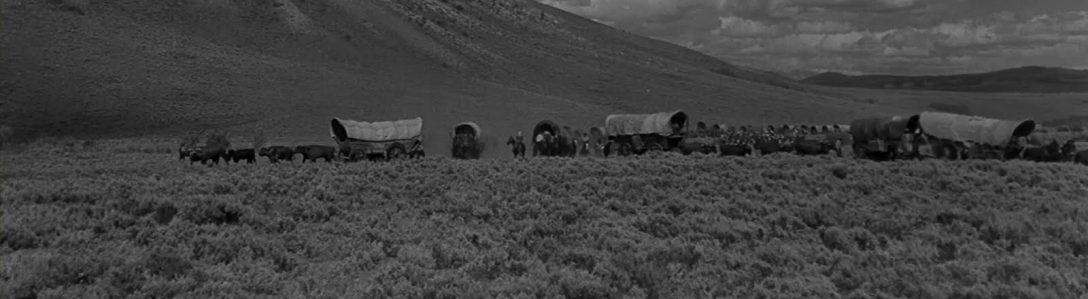
Wagon Master (1950) is one of his lesser known Westerns, but perfectly expresses Ford’s vision of community. Starring Ben Johnson and Harry Carey Jr., it follows a wagon train of Mormons and Medicine Show performers as they head west for the promised land. Ejected from every city they land in, together they create an outsider society of their own. In The Quiet Man (1952), John Wayne runs away from a violent past into the Emerald Isle, shot in eye-popping Technicolor by Winston C. Hoch. One of Ford’s passion projects, he had been trying to get it made since 1935, and finally convinced Republic Pictures’ Herbert Yates to back it after getting Wayne and Maureen O’Hara to accept pay cuts. Filled with knockabout Irish comedy and sweeping romance, it became one of Ford’s most popular pictures, and he won his final Best Director Oscar for his efforts. His other personal project for Republic, the Judge Priest remake The Sun Shines Bright (1953), disappeared quickly from theaters. A profoundly moving tale of tolerance, its plainspoken cornpone honesty did not connect with audiences.

Ford soon proved his box office bona fides with Mogambo (1953), an exotic big game hunting adventure with Clark Gable and Ava Gardner. On the shoot in Africa he contracted amoebic dysentery, which eventually led to cataract surgery and the donning of his trademark eyepatch. Always a heavy drinker, his alcoholism became chronic in this period, leading to the chaotic Mister Roberts (1955) production, for which Henry Fonda returned to the screen after eight years on Broadway. The two clashed, and the combination of drink and stress led to a ruptured gall bladder. Mervyn Leroy was called in to finish the production. The film was a hit in spite of itself.

Out of the chaos of Mister Roberts came Ford’s supreme masterpiece, The Searchers. Invigorated by his return to the Western genre and Monument Valley, it is an immersive journey into the dark heart of America. John Wayne plays Ethan Edwards, former Confederate soldier and mercenary gun for hire on a vengeful quest into Comanche territory to recover his kidnapped niece, whose parents were slaughtered. He is a virulent racist set on killing the niece sullied by the Comanche—Westward expansion envisioned as genocide. The ending is a miracle and a wish, a conversion into the communal America of My Darling Clementine and The Sun Shines Bright.

After a detour to Ireland and England with The Rising of the Moon (1957) and Gideon of Scotland Yard (1958), Ford returned to America and continued to feel his age, and make films about the process. The Last Hurrah (1958) tells the last days of a Boston politician, played with warmth by Spencer Tracy, and Two Rode Together (1961) is about an aging gunslinger Jimmy Stewart, exhausted and cynical about a town’s plan to recover their kidnapped children. Stewart returned for The Man Who Shot Liberty Valance (1962), a stately B&W memorial to the Western, in which, like Fort Apache, history is re-written to protect our country’s founding myths.

In his final decade Ford was engaging with the Civil Rights movement, reflecting on his own representation of Black and Native Americans (although personally he drifted toward Conservative Republican politics after WWII). Sergeant Rutledge gave Woody Strode a rare leading role in a chamber courtroom drama, playing a cavalry officer unjustly accused of raping a white woman. Cheyenne Autumn (1964) tells the tale of a Cheyenne tribe starved of resources by U.S. Indian Agents, and how they break through their reservation to take back their ancestral hunting grounds. Ford’s final film, 7 Women (1966), has the verve of a pulp adventure novel as Christian missionaries are besieged by Mongolian warriors, with only secular doctor Anne Bancroft to save them. It is like a feminist version of the Cavalry Trilogy, a siege narrative with nuns instead of soldiers (and with Vietnam the unspoken allegory, instead of WWII).

Ford’s health kept deteriorating, and in October of 1971 he was diagnosed with terminal cancer. While battling the disease he stayed in touch with his stock company and watched old Westerns on television. He died on August 31st, 1973, with Woody Strode holding his hand.

–by R. Emmet Sweeney

John Ford: The Columbia Films Collection

These are the liner notes I wrote for John Ford: The Columbia Films Collection (DVD, 2013)

ford columbia

The five features John Ford directed at Columbia Pictures are fascinating departures, a group of mostly city-set tragicomedies that reveal how this legendary director of Westerns was also a keen observer of his present day. From the neurotic split personalities in The Whole Town’s Talking (1935) to the  worn out politician in  The Last Hurrah (1958), these films  depict how industrialization was altering the civilization Ford  so movingly constructed in The Iron Horse (1924) and My Darling Clementine (1946), by privileging the individual above the community. This is also reflected in his late Westerns like Two Rode Together (1961), which presents the township as riven with hypocrisy. Made decades apart, these films present an alternate history of Ford as a gimlet-eyed chronicler of urban life .

 The Whole Town’s Talking was an agreeable assignment. In late 1934 Ford had finally convinced RKO to fund The Informer, after being turned down by the five major studios because of the film’s sensitive political content. To once again prove his box office bona fides, he made the lyrical Will Rogers comedy Steamboat Round the Bend (1935) for Fox, and was loaned to Columbia for The Whole Town’s Talking. Based on W.R. Burnett’s short story “Jail Breaker”, it was intended to be Edward G. Robinson’s return to box office glory.  Robinson was on suspension at Warner Bros., having rejected one script too many, and the studio was happy to loan him out to Columbia for some quick cash. Robinson biographer Alan L. Gansberg claims the actor rejected Alfred Santell as director, and demanded that Harry Cohn get John Ford from Fox.

Steamboat Round the Bend completed shooting in August of 1935, and The Whole Town’s Talking began rolling in October. Burnett’s story was adapted into a script by frequent Frank Capra collaborators Robert Riskin and Jo Swerling, and the film retains the Capraesque sensibility of a little man stumbling his way up the economic ladder. It tells the tale of mild mannered office clerk Arthur Ferguson Jones (Robinson) who just happens to be the spitting image of escaped gangster “Killer” Mannion (also Robinson). Jones is arrested, released and hired to pen a newspaper column about his brush with infamy, and when Mannion gets wind of it he leaks details of his violent exploits to his doppelganger. The column becomes a sensation, all while Jones is pining after Miss Clark (Jean Arthur), the sassy co-worker who acts as his de-facto agent and manager.

Ford presents the city as an undulating mass of humanity, people as indistinguishable suits and fedoras. The opening shot tracks through a city office, with hunched over workers typing at their clacking counting machines (perhaps a nod to King Vidor’s The Crowd (1928)). Later when Jones is arrested for looking like Mannion, he is subsumed by shouting police and press, left cowering in a corner chair. Jones yearns to disappear and be one of the mob, but his face betrays him. It is only Miss Clark who seems worthy of individuality. She is introduced in a nimbus of cigarette smoke at the office’s threshold. After taking a deep drag, she flicks away the butt, steps through the door and exhales an insouciant puff. Minutes later she is fired and rehired, and reacts to both as if it were a run in her stocking. She is, rather gloriously, her own woman.

The recessive Jones only catches her eye after getting loaded with the bosses and yelling, “so long, slaves!” to his co-workers,taking on the aggressive attitude of Mannion. The rest of the film finds Jones searching for balance, trying to say goodbye to servitude without subjugating others. Ford slowly empties out the frame, the madcap chaos of the office and police station scenes replaced by tense shotsof Jones and Mannion circling each other, deciding the ideal way to be free.

Ford would not return to Columbia for 20 years, until The Long Gray Line (1955). It is another story balancing the individual and the group, this time among the regimented life of soldiers at West Point. Producer Jerry Wald had wanted to produce a film version of West Point lifer Marty Maher’s autobiography at RKO. Bringing Up the Brass (1951) had strung together anecdotes from Maher’s 50 years as an instructor at the Point, but RKO declined to option it. Wald eventually took an executive producer position at Columbia, where he revived the project and hired Ford to direct and Tyrone Power to star.

It was Ford’s first feature since undergoing eye surgery for cataracts. During the Mogambo (1952) shoot in Africa, Ford contracted amoebic dysentry, and began suffering blurriness of vision. He stubbornly put off the operation until July 1953, when he started to fear going blind. Vision in his left eye would be impaired for the rest of his life, and necessitated that he wear his famous eye-patch. Ford biographer Joseph McBride quotes one of the director’s soundmen observing, “The Old Man can’t hear, he can’t see. All he can do is make good pictures.”

Now with only one good eye, the studio mandated he make The Long Gray Line in CinemaScope, his first experience with the new format. He was none too happy with the process, telling Peter Bogdanovich, “You’ve never seen a painter use that kind of composition. Your eyes pop back and forth, and it’s very difficult to get a close-up.” Despite his complaints, he took to the process naturally, using the film’s title as visual instruction, with rows of gray Marines set up like dominos across the wide frame. Irish immigrant Martin Maher (Power) is always set apart from these lineups, a waiter who works his way up to become an instructor of boxing and swimming, despite his lack of experience in both.

While intended as a tribute to West Point and its former graduate (and current President) Dwight D. Eisenhower (played by Harry Carey, Jr.), the film endures as a treatise on aging, as Maher watches as his boys who once lined up for lap swim end up on long lists of dead men during the two World Wars. He is helpless against these ravages of time and the violent world outside. He finds comfort in the regimented order of life at West Point, where he can always find everything in its place, usually put there by his wife Mary O’Donnell (Maureen O’Hara), who even brings over his father and brother from Ireland. O’Hara reportedly had vicious fights on the set with Ford, and her performance is equally vehement, depcting Mary as a hotheaded Irish lass who delights in needling Marty’s masculine insecurities. Early in their marriage Mary and Marty learn they can’t have children, so their love turns to the cadets. As classes come and go, and die overseas, Marty and Mary become walking memorials to the men they taught and loved. In one of the most moving scenes in Ford’s films, he shows Marty tottering through an empty kitchen, the soldiers’ absence far stronger his presence. But as Marty and Mary have built their own isolated community in West Point, it fills up again with young recruits, eager to hear Marty’s stories of the old days. It ends on a triumphal note, but as the vicious cycles of the rest of the film have made clear, these boys will also disappear.

Ford continued the theme of solitude within a crowd with the laid back police procedural Gideon of Scotland Yard (1958). The most obscure of his sound features, it follows the harried Inspector of Scotland Yard (Jack Hawkins) over the course of one day, tracking murderers as well as a fish he must bring home to dinner. It was adapted from the detective novel Gideon’s Day (also the British title of the film), the first of a series by J.J. Marric, one of the many pseudonyms of prolific pulp novelist John Creasey.

Ford was reuniting with producer Michael Kilcannin, who had helped put together the Irish anthology film The Rising of the Moon (1957) with WB the previous year. The studio system was breaking down, and with it Ford’s post-Searchers project The Valiant Virginians, which was killed when the producer pulled out his money to invest in a chain of television stations. Ford sought to ease his frustrations abroad. His interest in Gideon revived Columbia British Productions after a fourteen year layoff; the studio was last active on Alberto Cavalcanti’s Affairs of a Rogue (1948). Joseph McBride surmises that Ford took on the project because he wanted to help British actress Anna Lee, a member of his acting stock company, get off of the blacklist. In her first role since 1952, she plays Gideon’s wife, Kate. The shoot also conveniently killed time while Ford was waiting for Spencer Tracy to finish shooting The Old Man and the Sea, so he could use him in The Last Hurrah.

Shot at Elstree studios in Hertfordshire, England with an all-British cast and crew, it held little market appeal in the U.S., where Columbia treated it as a B-picture. They cut it by a third (to 54 minutes) and only distributed B&W prints of the film shot in Technicolor by DP Freddie Young (Lawrence of Arabia).

This doomed its reputation at the time, but it is overdue for rediscovery. Gideon is a clear stand-in for Ford himself, an abrasive workaholic attempting to bend an unwieldy bureaucracy to his will. Ford always called his films “a job of work”, and Gideon treats his job with the same gruff professionalism. Whether it’s catching a thrill killer or getting to his daughter’s violin recital, he is only concerned with completing the task at hand. In an expansive mood Ford once called star Jack Hawkins, “the finest dramatic actor with whom I have worked.” Trained on the London stage, Hawkins is a rumpled masculine totem who keeps his emotions sewn up underneath a begrimed suit coat. (great description!)

The film details the messy overlapping chaos of the everyday, where work bleeds into private life until it’s impossible to tell the difference. At one point Gideon has lunch with his wife, but brings an army of detectives along, literally bringing work home with him. Anna Lee puts on a brave face of indomitable domesticity, but near the end of the film instructs her daughter (Anna Massey): “Promise me one thing. Never marry a policeman.” Shot in a string of medium shots and cut at a breakneck tempo by Ford’s standards, it is the most televisual of his films. The Gideon series of novels was eventually turned into a series on the British network ITV, while Ford had moved on to film another man working inside a bureaucratic system in The Last Hurrah.

After Ford finished reading Edwin O’Connor’s novel The Last Hurrah (1956), he fired off a telegram to Harry Cohn saying he would make the film version for free (he actually did it for $125,000 and 25% of the net, according to Joseph McBride). The novel is a fictionalization of the life of James M. Curley (1874 – 1958), Boston’s Irish-American political boss. The Democrat Curley was a four-term mayor, a two-term Congressman, and a two-time convict. O’Connor named him “Frank Skeffington”, and detailed his failed campaign for a fifth term as mayor, reflecting the decline of machine politics as children of immigrants began to climb the economic ladder. Already folk heroized in O’Connor’s book (adapted to the screen by Frank Nugent), Ford buffed him further, with no trace of the mob ties or kickbacks that kept him in power. Instead he zeroed in on the character’s creeping obsolescence, as political campaigns shifted from the streets onto television. It is unreliable as history but, like The Long Gray Line, is deeply moving as a film about aging.

Ford had a tough time casting the lead role, cycling through names like James Cagney, John Wayne and even Orson Welles, before agreeing upon the common sense choice, Spencer Tracy. The two proud Irishman had not worked together since Tracy’s debut in Up the River (1930), where, McBride writes, “Tracy found the director overbearing and always resisted being part of his stock company.” After Tracy rejected a part in Ford’s The Plough and The Stars (1936), their relationship deteriorated. Katherine Hepburn interceded to secure the plum role of Skeffington for Tracy, who was then in poor health after the demanding and stressful shoot on The Old Man and the Sea (1958). Tracy was so drained during The Last Hurrah he was contemplating retirement, telling The New York Times: “Twenty-eight years is a long time. I started with John Ford and it has been suggested that since he is directing this film it might be an appropriate time for me to call it quits. You know, the beginning and the end with Mr. Ford.”

He would go on to make six more films, but this mood of melancholy retrospection was ideal for the role of Skeffington, who takes stock of the world that was and the one swiftly passing him by. Sensing that his fifth election will be his last, he asks his sportswriter nephew Adam (Jeffrey Hunter) to join him and observe the end of his era. His campaign is filled with pressing-the-flesh handshakes and ill-fitting suits. Ford usually shoots in long shot to frame Tracy in crowds, whether it’s his fluttering advisors or favor-peddling constituents. Ford compares that to his isolated young opponent, propped up by his WASP benefactors in hilariously awkward television spots. A young priest echoes what Ford himself may have thought of the coming generation: ”I prefer an engaging rogue to a complete fool.”

Adam is the only member of Skeffington’s family who might learn his traditions, as his son is an airhead playboy and his beloved wife passed on. Skeffington honors her by placing a rose in front of her portrait before leaving the house, reminiscent of Will Rogers conversing with his dead wife in Judge Priest (1934). Skeffington hearkens back to Ford’s films with Rogers, a folksy politician who is more concerned with people than power. The Last Hurrah acts as a memorial for men like Judge Priest as well as the artist who made it, with Ford perhaps reflecting on his own obsolescence. The cast is filled with old character actors from his past: Jane Darwell, John Carradine, Mae Marsh, Pat O’Brien, Donald Crisp and many more. They hover around Skeffington like friendly ghosts, easing him into the afterlife. When Skeffington loses the election, and strolls alone past the victory parade, it is a mournful inversion of the finale to The Sun Shines Bright (1953), Ford’s remake to Judge Priest. That film concludes with the whole town parading before the kindly judge, paying their respects. In this version he is rejected by the next generation, disappearing into the cheering crowds and ending up on his deathbed.

While he was filming Two Rode Together (1961) Ford was forced to bid farewell to Ward Bond, who died of a heart attack at the age of 57. He had directed Bond in over 20 features, and when he was informed of Bond’s death on the set by Andy Devine, he characteristically replied, “Well, I think you’re going to have be my horse’s ass now!” He would mourn after the shoot with an alcoholic bender that would land him in the hospital. Ford did not have fond memories of the film, calling it “the worst piece of crap I’ve done in twenty years”. His grandson Dan Ford said he made it solely for the money ($225,000 plus 25% net profits), yet, as disjointed as it is, it features darkly funny performances from Jimmy Stewart and Richard Widmark, flashing some of Ford’s gruff witWhere The Last Hurrah and The Long Gray Line mourn time’s passing, Two Rode Together is bitter about it. The story, adapted by Frank Nugent from Will Cook’s novel Comanche Captives,, follows cynical small town sheriff Guthrie McCabe (Jimmy Stewart) as he is asked to enter Comanche territory and reclaim kidnapped white children, some lost for years. Accompanying him is cavalry officer Jim Gary (Richard Widmark), a sometime friend appalled by Guthrie’s mercenary instincts to profit from parents’ desperation.

Jimmy Stewart is corrosively funny as Guthrie, as he skewers the townspeople’s misplaced hopes and casual racism against his Mexican girlfriend Elena (Linda Cristal), who once lived with the Comanche. He’s introduced tipping back in his chair in a dandified suit, his foot on a front porch post, a burlesque of Henry Fonda’s similar pose in My Darling Clementine. It’s clear from this visual rhyme that the simplicity of Fonda’s Wyatt Earp has curdled into decadence. The Comanches revert to the stereotype of simplistic savages, riven by petty jealousies and driven by the bloodlust of warrior chief Stone Calf (Woody Strode, who was part Native American).

The film is fueled by a palpable disgust with humanity, perhaps exacerbated when Ford got word of Bond’s passing. The film is at its calmest and most engaging when it focuses on the sniping friendship between Guthrie and Jim, a battle of clashing insecurities expertly deployed by Stewart and Widmark. Ford clearly enjoys watching them work, as the story slows down to a crawl to accommodate them. The highlight of the film is a nearly four-minute shot of the two men sitting creekside, where they argue about money, jealousy and the terrors of marriage proposals. Ford frames them from the ankles up, so they fill up the composition with their jousting gestures, their stogies brandished like rattling sabres. It’s a charming scene of pure performance, before the plot rears its ugly head.

Guthrie and Jim find a few of the children, but they are irredeemable, just like the townspeople. It acts as a blackly comic version The Searchers, similar to how Ford parodied The Grapes of Wrath (1940) with Tobacco Road (1941). In The Searchers Ethan Edwards is a necessary monster, brutally clearing the way for a nascent civilization, while in Two Rode Together Guthrie’s search proves him to be a wreck clearing the way for more of the same. Progress has stunted, and Guthrie’s only recourse, in the ostensibly happy ending, is to leave town with Elena for parts unknown.

Following this distorted little Western, Ford would make The Man Who Shot Liberty Valance (1962), which clarified and deepened his concerns about the narrative of progress in the old West. John Ford’s films with Columbia often have the feel of test runs for something greater, but it is that spirit of experiment that makes them so essential, with ideas flying out in every direction. Whether through CinemaScope or Academy ratio, snappy urban comedy or prestigious biopic, Ford vigilantly pursued his themes of freedom vs. conformity, nature vs. civilization, and the passage of time that would make them all obsolete. But these films will endure.
 

FRAME UP: BONJOUR TRISTESSE, THEY LIVE and TWILIGHT’S LAST GLEAMING

November 13, 2012

Screen Shot 2020-02-05 at 5.24.15 PM

From the multiplicity of locations to place a camera, the director and his collaborators have to settle on one. This decision, born of practical training and on-set instinct, can turn a routine shot into an extraordinary one. Three recent Blu-ray releases display the talents of the canniest of decision makers: Otto Preminger’s Bonjour Tristesse (1958), John Carpenter’s They Live (1988) and Robert Aldrich’s Twilight’s Last Gleaming (1977). Preminger and Carpenter are naturals in the CinemaScope sized frame, both alternating between B&W and color to emphasize their images’ deceptive surfaces. Aldrich uses the boxier 1.85 ratio, but chops it up into split-screens which convey a dizzying information overload that accompanies the creeping surveillance state of that film’s USA.

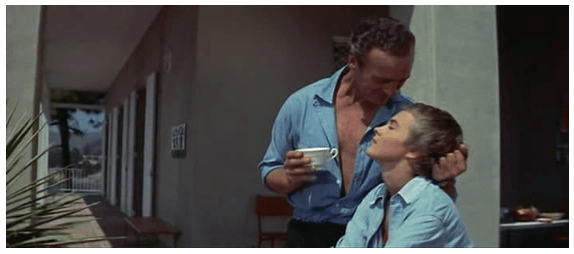
In Jean-Luc Godard’s Contempt, Fritz Lang famously said that CinemaScope was only fit for snakes and funerals, so his character clearly hadn’t yet seen Bonjour Tristesse (1958). Out today on Blu-Ray in a sublime transfer from Twilight Time (available through Screen Archives), Otto Preminger’s film uses the wide frame to emphasize surfaces, whether it’s of Jean Seberg’s impassive face or the doorways and windows that promise a depth that never materializes. Preminger bought the rights to Francoise Sagan’s novel in 1955, and gave S.N. Behrman a crack at the screenplay before turning it over to Arthur Laurents, who received sole screen credit. The story tells of Cecile (Jean Seberg), a carefree teen spending a summer on the French Riviera with her playboy  father Raymond (David Niven, with chest hair perpetually flared). They act more like swingers than family, urging each other into wild romantic escapades and laughing at the wreckage.  But when Raymond falls for their old pal Anne (Deborah Kerr), Cecile becomes wildly jealous and aims to break them up. Her efforts, tragically, succeed.

Screen Shot 2020-02-05 at 5.25.37 PM

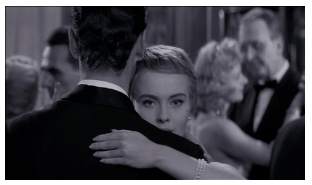
The story is told in flashback, with the present-tense Cecile in black and white, a joyless mannequin twirling through the nightclubs of Paris. She stares dead-eyed into the camera, her arm around another interchangeable Lothario, as she speaks of happier times in voice-over. This is when the color starts to peek through, a strikingly melancholy optical printing effect, as sections of the frame next to her head burst into the color of the Riviera, flickerings of memory coming to life. B&W gives way to hot reds and shimmering blues. The effort already shows in the flashback of Raymond and Cecile’s mirthmaking, having to constantly remind each other that they’re having fun.

Screen Shot 2020-02-05 at 5.25.45 PM

Exteriors are what matter. Early on Raymond’s chirpy French girlfriend Elsa (a hilarious Mylene Demongeot) gets badly sunburned, and this reminder of physical deterioration makes Elsa not long for Raymond’s world. Soon he ignores her for the regal Anne. Preminger emphasizes the openings and closures in their Riviera cottage, where windows, doors and hallways are made visible in every shot, intimating the depths beneath the skin that Raymond and Cecile fear to tread. They are almost always outside, whether on the beach or out on the town.

Screen Shot 2020-02-05 at 5.25.54 PM

The first assistant director Serge Friedman recalled that Preminger did not have the shot choreography planned out, but would have “to do a lot of thinking before he could find the right place.” One of the most memorable shots utlilizes the full ‘Scope frame at a dinner party. A maid is arranged in the  far left edge foreground, secretly chugging a beer behind the bar, while Raymond and his clan are grouped to the right, in the middle distance, nattering on about a casino. Their total obliviousness to the world around them is encapsulated in that slyly funny frame.  Chris Fujiwara, in his Preminger study The World and its Double, writes that “the floor of the set was treated with gelatin to allow the camera to move as freely as possible”, regardless of where he chose to move it. His method is improvisatory, but the result is controlled and structured – even Elsa’s skin troubles are rhymed in the devastating final shot, when Cecile rubs in face cream to preserve her beauty, which is all she has left.

Screen Shot 2020-02-05 at 5.26.01 PM

Another film of deceptive surfaces is John Carpenter’s They Live (1988),  now out on Blu-Ray from Shout! FactoryA scathing  sci-fi satire of Reagan-era America, Carpenter uses the CinemaScope-equivalent aspect ratio (2.35:1) make his compositions as herd-like as the zombified consumer society he is depicting, of crowds and lines and glimmering store lights. The hero in this debased trickle down society is, appropriately enough, played by mulleted (and likely roided) pro wrestler Rowdy Roddy Piper. An unemployed drifter who still believes in the American dream, he is introduced as a hero from a Western, dropped off by a train in a dynamic diagonal composition, as did Charles Bronson in Once Upon a Time in the West.

Screen Shot 2020-02-05 at 5.26.09 PM

He realizes the truth upon donning some magic shades, which reveal a B&W world of alien brainwashing. Billboards scream OBEY and WATCH TV, hidden messages that are also beamed through TV screens to lull the populace into consumer comas. As with Bonjour, the sober B&W represents brute reality, and color the world of exteriors. Carpenter’s project is not one of subtlety, but a kind of satiric shock and awe. Piper’s pal, played by Keith David, is introduced behind a line of iron rebar, and they live in a smoggy abandoned lot across from a church.  They Live is a proto-Occupy Wall Street in its emphasis on extreme income inequality, visualized in alternating rows – of Piper and David’s construction sites and the aliens’ tuxedoed gentry imbibing champagne at a gala dinner.

Released today on Blu-ray from Olive Films, Twilight’s Last Gleaming may be even more timely in its visualization of image overload. A paranoid political thriller still haunted by the death toll of Vietnam, it places Burt Lancaster as a dissident Army vet who breaks into and gains control of a nuclear missile silo. Unless President Charles Durning releases a secret National Security Council memo to the public that reveals the cynical reasoning behind the war, Lancaster will fire the nukes.  A furious film, director Robert Aldrich finds an equally furious style. Instead of parallel editing between the White House, Richard Widmark’s hawkish general (modeled after Curtis LeMay) and the silo, Aldrich uses an increasingly complicated series of split screens (of two and four), in which actions unspool simultaneously, as if you are watching the live feed from the President’s Situation Room. The footage of Durning sitting with his cabinet (which includes an avuncular Melvyn Douglas and a sepulchral Joseph Cotten) as they watch a special forces raid on the silo recalls the photograph of Obama’s team watching the raid on Osama Bin Laden. Or maybe it’s the first found footage movie, a scarier version of The Blair Witch Project in which the bogeyman isn’t one pissed off ghost but the entire social and political system in which we live and work.

WARNER ARCHIVE ROUNDUP: BORN TO BE BAD

October 30, 2012

BORNTOBEBADLC3

The Warner Archive continues to release an enormous amount of the WB back catalog, at a rate impossible to keep up with. Here is my vain attempt to catch up, covering a group of four films made up of bad men and one very bad woman. The most famous title is Nicholas Ray’s Born to Be Bad (1950), a devious noir/woman’s picture in which Joan Fontaine uses her seductive wiles to marry the heir to a family fortune. Then there is a trio of manly ne’er do wells, with Peter Graves leading a mercenary force in the spaghetti western The Five Man Army (1969), Robert Mitchum doing the same in a priest’s habit in The Wrath of God (1972), and Rod Taylor carousing his way through Dublin in Young Cassidy (1965).

Nicholas Ray shot what was then titled Bed of Roses in 35 days, from June 20th to July 30th of 1949. It was a project that the head of RKO, Howard Hughes, had indefinitely postponed in 1948, one of the provocations that caused the production head Dore Schary to quit. It had gone through seven screenwriters and five directors before Ray took over, with Joan Fontaine in the lead role. Even Fontaine was wary, with her husband William Dozier writing to Hughes, “I’m afraid Joan’s enthusiasm for this project has not heightened any with the passage of time.” It was an adaptation of the 1928 novel All Kneeling by Anne Parrish, divulging the seedy story of Christabel Caine (Fontaine), a manipulative ladder-climber eager to seduce every man she meets and then marry the one with the most money. Her target is Curtis Carey (Zachary Scott), the scion of a wealthy family already engaged to Donna (Joan Leslie), the whip-smart assistant to Christabel’s Uncle John, a publisher. Christabel also has the acidically funny Nick (Robert Ryan) on a string, who is one of John’s up and coming authors. Despite all the studio snags, Ray orchestrates a deliciously cynical melodrama of sexual power plays. It is a movie of lush upper class interiors, and Ryan has the characters constantly shifting in the frame, as seen in the bravura opening sequence, in which Donna is preparing a dinner party. Donna is a blur of preparatory focus, walking in and out of rooms while Ray returns to a fixed shot of the hallway. Eventually Donna is speedwalking toward the camera, and trips to the floor over a suitcase inconveniently placed in the hall. It is the introduction of Christabel, who is sitting patiently in a room to the right. In this clever bit of choreography, Christabel is visualized as a roadblock to Donna’s best-laid plans.

Ray is aided by richly layered performances from Fontaine and Ryan. Fontaine uses a girlish hair-flipping exterior to hide her designs, letting diabolical smiles slip out once the other characters leave the frame. Ryan is a wisecracking rogue who sees through Fontaine’s exterior, describing her dual personality to her face, and yet unable to tear himself away from her. In a damning kiss off at one of her ballroom parties, following her marriage to Curtis, Ryan tells her, “I love you so much I wish I liked you.” And yet a few scenes later he’s back in her arms, ready and willing to believe her latest bedside conversion.

If Born to be Bad exhibits the genius of the Hollywood studio system, then The Five Man Army is representative of that system’s decline. As the Paramount Decision dismantled the vertical integration of studios, they scrambled to find new ways to gain audiences. The spaghetti western was one such avenue, and as the success of these products became clear, studios cut in on the action. The Five Man Army is a U.S.-Italy co-production distributed by MGM. Although Don Taylor is credited with directing the film, various reports have producer Italo Zingarelli (the pseudonym of director Giulio Questi) and even the young co-screenwriter Dario Argento taking the reigns after Kelly had to depart early to take on a TV production. There is a marked difference between the early, dialogue heavy scenes and the epic, almost wordless train heist takes up nearly the entirety of the last half-hour of the film. I haven’t found any reliable sources on the matter, but whoever ended up sitting behind the camera, it’s an effective Seven Samurai/Magnificent Seven style mercenary film, capped by a surging Ennio Morriconne score and that extraordinary finale. Peter Graves, then famous for his role on Mission Impossible, headed the international cast, which was made up of mountainous Neapolitan tough guy Bud Spencer, the stereotyped silent Japanese “Samurai” (Tetsuro Tanba), tiny Italian firecracker Nino Castelnuovo, and Midwestern American James Daly. This roughshod group follows Graves’ immaculate white helmet hair in his attempt to rob an army train filled with gold.

The Wrath of God (1972) is a similarly post-Paramount Decision product, filled with aging Hollywood stars and shot in Mexico. Robert Mitchum, in a nod to his seminal psycho in The Night of the Hunter, plays a lapsed priest, only this time he’s a robber during the Mexican Revolution, using his priestly garb as a passkey through the country. It also features Rita Hayworth in her final feature performance, playing the mournful mother to Frank Langella’s psychopathic son. Mitchum is rounded up by a local strongman to take out Langella, aided by a feuding Englishman and Irishman – Jennings (Victor Buono) and Emmet (Ken Hutchison). Mitchum is as laid back as ever, his laconic priest passively taking in the casual indignities and random slaughters imposed upon the Mexican people. But when he finally rouses himself into action, and flings a tommy gun from behind his robes, it’s a deliriously entertaining moment.

There is nothing so daring about Young Cassidy (1965)a rote bio-pic about the early years of Irish playwright Sean O’Casey (named John Cassidy in the movie – one of O’Casey’s pseudonyms). Originally developed by John Ford, he had quite the job when assailed by a strep throat (and his usual alcoholism), and DP Jack Cardiff stepped into the director’s chair. Ford biographer Joseph McBride suggests that Ford was unhappy with the script and casting, and that his ailments were intentionally self-inflicted to get him off the film. The producers denied his request to shoot in black and white and refused to let him shoot in the old-fashioned Limerick instead of the modernized Dublin. Sean Connery was originally cast in the O’Casey role, but had to back out when he had to fulfill his contract in the James Bond film Goldfinger (1964, released before Cassidy). So instead of the Scot, the Australian Rod Taylor took over the role. He manages a decent Irish accent, but gets lost in the episodic script, which is a succession of disconnected macho escapades. The pleasures of the film are exclusively provided by the actresses – a luminous, playful Julie Christie as a Dublin prostitute, and a furtive, hesitant Maggie Smith as O’Casey’s patient girlfriend, until that patience runs out.

As ever, the Warner Archive is an essential resource for the curious cinephile, whether you’re an auteurist or a genre aficionado. This post hopefully suggests that it’s more fun to be both.

PLEASURES OF THE PRE-CODE: FORBIDDEN HOLLYWOOD VOLUMES 4 AND 5

July 24, 2012

Screen Shot 2020-02-05 at 12.36.19 PM

This astounding publicity shot of a screwfaced James Cagney reluctantly probing the shoulder of a coolly admiring Claire Dodd should sell anyone on the value of Hard To Handle (1933), or of the two new volumes of WB’s Forbidden Hollywood DVD series that is releasing it. The way Cagney separates his left ring and pinky fingers – as if he couldn’t bear to put the effort into using all five digits – exemplifies his casual mastery (even in PR shoots!) in fleshing out the con-artist cads he played throughout this period. And this is only one of the pleasures found within volumes 4 and 5 of the series, which includes a trio of treats from director William Dieterle, and snappy banter from the likes of Barbara Stanwyck and Joan Blondell. The last edition appeared in 2009, containing a bevy of depression-scarred William Wellman films, but as DVD sales have continued to crater, so has the prominence of this series, with the new editions being released on WB’s movies-on-demand line, the Warner Archive.

Volume 4 includes Jewel Robbery (1932), Lawyer Man (1932), Man Wanted (1932) and They Call It Sin (1932). The first three were directed by William Dieterle in his first flurry of creativity after arriving from Germany in 1931. I have enthused about Jewel Robbery in this space before, but it is truly a marvel, an effervescent sex (and drugs) comedy that is also one of Hollywood’s rare explorations of female desire. Kay Francis wishes for adventure, and in swoops the slick-haired and slicker-tongued thief William Powell, waiting to sweep her away. Lawyer Man (shot in 21 days) finds Powell back as a smooth talker, this time as an idealistic New York City lawyer brought low by the corruption in the system and in his loins. His sole connection to his former straight life is his ever-loyal and plucky secretary Lola, played with usual verve by Joan Blondell.

Blondell is the star of Miss Pinkerton (1932), part of Volume 5, which also includes Hard To Handle (’33), Ladies They Talk About (’33) and The Mind Reader (’33). As with Kay Francis in Jewel Robbery, Blondell plays a gal eager for adventure, although instead of a society dame, she’s a gum-smacking nurse. While dressing down to her negligee in the employee lounge, she dreams of an escape from routine and the smell of chloroform. Then she is plucked to minister to a sick old crone in an old dark house. It turns out the crone’s nephew may have been murdered there, and the detective in charge (George Brent) has tapped Blondell to glean any info she can from its nervous inhabitants. The story is a third-rate whodunit, but it’s directed by the prolific pro Lloyd Bacon with speed and plenty of comically looming shadows, and Blondell is as charming as ever, blazing through the dusty plot mechanics with a brassy bravado.

Then there’s Hard To Handle, a breezy comedy about an endearing shyster. Cagney is loose and playful as Lefty Merrill, a two-bit scam artist who goes from promoting a phony “treasure hunt” (which causes a riot) to becoming the CEO of his own giant PR firm. The art of the con is essential knowledge for the advertising biz, as Cagney lies his way up the ladder. His rise is paralleled with his gal pal Ruth (Mary Brian), an aspiring model whose scheming mother Lil (Ruth Donnelly) plans to marry her to the richest husband possible. As Lefty’s fortune’s rise and fall and rise again, so does Lil’s interest. Everyone has an angle, but this is no cynical satire, but rather a bubbly romantic comedy. Director Mervyn LeRoy simply lets Cagney spin like a top, his machine-gunning speech patterns timed to nimble half-pirouettes, a man in constant motion, forever searching for a score. Scrounging for money was simply a fact of life, with no moral qualms attached.

Ladies They Talk About is saddled with moralizing speeches, by radio pedagogue David Slade (Preston Foster). A non-denominational preacher, he gains fame (and one assumes) fortune from railing against the vices pre-code Warner Brothers capitalized so heartily on. But while Slade wins in the end, there is plenty of titillation in between his hollow victory. The focus of his efforts is Nan Taylor (a particularly slinky Barbara Stanwyck), who got arrested for acting as a decoy for a gang of bank robbers. Initially posing as innocent, Slade sets up a PR assault to set her free, until she offhandedly admits her guilt, and Slade lets her go to jail. One of the earliest women-in-prison movies, Ladies They Talk About excels in scenes of female camaraderie, as Stanywck strikes up an instant friendship with another tough broad played by Lillian Roth. She takes her on a tour of the cell block, a hard-bitten crew of murderers and thieves given a roll-call in close-up, no innocents here. Directors Howard Bretherton and William Keighley give a sense of their daily routine in an impressive tracking shot across multiple cells. A particularly grim vision of femininity as imprisonment, Nan’s union with Slade retrospectively looks like she’s trading one cell for another.

Warren William’s characters, however, thoroughly enjoy the patriarchy and wring every advantage possible out of it. In The Mind Reader (shot in 22 days), William plays another con-artist of the carny kind, pulling teeth “painlessly” at a county fair, selling hair tonic on the road, and finally hitting the jackpot in the fortune telling business. He slaps a towel on his head, calls himself “Chandra”, and William has women pledging their bank accounts to him. Busy milking the rubes, he also finds time to fall in love with boring good-girl Sylvia (Constance Cummings), who only marries him if he promises to quit the con game. He agrees, and pathetically goes door-to-door selling wire brushes.  William tells a friend, “I’m on the straight and narrow…you know…the wife.” Bored and broken, William realizes he’s a cheat at heart, and returns to soothsaying even though he knows it could destroy his life. In the shattering penultimate sequence, William is shown drunk in Tijuana, the perfectly oiled William coiffure mussed into a mess. Overcome by self-loathing, he re-directs it toward the crowd, berating them for believing his lies of their future, believing that his own had all but run out.

A cornucopia of deviant money-grubbing borne out of the Great Depression, volumes 4 and 5 of Forbidden Hollywood are ideal viewing for our never-ending Great Recession, with the added value of sublime performances from Kay Francis, James Cagney, Joan Blondell and Barbara Stanwyck. There is no finer way to spend an economic apocalypse than in their company.

THE BATTLE HYMN OF REPUBLIC PICTURES

July 3, 2012

Screen Shot 2020-02-04 at 2.55.14 PM

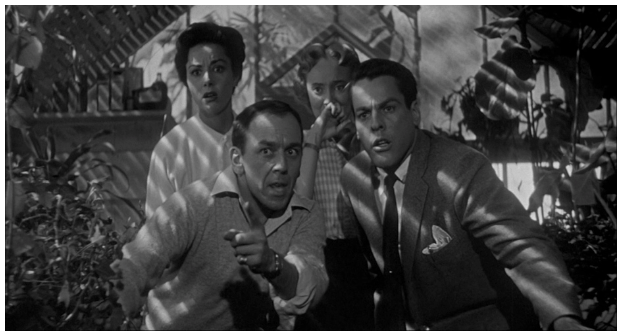
On July 18th, Olive Films will begin their roll-out of the Republic Pictures library with DVD/Blu-Ray releases of High Noon (1952) and Invasion of the Body Snatchers (1956). Republic has long been one of the most underutilized holdings in the home video market, passing from corporation to corporation with little concern for the treasures it contained. But upstart Olive has closed a massive licensing deal with Republic parent Paramount Pictures, and is set to release a flood of material (from B-Westerns to prestige pics) in 2012 that had mostly been overlooked in the digital age. While these first two releases have been well-represented on DVD, it is their premiere on Blu-Ray, and there are plenty of rare gems coming down the pike (all transferred in HD), including Nicholas Ray’s Johnny Guitar,  Fritz Lang’s Secret Beyond the Door and Orson Welles’ Macbeth.

Herbert J. Yates began his career in film processing in 1915. By the 1930s his Consolidated Film Laboratories was a major developer of B-film. As the Great Depression sent many Poverty Row studios into the red, Yates took them over, combining six companies (Monogram, Mascot, Liberty, Majestic, Chesterfield and Invincible) into one Republic in 1935. They made money off of disreputable serials and Westerns, giving daredevil action directors like William Witney endless opportunities to hone their craft on a shoestring budget.

Witney started his career at Mascot, riding horses in films for his brother-in-law, and director, Colbert Clark. Witney directed his first film, The Painted Stallion (1937), for Yates, and remembers the set-up in his autobiography, In A Door, Into a Fight, Out a Door, Into a Chase:

Republic’s main office was in New York where taxes were lower than in California, and Consolidated Film Industries, which made all the release prints, was located next door in Fort Lee, New Jersey. The office in New York City was located at 1776 Broadway…

Then, after Yates bought out the last of the executives from the six former companies, Witney writes, “I will say one thing for him. He screwed a lot of very smart men.” Witney wasn’t one of them, working productively for the company in serials (Daredevils of the Red Circle, The Adventures of Captain Marvel), Roy Rogers Westerns and teen-sploitation (Juvenile Jungle, Young and Wild) until the company was sold in 1959. It was because of money-making B-pictures like Witney’s that Yates had the money to invest in prestige productions like Orson Welles’ Macbeth and John Ford’s The Quiet Man and (the less expensive) The Sun Shines Bright. Yates rubbed Ford the wrong way, as the curmudgeonly director told biographer Joseph McBride, regarding The Sun Shines Bright:

Well, they didn’t ruin it, they couldn’t ruin it. But they cut a lot out of it. You’re working with a stupid lot of people, the executive producers, so what the hell, you’ve got to expect it.

But whatever his shortcomings as a producer and a shameless money-grubber, Herbert J. Yates, through accident or circumstance, funded some of the glories of the Hollywood Classical Cinema, both the high art of Ford and the low of Witney, and for that he deserves our reluctant thanks.

Yates sold his company’s library in toto to National Telefilm Associates (NTA) in ’59, bowing to the rising dominance of television. They had severely curtailed production, and were mainly making their money selling TV rights anyhow.  A Dec. 23rd, 1957 issue of Billboard announces the sale of syndication rights to NBC of 218 features and 15 serials for $3,5000,000, with the writer noting that, “the move by Republic to put its package in active sales is concurrent with reports that the studio is in the process of terminating film production.” At this point the demand for B-pictures had disappeared, as the 1948 anti-trust Paramount Decision had divested the studios of their theater ownership. They could no longer “block-book” their product and force theater managers to run whatever they sent them.

NTA made money syndicating the TV rights, with the rise of cable TV in the 1980s reinvigorating profits, leading them to change their name to Republic in 1986, and producing their own TV shows like Beauty and the Beast (1987). In 1994, Aaron Spelling Productions purchased NTA/Republic, and essentially used it as a distribution arm, and as a name to sell its own projects, completely divorced from the low-budget studio it once was. Now Republic Pictures Home Video would release a Spelling mini-series like James Michener’s Texas on VHS, while Johnny Guitarlanguished in the vaults. This was followed by some swift multinational swallowings, as Blockbuster purchased Spelling, and then Viacom bought Blockbuster. The Republic library then became the custody of the Viacom-owned Paramount Home Entertainment, all by the end of 1995.

There had been sluggish attempts to release the Republic library on home video during this period. Spelling licensed it to Artisan Video in 1995, who released The Quiet Man and a few others until the company was gobbled up by Lionsgate in 2003. Artisan’s rights expired in 2005, reverting briefly back to Paramount, but Lionsgate then decided to renew this license for another six years, starting in 2006. For what must have been effective but arcane accounting reasons, Lionsgate effectively sat on the Republic library. They released the comparatively unknown Arch of Triumph (1948), Only the Valiant (1951), and One Touch of Venus (1948) on DVD, but left the vast, and vastly better known, titles sitting on the shelf.

Once Lionsgate’s laissez-faire reign ended this year, Olive Films leapt into the fray, manically licensing Republic titles from Paramount, and almost immediately putting them into production. In the first few months of their stewardship, Olive will have released more of the Republic library than Artisan, Lionsgate and their forebears combined. As fast as they are releasing them, there are some quality control concerns, but the early returns are encouraging.  Both High Noon and Invasion of the Body Snatchers have received high marks from tech review site Blu-Ray.com, as well as my own eyes. The transfers are clean and sharp with rich contrast. Paramount’s archival wing had obviously had done strong HD transfers on these, and Olive presents them with no digital blow-drying. High Noon comes with a making-of documentary, while Invasion contains no extras, which is the norm for the company. And while Olive has had notoriously poor cover art in the past, their Republic discs all seem to have original poster artwork – a huge improvement over some of their early Photoshop jobs.

While it would have been ideal for Paramount to push its massive resources behind the restoration and release of the Republic library, perhaps it’s more appropriate for the scrappy and relatively under-funded Olive Films to do the job. Releasing its discs quickly, efficiently and with little marketing muscle, the Republic Pictures library has finally found a licensor that can match its huckster spirit, and that has the smarts to take advantage of other companies’ mistakes.

EDWARDIAN COMEDY: S.O.B., VICTOR/VICTORIA, SKIN DEEP

May 29, 2012

Screen Shot 2020-02-03 at 5.06.13 PM

John Ritter’s spastic freak-out in a parking garage in Skin Deep is an archetypal Blake Edwards image. What characters repress or ignore will always be expressed through their bodies, with or without their consent.  The Warner Archive recently re-issued three Edwards comedies on DVD: S.O.B. (1981), Victor/Victoria (1982) and Skin Deep (1989). While new transfers of these visually elegant works would have been welcome, they gave me an excuse to watch them for the first time, so I’ll keep my complaining to a minimum. All three films involve varying levels of performance, and bodies that either accept or reject the facades imposed upon them. The most furious rejection occurs in S.O.B., a flesh-eating virus coated letter to Hollywood.

The origin of S.O.B. lies in the failure of Edwards’ 1970 Darling Lili, a WWI spy movie musical that went over budget and then under performed. A common occurrence, but one that Edwards was virulently attacked for due to some extenuating circumstances. In his critical study A Splurch in the Kisser, Sam Wasson writes that the Commonwealth United Corporation lent Paramount parent Gulf + Western “a certain humongous sum” to complete production that G +W were unable to pay back, so the studio was especially incensed. Wasson writes that head of production at Paramount Bob Evans said that Edwards was responsible “for the most flagrant misappropriation of funds I’ve seen in my career.” Licking his wounds, but still ambitious, Edwards followed it up with the epic Western Wild Rovers (1971), another big budget disappointment that was cut down by nearly 40 minutes by new MGM head James Aubrey, whom John Houseman had nicknamed “The Smiling Cobra”. After battling with Aubrey again over the medical thriller The Carey Treatment (1972), from which he tried to get his name removed, Edwards was a frustrated man. He moved to Switzerland, only to return to filmmaking two years later for The Tamarind Seed (1974), three Pink Panther sequels, and the enormous hit Ten (1979).

With Inspector Clouseau and Bo Derek’s slow-motion trot restoring him to studios’ good graces, he was finally able to get his savage satire, Hollywood S.O.B. funded. Something of a “secret legend” in town, according to Wasson, it was picked up and then ditched by Orion, before upstart Lorimar, transitioning from TV to film, agreed to back the title-shortened S.O.B., Victor/Victoria, and a sci-fi comedy Far Out that was never made. In an appropriate irony, Lorimar had recently made a deal with Paramount to distribute their films, the studio that S.O.B.is targeted at.

The film is set in motion by the attempted suicide of director Felix Farmer (Richard Mulligan), whose family friendly musical Night Wind tanks horribly. Left in a catatonic funk, his image conscious wife Sally (Julie Andrews, playing off her Mary Poppins persona) abandons him as he wanders his beachfront home clutching the trades, blaring headlines like, “NY CRITICS BREAK WIND”. Rings of PR maneuverings circle around him, from his assistants, to Sally’s team (led by a brassy Shelly Winters) outward to the studio’s, who sends out cynical fixer Tim Cully (William Holden) to corral Farmer and get him to re-edit the film. It’s three circles of self-obsessed hells, with Felix the ignored center. All three are oblivious to Farmer’s depression, and he wanders off to the garage to give himself a carbon monoxide cocktail. But his body betrays him, and he survives. Edwards frames him in backgrounds and corners early on, a wraith irrelevant to his life as an image. The entire film industry is out to defend or destroy his image, while the flesh and blood Farmer is out to polish himself off.

This is mirrored in another unobserved death, as an anonymous runner collapses on the beach outside his home – his body laying in plain sight of sun-bathers for days before he is identified as a corpse. The most sympathetic character in the movie is the dog who yelps for his fallen master (who turns out to be a character actor). Image trumps reality, and Farmer cracks under its pressure. Edwards arranges an ace menagerie of gargoyles to feast off of him, including Robert Vaughan as the cross-dressing vampire of a studio head, Robert Preston as an acidic drugged-up doctor, and Holden as the infernal ring leader, a grizzled vet so jaded he’s cynical about his cynicism.

When Farmer cracks through this PR babble, he changes roles from tortured artist to crackpot prophet, one he acts out with brio, preaching to the lowest common denominator: “We sold them schmaltz – they want sadomasochism!” He proposes re-shooting Night Wind and turning it into soft-core pornography, which Sally agrees to only after weighing the PR hit of a long lawsuit. No matter how much Farmer panders to the audience’s basest impulses, in the end the system returns him to the background, incinerated in a Viking funeral as that sympathetic dog yelps once more.

Victor/Victoria represents the inverse of S.O.B., Edwards’ ideal of performance, one in which identities can be perfected on stage, and the image and the man (or woman in drag), can become one. It is a remake of the Weimar musical comedy Viktor und Viktoria, directed by Reinhold Schünzel, about a down on her luck opera singer who becomes a star as a male drag queen, pretending to be a man pretending to be a woman. In Edwards’ version, it is one Victoria Grant (Julie Andrews) on poverty row, plucked from obscurity from recently fired nightclub singer Toddy (Robert Preston). Chicago gangster King Marchand (James Garner) is hot to book her at his club and into his bed – convinced she’s a woman.

The movie buzzes on a colliding series of contradictions, of which the gender bending is the most obvious. Victoria is an opera singer who makes money at burlesque; King is homophobic and in love with Victor; Toddy is gay but has to pretend to sleep with Victoria. Constructing the Paris of 1934 entirely on a backlot, Edwards has a controlled environment to run these experiments in the expansive 2.40:1 frame, chaotic in café and bar fights, a mess of arms and legs, and only unified on stage, in which Victor/Victoria and Toddy each get their moments of self-actualization. Victoria, after her scandalous debut in which she ripped off a wig to become a “man”, returns to womanhood and cedes the stage to Toddy, who becomes an unselfconscious queen in the raucously funny finale, more woman than Victoria could ever hope to be.

Skin Deep finds Edwards in more heterosexual terrain, as womanizing Pulitzer Prize-winning writer Zach (John Ritter) loses his wife, his career and his sanity. He is introduced as a torso leaning back on a barber’s chair, his head off-screen behind the entryway, as a blonde hairdresser undresses and mounts him in a very unprofessional manner. This is all seen in long shot, from the perspective of the first of many spurned lovers, who will soon have him in bed with a gun to his head. In these brisk opening minutes Edwards establishes images that show Zach as literally brainless, a human pleasure receptor and not much else.

Edwards will use off-screen space, as well as elliptical editing, to indicate Zach’s short attention span and disconnection from the world. In a rapid montage Zach will hear his wife’s divorce demands, and a few shots later, they will be enforced by the judge, his defense invisible, and his force of will indicated by Ritter’s slackjawed stare. Zach becomes more and more self-obsessed and debilitatingly horny, unable to write or maintain any emotional connections (except with an exceedingly understanding bartender, Barney (Vincent Gardenia)). The jokes play off of Zach’s spiraling disconnection, from waking up bleary eyed in a women’s aerobics class to wandering into a black tie party in an Aladdin costume. He even can’t get shocked into self-awareness: the top image shows him recovering from a session with her electric massaging machine. The most notorious joke is one in which Zach entirely disappears except for his erection – a glow in the dark condom provides for a new definition of sword fight. These tame gross-out moments seem to anticipate the Farrelly Brothers  – there’s even an unconscious dog gag that re-appears in There’s Something About Mary.

The ending of the film is disappointingly traditional, coming in the form of a deux ex machina tidal wave that sets Zach on the straight and monogamous path. The natural end for the repeated imagery of a mind-body split would be a beheading of one form or another, but I think it’s safe to say that wouldn’t get past the producers. In any case it is still a tightly shot and structured comedy whose laughs spin organically from Edwards’ mise-en-scene, of a man divided against himself. Maybe if he just watched Victor and Victoria he wouldn’t have had to go through all that trouble.