John Ford: The Columbia Films Collection

These are the liner notes I wrote for John Ford: The Columbia Films Collection (DVD, 2013)

ford columbia

The five features John Ford directed at Columbia Pictures are fascinating departures, a group of mostly city-set tragicomedies that reveal how this legendary director of Westerns was also a keen observer of his present day. From the neurotic split personalities in The Whole Town’s Talking (1935) to the  worn out politician in  The Last Hurrah (1958), these films  depict how industrialization was altering the civilization Ford  so movingly constructed in The Iron Horse (1924) and My Darling Clementine (1946), by privileging the individual above the community. This is also reflected in his late Westerns like Two Rode Together (1961), which presents the township as riven with hypocrisy. Made decades apart, these films present an alternate history of Ford as a gimlet-eyed chronicler of urban life .

 The Whole Town’s Talking was an agreeable assignment. In late 1934 Ford had finally convinced RKO to fund The Informer, after being turned down by the five major studios because of the film’s sensitive political content. To once again prove his box office bona fides, he made the lyrical Will Rogers comedy Steamboat Round the Bend (1935) for Fox, and was loaned to Columbia for The Whole Town’s Talking. Based on W.R. Burnett’s short story “Jail Breaker”, it was intended to be Edward G. Robinson’s return to box office glory.  Robinson was on suspension at Warner Bros., having rejected one script too many, and the studio was happy to loan him out to Columbia for some quick cash. Robinson biographer Alan L. Gansberg claims the actor rejected Alfred Santell as director, and demanded that Harry Cohn get John Ford from Fox.

Steamboat Round the Bend completed shooting in August of 1935, and The Whole Town’s Talking began rolling in October. Burnett’s story was adapted into a script by frequent Frank Capra collaborators Robert Riskin and Jo Swerling, and the film retains the Capraesque sensibility of a little man stumbling his way up the economic ladder. It tells the tale of mild mannered office clerk Arthur Ferguson Jones (Robinson) who just happens to be the spitting image of escaped gangster “Killer” Mannion (also Robinson). Jones is arrested, released and hired to pen a newspaper column about his brush with infamy, and when Mannion gets wind of it he leaks details of his violent exploits to his doppelganger. The column becomes a sensation, all while Jones is pining after Miss Clark (Jean Arthur), the sassy co-worker who acts as his de-facto agent and manager.

Ford presents the city as an undulating mass of humanity, people as indistinguishable suits and fedoras. The opening shot tracks through a city office, with hunched over workers typing at their clacking counting machines (perhaps a nod to King Vidor’s The Crowd (1928)). Later when Jones is arrested for looking like Mannion, he is subsumed by shouting police and press, left cowering in a corner chair. Jones yearns to disappear and be one of the mob, but his face betrays him. It is only Miss Clark who seems worthy of individuality. She is introduced in a nimbus of cigarette smoke at the office’s threshold. After taking a deep drag, she flicks away the butt, steps through the door and exhales an insouciant puff. Minutes later she is fired and rehired, and reacts to both as if it were a run in her stocking. She is, rather gloriously, her own woman.

The recessive Jones only catches her eye after getting loaded with the bosses and yelling, “so long, slaves!” to his co-workers,taking on the aggressive attitude of Mannion. The rest of the film finds Jones searching for balance, trying to say goodbye to servitude without subjugating others. Ford slowly empties out the frame, the madcap chaos of the office and police station scenes replaced by tense shotsof Jones and Mannion circling each other, deciding the ideal way to be free.

Ford would not return to Columbia for 20 years, until The Long Gray Line (1955). It is another story balancing the individual and the group, this time among the regimented life of soldiers at West Point. Producer Jerry Wald had wanted to produce a film version of West Point lifer Marty Maher’s autobiography at RKO. Bringing Up the Brass (1951) had strung together anecdotes from Maher’s 50 years as an instructor at the Point, but RKO declined to option it. Wald eventually took an executive producer position at Columbia, where he revived the project and hired Ford to direct and Tyrone Power to star.

It was Ford’s first feature since undergoing eye surgery for cataracts. During the Mogambo (1952) shoot in Africa, Ford contracted amoebic dysentry, and began suffering blurriness of vision. He stubbornly put off the operation until July 1953, when he started to fear going blind. Vision in his left eye would be impaired for the rest of his life, and necessitated that he wear his famous eye-patch. Ford biographer Joseph McBride quotes one of the director’s soundmen observing, “The Old Man can’t hear, he can’t see. All he can do is make good pictures.”

Now with only one good eye, the studio mandated he make The Long Gray Line in CinemaScope, his first experience with the new format. He was none too happy with the process, telling Peter Bogdanovich, “You’ve never seen a painter use that kind of composition. Your eyes pop back and forth, and it’s very difficult to get a close-up.” Despite his complaints, he took to the process naturally, using the film’s title as visual instruction, with rows of gray Marines set up like dominos across the wide frame. Irish immigrant Martin Maher (Power) is always set apart from these lineups, a waiter who works his way up to become an instructor of boxing and swimming, despite his lack of experience in both.

While intended as a tribute to West Point and its former graduate (and current President) Dwight D. Eisenhower (played by Harry Carey, Jr.), the film endures as a treatise on aging, as Maher watches as his boys who once lined up for lap swim end up on long lists of dead men during the two World Wars. He is helpless against these ravages of time and the violent world outside. He finds comfort in the regimented order of life at West Point, where he can always find everything in its place, usually put there by his wife Mary O’Donnell (Maureen O’Hara), who even brings over his father and brother from Ireland. O’Hara reportedly had vicious fights on the set with Ford, and her performance is equally vehement, depcting Mary as a hotheaded Irish lass who delights in needling Marty’s masculine insecurities. Early in their marriage Mary and Marty learn they can’t have children, so their love turns to the cadets. As classes come and go, and die overseas, Marty and Mary become walking memorials to the men they taught and loved. In one of the most moving scenes in Ford’s films, he shows Marty tottering through an empty kitchen, the soldiers’ absence far stronger his presence. But as Marty and Mary have built their own isolated community in West Point, it fills up again with young recruits, eager to hear Marty’s stories of the old days. It ends on a triumphal note, but as the vicious cycles of the rest of the film have made clear, these boys will also disappear.

Ford continued the theme of solitude within a crowd with the laid back police procedural Gideon of Scotland Yard (1958). The most obscure of his sound features, it follows the harried Inspector of Scotland Yard (Jack Hawkins) over the course of one day, tracking murderers as well as a fish he must bring home to dinner. It was adapted from the detective novel Gideon’s Day (also the British title of the film), the first of a series by J.J. Marric, one of the many pseudonyms of prolific pulp novelist John Creasey.

Ford was reuniting with producer Michael Kilcannin, who had helped put together the Irish anthology film The Rising of the Moon (1957) with WB the previous year. The studio system was breaking down, and with it Ford’s post-Searchers project The Valiant Virginians, which was killed when the producer pulled out his money to invest in a chain of television stations. Ford sought to ease his frustrations abroad. His interest in Gideon revived Columbia British Productions after a fourteen year layoff; the studio was last active on Alberto Cavalcanti’s Affairs of a Rogue (1948). Joseph McBride surmises that Ford took on the project because he wanted to help British actress Anna Lee, a member of his acting stock company, get off of the blacklist. In her first role since 1952, she plays Gideon’s wife, Kate. The shoot also conveniently killed time while Ford was waiting for Spencer Tracy to finish shooting The Old Man and the Sea, so he could use him in The Last Hurrah.

Shot at Elstree studios in Hertfordshire, England with an all-British cast and crew, it held little market appeal in the U.S., where Columbia treated it as a B-picture. They cut it by a third (to 54 minutes) and only distributed B&W prints of the film shot in Technicolor by DP Freddie Young (Lawrence of Arabia).

This doomed its reputation at the time, but it is overdue for rediscovery. Gideon is a clear stand-in for Ford himself, an abrasive workaholic attempting to bend an unwieldy bureaucracy to his will. Ford always called his films “a job of work”, and Gideon treats his job with the same gruff professionalism. Whether it’s catching a thrill killer or getting to his daughter’s violin recital, he is only concerned with completing the task at hand. In an expansive mood Ford once called star Jack Hawkins, “the finest dramatic actor with whom I have worked.” Trained on the London stage, Hawkins is a rumpled masculine totem who keeps his emotions sewn up underneath a begrimed suit coat. (great description!)

The film details the messy overlapping chaos of the everyday, where work bleeds into private life until it’s impossible to tell the difference. At one point Gideon has lunch with his wife, but brings an army of detectives along, literally bringing work home with him. Anna Lee puts on a brave face of indomitable domesticity, but near the end of the film instructs her daughter (Anna Massey): “Promise me one thing. Never marry a policeman.” Shot in a string of medium shots and cut at a breakneck tempo by Ford’s standards, it is the most televisual of his films. The Gideon series of novels was eventually turned into a series on the British network ITV, while Ford had moved on to film another man working inside a bureaucratic system in The Last Hurrah.

After Ford finished reading Edwin O’Connor’s novel The Last Hurrah (1956), he fired off a telegram to Harry Cohn saying he would make the film version for free (he actually did it for $125,000 and 25% of the net, according to Joseph McBride). The novel is a fictionalization of the life of James M. Curley (1874 – 1958), Boston’s Irish-American political boss. The Democrat Curley was a four-term mayor, a two-term Congressman, and a two-time convict. O’Connor named him “Frank Skeffington”, and detailed his failed campaign for a fifth term as mayor, reflecting the decline of machine politics as children of immigrants began to climb the economic ladder. Already folk heroized in O’Connor’s book (adapted to the screen by Frank Nugent), Ford buffed him further, with no trace of the mob ties or kickbacks that kept him in power. Instead he zeroed in on the character’s creeping obsolescence, as political campaigns shifted from the streets onto television. It is unreliable as history but, like The Long Gray Line, is deeply moving as a film about aging.

Ford had a tough time casting the lead role, cycling through names like James Cagney, John Wayne and even Orson Welles, before agreeing upon the common sense choice, Spencer Tracy. The two proud Irishman had not worked together since Tracy’s debut in Up the River (1930), where, McBride writes, “Tracy found the director overbearing and always resisted being part of his stock company.” After Tracy rejected a part in Ford’s The Plough and The Stars (1936), their relationship deteriorated. Katherine Hepburn interceded to secure the plum role of Skeffington for Tracy, who was then in poor health after the demanding and stressful shoot on The Old Man and the Sea (1958). Tracy was so drained during The Last Hurrah he was contemplating retirement, telling The New York Times: “Twenty-eight years is a long time. I started with John Ford and it has been suggested that since he is directing this film it might be an appropriate time for me to call it quits. You know, the beginning and the end with Mr. Ford.”

He would go on to make six more films, but this mood of melancholy retrospection was ideal for the role of Skeffington, who takes stock of the world that was and the one swiftly passing him by. Sensing that his fifth election will be his last, he asks his sportswriter nephew Adam (Jeffrey Hunter) to join him and observe the end of his era. His campaign is filled with pressing-the-flesh handshakes and ill-fitting suits. Ford usually shoots in long shot to frame Tracy in crowds, whether it’s his fluttering advisors or favor-peddling constituents. Ford compares that to his isolated young opponent, propped up by his WASP benefactors in hilariously awkward television spots. A young priest echoes what Ford himself may have thought of the coming generation: ”I prefer an engaging rogue to a complete fool.”

Adam is the only member of Skeffington’s family who might learn his traditions, as his son is an airhead playboy and his beloved wife passed on. Skeffington honors her by placing a rose in front of her portrait before leaving the house, reminiscent of Will Rogers conversing with his dead wife in Judge Priest (1934). Skeffington hearkens back to Ford’s films with Rogers, a folksy politician who is more concerned with people than power. The Last Hurrah acts as a memorial for men like Judge Priest as well as the artist who made it, with Ford perhaps reflecting on his own obsolescence. The cast is filled with old character actors from his past: Jane Darwell, John Carradine, Mae Marsh, Pat O’Brien, Donald Crisp and many more. They hover around Skeffington like friendly ghosts, easing him into the afterlife. When Skeffington loses the election, and strolls alone past the victory parade, it is a mournful inversion of the finale to The Sun Shines Bright (1953), Ford’s remake to Judge Priest. That film concludes with the whole town parading before the kindly judge, paying their respects. In this version he is rejected by the next generation, disappearing into the cheering crowds and ending up on his deathbed.

While he was filming Two Rode Together (1961) Ford was forced to bid farewell to Ward Bond, who died of a heart attack at the age of 57. He had directed Bond in over 20 features, and when he was informed of Bond’s death on the set by Andy Devine, he characteristically replied, “Well, I think you’re going to have be my horse’s ass now!” He would mourn after the shoot with an alcoholic bender that would land him in the hospital. Ford did not have fond memories of the film, calling it “the worst piece of crap I’ve done in twenty years”. His grandson Dan Ford said he made it solely for the money ($225,000 plus 25% net profits), yet, as disjointed as it is, it features darkly funny performances from Jimmy Stewart and Richard Widmark, flashing some of Ford’s gruff witWhere The Last Hurrah and The Long Gray Line mourn time’s passing, Two Rode Together is bitter about it. The story, adapted by Frank Nugent from Will Cook’s novel Comanche Captives,, follows cynical small town sheriff Guthrie McCabe (Jimmy Stewart) as he is asked to enter Comanche territory and reclaim kidnapped white children, some lost for years. Accompanying him is cavalry officer Jim Gary (Richard Widmark), a sometime friend appalled by Guthrie’s mercenary instincts to profit from parents’ desperation.

Jimmy Stewart is corrosively funny as Guthrie, as he skewers the townspeople’s misplaced hopes and casual racism against his Mexican girlfriend Elena (Linda Cristal), who once lived with the Comanche. He’s introduced tipping back in his chair in a dandified suit, his foot on a front porch post, a burlesque of Henry Fonda’s similar pose in My Darling Clementine. It’s clear from this visual rhyme that the simplicity of Fonda’s Wyatt Earp has curdled into decadence. The Comanches revert to the stereotype of simplistic savages, riven by petty jealousies and driven by the bloodlust of warrior chief Stone Calf (Woody Strode, who was part Native American).

The film is fueled by a palpable disgust with humanity, perhaps exacerbated when Ford got word of Bond’s passing. The film is at its calmest and most engaging when it focuses on the sniping friendship between Guthrie and Jim, a battle of clashing insecurities expertly deployed by Stewart and Widmark. Ford clearly enjoys watching them work, as the story slows down to a crawl to accommodate them. The highlight of the film is a nearly four-minute shot of the two men sitting creekside, where they argue about money, jealousy and the terrors of marriage proposals. Ford frames them from the ankles up, so they fill up the composition with their jousting gestures, their stogies brandished like rattling sabres. It’s a charming scene of pure performance, before the plot rears its ugly head.

Guthrie and Jim find a few of the children, but they are irredeemable, just like the townspeople. It acts as a blackly comic version The Searchers, similar to how Ford parodied The Grapes of Wrath (1940) with Tobacco Road (1941). In The Searchers Ethan Edwards is a necessary monster, brutally clearing the way for a nascent civilization, while in Two Rode Together Guthrie’s search proves him to be a wreck clearing the way for more of the same. Progress has stunted, and Guthrie’s only recourse, in the ostensibly happy ending, is to leave town with Elena for parts unknown.

Following this distorted little Western, Ford would make The Man Who Shot Liberty Valance (1962), which clarified and deepened his concerns about the narrative of progress in the old West. John Ford’s films with Columbia often have the feel of test runs for something greater, but it is that spirit of experiment that makes them so essential, with ideas flying out in every direction. Whether through CinemaScope or Academy ratio, snappy urban comedy or prestigious biopic, Ford vigilantly pursued his themes of freedom vs. conformity, nature vs. civilization, and the passage of time that would make them all obsolete. But these films will endure.
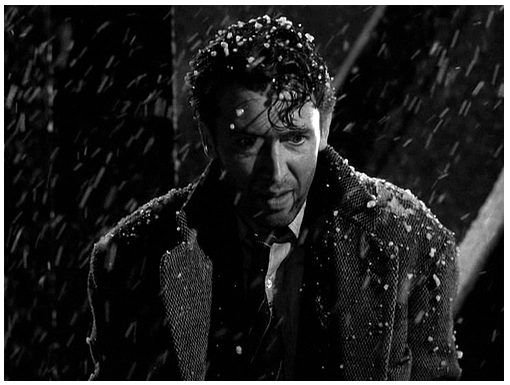
 

LIVES OF THE AIN’TS: IT’S A WONDERFUL LIFE (1946)

December 25, 2012

Screen Shot 2020-02-05 at 5.49.04 PM

It’s A Wonderful Life has screened so often it has become cultural wallpaper, the background noise to tree decorating and on-line discount shopping. When it shifted into the public domain in 1974, television channels could air it without paying fees, and it became program filler for twenty years before subsequent copyright battles (it is now owned by Viacom/Paramount). Familiarity can breed, if not contempt, then at least apathy, and It’s A Wonderful Life  is treated more like a nostalgia piece than a work of art. That was my ignorant attitude, at least, until I watched it again this past weekend, and for the first time fully appreciated its melancholic rendering of adulthood’s parade of dashed hopes and perpetually delayed dreams. It was Frank Capra’s  first narrative feature after four years of making propaganda films for the Army during WWII, and it feels like he imbued it with a life’s worth of disappointments, tagged with a vision of transcending these failures in an ending only Hollywood could provide.

The story for It’s a Wonderful Life was written by Philip Van Doren Stern, who sent it out in a 1943 Christmas card. A Civil War historian and sometime fiction writer, Van Doren Stern started work on his short story, then entitled The Greatest Gift, in 1939, but couldn’t find a publisher, so included it in his’43  holiday mailings. It somehow reached Cary Grant, who brought it to RKO’s attention. RKO bought the rights, and started to prepare a version in which Grant and Gary Cooper would star. After treatments by leftists Dalton Trumbo (blacklisted in 1947) and Clifford Odets (who testified before HUAC) were both rejected (were their versions too downbeat?), RKO sold the story rights to Liberty Films, a newly formed company started by Frank Capra, William Wyler, George Stevens and Samuel J. Briskin after their release from WWII service. Liberty would produce and RKO would distribute, with Jimmy Stewart, also freshly released from wartime service, to star. Liberty borrowed $1,540,000 from Bank of America to fund their first production.

Capra began shooting It’s a Wonderful Life in April of 1946, just as William Wyler began production on The Best Years of Our Lives, which dealt with the war’s aftermath more directly. Capra was not interested in memorializing the war. He told Richard Glatzer:

Yes, the war did affect me. I didn’t want to see another cannon go off; I didn’t want to see another bomb blow up. War lost its glamour for me. Just to see those trembling people in London during the Blitz, poor sick old ladies crying, crying in terror…children. There’s got to be something better than bombing old ladies and children. I lost…there’s nothing glamorous about war. I didn’t want to be a war hero, nothing. That’s why I made a movie about an ordinary guy.

George Bailey (Jimmy Stewart) is listed 4F for the war because of his bad left ear. He is an outsider to his age, missing out on WWII as well as the post-war economic boom when he fails to invest in his old school buddy’s plastics business. His only dream is to travel, but with the death of his father and the entire Building and Loan company depending on him, he stays in the sleepy town of Bedford Falls, deferring his adventurous plans year after year. There is one devastating shot when this dream finally dies. George meets his brother Harry at the train station, and learns that Harry will not be taking over his job at the Building and Loan. Stewart’s face collapses in passing, before re-composing enough to congratulate his brother on his marriage and his new life. That expression is Bailey’s private funeral for his future, one now forever bound to be anonymously lower middle class. George is Capra’s ordinary guy, one who sacrifices his own life so his brother can join the stream of history and become the subject of Hollywood hagiographies. But at least in It’s a Wonderful Life, George is the star.

Capra emphasizes George’s subordination, keeping most action in the background while George is oblivious in the fore. As kids, Harry sleds right by George and into a crack in the ice. George has to save him, and loses part of his hearing in the process, setting up his sacrificial role for life. Then there is the school dance, in which George and his girl Mary (Donna Reed) dance without noticing that the gym floor is slowly cracking open, revealing the pool underneath. The rest of the party has noticed and stepped back, but George is again oblivious, and drags Mary along with him into the drink. Capra artfully deploys this water-as-oblivion metaphor throughout, culminating in the snowstorm that marks his decision to jump into the abyss one final time, a potential suicide leap off a bridge.

Disgusted with forever being on the periphery of the American dream, George decides to end it all, which triggers the appearance of Clarence (Henry Travers) the deus ex machina angel. Only through fantasy, through the construction of a George Bailey-less alternate reality, where Bedford Falls becomes a seedy juke-joint town called Pottersville, can his existence be justified. That is, through cinema itself, for what is Clarence if not the director of this nightmare, constructing it with the flick of his finger?  His grindhouse version of Bedford Falls has Bailey as agog as a gullible teen at an opening night of Paranormal Activity, wide-eyed with terror. But instead of glorifying Hollywood trickery, what makes It’s A Wonderful Life so unbearably moving is that it urges George to escape artifice and return to banal reality and celebrate what meager joys are left to us here.  It is the saddest of happiest endings.

OLD DOGS, OLDER TRICKS: THE WILD GEESE (1978)

December 18, 2012

Screen Shot 2020-02-05 at 5.45.15 PM

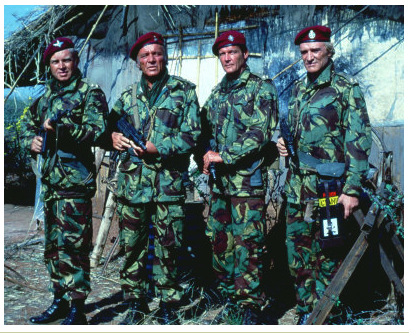
For as long as there are aging matinee idols looking for a quick paycheck, there will be commando movies there to pay them. While the painfully self-conscious Expendables movies brought this prestigious genre back into box office glory, it’s a format that has been cranking along for decades. Before Stallone, the most successful old man revitalizer was Andrew V. McLaglen (son of actor Victor), who cranked out fogey action flicks from the 60s through the 80s, after a long career in TV Westerns. Cult home video outfit Severin has just released The Wild Geese (1978) on Blu-Ray, which stars the leathery trio of Richard Burton, Richard Harris and Roger Moore. McLaglen’s favorite among his films, it is a bloody imperialist fantasy in which a group of ex-Special Ops Brits parachute into Africa to rescue a deposed leader from a tyrannical despot. Fitfully released in the United States as its distributor was going through bankruptcy, it exudes more testosterone per film frame than Stallone’s pec-flexing opus.

British producer Euan Lloyd had been interested in making a commando picture like The Guns of Navarone(1961) since he became an independent producer in 1968. It wasn’t until he read Daniel Carney’s unpublished novel The Thin White Line that he decided to make one. He purchased the rights in the mid 70s, and started developing the project at United Artists. Remembering a conversation with John Ford, who called McLaglen “a general in the field” according to journalist Tony Earnshaw, Lloyd hired him to direct. Ford was a friend and collaborator with his father Victor McLaglen, but those warm feelings didn’t transfer to United Artists, who wanted Michael “Death Wish” Winner to apply his brand of reactionary nihilism to the material. Lloyd balked, and brought the project to Allied Artists, who were happy to take on a film with that cast, despite the declining fortunes of Burton, fresh off of The Exorcist II (1977).

This was a fallow period in McLaglen’s career, filled with bills paying TV work following the unintentionally sexual title The Last Hard Men (1976), starring Charlton Heston and James Coburn. Ford’s recommendation was a godsend, as he told Wheeler Winston Dixon that he thought, “’I’m back in the big time, thank God’, because I had a little slump there.” The international success of The Wild Geese extended his extraordinarily long career into the 1990s.

The setup is simple: Richard Burton is a retired special operations officer hired to rescue the deposed leader of the made up country of Zembala. He gets his old team together, including operations planner Richard Harris, explosives expert Hardy Kruger and smirking muscle Roger Moore, who looks happy to be cashing a paycheck in an inter-Bond year (between The Spy Who Loved Me (’77) and Moonraker (’79)). The extraction goes off without a hitch, but the lily-livered bureaucrats strike a deal with the Zembala dictator and leave the group to be eliminated. Burton and his merry men have to blast their way out to survive, leading to the discomfiting images of a meddling, terroristic British force slaughtering the native African population for the audience’s pleasure.

Up until this point it is an efficiently entertaining action movie, with an energized Burton and Harris ably deploying the dry wit written by Reginald Rose (12 Angry Men). After Burton knocks back a scotch with a two-handed vise grip, he tells his employer, “my liver has to be buried separately, with honors”. This is the kind of offhand self-referential humor (to Burton’s well-known boozing), that The Expendables films telegraph with belabored obviousness (see: Schwarzenegger’s groan-inducing “I’ll be back” in the sequel). There’s no attempt to hide the stars’ advancing decrepitude, as the shock of grey in Burton’s hair and the enormity of Richard Harris’ glasses attest. Only the tanned and toned Roger Moore seems unaffected by the passage of time, content to hang out in the background and chomp on his cigar regardless of circumstance – which seems to be his character’s sole motivation.

McLaglen is a direct if inelegant filmmaker, his compositions clumping people in the middle of the frame. This makes action sequences legible, but renders them monotonous when repeated throughout the length of the movie’s 134 minute run time. The last third is almost entirely made up of undifferentiated machine gun fire and collapsing bodies. Hardy Kruger, who plays the voice of conscience in the group (and is thus killed off), told Earnshaw that “Andrew butchered my performance by not understanding that you can play a part by listening.” McLaglen is always cutting to action, whether it is shooting or talking, with no rests or pauses in between.  This careening style becomes as tiring and one note as its politics, which presents military intervention in Africa as an unspoken right of the British people. The Wild Geese is a fascinating relic, part of the lineage of imperialistic action cinema that is indebted more to John Wayne’s Vietnam War flag waver The Green Berets (’68) than the influential subversiveness of Robert Aldrich’s The Dirty Dozen (’67).

TWO’S A CROWD: THE WHOLE TOWN’S TALKING (1935)

December 11, 2012

Screen Shot 2020-02-05 at 5.41.03 PM

In an early Christmas present, the Museum of the Moving Image screened a 35mm print of John Ford’s unaccountably hard-to-see The Whole Town’s Talking (1935) this past Saturday. Unavailable on home video, aside from out-of-print VHS tapes going for $60 on Amazon, it deserves to be as well known as his Oscar winning drama from the same year, The Informer (his third film in ’35, Steamboat ‘Round the Bend, is no slouch either). A box office hit which revived the career of Edward G. Robinson, its descent into relative obscurity is puzzling, aside from the larger trend of studios choosing to ignore their own history. It has not even been released on Sony/Columbia’s DVD burn-on-demand service, which was made for titles like this.  In any case, it is an elegantly constructed farce that showcases the astounding range of Robinson, who can play delicate meekness and gruff murderousness for equal laughs.

John Ford made The Informer at RKO, Steamboat ‘Round the Bend for Fox, and The Whole Town’s Talking for Columbia, a free agent playing the field for quality projects and paychecks. While Ford had to fight for The Informer to get made at RKO, The Whole Town’s Talking was pitched to Harry Cohn at Columbia by independent producer Lester Cowan. He was selling Robert Riskin and Jo Swerling’s script, which was adapted from a short story by moneymaker W.R. Burnett (Little Caesar). Riskin was a frequent collaborator of Frank Capra, and The Whole Town’s Talking is sandwiched in between his work in It Happened One Night (1934) and Mr. Deeds (1936). His script for Ford exhibits a Capra feel, in that it concerns a mild-mannered worker or vagabond thrust into extraordinary circumstances, as in Deeds or Meet John Doe.

Arthur Jones (Edward G. Robinson) has never once been late to work at the J.G. Carpenter accounting firm, but his regimented life becomes upended when escaped mobster “Killer” Mannion (also Robinson), turns out to look exactly like Jones. The cops immediately arrest Jones, and he becomes a minor celebrity for being a murderer’s look-a-like. Then Mannion decides that Jones could be of use to him, and the two engage in a roundelay of identity swaps that confuses the cops, their friends and in the end, themselves.

wholtownFord sets up the city as fidgeting mass of humanity, so large and indistinguishable that two people could swap identities with ease. He opens the film with a tracking shot that surveys the faceless workers at J.G. Carpenter, all hunched over their desks and pecking away at their number machines. Later, when Jones is apprehended, the police and the press are depicted as yammering mobs, filling the frame with shouts and bravado as Robinson cowers in a corner. Robinson plays Jones as a man who desperately wants to fit in and disappear like the rest of his colleagues, quiet and recessive.

From the beginning, though, fate is against him. His alarm clock breaks, and he arrives at work late for the first time in almost a decade. Standing out alongside him is Miss Clark (Jean Arthur), who sashays into work even later, in a nimbus of cigarette smoke. Jean Arthur’s entrance here is a marvel of physical control, sucking in one last draw before the door, flicking away the butt an instant before entering, and then exhaling the smoke in the instant after crossing the threshold – a perfect puff of insouciance. It unravels as one continuous gesture, a perfect performance that takes only a few seconds of screen time.

How does such a magical scene happen? Arthur described John Ford’s directing style on the film to Joseph McBride in in his essential Searching for John Ford bio:

Ford always had a handkerchief or a pipe hangin’ out of his mouth. He chewed on it and you never knew what he said. And Robinson had a pipe that he’d chew. They’d stand there, these two guys, and never give you any directions at all or anything much. I’d say, ‘How do I know what I’m gonna do if you don’t talk?’ And they said, ‘Well, we talk with our brains. We don’t need to verbalize things.’…You know what he’s thinking anyway. He’s just – it’s all over him. A darling, darling man. I don’t think he gave much direction, but everybody seemed to understand what they were supposed to do.

Ford trusted his collaborators, which comes across in the moments of offhand beauty like Arthur’s entrance. As Miss Clark she is the willing outsider, Jones an accidental one, although he fervently desires to win her hand, leaving facile anonymous love poems on her desk.

It is only when he encounters Mannion, and discovers a similar animalistic quality in himself, that she shows any interest. He awakens this flicker of attraction in her after boozing it up with the boss, who is looking to curry Jones’ minor celebrity into publicity for the firm. He plies Jones with cigars and whiskey, and Robinson gives a master class in queasy reaction shots. He holds the cigar as if it were radioactive, his hand underneath, pinching it with thumb and forefinger. Ford holds the reaction even longer after he knocks back a shot of liquor, his face full of micro-narratives of disgust, fear and a flickering of acceptance. It is an uproarious sequence that ends with a woozy Jones  smooching Miss Clark and kissing off the rest of the office with a slurred, “so long, slaves!”. Jean Arthur’s smile at this subversive action reveals that she has ID’d one of her own kind.

When she encounters Mannion, she senses the sociopath instead of the subversive. Robinson plays Mannion with a five ‘o clock shadow and an inferiority complex. He speaks in staccato bursts and narrows his eyes into slivers, but at the merest hint of criticism he blows up. Mannion’s darkness cloaks the farce – there are real mortal consequences to all the ridiculous circling of the sub-Keystone cops and press corps. In order for Jones to survive and win the girl, he is forced to kill, or at least abet a killing, and it is that ferocity which attracts her. It is this violent undertone which gives The Whole Town’s Talking its curious power, and is what connects it to the wider current of Ford’s work.  Jones/Mannion are the comic versions of what will later emerge as the dueling impulses of The Searchers’ sadistic hero Ethan Edwards.

MOVIES ON DEMAND: GALLANT LADY and DEATHTRAP

December 4, 2012

Screen Shot 2020-02-05 at 5.37.46 PM

Clive Brook with a bottle in his hand is the most memorable image in Gregory La Cava’s Gallant Lady, an unusual melodrama that skews from an engaging women’s picture into an unrepentant celebration of alcoholism. A recent release from the Fox Cinema Archives, their DVD burn-on-demand service, the film continues to alter my understanding of La Cava, following my consideration of Bed of Roses and The Half Naked Truth in last week’s post. The more I watch of his work, the more it becomes clear how little I knew. An anti-authoritarian rage bubbles beneath his dry humor, coming out in full force in Gallant Lady, pushing it off its genre moorings and becoming a vagrant’s statement of purpose. Far less personal is Sidney Lumet’s Deathtrap (1982), which arrives in the first batch of Warner Archive Blu-rays (alongside Gypsy, while The Hudsucker Proxy and others are promised in the future). An adaptation of Ira Levin’s hit play, it’s an actor’s showcase in which Michael Caine and Christopher Reeve duel in a battle of crime fiction writer wits, a clever bit of meta-Agatha Christie.

Gallant Lady was filmed in one month, from October to November of 1933, four months after the release of Bed of Roses. The script by Sam Mintz, later elaborated on the set by La Cava, begins as a classic melodrama, as Sally Wyndham (Ann Harding) watches in horror as her stunt-flying husband-to-be dies in a crash. Unwed and secretly pregnant, she gives up the child for adoption, while making ends meet thanks to the help of disgraced doctor and heavy drinker Dan Pritchard (Clive Brook). Sally yearns to get her baby back when she learns that the original adoptive mother has died, and that the stepmom is a bit of a bitch. Pritchard, cast aside in her pursuit of hearth and home, becomes a bitter drunk, and rather enjoys it.

In his essential NY Times home video column this past Sunday on the Fox Cinema Archive, Dave Kehr wrote that the “sensitive and self-destructive director Gregory La Cava” offered ” a self-portrait in Clive Brook’s supporting performance”. Being unfamiliar with La Cava’s reputation, I did some quick research that revealed him to be a notorious souse, with W.C. Fields among his favorite drinking partners. Director Allan Dwan recalled that:

When he got the alcohol in him, he got mean, and sometimes got himself into jams. He got into jams with studio heads. He was insulting, let’s put it that way. He had a great capacity for saying something sharp that would hurt people, but that he’d think was funny.

It is the hurt behind the humor that is so striking to me in these early 30s La Cava films, whether it’s the loneliness masked by Constance Bennett’s zingers in Bed of Roses, or Sally’s mournful crack, “Why do animals become ill? To escape affection.”

Pritchard is desperately in love with Sally, and even makes furtive attempts to go straight to win her admiration – going so far as to start a veterinary clinic. But her eyes are only for her child, so she sets upon seducing and marrying the adoptive father – without him knowing her true identity. The majority of the film is taken up by Sally’s pursuit, but the most seductive figure here is Pritchard, played in one long, exhausted sigh by Clive Brook. He’s a broken man briefly conjured back to life by Sally, but whose rejection forces him to back into himself. What he discovers, in a line that could have come straight out of the tippling La Cava’s mouth, is that, “I like bumming around and I like to drink”. Exit stage right. Left agog, Sally must return to the family she so desired, with her real son and fake husband, who still is unaware of her story. The film ends on her half-hearted smile as she agrees to marry him, entering a contract of duties that Pritchard has abandoned. La Cava’s sympathies are clear – he would rather die young and free than old and cooped up. As his boozing took its toll, he only directed five features in the 1940s, before dying on his own terms at the age of 59.

Gallant Lady is the film of an artist, while Deathtrap is that of an artisan. Lumet, the son of a Yiddish stage actor who quit performing on Broadway in his 20s, had a deep and abiding respect for the theater, and in Deathtrap he treats Ira Levin’s play as a sacred text. He told Michel Ciment in 1982 that:

For someone like me, with a tendency to be introverted, it’s important simply to film an action-packed story, just for fun. My latest film, Deathtrap, falls into that category, a crime story with a tight plot, one of the best I have ever read, based on a Broadway play. Everything takes place in an enclosed space, after a first sequence that takes place in a theater. For me, these films are like the parallel bars in gymnastics. They are for practicing and maintaining your technique.

Deathtrap is a useful exercise for him, plotting ways to make the interior of a living room engaging for two hours. He partway succeeds, thanks to the the fiendishly clever Ira Levin play, which artfully masks its nested series of reversals, and the ferocious performances of Michael Caine and Christopher Reeve. Reeve is especially lithe and menacing as Clifford Anderson, the one-time student of once famed thriller playwright Sidney Bruhl (Caine). Bruhl, after a string of flops, is eager to kill Anderson and steal his sure-to-be hit play. But there are enough feints, double-crosses and twists to sustain their pas-de-deux through its bloody climax. The title is a nod to Agatha Christie’s stage whodunit Mousetrap, which had the longest initial run of any play in history. Levin adds layers of self-consciousness, but at its heart it’s a densely plotted descendent of Christie.

Lumet takes a curious approach to the enclosed space – he shrinks it rather than enlarging it. He establishes the full space in a 360 degree tracking shot of Bruhl inviting Anderson over to his home, but then fixes his camera to a different side of the room for each movement in the plot. It shifts from a backyard facing camera to a front-facing one, after the initial twist is revealed. This is effective in activating new spaces for the unfurling activities of the plot, but his style is as equally mechanical as Levin’s play. Although it does happen to be one fine tuned machine.

The Warner Archive Blu-ray was not made with their on-demand technology, but manufactured in the regular “pressed” manner as the rest of WB’s discs, only in smaller quantities. The transfer is crisp and pleasing, and bodes well for future entries in the series. The Fox Cinema Archives disc is soft and fuzzy, although Fox is dealing with older and inferior elements. And in any case, La Cava would probably prefer you get as fuzzy and faded as the print before watching his ode to the demon rum.

VIVA LA CAVA: THE HALF NAKED TRUTH AND BED OF ROSES

November 27, 2012

Screen Shot 2020-02-05 at 5.34.58 PM

One of the advantages of being home for the holidays are the huge gaps of time that open up when work and other daily annoyances fade from view. In the lazy hours surrounding Thanksgiving I hunkered down in front of my family’s DVR and monolithic tube TV, searching the TCM schedule for something to while away the hours with. One particular item caught my eye, an early morning screening of Gregory La Cava’s Bed of Roses (1933). The description mentioned steamboats and female con-artistry, two of my favored subjects, so I clicked record in sweaty anticipation. The film turned out to be far more than an amiable time-killer, but an astoundingly subversive pre-code with some of La Cava’s finest lowdown dialogue. Wondering what other gems lay hidden in early 1930s La Cava, I also tracked down The Half Naked Truth (1932), which was a looser but still uproarious bit of scam artist screwball.

The Half Naked Truth was the fifth film Gregory La Cava directed for RKO, and the third straight produced by David O. Selznick. Following two dramas on which he didn’t receive a screenwriting credit (Symphony of Six Million and Age of Consent), La Cava was handed The Anatomy of Ballyhoo, the 1931 memoir of press agent Harry Reichenbach. Filled with outrageous incident, La Cava and Corey Ford’s script is a marvel of escalatingly elaborate scams, testing the limits of American gullibility, although much was probably re-written on the set. In a 1937 letter proposing La Cava be hired as a director-producer, Selznick wrote: “La Cava would drive me crazy as a director with the rewriting he does on set, for as you know I don’t like any projection-room surprises or shocks, but if he were his own producer we could take chance that he would shock himself.” Selznick never made him producer, but conveyed the kind of on-set improvisation that led to La Cava’s freest movies, which crackle with possibility.

Changing the name to The Half Naked Truth, the movie follows Jimmy Bates (Lee Tracy) on his rise from carnival barker to Broadway impresario. Eager to prove that not only is there a sucker born every minute, but probably every second, Bates invents outrageous backstories for his gal Teresita (Lupe Velez) and pal Achilles (Eugene Pallette) at every stop, from scorned orphan to Turkish Princess, and it makes him money every time. He states his position to the carnival owner: “the world wants excitement, sensation, baloney!”. Part of a spate of comic con man movies that flowered during the Depression, including Hard to Handle (’33, with James Cagney) and The Mind Reader (’33, starring Warren William), The Half Naked Truth made light of the fact that the only possible way to make a living was to lie, cheat or steal.

Lee Tracy is ideal casting as the motormouth promoter (despite later being sued by Selznick for repeatedly showing up late to the set). He spits out hilariously ridiculous lines with a mix of bravado and self-absorption, as when he tells Lupe Velez to, “stick with me baby, the next stop is Broadway”, as the fair burns down behind him due to his previous scheme’s spectacular failure. By the time he brings a lion into a hotel room or invents a nudist colony that parades through NYC, it becomes clear he can sell anything to anyone.

After directing the bizarre liberal fascist fantasy Gabriel Over the White House (1933, read J. Hoberman’s An Army of Phantoms on that one), La Cava was assigned another scamming Depression-era character in Bed of Roses (1933), this time a cynical prostitute hustler played by Constance Bennett. The original script by Wanda Tuchock was spruced up by La Cava and Eugene Thackrey (both receive “dialogue” credits), and is a boozy dip into the world of drunk-rolling Johns and blackmailing rich patrons. Lorry Evans (Bennett) is a jaw-droppingly amoral character who uses her formidable sexual allure to rob a boll weevil exterminator and cotton barge captain (Joel McCrea), before having herself installed in high-rise luxury by publisher Stephen Paige (John Halliday).

While Jimmy Bates bent the law to climb the ladder of success, Lorry is an out and out criminal, and Constance Bennett’s buzzed, almost slow-motion performance makes it seem positively alluring. The strengthening Production Code had just begun, and some were concerned about the film’s tone. In April of ’33,  Studio Relations Committee head Dr. James Wingate urged the film’s producer Merian C. Cooper to, “show some positive qualities of retribution and regeneration that will counter-balance this apparent glorifying of an unscrupulous adventuress.” It is unknown what changes were made to the original script, although later scenes of Lorry living an ascetic lifestyle to “prove” she could go straight were likely added due to urgings such as these.

The role of “unscrupulous adventuress” was a departure for Bennett, with The Motion Picture Herald describing it as, “quite different from Connie’s usual society stuff”, and Mordaunt Hall of the New York Times wrote in his review that it was, “disconcerting to see her emerging from a reformatory”. But Bennett seems to relish the opportunity to go slumming, with a shoulder raised and back arched, as if a bow pulled taut before flinging itself at its target. Bennett is aided in her tawdry crimes by Pert Kelton, who plays the even seamier Minnie with a spot-on imitation of Mae West, her suggestive nasal drawl and thunderous hip swagger enough to bring a few middle-western rubes to their knees.

What gives Bed of Roses an emotional kick, however, is the no-nonsense romance between Lorry and the cotton barge captain, Dan. Their meet-cute has Dan fish Lorry out of the bay after she escapes from the cops, with Lorry then tossing him into the drink for impugning her virtue. The romantic climax is no top of the Empire State Building affair, but a charged exchange of sharpened words in a shabby tenement.

The mix of McCrea’s open-hearted sweetness and Bennett’s world-weary resignation elicits not sparks but genuine warmth, and their courtship is without illusions. Neither care for past improprieties – Dan brushes off the revelation of Lorry’s whoring past with a shrug – both are only concerned for what the present may bring. It’s a tough and loving and uproarious work, and should be placed alongside My Man Godfrey (1936) as Gregory La Cava’s best. And after forcing my parents to watch it the day before Thanksgiving, my mother would agree. She said it was her new favorite movie.

LOST SOUL: THE WHITE SHADOW (1924) AND ALFRED HITCHCOCK

November 20, 2012

Screen Shot 2020-02-05 at 5.30.55 PM

The 2012 holiday season is also Alfred Hitchcock season, as studios have been looking for various ways to earn your master of suspense dollar. Universal released a brick of new Blu-rays, HBO aired The Girl, a drama about the Hitch-Tippi Hedren relationship, and Hitchcock, the dubious-looking fiction about the production of Psycho, opens in a limited theatrical release this Friday. The most exciting Hitch development won’t cost you a thing, however, as the three extant reels of The White Shadow (1924) are now free to stream on the National Film Preservation Foundation website. Part of the cache of rarities discovered in the New Zealand Film Archives in 2010, along with John Ford’s UpstreamThe White Shadow is the earliest surviving film that Hitchcock worked on. He was assistant director, editor, scenarist and art director, the second of five films on which he was the jack of all trades for director Graham Cutts. The White Shadow was a critical and box office failure, even leading to the dissolution of its production company, but what remains is an essential document of Hitchcock’s artistic maturation, containing themes of doubling and mistaken identity that would re-emerge and deepen throughout his career. Along with The National Film Preservation Foundation, great thanks are also due to David Sterritt for his informative film notes and Marilyn Ferdinand, Farran Smith Nehme and Roderick Heath, whose For The Love Of Film Blogathon funded the recording of the fine score by Michael Mortilla.

Alfred Hitchcock started his career in movies when Famous Players-BeLasky opened up an office in Islington, London in October 1919. He applied to become an illustrator for silent film intertitles, telling Francois Truffaut, “For instance, if the line read: ‘George was leading a very fast life by this time,’ I would draw a candle, with a flame at each end, just below the sentence. Very naive.” He was hired in 1921 and quickly rose up the ranks, from head of the title department into the editorial department, where he would re-write scripts. After Famous Players shuddered the studio, an enterprising production company, Balcon-Saville-Freedman, moved in. They hired Hitchcock as an assistant director, and it was on his first film with director Graham Cutts, Woman to Woman (1923), that he met his future wife and collaborator, Alma Reville. The melodramatic WW1 romance was adapted from a hit play by Michael Morton, and with the casting of popular Hollywood star Betty Compson, the movie version was a success as well. The Daily Express called it the “best American picture made in England”, which was a high compliment considering the popularity of Hollywood films at the time.

Rushing to capitalize on the film’s success, The White Shadow was fast-tracked into production, with the same team in place. Betty Compson would again star, and another Michael Morton work was used, but instead of a hit play, they adapted an unpublished novel titled Children of Chance. It was distributed in the United States by Lewis J. Selznick, whose son David would later bring Hitchcock to Hollywood. The “white shadow” refers to the human soul, which Nancy Brent (Compson) is definitively missing. She is a hard partier, taking after her alcoholic father Maurice (A.B. Imeson) instead of her delicate mother Elizabeth (Daisy Cambell) or kind twin sister Georgina (also Compson). Nancy catches the eye of the dashing American traveler Robin (Clive Brook), but she slips both his and her family’s grasp and disappears into the smoky underworld of London. Maurice searches for her – and never returns. Desperate to hide the truth, Georgina pretends to be Nancy in the presence of Robin, and they both fall deeply in love. When Nancy and her father are found in a dissolute nightclub, lies are unraveled and souls are bestowed.

It is the first half of the film that survives, which contains some fine sun dappled outdoors scenes outside of the Brent estate, as well as the high-vaulted ceiling interiors, which makes the estate seem more like a mausoleum than a home. It is nothing more than a well-photographed Victorian melodrama though, until the riveting nightclub scene, which roils with anxiety as identities are on the cusp of being revealed. Nancy is a habitue at The Cat Who Laughs Cabaret, a two-tiered dive presided over by a statue of grinning feline with satanic horns, a playfully devilish image likely designed (or procured) by art director Hitchcock. It’s a self-aware logo, mocking the do-gooders’ stereotype of their lifestyle, and  thus does so for the rest of the film’s Manichean view of good (Georgina) and evil (Nancy). The club is filled with hot-stepping revelers, who stop and yell “Get out!” to any newcomer. If they ignore the request, then they are welcomed with open arms filled with booze. It’s a strange and hilarious bit of business, again displaying The Cat Who Laughs denizens to be an ironic, intellectual lot who are far more fun than the banal world of proper society that the story is navigating Nancy back towards.

Compson is shown at the club in a seductive close-up at a poker table full of men, wearing a rakishly tilted flowered hat and smoking her cigarette in a long, stylish holder. Her sly smile shows a sense of comfort and control with her environs not seen in proper society. Graham Cutts’ camera is frustratingly static, but it’s a sequence where Hitchcock’s art design and screenplay displays his subversive humor, revealing the freedom with which emotions are expressed in the demonized zone outside of polite society.  When Georgina finally locates the cabaret, she demurely sits alone in her long skirts, trembling with anxiety. She doesn’t recognize her father, now a filthy beggar, while Robin (whom she is to marry while still pretending to be Nancy), is sitting across the room. Everyone in the room has either hidden their identity, forgotten it, or been deceived by it. Then the real Nancy makes her entrance, strutting down the main staircase with the brazen erotic energy of Mae West. It is at this point where the film cuts off. And this is probably for the best, for, instead of leading the room in a orgiastic party rejecting her former life, the plot description says she returns to a life of traditional morality, in which Nancy must be punished and Georgina martyred for their sins of being women. But in the room of The Cat Who Laughs, one can sense the sexual violence that animates Marnie and the misshapen identities and obsessions of Vertigo. Inside The Cat Who Laughs, one can sense the future of the medium.

FRAME UP: BONJOUR TRISTESSE, THEY LIVE and TWILIGHT’S LAST GLEAMING

November 13, 2012

Screen Shot 2020-02-05 at 5.24.15 PM

From the multiplicity of locations to place a camera, the director and his collaborators have to settle on one. This decision, born of practical training and on-set instinct, can turn a routine shot into an extraordinary one. Three recent Blu-ray releases display the talents of the canniest of decision makers: Otto Preminger’s Bonjour Tristesse (1958), John Carpenter’s They Live (1988) and Robert Aldrich’s Twilight’s Last Gleaming (1977). Preminger and Carpenter are naturals in the CinemaScope sized frame, both alternating between B&W and color to emphasize their images’ deceptive surfaces. Aldrich uses the boxier 1.85 ratio, but chops it up into split-screens which convey a dizzying information overload that accompanies the creeping surveillance state of that film’s USA.

In Jean-Luc Godard’s Contempt, Fritz Lang famously said that CinemaScope was only fit for snakes and funerals, so his character clearly hadn’t yet seen Bonjour Tristesse (1958). Out today on Blu-Ray in a sublime transfer from Twilight Time (available through Screen Archives), Otto Preminger’s film uses the wide frame to emphasize surfaces, whether it’s of Jean Seberg’s impassive face or the doorways and windows that promise a depth that never materializes. Preminger bought the rights to Francoise Sagan’s novel in 1955, and gave S.N. Behrman a crack at the screenplay before turning it over to Arthur Laurents, who received sole screen credit. The story tells of Cecile (Jean Seberg), a carefree teen spending a summer on the French Riviera with her playboy  father Raymond (David Niven, with chest hair perpetually flared). They act more like swingers than family, urging each other into wild romantic escapades and laughing at the wreckage.  But when Raymond falls for their old pal Anne (Deborah Kerr), Cecile becomes wildly jealous and aims to break them up. Her efforts, tragically, succeed.

Screen Shot 2020-02-05 at 5.25.37 PM

The story is told in flashback, with the present-tense Cecile in black and white, a joyless mannequin twirling through the nightclubs of Paris. She stares dead-eyed into the camera, her arm around another interchangeable Lothario, as she speaks of happier times in voice-over. This is when the color starts to peek through, a strikingly melancholy optical printing effect, as sections of the frame next to her head burst into the color of the Riviera, flickerings of memory coming to life. B&W gives way to hot reds and shimmering blues. The effort already shows in the flashback of Raymond and Cecile’s mirthmaking, having to constantly remind each other that they’re having fun.

Screen Shot 2020-02-05 at 5.25.45 PM

Exteriors are what matter. Early on Raymond’s chirpy French girlfriend Elsa (a hilarious Mylene Demongeot) gets badly sunburned, and this reminder of physical deterioration makes Elsa not long for Raymond’s world. Soon he ignores her for the regal Anne. Preminger emphasizes the openings and closures in their Riviera cottage, where windows, doors and hallways are made visible in every shot, intimating the depths beneath the skin that Raymond and Cecile fear to tread. They are almost always outside, whether on the beach or out on the town.

Screen Shot 2020-02-05 at 5.25.54 PM

The first assistant director Serge Friedman recalled that Preminger did not have the shot choreography planned out, but would have “to do a lot of thinking before he could find the right place.” One of the most memorable shots utlilizes the full ‘Scope frame at a dinner party. A maid is arranged in the  far left edge foreground, secretly chugging a beer behind the bar, while Raymond and his clan are grouped to the right, in the middle distance, nattering on about a casino. Their total obliviousness to the world around them is encapsulated in that slyly funny frame.  Chris Fujiwara, in his Preminger study The World and its Double, writes that “the floor of the set was treated with gelatin to allow the camera to move as freely as possible”, regardless of where he chose to move it. His method is improvisatory, but the result is controlled and structured – even Elsa’s skin troubles are rhymed in the devastating final shot, when Cecile rubs in face cream to preserve her beauty, which is all she has left.

Screen Shot 2020-02-05 at 5.26.01 PM

Another film of deceptive surfaces is John Carpenter’s They Live (1988),  now out on Blu-Ray from Shout! FactoryA scathing  sci-fi satire of Reagan-era America, Carpenter uses the CinemaScope-equivalent aspect ratio (2.35:1) make his compositions as herd-like as the zombified consumer society he is depicting, of crowds and lines and glimmering store lights. The hero in this debased trickle down society is, appropriately enough, played by mulleted (and likely roided) pro wrestler Rowdy Roddy Piper. An unemployed drifter who still believes in the American dream, he is introduced as a hero from a Western, dropped off by a train in a dynamic diagonal composition, as did Charles Bronson in Once Upon a Time in the West.

Screen Shot 2020-02-05 at 5.26.09 PM

He realizes the truth upon donning some magic shades, which reveal a B&W world of alien brainwashing. Billboards scream OBEY and WATCH TV, hidden messages that are also beamed through TV screens to lull the populace into consumer comas. As with Bonjour, the sober B&W represents brute reality, and color the world of exteriors. Carpenter’s project is not one of subtlety, but a kind of satiric shock and awe. Piper’s pal, played by Keith David, is introduced behind a line of iron rebar, and they live in a smoggy abandoned lot across from a church.  They Live is a proto-Occupy Wall Street in its emphasis on extreme income inequality, visualized in alternating rows – of Piper and David’s construction sites and the aliens’ tuxedoed gentry imbibing champagne at a gala dinner.

Released today on Blu-ray from Olive Films, Twilight’s Last Gleaming may be even more timely in its visualization of image overload. A paranoid political thriller still haunted by the death toll of Vietnam, it places Burt Lancaster as a dissident Army vet who breaks into and gains control of a nuclear missile silo. Unless President Charles Durning releases a secret National Security Council memo to the public that reveals the cynical reasoning behind the war, Lancaster will fire the nukes.  A furious film, director Robert Aldrich finds an equally furious style. Instead of parallel editing between the White House, Richard Widmark’s hawkish general (modeled after Curtis LeMay) and the silo, Aldrich uses an increasingly complicated series of split screens (of two and four), in which actions unspool simultaneously, as if you are watching the live feed from the President’s Situation Room. The footage of Durning sitting with his cabinet (which includes an avuncular Melvyn Douglas and a sepulchral Joseph Cotten) as they watch a special forces raid on the silo recalls the photograph of Obama’s team watching the raid on Osama Bin Laden. Or maybe it’s the first found footage movie, a scarier version of The Blair Witch Project in which the bogeyman isn’t one pissed off ghost but the entire social and political system in which we live and work.

TWIN KILLING: THE DARK MIRROR (1946)

November 6, 2012

Screen Shot 2020-02-05 at 5.21.31 PM

In 1946 the German emigre Robert Siodmak directed a trio of brooding hits that lifted his Hollywood pay grade from programmers to prestige pics, earning him a rare share of fame for a  director of the period. The creepy slasher The Spiral Staircase was a hit in February, his noir adaptation of Hemingway’s The Killers made headlines in August, and October brought the finely wrought psychological thriller The Dark Mirror. In ’47 he would receive a lengthy profile in LIFE magazine that makes proto-auteurist arguments while stating he was “just moving into the front rank of his profession.” The first two titles are ensconced as classics of their genres, and have long been available on home video, but  The Dark Mirror has been elusive until Olive Films released a a sharp looking Blu-ray/DVD in September. Capitalizing on the spike in interest in clinical psychology following WWII, it winds together a traditional whodunit with a case study of a paranoiac, filmed with endless images of reflections and doublings by Siodmak.

LIFE reporter Donald Marshman attributes Siodmak’s sudden success to his ability to tap into “Hollywood’s profound postwar affection for morbid drama”. What Marshman calls “morbid drama” would later be termed film noir, but The Dark Mirror fits either term. In Nunnally Johnson’s screenplay of an Oscar nominated story by Vladimir Pozner, Olivia de Havilland stars in a dual role as Terry and Ruth Collins, identical twin sisters implicated in the murder of a prominent physician. While witnesses swear they spotted one of the sisters exiting the murdered doctor’s apartment building, it is impossible to determine which Collins girl they saw, and thus they are impossible to prosecute.  Lt. Stevenson (a brilliant Thomas Mitchell) refuses to bow to their apparent perfect crime, and asks psychologist and “twin expert” Scott Elliott (Lew Ayres) to study them for clues to their personalities. Elliott reluctantly agrees, and is soon falling in love with one, while suspecting the other might be a ravening lunatic.

Using effective optical printing work, de Havilland is able to play the two characters in the same frame without recourse to too many clunky back-of-head shots of body doubles. The gimmickry is mostly invisible, thanks to DP Milton Krasner and effects photographers J. Devereaux Jennings and Paul Lerpae. De Havilland’s subtle performances build on their efforts by instilling both sisters with shades of instability. Ruth is an innocent, both kind and weak, close to breaking down upon the first interrogation by Stevenson. Terry is forthright and aggressive, with an acerbic sense of humor. It is a matter of de Havilland softening or hardening her gaze, and this allows enough certainty for Siodmak to wring suspense out of Elliott’s psychiatric investigation. The two women circle each other in their spare apartment as mutual resentments build, Siodmak blocking the De Havillands like two demented tigers in a cage. Dr. Elliott does not engage them in a Freudian talking cure – no delving into the unconscious here – but a kind of investigative diagnosis, using Rorschach and polygraph tests until they reveal their true selves. Psychology is presented as simply another police tool, which the Lieutenant is eager to profit from, regardless of his potshots at Elliott’s taste in music and interior design.

Lew Ayres is interesting casting, because it was his first performance in four years, after he had declared himself a conscientious objector during WWII and was confined to an internment camp. He later relented, changing his status to “non-combatant” and serving in the Army Medical Corps. His career suffered due to this radically pacifist stance, working sporadically in features before a long career on TV. But as a man, and an image, of progressive principle, Ayres brings a sense of gravitas to this relentlessly logical character, a stereotypically tweedy intellectual, but with spine.

As impressive as the performances are in this film, and I haven’t had time to detail the blustery greatness of Thomas Mitchell, it is Siodmak’s direction that causes LIFE’s Marshman to swoon, and to even write an early version of the auteur theory, which Francois Truffaut at Cahiers du Cinema wouldn’t codify until his 1954 essay “A Certain Tendency in French Cinema”. Marshman writes in 1947:

Movie-making is a cooperative effort that can add up to nothing if one of the four principals [writers, actors, producers, directors] muffs his assignment. In a sense however, the director is the key man on the job, for his function is peculiar to the movies. The director personifies the only gadget which makes motion pictures a more glittering and fascinating and understandable form of entertainment and (sometimes) of art than any other. This is the camera, an instrument so fluid that it can believably transport an audience from a moldy temple at Angkor Wat to Grand Central Station in a single dissolve. …Movie directing is a specialized art, far removed even from something so closely related as directing a play.

This is a remarkable statement endorsing the director’s role as one exclusive to film, and is a more nuanced argument for the auteur theory (allowing that it is a collaborative art form) than the more polemical statement issued by Truffaut seven years later.

The Dark Mirror displays the “glittering and fascinating” possibilities of the art form through Siodmak and his production team’s ability to refresh a traditional whodunit with the language of postwar psychology, one in which the killer is revealed not through gunshots but by an inflection in De Havilland’s quavering voice.

WARNER ARCHIVE ROUNDUP: BORN TO BE BAD

October 30, 2012

BORNTOBEBADLC3

The Warner Archive continues to release an enormous amount of the WB back catalog, at a rate impossible to keep up with. Here is my vain attempt to catch up, covering a group of four films made up of bad men and one very bad woman. The most famous title is Nicholas Ray’s Born to Be Bad (1950), a devious noir/woman’s picture in which Joan Fontaine uses her seductive wiles to marry the heir to a family fortune. Then there is a trio of manly ne’er do wells, with Peter Graves leading a mercenary force in the spaghetti western The Five Man Army (1969), Robert Mitchum doing the same in a priest’s habit in The Wrath of God (1972), and Rod Taylor carousing his way through Dublin in Young Cassidy (1965).

Nicholas Ray shot what was then titled Bed of Roses in 35 days, from June 20th to July 30th of 1949. It was a project that the head of RKO, Howard Hughes, had indefinitely postponed in 1948, one of the provocations that caused the production head Dore Schary to quit. It had gone through seven screenwriters and five directors before Ray took over, with Joan Fontaine in the lead role. Even Fontaine was wary, with her husband William Dozier writing to Hughes, “I’m afraid Joan’s enthusiasm for this project has not heightened any with the passage of time.” It was an adaptation of the 1928 novel All Kneeling by Anne Parrish, divulging the seedy story of Christabel Caine (Fontaine), a manipulative ladder-climber eager to seduce every man she meets and then marry the one with the most money. Her target is Curtis Carey (Zachary Scott), the scion of a wealthy family already engaged to Donna (Joan Leslie), the whip-smart assistant to Christabel’s Uncle John, a publisher. Christabel also has the acidically funny Nick (Robert Ryan) on a string, who is one of John’s up and coming authors. Despite all the studio snags, Ray orchestrates a deliciously cynical melodrama of sexual power plays. It is a movie of lush upper class interiors, and Ryan has the characters constantly shifting in the frame, as seen in the bravura opening sequence, in which Donna is preparing a dinner party. Donna is a blur of preparatory focus, walking in and out of rooms while Ray returns to a fixed shot of the hallway. Eventually Donna is speedwalking toward the camera, and trips to the floor over a suitcase inconveniently placed in the hall. It is the introduction of Christabel, who is sitting patiently in a room to the right. In this clever bit of choreography, Christabel is visualized as a roadblock to Donna’s best-laid plans.

Ray is aided by richly layered performances from Fontaine and Ryan. Fontaine uses a girlish hair-flipping exterior to hide her designs, letting diabolical smiles slip out once the other characters leave the frame. Ryan is a wisecracking rogue who sees through Fontaine’s exterior, describing her dual personality to her face, and yet unable to tear himself away from her. In a damning kiss off at one of her ballroom parties, following her marriage to Curtis, Ryan tells her, “I love you so much I wish I liked you.” And yet a few scenes later he’s back in her arms, ready and willing to believe her latest bedside conversion.

If Born to be Bad exhibits the genius of the Hollywood studio system, then The Five Man Army is representative of that system’s decline. As the Paramount Decision dismantled the vertical integration of studios, they scrambled to find new ways to gain audiences. The spaghetti western was one such avenue, and as the success of these products became clear, studios cut in on the action. The Five Man Army is a U.S.-Italy co-production distributed by MGM. Although Don Taylor is credited with directing the film, various reports have producer Italo Zingarelli (the pseudonym of director Giulio Questi) and even the young co-screenwriter Dario Argento taking the reigns after Kelly had to depart early to take on a TV production. There is a marked difference between the early, dialogue heavy scenes and the epic, almost wordless train heist takes up nearly the entirety of the last half-hour of the film. I haven’t found any reliable sources on the matter, but whoever ended up sitting behind the camera, it’s an effective Seven Samurai/Magnificent Seven style mercenary film, capped by a surging Ennio Morriconne score and that extraordinary finale. Peter Graves, then famous for his role on Mission Impossible, headed the international cast, which was made up of mountainous Neapolitan tough guy Bud Spencer, the stereotyped silent Japanese “Samurai” (Tetsuro Tanba), tiny Italian firecracker Nino Castelnuovo, and Midwestern American James Daly. This roughshod group follows Graves’ immaculate white helmet hair in his attempt to rob an army train filled with gold.

The Wrath of God (1972) is a similarly post-Paramount Decision product, filled with aging Hollywood stars and shot in Mexico. Robert Mitchum, in a nod to his seminal psycho in The Night of the Hunter, plays a lapsed priest, only this time he’s a robber during the Mexican Revolution, using his priestly garb as a passkey through the country. It also features Rita Hayworth in her final feature performance, playing the mournful mother to Frank Langella’s psychopathic son. Mitchum is rounded up by a local strongman to take out Langella, aided by a feuding Englishman and Irishman – Jennings (Victor Buono) and Emmet (Ken Hutchison). Mitchum is as laid back as ever, his laconic priest passively taking in the casual indignities and random slaughters imposed upon the Mexican people. But when he finally rouses himself into action, and flings a tommy gun from behind his robes, it’s a deliriously entertaining moment.

There is nothing so daring about Young Cassidy (1965)a rote bio-pic about the early years of Irish playwright Sean O’Casey (named John Cassidy in the movie – one of O’Casey’s pseudonyms). Originally developed by John Ford, he had quite the job when assailed by a strep throat (and his usual alcoholism), and DP Jack Cardiff stepped into the director’s chair. Ford biographer Joseph McBride suggests that Ford was unhappy with the script and casting, and that his ailments were intentionally self-inflicted to get him off the film. The producers denied his request to shoot in black and white and refused to let him shoot in the old-fashioned Limerick instead of the modernized Dublin. Sean Connery was originally cast in the O’Casey role, but had to back out when he had to fulfill his contract in the James Bond film Goldfinger (1964, released before Cassidy). So instead of the Scot, the Australian Rod Taylor took over the role. He manages a decent Irish accent, but gets lost in the episodic script, which is a succession of disconnected macho escapades. The pleasures of the film are exclusively provided by the actresses – a luminous, playful Julie Christie as a Dublin prostitute, and a furtive, hesitant Maggie Smith as O’Casey’s patient girlfriend, until that patience runs out.

As ever, the Warner Archive is an essential resource for the curious cinephile, whether you’re an auteurist or a genre aficionado. This post hopefully suggests that it’s more fun to be both.