THE GRIM OUTDOORS: RIVER OF NO RETURN (1954)

August 14, 2012

Screen Shot 2020-02-05 at 1.18.58 PM

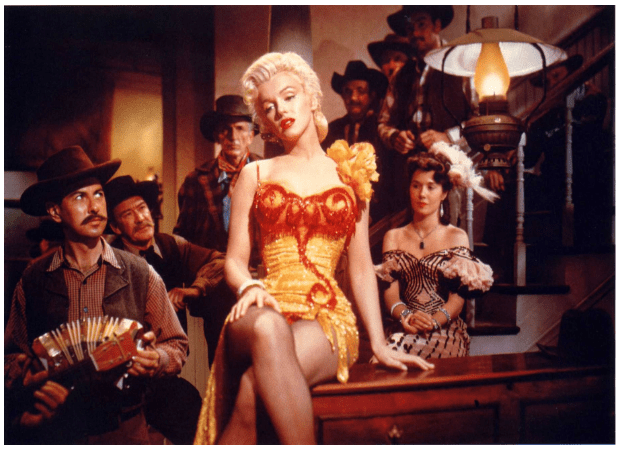
In the numerous attempts to capitalize on the 50th anniversary of Marilyn Monroe’s tragic death, 20th Century Fox has made the most welcome one, releasing impeccably restored editions of seven of her films in the “Forever Marilyn” Blu-Ray box set. Also available individually, these discs are a striking reminder that Monroe was not simply a mass-produced fetish toy, but an idiosyncratic artist who keenly played off of, and frequently subverted, the dumb-blonde characters she was saddled with. It includes Gentlemen Prefer Blondes, How To Marry A Millionaire, River of No Return, There’s No Business Like Show Business, The Seven Year Itch, Some Like It Hot and The Misfits. While Gentlemen Prefer Blondes remains an ebulliently entertaining treatise on female friendship, the revelation for me was Otto Preminger’s River of No Return (1954), a rather melancholy Western (with the saddest theme song in history), in which she plays her woman of questionable virtue with a daring opacity, causing Darryl Zanuck to demand re-shoots to clarify her character’s motivations.

River of No Return was originally conceived by screenwriter Louis Lantz as a Western remake of Vittorio De Sica’s Bicycle Thieves. It concerns a man, Matt Calder (Robert Mitchum) whose horse and gun are stolen by gambler Harry Weston (Rory Calhoun). Unable to work on or defend his farm, Calder and his son Mark (Tommy Rettig) search the dangerous countryside for the thief. As Chris Fujiwara reports in his meticulously researched critical biography of Preminger, The World And Its Double, Lettig’s treatment was heavily revised by Frank Fenton, brought in by young Fox producer Stanley Rubin. They fleshed out Calder’s backstory, making him an ex-con recently released from prison on a murder charge. Weston was also given a saloon singer fiancee, Kay, to be played by Monroe. After the theft, Kay is embarrassed by Weston’s actions and stays behind with Matt and Mark,  but her ultimate loyalties are left ambiguously undefined.

Fox executive Darryl Zanuck intended the film to be a garish spectacle that would show off Monroe and the new CinemaScope process, writing in a memo that he wanted it to “stand an audience on its ear.” Otto Preminger did not entirely deliver the thrills Zanuck sought, so Jean Negulesco was brought on to film reshoots, including the sexually suggestive scenes in which Mitchum massages, and later violently wrestles with, Monroe.

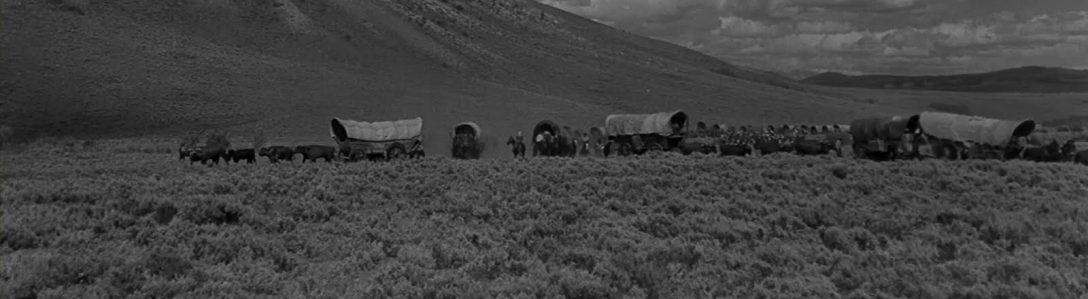
Preminger was brought late into the production, after the screenplay and much of the cast were finalized. Used to being producer/director on his films, and having just finished The Moon Is Blue, doing work for hire was a new and fraught experience for him. It was also the first film that he shot in CinemaScope, which he adapted to with a remarkable ease. Working with cinematographer Joseph La Shelle, Preminger composed images for the widescreen frame, which was perfect for capturing the horizontal lines of the pseudonymous river (shot in Alberta, Canada). He also instinctively understood that the wider frame was inimical to quick pans and editing, so he often uses depth to stage multiple actions in one shot. At the time Andre Bazin wrote that River of No Return was an exemplar of CinemaScope filmmaking, that it was one of the first films in which “the format really added something important to the mise en scene.”

This can be seen to an offhandedly brilliant effect in an early shot where Mitchum is strolling through a gold rush town, interrogating a priest about the whereabouts of his son, whom he is picking up. The priest laments that he came West as a missionary to convert Native Americans, but that he thinks white folk need him more now. Gold fever has corrupted his town. In the background Preminger presents nature as another force luring people into the muck. There is a carriage fording the river behind Mitchum, loaded up with women. It gets stuck in the mud,  and one of the ladies tumbles into the water before it reaches shore. This is a comic variation on the dangers the river will later present to Calder and to Kay. Background is comedy, foreground is tragedy.

As easily as Preminger adapted to CinemaScope, the same can’t be said regarding his relationship with Marilyn Monroe, who brought along her very vocal acting coach Natasha Lytess. Fujiwara details Preminger’s growing irritation with Lytess’ constant interruptions, until he finally banned her from the set. She would later return due to Zanuck’s intervention. But regardless of the tension off the set, Monroe is teasingly enigmatic in the film, emphasizing Kay as a performer. She appears warm toward Mark, but there is a coldness in her tone that implies it could be an act, as she is still sworn to marry Weston. She is the perfect foil for Mitchum’s brooding introvert – who repeatedly tells Kay and his son that they are likely to die on their journey. They are like two stubborn mules who kick each other enough until they realize they both like it.

Zanuck did not approve of the ambiguous nature of Kay and Calder’s motivations, writing in a memo that “our picture is inarticulate. We have got to stop guessing about these relationships. Once and for all, we want to lay it on the line so there can be no doubt or confusion as to what our people mean and how they feel.” Three new scenes were shot, including the two sexually suggestive ones previously mentioned, and another with Monroe and Rory Calhoun that would clarify their intent to marry.

Regardless of these additions, Preminger’s film remains intriguingly opaque, the characters’ moral reversals seemingly coming with the wind more than from some inner will. In the glorious CinemaScope landscapes, it is the world that seems to determine the action, and not the other way around, as Calder and Kay are tossed to and fro along the riverbank. It is even the river that provides the most famous symbolic moment in the film – when Kay’s suitcase escapes in the water as Weston carries her to the shore, and onto Calder’s farm. Her final ties to civilization are carried away by the current, and Mitchum’s (gun and horse) are forcibly removed by Weston. They are forced to find a new life, re-shaped and re-directed by the river’s ceaseless flow.

THE TOSHIRO MIFUNE BLOGATHON: THE CHALLENGE (1982)

August 7, 2012

Screen Shot 2020-02-05 at 1.13.22 PM

The collaboration between Toshiro Mifune and director Akira Kurosawa ended in 1965, following the release of Red Beard, their sixteenth and final film together. Having built up an international reputation thanks to his work with Kurosawa, Mifune looked West, receiving his first Hollywood paycheck playing against type as a Japanese industrialist in John Frankenheimer’s Grand Prix (1966). He would jump back and forth between Japan and the U.S. through the early 80s, working mainly in stolid war dramas (MidwayInchon), but also getting to stretch out a bit with John Boorman (Hell in the Pacific) and Steven Spielberg (1941). In terms of viewership, his greatest success was playing opposite Richard Chamberlain in the TV mini-series of James Clavell’s Shogun (1980).Perhaps realizing that Hollywood would continue to shunt him into stereotyped Japanese roles in stuffy historical dramas, he spent the majority of his remaining career at home. For his final U.S. film in this period, he re-united with John Frankenheimer to shoot the entertainingly silly East-meets-West martial arts film, The Challenge (1982). Frankenheimer had similarly entered a low ebb in his career, resulting in these two dynamic talents making a mid-budget action film for CBS Films, to be distributed by the small Embassy Pictures studio.

The Challenge stars Scott Glenn as a prototypical ugly American who gets caught in the middle of a feud between two Japanese brothers over their family’s legendary samurai swords. Glenn was fresh off of his supporting role in Urban Cowboy, and this was CBS and Embassy’s attempt to capitalize on that and make him a star. That it didn’t work doesn’t take away from Glenn’s admirably schlubby performance, in which he slouches and slurs his way through Kyoto. Buried up to his head in dirt, he even manages to croak out “Deep In the Heart of Texas.”  Shot on location, the film has a largely Japanese crew, including DP Kozo Okazaki, but there were some up and coming American collaborators as well. John Sayles did a major re-write of the screenplay, and had fond memories working on the film, as he told Philip Wuntch:

The funniest experience I had was rewriting The Challenge for John Frankenheimer before it started filming. When Frankenheimer found out he could get Toshiro Mifune, he changed the background from Chinese martial arts to Japanese martial arts. They’re completely opposite forms, but he said no one would know the difference. We changed all the martial arts scenes and all the background story because he was able to get Mifune.

Steven Seagal was living and teaching Aikido in Japan, and was brought on as “martial arts coordinator”, presumably helping to help choreograph and fact check the accuracy of the fight sequences. He would later open a martial arts school in North Hollywood, teaching the movie execs who would later make him a short-lived star. But as Sayles writes, it was Frankenheimer’s eagerness to work with Mifune that necessitated large scale revisions, as well as scouting locations in an entirely different country from which they expected. As an actor, Mifune still garnered that kind of respect, although Embassy had to be hoping it was Glenn that would drive the box office, as it was his face that is emblazoned on the posters.

The movie provides a stark vision of culture clashes, creating a triangle between old-school samurai Toru (Mifune), his super-rich Westernized brother Hideo (Atsuo Nakamura), and the brusque uncultured America of Rick (Scott Glenn). Rick is a down and out boxer, who Toru recruits to help escort one of his lost swords back to Kyoto. Unaware of the dangers of his employment, he agrees, but he is soon waylaid by Hideo’s goon Ando (a wonderfully sarcastic Calvin Jung), and endures a barrage of beatings before he has any idea what is going on. It’s a broad mishmash of the kineticism of Chinese kung-fu movies, the honor code of Japanese samurai films, and the body count of Hollywood action movies.

Mifune plays his Toru as a gruff, soft-spoken patriarch with a shock of white hair, injecting gravitas into a movie of profound absurdity. The final action sequence has the samurai-robed Mifune taking down an entire skyscraper of guards and goons with his bow and arrow (and an assist from a machine-gunning Glenn). It’s an outrageous sequence that presages the bloodbath at the end of Commando (1985), and the only thing keeping the film moored to its dramatic arc is Mifune playing it absolutely straight. The sequence is a pungent metaphor for the fears Americans had toward the growing economic power of Japan, as the film pines for the civilized, if technologically backward dojo of Toru, while painting Hideo as an unprincipled free-market capitalist ready to destroy tradition for his material gain. The American Glenn comes to the aid of Toru, battling back the threatened economic competitor.

It is what they call “a rich text”, although it’s unclear how much Frankenheimer contributed. It was during this period that he had become a serious alcoholic, and he told Charles Champlin that he was even bringing drinks to the set, for the first time in his career. It was following this eye-opening and sense-dulling shoot that Frankenheimer checked himself into rehab and dried out. It is not one of his more visually interesting films, lacking his usual smooth lines and frames-within-frames. Although I should admit I had to watch it in a cropped 1.33:1 aspect ratio (it was shot in 1.85), as this VHS version is the only one available. He would dry out, and revive his career on television, where he began. Mifune would also make a series of TV movies in Japan, before ending his career in 1995 with the drama Fukai kawa.

SOMETHING TOUGH: BODY AND SOUL and FORCE OF EVIL

July 31, 2012

Screen Shot 2020-02-05 at 12.40.26 PM

“According to materials contained in the PCA [Production Code Administration] files in the AMPAS Library, PCA director Joseph I. Breen objected to ‘the completely anti-social basic theme of this story, which presents wrong as right and right as wrong, in violation of both the letter and spirit of the Production Code.’” –Force of Evil entry, American Film Institute Catalog

In 1946, John Garfield’s contract with Warner Brothers expired. Instead of re-signing, or moving to another studio, Garfield signed on with the independent Enterprise Productions. Bringing together a group of artists who were communists, or communist sympathizers, Enterprise made an inflammatory group of nine films before folding, after which many of its members were blacklisted, including directors Robert Rossen and Abraham Polonsky. Two of their features, Body and Soul (1947) and Force of Evil (1948), respectively, ended up in the Republic Pictures library, and are being released today on Blu-Ray from Olive Films, in strong transfers. Garfield was eager to make a statement with Enterprise, telling PM Magazine in this period that:

I want to make pictures with a point – I know I gotta continue to appear in pictures like Postman [The Postman Always Rings Twice, 1946]. I know I gotta retain my position of value at the box office, but I also want to be available in between for the kind of picture that’s harder to do but may turn out to be more interesting. Maybe in the next few years I’ll make so many mistakes I’ll kill my career. I can afford the chance. There’s fear in Hollywood about tackling dangerous subjects, difficult subjects. I feel I owe it to myself to be available when some enterprising people want to try something tough.

Enterprise productions was formed by David L. Loew, Charles Einfeld, and silent partner A. Pam Blumenthal. Loew was a son of MGM founder Marcus Loew, and left the studio to pursue an independent producing career in 1935, working with directors like Jean Renoir (on The Southerner (1945)) and Albert Lewin (The Moon and Sixpence (1942)). Einfeld was the former advertising and publicity director at Warner Brothers, and therefore familiar with Garfield, while Blumenthal helped them garner a $10 million line of credit from Bank of America to finance their first six films. Garfield and his business partner Bob Roberts set-up their Roberts Productions shingle under the Enterprise banner.

It was an idealistic endeavor, which actor Norman Lloyd described as “Nirvana”, and then-Assistant Director Robert Aldrich judged that, “For about two and a half or three years before it went down the drain, I would guess that it had a better esprit de corps, and more interest and excitement going for it among the employees, from the laborer to the star, than any place in Hollywood.” Garfield and Roberts’ first film at Enterprise was Body and Soul (1948), and the talent on-board is staggering. Along with Aldrich as AD, it attracted Rossen as director, Polonsky as screenwriter, James Wong Howe as cinematographer and Robert Parrish as editor. Dialogue director (and later a director period) Don Weis told Garfield biographer Robert Nott that “I was amazed that everyone in the company with the exception of [cameraman] Jimmy Howe was involved politically. Every day they [Polonsky, Roberts and Garfield] would come down from the office with a petition for us to sign, for good things like housing for the poor, and I signed everything. “

Garfield bought the rights to the life story of Barney Ross, a Jewish boxer and decorated WWII soldier who was born on Rivington St. in the Lower East Side of NYC, just like Garfield. Ross was born Dov-Ber Rosofsky, son of a Talmudic scholar, while Garfield was originally named Jacob Garfinkle, born to a clothes presser and part-time cantor. It was a deeply personal story to Garfield, although the story’s ethnic character was drained by the PCA, who even objected to showing bouts between a black and a white fighter, although the fight between Garfield and Canada Lee remains in the film. The script had to be heavily revised by Polonsky in any case, telling a profoundly sad version of the familiar rise and fall boxing narrative, as Charley Davis (Garfield) spurns his neighborhood sweetheart and family for the lure of big money promised by mobbed up promoter Roberts (Lloyd Gough). Charley’s Jewishness is never stated directly, but is strongly implied by a neighbor who states that, “over in Europe, Nazis are killing people like us, just because of their religion. But here, Charley Davis is champion.”

The previous winter the N.Y. State Boxing Commission investigated bribery charges, to much publicity and little results, which inspired the powerfully damning depiction of corruption in the Roberts character. His money instantly degrades, as seen when punch-drunk Ben (the civil-rights activist Canada Lee) refuses to take the bills Roberts contemptuously throws onto the ground at his feet. Ben refuses, but Charley picks it up and forces him to take it, telling him that cash has no memory.

This off-hand character moment in Body and Soul becomes the central theme of Force Of Evil (1948), in which the phrase is turned around into, “money has no moral opinions”, and capitalism exists as a pit of despair in which all of the film’s characters sink. J. Hoberman writes in An Army of Phantoms that “The threat in this openly anticapitalist gangster film is the system itself.” Both written and directed by Polonsky this time (adapted from Ira Wolfert’s 1943 novel Tucker’s People), it retains many of Body and Soul‘s crew, including Aldrich and Weis, although now George Barnes would handle the cinematography’s canted angles and haunting chiaroscuro. The compositions often look like they are for a horror film, with the monster around every corner. The largest bogeyman in this stretch of Wall Street is Tucker (Roy Roberts) a mobster looking to take over the numbers rackets in town, aided by Joe Morse (Garfield), a convictionless lawyer. Tucker even wants to absorb the Mom and Pop bookie service run by Joe’s brother Leo. This relentless amassing of power, with little regard for the welfare of its workers, is the bluntly drawn and bleakly devastating metaphor for the post-war capitalist system that Polonsky and his collaborators were agitating against.

They lost. Enterprise Productions’ largest production, Arch of Triumph (1948), was a box office disaster. Set among refugees in pre-WWII Paris, they again attracted great talents, including Ingrid Bergman and director Lewis Milestone, but their investment went bust. So just as Force of Evil’s indictment of capitalism was hitting screens, Bank of America was seizing the assets of Roberts Productions, after their failure to make their loan payments. Garfield, Polonsky and Rossen were called before the House Un-American Activities committee in 1951, refused to name names, and were blacklisted. Garfield then died of a heart attack on May 1st, 1952.

PLEASURES OF THE PRE-CODE: FORBIDDEN HOLLYWOOD VOLUMES 4 AND 5

July 24, 2012

Screen Shot 2020-02-05 at 12.36.19 PM

This astounding publicity shot of a screwfaced James Cagney reluctantly probing the shoulder of a coolly admiring Claire Dodd should sell anyone on the value of Hard To Handle (1933), or of the two new volumes of WB’s Forbidden Hollywood DVD series that is releasing it. The way Cagney separates his left ring and pinky fingers – as if he couldn’t bear to put the effort into using all five digits – exemplifies his casual mastery (even in PR shoots!) in fleshing out the con-artist cads he played throughout this period. And this is only one of the pleasures found within volumes 4 and 5 of the series, which includes a trio of treats from director William Dieterle, and snappy banter from the likes of Barbara Stanwyck and Joan Blondell. The last edition appeared in 2009, containing a bevy of depression-scarred William Wellman films, but as DVD sales have continued to crater, so has the prominence of this series, with the new editions being released on WB’s movies-on-demand line, the Warner Archive.

Volume 4 includes Jewel Robbery (1932), Lawyer Man (1932), Man Wanted (1932) and They Call It Sin (1932). The first three were directed by William Dieterle in his first flurry of creativity after arriving from Germany in 1931. I have enthused about Jewel Robbery in this space before, but it is truly a marvel, an effervescent sex (and drugs) comedy that is also one of Hollywood’s rare explorations of female desire. Kay Francis wishes for adventure, and in swoops the slick-haired and slicker-tongued thief William Powell, waiting to sweep her away. Lawyer Man (shot in 21 days) finds Powell back as a smooth talker, this time as an idealistic New York City lawyer brought low by the corruption in the system and in his loins. His sole connection to his former straight life is his ever-loyal and plucky secretary Lola, played with usual verve by Joan Blondell.

Blondell is the star of Miss Pinkerton (1932), part of Volume 5, which also includes Hard To Handle (’33), Ladies They Talk About (’33) and The Mind Reader (’33). As with Kay Francis in Jewel Robbery, Blondell plays a gal eager for adventure, although instead of a society dame, she’s a gum-smacking nurse. While dressing down to her negligee in the employee lounge, she dreams of an escape from routine and the smell of chloroform. Then she is plucked to minister to a sick old crone in an old dark house. It turns out the crone’s nephew may have been murdered there, and the detective in charge (George Brent) has tapped Blondell to glean any info she can from its nervous inhabitants. The story is a third-rate whodunit, but it’s directed by the prolific pro Lloyd Bacon with speed and plenty of comically looming shadows, and Blondell is as charming as ever, blazing through the dusty plot mechanics with a brassy bravado.

Then there’s Hard To Handle, a breezy comedy about an endearing shyster. Cagney is loose and playful as Lefty Merrill, a two-bit scam artist who goes from promoting a phony “treasure hunt” (which causes a riot) to becoming the CEO of his own giant PR firm. The art of the con is essential knowledge for the advertising biz, as Cagney lies his way up the ladder. His rise is paralleled with his gal pal Ruth (Mary Brian), an aspiring model whose scheming mother Lil (Ruth Donnelly) plans to marry her to the richest husband possible. As Lefty’s fortune’s rise and fall and rise again, so does Lil’s interest. Everyone has an angle, but this is no cynical satire, but rather a bubbly romantic comedy. Director Mervyn LeRoy simply lets Cagney spin like a top, his machine-gunning speech patterns timed to nimble half-pirouettes, a man in constant motion, forever searching for a score. Scrounging for money was simply a fact of life, with no moral qualms attached.

Ladies They Talk About is saddled with moralizing speeches, by radio pedagogue David Slade (Preston Foster). A non-denominational preacher, he gains fame (and one assumes) fortune from railing against the vices pre-code Warner Brothers capitalized so heartily on. But while Slade wins in the end, there is plenty of titillation in between his hollow victory. The focus of his efforts is Nan Taylor (a particularly slinky Barbara Stanwyck), who got arrested for acting as a decoy for a gang of bank robbers. Initially posing as innocent, Slade sets up a PR assault to set her free, until she offhandedly admits her guilt, and Slade lets her go to jail. One of the earliest women-in-prison movies, Ladies They Talk About excels in scenes of female camaraderie, as Stanywck strikes up an instant friendship with another tough broad played by Lillian Roth. She takes her on a tour of the cell block, a hard-bitten crew of murderers and thieves given a roll-call in close-up, no innocents here. Directors Howard Bretherton and William Keighley give a sense of their daily routine in an impressive tracking shot across multiple cells. A particularly grim vision of femininity as imprisonment, Nan’s union with Slade retrospectively looks like she’s trading one cell for another.

Warren William’s characters, however, thoroughly enjoy the patriarchy and wring every advantage possible out of it. In The Mind Reader (shot in 22 days), William plays another con-artist of the carny kind, pulling teeth “painlessly” at a county fair, selling hair tonic on the road, and finally hitting the jackpot in the fortune telling business. He slaps a towel on his head, calls himself “Chandra”, and William has women pledging their bank accounts to him. Busy milking the rubes, he also finds time to fall in love with boring good-girl Sylvia (Constance Cummings), who only marries him if he promises to quit the con game. He agrees, and pathetically goes door-to-door selling wire brushes.  William tells a friend, “I’m on the straight and narrow…you know…the wife.” Bored and broken, William realizes he’s a cheat at heart, and returns to soothsaying even though he knows it could destroy his life. In the shattering penultimate sequence, William is shown drunk in Tijuana, the perfectly oiled William coiffure mussed into a mess. Overcome by self-loathing, he re-directs it toward the crowd, berating them for believing his lies of their future, believing that his own had all but run out.

A cornucopia of deviant money-grubbing borne out of the Great Depression, volumes 4 and 5 of Forbidden Hollywood are ideal viewing for our never-ending Great Recession, with the added value of sublime performances from Kay Francis, James Cagney, Joan Blondell and Barbara Stanwyck. There is no finer way to spend an economic apocalypse than in their company.

STILL SINGING: SINGIN’ IN THE RAIN and COVER GIRL

July 17, 2012

Screen Shot 2020-02-04 at 3.03.04 PM

Singin’ In the Rain (1952) is 60 years young in 2012, a birthday which Warner Brothers is celebrating with a dazzlingly remastered Blu-ray that comes out today. Richly textured with popping primary colors, this is the best the film will look outside a screening of a new 35mm print. Last week, the boutique home video distributor Twilight Time released a Blu-ray of Cover Girl (1944), the first film in which Gene Kelly and Stanley Donen were given free rein to choreograph their own dance routines, under the auspices of director Charles Vidor. Licensed from Columbia Pictures, the transfer of this Technicolor film is dark with fluctuating color intensities – Rita Hayworth’s hair doesn’t quite blaze off the screen like it should. That technical quibble aside, these releases are a wonderful excuse to revisit the work of Kelly and Donen, and what struck me this time around was the violence of some of their routines, borne out of a melancholy that would come to the fore in their final collaboration, It’s Always Fair Weather (1955).

Cover Girl was promoted as the first musical to integrate its musical numbers into the plot, arising out of and advancing the story. There are sure to have been predecessors, but this was the biggest hit, and became the most influential. The story is a boiler plate backstage musical, with dancing girl Rita Hayworth rocketing to stardom after winning a magazine cover girl contest, and having to struggle with leaving her nightclub manager Gene Kelly for the bright lights of Broadway. The story arc is a predictable drag, but the film has some incredible compensatory pleasures, from its score to its choreography.

Rita Hayworth’s Svengali Harry Cohn was not enthused with the casting of Gene Kelly and his “tough Irish face”, and Columbia originally wanted to borrow Dennis Morgan from Warners to play the lead. Kelly was slated to appear in Dragon Seed (1944), but when that project was postponed, MGM extended his loan out to Columbia, and movie history was made.

It’s a film of firsts. It was Jerome Kern and Ira Gershwin’s first pairing for a film production, writing the future standard “Long Ago and Far Away”. And then there is Kelly and Donen being granted creative control of their routines, a canny move by producer Arthur Schwartz. You can see the duo bursting with inventiveness, eager to break out of the stodgy confines of the story. The most famous is the “Alter Ego” dance routine, in which Kelly confronts his conscience over Hayworth stepping out with another man, dancing a duet with his super-imposed image on the dark studio streets of New York, the rage-filled inverse to the title Singin’ in the Rain softshoe. He chases himself across the street, each mirror-image seeming to pull the string on the other, until the “real” Kelly destroys the superimposed one by smashing his image with a garbage can. Cover Girl doesn’t dare play out the self-destructive impulses this sequence implies.

Singin’ In the Rain is such a contradictory pleasure, a film that parodies the artificiality of film construction, but in turn uses that construction to create one of the most giddily entertaining movies of the period. This is encapsulated in the “You Were Meant for Me” ballad, sung in an abandoned sound stage. We see Kelly arrange the set, flicking on the fill lights and industrial-strength fan, and watch Debbie Reynolds ascend a ladder and arch her back to appropriately catch the artificial wind and rays. But by the end of the sequence, as Jane Feuer wrote in her seminal The Hollywood Musical, “the camera arcs around and comes in for a tighter shot of the couple…reframing to exclude the previously exposed equipment. We regress from an expose of romantic duets to an example of a romantic duet.” I would quibble with her use of “regress”, but there is definitely some sleight-of-hand here, except we have already been shown how the trick works.

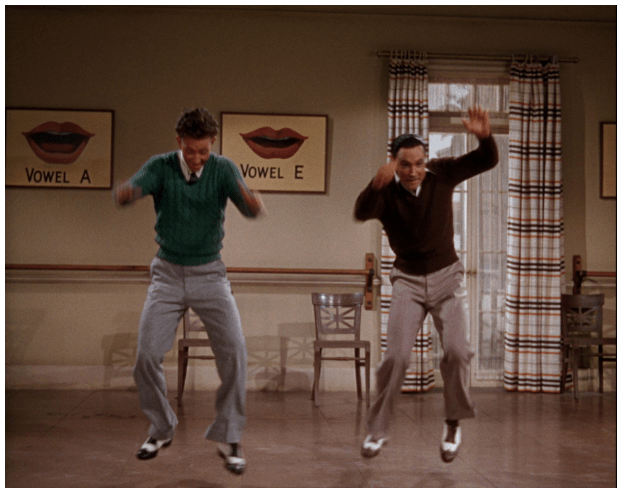
This trick also appears in my favorite number in the film, and one of the two original songs (along with “Make ‘Em Laugh”, “Moses Supposes”.The pleasure of the sequence comes out of the seeming sponteneity of their actions, from twirling a tie to using curtains as veils. But of course this sequence was meticulously planned out. It’s hard to make something look this easy. Violently anarchic, this elocution lesson ends up, as in the “Alter Ego” number, with up-ended trash cans and a feeling of ecstatic release. This is pitched in a comic rather than dramatic mode, with Kelly and Donald O’Connor parodying the nasal stuffiness of the teacher by inventing a nonsense rhyme and tap-dancing the room into submission.This introduces another favored Hollywood trope, that of upsetting the apple cart of “high art” with the more spontaneous, communal pleasures of the low arts; in Singin’ in the Rain, it’s vaudeville. This theme is brought to its apex in Vincente Minnelli’s The Band Wagon, but it’s present here too, most famously in the opening montage, in which Kelly’s gaseous voice-over about “Dignity, always dignity”, is replaced with the reality of his hoofing it as a vaudevillian and stunt man.

“Alter Ego” allowed Kelly to cut loose without the less schooled dancer Hayworth, and the same is true here, with Kelly paired with the astoundingly athletic O’Connor, and they end up stamping an office table, tapping on a pair of wooden chairs before trashing the room. When Kelly is paired with a classically trained dancer in Cyd Charisse for the “Broadway Melody” routine, it can only be done in a fantasy sequence, so the down-to-earth quality of Kelly’s character is not upset by the delicacy of his sublime work with Charisse. Her impossibly sharp angles and Kelly’s rounded movements melt into an inflammatory erotic reverie, punctuated by those delirium inducing ascending crane shots. It is another privileged moment when Kelly loses his grip, and it is moments like these that make up  It’s Always Fair Weather, in which army buddies reunite and realize their past friendship may have been a sham.  Kelly threatens to finally fall apart completely, but instead he simply loses his audience, and that film signaled the end of the classical Hollywood musical.

JAPAN CUTS: THE NEW YORK FESTIVAL OF CONTEMPORARY JAPANESE CINEMA

July 10, 2012

Screen Shot 2020-02-04 at 2.58.55 PM

For the sixth year running, the Japan Cuts film series in New York City presents an eye-opening glimpse of contemporary filmmaking from across the Pacific, the vast majority of which will never receive distribution in the United States. Programmed in concert with the ongoing New York Asian Film Festival (which I covered for Film Comment), it runs from July 12 – 28 at the Japan Society, and will screen 37 features and two shorts. The normally sober-minded fest has gone pop this year, booking a slate bubbling with hyperactive rom-coms and sci-fi extravaganzas, but there is also a sidebar of films responding to the Fukushima nuclear disaster, as well as a tribute to the expressively stone-faced actor Koji Yakusho, who will appear in-person for the screening of The Woodsman and the Rain (2011).

Japanese studios wring established brands as dry as any Hollywood outfit with a superhero license, as the caffeinated pleasures of Love Strikes! (2011) can attest. It’s a manic romantic comedy adapted from a hit TV show (Moteki, 2010), which was in turn the small screen version of a blockbuster manga comic book by Mitsuro Kubo. Toho, the largest Japanese production and distribution company, dominates the native box office with re-dos such as these, especially the endless iterations of anime behemoths Pokemon and Doraemon.

Love Strikes! was a solid hit in 2011, and it is a cross-promotional machine, playing clips from what seems like every J-pop band of the last twenty years. But instead of a bubblegum-tween romance, it’s pitched towards an older crowd, aiming for the instant nostalgia of the early-30s set. The main character is Yukiyo Fujimoto (the mousy Mirai Moriyama), a 31-year-old virgin who quotes Goethe and reads way too deeply into teen pop lyrics. He gets a job at an internet culture magazine, but is thrown through a loop when the perky hip chick Miyuki (Masami Nagasawa) responds to his music nerd musings on Twitter (Yukiyo: “Someone register her as a world heritage site”). Director Hitoshi Ohne (ported over from the TV show), slathers the screen with scrolling Twitter pages and karaoke lyrics, topped off with Fujimoto’s self-doubting voice-over.

The highlight of this ADD-cinema is an impromptu music video featuring girl group trio Perfume, who dance through Tokyo with Yukiyo to their hit “Baby Cruising Love”, enacting his budding self-actualization. I was largely won over by this shock and awe pop assault, deluded male fantasy though it is, thanks to its witty screenplay by Ohne and an energetic performance by Nagasawa (justly deserving of the festival’s Rising Star award), who injects her thankless object-of-nerd-lust role with an unexpected aggressiveness and spunk. The third act devolves too far into passive male wish-fulfillment, but Ohne keeps the visuals popping around it.

The Closing Night film of the festival is another Toho-stravaganza, the sci-fi spectacular Space Battleship Yamato (2010), a live-action adaptation of the much beloved 1974 animated series. Directed by visual effects specialist Takashi Yamazaki, director of the Japan Academy prize winner Always, it pushes the limits of Japanese FX technology, sometimes to the breaking point. The story is ultra-nationalist, pushing themes of self-sacrifice to self-destructive lengths (the Yamato was the lead Japanese battleship in WWII). It follows one-time rebel Susumu Kodai (Takuya Kimura), who learns to love the military after the country is attacked, and about to be decimated by, the alien Gamilas. With a $29.4 million dollar budget, it is a major production, but the scale of the film needs Hollywood-style cash, and some of the alien worlds lack detail and dimensionality, giving them a video-game flatness. The film has a lack of self-consciousness in its propaganda, kind of Starship Troopers played straight, which to be honest has a refreshing pulp quality to it, as men speak in clipped moralistic phrases and rush around feverishly blinking panels.

Koji Yakusho doesn’t need flash to sell tickets. With his prominent cheekbones, piercing stare, and air of calm reserve, he could be a model, an assassin, or a model assassin, but instead he has chosen roles of subtle dramatic gradations, including the rumpled detective in Kiyoshi Kurosawa’s Cure, or the crusty old patriarch in  Chronicle of My Mother (2011), another Toho-hit, in which he grapples with the growing senility of his mother. It’s a solid family drama, the kind of well-crafted multi-generational weepie even second-tier Japanese directors like Masato Harada can churn out with ease. Although not on the level of Yoji Yamada’s About Her Brother (2010) or Hirokazu Kore-eda’s Still Walking (2008), Harada uses distanced camerawork and detailed 50s era art direction to emphasize the distance he has set up between his own family members. Kirin Kiri is endearingly batty as his equally withholding mother, and their inevitable emotional breakthrough is underplayed so well that Yakusho’s grin has the same impact of a full-throated sob.

Yoshihiro Nakamura is a director who deals with Toho but has been able to maintain an individual artistic identity. While making cash-grabbers for Toho like last year’s dreadful-looking Eiga Kaibutsukun (watch the trailer – if you dare) he has also pursued a productive collaboration with mystery novelist Kotara Isaka , whose twisting Rube Goldberg narratives Nakamura has adapted multiple times over the years. His breakthrough film in the West was the briskly entertaining Fish Story (2009, available on DVD and streaming on Netflix) in which a long-forgotten punk song from 1975 inadvertently prevents the Earth from getting creamed by an asteroid in the present. Then in 2010 Nakamura adapted Isaka’s Golden Slumber (2010), a rather plodding conspiracy narrative that piles on subplots without Fish Story’s fleet pacing. Golden Slumber was Isaka’s first novel translated into English, with the title changed to Remote Control.  Last year found Nakamura take a break from Isaka’s work, and made his simplest and most affecting film, A Boy and his Samurai (aka Chonmage Purin, 2010). A sweetly sentimental fish out of water comedy, it plops a time-traveling samurai into modern Japan, who promptly becomes a master pastry chef.

This year has Nakamura return to Isaka’s work, adapting one of his short stories for Chips (aka Potechi, 2012), a svelte 68 minute comedy that combines the deadpan humor and narrative web of Fish Story with the naked emotionality of A Boy and His Samurai. Partly funded by the Sendai Miyagi Film Commission, Chips was shot in Sendai, and was recruited to help bring business back to the city, so devastated by the earthquake and subsequent tsunami of 2011. That is why Chips is included in the Japan Cuts sidebar, “Focus on Post 3.11 Cinema”, which consists of four fiction films attempting to respond to those events, including Toshi Fujiwara’s No Man’s Zone and Masahiro Kobayashi’s Women on the Edge. You can read more about them in Dennis Lim’s NY Times piece here.

Chips begins with Imamura (Nakamura regular Gaku Hamada) and Kurosawa (Nao Ohmori) watching an empty stage in the park. Imamura is the funny one, and Kurosawa the serious one, playing off the personas of their famed director namesakes. Their circuitous actions will fill the stage of the screen, set in motion when Imamura answers the phone during one of his petty thievery jobs, one of those small actions that has epic existential effects in Nakamura’s world. The girl who answers is threatening to commit suicide. He talks her down, but then the two of them are sitting during another robbery, and another phone rings. This time they are ensnared in a blackmail ring involving the baseball player Ozaki. Stories sprout new stories, all of them tinged with loss, from the prospective suicide to the final revelation, which opens up doubt about Imamura’s own identity. Imamura’s life becomes doubled with Ozaki’s, ending at a baseball game that unfurls with the compressed ritual intensity of kabuki theater, one that will shake the two men’s destinies apart. It is a wildly melodramatic and deeply sad conclusion, which pushes Imamura into a place where he is cheering for the destruction of his own identity. All this is accomplished with an unobtrusive fixed camera, usually focused on Hamada’s slackjawed moon face, which looks as if it is in a perpetual state of stunned surprise, which is a decent description of Nakamura’s audience as well.

Toshiaki Toyoda has staked out a less accommodating stance with the studios, and has become persona non grata since his arrest for drug possession in 2005. His new film Monsters Club is an unsettling re-telling of the Unabomber story, complete with a mail-bomb POV shot, from construction to explosion. Shot over two weeks without a script in snow clogged mountains, its method of shooting was as mad as its main character. Although it opts for rote pop-psychology explanations by the end, the visuals are far more unsettling, especially the hallucinations of colored shaving cream covered swamp people designed by transgender Japanese artist Pyuupiru.

This year’s Japan Cuts holds fascinating insights into how the Japanese commercial cinema works these days, which is not too far off from our own much-maligned Hollywood model of the necessity of “brand-awareness”. As Love Strikes! shows, though, these pre-digested products don’t have to be creatively diluted, as long as they fulfill their promotional duties first. Yoshihiro Nakamura is the most intriguing figure here, one who seems to be able to float back and forth between Toho-blessed A-pictures and his own little curios, much like the soon to be retired Steven Soderbergh. It will interesting to see how long he can survive the balancing act, before getting burned out and frustrated like his American counterpart.

THE BATTLE HYMN OF REPUBLIC PICTURES

July 3, 2012

Screen Shot 2020-02-04 at 2.55.14 PM

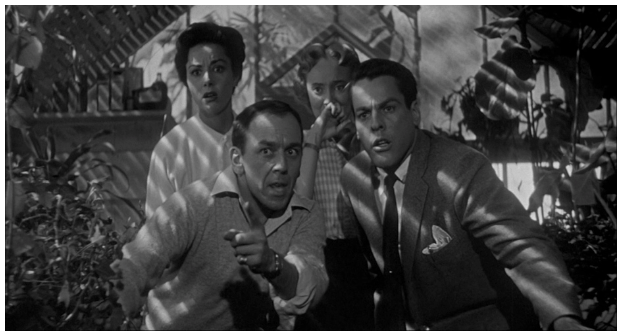
On July 18th, Olive Films will begin their roll-out of the Republic Pictures library with DVD/Blu-Ray releases of High Noon (1952) and Invasion of the Body Snatchers (1956). Republic has long been one of the most underutilized holdings in the home video market, passing from corporation to corporation with little concern for the treasures it contained. But upstart Olive has closed a massive licensing deal with Republic parent Paramount Pictures, and is set to release a flood of material (from B-Westerns to prestige pics) in 2012 that had mostly been overlooked in the digital age. While these first two releases have been well-represented on DVD, it is their premiere on Blu-Ray, and there are plenty of rare gems coming down the pike (all transferred in HD), including Nicholas Ray’s Johnny Guitar,  Fritz Lang’s Secret Beyond the Door and Orson Welles’ Macbeth.

Herbert J. Yates began his career in film processing in 1915. By the 1930s his Consolidated Film Laboratories was a major developer of B-film. As the Great Depression sent many Poverty Row studios into the red, Yates took them over, combining six companies (Monogram, Mascot, Liberty, Majestic, Chesterfield and Invincible) into one Republic in 1935. They made money off of disreputable serials and Westerns, giving daredevil action directors like William Witney endless opportunities to hone their craft on a shoestring budget.

Witney started his career at Mascot, riding horses in films for his brother-in-law, and director, Colbert Clark. Witney directed his first film, The Painted Stallion (1937), for Yates, and remembers the set-up in his autobiography, In A Door, Into a Fight, Out a Door, Into a Chase:

Republic’s main office was in New York where taxes were lower than in California, and Consolidated Film Industries, which made all the release prints, was located next door in Fort Lee, New Jersey. The office in New York City was located at 1776 Broadway…

Then, after Yates bought out the last of the executives from the six former companies, Witney writes, “I will say one thing for him. He screwed a lot of very smart men.” Witney wasn’t one of them, working productively for the company in serials (Daredevils of the Red Circle, The Adventures of Captain Marvel), Roy Rogers Westerns and teen-sploitation (Juvenile Jungle, Young and Wild) until the company was sold in 1959. It was because of money-making B-pictures like Witney’s that Yates had the money to invest in prestige productions like Orson Welles’ Macbeth and John Ford’s The Quiet Man and (the less expensive) The Sun Shines Bright. Yates rubbed Ford the wrong way, as the curmudgeonly director told biographer Joseph McBride, regarding The Sun Shines Bright:

Well, they didn’t ruin it, they couldn’t ruin it. But they cut a lot out of it. You’re working with a stupid lot of people, the executive producers, so what the hell, you’ve got to expect it.

But whatever his shortcomings as a producer and a shameless money-grubber, Herbert J. Yates, through accident or circumstance, funded some of the glories of the Hollywood Classical Cinema, both the high art of Ford and the low of Witney, and for that he deserves our reluctant thanks.

Yates sold his company’s library in toto to National Telefilm Associates (NTA) in ’59, bowing to the rising dominance of television. They had severely curtailed production, and were mainly making their money selling TV rights anyhow.  A Dec. 23rd, 1957 issue of Billboard announces the sale of syndication rights to NBC of 218 features and 15 serials for $3,5000,000, with the writer noting that, “the move by Republic to put its package in active sales is concurrent with reports that the studio is in the process of terminating film production.” At this point the demand for B-pictures had disappeared, as the 1948 anti-trust Paramount Decision had divested the studios of their theater ownership. They could no longer “block-book” their product and force theater managers to run whatever they sent them.

NTA made money syndicating the TV rights, with the rise of cable TV in the 1980s reinvigorating profits, leading them to change their name to Republic in 1986, and producing their own TV shows like Beauty and the Beast (1987). In 1994, Aaron Spelling Productions purchased NTA/Republic, and essentially used it as a distribution arm, and as a name to sell its own projects, completely divorced from the low-budget studio it once was. Now Republic Pictures Home Video would release a Spelling mini-series like James Michener’s Texas on VHS, while Johnny Guitarlanguished in the vaults. This was followed by some swift multinational swallowings, as Blockbuster purchased Spelling, and then Viacom bought Blockbuster. The Republic library then became the custody of the Viacom-owned Paramount Home Entertainment, all by the end of 1995.

There had been sluggish attempts to release the Republic library on home video during this period. Spelling licensed it to Artisan Video in 1995, who released The Quiet Man and a few others until the company was gobbled up by Lionsgate in 2003. Artisan’s rights expired in 2005, reverting briefly back to Paramount, but Lionsgate then decided to renew this license for another six years, starting in 2006. For what must have been effective but arcane accounting reasons, Lionsgate effectively sat on the Republic library. They released the comparatively unknown Arch of Triumph (1948), Only the Valiant (1951), and One Touch of Venus (1948) on DVD, but left the vast, and vastly better known, titles sitting on the shelf.

Once Lionsgate’s laissez-faire reign ended this year, Olive Films leapt into the fray, manically licensing Republic titles from Paramount, and almost immediately putting them into production. In the first few months of their stewardship, Olive will have released more of the Republic library than Artisan, Lionsgate and their forebears combined. As fast as they are releasing them, there are some quality control concerns, but the early returns are encouraging.  Both High Noon and Invasion of the Body Snatchers have received high marks from tech review site Blu-Ray.com, as well as my own eyes. The transfers are clean and sharp with rich contrast. Paramount’s archival wing had obviously had done strong HD transfers on these, and Olive presents them with no digital blow-drying. High Noon comes with a making-of documentary, while Invasion contains no extras, which is the norm for the company. And while Olive has had notoriously poor cover art in the past, their Republic discs all seem to have original poster artwork – a huge improvement over some of their early Photoshop jobs.

While it would have been ideal for Paramount to push its massive resources behind the restoration and release of the Republic library, perhaps it’s more appropriate for the scrappy and relatively under-funded Olive Films to do the job. Releasing its discs quickly, efficiently and with little marketing muscle, the Republic Pictures library has finally found a licensor that can match its huckster spirit, and that has the smarts to take advantage of other companies’ mistakes.

ANDREW SARRIS, 1928-2012

Originally published at Movie Morlocks, the official blog of Turner Classic Movies

June 26, 2012
Screen Shot 2020-02-04 at 2.50.41 PM

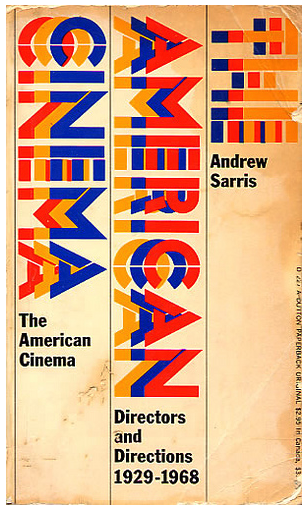
The influence of Andrew Sarris’ film criticism has become so omnipresent it is now invisible, part of the received wisdom of how we approach and watch movies. This has only become clearer after his death last week at the age of 83.  You can see his mark in the marketing of the upcoming “Hitchcock Masterpiece” Blu-Ray collection from Universal, and in every movie review that even mentions the name of the director. The auteur theory will be his legacy, regardless of how often it is misinterpreted as some kind of iron law rather than the policy of “perpetual revaluation” that he proposed it as.  Enough has been written about auteurism though, and not enough about the constant sense of discovery in reading his seductively winding prose. He approached films like an explorer, traveling down a multitude of paths, be it historical, stylistic or even personal, searching methodically for flashes of insight or originality, whether from the director or any of the film’s collaborative artists. His sentences would gather long strings of actors, colors and themes, as list-happy as in The American Cinema, seemingly sussing out his opinion along the way – a perambulating, open-air kind of criticism where interruption, digression and contradiction are welcome.

There are plenty of moving and detailed remembrances of Mr. Sarris around the internet (Matt Singer has gathered tributes at Indiewire, as has David Hudson at the Fandor Keyframe blog), so instead I asked a number of writers and academics to choose their favorite excerpts of his writing (Tom Gunning recited his from memory!), and to add comments if they had any. Below I have listed their responses, while including my own favorite Sarrisms at the end.

Guest Selections of Sarris’ work

Tom Gunning,  A. and Betty L. Bergman Distinguished Service Professor at the University of Chicago, Department of Art History, Department of Cinema and Media Studies

Entry on Ernst Lubitsch (Pantheon), The American Cinema:

For Lubitsch, it was sufficient to say that Hitler had bad manners, and no evil was then inconceivable.

Besides  showing how  concise and precise he could be, it shows Sarris’ ultimate values. In an era when it was claimed films were valuable only if they had Big Ideas (e.g.. Ingmar Bergman) or made Big Statements (e.g. Stanley Kramer), Sarris upheld  film style, not simply as a decorative function, but as the true means of expressing a judgement on the world and the people in it. He showed that the great directors of American cinema were great because they had style. Sarris had style. -Tom Gunning

***

Adrian Martin, writer, film critic, teacher

Q&A at the University of Washington, 1987 (transcription at Film Comment):

People talk about Platoon being a great war film. A great war film is Madame de… – the Stendhalian battle of love.

***

Miriam Bale, editor of Joan’s Digest, freelance critic and programmer

Review of Robert Aldrich’s …All the Marbles (Village Voice, 1981):

I cannot explain my feelings exactly, but when I left that theater of gutter trash, The National Theater, after a showing of …All the Marbles, I felt cleansed, exhilarated, almost sanctified.

***

Michael J. Anderson, Ph.D. candidate at Yale University, proprietor of the blog Tativille

Entry on John Ford (Pantheon), The American Cinema:

A Ford film, particularly a late Ford film, is more than its story and characterizations; it is also the director’s attitude toward his milieu and its codes of conduct.  There is a fantastic sequence in The Searchers involving a brash frontier character played by Ward Bond. Bond is drinking some coffee in a standing-up position before going out to hunt some Comanches. He glances toward one of the bedrooms, and notices the woman of the house tenderly caressing the Army uniform of her husband’s brother. Ford cuts back to a full-faced shot of Bond drinking his coffee, his eyes tactfully averted from the intimate scene he has witnessed. Nothing on earth would ever force this man to reveal what he had seen. There is a deep, subtle chivalry at work here, and in most of Ford’s films, but its never obtrusive enough to interfere with the flow of the narrative. The delicacy of emotion expressed here in three quick shots, perfectly cut, framed and distanced, would completely escape the dulled perception of our more literary-minded critics even if they designed to consider a despised genre like the Western. The economy of expression that Ford has achieved in fifty years of film-making constitutes the beauty of his style. If it had taken any longer than three shots and a few seconds to establish this insight into the Bond character, the point would not be worth making. Ford would be false to the manners of a time and a place bounded by the rigorous necessity of survival.

***

Gina Telaroli, filmmaker and video archivist

Review of Psycho (Village Voice, August 11, 1960):

Psycho should be seen at least three times by any discerning film-goer, the first time for the sheer terror of the experience, and on this occasion I fully agree with Hitchcock that only a congenital spoilsport would reveal the plot; the second time for the macabre comedy inherent in the conception of the film; and the third for all the hidden meanings and symbols lurking beneath the surface of the first American movie since “Touch of Evil” to stand in the same creative rank as the great European films.

A wonderful riff on the importance and joys of repeat viewings, with my favorite movie as the subject. -Gina Telaroli

***

C. Mason Wells, IFC Center

Entry on Buster Keaton (Pantheon), The American Cinema:

The difference between Keaton and Chaplin is the difference between poise and poetry, between the aristocrat and the tramp, between adaptability and dislocation, between the function of things and the meaning of things, between eccentricity and mysticism, between man as machine and man as angel, between the girl as a convention and the girl as an ideal, between the centripetal and the centrifugal tendencies of slapstick.

***

Brynn White, film researcher and writer

Review of Marnie (Village Voice, July 9, 1964):

Eisenstein may be spinach, pure iron for aesthetic corpuscles, and Dreyer high protein for the soul, but Hitchcock has always been pure carbohydrate for the palate.

Cinema was, as this quote literally illustrates, Andrew Sarris’s subsistence. Its a hearty twist on the Sarris categorization impulse, complete with unrealized fantasies of an auteur nutritional pyramid or all-you-can-eat buffet. To see Sarris and Molly Haskell introduce a film in all their symbiotic majesty was perhaps the most delectable treat; the duo’s fluid extemporization offered an intimate peek into a long evolving, near cosmic shared life in cinephilia, more seemingly pure than today’s blogs and internet forums. He showed film lovers how to build a happy home, body and mind in the dark. He excused us for letting the medium into our bloodstreams. -Brynn White

***

David Phelps, film critic and programmer

Entry on Raoul Walsh (The Far Side of Paradise), The American Cinema:

The Fordian hero knows why he is doing something even if he doesn’t know how. The Hawksian hero knows how to do what he is doing even if he doesn’t know why. The Walshian hero is less interested in the why or the how than the what. He is always plunging into the unknown, and he is never too sure what he will find there. There is a pathos and vunerability in Walsh’s characters lacking in the more self-contained Ford and Hawks counterparts. Where Ford shifts from the immediacy of the slightly depressed heroic angle to the horizon line of history, and Hawks remains at eye level, Walsh often moves to the slightly elevated angle of the lost child in the big world…If there is no place in the cinema for the virtues and limitations of Raoul Walsh, there is even less place for an honestly pluralistic criticism.
The last line is, of course, revealing: the filmmakers may plug into big themes of Americana, but it’s for the critic to take the role of Walshian explorer in a morass of movie-history, to be “less interested in the why or the how than the what”—as Sarris’ own passage shows in discussing thematics with blithe concern for anything other than how they structure the movements of the movie and the experience watching it. -David Phelps

***

Raya Martin, filmmaker

“Godard and the Revolution” (Village Voice, April 30, 1970):

The death of an artist is too high a price to pay for the birth of a revolutionary, even when the revolution seems to make more sense than ever before.

***

Michael Lieberman, filmmaker, filmgoer

Entry on Jean Renoir (Pantheon), The American Cinema

Renoir’s career is a river of personal expression. The waters may vary here and there in turbulence and depth, but the flow of personality is consistently directed to its final outlet in the sea of life.

After BAMcinematek’s 2010 retrospective of Renoir, I glanced over these two sentences, repeatedly. How often had a writer managed to nail the heart of the matter of a great artist, while also elevating their work? In that typically brisk and gorgeous summation, Sarris did just that. -Michael Lieberman

***

Aaron Cutler, critic

Review of Easy Rider (Village Voice, July 3, 1969)

We are simply too close to the popular cinema of today to read it correctly. If American movies today seem too eclectic, too derivative, and too mannered, so did they seem back in the twenties, the thirties, the forties and the fifties…Out of all the mimicry of earlier times emerged very personal styles, and there is no reason to believe that the same thing will not happen again and again. Hence beware of all generalizations, including this one, perhaps especially this one, because it is just remotely possible that after all the false cries of doom, the cinema might actually be racing to the creative standstill so long predicted for it. But I doubt it. It is not the medium that is most likely to get old, tired, and cynical, but its aging and metaphysically confused critics. This particular critic has never felt younger in his life.

What made Andrew Sarris a great critic, more so than any body of knowledge, I think, was his consistent approach to movie-reviewing: To be as generously open-minded as possible within personal limits, of which one always does one’s best to stay good-naturedly self-aware. -Aaron Cutler

***

My Selections

“Preston Sturges Recalled by Andrew Sarris” (Film Culture, No. 26, Fall 1962):

What distinguishes Preston Sturges from his contemporaries is the density and congestion of his comedies. The Breughel of American comedy directors, Sturges created a world of peripheral professionals – politicians, gangsters, executives, bartenders, cab drivers, secretaries, bookies, card sharps, movie producers, doctors, dentists, bodyguards, butlers, inventors, millionaires and derelicts. These were not the usual flotsam and jetsam of Hollywood cinema, but self-expressive cameos of aggressive individualism. With the determinism of the Sturges plots, these infinitely detailed miniatures served as contingent elements, and it is these elements, and the single-take, multiple viewpoint sequences formally demanded by these elements, which establishes the comedies of Preston Sturges once and for all as comedy/not tragedy.

***

The Films of Josef Von Sternberg, p.15 (The Museum of Modern Art, 1966):

No director in the history of the cinema can match Sternberg’s preoccupation with the harmonies of hand signals. This realm is usually restricted to actors only, but Sternberg ignored the tabu at his own peril. To light a cigarette, to grasp a coffee cup, to fondle one’s furs is, for Sternberg, equivalent to baring one’s soul.

***

Review of Seven Women (Village Voice, May 26, 1966):

Seven Women is a genuinely great film from the opening credit sequence of a Mongolian cavalry massing and surging in slashing diagonals across the screen to Anne Bancroft’s implacable farewell to Mike Mazurki’s Mongolian chieftain: ‘So long, you bastard.’ No lingeringly bitter tea of General Yen for Ford.

***

Review of Gertrud (Village Voice, June 2, 1966)

How can you have cinema when two people sit and talk on a couch as their life drifts imperceptibly out of their grasp? The academicians are right of course. Dreyer simply isn’t cinema. Cinema is Dreyer.

***

Review of El Dorado (Village Voice, July 27, 1967):

So much is coming to an end in El Dorado. Wayne, Hawks, Hollywood, the heroic western, the classical cinema. Or, as Shaw has said of Shakespeare, ‘The lot of the man who sees life truly and thinks about it romantically is despair.’ Fortunately, El Dorado is a western that sticks to its guns by affirming the spirit of adventure instead of trampling it in the dust of a fashionable misanthropy. Humor and affirmation on the brink of despair are the poetic ingredients of the Hawksian western. And now memory. Especially memory. Only those who see some point in remembering movies will find El Dorado truly unforgettable.

***

Review of Up The Down Staircase (Village Voice, October 19, 1967):

There is a five-or-six-minute sequence in Up the Down Staircase that is better than anything I have seen on the screen this year. The sequence begins with an act of compassion at a high-school dance and ends with an adolescent’s suicide the next day. The lyrical link between the two time sequences is composed of a gliding camera movement that follows the young girl as she shuffles away from and back to the teacher’s letter box in which she has deposited a note of heartfelt gratitude the night before. The teacher summons her for a cruel lesson in ‘composition.’ As he corrects her grammatical (and emotional) errors, Mulligan’s camera glances at the girl’s poignantly inexpressive face and then cuts to her hand clutching the sleeve of her coat. Between them, Robert Mulligan and Ellen O’Mara have resurrected the behavioral beauty of those old Hollywood movies that amaze us with their privileged moments in the midst of punk scenarios.

***

Opening line of his review of Weekend (Village Voice, October 24, 1968)

Weekend consolidates Jean-Luc Godard’s position as the most disconcerting of all contemporary directors, a veritable paragon of paradoxes, violent and yet vulnerable, the most elegant stylist and the most vulgar polemicist, the most remorseful classicist and the most relentless modernist, the man of the moment and the artist for the ages.

***

Entry on Max Ophuls (Pantheon), The American Cinema (1968):

This is the ultimate meaning of Ophulsian camera movement: time has no stop. Montage tends to suspend time in the limbo of abstract images, but the moving camera records inexorably the passage of time, moment by moment. As we follow the Ophulsian characters, step by step, up and down stairs, up and down streets, and round and round the ballroom, we realize their imprisonment in time. We know they can never escape, but we know also that they will never lose their poise and grace for the sake of futile desperation. They will dance beautifully, they will walk purposively, they will love deeply, and they will even die gallantly, and they will never whine or whimper or even discard their vanity.
THE HAZY LIVES OF NOBUHIRO YAMASHITA

June 19, 2012

Screen Shot 2020-02-04 at 12.30.34 PM

The characters in a Nobuhiro Yamashita film do a lot of standing around. They are waiting for something, whether it be a friend, a bus, or simply for the day to end. Yamashita’s films are about killing time, in the hope that the following morning will contain less of it. But each day seems to grow longer, and these young men and women continue to stand, until they have forgotten what they were waiting for in the first place. These are films attuned to the rhythms of in-between moments , reveling in their awkward absurdity and percolating anxiousness. Yamashita’s films are frequently hilarious but of a kind that sticks in the throat, as life sails by his weightless, indecisive characters. Operating in near-anonymity out of Japan, with little festival or international distribution, Yamashita has forged a consistently funny and bittersweet body of work that is deserving of a vastly wider audience.

Nobuhiro Yamashita was born in Aichi Prefecture, Japan in 1976. It is the country’s most heavily industrialized area, perhaps leading Yamashita toward his ambivalent attitude towards work, as his characters are all either unemployed or terrible at their jobs. He went to film school at the Osaka University of Arts, where he met his frequent collaborator, screenwriter Kosuke Mukai. They made a series of short films together before completing Hazy Life, which was accepted into the Rotterdam Film Festival’s Tiger Award Competition for young filmmakers in 2000. A startlingly assured debut for a 24-year-old, it is very much under the sway of Jim Jarmusch, a series of deadpan blackout sketches about two aimless youths stuck between immaturity and adulthood.

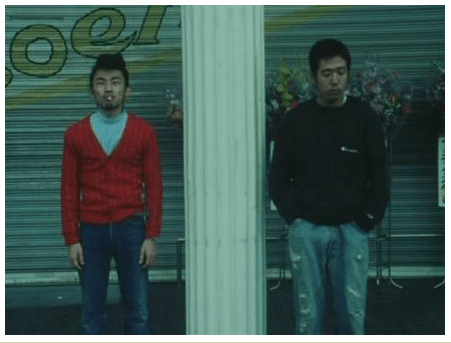
Minami (Yamashita axiom Hiroshi Yamamoto) enters life pompadour first, as the film opens with his conical hair horn poking into the frame. The next shot is a street-level  of his high-heeled boots, a man of style if not, at this point, any perceptible substance. He walks across a parking lot to grab a soda, where he stands next to the schlubby Machida, in usual college slob wear, dingy sweatshirt and jeans. It is their first meeting, set up by Yamashita in fixed camera shots and symmetrical compositions, which repeat throughout, the form following the enervating sameness of their days and nights. Minami recruits Machida to help him dub amateur porn on VHS tapes for a nominal fee, after which they become friends, more out of inertia than pleasure. They are standing next to each other, so they might as well hang out. They each fantasize about taking an active role in life, of going on dates, assaulting a deli clerk and joining a motorcycle gang, but by the end of the film all they have are dreams, as they sit on a bus bench and rationalize, “at least we’re alive”.

Ramblers (2003) is Yamashita’s third feature, made after No One’s Ark (2003), which I have yet to track down. Ramblers is the last film he would make in Osaka, before he decided he needed to make a living and moved to Tokyo to work for the studios. Once again working with Mukai (who adapted the script from a manga by Yoshiharu Tsuge), it tells another story of two young men thrust together in order to wait. This time it is a director, Kinoshita (Hiroshi Yamamoto) and a writer, Tsuboi (Keishi Nagatsuka) who meet up in a sleepy mountain town to set up the production of a feature. They are waiting for a third collaborator to arrive…who is indefinitely delayed. The duo has to kill time, so they go fishing, practice their golf putting, encounter a series of obstreperous locals, and briefly fall in love with a young runaway who breezes through their life. Atsuko (Machiko Ono) appears to them like a mythical creature, running naked down the beach as they sit and shoot the breeze. Someone has robbed her while she was in the water, and Kinoshita and Tsuboi immediately let this apparition into their daily routine of putzing around. Their emotions briefly buoyed, she just as quickly disappears, jumping on a bus that actually arrives, something inconceivable to a Yamashita character. Alone once again, they begin running out of money, their hotels (and their managers) becoming comically decrepit, until they are forced to leave, the Atsuko interlude more shared myth than reality.

Yamashita’s first contract job once arriving in Tokyo was Cream Lemon (2004), made for the Fullmotion production company, known for their erotic “pink” movies. It’s an adaptation of the hentai manga (or pornographic comic book) of the same name, but Yamashita and Mukai turned it into an unsettling art film. It is the story of a step-brother and sister who fall in love, but instead of a parade of sex scenes, Yamashita stretches out the moments beforehand, when the two nervous siblings send out feelers of mutual desire. It remains a film about waiting, this time of the anxious moments yearning for another’s touch.

Then came Yamashita’s one major box office success, the ebullient high school musical Linda Linda Linda (2005), which is the only film of his to receive a limited release in the U.S. The script by Wakako Miyashita had won a screenwriting competition, which garnered the attention of producer Hiroyuki Negishi, who then brought in Yamashita. Yamashita and Mukai were allowed to re-write the scenario, but this is the first of their films to lack their deliberate pacing and obsession with in-between moments. This is very much a mainstream comedy, but is a thoroughly delightful one, and shows Yamashita to be adept at energetic pop entertainment. It concerns a high school girl band who needs to recruit a new vocalist three days before a festival performance. They settle on Korean exchange student Son (Bae Doo-na), whose shaky grasp of Japanese is the source of the film’s manic comedy of mis-communication. Add that to the insanely catchy theme song adapted from The Blue Hearts’ pop-punk “Linda Linda”, and there’s little secret to the film’s popularity.

He returned to more familiar ground in The Matsugane Potshot Affair (2006), a sprawling black comedy about a fictional small town (shot around the snowy climes of Nagano) that is slowly falling apart. It returns to the slow-burn, fixed camera set-ups from his independent days, but set across a wider locale, as this time an entire town watches their lives pass them by. Families are crumbling, the police are clueless, and the coroner incompetent. The opening sequence ends with a declared death coming back to life. The fulcrums to the story are fraternal twins, one a directionless cop, the other a farmer who knocks a woman unconscious in a hit and run. Their respective disdain for action leads them to slip further and further into crime and ignorance. Bags of gold, heads in bags, and mice in the ceiling act as triggers for their slow mental decline. Unable to alter the deep grooves of their daily routines, they are doomed to circle in their morally deficient hometown, with neither the will nor the imagination to escape. Yamashita’s protagonists have aged, and their indolence no longer has roguish charm but has curdled into sour regrets.

Shortly after the release of Matsugane Yamashita told Midnight Eye that, ” these past three years the films I’ve made have always been ‘based on’ something. I do feel that it’s about time that I do something that I’m completely involved in from scratch. If not, I don’t know if I will continue to feel so comfortable for very long.” Since Matsugane, he made the lovely rural school comedy (and manga adaptation) A Gentle Breeze in the Village (2007, and his first film without a script by Mukai), the ’70s student radical drama My Back Page(2011), adapted from a novel, and he has a new comedy, Kueki Ressha (2012) opening in Japan in July, which is also based on a book (and was written without Mukai). Since his arrival in Tokyo in 2004, he has not produced an original script, and his comfort level must be dwindling. His films have never been shown at Cannes, nor at most of the other major festivals, so he cannot depend on foreign investment to produce his work. He has to make what the Japanese studios will support, making the possibility of another Hazy Life close to nil. But unlike his protagonists, Yamashita has proven to be adaptable, deepening high school musicals and sentimental teen romances with his outsider sympathies and eye for oddball detail. He is, as ever, a director to keep an eye on.

ALIEN DIMENSIONS: PROMETHEUS IN 3D

June 12, 2012

Screen Shot 2020-02-04 at 12.26.41 PM

It has been 30 years since Ridley Scott directed Blade Runner, and he hasn’t lensed an indelible image since. That is, until Prometheus, the Alien prequel which resurrects H.R. Giger’s oozingly organic set and creature design. Scott has never had a more brilliant collaborator, and filming the late Giger’s vision in elegantly executed 3D makes for an immersively entertaining spectacle, opening up the dank corridors of Alien into deepening chasms and high-vaulted chambers. It’s a 3D film with depth effects in every frame, one of the rare blockbusters to fully take advantage of the technology.

The story is starry-eyed pulp, as God-fearing scientist Elisabeth Shaw (Noomi Rapace) believes that the symbols from ancient cave paintings point to a distant planet that may hold the secret to the origins of human life. She and her douchey husband Charlie (Logan Marshall-Green) are hired by the demonstrably evil Weyland Corporation to explore said planet, and discover that its inhabitants, instead of divulging the secrets of the universe, might want to implant wriggling monsters into their chests.

There’s a lot of convoluted mythmaking here, along with a tossed off religion vs. science debate, but in its most basic form it follows the template popularized by The Thing From Another World (1951), where a small group of adventurers are trapped in an isolated area and threatened by a malevolent force. In the hands of Howard Hawks, the setup is an excuse to explore the dynamics of a group at work, while It! The Terror From Beyond Space (1958) is a B-movie spin on the material more concerned with streamlined thrills. It is the latter that was one of the main influences on Alien, although initially unacknowledged. The ’58 Edward L. Cahn film is about an exploratory space ship in which a monstrous alien stowaway hitches a ride on the return trip to Earth. Screenwriter Jerome Bixby said, “I feel like the grandfather of Alien“, because of all of the similarities between the two films, and even consulted his lawyer about taking legal action against Dan O’Bannon’s script (Which is all very silly, considering how much he admittedly lifted from the Hawks film).

Damon Lindelof and Jon Spaihths’ script for Prometheus, despite all its gestures towards the mystical, retains the structure of Thing and It! and Alien. It is almost a beat for beat remake of the latter, opening with a steadi-cam tour of an emptied out ship, its inhabitants still in stasis. Then there is the touch down onto the strange planet, the growing realization that something is “off” (including a foreboding storm in both), with chaos soon ensuing. The only departure Prometheus takes from Alien and It! is that the main action occurs on the alien planet, not the ship. This allows for grand landscape shots of a dramatic mountain valley (shot in Iceland), that opens up the film and creates a nice tension with the tight dark hallways that dominates the rest of the action inside what is thought to be a hollowed out hill. These interiors eventually open up themselves, revealing intricately designed, bone-edged chambers. These grand crevasses and dark hallways are perfect for 3D, and Scott and his collaborators take full advantage.

Director of Photography Dariusz Wolski was instrumental in getting Scott to shoot in 3D, convincing him that they could shoot at the same tempo as 2D with new “atom” rigs from 3ality Technica (see below) that are half the size of usual stereoscopic setups. This allowed them to attach them to tripods, dollies and steadicams, enabling the same freedom of motion as 2D cameras. Stephen Pizzo from 3ality describes the setup: “They had the four studio cams working continuously and they would bring in the steadicam rig as required. The crew moved the rigs around just as if they were regular cameras, and other than the addition of a convergence puller for that shoot, it looked very much like a standard crew compilation.” The results are often stunning, as the film adds the cavernous dropoffs of waterfalls and mountain valleys to add to the depth effects of the narrow passageways of Alien. Further enhancing the effect is the sparing use of green screen, with the majority of scenes shot in massive sets constructed by Scott’s long time production designer Arthur Max. This gives the 3D a tactility gone missing in most of the all-CG 3D blockbusters. According to Wolski in Variety, Scott reacted to the new technology by saying, “Guys, we’ve been shooting 3D all our lives. We always think three-dimensional, now we just have a tool to enhance it.”